

PART 1 — The Ambulance in the Driveway
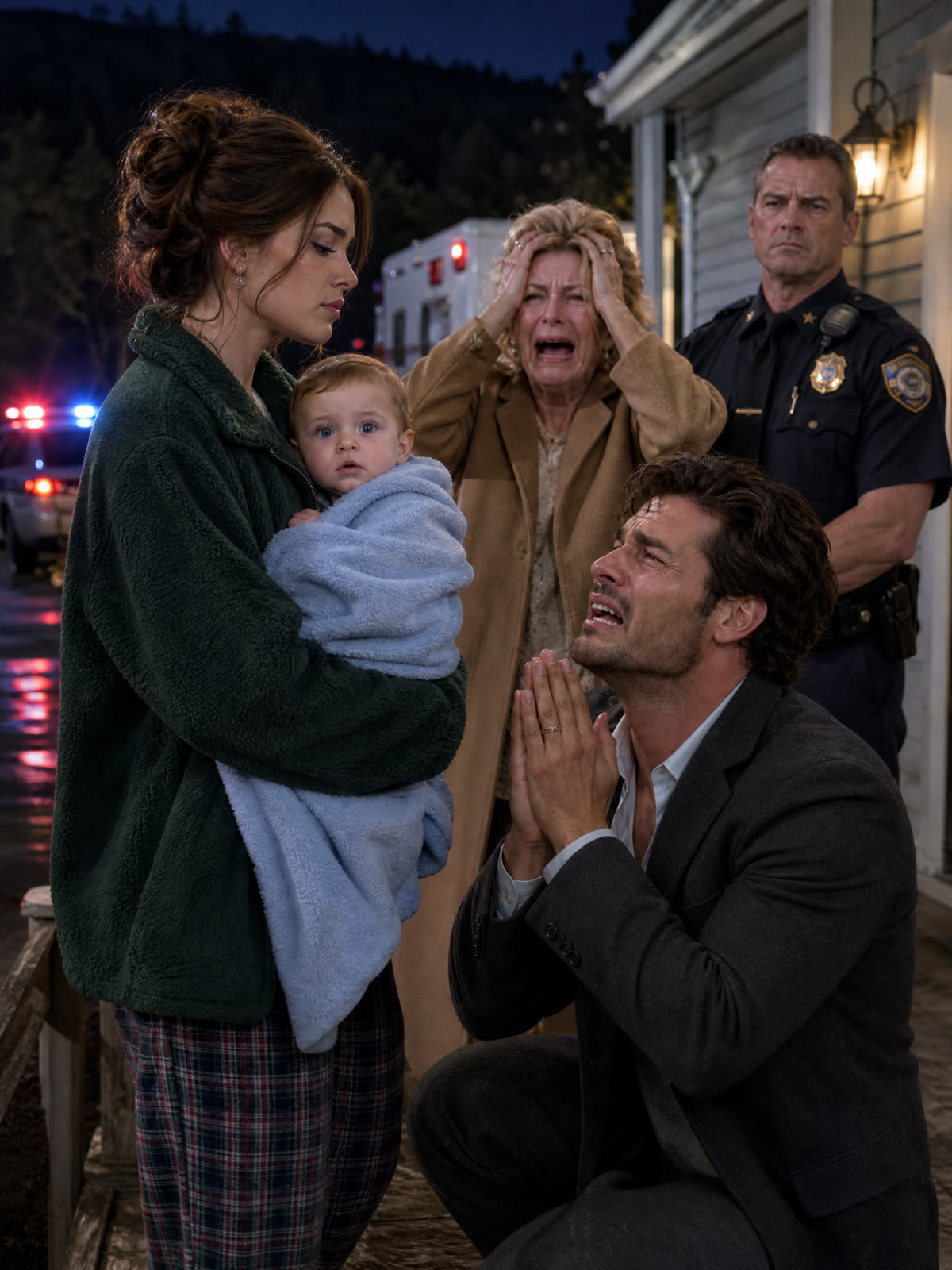
“Ma’am, please put the child down slowly and step outside with your hands where we can clearly see them!” It was close to midnight when three sheriff’s cruisers washed the yard of my late mother’s farmhouse in Woodstock, Vermont, with fierce red and blue light. I stood on the porch in a thick fleece jacket pulled over my flannel pajamas, my boots still crusted with mud. My ten-month-old son, Noah, slept against my chest, unaware of the officers, the flashing lights, or the accusation that had followed us there. What had always been my mother’s peaceful home suddenly felt surrounded.
“She kidnapped my grandson!” Patricia, my mother-in-law, cried, collapsing theatrically onto her knees before the deputies. “My poor daughter-in-law completely lost her mind after giving birth to that baby!” Graham emerged from behind her, his hair perfectly arranged and his expression carefully shaped into anguish. He had made the same drive from Burlington that I had, yet there was nothing disheveled about him. “Hannah, sweetheart, please listen to me,” he pleaded softly while extending his arms. “Just hand Noah over to me right now, because I know you are sick and nobody here is going to judge you.”
A senior deputy approached, studying me with unmistakable suspicion. “Your husband called dispatch and reported that you threatened him with a kitchen knife before fleeing the house with the baby, so we need to sort this out immediately.” For an instant, I wanted to scream. Instead, I steadied myself, tucked Noah’s fleece blanket more securely around him, and concentrated on keeping my voice even. “Did he really tell you that on the phone, and was his exact wording recorded by your dispatch center?” Graham’s performance faltered. His tears stopped for a moment, and the muscles along his jaw tightened.
Eight years earlier, I would have accepted anything Graham said without hesitation. I was a senior corporate accountant at a large logistics company, accustomed to examining other people’s financial records, yet I had trusted my husband without demanding the same proof. When we married, nearly all my savings and the proceeds of my mother’s life insurance had gone toward our colonial house in Burlington. Graham had supplied almost none of the down payment. Nevertheless, I wanted both our names on the deed. “What we are building together is going to last forever,” he had whispered when we signed the closing documents.
Patricia had seemed just as devoted. Whenever I caught a cold, she appeared with homemade chicken noodle soup. After Noah arrived, she visited almost every afternoon to care for him while I caught up on sleep. My own mother had been gone for several years, and Patricia’s assurances that I was like a daughter to her reached a place in me that was still painfully empty. I thought her affection had returned something I had lost. For a long time, I believed the family surrounding me was the safe, loving family I had always wanted. Then small things began refusing to fit.
One day Graham’s phone lit up on the kitchen counter, displaying a message from a woman named Heather: “I already put a hold on the downtown condo, so please do not let me down with the deposit tomorrow.” When I asked about it calmly, he described her as a difficult corporate client who needed temporary housing. A few days afterward, I discovered my passport and a certified copy of our property deed outside the locked drawer where I kept them. Neither discovery alone explained what was happening, but together they unsettled me. Things I had carefully put away were being handled without my knowledge.
A week before the deputies arrived, Patricia had urged me to take an afternoon off and enjoy a massage. The appointment was canceled, so I returned much sooner than expected. Graham, who should have been at work, was searching through my private filing cabinet. He shut the drawer hurriedly when he saw me. “I was just looking for an old tax receipt for my accountant,” he improvised quickly while slamming the drawer shut. That afternoon, I called an old family lawyer my mother had relied on for decades. Her advice was clear: collect reliable evidence quietly, and do not confront either of them without support.
Earlier that day, with Patricia watching Noah at our house, I had gone to a salon across town. While I was there, I checked the nursery through the baby monitor application on my phone and discovered that the camera had been unplugged. Patricia apparently assumed removing the cord would stop it completely. She did not know that the newer model I had bought the previous month contained a backup battery. Although the camera had lost its ordinary power supply, it could still capture sound and send the recordings directly to the cloud. I put in my earbuds and listened.
Graham’s voice came clearly through the nursery microphone as he spoke into his phone. “Heather, just relax and stop worrying, because we will sort out the money tomorrow morning, and right after that we will have Claudia committed to the hospital so we can keep the kid.” My hands shook so violently that my purse fell. I left the salon, drove home, and collected Noah quietly from his crib while Patricia was in the bathroom. After texting my lawyer our destination, I headed for my mother’s farmhouse. Standing beneath the patrol lights hours later, I finally understood why Graham and Patricia had pursued us.
I reached into my jacket pocket for the phone, intending to let the senior deputy hear the recording. Before I could play it, a white private ambulance turned into the driveway behind the patrol cars. Two men wearing dark-blue uniforms climbed out and opened the rear doors. They brought down a wheeled stretcher, and the sight of it made the purpose of Graham’s performance brutally clear. He gave a faint smile and pointed directly at me. “That is her right there, gentlemen, and we have the signed medical order to have her admitted to the facility tonight.”
“Whose order are you talking about?” I demanded loudly while keeping Noah against my shoulder. The senior deputy moved between the approaching stretcher and me. One of the paramedics raised a thick manila folder bearing the emblem of a private psychiatric clinic outside Montpelier. The paperwork included an evaluation carrying a psychiatrist’s signature, a manufactured account of supposedly violent incidents, and a request for involuntary transport signed by Graham. They had not merely followed me to the farmhouse hoping to frighten me into returning. They had arrived with documents intended to make taking me away appear legitimate.
“The family informed our dispatch that she poses an immediate physical danger to herself and the infant,” the paramedic explained while looking toward the deputies. The senior officer did not move aside. “That piece of paper does not authorize you to drag her out of here by force,” the senior deputy replied firmly, “because we are going to verify every single detail of this situation before anyone takes a step.” Patricia scrambled upright and gestured wildly toward Noah. “Just look at how tightly she is squeezing that poor baby, officer, she is completely out of her mind and you need to listen to her husband!”
Her performance brought me more sadness than fear. For months, I had thanked her for the fresh chamomile tea she made every evening when I could not sleep. I had even allowed Graham to accompany me to medical appointments because he said my exhaustion worried him. Once we were there, he answered nearly every question on my behalf. “You really need professional help, sweetheart,” he kept repeating to me every evening, “because you cannot properly take care of Noah if you are never getting any real sleep.” What had sounded like concern now belonged to the same terrible pattern as the papers beside the stretcher.
Neither of them knew I had stopped drinking the tea two weeks earlier. A strange, medicinal bitterness had begun lingering beneath its familiar flavor. Rather than tip the remaining tea into the sink, I had transferred a sample into a clean glass vial and taken it to an independent toxicology laboratory. The preliminary results identified a strong prescription sedative, a medication no doctor had prescribed to me. The nights they described as proof that I could not cope had another explanation. I had been trying to understand that explanation quietly while they continued telling me something was wrong with my mind.
I met the senior deputy’s eyes. “I already have a formal criminal complaint drafted by my attorney, along with laboratory proof that they have been drugging me without my knowledge or consent.” Graham responded with a strained laugh and a shake of his head, trying to turn my evidence into another symptom. “Do you see what I am dealing with here, officer, because that is her severe paranoia talking and she genuinely believes everyone around her is trying to poison her.” I did not argue with him. I unlocked my phone and held it where the deputy could examine the screen.
First, I brought up the urgent fraud notification from my bank concerning a home equity loan application for one hundred and sixty thousand dollars. Our house had been offered as security. The electronic signature supposedly belonging to me was forged, and I pointed that out before opening the cloud application. Then I raised the volume until the nursery audio carried across the yard. The same microphone that had captured Graham’s conversation had preserved Patricia’s voice, too. There was no need for me to imitate their words or explain what I thought they meant. The deputy could hear them for himself.
“Once she is heavily sedated tonight, we will forge the rest of the paperwork, and once the house is mortgaged, Hannah will walk away with absolutely nothing because if we hold onto Noah, she will agree to whatever we demand.” Patricia’s recorded voice sounded startlingly clear in the night air. Graham’s followed immediately, recognizable and unguarded. “Just tell Heather not to make a scene at the bank tomorrow, because as long as Hannah looks mentally unstable, we will buy ourselves plenty of time to clear the funds.” The men standing in front of me had heard something very different from the desperate family emergency they had been summoned to address.
The deputies exchanged a long look. The lead paramedic closed the folder slowly and retreated toward the ambulance. “Sir, we were told nothing about any of this when your family called our private transport line,” the paramedic told Graham coldly. Graham sprang toward me and reached for the phone, but the younger deputy intercepted him, blocking his arm before he could take it. Patricia pressed a hand to her chest and shouted that I had manufactured the recording with artificial intelligence. I let her shout while I continued opening the documents I had saved.
I showed the officers the laboratory results, messages from the questionable clinic coordinator, and my lawyer’s written confirmation that the bank had stopped unauthorized activity. “The loan has not been disbursed yet,” I clarified calmly, “and not a single dollar is going to be released until federal investigators examine those forged signatures.” Graham went pale. His mouth fell open, and for a moment he abandoned every claim that he was concerned only about his wife and son. “Wait a second, did you actually call the bank and block the wire transfer?” he asked, seemingly forgetting Noah altogether.
Before anyone answered, Patricia’s phone began vibrating inside her coat. The display glowed through the fabric, and the name Trevor appeared when she pulled it out. Graham’s older brother was calling. She tried desperately to silence the ringing, but her trembling fingers struck the answer button instead. As she struggled to push the phone back into her pocket, his voice burst through the speaker. “Mom!” a desperate male voice shouted through the speakerphone. “Please tell me Hannah’s loan money is ready for tomorrow morning, because I have to pay those guys ninety-five thousand dollars by noon or they are going to take my entire business and break my legs!”
I went completely still on the porch. Until that moment, I had believed the money was meant to purchase Graham’s new life with Heather. Their plan had been horrifying enough when I thought it involved an affair, a stolen home, and a fabricated psychiatric crisis. Now another member of the family was demanding his share of money taken in my name. Heather was not the only person who had been promised the savings and security I had spent years building. Patricia’s panic deepened as Trevor kept speaking, and she tried to smother the sound against her coat.
Then Trevor began asking what they had finally decided to do with Noah. My son lay against me while his grandmother fought to silence the answer. The money, the false medical documents, and Graham’s polished concern had already exposed the shape of their scheme. But Trevor’s voice was still coming through the speaker, and Patricia was suddenly more desperate to stop him than she had been to stop the recording. Whatever arrangement they had made for my baby, even she did not want the deputies to hear it.
PART 2 — What They Had Planned for My Son
“Do not say another single word right now!” Patricia shrieked into her jacket as her fingers searched for the side buttons. It was too late to retrieve what Trevor had already said. The deputy beside the porch instructed her not to erase the call log, then gently offered to let Noah and me wait in the warmth of a patrol cruiser. Before I could descend the steps, Trevor’s frightened voice rang out again. “What is going on over there, Mom, did they already lock Hannah up in that private clinic, because Graham promised me that once she was hospitalized, nobody would fight us over the house and we could just dump the kid with Aunt Brenda until the dust settles!”
Patricia finally pulled open the battery case and severed the call. A long silence settled over the yard. Graham stood motionless near the driveway, and for once neither he nor his mother seemed able to produce an explanation. The ambulance engine idled beneath the sounds of crickets in the woods. Against my neck, Noah breathed softly. The commotion had awakened him, and he looked up with wide, bewildered eyes. My arms were trembling, and he could not understand why. The family claiming to have come for his protection had just discussed leaving him elsewhere once I was locked away.
I looked directly at Patricia. “You stood right here five minutes ago claiming you drove up to rescue your beloved grandson,” I said quietly while looking directly at Patricia, “yet I just heard with my own ears that you were planning to dump him with an aunt so you could steal my house.” Her answer came sharp and defensive. “Trevor is completely desperate right now!” she snapped back defensively. “He is terrified out of his mind and he does not even know what he is saying!” She spoke as though his fear could somehow erase the details he had supplied.
The senior deputy interrupted before she could turn desperation into an excuse. “Then why do you not explain it to us, ma’am,” the senior deputy interjected sternly, “why your older son just called begging for money from a mortgage loan that this lady insists she never applied for?” I had known Trevor was struggling financially. His small auto repair and parts business in Rutland repeatedly needed short-term credit to keep inventory on hand. What I had not understood was the scale of the trouble behind those familiar requests for money, or how far the rest of his family had decided to go to rescue him.
For almost a year, Trevor had secretly been losing substantial sums at illegal underground poker games. His repair shop had gone first, followed by his heavy-duty tow truck. Eventually, he signed high-interest promises to repay violent lenders who began appearing at his home. Graham had agreed to save his brother from the disaster. Patricia could not bear the possibility that her favored son might face the consequences of his own recklessness. Instead of accepting those consequences, she settled on someone else’s property as the solution. The house purchased with my savings and my mother’s insurance money became their intended escape.
I turned toward Graham. “One hundred and sixty thousand dollars,” I stated aloud while looking straight at my husband. “Ninety-five thousand dollars to pay off Trevor’s gambling debts, fifty thousand dollars for Heather’s new downtown condo, and the remaining fifteen thousand for closing fees and kickbacks, am I wrong about a single cent?” His head jerked up. “How on earth do you know the exact breakdown of those numbers?” For a man who had spent the night presenting me as confused and incapable, he looked astonished that I had followed the money accurately enough to name every portion.
“Because I also know that you promised a crooked loan officer a hefty cash commission if he pushed the paperwork through with a forged signature,” I replied evenly, “and because I am a certified corporate accountant, Graham, which means I have spent the last eight years auditing spreadsheets and wire transfers for a living, so I was certainly not going to stop paying attention when it involved my own home.” My work had taught me to examine patterns rather than accept reassuring explanations. Once Heather’s message gave me a reason to look, their financial activity left plenty for me to examine.
I had quietly gathered our joint account statements instead of confronting Graham and giving him time to conceal anything. Small payments had been leaving our accounts repeatedly and arriving in Patricia’s personal checking account. Almost immediately afterward, matching amounts were withdrawn as cash. I printed and preserved every receipt I could obtain. Several days later, a crumpled hotel receipt in Graham’s gym bag supplied another piece of the picture. Beside it was a printed photograph of him embracing a blonde woman in a fitted red dress. The explanations he had offered about a demanding corporate client no longer deserved any consideration.
I contacted the bank’s corporate security department directly. Its fraud team confirmed that a home equity application was moving through underwriting through an outside broker, but final biometric verification and my in-person consent were still required before money could be released. I told them I had neither approved the loan nor signed the papers. They froze the application immediately, and my lawyer kept their written confirmation while preparing allegations of identity theft, wire fraud, and forgery. “So there was never actually a hundred and sixty thousand dollars sitting ready to clear tomorrow morning,” Graham muttered under his breath, his expression twisting with rage. “There was never a single dollar that you could have stolen from me,” I answered coldly, “although you certainly left behind a paper trail of fraudulent applications, text messages, and forged signatures that you are going to have to explain to a state prosecutor.”
Patricia changed her approach. Her posture softened, and she edged toward me beside the patrol car. “Hannah, my sweet girl, please just listen to me for one second, because Trevor did something terribly foolish and a mother naturally panics when she sees her children in mortal danger, and since you are a mother too, you should understand why I did it.” For a moment, I remembered her holding Noah at the hospital, embracing me when I missed my mother, and telling me over Sunday dinners how fortunate I was to belong to her family. “Understand you?” I asked, my voice trembling with disgust. “How on earth do you expect me to understand a woman who plotted to lock me in a psychiatric ward and take my baby away from me?”
The cloud recording contained more than the pieces I had already played. Patricia had been speaking freely to Heather over speakerphone while Noah slept only a few feet away. “Graham never actually wanted to stay married to Hannah,” Patricia had laughed cruelly on that tape, “it was just convenient for us that she bought that big house with her mother’s life insurance money, so once the loan papers are signed, we will kick her out and leave the boy somewhere he will not get in your way.” Hearing that had stripped away the last comforting possibility that some part of her affection for me had been genuine.
She had continued mocking me on the same recording. “Do you remember that engagement ring I gave Graham to put on her finger at their wedding, well she still thinks it is a real family heirloom diamond, when it is actually cheap cubic zirconia because I saved the real diamond for a woman who truly deserves to carry our family name.” Tears spilled down my cheeks. It was not the price of the stone that wounded me. For eight years, I had treasured that ring without taking it off, sometimes kissing it before sleep because I believed it represented the unconditional maternal love I had lost. “Do not ever call me your daughter again,” I whispered fiercely.
Graham moved closer and reached for my shoulder. I pulled away before he touched me. “Hannah, I swear to God I knew nothing about that ring,” he pleaded desperately. “My mom went way too far with that, I promise you, because all I wanted to do was help Trevor stay alive!” His attempt to separate himself from one cruelty did not erase the rest. “And what about Heather?” I shot back immediately. “Was buying a fifty-thousand-dollar condo for your mistress also just a way to help your brother?” Then I made sure the deputies could hear my next questions. “And what about the sleeping pills you were slipping into my tea every night?” I added loudly so the deputies could hear every word. “Was drugging your wife part of your noble rescue mission too?”
The senior deputy returned to the ambulance and asked to examine the complete transport file. A typed evaluation attributed to Dr. Arthur Pendelton claimed that I had severe postpartum psychosis. Graham’s consent form accompanied it, but nothing documented an actual examination. The paramedics soon acknowledged that the family’s urgent telephone call had been the sole basis for their dispatch. They also confirmed that they lacked lawful authority to take me against my will. “This medical transfer is officially canceled,” the deputy told them firmly, “and I need both of you to remain right here to give us your statements and tell us exactly who booked this service.”
I explained to the deputies how the tea had first raised my suspicions. For weeks, I had awakened beneath an unnatural heaviness, as though my thoughts were struggling through a dense fog. Twice, I slept through the loud alarm on my phone, something that had never happened during my adult life. Graham and Patricia kept offering the herbal tea as a remedy for the exhaustion they repeatedly described. I had been grateful for what I thought was help, even while I felt less capable of understanding why mornings had become so difficult. The lingering chemical bitterness finally made me question the drink itself.
I had transferred the remaining liquid into a sterile container and paid an independent laboratory for a full toxicology panel. The result identified zolpidem, a strong prescription sleep medication that had never been prescribed to me. I told the deputy plainly that a private laboratory result could not establish who had put it in the mug. That was why I had kept the original glass thermos, preserved Graham’s messages asking his mother whether she had fully dissolved the pills in my tea, and backed up the nursery audio in which he boasted about keeping me sedated. Each piece mattered alongside the others.
“We are going to bag all of this physical evidence immediately and submit it to the state crime lab for official forensic verification,” the deputy assured me. His words did not undo what had happened, but they meant the evidence would no longer depend only on my ability to keep it safe. The tea sample, the container, the messages, and the original recordings could be examined through an official investigation. Graham could call me paranoid as often as he wanted. Patricia could accuse me of manufacturing voices. There were now materials for investigators to test and records for them to trace.
Then Graham’s phone began vibrating insistently in his slacks pocket. He took it out to stop the ringing, exposing Heather’s name on the display. He hurriedly declined the call, but another notification appeared only seconds later. The lock-screen message was visible directly in front of the deputy. “If you do not wire me that deposit money by tomorrow morning, I am going straight to the police and telling them everything about the fake doctor and the sleeping pills you bought,” the message read. Graham had spent the night insisting that I needed psychiatric treatment. Now the woman waiting for his stolen money was threatening to expose how he had arranged it.
PART 3 — The Truth They Could Not Take Back
Heather was not an unsuspecting woman who had simply believed a married man’s charm. Her message made it plain that she knew about the false doctor and the sleeping medication. She understood that Graham intended to take equity from my house, and she had participated in the scheme. Yet even she had not been given the complete picture. He had promised her fifty thousand dollars for their new beginning while secretly reserving almost twice that amount for Trevor’s gambling debts. They had each been waiting for money attached to my name, my home, and a signature I had never supplied. “Did you honestly believe you could build a happy new family on top of the ruins of ours?” I asked him quietly.
The last of Graham’s courteous concern disappeared. “Oh, stop acting like you are some kind of saint, Hannah!” Graham spat back, his polite mask finally shattering completely. “You were always subtly reminding me that you paid for the house, and you made me feel like a pathetic freeloader under my own roof!” I kept my voice steady. “I never once held that house over your head,” I replied steadily. “I put your name on that deed because I loved you with my whole heart, so do not ever twist my trust into some kind of debt that I owed you.” The decision I had made out of love was not permission for him to destroy the life it had helped build.
Patricia began screaming that I was ruining her entire family. “Your family destroyed itself the very second you decided to use my innocent baby boy as a pawn to force me to sign away my home,” I told her calmly. The deputies moved between us and guided her and Graham toward their SUV. The senior deputy gave me his business card and offered an escort to the county courthouse in the morning so I could seek an emergency restraining order. He also told Graham that he had to report to the sheriff’s station for formal questioning and must not interfere with the investigation. Even then, Graham made one last sudden rush toward me, reaching for my wrist and the phone.
The younger deputy caught him immediately, twisted his arm behind his back, and held him against the cruiser’s hood. His body camera recorded the assault. No judge appeared in that muddy driveway to announce a verdict, and the evidence did not become a completed criminal case simply because the officers had heard it. What happened was more basic, and for me more important: my account was finally being recorded officially. Physical evidence supported it. People who were not under Graham’s influence were listening. He could no longer decide which version of me everyone else would be permitted to see.
At daybreak, I entered the County Prosecutor’s Office beside my family attorney. Noah remained at the farmhouse for a few hours with Mrs. Gable, the elderly neighbor who had watched over my mother’s property since her death. In a conference room, I submitted the original cloud recordings, the certified toxicology report, the bank’s fraud documentation, and the saved collection of Graham’s incriminating messages. I formally requested emergency protection for Noah and me. I wanted more than a promise that they would leave us alone. After what had happened, I needed the request, the evidence, and the reasons for it placed where they could not simply be talked away.
Leaving that building, I understood that the fight was no longer mine to carry alone in the dark. My lawyer promptly sought an emergency freeze on marital assets, protection for my equity in the Burlington house, and the beginning of contested divorce proceedings. During the weeks that followed, I gradually resumed my accounting work remotely from Woodstock. A trusted coworker covered meetings that required an office presence whenever court hearings kept me away. Mrs. Gable cared for Noah when I needed to speak with investigators. Those arrangements allowed me to keep doing the ordinary work of supporting my child while the extraordinary damage to our lives was examined.
The state crime laboratory’s findings eventually corroborated the evidence I had provided. Graham and the dishonest mortgage broker were formally indicted for attempted bank fraud, identity theft, and forgery of legal documents. The confirmed administration of prescription sedatives without my consent generated a separate felony case involving both Graham and Patricia. Hoping to avoid a lengthy prison term, Heather agreed to testify for the state and surrendered her complete phone history. Those records exposed more of the conspiracy. Dr. Arthur Pendelton, whose signature appeared on the fraudulent commitment paperwork, also came under investigation by the state medical board and federal prosecutors. The people who had expected my supposed instability to protect them now had their own actions to explain.
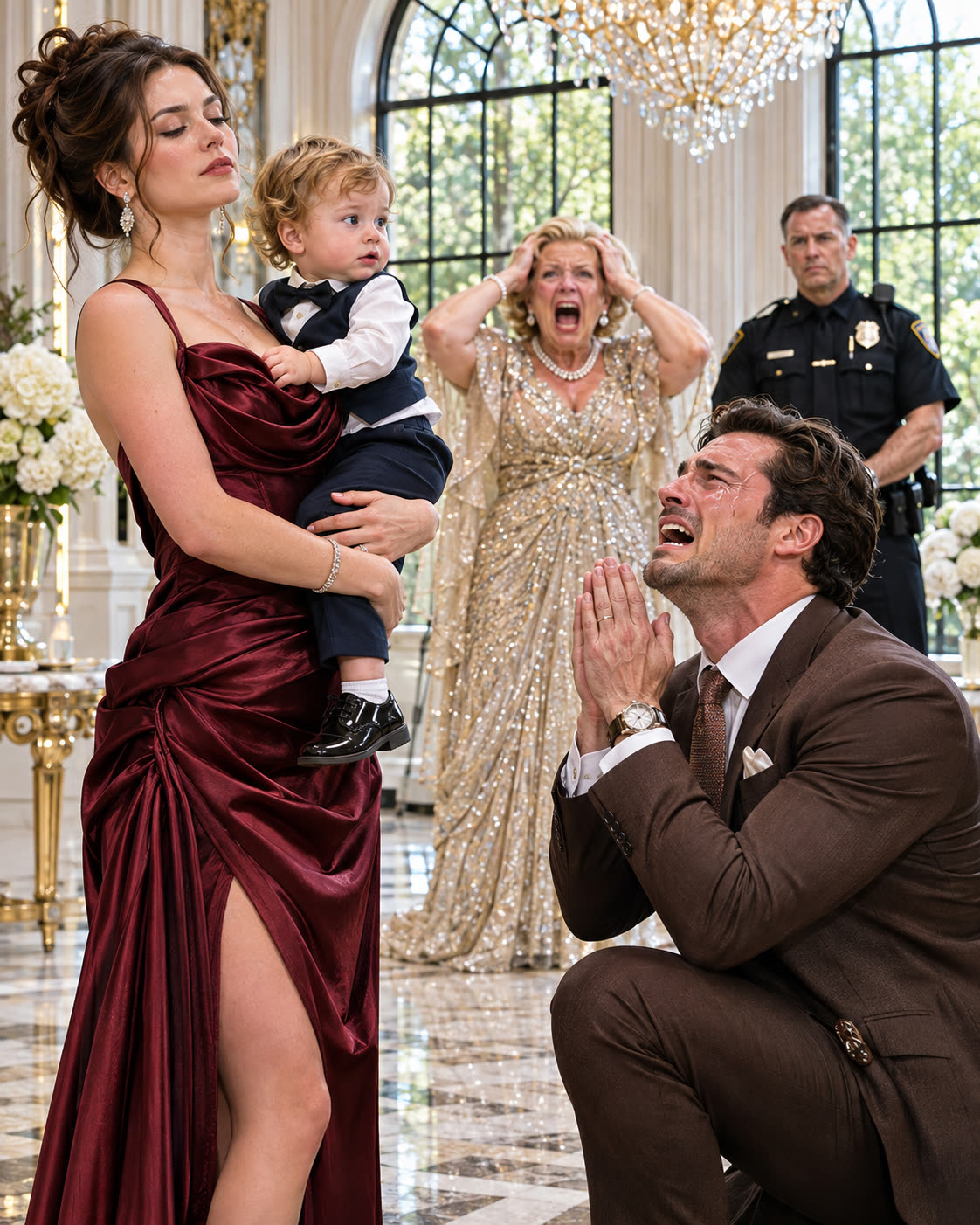
One clear autumn afternoon, I came out of the Woodstock grocery store carrying a bag of apples. Graham stepped from behind a parked pickup and asked for a minute of my time. “You have no idea how truly sorry I am for everything, Hannah,” he said softly while staring down at his shoes. “I lost my job at the firm, Heather packed her bags and left me, my mother’s health is failing, and I just cannot bear the thought of Noah growing up hating his own father.” He sounded like the man I remembered, the man who had once made promises about a life we were supposed to share.
For an instant, the familiar warmth in his voice hurt more than shouting would have. Eight years of memories did not disappear merely because I finally understood the lies beneath them. I could recognize what I had once loved without pretending that the evidence had ceased to exist. “Noah does not have to grow up hating you, Graham,” I replied calmly while holding onto my grocery bag. “However, I refuse to teach my son that loving someone means letting them destroy your life.” Graham finally raised his eyes. “So does that mean you can never forgive me?” he asked, finally lifting his eyes to meet mine.
I studied him without answering immediately. He had not asked whether Noah was well. He had not asked if I could sleep through a night peacefully, whether I was still frightened, or whether I had managed to keep our home. His concern remained fixed on what his choices had cost him and whether I might make those consequences disappear. The old voice and the lowered eyes did not change the questions he had failed to ask. “Forgiveness does not erase forensic evidence, and it certainly does not restore broken trust,” I told him firmly, “so I am never going to lie to the court just to save you from what you chose to do.”
In the months afterward, the family court made binding decisions about custody and the division of our property. Nothing in those orders could return the eight years I had spent trusting a marriage that had become a lie. But the fraudulent mortgage application was permanently invalidated, and my documented inheritance supported the restoration of sole ownership of the Burlington house. Strictly supervised visitation requirements put Noah’s safety first. The separate felony prosecutions continued through the state courts. They did not stop because Graham regretted losing his job or because he could still speak in the familiar tone that once would have made me question my own judgment.
The last time I saw Patricia was outside the courthouse after a pretrial hearing. In only a few months, she seemed to have aged by twenty years. She stared at me for a long time without speaking, almost as though she expected the old bond to reassert itself and make me call her Mom again. I remembered too clearly what that word had meant to me when I believed she loved me. “I only wanted to save my children,” she whispered hoarsely as I walked past her. “And in order to save them, you were completely willing to leave my innocent son without his mother,” I answered without stopping my stride.
That afternoon, I returned to my mother’s quiet farmhouse in Woodstock. Fresh coffee scented the kitchen, mingling with the sweet cinnamon apples Mrs. Gable had brought from a local orchard. After so many meetings, documents, and courthouse corridors, the familiar rooms offered something the arguments never could. Noah had begun pulling himself upright and moving along the living room furniture. When he saw me come through the door, he gave a delighted cry. I set my keys on the table, lowered myself onto the braided rug, and opened my arms. He was looking at me with nothing of the confusion he had worn beneath the flashing patrol lights.
He wobbled toward me and managed two awkward, determined steps before falling happily against my chest. His laughter grew louder when I caught him. That was when I finally allowed myself to cry freely. The tears came while I held him, not because I needed anyone to understand my account or because another piece of evidence had been questioned. I was grieving the woman I had been, the woman who believed that staying silent could preserve peace and that giving more of herself would somehow guarantee love. At the same time, I was overwhelmed with gratitude that my son could still come into my arms without fear.
The hurt surrounding the ring had never really concerned a diamond. Nor had the deepest loss been limited to the figures on a bank application, though the money represented years of work and the final gift my mother had left me. I had mourned what those things were supposed to mean: a marriage built on trust, a home we were building together, and a mother’s love offered to a daughter who badly missed her own. Learning what Patricia had said forced me to grieve those meanings. Holding Noah reminded me that their dishonesty had not made every loving thing in my life a lie.
That night on the porch had shown me that some of the cruelest betrayals do not arrive from unfamiliar people waiting in dark corners. Sometimes they arrive through hands that bring you tea, through the person who places a warm blanket over your shoulders, or through a voice that insists it knows what is best for you. I had accepted those gestures as evidence of care because I wanted them to be genuine. The recordings and laboratory reports revealed what had been concealed beneath them. Their familiar faces had made the betrayal harder to recognize, not less dangerous once I finally recognized it.
If Noah ever asks why I carried him away from our home in the middle of the night, I will tell him the truth. I will not tell him that his mother fled because she was weak or incapable. I will explain that I left because I finally understood that love should never require a person to surrender her freedom. The home, the money, and the court orders mattered, but so did that truth. I wanted my son to grow up knowing that loving someone does not mean accepting whatever harm they choose to inflict, even when they insist that the harm is for your own good.
For that afternoon, I could sit on my mother’s braided rug with Noah against me and hear his laughter in a house that had once been surrounded by sirens. He had taken two steps into my arms, and I had caught him. Yet beyond that quiet room, the criminal cases against Graham and Patricia were still moving forward, and their apologies had not answered the evidence. I had found the strength to leave. What they would finally have to answer for was still waiting in the courts.
Disclaimer: This story is a work of fiction inspired by real-life themes. Names, characters, places and events are fictionalized, and any resemblance to real persons is purely coincidental. It does not represent any person or organization and does not encourage inappropriate behavior. Images are for illustration purposes only.
