


PART 1: THE WIFE THEY BELIEVED HAD NO CHANCE
My father-in-law burst into laughter the moment I entered divorce court without a lawyer.
My mother-in-law quickly joined him, while my husband of seven years leaned comfortably against his chair, smiling as though the outcome had already been decided.
They were convinced I had walked into a battle I couldn’t possibly win.
What none of them knew was that before becoming Amelia Hale, the quiet wife who arranged family gatherings and remembered every birthday, I had been Captain Amelia Carter, a military attorney in the United States Army Judge Advocate General’s Corps.
I had questioned hostile witnesses, argued contested cases, and stood before military judges when people’s careers and futures depended on the evidence.
And the three expensive attorneys sitting beside my husband were about to learn something his family had never understood.
Being quiet did not mean being helpless.
The courtroom felt unusually cold that morning. Sunlight streamed through its tall windows, illuminating the polished benches and dark marble flooring.
I approached the table assigned to me and set down my aging leather briefcase.
There were no assistants carrying documents, no junior attorneys preparing exhibits, and no legal team offering last-minute advice.
Only me, a yellow notepad, and a glass of water.
Across the aisle, Preston Hale sat in the charcoal-gray suit I had helped him select. Beside him was Martin Voss, an established family-law attorney, accompanied by two colleagues.
Their table was crowded with laptops, thick binders, and meticulously arranged legal documents.
Mine looked almost empty.
A quiet laugh came from behind me.
Vivian Hale, my mother-in-law, lifted her manicured hand toward her mouth. Her diamond bracelet caught the light as she leaned toward Howard, Preston’s father.
“She actually came alone,” he whispered.
Vivian shook her head.
“Poor thing.
She never did understand how the real world works.”
I continued looking toward the judge’s bench.

Their remarks were deliberately loud enough for me to hear.
What they didn’t understand was that I had spent years maintaining my composure while people attempted to intimidate me. Compared with the pressure of military legal proceedings, their mockery was hardly unfamiliar.
Judge Rebecca Morrison entered shortly afterward.
Everyone stood.
Once seated, she reviewed the case documents before addressing me.
“Mrs. Hale, I understand you’re appearing without counsel today.”
“Yes, Your Honor.”
“Do you understand that you have the right to retain an attorney?”
“I do.”
“And you’re choosing to represent yourself?”
“Yes, Your Honor.”
Martin Voss stood, adjusting his jacket.
“Your Honor, before we proceed, the petitioner would like to express concern about Mrs. Hale’s decision to appear without legal representation.”
The judge turned toward him.
“On what grounds, Mr. Voss?”
“This matter involves financial issues that may be difficult for a layperson to navigate.
We simply want to ensure that the proceedings remain efficient.”
Layperson.
I quietly wrote the word in my notebook.
Not because it offended me, but because it revealed how little he had bothered to learn about his opponent.
Judge Morrison looked at me again.
“Mrs. Hale, are you prepared to proceed?”
“Completely, Your Honor.”
Martin smiled faintly.
“After all, Your Honor, this is a relatively straightforward matter.”
Straightforward.
That was how Preston described ending our marriage, taking the house, keeping his company, and dismissing seven years of my contributions.
According to his family, he had earned everything while I had merely enjoyed the benefits.
But three weeks earlier, when that version of our marriage first appeared in writing, I had discovered something they had overlooked.
It happened on a Tuesday morning.
I had just prepared Preston’s usual breakfast of scrambled eggs, toast, and black coffee when he entered our kitchen carrying a cream-colored envelope.
He placed it beside my plate.
“What’s this?”
I asked.
“Something we need to deal with.”
He sat opposite me while I opened it.
The first page read:
PETITION FOR DISSOLUTION OF MARRIAGE.
My stomach tightened.
“Preston?”
Instead of answering, he glanced at his phone.
“Look, Amelia, I don’t want this to turn into a big emotional thing.”
I couldn’t believe what I was hearing.
“You’re divorcing me over breakfast, and you don’t want it to become emotional?”
He sighed.
“We’ve both known things haven’t been working.”
“No,” I said quietly.
“You’ve known something.
Apparently, I was the last person you intended to tell.”
He pushed his coffee away.
“I’ve thought about this carefully.”
I examined the proposed settlement.
Preston wanted our house, complete ownership of Hale Advisory, and recognition that I had made no meaningful financial contribution to either asset.
In exchange, he offered me eighteen thousand dollars.
Seven years of marriage.
Seven years of supporting his ambitions.
And he believed eighteen thousand dollars was enough to make me disappear.
I turned another page.
“You want me to leave the house?”
“Eventually.”
“And you want me to sign away any claim to the company?”
“Amelia, you never worked for the company.”
I stared at him.
“Are you serious?”
“You helped with things occasionally.”
“Occasionally?”
He leaned backward.
“Don’t make this more complicated than it is.”
I felt an ache spreading through my chest.
“So I didn’t contribute anything at all?”
He shrugged.
“You took care of the house.”
“I took care of everything.”
His face hardened.
“And I’m not denying that.
But we need to be realistic about what those things are worth.”
I remembered the nights I had stayed awake helping him prepare business proposals, the money I had contributed when his company was struggling to begin, and the countless weekends spent organizing client events.
Now he was treating those years as though they had almost no value.
“Who prepared these documents?”
I asked.
“Martin Voss.”
“Did you review the financial statements yourself?”
“Of course.”
“Every page?”
He looked irritated.
“Amelia, Martin knows what he’s doing.”
I nodded.
Preston had already decided what our marriage was worth, and he expected me to accept his calculation without questioning it.
He tapped the agreement.
“Sign it, Amelia.
We can both move on.”
I closed the folder.
“No.”
His expression shifted.
“No?”
“I’m not signing this.”
He laughed with obvious irritation.
“You’re making a mistake.”
“Then it’s mine to make.”
He stood.
“My parents warned me you’d get emotional.”
I looked up.
“Your parents know?”
“They helped me think through things.”
Of course they had.
Vivian and Howard had always treated me as someone fortunate to have married into their family.
They liked that I organized dinners, maintained the household, and made Preston’s life convenient.
But they never considered those contributions important.
Now they were helping him erase them.
Preston picked up his phone.
“The attorneys will handle everything from here.”
At the doorway, he stopped.
“And Amelia?
Don’t make this ugly.
You can’t afford the kind of fight you’re trying to start.”
Then he left.
I sat motionless until his coffee turned cold.
I wanted to cry. I wanted to demand an explanation. I wanted to understand when the man I loved had begun regarding me as an inconvenience.
But eventually, I reopened the paperwork.
This time, I read it as an attorney rather than a devastated wife.
One statement appeared repeatedly:
Mrs. Hale made no substantial financial contribution to the acquisition or growth of the marital assets.
I studied the financial exhibits attached to that claim.
And suddenly, my attention stopped on one particular transaction.
The figure was sixty-two thousand dollars.
Beside it was an abbreviated name.
A. Carter.
My maiden name.
The transfer originated from the savings account I had maintained before marrying Preston.
And somehow, the very attorneys claiming I had contributed nothing had included proof of my contribution in their own evidence.
I checked the amount, the date, and the originating account.
Everything matched.
Back in the courtroom, Judge Morrison adjusted her glasses.
“Mrs. Hale, you may begin.”
I opened my briefcase and removed a thin dark-blue folder.
Across the aisle, Martin Voss watched with a confident smile.
Howard was still amused.
I stood.
“Thank you, Your Honor.”
Then I turned toward the judge, ready to reveal the document that could dismantle the financial argument Preston had built against me.
But before I presented it, I remembered exactly how those sixty-two thousand dollars had changed our lives—and how easily my husband had pretended they never existed.
PART 2: THE EVIDENCE THEY NEVER EXPECTED ME TO FIND
Seven years earlier, I had left active military service hoping to build a quieter future.
My work as an Army attorney had involved demanding cases, witness preparation, difficult examinations, and legal decisions with serious consequences.
I understood the importance of accurate records and careful preparation.
But I wanted a peaceful home and a marriage where I didn’t always have to be Captain Carter.
When I met Preston, he appeared to offer that possibility.
He was ambitious, charming, and determined to establish his own consulting company.
During an early dinner, I mentioned my military legal career.
“Military law?” he asked.
“Yes.”
“So you handled paperwork and disciplinary hearings?”
“Among other things.”
He smiled.
“That explains why you’re so organized.”
I didn’t correct his limited understanding.
I wasn’t trying to impress him with my professional background.
I wanted him to love Amelia.
Unfortunately, his assumptions gradually became the version of me his entire family accepted.
When his parents asked about my previous work, Preston described it as military administration.
I corrected him once.
“I was an attorney.”
Vivian dismissed the clarification.
“Well, government work can be so complicated.
I’m sure you’re enjoying something quieter now.”
I allowed the conversation to end.
At the time, it seemed harmless.
I didn’t realize how thoroughly they would eventually mistake my silence for ignorance.
When Preston launched Hale Advisory, we were newly married.
He had promising ideas but insufficient capital.
One evening, he sat beside me studying a spreadsheet.
“The office lease is going to eat through everything,” he said.
“How much are you short?”
He hesitated.
“More than I’m comfortable admitting.”
We reviewed the projected expenses together: office equipment, insurance, professional services, operating costs, and the reserves required before accepting clients.
After checking the numbers, I suggested using my savings.
He looked surprised.
“Amelia, that’s your money.”
“We’re married.”
“I don’t want you risking everything on me.”
“Then don’t waste it.”
He laughed and kissed my forehead.
“I won’t.”
Several days later, I transferred sixty-two thousand dollars from my premarital savings account into the account used to establish Hale Advisory.
The originating account still carried my maiden name.
Amelia Carter.
Preston promised we were building a future together.
I believed him.
I never demanded a company title or public recognition. I didn’t insist that his parents acknowledge my financial contribution.
I simply wanted our marriage to succeed.
As his company grew, I handled the household, organized client dinners, reviewed presentations, coordinated vendors, and helped arrange professional events.
None of those responsibilities came with a salary.
But they required time and effort, allowing Preston to concentrate on expanding his business.
When he secured his first major client, we celebrated in our kitchen with takeout and inexpensive sparkling wine.
He embraced me.
“We did it,” he whispered.
I never forgot those words.
We did it.
But as Hale Advisory became successful, Preston’s language changed.
He began saying, “I built this.”
At family gatherings, Howard praised his son’s independence.
Vivian told friends that Preston’s success came entirely from his determination.
One Thanksgiving, Howard raised his glass.
“To Preston,” he announced.
“A man who made himself successful without depending on anyone.”
Everyone applauded.
Preston accepted the praise without acknowledging me.
Later, I questioned him privately.
“Of course I remember.”
“Your father said you did it without anyone’s help.”
“Amelia, he was making a toast.”
“I know.”
“Then don’t turn it into something.”
Eventually, I stopped asking for recognition.
When we purchased our home, I contributed additional premarital savings toward the down payment.
The deed was placed in Preston’s name because he said it would simplify financing arrangements.
I trusted him.
I never imagined I would need to prove my contribution to our shared home.
Yet I continued keeping financial records.
Bank statements, receipts, transfer confirmations, correspondence, and documents relating to our property.
My military training had taught me that memories could be disputed, but dated records were harder to dismiss.
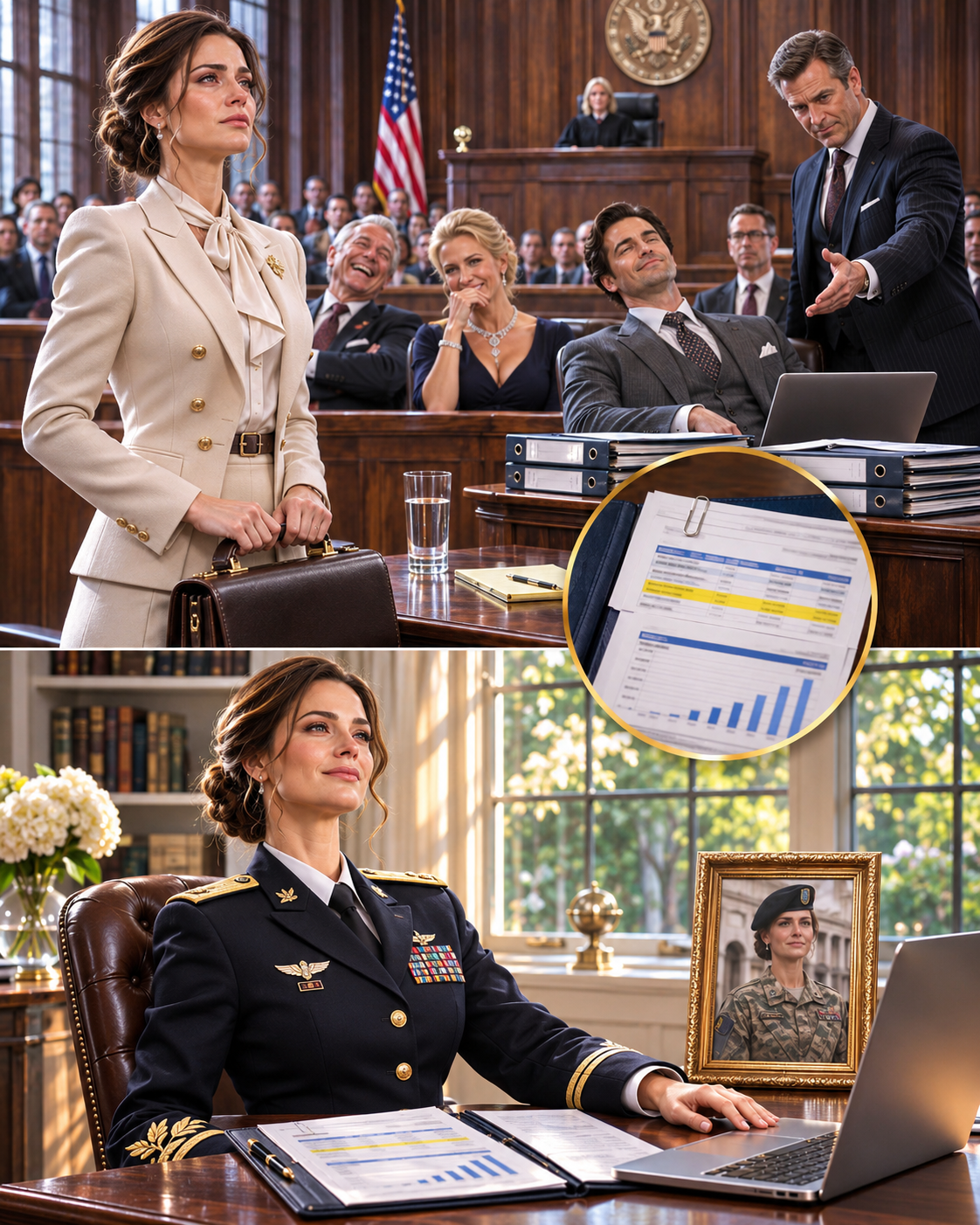
Those files became essential when Preston served me with divorce papers.
His financial declaration claimed the company had been established through his personal resources.
His proposed settlement asserted that I had provided no substantial capital.
And his attorneys portrayed me as someone who had benefited from his success without contributing to it.
Their own Exhibit Six contradicted that account.
It contained the original business capitalization summary and supporting transfer confirmation.
The sixty-two-thousand-dollar payment was plainly recorded.
And the originating account belonged to me.
Two days after receiving the divorce papers, Vivian called.
“Amelia, I hope you’re going to handle this sensibly.”
I stood in the kitchen.
“What would sensible look like to you?”
“Accepting the agreement without forcing everyone through an unpleasant legal process.”
“Have you actually read the agreement?”
“Preston has excellent attorneys.”
“That wasn’t my question.”
She sighed.
“Don’t be difficult.
You’re being offered money to help you get started.
Many women would be grateful.”
“Would you be grateful if someone offered you eighteen thousand dollars to walk away from seven years of marriage?”
Her tone sharpened.
“Howard and I worked very hard to give Preston every opportunity.
He has worked extremely hard to build his company.”
“So have I.”
She laughed.
“Oh, Amelia.
Hosting dinner parties isn’t the same as building a business.”
Her dismissal hurt because I had performed those responsibilities willingly, believing they mattered.
Now she treated them as evidence of my worthlessness.
“I won’t discuss the settlement with you,” I said.
“Then prepare yourself for court.”
“I am.”
She paused.
“You really should hire a lawyer.”
“Thank you for the advice.”
“Martin Voss is very experienced.
Preston will have the best representation available.”
“I’m sure he will.”
Vivian lowered her voice.
“Don’t embarrass yourself trying to fight something you don’t understand.”
After hanging up, I began preparing.
I knew military law and civilian family law weren’t identical, so I carefully reviewed the applicable procedures.
The upcoming hearing would not finalize our divorce.
It concerned temporary financial arrangements, preservation of assets, and Preston’s request for exclusive possession of the house.
If his position succeeded, I could lose access to our home while facing substantial financial pressure.
That was the advantage his attorneys wanted.
Over the following days, I reconstructed our financial history using documents rather than recollections.
I located statements proving my savings existed before marriage, the original sixty-two-thousand-dollar transfer, and records of my contribution toward the house.
I also gathered correspondence and receipts showing the administrative and household responsibilities I had performed.
I wasn’t claiming that I had done Preston’s consulting work or that every company dollar belonged to me.
My argument was simpler.
His assertion that I had contributed nothing was false.
Five days after handing me the divorce papers, Preston found me reviewing documents.
“What are you doing?”
“Preparing my response.”
He frowned.
“You’re seriously going to represent yourself?”
“Yes.”
He laughed.
“Amelia, this isn’t a disagreement about the grocery budget.”
“I understand that.”
“Martin has handled cases like this for decades.”
“Then he should understand the documents he’s filing.”
Preston stared.
“What does that mean?”
“It means I’m reading them.”
His expression briefly changed.
Then he shrugged.
“You’re wasting your time.”
He walked toward the refrigerator.
“My father says people who represent themselves usually make everything worse.”
“Your father isn’t the judge.”
He stopped.
“What’s gotten into you?”
I closed my folder.
“Nothing new, Preston.
You’re just hearing me this time.”
His face hardened.
“Don’t expect me to go easy on you because we were married.”
I felt the familiar ache return.
“We still are married.”
He looked away.
“Not for much longer.”
After he left, I sat alone, wishing he would remember the woman who had supported him when his company existed only on a spreadsheet.
But I understood that grieving my marriage did not require surrendering my rights.
I filed my response, disputed his financial claims, opposed his request to remove me from the house, and asked the court to preserve the marital assets.
Martin Voss later sent another settlement proposal.
The amount and conditions remained essentially unchanged.
I rejected it.
Preston called.
“Martin says you’re refusing the settlement.”
“That’s correct.”
“Why?”
“Because it’s unfair.”
“That’s not a legal argument.”
“No. It’s my reason for not signing.”
He sighed.
“You’re going to lose, Amelia.”
“Then the court will decide that.”
“You don’t understand how humiliating this is going to be.”
I looked at our wedding photograph.
“Preston,” I said quietly, “you should be more worried about whether your statements are accurate than whether I feel humiliated.”
After a pause, he answered coldly.
“See you in court.”
That evening, I examined Exhibit Six again.
The transfer confirmation wasn’t merely buried among unrelated documents.
Preston’s attorneys had attached it directly to an exhibit supporting their own argument.
I prepared a folder labeled FOUNDATION and placed the relevant records inside.
On hearing day, I wore my navy-blue suit, tied my hair back, and checked my briefcase.
Preston saw me leaving.
“That’s what you’re wearing?”
“Yes.”
“Still no lawyer?”
“No.”
He shook his head.
“You’re really determined to make a fool of yourself.”
I picked up my keys.
“Goodbye, Preston.”
At the courthouse, Howard noticed me sitting alone.
“Maybe this will finally teach her some sense.”
Then the hearing began.
Standing before Judge Morrison, I opened my folder and delivered the sentence that made Preston stop smiling.
“Your Honor, the first sixty-two thousand dollars of my husband’s business came from my military savings account, and the receipt proving it is inside the exhibit his own attorneys submitted.”
The courtroom fell silent.
Martin Voss immediately looked down at his documents.
Judge Morrison leaned forward.
“Mrs. Hale, which exhibit are you referring to?”
“Petitioner’s Exhibit Six, Your Honor.”
I lifted the financial records.
“The business capitalization summary and its supporting transfer confirmation.”
The judge examined the exhibit.
Then she looked directly at Preston’s attorney.
What she said next made it clear that the hearing was no longer going according to his plan.
PART 3: THE MOMENT THEIR LAUGHTER DISAPPEARED
“Mr. Voss, your client’s declaration states that Mrs. Hale did not contribute substantial funds toward establishing this business.”
Martin straightened.
“That is our client’s position, Your Honor.”
“Then this transaction requires an explanation.”
His confidence visibly diminished.
“The petitioner would maintain that the business remains attributable primarily to his efforts, regardless of any assistance Mrs. Hale may have provided.”
“That is a separate issue,” the judge replied.
I remained composed.
Preston had worked hard to build his company. I had never denied that.
But his professional efforts didn’t erase my financial contribution.
Judge Morrison examined the transfer record again.
“The originating account is listed under A. Carter.”
“Yes, Your Honor.”
“And you’re saying that account belonged to you?”
“Yes.
My name before marriage was Amelia Carter.”
She continued studying the documents.
“Do you have documentation establishing ownership and the source of those funds?”
“I do.”
I presented the corresponding bank statements, already identified in my filed response.
They established that the account existed before my marriage and that sixty-two thousand dollars had been transferred on the date appearing in Hale Advisory’s capitalization records.
Martin consulted quietly with his associates.
Preston’s expression grew tense.
When he was called to testify, his attorney first questioned him about establishing the company.
Preston described his long working hours and professional sacrifices.
Then Martin addressed my involvement.
“Did your wife work as a paid employee of Hale Advisory?”
“No.”
“Did she hold an executive position in the company?”
“No.”
“Was she responsible for the firm’s principal consulting services?”
“No.”
Martin nodded.
“And would you characterize her involvement as occasional assistance with household and social matters?”
“Yes.”
When Martin finished, Judge Morrison turned toward me.
“Mrs. Hale, you may ask questions.”
I stood and picked up Exhibit Six.
“Mr. Hale,” I began, “do you recognize this financial statement?”
“Yes.”
“Is it a record of the original funds used to establish your company?”
“Yes.”
“Did you provide this information for the financial disclosures filed in this case?”
“Yes.”
“Is the sixty-two-thousand-dollar transfer shown here part of the initial capital used to establish Hale Advisory?”
He hesitated.
“Yes, but—”
“Thank you.”
I turned to the next page.
“Do you recognize the transfer confirmation?”
He glanced toward Martin.
Judge Morrison intervened.
“Mr. Hale,” Judge Morrison said, “please answer the question.”
“Yes.”
“Did the money come from the account identified on that confirmation?”
“Yes.”
“And was that account mine?”
He paused.
“It was an account you had.”
I waited.
“Was it my account, Preston?”
“Yes.”
I continued.
“Did I transfer that money because you needed funds to launch Hale Advisory?”
His jaw tightened.
“We discussed investing in the business.”
“Did I provide the money?”
“Yes.”
“Thank you.”
I didn’t raise my voice or accuse him of anything.

The documents and his own answers established what I needed.
Martin stood.
“Your Honor, the origin of one contribution does not establish ownership of a business or determine the final distribution of marital property.”
Judge Morrison nodded.
“I agree that it does not, Mr. Voss.”
I addressed the court.
“Your Honor, I’m not asking the court to determine final ownership based on one transfer.
I’m asking the court not to accept a declaration that I contributed no substantial funds when the petitioner’s own records contradict that assertion.”
“Understood.”
Howard shifted uncomfortably behind Preston.
The laughter had disappeared.
Martin questioned whether I was suggesting Preston’s success resulted primarily from my efforts.
“No.”
My immediate answer surprised him.
“I’m saying that his success doesn’t erase my contributions.”
He pressed further.
“And you believe your household activities entitle you to a financial interest in his company?”
“I believe the court should evaluate the actual nature of the marital assets and the contributions made during the marriage, rather than accepting the claim that I did nothing.”
I then described the client events, administrative work, household responsibilities, and documented financial contributions that had supported our shared life.
Martin attempted to dismiss my arguments as emotional dissatisfaction.
“Mrs. Hale,” he said, “it’s important to understand that a legal proceeding is not simply a place for someone to express disappointment about the end of a marriage.”
“I understand that.”
He continued.
“Family law involves established standards and legal distinctions that may not be obvious to someone without professional training.”
I paused.
“Mr. Voss, I’m aware of the difference between disappointment and evidence.”
His smile narrowed.
“Are you?”
“Yes.”
“And what experience leads you to believe you understand the evidentiary issues involved?”
I stood straighter.
“Before my marriage, I served as Captain Amelia Carter in the United States Army Judge Advocate General’s Corps, where I practiced as a military attorney.”
The courtroom became quiet again.
“I handled contested proceedings, prepared witnesses, examined evidence, and represented legal positions under circumstances where accuracy mattered considerably more than appearances.”
Martin stared at me.
One associate stopped writing.
Judge Morrison looked over her glasses.
“You’re a former military attorney, Mrs. Hale?”
“Yes, Your Honor.”
“Very well.”
She turned toward Martin.
“Mr. Voss, let’s return to the financial issues before the court.”
I glanced at Preston.
He looked at me as though he were seeing someone unfamiliar.
Vivian sat motionless.
Howard’s hands were tightly clasped.
After reviewing the evidence and arguments, Judge Morrison announced her temporary ruling.
She declined Preston’s request to remove me from the house, ordered preservation of the marital assets under the court’s restrictions, and required fuller financial disclosure.
She also made clear that my contributions could not simply be treated as nonexistent.
The divorce was not over.
But Preston had lost the immediate advantage he expected.
As the hearing concluded, Howard whispered to Vivian.
“Why didn’t anyone tell us she was a lawyer?”
Vivian had no answer.
Preston turned toward me, his face pale.
“Amelia… why didn’t you ever tell me who you really were?”
I looked at him.
“I did tell you.”
He frowned.
“No. You never said you were some kind of courtroom attorney.”
“On one of our first dates, I told you I was a military lawyer.”
“You said you worked in the military.”
“I told you I was a legal officer.
I told you I handled cases.”
He looked confused.
“I thought that meant administrative work.”
“I know.”
I swallowed.
“That’s the part that hurts, Preston.
I told you enough to understand, and you decided what it meant without ever asking.”
He looked toward his attorneys.
“You made me look like an idiot.”
Even now, he cared more about his embarrassment than the truth.
“I didn’t make you say I contributed nothing.”
He lowered his voice.
“You could have warned me.”
“About the truth?”
He remained silent.
“You signed the financial statements, Preston.
You knew where the money came from.
You knew what I did for our home and your business.
I didn’t hide those things from you.”
His jaw tightened.
“Those years weren’t all about you.”
“I never said they were.”
I took a breath.
“But they weren’t all about you, either.”
For once, he had nothing to say.
I left the courtroom with my leather briefcase and stopped beside a hallway window.
Then I cried.
Not because I had lost.
Because defending myself didn’t make seven years of betrayal painless.
I still loved the man Preston had once been. But I no longer believed loving him meant allowing him to determine my worth.
The legal proceedings continued for several months.
Financial records were exchanged, the business was examined, and the property issues were negotiated.
Preston’s attorneys stopped treating my contributions as irrelevant.
Eventually, we reached an agreement recognizing a meaningful share of the marital property, addressing my documented contributions, and considering the value of Hale Advisory as part of the overall financial resolution.
It wasn’t about taking everything.
I wanted fairness, not revenge.
During one settlement discussion, Preston asked, “When did you become so different?”
I looked at him.
“I didn’t.”
He frowned.
“You never used to fight me about things.”
“Because I thought we were on the same side.”
He lowered his eyes.
“There’s a difference between choosing peace and having no voice, Preston.
I chose peace with you because I trusted you.”
He said nothing.
“And when you tried to use that trust against me, I had to stop.”
Several weeks later, Vivian approached me after another court appearance.
“Amelia,” she said.
“Vivian.”
She hesitated.
“We didn’t know about your military career.”
“No. You didn’t.”
“Preston never explained any of that.”
I remembered the times she had dismissed my profession, but I didn’t argue.
“You could have told us,” she added.
“I did.”
She looked away.
“Well, I suppose we underestimated you.”
I considered her words.
“Yes,” I said.
“You did.”
Then I added, “But I don’t need you to make that mistake right anymore.”
I walked away without waiting for a response.
When the divorce was finalized, I moved into a quieter home.
There were no elaborate entertaining rooms or large dining tables where I had spent countless hours caring for everyone else.
But it was a place where I could begin choosing my own future.
One afternoon, I opened a storage box containing my military records, legal certificates, and an old photograph of myself standing outside a military courthouse.
I placed the photograph on a shelf.
Then I opened my laptop and began researching what returning to legal work would require.
I knew I would need to rebuild professional connections and refresh my knowledge of civilian practice.
But starting over no longer frightened me.
Several days later, Preston sent one final message.
“I didn’t realize how much you did for me.”
I read it twice.
Once, those words would have meant everything.
Now they only made me sad that he had needed a courtroom to recognize the woman who had supported him for seven years.
I began typing a reply, then deleted it.
There was nothing left to explain.
That evening, I walked outside beneath a soft golden sky.
Ordinary life continued around me.
And for the first time in months, I felt comforted by that simplicity.
I thought about Howard’s laughter, Vivian’s mocking smile, and Preston sitting confidently beside three expensive attorneys.
They had believed that entering court alone meant I was defenseless.
They had mistaken my kindness for submission, my privacy for ignorance, and my willingness to support my husband for dependence.
But they were wrong.
I had never needed Preston to give me intelligence.
I had never needed his wealthy parents to grant me dignity.
And I had never needed three attorneys beside me to recognize when evidence contradicted a convenient story.
My greatest victory wasn’t the settlement or the shock on their faces.
It was realizing I no longer needed anyone else’s approval to know my worth.
I had entered that courtroom as the wife they expected to defeat.
I left remembering the capable woman I had always been.
My father-in-law laughed because I came without a lawyer.
My mother-in-law smiled because she believed I had no chance.
My husband thought his money and attorneys could erase everything I had contributed.
But none of them understood what I carried inside that worn leather briefcase.
The truth.
And when I finally stood to defend myself, that truth accomplished what their laughter never could.
It spoke for itself.
I walked into court alone.
But I had never been powerless.
And the day their laughter stopped was the day I stopped allowing anyone else to define who I was.
THE END.
