


PART 1 — The Permission I Never Gave
My parents arranged for my brother to access my $185,000 retirement fund without realizing I had already moved the money. Mom announced: “He has a family. He deserves access to your future.” I smiled and answered: “Perfect. He can retire on the $0.08 I left.” They thought they had handed Spencer the key to an account containing everything I had saved. They had no idea it was empty. Mom explained, “He has a family. He deserves access to your future.” Smiling, I replied, “Perfect. He can retire on the 8 cents I left.”
The brokerage called on a Tuesday morning while I was lifting fresh sourdough from the oven. I almost let the telephone ring. The area code matched my parents’, and I assumed Evette wanted to discuss our regular Sunday dinner. Instead, the woman introduced herself as Dana from Ridgewell Financial’s compliance department. “Miss Mallister, we received a request to grant Spencer Mallister authorized agent status with full withdrawal rights on your investment account. We need your authorization before we can process this change.” I lowered the baking tray onto its rack. It was 6:40 a.m.; Faye was portioning croissant dough, and the front lights were still off.
In the quiet kitchen, I could hear the bread cooling and Dana waiting for the kind of uncomplicated answer people expected from me: “Yes, of course, he is my brother. Go ahead.” Instead, I asked, “Who submitted the request?” She paused. “The request came from a party with limited trading authorization on the account, Evette Mallister. The request was accompanied by a family hardship letter.” My mother had used permissions left over from my childhood to request that my brother be allowed to withdraw my investments. She had not mentioned it to me, much less asked.
Grandma Odette had died when I was fourteen, leaving $50,000 expressly to me. Spencer had no share in that inheritance. Neither did anyone else in the family. Her single-page will made that clear. “No,” I replied. “Do not process the change. I want to revoke all trading authorizations on the account effective immediately.” Dana asked me to confirm, and I did. She explained that the existing authorization would be canceled within twenty-four hours and Spencer’s application rejected. Then she told me something that made my fingers tighten around the telephone.
“Miss Mallister, I should let you know that the hardship letter submitted with the request references approximately $22,000 in unsecured credit card debt belonging to the proposed agent. The letter describes the situation as a family financial emergency.” Spencer owed $22,000 on credit cards. My mother had written that figure into a formal appeal, apparently believing his unpaid bills justified access to money he had never earned. I thanked Dana and ended the call. For a while, I remained beside the cooling racks, flour on my apron and fresh sourdough behind me, trying to understand what my mother had done.
My mind went to the ceramic bird on my apartment’s kitchen windowsill, three miles away. It had stood in Odette’s kitchen for thirty years. Its pale blue glaze was unmarked except for the wing I broke when I was seven. Grandma had glued it back without scolding me. She called it the watcher. “It sees everything,” she once explained, “even when the people do not.” Habit had nearly made me trust my parents without questioning the request. Then I remembered Grandma’s card, written in blue ink and kept in my bedside drawer for fifteen years: “For Margot. Only Margot.” The ink had faded. The instruction had not.
That afternoon, I called Ridgewell again and asked about moving the entire account to another brokerage. A representative walked me through the ACATS forms. After my shift, I filled them out at my kitchen table, still smelling of butter and bread and wearing the apron I had forgotten to remove. The transfer would include everything except interest posted after settlement. Asked how much might remain, the representative said probably a few pennies from accrual and rounding. Five business days later, the following Monday, $184,999.92 arrived safely at another institution. No Mallister relative had permission, standing, or even a registered telephone number there.
Eight cents remained in the old Ridgewell account. I left them where they were, an unsolicited receipt for what my family had attempted. That same day, I filed a formal compliance complaint. A person whose restricted trading authority dated from a custodial account had tried to grant a third party unrestricted withdrawal rights without consulting the adult owner. I wanted Ridgewell to investigate why those permissions had survived when I turned eighteen. The brokerage’s administrative failure was one matter. My parents’ willingness to take advantage of it was another. Neither deserved to disappear beneath the convenient explanation that we were family.
My parents knew nothing about the transfer or the complaint. They believed Spencer would be able to withdraw the $185,000 they assumed remained available. When Evette invited me to dinner the following Sunday to discuss the family finances, she used those exact words. I accepted. Welcome to Betrayal Unfolded, where we share real accounts of family betrayal, damaged trust, and the courage to respond. If this story feels familiar, subscribe and stay for what happened next. Before that dinner, though, I had to confront how thoroughly I had learned to mistake obedience for loyalty.
The morning after Dana’s call, my hands shook so badly that a tray of almond croissants slipped from my grasp. Faye caught it six inches above the floor. She slid it back onto the rack and did not demand an explanation. “Whatever it is, you already know what to do. You just have not done it yet.” She was right. I knew how to protect the account. What I had not learned was how to protect myself from the guilt my family attached to doing it. Even with the paperwork underway, their expectations still had the power to make my hands tremble.

Odette had been seventy-two when ovarian cancer took her. The diagnosis came too late, and the illness moved quickly. She lived alone in a small yellow-sided house where cinnamon and baking always seemed to linger in the kitchen. Although she owned a dishwasher, she washed everything by hand because she thought the machine clouded her glasses. During my last visit, she sat at the kitchen table with a cup of tea she was too tired to finish. That was when she told me about the money she had spent twenty years setting aside.
Her savings came from small deposits, Social Security payments, birthday gifts she never spent, and tax refunds sent straight into the account. “This is yours,” she told me. “Nobody else’s. Promise me you will keep it.” At fourteen, I did not fully understand the responsibility, but I promised. Aside from that one provision, her estate was divided among her three children. The exception was $50,000 held in trust for Margot Elise Mallister. The estate lawyer directed my parents to establish a custodial investment account until I reached eighteen. Ridgewell gave them limited trading authority to manage it while I was a minor.
The arrangement should have ended when I became an adult. Instead, eighteen passed, then nineteen, then twenty, and the permissions stayed. Nobody at the brokerage mentioned them. Neither did my parents. The account became mine individually, but their access remained attached like a forgotten administrative note. I trusted the people who had opened it and never thought to investigate. At nineteen, I began adding $350 every month from my $36,000 pretax bakery salary. Finding that money required decisions that were small enough to go unnoticed and persistent enough to shape my entire life.
I packed lunch five days a week, skipped vacations, and kept driving a twelve-year-old Corolla with a cracked windshield. Replacing the glass would cost $400, more than one month’s contribution. My shoes wore so smooth that Faye warned I might slip on the bakery floor and suffer an injury insurance would not cover. Over ten years, 120 deposits added $42,000 to Grandma’s original $50,000. Investment growth brought the balance to $185,000 that February. Each month, I checked it from the kitchen stool beside the bird. Like dough rising, the change happened quietly until I looked again.
Nobody in my family asked how I managed those contributions on my salary. Spencer earned $78,000 a year as an insurance adjuster. He and Clare had two children, a mortgage, and a Chevy Tahoe whose monthly payment he liked to mention at gatherings. My parents treated his life as a finished building, complete with plans and solid foundations. Mine seemed to them like a project someone had abandoned. Evette introduced me as “my daughter who works at a bakery.” Never “my daughter who has been with the same business for seven years.” Never “my daughter who opens at 4:30.”
With Spencer, her introduction changed: “My son, the insurance adjuster. He just got his CPCU designation.” She remembered the letters after his name but knew nothing about my monthly savings. My investments did not interest her until he confessed his financial trouble three months earlier. Then my future became a possible rescue fund. Two years before, he had asked me for $6,000, saying his transmission needed rebuilding and the mechanic required payment in advance. I transferred the money within the week after he promised to repay it in three months. Six months passed, then a year. Nothing came back.
At Christmas, I asked as mildly as if I wanted a borrowed book returned. Spencer laughed and mentioned an expected bonus. The bonus arrived in January; he bought a grill. At Thanksgiving, I asked again, more directly. Evette put down her fork and looked at me with the irritation she usually saved for a server bringing the wrong meal. “He has a family. Margot, let it go.” Spencer kept eating. Hugh adjusted his napkin. Seventeen months of packed lunches, declined invitations, and driving with damaged glass apparently did not deserve a pause in dinner. I stopped asking.
That loan had been a preview. Evette distributed consideration the way she served food: according to whose needs she considered legitimate. A mortgage, marriage, and children made Spencer’s expenses real. My apartment, old car, and bakery uniform made mine optional. Because I had no dependents and kept my costs low, she saw my savings as surplus. She never counted the discipline behind them. She mistook restraint for a life too small to matter. It never occurred to her that living within a $36,000 income was precisely how someone frosting cupcakes could build a $185,000 investment account.
For years, I kept returning to Sunday dinner because of something Grandma used to say: “Family is the people who stay.” She had not explained what to do when those people turned against you. Perhaps her instruction about the inheritance answered that question, too. Protect what belongs to you. On the morning of dinner, my new brokerage showed $184,999.92, beyond my relatives’ reach. I drove the same damaged-windshield Corolla I had owned since seventeen, the one Spencer once called a death trap while praising the lane departure warning on his Tahoe.
My parents lived fourteen minutes away. I passed the familiar shopping plaza, filling station, and church parking lot emptied after noon services. I had followed that route every Sunday for a decade. This time, I knew what awaited me. My parents intended to announce that Spencer could access my savings. They expected me to sit in my usual chair, absorb their decision, and accept it. When I arrived, Evette had brought out the special dinnerware. Roasted chicken and rolls waited inside. They had prepared an important family announcement—and none of them knew I had brought one of my own.
PART 2 — The Balance on the Screen
Rosemary filled the dining room while Hugh carved the chicken into his usual undersized portions. Despite the early March weather, the closed windows left the room warm enough for my collar to stick against my skin. Spencer and Clare were already there. I took the seat nearest the kitchen entrance, the same place I had occupied since I was nine. Across from me, Clare shifted beside my brother and rested a hand over her seven-month-pregnant belly. Their third baby was coming. Everyone at that table knew why I had been invited except, supposedly, me.
Hugh poured water into everyone’s glasses without offering anything else. Evette brought the rolls in a basket lined with freshly ironed linen. We went through the familiar motions of dinner. Spencer discussed a disputed hail-damage claim. Clare asked Hugh about his garden. Mom kept replenishing the bread. Their practiced smiles never slipped far enough to acknowledge the reason we were together. I listened, ate, and waited while they postponed the conversation they had already settled among themselves. The ordinary routine made their silence feel more deliberate, not less. My future was apparently important enough to redistribute, but not important enough to mention before dessert plates were cleared.
After the meal, Evette stacked dishes on the counter, dried her hands, and returned to her seat. She folded her hands with the calm certainty of someone expecting agreement. “We need to talk about the family finances.” Her eyes moved from Spencer to me. “Your father and I have been thinking about this for a while. Spencer has a mortgage, two children, and another baby on the way. He has real obligations.” She did not ask how I was managing. There was no question about what my savings meant to me. She began with his needs, as she always did.
“We thought it would be responsible to give him access to the investment account Grandma Odette started for you. We submitted the paperwork two weeks ago. Spencer now has withdrawal rights on the account.” She delivered the announcement as though all that remained was my acceptance. “When did you submit the request?” I asked. “Two weeks ago. Like I said.” “Did the brokerage contact you after you submitted it?” “They said they would handle it.” She flicked her hand, dismissing the question as casually as if we were discussing a magazine subscription rather than permission to withdraw my retirement savings.
“And you assumed they would process it without calling me?” Her jaw tightened briefly, then relaxed into its familiar composure. “Why would they need to call you? We are on the account. We have been on the account since the beginning.” I asked, “Why did you not ask me first?” She leaned toward me and lowered her voice, making every word deliberate. “Because we both know what your answer would have been, and it would have been selfish. Your brother has two children, a mortgage, and a career that actually requires a degree.”
She continued without giving me room to respond. “You frost cupcakes, Margot. You are 29 with no husband, no house, and no plan for any of it. That money is wasted sitting in an account for a future you are never going to build.” Spencer folded his arms and offered the smallest nod. It managed to say, “I agree, and I was expecting this, and I deserve what is coming to me,” all at once. Clare stared down at her plate. Hugh studied his water glass as though an answer might appear at the bottom.
Stay with Betrayal Unfolded, because the balance I showed them changed everything in that room. I nearly skipped the rest of my questions and opened the account immediately. Then I saw Spencer nodding at the insult about cupcakes. He was not embarrassed. He did not seem troubled that the money he expected represented 435 hours of my bakery shifts. His agreement made that plain. I let Mom’s words remain between us, hanging over the expensive dishes and the remnants of dinner. For once, I did not hurry to soften the discomfort someone else had created.
“How much do you think is in the account?” I asked. Spencer unfolded his arms. “About 185, maybe more with the quarter.” He knew the approximate balance. He had come expecting access to it, not merely hoping we might discuss a loan. The figure was already part of whatever plans he had made. “Would you like to check?” I opened the Ridgewell application on my phone. There was no need to explain the transfer yet. No need to argue over whose obligations mattered most. The number on the screen could speak before I did.
I slid the phone across the table, faceup. Spencer lifted it and moved his lips soundlessly as he read. Then his mouth stopped. The balance appeared in plain black digits against white: $0.08. Eight pennies of residual interest after $184,999.92 had completed its five-day transfer. An automatic calculation had left them there, indifferent to anyone’s mortgage, family position, or assumptions about my future. Spencer lowered the phone with unusual care. His hand stayed beside it, as though moving away would make him acknowledge that the money he had expected to find was not there.
Mom pulled the phone toward herself. Her mouth opened and closed without a sound. Her other hand gripped the table until her knuckles whitened and the tendons stood out at her wrist. Hugh finally looked up. He did not seem surprised so much as emptied, like someone watching a feared possibility become unavoidable. Clare leaned forward to read, looked from Spencer to Evette, and sat back with both hands across her stomach. The five of us remained around the same table, but the arrangement had changed. For the first time that evening, nobody seemed certain what would happen next.
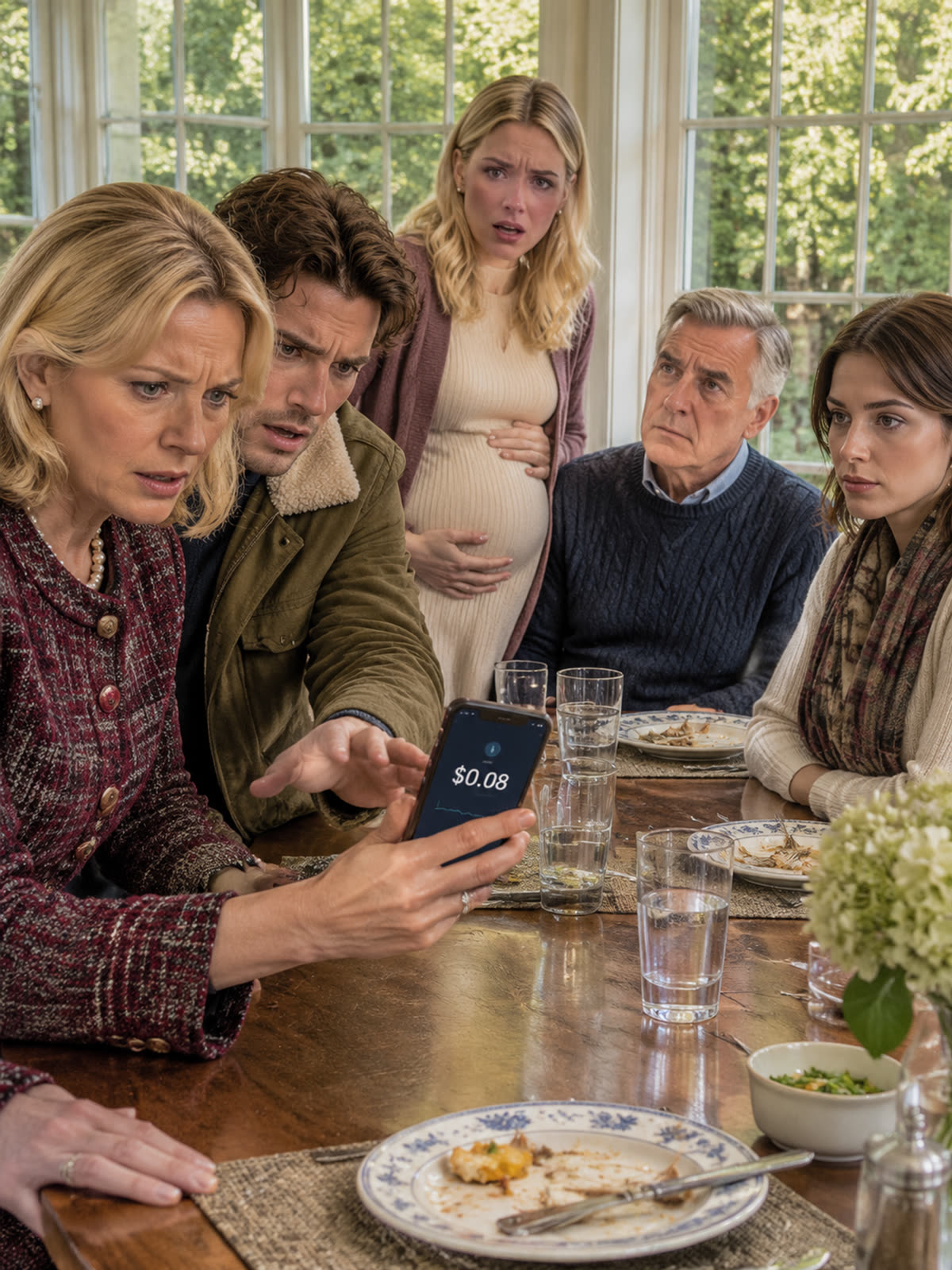
“Where is the money?” Spencer sounded confused, not angry, as though he had arrived to collect a promised payment and found nothing waiting. “A new account at a different institution. One where none of you are authorized, named, or known.” “You moved it.” It was a statement rather than a question. “I transferred it. A standard ACATS brokerage transfer. Legal, documented, and final.” Evette kept pressing her fingers against the phone until its screen went dark. There was nothing hidden in the display. The eight cents were all that remained for her to inspect.
“You had no right to do that.” I answered without raising my voice. “I had every right. It is my account. It has been my account since I turned 18. Your trading authorization was a leftover from the custodial setup that should have been revoked 11 years ago.” I continued, “You used it to try to grant Spencer withdrawal rights without my knowledge or consent. The brokerage flagged it. They called me. I said no.” The explanation was simple. She had counted on old access and my silence. The brokerage had required my permission, and permission was precisely what she did not have.
Spencer moved his chair slightly away from the table but stayed seated. His arms folded again, his jaw set as though he was bracing for another impact. Clare looked between us, her hand still on her belly. “Grandma Odette left that money for me.” I spoke normally. There was no need to shout or whisper; the words had weight without either. “Her will said, ‘For Margot.’ Not for the family. Not for Spencer.” My grandmother’s intention had never been unclear. The confusion existed only because respecting it had become inconvenient for the people across from me.
“I contributed $350 a month for ten years from a bakery salary you call a joke. I built that account to $185,000 while frosting cupcakes.” Every packed lunch and postponed expense belonged in that sentence, whether my mother wanted to acknowledge them or not. “And you tried to hand it to someone who did not earn a single dollar of it, without asking me, without telling me, using authorization you should have lost when I was 18 years old.” I was not defending a lucky balance that had appeared untouched. I was describing ten years of choices they had never bothered to notice.
I turned to Spencer. “You make $78,000 a year. You needed my retirement savings?” He had no answer. “You sat at this table and let Mom submit the paperwork, and you nodded when she called my job a joke.” I reminded him of the loan he had allowed everyone to forget. “You borrowed $6,000 from me two years ago and never paid it back. And when I asked for it, Mom told me to let it go because you have a family.” I let the next words stand on their own. “Like I do not have a future.”
Then I faced Clare. “Ask him about the credit cards.” She turned toward her husband, moving one hand from her belly to the edge of the table. “What credit cards?” Spencer said nothing. A muscle shifted along his clenched jaw. He pressed both palms flat against the wood as the color drained from his face. His breathing grew quick and shallow. Until then, he had been watching the disappearance of money he thought would solve his problem. Now he understood that his problem was about to become visible to the person sitting beside him.
“Three months ago, your husband told Evette he was $22,000 in credit card debt. Debt you did not know about.” Clare kept looking at him. “Evette submitted a hardship letter to the brokerage with my account request describing Spencer’s financial emergency. She put the number in writing.” My mother had not merely talked about using my investments. She had attached his private debts to an application involving an account he did not own. “$22,000 of unsecured debt attached to paperwork on an account that is not his.” The amount was not a guess or a family rumor. It was in Ridgewell’s records.
I looked back at Mom. “She did not submit that request because she believes in family. She submitted it because she was trying to bail Spencer out before you found the statements.” Evette stood so abruptly that her chair scraped across the floor. “You do not know what you are talking about. Spencer has obligations. He has responsibilities you could not understand because you have never built anything in your life.” She reached again for the same insult. “You frost cupcakes and come home to an empty apartment. That is not a future. That is a holding pattern.”
“Tell me something, Mom. When Spencer came to you three months ago and told you about the $22,000, whose idea was it to use my account? Yours or his?” The room shifted. Evette opened her mouth but did not answer. Spencer snapped his head toward her. Clare’s hand stopped over her belly. “How do you know about that?” he asked, barely above a whisper. He was no longer trying to conceal his shock. His wife had heard the amount, his mother’s involvement, and the reason they had tried to reach my savings. What he wanted to know was how their secret had escaped.
“You told Mom. And Mom wrote it in a letter to my brokerage.” I gave him the part he apparently had not considered. “She attached your debt to a form on my account, signed her name to it, and sent it to a compliance department that keeps records.” I paused long enough for them to understand. “Every dollar of your $22,000 is in a file at Ridgewell Financial with your mother’s signature under it.” Evette’s attempt to make his situation sound urgent had supplied the very documentation neither of them now wanted discussed.
Spencer stared at her. “You put it in writing.” “I did what I had to do.” Her voice rose as her hands tightened around the chair back until the wood creaked. Hugh pushed his chair away from the table without standing. It was his first movement that evening not connected to serving water. Clare spoke to her husband again. “What credit cards? Spencer, what is she talking about?” He still did not answer. His fingers pressed so hard against the tabletop that his nails went white. There was no smile left, no approving nod, no suggestion that this was a reasonable family arrangement.
I had spent a decade arriving before dawn, working with my hands, and saving money other people assumed I could spare. I had spent almost as long making excuses for what happened around this table. Watching Spencer refuse to answer his pregnant wife, I finally understood how much silence had protected. “It stopped being a family matter when she filed paperwork on my account.” I pushed back my chair and stood. The account was already safe. The complaint was already filed. But the words I had swallowed for years were still waiting—and this time, I was not going to leave them unsaid.
PART 3 — What They Could Not Take
“You stole from me. That is what this was.” I stood beside the place where I had been expected to accept their decision. “You used authorization you should not have had to hand my money to someone who did not earn it.” The force in my voice came from years of beginning work at 4:30 in the morning and treating every deposit as a promise to myself. The money had not left my ownership, but that did not change what they had attempted. I would not make it sound harmless simply because the brokerage had stopped them.
“Evette submitted the paperwork. Spencer sat here nodding. Hugh sat here and let her do it the same way he has handled every problem in this family, by letting Mom decide and looking at his plate.” My father remained silent. “All three of you treated my savings like a fund you could raid because the person who earned it frosts cupcakes, drives a cracked-windshield Corolla, and does not have a degree.” Their reasons had nothing to do with who owned the account. They had decided my life made me less entitled to protect it.
I faced my brother again. “I built $185,000 from a $36,000 salary. Every dollar, every month, for ten years.” His folded arms and downcast face no longer resembled agreement. “What did you build with $78,000?” I did not wait for the answer he had refused to give his wife. “$22,000 of debt you hid from your pregnant wife. And you had the nerve to nod when Mom said I have no future.” He had earned more than twice my income and still expected the money I saved to absorb the consequences of what he concealed.
Evette’s fingers were white against the chair. Her shoulders had risen close to her ears, and she was breathing fast. “That money was supposed to help this family.” After everything I had explained, she still spoke as though my grandmother’s will and my own work were secondary to her decision. There was no question about what I needed, no acknowledgment of the request she had submitted behind my back. Even with eight cents on the screen and a compliance complaint already underway, she wanted the same outcome she had announced before I arrived.
For the first time that evening, I smiled. I was not trying to be cruel. I had earned that smile through ten years of early alarms, lunches wrapped in foil, and $350 deposits made before I allowed myself to treat the money as available for anything else. My mother had called that future imaginary. Yet it existed, protected in an account she could not touch. “Grandma left that money for me. He can retire on the 8 cents.” This time, there was no approving nod from my brother and no quick instruction from my mother to let the matter go.
Silence settled over the table. The clock ticked three times before Clare stood. She did not look at Spencer. Instead, she held Evette’s gaze for three uninterrupted seconds, then walked to the front door and went out to the car alone. Her departure needed no explanation. She had arrived carrying their third child and listening to ordinary dinner conversation. She was leaving with knowledge her husband had concealed and his mother had tried to manage through my account. Nobody stopped her. Spencer stayed where he was, staring at the table.
He remained seated for another four minutes, four full turns of the clock’s second hand. Then he moved his chair and followed her. Clare was already in the driver’s seat. Spencer got into the passenger side without a word. Their headlights swept across the driveway before the car pulled away. The room they left behind felt stripped of its rehearsed purpose. The meal had been arranged to explain what they had decided to do with my future. Instead, their own household finances had left the room with them, no longer hidden from the person entitled to know.
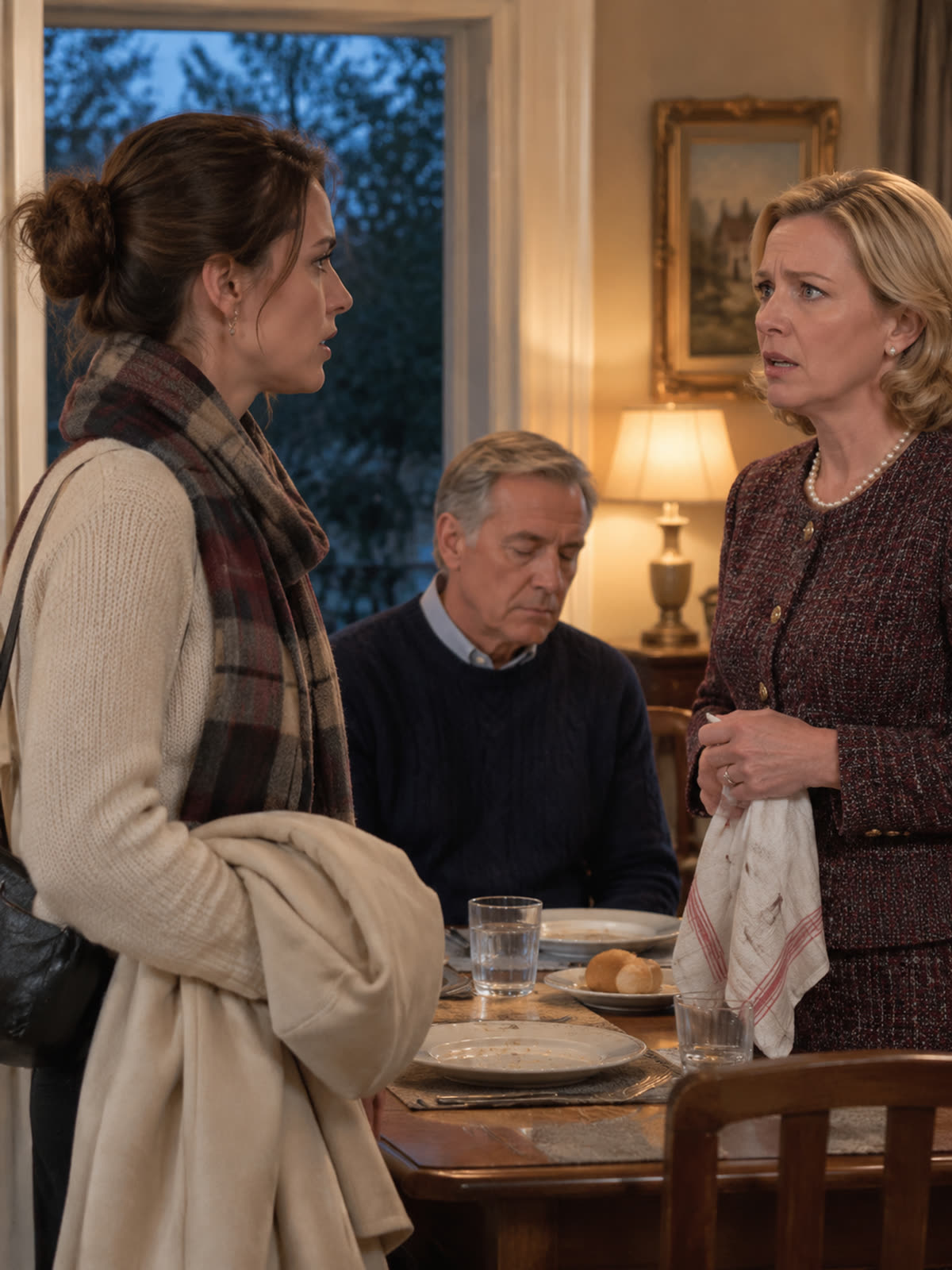
Evette stood beside the table, clutching a tea towel without seeming aware of it. I made the boundary explicit. “The account at Ridgewell is closed to all of you. The money is in a new institution where none of you have authorization, access, or standing.” I had no intention of leaving them room to reinterpret what had happened. “I filed a complaint with Ridgewell about the unauthorized modification request and the hardship letter. Your names are in that complaint.” This was no longer a conversation they could revise afterward into a misunderstanding over family generosity.
I turned toward Hugh. He had not spoken once during the entire evening. “Both of your names.” I took my coat from the chair. My father’s quietness had always looked less aggressive than my mother’s certainty, but it had helped carry her decisions just as effectively. He had sat through the announcement, the insults, and the exposure of the letter. He had poured water and looked away. I was finished treating his refusal to intervene as though it placed him outside what happened. He had been there, and his name belonged in the complaint.
“Do not call me about money again. Do not call me about Spencer’s mortgage, his kids, or his problems.” Holding my coat, I gave them the last words I intended to offer at that table. “The $6,000 he never returned is now the most expensive car repair in the history of this family.” Then I looked at the people who had decided I had nothing worth protecting. “And the next time you want to talk about my future, try asking me if I have one first.” I left without waiting for an answer.
The porch light was on. In the cold March air, my breath showed for two steps before I reached the Corolla. I sat behind the wheel for a full minute before starting the engine. The crack across the windshield split the porch light into two bright streaks. For ten years, I had kept making the same Sunday drive, hoping that staying would mean belonging. That evening, I understood I would not be returning. My old car, my apartment, and my bakery job had not become different during dinner. What changed was my willingness to let those things be used against me.
Exactly one week later, Evette called. I let it go to voicemail. Her message came in a carefully controlled voice, as if she had rehearsed it twice and still disliked the result. “Margot, Spencer’s blood pressure has been through the roof since the dinner. Clare is seven months pregnant with their third. The stress is affecting his health.” There was no apology. She continued, “His doctor told him his numbers are dangerously high. If something happens to him, if the stress puts him in a hospital, that is on you, Margot. You need to think about what you did to this family.”
I almost called back. I wanted to tell her what I thought of attempting to take her daughter’s investments and then making that daughter responsible for the consequences. Instead, I looked at the bird on the windowsill. I imagined Grandma observing the whole exchange. She would have let the telephone sit and allowed silence to do what another argument could not. I listened once, then forwarded the recording to Clare without a message. Evette’s own voice explained her position more clearly than any account I could provide.
Clare had been at dinner. She had seen the eight-cent balance and heard what prompted it. Now she could hear the woman who tried to redirect my savings blaming me for Spencer’s health. Nobody needed to interpret the accusation for her. On Tuesday at two in the morning, a notification showed that Spencer had deposited $6,000 into my account. There was no message or apology. It was the money he had borrowed two years earlier for the transmission repair I had begun to doubt. His silent repayment said plenty, but it did not erase the years before it.
Two weeks later, Clare told me what had happened after dinner. She was not passing along gossip; she was giving me an accounting. Over that weekend, she had examined fourteen months of statements Spencer thought she would never see. There were restaurant charges for meals she had not attended, online orders that had not arrived at their home, and subscriptions she did not recognize. Two credit cards carried a combined balance of $22,000. He had made minimum payments from an account supposedly reserved for vehicle maintenance and household repairs.
When she confronted him at their kitchen table, he could not explain where even half the money had gone. During that same weekend, Clare put their shared checking and savings accounts exclusively in her name, made herself the primary person on the automatic mortgage payments, and told him that she would determine his access to the household finances. She was not divorcing him, but their marriage had changed. She drove herself and decided when to arrive or leave. When they traveled together, he sat in the passenger seat and no longer questioned where they were going.
The family group chat remained open and completely silent. Dinner invitations stopped. So did birthday reminders and photographs of Ethan’s kindergarten artwork. For three weeks, it resembled a room with the lights off: nobody spoke, nobody left, and nobody acknowledged the emptiness. Hugh did not contact me by telephone, text, or through anyone else. At sixty-one, he behaved exactly as he had at forty-five and thirty-eight—present in every photograph, available for every gathering, absent whenever speaking would require taking a side.
Ridgewell’s investigation continued at the slow, impersonal pace of institutional paperwork. An internal team had been assigned to examine why the custodial trading permissions survived for more than a decade. Nobody went to prison, but both parents were formally named in the unauthorized modification complaint. Evette’s signed hardship letter would remain in the firm’s records for years. If either parent tried to become an authorized party there again, the flag would appear before the application could be processed. Their choices had created a record that did not depend on whether the family wished to discuss it.
If Betrayal Unfolded brings to mind relatives who overlook you until they need your savings, share your experience below. Your story matters. Subscribe for the next account. For me, the change came down to a single question from a compliance employee on a Tuesday morning: “Miss Mallister, do you authorize this change?” “No.” One syllable. It was what I should have told Spencer when he requested $6,000. It was what I should have said when Mom instructed me to forget repayment. It was certainly what Grandma would have said if she had heard their plans for her savings.
Late March light slanted through my peaceful apartment and caught the ceramic bird’s repaired wing. The glue had yellowed enough for anyone looking closely to see the join, but it still held twenty-two years after Grandma applied it. From my kitchen stool, I opened the new brokerage application. $184,999.92. Her inheritance and my contributions were safe. Every monthly deposit had remained mine, even while my family treated Spencer’s mortgage as essential and my future as something they could surrender on my behalf.
I closed the application and looked at the little watcher. It had spent thirty years in Odette’s yellow kitchen among the glasses she washed by hand. Later, it stood near my packed lunches and carefully calculated contributions. It was there through a decade of Sunday drives past the shopping plaza, gas station, and empty church parking lot. The repaired wing shone in the sunlight. Grandma had fixed what I broke without lectures, conditions, or demands. She never brought up the accident afterward. She had simply repaired it and let me keep loving the bird.
That was the difference between her gift and my mother’s authority. Grandma gave me $50,000 expecting nothing back. Mom kept trading privileges for eleven years and eventually tried to use them to give my money away. That evening, Faye sent a photograph of the bakery display case, filled for the following morning. There were no questions or captions. She knew I would arrive at 4:30 to handle trays and divide dough, continuing the work my mother would not recognize as a career. Faye had seen seven years without a missed shift, caught the falling tray, and offered the advice I needed.
The bird remained on the windowsill. My investments remained secure. I would not take my place again at a table where everyone thought my future belonged to them. Three weeks after the confrontation, though, my empty chair was still there. On a Sunday afternoon, five-year-old Ethan sat with his grandmother at her dining table. There were no special plates and no roasted chicken waiting on the counter. The basket of rolls was unusually small. He looked from it to the place I had occupied since childhood, then turned toward Evette.
“Grandma, why does Aunt Margot not come to dinner anymore?” Evette held a serving spoon and said nothing. In the kitchen where she had justified giving Spencer access to my future, she now faced a child asking for the explanation she would not speak. The saucepan stayed on the stove. After waiting, Ethan went back to moving carrots around his plate. My mother still had the spoon in her hand—and the question remained unanswered.
Disclaimer: This story is a work of fiction inspired by real-life themes. Names, characters, places and events are fictionalized, and any resemblance to real persons is purely coincidental. Images are for illustration purposes only.
