


PART 1: TWO SONS AND THE TRUTH INSIDE BOX 214
The telephone rang thirty-seven minutes before midnight. By the time I reached St. Catherine’s Women’s Hospital, I was prepared to dismantle whatever last maneuver my ex-wife had arranged. Rain had reduced Boston’s Back Bay to wet darkness and reflected light. For fifteen years, I had directed my family’s businesses, unions, territory, and men whose reputations made politicians answer promptly. Waverly was a name that cleared a path. Yet an unfamiliar woman had somehow obtained my private number. “Your ex-wife has been admitted,” she had said. “Room 418. Maternity recovery. Come now, before your family does.” Then the connection ended.
Mara Bennett Waverly. Seven months divorced, after lawyers, restricted accounts, confidential accusations, and an exhausting silence. Once, she had been the one person who could challenge me without first considering the consequences. Then documents had appeared showing she had betrayed a protected family business. At the nurses’ desk, a woman rose. “Sir, visiting hours are over.” “Room 418.” “You can’t just—” “I’m not visiting.” Her expression stayed steady. “Mr. Waverly,” she said. “I’m June Harper. I called you.” “You used a number fewer than ten people have.” “I know.” “That number isn’t available through the hospital.” “I know that too.”
My voice hardened. “Then you’d better have a very good reason.” June held my gaze. “I had two.” “What two?” “They’re in Mara’s room.” A chill displaced my anger. “What exactly are you telling me?” She moved nearer. “Before you go inside, you need to understand something. Your ex-wife didn’t come here asking for money, Grant. She came here in labor.” Seven months. “No.” June’s face grew firm. “Two boys,” she said. “Born early. Neither one cried when they arrived.” Then she gave me a brass key. “Mara made me promise that if anything happened to her, I would give you this before your mother got here.” “What does it open?” “A locked trust your family never expected you to find.”
“Where is she?” June indicated the room. “Awake. Tired, but stable. The boys are being monitored in the special-care nursery because they arrived early, but they’re doing well now. The pediatric team is encouraged.” Only then did I recognize how badly I needed that reassurance. “And Mara?” “She needs rest. More than anything, she needs calm.” June explained that Mara had not known she was calling. “Then why did you?” “Because I’ve known Mara Bennett since before she became Mara Waverly.” She had worked with Mara’s mother. Three months earlier, Mara had asked her to witness documents she feared might disappear.
“Why would my mother know about them?” “I didn’t say she does.” “You told me to get here before my family.” June explained that Mara had forbidden anyone in my family from receiving her belongings before I saw her. “I am the Waverly family.” “No, Mr. Waverly. You’re a member of it. There’s a difference.” People generally avoided correcting me. Mara never had. Apparently June did not intend to start. Inside, Mara looked from me to June. “You called him.” “I did.” “June.” “You can be annoyed with me tomorrow.” “I’m considering starting tonight.” June allowed ten minutes, then left us.
Mara noticed the key. “So she gave you that too.” “You knew she would.” “I hoped she wouldn’t need to.” “What does it open?” “Grant.” “What does it open?” “You haven’t asked about them.” “I was told they’re doing well.” “That isn’t what I said.” I finally asked, “Are they mine?” “Yes.” “You knew when we divorced.” “Yes.” “How long?” “I found out eleven days before the papers were finalized.” “You signed anyway.” “Yes.” “Why?” She turned toward the window. “Because at the time, I thought the divorce was the safest thing I could give them.”
“Safest from me?” “From what our marriage had become.” “That’s not an answer.” “It’s the only answer I can give you tonight.” “No. You don’t get to decide that.” Mara faced me. “Grant, I spent twelve years watching your family decide what other people were allowed to know. I’m not doing that anymore.” “You kept my sons from me.” “I kept a pregnancy private for seven months.” “They are my children.” “I know.” “You didn’t think I had a right to know?” “I thought you had a right to know the truth.” She paused. “I just wasn’t sure you were willing to hear it.”
I remembered our final confrontation: Mara holding a folder, Stephen insisting the evidence was conclusive, and my refusal to look beyond it. “That’s why the trust exists,” she said. It contained records, agreements, correspondence—the material she had tried to show me. “The evidence against you came from our own internal auditors.” “No. The evidence came through them.” “That’s not the same thing.” “No.” She explained that the transactions and signatures were genuine, but her authorization had been added after somebody else approved the transfers. “Our systems require dual authorization.” “They did.” “Who was the second authorization?” She would not say. “Open the trust first.”
Commonwealth Trust Company, Beacon Street. Box 214. “I can have someone there in twenty minutes.” “No.” “Mara—” “You go yourself.” “I don’t—” “Alone.” She warned me against calling Waverly employees, our attorney, my mother, or Stephen before opening it. June returned. “That’s ten minutes.” “I need another five.” “No.” Mara almost smiled. “I told you she was impossible.” “I’m beloved.” I turned to June. “Can I see them?” “Yes.” Before leaving Mara, I understood that the key was not an invitation to take control. For once, someone was asking me to approach the truth without bringing my family’s machinery with me.
June brought me to the two bassinets. The boys needed feeding, monitoring, rest, and time. Two sons. “Do they have names?” “Mara wanted to wait until she could tell you.” “She planned to tell me?” “She planned to.” “When?” “That was one of the things you two needed to decide.” I studied their tiny faces. “Do they look like her?” “The smaller one has her mouth.” “And the other?” “Unfortunately for him, he may have your eyebrows.” Her smile widened. “That’s better.” “What?” “You looked like you were attending a merger.” I did not know how to stand beside them, much less become what they needed.
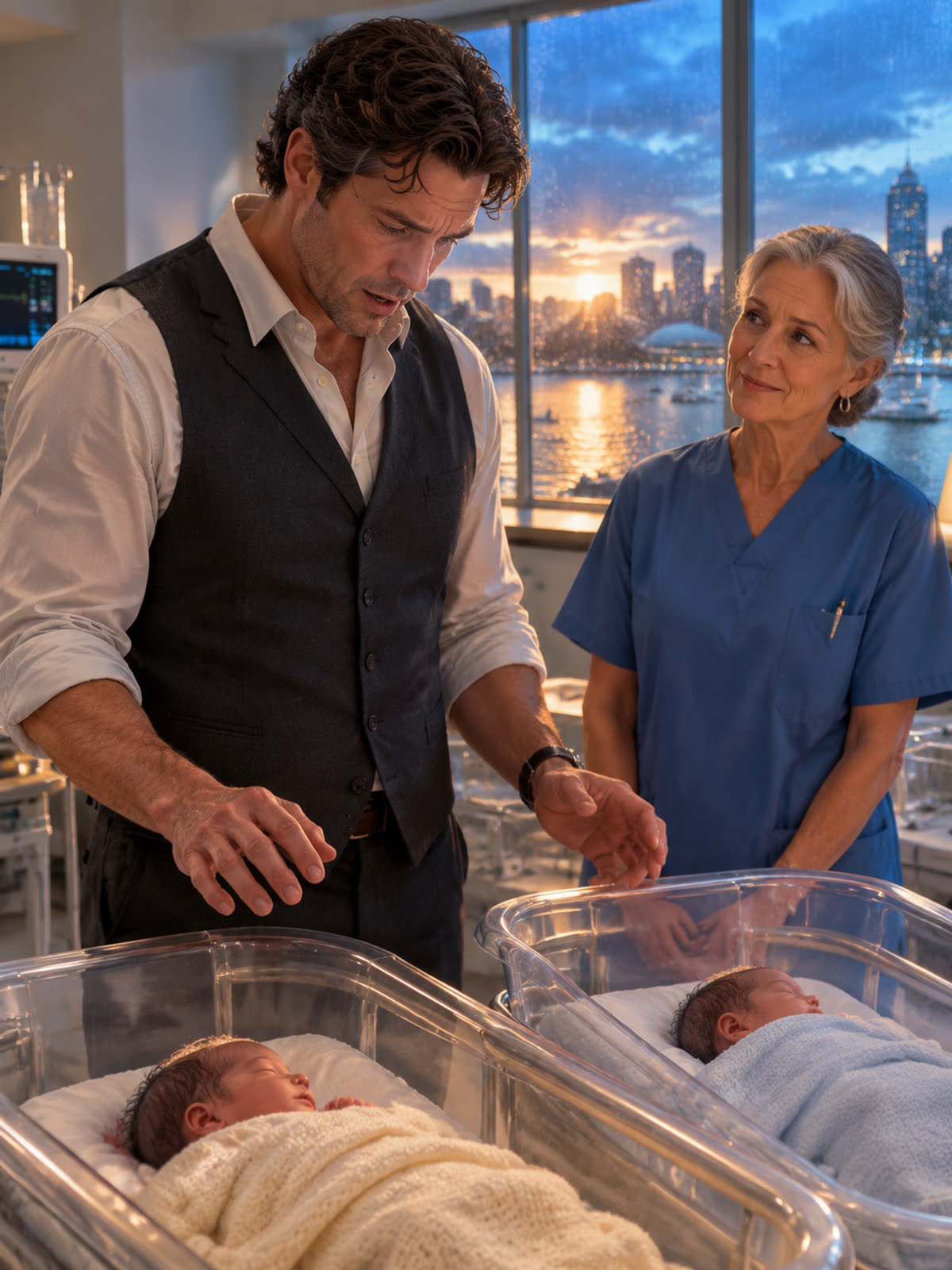
“What am I supposed to do?” “For tonight?” “Yes.” “Nothing heroic.” June’s instructions were ordinary and therefore unfamiliar: remain present, listen to the doctors, let Mara sleep, learn the boys’ routines, ask questions. “That’s it?” “That’s quite a lot.” By morning, the storm had passed beneath a pale September sky. I showered in a nearby hotel rather than return to the townhouse we had shared. At nine fifteen, Commonwealth Trust Company’s elderly manager checked my identification. “Mrs. Waverly instructed us that Box 214 was to be accessed only by you or her.” “My ex-wife.” “The instructions were filed while she was still your wife.” Eight months earlier.
Mr. Bell escorted me downstairs. There was no cash inside the box. The first folder concerned Bennett Urban Development. A transfer had begun at 6:42 p.m.; Mara’s authorization appeared at 7:18. But she had been beside me at a foundation dinner from six until nearly ten. The other approval belonged to an executive credential: Stephen Waverly. My brother had personally delivered the audit and argued most forcefully against her. Another folder held correspondence from Eleanor Waverly to Walter Kessler, our longtime chief counsel. My mother’s controlled language was instantly recognizable. Mara opposed consolidating the Bennett waterfront parcels. I would not proceed without her agreement. An alternative was needed before the municipal vote.
The next message suggested temporary account discrepancies could activate the partnership agreement’s morality clause. Everything, my mother insisted, must remain correctable. Nothing illegal. Nothing permanent. Only enough uncertainty to separate the Bennett and Waverly interests. I stopped. What they had described as a manageable business pressure had dismantled my marriage. An outside forensic accountant’s correspondence showed that Mara had identified the altered approval trail three weeks before I confronted her. She had not been inventing a defense afterward. She had been investigating beforehand. Her handwritten questions asked why Eleanor wanted me convinced, whether the vote explained it, and who had accessed her archived signature.
One note struck harder than the financial records: she would not tell me until the findings were independently verified, because incomplete evidence would make me defend my family first. She had understood exactly what I would do. A sealed envelope bore my name. Her letter was dated eight months earlier, before the accusations and the divorce. She hoped I was reading because she had persuaded me to question the account I had accepted—not because something had happened to her. She doubted Stephen had acted alone. She also doubted my mother had intended our marriage to end. Eleanor had expected pressure, the tool she considered a normal part of managing a family.
Mara had refused to excuse what she could explain. She knew I loved my mother and brother, but believed I could love them without giving away my judgment. She asked me to remember that man. I stopped twice while reading. There was no cruelty to defend myself against. She described my loyalty and her stubbornness, my retreat into responsibility and her tendency to withhold worries until she could present a finished case. We had damaged each other before the false evidence arrived. Then came the words I had not expected: she had not left because she no longer loved me. She had left because love had become indistinguishable from absorption into my family.
The remaining legal papers established the Waverly-Bennett Independence Trust. It controlled voting proxies over the Bennett waterfront parcels and minority Waverly holdings Mara had lawfully received through our settlement. Acting required her agreement and required us to step outside our official business roles. She had constructed a decision neither family could make on our behalf. An amendment, filed after she learned she was pregnant, protected independent assets for our children from automatic control by either family’s companies. She had not been taking something from me. She had been preserving something neither of us had managed to protect while we were married.
Beneath the legal papers lay her notebook. Near the back was a list of things she wanted the twins to know about their father. I turned up the heat when someone was cold without mentioning it. I disliked pears but bought them for her. I remembered employees’ spouses, pretended to dislike Christmas music, and could not cook eggs. I read contracts too quickly. I apologized badly, but sincerely when I finally managed it. I loved my family fiercely—sometimes too fiercely. She had written that I was kinder than the role I played. Even while preparing to raise our sons apart from me, Mara had preserved a version of me I had almost forgotten.
I remained seated with the notebook open. My mother, Stephen, Walter: the names no longer formed a wall of unquestionable protection. They were people who had chosen, concealed, and permitted things. So was I. Mara’s innocence did not erase our earlier failures, but it stripped away the explanation I had used to avoid them. The key had opened no fortune, no weapon, no spectacular secret account. It had opened a record of the precise moment when loyalty became obedience—and the months during which I had mistaken that obedience for certainty.
I called my mother. “Grant.” “Hospital cafeteria. Eleven thirty.” “Is Mara—” “She’s fine.” “What is this about?” “Come alone.” “Grant—” “Eleven thirty.” There would be no family attorney beside her, no advance conference to agree upon the acceptable version. I had spent seven months accepting polished explanations. The papers in front of me showed how easily polished explanations could conceal ugly decisions. For once, I did not ask anybody else to arrange the conversation or tell me whether confronting her was wise.
Then I called Stephen. “Where are you?” “On my way to the hospital.” “No.” “What?” “Meet me at the cafeteria at noon.” “Grant, Mom said Mara had some kind of—” “Stephen.” I looked at the authorization record. “Did you use credential SW-03 to authorize the Bennett transfers?” Silence replaced his confusion. Finally he asked, “Where did you get that?” I closed the folder. “Noon.” My brother had not denied it. Whatever explanation waited at that table, the family I thought I knew had already begun to come apart.
PART 2: THE FAMILY’S CONFESSION AND A DEAD MAN’S PROMISE
My mother arrived seventeen minutes early. Eleanor Waverly had turned seventy two months before and regarded age as an administrative inconvenience. “You look terrible.” “I’ve had an unusual night.” “The baby?” “Babies.” “What?” “Twin boys.” “Grant.” “No.” I would not let her establish the terms. “You knew.” “I knew there had been irregularities.” “Don’t.” “Grant—” “Do not speak to me like I’m one of your board members.” Mara had been pregnant when the divorce became final. “She should have told you.” “So should you.” My mother’s composure shifted. “You found the correspondence.” “Yes.”
“Then you know I never intended—” “I know what you intended.” I laid out the plan: damage Mara’s apparent judgment until I supported waterfront consolidation. “You expected me to pressure my wife.” “I expected you to protect a family interest.” “I was supposed to protect my marriage too.” “The project involved four thousand jobs.” “And that made falsifying the appearance of her authorization acceptable?” “No.” She repeated it. “No. It didn’t.” She had believed the decision could be contained. “You gambled with my marriage.” “Yes.” A doctor passed carrying coffee while my mother acknowledged what had broken my home.
Walter had assured her the records could later be repaired without financial loss. Stephen, she said, had initially been told it was an internal compliance test, not a strategy involving my marriage. By the time he understood, he had panicked. “He doubled down.” “Yes.” “Why?” “Because he was afraid of you.” “Stephen is forty-one years old.” “So are many frightened men.” Then she added, “You became very difficult to disappoint, Grant.” It was explanation, she insisted, not absolution. She had intended to tell me after the waterfront vote. “That was seven months ago.” “Yes.” “You had seven months.” “I know.”
Stephen arrived at noon. “You said—” “Sit down.” “Grant.” “Tell me the truth.” He glanced at our mother. “No more managing this,” she told him. “Tell him.” “It was supposed to be temporary.” “That sentence is becoming very popular.” He said Walter had requested a controlled transfer that compliance would flag. “You used Mara’s authorization.” “No.” He touched the record. “I used my credential. Walter’s office attached Mara’s archived digital authorization afterward.” He learned that three days before bringing the audit to my house. “You knew then that she hadn’t done it.” “Yes.” “Yet you let me accuse her.” “Yes.”
Walter had warned him that disclosure could bring a board investigation against our mother, collapse the project, and freeze thousands of union jobs. “So you chose the company.” Stephen looked at me. “I chose everybody except Mara.” Then he added, “And you.” He claimed he had wanted to confess every day. “You had my number.” “I know.” There would be an independent review, no Walter, and complete disclosure—not merely material that protected us. Both agreed. When I rose, Stephen asked to accompany me upstairs. “No.” Then, “Not yet.” My mother asked whether her grandsons were well and whether they had names. I still did not know.
Mara was sitting up when I returned. “You hate hospital soup,” I said. “You remember.” “You complained about it for nine straight days after your appendix surgery.” “It was aggressively beige.” She knew from my face that I had opened the box. I told her about the cafeteria. “So quickly?” “I’m trying something new.” “What?” “Not waiting seven months to have difficult conversations.” My mother had admitted the plan; Walter had designed its mechanics; Stephen had approved the original transfer. Mara had suspected those distinctions. “Why didn’t you tell me?” Her eyes met mine. “I did.” The memory of her asking me to read before deciding left me nowhere to hide.
“I’m sorry.” There was no useful qualification. “I believed them,” I said. “I know.” “I believed them because they were family.” “I know.” Official-looking evidence had saved me from a harder judgment: whether I trusted my wife more than the system around me. “That’s more honest than you were seven months ago.” “It’s not enough.” “No.” “I know.” Then Mara said, “I’m not asking you to forgive me either.” “For what?” “For not telling you about the pregnancy.” She still believed some reasons were sound, but admitted fear had helped make her decisions.
“Fear of my family?” “Fear of repeating our marriage.” She had not wanted the twins treated as another Waverly undertaking, or pregnancy to become the reason I returned. She had not wanted my mother rearranging nurseries before we could speak honestly. “She would have reorganized nurseries.” “Three of them.” “At least.” Mara had planned to contact me after the review, then after independent legal protection, continually moving the threshold. “That sounds familiar.” “Yes.” I asked about the trust’s shared voting rights. Beyond the approved commercial development stood fourteen acres of her grandmother’s warehouse property. Mara had kept them because she envisioned something else: low-rise housing. Harbor House District.
Her father had imagined a similar development but lacked the capital. “And you do.” “We do.” The minority holdings could finance the first phase without selling the land. “You want to build this together?” “I want us to decide together whether it should be built.” “You planned all of this while pregnant?” “I had insomnia.” June appeared. “You two realize other people work here?” Mara checked the clock. “How long has he been here?” “Long enough that I’m charging him rent.” Then June announced, “The boys are ready for a family visit.” That word followed us into the nursery, where Mara was wheeled beside the bassinets.
“Grant.” “Yes?” “This is Owen.” “Owen.” “And that one is Noah.” “Noah.” She had selected their names months earlier without putting them on the forms. “I thought their father should hear them first.” “Owen and Noah,” I repeated. “Yes.” I asked to hold one. “You look terrified.” “I am.” “Good.” “What does that mean?” “It means you understand the assignment.” With help, Owen settled into my arms. I had held other people’s children, even Stephen’s daughter, but nothing had prepared me for this. My son knew nothing of my surname or what people believed it meant. “I don’t know how to do this.” “Neither do I.”
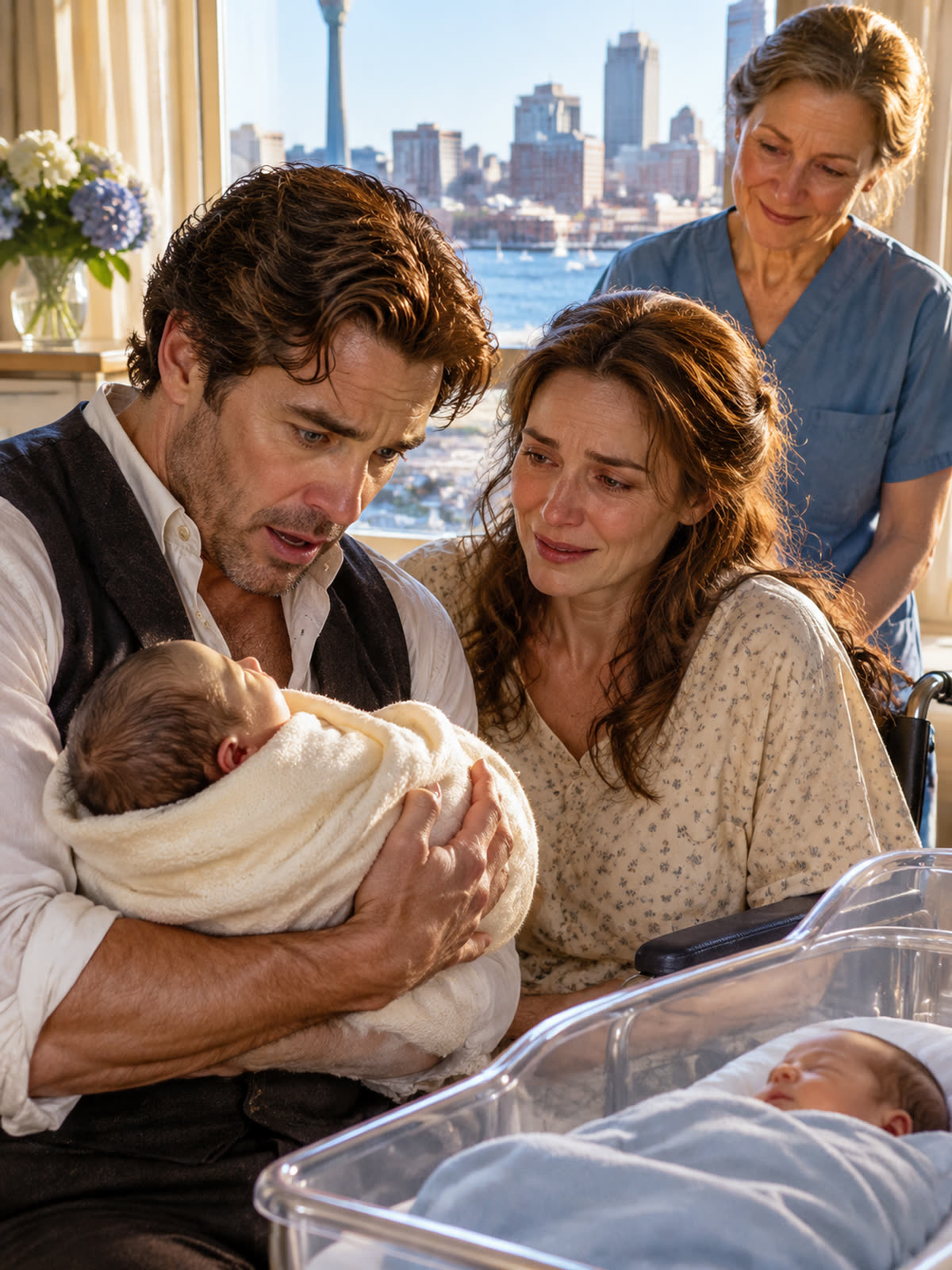
While I held Owen, Mara asked about my mother and Stephen. They had told enough truth for me to believe the rest could be uncovered. I had not confronted Walter. “Why?” “Because for once I’d rather understand the whole situation before deciding what to do.” Mara studied me. “That really is new.” “I’m having a difficult week.” Then she mentioned a document I had not described. “In the trust box.” “I read everything.” “No.” June had added something the previous day. Mara did not know what it was; months earlier she had authorized June, a trust witness, to deposit an independent document if circumstances changed.
There was another key. June had it. “Grant, you really hate not knowing things.” “I’m learning that about myself.” June saw me approach. “No.” “You don’t even know what I’m asking.” “Yes, I do.” “What did you put in Box 214?” “Something that belongs to your family.” “What?” “Not here.” “June.” “Tomorrow.” I recounted the midnight summons, the sons I had never known existed, and the evidence manufactured against my wife. “Ex-wife.” “That correction is not currently improving my mood.” She almost smiled. Whatever she had added, she said, was not about money. “What is it about?” “A promise.” “To whom?” “Your father.”
Charles Waverly had been dead eleven years. June produced another brass key, explaining that Box 214 contained a smaller locked compartment at the back. “How did you know my father?” “He came to this hospital long before Mara did.” “For what?” She looked toward the boys. “To make sure that one day, if his family ever forgot what mattered, somebody outside it could remind them.” The next time I sat at Commonwealth Trust, I asked Mr. Bell whether anything in the building could play the recording I had found. “Probably.” “Probably?” “This institution has been open since 1898. We have several things no one has had the courage to throw away.”
He returned twenty minutes later with an old tape recorder. First, I unfolded my father’s letter, written in his economical capital letters. If June had released it, something had happened he hoped would not. He acknowledged teaching me that strength meant holding the family together. Some of that lesson had helped us; some had been wrong. Trust had enabled survival, but survival had hardened into habit, habit into control, until control called itself loyalty. I remembered him teaching me that responsibility preceded privilege, insisting that I remember longtime employees—and warning me never to embarrass the family. I had inherited both instructions without recognizing their conflict.
He wrote that my mother’s strength could keep everyone moving long after they should have questioned the destination. Someone needed to ask those questions. He had not always done it; I must. Then he mentioned land connected with Daniel Bennett’s waterfront holdings. He and Mara’s father had wanted to build homes ordinary Boston families could afford. Obligations, pride, and the search for a convenient year had stopped them. There was never a convenient year to do right by the next generation. If the chance returned, he wanted me to think before exchanging it for another building bearing our name. Only then did I start the recording.
“If this thing works, June, I’m going to be deeply annoyed.” “You asked me to record it.” “I asked you to remember it.” “You’re a difficult patient.” “I’ve heard that.” Then his voice addressed me. “Grant, if you’re hearing this, I’m assuming June decided you needed a lecture from a dead man.” He apologized for the theatrics. June had nursed him during those nights when the offices, drivers, assistants, and structures of importance fell away. “I built systems to protect you boys,” he said. “Then I watched those systems begin making choices for you.” “I don’t know if a father gets to fix that late.”
June answered, “Maybe he gets to leave better instructions.” My father believed I would eventually understand. He spoke about Daniel, the harbor, and housing—almost the same plan Mara had shown me. “If our children ever find their way toward each other,” he said, “I hope we don’t ruin it by turning marriage into a business agreement.” “That sounds oddly specific.” Daniel believed Mara would terrify me. “Will she?” “Almost certainly.” I needed somebody unimpressed by our name. She needed somebody who understood responsibility could be love, even when clumsy. For eleven years, I had mistaken a company for my father’s final legacy.
Mr. Bell eventually knocked. “Mr. Waverly?” “Yes?” “We close at four on Fridays.” “I’m sorry.” “I have worked in private banking for forty-six years. You are not the first wealthy man to lose track of time after opening a box.” Back at the hospital, I found Mara walking slowly with June. “You’re supposed to be resting,” I said. “You’ve been spending too much time with June.” June looked pleased, then understood. “You listened.” “Yes.” Mara glanced between us. “What is that?” “My father.” We returned to Room 418, where I told her what the second key had opened.
Neither of our fathers had told us. June said both men had felt ashamed—not simply because the development failed, but because they had not been brave enough to complete it. Investors had been ready, preliminary plans drawn, community support secured. Then markets shifted, capital was needed elsewhere, and creditors grew nervous. “So they stopped,” Mara said. “Yes.” “That’s normal.” “It is.” But neither man had forgiven himself for turning a reasonable postponement into a permanent surrender. We had independently returned to the same idea. June corrected that: it was not merely similar. Daniel had kept the original plans.
Mara stared. June had seen them because Mara’s mother had entrusted them to her after Daniel died. Her mother had wanted to spare her an inherited obligation; her father had left a different instruction. If Mara ever imagined the project independently, June should show her. “Where are they?” Mara asked. Her eyes shone, although she did not cry. The development we had thought belonged only to our uncertain future had been waiting inside both our histories. June reached into her bag.
PART 3: THE LIFE WE CHOSE—AND THE QUESTION THE KEY LEFT OPEN
June placed a thin archival folder in Mara’s lap. The plans were twenty-two years old. Among them was a clinic. Mara rested her thumb on her father’s handwriting. “That sounds like him.” “It sounds like something you’d say.” “Maybe I inherited better things than I realized.” June looked at us both. “You both did.” Our sons stayed in the hospital another twelve days. Those days altered my life more thoroughly than the previous fifteen years. I learned nursery handwashing, Noah’s brief warning before impatience became noise, and how quietly Owen settled beneath a hand near his shoulder.
I learned Mara wanted tea at two in the morning and disliked the hospital’s blueberry muffins. We could sit beside our children without discussing our marriage. I placed Waverly Holdings under temporary shared oversight. Stephen left the redevelopment committee. Walter retired before the independent review began. Investigators found breaches of ethics, authorization procedures, and fiduciary obligations, but no stolen money and no criminal conspiracy. The explanation was smaller and more shameful: intelligent people had justified temporary deceit because they believed their larger purpose responsible. Trust had absorbed the loss. The report did not need to say so for us to understand it.
Stephen visited on the sixth day. “I owe you an apology.” Mara nodded. “Yes.” He admitted knowing she had not approved the transfers, then hiding behind the claim that he was protecting our mother, the company, the employees, and me. Mostly, he had protected himself from acknowledging his involvement. “I let you carry the blame because correcting the truth became more frightening every day.” “Yes,” she said. “I’m sorry.” “Thank you for saying it clearly.” He asked about Noah and Owen, then whether he could meet them. Mara looked at me. “Wash your hands.” Stephen went straight to the sink.
My mother sent a handwritten apology without conditions. She admitted interfering with Mara’s judgment, underestimating the consequences, and failing to correct the record once the damage became personal. She had mistaken protecting her family for permission to make its decisions. She promised to respect whatever boundaries Mara established for herself and the twins. “What do you think?” I asked. Mara folded the letter. “I think your mother has never written nine consecutive sentences without giving an instruction.” “That may be historic.” “It may.” I asked whether she wanted Eleanor to visit. Mara answered with another question. “Do you?”
Months earlier, I would have heard a test. Now I answered honestly. “Yes.” “Then ask her.” “Are you sure?” “I’m not offering her unrestricted access to our lives.” Our lives. We both noticed it. “She can visit,” Mara said. “On our terms.” “Exactly.” My mother came the following afternoon. I had watched her remain dry-eyed at funerals, but Noah’s yawn made her press two fingers against her mouth. “They’re beautiful,” she whispered. “Yes.” Then she looked at Mara. “I’m sorry.” “I read your note.” “I meant it.” “I believe you.” Believing the apology, Mara explained, was not the same as trusting her again.
“What would rebuilding trust require?” my mother asked. “Time.” “Yes.” “Respect for decisions you may disagree with.” “That sounds difficult.” “It will be.” There would be no family business around the boys and no reserving schools before they could sit up. “I would never.” I reminded her she had put Stephen’s daughter on a preschool list before birth. “That was different.” Mara laughed. Nothing was repaired in an afternoon. Still, my mother had asked what rebuilding required instead of announcing how it would happen. In our family, that was not a small distinction.
On discharge morning, June found me in the hallway. “You look less alarming.” “I’ve been sleeping four hours a night.” “That may be your natural state.” I thanked her—not for the coffee, but for calling. She admitted she had nearly honored Mara’s request not to contact me unless necessary. The boys had arrived early, Mara was exhausted, and my mother’s office had learned of the admission through an insurance administrator. June feared the family would appear before I knew. “I chose to give you a chance to arrive as their father instead of as head of the Waverly family.” “Did I?” “Eventually.”
Then she warned me. “Don’t turn this into a redemption project.” People who discovered they were wrong, she said, could become obsessed with proving themselves right. “You think that’s what I’m doing?” “I think you’re capable of it.” “Comforting.” “Mara does not need a transformed man making speeches.” “What does she need?” “A reliable one.” She drank her coffee. “So do your sons.” We did not reunite when Mara left the hospital. She went to her rented Cambridge townhouse, declining my mother’s offered properties. We made schedules, attended appointments, and learned how much attention a small life could require.
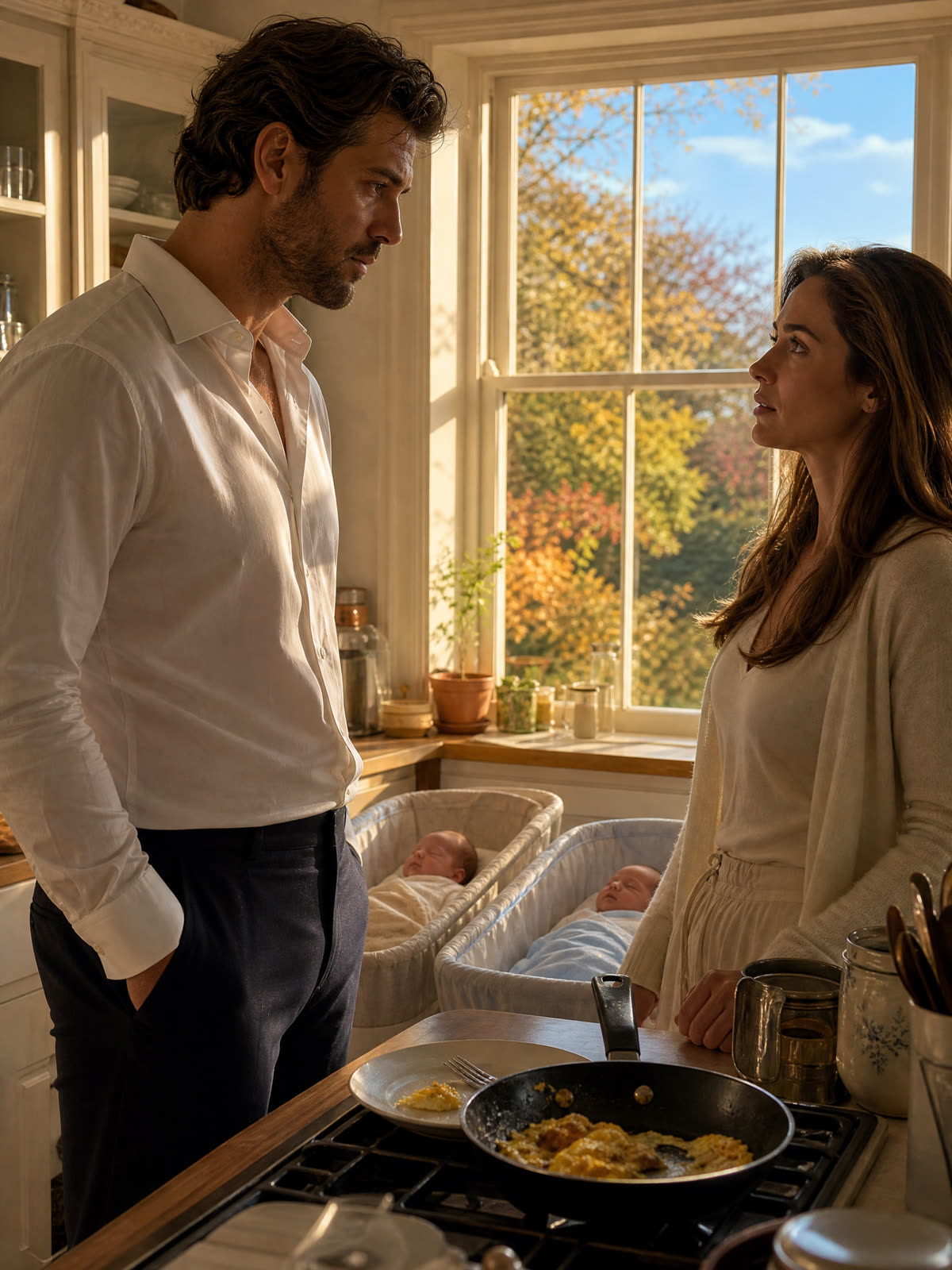
During that first month, infant laundry occupied more of my time than Waverly Holdings. The company survived a missed finance meeting for Noah’s appointment. Owen’s unsettled evening caused no bankruptcy. Mara enjoyed pointing this out. “You mean the corporation functions without constant exposure to your personality?” “Barely.” “Tragic.” My cooking remained less adaptable. “You’re destroying them.” “I’m cooking.” “You’re punishing breakfast.” “They’re eggs.” “They were eggs.” One morning she told me Stephen had called about returning in a non-financial role. She had said it was not her decision. I planned to ask what he had learned. “That sounds suspiciously mature.” “I dislike it.”
At the counter, I finally asked what I had been circling. “Do you still want the divorce?” “Grant.” “I’m not asking you to undo it.” I wanted to know whether the life we were assembling led somewhere she wanted to go. “I don’t know.” “Okay.” She seemed surprised that I offered no twelve-point argument. “I’m experimenting.” Then she said, “I love you.” Her eyes moved toward the sleeping boys. “I probably always will.” But love had not been our only difficulty. She needed to know the changes belonged to me, not another inherited role. “I can give you time.” “That’s what I need.”
Harbor House advanced into planning. We created an independent nonprofit development corporation, separate from both family companies. Stephen joined six months later and discovered the strength of public opinion about parking. “One man spoke for eighteen minutes.” “That sounds brief for Boston.” He hung up. Mara laughed for five minutes. He learned to admit mistakes without adding a defense. She learned to ask for help before exhaustion. Owen watched everything; Noah reached first and considered consequences afterward. Mara regarded that as proof of Waverly ancestry. On their first birthday, June gave them wooden boats. “Subtle.” “I’m old. I’ve earned the right to be obvious.”
The groundbreaking followed three weeks later. Waverly appeared among many names, and Bennett among others. While our sons played safely nearby with my mother and Stephen, Mara stood beside me. Our fathers, we agreed, would have found something to criticize: parking, retail, some detail neither could leave alone. “I wish they could see it.” “Maybe this is how they do.” She slid her hand into mine for the first time in nearly two years. Three months afterward, she invited me to dinner—not the usual shared food wherever the twins happened to be, but dinner for us. She wore the green dress I had always liked.
“You’re late,” I said. “Two toddlers believe shoes are optional.” “Fair.” Later she lowered her spoon. “I’ve been thinking.” “That phrase still concerns me.” “About us.” She did not want our old marriage restored. Neither did I. When she asked what I wanted, I first thought of a house. Instead I said, “Breakfast.” “What?” “Breakfast with you and the boys.” Most mornings. Eventual school arguments, imperfect vacations, optional Sunday dinners, Harbor House meetings, complaints about work and my inability to cook. Pretending badly not to like Christmas music. “I want a life.” “Not a merger?” “No.” “Not a restored Waverly marriage?” “No.”
“Not a solution?” “No.” It would become complicated. We would disagree. If my mother reserved another preschool place, I offered, “I will change our names and leave Massachusetts.” Mara laughed. “I want breakfast too.” “That sounds dangerously like a yes.” “It isn’t.” “Of course not.” “It’s a beginning.” “That’s better.” When we married again, June stood beside Mara and Stephen beside me. Owen and Noah wore tiny blue jackets and spent much of the ceremony trying to exchange shoes. We chose the public garden near Harbor House. Asked whether I chose Mara freely, I nearly laughed at how much that word now meant. “I do,” I said. “I do,” she answered.
Later, beneath strings of lights, my mother joined me near the harbor. “You seem happy.” “I am.” “So am I.” Noah was attempting to demonstrate that Stephen’s sleeve was an appropriate place for cake. My father would have liked this, she said—not simply the wedding, but that nobody had requested her permission. “I am learning.” “Yes.” “Slowly.” “Very.” She had once believed keeping a family together meant preventing anyone from leaving. Now she thought she had reversed it. “That people stay when they are allowed to belong without disappearing.” “You should write that down.” “Don’t be difficult.” “It’s genetic.” Across the lawn, Mara lifted Owen and looked toward me.
Three years after June’s call, Harbor House welcomed its first residents. A bookstore endured six unprofitable months before Mara persuaded my mother to bring her book club. The clinic did not carry our family name. Daniel Bennett’s words remained part of what we had built, and June pretended not to like the attention because it made her emotional. Our sons could not yet read the notes, but liked running their hands over them. One Sunday, the four of us followed the harbor path. Mara said she had been remembering the night they were born. “You were furious when you arrived.” “I was.” “I could tell.”
“I thought you had planned something.” “I had.” “The trust.” “That qualifies.” Neither of us had expected it to bring us together. She had only hoped it would finally make me examine what happened. “It did.” “I hated you for a while.” “I know.” “I missed you too.” “I know that now.” She asked what I had thought when June handed over the key. “That you were trying to ruin my life.” Mara laughed. “And?” Ahead, Owen helped Noah retrieve a scooter that had tipped onto the grass. My mother and Stephen argued from a bench about something apparently involving sandwiches. June approached carrying four coffees.
“I was right.” Mara raised an eyebrow. “Excuse me?” “You ruined the life I had.” “That is not romantic.” “I’m not finished.” “You ruined the life I thought I was supposed to want.” “And then?” “And then we built another one.” That evening, Noah wanted to know why the clinic did not bear our name. “Because not everything you help build has to belong to you.” “Why?” “Because sometimes it’s better if it belongs to everybody.” Owen understood it through the park. Noah accepted the explanation and returned to his pasta. Mara smiled at me across the table.
The boys would inherit names, property, expectations, histories, mistakes, and far too much advice. What mattered was whether truth reached them early enough to help, and whether love remained a choice rather than an obligation. I had believed our name opened doors. It did. I had not understood that it could also become a room people forgot they were allowed to leave. Mara showed me the door. Our sons showed me why it mattered. Slowly, imperfectly, my brother and mother learned to follow. I wanted a table where disappointment did not forbid return, where belonging required neither obedience nor disappearance.
I still sometimes keep the first brass key in my desk. The records are archived, the trust amended, the waterfront decisions made. It opens almost nothing now. That is why I keep it. What it unlocked was never merely a box, but a different measure of what deserved preserving: bad eggs, boys disputing toast, a woman who corrects me, a brother practicing honesty, a mother releasing her grip, a retired nurse criticizing our coffee, a neighborhood beside the harbor. A chosen life. A home. Eventually, trust. Yet the little key leaves its most important question open: what kind of family will we choose to create?
Disclaimer: This story is a work of fiction inspired by real-life themes. Names, characters, places and events are fictionalized, and any resemblance to real persons is purely coincidental. Images are for illustration purposes only.
