


PART 1 — THE PROPOSAL MY MOTHER WAS WAITING FOR
My younger sister lowered herself onto one knee in front of my fiancé, opened a diamond ring box, and asked him to marry her while our family watched. My mother was recording. She made no attempt to interrupt, and nothing in her expression suggested surprise. Her phone was held at her chest, pointed directly at Bennett. “Marry me instead, Bennett,” Tessa whispered. “You know I’m the one you were supposed to end up with.” I remember the kitchen refrigerator humming, Dad’s coffee suspended halfway to his mouth, and the little silver ring shaking in her fingers. Most clearly, though, I remember Bennett’s face.
“Tessa,” he said, his voice dangerously quiet, “get off your knee.” She smiled as if his refusal was merely part of their performance. “Don’t do that. Not in front of everybody. Just tell the truth.” Bennett looked toward me. I was sitting on the sofa with the engagement ring he had given me two months earlier on my finger. My name is Willa Hargrove. I was thirty-three, and until then, I had believed my younger sister’s worst offense would be spoiling another family dinner. I had been wrong. “Willa,” Bennett said, reaching for my hand, “I need you to hear me clearly.”
Tessa stopped smiling. “Bennett, don’t.” He answered without hesitation. “I’m marrying Willa, not you.” Her face drained of color. Mom’s phone lowered a fraction, and Dad shut his eyes. Then Tessa said something that left me cold. “Mom told me you’d say that at first.” I turned. “What?” Mom immediately dropped her phone. “Tessa, sweetheart, you’re upset. Let’s not make this worse.” Laurel, our oldest sister, got up so abruptly that her chair scraped the floor. “Are you kidding me? You knew she was going to do this?” Mom looked insulted. “I knew she needed closure.”
“Closure?” Bennett repeated. “You brought us here so your daughter could propose to me?” Tessa stood, still gripping the box. “Stop acting like I’m some stranger, Bennett. You wanted me first.” I had heard versions of that accusation for almost a year, as though briefly dating my sister had made him her permanent property. “Tessa, we went out for four weeks,” Bennett said. “You broke things off. I moved on.” She stared at him. “You moved on with my sister!” His voice rose. “Because I fell in love with her!” I had never heard him shout at anyone in my family.
Tessa turned on me with a look I recognized from childhood. “You always do this,” she hissed. “Do what?” I asked. “Take something that was supposed to be mine.” I could hardly believe we were having this conversation. “He’s a person, Tessa. Not a purse you left in a store!” She pressed on. “You think he actually loves you? He only started dating you because he couldn’t get over me.” Bennett stepped between us. “That’s enough.” Tessa leaned around him. “You were always the second choice, Willa. Even Mom knows that.” I looked at our mother.
Then I did something I would regret for the rest of my life. I slapped my sister. The crack seemed to fill the living room. Tessa stumbled back with a hand against her cheek, and for one awful second, everyone froze. Then she rushed at me and shoved me against the couch. Laurel seized her arm while Bennett pulled me away. Phoebe, our youngest sister, began crying. Mom went straight to Tessa. “My God! Look what you’ve done to your sister!” I stood staring at my hand. Nothing Tessa had said justified hitting her, and I knew I had crossed a line.
“I’m sorry I hit her,” I managed. Mom ignored me and faced Bennett. “Are you happy now? Look what you’ve done to this family!” He stared back. “I didn’t do anything except say no.” Mom’s voice sharpened. “You humiliated her!” Bennett answered, “She proposed to an engaged man in front of his fiancée!” Her expression hardened. “You don’t have to be cruel.” He fetched my coat. “We’re leaving.” Tessa began sobbing. “Please don’t go. Bennett, please. I just need five minutes alone with you.” He stopped at the door. “No.” She pleaded again. “Just five minutes!”
“I don’t love you, Tessa. I don’t want to marry you. I don’t want a private conversation, either.” Mom gasped, but Bennett continued. “And if you ever do something like this again, you won’t be invited to our wedding.” Mom snapped, “Then maybe there shouldn’t be a wedding!” I stared at her. “Did you seriously just say that?” Her answer came immediately. “A marriage that tears sisters apart isn’t starting on a healthy foundation.” She had watched Tessa try to take my fiancé, yet somehow our wedding had become the wrongdoing. Bennett opened the door, and December air struck my face.
We were halfway to the car when Laurel ran after us with my purse and phone. “Willa! Wait!” She glanced toward the living room window. “There’s something you need to know.” I waited as she lowered her voice. “I heard Mom and Tessa talking before dinner.” My stomach tightened. “What did they say?” Laurel swallowed. “Mom told Tessa that if Bennett really loved you, tonight would prove it.” I struggled to understand. “What does that mean?” Her answer would stay with me for months. “She called it a loyalty test. And Willa… I think they planned the whole thing.”
During the drive, I kept studying my oval diamond and its thin gold band, remembering how I had cried when Bennett proposed. “Did you know my mother was involved?” I asked. “No.” Then I asked whether he had ever encouraged Tessa. “Did you ever give Tessa any reason to believe you wanted her back?” The hurt in his glance made me regret it. “Willa, I was standing right there telling her I love you.” I whispered, “I know.” He asked, “Then why are you asking me that?” I answered honestly. “Because I don’t understand any of this.”
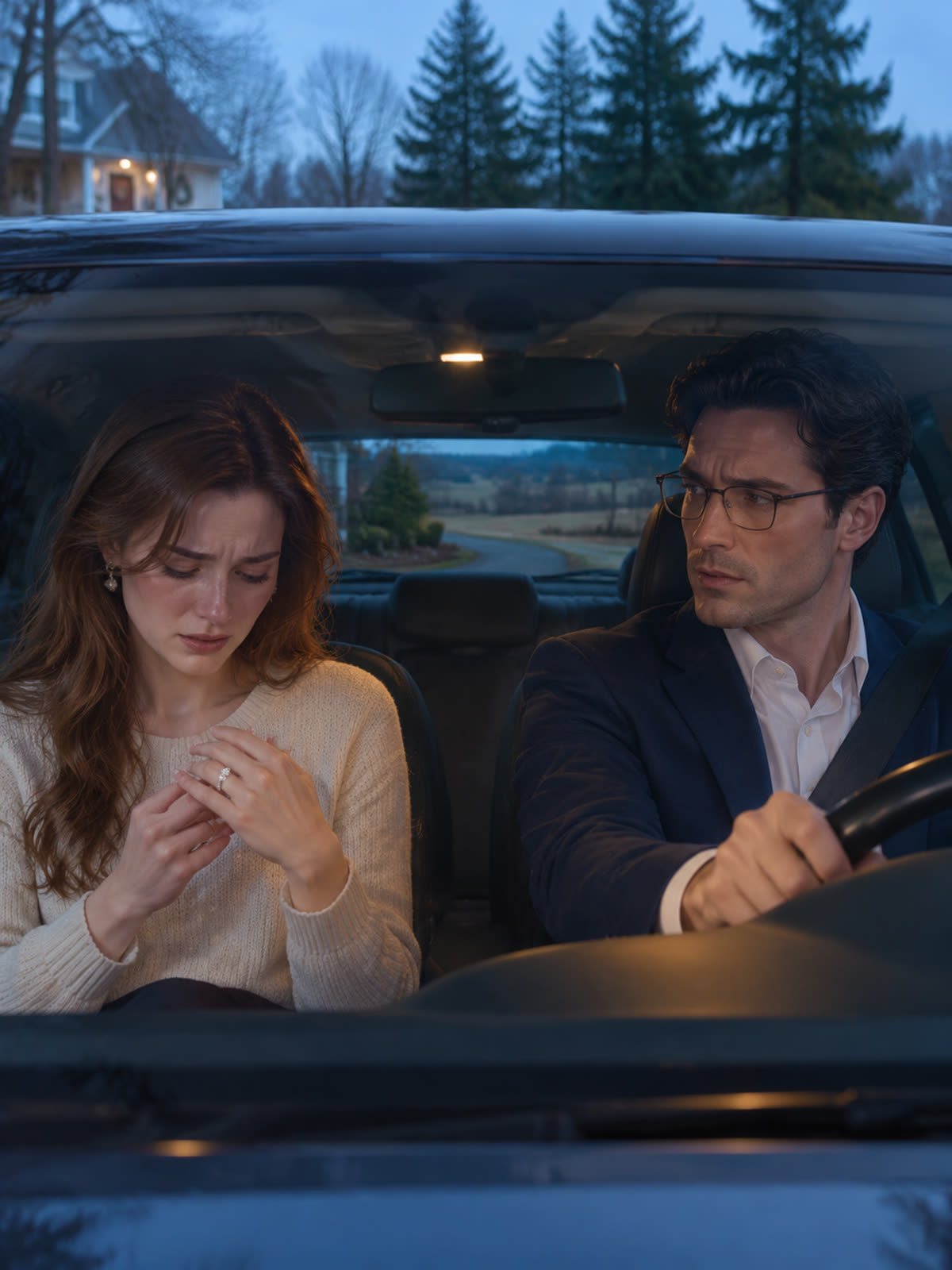
Bennett parked in our driveway and turned off the engine. “Neither do I. But I’m not going to spend our marriage proving I’m innocent every time your sister makes something up.” That frightened me, partly because Tessa had been turning my happiness into a contest long before he existed in our lives. We had grown up outside Fredericksburg, Virginia: responsible, outspoken Laurel first, then me, then Tessa, three years younger, and finally Phoebe. Mom, Nadine Hargrove, never said Tessa was her favorite. She simply made sure the rest of us understood it without needing an announcement.
When Tessa wanted shoes, she got them. When I needed them, Mom reminded me that money did not grow on trees. Tessa’s tears meant someone had mistreated her; mine meant I was dramatic. Dad, Russell, avoided conflict so faithfully that his silence became part of the household routine. Laurel defended me when she could, and Phoebe noticed more than anyone realized. I worked, saved, and eventually moved away. For several years, I lived in Delaware and coordinated schedules for a large medical practice. I dated, but nothing lasted. When a better position opened near Fredericksburg, I accepted it.
I returned for better pay, a shorter commute, and more time with Laurel’s children—not to repair my family. Three weeks later, Laurel dragged me to a coworker’s promotion party at a neighborhood pub. Someone spilled a drink on the chair next to mine, and Bennett arrived carrying napkins. “I’d offer you a dry seat,” he said, “but apparently this place charges extra for furniture without beer on it.” He was thirty-five and handled payroll for a regional distribution company. His confidence was quiet rather than demanding. We talked until last call, and he called the following day.
For the first time in years, dating felt uncomplicated. We explored small towns, debated barbecue restaurants, and once drove two hours to a farmers market only to find it closed. He respected my opinions, stayed present when I was stressed, and never treated my income as his emergency fund. After six months, he told me he wanted a future together. Neither of us knew about the complication waiting for us. Years before meeting me, he had dated Tessa for four weeks. She had ended it because she did not want anything serious. He had never met her family.
Tessa had used Mom’s maiden name on her dating profile, so Bennett did not recognize our connection. She had never shown me his photograph, either. When he first visited my parents, she stayed away, claiming a migraine. The next morning, Mom showed her a picture of us. My phone filled with accusations: IS THAT BENNETT KESSLER? YOU KNEW I DATED HIM. HOW COULD YOU DO THIS TO ME? I called immediately and explained that neither of us had known. “You stole him!” she insisted. “Tessa, you dumped him!” Her answer was, “That doesn’t mean you get to have him!”
Mom said Tessa needed time. Dad suggested we avoid discussing my relationship at family gatherings. Eventually, the complaints subsided, until Bennett proposed at my birthday dinner. Both families were at a restaurant overlooking the Rappahannock River. I began crying before he finished asking. Tessa stood up and accused him of deliberately humiliating her. Mom escorted her outside, then later asked why he could not have proposed privately. Bennett held me afterward. “Your sister doesn’t have to approve of our happiness for it to be real.” Two months later, Tessa invited us to the dinner where she knelt before him.
Sitting beside Bennett in our driveway, I finally understood what I had been unable to name. Tessa did not want him back because she loved him. She wanted proof that she could still take him from me. Then my phone vibrated. Mom had sent a photograph of Tessa’s swollen cheek. Beneath it, she demanded a public apology, praised Tessa’s bravery for expressing her feelings, and said our wedding would have no family blessing until I made things right. I passed Bennett the phone. I already knew I owed Tessa an apology for the slap, but that was not the same as accepting their version of the evening.
Bennett read the message, then asked, “Where’s the video your mother recorded?” I looked up. “What?” He explained, “She filmed the proposal. If she’s blaming us, I want to know what she’s doing with that recording.” I opened our extended family group chat. Mom had already uploaded a video lasting eighteen seconds. It began with me standing before Tessa, showed the slap, and ended with Mom screaming. There was no proposal, no rejection, and no accusation that I was second choice. Watching it, I looked like someone who had struck her younger sister without warning.
Mom’s caption claimed this was what I had done when Tessa tried to have an honest conversation. Relatives were already demanding apologies. Others threatened to skip our wedding. I stared at messages from people who had seen eighteen seconds and believed they understood the entire evening. Then Laurel contacted me privately. She told me not to answer yet because she had recorded what happened before Mom’s clip. A longer video appeared beneath her message. I opened it, hoping it would explain what the shorter recording had concealed.
The first thing I saw was Mom standing close to Tessa before she ever went down on one knee. Her manner was calm and encouraging. This was not a surprised mother trying to manage a daughter’s impulsive mistake. Laurel’s recording had captured the conversation before the proposal—the part Mom had left out. I pressed play, and my mother’s voice began explaining exactly what she expected Bennett to do.
PART 2 — WHAT MY FAMILY CALLED LOVE
Laurel’s recording was thirty-seven seconds longer than Mom’s. It opened beside the fireplace, where Tessa held a small black gift bag. Laurel could be heard offering to help with dessert. Then Mom spoke. “Just remember what we talked about, sweetheart. If there’s still something between you two, he’ll have to admit it when everyone is watching.” Tessa whispered, “What if he says no?” Mom squeezed her shoulder. “Then at least you’ll know you tried.” I watched three times. Mom had not merely allowed the proposal. She had encouraged it, then turned Bennett’s rejection into evidence against me.
I wanted every relative who had condemned me to see it immediately. Bennett stopped me. “Wait until morning,” he said. “You can tell the truth without turning this into another spectacle.” He was not protecting Mom; he was protecting us from decisions made in anger. The next morning, I admitted in the group chat that slapping Tessa was wrong and said I would apologize directly. Then I explained what preceded it and attached Laurel’s recording. I asked everyone to stop circulating a clip deliberately stripped of its context. Some relatives softened. Others preferred to say everyone should apologize and move on.
Mom called within five minutes. “How dare you humiliate your sister again!” I answered, “Mom, you posted an edited video of me.” She snapped, “Because you hit her!” I said, “And you removed the part where she proposed to my fiancé!” Mom replied, “That doesn’t excuse violence.” I agreed. “You’re right. It doesn’t. But why did you encourage her to do it?” After a silence, she said, “I was trying to help both my daughters find closure.” I reminded her, “One of your daughters was already engaged.” She warned, “Don’t take that tone with me.” This time, I said, “Don’t contact me until you’re willing to tell the truth.”
Three days later, Tessa came to our house. Bennett insisted on staying, which relieved me. We sat around untouched coffee at the kitchen table. “I’m sorry I slapped you. It was wrong, and I shouldn’t have done it. I’m not asking you to pretend it didn’t happen.” Tessa appeared surprised. “Thank you.” For a moment, I thought we might get somewhere. Bennett leaned forward. “Now I’d like to understand why you proposed to me.” She twisted her purse strap. “I thought you might still have feelings for me.” He asked, “Based on what?”
“My friend Marissa said men sometimes date someone close to an ex to make the ex jealous.” Bennett stared. “We dated for four weeks. You ended it. I hadn’t spoken to you in years when I met Willa.” Tessa murmured, “I know.” He asked, “Then why ask me to marry you?” Her answer was blunt. “Because I couldn’t stand watching you marry her.” The ring belonged to Marissa, who had lent it for the evening. Tessa had not planned a marriage. She had planned a moment in which Bennett might hesitate, allowing her to believe she still mattered more.
“If you’d looked unsure,” she said, “I would’ve known you still cared about me.” Bennett asked, “And if I said yes?” She looked down. “I hadn’t thought that far.” My engagement had been the stake in a competition she had invented. “Did Mom know you weren’t serious?” I asked. Tessa nodded. “She said you were both rushing into marriage and maybe this would make everybody slow down.” Bennett pushed back his chair. “Your mother thought humiliating my fiancée was a reasonable way to stop our wedding?” Tessa wiped her eyes. “She thought you might realize you chose the wrong sister.”
“Do you understand how cruel that sounds?” Bennett asked. Tessa gave a helpless shrug. “Mom said you always get what you want.” I thought about everything I had surrendered to keep her satisfied. Instead of listing it, I said, “You can feel jealous. You can feel rejected. But you don’t get to punish us for loving each other.” She turned to Bennett. “There’s really no chance?” He answered, “No,” and she cried again. Eventually, she announced that attending our wedding would be unbearable. “Then don’t come,” I said. She watched me, apparently waiting for me to take it back.
After she left, Bennett held me. “You did the right thing apologizing.” I admitted, “I still feel horrible about hitting her.” He answered, “You should take responsibility for that. But you don’t have to take responsibility for everything she did.” No one in my childhood had explained that difference so clearly. Mom refused to recognize it. Over the following weeks, she accused us of dividing the family, demanded a place for Tessa in the wedding party, and insisted that a sincere apology required me to praise Tessa publicly. Then she threatened to stay away herself. When that failed, she arrived carrying homemade soup.
For twenty minutes, Mom behaved like the mother I had always wanted. “I don’t want us fighting anymore.” She asked about flowers, photographs, and bridesmaid dresses. Then came her condition. “If Tessa isn’t invited, neither your father nor I will come.” I answered, “That’s your decision.” She stared. “You’d get married without your own mother?” I said, “I’d rather have you there. But I’m not inviting someone who tried to break up my engagement.” She accused me, “You’re choosing a man over your family.” I replied, “I’m choosing my future husband over someone who tried to take him away.” She warned, “You’ll regret this.”
Mom called Bennett privately, then requested one final family conversation, promising not to pressure us. He was reluctant, but I still hoped she could acknowledge hurting me. At dinner, she again asked him to persuade me. “Then you’re encouraging my daughter to turn against her family,” she said. “I’m encouraging Willa to make decisions that protect her peace.” Mom stood. “Don’t lecture me about my own daughter.” He collected plates. “I’m not interested in arguing, Mrs. Hargrove.” She followed him into the hallway. “Do you enjoy this?” she demanded. “Having two sisters fighting over you?” He answered, “No.” She continued, “You must think you’re something special.” He said, “Please stop.” He lifted his hands. “Let go of me.” I shouted, “Mom, stop!” She shoved him into the coat rack and slapped him hard enough to send his glasses onto the floor.
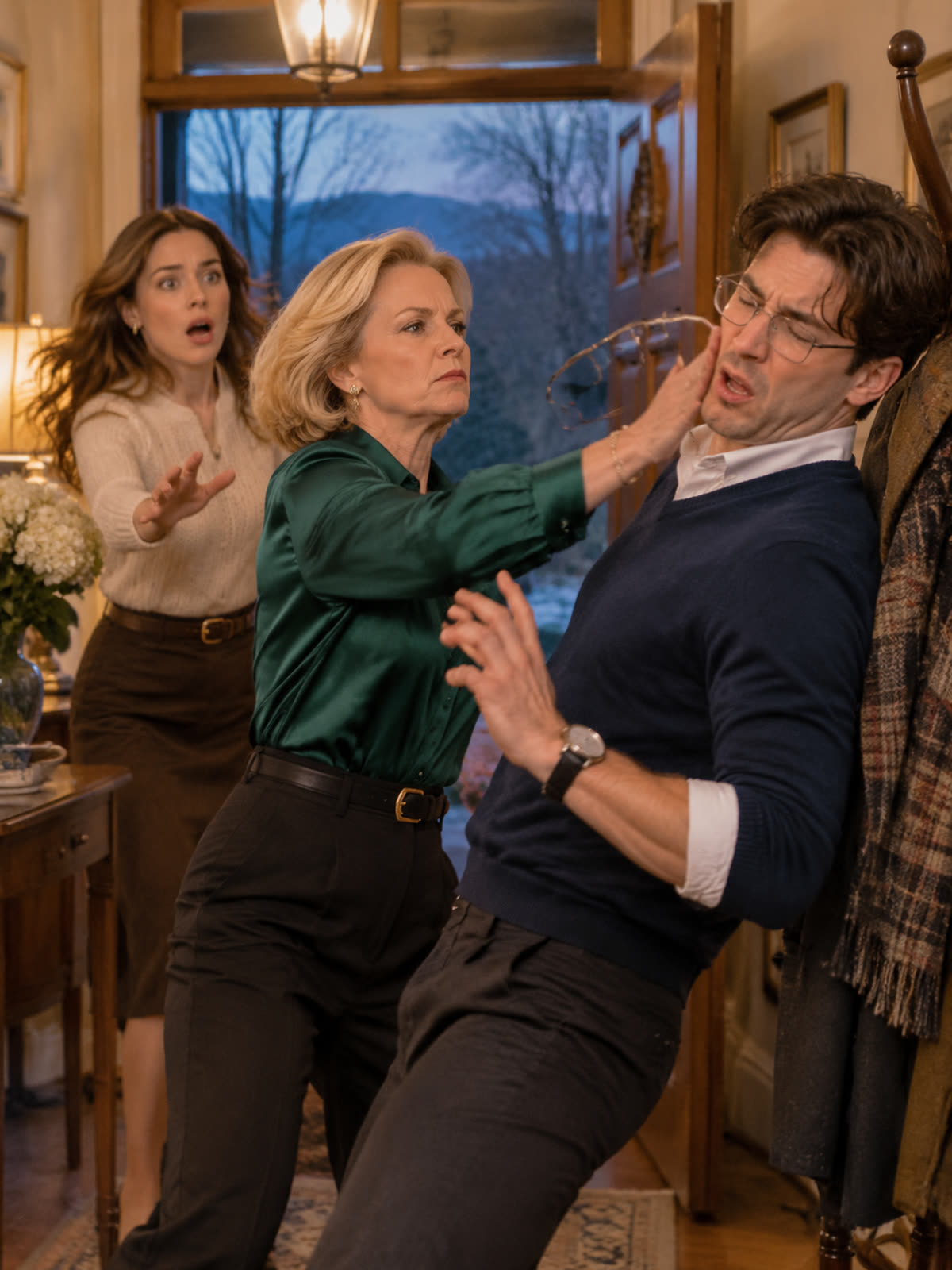
For a second, I could not move. Then she reached toward him again. “Get out!” I shouted. Mom looked at me. “Did you see him push me?” I answered, “He didn’t touch you!” She insisted, “He’s turning you against me!” I screamed, “GET OUT OF MY HOUSE!” She backed toward the door, pointed at Bennett, and said, “You’ll both regret what you’ve done.” He remained against the wall, breathing unevenly. His collar was stretched, a fine scratch marked his jaw, and one lens of his glasses had cracked. Less than two hours earlier, she had promised to respect our decisions.
“I’m so sorry,” I whispered. Bennett answered, “You didn’t hit me.” I said, “But I invited her.” He looked at me for a long time. “I told you I didn’t want her here.” I admitted, “I know.” His next words hurt because they were deserved. “I need you to listen when I say I don’t feel safe around someone.” We photographed his injury and saved Mom’s messages. I suggested the police, but he needed time. The following afternoon, his parents brought groceries, and his younger brother replaced the damaged coat rack. Nobody asked what Bennett had done to provoke her.
His father simply said, “You have every right to decide who comes into your home.” Watching them support him without demanding an apology nearly broke my heart. That evening, Bennett asked whether Mom had behaved this way before. Memories surfaced. At thirteen, Dad had offered me twenty dollars weekly for extra chores: cleaning bathrooms, folding laundry, and other work. Tessa complained that she was not receiving money. Mom ordered me to share. When I suggested sharing the chores, too, she refused. “Tessa has more activities than you.” I continued doing all the work and received half the pay.
At seventeen, I began working at a grocery store. By eighteen, I had saved enough for a used blue Honda Civic. Its air conditioner barely functioned, and the driver’s door clicked strangely, but I paid for the car, insurance, repairs, and gas. Then Tessa got her license. Mom called me selfish whenever I objected to her using it. Once, Tessa disappeared with it for six hours and left me unable to get to work. Mom said, “Your sister needs the car more than you do.” Eventually, she told me to surrender the car or find somewhere else to live.
I was eighteen, still in school, with nowhere to go. Dad handled the paperwork without meeting my eyes. Tessa drove away in the car I had worked eighteen months to buy. A few months later, she announced on my graduation morning that she did not want to sit through the ceremony. Mom decided making her attend would be unfair. Dad stayed home, too. Laurel and Phoebe brought flowers and cheered, but I kept scanning the bleachers for our parents. I smiled for photographs, then cried alone in a bathroom stall. At home, Mom casually asked whether I had enjoyed my day.
I told Bennett about the allowance, the car, graduation, and Dad’s reliable silence. He listened without interrupting. Finally, he said, “Willa, you grew up believing love meant surrendering.” Two days later, we visited the Fredericksburg police station. Bennett gave his account, and I supplied the photographs and Mom’s messages. An officer documented everything and explained our options if the harassment continued. Nobody promised an arrest. We wanted an accurate record before Mom created another version of events. Afterward, I called Dad. He said she had been emotionally overwhelmed. I asked whether that gave her permission to attack someone.
Then Dad said something that finally changed the way I understood him. “Your mother loves you, Willa. You just make it difficult for her sometimes.” He had watched her take my money, my car, my graduation, and now my peace. Still, he treated my refusal to surrender as the problem. For days, Mom sent furious messages accusing us of damaging her reputation. Nothing in them acknowledged Bennett’s injury or the fact that she had attacked him in our home. I kept working, saved the messages, and tried to absorb what setting a boundary had revealed about both my parents.
On Thursday evening, I finished a late shift at the clinic and walked toward my car. Someone called my name. Mom was standing beside the employee parking lot. “You’re going to withdraw that police report,” she said. I answered, “No.” Her expression tightened. “Don’t make me ask you twice.” I reached for my phone, and suddenly I felt eighteen again, watching her decide what I could keep. Before I could unlock the screen, her hand closed around my arm.
PART 3 — THE FAMILY I WOULD NO LONGER SURRENDER
“You’re going to call that police officer and tell him you exaggerated!” Mom said. “Let go of me.” She tightened her hold. “You’re destroying this family over a stupid argument!” I said, “Mom, you’re hurting me.” She shoved me toward the clinic entrance and struck my upper arm repeatedly, shouting that I was ungrateful. For an instant, I froze, my body remembering a frightened teenager. Then I shouted, “SECURITY!” Marcus Bell, the evening guard, hurried outside. “Ma’am, step away from her!” Mom released me. “This is my daughter. We’re having a private conversation.” He answered, “You’re on private property. You need to leave.”
Mom pointed at me. “She’s trying to have me arrested!” Marcus repeated, “Ma’am, step back.” My hands shook too badly to hold my phone. Police arrived within minutes. Jennifer confirmed seeing Mom grab me, and the entrance camera had recorded it. My supervisor, Dr. Harper Winslow, sat beside me during my statement. “Willa, no one has the right to come here and hurt you.” The clinic barred Mom from the property. The parking lot incident was referred for a misdemeanor charge; Bennett’s assault remained documented without a separate charge. Eventually, Mom accepted responsibility in court, received a fine, and was ordered to complete anger management classes.
There was no grand courtroom confrontation, only consequences for behavior our family had excused for decades. I began counseling. During my first appointment, I spent twenty minutes describing Mom’s good qualities: birthday cakes, care during illnesses, help after Laurel’s first baby. The counselor asked, “Why do you feel you have to prove your mother has good qualities before you’re allowed to describe how she hurt you?” I had grown up confusing honesty about cruelty with disloyalty. During one final call with Dad, I listed the allowance, car, graduation, proposal, and both assaults. He sighed. “We’ve all made mistakes.” I answered, “No,” then continued, “We haven’t all made the same kind of mistakes.”
“Willa—” Dad began. I stopped him. “I was wrong to slap Tessa. I admitted it and apologized. Mom assaulted Bennett and then came to my workplace and hurt me. Those aren’t misunderstandings.” He said, “Your mother is suffering.” I answered, “So am I, Dad.” Mom came onto the line. “I regret everything I’ve done for you!” Then, “After everything I sacrificed, you humiliate me in court? I wish I’d never had such an ungrateful daughter!” Bennett sat beside me as I replied, “Mom, I’m not going to let you hurt my family anymore.” She snapped, “Your family? We’re your family!” I said, “Bennett is my family, too.”
Afterward, I stared at the screen, grieving the mother I had spent my life trying to earn. Bennett let me cry. Six weeks later, I walked out of our bathroom on a Sunday morning holding a positive pregnancy test. He was making coffee and turned off the machine when he saw me. “Willa?” I could barely manage, “Are we…?” He crossed the kitchen in three steps and wrapped his arms around me. For the first time in months, our future seemed larger than the damage behind us. Still, pregnancy awakened fears about becoming like Mom or longing for her again if we had a daughter.
Counseling helped me separate those fears from what I could choose. Bennett reminded me that caring about our future child’s emotional safety was already a beginning. We told Laurel and Phoebe after the first appointment. Phoebe asked whether seeing our parents would harm her relationship with me. “Of course,” I said. “But please don’t share information about the baby.” She promised and kept that promise. I applied for a transfer to our clinic network’s Roanoke office. The pay was comparable, Bennett could work remotely most days, and his brother lived nearby. We rented a small house with a fenced backyard.
Its kitchen was dated, the hallway creaked, and the bathroom tiles were an unfortunate green. I loved it. No one there had demanded that I surrender something precious to prove I belonged. Laurel and Phoebe helped us pack while Bennett’s brother moved heavy furniture. We ate takeout pizza on the living room floor that first evening. Then we returned to planning our wedding. We abandoned the expensive reception and accepted his brother’s offer of a small ceremony on his family’s lakeside property. Our guests would be people who had supported us, not people who believed attendance was their entitlement.
Laurel would stand beside me, Phoebe would carry my bouquet, and Bennett’s parents would sit in the front row. Mom would not attend. The night before, I held my dress over my growing belly and faced the mirror. I had once imagined Mom helping me prepare. That would never be our memory. Then I turned and saw Laurel and Phoebe in the doorway. “You look incredible,” Laurel said. Phoebe wiped her eyes. “Don’t make me cry before tomorrow.” I realized I was not entering marriage without a family. I was entering it with the family that had chosen to love me properly.
We did not reserve empty chairs for my parents. Beside a quiet lake outside Roanoke, white flowers marked the aisle, lanterns hung from trees, and a breeze moved across the water. Laurel helped with my dress while Phoebe adjusted my hair and photographed everything. When I cried, she handed me a tissue. “Don’t ruin your makeup,” she said. Bennett waited beneath a wooden arch. Seeing me approach, he covered his mouth. I remembered him standing before my family while Tessa knelt at his feet and Mom filmed. Now he looked at me as though nobody else existed.
His voice shook during his vows. “Willa, I promise that you will never have to compete for my love. I promise to listen when you’re afraid, stand beside you when things are difficult, and build a home where being loved never depends on being perfect.” I was crying so hard that speaking was difficult. “I spent a long time believing love was something I had to earn. You taught me that real love doesn’t ask me to disappear. I promise to give you the same kindness, honesty, and safety you’ve given me.” We exchanged rings without speeches about family loyalty. Our marriage began with promises to each other.

A few months later, Evelyn arrived healthy, loud, and furious about her first bath. From the hospital bed, exhausted and overwhelmed, I watched Bennett hold her. “Hi, Evelyn,” he whispered. “I’m your dad.” I had never loved him more. Motherhood brought sleepless nights, endless laundry, and mornings when I could not remember my last proper meal. Bennett and I disagreed about chores, and we apologized. Whenever I looked at Evelyn, I reminded myself that her happiness would never be the price of my approval. She would not compete for affection or face abandonment as punishment. That was the home I intended to build.
For several months, my parents knew neither that we had married nor that Evelyn existed. Then a distant relative posted a wedding photograph, and someone mentioned her in a public comment. Mom created a new account and demanded access to her granddaughter, presenting forgiveness as something she was prepared to offer me. She still had not apologized for hurting Bennett or acknowledged attacking me outside work. I blocked her. A week later, Phoebe said Mom had demanded our address. She refused. When accused of disloyalty, she replied, “You don’t get to hurt people and then demand access to their children.”
Nearly eight months after Evelyn’s birth, Laurel called about a letter from Tessa. “Willa, I think you should read this one.” She sent a photograph of it. I expected excuses, but Tessa acknowledged that I had not stolen Bennett and that he had chosen me because he loved me. She admitted she had never wanted to marry him. She had wanted to prove she could make him choose her. Mom had encouraged that entitlement, she wrote, but she had been an adult, and her actions were her own responsibility. For once, she was not hiding behind our mother.
She apologized for trying to destroy my engagement, blaming me afterward, and treating my happiness like an insult. She asked for nothing and said I did not have to forgive her. I read the letter three times because I had never heard her accept responsibility without attaching a demand. A month later, I thanked her, acknowledged the apology, and explained that I was not ready for closeness. She accepted that. Our contact was nothing like the sisterhood I had once imagined, but when she asked about work or suggested coffee, I could answer honestly. I said I was not ready to meet.
I shared neither our address nor photographs of Evelyn. Trust would have to develop slowly, if it developed at all. This time, Tessa did not insist that I move faster. Dad occasionally sent word through relatives that he hoped we would reconcile. Mom continued describing herself as unfairly excluded from her grandchildren’s lives, but people no longer automatically believed her. Laurel and Phoebe stopped making excuses. Eventually, even Tessa told Mom she had caused much of the damage herself. Mom disliked hearing it, but for once, her displeasure did not make her daughters withdraw the truth.
The following spring, Phoebe married her longtime boyfriend. Mom used the wedding preparations to demand information about Evelyn. Phoebe warned her to stop, then withdrew her invitation when she persisted. Dad refused to attend without her. My youngest sister married without either parent. Before she walked down the aisle, I recognized the grief in her face. “You’re allowed to be happy today,” I whispered. “I know.” At the reception, Laurel’s children chased each other while Bennett held Evelyn asleep against his shoulder. Tessa was there, too. We acknowledged each other without another fight. It was not a repaired childhood, but neither was it another ruined celebration.
A year after our wedding, Bennett and I celebrated at home. Evelyn had just learned to walk. Carrying a stuffed rabbit, she tottered across the living room, landed on her diaper, and laughed. Bennett laughed with her while I watched from the couch, filled with an ordinary happiness that almost hurt. No shouting, no demands that I apologize for someone else’s behavior. Bills waited on the counter, clothes turned in the dryer, and dishes sat in the sink. Bennett joined me and took my hand. “Do you ever wish things had turned out differently?” he asked.
I thought about my sister, our original wedding plans, and the family relationships I had lost. “Sometimes I wish they’d been different people,” I admitted. “But I don’t wish we’d stayed.” Evelyn raised her rabbit and shouted, “Mama!” Then she wrapped her arms around my neck, entirely certain I would hold her. Mom had taught me that love could disappear whenever I disappointed her. Tessa had learned to treat it as a prize someone else might take. Dad had confused avoiding conflict with protecting his children. I could choose something different inside my own home.
My sister had knelt before my fiancé believing one public question could take my future away. Instead, his answer forced me to confront the people I had spent my life trying to satisfy. It cost relationships I once thought I could not survive losing and exposed truths I had been afraid to name. It also brought me to a family where nobody needed to lose for someone else to feel loved. Looking at Bennett and Evelyn, I knew Tessa had not stolen my future. She had shown me who deserved to share it. Whether she would ever earn a place in that future was the question still waiting for an answer.
Disclaimer: This story is a work of fiction inspired by real-life themes. Names, characters, places and events are fictionalized, and any resemblance to real persons is purely coincidental. Images are for illustration purposes only.
