

PART 1 — The Children Beneath the Shelter
My name is Spencer, and underestimating Bridget was how I brought my own life crashing down. That afternoon, a diamond ring rested inside my coat pocket. A restaurant table had been booked, champagne was ready, and Sloane Whitaker was waiting for me. I had practiced asking her to marry me until the words hardly required thought. Everything about the evening appeared settled. Then, on my way toward the future I had arranged so carefully, I caught sight of my former wife.
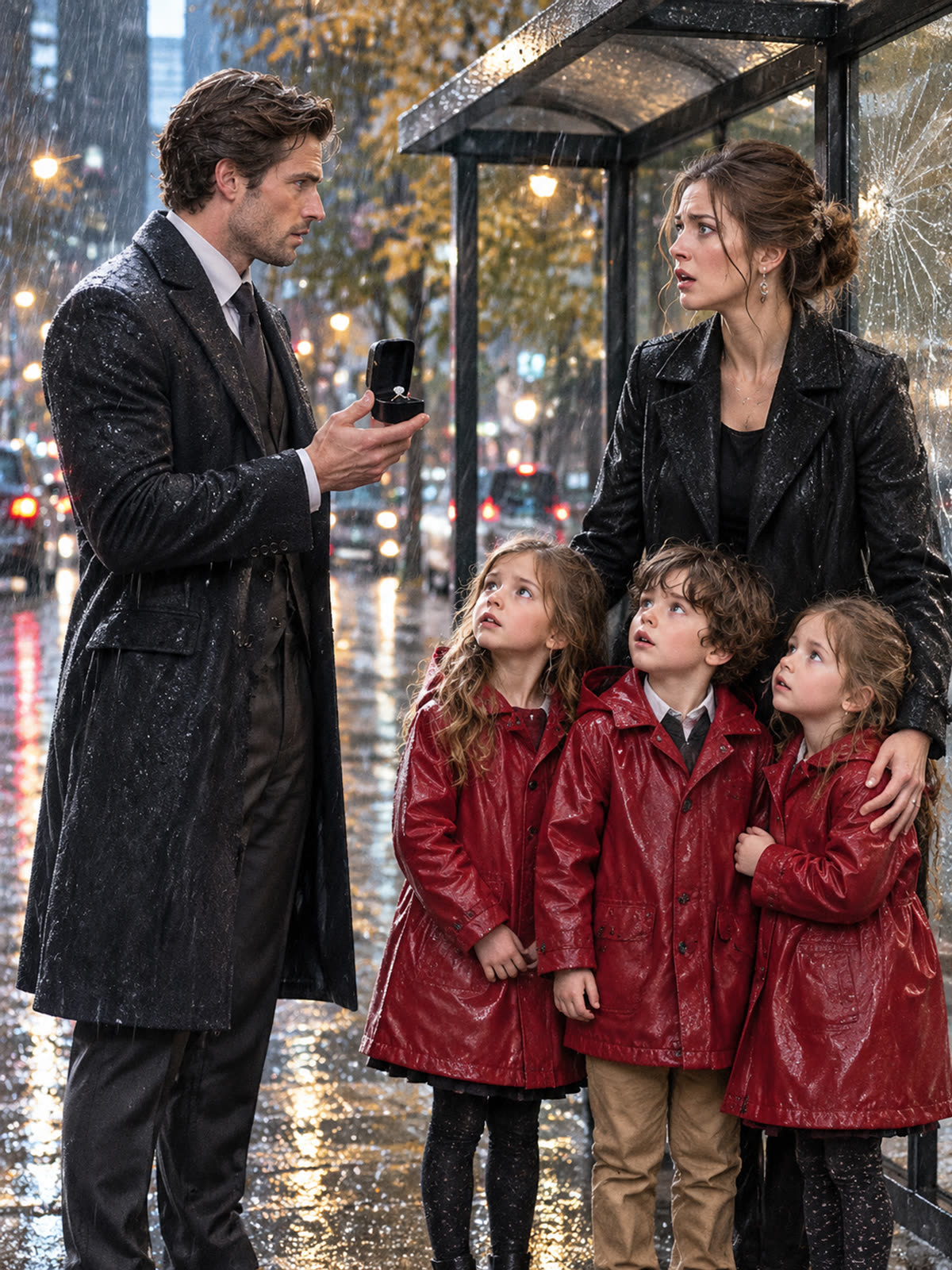
Bridget was standing beneath a damaged bus shelter, wearing a thin black coat that the rain had already penetrated. Three little children pressed against her legs, their matching red raincoats gathered close around her. My steps stopped before I had decided to stop them. She turned, and our eyes met. The color immediately left her face. “Spencer.” Hearing my name in her voice tightened something inside my stomach. It was not surprise I heard. She sounded frightened, and before I could ask what was wrong, she drew the children nearer.
Then the boy lifted his face toward mine, and my heart seemed to stop. His eyes did not merely resemble mine. They were mine: gray-blue, solemn, unmistakable. Even the small angle at which he held his head felt familiar. I knew it from photographs of myself as a child, from the face I had looked at in mirrors for thirty-eight years. I studied the girls next. One carried Bridget’s gentler features. The other had a determined little smile I recognized from generations of men in my family.
My hand moved into my pocket and found the velvet ring box. Everything I had planned lay against my fingers, while three children I had never heard of stood only ten feet away. I looked back at Bridget. “How old are they?” Her gaze flickered toward the road. For a moment, I thought she might give me something other than the truth. Instead, she lowered her voice. “Three.” The calculation came immediately, before I could brace myself for its meaning. Our divorce had become final almost exactly three years before.
Looking at them brought the closing months of our marriage back with painful clarity. Bridget had been exhausted, sometimes falling asleep before we ate. She had cried over things I had waved away as ordinary stress. She had asked me to remain at home and pleaded with me to refuse another business trip. I had gone anyway. There was always a meeting that mattered, a flight I could not miss, another deadline waiting somewhere beyond our apartment. I had called her too emotional and promised a conversation when I returned.
My family had never believed she belonged in the life I was creating. When she told me their behavior made her feel unwanted, I insisted she was imagining it. As the distance between us grew, I held her responsible. After she left, I settled on the explanation that our marriage had simply run its course. Now I stood facing three small children, and that comfortable version of our past was falling apart. “Bridget…” She interrupted immediately. “Please don’t.” I moved closer. “Are they mine?” She became completely still beneath the pounding rain.
One of the girls reached for her hand. Bridget looked down at the child, then turned her eyes away from me without answering. Somehow, that silence wounded me more deeply than an admission could have. A bus came around the corner, and she began gathering the children at once. “I have to go.” The answer left me before I considered it. “No.” Her eyes flashed. “I’ve already lost too much, Spencer.” The doors folded open, and she hurried the children aboard. The boy was last, turning back before the doors closed.
My own eyes looked out at me from his small face. Then the bus moved away. My phone vibrated with a message from Sloane asking where I was because everyone was waiting. I opened the velvet box, and the diamond reflected the dull afternoon light. Only an hour earlier, it had represented the life ahead of me. Now I could not even be certain I understood the life behind me. I watched the bus disappear among the cars, knowing the proposal would have to wait. Everything would have to wait.
There were three children on that bus who might be mine, and Bridget knew why I had spent three years unaware of them. I followed it. Twenty minutes later, it stopped outside a large building. She stepped down with the children, and I parked on the opposite side of the street. Then I read the sign. Every other thought vanished. They had come to a children’s medical center. Until that instant, I had believed the most frightening question was whether I was their father. Suddenly, I understood there might be something worse.
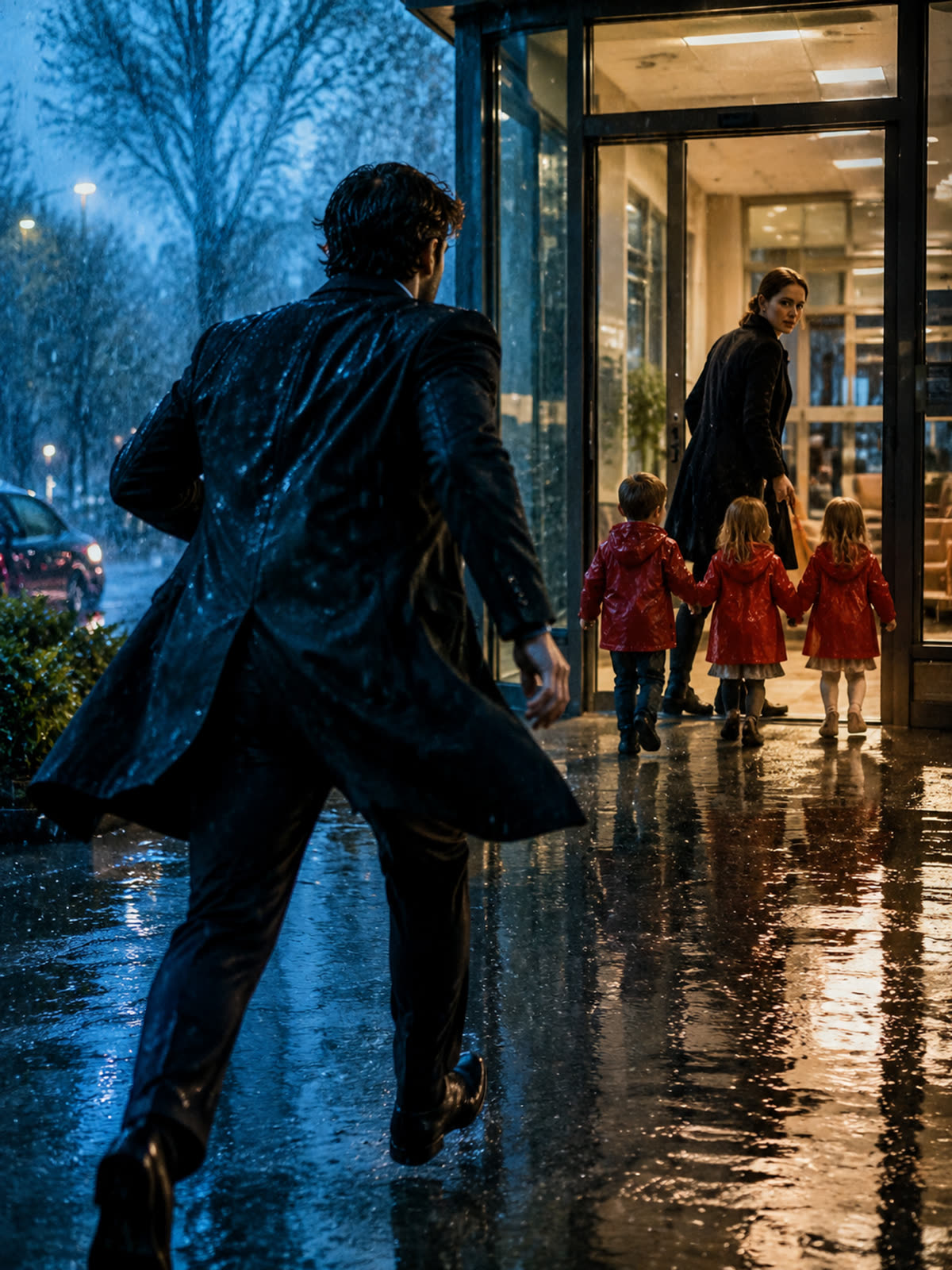
The heavy glass entrance of St. Anne’s opened, admitting Bridget and the children into the bright lobby. I switched off the engine, pushed my car door wide, and ran across the rain-slick asphalt. Cold water worked through my suit, but I hardly noticed. Through the glass, I could see them disappearing into a world of anxious parents and hospital staff. I reached the doors with my thoughts racing ahead of me. Whatever had brought them here was no longer something I could watch from across the street.
Inside, nurses maneuvered IV poles past waiting families while cartoons flickered across television screens for unsettled toddlers. I searched the lobby until I found them near a triage desk. A nurse dressed in dark-blue scrubs had crouched beside the boy and was offering him water in a small plastic cup. Bridget stood close, struggling to retrieve an insurance card from an old leather wallet. Her hands were shaking. The sight made the questions gathering inside me feel suddenly inadequate, almost unbearably small beside whatever she was facing.
I started toward them, my heart striking hard against my ribs. Each step seemed to require more effort than the last. What could I possibly say? “Surprise, I’m the father you never knew about?” How did someone apologize for three missing years when he had not even understood they were being taken from him? How could I face Bridget knowing she had carried these frightening moments alone while I had gone on attending dinners and building a life among people who had never needed anything difficult from me?
Before I reached them, a pediatrician carrying a thick manila folder appeared from Hallway B. “Ms. Keller?” His voice carried across the lobby. Bridget turned immediately, every part of her rigid with fear. “I’m here. Doctor, how are the labs? Is Milo’s fever breaking?” Milo. The little boy had a name now, and hearing it made him more real in a way I could hardly withstand. My son. The thought came with a certainty that had arrived long before anyone had offered me an answer.
The doctor approached and rested a reassuring hand on her shoulder. Under the unforgiving hospital lights, I could see how hollow her cheeks had become. Her lips were pale, her eyes shadowed by an exhaustion so deep it made my chest ache. “Let’s talk in my office, Bridget,” he said, looking toward the children. “Bring the little ones. Nurse Dolores can set them up with some coloring books in the consultation room.” She nodded without speaking. Her knees weakened briefly, and she steadied herself against the nurses’ station.
I moved out from behind a tall pillar before I could reconsider. “Bridget.” She stopped. Even the doctor’s grip on the folder shifted as she slowly turned toward me. Her brown eyes widened in horror. I could feel water dripping from my hair, and my expensive Italian suit was soaked beyond saving, but I had no attention left for either. Whatever was happening inside me must have been written plainly across my face. I had followed her into the hospital, and now there was no pretending we had merely passed each other.
“Spencer,” she breathed, almost too quietly to hear beneath the intercom. “What… what are you doing here?” The doctor watched me with open curiosity, but I could not make myself explain to him. I had spent the journey behind that bus watching its windows, imagining the children inside, measuring three years against every memory I had trusted. Now they stood directly in front of me again, looking up with those wide gray-blue eyes. Bridget waited, pale and trembling, while I tried to make the question come out steadily.
“I followed you,” I said. I stepped nearer, my attention shifting between her and the children. “You didn’t answer my question back at the bus stop, Bridget. And you’re not walking away this time until I get an answer. Are these my children?” Nothing about the lobby seemed to move normally after that. The other families remained around us, the hospital carried on, but my whole world had narrowed to Bridget’s face and the answer she had already refused to give me beneath the shelter.
What little color remained in her cheeks disappeared. For one terrible moment, I thought she would collapse. She swayed backward, and I reached instinctively, catching her by the elbows. The fabric of her coat was wet beneath my hands. After years without touching her, that brief contact felt startlingly familiar and utterly wrong at the same time. I had stepped toward her as though I still had some right to steady her, without knowing what she remembered whenever she looked at me.
She pulled away as though my touch had burned. Fury blazed through the exhaustion in her eyes, sudden and fierce enough to stop me where I stood. I had seen Bridget hurt during our marriage. I had watched her become distant, watched her cry, watched her struggle to make me hear her. I had never seen her look at me like this. The silence that had frightened me at the bus shelter was gone. Something far more devastating was about to take its place.
The children remained close to her, and the doctor stood beside them with the folder in his hands. My question hung between us, stripped now of any hope that an answer could be simple. Bridget looked at me with a rage that seemed to contain every unanswered call and every evening I had chosen to be elsewhere. I had come demanding to know whether I was their father. Standing in front of her, I began to understand that she had a question for me, too: where I had been when she needed one.
PART 2 — The Letter I Never Wrote
“Your children?” Bridget gave a broken, humorless laugh. “You have a lot of nerve calling them your children, Spencer. Where were you three years ago when I sat on the bathroom floor of that empty apartment bleeding and terrified, dialing your office number four times while your secretary told me you were unavailable because you were closing a multi-million-dollar acquisition in New York?” Each word struck with enough force to leave me struggling for air. I had demanded an answer without understanding what answering would cost her.
“Bridget…” I stumbled back half a step. “I… I didn’t know. You never told me you were pregnant when you left—” Her voice rose and cracked. “Of course I didn’t tell you!” Tears spilled down her cheeks. “I tried to tell you for six months before I left! I tried to tell you every single night when you came home smelling of perfume and scotch! But you were too busy looking at your phone, too busy telling me I was ungrateful, too busy building an empire that didn’t have room for a wife who was falling apart!”
People across the lobby had begun looking at us. The pediatrician moved between Bridget and me, his expression hardening. “Ma’am, do you need security? Is this man harassing you?” She pressed trembling fingertips to her forehead and struggled to slow her breathing. “No,” she whispered. When she looked up again, the coldness in her eyes was more devastating than her shouting. “No, Doctor. He’s not harassing me. He’s just a ghost from a life I buried three years ago.”
She turned away from me. “Dolores, please take the children into the playroom.” Milo caught the edge of her soaked coat and studied me with the same searching curiosity I recognized in myself. “Mommy, who is that man?” A painfully tender smile crossed her face as she looked at him. I could not remember seeing that smile directed at me during the last days of our marriage. “Nobody, sweetie,” she whispered, her voice breaking. “Just a stranger. Come on.” Then she walked down the corridor, leaving me motionless in the lobby.
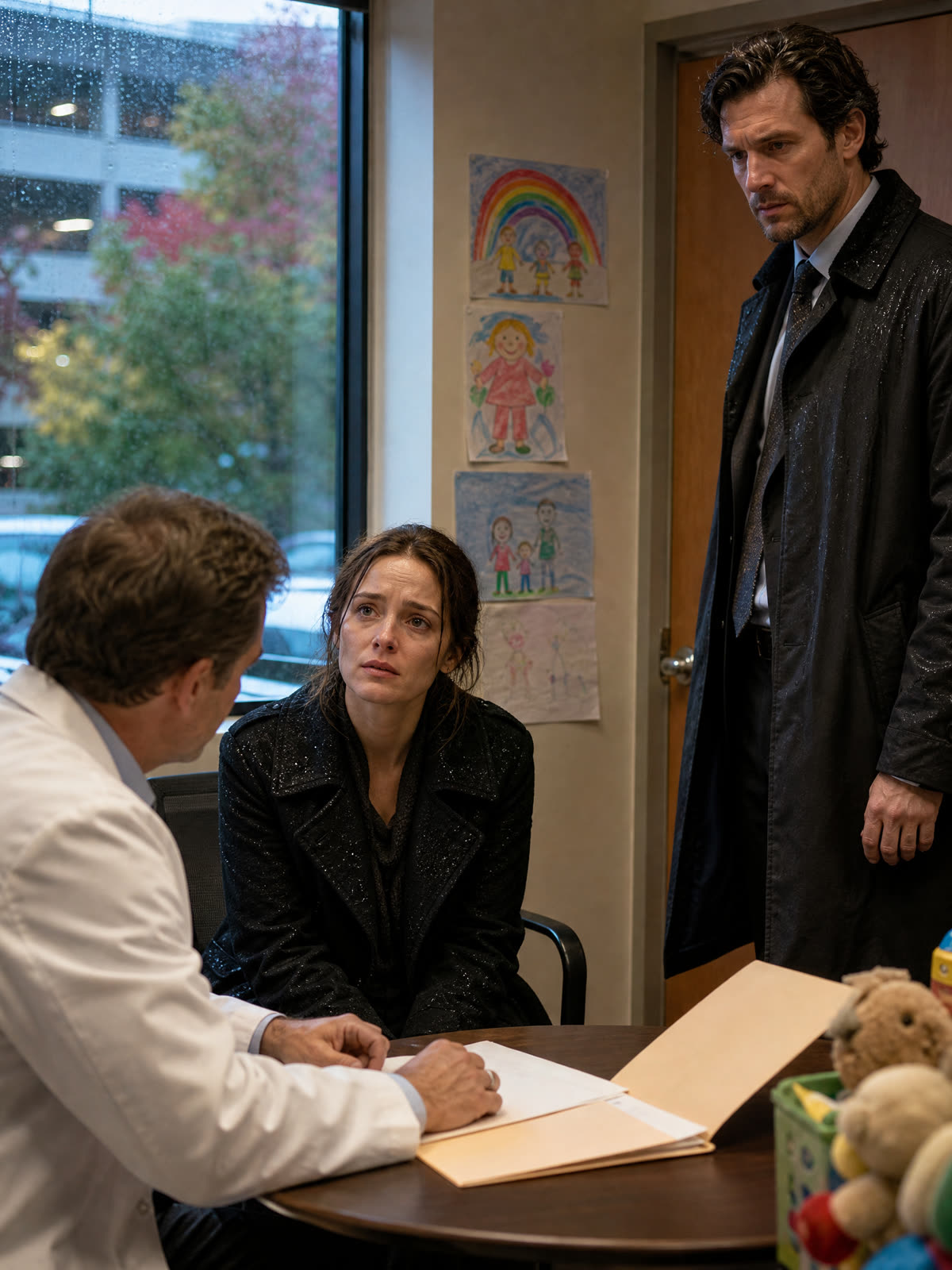
By the time we reached Dr. Abel Rosen’s office, Dolores had taken the children to the playroom. The room was small and warm, with a window facing a parking structure and children’s drawings displayed along one wall. Bridget lowered herself into a visitor’s chair without removing her dripping coat. I remained beside the door. She had not ordered me out, but I did not trust my legs to carry me to a seat. Learning that the children were mine had begun to feel like the opening of something much worse.
“Ms. Keller,” Dr. Rosen said, looking briefly toward me, “are you comfortable discussing this with him present?” Bridget did not raise her eyes. “He can stay,” she said. “He’s going to find out anyway.” The doctor opened the thick folder. The permission offered no comfort. I was being allowed to hear something she had already been living with, something important enough to have brought her through that rain with three small children and hands that would not stop trembling.
“Milo’s fever isn’t the problem. It’s a symptom. His blood counts have been falling for four months, and the bone marrow biopsy confirmed it last week. He has severe aplastic anemia. His marrow has stopped producing healthy blood cells.” For an instant, the room seemed to tip beneath me. I had only just learned my son’s name. Now a doctor was describing what was happening inside his body, calmly opening a folder that held months of fear I had known nothing about.
“Is it treatable?” I asked. “Yes. The best treatment is a bone marrow transplant from a well-matched donor.” Dr. Rosen turned toward Bridget. “We tested both of his sisters. Neither is a close enough match. And the national registry hasn’t produced a donor yet.” The boy in the lobby had looked small beneath his red raincoat, but nothing about seeing him had prepared me for this. His sisters had already been tested. Bridget had already waited for answers. Their lives had been moving through this emergency without me.
“He needs a parent,” Bridget said quietly. At last, she met my eyes. “A parent can be a partial match. Milo’s father is the only one left who might work.” I caught on one word. “Left?” Her answer came without softness. “My parents are gone, Spencer. I’m not a match. I’m the one who gave birth to him, and I’m not even that.” The helplessness beneath those words was unbearable. For three years I had not known I had a son; she had been trying to save him.
Then she answered the question I had been carrying since the shelter. “I didn’t come to the bus stop to find you. I came because it’s the only stop near the hospital that doesn’t require a transfer. I’ve been praying for three months that I wouldn’t have to call you.” She sat across from me with the medical file open between us, and the last possibility that our meeting had been planned disappeared. I had not been summoned. I had simply crossed her path when she was running out of choices.
“Why?” I asked. “Because the last time I tried, you made it very clear.” I could not reconcile those words with anything I remembered. “I never made anything clear,” I said. “I didn’t know.” She studied my face for a long time. Her expression shifted slowly, as though something she had believed for years no longer fitted what she was seeing. “You really didn’t,” she said slowly. It was not forgiveness. It was the first sign that we might have been living inside different versions of the same loss.
She explained in the hospital cafeteria, with two cups of tea cooling untouched between us. Nine days after leaving our apartment, she had learned she was pregnant with triplets. She had called my office four times and been told I could not speak. Calls to my cell had reached voicemail. On the fifth day, with nowhere else to turn, she had taken a bus to my mother’s house in Lake Forest. While she spoke, I tried to hold those days beside the life I remembered living through them.
“Lorraine let me in,” she said. “She poured me tea. She listened to everything. I remember thinking she was kinder than I had ever given her credit for.” My jaw tightened. “What did she say?” Bridget kept her attention on me. “That she would talk to you herself. That I should go home and rest. And two days later, a courier brought an envelope to my sister’s house.” My mother had known. Before Bridget even described the envelope, that fact had begun changing everything I thought I understood.
“What was in it?” I asked. “A letter on your company’s stationery, signed with your name. It said you were aware of the pregnancy and wanted no involvement. It said any attempt to contact you would be treated as harassment. And there was a check.” Her laugh contained no humor. “Two hundred thousand dollars, with a nondisclosure agreement attached.” I stared at her. “I never wrote that.” She nodded. “I know that now. I think I knew it then, too, but you’d spent so long telling me I was imagining things. It was easy to believe you’d hardened that much.”
I remembered my mother’s hand resting on my shoulder at our wedding, remembered her telling me Bridget was lovely but not for us. For three Thanksgivings, she had sat across from me and gently asked whether I was seeing anyone. All that time, she had known what Bridget had been told. “I tore up the check,” Bridget said. “I’ve never touched a dime from your family. I worked two jobs while I was pregnant, and I’ve worked ever since. I’m a dental hygienist. It’s not much, but it’s mine.”
“Bridget.” My voice broke. “I would have been there. I swear to you, I would have been there.” Her eyes shone. “I want to believe you,” she said. “But right now, I only have room for one question.” I could not give her back the years. I could not make my earlier indifference disappear simply because someone else had written that letter. But there was one answer I could give without hesitation. “Ask me.” She looked straight at me. “Will you get tested for Milo?”
“Yes,” I said, already rising. “Yes. Now.” The results took four days. I had never known time to move so slowly. During that wait, I did three things. The first was calling Sloane and asking her to meet me at a quiet coffee shop in River North. I told her everything while she listened without interrupting, her hands wrapped around her cup. There was no way to explain the ring in my pocket without explaining the three children and the woman I had failed long before that afternoon.
“I’m so sorry,” I said. “I was less than an hour from proposing to you. I should have told you sooner that there was something unresolved in my past, and I didn’t even know what it was. You deserved better.” Sloane remained quiet for a long moment. I had arrived prepared to explain the collapse of the future we had been approaching. I had not imagined there was something about its beginning that she needed to explain to me.
“Spencer, I need to tell you something. Your mother introduced us. She sent me three emails before we ever met. She told me what restaurants you liked and what to wear.” Sloane gave a weary little smile. “I thought it was sweet. I think I knew, a little, that it wasn’t. I wasn’t in love with you. I was in love with the idea of belonging somewhere.” My mother’s influence had reached into this relationship, too. Even the future I believed I had chosen had been quietly arranged.
“I never meant to hurt you.” Sloane answered gently. “You didn’t,” she said. “Go be a father.” There was no proposal after that, no return to the evening I had rehearsed. What remained was a child waiting for a donor, a woman who had been sent away in my name, and a letter carrying a signature I had never written. My mother had spent three years asking about my life while keeping my children outside it. Now I was going to place that letter in front of her.
PART 3 — What It Means to Show Up
The second thing I did during those four days was visit my mother. She received me in the sunroom, dressed in a pale-blue cardigan, with a silver tea service arranged on the table. I brought the nondisclosure agreement Bridget had kept in a drawer for three years, along with the letter bearing my forged signature. I placed both on the glass tabletop. They looked painfully ordinary there. Paper and ink had been enough to persuade Bridget that I wanted nothing to do with the children she was carrying.
My mother examined the pages for a long time. I watched her, waiting for a denial, an explanation that might somehow change what I had learned. She offered no denial. “I was protecting you,” she said at last. The words made the distance across the table feel enormous. “From my own children?” I asked. I had spent years accepting her guidance as concern, overlooking the judgments underneath it. Now the cost of that acceptance had names: Milo, Tilly, and Greta.
“From a woman who left you. From a life that would have ended your career.” Her voice trembled. “Spencer, you were thirty-five, and you were building something extraordinary. I thought it was a mistake.” I thought of Bridget working through her pregnancy, of the children gathered beneath the damaged shelter, of Milo accepting water from a nurse. The life my mother had decided would ruin mine had gone on without me. She had watched that happen and still believed protection was the word for what she had done.
“Milo is three years old and he has a blood disease,” I said. “He might die. And you knew about him the entire time.” For the first time I could remember, she began crying without first gathering herself into something composed. “I didn’t know he was sick,” she whispered. There it was again: an answer that avoided the thing I had actually said. “That’s not an answer.” She looked at me through her tears. “No,” she said. “It isn’t.”
I stood. “I’m not going to scream at you. I’m going to ask you to stay away from them until I decide otherwise. And if you ever contact Bridget again without her permission, I’ll sever this family so completely you’ll never find the seams.” I had no wish to spend the moment raising my voice. There was nothing shouting could restore. What mattered now was that she understood the boundary and that Bridget would not once again have to defend herself against decisions made without her.
The third thing I did was give blood and wait. I had already answered Bridget before she finished asking whether I would be tested, but willingness could not determine the result. For four days, I lived with the possibility that I might finally have an opportunity to help my son and still be unable to do what he needed. The lost years could not be repaired by a test. Neither could the nights I had dismissed his mother. But the test might give him a future.
Dr. Rosen called me into his office on a Thursday morning. Bridget was already sitting beside his desk. Seeing her there brought back the first time I had entered that room, dripping rainwater and hardly able to understand the words in Milo’s medical file. There had been no certainty to offer her then, only questions and a promise to be tested. Now the result existed, and whatever the doctor was about to tell us would determine whether that promise could become something more useful.
“Mr. Pierce,” he said. “You are a half match. In transplant terms, that’s called haploidentical. It’s not perfect, but with modern protocols, it’s a very good option. Success rates are strong.” I heard each part of the explanation, trying to take it in without losing the meaning underneath. There was an option. After the tests on Milo’s sisters and the unsuccessful search of the registry, there was something the doctors could use. I had arrived three years late, but this time I had not arrived with nothing.
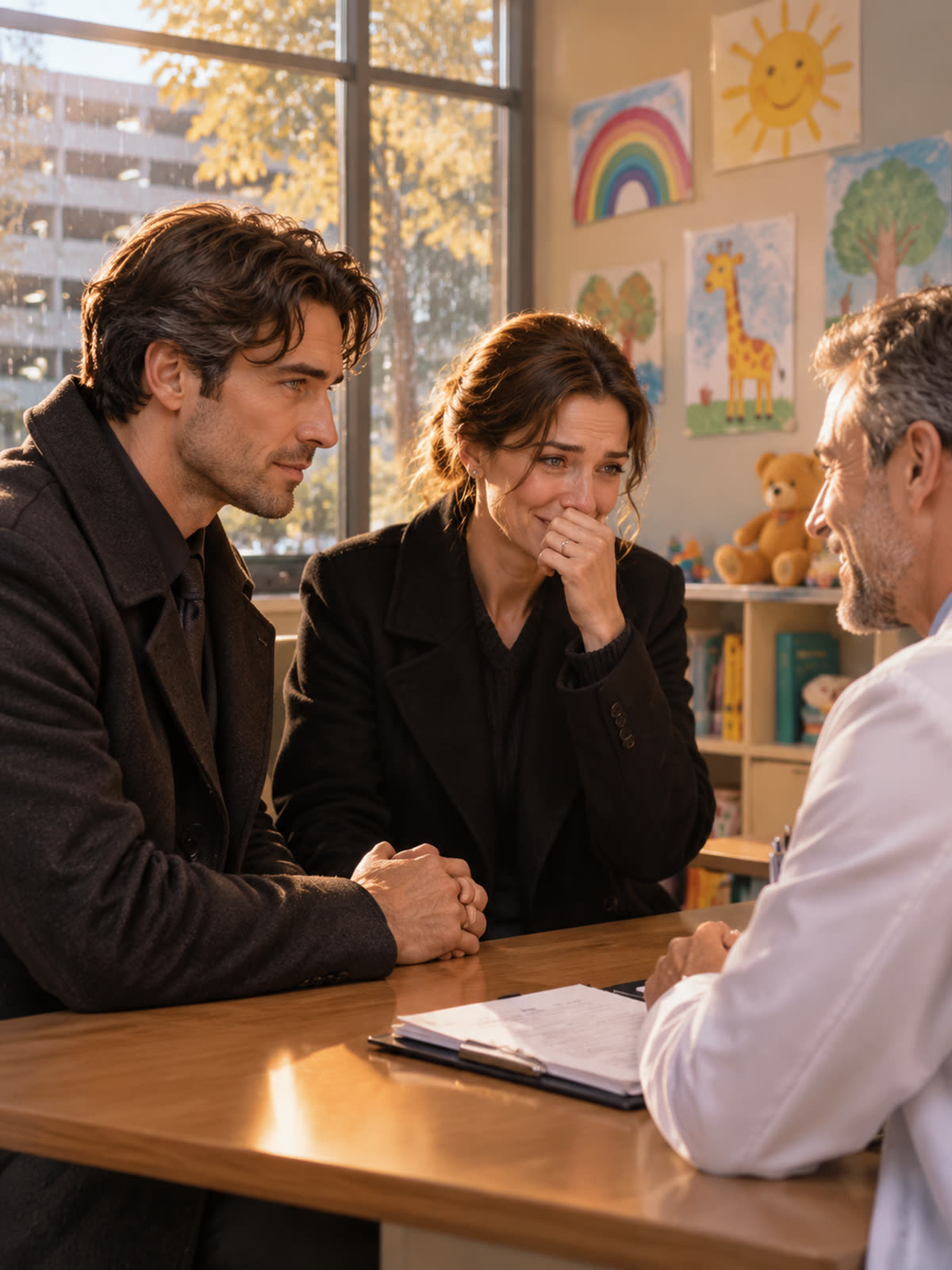
Bridget made a small sound and lifted a hand over her mouth. I reached toward her, then stopped. The memory of her pulling away in the lobby remained too clear for me to assume that relief gave me permission to touch her. She looked down at my hand. Slowly, deliberately, she placed hers in it. It was a small movement, but after everything we had said to each other, I understood how much care it required.
Her hand remained in mine while we faced the doctor together. Nothing about it erased the past. The forged letter still existed, the years were still gone, and Milo was still ill. But the answer we had waited four days to hear was no longer hidden in a laboratory. “What do you need me to do?” I asked. Dr. Rosen smiled. “Show up,” he said. “The rest is our job.” For once, what was being asked of me could not have been clearer.
The transplant happened in December. After the procedure, I spent two days in the hospital, sore and groggy, with a narrow bandage over my hip. I had spent so much of my earlier life treating every demand as something to schedule around work. This time, there had been no competition between obligations, no meeting that seemed more urgent, no flight I needed to catch. My son was in the same hospital, and being there was the only thing that mattered.
On the second night, Bridget came into my room carrying Tilly, who was asleep in her arms. “He’s in the ICU unit,” she whispered. “The nurses say the first signs look good.” I wanted to see him immediately. “Can I see him?” She answered quietly. “Tomorrow.” Then she sat on the edge of my bed and settled a blanket around our daughter. The sight of them there was gentler than anything that had passed between us since the rain-soaked afternoon outside the shelter.
“Spencer, why did you do it so fast? You didn’t even ask what it would cost.” Her question surprised me, though I understood the years behind it. She had known a husband who could make her wait for a conversation, who could leave her frightened and call her emotional. Now she was looking at me as though trying to understand an answer I had given without calculation. “Because he’s my son,” I said. “I would have done it before I even knew his name.”
She watched me for a long while, tears bright in her eyes. “I had a speech prepared,” she said. “I rehearsed it for three years. All the things I was going to say if you ever came back. I don’t remember a word of it.” I had rehearsed a speech, too, before the afternoon we found each other again. Mine had belonged to a restaurant table and a ring box. Hers had been shaped by three years of being left to believe I had chosen not to know my children.
In January, Milo’s blood counts began rising. By March, he was home. By June, he raced along the hallway of Bridget’s small rented house, gripping a plastic fire truck in each hand while Tilly and Greta chased him, shrieking with laughter. His doctors warned that he would need years of monitoring. Still, there was another word they used carefully, with a small smile: cured. Hearing it did not make the months before it disappear, but it changed what we could imagine beyond them.
I did not move into the house. Bridget would not have permitted that, and she was right. Instead, I rented a modest apartment ten minutes away and began learning the ordinary details I had missed. I learned her neighbors’ names. I learned that Tilly despised peas, that Greta insisted on wearing blue, and that Milo required three bedtime stories. Two would never pass unnoticed. These were not the large, impressive things I had once believed made a life. They were the things my children expected me to remember.
Every Saturday, I came with groceries and a toolbox, because the back step needed repairing. For eight months, Bridget and I treated each other with careful kindness. We were courteous without pretending the damage had vanished, two people separated by a broken bridge and not yet ready to trust its boards. I could not repair that distance by insisting I had changed. The only thing available to me was to keep arriving, keep listening, and allow her to decide what my presence meant.
One evening in October, she brought me coffee on the back porch and sat beside me. “I’ve been thinking about what you said in the hospital,” she said. “About how you would have been there.” I answered, “I would have.” She looked toward the sky. “I know.” Then she continued. “I think I forgave you somewhere around the second month. Not for what happened. You didn’t do it, your mother did. I forgave you for the years before that, for the nights I waited and you didn’t come home.”
“I don’t deserve that.” A slight smile touched her face. “No,” she said. “But I’m giving it anyway.” For a while, I could not speak. I looked at the fire trucks scattered across the grass and the three little coats hanging beside the door. “I’m not asking you to marry me,” I said finally. “I don’t think I’ve earned the right to ask. I only want to keep showing up, for as long as you’ll let me.” She answered, “That’s the right answer,” and rested her head against my shoulder.
The porch light switched on. Inside, Milo called to ask whether it was time for his third story. I thought of the ring box in my rain-soaked coat, of the future I had planned without considering what I had left behind. I had believed that building something big enough would make everything else follow. Now I stood and offered Bridget my hand. “Come on,” I said. “He’ll know if we skip it.” She took it, and we went inside—where our son was waiting for the story that still had to be told.
Disclaimer: This story is a work of fiction inspired by real-life themes. Names, characters, places and events are fictionalized, and any resemblance to real persons is purely coincidental. Images are for illustration purposes only.
