

PART 1 — The Child Still Waiting
At 5:52 on Christmas Eve, my phone rang while I was in the kitchen making dinner for the family I thought was whole. Emma, my nine-month-old daughter, occupied herself with a wooden spoon in her high chair. In the next room, my husband, Patrick, was rearranging the white lights on our Christmas tree. A light covering of snow lay across our quiet Massachusetts neighborhood, and the houses outside shone with that reassuring warmth I had always associated with Christmas. Then I glanced at the name on my phone: Cedar Ridge Preparatory School.
Cedar Ridge was the private boarding school in southern Vermont where my fourteen-year-old stepson, Benjamin, had been studying since September. I answered with the familiar uneasiness of a parent receiving an unexpected school call. “Mrs. Bennett? This is Dr. Martin Fletcher, the head of Cedar Ridge. I’m sorry to disturb your holiday, but we need to discuss Benjamin’s transportation.” At first, I thought someone had confused the arrangements. Patrick had told me more than once that Benjamin preferred spending Christmas at school with his friends rather than coming home to a household centered on a baby.
“I’m not sure I understand,” I replied. “My husband said Benjamin was staying for the winter program.” A brief hesitation followed. “Our holiday program ended at noon, Mrs. Bennett. Every other student has already gone home. Benjamin has been waiting for his father since lunchtime.” From the kitchen, I could see Patrick humming to a Christmas song while shifting a silver ornament. “Are you saying he’s there by himself?” I asked. “He’s with our staff, and we’ve made sure he’s comfortable, but yes, he’s the last student on campus. His father confirmed yesterday that he would collect him at twelve.” I stared at the clock. Almost six hours had passed.
For nearly six hours, a fourteen-year-old had waited for his father to keep a promise while that father stood comfortably in our living room decorating a tree. I thanked Dr. Fletcher, asked him to stay with Benjamin, and entered the living room with the phone against my chest. Patrick noticed my expression. “Everything okay?” “Benjamin is still at school.” Surprise crossed his face, followed so quickly by something resembling fear that I almost missed it. “What are you talking about?” “He’s been waiting for you since noon. The headmaster says you promised to pick him up.” He lowered the ornament. “Elise, this is complicated.” “What’s complicated about picking up your son?”
Patrick looked at the tree. “He’s fourteen. He’s old enough to understand that sometimes plans change.” I struggled to recognize the man I had married three years earlier—the father who checked Emma’s temperature when she seemed too quiet and worried whether her blankets were warm enough. “Did you know he was waiting?” He offered no answer, which was answer enough. I returned to the phone and told Dr. Fletcher I was on my way. Patrick followed as I reached for my coat. “It’s Christmas Eve, Elise. The school’s almost two hours away.” “Then I should have left six hours ago.” “Couldn’t they keep him there until morning?” I looked at him, unable to understand how one child’s loneliness could seem like an inconvenience to someone so tender with another.
“I’m going to get Benjamin. You’re staying here with Emma.” I gave Patrick her bottle, told him where to find her pajamas, and collected my keys. Before I opened the door, he tried once more. “Please don’t go up there. You’re only going to make everything harder.” I turned. “Harder for whom?” Again, he had nothing to say. As I drove into the December darkness, his reluctance stayed with me. I kept wondering what he was so anxious for me not to discover. The highway was quiet, interrupted by approaching headlights and the soft glow of small towns beyond the trees. I left the radio off.
I pictured Benjamin near the entrance of an emptying school, checking each arriving car. I had known him since he was eleven. He was reserved rather than openly affectionate, but his gentle humor and thoughtful attention to the world had gradually drawn me close. His mother, Rebecca, had died after a long illness when he was nine, and Patrick had raised him alone for several years before we met. Benjamin made breakfast without help, managed his assignments, and seldom protested when the adults around him were occupied. People praised his maturity. Until that drive, I had never seriously considered how much of it might have developed from learning not to ask for too much.
When Emma was born, he had held her awkwardly over a pillow, both arms rigid beneath her tiny body. “She’s really small,” he’d whispered. “Babies usually are,” I had answered. “Well, somebody should tell her to hurry up and grow. I have absolutely no idea how to play with someone this size.” We had laughed, and afterward he began asking which toys babies enjoyed and when she would recognize him. Remembering his interest made the journey feel longer. So did another memory: three weeks earlier, with Emma teething, my freelance bookkeeping work piling up, and twelve relatives expected for Christmas dinner, I had nearly cried from exhaustion.
“I can’t manage another enormous Christmas,” I had told Patrick. “I just want one peaceful morning with you and Emma, without cooking for everybody or feeling responsible for making everything perfect.” He had held me and promised a simpler holiday. Days later, he said Benjamin had chosen to stay at school. I had felt disappointed, but I had not questioned it. Beneath my tiredness, I had even felt relieved to have one fewer responsibility. That admission troubled me all the way through Cedar Ridge’s gates shortly after 7:30. Snow lay across the lawns around the old brick buildings, and a wreath hung over the entrance. The nearly deserted parking lot made the picturesque campus feel abandoned.
Dr. Fletcher met me in the lobby and led me to a sitting area near reception. Benjamin was on a wooden bench beneath artificial pine garland, his navy hoodie visible under his winter coat. A black suitcase stood beside his sneakers; a small green gift bag rested on his backpack. He was already watching the entrance. The instant he saw me, he stood. “Elise?” “Hey, sweetheart. I’m here.” His gaze slipped past my shoulder. “Where’s Dad?” “He’s home with Emma.” The hope on his face faded, although he worked hard to hide it. “Oh. Okay.” I wanted to hold him, but his uncertainty made me reach for the suitcase instead. “Come on. Let’s get you home.”
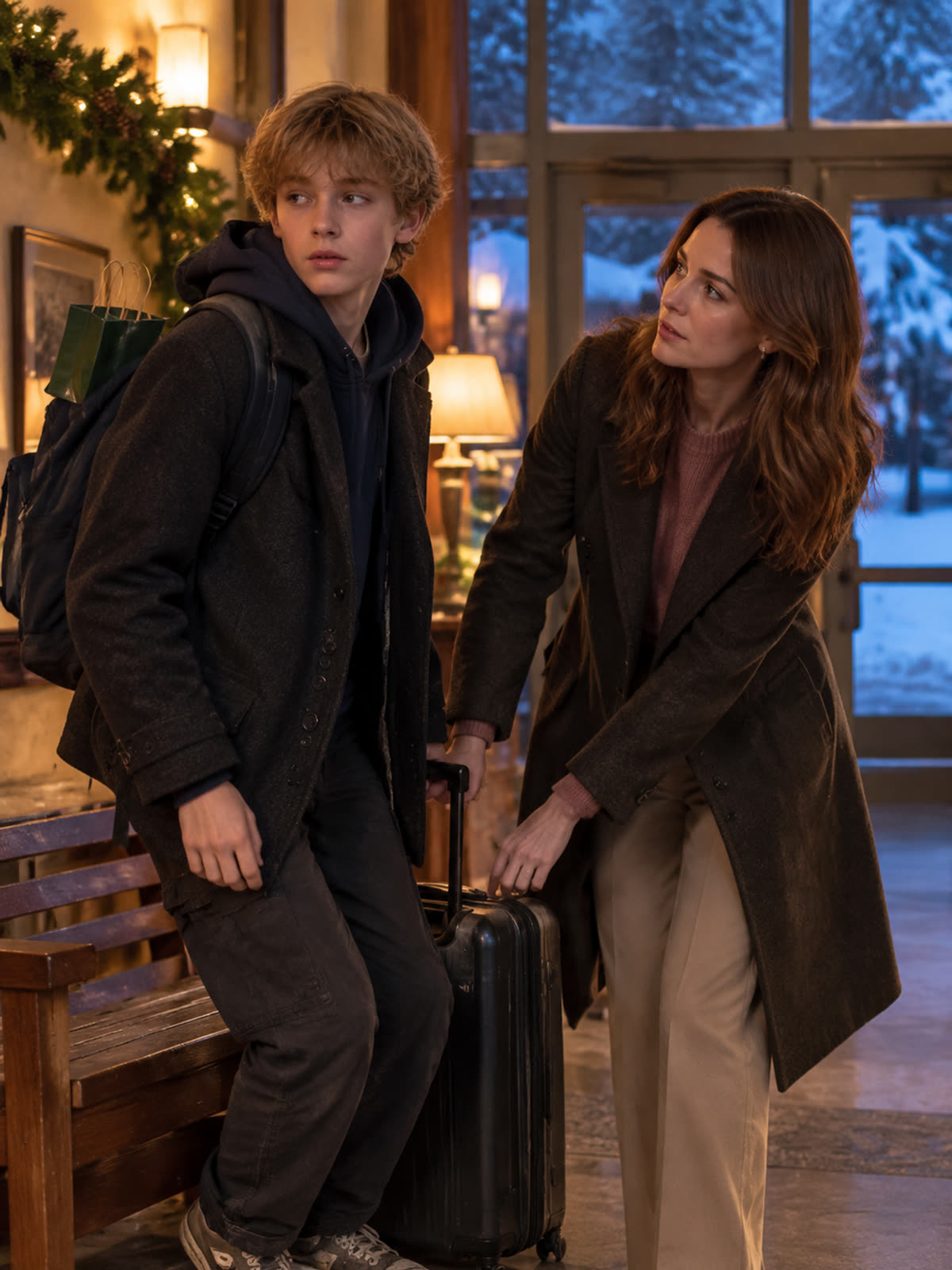
Before answering, he looked at the headmaster. “I’m sorry you had to drive all this way.” “Benjamin, you haven’t done anything wrong.” He nodded, yet his expression suggested the reassurance had not quite reached him. While I signed the necessary paperwork, Dr. Fletcher quietly explained that Patrick himself had confirmed the pickup the previous afternoon. Staff members had called him repeatedly. Benjamin had refused to move far from the front doors because he wanted to spot his father’s car as soon as it arrived. I listened, feeling worse with every detail, then walked outside with him.
Beside the passenger door, Benjamin stopped while I unlocked the car. “Elise, can I ask you something?” “Of course.” He studied the green gift bag. “Did Dad tell you to come because you changed your mind?” I frowned. “Changed my mind about what?” He swallowed, choosing his words with the painstaking politeness of someone bracing for rejection. “About letting me come home for Christmas.” For a moment I stood motionless, keys still in my hand. “Why would you think I didn’t want you home?” He shifted uneasily. “Dad said you wanted your first Christmas with Emma to be special. Just you, him, and the baby.”
The words were familiar enough to hurt. I had said something close to that, but I had meant a holiday free from houseguests, elaborate cooking, and the responsibility of entertaining relatives. Never had I intended to exclude a child who had already lost a parent. “Benjamin, can we sit down somewhere warm for a minute?” He glanced toward the school. “Did I mess something up?” “No. I promise you didn’t. I just need to understand what happened.” We went back inside. Dr. Fletcher left us alone in the lobby, and Benjamin sat beside me with his backpack held between his knees.
He told me Patrick had called two weeks earlier to explain how exhausted I had been since Emma’s birth. His father had said I needed quiet time with my own little family, and that remaining at school would be considerate. “He asked if I’d be okay with it,” Benjamin said. “And what did you tell him?” “I said sure.” “But was that what you wanted?” He looked at me as if there could be only one answer. “It’s Christmas, Elise. Of course I wanted to come home.” My throat tightened. “Then why didn’t you tell him?” “Because he made it sound like you really needed the break, and I didn’t want to be the reason you were upset.”
There was no bitterness in his explanation. He simply seemed certain that protecting everyone else’s comfort mattered more than admitting what he wanted. Then, unexpectedly, Patrick had called the previous afternoon and instructed him to pack: he would collect him at noon. Benjamin had been thrilled, though he had tried to keep that excitement out of his voice. By eleven-thirty that morning, his clothes were folded, his suitcase packed, and he was waiting at the entrance. At first, he blamed traffic. Later, he worried about an accident. When the other students left and staff began calling, he wondered whether his father had changed his mind.
I let him finish without interrupting. Finally, he asked what I had feared he would ask. “Did you really say you wanted Christmas with just the three of you?” There were ways to answer that would have protected me. I could have put everything on Patrick, argued that Benjamin had misunderstood, or stressed how deliberately my words had been distorted. Instead, I met his eyes. “Yes, I said something like that.” His face became still. “Okay.” I forced myself to continue rather than soften the truth into something easier for me to say.
“But I was talking about not having a big celebration, Benjamin. I was overwhelmed, and I wanted a quiet holiday. I wasn’t thinking about excluding you, and I should have been more careful with my words.” He lowered his gaze. “So Dad didn’t make up all of it.” “No. He didn’t. But he didn’t tell you what I meant, either.” He nodded slowly. I knew telling him honestly was necessary, even if honesty did not bring immediate relief. There was no explanation that could instantly erase the hours he had spent believing he was unwelcome.
After a while, he opened the green bag and took out a children’s picture book bright with farm animals. On the inside cover, he had written: For Emma. When you’re old enough, I’ll teach you every animal sound, even the embarrassing ones. Love, your big brother, Ben. “I was going to give it to her tomorrow,” he explained. “I figured she’d like hearing the sounds, even if she’s too little to understand the pictures.” I traced the careful handwriting. “She’s going to love it.” “You think so?” “I know so.” A faint smile appeared. “I didn’t spend much. It’s just a book.” “That doesn’t make it any less special.”
We remained there quietly for another minute. Then I stood and lifted his suitcase. “Come on, Benjamin. Your sister’s waiting for you.” He came with me toward the entrance, but before we reached the door, he spoke so softly I almost missed it. “Are you sure it’s okay for me to come?” I turned to face him. “You belong at home with us.” He nodded, although the doubt had not left his eyes. I had finally come for him. Now I had to take him back to the father who had not—and discover what would be waiting when we opened our front door.
PART 2 — The Stocking We Had Left in a Box
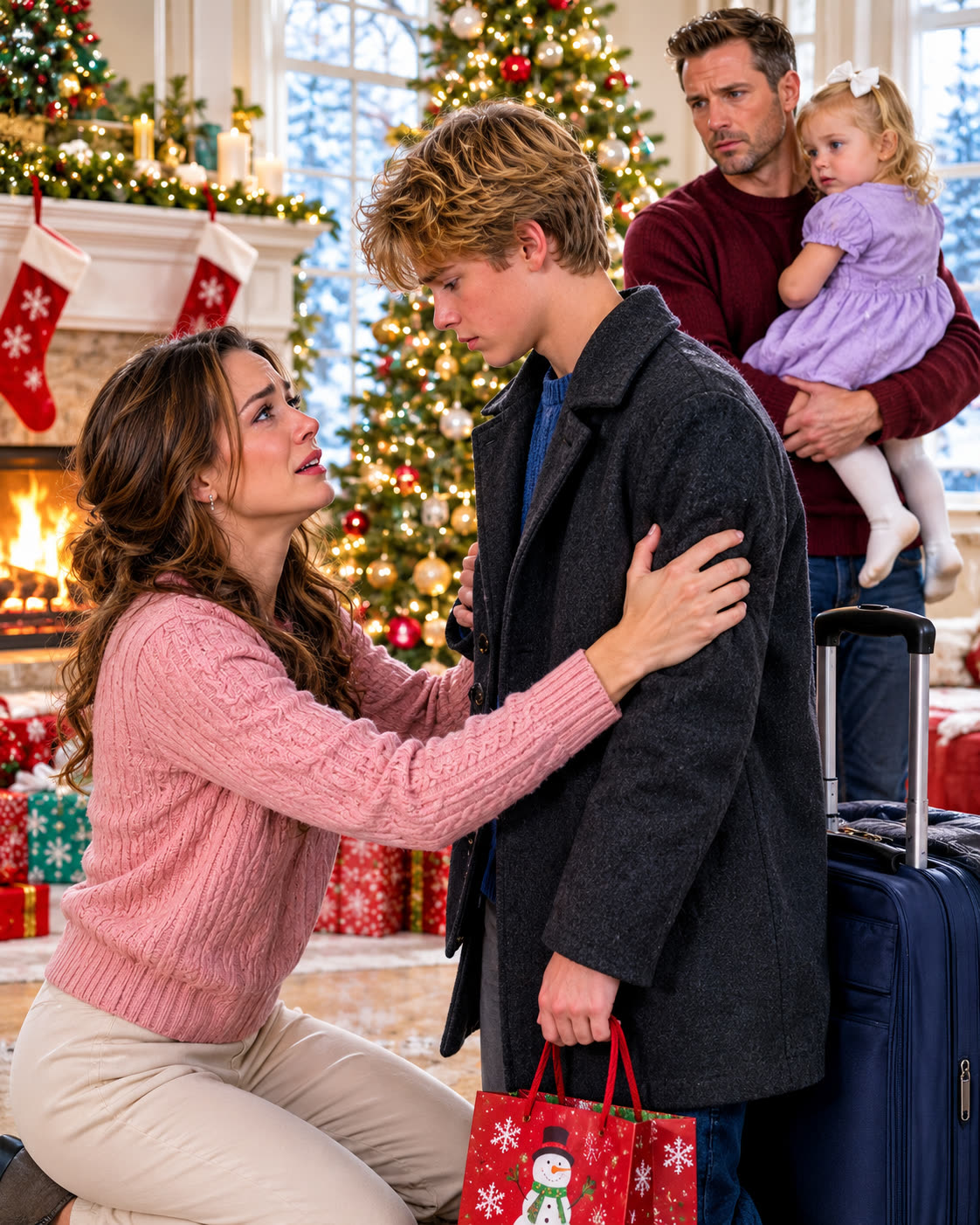
It was a little after nine when we pulled into the driveway. Our porch lights were on, the tree sparkled behind the front window, and roasted chicken scented the doorway when Patrick opened it. Emma was in his arms. The moment she saw Benjamin, she began bouncing excitedly. “Hey, buddy! Merry Christmas!” Patrick sounded so cheerful that the effort behind it was painful to hear. “Merry Christmas, Dad.” Benjamin’s reply was quiet. Patrick leaned toward him, apparently expecting an embrace, but his son shifted his suitcase and walked inside. I saw my husband act as though he had not noticed.
Emma refused to cooperate with the awkwardness. She reached both arms toward her brother and squealed until he finally smiled. “Hey, little peanut. You got bigger while I was gone.” For a brief moment, the sight of them offered the possibility of a gentler evening. Then Benjamin looked toward the fireplace. Three stockings hung above it: Patrick’s, mine, and Emma’s little stocking with its smiling reindeer. His was missing. I had decorated earlier in the month, certain he would be spending the holiday elsewhere, and had never reconsidered what I had arranged.
Watching him take in those three stockings, I understood what my thoughtlessness had made visible. He was absent not only from our decorations but from the version of our family I had displayed. “I think I’ll go upstairs,” he said quietly. “Of course, sweetheart.” Patrick tried to draw him back. “Aren’t you going to give your dad a hug?” Benjamin paused. “Maybe later.” He carried his suitcase up, and after his bedroom door closed, I faced Patrick. “We need to talk.” He sighed. “Elise, he’s upset. He’ll settle down.”
“He waited six hours for you.” “I know, and I’m sorry, but he’s not a little kid.” “No. He’s old enough to remember every minute of it.” I settled Emma safely in her playpen and returned to him. Eventually, Patrick acknowledged that he had told Benjamin I wanted Christmas without him while assuring me that Benjamin preferred celebrating with his friends. When I asked why he had then promised a pickup he never made, he rubbed his forehead and stared down. “I was planning to bring him back,” he explained. “I thought I’d tell you he’d changed his mind, and everything would work out.”
“Then why didn’t you leave?” Patrick’s answer came slowly. “You were so happy this morning. You were singing to Emma and making pancakes, and you kept saying how nice it was going to be to have a peaceful Christmas.” I could hardly believe what he was telling me. “So you decided not to bring your son home?” “I thought the school might let him stay another night. Then things got late, and I didn’t know what to say.” “Did you call them?” He shook his head. “Did you answer when they called you?” His silence returned.
His phone was on the kitchen counter. When he finally let me see it, several missed calls from Cedar Ridge were plainly visible. He had known Benjamin was still waiting. This had not been an innocent misunderstanding that grew beyond his control; he had avoided facing a conversation while his son waited for him. “Why would you do this to him?” I asked. Tears gathered in Patrick’s eyes. “I was trying to keep everyone happy.” “Everyone except Benjamin.” He turned his face away, and a long silence opened between us.
At last, Patrick said what he had been avoiding all evening. “I thought if he believed you didn’t want him here, he’d be upset with you instead of me.” Before I could respond, a small voice came from the stairs. “Is that why you didn’t come?” Benjamin stood halfway down in his old pajamas. Patrick turned toward him. “Buddy, your stepmom and I are just talking.” Benjamin shook his head. “You’re talking about me.” None of us moved. The explanation Patrick had hidden from his son had reached him in the worst possible way.
“You told me noon,” Benjamin continued. “I was ready early because I didn’t want to make you wait.” Patrick started to speak but could not find an explanation. “I kept looking for your car,” Benjamin said. “Why couldn’t you just tell me you weren’t coming?” Silence filled the room. After a while, he went back upstairs and gently shut his door. Patrick sank onto the sofa, his face in his hands. Looking at him, I finally understood that we were not dealing with one missed pickup or a Christmas plan handled badly. Something had been going wrong in our family for months.
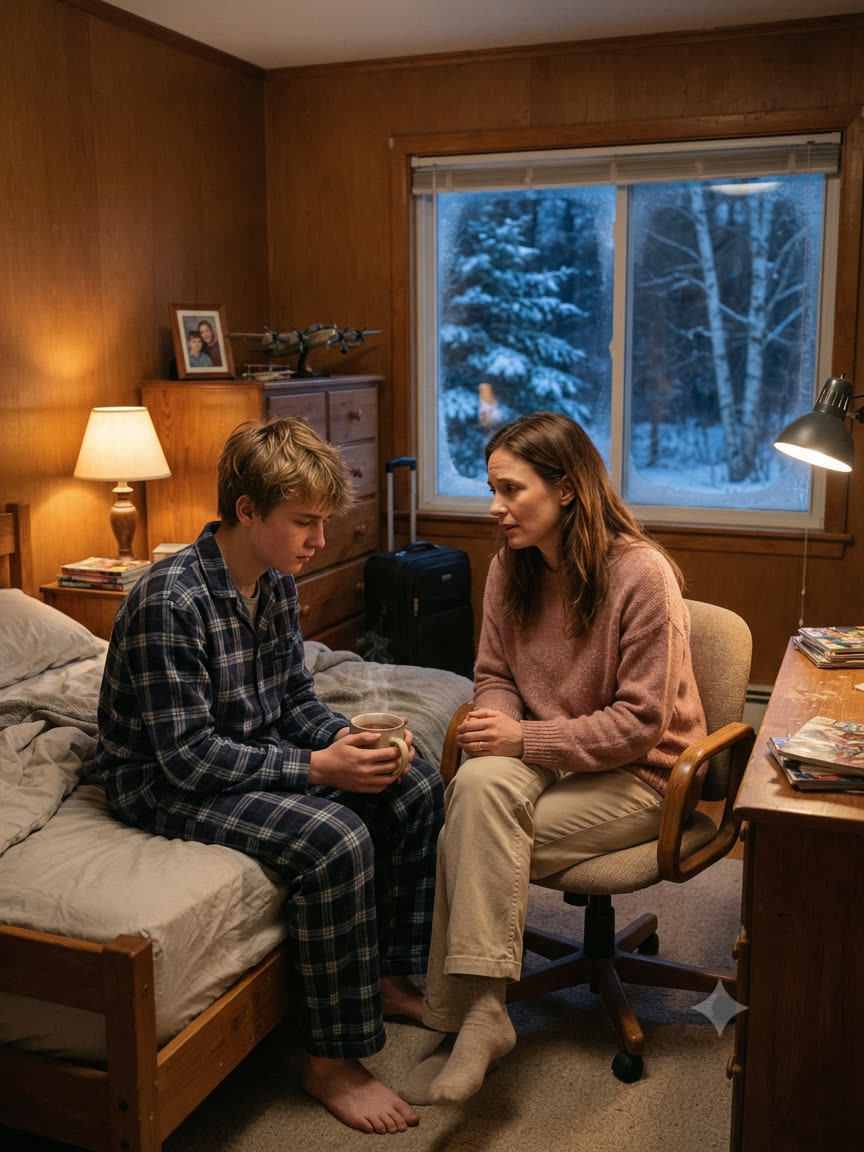
Once Emma was asleep, I made two mugs of hot chocolate and took one upstairs. Benjamin answered my knock, sounding surprised that I wanted to visit. His room looked unchanged since September: the model airplane on the shelf, comic books beside the desk, and a photograph of him with his mother near the window. His suitcase stood closed beside the dresser. I gave him the mug and sat in his desk chair. “I owe you an apology,” I began. He shook his head. “You came to get me. Dad’s the one who didn’t show up.”
“That’s true, but I also let you feel like you weren’t part of our Christmas, and I should have done better.” He stared into his hot chocolate. “I’m not really your kid, though.” He sounded neither angry nor accusing, only certain that he was stating a fact. “You’re Patrick’s son,” I answered. “And Emma is my daughter. But that doesn’t mean one of you matters more than the other.” He said nothing. Beside us, the closed suitcase seemed to hold a question neither of us had yet spoken aloud.
For years, I had tried so carefully not to intrude on Benjamin’s relationship with his father that I had stopped asking enough questions myself. Patrick managed school, transport, and most telephone calls. I concentrated on Emma and my work. I had thought of it as respecting boundaries, but I began to wonder whether Benjamin had felt that I was keeping him at arm’s length. When I asked about school, he admitted Patrick was often too busy to talk. Sometimes Emma was sleeping; sometimes we supposedly had plans. Eventually, Benjamin had begun calling less.
“I figured you guys had enough going on,” he said. I looked toward his luggage. “Is that why you haven’t unpacked?” His eyes followed mine. “I wasn’t sure how long I was allowed to stay.” I needed a moment before I could answer. “You can stay for the whole break, Benjamin.” “Does Dad know?” “Yes.” “Did you ask him?” “I didn’t need permission to bring you home.” His surprise was so open that I wondered how long he had been thinking of himself as a guest in his own house.
As we talked, the conversation drifted toward Rebecca. He showed me the photograph from a summer fair when he was eight. His mother had spent almost an hour trying to win a stuffed bear. “Dad said she was terrible at those games,” he recalled, smiling. “But she wouldn’t quit until she got it.” He told me she had always given him new pajamas on Christmas Eve. Patrick had kept that tradition for one Christmas after her death, but then it had faded. I listened as he described her laugh and her habit of adding too much cinnamon to hot chocolate.
Rebecca had also insisted that Christmas was not complete unless the entire family sat down to breakfast together. Until that night, I had not fully understood how many memories the holiday carried for Benjamin, or what it meant to spend it wondering whether he had a place with us. Before leaving, I told him how glad I was that he was home. He gave me a polite smile. “Thanks for coming, Elise.” In the hallway, I stood still, thinking about the care with which he thanked people for things a child should be able to depend on.
Patrick waited downstairs at the kitchen table. I repeated what Benjamin had told me, including his uncertainty about whether he could remain for the whole break. My husband looked miserable. “I don’t know how to fix this,” he admitted. “You start by telling him the truth without blaming anyone else.” We talked for almost an hour. I accepted responsibility for my own failures: leaving Benjamin out of our holiday planning and taking Patrick’s accounts on trust instead of speaking to him directly. But Patrick had to recognize that avoiding hard conversations was not the same as looking after us.
I proposed counseling for our marriage and, if Benjamin wished, for the family. Patrick agreed. Then I brought over the calendar from the refrigerator and laid it on the table. Emma’s appointments filled its squares alongside my deadlines, Patrick’s work commitments, and our plans for the new year. Nothing on it concerned Benjamin. There were no school holidays, no academic events, not even the date he should have come home. Patrick studied the empty places for a long time. “We can’t keep treating him like he’s somebody who visits occasionally,” I said. He nodded.
Later, when I checked on Benjamin, he asked if he could stay until New Year’s. “Of course.” He hesitated before explaining. “I just don’t want to be in everybody’s way.” I sat down beside him. “Benjamin, being part of this family isn’t something you have to earn by being convenient.” He looked at me without speaking. I could see that he was not completely convinced, but when I put an arm around his shoulders, he shifted a little nearer. It was a small movement, and I knew better than to mistake it for everything being repaired.
After he fell asleep, I went down to the basement and opened the containers of Christmas decorations. Beneath a tangle of lights at the bottom of an old plastic box, I found his stocking. It was dark blue, with a crooked snowman stitched to the front and a little silver bell at the top. Patrick had told me once that Rebecca made it when Benjamin was a baby. Its seams were uneven, one snowman eye had worked loose, and the worn cloth showed how many Christmases it had been loved through.
I carried it upstairs. Without speaking, Patrick watched me take down the three stockings and shift their places to fit a fourth. When I reached for the hooks, he joined me. Hanging a stocking was not a remedy for what had happened; neither of us could pretend otherwise. Still, to leave it packed away would have been to accept the incomplete picture we had made. We worked quietly, making space where there should always have been space, and left Benjamin’s stocking between his father’s and his sister’s.
Emma woke us before sunrise with happy calls from her crib. While Patrick changed her, I made coffee. A little after seven, Benjamin came downstairs in the sweatshirt he had worn the night before. He stopped at the sight of the mantel. Four stockings were hanging there now. For several seconds he only stared. “You found mine,” he said. “It was downstairs with the decorations.” He moved closer and touched the snowman’s uneven face. “Mom made this.” “I know. I thought it belonged up here.” A small smile appeared.
“She wasn’t very good at sewing.” “Neither am I, so the snowman is safe from my attempts to improve him.” The stocking was finally where it belonged, and Benjamin was standing beneath it. But we had not yet heard what Patrick would say when he faced his son without excuses—and none of us knew what Benjamin would be able to believe.
PART 3 — The Next Promise
Benjamin laughed, and this time there was nothing strained about the sound. We made pancakes, sliced strawberries, and helped Emma unwrap gifts she found less fascinating than their paper. On the living room rug, Benjamin brought out the animal book he had carried home. He opened to the cow and gave an extravagant moo. Emma laughed delightedly. He followed with a sheep, a horse, and a rooster so ridiculous that she giggled against his arm. Patrick watched nearby, tenderness mixed with sadness in his face. He was looking at an ordinary family morning that his own choices had nearly kept from happening.
Later, Patrick asked to speak with Benjamin alone. I remained downstairs with Emma, although their voices drifted faintly from the bedroom. He apologized for the promised pickup he had abandoned, for ignoring the calls, and for making me responsible for decisions that had been his. He admitted that fear of disappointing us had led him into dishonesty. Benjamin listened. Then came the question his father had to answer. “Did you really know I was waiting?” “Yes,” Patrick answered. “And you still didn’t come?” A long pause followed. “Yes. I made a terrible decision, and you didn’t deserve it.”
Benjamin did not offer immediate forgiveness. “I thought maybe something happened to you,” he said. “Then I thought you forgot. Finding out you knew was worse.” Patrick apologized again, but eventually Benjamin said he wanted the conversation to end. His father accepted that. When Patrick came downstairs, he looked drained. “He doesn’t trust me,” he said. “Then you’ll have to give him reasons to trust you again.” That afternoon, Benjamin joined me while I walked Emma around the backyard. Along the paved garden path, he asked whether his father was hurt because he had not accepted the apology straightaway.
“You’re allowed to need time,” I told him. “You don’t have to pretend everything feels better just because someone says they’re sorry.” He watched Emma reaching for the bright mitten hanging from her stroller. “I love Dad,” he said quietly. “I just don’t know if I can believe him right now.” “I understand.” Later that evening, I passed his room and saw the suitcase standing open. Clothes hung in the closet. His toothbrush was beside the bathroom sink, and the green gift bag lay neatly folded on his desk. He had finally unpacked. It did not mean everything was all right, but he had stopped preparing to leave.
The days that followed were imperfect and still better than I had feared. Some breakfasts were uncomfortable; some dinners were quiet. Patrick occasionally worked too hard to make his son laugh when Benjamin was not ready. Little by little, however, the distance eased. One afternoon Benjamin asked him for a ride to a hobby shop to buy supplies for an engineering project. They returned almost two hours later with motors, wires, and plastic pieces, discussing the miniature vehicle Benjamin planned to build. “You’re telling me this tiny motor costs thirty-five dollars?” Patrick asked. “Dad, I’ve explained it three times.” “Well, explain it a fourth time. I still think they charged you too much.” Benjamin laughed.
I began to understand that recovery was made of moments that small. Patrick called Dr. Fletcher himself, apologized, and established clearer pickup arrangements. He booked a family counselor, too, while we assured Benjamin he would not be pushed to attend before he was comfortable. On New Year’s Eve, we ate pizza and played board games while Emma fell asleep long before midnight. The next morning, as we packed away the decorations, Benjamin handed me the blue stocking. “Can you keep it with the others this year?” I laid it beside ours in the box. “That’s exactly where it belongs.” He watched me close the lid and carried the box downstairs.
When school resumed in January, Patrick drove him back to Vermont. Before they left, Benjamin hugged Emma, thanked me for breakfast, and asked if he could telephone me sometimes. “Anytime,” I told him. He paused. “Even when Emma’s sleeping?” “Especially then. She isn’t much of a conversationalist yet.” He laughed before getting into the car. During the weeks that followed, Patrick and I began counseling. I acknowledged how fear of overstepping as a stepmother had kept me too far away. He recognized his habit of postponing uncomfortable discussions until manageable problems became much worse. We added Benjamin’s school dates to the family calendar and made it clear that home remained open to him.
I began calling Benjamin myself rather than relying on Patrick to pass messages between us. Some calls were brief. Others wandered through classes, friends, and the engineering projects he enjoyed. One evening, he mentioned an essay about someone who had changed his life. He wanted to write about Rebecca. “Would it be weird if I told you about her?” he asked. “Not at all. I’d love to hear.” For nearly forty minutes, he talked about her favorite music, her hopeless driving directions, and the first pancake she always burned. He remembered her crying with happiness when he learned to ride a bicycle. I listened without measuring myself against her. His memories did not leave less room for me; I did not have to replace his mother to earn his trust.
The real test arrived in mid-January. Benjamin had a three-day weekend, and Patrick had promised to collect him at four on Friday. Dr. Fletcher knew the arrangement, our shared calendar showed it, and Benjamin had a message from his father confirming he would be there. That morning, Patrick mentioned that an important meeting at the property management company where he worked might finish late. My stomach tightened. He saw it. “You’re worried I’m going to be late.” I put down my coffee. “Are you?” After considering that, he called his office and arranged for a colleague to cover the meeting’s final portion if needed. “I need to leave by two,” he explained. “I’m picking up my son.”
I nodded, resisting the impulse to remind him about traffic, weather, and fuel. He needed to carry those responsibilities without me overseeing them. At 2:10, his car left our driveway. I went back to work and tried not to keep checking the time. At 3:48, my phone vibrated. Patrick had sent a photograph of Cedar Ridge’s entrance. Underneath it were three words: I’m here early. I looked at the picture for a long while before replying: Good. Keeping a promise did not require a celebration. Still, I felt quiet gratitude that Benjamin would not spend this afternoon wondering whether his father was coming.

Patrick later described the students coming out of the building. Benjamin had his backpack over one shoulder and a duffel bag in his hand. He was talking with a classmate as they approached the parking area. Then he saw his father’s car and stopped briefly. Patrick recognized the hesitation at once. Benjamin had been looking for him, checking whether the promise had become real. This time, it had. His father was already there, not on his way, not explaining a delay, and not leaving someone else to answer for him.
Patrick got out and greeted him, then offered to take his bag. After putting it in the trunk, they paused beside the passenger door. “You got here early?” Benjamin asked. “Yeah. I wanted to make sure I was here when you came out.” Benjamin nodded. “That’s good.” Patrick opened the door. “Ready to head home?” His son looked at him and gave a small smile. “Yeah, Dad. Let’s go.” There was no grand reconciliation in those few words, no sudden announcement that the hurt had vanished. There was simply a father who had arrived and a boy willing to climb into the car.
On the drive back, they bought snacks, talked about school, and considered whether a different motor might improve Benjamin’s engineering project. Nothing extraordinary occurred. That was what made the journey matter. He did not have to spend it wondering why he had been forgotten, whether he had caused an argument, or how long he would be permitted to stay. His father drove, he talked, and they headed toward the house where his things had a place. For that afternoon, coming home could be an ordinary part of his life.
A little after five-thirty, another message reached me. This one was from Benjamin: We’re on our way. Can we have spaghetti tonight? I smiled and told him spaghetti sounded wonderful. His next message arrived almost at once: And garlic bread? I laughed as I typed back: Now you’re getting demanding. He answered with a laughing emoji, then another message: Thanks, Elise. The exchange was so simple that someone else might have overlooked it. I could not. A few weeks before, he had needed reassurance that he was allowed through our door. Now he was asking what we could have for dinner.
Across the kitchen, Emma sat on the rug with the farm-animal book. She worked her little fingers against its pages and occasionally squealed at a colorful picture. I picked up my phone again and wrote: Emma’s waiting for you. After a pause, I added: I am, too. His answer appeared a moment later: See you soon. I set the phone on the counter and filled a large pot with water. Outside, the winter sky was darkening already. In the kitchen windows, the lights over our dining table glowed back at me.
There was still work ahead for our family. Patrick and I had conversations left to have, and Benjamin would need more than one successful pickup before his father’s promises felt secure again. There would be misunderstandings and disappointments. There would be ordinary days when tiredness or distraction got the better of us. Counseling had not made us different people overnight, and no carefully arranged Christmas morning could undo what had brought Benjamin home so uncertain of his place. I knew we could not ask him to act as though it had.
But an important part of his life had begun to change. He no longer needed someone else to tell him whether I wanted to hear from him. He could call me himself. He could ask for spaghetti, or garlic bread, without making his request sound like an apology. He could talk about Rebecca without fearing that loving her would offend me. And he could come home without first proving that his presence would be convenient. Those were not favors we were granting him. They were things he should never have had to doubt.
When the water began to simmer, I opened the cabinet and took down four plates. There was one for Patrick, one for Benjamin, and one for me, along with Emma’s small plastic plate. I placed them around the table and thought of the stockings above our fireplace: the three I had first hung, and the fourth that had waited in a basement box. I had not intended that empty place to say anything cruel. Intention had not stopped Benjamin from seeing it, or from recognizing himself as the person who had been left out.
Only a few weeks earlier, he had spent six hours beside a suitcase, wondering whether the people who should love him considered him an inconvenience. Now he was on the road home, requesting his favorite dinner with the easy expectation a child should have. I could not change that Christmas Eve. Neither could Patrick. We could not remove the memory of the empty school or make our explanations less painful in retrospect. What we could do was decide, through our actions afterward, whether that night would continue to describe our family.
Standing at the stove, I understood that the greatest thing we could offer Benjamin was not a flawless holiday, a costly gift, or another apology shaped into all the right words. It was the certainty that a call would be answered, that a promised arrival would happen, and that a place at our table would not disappear when life became tiring or complicated. Belonging could not depend on whether there happened to be spare time, spare patience, or an easy answer. We had to make it something he could trust.
Four plates waited beneath the warm light. His stocking was packed beside ours. His message was still on my phone, telling me he would see me soon. This time, Patrick had kept his word, and Benjamin was coming home without apologizing for it. But one afternoon could only begin to answer the question Christmas Eve had left behind. The next promise—and whether we kept it—was still ahead of us.
Disclaimer: This story is a work of fiction inspired by real-life themes. Names, characters, places and events are fictionalized, and any resemblance to real persons is purely coincidental. Images are for illustration purposes only.
