

PART 1 — The Light in the Laundry Room
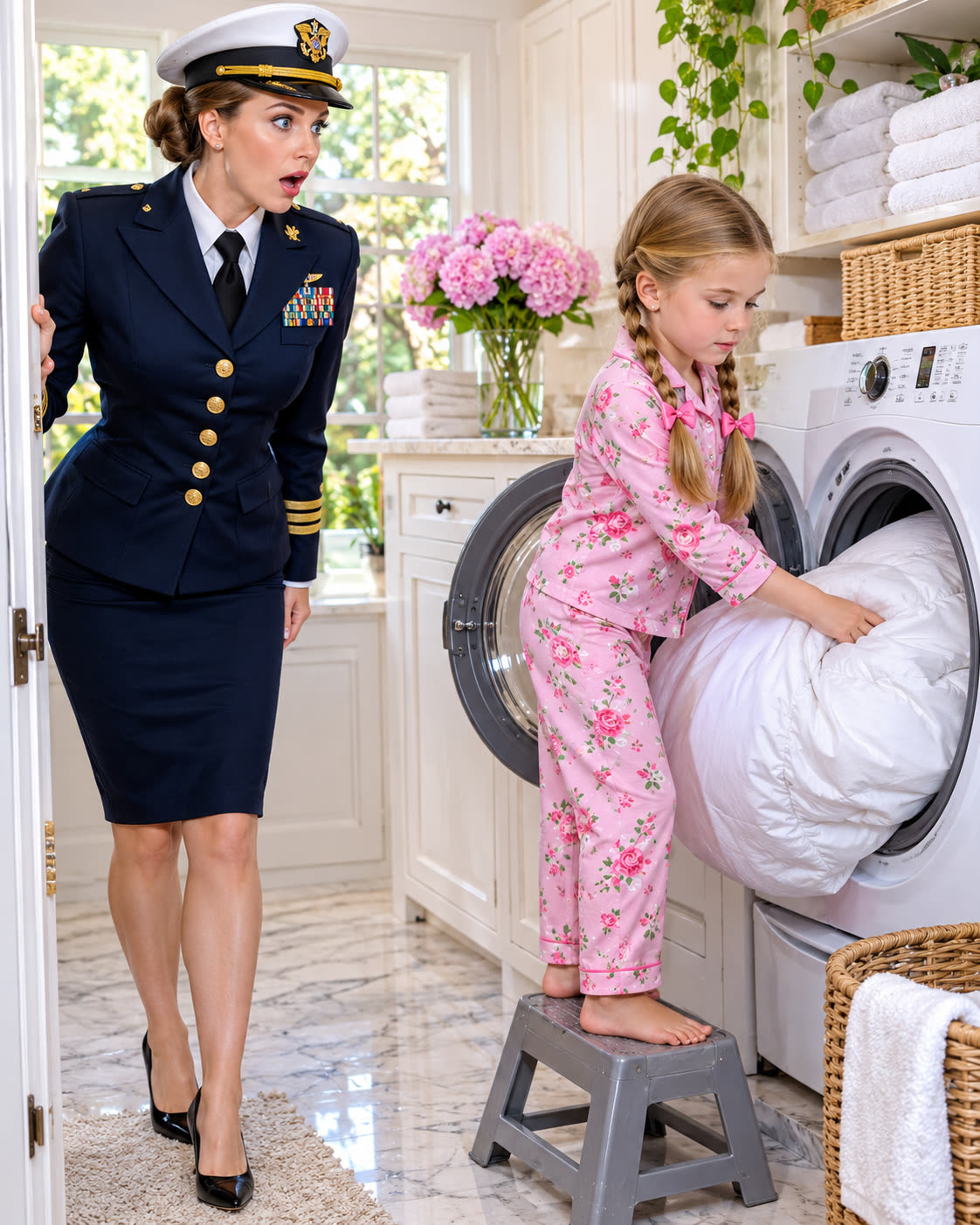
“Mom, please don’t turn off the washing machine! If Daddy finds out I didn’t finish the sheets, he’ll punish me!” Those were the first words my nine-year-old daughter said when I returned after four months of Navy service. Midnight was approaching. Tessie stood on an overturned bucket, struggling to push an enormous bundle of sheets into the washer. Her eyes were puffy, her hands reddened, and detergent had left marks across her pajamas. During the long journey home, I had imagined our reunion over and over. Not once had I pictured my daughter greeting me with a plea not to let her rest.
My name is Joanna Pruett. I was 43, with more than two decades of service in the United States Navy behind me. That night, I was coming back from an extended deployment in the Pacific to our home in Pensacola, Florida. My husband, Dale, and I had bought that house after years of going without things we wanted. I had kept my arrival a secret because I wanted to surprise him. More than anything, I wanted to hold Tessie before she woke the following morning. Instead, I entered an unnaturally quiet house and noticed that the laundry-room light was still burning.
“Tessie?” I called. She spun toward me, startled, and for an instant fear seemed stronger than happiness on her face. Then she rushed into my arms and held me so fiercely that I almost lost my balance. “Mom! I thought you weren’t coming back for a long time!” I picked her up. “I’m here now, sweetheart. Why are you doing laundry this late?” Her gaze dropped. “Daddy said I had to finish before bed.” When I asked, “And where is your dad?” she pointed upstairs. “In his room.
But don’t go up, Mom.
He’ll get mad.” A cold feeling moved through me.
I settled Tessie on the couch and assured her that nobody was going to punish her. Then I climbed the stairs. A woman’s laughter drifted from our bedroom. When I opened the door, Dale was stretched out in our bed with his arms around a stranger. A bottle of wine and two glasses stood beside them. He blinked at me. “Joanna? What are you doing here?
I thought you were coming back next week.” The woman immediately sat upright. “You said your wife was out of the country!” she snapped. I kept my attention on my husband. “Get out of my house,” I told Dale.
He gave a small, uneasy laugh. “Don’t overreact.
We can talk tomorrow.” I answered, “My daughter is washing your sheets at midnight while you’re in here with another woman.” His expression shifted. “Tessie needs to learn some responsibility.
You’re never around to raise her.” That accusation cut more deeply than the sight of another woman in our bed. She collected her clothes and left in a hurry. Dale remained there, looking irritated that his evening had been interrupted. “Don’t come home after four months and tell me how to run this house,” he muttered. I refused to argue while Tessie was downstairs waiting.
I found her beside the washing machine, holding a little notebook tightly against her chest. “What have you got there, honey?” She moved as though to conceal it. “Nothing, Mom.” Kneeling in front of her, I said, “You can trust me.” Tears gathered in her eyes. “It’s the list Daddy and Miss Shelby made me.
If I don’t finish everything, they say I don’t deserve to rest.” Inside were daily assignments: laundry, bathrooms, breakfast, garbage, and bedrooms. An adult had added a warning beneath one list: “If Mom asks, tell her you do it because you want to.” Tessie caught my hand. “Mom, there’s something else Daddy told me not to tell you… and it has to do with Miss Shelby and our house.”
“Daddy says this house will belong to Shelby soon,” Tessie whispered. “He says she’s going to be my new mom when you leave again.” I felt as though the floor had disappeared. “Who told you that?” Her answer made everything worse. “Both of them. Shelby says women who work far away from their kids shouldn’t get to have a family.” Her chin quivered. “I told them I wanted you. But Daddy said if I didn’t learn to obey, a judge would decide where I had to live.” I drew her close. Dale’s betrayal was not confined to our marriage. During my absence, he had taught our daughter to fear speaking honestly.
The next morning, Dale wandered into the kitchen as though the night before had never happened. “We need to talk about us.” I answered, “First we’re going to talk about Tessie.” He rolled his eyes. “Here we go again. She needs discipline. You spoil her.” I reminded him, “She’s nine, Dale. She’s not your employee.” His response was immediate. “Somebody has to keep this house running while you play hero.” I did not let him pull me into an argument. After he went to work, I opened the recordings from the security cameras we had installed years earlier. What I saw made me feel sick.
One recording showed Tessie hauling two huge garbage bags toward the curb in the rain. Another showed her scrubbing the patio while Dale and Shelby sat nearby eating breakfast. In a third, she entered the laundry room shortly before eleven at night. The notebook had not exaggerated her responsibilities. Afterward, I checked our bank accounts. Almost $44,000 had been transferred during those four months to Gulf Horizon Development, a company I knew nothing about. I had approved none of those payments. I called Beth, an old Navy friend. “I need a lawyer,” I said. She referred me to a family law attorney named Renee Lockhart.
When I finished explaining everything, Renee set down her pen. “Joanna, the affair is the least of it. We need to protect your daughter and document what she’s been through.” Following her guidance, I arranged an appointment with child psychologist Dr. Faye Sorenson. After meeting Tessie, she said, “Tessie is showing signs of parentification. She’s taking on responsibilities and emotional burdens that belong to adults.” I asked, “Can she recover?” The doctor answered, “Yes. But she needs safety, support, and to understand that she doesn’t have to earn anyone’s love.” That afternoon, after securing the notebook as evidence, I took Tessie to the beach to play soccer. “Don’t I have to clean first?” she asked uneasily. “Today your only job is to have fun.” Then, finally, I heard her laugh without fear.

The relief did not last. Three days later, a process server delivered papers announcing that Dale wanted full custody of Tessie and exclusive possession of our home. He claimed that my deployments made me an absent mother. The man whose behavior I had seen on those recordings was presenting himself as the parent who offered stability. When I challenged him, he wore a smug expression. “I’ve been the one raising her. You just visit.” His words turned the months I had spent serving into an accusation, as though being physically present in the house erased everything he had done while I was away.
Then I discovered he was preparing Tessie to tell the court that she wanted to stay with him and Shelby. He had offered her a new bicycle. Renee sought temporary protective orders and arranged a neutral interview where Tessie could answer without either parent pressuring her. In a room furnished with beanbag chairs, a gentle interviewer listened as my daughter described her punishments, the late-night washing, and the tightness in her stomach whenever Dale became angry. Afterward, she pressed her face into my coat. “I’m sorry, Mom. Daddy said I had to pick him, but I couldn’t lie.” I held her. “You have nothing to be sorry for, baby.”
When Dale learned that Tessie had spoken openly, the color drained from his face. That evening, Renee called with urgency in her voice. “Joanna, we dug into Gulf Horizon Development. It’s linked to Shelby.” For a moment I could barely form a response. “My husband gave her our savings?” Renee continued, “There’s more. We found loan paperwork for buying land. Your house is listed as collateral.” I could not reconcile those words with anything I had agreed to. “That’s impossible. I never signed anything.” She paused before answering. “That’s exactly why I need you to come in. There’s an authorization with your name on it. It’s dated while you were still at sea.”
Across twenty-three years of service, I had learned to remain steady when circumstances turned dangerous. I had endured heavy seas and made difficult decisions under intense pressure. None of that had prepared me for learning that my husband might have used my deployment to endanger our home while trying to separate me from our daughter. At Renee’s office, paperwork covered her desk. “Before you read these, understand this,” she said. “Your house isn’t mortgaged yet. What we found is a loan application listing it as collateral. They’d need more steps to finalize it. But someone used an authorization with your signature.”
I lifted the document and studied my name. Joanna Pruett. At first glance, the signature resembled mine. Looking more closely, I could see little flourishes my hand would never have made. It was dated on a Wednesday in April, a day when I had been aboard a Navy vessel hundreds of miles offshore. “I didn’t sign this.” Renee answered without hesitation. “I know. And we’re going to prove it.” Seeing that imitation of my handwriting brought the situation into sharper focus. This was no longer only about money missing from an account. Someone had placed my name on permission I had never given.
Renee explained that Dale had been pursuing the purchase of two land parcels near Orange Beach, Alabama, through Gulf Horizon Development. A former business associate of his operated the company, and Shelby appeared as an agent on certain transactions. The missing $44,000 had paid deposits, fees, and other expenses connected to the deal. “What was the plan?” I asked. Renee replied, “From the emails, it looks like they meant to secure more financing, finish the project, and keep the profits. We still have to confirm how far they got.” I stared at the paperwork, trying to absorb how much had happened while I believed our savings were protecting Tessie’s future.
For four months, I had worked far from my daughter believing that the sacrifices meant something for our family. Dale had used our savings to pursue a future with another woman. Now the home where Tessie had taken her first steps had become part of their plans. My hands tightened into fists. “I want him to pay for all of it.” Renee met my eyes. “Then we do this correctly. We don’t need revenge. We need to prove what he did and protect Tessie.” Her calm answer gave me something firmer to hold on to than anger. Whatever happened next had to be done in a way that protected my child.
That week, I supplied official deployment records. We took steps to preserve the banking documents and requested an examination of the signature. Renee explained that the property proceedings would remain separate from the custody matter, and any suspected forgery would require its own investigation. I kept returning to the same priority: Tessie’s safety mattered more than anything else. Two days later, Dale discovered what we had done. He stormed into the house, furious, while our daughter worked on homework in her room. “You hired somebody to dig through my accounts?” The documents had finally reached the one person who did not want them examined.
PART 2 — What He Could Not Explain
I told Dale to lower his voice. Tessie was in her room, and I would not let another confrontation become something she had to endure. “I’m reviewing what you did with our money.” He immediately fired back, “That money is mine too!” I kept my attention on the issue he had avoided. “Then explain why you used a signature that isn’t mine.” For the first time since my return, he seemed unable to reach for a ready excuse. His face lost its color. The certainty he had shown when threatening to take the house and our daughter suddenly looked much less secure.
“You don’t understand how business works.” It was an attempt to dismiss the question rather than answer it. “I know exactly when I’ve signed something.” He moved closer, changing his approach. “Joanna, we can fix this between us.” I did not allow him to turn the conversation into a private arrangement that ignored Tessie. “We can also talk about why our daughter was afraid to go to bed without finishing your chores.” His expression hardened at once. “The kid again! You’re filling her head with nonsense.” I answered, “No. Tessie is finally telling the truth about what she lived through.”
Dale struck the table with his hand. “I took care of her while you were gone!” I held my ground. “Taking care of a child doesn’t mean turning her into a servant so you can entertain your girlfriend.” Shelby appeared at the foot of the stairs wearing one of my robes. “Dale, you don’t have to put up with this humiliation.” I looked at her. “That robe is mine,” I said. “I’d appreciate it if you stopped using my things.” She gave me a smug smile. “We’ll be talking soon about who keeps what.” Even then, she spoke as though our home were already being divided according to her wishes.
“The courts will decide that. But understand this: Tessie is not a piece of property you get to include in your plans.” Dale stared at me. “When the judge sees how much you work, he’ll know she’s better off with me.” I said nothing more. He still seemed convinced that a house, money, and the hours he had spent physically near Tessie were enough to prove he was a good father. He spoke about my absences without acknowledging what he had chosen to do during them. He appeared unable to understand the depth of the harm he had caused our daughter.
The weeks spent preparing for the hearing were among the hardest I had known. Renee assembled the recordings, financial statements, and company paperwork into a record the court could follow. We also contacted our neighbor, Mrs. Odell, who was 68. When I explained what had been happening inside our house, she began to cry. “I used to see Tessie dragging out the garbage after dark,” she admitted. “One night it was pouring and I told her to get inside. She said her daddy would be angry if the cans weren’t out.” Hearing someone else describe my daughter’s fear made it impossible to dismiss any part of it.
“Why didn’t you ever call me?” I asked. Mrs. Odell looked down. “I thought they were just chores. I never imagined the child was going through all that.” Then she remembered an afternoon when Tessie had sat on the curb, exhausted before she could finish sweeping the driveway. Mrs. Odell had offered her a cookie. Tessie would not accept it. “She told me she wasn’t allowed to eat anything nice until her work was done,” Mrs. Odell said. That small detail hurt in a different way. Even a neighbor’s kindness had become something my daughter believed she needed to earn before she could receive it.
That night, I sat beside Tessie’s bed. She held the stuffed dinosaur I had bought her before leaving. “Can I ask you something, kiddo?” She nodded. I had been turning the question over in my mind, remembering our video calls and everything that had remained outside the frame. “Why didn’t you tell me what was happening when we talked on video calls?” Her face crumpled. “Because Daddy said you’d worry and might lose your job.” My throat tightened. She had been carrying not only her own fear but the belief that telling me might somehow damage the work that kept me away.
“Sweetheart, you never have to hide something from me that’s hurting you.” Tessie squeezed the dinosaur more tightly. “I thought if I worked really hard, Daddy would love me more.” I gathered her gently into my arms. “You don’t have to work for love. Not mine, not anyone’s.” She needed to test that promise against the mistakes she feared. “Even if I get bad grades?” I answered, “Even if you get bad grades.” Then she asked, “Even if I don’t know how to wash clothes right?” I told her, “Even if you never touch a washing machine again.”
A faint smile finally appeared. “Even if I burn the pancakes?” I laughed. “That would be tough, because I burn them worse.” Tessie giggled, and for a moment the room held something lighter than everything we had been discussing. I made a promise to myself that night: I would never confuse an immaculate house with a happy home again. Clean floors and neatly folded sheets could conceal fear just as easily as they could reflect care. What mattered was not whether Tessie completed every task without a mistake. What mattered was whether she knew she was safe when she could not.
Weeks later, I entered a family courtroom in Pensacola with Renee for the temporary-orders hearing. Dale arrived in an expensive suit, his hair carefully arranged, beside a lawyer carrying a thick binder. He looked at me as though the result had already been settled in his favor. His attorney began with my deployments. “Mr. Pruitt has provided daily stability for the child. The mother’s professional obligations keep her away from the family home for long stretches.” I could not deny the time I had spent away. But I would not accept the claim that serving my country proved I did not love my daughter.

Renee began presenting the evidence. The courtroom screen showed Tessie moving a garbage can that was nearly her own height. Then came the recording of my daughter scrubbing the patio while Dale talked with Shelby nearby. Watching those moments again in a room full of people did not make them easier to bear. The judge asked when the recordings had been made, and Renee supplied the dates and times. She explained that the footage did not show one unusual evening or an isolated demand. It documented a pattern, the same pattern Tessie had described in the notebook and during her interview.
Next came the notebook itself. Its pages recorded a schedule heavy enough to wear down an adult: laundry, bathrooms, food preparation, bedrooms, and garbage. Checkmarks followed the assignments. Beside some of them were corrections in Dale’s handwriting, instructions that the work was wrong, that it must be repeated, that rest could come only afterward. My eyes stung as I looked at those pages. At home, Tessie had clutched that notebook as though it contained the rules she had to obey to remain safe. Now it lay before the court, showing the demands that had governed her days.
Renee submitted Dr. Sorenson’s report as well. It described Tessie’s anxiety, her fear of mistakes, and her conviction that adult responsibilities were the price of approval. The judge also reviewed the neutral interview. Tessie did not have to stand before everyone and repeat what had happened. Her account had already been recorded where she could speak without pressure. I was grateful that making herself heard did not require another public test of her courage. She had spent too long worrying about what would happen if she told the truth. At least here, her words could be considered without making her face her father across the room.
Mrs. Odell testified about the things she had witnessed from her yard. Dale avoided looking at her. What she described was ordinary enough on the surface—a child carrying garbage, a child sweeping—but the circumstances revealed what those tasks had meant for Tessie. Darkness, rain, exhaustion, and fear had accompanied them. When my turn arrived, I drew a breath. The weeks of collecting documents and describing what had happened had brought us to that moment. I could not undo my absences or pretend I had seen everything sooner. I could only speak plainly about what I now knew and what my daughter needed.
“I’ve served my country for twenty-three years,” I began. “I know my work means absences, and I know I have to plan around them as a mother. I’m not claiming to be perfect.” Facing the judge, I continued. “But my daughter was nine years old when I came home and found her washing sheets at midnight. She was afraid of making a mistake. She was afraid to rest. And she had learned to believe she didn’t deserve love unless she finished her chores.” My voice trembled. “I’m not asking the court to punish Dale for cheating on me. I’m asking that Tessie get to feel safe again.”
Dale attempted to defend his decisions. “I was only teaching her discipline. Her mother lets her do whatever she wants.” The judge asked whether he considered it appropriate to give a nine-year-old extensive housework late into the night. He hesitated before answering. “There was a lot of work to do around the house.” Renee rose. “And why did your daughter have to do it while you and your girlfriend relaxed?” Dale had no response. His attorney began an objection, but the silence had already exposed the weakness in his explanation. The work had not fallen on Tessie because no adults were available.
The financial paperwork followed. The judge explained that this hearing would not determine whether a signature had been forged, nor would it settle the property division. Those questions belonged to their own proceedings. Still, the documents helped explain the conflict surrounding our family and the protections needed while the cases continued. I listened carefully to that distinction. Finding the paperwork had not produced an instant answer to every problem. The house, the savings, the authorization, and Tessie’s custody were connected in our lives, but each issue still had to be addressed properly. Renee had warned me that the process would not move as one simple case.
After both sides had finished, the judge prepared to announce her temporary decision. Until that moment, I had held myself together by concentrating on the next piece of evidence, the next question, the next thing I needed to explain. Now there was nothing left for me to present. Dale had arrived certain that my service would count against me. I had come hoping the court would see what his version of stability had cost our daughter. Everything we had gathered was before the judge. The next words she spoke would decide where Tessie lived—and whether she could finally begin to feel safe.
PART 3 — The Home She Deserved
The judge ordered that Tessie remain in my primary care. Dale’s visits would initially be supervised, with evaluation and professional follow-up determining what came next. Tessie and I could stay in the family home while the remaining matters were addressed. Hearing the ruling, I felt as though I had released a breath I had been holding for weeks. Dale lowered his head. I did not smile at him. There was no pleasure in seeing our family reduced to evidence and temporary orders. I had not collected a prize. I had secured some safety for my daughter while we started the difficult work of rebuilding.
Dale left the house soon afterward. Shelby went with him, carrying her possessions away in boxes. There was no shouting farewell, no final scene at the door. The woman who had spoken of taking my place did not even look toward Tessie. My daughter stood beside me as their car drove away. “Is Daddy not going to live here anymore?” I answered, “For now he’s going to live somewhere else.” Then came the question that showed how much responsibility she was still placing on herself. “Is he mad at me?” I knelt beside her. “What grown-ups decide is the grown-ups’ responsibility. You didn’t cause any of this.”
She considered that for a moment. “Can I still love him?” The question nearly broke me. “Of course, baby. He’s your dad. You can love him and still say so when something hurts you.” She wrapped her arms around me. Holding her, I understood that keeping Tessie safe did not mean teaching her to hate Dale. She did not need another demand about which feelings were acceptable. She needed to know that loving someone did not require silence when that person caused pain. My responsibility was to help separate love from fear, not ask her to erase the part of herself that still wanted her father.
The months that followed were difficult. The documents remained under investigation. A forensic examiner identified substantial differences in the signature, and additional evidence was sought about the source of the authorization. Once the lender learned of the dispute, the financing was frozen. Dale was ordered to produce records concerning the transfers and the land investment made with our savings. The property case continued on a separate path from custody. Nothing about the missing money was resolved overnight. Still, he no longer held the unquestioned control he had seemed so sure he possessed when I first came home.
His relationship with Shelby ended as well. One afternoon, he called about arranging a visit with Tessie. His voice sounded different. “Shelby left,” he said. I offered no response. After a moment, he continued. “When the money trouble started, she said she didn’t want to be involved.” I had spent enough time dealing with the consequences of the life they had planned together. I would not become the person who comforted him because it had fallen apart. “That has nothing to do with me anymore, Dale.” The boundary felt necessary, not cruel. Our conversations needed to concern our daughter, not the woman who had helped make her afraid.
He sighed. “Tessie barely talks to me during visits.” I answered, “She needs time.” Then he said, “I feel like she’s afraid of me.” For once, I did not hear the arrogance that had marked so many earlier conversations. “For months you taught her she could lose your love if she didn’t obey,” I said. “Now you have to show her she can trust you even when she doesn’t do everything you ask.” He remained quiet for several seconds. “I didn’t think I was hurting her this much.” I replied, “That was exactly the problem. You never stopped to ask how she felt.”
We ended the call without an argument. I did not know whether Dale would genuinely change, but I knew that sparing him the consequences of his choices was no longer my responsibility. Meanwhile, Tessie slowly began reclaiming the ordinary freedoms of childhood. We made pancakes on Saturdays. I continued burning some of them, and she laughed whenever she caught the smell of the first batch. Those mornings did not erase what had happened. They gave us something different to repeat: a mistake that brought laughter instead of punishment, a meal that did not depend on her finishing a list first.
After breakfast, we walked on the beach or played soccer until we were worn out. Tessie still had small responsibilities appropriate for her age, such as putting away her toys or taking her plate to the sink. The difference was not that she would never help at home again. It was that an unfinished task or a clumsy mistake no longer had to fill her with terror. She could learn without believing that failure might cost her affection. The house did not need to run at her expense. There was room in it for play, rest, imperfect work, and a little girl who was still learning.
She continued seeing her therapist. Gradually, she stopped asking whether she was allowed to rest. Friends began coming over again. Her teacher told me that she was participating more in class and had returned to writing stories, something she had once loved. I had changes to make too. I requested a shore assignment that would offer greater stability, and I developed a network of support for the periods when duty would still take me away. I did not abandon my career. But I could no longer assume that loving Tessie deeply was enough if I failed to understand what was happening in her daily life.
The beach became part of the childhood she was getting back. We walked beside the water or sent a soccer ball across the sand, and Tessie could laugh without first checking whether she had earned it. I thought about the afternoon after her appointment with Dr. Sorenson, when even the invitation to play had made her wonder about cleaning. The change was gradual, not something a court order had accomplished in a single day. Yet it was there in the way she rested, played, and made mistakes. She was beginning to believe that being a child was not a responsibility she had neglected.

A year later, Tessie rushed into the kitchen waving a sheet of paper. “Mom! I won the school essay contest!” I hugged her. “Congratulations, kiddo! What did you write about?” She gave me a mysterious grin. “It’s a surprise.” A week afterward, I attended the ceremony. Parents, teachers, and students filled the auditorium. When the winning essay was announced, I heard its title: “The Bravest Person I Know.” Tessie stepped onto the stage holding her pages with both hands. Watching her stand before that room, I remembered the child who had once been frightened to tell me what was happening in her own home.
At first, her voice was nervous. “A lot of people think my mom is brave because she’s in the Navy.” She paused before continuing. “I think she’s brave for that, too. But that’s not the most important thing.” Her eyes searched the audience until she found me. “My mom taught me that I don’t have to do hard things for someone to love me. I used to think if I didn’t clean right, or if I made a mistake, I was a bad kid.” Tears began running down my face. She was saying aloud the belief that had once kept her standing at a washing machine near midnight.
“When she came home, she told me my only job was to be a kid. Now I know I can play, and laugh, and rest without being scared.” The auditorium had fallen completely quiet. Tessie continued, “I think a brave person isn’t someone who’s never afraid. It’s someone who protects somebody, even when it’s hard.” Then she smiled. “My mom says she’s proud of me. But I’m prouder of her, because she taught me that a house doesn’t have to be perfect to be a home.” Those were not words about clean rooms or court victories. They were about the safety she had finally begun to feel.
Applause filled the room when she finished. Through my tears, I could hardly make out the stage. Tessie ran toward me, and I held her as tightly as I had on the night I returned from deployment. But the difference between those two embraces was enormous. That first night, she had clung to me while frightened of what might happen next. Now she was happy. Her happiness was not a small thing or an ordinary detail I could overlook. After everything she had carried, seeing her reach for me without fear meant more than any argument I might have won against Dale.
We walked hand in hand toward the car afterward. “Mom, are we going home?” she asked. “Of course, sweetheart.” Her next question made me laugh. “Can we make pancakes for dinner?” I answered, “If you promise not to make fun of me when I burn them.” She replied, “I don’t promise anything.” Her laughter carried across the parking lot. Listening to it, I remembered the sheets, the overturned bucket, and the small notebook that had revealed so much. I had come home expecting my family to be waiting. Instead, I had discovered betrayal and a little girl who felt guilty for needing love.
My marriage had ended. There had been hearings, painful confrontations, and discoveries I would once have struggled to imagine. None of that could be made harmless simply because Tessie was smiling again. But something more important than the marriage I lost had begun returning: my daughter’s peace of mind. When I looked back, I no longer thought first of Dale and Shelby. I thought of Tessie trying to flip a pancake, laughing at the same mistakes that once would have frightened her. I thought about how little a child should have to prove before feeling certain that she belongs in her own home.
One truth remained clear through everything. A child can learn to straighten a bed, collect her toys, and lend a hand around the house. She should never have to shoulder adult burdens or qualify for the right to be loved. A real home is not defined by spotless rooms or by the absence of mistakes. It is a place where a child can fall asleep without worrying that affection will disappear by morning because she was not good enough. That was the home I wanted Tessie to remember, not one where she stood awake over a pile of sheets, frightened of the person upstairs.
I could not take back the months she had spent afraid, and I could not make her father understand by doing the work for him. What I could do was keep paying attention, keep making room for her feelings, and keep showing her that rest and love were not rewards for perfect behavior. Tessie was learning to trust that promise. Her laughter had returned, and her childhood was becoming her own again. But beyond the safety we were rebuilding, one question still had no answer: would Dale ever truly change?
Disclaimer: This story is a work of fiction inspired by real-life themes. Names, characters, places and events are fictionalized, and any resemblance to real persons is purely coincidental. Images are for illustration purposes only.
