

PART 1: The Woman He Called Nobody
For twenty years, my husband insisted the woman tattooed over his heart wasn’t real. For twenty years, I came close to believing him. Then an ordinary afternoon brought an old photograph tumbling out of his toolbox, and six words on its reverse sent me looking for someone I was never supposed to find. I had entered the garage to fetch a spare furnace filter. Ours needed replacing, and I wanted the chore finished before Richard returned from work. Instead, I found myself staring at a stranger whose face I already knew.
The photograph slid from underneath a loose bottom panel and dropped onto the concrete. I had opened that toolbox countless times during our marriage, searching for screwdrivers or tape, without suspecting it contained anything hidden. This time, my hand disturbed the panel. I bent automatically to retrieve what had fallen, noticing its yellowed edges and the softened surface of a picture handled often and kept out of daylight. Then I recognized the woman, and the filter became something useless in my other hand.
She looked younger than the portrait on Richard’s chest, but those lowered, peaceful eyes were unmistakable. Behind her left ear sat the same little rose I had touched a thousand times while my husband slept. She held a terribly premature infant. After years spent in clinics and hospital units, I recognized the neonatal equipment, the transparent bassinet, the institutional lighting. Her attention belonged entirely to the baby. The tenderness on her face made me feel I had intruded on something sacred. With a trembling thumb, I turned the picture over. Richard’s familiar handwriting filled the back: Forgive me, Rose. She can’t know.
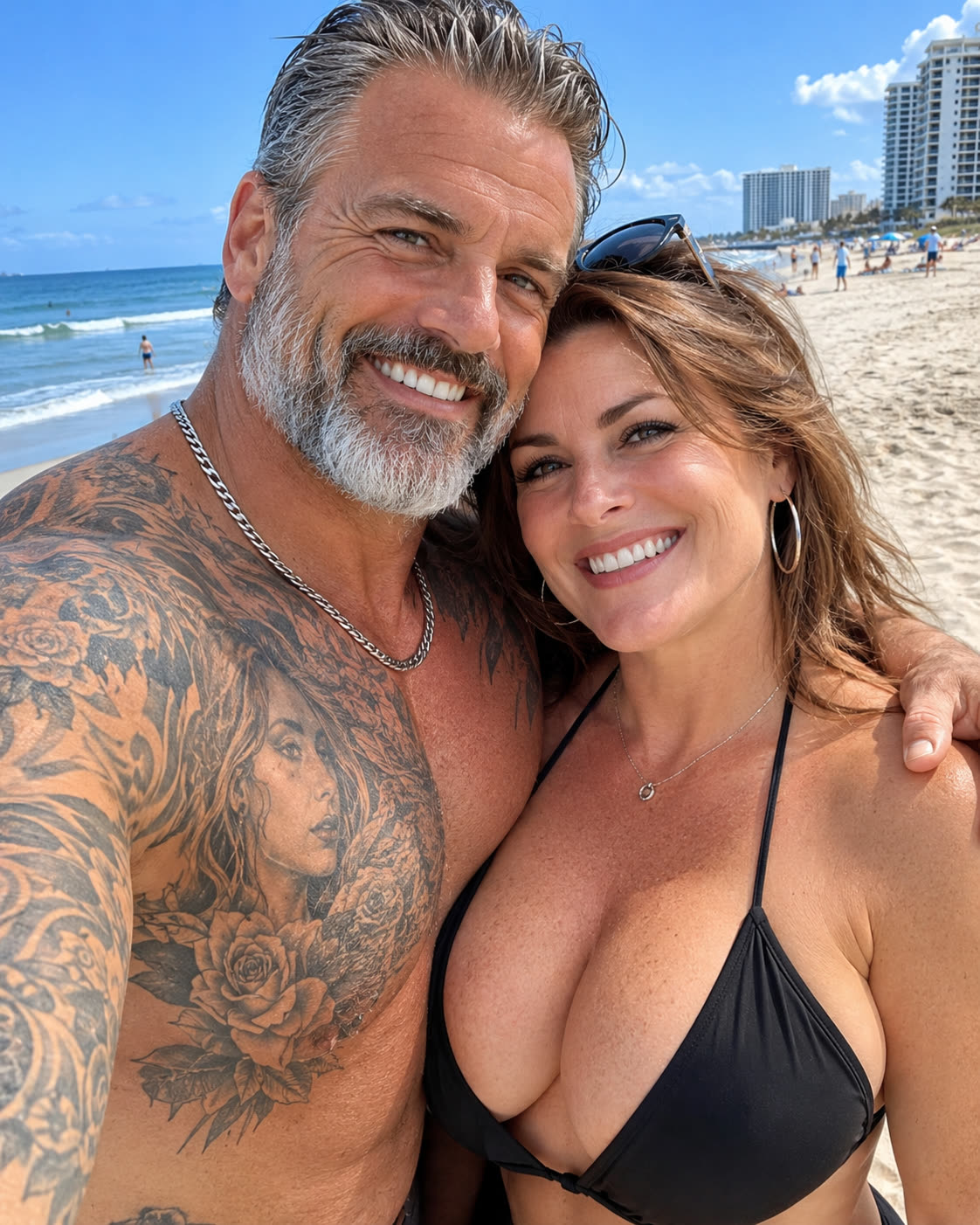
I remembered our honeymoon. Richard had emerged from the bathroom with damp hair and a towel around his waist, and for the first time I had a proper look at the beautiful woman inked above his heart. “Who is she?” I asked, trying for a newlywed’s easy curiosity despite the tightening in my chest. He looked down as though surprised to find her there. “Nobody,” he said. “Nobody gets tattooed directly over your heart, Richie.” He laughed, crossed the room, and gathered me close, smelling of hotel soap. “She’s nobody you know, I promise. I had it done years and years ago, back when I was young and dramatic. It doesn’t mean anything anymore.”
I believed him. That matters, because I hadn’t spent our marriage waiting to expose some old deception. We had been married three days. I had just entrusted him with my future, and I wasn’t going to turn our honeymoon into an interrogation about body art. I put his answer away and left it undisturbed. Through everything that followed, I needed to believe there was something uncomplicated about the man beside me, something dependable while my own body kept becoming a source of grief.
Five rounds of fertility treatment wore us down. Our lives narrowed to calendars, injections, examination rooms, and waiting. Richard learned to give the shots in my hip when my shaking hands couldn’t manage them. The telephone calls always began with the nurse apologizing, and eventually those opening words told me everything before she reached the explanation. We spent money we didn’t have and borrowed against the house for the last two attempts. Nothing worked. On a gray November afternoon, a doctor gently suggested we stop. Richard drove home without speaking, then held me on the kitchen floor while I cried for an hour. Whatever else he had concealed, he had not abandoned me in that sorrow.
Then, after two years of waiting, home inspections, interviews, and paperwork, we brought home our daughter. She was premature, dark-eyed, and fiercely loud for someone so small, with a cream blanket tucked around her tiny legs. On that morning, an old tattoo seemed beyond irrelevant. We had Claire. The years of disappointment had finally led to a child I could hold. I had carried Richard’s explanation through grief, and now I carried it into happiness without examining it again. Standing in the garage two decades later, I reread the message until the words blurred. Forgive me, Rose. She can’t know.
I searched the toolbox again, no longer casually. I removed trays and felt into corners until my fingers found a small black address book beneath the sorted screws and washers. Its spine was cracked and peeling. I had never seen it before, though I would have said I knew everything Richard owned. Many entries were crossed out, people whose usefulness or place in his life had ended. Near the front, however, one name remained untouched, circled in faded ink: Rose. I stared at the telephone number beside it, then carried the book into the kitchen and reached for the old landline.
The ringing seemed to continue forever. Once, twice, then three times. By the fifth, I was nearly ready to replace the receiver, relieved at the possibility of postponing whatever I had begun. A click interrupted the ringing. “Hello?” The woman sounded older and wary, unused to unexpected calls. My throat closed. Silence lengthened between us while I stood gripping the receiver in the kitchen where Richard and I had spent so much of our ordinary life. The photograph lay beside me, its explanation still hidden on the other end of the line.
“Richard?” she whispered. Our number must have appeared on her screen. “Richard, is that really you? After all this time?” I wound my fingers into the telephone cord until my knuckles hurt. “This isn’t Richard,” I managed. My voice sounded distant and flat. “It’s his wife.” Something rattled against a hard surface at her end, a cup set down too abruptly. Then she began crying, softly rather than dramatically, as though an event she had spent years preparing herself for had finally arrived.
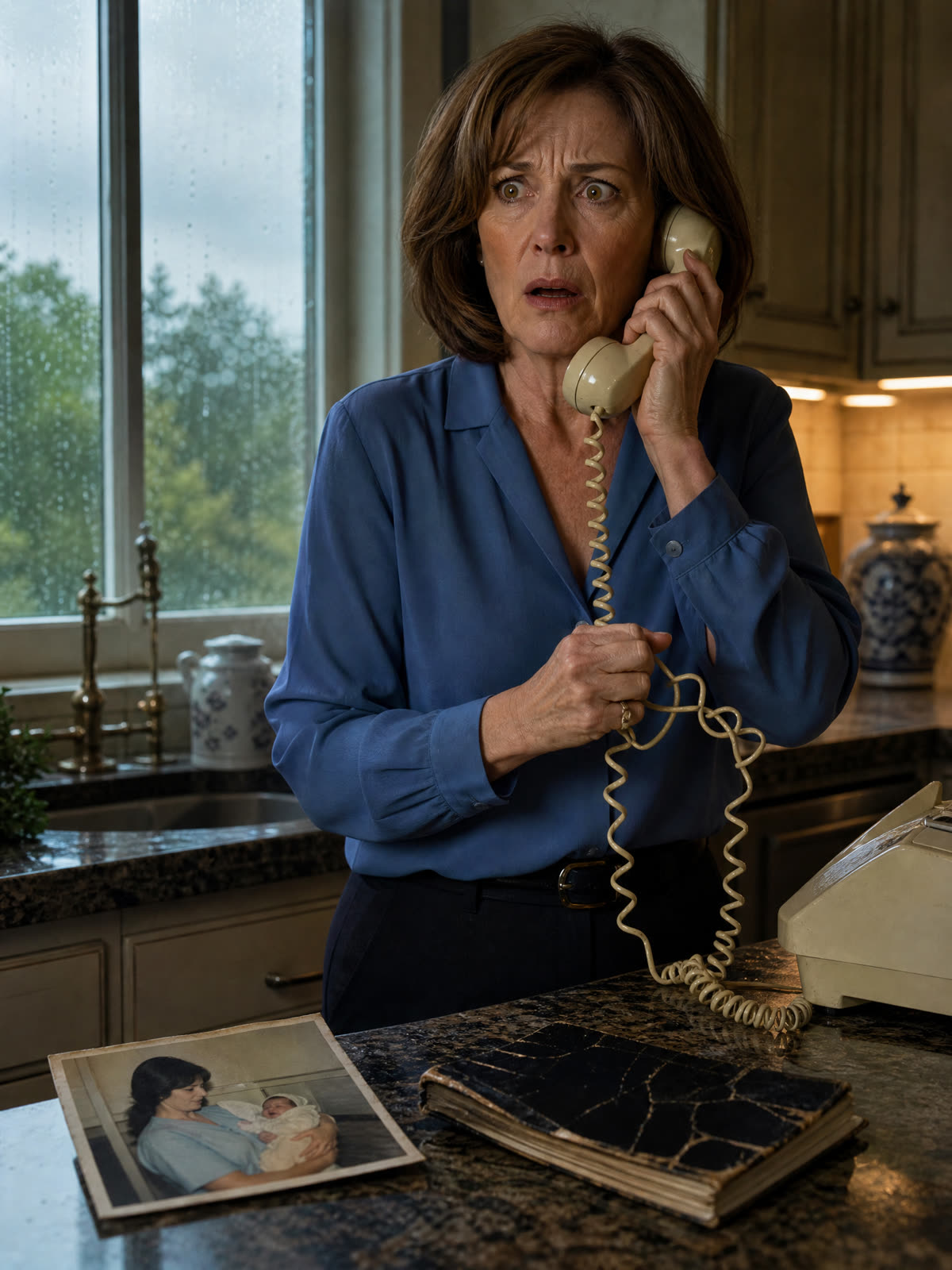
“You finally found me,” she said, through her tears. “Oh. Oh, I always wondered if this day would ever come. I told myself it wouldn’t. I told myself he’d take it to his grave. But I always wondered.” The kitchen seemed suddenly unfamiliar around me. “Who are you?” I said. She paused long enough for me to hear her gathering herself. “I can’t tell you this over the phone, sweetheart,” she said finally. “It isn’t the kind of thing you say into a telephone.”
“You can tell me right now,” I said. “You will tell me right now. I’ve been staring at a photograph of you holding a baby, and my husband’s handwriting on the back of it, and I am not going to hang up this phone not knowing.” Her kindness did not waver, which somehow made everything worse. “No.” Then she continued, “Not like this. Some truths shouldn’t arrive without a face attached to them, Evelyn. You deserve so much better than a stranger’s voice on a telephone line. Please. Let me give you that much. Let me at least tell you properly.”
She knew my name. I hadn’t told her, and that knowledge frightened me more than her tears. She gave me a diner’s name and address in the next town, somewhere neutral where we could sit across from one another. I copied it onto an envelope with a hand that scarcely obeyed me. Then I put the photograph in my purse and left before Richard returned. I left no message and made no call. For the first time in our marriage, I drove away carrying a secret of my own.
My hands shook so badly that I missed the highway turn twice. Rain began falling, a fine gray drizzle that the wipers swept aside while I rehearsed disasters. An affair. Another marriage. A child. Every possibility seemed worse than the one before it. I remembered little else of the drive by the time I reached the gravel parking lot. I had imagined a dozen different ways my marriage might collapse. None resembled what waited inside.
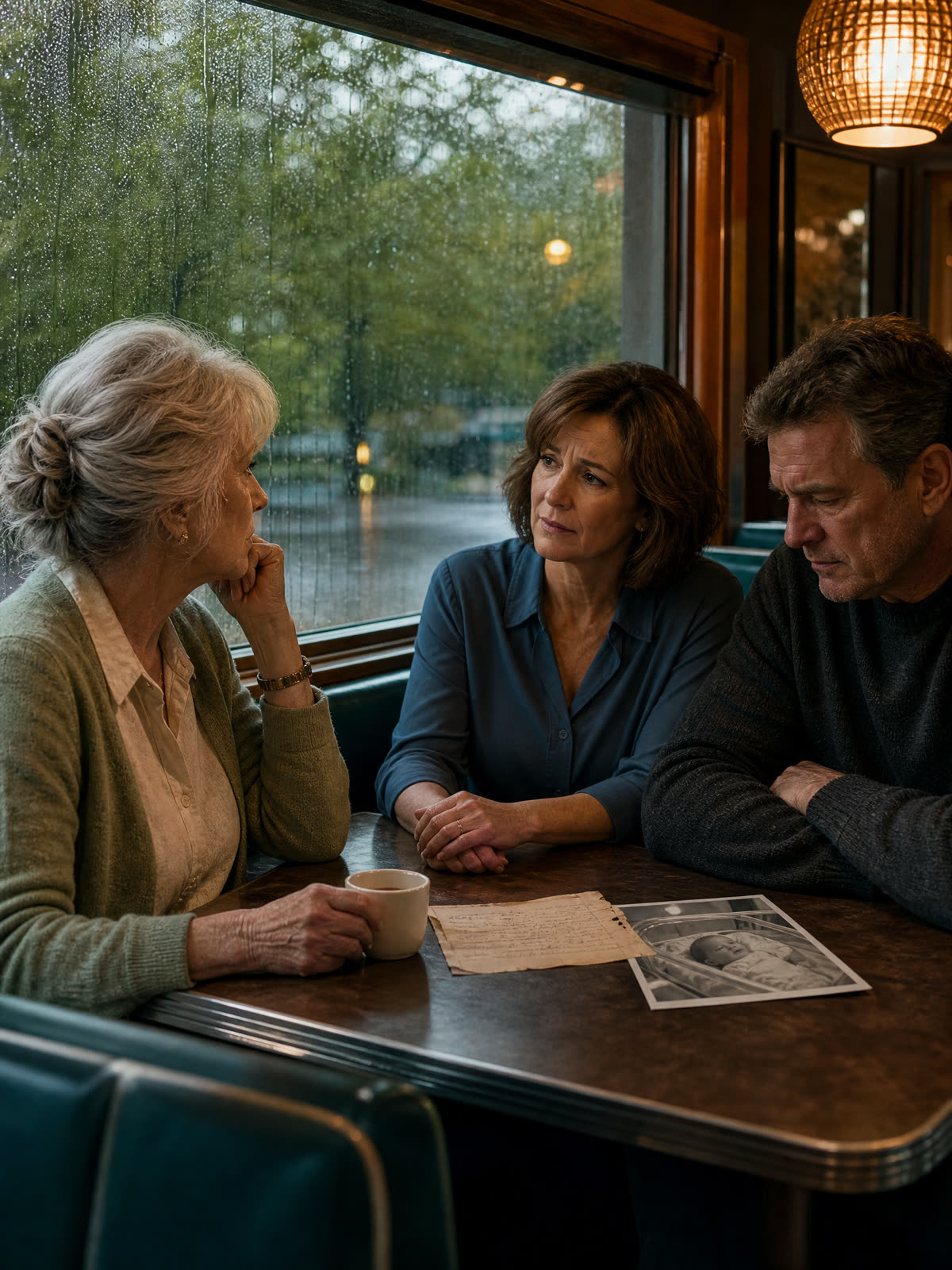
Rose occupied the last booth beside a rain-streaked window. Her hair was entirely silver now, her face softened by age, yet I recognized her immediately. I had spent too many years seeing that face on my husband’s skin not to know it. Both hands enclosed a white coffee cup, though the room was warm. “You’re Evelyn,” she said before I sat down. “And you,” I said, easing into the opposite seat, “are the woman on my husband’s chest.” Her fingers stopped moving.
I placed the picture between us. “What is this,” I said. “What is this, exactly.” Rose lowered her eyes to the baby in the photograph. Her shoulders loosened, and I saw something like relief move through her, the release of a burden carried so long it had become part of her posture. Before she could explain, the bell above the entrance sounded. I turned. Richard stood in the doorway.
At first he seemed merely confused to find me there. Then he saw Rose, and then the photograph. The color left his face. He caught the back of an empty chair as though he needed help remaining upright. I had prepared myself for a guilty lover’s expression, for frantic calculation or the beginnings of an excuse. Instead, he looked frightened and almost relieved. That relief unsettled me most. Some part of him had apparently wanted this moment to come.
Rose started to stand, then settled back. “I called him,” she told me quietly. “After you and I spoke on the phone. I couldn’t let the two of you sit here and do this without him. It wouldn’t have been right, or fair, to any of the three of you. This was never mine to tell alone, and it was never yours to hear alone.” Looking beyond me, she asked, “Richard. Did you keep it? After all this time?” He removed his coat but stayed in the aisle. “Every day,” he said roughly. “For twenty years. Every single day.”
From a concealed fold in his wallet, Richard withdrew a small square of paper. Its creases were nearly transparent from constant folding. He had carried it everywhere: our celebrations, Claire’s birthdays, her school performances, the ordinary days when I stood inches away without knowing. He approached and laid it beside the photograph with extraordinary care. Rose only stared, her eyes filling. I lifted the paper and opened it cautiously, afraid it might separate along the worn folds.
A woman’s faded handwriting said: Promise me she’ll always grow up believing she was wanted. Never make her feel like someone gave her away. I read it twice. The story I had constructed in the car would not accommodate those words. “Who,” I said carefully, “is she?” Richard slipped into the booth beside me, leaving a deliberate space between us. A waitress approached with coffee, took in our faces, and quietly withdrew.
He kept looking at the note. Rose turned her cup in small circles. “Richard,” I said. My husband did not reach for me or attempt to soften what came next. “Claire,” he said. The name was spoken almost gently. Nevertheless, it shifted the ground beneath every fear I had brought into that diner. The photograph, the hidden message, the woman over his heart—all of it led, somehow, to our daughter.
PART 2: The First Four Months
I looked from Richard to Rose, trying to force their faces into an explanation. “Is Claire your daughter?” I asked. “Is that what this is? Is Claire biologically yours?” His response was immediate. “No.” I turned toward the woman across from us. “Is she Rose’s daughter, then?” Rose looked through the wet window. “No,” Richard said. My voice broke. “Then I don’t understand,” I said. “I don’t understand any of this.” He rubbed the old note’s edge with his thumb. “Rose,” he said quietly, “was the neonatal nurse who quietly changed the way I understood what it means to be kind, years and years before I ever met you.”
For several seconds I couldn’t make his explanation mean anything. Throughout the drive, I had imagined another woman, another relationship, perhaps even Richard bringing his own baby into our home under the disguise of adoption. I had prepared myself to understand cruelty. A nurse did not fit. The woman tattooed over his heart had held my daughter through her earliest nights, and the truth stood so far outside my suspicions that my thoughts kept returning to the familiar shape of betrayal rather than taking hold of it.
Rose studied her coffee. “Claire was born more than ten weeks early,” she said softly. “She spent almost four months in the neonatal intensive care unit before she was well enough to go anywhere.” I struggled to keep my voice steady. “I know that,” I said. “I know she was premature. I know she was in the NICU. The agency told us all of it.” Rose raised her eyes. “You know what the agency told you, Evelyn,” she said. Something in her expression made my stomach fall.
“They told us,” I said slowly, “that she’d been abandoned. That she was left shortly after birth and nobody came back for her.” Rose’s answer was barely audible. “No one came back for her,” she whispered. “That part was true. That part was always true.” Around us, dishes clinked and other conversations continued, ordinary sounds pressing against a moment that felt anything but ordinary. She began describing the baby’s hand closing around the tip of her finger.
“She was so small when she came to us that she could only wrap two fingers around the very tip of one of mine. She hated the monitoring leads, hated them, would fuss and squirm every time we placed them. And she worked one foot loose out of her blanket every single night, no matter how carefully or how tightly we tucked her in. Every morning, one bare foot, sticking out.” A faint smile appeared. “The other nurses on the unit called her stubborn,” she said. “What did you call her?” I asked. Her smile deepened slightly. “Determined,” she said.
I examined the photograph again. This time, I recognized the expression rather than merely the face. I had worn it during midnight feedings, when Claire’s warm weight rested against me and the whole sleeping house seemed to hold its breath around us. I knew that fierce absorption, that feeling that I could destroy anything threatening the child in my arms. “Why were you holding her?” I asked. “In the photo. Why is a nurse holding a baby like.”
“Because babies need to be held,” Rose said simply. “Even the ones nobody has come for yet. Especially those ones. You can’t leave a human being that small alone in a plastic box for four months and expect her to learn that the world is a place worth staying in. Somebody has to hold her. So on my breaks, and after my shifts, I held her. That’s all.” Something loosened inside my anger, though it did not disappear. Richard smoothed the note against the tabletop.
“Rose used to sing to her during the procedures,” he said. “The painful ones, the blood draws, the line changes. She’d sing so Claire had something other than the pain to hold onto. She read out loud beside the incubator on quiet nights. She celebrated every single ounce that baby gained like it was a national holiday.” Then Rose explained what her own life had been during those months. After working nights with fragile infants, she went home to care for her dying mother. Their apartment had one bedroom, occupied by her mother. Money vanished into rent, prescriptions, and the relentless expenses of a long illness. She slept whenever she could, between shifts and medications, exhausted beyond anything a night’s rest could repair.
In the middle of that life, she had fallen in love with a three-pound girl who kicked off her blankets. When Claire became legally available for adoption, Rose asked the social worker whether she could apply. “I thought,” she said, her voice finally wavering, “that loving her might be enough. I honestly believed that. I’d held her through the worst of it. I knew her better than anyone alive knew her. I thought surely that has to count for something. Surely love is the main qualification.” But she had no bedroom for a child, no savings, and no dependable help. Claire might need specialists, surgeries, and years of demanding care. The assessment was not cruel, merely clear. Love could not supply what her circumstances lacked.
“So you stepped aside,” I said quietly. Rose watched rain making crooked tracks down the glass. “I was pushed aside by the facts of my own life,” she said. “There’s a difference, and it took me years to make peace with it. Stepping aside sounds noble, like something I chose. The truth is the facts pushed me out first. But then, afterward, once I understood I could never give her what she truly needed, I did choose something. I chose how to lose her. I decided I would lose her cleanly, and completely, and without making a single sound about it, so that she could have a whole family with two parents and a house and a future, instead of half of a exhausted one who loved her but couldn’t keep the lights on. That part, the how, that part was mine to choose. So I chose well. It’s the thing I’m proudest of and the thing that cost me the most.”
Richard rested his hand near the picture. “We met her,” he said quietly, “the morning we came to bring Claire home. Rose was the nurse on duty.” Memory returned in fragments: pale green walls, a hand-washing poster, our carefully installed carrier, and the sleeping baby I could scarcely believe was ours. A nurse tucked the cream blanket around Claire and explained that humming soothed her, whatever the tune. She warned me not to bundle her too warmly because she would work one foot free. I had accepted each instruction as precious, never wondering how someone knew our daughter so intimately.
Then I remembered a woman near the doorway after the signatures were complete. She had watched us gather up our child without asking for attention or saying anything to interrupt us. I hadn’t really looked at her. She had belonged to the room, to the hospital, to the happiest day of my life. “That was you,” I breathed. “Standing in the doorway. That whole time. That was you.” Rose nodded. “I couldn’t stay in the room,” she said. “Once you had her, I couldn’t stay.” “Why not?” Her gaze met mine.
“Because you were becoming her mother, right there in front of me,” she said. “I could see it happening. And I had already taken up more than enough space in that little girl’s life. It was your turn. It was supposed to be your turn. The kindest thing I could do was disappear from the doorway before I made it about me.” Richard touched the note. “She gave me this outside the hospital that morning,” he said. “In the parking lot, before we drove away. She pressed it into my hand and asked me to promise her that we would never let Claire grow up feeling like she’d been discarded. Like she was something someone gave away.”
I turned fully toward him. “And you decided,” I said, “that keeping that promise to her meant lying to me? For our entire marriage?” A muscle moved in his cheek. “I told myself Claire was too young to understand any of it,” he said. “When she was a baby, that was even true. And then I told myself you had already been through so much, the fertility years, everything they took out of you, that you didn’t need one more complicated thing to carry. And then, somehow, it just became the shape of things. The permanent shape. The longer I held onto it, the heavier it got and the harder it became to ever set it down. Every year that passed made it a bigger betrayal to finally confess, so every year I chose the silence again. That’s how a lie gets to be twenty years old. Not all at once. One quiet day at a time.”
Rose’s gentleness acquired an unmistakable firmness. “You should have told your wife, Richard,” she said. “All of it. Years and years ago. That part was never my promise, and you know it. I asked you to protect Claire’s heart. I never once asked you to keep secrets from the woman lying next to you. You added that part yourself. Don’t hang it on me.” Richard looked down. He offered no argument and tried to rescue none of his pride. Somehow, his willingness to remain undefended felt like the first unqualified honesty to emerge from the secret.
I returned my attention to the rose behind the young woman’s ear. “Then why,” I said. “Why is her face the one tattooed over your heart? If it was never romantic. If she was a nurse. Why her?” Richard placed his palm over his chest. “When I was nineteen,” he said, “I volunteered at that hospital after my classes. Just an orderly, really, running errands and pushing wheelchairs and delivering flowers up to the rooms. I was pre-med and full of myself and pretty sure I already understood everything about medicine and mercy. And every single afternoon my route took me right past the big window of the neonatal unit, and Rose was always, always there. I’d slow down and look through the glass. She’d be talking softly to babies whose parents couldn’t be there, or wouldn’t come. Rocking the ones nobody visited. Singing to the ones getting stuck with needles. Celebrating every ounce they gained like it was the finest news anyone had ever received.”
He looked across at her. “I was nineteen and arrogant and I thought I knew what a good person looked like, and then I watched that woman through a pane of glass, day after day after day, doing the hardest and most invisible work I’d ever seen, for babies who could never thank her and parents who would never know, and I understood that I hadn’t known anything at all. She rebuilt what I even thought the word kindness meant. I never once spoke to her back then. I was too shy. But she changed me.” I listened, trying to reconcile that young man with the husband who had dismissed her as nobody.
“One evening near the end of that year, another volunteer, an art student doing her required hours, sketched Rose sitting beside an incubator without Rose ever knowing she was doing it. Just a quick thing, pencil on the back of an intake form. And when the girl was going to throw it out, I asked if I could keep it. And I carried that folded-up sketch in my wallet for months and months, the way you carry a thing that reminds you of who you’re trying to become.” His voice softened further. “Eventually, a couple of years later, I took it to a tattoo artist and had it put over my heart. Not because I was in love with a woman I’d never met. Because I wanted to keep her there. I wanted to never forget what I’d seen through that window. I wanted to carry that standard of kindness around with me for the rest of my life, right where I’d feel it.”
His eyes shone as he faced Rose again. “And then twenty years went by, and I met you, and I married you, and we tried and tried to have a child and couldn’t. And the morning we finally walked into that hospital to bring home the daughter we’d been given, the nurse standing there waiting for us, holding my daughter, was her. It was Rose. After all those years. I nearly went to my knees right there in the hallway. I couldn’t believe it. And she looked up at me, and she recognized me too, the volunteer boy, all grown up.”
I pressed my fingertips against the table’s edge. “And you lied to me,” I said. “You had this whole, this whole beautiful thing, and you looked me in the eye on our honeymoon and told me she was nobody.” His hand remained over the portrait. “Yes,” he said. “And I was wrong to. I know that. I’ve always known that. But Evelyn, I never once wanted to forget that our family, you and me and Claire, was built on top of a kindness that started before any of us even arrived. Rose held our daughter when she was alone in the world. That’s the ground we’re all standing on. I couldn’t let myself forget it.”
“But you let me believe she was imaginary,” I said. “You let me think I’d married a man who put a stranger’s face over his heart and shrugged about it.” “Yes,” he said. Nothing followed to cushion it. He did not take my hand. That plain acknowledgment hurt and helped in equal measure. Then Rose bent toward a canvas bag beside her. She brought something out and laid it on the table. I recognized it before I could understand how it had come to be in her possession.
PART 3: The Stitch She Left Behind
It was Claire’s cream baby blanket. I knew its faded satin edging, the stubborn old mark that had survived every washing, the loose thread Claire had rubbed between her fingers whenever she was tired or unhappy. For twenty years, this had belonged among our family’s most intimate possessions. Seeing it emerge from a stranger’s bag made the room seem to tilt again. “Why,” I said, struggling to make my voice work, “do you have this? This is Claire’s. This has been in our house for twenty years.”
“When Richard recognized me that morning,” Rose said, “we stayed in touch. Not often. A Christmas card every few years, that was mostly all. Just enough of a thread to know the other was still out there.” She glanced toward him. “But last week, he brought me the blanket. Because he remembered that I was the one who first stitched it, all those years ago, and he thought I might want to hold it again after all this time. That’s why he had it. That’s the only reason he took it from the house.”
I lifted the blanket with both hands. Near the hem was a tiny embroidered rose, careful and delicate, scarcely larger than a thumbnail. I had washed this fabric hundreds of times. It had comforted Claire through fevers, traveled in suitcases, and covered her knees on the drive to her college dormitory. I had cried all the way home afterward. Through every one of those moments, the flower had been there. I had never asked who stitched it. I had assumed, without thinking, that it simply belonged.
“One corner kept fraying while she was with us on the unit,” Rose said quietly. “The satin binding was coming loose. I fixed it one night during a break. And while I was at it, I.” She held a finger just above the embroidered petals. “I wanted to leave something of myself with her,” she said. “Something small enough that it would never get in the way. Something no one would ever have to notice or explain. Just small enough to be there.” Before I could answer, the bell above the entrance rang again. Claire walked into the diner.
Richard had texted her from the parking lot before coming inside, telling her only that we needed to talk and where to find us. My twenty-year-old daughter noticed our booth and approached, then slowed when she saw what I held. “Why do you have that, Mom?” she asked. Her gaze moved over our faces, the photograph, the worn note, and the silver-haired woman. “Mom? Dad? What’s going on?” She sat beside Rose, opposite Richard and me. I slid the photograph in front of her without speaking.
She studied the image, then looked at the fabric in my hands. “That’s my blanket,” she said slowly. “Yes,” I said. Claire turned toward the woman sitting next to her, someone she believed she had never seen. Rose placed both palms on the table. Her hands were perfectly steady now. “I was one of your nurses, sweetheart,” she said gently. “A very long time ago, when you were very, very small. Smaller than you could ever imagine.” Claire opened her mouth, but no words followed.
Rose’s eyes filled even as a smile began. “You kicked one foot free of your blanket every single night,” she went on. “No matter how carefully we tucked you in, every morning, one bare little foot sticking out into the cold. And you’d only really settle down and sleep if someone was humming to you. Didn’t matter the song. And the week before you finally got to go home with your mom and your dad, you gained three whole ounces, which for a baby your size was enormous, a triumph, and a few of us celebrated with terrible stale cupcakes out of the vending machine down the hall at two in the morning, because that felt like exactly the right way to honor it.”
Claire touched the embroidered flower. Her fingertips trembled against the worn fabric, resting on something she had known all her life without understanding it. “You made this,” she said softly. “The rose in the corner. You’re the one who made this.” Rose nodded, unable to answer immediately. I watched recognition take shape in my daughter’s face, not recognition of a memory she could possibly retrieve, but of the care that had surrounded her before memory began.
The photograph lay beside the old promise. Until that afternoon, Claire’s earliest months had existed for us mostly as medical facts: her prematurity, her time in the unit, the long wait until we could bring her home. Now those months had a face and a voice. They contained songs, sleepless attention, repaired satin, and a celebration over three ounces. The woman beside her had known the small habits we would later think of as ours to discover. All of that had been real long before I entered the discharge room.
“But why?” Claire asked, her voice thickening. “Why would you do all of that, sit up with me, and sing to me, and fix my blanket, for a baby who wasn’t even yours to keep? Who you knew you were going to lose?” The diner seemed to become utterly quiet, though perhaps that was only the rush in my ears. Rose waited before replying. She appeared to be choosing her words as carefully as she had once handled the fragile child now sitting beside her.
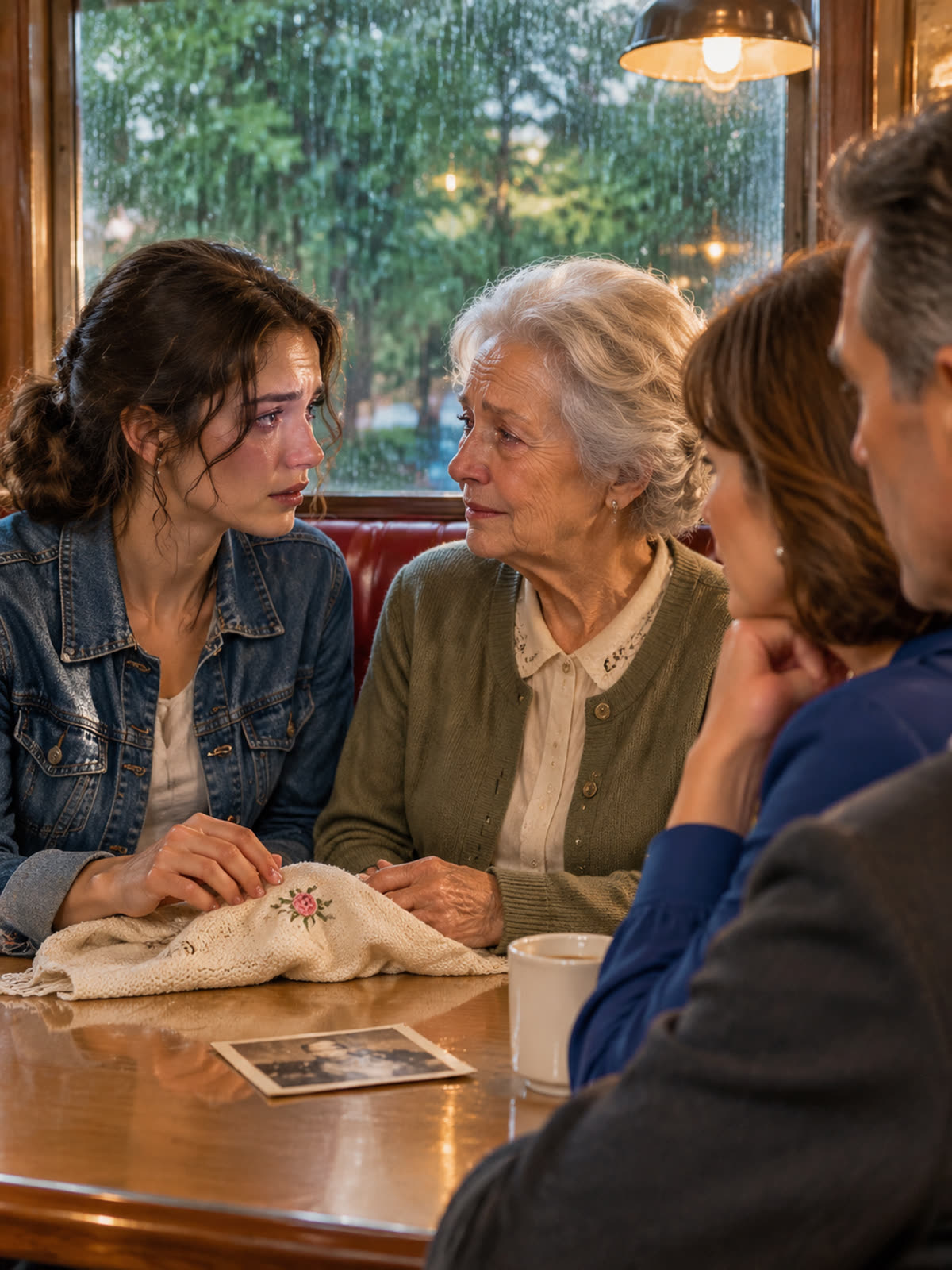
“Because I got to love you first,” she said simply. “For four whole months, when the world hadn’t yet decided what it was going to do with you, when you were the smallest and most alone that a person can be, I got to be the one who loved you. That was my part. That was the whole of what I was given. And then your mom and your dad, they got to love you forever, every day after, and they still do, and they always will. That was always the better deal, sweetheart, and I knew it even then. I only ever had the first four months. They got all the rest of your life. But I wanted to leave one small stitch of myself behind in that blanket, so that some tiny piece of me got to go home with you and be there for all the parts I would never see.”
Claire’s hand stopped moving over the flower. Then she rose from the booth, moved around its curve, and wrapped both arms around Rose. She held her with the same wholehearted grip she had once used with me during thunderstorms. For a fraction of a second, Rose remained motionless. In that pause, I understood what twenty years of restraint might feel like inside a body: learning not to reach, not to expect, not to hope for an embrace that would make all the missing years suddenly tangible.
She had walked away from the doorway and taught herself to stay away. A card every few years had been enough contact to know, and too little to soothe the longing. Now the girl she had once held through painful procedures was holding her. Slowly, Rose raised her arms. She drew Claire against her and bowed her silver head beside my daughter’s dark one. At last, she permitted herself what she had spent two decades refusing to ask for.
I cried as I watched them. Somewhere during that hour, the last of the anger filling the space between Rose and me had drained away. There was no rival across the table, no woman trying to claim what belonged to me. There was someone who had loved my child before I knew her, and who had accepted being absent so we could become a family. Her grief had never required my happiness to be smaller. She had protected room for it, even when doing so meant leaving the room herself.
When Claire sat down again, she wiped her eyes with the heel of her hand. Then she reached across the table and touched Richard’s shirt over his heart. She had seen that tattoo at swimming pools and beaches throughout her childhood and never considered questioning it. “The tattoo,” she said in wonder. “It’s her. It’s been her this whole time. My whole life.” Richard laid his larger hand over hers and held it gently against his chest.
“Every family has someone that history almost forgets,” he said quietly. “Someone who did the quiet, invisible thing that everything else got built on top of.” His eyes shone as he looked at Rose. “I promised myself, a long time ago, that ours never would. That’s all the tattoo ever was, Claire. A promise not to forget her.” I looked at the photograph, the note, and the little stitched flower. Three ordinary objects had carried an entire history we had lived beside without seeing.
That evening, I sat at our dining table folding the blanket. The house was quiet. My thumb traveled along the thin satin edge as Claire’s fingers had done when she was little. Everything I had heard in the diner returned in pieces: a nurse humming through a procedure, a bare foot escaping its wrapping, a woman standing by a doorway while another woman became a mother. The blanket had accompanied us through so much that I had thought I knew every part of it. Now even its smallest detail held a life beyond our own.
For twenty years, I had believed the face on Richard’s chest represented another woman in the most threatening sense: a rival, a ghost, some old wound I had agreed not to investigate. I had made an uneasy peace with not knowing. But the person he remembered was neither an affair nor a secret love. What he had placed over his heart was gratitude, stubborn enough to survive decades, toward the woman who loved our daughter when she weighed three pounds and no one had come for her.
I understood, finally, what he had wanted to preserve. Our ordinary happiness had rested partly on care we never witnessed. Before our birthdays, school plays, holidays, and long drives, there had been someone singing beside an incubator. Before I learned how Claire liked to be soothed, someone else had stayed long enough to find out. Rose’s contribution had not diminished our parenthood. It had helped make the life we shared possible. I no longer wanted that history returned to darkness merely because learning it had hurt.
I smoothed the small rose with my thumb and folded the blanket as carefully as something intended to last forever. Then I placed it inside Claire’s keepsake box, where it belonged. This time, the flower was no longer an unexplained decoration. Its maker belonged to our daughter’s story openly. The first four months, the quiet sacrifice, the kindness woven into everything afterward—none of it needed to remain concealed from the people who loved her.
Richard appeared in the doorway. He stayed at the threshold instead of entering, uncertain whether he was welcome. He did not ask if I forgave him, and I was grateful. I had no answer ready, and neither of us had earned an easy one. A promise could begin beautifully and still become a wall around the person excluded from it. He had honored a good woman’s plea while deceiving his own wife. Understanding the first truth did not erase the second.
There would be difficult conversations about the evenings when he could have spoken and chose silence instead. Twenty years could not vanish because one afternoon had revealed something extraordinary. The story of the tattoo had changed forever, and I no longer feared the woman it portrayed. But Richard remained in the doorway while I sat beside our daughter’s keepsake box. Rose’s secret was finally behind us. The reckoning between my husband and me was still waiting to begin.
Disclaimer: This story is a work of fiction inspired by real-life themes. Names, characters, places and events are fictionalized, and any resemblance to real persons is purely coincidental. Images are for illustration purposes only.
