

PART 1: The Address He Never Forgot
Call an emergency dispatch center in rural America, and the opening question usually concerns location rather than explanation: What is the address of your emergency? Instructors discovered long ago that cell signals disappear, frightened callers lose their breath, and connections fail without warning. An address entered into a computer, however, can still send deputies and an ambulance down a dark country road. That is why teachers make children memorize their road names and house numbers before they understand long division. My fourteen-year-old son knew that lesson perfectly. Beneath a denim quilt, with heavy boots battering his bedroom door, he whispered our address four times. The woman listening knew those numbers already. She had eaten Thanksgiving dinner at our table for twelve years. My name is Sergeant First Class Danielle Ellison, although almost everyone in Hollis Creek, Indiana, calls me Dani. I had spent twenty-three years dividing my days between my family’s butcher business and the Indiana Army National Guard. Neither occupation prepared me for what happened to my boy.
My grandfather established Ellison Custom Meat beside State Road 56 in 1958. Twenty years afterward, my father built the hickory smokehouse. After my second overseas tour, I assumed management and contributed digital scales and a simple website that my son, Micah, put together over one rainy April weekend. Farmers delivered cattle and hogs; November hunters arrived with field-dressed deer. My work turned those animals into food families could keep through winter. At six feet tall, with broad shoulders, I had learned to hold my ground in a business mostly run by heavyset men. I had also learned that a blunt knife was more dangerous than a sharp one: forcing an edge through bone invited mistakes. My grandfather’s other lesson concerned the hanging rails. Never turn your back on a hanging side. A swinging side of beef could break a collarbone without slowing. Cold metal did not care whether you were distracted, confident, or afraid.
I was forty-two when orders arrived for a ten-month deployment to Kuwait, managing fuel and supply operations with a regional sustainment brigade. My husband, David, responded with the practical calm I depended on. He worked overnight as a hospital pharmacy technician in Lindley, twenty-six miles away, and organized his life around checklists and reliable routines. While I studied my deployment paperwork, he mounted a fresh calendar on our refrigerator and began arranging track-practice rides, shop inventory, and yard work. “My sister promised she’ll look in on Micah during my midnight shifts,” David said quietly, pouring coffee into my thermos. “And Heath asked if he could park his rollback wrecker and boat trailer in our back pole barn until spring. I told him it was fine.” The steel barn stood a hundred yards behind our farmhouse. “Heath owns a boat?” I asked. “Every time I’ve driven past his salvage yard, all I’ve seen are rusted chassis and scrap heaps. Since when does Heath Haynes have a boat?”
“He says he picked up an outboard runabout off an auction lot in Louisville,” David answered. “You know how Heath operates. He buys junk, flips it, and leaves the clutter wherever he finds dry ground. He’s family, Dani. It keeps peace between the houses.” His sister, Becky Haynes, was almost an institution in Brandon County. She had worked emergency dispatch for sixteen years and supervised overnight operations for five. In 2019, when a school bus slid into floodwater, Becky spent fifty-two minutes guiding its terrified driver through getting nineteen children onto the roof. The newspaper called her The Steady Voice in the Dark. David displayed the framed article in our entryway. Heath, who operated Haynes Towing and Salvage, inspired a different kind of recognition. His eight-acre yard held crushed cars and leaking machinery behind chain-link fencing. He could buy drinks for a whole tavern, then ask someone outside for fifty dollars. I never hated him, but his restless eyes suggested a man always calculating how far his debts were behind him.
The evening before I reported to the armory, I found Micah sitting on an overturned bucket inside our refrigerated hanging locker. He had his own shop key, although he was not supposed to enter that room alone. The compressors maintained thirty-four degrees, and his breath drifted white above his gray sweatshirt. “You’re going to catch pneumonia in here, kiddo,” I murmured. “Cold air clarifies your thinking,” he replied, giving me the crooked smile he had inherited from David. “Saw an article about it online.” I brought over another bucket. Fourteen had made him all elbows, long legs, and unpredictable growth. He ran the quarter-mile with more natural speed than technique and could recognize or imitate voices with startling accuracy. At ten, he had impersonated me on the telephone well enough to order an entire pallet of butcher paper. Now he stared down at the concrete. “Mom,” he said. “Why does Uncle Heath need our barn? I rode my bicycle out to his scrap yard last week to get an inner tube. There isn’t any boat out there. Just two flatbeds and a lot of smashed minivans.”
I put a gloved hand on his shoulder, my thoughts crowded with travel arrangements and unfinished military paperwork. “He probably hasn’t hauled it up from Kentucky yet,” I said gently. “Don’t borrow trouble, Micah. Watch out for your dad while I’m overseas. You’re the eyes and ears around here now. Keep an eye on our place.” His expression tightened with solemn purpose. What I intended as reassurance became an assignment he believed he had sworn to complete. Three weeks after my transport landed in Kuwait, a diesel truck came down our lane late at night. David was already at work. From his upstairs window, Micah watched Heath reverse his wrecker toward the barn beneath the amber security light. There was no boat on its tilted bed. Instead, a passenger sedan scraped backward toward the concrete. Heath and an unfamiliar thin man in a greasy ball cap unlocked a new brass padlock, unloaded the vehicle, and shut the sliding doors. Soon a reciprocating saw shrieked across the pasture, while blue-white flashes lit the dirty windows.
Before school, Micah inspected the barn. Its doors were locked, but fresh oil shone on the gravel, and little curls of cut stainless steel lay in the weeds. He pocketed three and presented them to David that afternoon. My husband sat in blue scrubs, stirring sugar into coffee, exhaustion darkening the skin beneath his eyes. “Heath’s doing some contract exhaust work for a private client,” he said. “Becky told me all about it last Sunday. He needs a secure, covered bay so folks from the scrap yard don’t wander off with his tools. It’s fine, Micah. Heath just keeps odd hours.” Micah’s frustration rose. “Dad, it was one in the morning,” he protested. “He brought a sedan in on the rollback and sawed the exhaust right off the frame.” David’s answer sharpened. “Your uncle operates a twenty-four-hour towing concession,” he said. “Leave it alone, son. Your mother didn’t leave us here to police our relatives.” It was easier to defend family than investigate why family needed defending.
The arrivals continued twice a week, between midnight and three, always when David’s car was missing. Vans appeared, then crossovers, sometimes two in one night. Micah kept a spiral notebook under his mattress and recorded the pattern. Newspaper reports supplied the explanation. A catalytic-converter theft ring was stripping vehicles throughout three counties, taking components containing platinum, palladium, and rhodium from church lots, hospital garages, and commuter stations. In ninety seconds, battery-powered saws could turn two severed pipes into hundreds of dollars. Detective Joy Pierce, leading a joint task force, explained the investigation in a local article. “We are hunting a centralized consolidation hub,” she told the paper. “These components aren’t being moved out of car trunks. Somebody has an industrial outbuilding where these units are harvested, boxed, and prepped for interstate transport.” Reading those words, Micah understood that the building belonged to me. He began an urgent email, then erased it. I was overseas, moving supplies through dangerous territory. He decided that reporting suspicions without proof would only leave me frightened and powerless.
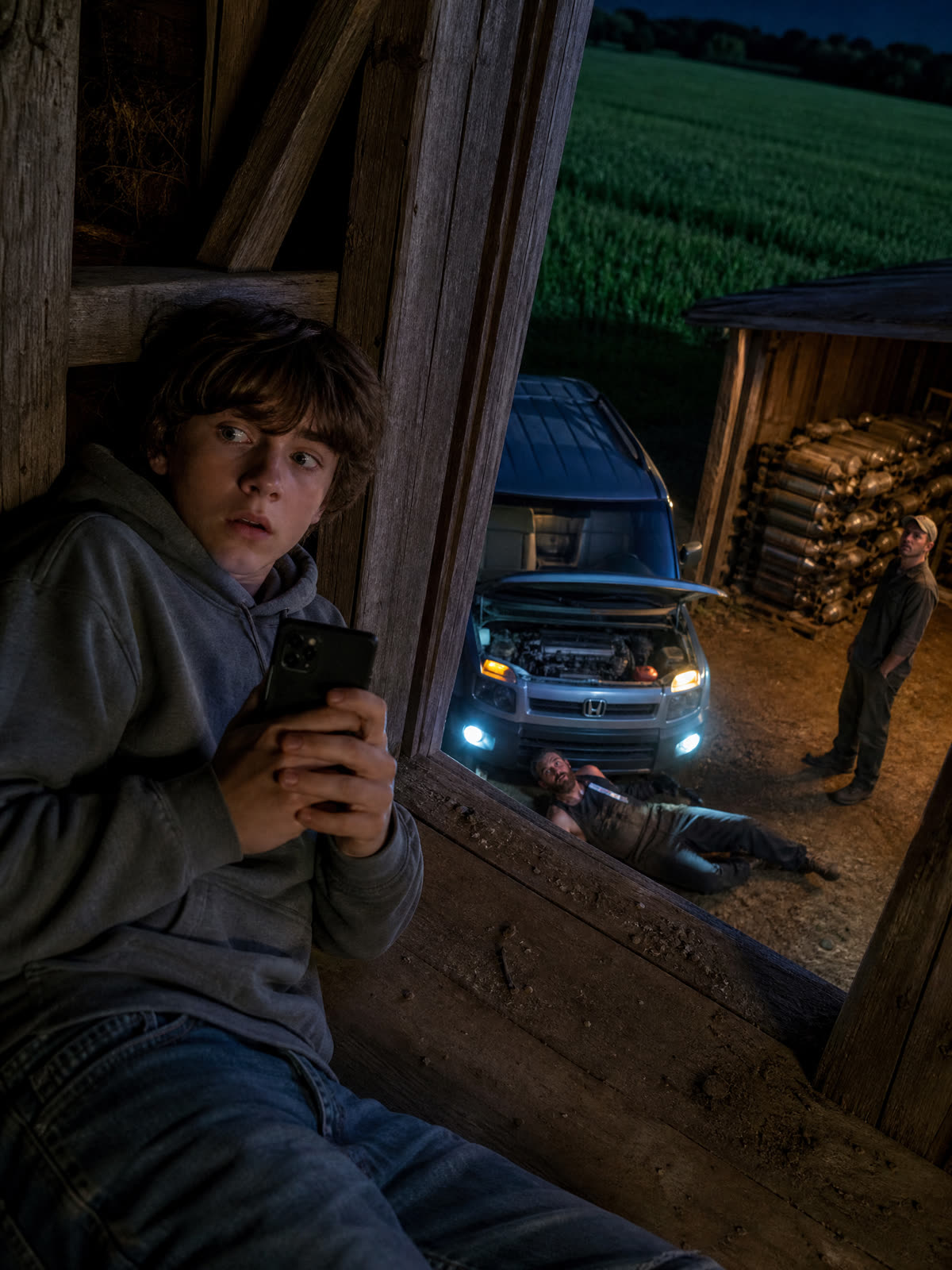
On the first Friday in June, he took his smartphone up the outside ladder of the old timber corncrib, twenty feet from the barn. He waited among cobwebs and dust for three hours. When the diesel finally approached, he settled beside a glassless opening that gave him a clear view through the barn’s open upper transom. Below him, Heath and the thin man went to work. Micah had convinced himself that being my eyes and ears meant collecting something no adult could dismiss. He would not bring David another handful of shavings. He would bring evidence. He kept still as the barn filled with harsh working light, its brightness spilling into the surrounding darkness. Then he raised his phone and began recording. For the next nine minutes, the screen held everything that had been happening a hundred yards from his bed while his father filled prescriptions and his mother served on the other side of the world.
Heath wore a leather welding apron as he slid beneath a stolen Honda Element on a mechanic’s creeper. Nearby, the man in the cap stacked converter canisters on a pallet already thirty units high. A dry-erase board against my grandfather’s pegboard displayed license numbers and payments. At eight minutes, Micah shifted to improve his view. A dried floorboard groaned beneath his sneaker. The saw stopped. Heath rolled out, wiped his forehead with a filthy arm, and looked directly toward the dark corncrib rafters. “Somebody up there?” he barked. Micah flattened himself against the timber, his chest pressed into dust, terrified that even his heartbeat might betray him. Two minutes stretched into an eternity. Then the saw started again. He remained hidden until the men loaded their pallets and drove away. Only after their engine faded did he climb down and run back to the farmhouse.
For two weeks, nothing happened. Heath stayed away. Becky continued calling on Saturdays to ask David about groceries and whether Micah wanted a ride to the hardware store. The ordinary sound of those conversations gradually persuaded my son that the darkness had concealed him. He kept the nine-minute recording encrypted on his phone, imagining my return through the Indianapolis terminal. In his mind, he would bring me into the kitchen, hand over the device, and explain that he had done what I asked. He had watched the farm. He had noticed what the adults refused to see. He had collected proof instead of troubling me with guesses. He did not yet understand that silence from a dangerous man was not necessarily safety. Sometimes it meant the man was deciding how to take back what a child had discovered.
On the final Tuesday in June, at 3:09 in the morning, metal rattled against his bedroom door. Someone was working the brass handle, testing the old skeleton lock. Micah sat upright. David had left for the hospital at eleven, and the farmhouse was entirely dark. Even the hallway nightlight, which had burned there since Micah was a baby, had been unscrewed. “Micah,” a voice hissed through the wood. The words were thick with liquor. “Open the door, boy. It’s your Uncle Heath.” My son stopped breathing. Heath leaned against the frame until it creaked. “I know what’s on your phone, kid,” he mumbled. “Just hand the damn phone through the door, and I walk away. Nobody gets hurt. Nobody says a word to your folks. Be smart.” The lock was the only thing between them.
Micah dragged his quilt onto the floor and crawled beneath it beside the nightstand. His fingers shook so badly that he entered his passcode incorrectly twice. The screen finally opened, lighting his frightened face beneath the blanket. “Open the damn door, Micah!” The first kick struck the lock plate with the force of a hammer. Pine casing split. A framed photograph from our family trip to the state fair dropped from the wall and shattered on the floorboards. Cornered between the mattress and window, Micah dialed 911. The call connected after one mechanical ring. “Brandon County 911. What is the address of your emergency?” He knew the voice immediately. It belonged to the aunt who had comforted him through measles, shared our holiday meals, and been praised throughout the county for never losing her calm.
He did not spend precious seconds explaining who he was. He pressed his mouth against the microphone and repeated the lesson we had practiced in our kitchen. “5719 Pehl Road. 5719 Pehl Road. Someone is kicking my door down. 5719 Pehl Road.” Another kick demolished the door’s middle rail. The crack sounded like a gunshot. “Please,” he whimpered. “5719 Pehl Road.” A pause followed. Across the open connection, Heath’s drunken shouting carried clearly from the hallway: “I know you’re in there, you little rat!” Then Becky sighed. Not in alarm. Not with the concentration of someone sending help. It was the weary, irritated breath of an adult unwilling to deal with a troublesome child. “Not tonight, kid,” Becky Haynes said flatly. “Go back to bed.” She disconnected.
My son stared at the screen. The call had lasted forty-one seconds. Then a third kick tore the center panel into splinters. Heath’s thick arm thrust through the opening, reaching blindly for the inside bolt. Micah had nowhere else to go. He shoved up the window, kicked the insect screen into the darkness, and climbed onto the sill. Eighteen feet below lay the flagstone terrace my grandfather had laid. Behind him, wood shifted beneath his uncle’s hand. Below him was stone. The people who were supposed to protect him had reduced his choices to those two things. He jumped. His tibia and femur broke against the terrace, the impact driving the air from his lungs. He collapsed onto his side, and his phone bounced away into the crabgrass.
Heavy footsteps came around the house. Heath stood over him beneath the barn light, breathing hard and smelling of bourbon. He looked at Micah’s twisted legs, retrieved the phone from the grass, and put it in his back pocket. “You were sleepwalking,” he muttered, pointing at my son’s graying face. “You took a bad step out the window while having a nightmare. That’s the story, Micah. You hear me? You were sleepwalking.” He did not fetch a blanket. He did not call an ambulance. He returned to his truck, started the engine, and drove away down Pehl Road. My boy remained on the flagstones in track shorts and an undershirt while the temperature dropped to fifty-one degrees. For three hours and thirty-one minutes, the farmhouse stayed dark above him.
He tried to scream, but the terror had broken the connection between the urge and the sound. Severe hypothermic shock took hold. His body trembled, and the voice that had once mimicked mine so convincingly could no longer summon anyone. At twenty minutes to seven, David turned into the driveway and found him. My husband dropped his keys, fell beside the terrace, and bent over our only child. Micah’s lips were blue; his legs lay at impossible angles. David lowered his ear to the faint movement of his mouth. My son did not ask for pain medicine. He did not explain the fall. With what little breath he had left, he whispered the truth that would eventually bring his aunt’s celebrated world down around her: “Aunt Becky hung up on me.”
PART 2: What the Clean Floor Concealed
The Red Cross message reached my operations center at five in the morning, Kuwait time. My company commander handed me one typed page: Dependent son hospitalized. Severe orthopedic trauma resulting from fall. Condition stable. He fought to arrange compassionate leave, but grief did not make military transport or staffing move faster. Our battalion was carrying out a critical fuel transfer, and my replacement could not reach the forward base for almost three weeks. Nineteen days passed beneath the canvas ceiling of an operations tent. Diesel generators droned outside while I lay awake, unable to cross the distance between my duty station and my child. Every skill I possessed involved getting essential things where they needed to go. None of those skills could put me beside Micah’s hospital bed when he needed his mother.
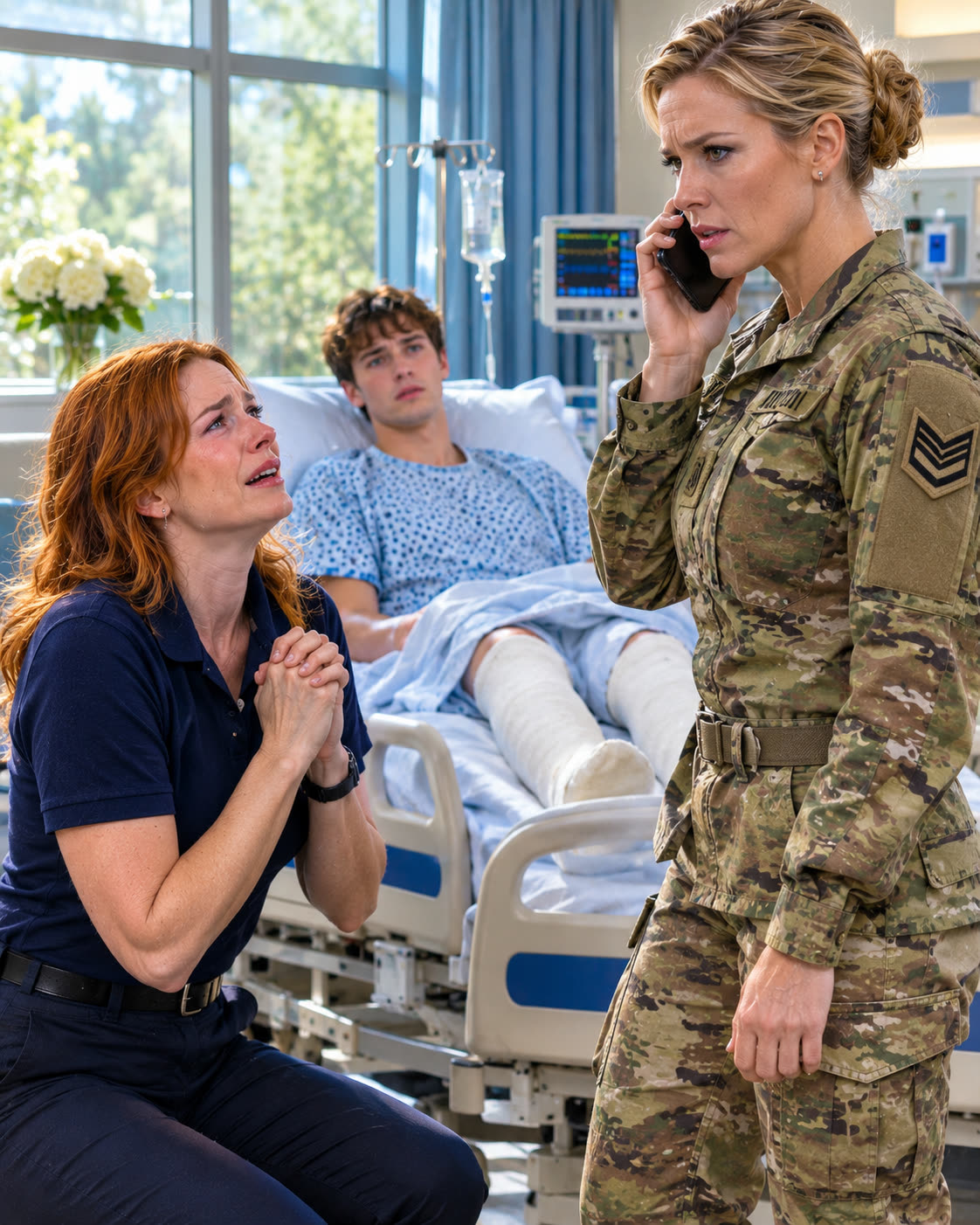
When an encrypted video connection finally opened to the pediatric surgical hospital in Evansville, I barely recognized him. Heavy external fixators surrounded both legs, titanium frames secured by steel pins through skin and shattered bone. The lean runner who had sat with me in the cooler looked hollow and chalk-white against the bedding. “Hey there, soldier,” I managed, struggling to hold my face steady. His lips opened. His neck tightened as he tried to speak, but only a rough thread of air emerged. David moved his phone closer. “He can’t project his voice, Dani,” he explained, sounding emptied by exhaustion. “The pediatric specialists call it psychogenic aphonia . His vocal cords aren’t damaged, but the trauma of the impact and the fear shut down his motor speech control. He can only whisper.” I leaned toward the screen. “Whisper it to me, baby. Tell your mom.”
He told me everything in that fragile breath: the late-night trucks, the saw, the video, his uncle at the bedroom door, the address repeated beneath his quilt. Across the satellite connection, I heard how the woman our county celebrated had refused him help. “I know her voice, Mom,” he rasped, tears marking his pale cheeks. “I’ve heard it across the kitchen table my whole life. It was Aunt Becky. She hung up and left me there.” Silence settled around my workstation. My heart was breaking, but I asked him once to try. “Try once for me, son,” I said softly. “Give me your real voice. Just one word.” His fists tightened in the sheets. His face reddened, and his jaw shook. Nothing came except that terrible breath. “That’s enough,” I told him. “Rest now. Mom is coming home.”
That night I wrote to Alan Klene, civilian director of the Brandon County Emergency Communications Center. My request cited the Indiana Access to Public Records Act and specified the master audio and system records for the call from our house at 3:12 AM on June 24th. His reply arrived within forty-eight hours, courteous and polished. He expressed institutional sorrow over Micah’s accident, then explained that a brief power surge had affected one console during the overnight shift. The forty-one-second call had supposedly failed to archive. The shift supervisor had documented and certified the malfunction. I enlarged the attached verification form until its signature dissolved into pixels: Rebecca Haynes, Shift Supervisor, Operations Division. I had spent years identifying what knives had done to flesh. I knew the difference between natural deterioration and a deliberate cut. A machine did not conveniently lose one household’s emergency call while preserving the rest of an eight-hour shift. Someone had removed it.
When my transport finally reached the regional armory in late August, families crowded the gym with signs, applause, and tears. I walked through the doors in camouflage, searching until I saw Micah in the front row. His wheelchair held his legs elevated inside their metal frames. Across his lap lay a cardboard sign: Welcome Home, SFC Mom. My bag hit the basketball floor. I knelt, wrapped my arms around him without touching the pins, and buried my face against his shirt. He pressed his mouth near my shoulder patch. “I watched the farm, Mom. Just like you said.” I held him tighter. “You did your duty, soldier,” I choked out. “You did your duty.” Three feet behind him stood the two people responsible. Heath wore a clean polo and clapped my shoulder. “Proud of you, sister! Hollis Creek’s finest returns!” I took his hand and felt the healed abrasions across his knuckles.
“Good to see you, Heath,” I said, holding his palm a little longer than courtesy required. “I hear you’ve been real helpful around the place.” I gave him nothing he could read. Becky stepped forward with a container of iced lemon pound cake. “Just family taking care of family,” she said brightly. “We managed the storm while you were keeping us safe, Dani. Micah’s going to be just fine. Children have incredible resilience.” I studied her warm brown eyes while something cold settled into focus inside me. At home, David moved through the kitchen as if every step might set something off. Becky had spent weeks surrounding him with casseroles, hospital visits, and explanations. She told doctors that Micah had sleepwalked at seven while staying at a family lake cabin. Believing our son meant accepting that David’s own sister had abandoned him to protect her husband’s criminal business. My husband had hidden inside the version that hurt less.
At dawn, I went to the barn. Industrial cleaner and high-pressure water had scoured the concrete, leaving a faint residue of bleach. The padlock was gone, and my father’s garden tools hung neatly in place. To anyone unfamiliar with processing plants, the building might have looked untouched. I knew where blood and fat survived a washdown. Kneeling with a flashlight, I examined the expansion joint beside the north wall. Fine metallic swarf remained packed deep in its seal. Beneath the central drain flange, I found a broken exhaust bolt and a crushed piece of heat shield bearing part of a manufacturer’s number. A waist-high mark on a steel column showed where a hot saw had blistered the white paint. I placed the shavings, bolt, and scorched fragments in vacuum-seal bags from the shop and labeled them carefully. The cleanup had hidden the work from casual eyes. It had not erased it.
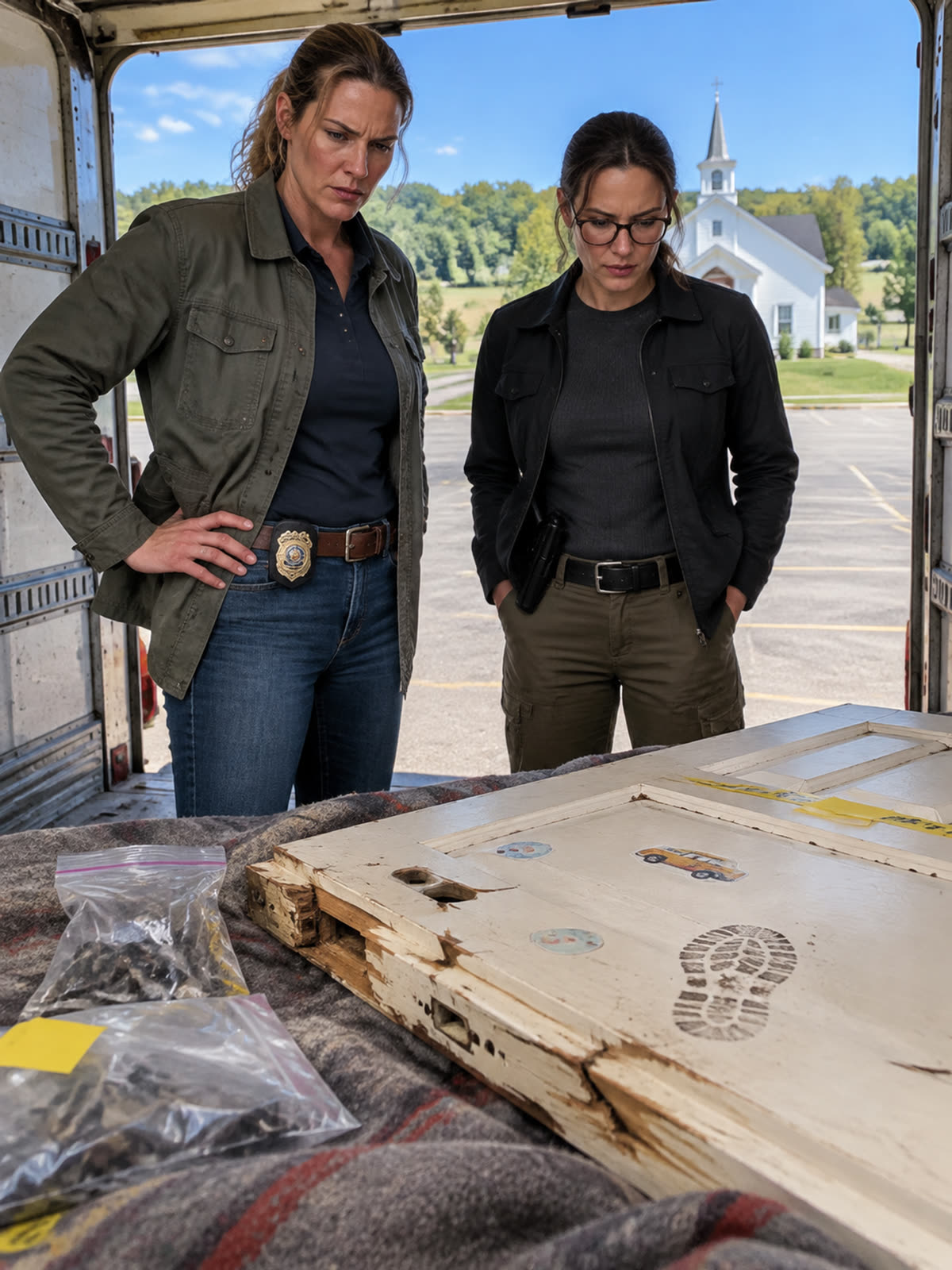
On Monday, I drove our refrigerated truck to Haynes Towing and Salvage. At the gate, I told a teenage mechanic I needed an old steel rim for a wash-bay hose reel. He waved me through without looking up from his phone. Behind the stacked wrecks, beside the car crusher, household junk waited to be destroyed: worn sofas, water heaters, and a pile of interior doors. The third door stopped me. Its off-white panels surrounded a blown-out lock rail, and a heavy boot had left an oily tread mark four inches below the knob. I turned it over. Three faded track-meet lane stickers remained near the top. A strip of yellow masking tape carried Micah’s handwriting: Knock First, Man of the House. For a long moment, I heard only wind in the perimeter fence. Then I carried my son’s ruined door to the truck and laid it on a clean wool blanket.
An hour later, Detective Joy Pierce met me behind a Baptist church near the county line. Her unmarked Impala rolled into the empty lot, and she approached with the guarded weariness of someone accustomed to fighting more than criminals. Inside the truck, she held my sealed evidence toward the sunlight and examined the broken bolt. Then I folded back the blanket. The door lay between us, its damaged lock rail facing upward, its familiar stickers making plain whose room it had protected. Pierce stopped moving. Her hand settled beside her holstered weapon, and she stared for two full minutes. I had not brought her a rumor, a family disagreement, or another explanation offered by an exhausted adult. I had brought the thing Heath’s boot had broken while my son whispered for help on the other side.
“Fourteen months,” Pierce whispered, anger tightening her voice. “We’ve run this multi-county auto-theft task force for fourteen months. Three distinct times we developed actionable intelligence on consolidation garages—one in Lindley, an abandoned dairy barn out past the reservoir, a transmission shop near Dale. Every single time we secured our search warrants and staged sixteen deputies at five in the morning, the target buildings were completely cleaned out. Not a bolt left on the slab.” She removed her glasses and rubbed her nose. “Every single operation required us to file an advance logistical operational notice into the restricted dispatch database twelve hours prior,” she continued. “It’s standard officer safety protocol so the overnight dispatch supervisor can clear radio frequencies and coordinate emergency medical routing around the breach site.” I met her eyes. “The overnight supervisor,” I said. “Becky Haynes,” Pierce answered bitterly. “She was tipping off her husband from the communications console before our cruisers even left the motor pool.”
“Arrest them,” I said. The detective’s expression did not soften. “With what, Sergeant? A boot print on a hollow-core door that Heath will claim came from helping your husband move furniture? A scrubbed barn? A child’s testimony taken while he was heavily medicated, whispering in a hospital bed with his aunt holding his hand? Becky Haynes is the golden girl of this county. The county sheriff is running for re-election in eight weeks, and his campaign posters feature him shaking Becky’s hand at the courthouse steps. If I take this circumstantial file to the county prosecutor this afternoon, he makes a courtesy call to Director Klene. Klene alerts Becky. And before sunrise tomorrow, any physical evidence remaining in this county vanishes into Heath’s car crusher.” The truth was sitting in my truck. Getting anyone to protect it was another matter entirely.
“What does it take to break her?” I asked. Pierce answered without hesitation. “A full, un-tampered confession,” she said. “Her own voice on an open, un-scrubbed recording channel that cannot be deleted, witnessed by an authority she cannot compromise. And you can’t get that through a standard interrogation. The moment I read her her rights, she demands an attorney, and the wall goes up.” She climbed down from the refrigerated bay, then looked back. “I can’t help you orchestrate a trap, Sergeant. That violates every standard of my badge. That’s a career-ending federal lawsuit.” I kept my voice quiet. “I never asked for your badge, Detective,” I told her. “Just keep your duty radio turned to the primary dispatch channel this Thursday night at a quarter past three.” I had spent my working life learning where pressure belonged. Now I knew the point I needed to reach.
That evening, I brought the evidence bags and broken door into our kitchen. I leaned the wood beside the dining table beneath the overhead light and made David examine it. He looked at the shattered lock rail. He looked at the tread mark that matched the boots on his sister’s porch. The protective story he had accepted for ten weeks could not survive what stood in front of him. He sank to his knees, covered his face, and sobbed until his breathing rattled. I let him look. I let him understand what our son had tried to tell him before the fall, and what believing Becky had required him to deny afterward. When he stood, his face was pale and fixed. He went into the hall and removed a brass key from his ring. A small plastic sunflower hung beside it.
It was the spare key Becky had exchanged with him twenty years earlier so they could watch each other’s houses. David put it in my palm and closed my fingers around it. “Heath drinks a twelve-pack of lager every Thursday night watching late baseball,” he whispered. “He sleeps like a dead man in his recliner. Becky’s shift runs midnight to eight.” There was no comfort in finally sharing the truth, only an end to pretending. For forty-eight hours, I studied the dispatch center’s arrangements as carefully as a convoy manifest. Public agency notices explained that Director Klene conducted his quarterly quality review on the third Thursday of September. From midnight until six, he sat beside his overnight supervisor at the master console, listening through a second headset connected to an auxiliary jack. Becky would be doing her work with her director four feet away, joined to her by coiled wire.
At 2:40 that Thursday morning, I left our refrigerated truck behind the Methodist church, two streets from Orchard Lane. Seventy yards away, Pierce’s Impala sat dark and silent. Neither of us acknowledged the other. I wrapped Micah’s door in its wool blanket and carried it across two trimmed lawns. David’s key turned Becky’s front lock without a click. Inside, floor wax and fabric softener mixed with the sour smell of alcohol. A muted television flickered blue across the living room. Heath lay sprawled in a leather recliner, his work boots still on. Crushed cans surrounded an empty beer carton. His breathing was wet and heavy. I passed within two feet of him and entered the kitchen. I did not feel the rush of blind fury people later imagined. Panic had no place in what I needed to do.
I unwrapped the door and set it against the breakfast island, facing the hallway from the living room. Anyone entering would see the split wood, the boot mark, and the strip of tape identifying the room Heath had invaded. I hung my field jacket on a chair and sat at the table. The microwave clock read 3:08. I laid my hands flat on the laminate. While the seconds advanced, I pictured my boy on the terrace, calling for a mother thousands of miles away. I pictured the quilt he had pulled over himself, the screen showing the end of a forty-one-second call, and the woman who had decided her husband mattered more than a child. I had not come to hurt a sleeping man. I had come to make sure his wife could no longer decide which voice the county was allowed to hear.
At 3:11, I stood beside the beige telephone mounted near the refrigerator. Heath kept the landline for after-hours towing calls from highway patrol dispatchers. Its fixed address would appear automatically in the emergency system the moment I connected. At exactly 3:12, the minute Micah had called three months earlier, I lifted the receiver and dialed 911. In Lindley, twenty-two miles away, the incoming address appeared across the dispatch floor: HAYNES, HEATH & REBECCA — 518 ORCHARD LANE, HOLLIS CREEK. Klene stopped with his pen above his clipboard and adjusted his monitoring headset. “Becky? Is that your home address?” Habit carried her through her first moment of uncertainty. She opened the line in the measured voice our county knew so well. “Brandon County 911. What is the address of your emergency?”
“You already know the address, Becky,” I answered, low and even. “I’m sitting at your kitchen table.” Silence struck the connection. I could hear cooling fans at the other end and the sharp catch of her breath. In the background, Klene spoke into his microphone. “Becky, who is that in your house?” I allowed her one second, no more than the mercy she had offered Micah. Then I brought the receiver closer. Heath was still breathing in the adjoining room. The shattered door stood where I had placed it. And the woman who had erased my son’s cry for help was listening beside a witness she could not switch off. “Tell your husband goodbye, Becky,” I whispered. “Tonight is the end of the line for him.”
PART 3: The Voice She Could Not Erase
The next fifty-eight seconds went onto an uncompromised recorder on a secure state server. Becky could not simply disconnect. Klene was listening through her auxiliary jack, and a sudden termination of an emergency call from an employee’s home would trigger an immediate alert and response. More importantly, she believed the danger she imagined. She had known me for twenty years. She knew I had worked with long butcher’s knives since adolescence and managed military supply movements overseas. She also knew exactly how much I loved Micah. In her mind, I stood a few steps from her helpless husband with a blade in my hand. She could not see my empty palms or the untouched kitchen table. Fear supplied what the open telephone line did not. For once, she was the person listening helplessly while someone else controlled what happened next.
“Dani, please! No!” Her voice broke into a shriek that carried across the communications room. “Don’t do it! Please, God, Dani, listen to me! He didn’t push him! He never pushed him off that roof!” I held my own voice steady. “He kicked his door in, Becky. He broke my boy.” The details came tumbling out before she could collect them. “He only went there for the phone!” she screamed. “Heath was drunk! He panicked about the video Micah took of the converters! He just wanted the phone to delete the files! He swore to me he never laid a hand on him! He said Micah jumped out the window on his own!” She was no longer defending a sleepwalking accident. In front of her director, she was describing the crime she had known about all along.
“And Heath left him there,” I said. “He left a fourteen-year-old child with his legs broken on the stone for three and a half hours in the freezing cold.” Her sobbing swallowed the professional rhythm that had made her famous. “I know! I know, and I’m sorry!” she wailed. “I’m sorry, Dani! When Micah called… I couldn’t send the cruisers! I heard Heath shouting in the hallway! If the deputies went out there, they would have caught Heath in the barn! They would have found all six hundred units! Heath would have gone to federal prison! I just wanted Micah to go to sleep so we could fix it in the morning! I didn’t know his legs were broken! I didn’t know he was lying in the yard!” Eight other dispatchers sat at their stations while the county’s trusted voice confessed what she had chosen to protect.
I did not let her hide inside what she claimed she had not known afterward. “You told him to go back to bed,” I whispered. “And then you scrubbed the digital recording from the server.” She was crying too hard to remember the director beside her. “I deleted it to save my family!” she sobbed. “I certified the console error! I did it all for Heath! Please don’t hurt him, Dani! Please, God, he’s all I have! Don’t kill him!” There it was: not a surge, not a storage failure, not an unfortunate gap in an otherwise reliable system. She had heard a frightened child, recognized her husband’s voice behind his door, refused to send help, and then signed the paperwork that made his call disappear. Everything Micah had whispered was finally being said aloud by the person who had tried to bury it.
A scuffle sounded over the connection as Klene took control of the microphone. “Ma’am, this is Director Alan Klene. I am now in operational control of this emergency channel. Rebecca, take your hands off the console and step back against the wall. Step back right now!” Becky’s crying continued behind him. Then he addressed me, his administrative authority shaken by what he had heard. “Sergeant Ellison,” he said. “Are you currently armed?” I looked down at the table where I had been waiting. I had brought no weapon. The only thing in that kitchen capable of breaking Heath’s life apart was the truth leaning against the island. It still carried track stickers, a boot mark, and a boy’s joke about being the man of the house.
“No, sir,” I answered. “My name is Sergeant First Class Danielle Ellison. I am sitting unarmed at the kitchen table at 518 Orchard Lane. Both of my hands are resting flat against the laminate surface. Heath Haynes is currently asleep in his recliner in the adjoining room. Leaning against his kitchen island is my son’s bedroom door, complete with Heath’s boot print and the structural fractures from his forced entry. I suggest your deputies bring an evidence van.” Klene paused. “Sergeant… you told her this was his last day.” I had never needed the ending Becky supplied for herself. “His last day as a free man, Director,” I replied coldly. “I am a soldier, not a murderer. I brought you the truth. Now do your job.” Then I returned the receiver to its cradle.
Outside, tires cut across gravel. Pierce’s Impala stopped at an angle behind Heath’s wrecker, and her searchlights filled the kitchen windows with white glare. The arrival finally dragged him out of his drunken sleep. He coughed, stumbled from the recliner, and lurched toward the kitchen rubbing his beard. I remained at the table. He stopped when he saw me, and then his gaze moved to the door. There was the wood his boot had shattered. There was the tread mark he had left behind. There was Micah’s handwriting on the yellow tape. No one needed to explain why I had carried that particular object into his house. For a moment, his jaw shook and his expression became the naked fear of a man who understood that his story no longer belonged to him.
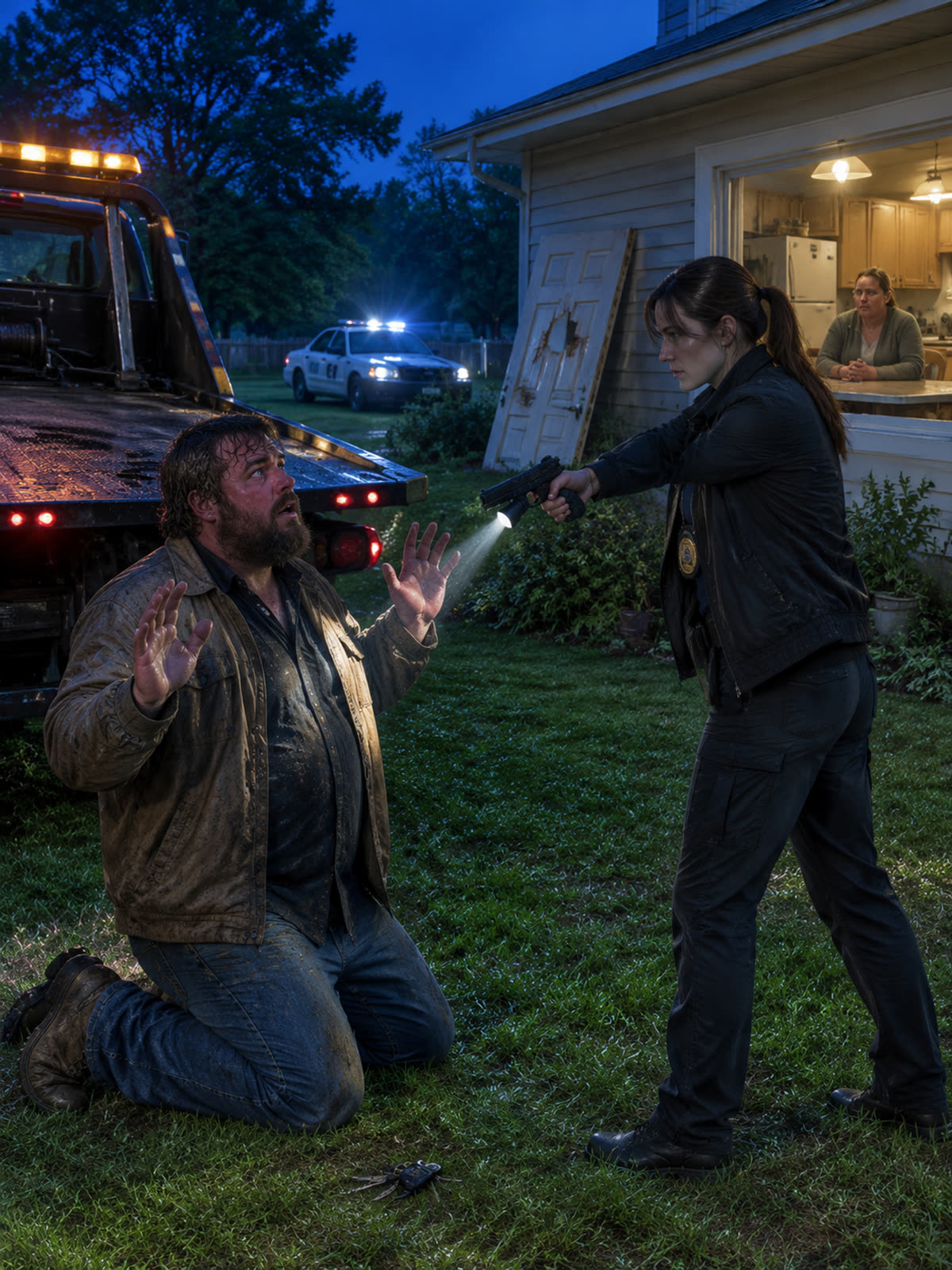
Then he ran. He lunged toward the rear sliding door, pulled it open, and hurried across the deck toward his truck. I did not follow. I had spent enough time carrying what he had done; I did not need to chase him as well. Beyond the kitchen, the searchlights cut through the dark yard. The truck that had delivered stolen vehicles to my barn and carried away my son’s phone stood outside with no road open to it. Heath fumbled in his pocket for the keys. The same hands that had reached through Micah’s bedroom door could not find a quick way out of this one. Pierce came around the garage before he reached the cab.
Her weapon was raised and steady, its light centered on his chest. “Hands, Heath!” she commanded. “Show me your hands right now, or you won’t live to see the county jail!” He stopped. The keys fell from his fingers into the wet grass. There was no blustering charm left, no joke about family taking care of family, and no wife at a console who could warn him before the deputies arrived. He lifted his hands. Inside the house, I sat where Klene knew to find me, with my palms visible and my son’s door beside me. The confrontation had ended without a blade, a blow, or the vengeance Becky had imagined. What remained was the ordinary work she had spent fourteen months preventing other people from doing.
Heath lowered himself to his knees in the grass, arms shaking beneath the hard white light. Before sunrise, a circuit judge signed the search warrant for Haynes Towing and Salvage. He needed no elaborate argument; he listened to the fifty-eight seconds recorded through Klene’s monitoring channel. By nine that morning, state investigators had opened the wrecker’s cab. A plastic bag inside the center console held Micah’s phone. Heath’s scrap broker had told him not to destroy it until they established whether the video had been uploaded elsewhere. That afternoon, Pierce stood beside Micah’s hospital bed while he entered his passcode with steady fingers. The screen opened onto nine minutes of the operation, ending with Heath’s face turned toward the camera. The detective leaned down and squeezed his shoulder. “That’s the ballgame, kiddo,” she whispered.
The salvage-yard search uncovered a locked forty-foot shipping container concealed beneath stacked wrecks. Inside were 612 stolen catalytic converters and the dry-erase ledger listing license plates, vehicle makes, and payments. A forensic examination of the dispatch network completed the pattern Pierce had described in my truck. Before every failed raid during the previous fourteen months, Becky’s administrative account had accessed the restricted operational notices. Her celebrated position had given the theft ring its warning system. The same desk from which she had guided a school-bus evacuation had also helped her husband empty buildings before deputies arrived. None of her earlier service made those choices less deliberate. None of the community’s gratitude could turn Micah’s emergency call into the accident she had certified.
In January, Heath pleaded guilty to corrupt business influence, residential burglary, and felony neglect of a dependent causing catastrophic bodily injury. The judge sentenced him to twenty-three years in state prison. Becky admitted official misconduct, obstruction of justice, and felony destruction of public records. The state telecommunications board revoked her professional license in an emergency session lasting less than ninety seconds. Her prison term was seven years at Rockville Correctional Facility. Klene resigned before county commissioners could begin their inquiry. In November, the sheriff whose campaign material had shown him shaking Becky’s hand lost reelection by twelve hundred votes. Accountability did not repair Micah’s bones or return the hours he had spent on the terrace. It did, however, prevent the county from continuing to call what happened a misunderstanding.
There was a charge against me, too. The prosecutor filed one misdemeanor count of criminal trespass because I had entered Becky’s house without explicit permission. I appeared in dress uniform and pleaded guilty. After reviewing the file, the judge looked over his glasses and ordered two hundred hours of community service. That winter, I completed them by cutting, processing, and packaging four thousand pounds of donated venison for the county food bank. “Sergeant Ellison,” he said before bringing down his gavel, “I trust you will never take investigative protocol into your own hands again.” I met his eyes. “Understood, Your Honor,” I answered. “My mission is complete.” I accepted the sentence. I had crossed a threshold without permission, and the court could judge that without asking my son to surrender the truth again.
Our family did not pass through the aftermath untouched. David’s ties to his relatives broke apart. At his sister’s sentencing, his voice failed more than once, but he did not retreat from describing what Micah had suffered. His mother would not speak to him for months. She could not reconcile the daughter she admired with the woman being sent to prison. That Christmas, only three places were set in our kitchen. We ate roast chicken without cousins, aunts, or the framed public version of anyone’s goodness presiding over us. The quiet was unfamiliar, but it did not carry the old demand that we keep peace by overlooking what hurt. For the first time, silence at our table felt clean. David no longer asked our son to leave family matters alone.
The titanium pins came out in late February. Micah moved from his wheelchair to crutches, then eventually to one cane. Three mornings each week, rehabilitation demanded that he rebuild muscle around the reconstructed bones. Progress hurt. There was no single moment when his legs became the legs he remembered, only repeated effort and the next movement he could manage. His voice, however, remained a whisper. The specialists had found no physical injury to his vocal cords, yet the wall of shock held. Every ordinary request—a drink of water, a book moved within reach—came in that faint, dry breath. I could package thousands of pounds of meat, complete military paperwork, and bring a criminal operation into daylight. I could not command that wall to come down.
The change arrived on a cold Tuesday in the middle of March. I stood at the stove turning eggs in a cast-iron skillet. David was asleep upstairs before his next overnight shift, and Micah sat at the kitchen table with schoolbooks and an application for a summer youth driving course. I heard him reading an entry aloud before I understood what made the sound different. “5719 Pehl Road.” My hand stopped with the spatula above the pan. It was not air scraped into a whisper. It was a clear, steady voice, deeper than the one he had possessed before the fall. A fifteen-year-old’s new baritone had filled the kitchen so naturally that, for one stunned instant, neither of us moved.
Micah lifted his head. His hazel eyes widened as he realized he had heard it, too. He swallowed, testing something he had not trusted for months. Then he tried again, giving the words more breath and strength. “5719 Pehl Road, Hollis Creek, Indiana.” The consonants were rough, and his voice cracked, but the sound was unmistakably there. His pencil dropped. A smile spread across his face, bright and wet with tears. “5719 Pehl Road!” he shouted, laughing as he cried. The address he had whispered into a dead-end emergency call had become the first thing his returning voice could carry. The numbers were no longer disappearing beneath a quilt. They were ringing against our kitchen walls.
I dropped the spatula onto the burner and crossed to him. We held each other, laughing and weeping in the morning light. David stumbled downstairs in his flannel robe, hair disordered from sleep, and stopped on the lowest step with a hand over his mouth. Then the three of us linked arms and marched around the table, chanting our address as though it were a military cadence. The eggs smoked in the skillet. We kept going until the hallway smoke alarm sounded above us. There was no audience to applaud, no newspaper photographer, and no official record to certify that something essential had returned. There was only our boy, speaking loudly enough to fill the home he had once been afraid to make a sound inside.
The kitchen telephone still rings on Sunday evenings around six. When David lifts it, a recorded voice announces: “You have a collect call from an inmate at the Rockville Correctional Facility. Press one to accept charges.” He remains beside the refrigerator with the beige receiver against his ear. He lets the message repeat three times, keeping the connection open long enough for his sister to understand that someone is listening to the silence. Then he replaces the receiver carefully, turns away from the wall, and comes back to dinner. He does not ask Micah to forgive her for the sake of family harmony. He does not explain her choices for her. The chair waiting at our table belongs to the family he chose to believe.
People sometimes praise the courage it took to sit in that kitchen on Orchard Lane and make my call. I know the greater courage belonged to a boy three months earlier, hidden beneath a quilt, who lowered his voice because someone dangerous was listening outside his door. A whisper is not merely speech without volume. It can be a map of the threat around the speaker. It can tell you that the person they fear is across a table, beyond a wall, or protected by a position everyone else respects. Becky had sixteen years of training. She did not misunderstand Micah’s quiet words. She understood them completely and chose a lie because the truth endangered someone she wanted to protect.
Most of us will never answer an emergency console, but sooner or later a child may speak too softly beside us: a niece at a gathering, a student after class, our own child staring through a car window instead of meeting our eyes. That is not always the moment to tell them to speak up. Lower your voice. Move closer. Listen to what the quiet is trying to tell you. I learned that lesson from a boy who knew his address perfectly and discovered that knowing it was not enough. Before you decide the room is safe, before you dismiss the tremor or explain away the fear, look carefully toward the door—and consider who might be standing on the other side.
Disclaimer: This story is a work of fiction inspired by real-life themes. Names, characters, places and events are fictionalized, and any resemblance to real persons is purely coincidental. Images are for illustration purposes only.
