

PART 1 — The Empty Chair
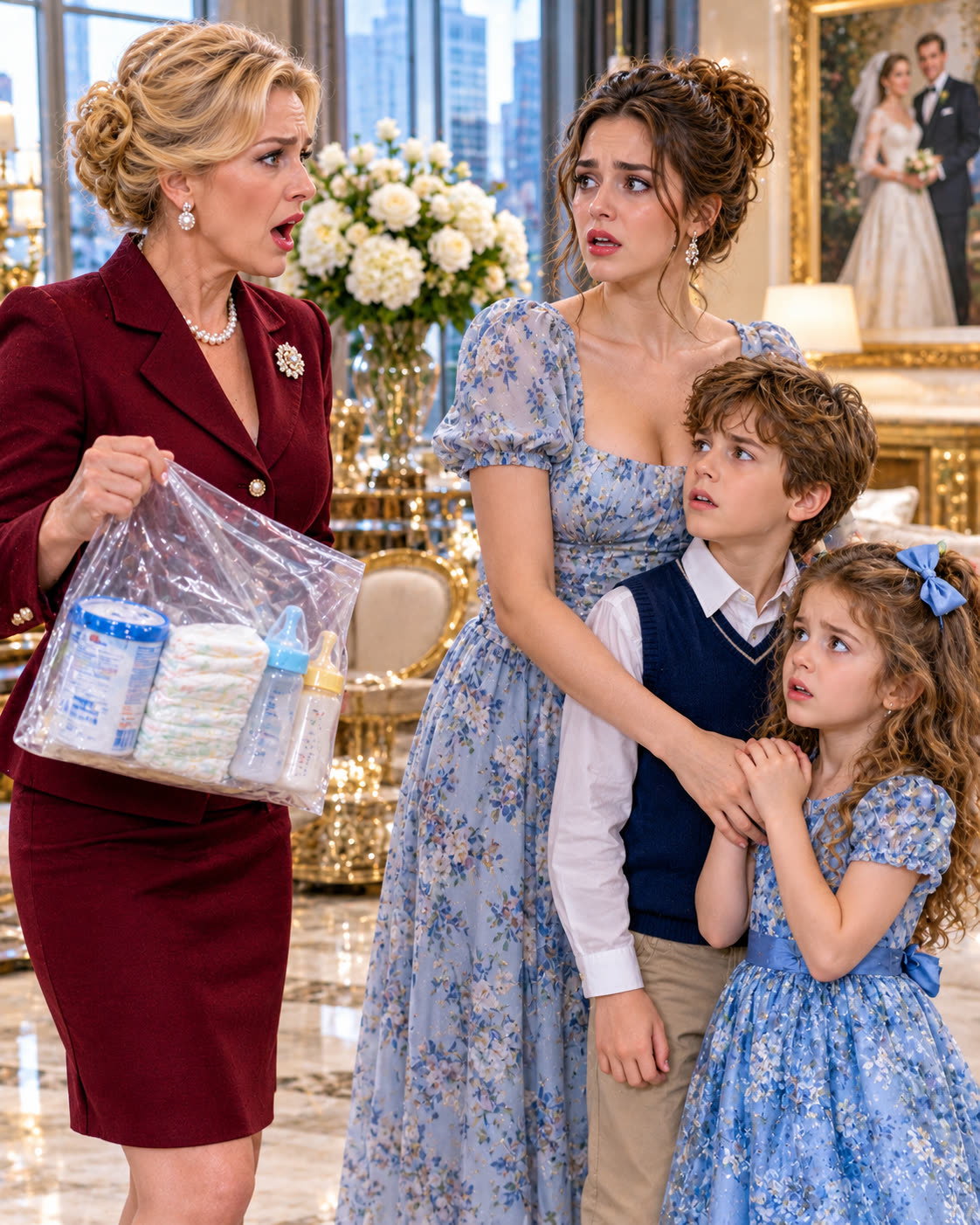
My mother-in-law arrived one Saturday morning carrying presents for her grandchildren. The smile she brought with her disappeared almost as soon as she stepped inside. For six months, I had been hiding the truth from Dorothy. Whenever she asked about Trevor, I said her son was away for work. I never told her that he had walked out on us for another woman, or that our children still wanted to know, night after night, when their father would return. I had dreaded the moment she uncovered my deception. What I had never imagined was that discovering my lie would lead her to reveal something far worse.
I was preparing breakfast when the doorbell sounded. Dorothy stood outside with an enormous bag, already looking past me for the children. “Where are my little ones?” she asked, without bothering with a greeting. “In the living room. They’re eating breakfast.” She entered with the assurance I had always associated with her, but then her steps stopped. Her gaze moved across the entryway, lingering first on the coat rack where Trevor’s jacket had once hung, then dropping to the shoes beside the door. There were three pairs now: mine, Piper’s, and Gavin’s. His absence had left its outline everywhere, however carefully I avoided naming it.
“Where’s Trevor?” she asked. My heart tightened before I could answer. “He’s at work.” Dorothy looked at me. “On a Saturday?” I reached for the explanation I had used so often that it should have sounded natural. “He’s been really busy lately.” She offered no reply. Her silence was worse than another question. I knew how closely she watched people, how readily she noticed the pause before an answer or the breath someone took before offering an excuse. I had managed this deception from a distance. With Dorothy standing inside our home, looking at everything Trevor had left behind, it suddenly seemed impossible to maintain.
Piper and Gavin came rushing toward her before either of us spoke again. My daughter was eight, my son five, and both shouted the same delighted greeting: “Grandma!” Dorothy gathered them into a fierce embrace. For a moment, watching their happiness, I hoped their arrival might carry her attention away from the empty spaces she had noticed. Perhaps she would concentrate on the children and the gifts and allow the morning to pass. But I knew her too well to believe that hope for long. She could love her grandchildren wholeheartedly and still recognize that something in their home had changed.
Throughout breakfast, Dorothy said very little. Her attention moved from Trevor’s vacant chair to the calendar on the refrigerator and the family photographs I had never taken down. I tried to behave as though nothing was wrong, but my trembling hands betrayed me. Coffee spilled over the table, exposing the strain I could not keep out of my movements. At last, she addressed me directly. “Joanna,” she finally said, “how long has it been since Trevor came home?” I went still. “I already told you. He’s working out of town.” Her answer left no room for another rehearsed explanation. “I asked how long.”
Before I found a way to respond, Piper lifted her eyes from breakfast. “Grandma, Daddy doesn’t sleep here anymore.” The room fell silent. Dorothy turned toward her granddaughter. “What do you mean he doesn’t sleep here, sweetheart?” Piper lowered her head. “Mommy says he’s busy, but I think he doesn’t want to live with us anymore.” Tears gathered in my eyes. The thing I had tried so hard to soften for my children had reached them anyway. Dorothy looked from Piper to me, and this time she asked nothing. Her silence held everything I had been trying not to say.
Trevor had left six months before that breakfast. There had been no shouting, no shattered dishes, no dramatic argument that announced the end of our marriage. He simply returned home one evening, placed his keys on the table, and spoke as though he had reached the end of an ordinary day. “Joanna, I’m tired of this life.” I thought he meant the pressure of work, the bills, the endless responsibilities we shared. The next morning, with the children at school, I found him packing. He was closing his suitcase when he finally explained. “There’s someone else,” he confessed when I caught him zipping up his suitcase.
Eleven years of marriage collapsed beneath those three words. The woman was named Tiffany, and she worked with him. He said they had been in love for months. When I asked where that left our children, he made a promise that I wanted desperately to believe. “I’ll still see them,” he said. During the first few weeks, he answered a few messages. Then the calls dwindled. Visits he had promised became explanations for why he could not come. Eventually, even the excuses stopped. I kept working, paying the bills, and trying to smile when Piper and Gavin asked about him. Meanwhile, Dorothy remained the one person I could not bring myself to tell.
Since her husband’s death, Trevor had been her only son and her greatest source of pride. I feared that learning what he had done would break what remained of her heart. So I supplied business trips, meetings, and projects in other cities, building one explanation upon another until that Saturday left me nowhere to hide. After lunch, when the children went upstairs to rest, Dorothy asked me to sit with her in the kitchen. “I want you to tell me the truth.” I could not meet her eyes. “Trevor left,” I whispered. “When?” “Six months ago.” Her hand tightened around her cup. “And the children?” “They stayed with me.” “Does he visit them?” I shook my head. Bewilderment crossed her face, followed by sorrow and something that looked almost like horror. “Is there another woman?” she asked. I nodded.
Without speaking, Dorothy went upstairs to the bedroom Trevor and I had shared. She returned holding our wedding photograph. “I can’t believe my son did this,” she murmured. Then she reached into her purse for her phone. “Joanna, there’s something you need to know.” Her voice shook. “Trevor has been calling me all these months.” A cold feeling moved through me. “What?” “He told me you threw him out. That you were keeping him from his children and trying to turn them against him.” I covered my mouth as tears filled her eyes. “And three days ago, he asked me for a favor.” She opened their conversation and held out the screen. I read his message twice. “Mom, I need you to testify for me. If you confirm that Joanna is an unstable mother, I can get custody of the kids. Don’t let me down.”
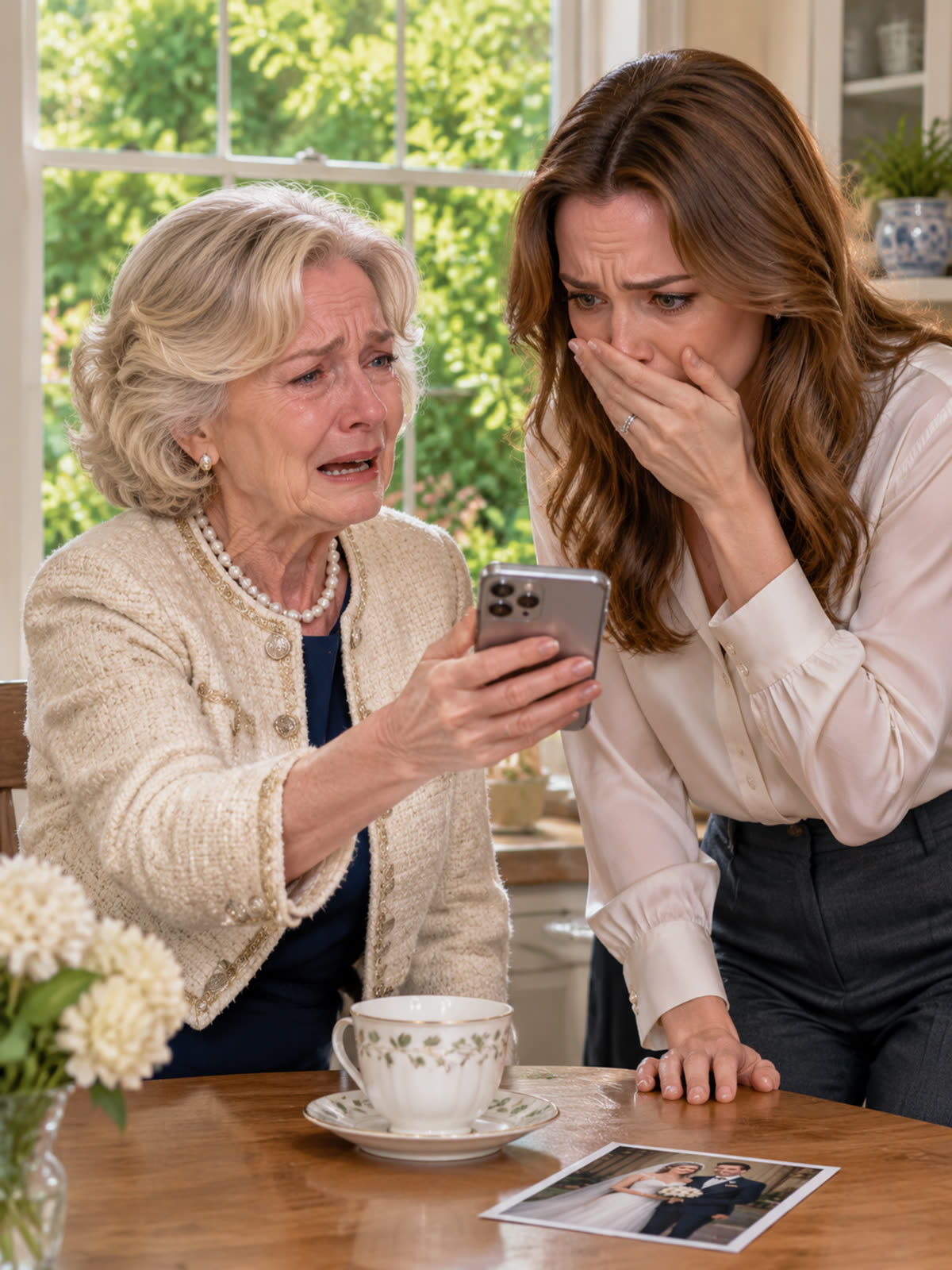
For a moment, breathing felt impossible. Trevor had not merely walked away and left me to explain his absence. While I was comforting our children and protecting his mother from the truth, he had been telling a story in which I was the danger. Now he wanted to take Piper and Gavin from me, and he had asked Dorothy to help him do it. I looked at the woman across the table, trying to understand what she had already agreed to. Then she spoke again, and the little steadiness I had left deserted me. “Joanna… I’ve already spoken to his lawyer. And there’s something else you don’t know yet.”
PART 2 — What Dorothy Had Recorded
For several seconds, I remained completely still. Nothing around us had changed, and that ordinary sameness felt almost unbearable. Sunlight continued to fall through the kitchen window. The clock showed four-twenty. Upstairs, Piper and Gavin were asleep, unaware of the conversation taking place below them. Somewhere outside, a neighbor was mowing his lawn. Yet the life I thought I understood had shifted again. The man I had spent eleven years married to was preparing to separate me from my children, and his mother might already have helped him begin. I could hear her last words, but I could not make myself understand them.
“What do you mean, you spoke to his lawyer?” I finally asked. Dorothy placed her phone on the table. In the space of that afternoon, she seemed to have grown ten years older. The confidence with which she had entered my house had given way to an exhaustion I had rarely seen in her. “I called him on Thursday,” she said. “I told him I wanted to help my son. That I’d say whatever was needed.” My stomach sank. “Dorothy…” I could barely get her name out. I had spent months trying to spare her pain, and now I was afraid of what that silence might have allowed.
She raised a shaking hand before I could continue. “Let me finish.” Then she told me why she had made the call. “I wanted to know exactly what Trevor was planning. So I let that lawyer talk. And I recorded every word.” She touched the screen and moved the phone across the table toward me. The explanation did not make the fear disappear, but it changed its shape. Dorothy had not come carrying only Trevor’s accusations. She had listened to what he wanted and made sure his lawyer’s words would not depend on anyone’s memory. Then a man’s polished voice began playing in the kitchen.
“What we need, Mrs. Hale, is a pattern. Mr. Hale is willing to say his wife has had emotional episodes. That she drinks. If you can say you’ve seen it, even once, the court will take it seriously.” I stared at the phone. Hearing a stranger discuss those accusations so smoothly made them feel both absurd and terrifying. This was not a misunderstanding about who had ended our marriage. He was describing a version of me that did not exist, offering Dorothy a place in a story Trevor intended to present as truth. My husband’s disappearance was being replaced with allegations against the parent who had stayed.
“I don’t drink,” I whispered. “I haven’t had more than a glass of wine at Christmas in two years.” Dorothy answered quietly, without hesitation. “I know that,” Dorothy said quietly. “I’ve known you for fourteen years.” Fourteen years stood between her and the lies coming from that phone: years in which she had known me beyond Trevor’s account of our marriage. The recording continued before I could say anything else. “And you should know, the custody petition has a practical side. Primary custody eliminates child support. With his girlfriend expecting, my client’s finances are stretched thin.” I could only stare. “Expecting?”
Dorothy closed her eyes. “Tiffany is pregnant. Almost five months. That’s why he left when he did. It wasn’t about being tired of this life, Joanna. He was tired of being responsible for it.” I pressed my fingers to my lips. Every unanswered message and abandoned promise seemed to return at once. I thought of Gavin crying himself to sleep, of both children waiting for a father who could not make himself call. Now their place in his life was being discussed in terms of expense. The hurt of his leaving had been terrible enough. This calculation made it feel colder than I had known how to imagine.
“Why didn’t he just ask for a divorce and leave it at that?” I said. My voice cracked. “Why take them?” Dorothy did not try to soften the answer. “Because it’s cheaper than paying for them,” Dorothy said flatly. “That’s what he told that lawyer.” Neither of us spoke for a long time. There seemed to be nothing adequate to say about a father turning his children into the answer to a financial problem. At last, she reached over and took my hand. Her skin felt cool and papery, but her fingers closed around mine with unexpected strength. “Now I have to tell you the part that I’m most ashamed of.”
I waited, already frightened of another revelation. “Last spring, I saw them together.” My breath caught. Dorothy explained where it had happened. “I was in Columbus for my doctor’s appointment, and I stopped for lunch at that little Italian place near the courthouse. Trevor was at a corner table with a young woman. He was holding her hand.” “Dorothy…” There was so much in that single name that I could not separate one feeling from another. She had seen them before he walked out. Before the months of excuses. Before I began trying to explain an absence I could barely understand myself.
Tears slipped down Dorothy’s face as she continued. “He saw me. He came over, white as a sheet, and said she was a coworker and they were celebrating a deal. I knew it was a lie. A mother knows.” She had understood what she was seeing, yet she had wanted his explanation to be true. “But I wanted so badly to believe him. I told myself that if I didn’t say it out loud, it wouldn’t be true. So I said nothing. To you, to anyone.” Her confession left us facing a different silence from the one that had followed Trevor’s message. This one belonged to what she had known and what neither of us could undo.
Dorothy lifted my hand against her cheek. “If I had spoken up then, maybe he would have stopped. Maybe you wouldn’t have spent six months pretending you were fine. I’ve been carrying that ever since, and I’m so sorry. I failed you. I failed all of you.” Part of me was furious. But watching this proud, perceptive woman fall apart across my kitchen table, I understood that she had been mourning a son she could not bear to recognize. “I lied to you, too,” I said. “For six months.” Her smile trembled through tears. “You lied to protect me.” She managed a watery smile. “I lied to protect a fantasy. There’s a difference.”
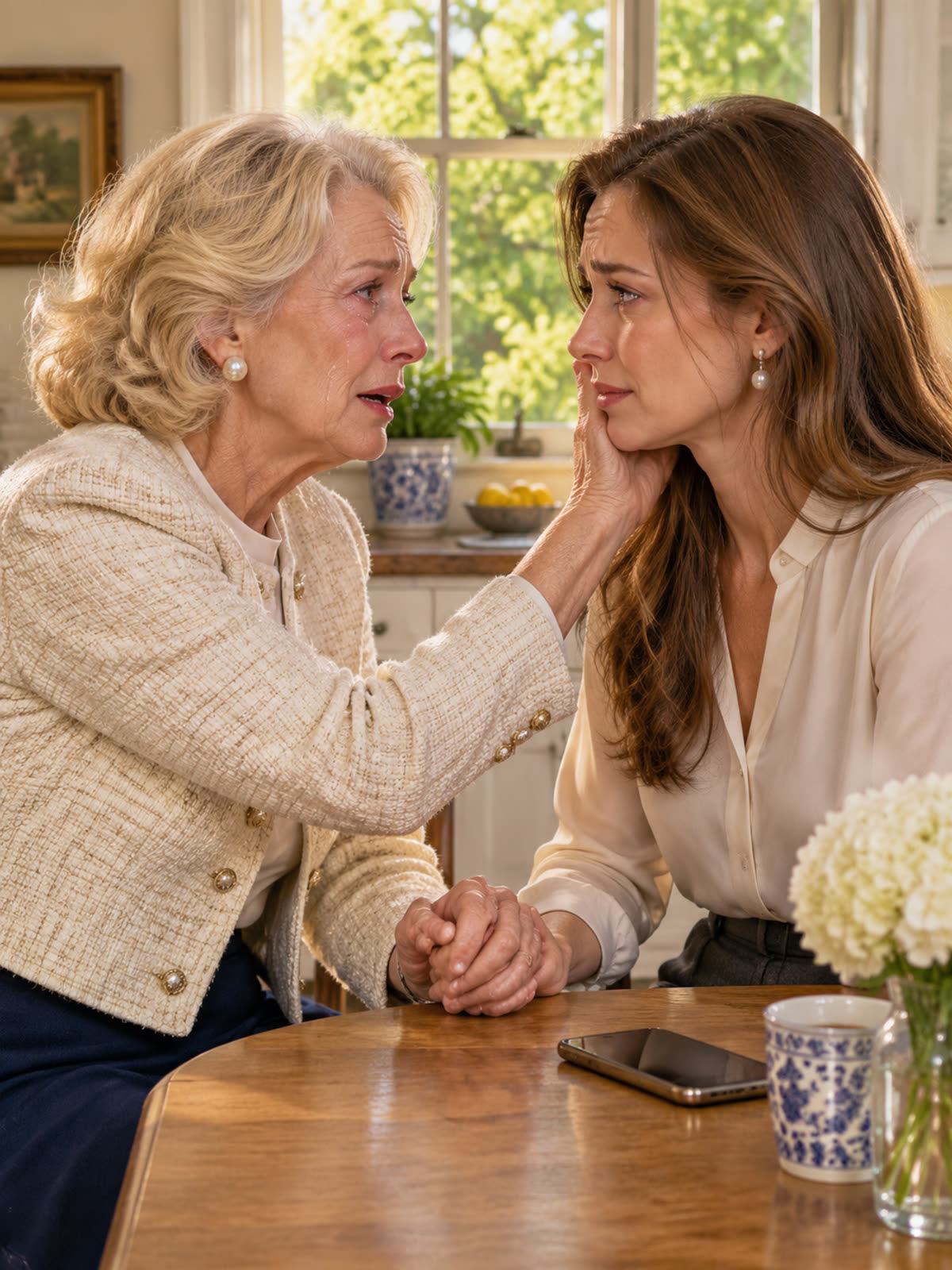
We stayed there with our hands clasped until the clock moved past five. The truth had hurt us both, but at least neither of us was holding it alone anymore. “What happens now?” I asked. Dorothy wiped her face and drew her shoulders back. Something familiar returned to her expression. “Now we fight. I already called my late husband’s attorney. Gerald Whitcomb. He’s eighty-one and meaner than a snapping turtle, and he’s furious. He wants to see you Monday morning.” For the first time that afternoon, there was a next step that did not belong to Trevor. Still, the cost frightened me. “I can’t afford a lawyer like that.”
Dorothy had already made her decision. “You’re not paying for him. I am.” She lifted her chin. “I have my pension and Frank’s life insurance, and I can think of nothing better to spend it on than my grandchildren.” A laugh escaped me, tangled with a sob. On Monday morning, we sat together in Gerald Whitcomb’s wood-paneled office in downtown Cleveland. He listened to the recording twice, his expression unchanged, then removed his glasses. “Mrs. Hale,” he said to Dorothy, “do you understand that if you testify to this, you’ll be testifying against your own son?” Her answer came without retreat. “I understand that I’m testifying for the truth,” she said. “He’ll have to forgive me or not.” The next four months became the hardest of my life. Trevor’s lawyer filed the petition, exactly as promised.
PART 3 — The Witness He Had Counted On
The petition accused me of instability, neglect, and alcohol abuse. Reading it felt like opening a stranger’s file and discovering my own name attached to her life. On those pages, I became a woman who had done terrible things, someone who could not be trusted with the children I had been raising through their father’s absence. I knew the allegations were false, but seeing them laid out so formally still frightened me. Trevor had taken the ordinary strain of the months after he left and tried to turn it into evidence that I deserved to lose everything.
Whitcomb answered with the people who actually knew our days. He subpoenaed Piper’s teachers, who described the mother who attended every conference and volunteered at every bake sale. He called our pediatrician. Neighbors spoke about watching me bring groceries, soccer cleats, and exhausted children up the driveway over six months of doing it without Trevor. Their accounts were made from the unremarkable tasks I had barely had time to think about while I was doing them. Now those same tasks mattered because they showed the life the petition had tried to erase.
There were also the phone records. Since March, Trevor had called his children exactly four times. Four calls stood against the story that I was keeping him from them, against the claim that I had been turning them away from a father trying to remain involved. I had lived through every missed conversation and every promise that became silence. Seeing his absence reduced to a count did not lessen what it had done to Piper and Gavin, but it gave that absence a shape that existed outside my grief. Whitcomb had more than my word to place before the court.
The hearing took place on a gray Tuesday in February. After months of waiting, the day arrived without making any of it feel easier. Trevor sat across the courtroom, close enough for me to recognize the familiar ways he avoided what he did not want to face. This was the man I had shared a home and eleven years with, now asking a judge to believe that our children would be safer away from me. I had spent so long responding to the consequences of his choices that seeing him there still felt strangely difficult to accept.
He wore a navy suit I had never seen before. Behind him in the gallery sat Tiffany, visibly pregnant. Trevor kept his eyes lowered to the table instead of looking at me. It was an expression I remembered from smaller disappointments, the way he used to look when he knew he had forgotten an anniversary. That familiarity hurt in its own way. The gesture belonged to the husband I had known, but the situation around it belonged to someone I was still struggling to recognize. Across the room, he would not meet my eyes.
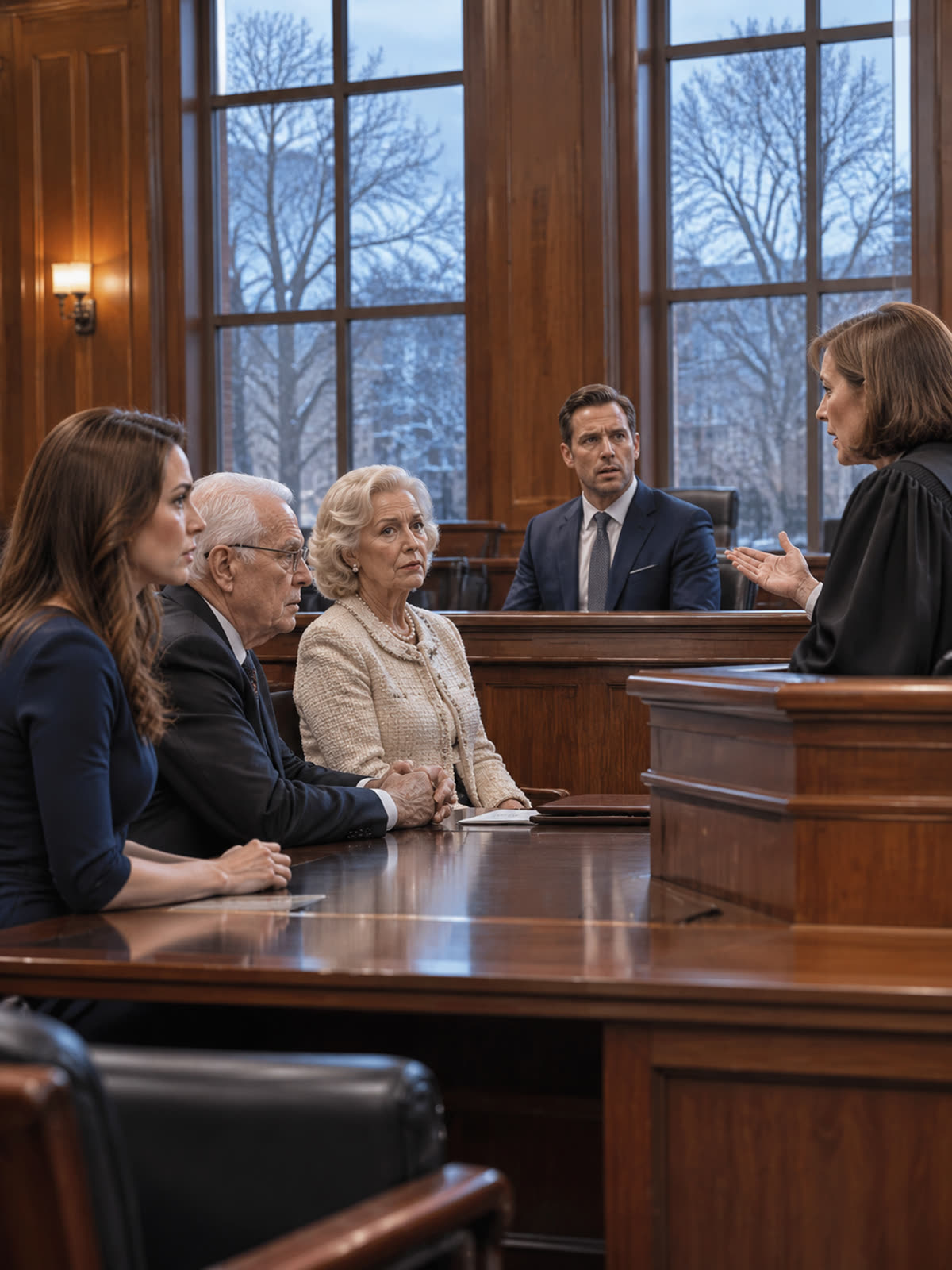
When Dorothy took the witness stand, the room became still. Trevor had asked his mother to confirm the story he wanted the court to hear. He had counted on her loyalty, on her pride in him, and on the version of their family she had once been willing to protect. But the woman taking the stand had heard the recording, sat at my kitchen table, and faced what her son had done. She had already been asked whether she understood what testifying would mean. She had answered that question before we ever entered the courtroom.
Trevor’s lawyer approached with the confidence of someone expecting a useful answer. “Mrs. Hale,” Trevor’s lawyer began, with the confident smile of a man who thought he knew the answer, “you’ve observed your daughter-in-law’s parenting. Would you describe her as stable?” It was the question his plan had been built around. One statement from Dorothy, one claim that she had seen what he alleged, could have helped turn his accusations into something more dangerous. She sat before him with the knowledge of what he had asked her to do and what his lawyer had said when he believed she would cooperate.
Dorothy folded her hands. “I would describe her as the strongest woman I have ever met,” she said. “I would describe my son as a man who abandoned his family, lied to me about it, and then asked me to help him take his children away. I have the recording, if the court would like to hear it.” She did not offer the answer Trevor had requested. She offered the truth she had promised to tell, plainly enough that there was no mistaking whom she meant or what she was refusing to conceal.
Trevor’s head jerked upward. For the first time since this had begun, I saw fear on his face. The judge listened to the recording without speaking. The words that had filled my kitchen now played in the courtroom, where they could not be explained away as my interpretation of what had happened. When the recording ended, the judge removed her glasses. She looked at Trevor for a long time. The silence was different from the silences I had endured at home. This time, I was not the one left searching for an answer.
“Mr. Hale,” she said, “in twenty-two years on this bench, I’ve rarely heard anything that disappointed me more.” She awarded me full primary custody. Trevor would have visitation every other weekend, supervised for the first six months, and child support calculated at the full guideline amount. His lawyer tried to object, but the judge stopped him before he could finish. The petition that had made me feel as though I were reading about a stranger had not become the truth merely because Trevor had filed it. The children would remain with me. Dorothy had refused to supply the lie he needed.
Afterward, Trevor caught us near the elevators in the hallway. “Mom,” he said. His voice was small. “How could you?” Dorothy turned to face him. At seventy-three, she looked directly into her son’s eyes. “I did it because I love you,” she said. “And because someone should have told you no a long time ago. Come see your children. Show up, and I’ll be the first to hug you. But I won’t lie for you again. Not ever.” He remained there with his mouth slightly open while the elevator doors closed between us.
That spring, Dorothy sold her Cleveland house and bought a little yellow bungalow six blocks from ours. After school, she was in my kitchen every day, working through fractions with Piper and showing Gavin how to make her famous butterscotch cookies. Her support no longer belonged only to the terrible months of the case. It became part of our ordinary afternoons, part of the life the children and I were continuing to build. The woman I had been afraid to tell was now close enough to help with homework and share the daily moments Trevor had stopped showing up for.
Trevor visited during those first months, stiff and uncomfortable, and then began coming less often. Eventually, his relationship with the children settled into something fragile and thin. Piper remained cautious around him. Gavin forgave more quickly, with the readiness a five-year-old can still have. I stopped trying to decide whether I had forgiven him myself. There was no answer I could force into place simply because the hearing was over. Some wounds followed their own pace, and the life we had after the ruling did not require me to pretend otherwise.
On the first anniversary of that Saturday, Dorothy arrived carrying another bag of presents. This time, Piper and Gavin tore into it with delighted shrieks over matching baseball gloves. “Grandma, are you staying for dinner?” Gavin asked. “I wouldn’t miss it for the world.” Her gaze moved toward the coat rack beside the door. My jacket hung there with the children’s backpacks and the bright yellow raincoat she had bought for herself and begun leaving at our house. A year earlier, she had studied that same space and noticed what was missing. Now something of hers belonged there too.
Then Dorothy looked at me. “It looks like a home again,” she said. I slipped my arm around her shoulders. I thought of everything that had remained while I was afraid only of what we had lost: the children, the work of caring for them, and the home I had kept going through those six long months. Dorothy had walked in expecting to see her grandchildren and had stayed to face a truth neither of us wanted. “It always was,” I said. “It just needed someone to walk in and see it.”
Disclaimer: This story is a work of fiction inspired by real-life themes. Names, characters, places and events are fictionalized, and any resemblance to real persons is purely coincidental. Images are for illustration purposes only.
