

PART 1: The Woman They Thought They Knew
The cold amber foam reached my scalp before the sound of the bottle registered in the heavy summer air. Sour beer streamed down my neck, caught in my eyelashes, and soaked the linen of my carefully pressed blouse. For three suspended seconds, the backyard in Broken Arrow, Oklahoma, seemed to disappear. Only hamburger grease could be heard hissing against the grill’s white-hot coals. Then my brother-in-law, Colton Pierce, began to laugh. It was not an awkward laugh or a drunken attempt to disguise embarrassment. It was the booming amusement of a man convinced that everyone around him existed for his entertainment. Above my head, he tipped the bottle until its last murky drop landed on my nose.
“Look at her!” Colton bellowed to the patio, gesturing at the folding tables where forty guests had stopped eating. “Not a peep! Didn’t I tell you? You could drop a bomb on Jolene, and she’d apologize for making a mess with the dust!” My name is Jolene Pierce. I am thirty-four, and for six years I had worked at making myself almost invisible. To my husband Wesley’s family, I was an unremarkable, soft-spoken bookkeeper from an East Tulsa accounting pool. I cut celery into matching crescents for their June gathering on Elm Creek Road, collected abandoned plates, and smiled when relatives interrupted me. They mistook restraint for fear.
Darlene Pierce, my mother-in-law, had spent years assuring her church friends that Wesley had found a woman with “no sharp edges to speak of.” None of them knew about the plain gym beside the Tulsa rail yards, its sweat-darkened canvas, or Hector Villanueva, the blunt Mexican trainer with a broken nose who had spent seven years teaching me to become immovable. The person who loses their temper is already beaten, Joe, he used to tell me between rounds, holding a cold enswell against my cheek. Violence is just physics with bad manners. You stay cold. Cold water puts out hot grease every single time. His lessons had outlasted my gloves.
Colton had started drinking silver cans of Coors at ten that morning. His stomach strained his Western shirt’s pearl snaps, and his face wore the blotchy purple flush of someone who confused high blood pressure with strength. Beneath the weeping willows, he had spent an hour boasting about Pierce & Sons Exteriors, his diesel dual-wheel truck, and municipal roofing contracts supposedly secured with handshakes. Eventually his attention settled on Wesley, whose shoulders folded inward like a rain-soaked book. My husband reconciled commercial logistics accounts forty-eight hours a week and drove a faded gray Civic with a cracked windshield. To Colton, that made him convenient entertainment.
“Hey, little brother,” he called above the thin country music. “Must be peaceful living small. Knowing you ain’t ever gonna have to worry about tax brackets or commercial fleet insurance. Course, having a wife who brings home pocket change from behind a gym counter helps keep the lights on, don’t it?” Several cousins laughed into their drinks. Wesley stared at his brisket, gripping his plastic fork until his knuckles whitened. I had never worked behind a gym counter. Early in our relationship, Wesley had offered that explanation to keep Darlene from prying into my history. She had spent the following six years turning his awkward little lie into proof that he had married beneath himself.
When I rose with an empty pitcher, intending to refill it at the outdoor spigot, Colton blocked me. Sour liquor, tobacco, and heated polyester hung around him. “Don’t run off, sweet girl,” he murmured, bringing his face close. “I’m just giving the boy some guidance. A man needs to know when he’s trailing behind the herd.” I kept my voice level. “Excuse me, Colton. I’m refilling the tea,” I said. “Tea,” he repeated scornfully, looking toward his audience. “Sweet little church girl drinks iced tea while the rest of us pull the plow.” Then his shoulder dipped and his elbow moved outward. He raised the bottle.
My body recognized the movement immediately. Thousands of rounds had built that recognition into me. My weight settled lower, and my left hand started upward, ready to redirect the glass and answer with the heel of my palm. Then I saw Wesley across the table. His face had drained of color. His parted lips and frightened eyes carried a silent plea not to make a scene at his mother’s house. I stopped the reflex, planted my heels in the crabgrass, and let Colton empty twelve ounces of stale beer over my face. A woman gasped. Someone near the horseshoe pit laughed nervously. At the grill, Darlene watched without flinching and turned the hot dogs.
“Look at that,” Colton laughed, resting against a cedar post. “Brought some color to your cheeks, didn’t it?” I wiped the foam from my eyes with a slow sweep of my fingers. My pulse remained at fifty-two beats a minute. Hector had taught me that stillness, the strange stretching of time when everyone else became frantic. “Colton.” Wesley’s thin voice interrupted the backyard’s uneasy noise. He was standing, his hands trembling beside him, his breath catching beneath his cotton shirt. “Apologize to my wife,” Wesley whispered. The amusement disappeared from Colton’s face. He crossed the space between them in three deliberate strides and punched his brother in the jaw.
Bone met bone with a thick, terrible sound. Wesley’s glasses spun into the clover, and his knees gave way. His body struck the hinged lid of a blue marine cooler, scattering ice, water, and red soda cans into the mud. A plate broke against the patio. A child cried from the porch swing. Forty adults who shared churches, childhood ball games, and Thanksgiving dinners stood and did nothing. They looked toward the horizon or down at their shoes. Their silence told Colton exactly how protected he was. “Open your mouth to me again, boy,” he growled, flexing his knuckles, “and I’ll put you through the fence.”
I reached Wesley before his head had finished settling against the grass. Blood ran from the split skin near his cheekbone, and the swelling was already darkening. “Wesley,” I whispered, checking his airway with my thumbs beneath his chin. “Wes, look at me. Stay still.” Through bloodied teeth, he wheezed, “I’m sorry, Joe,” and then, “Don’t… please don’t…” That word had chained our marriage to his family for years. Don’t upset his mother. Don’t challenge his brother. Don’t disturb the peace they demanded from everyone except Colton. I stood. Before I could straighten completely, Colton seized my right wrist and hauled me toward him.
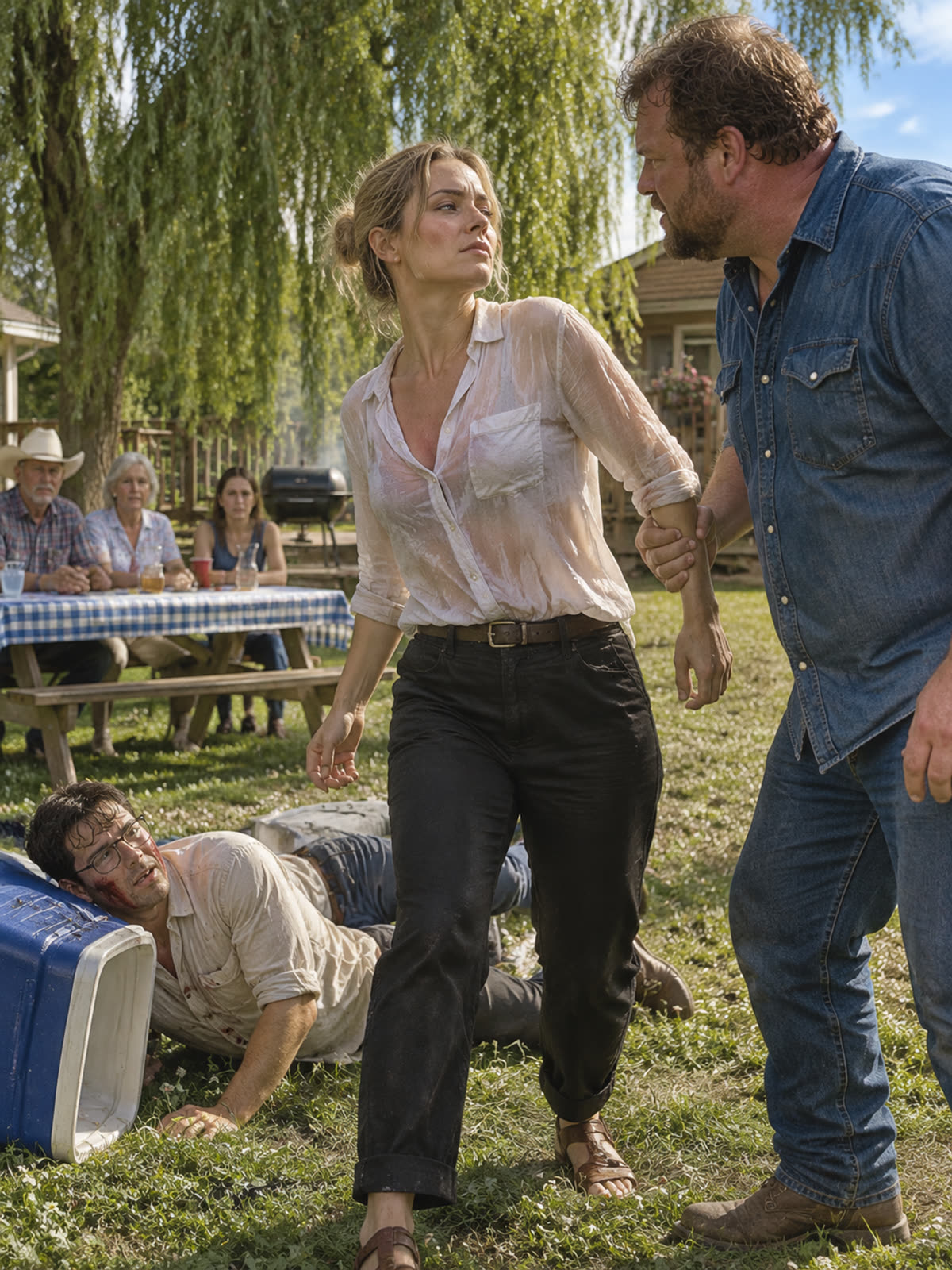
His thick, rough fingers closed like a corroded vise, twisting hard enough to injure someone who did not know how to move with the pressure. His face hung inches above mine. “You don’t walk away from me either,” he hissed. “You two are here on charity. You don’t disrespect this house, and you don’t disrespect me. You got that, girl?” I studied his thumb, his extended elbow, and the weight sitting uselessly on his right heel. His chin was uncovered, his balance misplaced, his ribs unprotected beneath his denim shirt. Eleven years of restraint seemed to fall away, leaving something clear and precise. Behind us, Darlene called, “Colton, let her loose. She isn’t worth the commotion.”
I drew one quiet breath. The ball of my left foot shifted two inches, bringing my hips into alignment, and I let my hand soften inside his grip. A scream tore across the lawn, so frightened and sharp that even the afternoon seemed to pause. “Colton, let go of her! Let go of her right now! “ Everyone turned toward the porch. Shannon Pierce Ledbetter stood on its second step. Her iced tea tumbler had shattered beside her sandals, wetting the timber and splashing her ankles. Both hands covered her mouth. Her wide eyes held neither outrage nor embarrassment. What I saw in them was unmistakable terror.
“Shannon, shut your mouth,” Colton snapped, keeping hold of me. “I’m handling this.” She stumbled down the stairs, her knees shaking. “Colton, let go of her arm!” she screamed. “You don’t know who she is! You don’t know what you’re holding!” Confusion silenced the guests. Uncle Dale straightened beside the trailer hitch, a toothpick still caught between his lips. Darlene set aside her spatula, looking more irritated than concerned. “Shannon Marie, what in heaven’s name has gotten into you?” she demanded. “Get inside the house if you’re going to be hysterical.” But Shannon kept staring at my feet, recognition gathering with every breath.
“Look at her feet, Colton!” she cried, pointing at my sandals. “Look at how she’s standing! I know that stance! I’ve seen it!” He glanced down, squinting at something he could not understand. “What are you talking about? It’s Joe. She runs a calculator.” Shannon’s answer rang across the yard. “Tulsa Expo Square!” she shouted. “Twelve years ago! H-F-C Strawweight Championship! My ex-boyfriend took me to the cage… the main event! The girl who walked out with her hood up, looking like she was going to Sunday service!” Her gaze met mine with the horrified recognition of someone discovering an uncaged predator only a few feet away.
“They called her The Hammer ,” Shannon whispered into the silence. “ Jolene ‘The Hammer’ Maddox . Fourteen wins. Zero knockouts against her. She broke a girl’s arm in the third round and walked away with the belt when she was twenty-four years old.” The backyard seemed suddenly colder. Colton’s fingers eased slightly, but pride and alcohol kept his hand around my wrist. “You’re out of your mind, Shannon. She’s five-foot-three. She brings macaroni to church picnics.” Tears filled Shannon’s eyes as Brent, her husband, came up behind her. She gripped his arm. “Look at her eyes, Colton!” she pleaded. “It’s her! I swear on Daddy’s grave, it’s her!”
For six years, I had carefully avoided meeting Shannon’s eyes when conversations turned to old sporting events. I had forgotten that her college boyfriend had been an amateur welterweight who regularly sat three rows behind the blue corner. I had forgotten how stubbornly people remember blood. Looking straight at Colton, I spoke quietly. “Shannon is telling you the truth, Colton,” I said. “Take your hand off my wrist.” He released me as though my skin had burned him. Stumbling backward, he stared between my face and the circle of relatives. The cousins who had mocked Wesley’s car studied my shoulders. Aunts who found fault with my pie crust edged toward the screen door.
I should have left then. I should have returned to Wesley, cleaned his chin, and helped him through the side gate to our aging Civic. I had stopped fighting at twenty-six, when my father’s farm supply business came within six weeks of a courthouse auction. Regional fight purses scarcely paid for wraps and physical therapy. A plated championship belt could not settle the real tax liens against his warehouse. I put my gloves on Hector’s desk and spent my last five hundred dollars on an accounting textbook. For three years, I taught myself double-entry bookkeeping until bells no longer made my hands twitch. I had never regretted that choice.
But Colton had built his life around being the biggest man in a small world. He had pushed smaller boys into lockers, bullied his younger brother, and listened while their mother explained why he was meant for greatness. Fear did not remain on his face for long. Humiliation replaced it, swelling purple through his cheeks and thick neck. “A fighter?” he muttered, his voice heavy with drink and fury. “A little girl playing tough? You think I’m scared of a girl who plays with balance sheets?” Brent stepped forward with his phone raised. “Colton, no!” he shouted. Colton ignored him. All two hundred and forty pounds came hurtling toward me, his right fist swinging for my head.
PART 2: What the Numbers Remembered
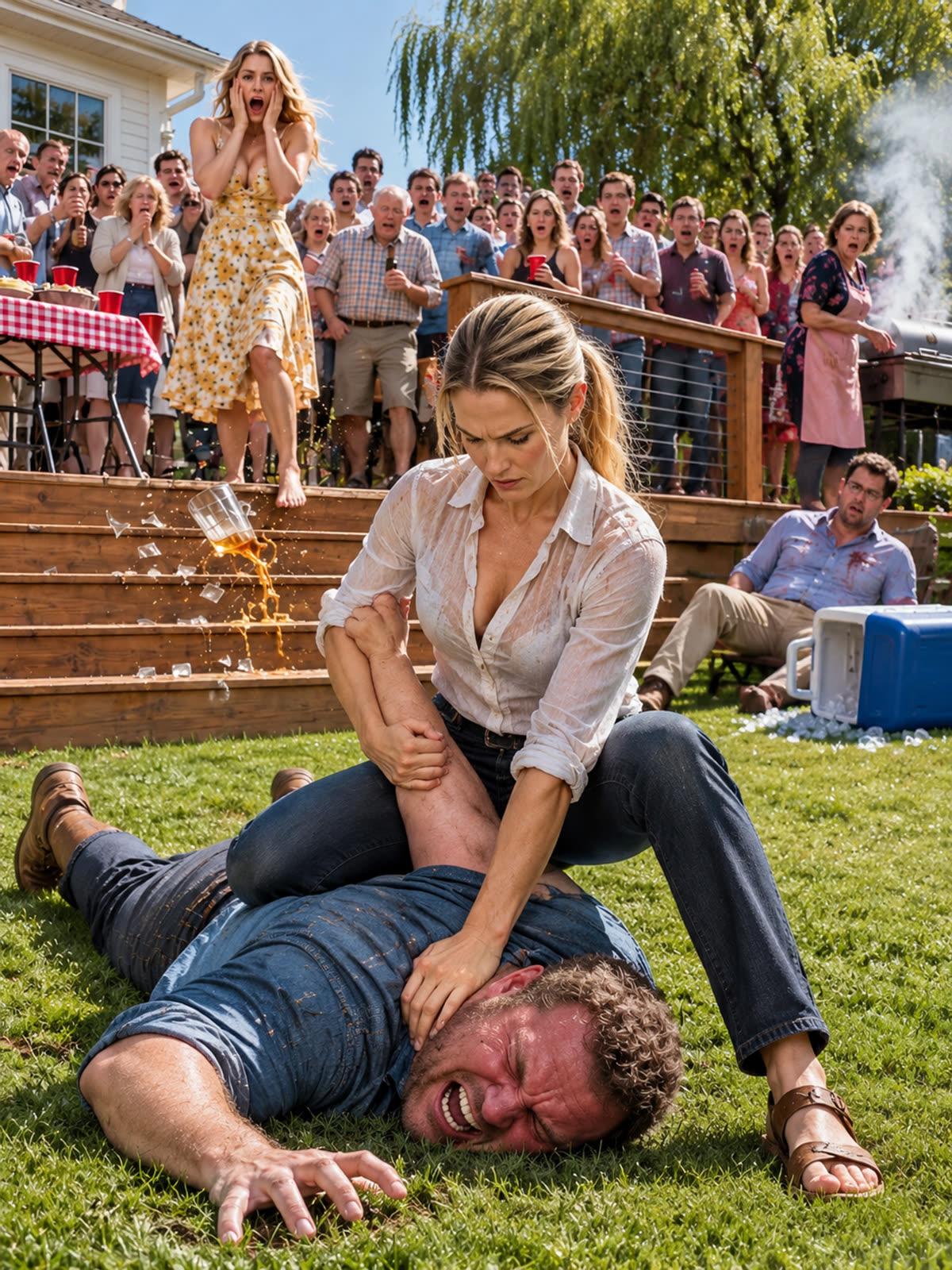
A punch like Colton’s contains more time than most people realize. To the relatives watching, he might have looked unstoppable. To me, his body was already falling toward a place I no longer occupied. His shoulder announced the attack before his fist rose. His chin was lifted, his chest exposed, and every pound of his weight had been committed in advance. I did not retreat. Instead, I stepped beneath the sweep of his arm. Air brushed my hair as his fist passed overhead. My shoulder met his chest, my foot moved behind his heel, and my hand secured the back of his collar.
There was no exchange of blows. There was only leverage. I turned my hips and allowed his momentum to complete what he had started. His boots gouged the clover as he left the ground, a startled grunt escaping him before he landed heavily on the lawn. The impact traveled through the gathered guests’ shoes. Before the grass settled, I had him facedown, one knee controlling his shoulder blade and his arm secured beneath my thigh. The movement was continuous, familiar, and quiet. Colton lay in the dirt, struggling to replace the breath his own weight had driven from his lungs.
“Stop moving, Colton,” I told him, using the same voice I used for a client’s twelve-cent bookkeeping discrepancy. “If you try to roll, you’re going to dislocate your shoulder. I don’t want to hurt you, but you need to be very quiet now.” He spat grass as he wheezed, “Get off me!” Then he called for his mother. “Mom! Get this crazy bitch off me!” I adjusted my position slightly, easing the pressure without surrendering control. “I will let you up the moment you decide to behave like a grown man,” I said. “Not one second before.” For the first time that afternoon, his size gave him nothing.
Darlene ran toward us, both hands extended and her face distorted by fury. “Get your hands off my son!” she screamed. “You broke his arm! Somebody pull her off him! Dale! Wayne! Do something!” Neither man moved. Dale remained beside the trailer hitch, and Wayne appeared fascinated by the label on his beer. Brent’s voice stopped Darlene before she reached me. “Don’t touch her, Darlene!” The usually quiet insurance adjuster stood at the patio’s edge, boots planted firmly apart. He held his smartphone steadily in both hands, its screen bright beneath the Oklahoma sun. Unlike the others, he had something more useful than silence.
“I’ve got every single frame,” Brent said. “From the beer bottle over her head to Colton punching Wes, to Colton lunging at her while she was standing still. I’ve got forty-two seconds of clean high-definition video. If anyone takes another step toward her, it goes straight to the district attorney’s portal before the deputies even hit the turnpike.” Darlene stopped abruptly on the wet grass, breathing hard. She stared as though her son-in-law had threatened her with a weapon. “Brent… you’re family,” she protested. Without lowering his phone, he answered, “Wesley is family too,” then added, “And you just watched your oldest boy try to crack his skull open over a blue plastic cooler.”
A siren began to rise from the road two miles away. For four minutes, the gathering remained almost motionless. Beneath my knee, Colton cursed and groaned into the lawn. Wesley slowly propped himself against the overturned cooler, holding a beer-soaked dishcloth to his bleeding face. His eyes stayed on me, bewilderment gradually giving way to understanding. Then white-and-gold Tulsa County sheriff’s cruisers crossed the cattle guard and stopped in the driveway. Deputy Tom Haskins entered through the cedar gate with one hand resting near his holster. Gray marked his temples, and three decades of domestic calls seemed etched around his mouth. A younger deputy followed him.
Haskins surveyed the cooler, Wesley’s bloodstained collar, the silent guests, and the small woman kneeling over the largest man present. “Alright,” he said. “Nobody move an inch. Ma’am, step back from him real slow and keep your hands where I can see them.” “Yes, sir,” I answered. I let go, stood smoothly, and moved back three paces with my palms raised. “My name is Jolene Pierce,” I explained. “That man is Colton Pierce. He struck my husband without provocation, grabbed my wrist to prevent me from leaving, and then attempted to strike me. I used minimal physical force to restrain him until your arrival. I did not strike him once.”
Colton lurched upright, dirt and dried foam clinging to him. “She assaulted me! Look at her! She’s some kind of cage fighter! She ambushed me in my own mother’s yard! Arrest her!” Haskins looked from Colton’s heavy frame to my beer-soaked white blouse and still hands, then turned toward Brent. “You got that on there, son?” he asked. “From start to finish, Deputy,” Brent replied. Both deputies watched the recording beside him. I had no reason to look. I remembered every frame: the tilted bottle, Wesley falling, Colton charging, and my hands remaining lowered until the last instant. When it ended, Haskins gave a long whistle.
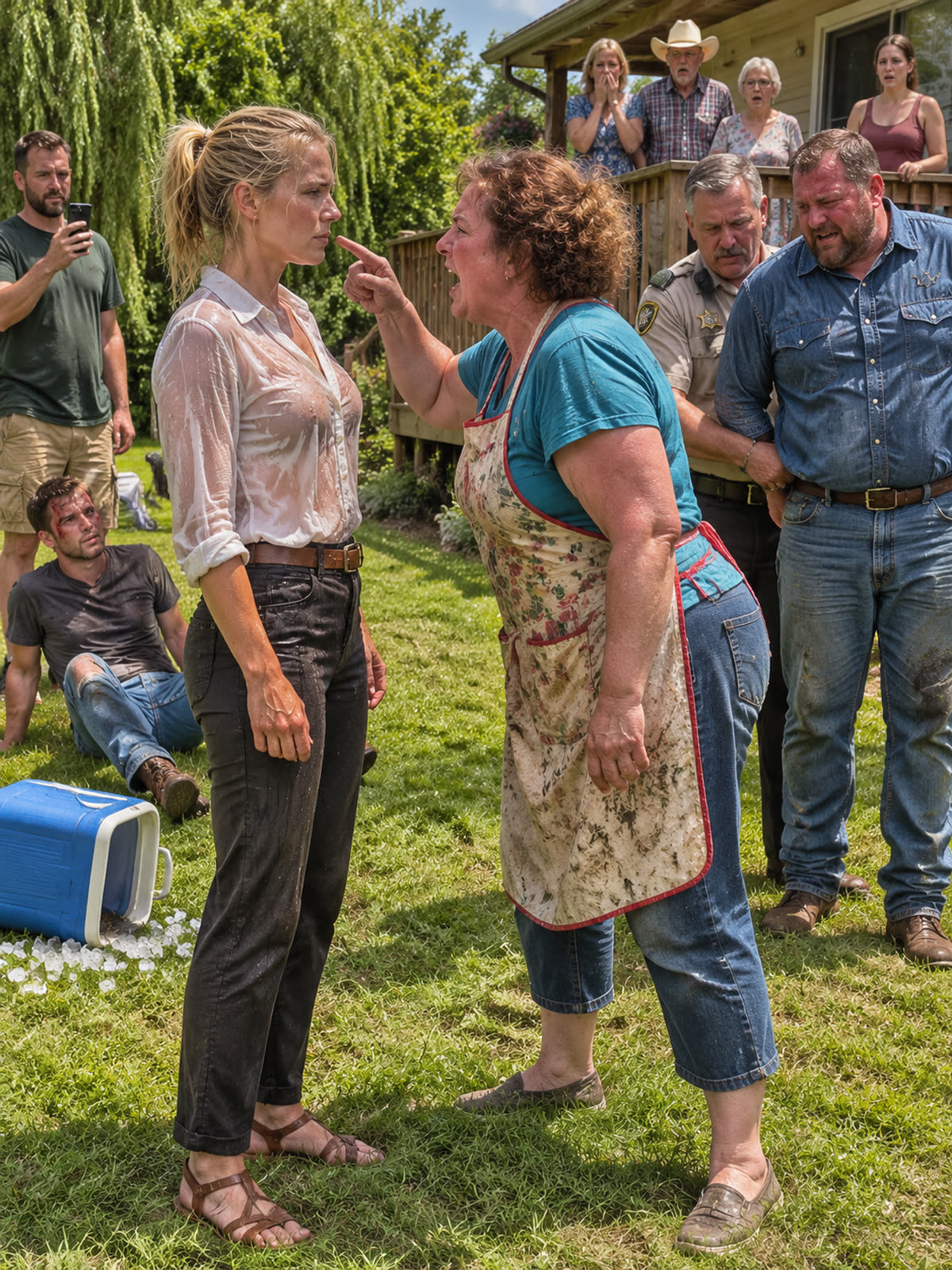
He unfastened his handcuffs. “Mr. Pierce,” he said. “Turn around and put your hands behind your small of your back.” Colton backed toward the porch. “What?” he cried. “You’re arresting me ? In my mother’s yard?” Haskins took his arm. “Assault and battery, domestic violence, and public intoxication to start,” he answered. “You can walk to the cruiser, or we can assist you to the cruiser. It’s entirely up to your level of cooperation.” The cuffs closed with a metallic click. Around us, forty witnesses remained silent, but the meaning of that silence had changed. It no longer protected him from what everyone had seen.
Darlene surged toward me, her shaking finger inches from my face. “You deceitful little viper!” she screamed. “You lied to this family for six years! You made a spectacle of my boy! You drop these charges right now, Jolene, or so help me God, you will never set foot in this county again without regretting it!” I looked at the soot on her apron, the grease on her knuckles, and the wind loosening her hair. Her authority had always depended on other people agreeing to be afraid. “Darlene,” I said, with the cold calm that once unsettled opponents in arena locker rooms. “I haven’t even started deciding what I’m going to do yet.”
That night, Wesley and I waited beneath the fluorescent lights of St. John Urgent Care on Kenosha Street. He needed seven stitches inside his lower lip and another three above his eyebrow. Digital X-rays revealed a hairline fracture in the zygomatic arch of his left cheekbone. Surgery was unnecessary, but chewing solid food would hurt for three weeks. Until two in the morning, I sat beside the examination table, holding his cold, trembling hand. Dried beer still soured my clothes. Wesley stared at the ceiling tiles, exhausted and ashamed, as if his brother’s violence had somehow become another responsibility he had failed to manage.
“I’m sorry, Joe,” he whispered again through the gauze at his mouth. “I should have stood up to him six years ago. I should have told Mom to go to hell the first time she made you wash those dishes by yourself.” I stroked his bruised knuckles. “You stood up tonight, Wes,” I told him. “That was enough.” A faint smile pulled at the uninjured corner of his mouth. “He looked so small when you threw him,” he said. “He looked like an old sack of laundry.” “He is an old sack of laundry,” I replied. “Now rest.” We expected anger afterward, followed eventually by a permanent, peaceful separation.
The furious messages from distant aunts did not surprise us. Neither did Darlene’s voicemail declaring Wesley dead to her until he persuaded me to sign an affidavit withdrawing the assault charges. Tuesday evening’s visitor was different. Shannon stood beneath our porch’s yellow bug light, alone, clutching a large manila envelope against her ribs. Dark circles surrounded her bloodshot eyes. “Can I come in?” she asked. “Please, Jolene. Brent’s in the truck. I just… I need you to look at something.” Wesley appeared from the kitchen with frozen peas pressed against his swollen cheek. His expression closed as soon as he saw his sister.
“If Mom sent you to get me to sign off on Colton’s bail conditions, Shannon, you can turn around right now.” Shannon’s voice shook. “Mom doesn’t know I’m here,” she said. “Mom would kill me if she knew I had these.” At our little laminate kitchen table, she placed the envelope between us. “Daddy died four years ago,” she began, looking at the salt shaker. “You remember how it went, Wes. Mom said the medical bills from the cancer treatments wiped out the savings. She said the tractor and the backhoe had to go to pay off back taxes, and that the funeral home took the rest. She gave you a cashier’s check for six thousand dollars. She gave me eight thousand because I had the baby coming.”
Wesley nodded. “That was the estate. Dad didn’t have much left at the end.” Shannon’s jaw tightened. “Colton bought two new flatbed trailers the month after the probate court closed Daddy’s file,” she said. “He started Pierce & Sons Exteriors sixty days later. Then, last summer, Daddy’s forty acres out on Lake Fort Gibson got sold to a developer from Dallas. Mom told me the title was tangled in an old mechanic’s lien and there wasn’t anything left after the lawyers got their cut.” When she lifted her eyes, the hurt in them looked older than the bruises on Wesley’s face.
“You do books, Joe,” she continued. “Real books. For people who have to account for every nickel. I went down to the Tulsa County Courthouse yesterday morning on my lunch break. The estate file is public record. Anybody can pay twelve dollars and pull the microfiche.” Her manicured finger touched the envelope. “Something’s wrong,” she said. “I don’t know numbers like you do, but the pages don’t make sense. None of it smells right.” After she left, pain medicine and exhaustion pulled Wesley asleep on the couch. I brewed black coffee, cleared the dinner dishes, and arranged forty-eight pages beneath the kitchen’s fluorescent light.
For an hour, the filings looked ordinary: formal language, dull schedules, and enough administrative phrasing to discourage anyone who did not make a living reading financial records. But figures have their own way of speaking. Given enough attention, they reveal who wanted something, who concealed it, and where the money went. At 1:40 a.m., my pen stopped on page twenty-two. Beneath Schedule D: Interim Administrative Disbursements sat an advance of $82,440 in operating capital to a designated beneficiary. There was no promissory note, repayment schedule, interest rate, or consent from Wesley or Shannon. The recipient was Colton Gene Pierce. The executor’s familiar blue signature belonged to Darlene Marie Pierce.
The following pages were worse. Their father’s forty acres on Fort Gibson included valuable timber and five hundred feet of deep-water shoreline. The transaction records led to a $210,000 sale, but its proceeds never reached the children through the estate account. Instead, the money had gone into commercial equipment leases for five new Ford F-250s bearing Pierce & Sons Exteriors’ green-and-gold logo. Wesley had not received his fair share of his father’s life. He had been handed what remained after Colton helped himself. The next morning, instead of opening my bookkeeping office, I drove Wesley downtown to see Lenore Abernathy.
Lenore had spent thirty-four years exposing fraudulent trusts and holding dishonest executors accountable. At sixty-two, she had razor-sharp silver hair, flint-colored eyes, and a mahogany desk crowded with red-rope files. She listened for fifteen minutes without taking notes, then put on tortoiseshell glasses and examined my highlighted copies. Traffic hummed six floors below on Boston Avenue. Twenty silent minutes passed before she folded her glasses. “Mr. Pierce,” she said, her Oklahoma drawl dry and rough. “Your mother didn’t just mismanage this estate. She committed wholesale breach of fiduciary duty, constructive fraud, and conversion of estate assets.” She tapped the $82,440 entry.
“An executor is not a king,” Lenore continued. “She is a servant of the court and a trustee for every beneficiary named in the four corners of that will. She handed your father’s legacy to your brother to build a contracting company, and then she lied under oath on a verified accounting to hide the carcass.” She leaned toward us. “We don’t ask for an explanation,” she said. “We file an emergency petition for an immediate judicial accounting, revocation of letters testamentary, and a surcharge against both Darlene Pierce and Colton Pierce personally. We go to court, and we take the roof off their house.” Wesley looked at me, then back at her. “Do it,” he said steadily. “File it today.”
PART 3: The Debt That Silence Could Not Erase
Two weeks later, a familiar beige Buick turned into our driveway. The post oaks were yellowing, and I was sweeping dead leaves from the porch mat when Darlene stepped out. She seemed to have aged a decade. Her floral blouse was creased, one side of her perm had flattened, and neither a spatula nor an admiring family audience accompanied her. She came up the walk with her shoulders bent against the October wind, hugging a vinyl purse to her stomach. “Jolene,” she said from below the steps. “I need to talk to my son.” Her voice sounded thin and depleted, stripped of the venom I knew.
“Wesley is at work, Darlene,” I answered, resting the broom against the siding. “You know you can’t be here. Miss Abernathy told your lawyer that all communication goes through her office.” Tears spilled beneath her smudged mascara. “This is madness!” she cried. “You are destroying this family! The sheriff came by the yard yesterday with a notice of levy on the trucks! If Colton loses those municipal contracts, he loses the company! The bank is going to call the note on his house! He has three children, Jolene!” From the upper step, I watched her clutch the purse tighter.
“Whose money bought those trucks, Darlene?” I asked. She went still. “Whose money was it?” I repeated, stepping down once. “It wasn’t Colton’s. It wasn’t yours. It belonged to Gene Pierce. It belonged equally to Shannon, to Wesley, and to Colton. You let Wesley drive a car with a cracked windshield for six years while Colton sat at your table and called him a failure using money stolen out of his father’s pockets.” The wind moved between us. For once, she could not turn toward a relative and find someone ready to explain why her oldest son deserved forgiveness and everyone else deserved less.
“Colton was trying to build something!” she sobbed. “Colton needed a start! Wesley… Wesley was always simple. He was happy with what he had! He didn’t need the burden!” My voice stayed level. “Wesley didn’t need his own father’s legacy?” I asked. “Or did you just decide that one son was worth more than the other?” Her mouth opened, but no answer followed. There was no church circle to persuade, no family hierarchy to shelter behind, and no threat that would make me move. She turned toward the Buick and shuffled down the driveway, head lowered, as though the ground beneath everything she had constructed had finally begun to give way.
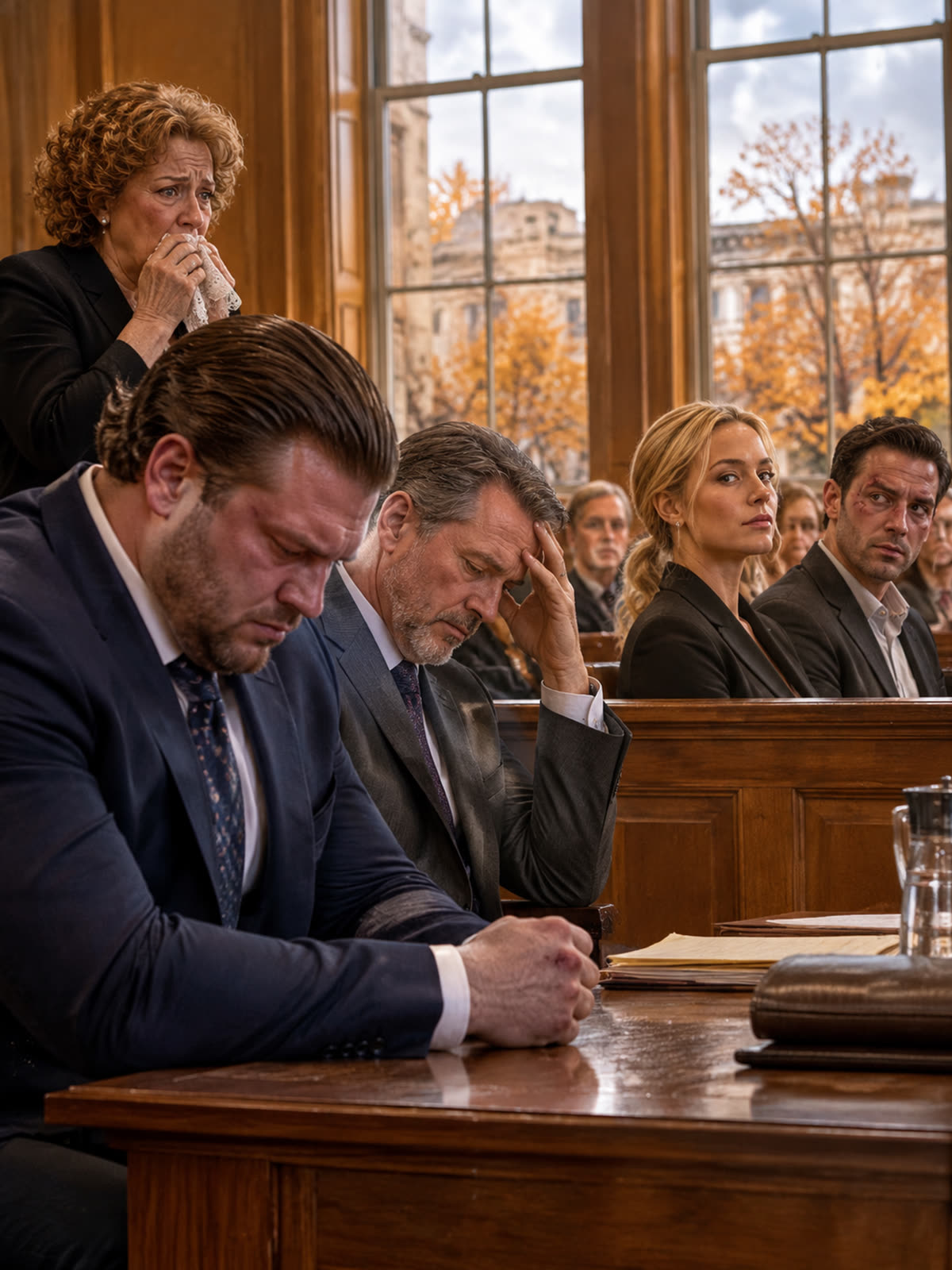
The hearing came on a gray morning in late November, in Courtroom 604 of the Tulsa County Courthouse. Floor polish, old books, and radiator heat filled the room. At the defense table, Colton sat beside an exhausted-looking attorney, wearing a navy suit too tight across his shoulders. His hair was slicked back, and his attention remained fixed on his scarred knuckles. He never looked toward Wesley. Darlene occupied the bench behind him, hands folded over a lace handkerchief, staring ahead with the rigid patience of someone waiting for a sermon. Judge Ramona Teague sat above them, iron-gray hair cropped close and her expression severe.
Before the judge lay our forty-eight marked pages and thirty-two additional pages of bank records Lenore had subpoenaed from the First National Bank of Broken Arrow. Judge Teague had no interest in speeches about family traditions or unwritten understandings. Looking over her half-moon glasses at Darlene, she said, “Mrs. Pierce,” then continued, “I have reviewed the estate inventory filed under your signature on September 14th of four years ago. I have also reviewed the deed transfer to C&D Holdings, of which you and your son Colton are the sole managing partners.” A page turned with a dry snap. Darlene remained very still.
“Did you, at any time prior to the disbursement of the eighty-two thousand four hundred and forty dollars, obtain the written, notarized consent of the co-beneficiaries, Wesley Pierce and Shannon Ledbetter?” Darlene rose slowly, relying on the railing. Her attorney touched her arm. “Answer the question, Mrs. Pierce,” the judge instructed. “No, Your Honor,” Darlene whispered. Judge Teague continued. “And did you disclose the purchase offer of two hundred and ten thousand dollars on the Lake Fort Gibson acreage to the probate court prior to selling that property to your own partnership for forty-five thousand?” Darlene looked toward Colton. He did not turn. “No, Your Honor,” she answered.
The judge closed the file with a report as sharp as a punch. “This court finds clear, convincing, and overwhelming evidence of gross breach of fiduciary trust, self-dealing, and intentional waste of estate assets,” she announced. Her ruling required less than twelve minutes. Darlene was removed as executor of Gene Pierce’s estate. Shannon was named successor administrator, with full authority to investigate. The court imposed a personal surcharge of $82,440 against Darlene and Colton, jointly and severally, together with statutory interest at eight percent compounded annually from the diversion. The money they had treated as Colton’s private beginning was finally being counted as someone else’s loss.
Judicial liens immediately attached to Colton’s corporate shares, his home, and three commercial vehicles titled in his name. The concealed lake-sale proceeds were ordered disgorged. Wesley’s and Shannon’s shares, calculated to the penny with the accrued interest, were to come from the liquidation of Colton’s commercial accounts before he received anything. Judge Teague reached for her pen. “You may step down,” she said. There was no dramatic speech left for Darlene to give and no family audience capable of changing the figures. Lenore had done exactly what she promised: she had exposed the structure beneath their prosperity and made the court look at every beam.
Three days later, Colton’s assault case concluded in the municipal division down the hall. Brent’s clear recording left little room for argument, and the prosecutor would accept no resolution without accountability. Colton pleaded no contest to assault and battery causing bodily injury. He received a twelve-month deferred sentence, seventy-five hours of community service, a mandatory twenty-six-week batterer’s intervention program, and restitution for all of Wesley’s medical bills, stitches, and dental consultations. Sixty days afterward, the municipal procurement board quietly canceled the roofing contracts he had bragged about. Their vendor requirements allowed neither an unclean criminal record nor outstanding tax or judgment liens.
I never raised my voice during any of it. I had not thrown a punch in the yard, and I did not answer the hateful calls from cousins who stopped visiting us. When Colton listed his dual-wheel diesel truck on Facebook Marketplace to make the first surcharge payment, I did not celebrate. Hector had taught me that violence was physics delivered without manners. The law had proved to be something else: an unforgiving machine when someone knew how to follow every figure. Colton had trusted his size. Darlene had trusted obedience. Neither had considered what would happen when a quiet bookkeeper stopped accepting the family’s version of the accounts.
Spring arrived early in northeastern Oklahoma the next year. By March, bright magenta redbuds lined the creek beds. Once the lake proceeds and interest were settled, Wesley’s restored inheritance came to nearly eighty-five thousand dollars. We used it to make a fifty-percent cash down payment on a small three-bedroom brick bungalow on Broken Arrow’s east side. A split-rail cedar fence surrounded its generous yard, and two mature pecan trees shaded the porch. In the kitchen, quartz counters gave me enough room to open twelve ledgers without stacking one over another. The house offered something neither of us had known at Darlene’s table: room to exist without apology.
Wesley healed well. A fine silver-white scar remained above his eyebrow, but the swelling disappeared. More importantly, he no longer entered rooms with his shoulders folded inward. The previous month, he had walked into his supervisor’s office carrying three years of operational metrics. Twenty minutes later, he left as senior accounts director with a twenty-percent raise. Shannon and Brent began bringing their two children to dinner nearly every other Saturday. We served sweet tea with mint from the bed beside the steps, not beer in brown bottles. At the smoker, Brent and Wesley argued cheerfully about whether brisket belonged over hickory or applewood.
Last Saturday, the children raced through the sprinkler while Shannon watched me slice lemons in the kitchen. She leaned against the counter, holding her glass. “Hector Villanueva called me last week,” she said softly. My knife stopped. “Hector? How does Hector have your number?” She gave a sheepish smile. “I tracked him down at the gym near the yards,” she admitted. “I went down there three weeks ago. I just wanted to see where you learned it. He’s sixty-eight now, Joe. His knees are bad, and he’s mostly teaching footwork to middle-school kids from the neighborhood who don’t have anywhere else to go after school.”
She placed her drink on the counter and rested her hand lightly on my forearm. “He said you were the most disciplined fighter he ever put into a ring,” she whispered. “He told me that in seven years, he never once had to tell you to calm down. He said he had to spend half his time telling you it was okay to let yourself win.” I looked through the window toward the pecan trees. For so long, control had meant making myself smaller, quieter, easier for other people to overlook. Hector had never confused that with discipline. He had known the difference long before I let myself acknowledge it.
“He asked if you’d consider coming down on Tuesday nights,” Shannon added. “Not to spar. Just to help him teach the girls. To show them how to hold their balance so nobody can ever push them into a corner.” I finished the lemon before answering. After wiping the carbon-steel blade with a clean linen cloth, I dropped the thin yellow circles into a pitcher of clear spring water and ice. Through the glass, Wesley was laughing with Brent. “Maybe,” I said. “I think I might like that.” It was not a return to the life I had left. It was a way of carrying forward the part worth keeping.
Three days ago, a small square envelope appeared in our mailbox. Wesley’s name was written across it in Colton’s rough hand. The postmark came from outside Claremore, where he had moved into a rental duplex after the bank foreclosed on his house. Inside was an ordinary five-by-seven card with a cedar tree on the front. There was no long account of what had happened, no explanation built from liquor, wounded pride, or the mother who had taught him to treat everyone else as something to strike. Across the blank space at the bottom, he had written only two words: I’m sorry.
Wesley left the card on the kitchen counter for three days. It sat untouched beside the bronze paperweight holding down my client invoices. This morning, sunlight climbed over the pecan trees and caught the dew until the lawn glittered. Wesley entered the kitchen, poured two mugs of black coffee, and looked at his brother’s handwriting. “What do you think, Joe?” he asked, his voice quiet and steady. “Should I answer it?” I accepted my mug and let its warmth settle into my hands. Then I leaned against his shoulder and looked over our peaceful yard. “There’s no hurry, Wes,” I told him. “We’ve got all the time in the world.” The card still waited for his answer.
Disclaimer: This story is a work of fiction inspired by real-life themes. Names, characters, places and events are fictionalized, and any resemblance to real persons is purely coincidental. Images are for illustration purposes only.
