

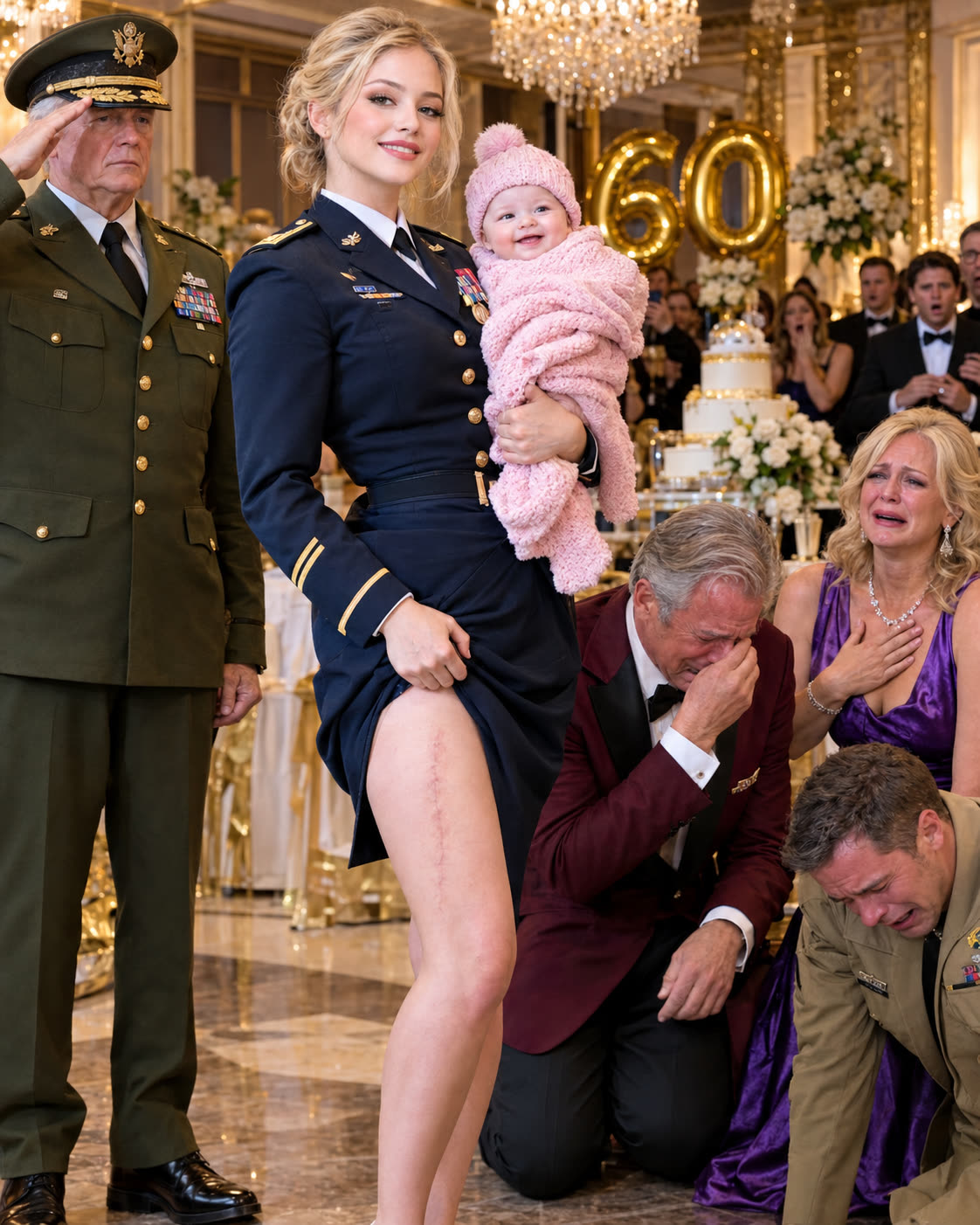
PART 1: The Daughter They Kept in the Shadows
“Just ensure you don’t cast a shadow over your father’s milestone tonight. We have enough mediocrity dragging down this family’s reputation without you putting it on display.” My mother delivered the warning through flawless porcelain teeth, her voice carrying the familiar poison of practiced contempt. Eleanor stood across the gold-leafed entrance to the Grand Solstice Hotel’s ballroom as though deciding who deserved admission. Her immaculate appearance suggested grace; everything about her expression denied it. The thick jasmine fragrance surrounding her reached me before I had crossed the threshold. With my daughter resting against my arm, I faced the same welcome I had received throughout my life: an instruction to make myself smaller.
Before I could move past her, my older brother, Julian, swept through the doorway in a custom Italian tuxedo. Diamonds flashed on his wrist beneath the chandeliers. He tipped his chin toward his investment-banking friends without bothering to slow down. “Look who finally decided to descend from her little cubicle. The government pencil-pusher graces us with her presence.” My father stood close enough to hear every word. Arthur, retired corporate titan and tonight’s sixty-year-old guest of honor, offered no objection. He simply lifted his scotch, rolled the amber liquor around his crystal tumbler, and turned his broad back. His deliberate indifference closed the conversation more effectively than another insult could have done.
The old dread tightened inside me, cold and immediate, but nothing moved across my face. My name is Victoria, and for more than a decade I had paid dearly for the privilege of being dismissed by these people. Money earned through dangerous, highly classified work had quietly disappeared into the holes they kept digging beneath themselves. Julian’s financial misconduct, Eleanor’s concealed debts, their endless determination to preserve appearances—I had helped keep all of it from collapsing into public disgrace. They accepted my transfers without curiosity or gratitude. Yet standing beneath those chandeliers with my baby, I remained, in their eyes, the disappointing daughter whose presence required an apology.
In reality, I was an SES-level Director within the United States Cyber Defense Command, a civilian position comparable to a three-star general. My clearances reached into operations involving satellite blackouts and the unseen digital conflicts protecting the country’s infrastructure. I spent my working life confronting threats my family would never hear discussed over dinner. That silence was not evidence of insignificance; it was a condition of my work. But confidentiality made a convenient screen for their assumptions. Since I could not describe my responsibilities, display their consequences, or turn classified operations into entertaining family anecdotes, they reduced me to a secretary with an inflated sense of importance. Their ignorance had hardened into certainty.
Tonight, however, I could not mistake the difference in myself. Beneath my emerald-green silk wrap dress, my breasts ached with milk. My three-month-old daughter, Madeline, lay securely in the bend of my left arm, tucked inside a soft cashmere blanket. Her small, sleeping weight anchored me more firmly than any practiced discipline. I had carried her through a pregnancy my family knew nothing about, protecting that vulnerable part of my life from their scrutiny. Beside me throughout it had been my husband, Sebastian. They knew almost nothing about him, either. The secrecy surrounding my marriage and motherhood had given us something their approval never could have offered: peace.
Sebastian was a deeply private logistics and technology billionaire whose global holdings dwarfed the combined, heavily leveraged fortunes represented in that ballroom. He had no appetite for the performances my relatives mistook for achievement. He did not need a roaring sports car, a conspicuous entrance, or someone smaller to humiliate. Only ten minutes earlier, I had kissed him in the back of his discreet, custom-armored town car in the hotel’s VIP parking area. He had pressed his lips to my forehead and gently traced our sleeping daughter’s cheek. “Go show them the ghost they created,” he had whispered. His low, steady voice had settled my nerves. “We’ll be right here waiting for you.”
I drew a careful breath, secured Madeline more closely, and passed Eleanor without offering a defense. The room beyond her was crowded with politicians, socialites, and men whose laughter seemed designed to advertise their success. Champagne, roasted meat, and expensive perfume thickened the warm air. I crossed beyond the central tables until I reached Table 14, a small, neglected station near the kitchen doors. It stood well outside the flattering light surrounding my father’s place at the center of the celebration. I sat with my back straight and wrapped my free hand around a glass of iced lemon water. The cold condensation steadied me while my family gathered elsewhere for photographs.
To understand why that isolated table felt so familiar, you would have needed to understand the household that raised me. Arthur governed our family like a damaged corporate board, assigning value according to visibility, influence, and the confidence with which a person announced superiority. Quiet work did not interest him. Neither did accomplishment without an audience. His children learned early that public success mattered more than private character, and that anything performed outside his preferred spotlight barely existed. Childhood carried the metallic smell of polished trophies and the stale pressure of unspoken anxiety. We were expected to compete for recognition while pretending the competition proved we were an exceptional family.
Julian embraced the lesson completely, hiding insecurity and poor judgment beneath noise, swagger, and a European sports car loud enough to disturb the street. Eleanor displayed her “financial prodigy” whenever his reputation could open another social door, even as her own spending dragged her deeper into debt. Beatrice pursued a more calculated route. A successful public relations director, she directed corporate money toward our parents’ struggling ventures and married Marcus Thorne, a decorated Air Force colonel who had moved into a prominent Department of Defense role. His silver eagles and commendation ribbons became the family’s newest objects of worship. Beside his visible distinction, my classified career seemed even easier for them to ridicule.
The breaking point had come the previous Christmas. Newly pregnant with Madeline, I had concealed my condition beneath thick, oversized cashmere sweaters. It was a high-risk pregnancy, complicated by rising blood pressure and the relentless strain of my command. Still, I drove three hours through a blinding snowstorm to reach my parents’ estate, arriving with swollen ankles and an aching lower back. Inside, the heat was oppressive, heavy with roasted goose and mulled wine. At the long dining table, Arthur lifted his goblet toward Marcus and praised him as the “absolute pinnacle of American exceptionalism.” Then my father looked down the table at me, his admiration hardening immediately into contempt.

“It’s a blessing to have men of real consequence in the family,” Arthur had boomed. “Unlike some people who hide in air-conditioned cubicles, punching keyboards to collect a meager taxpayer paycheck while the rest of us build the real world.” Julian laughed, gravy shining on his chin. “Yeah, little sister. When are the feds gonna fire you for drinking too much breakroom coffee?” Beneath the table, my hands hovered protectively over the pregnancy they could not see. I bit the inside of my cheek until I tasted blood. The pain gave me something immediate to concentrate on while their laughter moved around the table. They knew nothing about the child I was protecting, or what my work had protected for them.
Seventy-two hours before that Christmas dinner, I had been working with bloodshot eyes and cramped fingers to stop a foreign cyber-syndicate. The attackers had breached the encrypted satellite uplink serving Marcus’s entire regional defense grid. I had personally isolated their virus and cut off their connection before the intrusion became a catastrophic intelligence failure. Without that intervention, his career would have been destroyed and thousands of personnel placed in danger. I could not explain any of it while my father celebrated the only kind of service he understood. The man receiving his admiration remained safe in part because the daughter he despised had done her work without an audience.
Nor was silence the only thing they had taken from me. When Julian’s misuse of client money threatened to end his career, I sat in a stale, mahogany-lined law office and paid a four-hundred-thousand-dollar settlement from my private consulting savings. When Eleanor’s handling of her country club association’s funds left a sixty-thousand-dollar gap, I transferred federal hazard pay to keep her from public disgrace and possible embezzlement charges. Neither rescue earned even a simple expression of thanks. My contributions became another entitlement, something owed for belonging to the family. They treated my money as useful and my existence as embarrassing, never troubled by the contradiction between those two convictions.
At Christmas I had swallowed my anger, protected my pregnancy, and allowed the conversation to move past me. At Table 14, with my body still recovering from childbirth, I understood that endurance differently. Remaining silent at work protected people. Remaining endlessly available to my family only protected their cruelty from consequences. I looked down at Madeline, then toward the glittering center of the ballroom, where Beatrice and our parents arranged themselves for another photograph. Their polished smiles created the appearance of a secure, admirable bloodline. From my seat beside the kitchen, I could see the cost of maintaining that picture. I had been paying it for years.
I took out my encrypted phone and angled the screen away from the room. A message from a classified server appeared on the dark display: the evening’s most anticipated guest had reached the hotel perimeter. My family had spent the celebration awaiting him, ready to bask in the reflected light of his uniform. Unlike them, however, he knew what I had done inside a freezing, windowless intelligence facility three weeks earlier. He knew the significance of the work hidden behind my supposedly insignificant desk. The people posing beneath the chandeliers were waiting for someone to confirm their version of importance. They had no idea what knowledge he was bringing through those doors.
I put the phone down and rested my hand over Madeline’s blanket. My husband waited outside; my daughter slept safely against me. For the first time, those facts mattered more than anything Arthur or Eleanor might decide to say. I was finished standing between my relatives and the consequences of their behavior. Then the ballroom’s conversation faltered. Faces turned toward the entrance, and the background music suddenly sounded intrusive in the growing quiet. The ornate brass doors trembled in their frame. A moment later, their heavy handles clicked, sharp and unmistakable, and everyone watched to see who would enter.
PART 2: The Salute That Broke Their Perfect Picture
The doors swung inward with a rush of cool evening air, and Marcus Thorne stepped beneath the chandeliers. His Air Force dress blues were immaculate. Silver colonel’s eagles gleamed on his shoulders, and the rows of ribbons across his chest supplied exactly the kind of visible proof my family trusted. Around the ballroom, conversations stopped altogether. The faint mechanical hum from the ceiling became audible above the waiting crowd. Businessmen and socialites who had been competing for attention only moments earlier now surrendered it willingly. They recognized the uniform, the bearing, and the promise of proximity to someone important. My parents had prepared all evening for this entrance.
Eleanor immediately arranged her face into a broad, camera-ready smile. She stepped forward with her arms opening, already presenting herself as the welcoming center of his arrival. Arthur straightened, drew in his stomach, and squared his shoulders with almost exaggerated respect. Near the bar, Beatrice lifted a delicate hand, her engagement diamond catching the light as she smiled at her husband. Each of them seemed certain of the role he would play. Marcus would greet them, join the central table, and lend his distinction to the family celebration. From my distant chair, I watched the scene assemble itself around an expectation none of them had thought to question.
Marcus took three measured steps into the room. His eyes moved across the guests with a cool, assessing precision that did not match the warmth waiting to receive him. He did not turn toward Beatrice’s raised hand. He offered Eleanor no answering embrace and gave Arthur’s rigid posture no acknowledgment. His attention traveled past the central tables and the brightest arrangements of flowers, continuing into the less flattering edges of the hall. Then he found Table 14. His gaze settled first on me and then on the cashmere bundle against my chest. Something unmistakable changed in his posture. His back straightened, and the social ease expected of him disappeared.
He moved before my family understood what had happened. Instead of approaching the welcoming group by the entrance, he crossed the ballroom in a controlled, regulation stride. Guests stepped aside without being asked, opening a clear route between the tables. Eleanor’s arms lowered awkwardly. The practiced smile remained on her face for a moment after its purpose had vanished, then faltered. Arthur blinked as he followed the direction of Marcus’s advance. Julian stopped with his bourbon suspended near his mouth. Past the ice sculptures, the seafood display, and the costly floral centerpieces, the colonel continued toward the woman they had seated beside the kitchen. I stayed still, one hand resting protectively over Madeline’s sleeping head.
Marcus halted exactly three paces from my table. His polished heels came together with a sharp crack that carried across the marble floor. He stood rigidly upright, chin held in, his expression stripped of ordinary family familiarity. “Director.” The word traveled through the silence with a force no shouted introduction could have matched. Then his right hand rose in one precise movement. Fingers straight, middle fingertip aligned at his eyebrow, he delivered a flawless salute. There was nothing tentative about it, nothing that could be mistaken for a playful gesture between relatives. Before the people who had dismissed me, the man they revered was publicly acknowledging my authority.
A silver oyster fork struck a plate as my aunt dropped it. The ugly clatter seemed enormous in the quiet. Bourbon spilled over Julian’s glass and spread across his white cuff; his hand was shaking too hard to keep it level. Arthur’s mouth fell open. He had spent his life studying status, and now the rules he valued were producing an answer he could not bear. I did not smile or rescue him from the realization. I let the silence remain. The family’s carefully maintained explanation of me had met something it could neither dismiss nor comfortably absorb. Their celebrated colonel was standing at attention before the daughter they had treated as an inconvenience.
My phone vibrated against the linen beside me. Sebastian. I did not need to read the message to feel the reassurance behind it; I knew he was watching through the security feeds. Warmth moved through my chest, fierce and protective, while I kept my expression still. My real family was the man waiting outside and the baby breathing against me. Slowly, holding Madeline securely with my left arm, I rose. I squared my shoulders, concealed the exhaustion that came with new motherhood, and returned Marcus’s salute. “Colonel Thorne,” I said. My voice was quiet, but nothing in the room interfered with it. I lowered my hand, and he maintained his salute for one deliberate second before lowering his own.
Across the ballroom, Arthur’s face had gone gray. Eleanor gripped a cocktail table so tightly that her knuckles stood white against it. Her friends were watching her now, waiting for an explanation she did not possess. Marcus eased his shoulders and glanced down at Madeline, his expression softening. “I wasn’t sure you’d actually subject yourself to this tonight, Director,” he said quietly. His eyes moved toward the empty chair at my side. “May I?” I nodded once. He drew it out and sat beside me. Of all the gestures he could have made, that simple choice seemed to distress my family almost as much as the salute.
For roughly a minute, they remained trapped between what they had seen and what they wanted to believe. Then Beatrice hurried across the room, her high heels striking the marble. She stopped beside us with an anxious smile that could not conceal the panic underneath. “Marcus… you’re… you’re sitting all the way over here,” she stammered. “Dad’s table is up front.” Marcus did not rise or move his chair. “I am exactly where I need to be, Beatrice,” he replied. The answer was smooth, final, and impossible to mistake. He was not waiting for someone to correct his seating assignment. He had made a choice, and everyone nearby had heard it.
Julian recovered enough to come after her. His face was flushed, his movements clumsy with anger and fear, and the smell of alcohol reached the table with him. “What kind of sick joke is this, Marcus?” he demanded, pointing a trembling finger toward me. “She’s a glorified secretary! She pushes papers!” Marcus turned his head with such sudden intensity that Julian stumbled backward. He did not shout. “You have absolutely no idea what this woman does, Julian,” he said. “She holds the entire security apparatus of this nation in her hands. If it wasn’t for her intervention three weeks ago, my career, and the lives of hundreds of my people, would be over. You ever disrespect the Director again in my presence, I will personally ruin whatever is left of your pathetic, fraudulent life.”
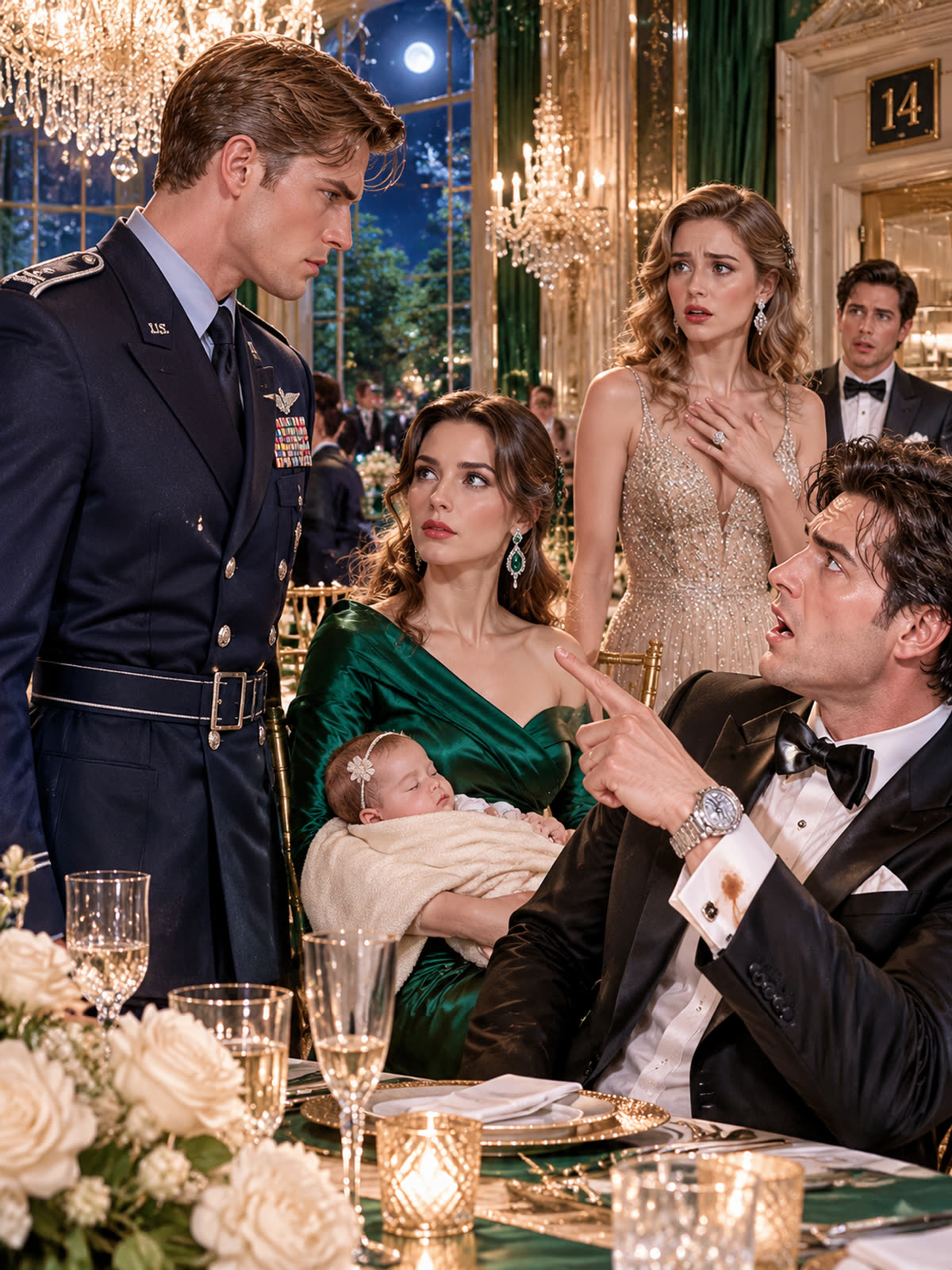
Julian’s mouth closed. He looked toward Arthur with the desperate expectation of a son who had always relied on his father to restore the preferred family order. Arthur offered him nothing. His gaze remained fixed on the floor, his authority undone by the very hierarchy he had taught us to worship. Around them, the guests listened with the uncomfortable stillness of people realizing they had accepted the wrong account of someone. I watched without satisfaction sharp enough to resemble triumph. There was exhaustion beneath my composure, and a clear recognition that I did not need to stay while my family searched for a way to make the evening manageable again.
I had no interest in the cake or the speeches. Neither could give me anything I had come to claim, because I was no longer there to claim their approval. I picked up my phone and adjusted Madeline’s blanket so the chandeliers would not shine into her eyes. The small, practical movement returned the evening to its proper scale. My daughter needed comfort; my husband was waiting. Whatever panic now occupied the central tables belonged to the people who had created it. I rose from Table 14 and turned toward the exit, leaving Marcus’s warning behind me. No further explanation from me could have made their position clearer.
The crowd opened as I walked. Earlier, I had slipped past these guests like someone they had no reason to notice. Now their eyes followed me with an uneasy mixture of respect and fear. My parents pressed back near the buffet as I approached, and for once neither tried to direct my movements. Their silence could no longer wound me in the way it once had. I had spent years interpreting their refusal to see me as evidence that I needed to work harder, provide more, or endure more gracefully. Crossing the ballroom with Madeline, I understood how little of my worth had ever depended on their willingness to recognize it.
I pushed through the brass doors and stepped into the cold night. The air outside cut cleanly through the heat and perfume still clinging to me. Across the manicured parking area, the armored sedan waited with its engine running. Sebastian stepped out as I approached, the streetlights outlining the sharp planes of his face. He opened the door without making me explain anything on the pavement. I lowered myself into the warm back seat with Madeline still tucked close. The familiar scents of milk and baby powder seemed to replace the ballroom at once. Only then did I feel how rigidly I had been holding my back.
Sebastian settled beside me, quiet amusement softening his eyes. “How was the birthday celebration?” he asked. I looked down at our daughter, drew her closer, and kissed the top of her head. “It’s over,” I whispered. “It’s all over.” I meant the performance, the endless effort to translate myself into something my parents would consider worthy. I meant the obligation that had sent my money into their failures and my silence into their version of our history. Inside the car, I could finally let some of the tension leave me. There was no audience to manage here and no one who required me to disappear.
Yet even as I said it, I knew the distinction between leaving and being allowed to leave. My family had lost more than an argument in that ballroom. They had lost the convenient certainty that I would absorb their contempt, repair their mistakes, and remain available for the next demand. Marcus’s salute had made that loss visible before people whose opinions mattered desperately to them. I could close a car door and return to the life I had built, but they would still be inside, surrounded by witnesses and unanswered questions. The celebration was finished for me. For Arthur, Eleanor, and Julian, the real panic had only begun.
PART 3: The Perimeter They Could No Longer Cross
People accustomed to controlling a family scapegoat do not necessarily respond to losing that control with honest reflection. Mine did not. They reached instead for the familiar tools that had kept me available: obligation, selective memory, and the suggestion that the harm would disappear if I simply agreed not to mention it. I answered by treating my private life with the same care I gave the secure networks under my command. Access would no longer be assumed. I imposed a complete communications blackout, not as an invitation to negotiate but as a boundary. For the first time, their need to reach me did not create a duty for me to respond.
Eleanor began with a voicemail, breathless beneath the sugary warmth she used when she wanted something to sound inevitable. “Victoria, darling… things got a little tense and misunderstood at the party. Your father is quite shaken. We should all just sit down for a lovely dinner at that new French place. We are family, after all, and we need to see our new granddaughter!” I listened without allowing the familiar tone to do its usual work. The party had not been misunderstood; it had exposed something she preferred to keep hidden. Her message offered a dinner in place of accountability and access to Madeline as though it naturally followed. I deleted it.
Then came the appeal to a childhood she seemed newly eager to remember differently. An expensive envelope arrived at our gated estate with photographs from a middle-school science fair. A bright pink note described me as “always the secret genius of the family.” I looked at the neat images and the revision attached to them without feeling the old pull to accept whatever affection was offered. The photographs could not turn years of contempt into overlooked admiration. I did not open the additional envelopes. In Sebastian’s soundproof office, I fed the package into the heavy-duty shredder and let the machinery reduce it to something that could no longer ask anything of me.
Julian chose a more public defense. On his professional networking profile, he posted a photograph of himself posed before a leased private jet. The caption read: “Some people hide behind fancy government titles and classified secrets. Real men actually build wealth and serve the economy.” Once, a statement like that would have kept me awake, furious at its dishonesty and ashamed of how deeply it hurt. Now I felt something far more detached. His performance looked small, especially beside the knowledge of what I had paid to preserve it. I noticed his declining engagement figures, then blocked him permanently across every platform. There would be no argument for him to display.
Beyond those failed attempts to reach me, my life continued in a warmth my family had never understood. Sebastian and I lived on the quiet outskirts of the city, in a sprawling, closely guarded estate surrounded by ancient oaks. Its technological protections mattered, but so did the simple privacy they gave us. In the evenings, he managed his logistics empire from an encrypted tablet near the fireplace while I nursed Madeline. Neither of us needed to turn the room into a stage. We understood the demands of each other’s responsibilities without competing to make them louder. After the ballroom, that ordinary companionship felt especially clear: this was what safety looked like when it did not require self-erasure.
Sebastian never demanded a public explanation of the parts of my work I could not discuss. He understood that silence could carry responsibility rather than conceal emptiness. His own empire had taught him the weight of decisions made far from an audience, and he respected the pressures I brought home without asking me to prove them. With Madeline between us, our lives held a kind of quiet authority that bore no resemblance to my parents’ hunger for recognition. Their calls and gestures came from outside that life. For once, I did not confuse the noise of their dissatisfaction with evidence that something inside our home needed to change.
A month after the birthday dinner, another linen envelope arrived through the secure mail drop. This one was from Beatrice. I recognized her handwriting, but the letter itself did not follow the familiar family pattern. There was no explanation designed to make me responsible for understanding everyone else, no accusation hidden inside an apology, and no attempt to blame Marcus for what had happened. I read it carefully. My sister had spent years benefiting from the role assigned to me, and I had no desire to make her admission easier than it needed to be. Still, for the first time, the words in front of me appeared to acknowledge that role without defending it.
“I’m deeply sorry,” she had written. “I blindly chased the money and the social image, and I let them treat you like absolute garbage for decades because, God help me, it made me look better by comparison. I was a coward. I am a coward. I know you just had a beautiful baby girl, and I’m so profoundly ashamed that I wasn’t there for you, that I didn’t even know she existed until you walked into that room. I don’t expect your forgiveness. I haven’t earned it. But I am sorry, Victoria. Truly.” I read the confession without supplying the forgiveness she had explicitly said she could not expect.
I sat beside the nursery’s broad bay window, watching moonlight move through the trees while Sebastian gently settled Madeline in her mahogany crib. My fingers followed the uneven pressure in Beatrice’s handwriting. The letter was the first unguarded communication I had received from anyone in that family in more than twenty years. That did not erase what came before it. It did, however, make one limited conversation possible. I unblocked her private number and called. She answered immediately, her breath catching before she spoke. “I’m listening,” I said. My voice held no welcome I did not yet feel, but I made no effort to sharpen it into cruelty.
“Victoria, I… I just want to—” she began. “We aren’t doing the tears, Beatrice,” I interrupted. “I am establishing the perimeter right now. You will never, ever stay silent if they insult me or my family again. You will not act as a messenger pigeon for Eleanor or Arthur. You will never weaponize my daughter’s existence to try and force a dramatic family reunion. You break even one of those rules, the line goes dead forever, and you will never see me again. Are we perfectly clear?” There was no room in the terms for the old evasions. If she wanted a relationship, it would no longer depend on my willingness to accept harm quietly.

“Clear,” she whispered. Her voice was strained with emotion, but it did not retreat from the answer. “I understand.” I offered no sudden declaration of love and no sweeping restoration of the closeness we had never truly possessed. An apology had opened the possibility of contact, nothing more. What followed would depend on conduct, not the elegance of a letter or the intensity of a difficult call. Setting those limits felt different from the defensive explanations I had spent years composing in my head. I was not asking Beatrice to agree that I deserved protection. I was telling her the conditions under which she could remain in my life.
Two months later, my professional responsibilities changed formally. I was promoted to the agency’s highest level, taking the lead as JSOC Global Cyber Command Chief Directorate. The position placed me in direct accountability to the President and the Secretary of Defense. Much about the appointment remained redacted, but enough became public for the news to circulate through major military and government networks. Congratulations arrived from allied generals, senators, and international defense directors. Their messages concerned work and responsibility, not the need to rescue an image. I accepted the recognition without mistaking it for the source of my value. The work had mattered before anyone outside its protected channels could acknowledge it.
From Arthur, Eleanor, and Julian came nothing. Their silence carried humiliation rather than peace, but it was still silence, and I did not break it for them. I had once spent so much effort anticipating their reactions that their absence could have felt like another form of judgment. Now I allowed it to remain outside the perimeter I had set. Beatrice had been given her own narrow path forward; the others had not earned one. With my home secure and my responsibilities expanding, I believed the worst of the conflict had finally exhausted itself. The ballroom seemed increasingly like the last scene of an old life rather than the beginning of another confrontation.
Then I was summoned to Washington, D.C., to serve as keynote briefer at a major joint congressional hearing on international cyber-terrorism threats. The assignment belonged entirely to the world my family had reduced to paper pushing. In a secure holding room, I stood alone for a moment and ran my thumb along the crisp fabric of my tailored suit. I adjusted the small, understated lapel pin marking my rank. The preparation was familiar: settle the body, order the mind, leave distraction outside the room. There was no need for a dramatic entrance. The people waiting beyond the door understood why I had been asked to speak.
I entered the large, wood-paneled briefing hall and approached the elevated podium. In the front rows sat four-star generals, admirals, and senators, their pens ready and their attention directed toward the briefing about to begin. These were people whose decisions shaped the country’s military and economic machinery, and for the moment they were waiting for mine. I made my usual visual sweep of the space, noting exits and personnel with the automatic attention my work required. My gaze moved beyond the principal seating toward the upper civilian observation gallery, the area intended for visitors and junior aides. I had almost completed the sweep when something there arrested my attention.
For a fraction of a second, the blood in my veins seemed to turn to ice. In the gallery’s cramped second row sat Arthur and Eleanor. Cheap plastic temporary visitor badges rested in their hands. Without their ballroom, their guests, or the familiar arrangement that placed them at the center of everything, they looked painfully out of place. More than that, they looked frightened. Below them, the generals and senators waited in silence for me to begin. I stood at the podium with the briefing before me and my parents above me, suddenly certain that the past had not finished trying to cross the boundary I had drawn.
Disclaimer: This story is a work of fiction inspired by real-life themes. Names, characters, places and events are fictionalized, and any resemblance to real persons is purely coincidental. Images are for illustration purposes only.
