


PART 1 — THE FLIGHT I NEVER TOOK
“Get your hand off my car, Natalie. I’m not missing her emergency because you’re upset about a vacation.”
My husband said that outside Philadelphia International Airport while I held two first-class boarding passes and the anniversary gift I had spent three months making. I’m Natalie Harker, thirty-two. Until then, I had mistaken asking for less for being a devoted wife. Rain hammered Graham Lockwood’s black SUV as security waved traffic forward. He barely glanced away from his phone.
“Graham,” I whispered, “today is our third wedding anniversary.”
He looked up, and for one foolish second I anticipated an apology.
“Not now, Natalie.”
“Not now?” I repeated. “We’ve been planning this trip for two weeks.”
“You planned it. I agreed to go because you wouldn’t stop talking about it.”
I stared at the California tickets, stunned. My interior design earnings had paid for five nights beside the ocean and a private anniversary dinner overlooking the Pacific. For months, I had pictured sharing my husband with nobody—not his laptop, his callers, or another executive. A single call from Sloane Delaney had erased everything. Graham’s first love had returned to Pennsylvania after performing with European ballet companies. Now she had apparently hurt her ankle in rehearsal.
“She thinks she tore a ligament,” he said. “She’s alone, frightened, and in pain.”
“Then call an ambulance.”
His jaw tightened.
“Don’t be ridiculous.”
“Or arrange a driver. You have three assistants, Graham. You can have someone take her to the hospital.”
“She asked for me.”
Those four words made my position painfully clear.
“She asked for you,” I repeated slowly. “And I’m your wife.”
He glanced toward the waiting traffic.
“Natalie, stop making this a competition.”
“Then why does she always win?”
His irritation settled into the coldness I knew too well.
“You’re embarrassing yourself.”
An airport employee approached.
“Sir, you can’t park here.”
Graham nodded without looking away from me.
“Move back, Natalie.”
I held the passenger door.
“Are you actually leaving me here?”
“Take a rideshare home.”
“With everything?”
“Your suitcase isn’t my problem.”
Something inside me broke.
“Three years,” I whispered. “I’ve spent three years waiting for you to make time for me.”
He sighed with the same exhausted impatience that always greeted my unhappiness.
“You’re being dramatic. We’ll celebrate another time.”
“Like my birthday?”
His eyes narrowed.
“Don’t start.”
“Or Christmas? Or the dinner with my parents you canceled? Or the weekend you promised we’d spend together before taking Sloane to a fundraiser?”
“Enough.”
Travelers turned at his raised voice. Leaning across the seat, Graham pried my fingers from the door.
“I don’t have time for this.”
He raised the window and answered another call.
“Sloane? I’m coming. Don’t worry. I’ll be there soon.”
His voice softened immediately. That tenderness wounded me more than the ruined trip, the soaking rain, or the strangers witnessing my humiliation. I had waited years to hear him address me that way. Then the SUV vanished into traffic.
My phone vibrated. For an instant, I thought he had reconsidered. Instead, the resort had sent a confirmation: We look forward to welcoming Mr. and Mrs. Lockwood. I stared until laughter escaped, although nothing was funny. Graham had not forgotten how to love; he simply did not want to offer that love to me. A security officer came over.
“Ma’am? Are you okay?”
I looked down at the wet tickets trembling between my fingers.
“No,” I said. “But I think I’m going to be.”
Rather than begging Graham to return or arranging a ride home, I went inside. I canceled the reservation, accepted a partial refund, and opened an old phone folder: Places I Want to Go Someday.
One saved photograph showed Stone & Sparrow Pottery in Juniper Falls, Virginia, tucked among the Blue Ridge Mountains. I had found it before our second anniversary, back when I still expected Graham to become interested in my dreams. I called.
“Stone & Sparrow. Silas speaking.”
“My name is Natalie Harker,” I said. “Do you still offer extended ceramics apprenticeships?”
“We do. Why?”
I shut my eyes.
“Because I need to learn how to build something that belongs to me.”
After a pause, he said, “Well, that’s as good a reason as any.”
An hour later, I had a room, train and bus connections, and a southbound ticket. Before leaving, I called my cousin Rebecca.
“I’m safe,” I told her. “I’m leaving town for a while.”
“Does Graham know?”
“No.”
“Do you want him to?”
Rain slid down the terminal windows.
“Not anymore.”
By midnight, I had removed my wedding ring. By morning, I was heading toward Virginia. Seven days would pass before Graham wondered why I had not returned. He would discover that I had not disappeared; I had stopped waiting. But first, I had to learn how to spend a morning without arranging it around him. On waking in Juniper Falls, I instinctively reached across the bed. Three years had trained me to anticipate his schedule: coffee at 6:15, breakfast at 6:30, everything prepared for his departure by 6:45.
Even after midnight, I usually slept lightly, listening for Graham to come home. Now birds sang outside a modest guest room overlooking flowers. No breakfast awaited preparation. No presentation needed printing. Nobody would complain that I was making unnecessary noise. The stillness frightened me. Maple House was a white farmhouse converted into a six-room inn. Its owner, Maggie Foster, was a widow in her sixties who favored colorful sweaters and understood privacy. When I arrived exhausted with my suitcase, she offered a towel.
“Long trip?”
“Long marriage,” I answered.
She asked nothing else, serving scrambled eggs, sourdough toast, and coffee in a chipped blue mug. Nobody had prepared breakfast for me in months. The toast nearly made me cry.
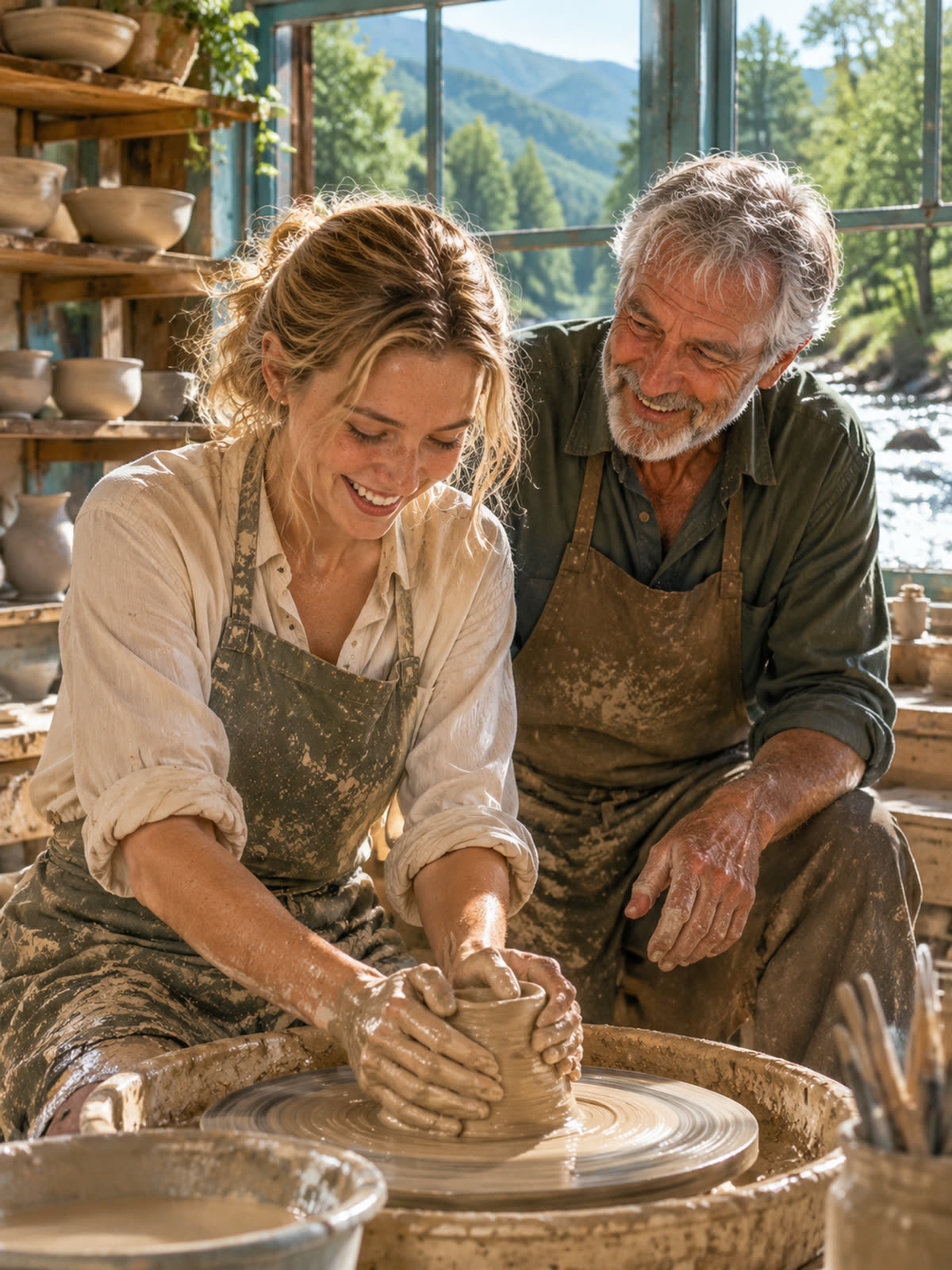
At nine, I walked into Stone & Sparrow. Wet clay, sawdust, and coffee scented the workshop. Unfinished bowls occupied the shelves, kilns lined the back, and broad windows admitted sunlight from the creek. Seventy-one-year-old Silas Boone was broad-shouldered, with a fingertip missing from an old accident. He examined my hands.
“Ever worked with clay?”
“Not seriously.”
“Then we’re starting with the basics.”
He dropped damp clay onto a pottery wheel.
“Center it.”
My attempt sent it sliding sideways. Silas laughed.
“That’s all right. Everybody thinks the wheel’s the problem at first.”
For three hours, my bowls buckled, my fingers hurt, and clay splattered my apron. Yet beneath the frustration, I was genuinely happy. I could be terrible at something without the experience becoming worthless. Beyond the windows, sunlight brightened the creek while I tried again. Graham would have hated the absence of immediate results. He measured achievement by what could be displayed, sold, or completed, and he had eventually begun measuring me the same way. Here, with my hands muddy and another shapeless bowl before me, nobody demanded that I justify the time. For the first time in years, learning something simply because I wanted to felt possible.
When Graham and I met, I was growing an interior design business while he expanded his family’s development company, Lockwood Residential. At first, he praised my imagination and introduced me proudly as extraordinarily talented. Marriage changed that. He suggested I decline certain assignments, then asked me to organize corporate dinners, charitable functions, and renovations. My work gradually occupied the scraps of time left after his needs. He called that partnership. I called it love. Neither description survived closer examination. Fortunately, I had continued accepting private commissions under my maiden name, putting the payments into a separate business account. Over three years, those projects had earned me more than sixty thousand dollars in savings.
Graham knew I sometimes worked. He had simply never cared enough to ask what I accomplished. On my second day in Virginia, I called Nina Salazar, a family-law attorney Rebecca recommended. I explained the airport, Sloane, our anniversary, and the years of feeling like another piece of furniture. Nina listened before asking, “Are you hoping this will make him change?”
I looked toward the creek outside.
“No. I’m hoping to change my own life.”
“Good. Because those are two very different goals.”
We discussed marital property, my business accounts, separation, and divorce. She made clear that walking away did not mean forfeiting everything I had helped create. I appreciated that, although one possession continued troubling me: my wedding ring.
The diamond’s value meant nothing. I could no longer bear looking at it. I slipped it into a padded envelope with the debit card Graham had supplied for household expenses. Then I wrote:
Graham,
You told me to figure things out.
I have.
I am safe. I have chosen to leave our marriage. Please direct all legal communication through my attorney.
The household card and wedding ring are enclosed. You can keep the money, the house, and the excuses.
I am keeping my future.
Natalie.
I sent it overnight to his office, requesting a signature. Afterward, I changed my number and deactivated the messaging accounts he used. Rebecca, Nina, and Maggie received my new details. I was not vanishing from the world. I was deciding who could reach me.
Seven evenings after I left Philadelphia, Nina called as I rinsed clay from my fingers.
“Natalie, your husband’s office contacted me.”
My stomach tightened.
“What happened?”
“Apparently, he returned home this afternoon and discovered you hadn’t been there all week.”
I closed my eyes. Seven days, and he had not once checked whether I had made it home safely.
“What did he say?”
“According to his assistant, Mr. Lockwood initially assumed you were extending your vacation.”
I almost laughed.
“What vacation?”
“Exactly.”
There was a pause before she continued.
“There’s something else. His assistant said Graham became extremely distressed when he opened your envelope.”
I leaned against the sink. So many times, I had imagined the satisfaction of Graham finally realizing how deeply he had hurt me. Instead, all I felt was exhaustion.
“What does he want?” I asked.
“To speak with you directly.”
“No.”
“He says it’s urgent.”
“So was our anniversary.”
Nina paused.
“I’ll relay your decision.”
I thought that would end it. He had my letter, my ring, and an attorney’s number. For once, I had stated what I wanted without softening it to protect his comfort. I returned to the workshop and the ordinary difficulty of keeping a vessel upright. Two days later, I was shaping my first successful vase when a familiar voice came from the entrance.
“Natalie.”
My hands froze against the turning clay. Slowly, I raised my head. Graham stood in the doorway in an immaculate charcoal suit, but the rest of him looked unfamiliar. His eyes were bloodshot. The hand holding my returned ring shook. Throughout our marriage, I had wanted him to look at me as though losing me mattered. Now that expression was finally on his face, and I could not summon the urge to soothe him. Behind me stood the shelves of unfinished work; beneath my hands, the vase continued turning. He looked at me as if the life he had always assumed would wait for him had suddenly become unrecognizable.
“Natalie,” he whispered, “please tell me this isn’t really happening.”
PART 2 — THE LIFE HE EXPECTED TO FIND WAITING
Graham looked pale and rumpled despite his tailored suit. Shadows ringed his eyes, and his expensive watch rested loosely on his wrist. He was neither angry nor impatient. He was afraid.
“How did you find me?” I asked.
He surveyed the workshop.
“The return address on your package. I called the local businesses until I found the studio.”
“You could have called my attorney.”
“I did. She wouldn’t tell me where you were.”
“That should have told you something.”
He flinched. Near the kiln, Silas put down his tools.
“Natalie, I’ll be in the back if you need anything.”
I nodded. Graham watched him go.
“Who is that?”
“My teacher.”
“You’re taking pottery lessons?”
“Yes.”
He studied my apron and the unfinished pieces.
“Since when?”
“Since I remembered that I had a life before becoming your wife.”
His jaw tightened.
“Natalie, please. I’m not here to argue.”
“Then why are you here?”
He lifted the ring.
“Because I came home and found this.”
I remembered him sliding that diamond onto my finger beneath a chandelier, with two hundred wedding guests watching. He had promised I would never face hardship alone. Now it seemed merely costly decoration attached to a promise he had not kept.
“I sent it back,” I said. “You received it.”
“People don’t end marriages over one missed vacation.”
“No,” I agreed. “They end marriages when the missed vacation is the last thing in a very long list.”
He shook his head.
“That isn’t fair.”
“Neither was leaving me outside an airport in the rain.”
“Sloane was hurt.”
“Yes, Graham. You’ve mentioned that.”
“She needed me.”
“And I didn’t?”
He started to answer, then stopped. I stepped away from the wheel.
“Do you know what I did after you drove away?”
His expression became helpless.
“I spent twenty minutes standing in the rain because I couldn’t believe you were actually gone. I kept thinking you’d come back. That you’d remember what day it was.”
He lowered his eyes.
“But you didn’t. And when I realized you weren’t coming back, something changed.”
“Natalie—”
“I didn’t feel like your wife anymore. I felt like an inconvenience you’d dropped off on the sidewalk.”
His jaw clenched.
“I’ve made mistakes. I know that.”
“Do you?”
“Yes.”
“Then tell me when my birthday is.”
He stared before finally answering.
“September,” he answered finally.
“October seventeenth.”
Color drained from his face.
“What did I study before interior design?”
“You studied design.”
“I studied sculpture for two years before switching majors.”
Silence.
“What’s my favorite food?”
“Natalie, this is ridiculous.”
“What’s my favorite food, Graham?”
He looked away, and I laughed softly.
“You don’t know.”
“I know plenty about you.”
“You know how I take your coffee. You know I keep your medication organized. You know I can manage your business dinners and remember your parents’ birthdays.”
I moved nearer.
“But you don’t know what makes me happy.”
He bowed his head, apparently out of excuses.
“I’m sorry,” he whispered.
I believed he regretted it. That did not mean regret could mend us.
“Did you remember our anniversary after you left the airport?”
He swallowed.
“No.”
“Did you call me that night?”
“No.”
“The next morning?”
He said nothing.
“Three days later?”
“Natalie, work was insane.”
I nodded.
“There it is.”
“What?”
“The excuse. There’s always an excuse.”
He rubbed his face.
“I thought you were upset. I thought you needed space.”
“Space?” I repeated. “You didn’t know whether I got on the plane. You didn’t know whether I went home. You didn’t even know whether I was safe.”
“I assumed—”
“Exactly.”
My voice broke.
“You assumed I would be there. You assumed I’d forgive you. You assumed that no matter how badly you treated me, I’d still be waiting when you finally decided to come home.”
His expression crumpled.
“I never meant to make you feel that way.”
“But you did.”
He glanced toward the creek.
“I can fix this.”
I shook my head.
“You can’t fix something you never cared enough to understand.”
“I’ll cancel my meetings. We can take that vacation. Anywhere you want.”
I smiled bitterly.
“I don’t want a vacation anymore.”
“Then tell me what you want.”
I studied my uneven vase. It was imperfect, but my hands had made it.
“I want a life where I don’t have to beg someone to notice I’m standing beside them.”
Tears gathered in his eyes. He had not cried at our wedding, his father’s funeral, or through a disastrous acquisition. Now he struggled for composure.
“Please come home,” he whispered.
“That house hasn’t felt like home in a long time.”
He moved toward me. I stepped back, and he stopped.
“I still love you,” he said.
My throat tightened. I had waited through lonely birthdays, sleepless nights, and solitary dinners for those words. Now they seemed like flowers sent after the recipient had moved away.
“Maybe you do,” I replied. “But your love doesn’t make me happy anymore.”
He closed his eyes.
“Is there another man?”
I stared in disbelief.
“No, Graham.”
“Then why won’t you give me another chance?”
“Because the person I’ve finally chosen is myself.”
He looked at the ring.
“What am I supposed to do?”
“Respect my decision. Speak to Nina about the separation.”
I returned to the wheel. After several motionless seconds, he left. Only when the door closed did I exhale. Silas emerged.
“You all right?”
I nodded. He inspected my sagging vase.
“Looks like you lost your center.”
“Can I fix it?”
“Maybe. Or you can start again.”
I switched off the wheel.
“I think I’d rather start again.”
Silas smiled.
“That’s the spirit.”
But Graham and Sloane were not finished. Three days later, while I glazed a bowl, a woman’s voice carried through the studio.
“Well, this explains everything.”
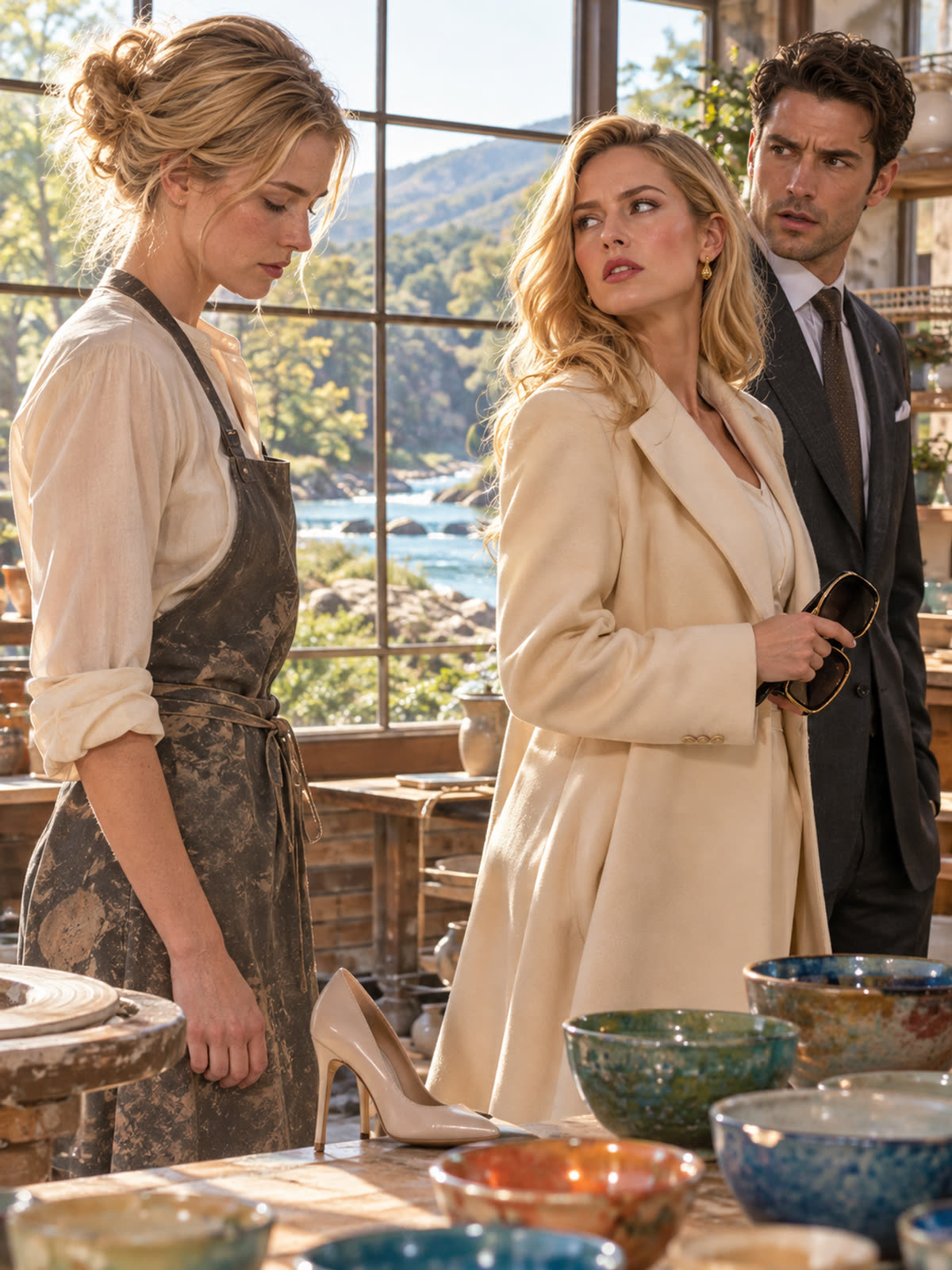
Sloane stood by the door in a designer cream coat, oversized sunglasses, and heels unsuited to the gravel outside.
Her blonde waves were flawless. She surveyed my dirty apron with distaste.
“So this is where Graham’s wife has been hiding?”
I lowered my brush.
“I’m not hiding.”
She laughed.
“Really? Because you’ve caused quite a scandal.”
Behind her, Graham looked startled.
“Sloane, I told you not to come inside.”
She ignored him.
“I wanted to see the woman who’s managed to make Graham miserable over one tiny misunderstanding.”
I raised an eyebrow.
“One tiny misunderstanding?”
Her smile widened.
“Look, Natalie, I know you’re upset about the airport. But you have to understand, Graham and I have a very complicated history.”
“I’m aware.”
“We’ve known each other since we were teenagers.”
“Congratulations.”
Her expression tightened.
“There’s no reason to be rude.”
“Then perhaps you should explain why you’re here.”
She removed her sunglasses.
“I came to apologize.”
“Okay.”
She blinked.
“Okay?”
“Apology acknowledged. You can leave.”
Graham nearly smiled. Sloane did not.
“You’re making this unnecessarily difficult. Graham has been worried sick about you.”
I looked at him.
“Has he?”
He stayed quiet.
“He barely sleeps. He’s canceled important meetings. His assistant says he’s never seen him like this.”
“Then he should speak to a doctor.”
She stared.
“Do you have any idea what you’re throwing away?”
I glanced at my pottery.
“Yes. I’ve thought about it carefully.”
“A successful husband. A beautiful home. A lifestyle most women would give anything to have.”
Her eyes swept the room.
“And instead, you’re making bowls in a dirty little town.”
Silas stirred behind me. I signaled that I was fine.
“Sloane, can I ask you something?”
She folded her arms.
“What?”
“How is your ankle?”
“It’s improving.”
“I’m glad.”
I looked at her heels.
“Those are impressive shoes for someone recovering from a torn ligament.”
Her cheeks flushed.
“It wasn’t a complete tear.”
“That’s good news.”
“The doctor said it was a moderate sprain.”
Graham turned abruptly.
“A moderate sprain?”
“Well, yes. It was extremely painful.”
“You told me you couldn’t stand.”
“I couldn’t at the time.”
“You said the doctor suspected a serious tear.”
“He did initially.”
Realization crossed his face: the urgent call, the abandoned journey, the emergency he had placed ahead of our anniversary. I took no satisfaction in it. Even if Sloane had broken three bones, Graham was responsible for leaving me. She turned toward me.
“See? This is exactly why I came. You’re blaming me for something that wasn’t my fault.”
“I’m not blaming you.”
“You’re not?”
“No.”
Confusion interrupted her composure.
“You called someone you trusted when you were injured. That’s your choice. Graham chose to abandon his wife on our anniversary. That’s his responsibility.”
I held his gaze.
“Nobody forced him to drive away.”
He swallowed. Sloane recovered quickly.
“Well, perhaps you should ask yourself why he was so willing to leave.”
The workshop fell quiet.
“Maybe he needed someone who understands him.”
The old insecurities stirred. For years, I had compared myself with her elegant clothes, ballet career, and treasured place in his past. I had wondered if being prettier, more accomplished, or more sophisticated would finally make me enough. Standing there with clay under my nails, I saw how pointless the competition had always been.
I smiled.
“You’re right about one thing.”
She looked victorious.
“What?”
“Graham and I never understood each other.”
Her smile grew.
“Because I spent three years learning everything about him, and he never bothered learning anything about me.”
Her expression fell. I removed my apron.
“But here’s what you misunderstand, Sloane. I’m not fighting you for him.”
She stared.
“I’m not trying to win. I’m not trying to convince him I’m better than you. I’m not trying to make him jealous.”
I looked at them both.
“I’m leaving a marriage that made me unhappy.”
Before she could interrupt, I continued.
“If he wants to be with you, that’s his decision. If he doesn’t, that’s also his decision. But neither of you gets to make me responsible for what happens next.”
Graham stepped forward.
“Sloane, enough. You need to leave.”
She turned on him.
“Graham, I was only trying to help.”
“No,” he said quietly. “You weren’t.”
Her eyes widened.
“I came all this way because I care about you!”
“I told you Natalie didn’t want to see me. You insisted that you could talk sense into her.”
“Because she’s destroying your marriage!”
Graham looked at me, his voice breaking.
“No. I did that.”
For the first time, he sounded as though he understood. Sloane stared.
“You’re choosing her over me?”
I shook my head.
“Nobody is choosing anybody. That’s what you both seem unable to understand.”
Graham faced her.
“Please go back to Philadelphia.”
She looked between us, her expression hardening.
“You’ll regret this.”
Her heels struck the floor as she stormed out. Graham and I remained in the quiet. He looked depleted.
“I’m sorry she came here.”
“I believe you.”
“I’m sorry about the airport.”
“I know.”
“I’m sorry about the last three years.”
That made me look at him.
“I thought providing everything was enough.”
I waited.
“I kept telling myself that if I worked harder, made more money, and built a bigger company, I’d be a better husband.”
He raised his eyes.
“But I never asked whether you were happy.”
“No,” I whispered. “You didn’t.”
Tears filled his eyes.
“I loved the life you made for me. I just forgot that you were supposed to have a life too.”
Briefly, I recognized the man I had loved: not the executive, but the young man who brought coffee during my late-night projects and spent a Sunday painting my tiny apartment. Remembering why we had married hurt. A beautiful beginning could not undo years of neglect.
“I hope you learn from this,” I said.
He nodded.
“Can I ask one last question?”
“Yes.”
“If I’d come back to the airport that night, would you still be leaving?”
I considered it.
“Maybe not that night.”
Hope appeared in his face.
“But eventually, Graham, yes. Unless our marriage had truly changed.”
He bowed his head. At last, he understood: the airport had not broken our marriage. It had revealed what was already broken.
A week later, Graham signed the separation agreement and went back to Philadelphia. Neither of us pretended anymore that affection could repair years of being overlooked. I believed his signature might be the most important thing he would ever give me. Three months later, while I prepared for my first pottery exhibition, a large parcel arrived at Maple House. Brown paper concealed a long wooden box containing photographs, sketches, and a thick cream envelope. I recognized his handwriting. Beneath his letter lay something he had kept in his study for years—something that would show he had known about the dream I believed he had forgotten.
PART 3 — THE LETTER HE HAD NO RIGHT TO HIDE
The parcel arrived on a Thursday afternoon. I unfolded Graham’s letter.
Natalie,
When you left, I started going through the things I’d put away over the years. I found this in the bottom drawer of my study.
I should have given it to you when it arrived.
I told myself I was protecting our marriage. The truth is that I was afraid of losing the life you made comfortable for me.
I have no excuse.
I’m sorry.
Graham.
Beneath it was another envelope, postmarked almost two years earlier. Northstar Arts Institute in Vermont. My fingers trembled. During our first year of marriage, I had applied for its prestigious nine-month ceramics fellowship, a program combining traditional materials with contemporary design. I had spent weeks preparing my portfolio, then checked the mail and email anxiously. Silence had seemed like rejection.
The letter began: Congratulations, Ms. Harker. We are delighted to offer you a place in our upcoming artist fellowship. I read the sentence again and again. Studio space, professional mentorship, an $18,000 stipend. They had accepted me. Graham had known. I sank onto the bed, remembering the dinner when I told him about it.
“Vermont? For nine months? That’s not realistic, Natalie.”
“It’s a wonderful program.”
“We’re building a life here.”
“I could come back on weekends.”
He had lowered his fork.
“You’re my wife. We shouldn’t be living separate lives.”
I explained that I was only applying. He said nothing. When the acceptance never appeared, he comforted me with an expensive necklace and a luxury hotel weekend. I had interpreted those gifts as kindness. He had been taking away my choice.
I called Nina.
“I’m sending you something,” I said.
“Are you all right?”
“No.”
My voice shook.
“But I finally understand why leaving was the right thing to do.”
She helped preserve the acceptance and Graham’s admission with our separation documents. She also urged a fair financial settlement.
“Freedom doesn’t require you to surrender property you’re legally entitled to,” she reminded me.
This time, I listened. Independence did not mean rejecting what my own contributions had helped build. Years of unpaid household management, design work, and emotional labor counted too. Eventually, we agreed on an equitable division. I kept my business, savings, and an agreed share of marital assets. Graham retained Lockwood Residential and the house. Neither of us fought over objects that had stopped mattering.
I never replied to his personal letter. Remorse could not return the fellowship or the years I had spent doubting myself. An apology could be acknowledged without being rewarded with forgiveness. The next morning, I brought the acceptance to Silas as he loaded a kiln. He read it carefully.
“Well, I’ll be.”
I gave a weak laugh.
“I got accepted two years ago.”
“Looks that way.”
“And I never even knew.”
He handed it back.
“That’s a shame.”
I lowered my gaze.
“Maybe I missed my chance.”
Silas shook his head.
“Natalie, a letter can expire. Talent doesn’t.”
I stared at him. He pointed toward the wheel.
“Now get back to work.”
So I did.
Over the following months, I worked harder at ceramics than ever. I learned moisture control, foot-ring trimming, glaze mixing, and the difficult business of failing without deciding I was a failure. Lovely pieces cracked in the kiln. Glazes emerged in unexpected colors. A careless movement could destroy six hours of effort. Silas kept separating mistakes from defeat.
“Clay tells you the truth,” he said. “You either listen or you don’t.”
By autumn, I had a small collection inspired by the Blue Ridge: deep blue bowls, pale green pitchers, and tall stoneware vases etched with lines like mountain streams. Silas urged me to enter the Juniper Falls Autumn Craft Festival.
“I’m not ready.”
“You’re never going to feel ready.”
He gestured at the collection.
“Let the customers decide.”
I rented a booth and arranged fourteen pieces on a linen-covered wooden table. During the first hour, hardly anyone paused. Panic crept in until an older woman lifted a bowl.
“Did you make this?”
“Yes, ma’am.”
She turned it carefully.
“The glaze is beautiful.”
“Thank you.”
“How much?”
I named the price. She bought it immediately, and I nearly cried. Six pieces had sold by lunch; by three, eleven were gone. Shortly before closing, a tall man with dark-blond hair approached.
“Natalie Harker?”
I looked up.
“Theo?”
Theo Kincaid had studied sculpture with me in college. Now he consulted on art and organized regional exhibitions. He examined the ceramics.
“These are yours?”
“Every one.”
He smiled.
“Then I think we should talk.”
A Richmond exhibition was seeking emerging ceramic artists, he explained, and my work might fit. I stared.
“You really think I’m good enough?”
His expression softened.
“Natalie, I wouldn’t be standing here if I didn’t.”
At the next booth, Silas raised his eyebrows as though reminding me he had spent months saying exactly that. I laughed.
“Okay,” I told Theo. “I’d love to apply.”
That evening, Maggie organized a celebration at the inn. Silas supplied homemade pie, and Theo stayed for dinner. We laughed until almost midnight. Nobody complained about wasted hours or treated my happiness as an inconvenience. Three months later, after the required legal process and waiting period, my divorce became final. In Nina’s office, I read the documents and signed the acknowledgment.
I had anticipated crushing grief. Instead, relief arrived, quiet and extraordinary. I was Natalie Harker again, no longer Mrs. Lockwood. The woman left outside an airport was finally moving toward a future of her own choosing. Three years after that rainy afternoon, I stood in a Richmond gallery beneath the exhibition title Natalie Harker — The Shape of Becoming. Visitors moved among thirty-six works, from delicate cups to enormous sculptural vessels. Galleries had requested commissions, two boutique hotels wanted exclusive collections, and a national design magazine had featured my studio among emerging American artisans. Success still surprised me, not because it had come easily, but because I knew exactly how much uncertainty and work lay behind it.
Those years contained exhaustion, failed firings, financial worry, and mornings of second-guessing. Yet the life belonged to me. Harker Studio employed four artisans and offered classes to young artists who could not afford expensive training. Theo handled exhibitions and commercial partnerships. Silas visited to criticize glaze experiments while pretending he was not proud. Maggie mailed cookies whenever she suspected overwork. I was surrounded by people who welcomed my ambitions. Near the exhibition’s end, someone spoke behind me.
“Natalie?”
Graham stood several feet away in a charcoal suit. His familiar authority remained, but his expression was softer, his eyes sadder. After a moment, I offered a polite smile.
“Hello, Graham.”
He looked around.
“This is incredible.”
“Thank you.”
“All of it is yours?”
“Every piece.”
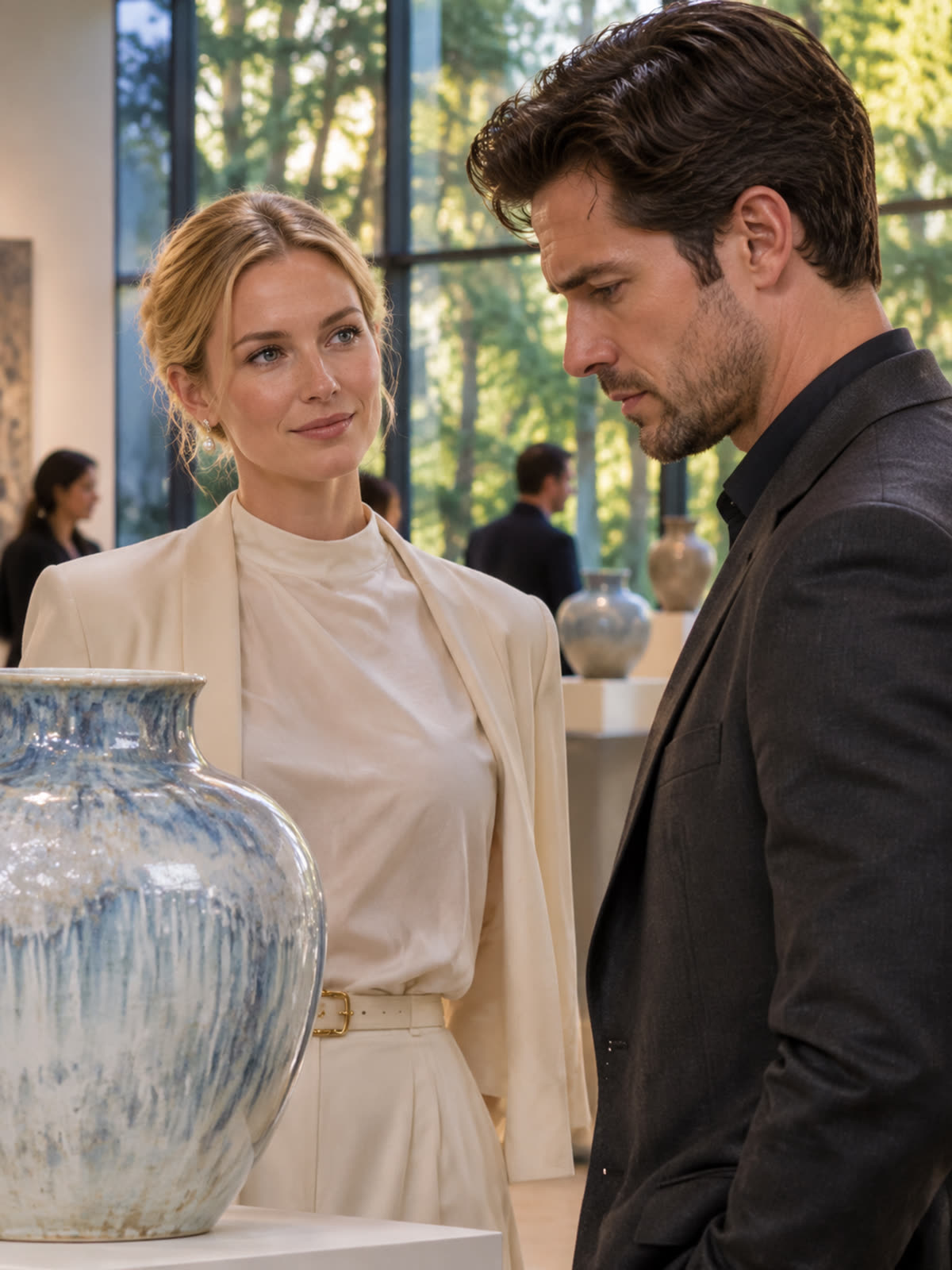
He stopped before a large stoneware vase layered in pale blue and white, its glaze resembling rain traveling down glass.
“What’s this one called?”
I joined him.
“After the Storm.”
Recognition crossed his face.
“Beautiful,” he whispered.
“Thank you.”
He continued studying it.
“I remember that night.”
I said nothing.
“I’ve thought about it more times than I can count.”
I folded my hands.
“That was a long time ago.”
“It doesn’t feel that way to me.”
He seemed older in a way that had little to do with his appearance. Perhaps experience had finally shown him that money could not correct every mistake. Between us stood the vase, made by hands he had once expected to spend their days arranging his life.
“How have you been?” I asked.
He gave a faint smile.
“Busy. The company’s doing well.”
“I’m glad.”
He glanced at Theo speaking to two collectors.
“Your business partner?”
“Yes.”
“He seems like a good man.”
“He is.”
Graham nodded, searching for words.
“I never married again.”
I met his gaze.
“I hope you’ve been happy, Graham.”
He laughed softly.
“That’s a difficult question.”
I let the silence remain.
“Sloane and I stopped seeing each other shortly after the divorce.”
“I see.”
“I realized I’d spent years chasing a memory of someone I used to love while ignoring the woman who was actually building a life with me.”
His voice roughened.
“I was an idiot.”
I considered his admission.
“You made choices.”
“Yes.”
“And those choices had consequences.”
He nodded.
“I know.”
His gaze shifted to photographs around the gallery: me at the wheel, freckles visible above clay-covered hands; Silas teaching; Theo and me outside the studio on opening day. Graham smiled sadly.
“You look happy.”
“I am.”
“I don’t think I ever saw you this happy when we were married.”
I breathed in.
“I wasn’t.”
He lowered his eyes.
“I know.”
After another pause, he reached into his jacket. I stiffened instinctively, but he produced only a business card.
“My company is developing a small luxury retreat. We’ve been looking for handmade pieces for the guest suites.”
He hesitated.
“I’d like to commission some of your work.”
Once, his approval would have meant everything. Now I considered him as I would another potential customer.
“That’s possible,” I said. “But our commercial orders are booked for the next eight months.”
He smiled faintly.
“Eight months?”
“Approximately.”
“I can wait.”
I indicated Theo.
“You can discuss the project with our business director. He’ll explain the process and pricing.”
Graham glanced over and nodded.
“Of course.”
He put away the card.
“Natalie, there’s one more thing.”
I waited.
“The fellowship letter.”
The old heaviness returned. He swallowed.
“I’ve wanted to explain why I kept it.”
“You already explained.”
“I was afraid you’d leave.”
I looked at him.
“You knew how much that opportunity meant to me.”
“Yes.”
“And you still chose to hide it.”
His eyes shone.
“Yes.”
I nodded.
“That’s the part I could never get past, Graham. Not the airport. Not even Sloane.”
He looked stricken.
“You took away my right to decide what kind of life I wanted.”
“I know.”
“And then, when I finally made that decision myself, you wanted me to come back.”
His lips pressed together.
“I was selfish.”
“Yes.”
There was no fury in my voice, only certainty.
“I spent a long time thinking I wasn’t talented enough because that letter never came. I questioned myself for years.”
His expression tightened.
“I wish I could undo it.”
“I know you do.”
“Can you ever forgive me?”
I considered the question. I had once imagined this confrontation endlessly. Now that it had arrived, I did not need his pain to make me whole.
“I don’t carry that anger anymore,” I said. “But forgiveness doesn’t mean we get another chance.”
He nodded slowly.
“I understand.”
“And I hope you find happiness.”
His voice trembled.
“I hope so too.”
After one last look, he offered his hand. I shook it. There were no accusations, frantic promises, or arguments left unfinished. Just goodbye. I watched him leave without the heartbreak I had felt outside the airport. Instead, I felt grateful that I had taken another direction. Minutes later, Theo approached.
“You okay?”
I smiled.
“Better than okay.”
He glanced toward the entrance.
“Was that your ex-husband?”
“Yes.”
“Everything all right?”
I nodded.
“Everything is exactly where it should be.”
Theo smiled.
“Good. Because I have news.”
“What kind of news?”
He handed me a printed email. An international ceramics program in Copenhagen wanted me to teach a six-week masterclass and exhibit selected pieces. All expenses were covered. My hand flew to my mouth.
“Theo!”
He laughed.
“You earned it.”
I stared at the invitation. Years earlier, someone had hidden an acceptance because he feared what my independence might mean. Now an opportunity lay openly in my hands, with nobody else deciding whether I could have it. Six weeks later, I returned to Philadelphia International Airport carrying a modest suitcase, my passport, portfolio photographs, and one boarding pass. Near the departures entrance, I stopped almost exactly where Graham had left me three years earlier.
I remembered the downpour, the black SUV, the woman on the phone, and the humiliation of seeing my husband choose someone else. I had felt unwanted, replaceable, utterly alone. Now people hurried around me, embracing loved ones and exchanging goodbyes. Outside, the sky was clear. Sunlight streamed through the terminal glass. My phone vibrated with a message from Theo: Have an incredible trip. Everyone at the studio is proud of you. Maggie followed: Remember to eat something besides airport snacks, sweetheart. Then Silas: Don’t let those Europeans tell you how to center clay. I burst out laughing, lifted my suitcase, and headed toward security. Three years earlier, I thought Graham driving away had ended my life. I had not understood that the person most important to my future had been standing there all along.
Me. I no longer needed somebody else to choose me. When the boarding announcement sounded, I did not look toward the entrance, hoping someone would arrive to bring me back. I smiled, offered my boarding pass, and walked through the gate. Leaving had not meant losing everything; it had given me a life I could call my own. And beyond that gate waited the next chapter—one I had not yet learned how to shape.
Disclaimer: This story is a work of fiction inspired by real-life themes. Names, characters, places and events are fictionalized, and any resemblance to real persons is purely coincidental. Images are for illustration purposes only.
