

PART 1 — The Orange Life Jacket
My name is Gwen Delgado. I’m thirty-eight, and I work as an insurance adjuster in Springfield, Missouri. Every Fourth of July, my family gathers at my parents’ house on the Lake of the Ozarks. There are fireworks, barbecue, and more beer than anyone needs. It is the same celebration every summer, familiar enough that I knew what to expect from nearly everyone there. Especially my younger brother.
Rhett is thirty-four, and in my parents’ eyes, he has always been the golden child. He has also been arrested twice for drunk driving. They describe that as “a rough patch.” That rough patch has lasted twelve years. My daughter, Winnie, is seven. She knows how to swim, but not confidently, and certainly not in open water. Whenever she goes anywhere near the lake, she wears a bright orange life jacket. My mother considers that “overkill.” I consider it necessary.
Before each visit, I go over the same rule with Winnie. “If you ever fall in deep water, don’t panic. Find something that floats. Hold on. Mommy will come.” That afternoon, I stepped inside the house for sunscreen. I was away from the dock for perhaps four minutes. Four minutes was all the time it took for the thing I was most careful about to happen without me there.
When I returned, Winnie was missing. So was Rhett’s jet ski. “Where’s Winnie?” My mother gestured toward the lake with her drink. “Relax. Rhett took her for a spin. She was begging.” The words reached me before I could make sense of what she had allowed. My daughter was out on open water with my brother, and nobody on that dock seemed to think I had any reason to be afraid.
“He’s been drinking since noon!” I said. My father dismissed the concern as easily as my mother had. “He’s fine,” he said. “He grew up on this lake.” I raised a hand against the glare and searched the water. Far from shore, I could make out the jet ski. It was moving fast, much too fast, cutting from side to side. Knowing the lake did not make what I was watching any safer.
Then the jet ski struck a wake. A little figure in a pink swimsuit flew off the back. I saw it happen from the dock: the sudden separation, the small shape leaving the machine, the water between them. The jet ski did not stop. It continued across the lake while my daughter was no longer on it.
I screamed, and my father caught my shoulder. “Don’t make a scene. He’ll go back for her.” I kept watching, waiting for Rhett to turn toward the place where she had fallen. He did not. Instead, the jet ski swept through a broad curve and headed back toward us. My father was still treating my reaction as the problem, while everything that mattered was somewhere out in the water.
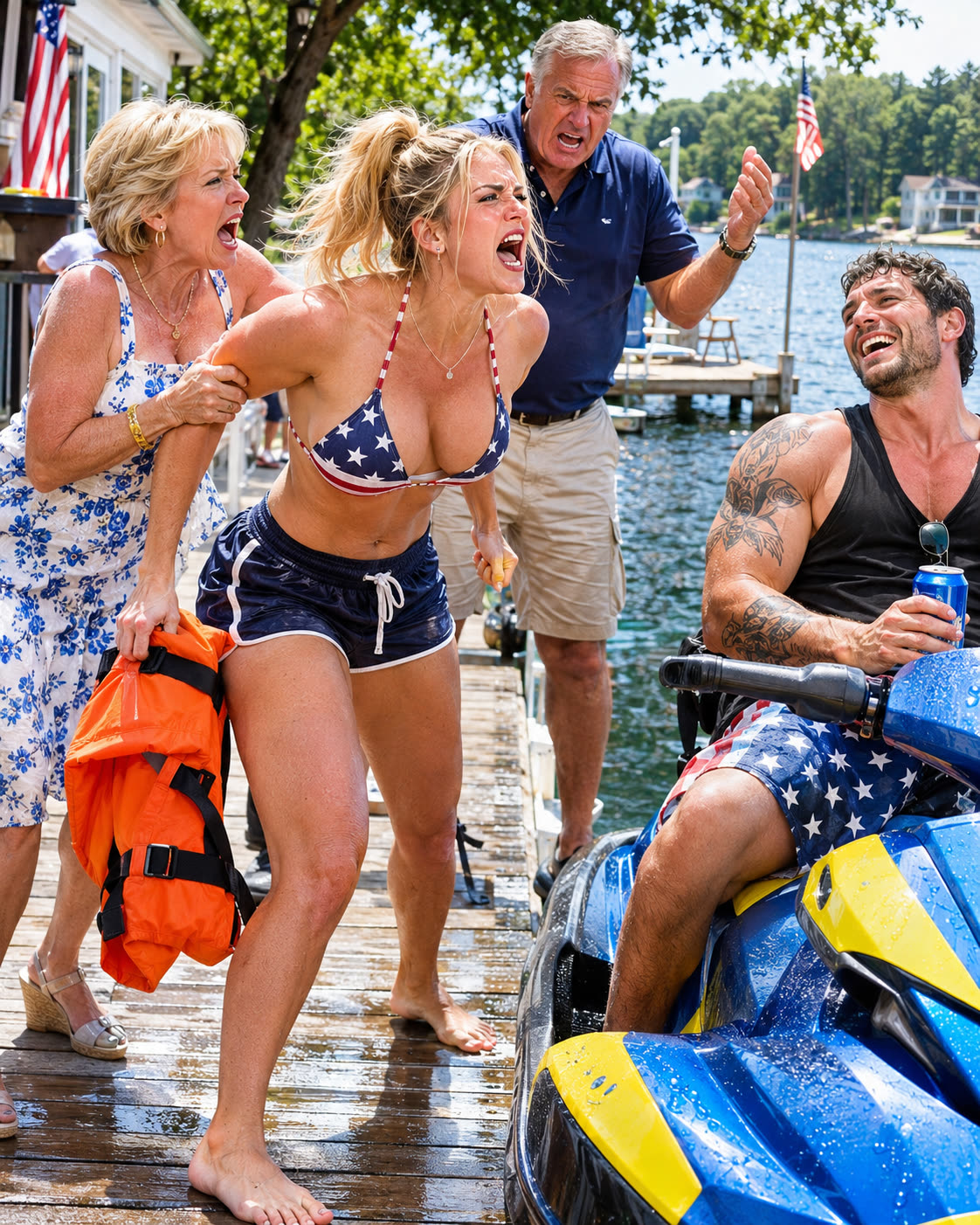
Rhett roared up to the dock, switched off the engine, and climbed off laughing. Winnie was not with him. He had returned alone, as though the ride were over and there were nothing left to do. For a moment, all I could see was what was missing. Then I noticed what he was carrying.
Winnie’s bright orange life jacket was in his hand. The vest that was supposed to be around her body was here on the dock instead, dry land beneath it and my brother laughing beside it. The sight turned the fear inside me cold. She had gone into the lake without the one thing I insisted she wear.
“She didn’t want to wear it,” he said. “Said it was for babies. I told her she could hold on to me.” I stared at him. “Rhett. She fell off. Without her vest. Where?” He blinked and swayed. “She’s fine. She can swim.” “WHERE?” He indicated the middle of the lake with a vague movement of his hand. That was all he could give me: a direction, open water, and the assurance that a seven-year-old would somehow manage.
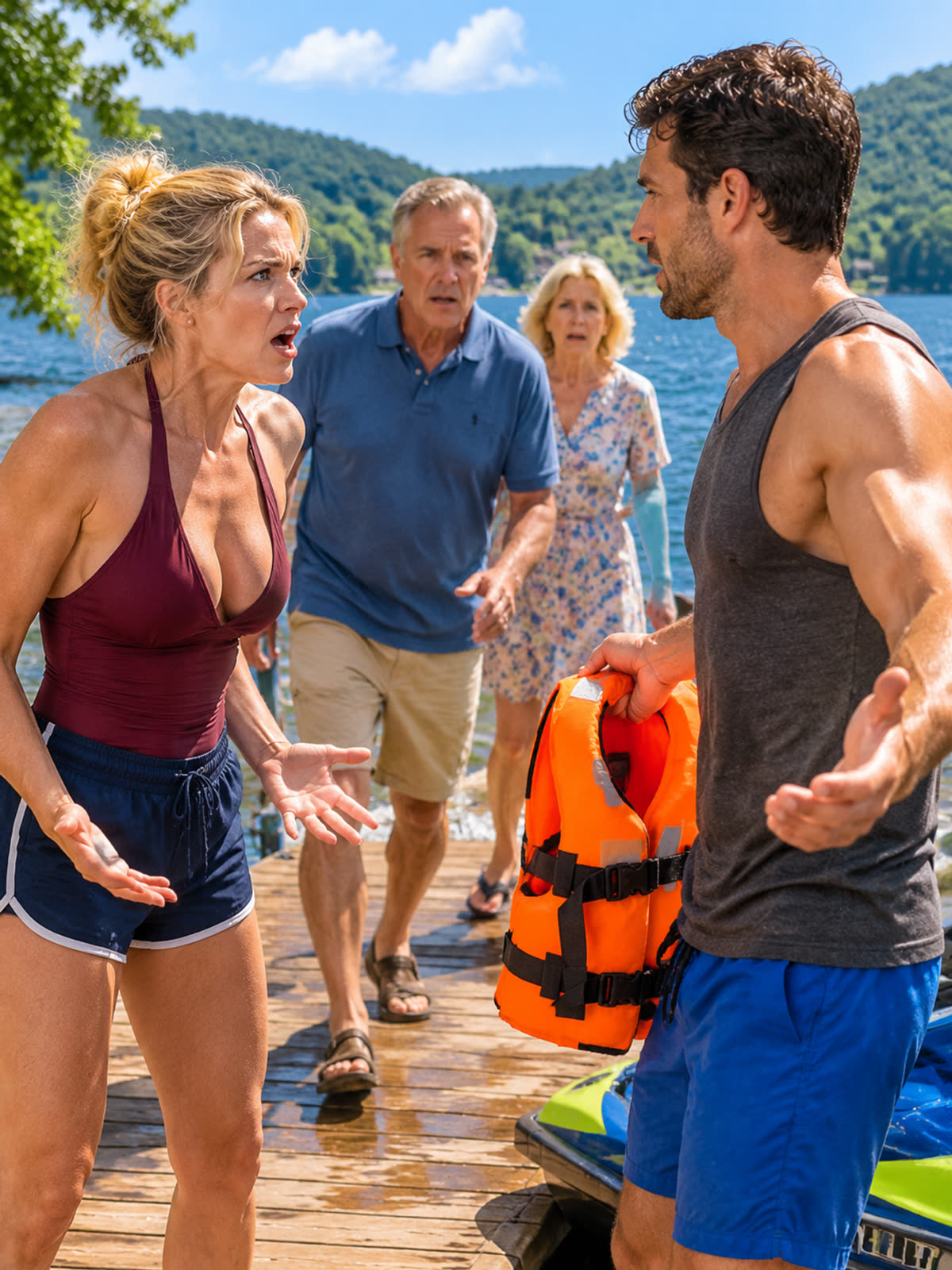
My father moved between us. “Gwen. Listen to me. Do not call the police on your brother. He’s already got two DUIs. A third one, he goes to prison.” My daughter was somewhere beyond the dock, without her life jacket, and he was already calculating how to protect Rhett. “My daughter is in the lake!” I shouted. My mother answered, “He’s had a hard year,” and then, “You always ruin everything.”
I did not argue. There was no time to make them understand what should already have mattered more than anything else. They had forgotten something about me, something that existed before my job and before motherhood. I had swum the 1,500 meters for the University of Missouri. For six summers, I had taught lifeguard classes. I knew how to move through water, and I knew that every moment spent on that dock was a moment I could not get back.
I slipped out of my sandals and took the orange vest from Rhett. Then I put my phone into the hands of my sixteen-year-old nephew. “Call 911. Tell them a child is in the water off this dock without a life jacket. Tell them it was a jet ski. Tell them the driver is drunk. Use those words.” Behind me, my father shouted, “Gwen, don’t you dare…” I went off the end of the dock.
Three hundred yards feels different when your child is somewhere at the other end. I swam with the effort I remembered from being nineteen, driving forward and lifting my head between strokes. I searched for orange, for a head, for anything that did not belong to the shifting surface. The vest was with me. Winnie was not. I had to find her before all that water hid her completely.
Behind me, boats began leaving the shoreline. Other people had heard my screams. I reached the area where I had seen her fall and looked around. There was nothing to tell me where she had gone. A passing boat’s wake lifted and lowered me. “Winnie! WINNIE!” I turned in the water, searching every direction, trying to find a child against the glitter and movement of the lake.
Then I spotted something floating a few feet away. It bobbed on the surface, small enough that I might have missed it if I had turned a different way. Her pink hair tie. The one with the little plastic strawberry. I recognized it immediately. But Winnie was not beside it. There was only that little familiar thing moving on the water where I needed to see her face.
I forced myself to stop. Panic wastes air. I had spent six summers saying that to teenagers from a pool deck, teaching them that a rescuer’s first task was to look rather than thrash. Now I had to follow my own instruction. I kept myself afloat and studied the water instead of fighting it blindly. The hair tie had drifted. I needed to understand where it had drifted from.
Holiday boat traffic had left the lake choppy, bright, and noisy. The wind was coming from the southwest, with wakes rolling northeast. A small body without a vest would be carried along by both. I turned toward the direction the hair tie had come from and followed the movement of the water. Training gave me something to do with the terror, something more useful than letting it swallow every thought.
“Winnie, it’s Mommy! Say something! Holler as loud as you can!” I listened. At first, nothing answered. Then a sound reached me from the left, beyond a stretch of chop, perhaps forty yards away. It was so faint that I could not be certain I had heard it at all. One small word, almost lost against the lake: “…Mommy?”
PART 2 — The Words They Wanted Silenced
I swam harder than I ever had. Before I reached her, I saw a little dark head and two thin arms gripping something yellow. It was a floating cushion, the sort that comes loose from a pontoon boat, left drifting from somebody’s earlier party. Winnie had hooked both arms and one knee around it. Her lips were blue-white. Her teeth were knocking together so violently that speaking was a struggle.
“I found something that floats,” she gasped. “I held on. Like you said.” I reached her, gathered her against me, and cried with lake water in my mouth. There was nothing controlled or quiet about it. She was there, in my arms, alive, after all that empty water. “You did everything right,” I said. “Everything, baby. Everything.”
I pulled the orange life jacket over her head and tightened it securely. Her fingers felt icy against my neck. “I yelled for Uncle Rhett,” she whispered. “He didn’t come back.” “I know. I’m here.” She had called for him while he headed toward the dock, and now she was telling me in a voice barely strong enough to carry between us.
“I thought you wouldn’t find me.” “I will always find you,” I said. “Always.” Behind us, a pontoon boat headed in our direction. A stranger wearing a ball cap stood at the wheel, calling across the water. “Ma’am! We’ve got you! We’ve got you!” This time, someone was coming toward Winnie instead of away from her.
The man was Dale Pruitt, a retired firefighter from Jefferson City. His wife wrapped Winnie first in a beach towel, then in a fleece blanket, and held her close while humming softly. “Her temperature’s low but she’s talking,” Dale said. “That’s good. I called it in. Sheriff’s marine patrol is two minutes out, and there’s an ambulance at the public dock.”
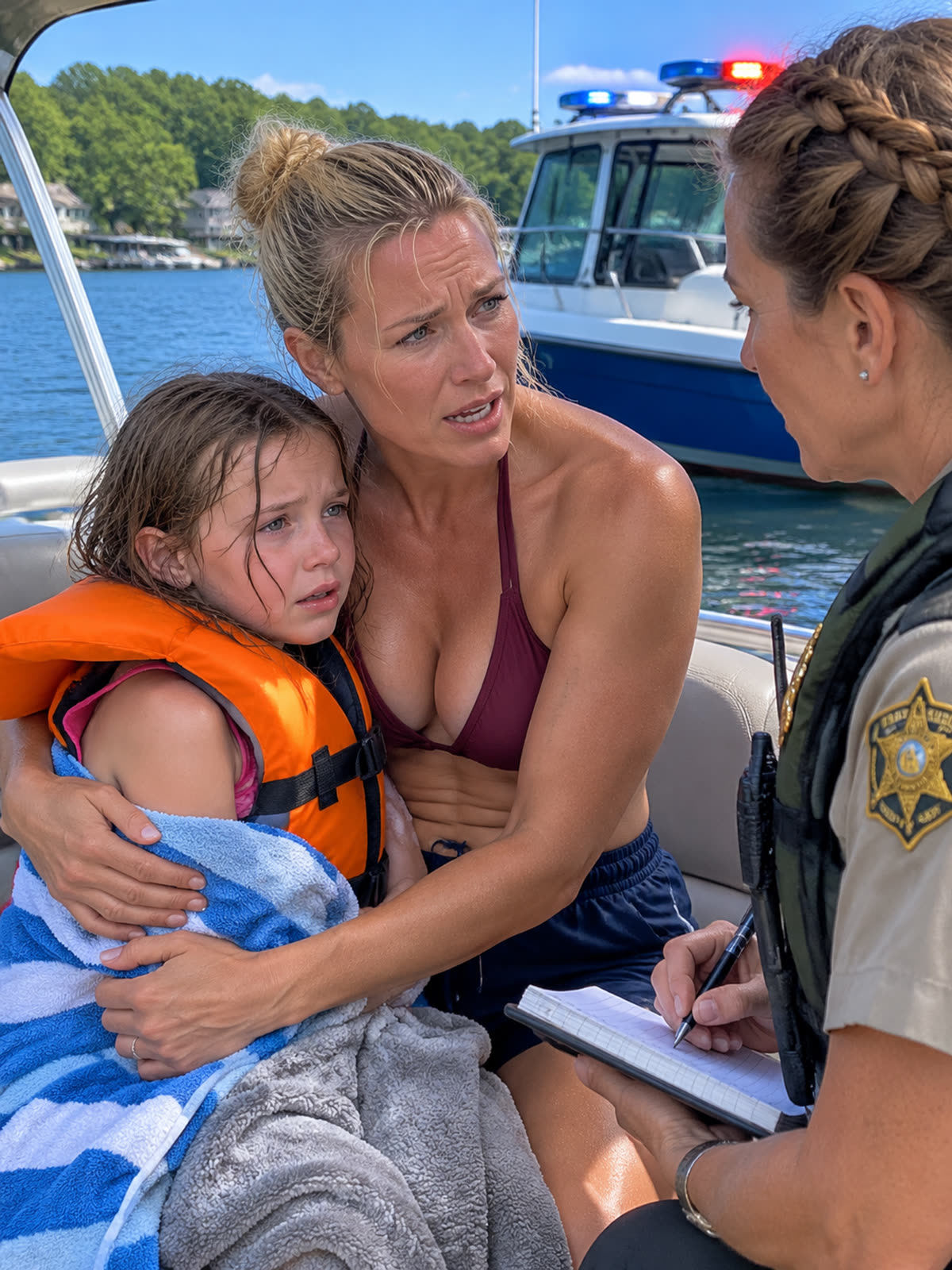
I sat on the pontoon’s deck with my arms around my daughter. I could not stop shaking; even my teeth hurt from it. A few minutes later, a white-and-blue marine patrol boat approached with its lights flashing. A deputy, a woman in her forties with braided hair, stepped aboard. She examined Winnie’s pulse and pupils while I waited for her to tell me what the cold and the water had done.
“She’s going to be fine, ma’am. She’s cold and scared, but she’s okay.” Those were the words I had needed since I saw the pink swimsuit fly from the jet ski. I nodded, then kept nodding. Winnie remained against me, bundled in the towel and blanket. I could hold her now. I could feel that she was there while the deputy spoke.
“Ma’am, I need to ask,” the deputy said gently. “Your son called dispatch, and he said the driver of the jet ski was intoxicated?” “My nephew. Yes. My brother.” “Is he still at your parents’ dock?” “He was.” She used her radio, then turned back to me. “We’ll take your daughter to the ambulance first. Then I’d like you to tell me exactly what happened.”
I told her everything. I described the four minutes inside the house, my mother gesturing toward the lake with her drink, and my father putting his hand on my shoulder. I told her about Rhett returning without Winnie, about the life jacket in his hand, and about his explanation that she didn’t want to wear it. I left nothing out to make any of them look better.
I also repeated what my father had said about the police and what my mother had said about me ruining everything. At first, the deputy simply listened. She did not interrupt or immediately put her pen to paper. Then she wrote it all down. The words my family had wanted kept on the dock became part of what I told the woman responsible for finding out what had happened.
By the time the ambulance took Winnie to Lake Regional, people had gathered on my parents’ dock. Sam, my nephew, had followed my instructions exactly. He called 911 and used every word I had given him. A neighbor later told me he stood there clutching my phone in both hands, crying, while my father shouted at him to hang up. Sam had stayed on the call.
He found me in the hospital corridor an hour later. He was still wearing his swim trunks, with a towel draped around his shoulders. Sixteen years old, thin, and looking closer to ten. “Aunt Gwen,” he said. “I’m sorry. I should’ve gone after Uncle Rhett sooner. I saw him drinking. I saw him take her.” He was carrying blame that did not belong to him.
“Sam. Look at me.” I rested my hands on his shoulders. “You did the one thing I needed. You called. You said the words. You did exactly right.” “Grandpa said I was ruining everything.” “Grandpa was wrong.” He began crying again, and I held him there in the hallway, surrounded by the smell of antiseptic and floor wax.
While I held him, I kept thinking about my father’s hand on my shoulder. For thirty-eight years, I had learned what my family expected me to swallow and when they expected me to stay quiet. Sam had been told to be quiet that afternoon, too. He had been frightened and crying, but he had still made the call I needed him to make.
Winnie came through it. She had a cold, some water in her lungs, and a night in the hospital for observation. A nurse let her choose a sticker after every finger prick. There was a cartoon whale on her hospital bracelet, and she would not let me leave her sight. Near midnight, she held my hand in her small one and asked, “Mommy,” then, “Is Uncle Rhett in trouble?”
“Yes.” “Because of me?” “No, sweetheart. Because of what he did.” She thought about that. “I did what you said,” she whispered. “I found something that floats.” “You did,” I said. “You saved yourself, Winnie. And I came.” I wanted her to understand the difference between what she had done to survive and what an adult had done to put her there.
Rhett was arrested at the dock that evening. His blood alcohol level tested at 0.19, almost two and a half times the legal limit. Two neighbors and the marine patrol’s review also established that he had spent much of the afternoon handling the jet ski recklessly in a crowded no-wake zone. What I had watched from shore had not been the only dangerous stretch of his day.
He faced charges of boating while intoxicated, child endangerment, and reckless operation of a vessel. Because he already had two DUI convictions, the prosecutor warned me that the consequences could be serious. His name was Mr. Holloway, and he spoke calmly and carefully. “It’s going to be hard,” he said. “Your family will pressure you.” “They already have.”
My mother called eleven times during the first day. Her first message was angry. The next sounded wounded. By the sixth, she was crying. Gwen, please. He’s your brother. You’ve ruined his life over one mistake. I did not return the calls. My father called once, late on the second night. I picked up because I wanted to hear what he had chosen to say.
“Gwen.” His voice sounded gruff. “I’d like you to talk to the prosecutor. Ask him to go easy.” “Dad. He threw my seven-year-old into the middle of a lake and left her.” “She wasn’t hurt.” “Because she was brave. Because she remembered a rule I taught her.” “He’s your brother…” “And she’s your granddaughter.”
Neither of us spoke for a moment. Then I said, “You told me not to call the police,” and added, “With my child in the water.” “I was thinking about Rhett.” “I know,” I said. “That’s the problem.” I ended the call. My hands did not shake. Until then, I had not realized that steadiness was something I could have in a conversation like that.
The hearing took place in September. Rhett arrived in a gray suit that fit him poorly. He had lost weight, and for the first time I could remember, he looked like someone beginning to understand what stood in front of him. My family had spent years softening the consequences for him. Now the judge would decide what came next.
PART 3 — What Forgiveness Could Not Erase
Rhett’s lawyer described him as a troubled man struggling with alcohol, someone who needed treatment rather than a prison sentence. The judge listened. He was heavyset, with a rough voice and reading glasses pushed up onto his forehead. I testified for forty minutes. I told the court about the four minutes I had been inside, the swim across the lake, and the strawberry hair tie floating without my daughter beside it.
I described Winnie’s blue lips. There was no gentler version of that afternoon that would still have been the truth. When I finished, the judge asked one question. “Ms. Delgado, what would you like this court to do?” I had spent weeks considering the answer. I did not want to confuse what I needed for Winnie with what anyone else wanted me to say for Rhett.
“I’d like my brother to get treatment,” I said. “Real treatment, not a weekend program. And I’d like him never to be allowed near a child unsupervised again, or near a boat, or a car, while he’s drinking.” I stopped briefly, then continued. “I’d like him to understand what happened. And I’d like that to matter more than being punished.”
The judge studied me for a long moment. He sentenced Rhett to three years in state prison and five years of probation afterward, with mandatory inpatient treatment during the first year and a lifetime prohibition on operating watercraft. While he read the sentence, my mother began sobbing in the gallery. My father would not meet my eyes.
In the corridor afterward, Rhett’s attorney asked whether I would allow his client a brief conversation. I agreed, provided a bailiff stayed nearby. Rhett faced me in handcuffs. His eyes were red. “Gwen,” he said hoarsely. “I don’t remember it. I remember the jet ski, and I remember her laughing, and I remember the dock. I don’t remember her falling.” “I know.”
“I would never…” He swallowed. “I would never hurt her.” “You did, though.” He shut his eyes. “Is she okay?” “She’s okay. She’s seven. She asks sometimes why you didn’t come back.” His shoulders began shaking. I let him cry without trying to make it easier for him. Comforting him was no longer my responsibility.
“I hope you get better,” I finally said. “I mean that. But I’m not going to be your safety net. Not ever again.” He gave a single nod. The bailiff took him away. I had meant the hope and the boundary equally. Wanting him to recover did not require me to stand between him and what he had done, or to let my daughter become the price of protecting him.
In October, Winnie returned to swimming lessons at the Y’s heated indoor pool. Getting there had not been simple. For weeks, even bathwater made her cry. Her therapist, Dr. Marsh, taught her to breathe slowly and encouraged her to draw the lake again and again, until the lake on the page no longer seemed so enormous. Recovery did not happen merely because she had left the hospital.
One fall afternoon, she looked up from the kitchen table. “I want to learn how to swim far.” “Far?” “So I can save somebody else.” I set my coffee down. For a moment, I could not trust my voice. “Okay, baby. Let’s learn.” The child who had held on to a drifting cushion wanted to become someone who could reach another person.
By spring, she could swim from one end of the pool to the other. By summer, she could tread water for five minutes and float on her back, her hair spread around her like a halo. She still wore the orange life jacket whenever we went near a lake. Learning more did not mean leaving behind the thing that helped keep her safe.

At the only family dinner I attended that year, my mother called the vest “overkill” again. Winnie looked directly at her. “It’s not overkill,” she said. “It’s what keeps you alive.” Nobody at the table spoke. My mother flushed. Then, unexpectedly, she lowered her eyes to her plate. “You’re right,” she said quietly. “I’m sorry.” I had never heard her apologize before.
My father needed more time. In November, he came to my house alone, carrying his hat. He waited on the porch for a full minute before knocking. When I opened the door, he said, “Gwen,” followed by, “I was wrong.” I stayed quiet. This time, I did not fill the silence or make the conversation easier for him.
“I put your brother ahead of your daughter. I told you not to call.” His voice was rough. “I’ve thought about it every night since. I keep seeing you go off that dock.” “Dad.” “I’ve been telling myself for twelve years that Rhett’s trouble was a rough patch. It wasn’t. It was a disease, and we fed it.” His eyes filled with tears. “I’d like to apologize to Winnie, if you’ll let me.”
I considered that for a long time. An apology mattered, but it did not undo what Winnie had lived through or entitle anyone to an immediate place beside her. “Not yet,” I said. “But maybe someday. If you keep showing up.” He nodded as though I had offered him something valuable. “I will,” he said.
He kept that promise. Every Sunday for a year, he drove over with a bakery pie and sat on the porch swing. He asked for nothing. Eventually, on a bright, cold day in March, Winnie came outside wearing mittens and sat next to him. “Hi, Grandpa,” she said. His chin trembled. “Hi, sweetheart.”
“Mom says you said sorry.” “I did.” She examined him with that serious, searching look of hers. He had come back, week after week, without asking her to hurry. Now she was beside him, deciding for herself what she was ready to give. “Okay,” she said, and rested her head against his arm.
On the second anniversary of that Fourth of July, Winnie and I visited another lake. It was smaller and quieter, a few hours from home. We rented a rowboat. She wore her orange vest and the pink hair tie with the little strawberry. I had retrieved it from the water that day and kept it in a drawer. After her third appointment with Dr. Marsh, she had asked to have it.
We drifted beside each other while the sun laid an orange glow across the lake. “Mommy?” “Yes?” “Remember the rule?” “Which one?” “Find something that floats. Hold on. Mommy will come.” “I remember.” She let her hand trail through the water. “You always came,” she said. “Even when it was far.”
I looked at my brave, extraordinary girl and remembered her soaked and trembling against me. I thought of every stroke and every breath between the dock and the place where I found her. I remembered my father’s hand on my shoulder, and shaking free of it. “I’ll always come,” I said.
Her smile was small and sure. The rowboat moved gently beneath us, and somewhere across the water, a loon gave a long, low call. The evening continued around us. I knew the promise I had made. What I could not know was how far I might have to swim to keep it.
Disclaimer: This story is a work of fiction inspired by real-life themes. Names, characters, places and events are fictionalized, and any resemblance to real persons is purely coincidental. Images are for illustration purposes only.
