

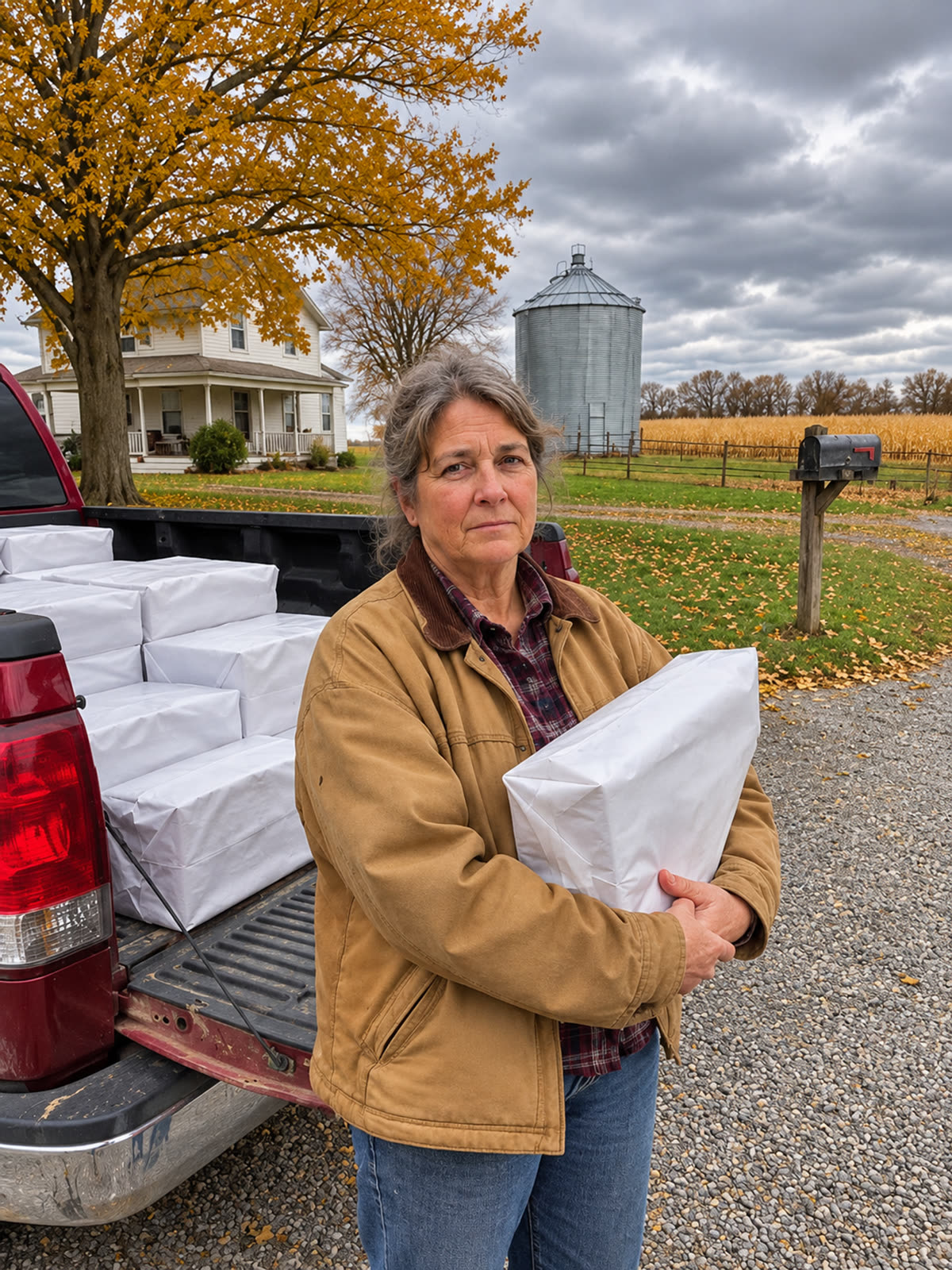
PART 1 — The Shot Across the Pasture
At 7:40 on a Saturday morning, a rifle cracked at the corner of our pasture. I was mixing pancake batter in the kitchen, listening to the farm report on KMA out of Shenandoah. Upstairs, Kinley was sleeping through the first Saturday in weeks when she had nowhere to be. Gunfire wasn’t unusual in the country. People shot coyotes or checked their deer rifles before November. But this was too near the house, too near the cattle. The window above the sink shook. I put down the bowl without cleaning my hands and ran outside in my slippers and barn coat.
Domino lay against the fence on our side. His legs stretched through the brown grass, his black-and-white head pressed beneath the bottom strand of wire. Blood darkened the ground. His eyes were open. Kinley had raised him from a bottle calf after his mother died during a February snowstorm two years earlier. Ray Petersen, whose farm was three miles south, had called me on my mail route to ask whether my nine-year-old wanted him. Dale brought him home wrapped in a horse blanket in the pickup’s back seat. He had a white patch around his left eye and three more along his side. Kinley looked at him and said, “Domino.”
For eight weeks, she mixed warm milk replacer at the kitchen sink before daylight, wearing pajamas and boots. At five every morning, she carried a big bottle with a red rubber nipple to the barn, finding her way with a flashlight through snow, rain, and bitter cold. At five every evening, she did it again. He grew into a steer who followed her like a dog, came when she called, and pushed his head against her chest until she rubbed his ears. He was intended for our freezer, and she had always understood that. In August, she cried, accepted it, and helped me mark the co-op calendar. His appointment at the locker was October twenty-sixth, two weeks away.
Vern stood twenty yards beyond him, beside his unharvested corn. My husband’s older brother wore a canvas coat and his DeKalb cap, holding a deer rifle loosely with its barrel toward the ground. He watched Domino instead of me. “He was in my corn again,” he said. I examined the four taut strands between the steel posts. Dale and I had rebuilt that corner in April. I remembered holding the wire stretcher, cutting my thumb, checking every staple beside him. When he finished, Dale had plucked the upper wire, and it rang. Nothing had broken through. “Through what, Vern?” I said. He offered no answer. His face looked gray and locked shut. Then he walked back through the end rows without looking behind him.
My phone was in my coat. I could have called the sheriff and reported someone shooting our livestock. Instead, I thought about the two brothers who had shared a bedroom, played Little League together, and learned to drive in this pasture. Vern was fifty-three; Dale was forty-nine. Their father, Harold Nyquist, had divided the farm when he died nine years earlier. Dale inherited the home place, barns, and two hundred and forty acres. Vern received another two hundred and forty acres and the old Lindgren house. Their father’s fence separated them. It would still separate them through decades of Thanksgivings, funerals, Kinley’s graduation, perhaps her wedding. A report would divide our family and all six households on Hollow Creek Road.
So I left the phone where it was and knelt beside Domino. Nineteen years on this farm, and a childhood on another, told me what had to happen. I used the knife from my belt to bleed him before the meat was lost. My grandfather had taught me after a heifer broke her leg in a gopher hole when I was ten. “You don’t waste her,” he said. “She gave her life. You make it count.” Back then I hadn’t understood the weight of those words. Now I forced my shaking hands steady and worked quickly. When I finished, my slippers were soaked and my sleeves stained. Looking at the white patch around his open eye, I whispered, “I’m sorry, buddy,” then, “I’m so sorry.”
Only then did I take out my phone and call Arnold Fogle at the Plainview Locker, beside Casey’s on Main Street. His family had processed the county’s livestock since 1951. He answered on the second ring. “Locker.” “Arnold,” I said. “It’s Jill Nyquist. I’ve got a steer down in my pasture. I need you to come get him. Now.” He paused. “The Domino steer?” Arnold said. “Kinley’s? He’s not scheduled till the twenty-sixth.” “He’s down, Arnold.” The silence stretched longer this time. “I’ll be out inside the hour,” he said.
He arrived before the hour was up in his white truck with the hoist mounted behind the cab. Arnold was sixty-eight, white-haired, with a crew cut and forearms thick as fence posts. He had butchered our beef for nineteen years. After parking beside the gate, he crossed the grass and stood over Domino. He studied him without commenting on the bullet wound. Then he went to the corner and examined the posts and all four strands of wire.
He hooked his thumb beneath the top strand and plucked it. The clear note traveled along the fence. “That corner’s tight,” he said. His gaze moved over Vern’s corn toward the old Lindgren house, where chimney smoke rose into the morning. Then he faced me. “You want me to call anybody, Jill?” “No,” I said. He nodded, slowly enough to tell me he understood, and returned to his truck for the hoist. I went to help him with the chains.
That was when Kinley came running from the house. Her hair was tangled from sleep; she wore a sweatshirt, pajama pants, and her rubber boots. Perhaps she had heard the shot or the truck, or simply seen Arnold outside her window. I dropped the chain and reached her halfway across the pasture, before she could see closely. My stained arms closed around her. She struggled against me. “Mom, let me go. Mom. Is that Domino? Mom!” “Don’t look, baby,” I said. “Don’t look. Come back to the house.” “Is it him?” “Yes.” Her resistance vanished. Nearly as tall as I was, she folded against me like a much smaller child.
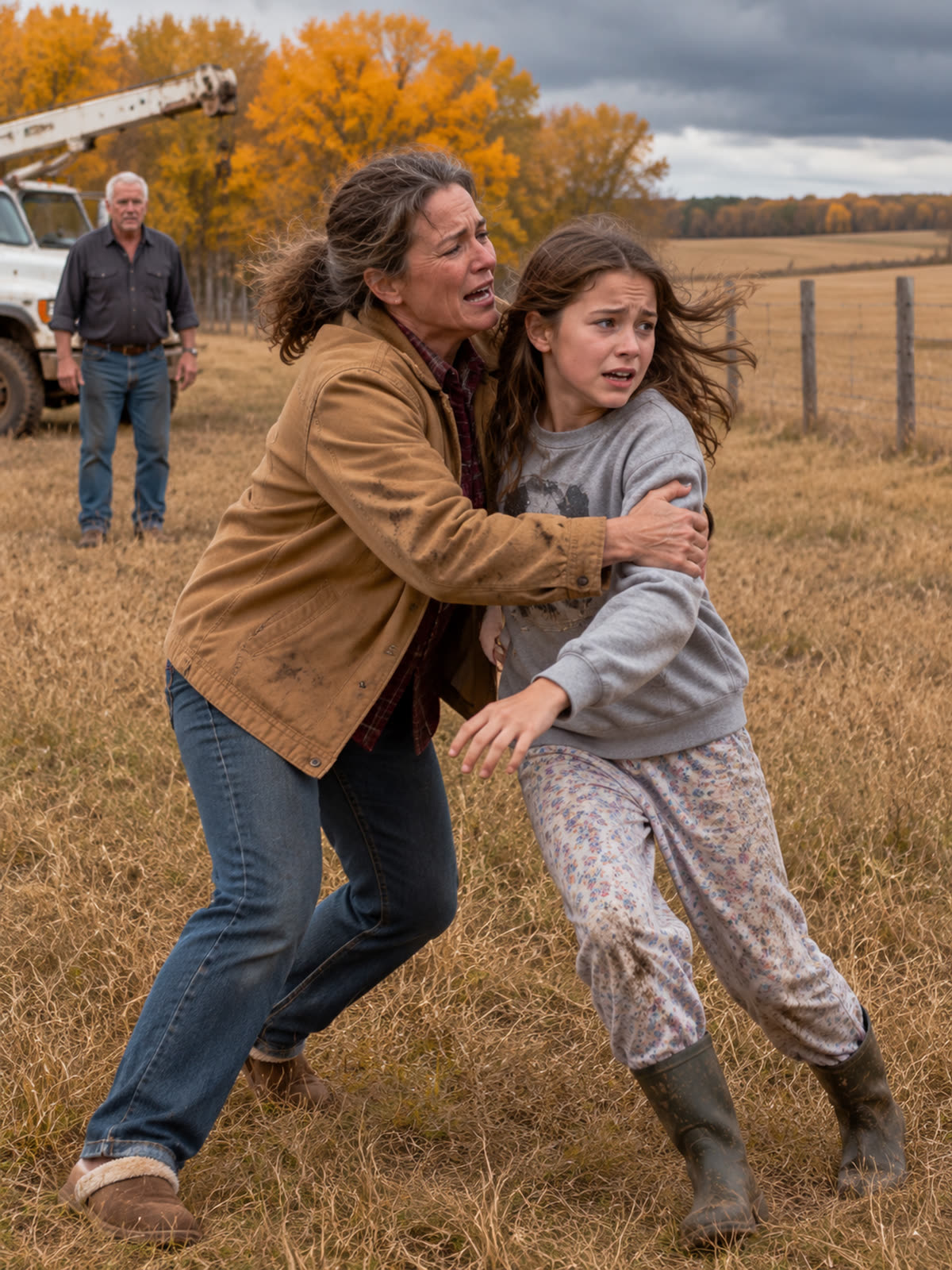
We crossed the pasture with her face against my shoulder. She stayed silent until we reached the porch. Then she sat on the lowest step and stared at the boots she had worn to feed him. The sobs came hard enough to shake her entire body. I sat beside her and held her while Arnold’s hoist worked in the distance. Behind us, the radio kept playing beside the abandoned pancake batter. “Who did it?” Kinley finally asked. Into my shoulder. “Mom. Who shot him?” I wanted to spare her, but I had never lied to my daughter—not about Santa Claus, babies, or the hamburger on her plate. “Uncle Vern,” I said.
Dale was two hundred miles away, hauling corn for the co-op. During harvest he drove twelve- and fourteen-hour days between the elevator, Shell Rock’s ethanol plant, and the river terminals in Dubuque. That morning he was waiting beside the Mississippi in a line of semis. He answered my call immediately. “Jill? What’s wrong?” I told him, listening afterward to his idling engine and the hiss of nearby air brakes. “He shot her steer,” he said finally. “Kinley’s steer.” “Yes.” “In our pasture.” “Yes.” “Is Kinley okay?” Beside me, she sat with her knees drawn up, staring toward the field. “No,” I said.
Dale tried his brother twice, once from the terminal and again an hour later. Neither call was answered. He arrived home at eleven that night and went directly upstairs. Kinley was asleep. He remained beside her bed in the dark before coming down for the flashlight by the door. From the kitchen window, I followed its small beam along the entire half-mile boundary, from the road to the creek. It stopped at every post. An hour and a half later, he returned, put the light on the counter, and sat opposite me looking older than forty-nine.
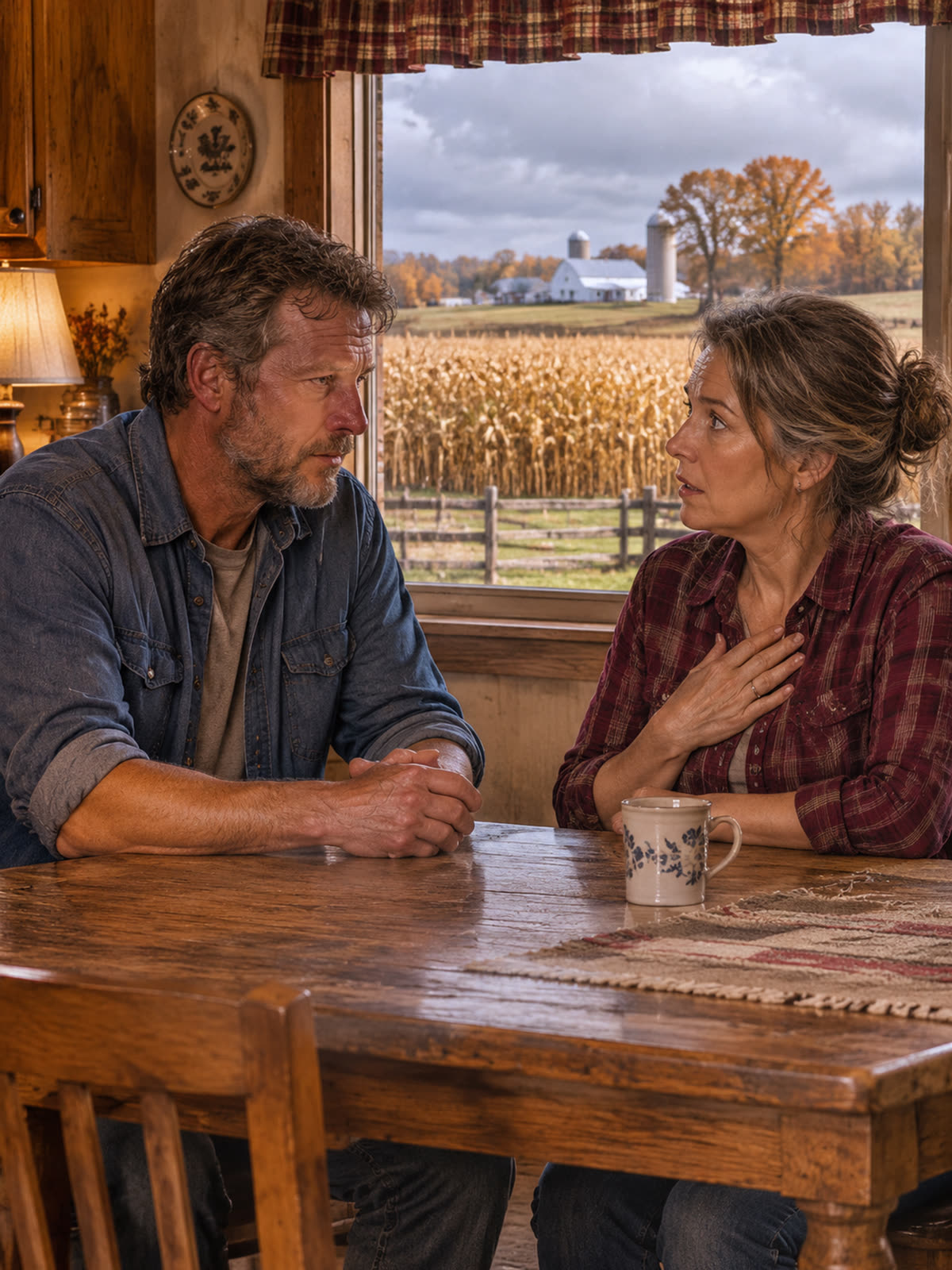
“It’s tight,” he said. “Every strand. Every staple. The corner’s tight as a drum. There’s not a hair on a barb anywhere.” I waited. “He’s my brother, Jill,” Dale said. “I’ve known him my whole life. I don’t know why he did it.” “I know.” He rubbed his face. “But it was your steer,” Dale said. “Yours and Kinley’s. You raised him. You paid for his feed.” Then he told me, “So it’s your call. Whatever you want to do. Call the sheriff. Don’t call the sheriff. I’ll back you either way.”
It was one in the morning, and I was still turning that choice over when Dale spoke again. “There’s something you should know,” Dale said. “Something I didn’t tell you.” He explained that Vern had hired a Waterloo surveyor in August. “Vern had the line surveyed,” Dale said. “In August. He hired a surveyor out of Waterloo. The guy came out and walked it with a GPS. I saw him out there. I didn’t think anything of it.” “And?”
“And Vern called me,” Dale said. “Right after Labor Day. He said the survey shows the fence is eighteen feet onto his side. The whole length. Eighteen feet by half a mile.” He lowered his eyes. “He said Dad put it in the wrong place in 1972, and we’ve been grazing on his land for fifty years. He wanted me to move it.” “What did you say?” I asked. “I said no,” Dale said. “I said Dad put that fence there, and it’s been there fifty years, and it’s not moving.” He shook his head. “He hung up on me. We haven’t talked since.”
I sat with that revelation. Vern hadn’t meant that Domino had actually pushed into standing corn. He meant the strip of grass he considered his own. Domino had been eating on our side of the fence, but on eighteen feet Vern believed belonged to him. “That doesn’t make it right,” I said. “No,” Dale said. “It doesn’t make it right.”
Arnold called Monday. “Six-forty,” he said. “Nice steer, Jill. Real nice marbling. Kinley did a good job with him.” Six hundred and forty pounds hanging weight, after cleaning and skinning. I couldn’t make myself answer. “I’ll let him hang fourteen days,” Arnold said. “Same as I would’ve. Then we’ll cut him. You know how you want it?” “I’ll call you,” I said. At that fall’s prices, Domino represented roughly eighteen hundred dollars in beef—steaks, roasts, hamburger, winter meals, maybe meals into spring. Money we wouldn’t have to spend at Fareway. Food my daughter had raised with her own cold hands.
All week, I thought while delivering Rural Route 2: a hundred and twelve gravel miles, three hundred and eighty mailboxes. After eleven years, I knew the people behind them. Eighty-four-year-old Marge Hansen received letters from Norway. Pete Larson had farmed beside Harold for forty years. The Brennans had a new baby; the Molinas had moved from Texas for work at the hog plant. Blind Mr. Thorson received recorded books from the state library. I knew their magazines, medicine deliveries, college care packages, and overdue envelopes. And every working day, I stopped at Vern’s mailbox.
Thursday evening, while Dale hauled corn and Kinley stayed behind her bedroom door, I took a legal pad to the kitchen table. Since Saturday, she had hardly eaten, had gone from school straight upstairs, and had avoided the barn. I listed every household on Hollow Creek Road. Six families. Six porches. Vern’s among them. The next morning I called Arnold and specified steaks, roasts, short ribs, and one-pound packages of ground beef, each wrapped in labeled white paper.
“And then,” I said, “I want you to divide it up.” “Divide it?” “Into seven,” I said. “Our share. And six boxes.” He went quiet. “Six boxes,” he said. “Six,” I said. “Roasts, steaks, and ground in each one. As even as you can make them.” “Who are they for, Jill?” “Everybody on our road,” I said. Another silence. “Everybody,” Arnold said. “Everybody,” I said. He slowly released his breath. “Okay,” he said. “Okay. I’ll have them ready a week from Saturday. In waxed boxes. On the dock.”
I had written six names. There would be six deliveries. Whatever happened on the first five porches, the last box was going to Vern.
PART 2 — His Name on the Bottom
We kept a larger share for our household, enough to stretch through winter. Arnold packed the remaining beef into six white waxed boxes. Each held a chuck roast, an arm roast, two T-bones, two sirloins, and six pounds of hamburger, all labeled in his square handwriting. Each box was worth about eighty dollars, perhaps more. On October twenty-sixth—the Saturday Domino should have arrived alive at the locker—we backed the pickup toward Arnold’s concrete loading dock. Kinley had initially refused to come. I hadn’t pressed her. Then, as I reached for the keys, she appeared in jeans and her barn coat. “I want to come,” she said.
She sat on the lowered tailgate holding a black Sharpie she had brought from home. Arnold rolled out the seven boxes on a hand cart. As each of the six delivery boxes reached her, Kinley turned it over and wrote DOMINO across its underside in large, careful sixth-grade capitals. She left our box unmarked. I watched her concentrate, her tongue caught at the corner of her mouth, while Arnold stood beside me with folded arms. After the sixth name, she capped the marker. “So they know who he was,” she said. Something caught in Arnold’s throat. He disappeared inside and returned later with red eyes. When I opened my checkbook, he refused payment. “Not for this one, Jill,” he said. “Not for Domino.”
The boxes rode along Hollow Creek Road in our dark red pickup, ours against the cab and the other six near the tailgate. Kinley sat beside me with folded hands. Instead of mail, I carried beef down those six gravel miles past bean stubble, pasture, and corn. Beneath each lid I had tucked an index card written the night before: From Kinley’s steer, Domino. Enjoy him. The Brennans weren’t home, so I left their box beside the stroller and pumpkins on their porch. Rosa Molina answered the second door with a dish towel in her hands. After reading the card, she glanced toward Kinley. “Domino?” she said. “The cow your girl raised?” I nodded. She pressed a hand to her chest and silently watched us leave.
At Mr. Thorson’s, I placed the box in his hands and read the card aloud. He stood feeling its weight. “Harold’s granddaughter,” he said. “Raised a steer.” “Yes, sir.” He smiled. “Harold always said that girl had a way with animals.” Then, “Tell her I said thank you. Tell her I’ll think of him.” Marge Hansen was already behind her storm door when we reached her house. She had lived on that road for sixty-one years. I carried her box up the steps. She studied the card, looked toward the pickup, and raised her hand toward Kinley, holding it there like a blessing. My daughter raised hers in return.
Pete Larson came out of his machine shed wiping his hands on a rag. At seventy-eight, he had known both brothers longer than almost anyone. He had farmed across the creek from Harold for forty years and carried his coffin. He saw DOMINO beneath my box and stood motionless. “That steer left his corner two weeks early,” he said. “He did,” I said. Of course the road knew. The shot had carried; people had seen Arnold’s truck. Pete accepted the box and held it against his chest as though it weighed far more than beef. Looking toward the last mailbox, he asked, “You going up there?” “Yes.”
Pete watched me another moment. “Harold put that fence in in ‘72,” he said. “I helped him. I held the posts.” He shook his head. “He knew right where the line was. He put it there on purpose.” “What do you mean?” But Pete only shook his head again and carried Domino into his shed. At Vern’s lane, Kinley remained in the cab. I parked beside the last mailbox before the road ended at the creek. “You want to come?” I asked. She shook her head. As I opened my door, she stopped me. “Mom,” she said. I turned. “Tell him his name,” she said as I got out. “Domino. Make sure he knows his name.”
Vern’s black mailbox stood on a cedar post, NYQUIST printed along its side in reflective white letters. Its broken flag had hung crooked for two years. I knew its contents: farm magazines, seed catalogs, utility bills, co-op statements, Farm Credit envelopes. Social Security letters still arrived for Lorraine, his mother, who had died the previous winter. For eight months I had also delivered Farm Credit envelopes marked FINAL NOTICE in red. Under the low October clouds, his uncombined corn rattled in a cold northwestern wind. I lowered the tailgate and lifted the last box. Far south, our white farmhouse and red barn stood a mile and a half down the gravel.
I started along his quarter-mile lane, planning to leave the box on the sagging porch of the old Lindgren house. Before I had gone far, the front door opened. Vern walked toward me in his canvas coat, bareheaded and unarmed. His gray hair looked as though he had spent the morning dragging his hands through it. His slow steps resembled a man approaching judgment. He must have watched the deliveries from his yard or window: the white boxes, Marge’s raised hand, Pete holding his share. He stopped six feet away and stared at the package against my hip.
“What’s that,” he said. The words were flat, almost without a question in them. “Your share,” I said. “It was going on your porch.” He reached with both hands and accepted it cautiously. Then he turned it upside down. For a long time, he stared at the black capitals while the wind stirred the corn and a crow called near the creek. When he finally lifted his eyes, the closed expression I remembered from the pasture had broken open.
“She wrote that,” he said. “Yes.” “Kinley.” “Yes.” He looked down again. His hands shook beneath the white box. “His name,” he said. “I didn’t know his name.” “She asked me to tell you,” I said. “She said, Make sure he knows his name.” A low sound came from his chest. He turned the box upright and wrapped both arms around it, holding it against his stomach. “I didn’t know his name,” he said again.
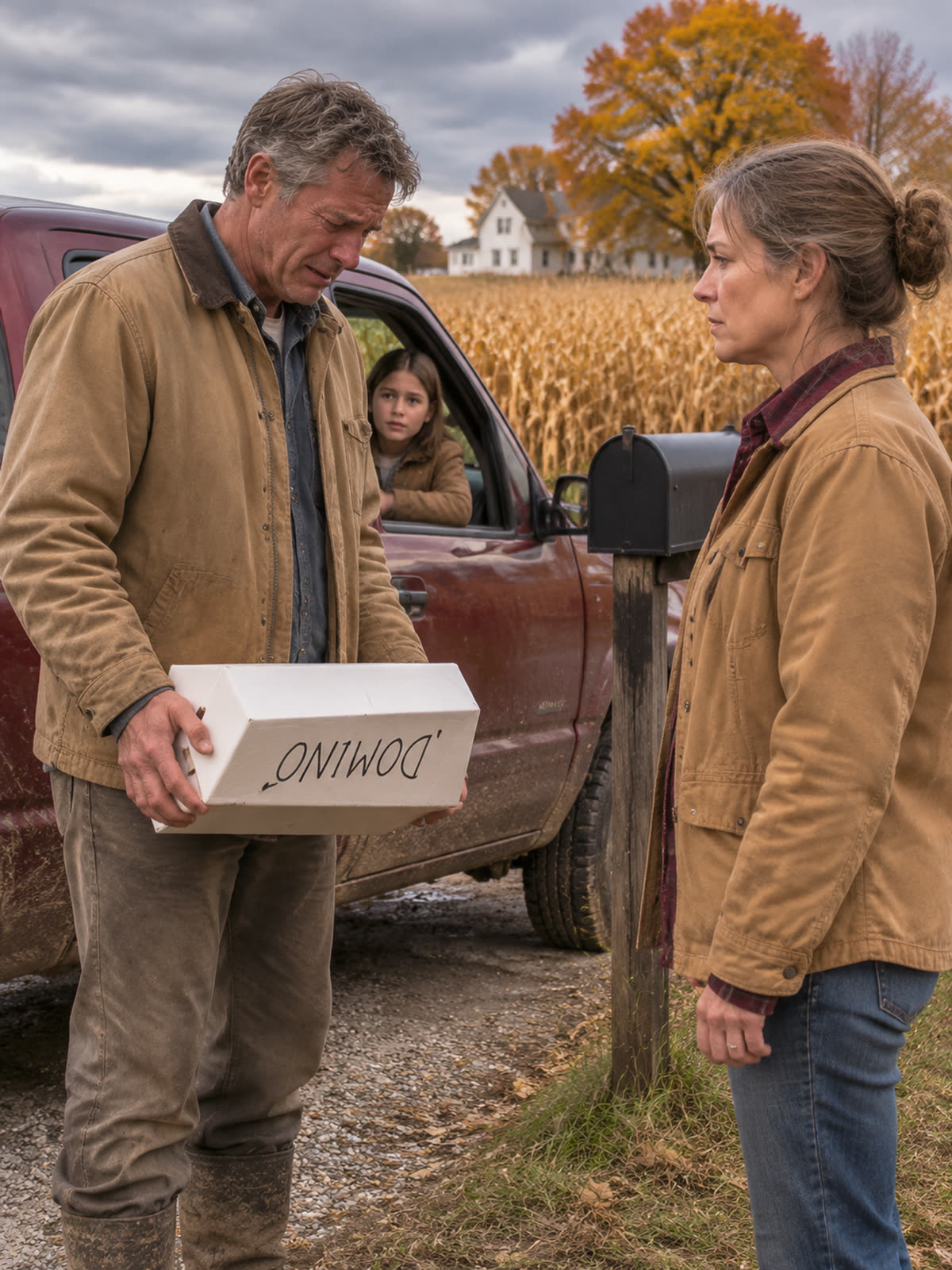
“Why’d you do it, Vern?” For a long while he looked down the road toward our house, our pasture, and the corner where Domino had fallen. “Eighteen feet,” he said finally. “The survey,” I said. “Dale told me.” He nodded. “The bank sent a man out in July,” he said. “From Farm Credit in Ames. To appraise the land. For the loan.” He swallowed. “I’m behind, Jill. Two years. Corn was bad last year. Beans were worse. And Mom’s nursing home took everything before she died. Eleven months at Good Samaritan. Eighty-four hundred a month.”
I listened. “The appraiser said the acres don’t match,” Vern said. “Said the deed says two hundred and forty, but he could only find two hundred and thirty-eight. Said I’d better get a survey.” He shook his head. “So I did. Fourteen hundred dollars I didn’t have. And the surveyor said the fence is eighteen feet onto my side. All the way. That’s my two acres. That’s the difference.” He went on, “I called Dale,” Vern said. “I asked him to move the fence. Just eighteen feet. Just so the bank would leave me alone.” His eyes dropped. “He said no. He said Dad put it there and it’s not moving.”
“So you shot Kinley’s steer.” He recoiled. “I didn’t mean to,” he said. “I swear to God, Jill. I didn’t plan it. I got up that morning and there was another letter from Farm Credit. And I walked out to the end rows to check the corn because I can’t afford to combine it, I can’t afford the fuel. And I looked across that fence.” He stopped before continuing. “And there he was,” Vern said. “Eating grass. On my eighteen feet. Fat and happy. Dale’s steer on my land.” His voice gave way. “And I had the rifle in the truck for coyotes. And I just…”
He couldn’t complete it. “He wasn’t Dale’s steer,” I said quietly. “He was Kinley’s. She fed him at five every morning before the school bus. For eight weeks. In the snow.” Vern shut his eyes. “I know,” he said. “I know that now. I’ve known it since Saturday. Since I watched her run across that pasture.” His eyes were wet when he opened them. “I watched her from my window, Jill. I watched you catch her. I watched her sit down on your porch steps.” He lowered his gaze to the box. “I haven’t slept since,” he said. “Not one night.”
“Why didn’t you answer Dale?” I asked. “He called you twice.” “Because I couldn’t,” Vern said. “What would I say? I shot your daughter’s steer because I’m losing my farm and I was mad at you about a fence our dad built?” His laugh sounded empty and terrible. “Lorraine’s gone,” he said. “My wife’s been gone six years. My boy’s in Denver and doesn’t call. I’ve got two hundred and thirty-eight acres of corn I can’t afford to combine and a bank that wants to take it. And my little brother’s got the home place and a wife and a daughter and a steer.” He faced me. “I’ve never been so ashamed of anything in my life,” he said.
I remained angry. I had been angry beside Domino, beside Kinley on the steps, and every time I passed this mailbox. His grief didn’t erase that. But standing before his gray face and trembling hands, I remembered my grandfather insisting that an animal’s life must count. “Vern,” I said. “Do you want to tell her yourself?” He looked startled. “She’s in the truck,” I said. “She asked me to tell you his name. But she’s right there.” He turned toward her face behind the passenger glass. “She won’t want to see me,” he said. “I don’t know what she wants,” I said. “Ask her.”
Carrying the box, he approached the pickup and stopped at her door. Kinley watched without lowering the window. Then she opened the door and remained seated, hands in her lap. “Kinley,” he said. She waited. “I shot your steer,” Vern said. At least he said it plainly. “I shot him, and I lied to your mom about why. He wasn’t in my corn. The fence was tight. Your dad built it right.” He swallowed. “I was angry at your dad about something that wasn’t Domino’s fault. And it wasn’t your fault. And I took it out on him.” Her chin trembled. “I’m sorry,” Vern said. “I’m so sorry, honey. I know that doesn’t bring him back.”
She studied him, then the box. “Did you know he came when you called him?” she asked. Vern shook his head. “He did,” Kinley said. Her voice was very small. “Like a dog. If you stood at the gate and said Domino, he’d come running from the far end of the pasture. And he’d put his head against your chest and push.” His face crumpled. “He liked his ears scratched,” Kinley said. “Right here.” She touched behind her ear. “And he was scared of thunder. When there was a storm, he’d stand by the barn door till I came out.” Tears slipped down her cheeks.
“I knew he was going to the locker,” she said. “I knew it. I’m not stupid. I live on a farm. I knew he was going to be our hamburger.” She wiped her sleeve across her face. “But I was going to say goodbye. On the twenty-sixth. I was going to walk him into the trailer myself and scratch his ears one more time and tell him he was a good boy.” She looked directly at him. “You took that,” she said. “That’s what you took. Not the beef. The goodbye.” Vern stood speechless, crying with his whole body, neither hiding nor wiping his face.
Then Kinley climbed out. She stepped onto the gravel in her rubber boots, came around the open door, and laid her hand on the box. “His name was Domino,” she said. “Domino,” Vern repeated. “Say it like you mean it.” He looked down at her. “Domino,” he said. His voice broke. She nodded once. “Okay,” she said. “Now you know who he was.” Then she returned to her seat and closed the door.
Over the cab, Vern looked at me. “Jill,” he said. “I’ll pay for him. Eighteen hundred dollars. Every dime. I don’t have it now. But I’ll get it.” “I don’t want your money, Vern,” I said. “Then what do you want?” I thought of his bank notices and the corn he couldn’t harvest. I thought of eighteen feet, and of Pete saying Harold had known exactly where he was putting those posts.
“I want you and Dale to walk that fence,” I said. “Together. Sunday afternoon. And I want you to take Pete Larson with you.”
PART 3 — What Their Father Left Between Them
Dale returned from Dubuque that night. At the kitchen table, I told him about every porch, the name beneath each box, his brother waiting at the end of the lane, and Kinley stepping onto the gravel. He listened without interrupting. Afterward, he remained quiet for a long time. Then he picked up the phone and called Vern. This time his brother answered on the first ring.
At two on Sunday afternoon, three men met beside the road in cold drizzle. Kinley watched from upstairs while I stood at the kitchen window. Dale and Vern wore canvas coats and feed caps. Pete walked between them with his cane. Slowly, they followed the entire half-mile fence, pausing at post after post. Pete rested a hand on the wood and talked while the brothers leaned close enough to hear. At the northwest corner, where Domino had died, they stayed much longer.
That night Dale told me what Pete had said. “Pete knew,” he said. “About the eighteen feet. He’s always known. He helped Dad set those posts in ‘72.” “What did he say?” “He said Dad put it there on purpose,” Dale said. “He said Dad knew exactly where the surveyed line was. It runs right through a low spot by the creek. Floods every spring. Dad didn’t want to fence through a slough. So he set it eighteen feet north, on high ground.” He shook his head. “And he told Pete, someday I’ll fix the deed so it matches. And he never did.”
“So Vern’s right,” I said. “Technically.” “On paper,” Dale said. “On the survey. But Pete says there’s a thing in Iowa law. When a fence has been there long enough, and both sides treat it as the line, it becomes the line. Even if the survey says different.” “Acquiescence,” I said. I recognized the word from delivering mail to Plainview’s lawyers. “That’s it,” Dale said. “Pete says after ten years in Iowa, a fence everybody’s lived by is the boundary. Fifty years, there’s no question. That eighteen feet is ours. Legally.”
He met my eyes. “And then he told Vern something,” Dale said. “Pete did. Right there at the corner where Domino died.” “What?” “He said, your daddy put that fence on the high ground so his cattle wouldn’t drown in the slough. And he put it on your side because he figured you boys would always be on the same side of it anyway.” Dale covered his face with both hands.
For a moment, he couldn’t continue. Outside, the boundary remained where Harold had built it, crossing the high ground between the two farms. I thought about the brothers stopping there beneath the gray sky, with Pete and his cane between them, hearing at last why their father had chosen that place.
“Vern sat down in the grass,” he said. “Right there in the corner. In the rain. Fifty-three years old. And he cried like a kid.” “And you?” “I sat down next to him,” Dale said.
The following week, the brothers went together to Rachel Ostrem, a Plainview attorney who had practiced farm law for thirty years. She prepared a boundary agreement recognizing the fence as the line. Both signed. She recorded it with the county and sent Farm Credit a copy. Then, at Dale’s request, she arranged something more.
“I bought the two acres,” Dale told me that night. “From Vern. The eighteen feet.” “Bought them? I thought they were ours already. Legally.” “They are,” Dale said. “But Vern needed it in the books. For the bank. The appraiser said two hundred and forty acres. So now the deed shows two hundred and thirty-eight, and the bank knows why. And Vern’s got the money for those two acres.” He studied the tabletop. “Eleven thousand dollars. At fair value. Rachel figured it.”
I stared at him. “We don’t have eleven thousand dollars, Dale.” “We do,” he said quietly. “It’s my truck-driving money. From harvest. I was saving it for a new pickup.” “Dale…” “He’s my brother, Jill,” Dale said. “I’ve got a pickup that runs. He’s got a bank that wants his farm.” In the kitchen, across the same table where he had told me about the survey, my husband gave up his new truck.
At seven on the first Monday in November, I looked outside and saw three combines moving through Vern’s corn: a green John Deere, a red Case, and a yellow-and-green machine I didn’t recognize. Grain carts followed, and semis waited along his lane. Pete owned the green combine; the Brennans owned the red. The third belonged to Tomas Molina, Rosa’s husband, who did custom harvesting on weekends. Dale was driving a grain cart. I called his cell. “Dale,” I said. “What is going on?”
“Pete called everybody,” Dale said. “Saturday night. After he walked the fence with us. He said Vern couldn’t afford to combine.” His engine rumbled behind his voice. “So everybody on Hollow Creek Road is combining it for him. Fuel’s on the co-op. Arnold Fogle donated it.” “Arnold?” “Arnold,” Dale said. “He said Domino would’ve wanted it.”
By Tuesday evening, they had finished all two hundred and thirty-eight acres. The yield was a hundred and ninety-one bushels an acre, better than expected. Vern sold the crop through the Plainview elevator and caught up enough of his Farm Credit payments for the bank to issue a new note. Not everything was paid, but it was enough. He offered money to the neighbors who had brought their machinery. Nobody accepted. “Harold helped me in ‘81,” Pete said. “When my barn burned. I’m just paying it back.”
The Saturday before Thanksgiving, Vern knocked at our back door. Dale was home, and Kinley sat at the kitchen table over her homework. Vern stood outside in his canvas coat, holding a familiar white box. DOMINO was still written underneath. “I haven’t opened it,” he said. “I couldn’t.” He came in and placed it in front of Kinley.
“I was wondering,” he said. “If maybe. For Thanksgiving.” He swallowed. “If we could all eat him together. Here. At Dad’s table. The whole family.” She looked from the box to her uncle. “So you can say goodbye?” she asked. “So we all can,” Vern said. “I took yours. I thought maybe we could do it together.”
On Thanksgiving, I cooked the chuck roast from Vern’s box in my grandmother’s cast-iron Dutch oven, with potatoes, onions, and carrots, the way my mother had taught me. Eleven of us gathered at Harold Nyquist’s old oak table: Dale, Kinley, and me; Vern; Pete; Marge, who drove down the road at ten miles an hour; Mr. Thorson, whom Kinley escorted across the yard; the Brennans with their baby; and Rosa and Tomas Molina. Arnold came later for pie.
Before we passed the food, Dale asked Kinley to say grace. Heads bowed around the table. “Thank you, God, for this food,” Kinley said. “And for our family. And our neighbors.” She paused. “And thank you for Domino. He was a good steer. He came when you called him. He liked his ears scratched.” Her voice trembled, but she continued. “He was scared of thunder,” she said. “But he wasn’t scared of anything else. Amen.”
For a moment, the table stayed silent. Then Vern said, “Amen.” His voice was barely above a whisper. Everyone joined him, and we began passing the roast.
A year has gone by. October has returned, with the smell of burning leaves and combines working along Hollow Creek Road. In April, Ray Petersen lost another heifer during a calving snowstorm. Again there was an orphaned calf. Vern drove the three miles south and bought him for sixty dollars. He brought him home wrapped in a horse blanket in the back seat of his pickup, just as Dale had brought Domino. Only Vern drove straight to our house and gave the calf to Kinley.
This one was a red-and-white Hereford cross. Kinley called him Checkers. “Because Domino was the game you lose,” she said. “And Checkers is the one where you get kinged.” Every morning at five, before the school bus, she mixes milk replacer in the kitchen sink in pajamas and boots. The bottle still has a red rubber nipple. But these days she doesn’t go to the barn alone.
At five, the yard light comes on at the old Lindgren house. Vern walks down his lane carrying a flashlight, crosses the gravel, and comes through our pasture gate. He meets Kinley in the barn. He holds the light while she mixes the milk and waits at the stall while Checkers drinks. They seldom talk much. Neither is especially talkative, particularly before sunrise. From my window, I watch the two figures together in the barn light: one tall, gray, and stooped; the other small and fierce in rubber boots.
Last Saturday, at 7:40, I was making pancakes again. The radio was giving the farm report. I looked toward the northwest corner, where four tight strands still separated our pasture from Vern’s. Every staple remained where Dale had driven it. Checkers stood on our side, red and white in the morning sun, flicking his tail. Across from him, Vern leaned against a post and reached over the upper wire to scratch behind his ears.
I watched for a long while. Eventually Vern noticed me at the kitchen window. He didn’t wave. He gave a single nod, then lifted his thumb and plucked the top strand. From the house, I couldn’t hear it, but sunlight caught the wire trembling all the way along the fence—the one his father had built and his brother kept tight.
I knew the sound. I watched the vibration travel down the line, waiting for that high, clear note.
Disclaimer: This story is a work of fiction inspired by real-life themes. Names, characters, places and events are fictionalized, and any resemblance to real persons is purely coincidental. Images are for illustration purposes only.
