

PART 1 — The Allowance I Had Never Received
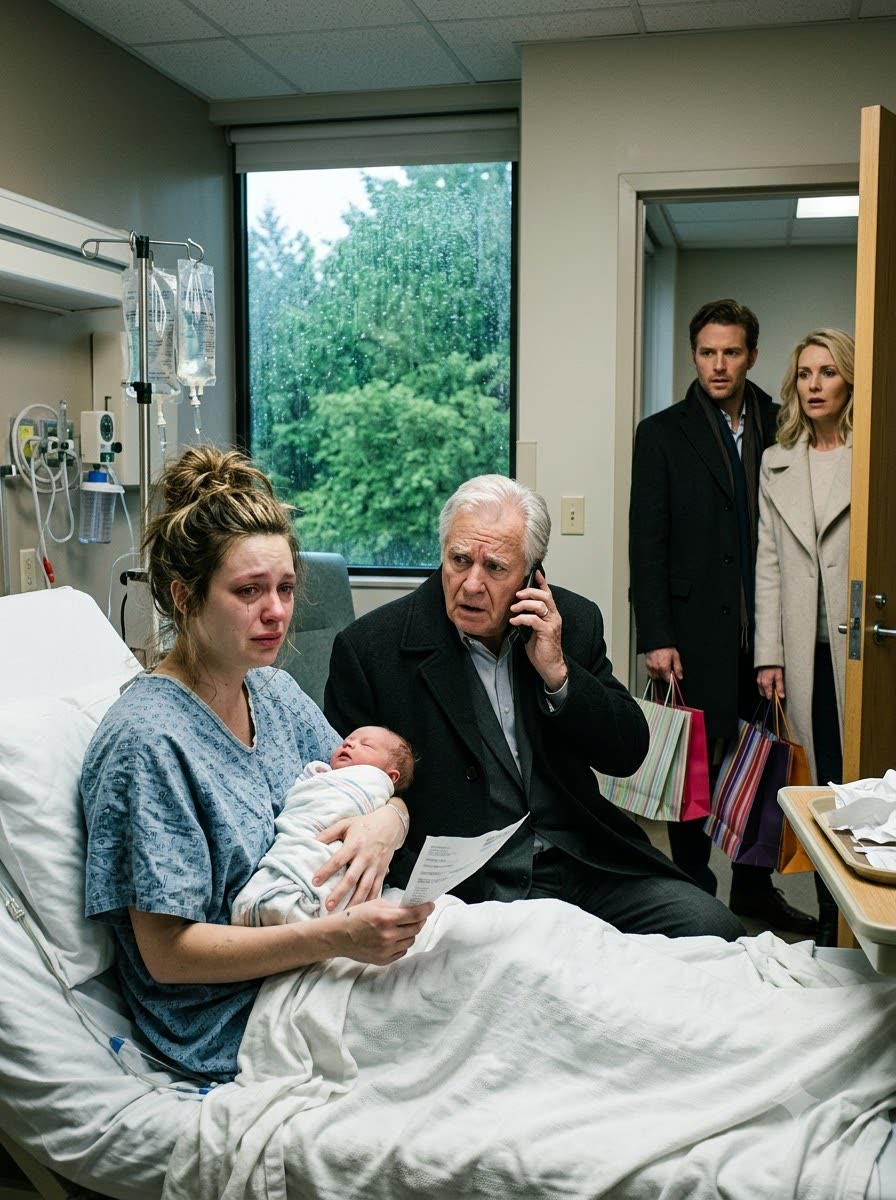
Antiseptic hung in the hospital room while rain tapped gently against the windows. Between the sounds of the monitors, I could hear my newborn daughter breathing. I sat at the edge of the bed in a faded blue gown, aching from a long labor, with her sleeping against my chest under a thin hospital blanket. She had been alive for only a few hours, yet I was already worrying about how I would afford the care she still needed. The estimate in my hand seemed to demand an answer I did not have.
A hospital employee had just explained that my insurance covered the ordinary stay, but an additional night or the iron treatment my doctor advised would need to be paid for upfront. I had nodded as though I were simply absorbing the information. In reality, I was thinking about our checking account. For months, every dollar had been assigned before we received it. During the previous week, I had repeatedly worked out whether we could cover the electricity, the car payment, and the baby supplies we were still missing.
I was still looking over the estimate when the door opened and my grandfather, Franklin Vale, walked in. At seventy-eight, he retained the composed authority of a man people were accustomed to hearing out. His silver hair was carefully combed, and the rain appeared not to have touched his dark overcoat. He had expanded a modest regional shipping company into a substantial business, then spent decades investing its earnings with care. His name was familiar throughout Charleston, although he seldom discussed how much money he had.
He paused beside the bassinet and studied my daughter. The severity left his face for a moment. When he offered her a finger, her tiny hand closed around it, though she remained asleep. Then he looked at me. His attention moved over my worn hospital gown, the rough skin of my hands, and the estimate clutched between my fingers. His expression shifted so abruptly that I wondered whether I had done something to distress him. “Elise, wasn’t the two hundred and fifty thousand a month enough?”
I could only stare, convinced I had heard him incorrectly. “What did you say?” He drew a chair alongside the bed and lowered himself into it. “The monthly allowance,” he said. “Three million dollars a year. I arranged for it after your wedding. The transfers have gone through on the first business day of every month.” Everything around me seemed suddenly distant. I could still hear a monitor outside, shoes squeaking past the doorway, and the shallow sound of my own breathing.
“Grandpa, I haven’t received any money.” He stayed silent at first. His eyes returned to my hands, and he reached across to feel the callused place below my thumb. “What happened to your hands?” There was no way to make the answer sound less stark than it was. “I clean offices at night,” I said. My voice came out thin and shaky. “I started taking the overnight shift at the medical complex when we fell behind on bills. I thought Mark was doing what he could, but I’ve been trying to help us stay current. I haven’t seen one dollar of the money you’re talking about.”
Franklin went completely still. The color drained from his face, and his jaw tightened. I had known him all my life without ever seeing him appear unsure of what to do. Now, watching him, I had the impression that staying calm required a deliberate effort. He took his phone from his coat and called his attorney. When the call was answered, his voice was quiet and controlled. “Helen Ward. I need you in Charleston as soon as you can get here. Bring your financial investigators.”
After hanging up, he slipped the phone away. I had no idea what to say. My daughter shifted against my chest and made a soft little noise, and I drew her closer. I had been trying to work out how to pay for one more night of medical care. Now my grandfather was describing a sum so far removed from our daily struggles that I could barely connect it to my own life. Before I could form another question, the door opened again.
My husband, Owen, entered laughing, two glossy shopping bags hanging from his arm. His mother, Lorraine, followed with several more. Owen wore an expensive coat and a scarf arranged with obvious care, and the cold had brought color to his cheeks. Lorraine’s pale wool coat and bright smile made her look entirely untouched by the worries that had occupied my morning. Then she noticed Franklin beside my bed, and her smile vanished.
“Oh, Elise, sweetheart,” Lorraine said, surveying the room. “The baby shop had the most beautiful little blankets. We found a few things that will look much better in the nursery.” She placed a bag on the chair before finally addressing my grandfather. “Mr. Vale. What a surprise.” I held my sleeping daughter and the hospital estimate while the shopping bags gathered around them. Franklin did not acknowledge Lorraine’s greeting. His attention remained fixed on Owen.

“Where is my granddaughter’s money?” Owen’s smile disappeared. He lowered the bags with exaggerated care, as though their contents were fragile. “I’m not sure what you mean.” Franklin did not soften his expression. “You know exactly what I mean.” Owen looked at me and then back at him. “There’s been a misunderstanding. Elise has been tired and worried about bills. New parents get overwhelmed. I was going to explain everything when we got home.”
For an instant, I felt that old, familiar flicker of doubt. Throughout our marriage, conversations about money had somehow ended with my concerns presented as proof that I was anxious, confused, or simply too tired to understand. Owen always seemed able to turn the discussion away from the numbers and toward whatever was supposedly wrong with my reaction. But this time the doubt did not hold. My grandfather had named the amount, the arrangement, and the dates. I understood what Owen was trying to do.
“You told me we couldn’t afford a new set of tires,” I said. “You said we needed to delay the baby’s doctor appointments until your next commission came through. You watched me go to work at midnight because we couldn’t pay the electric bill.” Owen’s voice sharpened. “You need to calm down,” he said. “You just had a baby. You’re not thinking clearly.” Franklin narrowed his eyes. “Do not speak to her that way.”
Lorraine moved forward, her bracelets knocking together. “Franklin, this is a private family matter. Owen has carried the responsibility for the household. He’s had business expenses, client dinners, and professional obligations. You can’t expect him to live like an ordinary man if he’s going to build a serious investment firm.” My grandfather rose from his chair. “He was given money to protect my granddaughter and her child. He used it to support his own lifestyle while she scrubbed floors at night.”
Owen’s expression hardened. The easy charm I remembered from our wedding, from dinners, and from his conversations with Franklin began to disappear. “I managed the account,” he said. “I made investments. You handed over a fortune and expected it to sit untouched. I was making sure it grew.” Franklin answered without hesitation. “You made sure it went where you wanted it to go,” Franklin replied. Owen started toward him, then stopped as my grandfather stepped nearer to my bed.
“Get your coat, Elise,” my grandfather said. “You and the baby are coming home with me.” Lorraine’s gaze darted toward the bags on the floor, and her expression changed again. “You can’t take her away and make this into a public scandal. Owen has investors. He has a business to protect.” Her hand came to rest on Franklin’s sleeve. He looked down at it before answering. “He can explain his business to the people whose money he took.”
Franklin helped me stand and picked up my hospital bag. Owen stayed beside the purchases, watching. He made no move to take the baby or ask whether I could walk steadily. His eyes remained on my grandfather, as though one more persuasive sentence might restore his control over the room. I had watched him find those sentences so many times before. This time, none came—and I still had no idea where all my money had gone.
PART 2 — What the Accounts Revealed
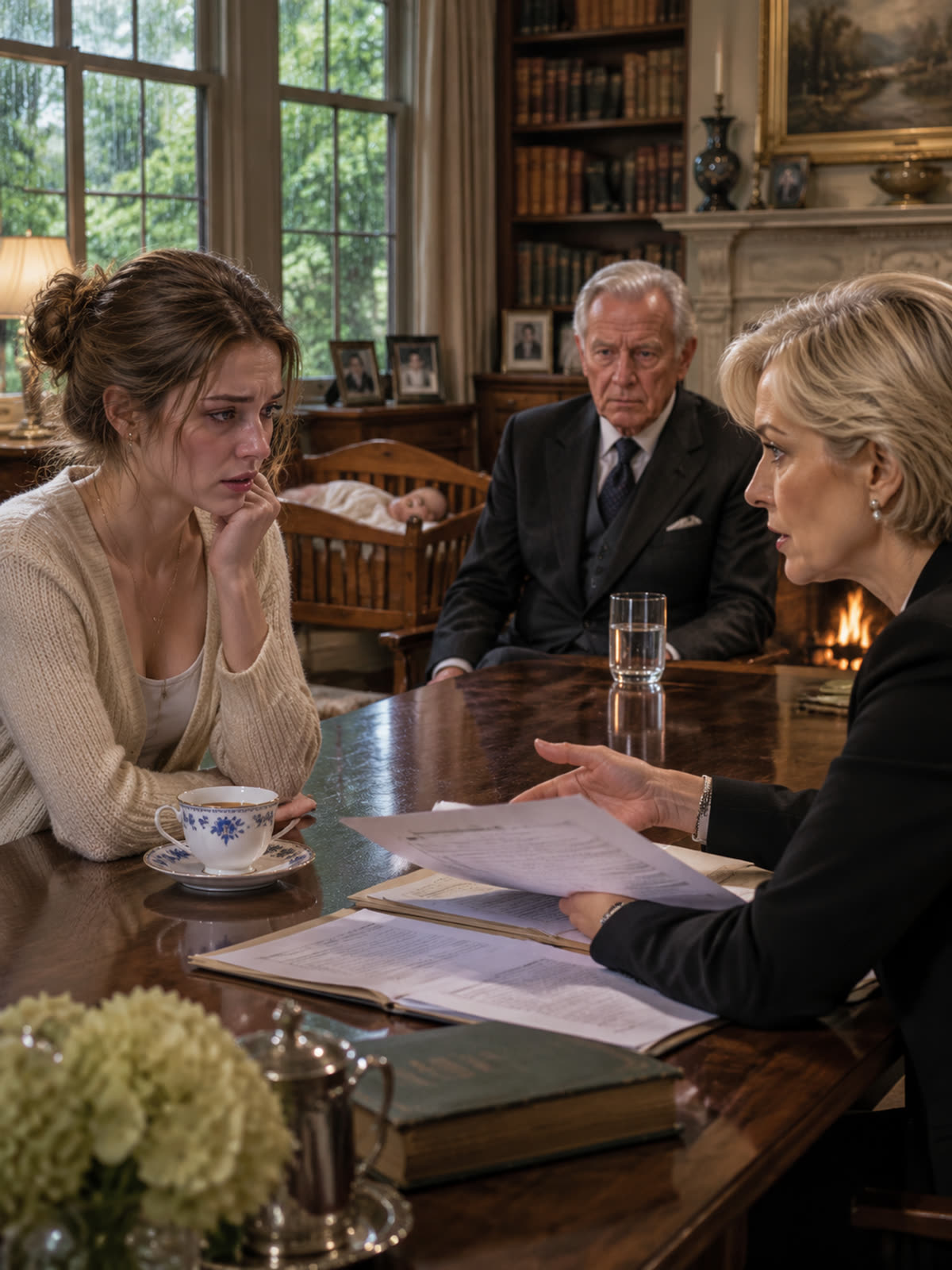
That evening, my daughter slept in a wooden cradle near the sitting-room fireplace at Franklin’s Charleston house. The home had been in his family for generations, but he had never arranged his life as though he were living inside an exhibition. Books showed signs of being read, photographs held their places among ordinary belongings, and the furniture looked used rather than preserved for appearances. After the hospital, I sat there trying to take in the contrast between the life I had believed I was living and the one my grandfather had intended for me.
At the long dining table, Helen Ward arranged a pile of bank statements. She was in her late fifties, with short silver-blond hair and a steady manner that gave weight to every carefully selected word. Years of working through difficult financial disputes had taught her to let the records speak. Franklin had called her because something was wrong; now she was beginning to show us how wrong it was. I held a cup of tea and left it untouched while she organized the documents.
“Your grandfather transferred two hundred and fifty thousand dollars each month into the household trust,” she said. “The trust was established for your benefit and for any children you might have. Owen was named co-manager so he could handle ordinary expenses while you were getting settled after the wedding.” I tried to fit that explanation beside everything my husband had told me. “He told me we were living on his income.”
Helen continued through the statements. “He moved most of the money within days of each deposit,” Helen said. “About seventy percent went to a company registered in Delaware under the name Mercer Coastal Holdings. You were not listed as an owner or officer.” She turned to another page and indicated a further set of transactions. The movements were there in the records, separate from any explanation Owen might have offered me across our kitchen table.
“The remaining funds went through a brokerage account. Some paid for the car leases, club dues, and other personal expenses. A separate card was issued to Lorraine. The statements show twelve to fifteen thousand dollars a month in charges for travel, clothing, spa visits, and a private boat slip.” As she spoke, I remembered the baby aisle in a discount store. I had stood there comparing two necessities with the cash in my wallet, then returned a package of plain onesies to the shelf because I thought we could make do.
“I thought Owen’s business was struggling,” I said. Helen opened a folder marked with tabs. “There is more.” Roughly a year before, Owen had established an overseas account through a company whose named director had no connection to him on paper. The deposits seemed to have been broken into smaller amounts to make them less noticeable. Added together, they exceeded a million dollars. The individual figures looked orderly on the page, even as the meaning of them overturned everything I had believed.
Helen had also secured messages and audio recordings from a device in Lorraine’s home. A recording stored in a cloud account had become part of the court filing. She read the transcript without changing her measured tone. “Lorraine: ‘What are you going to tell Franklin if he asks to see the account?’” Then came Owen’s answer. “Owen: ‘He won’t ask. He thinks I know what I’m doing. And even if Elise figures out we’re short, she won’t challenge me. She hates conflict. She’ll believe whatever I tell her.’”
Those words hurt more than the figures. For years, I had thought that keeping arguments from growing was one way to help a marriage withstand ordinary pressure. When Owen reassured me, I had imagined a man carrying worries he could not quite explain. Hearing his own description of me stripped that belief away. My reluctance to fight had not protected our marriage. He had treated it as something he could rely on while he moved the money and decided what I was allowed to know.
I turned toward the cradle. My daughter slept with one hand beside her cheek, her face peaceful. She knew nothing about account balances, offshore transfers, or the things adults could conceal from one another. Looking at her helped me ask the question I had been struggling to put into words. “What happens now?” I asked. Helen answered with the same calm precision she had brought to the statements.
“Tomorrow morning, we file in county court,” Helen said. “We’ll ask the judge to preserve the assets and restrict access to the accounts while the case moves forward. The complaint will describe the transfers, the breach of his duties as co-manager, and the money taken from the trust.” Franklin sat at the other end of the table with an untouched glass of water. The documents lay between us, showing what had happened to the money while I had been trying to keep our household afloat.
“And the investment group Owen approached this week?” he asked. Helen shut the folder. “The Charleston Ledger has confirmed the filings are authentic. They’ve agreed to hold their story until the court accepts our complaint. Owen was expecting a large investment from a regional partnership. If that group sees evidence that he diverted money from his own family’s trust, I doubt they will proceed.”
I remembered loving Owen’s laugh, his ability to recall a small detail from a conversation, and the assurance with which he put strangers at ease. Those memories had not disappeared, and their persistence made the evidence more difficult to accept. Warmth at dinner did not prevent cruelty in private. A man could remember my favorite song while deciding I had no right to see my own account. “File it,” I said. Helen watched me briefly. “Are you sure?” I looked at my daughter. “Yes. I don’t want her to grow up believing that silence is the price of being loved.”
The following morning, Helen sent a brief message confirming that the papers had reached Owen at his office. For a few hours, the house remained quiet. I fed the baby, changed her clothes, and attempted to eat some toast. Again and again, though, I found myself checking my phone. I had made the decision, but I did not yet know what its consequences would sound like when they reached me. Then Lorraine started calling.
I let the first call go unanswered. Two minutes later, she called again. When I played her voicemail, the voice was nothing like the polished one that had accompanied the shopping bags into my hospital room. “Elise, call me right now. Owen’s accounts are frozen, and reporters are outside his office. The investment group pulled its offer. You need to tell Franklin to stop this before he ruins everything. You are a wife and a mother. You should be helping your husband, not turning everyone against him.”
She kept talking, but I stopped listening. I erased the message and put down the phone. By lunchtime, the Charleston Ledger’s article was online. It detailed the transfers from the trust, the Delaware company, and the overseas account. It also quoted the recording made in Lorraine’s kitchen. The report traveled beyond Charleston, and by afternoon other news organizations were repeating it. What had been hidden inside statements and private conversations was no longer something Owen could explain away to me alone.
He did not call me himself. His lawyer instead requested that every communication pass through our attorneys. The request brought relief. I had spent years trying to discover the particular arrangement of words that might finally make Owen understand my concerns. I no longer wanted to keep looking. For once, I would not have to listen while he turned my questions into a discussion of my supposed confusion.
Around ten days after the filing, Owen attended a charity gala at a downtown hotel. His invitation was still valid, and apparently he thought a tuxedo and a confident appearance could recover some of what the reporting had cost him. According to several people present, he approached a group of business partners near the reception tables and began offering his explanation of what had happened.
He told them I had experienced a serious emotional crisis after giving birth. In his account, I had taken our daughter to Franklin’s house because my grandfather wanted power over the family. He portrayed the lawsuit as an effort to push him out of the business he had built. Once again, he placed my state of mind at the center of the story and moved the financial records out of view.
Owen had always been a practiced storyteller. He used that talent in business meetings, at social gatherings, and in the ordinary disagreements of married life. He trusted the advantage of speaking first. If he sounded certain enough, he expected everyone else to pause, question themselves, and give his version room to settle. He was trying the same method again, this time before people whose opinions he hoped could help restore his standing.
But among the guests was Meredith Caldwell, an eighty-year-old philanthropist who had been a close friend of my grandmother. She had spent decades serving on charitable boards and moving among people skilled at managing appearances. She knew the difference between a painful family difficulty and a performance arranged for an audience. Owen had chosen a room in which to tell his story without me—and he had not realized who was listening.
PART 3 — The Story I Could Finally Call My Own
The next morning, the telephone rang at my grandfather’s house while I was warming a bottle in the kitchen. Franklin answered and passed the receiver to me. “Elise, dear, this is Meredith Caldwell,” the woman said. “I heard what Owen said at the gala. I want you to know that I was there, and so were several people who can confirm what he told the room. I’ve also spoken with two former prosecutors who were sitting nearby. They are willing to provide statements.”
I thanked her with the bottle still in my other hand. “You don’t have to do this,” I said. “I know,” she replied. “That’s why it matters. People should not get to invent a story about you simply because you’re not standing in the room to answer them.” Helen incorporated the new material into our filings, adding a claim supported by the guests’ accounts. Owen’s attempt to control the explanation had produced more statements for the court to consider.
A week later, we attended a hearing at the county courthouse concerning the trust and the frozen accounts. Owen sat across from us beside his attorney. His hair was disheveled, and his tie looked as though he had fastened it in a rush. He seemed worn down. I could not know whether the strain came from fear about what lay ahead or from the work of maintaining his version of events.
The judge examined the bank documents and correspondence. Helen explained the transactions one by one, tracing the route from the family trust into Owen’s company and onward to personal accounts and spending. She presented the records of the overseas account as well. The transcript from Lorraine’s kitchen accompanied the figures. What I had first heard around Franklin’s dining table was now being set out before someone with the authority to act on it.
Owen’s lawyer rose to argue that finances within a marriage were not always easy to separate. He suggested that Owen had made choices he thought would benefit the household. The judge lifted a hand, and he stopped. “This court is not being asked to decide whether a married couple disagreed about budgeting,” the judge said. “The records describe a series of transfers from a trust established for a specific beneficiary. The beneficiary was not given access to the account, while the person managing it moved the money into companies and accounts under his control.”
She ordered that the domestic accounts stay frozen for the duration of the investigation. Owen was barred from transferring assets and instructed to give up his passport temporarily while the authorities examined the overseas transactions. The careful explanations he had offered at home could not change the path the money had taken. The records remained the records, however confidently he might have preferred to describe them.
Then the judge addressed him directly. “You are to remain away from your wife, your daughter, and the Vale residence unless the court changes this order. Any contact about the child will go through counsel.” There was no invitation to debate my exhaustion, my judgment, or whether I had misunderstood our bills. The direction was plain, and it had been spoken to him rather than to me.
Owen turned in my direction. For the first time since the hospital, he looked at me without that familiar, prepared smile. I thought anger might rise when our eyes met, but the feeling that came was quieter. My daughter rested against my shoulder. Holding her, I understood something I had not been able to grasp while I was still asking Owen to explain himself: I did not need his admission before I could believe what I knew.
Six months later, sunlight entered the windows of my own small house on a tree-lined street near Franklin’s. I had chosen the three-bedroom Victorian cottage myself. Its wooden floors creaked, a screened porch opened onto the outside air, and a camellia grew in the back garden. I had signed the lease using money from my new job. The house was modest, but the decision to live there had been mine.
June was seven months old. She sat on a quilt in the kitchen, striking a metal bowl with a wooden spoon. Each clang delighted her enough to make her do it again. Franklin came through the screen door with a basket of biscuits and crouched beside her. She caught at his watch chain, and he laughed when the spoon produced another bright crash. I stood nearby pouring coffee while my daughter’s determined music filled the kitchen.

“You’re encouraging her,” I said as I poured coffee. “A good ear for rhythm is useful,” he replied. “She may be the only person in this family with a future in music.” Smiling, I put a cup on the table. Conversation had become easy between us again. On some mornings, we hardly talked at all, and that was comfortable too. Silence no longer felt like a problem I was responsible for solving.
Before I married, I had been an archive assistant at a local maritime museum. My days had involved sorting the letters, pictures, and shipping records that old Charleston families donated. Over time, Owen had persuaded me that the position was too small to count for much and that I ought to concentrate on our home. Now I worked as a collections coordinator at a regional history center. Preserving other people’s stories suited me, and I valued knowing the wages I earned belonged to me.
Helen’s letter lay on the counter. I had already opened it and read the last update on the civil proceedings. Most of the money left in the domestic accounts had been recovered and placed in a new trust for June. I was its sole manager, and large withdrawals required two signatures. The overseas account was now involved in a tax investigation. The arrangements did not erase what had happened, but they no longer depended on Owen deciding what I needed to know.
He had accepted a repayment schedule and lost his professional investment licenses. Although he had avoided going immediately to prison, his career and reputation were no longer what they had been. Lorraine had sold her coastal cottage to meet her legal bills. Once, she had called my office and left a message saying that Owen was staying in a short-term apartment beyond the city and working for a small logistics company. I had not called her back.
“Do you want me to ask Helen to keep that information out of June’s file?” Franklin asked. “No,” I said. “I want the documents kept together. When June is old enough to ask questions, she can see the records and make her own sense of them. She won’t have to depend on either of us to tell her what happened.” He nodded before lowering his eyes to his coffee. I wanted her to have the account itself, not merely whichever version someone chose to give her.
“I should have checked the account myself,” he said. “I trusted Owen because I wanted to believe he was the kind of man who would take care of you. That was my mistake.” I laid my hand over his across the table. “You believed I was safe. He made sure I didn’t know how wrong that was.” His fingers closed around mine, warm and rough. “I’m sorry.”
For so long, I had felt embarrassed by our lack of money, by how tired I appeared, and by the effort it took simply to keep the electricity on. Even after leaving, I had thought I should have recognized the truth earlier. Surely someone wiser would have questioned more firmly, understood the gaps in his explanations, or refused to be soothed by answers that never quite added up. It had been easy to turn what he had done into another reason to judge myself.
But that shame had served Owen. It had made silence easier and encouraged me to believe I was simply failing at everyday life. Once I understood that, I could begin putting down responsibility for decisions that were never mine. He had made those choices. I had worked, worried, and tried to protect a household while being denied the information that would have shown me what was really happening.
June let the spoon fall and gripped the side of Franklin’s chair. She pulled herself up, her legs wavering before they steadied beneath her. Franklin extended his hands to catch her, but she held her balance. Then she surveyed the kitchen with the air of someone discovering that she had a place in it. Watching her, I thought about the life I wanted her to know: one where kindness did not demand surrender, and trusting someone did not require refusing to see.
Air drifted through the open window, bringing the smell of damp earth and the flowering bushes along the street. I had a home, work that mattered to me, and a daughter beginning to stand on her own feet. Someone else’s explanations no longer determined the shape of my life. For the first time in years, I could face the future without wondering what I had been forbidden to know. June steadied herself beside us, and I looked ahead with a question that finally felt like freedom: what would come next?
Disclaimer: This story is a work of fiction inspired by real-life themes. Names, characters, places and events are fictionalized, and any resemblance to real persons is purely coincidental. Images are for illustration purposes only.
