

PART 1: The Box That Carried Him Back
At eighty, I believed I had finally learned to live with losing Benjamin Hale, the boy I had loved since high school. For sixty-two years, I had understood his absence in the only way the world had allowed me to: he had died in Vietnam, and I had survived him. Then a stranger approached my table in a coffee shop, carrying a small blue box and a promise that had somehow outlasted all those years.
That morning, I was at the Marigold on Fifth Street, sitting beside twelve red carnations and a cup of coffee I had not touched. My niece Wren had suggested meeting before my yearly visit to the willow tree where Benjamin and I had once imagined our life together. She said she wanted some time with me. I had no reason to suspect she had arranged anything more.
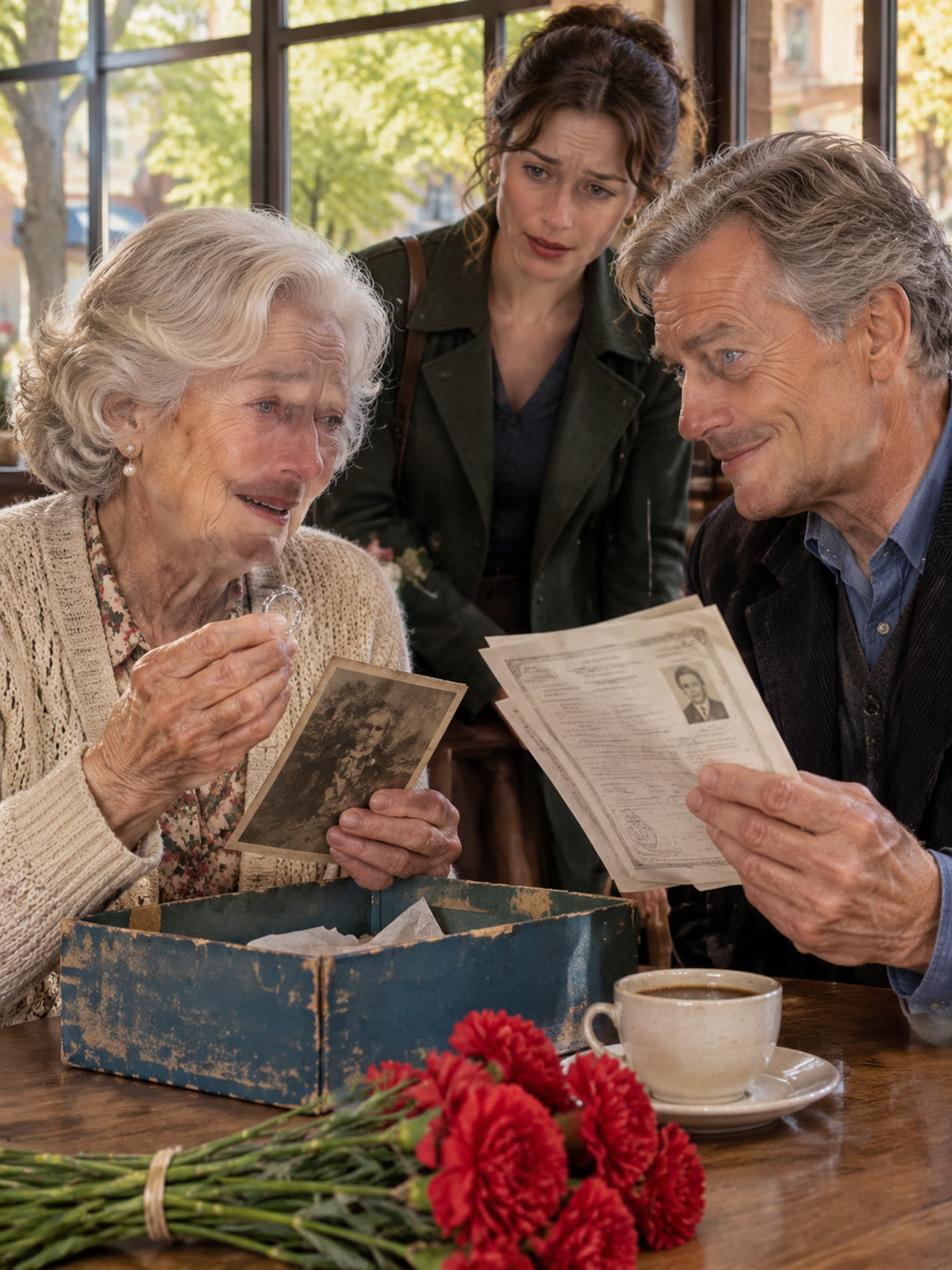
The stranger set a worn cardboard box on the table and said he had promised someone that it would reach me. His hands shook as he spoke. Yet it was his face, rather than his trembling fingers or the unexpected delivery, that held my attention. His blue eyes, crooked smile, and the little dimple in his chin were so familiar that looking at him felt like seeing my past appear in another man’s face.
“Who are you, and why have you brought this to me?” Before he could respond, Wren came through the door. She stopped when she noticed him beside my table, and her expression answered a question I had not yet asked. “You knew he was coming, didn’t you?” She admitted that he had contacted her about Benjamin. She had wanted to make certain his information was genuine before bringing it to me.
Her explanation did not take away the hurt. For more than six decades, I had carried everything Benjamin had left behind, including the hope I rarely allowed myself to name. “I’ve carried my hope for sixty-two years, Wren. I didn’t need anyone deciding when I was allowed to hear the truth.” She apologized. The stranger waited, then gently suggested I open the box he had brought.
Inside, nestled against yellowed tissue, lay a narrow silver ring engraved with B.H. and I.C. I knew it immediately. Benjamin had bought it at a pawn shop on Delaware Street for eleven dollars, then counted out another two dollars in quarters to have our initials added. The passing years had not made it unfamiliar. I remembered what that small purchase had meant to a boy who had so little money.
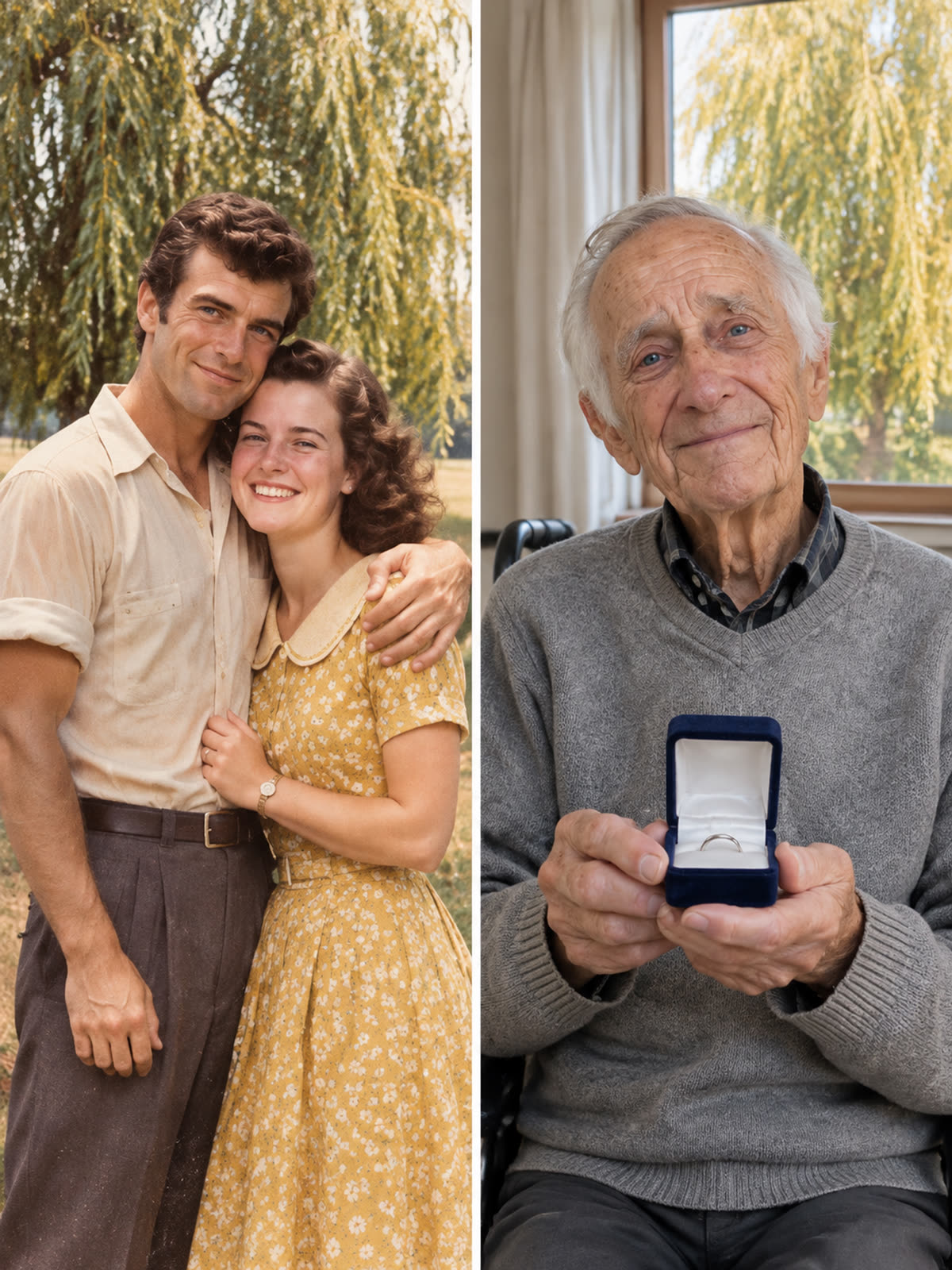
Underneath the ring was a faded photograph of us beneath the willow in Miller’s field. His arms circled my waist, and I wore the yellow dress he loved. Turning it over, I found his uneven handwriting. “Isobel, I will come home to you.” Those seven words were the promise he had made before leaving for war, preserved on the back of a picture I had never expected to hold again.
I began to cry. A little girl at a nearby table quietly offered me a napkin, and that small kindness undid what remained of my composure. Until then, I had been trying to understand the stranger, the box, and the impossible familiarity of everything inside it. Now I could only look at Benjamin’s handwriting and remember how completely I had believed him.
The man told me his name was Edward. Then he explained why his eyes and smile had seemed to belong to someone I knew. “Benjamin Hale is my father, Isobel. He survived the war.” I could scarcely comprehend the words. The boy I had mourned had lived long enough to become this man’s father. The years I had thought were empty of him had contained a life I knew nothing about.
Edward laid out official papers confirming what he had said. Benjamin had suffered a serious head injury that had taken much of his memory. He had been listed as missing, presumed dead, before being identified as alive. Although the military corrected his records in 1971, the notification went to his mother’s former address after her death. Then Edward told me Benjamin was still alive, though dementia had taken much of what he remembered.
For sixty-two years, I had believed there could be no next meeting, no later conversation, no chance to look into Benjamin’s eyes again. Now a stranger who was his son sat across from me, explaining that such a chance still existed. As I tried to take it in, I found myself thinking of the first time Benjamin had entered my life, long before there had been telegrams, missing years, or any reason to fear losing him.
We were in eleventh grade at Roosevelt High School when he stepped on my chemistry textbook. Rather than offering an ordinary apology, he announced that he had killed it and offered his condolences. I laughed before I even knew his name. He introduced himself as Benjamin Hale and decided almost at once that he would call me Belle. I objected, but the nickname stayed. No one else ever used it.
Benjamin spent his afternoons working at his uncle’s garage on Delaware Street. There was often motor oil beneath his nails when he arrived at school, and chemistry defeated him twice. But he listened with an attention I had never encountered. He remembered small things I mentioned and asked questions because he cared about the answers. Gradually, the sound of him calling me Belle became one of my favorite things.
We spent our afternoons together whenever we could, eventually making the willow at the edge of Miller’s field our place. Beneath its branches, we planned a house with a broad porch and a swing, several children, and a dog he insisted on naming Rooster. “Why would you call a dog Rooster?” I asked. “Because it’s a good name for a dog that thinks it’s a chicken.” His explanation made no more sense to me than the name itself.
During our senior year, he gave me the silver promise ring. He could not afford an engagement ring, he explained, but one day he meant to replace it. Then came his orders to report for military service on June seventeenth, the day after he turned eighteen. We were frightened. Still, we tried not to surrender every remaining moment to talking about the thing neither of us could stop.
On June sixteenth, Benjamin bought a red carnation at a corner store and placed it behind my ear. That evening, wearing my yellow dress, I met him beneath the willow. We stayed until sunrise. Around three in the morning, he finally admitted how afraid he was. I told him courage meant being terrified and going forward anyway. He liked that enough to ask whether he could keep it.
My hands were trembling when he took them in his. “No matter how long it takes, Belle, I’ll come home to you.” I needed to hear it again. “Promise me, Benjamin.” His answer was simple. “I promise.” He wrote the same assurance on our photograph and took it with the ring. The next morning, I watched his uncle drive him toward the bus station, not knowing how long it would be before I saw him again.
Eleven letters came from Vietnam. He described the heat and the insects, and told me about another soldier named Earl. However different the rest of a letter might be, he always ended with the same reassurance. “Still coming home. B.” Eleven months after he left, his mother arrived at my house with a telegram saying he was missing in action. Another notice followed months later, declaring him presumed dead.
I was nineteen. The future we had imagined beneath the willow no longer seemed to exist, and I could not picture loving someone else in his place. In 1972, a kind accountant named Gerald Pruitt asked me to marry him. I said no. It would have been unfair to accept the devotion of a good man while knowing that my heart remained with Benjamin.
But my life was not empty. I taught Sunday school and organized a food pantry through the church. I helped raise the daughters of my sister Carol and spent forty-one years volunteering at a children’s hospital. There were people to care for, work that mattered, and love to give. Every June sixteenth, though, I bought twelve red carnations and went back to our willow.
There, I told Benjamin what had happened during the year, sharing the things he had missed. I never imagined that somewhere he was still living. Now the ring was in front of me, his son was beside me, and the explanation for those lost decades rested in a stack of official papers. The man I had mourned could still be reached. But I had no way of knowing whether anything of me remained in his memory.
PART 2: The Man Who Had Forgotten My Name
At the Marigold, Edward explained how the blue box had finally come into his hands. He had been preparing to move Benjamin into full-time care when he discovered it in a dresser drawer. His father had kept it locked away for decades. Edward had known nothing about what was inside, or about the young woman whose photograph had remained with the ring through so much of his father’s life.
When Benjamin held the box, a brief moment of clarity broke through his confusion. He spoke a name Edward had never heard. “Belle must have the box.” Using the photograph and a page from an old Roosevelt High yearbook, Edward worked out who I was. A newspaper article about my hospital volunteering led him to the hospital, and the hospital put him in touch with Wren.
My niece had spent three weeks checking his papers before bringing us together. I understood why she had been careful, even though learning about that delay hurt. There had already been sixty-two years between Benjamin and me. I could not bear the thought of choosing to add anything more. “Take me to him, Edward. I’ve already waited sixty-two years.” Whatever Benjamin remembered, I needed to see him.
His care facility was two hours north. I went with Edward, and Wren followed in her own car. Along the way, he told me his father had sometimes dreamed of a girl wearing a yellow dress whose hands would not stop shaking. Benjamin had also repeated my explanation of courage throughout Edward’s childhood. Those fragments had survived even when so much else had disappeared, and knowing that gave me unexpected comfort.
Then I asked the question I had known I would have to ask: had Benjamin married? Edward told me about Dorothy, a nurse at the rehabilitation hospital in Ohio where his father had recovered. She had helped him relearn ordinary tasks over years of patient work. Eventually they married, and they spent fifty-one years together. Another woman had shared the future I had once pictured as mine.
The knowledge ached, but resentment would not come. Dorothy had stood beside Benjamin through difficulties I had never known he faced. She had noticed his fondness for red carnations and bought them every summer without understanding why he liked them. Five years earlier, cancer had taken her, leaving Edward to care for his increasingly fragile father. “She sounds like a wonderful woman, Edward. I’m grateful she was there when I couldn’t be.”
At the facility, a caregiver named Marisol prepared me for the possibility that Benjamin would not know me. Questions could confuse and distress him, she explained, so I should not push him to remember. I listened, trying to hold that warning beside everything I had carried into the building. Finding him alive had changed what I believed was possible. It had not changed what dementia could take.
Inside Room 114, an elderly man sat in a wheelchair by the window. His hair had gone white, his shoulders had narrowed, and deep lines marked his face. Yet his eyes were Benjamin’s. I recognized them immediately, just as I had recognized their likeness in Edward. The boy beneath the willow had grown old without me, but he was there, close enough for me to speak to him.
He greeted me courteously and asked whether I was one of the nurses. When I told him my name, he repeated it without recognition. I had imagined many things during that drive, despite Marisol’s warning. Hearing my name in his voice without the slightest sign that it meant anything to him was not something imagination could have prepared me for.
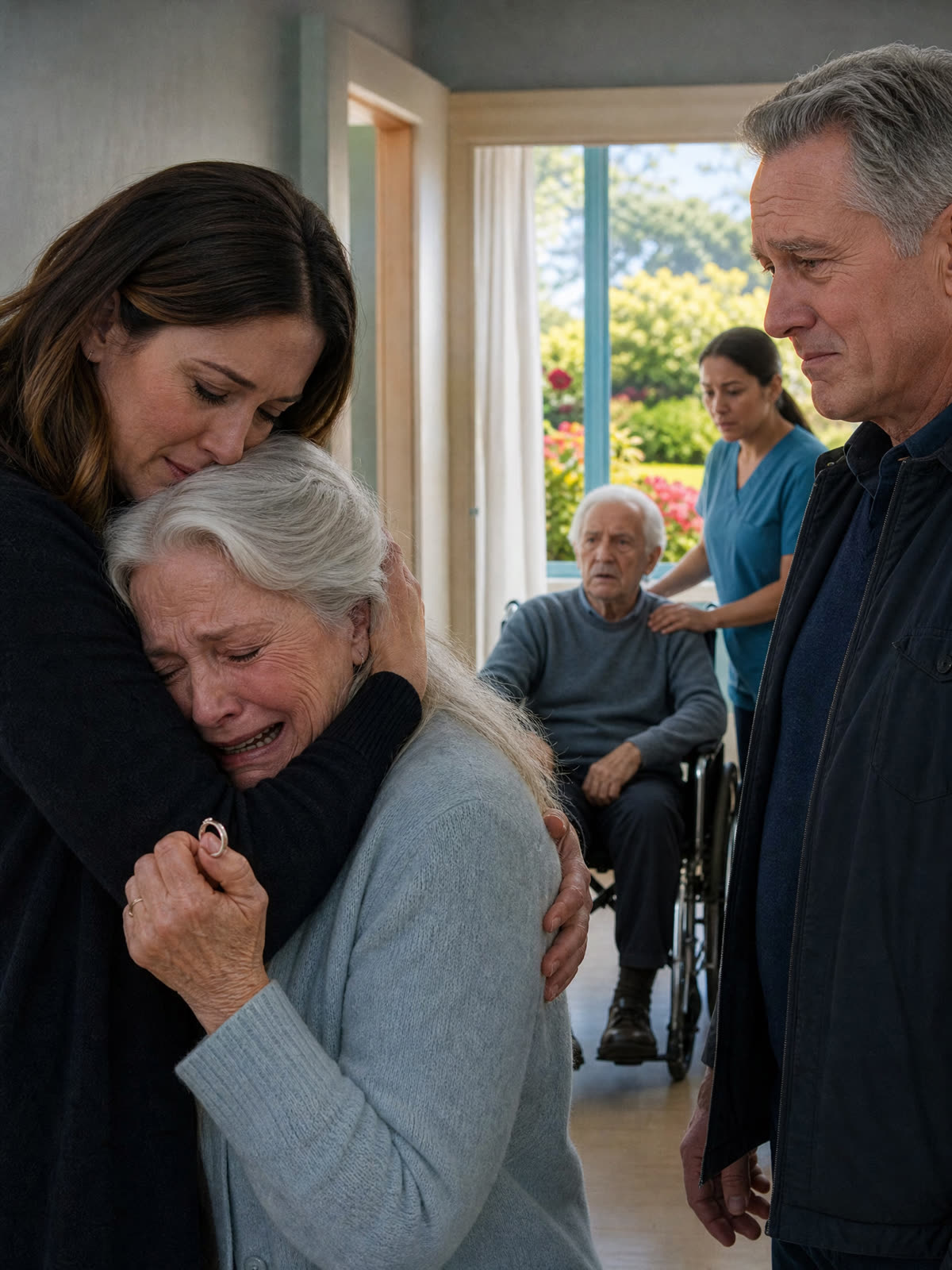
I showed him the silver ring. He admired it, but no memory followed. When I spoke about the willow and the yellow dress, he grew restless. Marisol gently brought the visit to a close. Outside his room, I wept in Wren’s arms. Benjamin had survived the war and all those intervening years, but the memories that had connected us seemed beyond my reach. Edward apologized, though none of this was his fault.
Two days later, I returned. After that, visiting became part of my life. I learned the bus route and stopped trying to prove that the past was still somewhere inside him. Instead of asking him to remember, I began reading aloud. It gave us something to share that did not depend on his being able to explain who I was or what we had once meant to one another.
Sometimes Benjamin listened. Sometimes he slept while I read. Occasionally, he believed I was Dorothy. I did not correct him harshly. His confusion was not a choice, and I knew that insisting on my own name could not restore everything the illness had taken. Being beside him was different from the reunion I had imagined, but it was still time with Benjamin, and I did not want to lose it.
One afternoon, I was reading a western when he complained that one of the characters talked too much. I reminded him that he had once talked through an entire night beneath a willow tree. “Then I must have been trying to impress a girl. Did it work?” he asked. “For sixty-two years, Benjamin.” He gave me that familiar crooked smile, and briefly I felt close to the boy I remembered.
By October, Edward had begun to worry about what the visits were doing to me. He had seen how much it hurt when Benjamin did not recognize me, and he suggested that perhaps I should come less frequently. I understood that he meant to spare me pain. Still, after being separated from Benjamin for so long, I could not let someone else decide how much of our remaining time I should accept.
Then Edward admitted what lay beneath his concern. “My mother is gone, and my father is dying. I don’t know how to carry your grief too.” His words helped me understand that his hesitation came from fear, not resentment. “I’m not asking you to carry it, Edward. I only want to love him while I still can.” Neither of us could change what was happening to Benjamin. We could only decide how to be there.
After that conversation, Edward and I started having coffee at Peg’s diner when my visits were over. I learned about his former wife Karen, his daughter Nora in Denver, and his work selling insurance. Until then, he had been the man who brought me the box and the son who cared for Benjamin. Over those coffees, I began to know more of the life behind those roles.
He told me Dorothy had taught him to make an excellent pie crust, even though he could cook little else. Once, he brought a cherry pie he had made to the facility. Benjamin tasted it and said it reminded him of home. I had never known the home he and Dorothy shared, but her care for him was still present in her son’s hands and in that familiar taste.
In November, Edward arranged for us to take Benjamin to the willow. It was not a simple outing. Medical approval had to be obtained, a wheelchair-accessible van arranged, and a nurse brought along. Edward hoped the old place might comfort his father. We knew better than to expect that a familiar landscape could return every memory, but we wanted to offer him whatever peace it might hold.
When we arrived, the willow’s leaves had turned gold. Edward settled Benjamin’s wheelchair beneath the branches and moved away so we could have some privacy. I knelt beside the man with whom I had once planned a house, children, and a dog with an absurd name. We had returned to the place I had visited alone through so many years, though neither of us had returned unchanged.
I put a red carnation into his hand. Then I began to tell him, gently, about the night before he went away. “We sat here until sunrise, Benjamin. You held my hands because they wouldn’t stop shaking, and you promised you’d come home.” I was no longer trying to demand a memory from him. I was sharing one, as I had shared so many stories during our quiet afternoons.
He touched the flower. Slowly, his eyes lifted to my face. I watched him beneath the golden branches, unable to know whether he was following my words or simply looking at the woman kneeling beside his chair. For a long moment, nothing was certain. Then his expression began to change.
PART 3: The Four Minutes That Brought Him Home
“Belle?” The name came from Benjamin as though the years between us had briefly loosened their hold. I began crying. He remembered the yellow dress and told me how beautiful I had looked. Beneath the willow, with the red carnation in his hand, he was speaking to the girl he had known. For that moment, I did not have to introduce myself or explain why I had come.
I told him he had finally returned. His answer held a tenderness that made the lost decades seem, for an instant, less important. “I think you’re the one who came and found me.” There was nothing I could say that would recover the years we had missed. But hearing him speak to me that way gave me something I had scarcely allowed myself to expect.
His clarity lasted about four minutes. He asked about my chemistry grade, the old corner store, and the dog we had intended to call Rooster. Those were the things waiting for him in the part of our life he could reach: school, familiar places, the future we had once discussed so easily. Then his attention drifted, and the moment passed as quietly as it had arrived.
Those minutes changed how I understood the time we still had. I stopped hoping that enough visits, familiar objects, or repeated stories might give us back everything we had lost. Instead, I concentrated on what we could share now. There were ordinary afternoons available to us, even when he could not place me in his past. I could sit beside him without asking the moment to become anything more.
At Christmas, Edward brought a small decorated tree into Benjamin’s room. Wren supplied cookies, and Marisol gave him a Santa hat. I brought a stuffed dog and asked what he wanted to call it. “Rooster, because he thinks he’s a chicken.” We laughed together. At last, I understood the ridiculous explanation he had offered so many years before, and another small piece of the boy I loved appeared through the illness.
One January afternoon, Benjamin asked whether I had been lonely. I told him about the children I had read to and the families I had helped. I spoke of the people who had filled my days and the love I had been able to give them. “Loving you left me with more love than I knew what to do with, Benjamin. So I spent sixty years giving it away.”
He squeezed my hand. I did not need to ask how much of my answer he understood. For so long, I had imagined that only a complete reunion could bring peace to the story we had begun as teenagers. Now there were moments when a hand around mine was enough. We were together, and I could love the man beside me without requiring him to remember the boy he had been.
At 4:50 on the morning of March ninth, Edward called to tell me Benjamin was nearing the end. Wren arrived eleven minutes later and drove me to the facility. Edward was already at his father’s bedside. Benjamin’s breathing was shallow. Marisol had placed a red carnation on the windowsill, and the stuffed dog called Rooster lay tucked beneath his arm.
Edward held one of his father’s hands. I sat on the other side and opened Charlotte’s Web, the book I had read to so many children at the hospital. When emotion stopped me from continuing, Edward took over. When his voice failed too, Wren read. We shared the words between us until, near sunrise, Benjamin opened his eyes. He recognized his son, then reached toward me.
I caught his hand before he could pull it back. “Still shaking,” he whispered. “Only a little, Benjamin. You should have seen them sixty years ago.” He turned his eyes toward the window as morning light entered the room. After a quiet pause, he asked, “Did I make it home?” I pressed his hand to my cheek. “You did, Benjamin. You made it home.” His eyes cleared. “Belle.” “I’m here.”
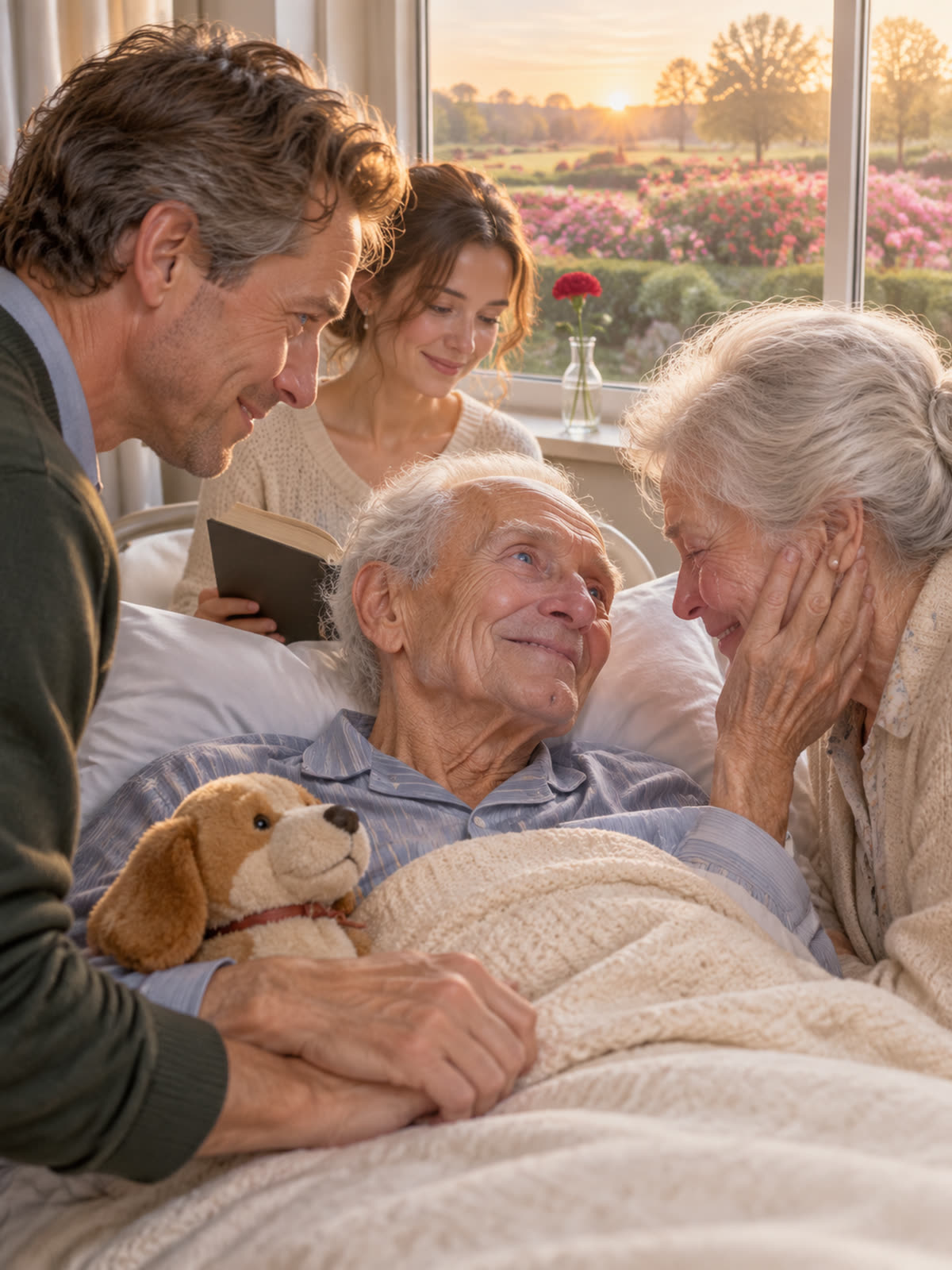
He smiled, then passed away peacefully with his hand still in mine. I kissed his fingers and whispered that keeping his promise had taken rather longer than either of us had expected. He had been back in my life for only nine months. Yet I had heard him say my name, sat with him through ordinary afternoons, and been there to tell him that his long journey was over.
At the funeral in Willow Falls, I intended to sit near the rear of the church. Benjamin had shared fifty-one years with Dorothy. Edward had known him as a father. I had come back into his life only near its end, and I did not assume that the place I held in my own heart entitled me to a place beside his family.
Edward came down the aisle and would not let me remain there. He told me I belonged with them and seated me beside him and Wren. During his tribute, he honored Dorothy for giving Benjamin a life after the war. He spoke of her devotion without diminishing anything she had been to his father, and I was grateful to hear her remembered that way.
He also acknowledged the woman who had carried his father’s first love for sixty-two years. He made it clear that neither relationship lessened the other. Dorothy’s place in Benjamin’s life did not have to erase mine, just as my return could not diminish the years she had shared with him. There was room to honor both, and Edward gave us that room.
Several weeks afterward, Edward met Wren and me beneath the willow. He brought the blue box back to me. Inside were the silver ring and the old photograph, the two things that had first made the impossible seem real at the Marigold. He had added another picture, one Wren took during our November visit, when the leaves above us had been golden.
In it, Benjamin sat in his wheelchair while I knelt beside him beneath the branches. The old photograph showed the young people we had been. The new one held the reunion we had actually been given. I threaded the ring onto a silver chain and began wearing it around my neck. It no longer belonged only to a promise made before the war.
Edward gradually became part of my family. He called on Sundays and visited for Thanksgiving. In time, he introduced me to his daughter Nora, who had inherited Benjamin’s distinctive chin dimple. The resemblance that had startled me in a coffee shop was there again in another generation. Through Edward and Nora, I came to know people whose lives had grown from the years I had thought Benjamin had lost.
Nora once asked whether I regretted waiting for someone who never returned. By then, I understood my own life differently than that question suggested. “I didn’t spend my whole life waiting, sweetheart. I spent my whole life living, and I never stopped loving him. Those are different things.” Remembering Benjamin had not prevented me from caring for others or from being present in the life I had.
At eighty-one, I was still volunteering at the children’s hospital. I still intended to visit the willow every June sixteenth. The habit that had carried me through so many years remained part of me, but the next tribute to Benjamin was different. Edward came, along with Wren, Nora, Marisol, and her two sons. The place where I had always spoken of him alone held other voices.
We laid twelve red carnations beneath the tree and shared cherry pie. I told them stories about Benjamin, about the boy whose humor had made me laugh before I knew his name and whose plans had once seemed inseparable from my own. For the first time in sixty-two years, I was not the only person there remembering him. His absence had become something we could share.
For a long time, I had believed his promise was broken beyond repair. Then a blue box had arrived, carrying a ring, a photograph, and the beginning of nine months I could never have expected. Those months did not return our youth or erase what we had missed. They gave us the chance to be together as we were, and they brought me a family I had never imagined.
Benjamin had made it home. The love that had crossed sixty-two years had not disappeared, even when memory could no longer explain it. I had once believed I knew how our story ended: a telegram, a ring, and one woman returning to a willow tree. But now Edward and Nora were part of that story too—and the next time I went back, I would not be going alone.
Disclaimer: This story is a work of fiction inspired by real-life themes. Names, characters, places and events are fictionalized, and any resemblance to real persons is purely coincidental. Images are for illustration purposes only.
