

PART 1 — Twelve Dollars at the Hospital Curb
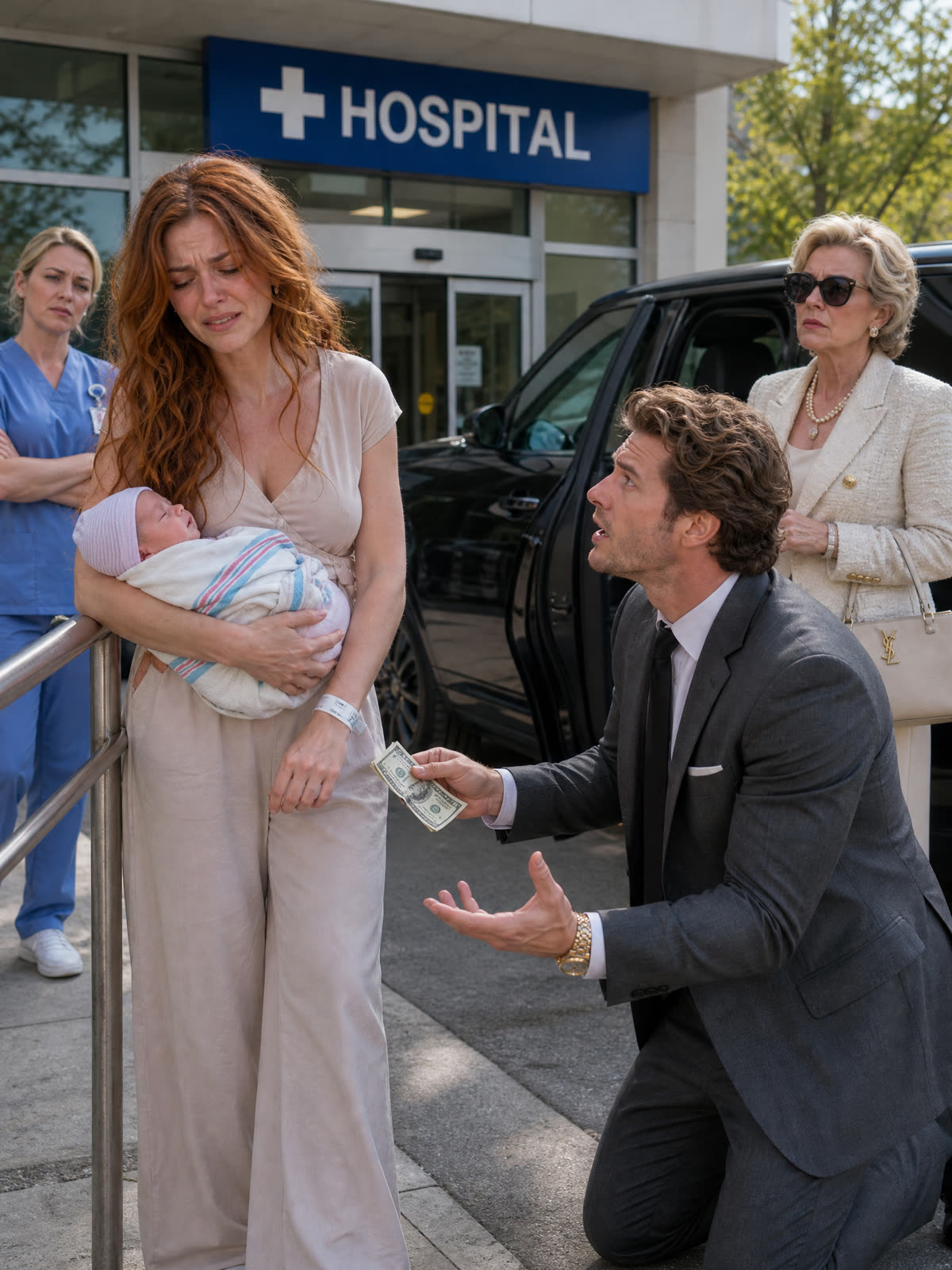
Five days after an emergency surgical delivery, my husband pressed twelve dollars in wrinkled bills into my hand and expected me to take a city bus home with our newborn. He had somewhere more important to be: a private lunch with his mother, reached in the custom black luxury vehicle that belonged to me. For years, he had regarded my father as an unremarkable retired state employee. He had no idea that one telephone call would expose just how little he understood about either of us.
I was standing beneath the concrete entrance canopy at Valley Crest Medical Center in Indianapolis, holding baby Liam against my collarbone. My discharge wristband was still around my wrist. Every slight movement tugged painfully at the fresh incision across my lower abdomen. Simply shifting my weight required care, and staying upright demanded more strength than I wanted anyone to notice. I had imagined leaving the hospital with my husband beside me, not negotiating for a safe ride home.
“Trent, you cannot genuinely expect me to ride a city bus with an infant right now,” I whispered as I struggled to keep my breathing even. “I can barely stay on my feet without feeling like my stomach is ripping apart.” Trent glanced at the gold face of his watch, snapping his wrist upward in obvious irritation. “My mother has been looking forward to this lunch reservation for two weeks, so please stop turning every minor detail into an exhausting debate, Hannah.”
Behind him stood the imposing black luxury SUV my father had given me as a wedding present. Over the previous three years, Trent had gradually made its keys his own. He liked arriving at investor appointments in a vehicle that suggested substantial personal wealth, and I had allowed the arrangement to become so ordinary that he no longer appeared to remember whose name was on the registration. That afternoon, my own wedding gift sat a few feet away while my husband explained why I could not ride in it.
His mother, Marilyn, emerged through the automatic glass doors, settling her dark designer sunglasses into place. “Trent, our table at the canal steakhouse is scheduled in thirty minutes, and we cannot afford to get trapped behind midday traffic.” He immediately moved to the passenger side and opened the heavy door for her with elaborate consideration. A small, bitter laugh rose in my throat. During nine exhausting months of pregnancy, I could not remember him showing me that simple courtesy even once.
“At least hand me the baby bag before you pull away,” I said. I braced my hip against the metal railing because my legs no longer felt dependable. Trent reached into the back seat, lifted out the heavy leather diaper bag, and let it fall onto the pavement beside my feet. There was no pause to consider whether I could pick it up while holding our son, and no offer to place it over my shoulder.
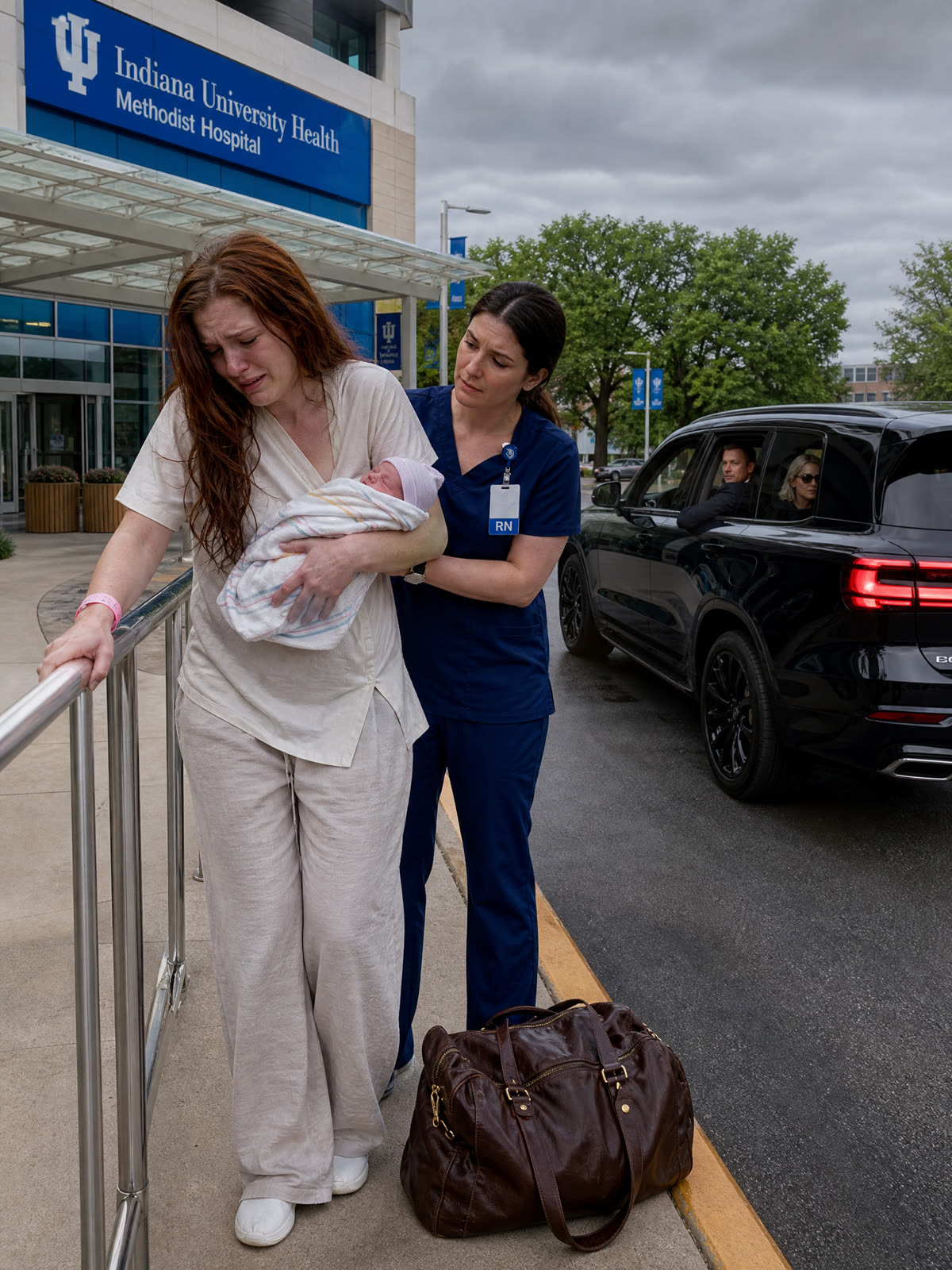
Without thinking, I started to bend. Pain shot across my stitches so sharply that my sight blurred, and I caught the railing before my knees could give way. A discharge nurse passing with an empty wheelchair hurried toward us and took my arm. “Ma’am, please do not bend over like that because you just had major abdominal surgery five days ago!” Her alarm made the situation impossible to disguise. I was not being difficult. I was barely managing to remain standing.
Trent answered the nurse’s concern with an exaggerated sigh and a roll of his eyes. “Can everyone please stop turning an ordinary walk to the curb into an overblown medical crisis?” He sounded embarrassed by the attention rather than disturbed by my pain. I held Liam more carefully against me and waited for even the smallest sign that my husband understood what he was doing. Instead, he turned toward the driver’s seat.
Before I could speak again, he climbed inside. Marilyn settled comfortably beside him, while his father, Walter, and his younger sister, Brooke, chatted from the other seats. The doors closed around them, shutting me out of my own vehicle. A moment later, Trent pulled into the midday traffic as though he had finished an ordinary errand and was now free to enjoy the rest of his afternoon.
I remained beneath the heavy gray sky with my newborn bundled in cotton against my chest. The nurse had steadied me, but the humiliation of what had happened seemed to leave me more exposed than the cold. I watched my black SUV disappear among the other cars. Its exhaust thinned into the air, and I was left at the hospital curb with a painful incision, a heavy diaper bag, and twelve dollars my husband apparently considered more than sufficient care.
A blue municipal bus arrived several minutes later, its air brakes releasing with a prolonged hiss. The driver noticed my pink hospital wristband and lowered the hydraulic boarding ramp without making me ask. He waited while I moved aboard carefully, sparing me the need to climb. That quiet act of consideration nearly undid me. A stranger had recognized in seconds what my husband had refused to acknowledge while standing directly in front of me.
“Here, sweetheart, take this seat right up front,” an elderly woman offered, rising from the place beside the broad front window. “Thank you so much,” I answered unsteadily as I lowered myself into the seat and settled Liam against my chest. She kept one hand around an overhead rail and studied me with gentle concern. “Where is your husband on a cold day like this, dear?”
I looked down at the floor. Explaining the truth to someone kind felt more humiliating than remaining silent. For three years, I had defended Trent whenever my family questioned his behavior. Whenever he ignored a boundary or dismissed something that mattered to me, I supplied an explanation that made him sound less selfish. Now I was sitting on a public bus five days after surgery, unable to bring myself to describe the man I had spent so long protecting.
Throughout our relationship, Trent had believed that Douglas Standish was simply an older man enjoying retirement. In his imagination, my father divided his days between prize tomatoes and fishing equipment in a modest suburban garage. I had allowed that impression to stand. When Trent and I first met during my last year of college, Dad had offered advice over coffee that I had never forgotten.
“Hannah, you have to be completely certain that a man loves who you are before you let him see the weight of your family name,” he had told me. “If you give him that knowledge too early, you will spend the rest of your life wondering whether he chose you or your background.” I wanted a marriage built around who I was, not around the opportunities my father might create with a discreet telephone call.
The bus vibrated beneath my seat as Liam slept peacefully against me. Looking at his little face, I finally admitted what I had spent years avoiding. Trent had not chosen me in the way I had hoped. He had become comfortable with the beautiful vehicle, the expensive surroundings, and the financial security I quietly supplied. My generosity had become an expectation, while my needs had become interruptions.
My fingers shook as I searched my purse for my phone and called the private number Dad kept available around the clock. He answered after a single ring. “Hannah, is everything alright with you and the baby?” His familiar voice was almost enough to break the control I had maintained since leaving the hospital. “Dad, I am currently riding a city bus with Liam,” I said, my voice cracking beneath everything I had kept to myself.
Silence held the line for a moment. Then he asked, “Where is Trent right now?” I watched brick buildings slide past the window. “He took his mother to lunch in my vehicle,” I replied. Dad’s voice changed, becoming measured in a way I had rarely heard directed at a family matter. “Sweetheart, you had major surgery five days ago,” he said. “Why on earth are you on a public transit bus with a five-day-old child?”
This time, I did not soften anything. I described the crumpled bills and the lunch reservation. I told him how Trent had dropped the diaper bag at my feet, how the pain had nearly brought me down, and how a nurse had rushed over while my husband complained about the inconvenience. I explained that his entire family had driven away in my vehicle while Liam and I remained outside the hospital. There were no excuses left that I wanted to make.
When I finished, Dad asked a single question. “Do you still want to remain married to this man, Hannah?” I lowered my eyes to my sleeping son. A quiet certainty settled inside me, stronger than the shame and exhaustion that had filled the afternoon. “No, Dad, I do not want to go back to him.” He did not hesitate. “Then you will never have to set foot in that house again.”
I brushed a tear from my cheek. “Dad, the black vehicle is still registered solely in my name, is it not?” His answer was immediate and precise. “Every single bolt of that vehicle belongs entirely to you.” My heart was beating hard now, not from uncertainty, but from the realization that I could stop allowing this. “What about the downtown loft?” I asked.
“There are several legal details regarding that lease that Trent does not know about,” Dad replied. “Right now, I need you to listen to me very carefully and follow my instructions to the letter.” The easy manner of a retired suburban father disappeared. In its place was General Douglas Standish, a four-star commander whose four decades of service had included directing high-level defense strategy from the Pentagon.
“Do not answer his calls, do not respond to any text messages, and know that you and Liam are completely secure.” For the first time that day, someone was telling me that my safety mattered without attaching conditions to it. I listened carefully. Dad was not asking me to endure one more slight, make one more excuse, or return home to smooth things over. He was making certain that Liam and I would not be left to manage this alone.
At the bus’s very next stop, two unmarked black sedans were waiting along the curb. A tall woman in an immaculate dark suit stepped out of the first, boarded the bus, and approached me with a respectful nod. “Mrs. Standish, your father sent us to bring you and the baby home safely,” she said. Her voice was quiet and reassuring, and the simple certainty of her presence allowed me to breathe a little more easily.
Before I could thank the driver, my phone vibrated. Trent had sent a message. “My mother wants to use the vehicle tomorrow morning for her shopping trip, so do not make any plans with it,” it read. Seconds later, another followed. “Make sure the living room is clean before we get back from lunch, because two potential investors from the financial district are stopping by tonight.”
I stared at the screen, then stepped off the bus with the security team. Even after leaving me at the hospital, Trent assumed I would be available to clean, organize, and surrender whatever his family wanted. Somewhere inside a restaurant with white tablecloths, he was enjoying lunch under that comforting assumption. Meanwhile, an attorney carrying a folder of property documents was crossing the parking lot toward the vehicle he thought of as his own.
The attorney was waiting beside the driver’s door when the family emerged from the steakhouse patio into the afternoon sunlight. His charcoal suit was carefully tailored, and a substantial leather folder rested beneath his arm. Marilyn spotted him first. “Trent, why is there a stranger loitering right beside our automobile?” she asked, lowering her designer sunglasses and staring across the pavement as though the man had intruded on something that belonged to her.
Trent adjusted his silk tie and approached with his usual assurance. “Excuse me, sir, can I help you with something?” The attorney greeted him with a professionally courteous smile. “Are you Mr. Trent Mercer?” Trent drew himself up. “Yes, I am,” he answered. “What is this regarding?” The man opened his folder and withdrew a document. “My name is Russell Harmon, and I am the legal representative of Mrs. Hannah Standish.”
Trent folded his arms and gave a patronizing laugh. “You mean my wife, Hannah Mercer?” Russell’s composure did not change. “Her legal name on all pre-marital property records remains Hannah Standish,” he replied. “This vehicle is registered exclusively under her name, and her formal authorization permitting you to operate this automobile was officially revoked fifteen minutes ago.”
The self-satisfied expression on Trent’s face stopped moving. He stared at the paper Russell offered him. “This is completely ridiculous, because we are married and this is our family vehicle.” Russell answered evenly. “Marriage does not automatically transfer legal title of an individual pre-marital asset to a spouse under state law.” Nothing in his manner invited a quarrel, which seemed only to make Trent more indignant.
Marilyn pushed forward, raising her voice enough to draw the attention of nearby diners. “Do you have any idea who my son is in this city, young man?” Russell met her stare. “No, ma’am, I do not.” The simple reply appeared to astonish her. She gripped her handbag and stood with her mouth slightly open, momentarily deprived of the importance she had expected her question to establish.
“This is just an immature emotional stunt because Hannah had to take a quick ride home from the hospital,” Trent insisted, his face reddening. “I have the electronic key right here in my coat pocket, and I am not giving it to anyone.” Russell held out his hand. “Mrs. Standish has formally requested the immediate surrender of her property, Mr. Mercer.” His voice stayed at the same unhurried, professional level.
“All of my golf clubs and my private business portfolios are in the trunk of this car!” Trent shouted, waving toward the rear hatch. “You have five minutes to retrieve your personal belongings before the vehicle is secured,” Russell told him. Trent looked around the valet area, plainly hoping someone would recognize the injustice he believed he was suffering. “My parents and my sister are standing right here on the sidewalk waiting to go home!”
“Then you will need to arrange alternative transportation for your family,” Russell replied. Walter finally stepped behind his son and laid a heavy hand on his shoulder. “Trent, just hand the man the keys so we do not cause an embarrassing scene in front of the lunch crowd.” Trent swore angrily, dragged the metal fob from his pocket, and slapped it into Russell’s open palm.
“Tell Hannah she is acting like an insane person, and I expect an apology before dinner tonight!” he snapped. Russell put the keys away and inclined his head. “Thank you for your cooperation, Mr. Mercer.” The exchange was over. There would be no triumphant departure in my SUV and no assumption that I would quietly absorb whatever had been done to me.
Trent immediately pulled out his phone and called. Three miles away, inside my father’s quiet sedan, I watched his name appear on my screen and allowed the call to reach voicemail. He tried again at once. During the next ten minutes, he called twelve times. I answered none of them. He knew I had taken back the vehicle. He did not yet know how much else was about to change.
PART 2 — The Name They Had Never Bothered to Know
Dad sat across from me in a leather captain’s seat, wearing ordinary civilian clothes without any visible sign of his rank. Beside me, Liam slept in a rear-facing infant seat, his tiny breaths steady and soft. The contrast between that peaceful cabin and the hospital curb was almost impossible to absorb. My phone continued lighting up, but nobody inside the car asked me to answer it or explain away what had happened.
“Your hands are trembling, Hannah,” Dad said gently. I looked down and tried to hold them still in my lap. “I am fine, Dad,” I murmured. He did not accept the familiar answer I had used so often to make other people comfortable. “No, you are not fine, and you do not have to pretend to be strong right now,” he told me.
That small permission brought down the last of my defenses. Tears spilled over before I could stop them. My body still ached from emergency surgery, my nursing top was damp with milk, and the marriage I had spent three years trying to protect had come apart outside a hospital. I had been holding myself together because I did not know what else to do. With Dad sitting across from me, I finally no longer had to.
“I truly believed he loved me for who I was, Dad,” I whispered, pressing a tissue beneath my eyes. “I kept convincing myself that he was just under immense pressure with his new financial firm.” Dad listened without interrupting. “I know you did, sweetheart,” he said. “I made excuses every time he dismissed my feelings or let his mother insult my background,” I confessed. “I let them treat me like someone who should feel lucky just to sit at their dinner table.”
He reached across the space between us and covered my hand with his. “You made excuses because you are a loyal person, Hannah, but today you chose yourself and your son.” His reassurance did not erase the grief, but it gave it somewhere safe to settle. I could mourn what I had believed in without pretending that returning to it would make it real.
My phone vibrated with another succession of messages. “What did you just do with my vehicle?” Trent demanded first. Then came, “Call me back right now, Hannah!” A third followed: “You are humiliating me in front of my family and everyone at the restaurant!” The possessive wording stood out more clearly than it ever had before. Even faced with the registration documents, he still thought of the vehicle as his.
Not one message asked whether Liam was all right. Not one asked if I had reached home safely, whether my incision was hurting, or whether I needed help. “What is he saying to you?” Dad asked. “He wants to know why I took the car away from him,” I replied, placing the phone facedown on the leather cushion. Dad leaned back with a look of weary recognition. “Of course that is his only question.”
Twenty minutes later, we passed through wrought-iron security gates and stopped before my father’s brick estate in the quiet hills beyond the city. A registered postpartum pediatric nurse waited in the entrance hall, ready to examine Liam and check my incision. Nothing about the welcome required me to prove how much pain I was in. Help had already been arranged, and for once, accepting it did not feel like asking too much.
The upstairs guest suite had been made ready with clean bedding, an infant crib, formula, medical dressings, and a peaceful place for Liam. The care behind those preparations tightened my throat. Two weeks earlier, Trent had complained about spending thirty dollars on a bedside bassinet. Here, everything we needed had simply been provided. When my phone rang again on the nightstand, I picked it up and switched on the speaker.
“Where are you right now?” Trent demanded. “I am in a safe place with our baby,” I answered steadily. “What does that even mean?” he snapped. “You need to bring the car back to the loft right now, Hannah.” I stood by the bed, no longer willing to mistake an order for a conversation. “I will not be returning to the loft, Trent,” I told him.

He gave a dismissive laugh. “Stop acting so completely dramatic over a minor misunderstanding!” I kept my voice level. “Trent, you left me on the sidewalk five days after an emergency abdominal procedure,” I reminded him. “You handed me twelve dollars and told me to take a public bus.” Saying the facts aloud made them sound no less cruel than they had felt while I was living through them.
“Women deliver babies every day without throwing childish tantrums!” he argued, growing louder. “The bus ride was only two dollars and twenty-five cents, so you had plenty of money!” Behind him, Marilyn was shouting loudly enough for me to hear her clearly. “Tell her to bring that vehicle back before our dinner guests arrive tonight!” Even then, the evening’s arrangements mattered more to them than the condition in which they had left me.
“That vehicle belongs to me, Trent, and you will not be driving it again,” I said. “We are married, which means your assets are our assets!” he shouted. “I have used that car for three years to build relationships with major investors!” I felt no obligation to solve that problem for him. “Then you will need to find another way to impress your clients from now on,” I replied.
“Hannah, you listen to me right now!” he barked. “No, Trent, my attorney will contact you in the morning to begin formal separation proceedings,” I said. Silence followed. When he spoke again, disbelief had replaced some of his anger. “Are you seriously telling me that you want a divorce over a single bus ride?” He was still searching for a version of events in which my response, rather than his behavior, was the problem.
“I am divorcing you because that bus ride made me realize that you have zero respect for me or our child,” I answered, and ended the call. From the armchair in the corner, Dad looked up from his tablet. “Did that boy actually try to tell you that major surgery is an excuse for bad behavior?” I lowered myself carefully onto the edge of the mattress. “He has always believed that his convenience comes before everyone else,” I said.
At eight the following morning, Trent went to the downtown loft expecting to find me cleaning the kitchen. The building concierge later described how he spent twenty minutes moving through the empty bedrooms before understanding that my clothes and Liam’s crib were gone. The space that had always waited for his return no longer contained the quiet evidence of everything I did to make it a home.
Marilyn arrived around ten, looking for the vehicle’s keys. Instead, she found her son pacing in his shirtsleeves. “Where is she hiding, Trent?” she asked, surveying the hallway. “The meeting with our partners is this afternoon.” He dragged his hands through his hair. “She moved her things out and says she wants a divorce,” he muttered. Marilyn dismissed the news with a wave. “She is just postpartum and overly emotional, so she will come crawling back once she realizes she cannot afford to live on her own.”
Two days later, I sat opposite Kendra Albright, my family attorney, in her glass-walled office above the White River. She had spent the preceding forty-eight hours reviewing the financial records of Trent’s boutique investment business, Crestline Capital. A substantial file lay between us on the mahogany table. I had come prepared to discuss separation. The question she asked instead made it clear that our marriage had concealed problems beyond the ones I already understood.
“Hannah, did you know that Trent has been listing your personal trust accounts as corporate liquidity on his client pitch decks?” Kendra asked, sliding the file toward me. I stared at the figures on the page. “He did what with my trust?” The words seemed impossible to connect to the private accounts I had never authorized him to use for any business purpose.
“He has been telling prospective clients that Crestline Capital has twenty million dollars in liquid capital reserves to back their investment portfolios,” she explained. “Those reserves happen to be your private inherited accounts.” A cold knot formed in my stomach. “I never authorized him to touch or even mention those funds,” I said. The distinction between marital entitlement and business misrepresentation was suddenly no longer theoretical.
“Using personal spousal assets without legal authority to solicit business investment constitutes severe financial misrepresentation,” Kendra said bluntly. Dad had been sitting quietly near the window. He turned toward her. “Send formal notices to every partner at that firm immediately.” I looked at him, uneasy with the consequences gathering around the discovery. “Dad, I do not want to ruin his career out of spite,” I said.
“This is not spite, sweetheart, this is legal truth,” Dad answered. “You are simply clarifying that your private inheritance does not belong to his business.” His explanation mattered. I was not asking anyone to take something that belonged to Trent. I was insisting that he stop presenting something of mine as his. The notices did not invent the problem at Crestline Capital. They removed the falsehood that had been concealing it.
Within hours of the notices reaching the firm, his attempts to contact me changed. First came anger: “You have no right to interfere with my corporate affairs!” Then negotiation: “Hannah, let us sit down with a counselor and work this out for the sake of our son.” When that brought no return, he tried guilt. “My mother is crying in the bedroom because you are tearing our family apart!”
Eventually, he offered the words I once would have wanted desperately to hear. “I still love you, and I promise to change everything if you just come home.” A week earlier, I might have searched those words for a reason to believe him. Now I could hear the panic underneath them. His promises had arrived after the loss of the vehicle and the exposure of the trust accounts, not after any apparent concern for what he had done to me.
Forty-eight hours later, a national financial newspaper published coverage of a strategic defense summit in Washington. The front page carried a large photograph of my father in full formal uniform, alongside a headline about his keynote address on national defense infrastructure. Four silver stars stood out on each shoulder board. The man Trent had dismissed as a harmless retiree was suddenly looking back at him from the news.
My phone rang almost as soon as the article appeared. Then came a rapid sequence of messages, including, “Is that four-star commander actually your father?” and, “Hannah, why on earth did you keep his military rank a secret from me for three years?” I read them without answering. He was not revisiting the hospital curb because he had finally recognized my vulnerability. He was realizing that he had treated badly someone whose family possessed influence he had never imagined.
Later that afternoon, Marilyn called. Her voice had acquired a sweetness and hesitation I had never heard from her before. “Hannah, darling, there has clearly been a terrible misunderstanding between our families,” she began. “There was no misunderstanding, Marilyn,” I replied. I did not raise my voice. I no longer needed to persuade her that her behavior had hurt me in order to refuse it.
“Well, you know how high emotions run after an emergency delivery,” she pleaded. “Is your father truly the General Douglas Standish from the morning news?” I gave her the plain answer. “Yes, he is.” She paused before asking, almost in a whisper, “A four-star general?” The rank seemed to trouble her far more than the memory of watching her son leave his recovering wife at a bus stop.
“That is correct,” I said. “And the reason I never told you was because I wanted to see how you would treat me when you thought my family had nothing to offer you.” Marilyn had no answer. For once, there was no dismissive remark, no instruction, and no attempt to put me back in my place. “Thank you for showing me exactly who you are,” I added, and hung up.
The following morning, Trent appeared at the estate’s stone entrance carrying a huge arrangement of white orchids. He wore his most expensive charcoal suit, and his hair had been carefully slicked back. He looked like a man trying to stage the appearance of a devoted husband. Beyond the iron gates, however, his expensive clothes and flowers could not give him the access he had always assumed was his.
“Tell Hannah that I am not leaving until she agrees to talk to me!” he shouted at the security guard. The guard remained calm. “You are welcome to stand on this public sidewalk as long as you like, sir.” Trent raised his voice further. “My newborn baby is inside that house, and I have a legal right to see my son!” The orchids hung heavily in his hands while he argued through the entrance.
Dad came down the stone path in a plain fleece jacket and trousers. The moment Trent recognized him, his posture changed. The bluster drained out of his stance, and he lowered the flowers. “General Standish,” he stammered. Dad stopped several paces inside the iron bars. “Mr. Mercer,” he replied. There was no uniform and no display of rank, only a father facing the man who had abandoned his daughter.
“I believe there has been a massive communication breakdown between Hannah and myself,” Trent said, his voice unsteady. Dad did not let the explanation settle between them. “No, there has not,” he answered evenly. “My daughter walked out of a hospital five days after major abdominal surgery holding a newborn infant because you prioritized your mother’s lunch reservation over her physical safety.”
For the first time, Trent had to hear the truth without me softening it on his behalf. He stood outside the gate with the orchids lowered, facing a man who was not interested in his presentation, his business connections, or his excuses. Then he tried one more defense—and with it, revealed that he still did not understand the question he was about to be asked.
PART 3 — What Twelve Dollars Could Never Buy
“I never physically forced her onto that bus!” Trent protested. Dad narrowed his eyes slightly. “Is that genuinely the legal defense you plan to present to a family court judge?” Trent swallowed and dropped his gaze to his polished shoes. The claim had sounded different when he was using it to defend himself. Spoken back to him in the context of a courtroom, it offered none of the reassurance he had apparently expected.
“Listen to me carefully, Mr. Mercer,” Dad continued. “I am not speaking to you today as a general. I am speaking to you strictly as Hannah’s father. Her legal counsel will handle all financial separations and custody arrangements through the proper civil courts. You will not loiter outside this property, and you will stop telling your business associates that my office pressured your investors.”
Trent looked up, startled. “I never said that to anyone!” Dad remained unmoved. “My staff received two inquiries this morning asking whether defense contracts were being pulled from Crestline Capital partners,” he said. “I have made zero calls regarding your firm. The collapse of your company is entirely the result of your own fraudulent representations.” There would be no convenient military intervention for Trent to blame, because none had taken place.
Over the next three weeks, Crestline Capital began unraveling. Once its principal investors learned that my trust accounts were not available as collateral, three major capital partners withdrew their money. The confidence Trent had borrowed from assets he did not own could not survive an accurate account of the firm’s resources. His expensive presentation was no substitute for the financial backing he had claimed.
He called late one evening from his office, sounding exhausted and furious. “You completely destroyed my reputation in this city, Hannah!” I answered from my bedroom without matching his anger. “I did nothing to your business, Trent,” I said. “My attorney simply informed your partners that my personal inheritance does not belong to your company.” He responded as though repeating his belief might turn it into a legal right. “We were married, and everything was supposed to be shared between us!”
“Not my pre-marital property, and certainly not funds you tried to claim without my knowledge,” I replied. His polished manner finally broke. “You would have nothing in this town without me!” he screamed. I let the words stand for a moment. “Say that again, Trent,” I said quietly. He immediately tried to retreat. “Hannah, that came out wrong,” he stammered.
“You left me outside a clinic with twelve dollars, you took my luxury car, and you expected me to scrub floors five days after surgery so you could impress clients,” I reminded him. “What part of my life did you genuinely believe came from you?” He ended the call rather than answer. The silence that followed was more honest than anything he had said while shouting.
Three weeks later, we attended our first formal mediation in a tenth-floor conference room in downtown Indianapolis. Trent arrived with two tired-looking defense attorneys and dark shadows beneath his eyes. Dad deliberately remained at home. He wanted the divorce handled as an ordinary civil proceeding by family lawyers, without giving Trent an outside authority figure to accuse of causing consequences that had grown directly from his own decisions.
During the morning recess, I stepped into the hallway and poured warm tea from a cart. Trent followed, his footsteps hurried and uneven against the marble. “Hannah, please just give me five minutes to speak with you,” he pleaded, stopping several feet away with his palms open. I turned slowly, keeping both hands around the porcelain cup. “What do you want to say, Trent?”
“Did you ever actually love me during our marriage?” he asked, his voice cracking. A familiar dull ache touched my chest. “Yes, Trent, I loved you with everything I had.” Hope flickered across his face. “Then how can you stand there and tear our entire life apart like this?” I looked at him, saddened by how completely he had reversed the question. “You are asking the wrong question, Trent,” I said softly.

“What do you mean?” he asked, moving closer. “You should be asking yourself how you could treat someone who loved you so deeply with such casual cruelty,” I answered. He looked down and could not meet my eyes. The hallway was no place for the excuses that had filled our marriage, but he reached for one anyway. “My mother was putting so much pressure on me that morning outside the hospital.”
“There it is again,” I said with a tired smile. “Marilyn is still the convenient excuse you hide behind.” He rushed to explain. “She would have caused a massive scene in the hospital lobby if I told her to wait!” His words only made the choice clearer. Someone’s disappointment had always been unacceptable to him. Someone else’s pain had always been easier to overlook.
“So you decided that your wife, who had just been cut open five days earlier, was the person whose pain did not matter,” I said. There was nothing he could offer in response. I turned toward the conference room, no longer waiting for him to produce a version that made the decision kind. “That was the pattern of our entire marriage, Trent,” I told him. “You always sacrificed me to keep your mother happy.”
The divorce became final six months later. There was no dramatic courtroom confrontation, no military threat, and no public spectacle arranged on my behalf. The legal work proceeded through the appropriate channels. That quiet ending mattered to me. I had not needed to defeat Trent in some elaborate performance. I had needed to separate my life and my son’s well-being from a marriage in which our needs were consistently treated as negotiable.
Trent had to relinquish the black SUV and leave the downtown penthouse loft when its lease ended. With his partners gone, Crestline Capital contracted into a small, two-room office near the edge of the city. For the first time, he had to operate using only the resources and credibility that were actually his. The appearance of wealth I had helped sustain was no longer available to carry him.
Eventually, Marilyn sent a courteous handwritten letter asking to see Liam. I agreed to supervised visits twice each month, with clear limits. There would be no cutting remarks, no attempts to create guilt, and no rewriting of the past as though nothing objectionable had happened. Allowing a relationship with Liam did not require me to surrender the boundaries that made that relationship safe.
Dad supported those conditions without reservation. “You are Liam’s mother, and you set the standard for how people treat your child.” His confidence helped me remember something I had spent too long giving away: I did not need the approval of the people who had dismissed me in order to decide what was acceptable. My son deserved consistency, and I intended to provide it.
Almost a year after Trent left me at Valley Crest Medical Center, I returned to the hospital. This time, I was not an exhausted patient trying to protect a surgical incision while holding a newborn. I had been invited to speak at a community foundation event organized by the maternal health ward. Walking into the building under those circumstances felt very different from the day I had struggled to leave it.
Six months earlier, I had quietly established an endowed transportation fund for low-income mothers going home after delivery. It provided private medical transportation and safe car seats. The purpose was practical and straightforward: women leaving the hospital with their babies needed a secure way to reach home. I knew too well what it felt like to stand at that curb and discover that the person who should have helped had chosen not to.
After the presentation, I passed through the main sliding doors into warm morning sunlight. Liam rested comfortably on my hip, eleven months old now, bright-eyed and babbling as he pulled at my gold necklace. The entrance was familiar, but I no longer felt like the woman who had stood there unable to bend down for her own bag. My body had healed, and so much of the rest of my life had changed with it.
Dad waited beside his dark sedan with an enormous brown stuffed bear, nearly bigger than Liam. The sight made me laugh before I reached him. “Dad, that toy will barely fit in his playroom,” I said. He adjusted the bear with exaggerated military seriousness. “The boy requires heavy perimeter defense against bedtime monsters, Hannah.” Liam squealed and stretched both hands toward one fuzzy ear.
While we laughed, a yellow taxi stopped at the corner roughly twenty yards away. Trent climbed out wearing a modest navy suit. He had come for his scheduled Saturday afternoon visit with Liam. During the previous six months, our exchanges had gradually become civil and businesslike. We were no longer trying to preserve a marriage, and the removal of that struggle had made room for a more predictable way of dealing with one another.
He approached the curb and nodded respectfully to Dad. “General.” Dad acknowledged him with a simple, “Trent,” then moved toward the front of the sedan to give us space. Trent glanced at the hospital banners behind me. “Was the maternal health ceremony held in the main auditorium today?” he asked. “Yes, it went very well,” I answered. There was no reason for the conversation to be anything but calm.
He shifted his weight, looked down, and then met my eyes. “I read the article about the transportation grant you created for the patients, Hannah.” I nodded. “Thank you.” He drew a deep breath. Something in his expression suggested that the article had forced him to consider the hospital in a way he had spent months avoiding.
“I spent an entire year trying to convince myself that you overreacted that morning outside these doors. I told everyone who would listen that it was just one bad afternoon during an overwhelming week.” I waited without interrupting. To my own quiet surprise, there was no surge of resentment inside me. I could hear him without feeling pulled back into the need to defend what I had experienced.
His voice roughened, and tears gathered in his eyes. “Every time I try to justify what I did out loud, it sounds completely indefensible,” he confessed. “I abandoned you when you were at your most vulnerable, and there is no excuse for it. I am truly sorry, Hannah.” There was no complaint about the vehicle attached to the apology, no mention of his mother, and no request that I undo the consequences.
The words gave me a gentle sense of closure. Not because I wanted our marriage restored, but because he was finally naming the thing he had done without asking me to make it smaller. “Thank you for saying that, Trent,” I replied with a soft smile. For so long, I had wanted him to understand. Now that he did, I realized I no longer needed that understanding in order to feel certain about my decision.
Trent opened his arms, and Liam leaned eagerly toward him. He lifted our son into a warm embrace while Liam babbled against his chest. Watching them, I noticed something in Trent’s posture I had not seen before: genuine humility. He was not presenting a successful husband or defending an injured reputation. He was simply holding his little boy.
I picked up the canvas baby bag from the sidewalk and passed it to him. It contained bottles, snacks, and spare clothes for the afternoon. A small white envelope rested inside the transparent front pocket. Trent noticed it as he took the bag. “What is this envelope for?” he asked. “You can open that once you get home tonight,” I told him gently.
That evening, after he returned Liam to the estate, my phone sounded with a single photo message. The envelope had contained a crisp twelve-dollar bill, the exact amount he had handed me on that bitterly cold afternoon almost a year earlier. Below the photograph, he had written only four words: “I understand now.”
I studied the message briefly, then closed the screen and left the phone on the kitchen counter. There was no anger waiting to answer him. I felt only the quiet peace that had come from rebuilding a life in which I no longer had to argue for my own worth. The money had once represented how little consideration he believed I required. It no longer had the power to define anything.
From the living room, I could see Dad sitting on the hardwood floor beside a partly assembled wooden balance bike. He was attempting to put it together without consulting the printed instructions. “Dad, you have the front fork installed backward,” I called from the kitchen doorway. He looked up with mock offense. “I spent forty years managing national defense logistics, Hannah.”
“And none of those defense logistics came with an allen wrench and six tiny bolts,” I replied, grinning. I laughed freely, without the physical pain that had accompanied those first days after Liam’s birth and without the emotional weight I had carried through so much of my marriage. The scene was ordinary, affectionate, and entirely enough.
I remembered Dad’s advice about learning who a man was before revealing everything my family possessed. For a long time, I had treated the end of my marriage as proof that I had failed that lesson. Standing in the warmth of my home, I understood it differently. I had needed time to recognize what Trent’s choices had been telling me, and more time still to trust myself enough to act on it.
Strength had not meant holding the marriage together regardless of what it cost me. It had meant accepting the truth when it finally became impossible to excuse. Walking away had not diminished what I had given. It had simply ended the expectation that I should keep giving to someone who treated my needs as an inconvenience.
For an entire year, I had kept the faded municipal bus transfer ticket in my desk drawer. At last, I took it out and dropped it into the wastebasket. I no longer needed a small piece of paper to remind me of the storm I had survived. I knew who I was again. The reminder was gone—and the rest of my life was still waiting.
Disclaimer: This story is a work of fiction inspired by real-life themes. Names, characters, places and events are fictionalized, and any resemblance to real persons is purely coincidental. Images are for illustration purposes only.
