

PART 1 — The Gift That Exposed the Family
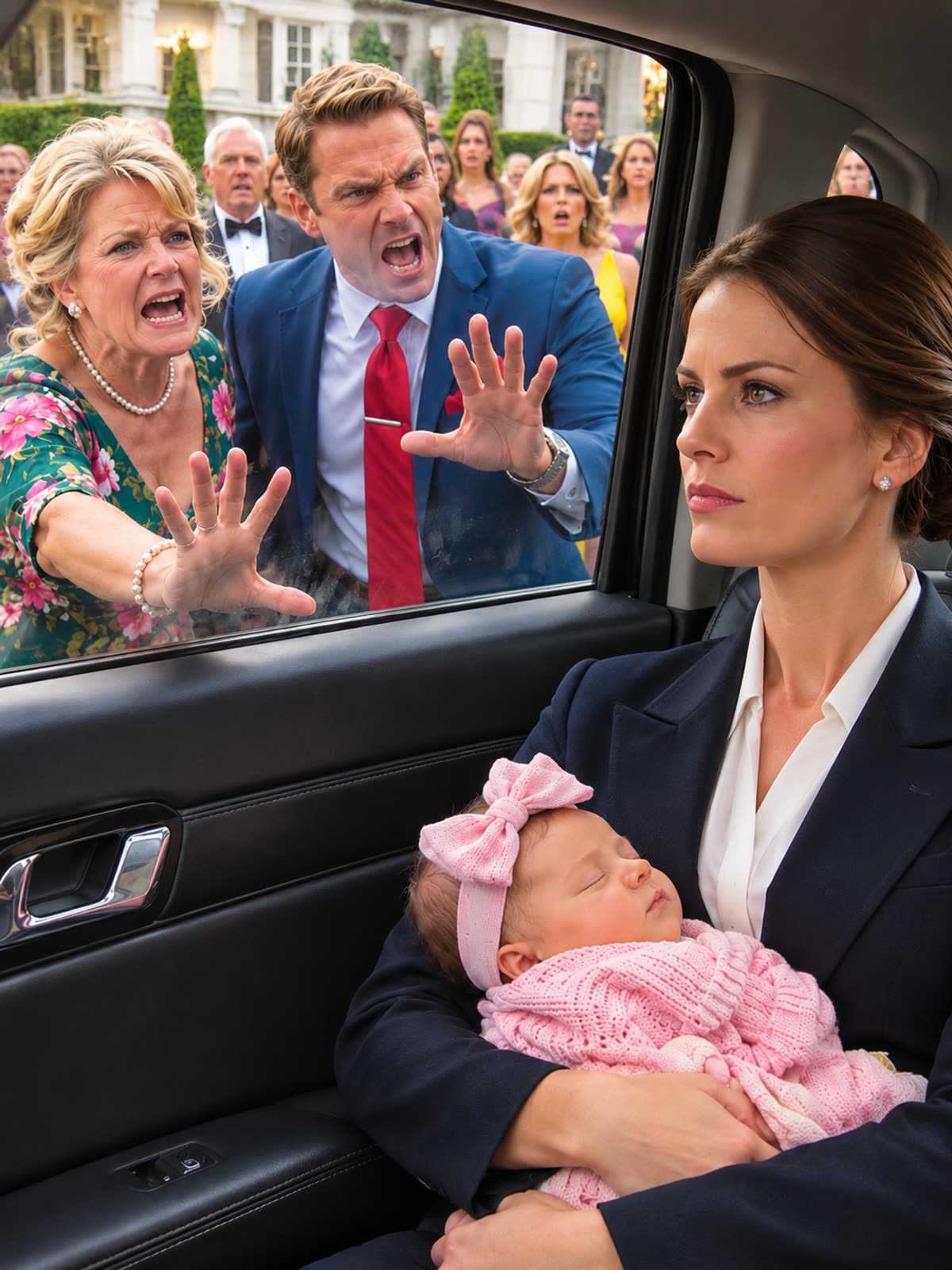
“She needs to learn her place in this family.” My mother-in-law, Margaret Pembroke, raised a little black dog collar with a gold bell dangling from it. About sixty guests laughed as she presented it as though it were an exquisite piece of jewelry. Beneath the crystal chandelier, I held my five-week-old daughter close. Margaret directed her smile at me. “Since my son was generous enough to marry you, Nora, I thought your daughter should have a reminder of where she belongs.” Laughter swept through the room again. June slept inside her pink blanket, unaware that her grandmother had turned her welcome party into a public humiliation.
I searched for my husband. Wesley Pembroke stood beside his father with his gaze fixed on the floor. He offered no objection. My name is Nora Ellis Pembroke. I was thirty-four and a senior officer in the United States Army, although almost nobody in Wesley’s wealthy family knew it. The Pembrokes lived in Myers Park, among Charlotte’s most expensive neighborhoods. Their estate featured marble floors, sprawling gardens, and a driveway crowded with luxury vehicles. I had grown up in a working-class household outside Dayton, Ohio. In Margaret’s eyes, those beginnings placed me permanently beneath her.
What Margaret didn’t understand was that my father, Colonel Thomas Ellis, had spent over thirty years in the Army. He taught me discipline, accountability, and the duty to protect anyone depending on me. I enlisted at eighteen, completed advanced command training, served overseas, and eventually accepted senior leadership responsibilities. My assignments called for discretion, so I seldom discussed them at family events. Wesley knew what I did, but he allowed his relatives to believe I worked an unremarkable government office job. He never thought it necessary to challenge their assumptions.
Margaret had mocked my upbringing for years. One Christmas, while her daughters unwrapped costly jewelry, she gave me an apron embroidered with Know Your Rank. Wesley dismissed it as harmless humor. Because I loved him and wanted our marriage to survive, I tried to overlook the insults. This time, however, she had crossed a different line. I was no longer the sole target. She had brought my daughter into it. “Put that away, Margaret,” I said. She laughed. “Oh, Nora. Don’t be so sensitive. It’s just a joke.” Then she moved toward June, the collar still in her hand.
I stepped back. “Don’t touch her.” June stirred awake and started crying. Margaret’s face tightened. “Give me the baby. You’re upsetting her.” “No.” Silence settled over the room. Margaret turned to Wesley. “Are you going to let your wife speak to me like that?” He shifted where he stood. “Mom, maybe you’ve made your point.” “Your wife is being dramatic,” she snapped. I waited for him to say something else, something that would finally defend us. He remained silent. I took out my phone and started recording Margaret, the collar, the guests’ laughter, and her continuing remarks about where my daughter belonged.
After recording what was happening, I picked up June’s diaper bag. “Where are you going?” Wesley asked. “Home.” “You can’t leave your own daughter’s party.” I met his eyes. “Your mother tried to put a dog collar on our newborn baby, and you stood there watching.” “It was a terrible joke, Nora.” “No. It was a test to see how much humiliation I would accept.” I left without shouting. After securing June in her car seat, I sent my father the unedited video. His call came almost at once. “Are you and June safe?” “Yes, Dad.”
“Send me everything. Don’t contact Margaret tonight.” I knew that voice. Dad wasn’t preparing to fuel a family quarrel. He intended to establish the facts before deciding what the situation required. The next morning, an exhausted-looking Wesley came home. “My father has called an emergency family meeting at the estate,” he said. “Everyone has to be there at noon.” I kept folding June’s blanket. “Then everyone can attend.” He paused. “Nora, there’s something else.” When I looked up, he continued. “Your father is coming too,” he said. “And he’s bringing an attorney and someone from his security team.”
For the first time since the party, Wesley appeared to grasp that his mother’s actions might lead to more than an awkward family disagreement. At noon, I returned to the estate with June asleep against my chest. Dad arrived in a black sedan with Dana Mercer, a family attorney, and Captain Rafael Ortiz, his former military aide, who now worked in security consulting. Wearing a plain navy suit, Dad kissed June’s forehead and turned to me. “Remember, Nora. We’re here to establish boundaries, not create a spectacle.” His purpose was clear, and it wasn’t revenge.
Inside, Mr. Hale, the butler, approached with visible unease. “Mrs. Pembroke has requested that everyone surrender their phones before entering.” Dad shook his head. “That won’t be necessary.” We continued into the sunroom. Nearly everyone who had attended the party was there again. Margaret sat near the fireplace in pearls and a pale-blue dress. The velvet box holding the collar lay on the coffee table. Charles Pembroke rose to greet us. “Colonel Ellis, thank you for coming. I’m sure we can resolve this misunderstanding.” Dad’s attention went directly to the box.
“Your wife tried to put a pet collar on my five-week-old granddaughter. What part of that was misunderstood?” Margaret gave a short, dismissive laugh. “Surely a military man understands that families sometimes make inappropriate jokes.” “I understand the difference between a joke and repeated humiliation.” Dad turned toward me. “My daughter has tolerated years of disrespect. Yesterday, that behavior was directed at her infant.” Margaret’s smile vanished. Dana opened her portfolio. “Mrs. Pembroke, Nora has preserved the recording. She hasn’t published it or contacted the media. She’s here because your husband requested this meeting.”
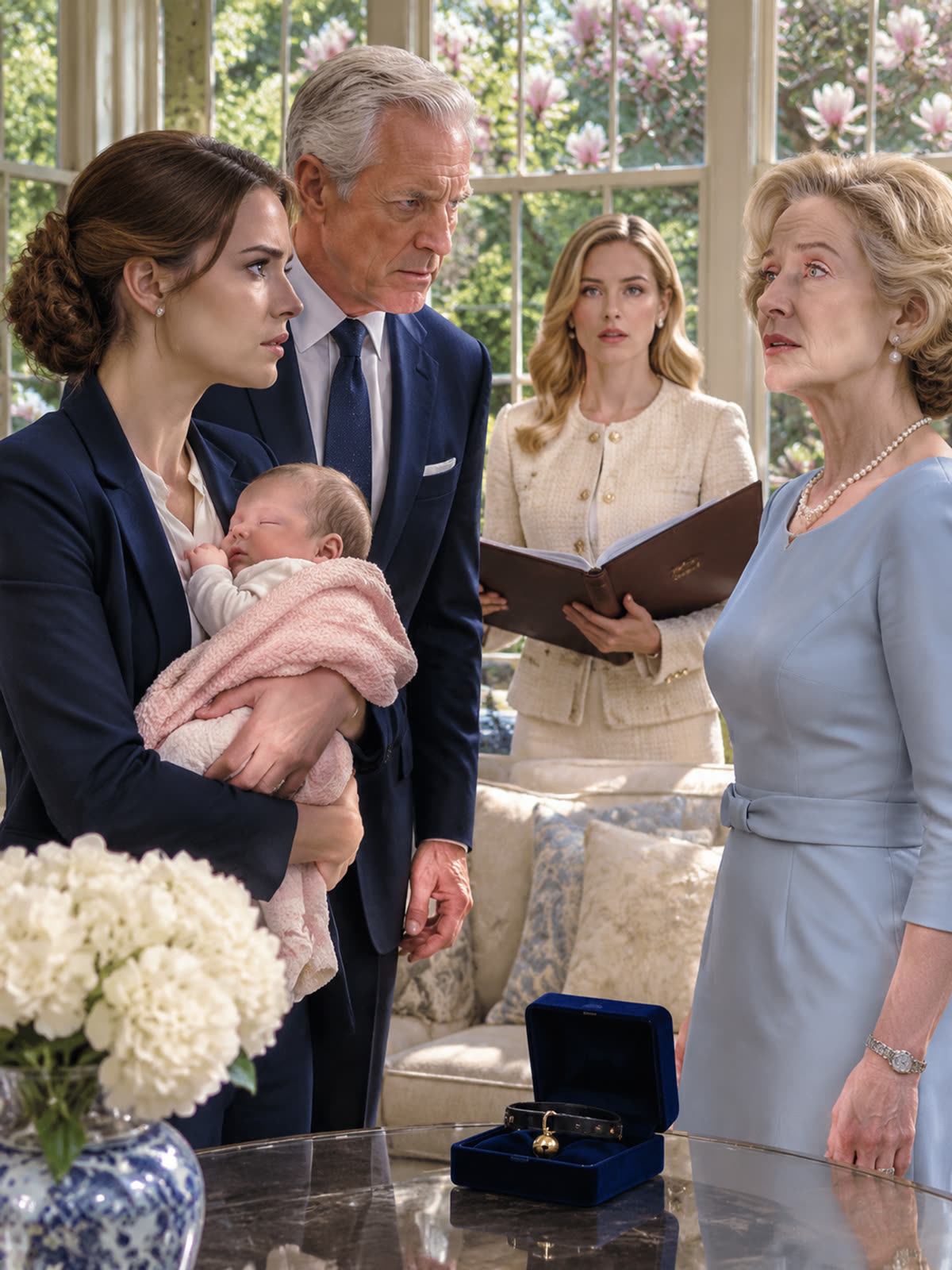
“Are you threatening me with a lawsuit?” Margaret demanded. “No. I’m explaining why everyone should take this seriously.” I moved forward. “I’ve never asked your family to admire my background or my career. I’ve only asked to be treated respectfully.” Margaret crossed her arms. “And now you’re using your father to intimidate us?” Before I could respond, Wesley interrupted. “Mom, stop.” Every face turned toward him. Looking at me, he said, “I should have defended Nora yesterday. I should have stopped those jokes years ago.” His mother stared at him as though she hadn’t heard correctly.
“Don’t apologize because your wife is making a scene.” “I’m apologizing because I failed my wife and daughter.” Charles finally intervened. “Margaret, you owe Nora an apology.” She would not give one. Dana set a document on the table describing the boundaries I was establishing. Until trust could be restored, Margaret would have no unsupervised contact with June. Degrading presents, insults about my relatives, and interference with my parenting would no longer be accepted. Margaret looked over the page. “You expect me to sign rules in my own home?”
“No,” I answered. “You can refuse. But you won’t have access to my daughter without respecting them.” She turned urgently to Wesley. “Are you choosing her over your mother?” “I’m choosing my wife and child,” he replied. “That shouldn’t be a difficult decision.” Several strained minutes passed before Margaret signed. Charles and Wesley signed as well. Then Wesley laid something next to the velvet box: the apron Margaret had given me two Christmases before. Know Your Rank. “I found this in our closet,” he said. “I kept pretending these things were harmless because admitting otherwise meant confronting my mother.”
For the first time, Margaret appeared embarrassed. Charles opened the velvet box, removed the collar, and passed it to Captain Ortiz. “Get rid of it.” Ortiz took it, but instead of throwing it away, he quietly sealed it inside an evidence bag. Dana began collecting the signed boundaries. It seemed the meeting had reached its end when Mr. Hale came closer. “Mr. Pembroke, there’s something you should know.” Charles turned toward him. “What is it?” The butler glanced at the collar. “That collar arrived yesterday morning with a delivery. Mrs. Pembroke didn’t purchase it.”
Margaret’s face lost its color. Mr. Hale continued. “There was a typed note inside the package.” “What note?” Wesley asked. Margaret cut in immediately. “It was nothing. I threw it away.” But Mr. Hale recalled a portion of it. “It said, ‘Start with the child, and she will remember who opened the door.’” An awful silence followed. With Charles’s permission, Ortiz searched the wastebasket and recovered the torn message. Dana carefully fitted the pieces together. Below the sentence Mr. Hale remembered, there was more.
Nora Ellis Pembroke was never meant to enter this family. Ask Charles what he buried before Wesley was born. I looked at my father-in-law. His face had gone completely pale. “Charles,” Wesley whispered. “What does that mean?” Charles held on to the mantel. For several seconds, no answer came. Then he looked at June. “It wasn’t what I buried,” he finally said. His voice broke. “It was who.”
PART 2 — The Sister They Erased
“Who did you bury, Dad?” Wesley waited for his father to explain. Charles lowered himself into a chair, looking drained. Across from him, Margaret clutched her armrest. “Please tell me this isn’t about Eleanor,” she whispered. Wesley turned. “Who’s Eleanor?” Charles bowed his head. “My younger sister.” In three years of marriage, I had never heard her name. Neither had Wesley. “She was eighteen when everything happened,” Charles explained. “Our father wanted her to marry someone from a respectable family. Instead, she fell in love with Daniel Reyes, a young man who worked at our property outside Asheville.”
Charles’s parents believed Daniel was beneath their daughter. When Eleanor said she intended to leave Charlotte to study art in Savannah, they threatened to cut her off. Their father then began threatening Daniel’s ability to earn a living. “Eleanor was terrified,” Charles admitted. “I was twenty-two, and I knew what our father was doing. But I was afraid of him too.” “Did she run away?” Wesley asked. “I drove her to the bus station.” Eleanor eventually married Daniel and made a home near Savannah. For nearly a year, letters arrived describing their life together.
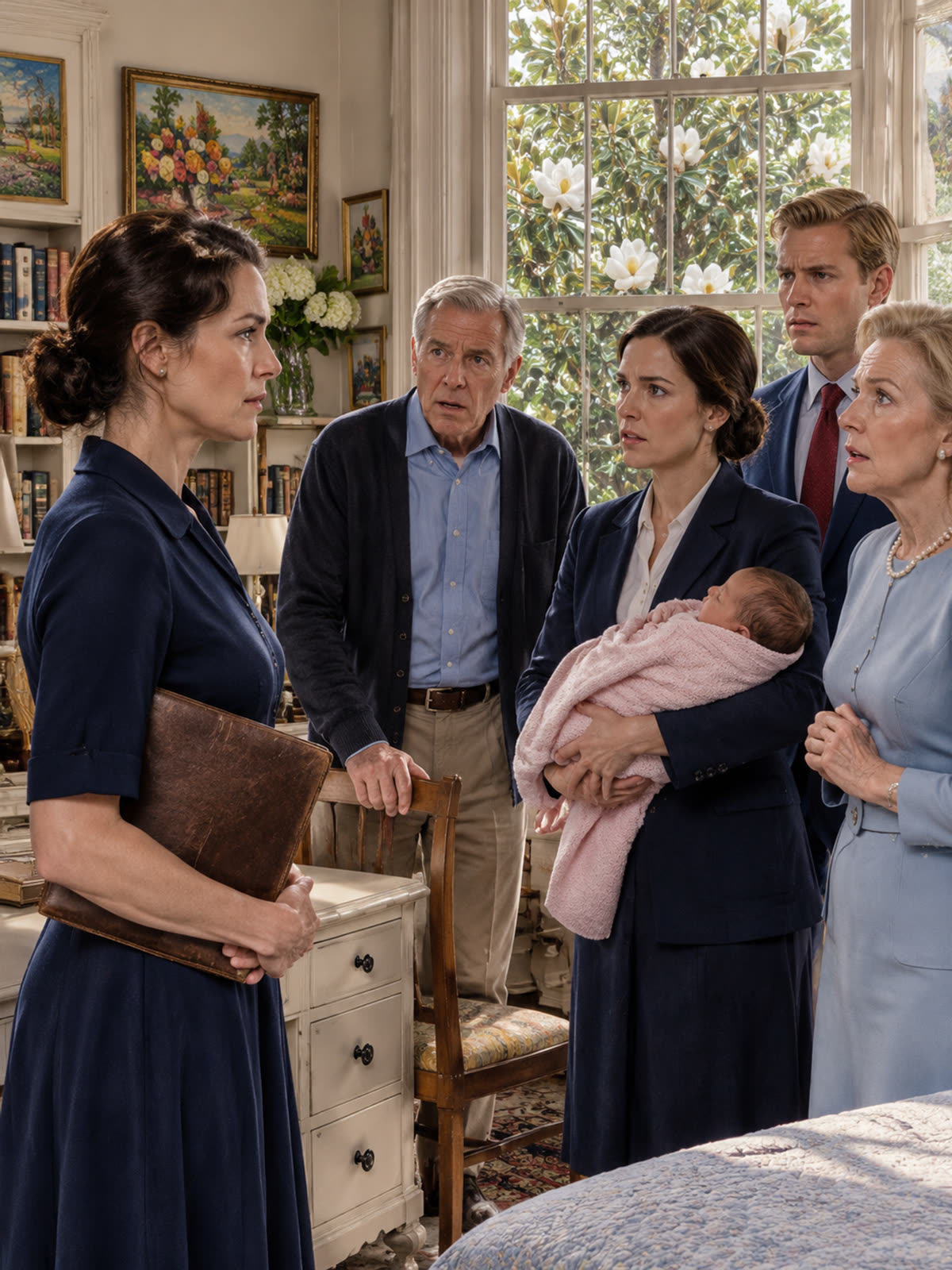
Money was scarce, but Eleanor wrote that she had never been happier. Then the letters changed. “Then she asked me for help,” Charles continued. From his pocket, he took a small brass key. “I kept this for forty years. It opens her old desk.” Margaret suddenly stood. “Charles, your father wanted those things destroyed.” “My father has been dead for seventeen years,” he replied. “I’m done protecting his secrets.” We followed him into the east wing. Mr. Hale showed us into a modest bedroom overlooking a magnolia tree.
The room was unlike the mansion around it. Simple furnishings, bright paintings, and shelves of aging books filled the space. Beneath the window stood a cream-colored desk. Charles unlocked it. Inside lay bundles of letters, a sketchbook, and an envelope bearing his name. He read the opening lines of the letter before passing it to Wesley, who began reading aloud. Eleanor said Daniel had left after their marriage grew difficult. She was caring for their six-month-old daughter alone. The child’s name was Lila. Wesley stopped. “You have a niece, Dad.” Charles covered his face. “I know.”
Eleanor needed money, identification documents, and a safe place to stay. She wanted assistance without handing control of her daughter to the Pembrokes. She had asked Charles to meet her at an old train depot on May 14. “What happened when you met her?” I asked. He shook his head. “I never went.” His father had found the earlier letters and threatened to destroy Charles’s engagement to Margaret if he helped Eleanor again. Charles had chosen his inheritance and his marriage over his sister. Three days later, Eleanor mailed one final postcard. It carried only four words: I understand now, Charlie.
Charles began to cry. Then Mr. Hale disclosed something worse. “Miss Eleanor came back that autumn,” he said quietly. “She brought her baby to the garden gate and asked to see you.” Charles stared. “You never told me.” “Your father ordered me to send her away. He said she’d made her choice.” No one spoke. For decades, Charles had thought Eleanor simply stopped trying to reach him. Now he knew she had returned with her baby, desperate enough to seek help from the family that had rejected her. Wesley looked at June asleep against me. “I almost let the same thing happen to my daughter,” he whispered.
Margaret’s eyes filled. “I knew Eleanor,” she admitted. “She once warned me not to let this family turn me into someone cruel.” She faced me. “Yesterday, I became exactly the person she warned me about. I’m sorry, Nora.” I acknowledged the apology without offering forgiveness. I wasn’t ready. Meanwhile, Ortiz had been looking through Eleanor’s sketchbook. He called Dana over after finding a folded page between the older papers. It looked far newer than everything around it. Dana unfolded it. “Nora,” she said, “this letter is addressed to you.”
My hands shook as I read. Eleanor’s daughter is alive, and she knows about June. Beneath that was another sentence. She was never the only child they tried to erase. Before I could ask what it meant, the downstairs doorbell sounded. Mr. Hale looked toward the hallway. Charles appeared frightened. “No one else was invited.” The bell rang again, and Margaret whispered a name none of us had expected. When it sounded a third time, she remained beside Eleanor’s desk, staring toward the hall. “Lila,” she whispered.
Wesley turned sharply. “How do you know who’s at the door?” “I don’t,” Margaret answered quickly. “I was only thinking about Eleanor’s daughter.” Her expression suggested she was withholding something. Mr. Hale went downstairs. Dad asked everyone else to stay where we were. Holding June closer, I struggled to make sense of the message addressed to me. A few minutes later, Hale returned with a woman in her early forties. She wore a plain navy dress, her dark hair pulled back, and held a worn leather folder.
Her eyes were strikingly similar to Charles’s. “My name is Lila Reyes,” she said. “Eleanor Pembroke was my mother.” Charles caught the back of a chair. “You’re Eleanor’s daughter?” She nodded. “And you’re the uncle my mother spent most of her life trying to forget.” Wesley moved forward. “Did you send the dog collar?” “No. I sent the letter that came with it.” I stared at her. “You knew someone intended to humiliate my daughter?” “I knew someone was planning to use your baby to send a message,” she replied. “I tried to warn you.”
Lila opened the folder and produced copies of emails. Three weeks earlier, someone claiming to represent the Pembrokes had contacted her. They asked whether she would take money to sign documents surrendering any possible claims connected with Eleanor. When she declined, the sender brought up my marriage and June’s birth. One message contained a chilling line: The newest Pembroke girl will learn the same lesson Eleanor learned. Dad studied the pages. “Who sent these?” “The account was registered under a company connected to this estate,” Lila answered.
Charles looked at Margaret. She shook her head. “I’ve never seen those messages.” Dana examined the correspondence. “Then we’ll need to establish who had access to that account.” Lila faced me. “I came because I didn’t want another little girl punished for being born into this family.” Her words affected me more deeply than I anticipated. Until then, I had seen the collar primarily as Margaret’s vicious joke. Now it was clear that someone had deliberately sent it with a message tied to Eleanor’s past.
Charles asked Lila to sit. “Where is your mother?” Her expression shifted. “She died six years ago.” He covered his mouth. “She spent years believing you didn’t want to see her,” Lila continued. “She wrote to you several times after leaving Charlotte. None of her letters received an answer.” Charles started crying. “I didn’t know she kept trying.” “That’s what she eventually told herself. That perhaps you never received them.” From another envelope, Lila withdrew a photograph of Eleanor holding her daughter outside a modest home.
On the reverse, Eleanor had written: We may not have their money, but nobody gets to decide what my daughter is worth. Margaret lowered her head. Lila then brought out another document. “This is why I came in person.” It was a copy of an old family trust agreement. Eleanor had been listed as a beneficiary before leaving home. Later, her father claimed she had willingly relinquished her share. “My mother never signed away anything,” Lila said. Dana inspected the signature. “Are you saying this document was falsified?”
“I’m saying my mother kept the original correspondence, and the signatures don’t match.” Charles looked bewildered. “My father told me Eleanor had accepted a settlement.” “She never received one.” The focus of the room shifted. What happened at June’s party was no longer the only concern. Someone had attempted to keep Eleanor’s daughter away while concealing questions surrounding a decades-old financial arrangement. Wesley turned to his father. “Who manages that trust now?” Charles hesitated before answering. “Our family’s private investment office.”
“And who has been overseeing it for the last fifteen years?” Charles looked at Margaret. She had become utterly still. “My brother,” she whispered. I thought again of the anonymous warning: She was never the only child they tried to erase. Lila reached into her folder and laid one last photograph on the desk. Margaret’s brother stood outside a hospital beside a young woman holding a newborn. A date on the back placed it twenty-three years earlier. Beneath it were three words that brought Margaret to tears: Our daughter, Caroline.
PART 3 — The Gate They Could Never Close Again
Margaret stared at the photograph of her brother, the young mother, and their baby. “Where did you get this?” she asked Lila. “My mother kept it with her letters. She believed your brother had another family he was hiding.” Margaret sank into a chair. Her brother, Robert, had overseen the Pembrokes’ private investments for fifteen years. Charles had entrusted him with the family’s finances, including the old trust their father established. “Caroline is Robert’s daughter?” Wesley asked. Margaret reluctantly nodded. “He had a relationship before he married. The woman became pregnant, and he paid her to stay quiet.”
“Did your family know?” I asked. “Charles’s father knew. He arranged everything.” Lila opened another folder. “My mother discovered the payments while trying to find out what happened to her inheritance. Robert contacted her afterward and threatened legal action if she continued asking questions.” Charles looked devastated. “So my sister was denied her inheritance, and Robert used our family’s money to silence another woman?” Dana stopped him from going further. “We need the financial records before drawing conclusions,” she cautioned. Dad agreed. “Then preserve everything and let an independent investigation establish the facts.”
In the weeks that followed, Charles brought in outside attorneys and forensic accountants to review the trust accounts. They found irregular transfers, questionable settlement paperwork, and payments linked to Robert’s former partner. The agreement Eleanor had supposedly signed underwent examination too. A handwriting specialist identified substantial discrepancies. The available records also failed to show that Eleanor had knowingly given up her interest. Charles removed Robert from his position while the investigation proceeded. Robert denied wrongdoing, but civil proceedings eventually followed over the disputed assets and financial records. Lila’s attorneys began pursuing the inheritance withheld from her mother.
The anonymous messages were eventually traced to an account used by someone working under Robert’s direction. The collar had been sent to the estate as part of an effort to intimidate me and draw attention to Eleanor’s history. Margaret admitted she had read the threatening note before the party. Instead of alerting anyone, she chose to make the collar the centerpiece of a degrading joke. “I thought I could make it seem ridiculous,” she told me. “You could have thrown it away,” I replied. “Instead, you held it up in front of sixty people and laughed at my daughter.”
She had no response. For the first time, I could see her understanding that whoever sent the package had not compelled her cruelty. That decision belonged to her. The sender had delivered the collar, but Margaret had chosen what to do with it. No explanation about the note changed the moment she held it up before those guests or the way she approached June afterward. The investigation might establish responsibility for the financial wrongdoing and the anonymous threats. It did not erase Margaret’s responsibility for what she had done in front of me.
Wesley and I started marriage counseling. He admitted that he had excused his mother for years because facing her seemed more difficult than letting me down. “I can’t undo what happened,” he told me one evening. “But I can stop expecting you to tolerate it.” I wanted to trust those words. Still, I told him plainly that apologies would not repair everything by themselves. His silence at the party had followed years of smaller silences. He understood now that allowing his mother to continue had protected his comfort at the expense of his wife and daughter.
During the following months, Wesley honored my boundaries. He stopped pushing me to attend family events and supported my decision to restrict Margaret’s contact with June. I no longer had to defend those limits against pressure from my own husband. Charles, meanwhile, began getting to know Lila. Through her, he learned about Eleanor’s years after Charlotte, the paintings she had sold, and the daughter she had raised without Pembroke money. Lila did not immediately forgive him. She did, however, agree to occasional meetings. Their relationship began cautiously, without pretending the lost decades could simply be restored.
The inheritance dispute eventually ended in a financial settlement acknowledging Eleanor’s disputed interest in the family trust. Lila devoted part of the money to a small arts scholarship bearing her mother’s name. It honored the life Eleanor had built after leaving Charlotte rather than only the wealth she had been denied. Charles continued learning about that life through Lila. Eleanor had been absent from the family’s conversations for forty years, but her daughter could finally speak about her without being dismissed. None of it returned what had been lost. It did allow something different to begin.
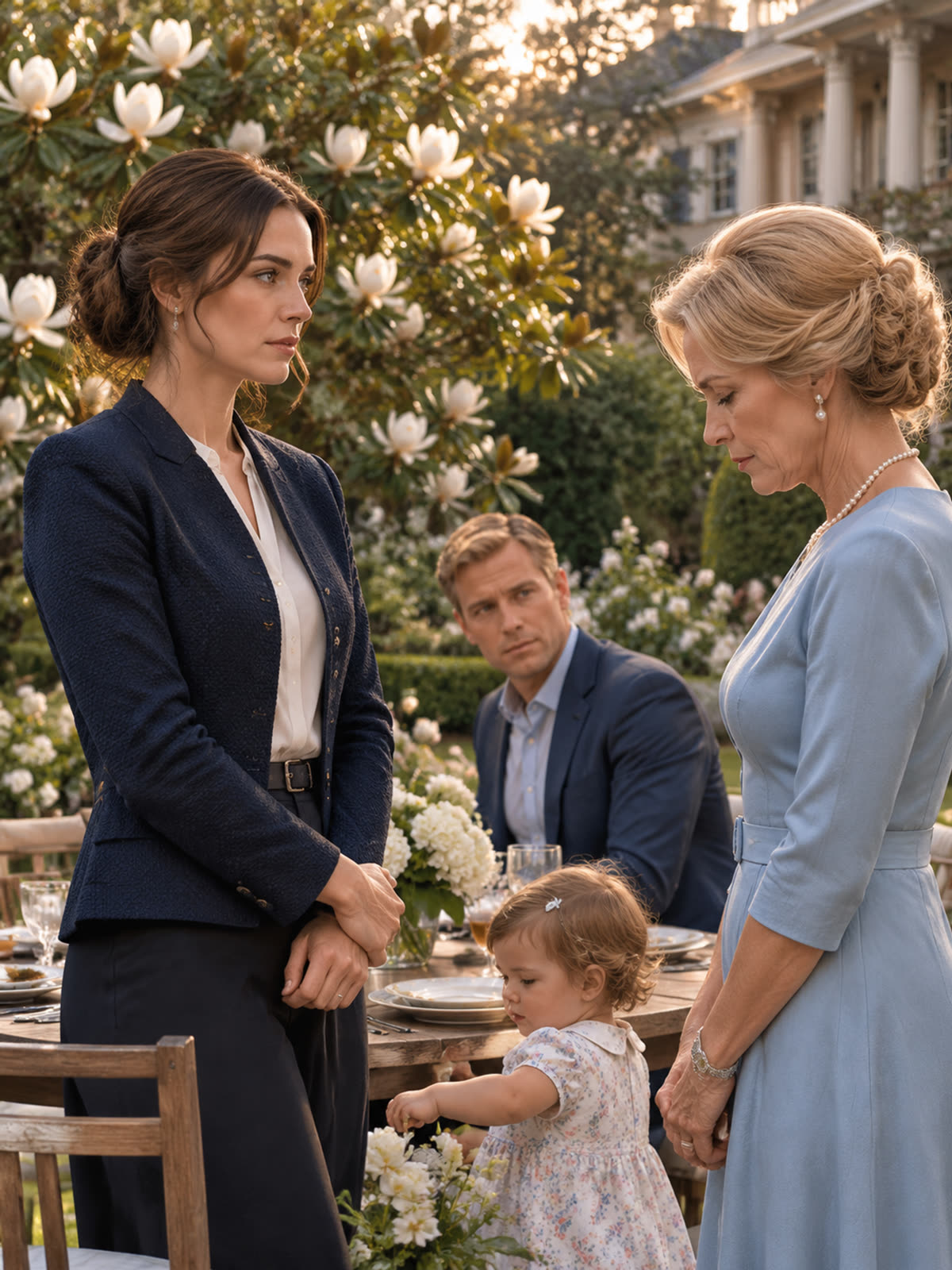
A year after June’s welcome party, Charles invited us to a quiet family gathering. This time there were no extravagant decorations and no crowd of guests waiting to be entertained. Only a few relatives sat around a table in the garden. Before dinner, Margaret approached me. “I know I don’t deserve your forgiveness,” she said. “But I want you to know I’m ashamed of what I did.” I looked toward June, who was playing beside Wesley. “Then make sure she never has a reason to feel ashamed of how her grandmother treats people.”
Margaret nodded. She did not ask me to hand June over. That restraint meant more than hearing another apology. A year earlier, she had demanded the baby while ignoring my refusal and treating my concern as an inconvenience. Now she left the decision with me. The gathering remained small and quiet, with June nearby and Wesley beside her. There was no claim that everything had been repaired, no immediate forgiveness offered in exchange for a few remorseful words. What mattered was whether the boundaries would continue to be respected.
Later, Lila joined us with a framed watercolor Eleanor had painted. A little girl stood beneath a magnolia tree, looking toward an open gate. Lila gave the painting to Charles. “My mother painted this after she left Charlotte. She called it The Way Home .” He held the frame carefully. Watching him, I thought about everything his sister had asked for and everything the family had denied her. The painting had come back to the estate even though Eleanor never had the welcome she wanted.
As the evening drew to a close, Dad stood beside me. “You handled this well, Nora,” he said. “I was terrified sometimes.” He smiled. “Courage doesn’t mean you aren’t afraid. It means you protect what matters despite the fear.” I watched Wesley lift June into his arms. Twelve months earlier, he had said nothing while his mother humiliated our daughter. Now he understood that protecting us demanded more than keeping everyone comfortable. Our marriage was still healing. Forgiveness would require time, and neither of us could bypass the work ahead.
June, however, would never have to earn her place in our family. Her value would not depend on her surname, inherited wealth, or anyone’s approval. Margaret had held up that collar intending to show my daughter that she stood beneath the Pembrokes. Instead, her cruelty had exposed the silence beneath their family history and given us a reason to break it. Nearby, Charles held Eleanor’s painting. “I wish she’d known she could come back.” Lila looked at him. “She tried, Uncle Charles. What matters now is that nobody closes that gate on another child.”
Disclaimer: This story is a work of fiction inspired by real-life themes. Names, characters, places and events are fictionalized, and any resemblance to real persons is purely coincidental. Images are for illustration purposes only.
