

PART 1 — The Children He Looked Straight Through
He crossed the courtyard as though he’d caught me trespassing in his home. It was a Saturday morning in April, and I was outside a university registration tent in Washington, D.C., holding two lanyards and a folder of permission forms. Freshly cut grass and someone’s coffee scented the air. A man shouldered through the waiting parents and stopped four feet away. “Claire?” Ten years had passed since Daniel had spoken my name in person. Gray now threaded his temples, and his camel-colored coat looked more expensive than a year of my car payments. But his stance hadn’t changed: weight resting on his left leg, one hand tucked into a pocket, as though the world was taking too long to entertain him.
Vanessa stood behind him—the woman he had left me for. Her costly blowout, rigid posture, and easily removable smile were familiar. There were fine lines beside her eyes, and noticing them made me feel immediately petty. Beside them waited a boy of about thirteen in a navy blazer with a gold crest. His academy was the sort of place whose tuition exceeded the price of my first house. Mason. I recognized him instantly. Pictures reach you even when you aren’t searching for them. Daniel’s surprise lasted perhaps two seconds before becoming something uglier. “What are you doing here?” Before I could answer, Vanessa joined him. “This is a private academic event,” she said. “It’s a national invitational,” I said. “There are teams here from thirty-one states.” Daniel glanced around, worked his jaw, and lowered his voice. Somehow that was worse. “How dare you come here today.”
Several parents turned. A woman in a red raincoat froze with her coffee halfway to her lips. Six feet behind me, my twins stood on the grass wearing their competition badges. Daniel either hadn’t noticed them or had seen two teenage boys in navy jackets without recognizing his own sons. That was what lodged beneath my ribs: he was looking past his children so he could resent my presence. Practice kept my voice level. “I’m here for my children,” I said. He actually laughed. “Your children?” His gaze barely touched the boys. “You brought them to this?” “Yes,” I said. Vanessa crossed her arms and finally studied them. “Daniel said you had twins,” she said. “I just didn’t realize…” She stopped. She hadn’t understood they were competitors. Daniel examined the plain jackets, the Cedar Grove Middle School embroidery, their named badges, and the confirmations in Owen’s hand.
“Claire,” he said. “This weekend is extremely important to Mason.” “It’s important to Eli and Owen too.” His expression tightened. “Whatever you’re still carrying about the past,” he said, “don’t make today about that.” Thirteen years crowded into my mind. Birthdays and Christmases. Reading lessons and bicycle rides in the church parking lot. Teeth tucked into labeled plastic bags so the Tooth Fairy wouldn’t confuse them. Owen breaking his arm after climbing onto the garage to “test the gutters.” Eli missing the travel soccer roster. Owen crying over Kaylee’s remark about his ears. Both boys working past midnight on their fifth-grade science fair display. Conferences attended alone, simultaneous stomach flu, orthodontist payments, and a hundred and forty spelling tests. Two children becoming young men—and Daniel imagined I’d driven six hours because I still wanted him.
I nearly laughed. Instead, I spoke softly. “Daniel. I didn’t know you were going to be here.” His face shifted. “I’m not here for you,” I said. “I haven’t been here for you in thirteen years.” Then I turned. “Come on, boys,” I said. “Registration closes in ten minutes.” We crossed the courtyard without looking back. Near the auditorium, Owen leaned toward me. “Mom.” “Yeah, honey.” “That was him. Wasn’t it.” I knew precisely what he meant. “Yes.” Eli looked over his shoulder. “Our father,” he said. “Yes.” Neither spoke again. But as we entered, I understood something Daniel and Vanessa didn’t: they had no idea what the next thirty hours would bring. To understand why that mattered, you have to understand how little he knew about the lives standing behind me.
People picture marriages ending with smashed plates, shouting, or clothes tossed through upstairs windows. Mine ended beside an envelope on a kitchen table. Daniel and I had been married six years. When we met, he was twenty-seven, funny, inquisitive, and ambitious without yet being consumed by it. He could vanish inside a secondhand bookstore for three hours. Crosswords, presidential biographies, and late-night documentaries fascinated him, especially those deep-sea creatures carrying lights on their heads. “Look at this one,” he’d say, pointing at the TV at one in the morning. “Look at it, Claire. It’s got its own flashlight. It lives in total darkness and it just made its own light.” I loved that curiosity, not his hunger for success. Our first home was a third-floor Columbus apartment without an elevator. Opening the refrigerator blocked the dishwasher. For eight months, we ate frozen pizza on the floor because we had no table. We were genuinely happy.
Then his consulting career accelerated. I never completely understood management consulting; companies paid him handsomely to explain what was wrong with them, and he excelled at it. Promotions brought money, a house, a proper kitchen, and a dining table. Business dinners became conferences, then trips to Singapore, London, and São Paulo. My pride in him helped me overlook what deserved attention. His phone acquired a new password. Messages arrived at eleven, and he turned the screen facedown. There were five-hundred-dollar shirts, a gym membership, unfamiliar cologne, and sudden irritation with habits he’d once liked. “Do you have to load the dishwasher like that?” “You’re wearing that to the dinner?” “Can you not hum while you read? It’s distracting.” I had hummed over books since we met. He used to find it endearing.
Vanessa worked in his division. She was twenty-eight, polished, and excessively friendly whenever we met at company functions. At the Christmas party, she embraced me beside the coat check. “Claire! I love your dress. Daniel talks about you all the time.” Her hand remained on my arm slightly too long. That exaggerated warmth should have warned me, but I blamed insecurity and exhaustion. Around then, after almost two years of trying, I discovered I was pregnant. Those years had revolved around thermometers, ovulation strips, refrigerator calendars, and the same monthly disappointment in the same bathroom. Once, sitting on that bathroom floor, we’d discussed how much more either of us could bear. Then, one July morning, two pink lines appeared. Celebration frightened me. My doctor wanted another appointment before I shared the news; after fertility difficulties, an early pregnancy could be fragile. I waited three weeks without telling anyone, even Daniel. I wanted certainty before putting hope into his hands.
At the second appointment, the technician guided the wand over my stomach, fell quiet, then smiled. “Well,” she said. “There are two.” “Two what?” “Two heartbeats,” she said. “You’re having twins.” The ultrasound picture occupied the passenger seat all the way home. At every red light I smiled so broadly that a man in a neighboring pickup stared. I planned lasagna with the good ricotta, Daniel’s favorite. The picture would go into a little white box tied with blue ribbon. I believed those were the gestures people made when a happy life was about to become happier. But Daniel was already at the kitchen table when I arrived. No jacket, laptop, or phone. The missing phone unsettled me most; he hadn’t willingly put it down in two years. A sealed manila envelope lay before him. “I need to talk to you,” he said.
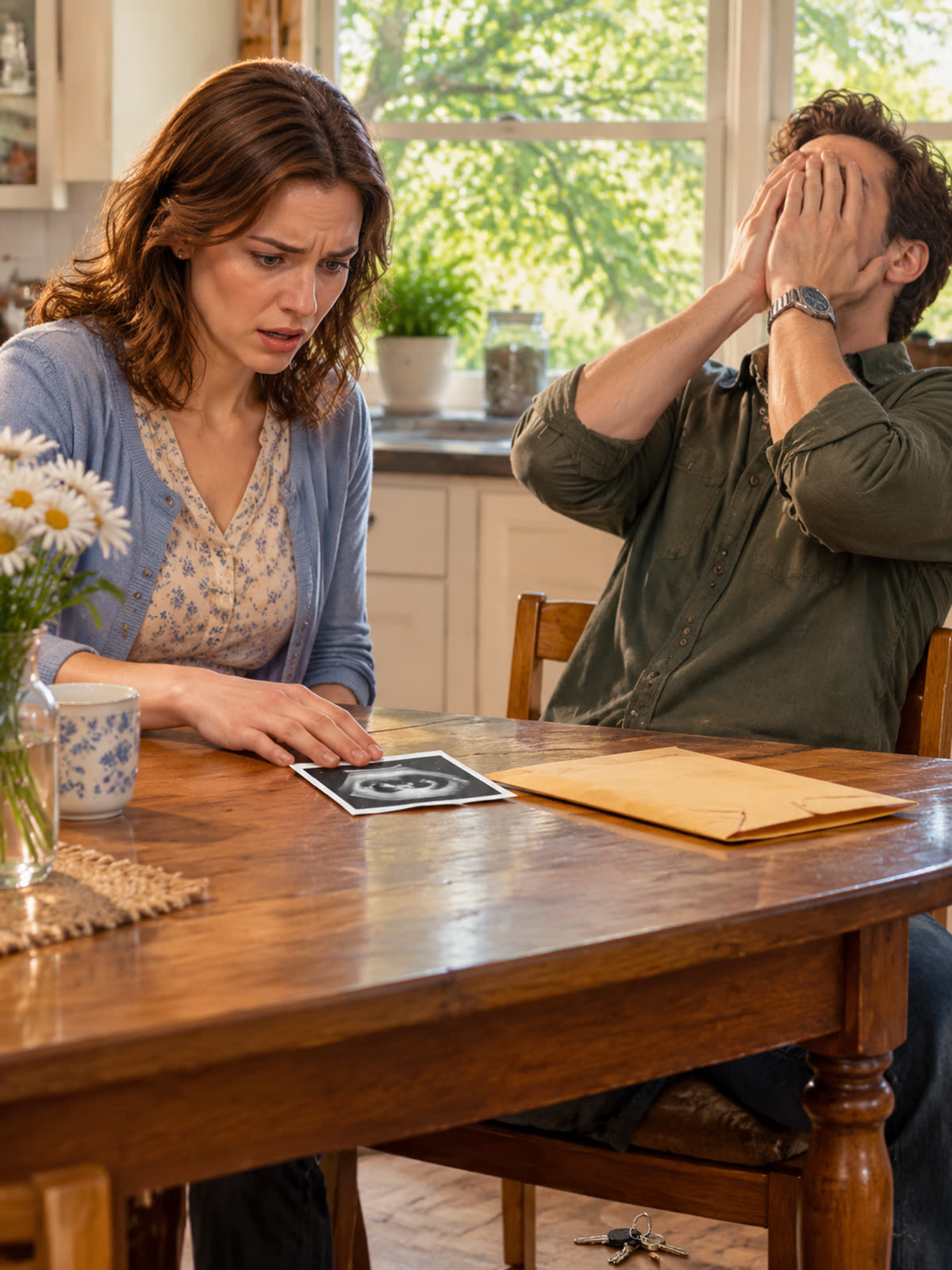
My body understood before my thoughts caught up. My knees weakened, and I sat. He avoided my eyes. “There’s someone else,” he said. I stared. “It wasn’t supposed to happen,” he said. “Vanessa,” I said. His silence confirmed it. “How long?” “Several months.” While I scheduled vitamins, rearranged appointments around his travel, and prayed over my steering wheel in the hospital garage, my husband had been constructing another life. Then he finished extinguishing my hope. “Vanessa is pregnant,” he said. I couldn’t remember how to breathe. Finally, he looked up. “I’m sorry, Claire.” My shaking hand fumbled inside my purse. My keys fell and slid beneath the table; neither of us retrieved them. I placed the ultrasound beside his envelope, forgetting the box and ribbon. “What’s that?” “I went to the doctor this afternoon,” I said. His face drained. “I’m pregnant too.” He looked between me and the photograph. “Twins,” I said. For one second, something moved in his eyes: shock, fear, perhaps even a spark of joy. Then it vanished. He leaned back and covered his face. “This can’t be happening,” he said.
Those were his first words about our children. Not a question about their health, not shared wonder, not even an admission of fear. Only disbelief that they could exist. During the following months, he tried to explain. On Sunday afternoons he sat at the kitchen table, drank coffee I prepared, and described his confusion, his mistakes, and how much he still cared. I think he believed that last part. But we always arrived at the same question. “Are you leaving Vanessa?” I’d ask. Silence. And then, finally: “No.” She was four months further along than I was. He had already moved into a downtown apartment with her before our conversation. The envelope contained separation papers. He said he intended to act responsibly. “Responsible to whom, exactly?” I asked him. He had no answer.
One September Sunday, across that same table, he gave me a sentence I have never forgotten. “Claire,” he said. “I can’t live two lives.” I rested a hand on my stomach. “You already made two,” I said. He promised money, visits, and a way forward. Promising is simple when children remain indistinct shapes on glossy paper. Mason arrived in November, and Daniel attended the birth. Online photographs showed Vanessa in a hospital bed with perfect hair, cradling a white-wrapped baby while Daniel leaned over them, radiant. My sons arrived four months later, in March: Eli at 6:10 a.m., Owen at 6:14. My mother had driven down from Dayton two weeks beforehand and slept on my sofa so she wouldn’t miss it. She held my hand throughout the delivery. Daniel arrived the next afternoon.
He stayed forty-seven minutes. I know because I watched the hospital clock the entire visit, something I had never admitted to anyone. He held Eli for roughly five minutes and Owen for fewer. Then Vanessa called. Mason had a fever. Daniel returned Owen to my arms. “I should go,” he said. My day-old baby had curled his little fist around my finger. “You just got here,” I said. “I know. I’m sorry.” Those words became his entire language with me. Over the next three years, I heard them dozens upon dozens of times. At three months, the boys saw him twice. At six months, once. Their first birthday brought matching stuffed elephants ordered online, with a packing slip reading Gift from Daniel M. Their second brought a card signed To the boys. Love, Dad. The handwriting wasn’t his. I suspected his assistant.
On their third birthday came a bank transfer and a text: Happy bday to the guys. After that, lawyers and automated deposits handled everything. He never contested custody because he never requested any. I need that understood: I did not keep my sons away from their father. There was nobody to keep them away from. He stopped arriving. By five, their father was a photograph tucked beneath sweaters in my dresser, and I had stopped expecting him to become a man he had plainly chosen not to be. Raising twins alone wasn’t heroic. People like to hang a halo over single motherhood, but most days the truth was exhaustion. When they were two, I moved us to Cedar Grove, Pennsylvania, about an hour west of Harrisburg. Houses were cheaper, my mother was closer, and our small brick ranch on Hollis Street had a great oak in front and a basement that flooded every April.
I processed claims at an insurance office downtown. At eleven at night I packed lunches, dug library books from sofa cushions, and removed Cheerios from places cereal should never reach: a VCR, a shoe, once the dog. Two children somehow needed six shoes while only three could ever be found. Money occasionally tightened—not dangerously, but enough to return groceries to the shelf and pretend I’d simply reconsidered. My mother watched them two afternoons each week until illness stopped her when they were seven. She died when they were eight. Eli read a poem he had written at her funeral. Owen made her a birdhouse, and we placed it on her grave. What I guarded most fiercely was the feeling inside our home. Nobody waited for another person’s temper to shift. Nobody crept around or wondered whether Dad would appear for dinner.
Our house was noisy and untidy. Tuesdays meant spaghetti, Fridays meant tacos, and board games sometimes ended with someone stalking away. But we were safe. The boys had been distinct from the beginning. Numbers drew Eli. At six, he wanted to understand why multiplication worked—not how, but why. “Why does three times four equal four times three?” he said, at dinner, with a meatball on his fork. “Why does it go both ways? Subtraction doesn’t go both ways.” I couldn’t answer. After bedtime, I sat at the kitchen table researching the commutative property. The following morning, I explained it over cereal. He considered my explanation with great seriousness. “That’s what I thought,” he said. By eight, he was working through logic puzzles intended for high school students. He wasn’t performing for anybody. He simply wanted things to make sense.
Owen wanted to discover what things could become. He assembled radios, popsicle-stick bridges, and machines built from dismantled toys. At seven, he converted a remote-control car into a lawnmower for the patch of grass outside his Lego village. When he was ten, our toaster stopped working. One Saturday I found him sitting on the kitchen floor with a screwdriver, surrounded by about forty pieces. “What are you doing?” “Diagnosing it.” “You’re ten.” Without looking up, he answered, “That doesn’t mean the toaster knows,” he said. That was Owen distilled into one sentence. He repaired it, too. It still works, though it only browns one side. Neither boy considered himself extraordinary. They were interested in the world, and nobody had instructed them to stop being interested.
I didn’t demand first place. I asked them to finish what they began. Good grades earned praise for the effort before the result. Losing came with permission to feel disappointed. Winning came with a reminder to thank the teacher who had helped. Their father wasn’t the organizing principle of our days. There was homework, dinner, shoes to locate, and an endless succession of ordinary problems requiring ordinary answers. Still, I knew curiosity would eventually turn toward the empty place in their history. When they asked, I intended to be truthful without sharpening that truth into a weapon. I could not make Daniel present, but I could refuse to let his absence tell my children what they were worth.
Eli asked first. He was nine. It was a Tuesday, and we were on the sofa watching a program about volcanoes. Nothing dramatic had happened that day. There had been no warning that the question I’d rehearsed answering would arrive between television segments. Then a commercial began, and he turned toward me. “Why doesn’t Dad ever visit?” Eli said. I switched off the television. Whatever I said next would have to explain a grown man’s absence without letting either child mistake it for his own fault.
PART 2 — Before There Was a Medal
I settled between them on the sofa. “Your father made choices about how he wanted to live his life,” I said. Owen’s voice was quiet. “Because of us?” “No,” I said. That answer had to be unmistakable. Nothing else mattered as much. “Sometimes adults make selfish decisions,” I said. “Those decisions belong to the adult who made them. They don’t belong to you. Not ever. Do you understand me?” Both nodded. Eli studied his hands. “Does he have another kid?” he said. “Yes.” “Mason?” That surprised me, though it shouldn’t have. They had searched online. Children eventually find what adults imagine is hidden. “Yes,” I said. “Does he live with him?” “Yes.” Owen remained silent for a long while. Then he asked, “Does Mason know about us?” “I don’t know, honey.” It was the truth, and somehow the hardest answer.
For days afterward, I looked for damage. I watched breakfast and dinner, listened outside their bedroom, and wondered whether something inside them had shifted. But children are sturdier than adults sometimes remember. Within a week they were absorbed in baseball, homework, and disputes over the final cookie. Daniel became part of their history rather than the center of their lives. Keeping him there took work, and I would do that work again. In seventh grade, their science teacher suggested the academic team. Mr. Reynolds was around sixty, with a gray mustache, glasses hanging on a cord, and a cardigan he wore even in June. He had taught at Cedar Grove Middle for thirty-one years. “Your boys,” he told me at a parent-teacher conference, “are wasted on worksheets.” “What does that mean?” “It means they’re bored, Ms. Bennett. And bored kids either get into trouble or stop trying. I’d like to give them something else to do.”
Cedar Grove wasn’t a school with much money. Practices took place after classes in Mr. Reynolds’s room, beneath stained ceiling tiles, on mismatched chairs. The buzzer equipment was older than its users. He had repaired it at least four times with black electrical tape. “It’s fine,” he’d say whenever it shorted out. “It just needs encouragement.” A solid slap to the control box generally revived it. What the school lacked in equipment, Mr. Reynolds supplied in belief. You couldn’t counterfeit the faith he had in those students. They competed in math, science, literature, history, and logic. Eli became the team’s strongest mathematician by a considerable margin. Owen flourished in science and engineering. They won districts, then January regionals in a Lancaster high school gym, then the state qualifier. Their confidence grew from doing the work, not from being told they ought to win.
One February evening in eighth grade, they burst through the front door hard enough to threaten its hinges. “MOM!” Owen waved an envelope overhead. “We made nationals!” The National Junior Scholars Invitational meant three April days at a major Washington university, with hundreds of students, team matches, individual contests, timed examinations, an engineering challenge, and a championship quiz on the final afternoon. I held them until they protested. Then I sat down with a calculator and spent the next two months working out how we could afford it. Our town answered. Teachers organized a spaghetti supper in the cafeteria. Hartley & Sons, a local engineering company, contributed toward travel. Parents baked, children washed cars in the church parking lot, and we sold raffle tickets outside Giant Eagle through three consecutive rainy Saturdays.
A man wearing a fishing hat bought forty dollars in tickets, then handed them back. “I don’t need a gift basket,” he said. “I need those kids to beat the private schools.” By April, we had raised enough. Mason never entered our conversations. I vaguely knew he attended an expensive Virginia academy because I’d once seen it on Daniel’s social media. Whether he competed in anything was a mystery. So when I first spotted Daniel by the campus entrance, I blamed the six-hour drive for making me imagine things. Then Vanessa came into focus. Then Mason. Above the registration tent hung the sponsors’ banner: THE MERCER FOUNDATION FOR ACADEMIC EXCELLENCE. Of course. In thirteen years Daniel had built Mercer Strategic into a consulting firm with offices in three cities. He had also built a public reputation for supporting children’s education.
Scholarships, grants, and a generous annual check for a national contest. Other people’s children benefited from the image he had carefully cultivated. The irony was too complete to be amusing. That was the banner above the courtyard where he demanded to know why I had come, the banner under which he looked past his sons. After registering, I hoped we could retreat into the event and leave the encounter behind. The boys had teammates, schedules, and real work to concentrate on. I had come to watch them, not to untangle Daniel’s preferred version of his life. But a shared campus, a packed competition, and two families connected by something one household had ignored were not going to remain neatly separated simply because I wanted a peaceful weekend.
The twins joined their Cedar Grove teammates, their plain navy jackets carrying no promise of money or influence. Their preparation lived in the hours spent in Mr. Reynolds’s classroom, the problems worked through, and the questions they had learned to ask one another. Around us were parents, teachers, and competitors from across the country. The national stage was bigger than anything their school usually encountered, but the boys had earned their places. I tried to keep my attention there. Daniel’s astonishment didn’t change their registration confirmations. Vanessa’s opinion couldn’t undo their state qualification. Still, seeing the foundation’s name made it impossible not to think about how much effort he had devoted to being publicly generous while remaining privately absent.
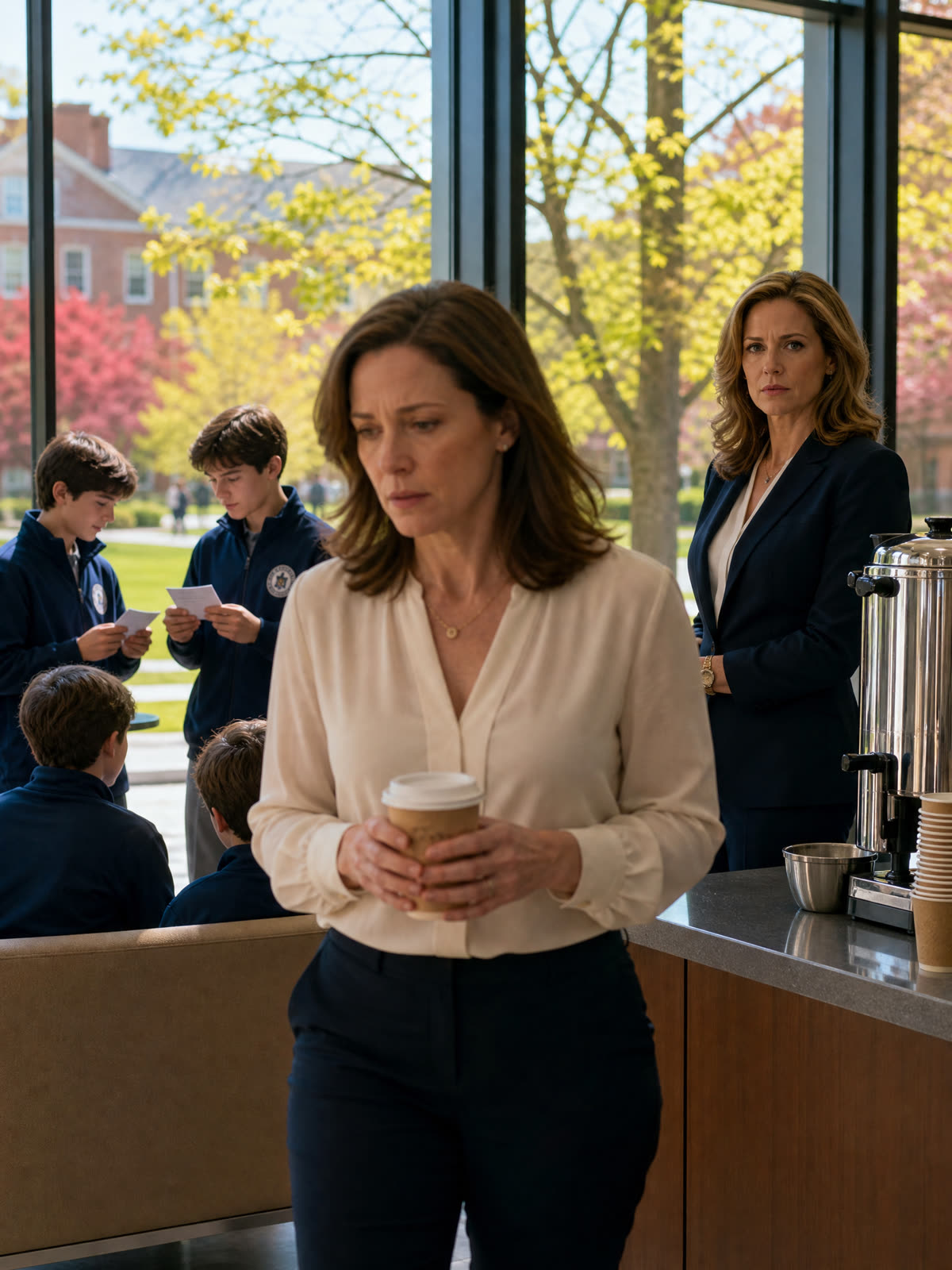
The first break brought coffee and the small movement of families between competition rooms. I found the refreshment tables and began filling a cup from a large silver urn. Vanessa approached before I could leave. “Claire,” she said. “I hope you can understand why Daniel reacted the way he did.” I continued pouring. “I really can’t,” I said. “This weekend means a great deal to Mason.” “I’m sure it does.” “He’s been preparing for almost a year. He has a private coach.” “My sons have been preparing too,” I said. “They have Mr. Reynolds and a buzzer held together with tape.” Her gaze moved beyond me toward the windows, where Eli and Owen were eating granola bars with their teammates and testing one another with flashcards.
This time she studied them rather than simply noticing their existence. I watched recognition work its way across her face. There was Eli’s jaw, the placement of Owen’s eyes, and Eli’s habit of smiling on only one side of his mouth—the same smile Daniel had worn at twenty-nine. Family resemblance is inconvenient when people have arranged their lives around pretending a family never happened. Vanessa looked away. “Mason’s academy is expected to win,” she said. “Then good luck to him,” I said. “I mean that.” My sincerity appeared to irritate her more than an argument would have. I had no wish for a thirteen-year-old to suffer because of choices made before he was born. If she needed me to resent Mason, she had misunderstood me as thoroughly as Daniel had.
“I just don’t want any unnecessary drama this weekend,” she said. “Then we’re in complete agreement.” I lifted my coffee. “I came to watch my kids compete, Vanessa,” I said. “Whatever story you and Daniel have been telling yourselves for thirteen years is entirely your business.” Then I left her beside the refreshments. My hands trembled, and I hoped she hadn’t seen. Beyond her, by the window, the boys were still absorbed in their flashcards. Nothing about their easy concentration suggested they understood how hard their mother was working merely to hold a cup steady. I wanted them to have their competition without inheriting the adults’ bitterness. Walking away was the only useful thing I could do.
Mason deserves to be described fairly. He was genuinely talented: quick, prepared, and gracious when he missed an answer. He would nod, make a note, and tell the student who got it right “good one”. Nothing that had happened among the adults belonged to him. His academy won literature outright and performed strongly in history. Daniel sat near the front, applauding loudly whenever Mason answered correctly. Vanessa recorded every round. I sat ten rows farther back with Cedar Grove’s parents. Our students had no matching academy blazers, professional coach, or family foundation on the banner. But they were fearless. No one seemed prepared for that. They weren’t apologizing for the school they represented, and they weren’t intimidated by the resources available to the teams sitting opposite them.
Eli took the individual mathematics semifinal by a single point, thanks to a geometry question about a cone inside a cylinder that still means nothing to me. Owen assembled a functioning water filter in nineteen minutes using sand, gravel, charcoal, two plastic bottles, and a coffee filter. It earned the engineering challenge’s highest score. Dirty water went into the top; clear water emerged below. One judge actually said “wow” aloud. By Saturday evening Cedar Grove stood second overall, behind Mason’s academy. The championship was scheduled for Sunday afternoon. We took the whole team to a burger restaurant two blocks from the hotel. Mr. Reynolds bought milkshakes for everybody and instructed them not to tell the parent volunteers. For a little while, it was simply a table full of children who had accomplished something difficult.
Eli hardly ate. “Nervous?” I asked. “A little.” Owen pushed a fry into ketchup. “I hate that he’s here,” Owen said. “Your father?” He nodded. “He keeps watching us now. In the rounds. Like, staring.” Then Eli said, “I think he figured it out.” “He already knows who you are, sweetheart.” “No.” Eli looked up. “I mean I think he figured out we’re actually good.” I wasn’t ready for how that hurt. My son wasn’t asking for Daniel’s approval. He was recognizing his father’s surprise. At thirteen, he understood that Daniel had expected little of him. I flattened both hands on the table. “Listen to me,” I said. “Both of you. Tomorrow has nothing to do with that man.” They looked at me. “You do not have to prove he made a mistake. You don’t have to prove you deserved his attention. And you absolutely do not have to beat Mason to make some point about our family.”
Owen frowned. “Then what are we supposed to do?” “What you came here to do.” Eli offered a small smile. “Win?” “Your best,” I said. Owen grinned. “So… win.” “Eat your dinner, Owen.” Later, I couldn’t sleep. They were out within ten minutes, Eli murmuring about prime numbers and Owen sleeping with one foot beyond the mattress. I stood by the window and watched the city lights. Perhaps Daniel was awake across town. Perhaps he was sleeping perfectly well. I remembered forty-seven minutes on a hospital clock, an ultrasound beside an envelope, the unused blue ribbon, and the lasagna I never made. Then I remembered the fishing hat and the rain outside Giant Eagle. I need those kids to beat the private schools. I laughed softly into the darkness, careful not to wake my sons, and finally went to bed.
Sunday’s final filled the main auditorium. Parents occupied every seat, teachers lined the walls, and aisle cameras streamed the contest. Someone’s grandmother carried a hand-painted sign. Four finalist schools sat behind long tables onstage, each student supplied with a new buzzer that required no encouraging slap. Just before the start, Daniel came down my row and bent beside my seat. “I know those boys are Eli and Owen,” he said. I looked up. “Congratulations,” I said. His face tightened. “You could have told me.” “Told you what?” “That they were doing this. Any of this.” Getting the words out was difficult. “Daniel,” I said. “You haven’t asked me one single question about them in ten years.” He straightened. “That’s not fair.” “No,” I said. “Fair would have been them having a father.”
He noticed nearby listeners. “Not here,” he said. “You started this conversation.” The lights dimmed, and I turned toward the stage. “Go sit with your family,” I said. After a moment, he left. Cedar Grove slipped behind early, trailing by twenty after the opening section. Even from ten rows away, I could see Mr. Reynolds’s bouncing leg. Owen missed a periodic-table question he certainly knew, shook his head, and struck the table in frustration. Then he answered three science questions consecutively. Eli followed with a double-value probability problem none of the other teams attempted. Priya, his teammate, seized his arm and shook it when the moderator confirmed the answer. With five questions remaining, the teams were level. My hands wouldn’t stay still, so I sat on them.
Mason reached the first buzzer and answered correctly. His academy moved ahead. Owen took the second question for Cedar Grove, bringing them even again. On the third, nobody buzzed. Eight silent seconds passed—I counted them—before the moderator supplied the answer and the room groaned together. Mason buzzed on question four. Wrong. The five-point penalty left his academy five behind. Across the aisle, Daniel pressed both hands over his mouth. The final question appeared: a logic problem with four conditions and a diagram of boxes and arrows on the large screen. The moderator read it aloud. Thirty seconds. Twenty. Ten. Eli leaned toward Owen and whispered. Owen answered quietly. Eli shook his head. Owen pointed at the screen. Five seconds remained. Then Owen struck the buzzer.
“Cedar Grove,” the moderator said. Owen leaned into the microphone and gave his answer. Silence settled across the auditorium. The moderator checked his card, lifted his head, and smiled. “Correct.” Nobody moved for a full second. Then our section erupted. Mr. Reynolds sprang up so violently his chair crashed backward. Parents screamed. The grandmother waved her sign. A stranger grabbed my arm and shook it. I covered my face and cried in front of four hundred people. A public middle school that practiced with a taped-together buzzer had won a national championship. Yet the afternoon still held something bigger for our family. After presenting the team trophy, the organizers began the individual awards. Mathematics came first: bronze, then silver, awarded to students from Texas and Oregon.
“And the gold medal for individual mathematics,” the announcer said, “goes to…” Somehow I knew before he finished. “Eli Bennett, Cedar Grove Middle School.” I made the loudest noise of my life. Eli approached the front of the stage with red ears and an embarrassed grin while his teammates celebrated behind him. They placed the gold medal and blue ribbon around his neck. He searched the audience—not for Daniel, but for me. Finding me in row eleven, he raised the medal slightly, just enough to make it ours. Science and engineering followed. Bronze. Silver. Beside his brother’s empty chair, Owen waited. Then the announcer spoke again. “And this year’s gold medal goes to Owen Bennett, Cedar Grove Middle School.”
PART 3 — The Photograph He Hadn’t Earned
Owen’s mouth dropped open. He remained at the table as though someone had disconnected him. Eli caught the back of his jacket and practically propelled him toward the front, making the audience laugh. Two brothers, two gold medals, and their mother crying in row eleven so hard she could scarcely see. Across the aisle, Daniel’s face had turned a deep red. Vanessa’s was almost purple. Neither applauded. Mason did. He stood beside his chair and clapped enthusiastically for the boys his parents had treated all weekend as unwelcome intruders. That mattered to me then, and it matters now. The announcer asked the medalists to remain for photographs. Eli draped an arm around Owen, and they lifted their medals together. I reached for my phone.
Daniel stepped into the aisle. For an instant I assumed he was coming toward me, but his destination was the stage. I stood. “Daniel.” He stopped. “I want a picture with them,” he said. I stared. “A picture.” “They’re my sons.” There it was. Not congratulations, not a wish to know them, not even a desire to tell them he was proud. A photograph. Thirteen years of absence, and he wanted proof of connection. Perhaps it was for himself, perhaps his foundation’s website, perhaps the watching audience that could now compare the resemblance onstage with the name on the banner. I couldn’t know. But Eli had heard. Still wearing his medal, he descended the side steps, walked up the aisle, and stopped before the man who had supplied half his DNA and almost none of his time.
Daniel offered an uncertain smile. “Eli,” he said. “You were incredible up there.” “Thank you.” “I’m proud of you.” My son studied him long enough that Daniel shifted his weight. Then Eli spoke the words I will remember forever. “Mom’s the one who should be proud,” he said. Daniel blinked. “She was there for the work,” Eli said. “Before there was a medal.” Silence followed. Owen came down and stood beside his brother. Daniel looked between them. “I know I haven’t been around,” he said. Owen lifted an eyebrow. “That’s one way to put it,” he said. “Owen,” I said quietly. “I’m not being rude, Mom. I’m being accurate.” Daniel drew a breath. “I made mistakes.” Eli’s answer was flat. “We know.” “I’d like a chance to explain.” Owen glanced at Eli, then me. “Maybe someday.”
That was when I knew I had done something right. Not because of medals. They had neither shouted nor humiliated him. They hadn’t mentioned Mason or turned their success into a weapon. They simply declined to behave as though thirteen years had disappeared. We were gathering our belongings in row eleven when someone addressed me. “Ms. Bennett?” Mason stood alone, tugging nervously at his blazer cuff. Neither parent was with him. “Hi,” he said. “Hi, Mason.” He glanced toward the twins as they pushed their jackets into backpacks. “I wanted to say congratulations,” he said. “To them.” “You can tell them yourself,” I said. He hesitated before approaching. Eli and Owen stopped talking. For a painfully awkward moment, the three boys formed a little circle, connected by a history none had chosen.
Mason broke the silence. “You guys were really good.” “You too,” Owen said. “I blew that second-to-last question.” “I blew four in the prelims,” Eli said. Mason laughed, and some of the tension loosened. Then he looked at me. “My parents didn’t really tell me anything about you,” he said. “I figured,” I said. He faced the twins again. “I knew Dad was married before. I didn’t know…” He stopped. “That he had sons?” Eli said. Mason nodded. Daniel’s silence had done something he had apparently never considered. He hadn’t only deprived my children of a father. He had deprived three boys of knowing they were brothers. Mason looked down. “I’m sorry about how they acted this weekend,” he said. “My parents. I’m really sorry.”
I rested my hand on his shoulder. “You don’t have to carry your parents’ choices, Mason,” I said. “Not any of them.” Then Owen offered his hand. “You still want to argue about the bridge problem from the engineering round?” he said. “Because I think you were right. And I think the rubric was wrong.” Mason’s entire expression brightened. “Yeah,” he said. “Yes. Absolutely.” Five minutes later they were on the auditorium steps, happily disputing load distribution and truss angles. Owen sketched on the reverse of a program, Mason pointed and shook his head, and Eli calculated on his phone. Across the room, Daniel and Vanessa watched from near the exit. She spoke quickly and quietly. He wasn’t listening. He was watching his three sons. He didn’t approach.
Something softened inside me—not toward Daniel, not yet, perhaps never as he might hope. It was the possibility that children could make something worthwhile from the wreckage adults abandoned. That night the twins dropped their medals on the hotel desk as casually as room keys. We ordered half pepperoni, half mushroom pizza because thirteen years had not produced agreement on toppings. Owen displayed a blister and complained that his dress shoes had ruined his feet. Eli misplaced his room key within four minutes; we found it in the pizza box. Soon they were sprawled across the beds, watching ridiculous videos and debating who had answered more questions correctly. They weren’t trophies, prodigies, or evidence in a case against their father. They were simply my children.
I was eating pizza in the armchair when Eli looked over. “Mom?” “Mm.” “Were you happy today?” I laughed. “Are you kidding?” “No,” he said. “I mean before. Before we won.” I considered the question beneath his question. Before applause? Before recognition? Before their father noticed? I set down my slice and sat on his bed. “Yes,” I said. He searched my expression. “Really?” “Really.” I looked between them. “I was happy when you were babies,” I said, “and neither one of you slept more than two hours at a time, and I was so tired I saw a man standing in the hallway who wasn’t there.” Owen laughed. “I was happy on your first day of kindergarten,” I said. “I was happy the day Eli superglued his hand to his science project.” “That happened one time,” Eli said.
“I was happy when Owen got cut from the soccer team in fifth grade and went back and tried out again the next year anyway.” Owen smiled toward the ceiling. “I was happy before today,” I said. “I’ve been happy the whole time.” I picked a medal up from the desk. “This is wonderful,” I said, holding it up. “I’m going to be completely insufferable about this at work for a year.” Then I pointed toward the beds. “But this was never the prize,” I said. Eli pulled a face. “Mom.” “What?” “You’re doing the emotional speech thing.” “I have earned the emotional speech thing.” Owen threw a pillow at my head. We laughed together in that Washington hotel room, with two gold medals beside the pizza box.
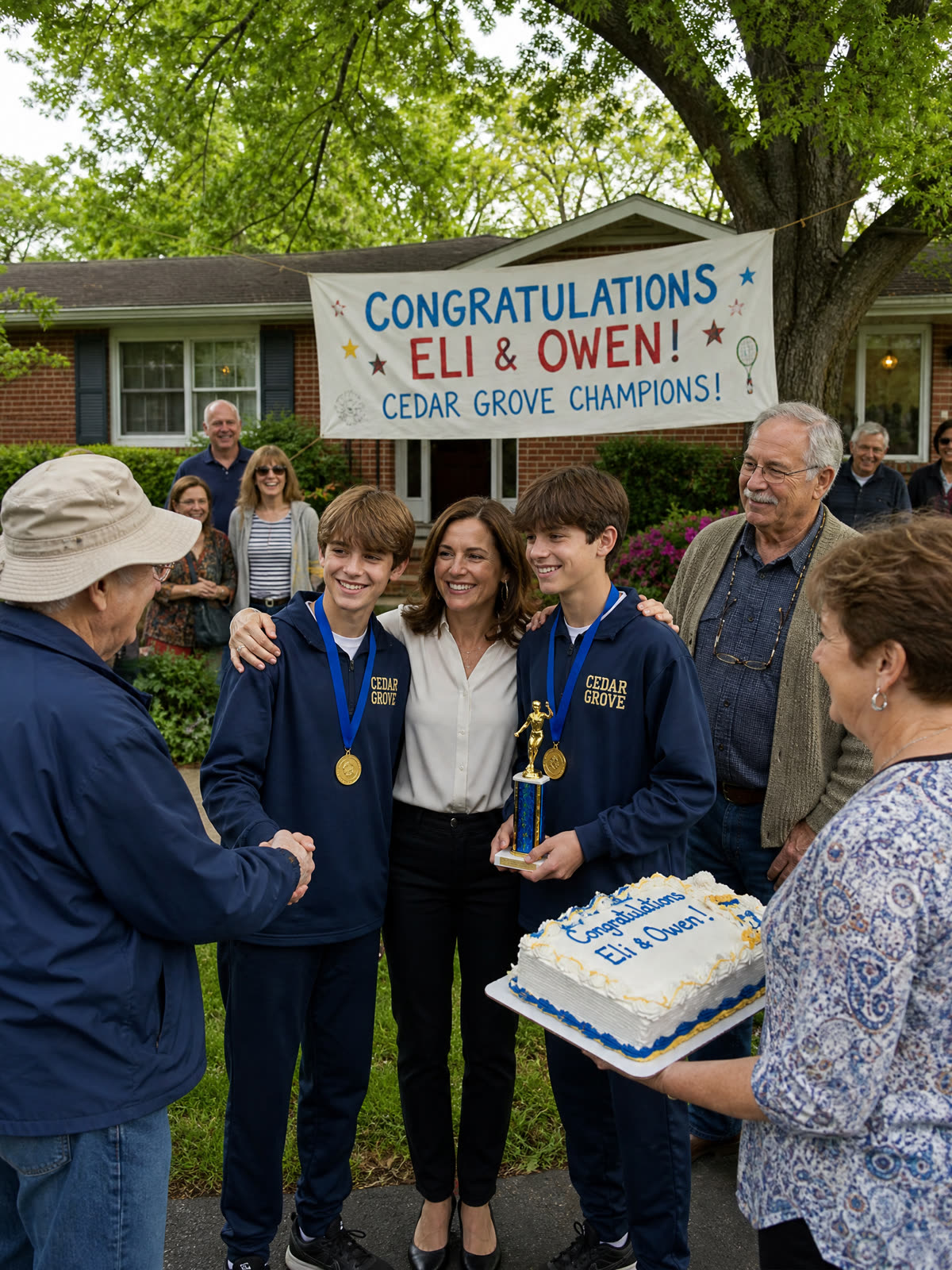
Monday morning we drove home. The trophy occupied the back seat between the boys, wearing a seatbelt because Owen insisted. After six hours on the turnpike, we turned onto Hollis Street and found a bedsheet banner across the house: CONGRATULATIONS ELI & OWEN — NATIONAL CHAMPS! Half the neighborhood stood on our lawn. Mrs. Kowalski had baked a sheet cake. Mr. Reynolds wore his familiar cardigan. Even the fishing-hat man from Giant Eagle had come. I never learned his name. He shook both boys’ hands, said, “Knew it,” and returned to his truck. The people who had helped send them to Washington were there to welcome them back. Daniel’s name was on the competition banner, but these were the people standing outside our home.
Three days later, on Wednesday, Daniel called. I was paying bills at the kitchen table. I watched his name through four rings and answered on the fifth. “Claire,” he said. “What do you want, Daniel?” He didn’t sound angry, which was different. “I’ve been thinking about the weekend,” he said. I waited. “I looked up their school,” he said. Still I said nothing. “I found the article about the regional championship. From January. In the Lancaster paper.” Then: “And Owen’s science fair project from last year. The one about the solar oven. It won first place in the county. And Eli’s math league ranking. He’s ranked ninth in the state, Claire. Ninth.” I closed my eyes. Those things had been public for years, attached to their names. He had simply never searched.
His voice thinned. “I missed everything,” he said. “Yes,” I said. “I thought sending money meant I was doing what I was supposed to do.” “No,” I said. “It meant you were doing the easiest part.” He didn’t argue. Then came the question. “Do they hate me?” Hurting him would have been effortless. I could have said yes, and perhaps he would have believed me and disappeared again. Instead, I gave him the truth. “Daniel,” I said. “They don’t know you well enough to hate you.” A long breath reached me through the phone. Then: “What do I do?” For the first time in thirteen years, he was asking the right thing. Not how to secure forgiveness, obtain a photograph, or manage appearances. What to do.
“You start small,” I said. “Okay.” “You don’t make promises. Not one. Not ever.” “Okay.” “You don’t show up unannounced. Not at the house. Not at school. Not at practice.” “Okay.” “And you don’t expect them to call you Dad. That word isn’t owed to you.” Silence stretched. “Okay,” he said. “And if they decide they’re not ready, you accept it. And you don’t push.” “I will.” Whether he would keep to that, I couldn’t know. I allowed him the opportunity to demonstrate it, not for his sake but for the boys’. If something good could come to them from this, I wouldn’t be the reason it failed. Giving them that possibility wasn’t the same as trusting him. It meant leaving their choices in their own hands.
When I told them about the call, we were having Friday tacos. “He wants to get to know you,” I said. “If you want. Only if you want.” Owen set his taco down. “Do we have to?” “No.” “Do you want us to?” I thought before answering. “I want you to decide for yourselves,” I said. “Not for me. Not for him. For you. And whatever you decide, I’m on your side. Today, tomorrow, and in five years if you change your mind.” Eli looked at Owen. Finally he said, “I want to ask him why,” Eli said finally. “Just why. I don’t need anything else. I just want to hear him say it.” Owen picked up his taco. “I don’t want to,” he said. “Not yet.” “That’s okay,” I said. “Is it?” “It’s okay,” I said again.
There wasn’t a perfect ending, and I have accepted that. Daniel didn’t become another person overnight. The boys didn’t begin spending weekends at his large Virginia house. We didn’t turn into a holiday-card blended family, and Vanessa and I will never be friends. There were uncomfortable dinners. In June, Eli met Daniel at a Cracker Barrel off the turnpike, halfway between us. I waited in the car for an hour and twenty minutes, holding a book I couldn’t read. Eli buckled in afterward and remained quiet for ten miles. Then he said, “He said he was scared. He said he was a coward. He said he picked the easy life and he’s been ashamed of it for a long time.” “How did that feel?” I asked. Looking through the window, Eli answered, “Honest,” he said. “First honest thing I ever heard from him.”
Plans were canceled. Daniel intended to attend a September math league meet, then called the previous evening with a client emergency. Eli shrugged. I didn’t. I called Daniel that night. “You said no promises,” I said. “I didn’t promise. I said I’d try.” “Daniel. To a thirteen-year-old, I’ll try is a promise. You know that. You were thirteen once.” He went quiet. He attended the next meet and the one after it, sitting at the back, making no speech, leaving when it finished. There were two difficult conversations at my kitchen table. One was in October, with him opposite me as he had been fourteen years earlier, except there was no envelope. For months, Owen sometimes wanted nothing to do with him. I let that remain his decision.
Other nights, Eli wanted to know about Daniel’s childhood, his parents, the man he had been at twenty-seven, and the deep-sea fish with their little lights. I answered honestly. Daniel had to discover that money couldn’t accelerate trust. Trust followed its own pace, indifferent to his calendar. Meanwhile, Mason texted the twins. Puzzle links and homework complaints became memes, then extended debates about whether a hot dog qualified as a sandwich. Eventually they discussed real things: his grandmother’s death, Owen’s first girlfriend, Eli’s disagreement with a teacher. Their relationship developed more naturally than anything the adults managed. It didn’t require a perfect explanation of the past before it could become something in the present.
Over Thanksgiving break, Mason visited Cedar Grove for a day. Vanessa stayed away. Daniel drove him and waited at a downtown coffee shop. The boys spent eight hours in my basement constructing a trebuchet from two-by-fours, then launched a pumpkin into Mrs. Kowalski’s backyard. She brought it over. I apologized. She said nothing so exciting had happened on Hollis Street since 1987. About seven months after Washington, Daniel attended Owen’s science fair. Folding tables and poster boards filled the Cedar Grove Middle gym, carrying that familiar smell of floor wax. He came by himself, without a photographer, foundation employees, or an expensive present. Wearing an ordinary jacket, he stood at the back with a paper cup of awful PTA coffee.
Owen noticed him. I watched a complicated expression cross my son’s face. He didn’t wave. After Owen finished presenting to the judges, Daniel approached. “That was impressive,” Daniel said. “Thanks,” Owen said. A long pause followed. Across the gym, I held my breath. Then Owen began describing his project, a solar-powered water pump. He explained the panel, pump, filtration rate, and the problem he had misunderstood twice before figuring it out at two in the morning. Daniel listened. That was all: ten minutes of a father listening to something his son cared about. No embrace, forgiveness speech, or tears. At one point Daniel indicated part of the pump and asked a question. Owen stopped and looked surprised.
“That’s actually a good question,” Owen said. “I used to be curious about things,” Daniel said. “A long time ago.” “What happened?” Daniel regarded him for a while. “I stopped,” he said. “I’m trying to start again.” Owen nodded slowly and returned to the explanation. Healing sometimes begins so quietly that most people in the room miss it. I didn’t. People assume my favorite memory is Daniel and Vanessa hearing both boys’ names called. I won’t deny the satisfaction. For thirteen years he had behaved as though the family he abandoned ceased existing when he closed the door. Then those children stood under national stage lights with gold medals around their necks. But that wasn’t what remained closest to me afterward.
What stayed was the hotel room, the pizza box, and the pillow striking my head. What stayed was Eli asking whether I had been happy before. I had. I always had. Thirteen years earlier, Daniel had looked at two heartbeats on an ultrasound and said, This can’t be happening. Thirteen years later, those heartbeats stood before four hundred people with blue ribbons around their necks, and he finally saw them. But they had never required a stage to deserve attention. They deserved it at two in the morning with croup, when I sat on the bathroom floor running the hot shower and balancing one boy on each knee. They deserved it after failed tests, on days without prizes, when the only applause came from their mother in a folding chair.
Washington didn’t prove that he had lost and I had won. It proved that somebody can leave, underestimate you, and build another life without bringing yours to a halt. You keep raising the children. You deal with the flooded basement every April. You live through ten thousand ordinary days with no applause and no photographs. Eventually you realize that while someone else protected an image, you were making something real. A few weeks after the awards, the official photographer sent our picture. I framed it and hung it in the hallway beside the front door. Eli stands on one side, Owen on the other, both wearing gold. I’m between them, mascara ruined by tears. Neither Daniel nor Vanessa appears.
When I look at it, I don’t see revenge. I see early mornings and late nights, cheap groceries, and a toaster that browns only one side. I see stubbornness, fear, laughter, and love: everything Daniel missed, and everything we built without him. Beside it now is a smaller, less carefully framed photograph. Three boys crowd together on the auditorium steps, arguing over the back of a program. One wears a navy blazer with a gold crest; two wear plain Cedar Grove jackets. Owen held out his phone to take it. Mason’s eyes are half shut, and Eli is caught in the middle of a sentence. It’s a terrible picture. It’s my favorite thing in the house. And whenever I see those three heads together, I wonder what they will build next.
Disclaimer: This story is a work of fiction inspired by real-life themes. Names, characters, places and events are fictionalized, and any resemblance to real persons is purely coincidental. Images are for illustration purposes only.
