

PART 1 — The Child at the Door
My name is Mabel Truesdale, and for nine years I worked as a greeter at a large store in Joplin, Missouri. Before that, I spent thirty-one years delivering mail. I retired from the post office when I was sixty, only to discover that retirement and I weren’t particularly well suited. I grew bored. My husband died. Eventually, I found another job, one that mostly required me to stand near a doorway and welcome whoever happened to come through it.
Inside my vest pocket, I always carried a roll of smiley-face stickers. Every child who entered could have one. It was a small thing, but children have a way of making small things matter. A few returned every Saturday looking for their sticker. After enough years, handing them out became as familiar to me as saying hello. I never imagined that anything I kept in that pocket would have a place in a courtroom.
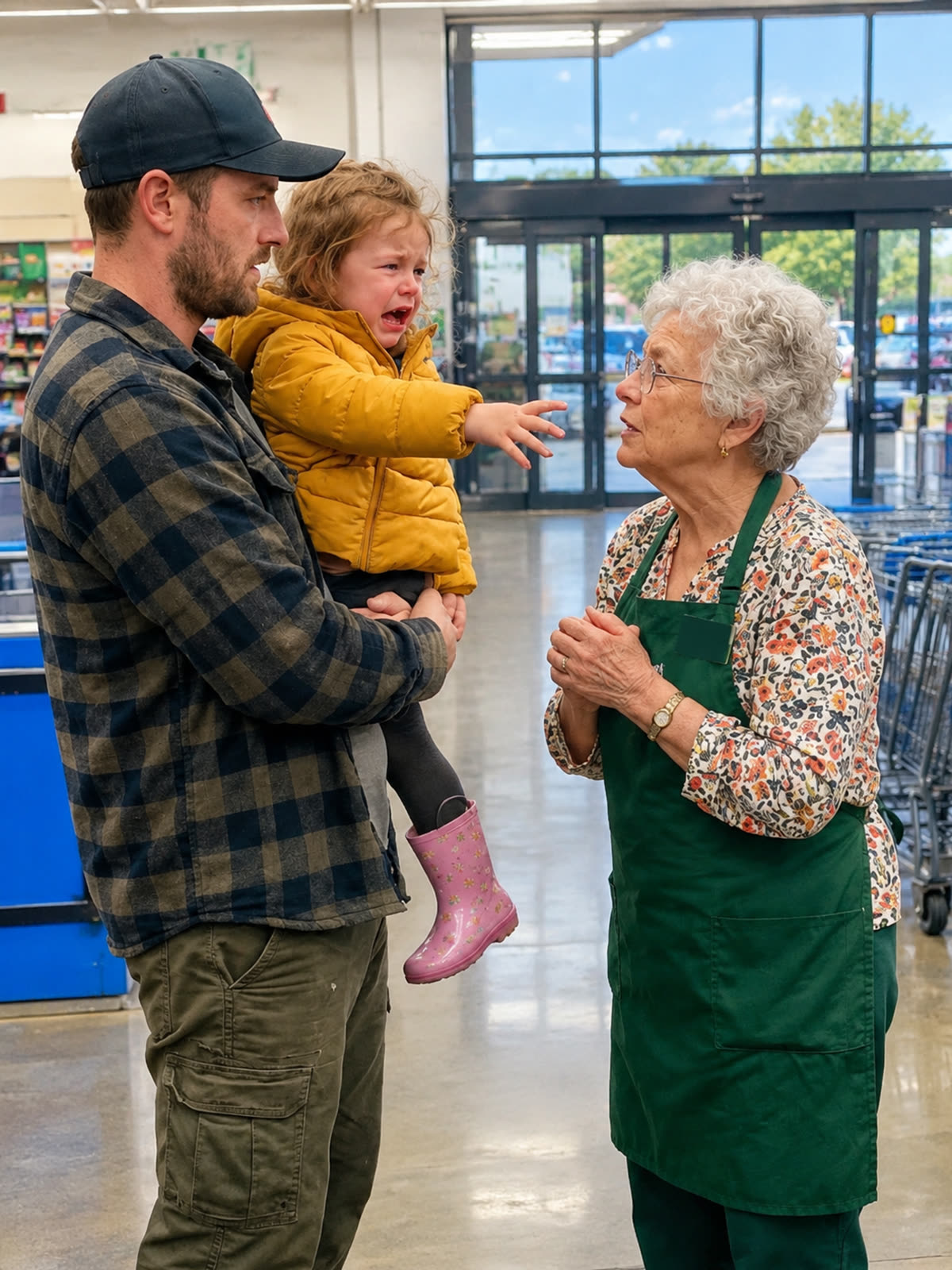
One Tuesday afternoon in March, I noticed a man approaching the exit with a little girl in his arms. She looked about three, with curly hair and pink rain boots. She was screaming, but it wasn’t the angry, exhausted sound of a child protesting something she hadn’t been allowed to have. This was fear. I recognized that much before I understood anything else, and I reached for the little yellow faces I usually offered children.
“Hi, sweetheart. Want a smiley face?” Instead of taking the sticker, she caught hold of my vest with both hands. “You’re not my daddy!” she screamed at the man. “I want my mommy! I want my mommy!” He gave me a tight smile. “Terrible twos. She’s tired. Excuse us.” Then he tried to continue toward the doors, carrying the child who was still reaching for me.
I moved into his path. “Sir, I’m sure you understand. She’s very upset. Can I just ask her name?” Whatever politeness he had managed disappeared. “Get out of my way, lady.” I asked again. “What’s her name, sir?” He paused. It was only a second, but it lasted longer than it should have. “Piper,” he said. “Her name’s Piper. I’m her father.” I turned my attention back to the little girl. “Piper,” I said gently. “Is this your daddy?”
She shook her head and screamed. “No! He took me! He took me from Miss Odessa’s!” His face reddened. “She’s three. She doesn’t know what she’s saying. Move, or I’ll move you.” I stayed where I was. I have never been a large woman, but delivering mail for thirty-one years teaches you a few things about holding your ground. Dogs had chased me. Snow had covered me. Men twice his size had cursed at me. None of that made it possible to ignore a frightened child.
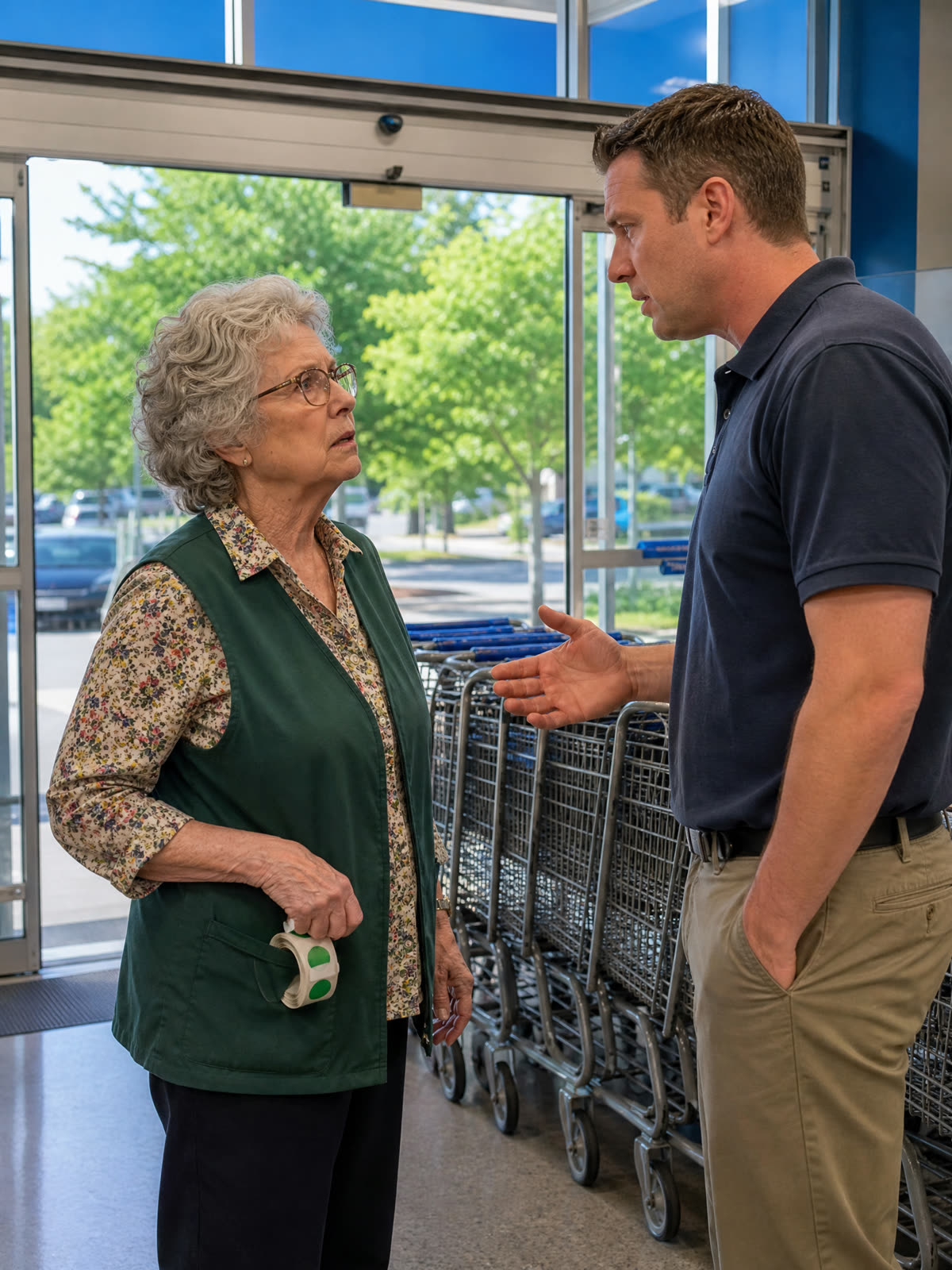
“I’m going to ask my manager to come over,” I said calmly. “Just to be safe.” Mr. Pruitt came over. He was thirty-five, wore a polo shirt, and seemed perpetually concerned about the possibility of a complaint. The man produced his wallet and showed him a driver’s license. After that came a photograph on his phone: the same man holding a baby. “See? My daughter. This old woman is harassing me.”
Mr. Pruitt examined the license and the photograph. Then he turned toward me with the expression he usually reserved for something that needed to be corrected. “Mabel, step aside. Now. He’s her father. You’re embarrassing the store.” I tried to bring him back to what the little girl had actually said. “Mr. Pruitt, she says he took her from someone named Miss Odessa.” His answer came in separate, unmistakable words. “Mabel. Step. Aside.”
I obeyed. I stepped out of the way, and the man carried Piper through the exit. But stepping aside wasn’t the same as forgetting what I had heard. I followed him to the doors and took out my phone. I photographed his face. I photographed the little girl through the car window. Then I photographed his license plate. Three pictures. Once I had them, I called 911 and told the operator what had happened.
The following morning, Mr. Pruitt fired me. “You made a scene. You followed a customer into the parking lot. You took photos of him. He’s filed a complaint with corporate.” That was how nine years at the entrance of that store ended: with the complaint of a man whose name I hadn’t known when I stood in front of him. I had never put a hand on him. I had asked a little girl a question, listened to her answer, and made a telephone call.
Three weeks afterward, an attorney’s letter arrived. By then, I learned the man’s name: Dale Rutherford. He wanted $250,000 from me for assault, defamation, and “emotional distress.” According to his lawyer, I had “grabbed his arm” and “publicly accused him of being a kidnapper.” Reading those words didn’t make them resemble anything that had happened. I had not touched him. Still, there was my name on a lawsuit, and there was a trial date in October.
There was no way I could pay for an attorney. A young man from legal aid agreed to represent me without charging a fee. His name was Teddy Marsh. He looked so young that I thought of him as about twelve, but he went through every page of my file twice. He took it seriously. He never offered the easy reassurance that I shouldn’t worry, and somehow I appreciated him all the more for that.
When the trial began, Rutherford sat across from me in a suit that had been carefully pressed. His lawyer described me as “a confused old woman with a hero complex.” I kept my hands folded in my lap and said nothing. Thirty-one years on a mail route had taught me how to do that, too. Being quiet wasn’t the same as agreeing. It was simply all I could do while someone described a version of me I didn’t recognize.
Before opening statements, the judge asked whether there were any additional witnesses. A young woman rose from a seat at the back of the room. In her arms was a little girl wearing pink rain boots. “Your Honor,” she said, her voice shaking. “I’m Piper’s mother.” Everyone turned. Across the courtroom, Dale Rutherford’s face went gray.
PART 2 — The Mother Who Found Me
The little girl saw me before I could make sense of seeing her again. She pointed straight at me. “Sticker lady!” My heart gave a strange, overwhelming turn. The last time I had seen her, she had been screaming and clutching at me. Now her hair was combed, a bow sat neatly in it, and she was smiling as though we had known each other forever. After all those months, there she was in her mother’s arms.
The judge, a silver-haired woman named Judge Alvarado, asked the young woman to approach. Her name was Marisol Vance. She was twenty-six and worked as a nursing assistant in a long-term care center. “Your Honor,” she said, “that man is Piper’s biological father. He lost custody when she was one, after he put me in the hospital. He’s had a protective order against him for two years.” A low sound of disgust passed through the people watching.
Rutherford’s attorney sprang up. “Your Honor, this is highly irregular, we weren’t notified…” Judge Alvarado didn’t look his way. “Sit down, counselor,” the judge said. “Ms. Vance, continue.” Marisol drew a breath. “On March the fourteenth, he walked into Piper’s in-home daycare, told the provider, Miss Odessa, that there was a family emergency, and took my daughter. Miss Odessa didn’t know about the order. I found out an hour later when she called me at work. The police issued an Amber Alert.”
Then Marisol looked across the room at me. “But by the time the Amber Alert went out, the police already had his license plate. And a photo of his face. And a photo of my daughter in his back seat.” My hand rose to cover my mouth. “Because this woman stood in front of a door,” Marisol said, her voice breaking, “and asked my baby her name.” In the silence that followed, I could hear the clock above the jury box.
She explained what happened next with the steadiness of someone who had already repeated it to detectives many times. Ninety minutes after Rutherford left the store, state troopers stopped his truck on the interstate. He had been traveling toward the Oklahoma border. Piper was asleep in the back seat without a car seat. On the floor lay a fast-food bag and a bottle of cough syrup. An officer later testified that she had received a dose that wasn’t hers. She had slept through two hours of the ride.
I felt ill listening to it. At the store, I had been certain that something was wrong, but certainty hadn’t shown me the worst of what was happening. Rutherford faced charges of kidnapping, interference with custody, and violating a protective order. He had been released on bond while awaiting his criminal trial. During that wait, he had brought this lawsuit against me. “To scare me into changing my statement,” I said quietly. I hadn’t intended for anyone else to hear.
The judge heard. “Mrs. Truesdale,” she said, “you’ll have your turn.” She looked first at Rutherford’s lawyer, then at Rutherford himself, holding her gaze on him for a long time. “Mr. Rutherford. I have presided over this courtroom for nineteen years. I’ve seen men try many things. I have rarely seen a pending kidnapping defendant file a civil suit against the principal witness against him.”
His attorney tried again. “Your Honor, my client was the victim of a false accusation…” The judge cut through the explanation. “Your client’s own license plate was recorded by the woman he’s suing. His own photograph is in the evidence log of an Amber Alert.” Her tone became sharper. “Counsel, I’d advise you to stop talking.” Beside me, Teddy Marsh stood with one sheet of paper. His boyish face hadn’t changed, but I was grateful beyond words that he was there.
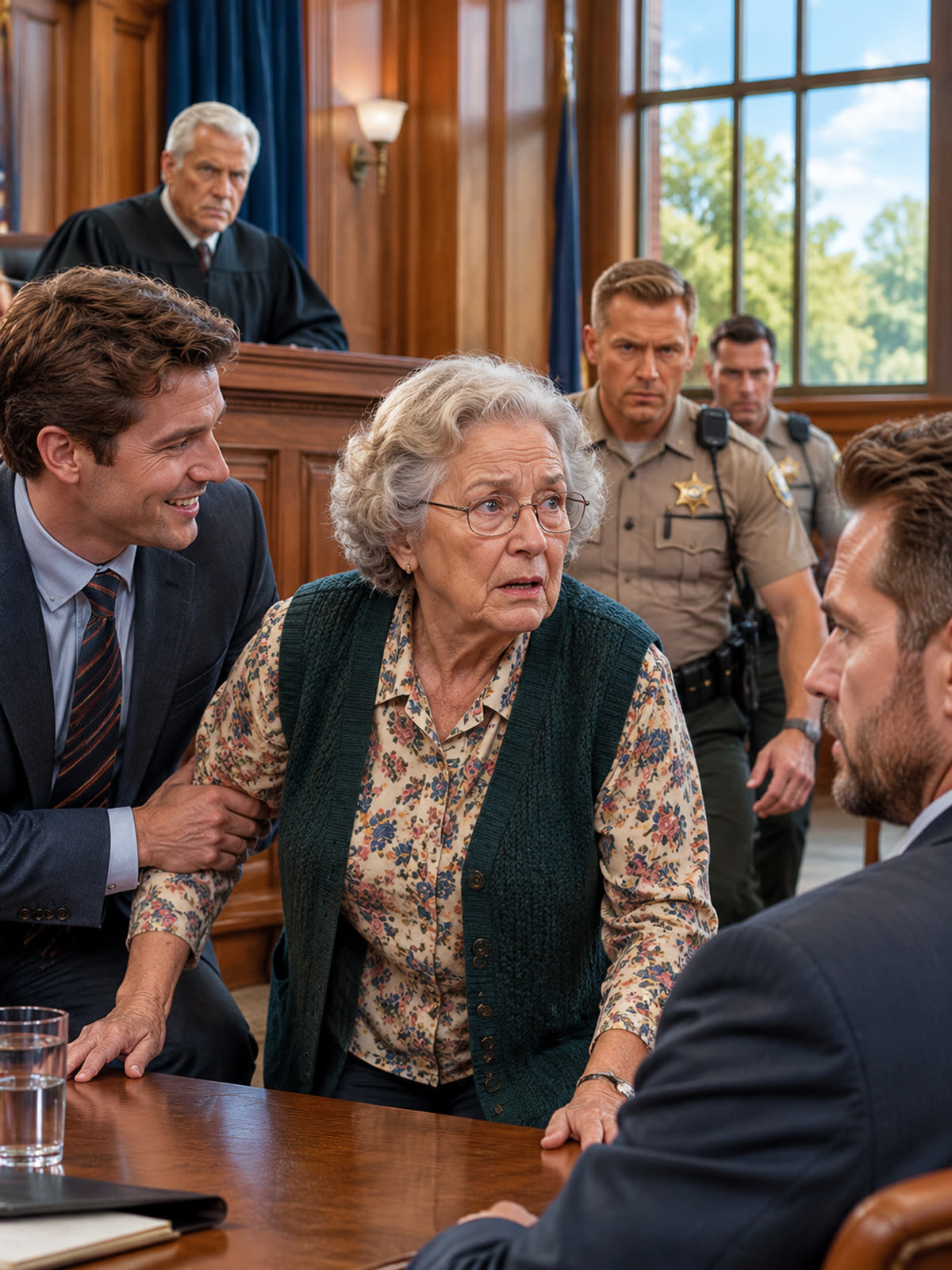
“Your Honor, the defense moves to dismiss with prejudice.” “Granted.” The answer came so plainly that it took a moment for its meaning to reach me. Judge Alvarado looked at me with kindness. “The case is dismissed with prejudice,” she said again. “Mrs. Truesdale, that means Mr. Rutherford may never file this suit again. You are free to go.” A few words had ended the lawsuit that had been hanging over me for months.
Then her attention returned to the other table. “Mr. Rutherford, using a civil lawsuit to intimidate a witness in a criminal case may itself be a crime. I am referring this matter to the county prosecutor’s office for review. You will remain seated until the bailiff has spoken with you.” Two deputies were already approaching him. I got to my feet, though my legs scarcely felt like they belonged to me. Teddy squeezed my arm, grinning like a boy who had just taken first prize at the county fair.
Marisol crossed the courtroom with Piper still on her hip. Tears streamed down her cheeks, and she made no effort to brush them away. “Mrs. Truesdale,” she said. “I never got to thank you.” “Honey, you don’t have to.” “I do.” She moved Piper to her other hip and held both my hands. There was nothing formal about the moment now. The lawsuit had ended, but the little girl I had worried about was close enough to touch.
“I was at the state trooper’s barracks when they called to say they’d found her. I had been sitting in a plastic chair for two hours, and I had stopped being able to feel my hands. And the officer said, ‘A woman at a store stopped him. Photographed everything.’ I asked who. He said, ‘A greeter. Sixty-something.’ I said I needed to find you. I didn’t even know your name.”
“Mabel,” I said, my voice cracking. “Everyone calls me Mabel.” “Mabel,” Marisol repeated. “I’m going to say your name every night for the rest of my life.” Piper stretched out her small, warm hand and patted my cheek. “Sticker?” she asked hopefully. I couldn’t help laughing. The sound came out broken and wet, and half the courtroom joined in. I reached into my vest pocket, where I still kept the roll, and tore off a smiley face. She stuck it on her jacket, directly over her heart.
Rutherford’s kidnapping trial took place in December. This time, I would have to testify. Teddy helped me rehearse at his kitchen table, with his wife taking the prosecutor’s part. Even with their help, I was terrified. I had never sat on a witness stand before. Practicing answers at a kitchen table was one thing. Going into a courtroom and telling everyone what I had witnessed was another, but the child’s words had not changed.
I testified for two hours. When the prosecutor asked what I had seen, I described it as I had to the 911 operator: the scream, the pause before Rutherford supplied Piper’s name, and his expression when she said he had taken her. Afterward, the jury went out to deliberate. I had told the truth as clearly as I knew how. Now, with Piper’s future beyond anything I could say or do, we had to wait for their answer.
PART 3 — The Rule That Mattered
The jury deliberated for less than three hours. They found Dale Rutherford guilty on every count. He received a twelve-year sentence and would not be eligible for release before serving eight. I wasn’t present when the sentence was announced. Marisol called from the hallway afterward, and I lowered myself onto my kitchen floor with one hand against my chest. Through the phone, I listened as she cried and laughed together.
“He can’t touch her,” she kept saying. “He can’t touch her for a long, long time.” “No, honey,” I said. “He can’t.” After everything that had begun at those automatic doors, those were the words I could give her. Piper’s mother had spent hours waiting for someone to find her daughter. Now she was calling to tell me he would be kept away from her for years.
Then something I hadn’t expected began happening: people called me. A reporter at the Joplin Globe wanted to interview me, followed by a television station in Springfield. I declined most of the requests. Eventually, Teddy persuaded me to speak with a local station. They came to my house and filmed while I made coffee. Their question was simple enough. They wanted to know what had made me stand in front of the door.
I gave them the truth. “I just listened. She said it wasn’t her daddy. Somebody ought to believe a child.” That was the sentence they put on the evening news. Before the weekend was over, cards from strangers were gathering on my kitchen table. One came from a grandmother in Tulsa. Another came from a school bus driver in Kansas. People I had never met were writing about something that, to me, had started with a child asking for her mother.
One woman wrote that someone had taken her when she was four. No one had stopped the man. She wished somebody like me had been at the door that day. I read her letter three times. Then I placed it in the drawer beside my bed, where I kept my husband’s old watch. Of all the messages that arrived, that was the one I put there.
The store’s corporate office had called the week after the civil lawsuit was dismissed. A vice president named Carolyn Whitaker spent twenty minutes apologizing. I wasn’t sure she paused long enough to breathe. “Mrs. Truesdale, what happened to you was unacceptable. You did exactly what we hope every associate would do, and you were punished for it. We’d like to offer your position back, with back pay, a raise, and a formal letter of commendation. And we want to ask you something.”
“What’s that?” I asked. “We’re implementing a new policy in every store in the region. If a child says, ‘That’s not my parent,’ staff call the police. Every time. No matter what identification anyone shows, no matter how calm or convincing the adult seems. We’d like to name it the Truesdale Rule.” For a little while, I couldn’t think of what to say. I listened to what she was offering and thought about whose words had mattered at that entrance.
“I’d rather you didn’t,” I said at last. “It’s not my rule. It’s every little kid’s rule. You just call it the Believe Her Rule, or the Believe Him Rule. Whatever the child is. Believe the child.” The line went quiet for a moment. “We can do that,” Carolyn Whitaker said softly. I hadn’t needed my name attached to a policy. I had needed someone to hear what Piper was saying.
Mr. Pruitt was transferred to a store in another state. I heard that he had to complete a course on child safety and responding to abductions. I hoped he learned something, and I thought perhaps he had. A month later, a regional supervisor came to the store and told me Pruitt had asked him to deliver a message. The note said, I should have listened to her. I folded it and saved it. It wasn’t much, but it was honest. On some days, honesty is enough.
I returned to work on a Saturday in January. Everything looked familiar: the blue carpet, the cart with the squeak, the rush of cold air whenever the automatic doors parted. People I had greeted over the past nine years stopped to shake my hand. A stranger pressed a twenty-dollar bill into my palm and refused to accept it back. A teenager wearing a hoodie said, “Hey, you’re the sticker lady from the news,” and I said, “I am,” and he said, “That’s badass,” which I chose to accept as a compliment.

At ten that morning, the doors opened again. A little girl in pink rain boots ran inside ahead of her mother. “Sticker lady!” Piper was nearly four by then. She had gained an inch and begun losing the roundness of her baby cheeks. She had also learned my name, more or less. To her, I was “Miss Mabber.” If she had asked, I believe I would have given her the entire store.
She presented her hand, palm upward, with the solemn dignity of a child certain of what she was entitled to receive. I gave her one smiley-face sticker. Then I gave her a second. Finally, because it was that sort of morning, I handed over the entire roll. This time, there was no frightened child trying to hold on to my vest. There was Piper, standing in front of me and waiting for the small thing she knew I would have for her.
Over her daughter’s head, Marisol met my eyes. She had on a new coat, bright yellow, and she looked rested in a way she hadn’t before. The shadows beneath her eyes had disappeared. “We’re doing okay,” she mouthed. “I can see that.” There was no need for her to explain it further. I could see it in her face, and I could see it in the little girl beside her.
Piper peeled off a sticker and placed it on my vest, covering my name tag. “Now you have one too,” she said. I looked down at that little yellow smile, and my eyes grew hot and blurred. For nine years, I had given those stickers away almost automatically. They were something cheerful to put into a child’s hand, a tiny way of making an ordinary Saturday brighter.
It had never occurred to me that the roll in my pocket had anything to do with the backbone that kept me standing at that door. I hadn’t imagined that a smiley face, a stubborn old woman, and one gentle question could help stop a vehicle headed toward the interstate. Yet when I looked back, those were the things I remembered. Nothing grand. Nothing that had seemed like the beginning of a story anyone would ask me to tell on television.
Perhaps that is what ordinary courage really amounts to. Not a cape. Not a speech. An older woman with stickers in her pocket, standing in the place where she is meant to stand. A frightened child who needs someone to ask a question and listen to the answer. And even after everyone tells that woman to move aside, something in her that refuses to move aside completely.
Ever since that day, I had carried a spare roll in my other pocket. Piper tugged at my sleeve. “Miss Mabber? Can you give me another one?” I laughed and wiped my eyes. Then, with her still waiting in front of me, I reached into my vest.
Disclaimer: This story is a work of fiction inspired by real-life themes. Names, characters, places and events are fictionalized, and any resemblance to real persons is purely coincidental. Images are for illustration purposes only.
