

PART 1 — The Girl Who Wouldn’t Go Home Empty-Handed
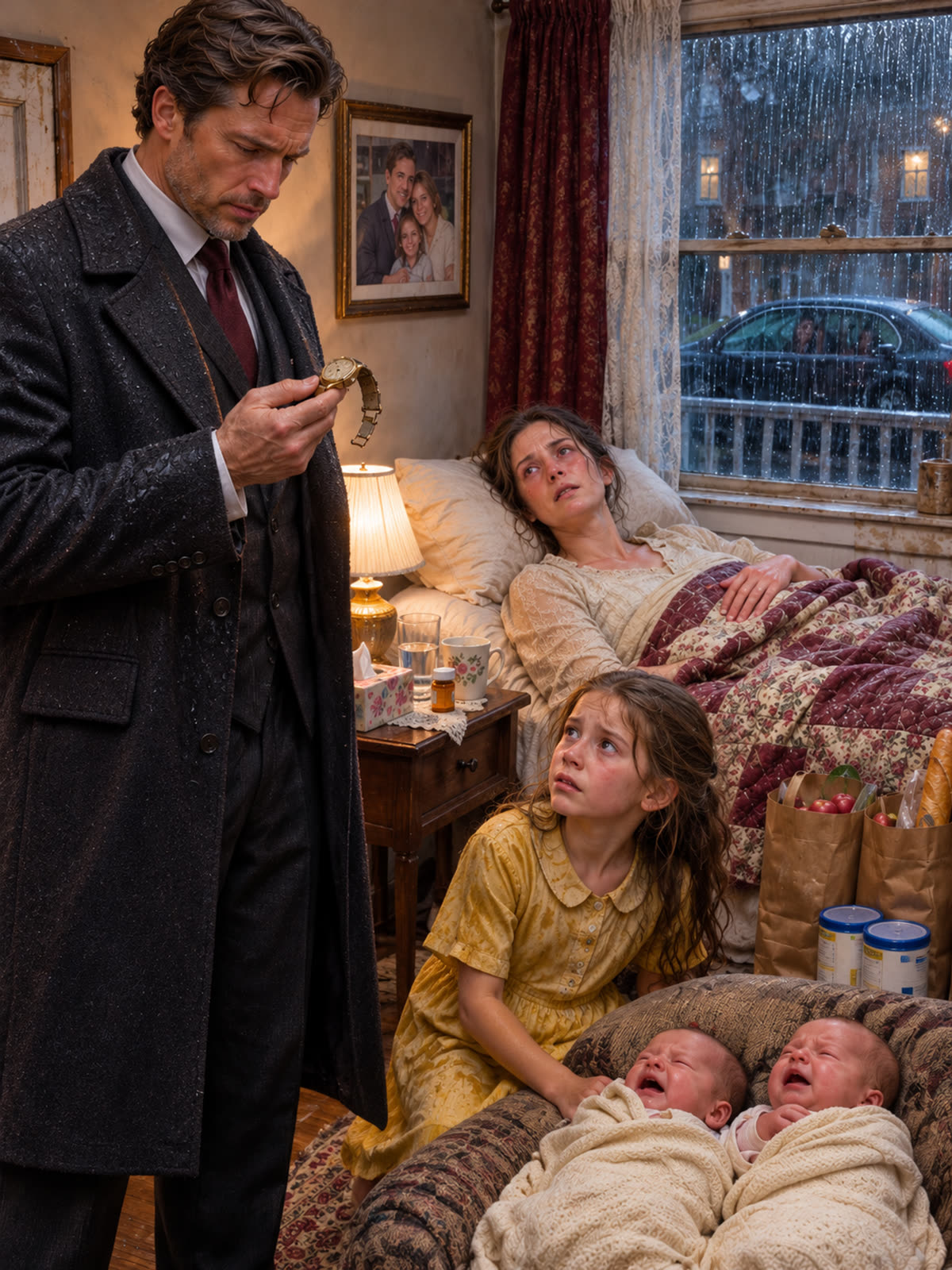
“Please, my baby brothers are hungry.” At first, the little girl directed the words toward the cashier. Then she lowered her face toward the wet floor, because he would no longer look at her. She was kneeling on the tiles of Bellman’s Market in Milwaukee, hugging two cans of infant formula as though letting them go would mean losing her only chance to bring them home. Water fell from the edge of her yellow dress and pooled beside her shoes. It was a little after six on a rainy Thursday evening in November, and nobody in that checkout line seemed to know what to do with her desperation.
I was third in line, carrying a roast chicken and sparkling water. The charcoal suit I wore had seen me through a business meeting that ended in sharp voices and unsigned documents. All I wanted was to sit at my kitchen counter, eat, and stop thinking about the day. “Sweetheart, I can’t let you leave with those unless they’re paid for,” the cashier told her. His name tag said MARVIN. “I have money.” She uncurled her fist above the conveyor belt. Quarters, a dime, and several pennies scattered toward the scanner. One dropped over the side and settled near her knee. “I can bring you more when I’m bigger,” she said.
Marvin summoned a manager. A tall man holding a clipboard approached with the weary expression of someone who believed he had already dealt with enough trouble that evening. HASKELL was printed on his name tag. He separated the coins with one finger. “That’s a dollar and thirty-eight cents,” he said. “These cans are thirty-one dollars and ninety-nine cents each. I can’t make an exception for one customer.” The girl tightened her hold on the formula. “My mommy won’t wake up right,” she whispered. “There are two babies, and they keep crying. I don’t know what else to do.” Behind me, a man gave a brief laugh. “That’s quite a story,” he remarked to the air.
A woman across the aisle raised her phone toward the child. Other shoppers glanced over and then became absorbed in the shelves, apparently finding something there that required their attention. The girl bowed so low that her forehead nearly reached the tiles. “I’ll mop,” she said. “I can carry boxes. Please don’t make me go home with nothing.” Something inside me moved. My name is Miles Bennett. I was forty-one, and my work involved helping troubled companies restructure before their failures consumed the livelihoods attached to them. Across polished tables, I had listened to people trying to keep their voices level while everything around them unraveled. I recognized distress that had become impossible to conceal.
Her hands shook with the particular trembling that comes from being frightened and cold for too long. But there was another reason I couldn’t look away. For six years, I had called investigators late at night, searched hospital records, and repeated questions that people eventually stopped answering. My older brother, Luke, had walked out of his Milwaukee apartment one October morning and never returned. Our mother continued laying an extra place at Thanksgiving. I covered her residence in Wauwatosa, financed the search, and paid the mortgage on a condo where I rarely slept. I never complained, because complaint would have forced me to acknowledge that my money had not brought Luke home. I understood what it felt like to ask for help while the world turned its face.
“That’s enough,” I said, leaving the line. “Ring it up.” Haskell looked from my suit to the platinum card I was holding, and his manner altered. “Sir, we’re just following store policy—” “I heard you. Ring it up.” I took a cart and collected formula, diapers in two sizes because I couldn’t guess the babies’ size, bread, eggs, canned soup, bottled water, wool socks, and two fleece blankets from the seasonal section. The girl trailed behind with her arms folded tightly against herself. She watched every item enter the cart, apparently waiting for the generosity to be withdrawn. The bill was $212.67. The man who had laughed no longer had anything to say.
“You don’t have to do this,” she told me. “I know. What’s your name?” “Sadie. Sadie Mercer.” “How old are you, Sadie?” “Eight.” “Then take these home. No one’s taking them back.” She examined my face with the caution of a child who had learned not to trust kindness too quickly. Finally, she thanked me, gathered several bags, and disappeared through the automatic doors into the rain. I remained beside my cooling chicken. There were sensible things I could have done: call emergency services, find a family assistance number, contact somebody equipped to help a child burdened with so much. I reminded myself of that twice. Then I put the chicken back on the belt and followed her.
Keeping roughly half a block behind, I watched her struggle into the wind. She passed a shelter on National Avenue, continued beyond a laundromat with a faded sign, and entered an alley where a streetlamp had gone out. From its entrance, I saw her approach a small house with a drooping porch and plywood over two windows. She climbed the steps sideways to keep the grocery bags from scraping and entered without knocking. I counted to thirty, trying to persuade myself to walk away. Then the crying reached me: two babies, their voices different in pitch but equally worn out. I crossed to the house and went through the unlocked door.
Damp plaster and sickness hung in the air. Two infants lay together on a sagging couch under a thin blanket, their faces flushed and their cries faint. Sadie knelt beside them, struggling to open a formula can with fingers that kept slipping. “I’m here, Theo. I’m here, Finn,” she murmured. “I got it. I got it.” Across the room, a woman lay on a narrow bed beneath a floral quilt. In the poor light, her face was pale, and every short breath seemed uneven. I moved toward her while reaching for my phone. Then something on the nightstand beside her hand stopped me: an orange prescription bottle and a gold watch with a broken clasp.
My hand went still. I already knew the watch, yet I turned it over beneath the lamp anyway. Across the back ran the crooked scratch I had seen made twenty years before. Beside it were the engraved initials L.M.B. Luke Michael Bennett. My brother’s watch lay beside a woman who hardly had the strength to raise her head. I had bought it with my first proper paycheck from a summer job in a law office. It cost $318 at a Water Street jeweler, and I had chosen it because Luke had just made his college baseball team. I wanted him to have something that showed how proud I was. Now it was here, in this damp little house, after six years of searching.
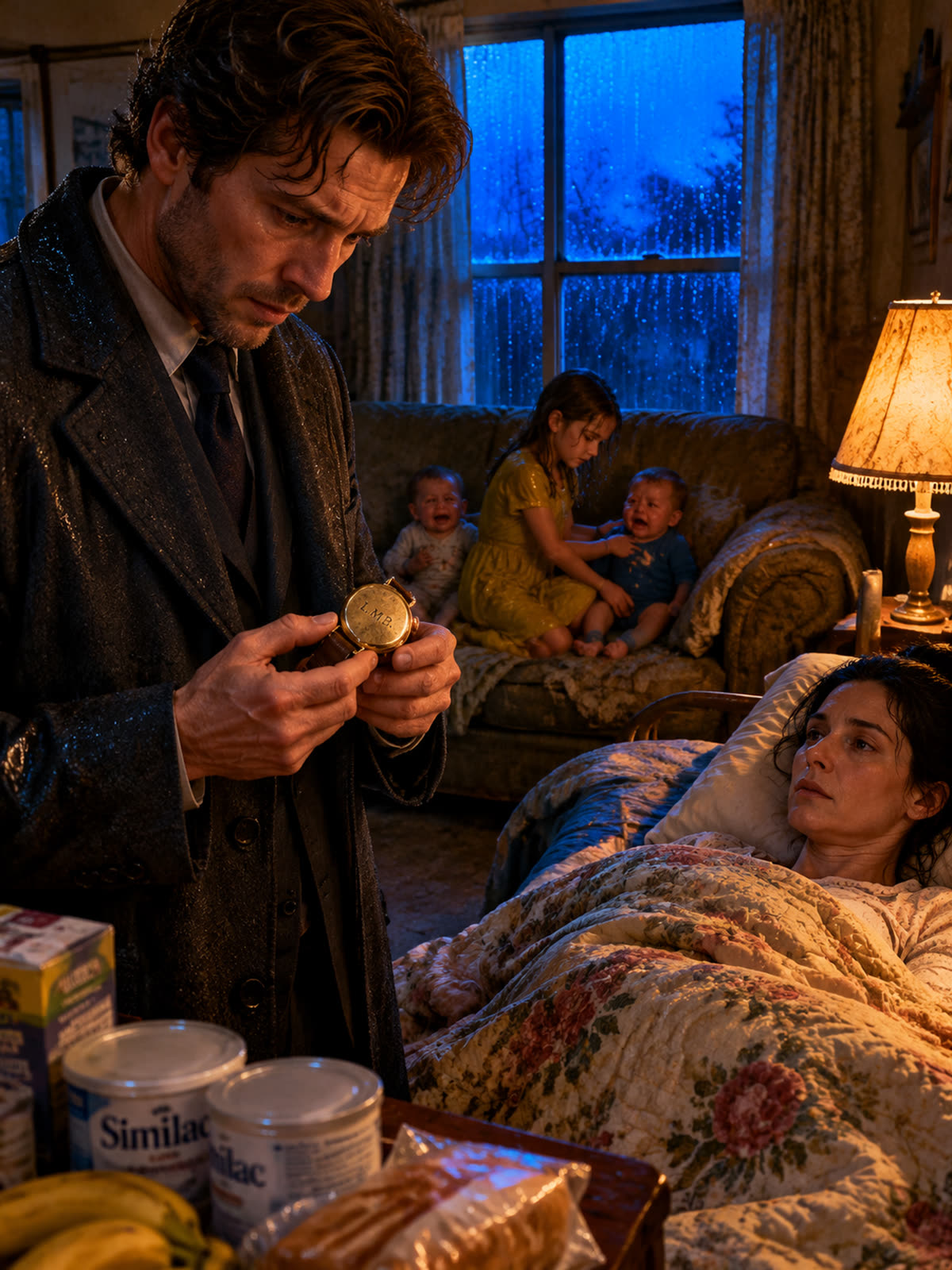
Three weeks after I gave it to him, Luke had dropped the watch on the pavement at McKinley Marina. He cried in front of me—the only time I had ever seen him cry. That fall had left the scratch. Afterward, he wore it daily, even as the band wore thin and the clasp loosened. Throughout the years he was missing, I had held on to one stubborn thought: a man who loved a gift that much would never deliberately abandon it. “Where did you get this?” I asked. My voice came out harsh. Sadie lifted her eyes from the formula and followed my gaze. “That’s Daddy’s,” she said. “Mommy keeps it by her bed. She says it helps us remember him.”
She pointed above the headboard. A photograph had been taped to the wall, its edges curled by dampness. The man in it was thinner than the brother I remembered, with hair brushing his collar. One arm circled the woman in the bed; the other held a laughing toddler whose wide brown eyes matched Sadie’s. She could only have been two or three, placing the photograph near the year Luke vanished. There was no mistaking him. For several seconds, I could do nothing but stand in my wet coat while the infants cried and rain tapped the covered windows. My brother had not disappeared into a river or somewhere beyond reach. He had been alive, raising a family in the city where I had been looking for him.
I couldn’t tell whether I wanted to shout or cry. “Is your mother named Helen?” I asked. Sadie nodded, studying my expression with a new uncertainty. I put the photograph down and felt for Helen’s pulse with two fingers. It was fast and weak. “She needs a doctor,” I said. “So do the babies.” Sadie sprang upright. “No! Mommy says if the wrong people come, they’ll take us. She says not to open the door and never to call anyone.” Her fear was immediate and absolute. “Sadie, listen to me. I won’t let anyone take you. But your mother is very sick, and I can’t fix that with groceries.”
She remained stiff and motionless, torn between terror and the responsibility she had carried for far too long. Before I could continue, Helen moved. Her eyes opened uncertainly. She looked to be in her mid-thirties, her dark hair escaping a bun and her lips cracked with fever. Her gaze traveled over the ceiling until she saw the watch in my hand. She tried to rise, and I caught her by the shoulders before she could slip off the mattress. Heat burned through her skin. “You look like him,” she whispered. “I’m Miles. Luke’s brother.” Relief crossed her face, followed by fear and another emotion I could not identify. Her fingers seized the front of my coat.
“Then you’re in the worst place you could possibly be.” I looked at her, trying to understand. “Where is Luke?” Her grasp tightened. “He didn’t leave us. He disappeared to keep us safe.” Those words struck more deeply than finding the watch. During six years of sleepless nights, I had returned to two explanations: Luke had chosen to abandon us, or something terrible had happened to him. A third possibility had never entered the stories I told myself. Meanwhile, Sadie had knelt again and was preparing formula with movements far too practiced for her age. She checked a bottle against her wrist, then raised her face toward me. “Can you hold Finn?”
I had never held a four-month-old baby. Supporting his head the way I had seen others do, I lifted Finn, and his tiny fist closed around my collar. He smelled of milk, rain, and blankets that needed washing. His crying stopped so abruptly that the silence seemed to have a sound of its own. “Are these Luke’s sons?” I asked Helen. She moved her head against the pillow. “No. Their mother was Dr. Elise Carver. Luke promised he’d keep them safe. When Elise was gone, I took them in.” “What happened to her?” Helen struggled for breath. “I can’t explain it yet. I’m sorry.” Her cough frightened me. “Miles, if you call the police, they’ll find us.”
“Who will?” I asked. “The people watching this house.” I stood with Finn resting against my shoulder and my phone in my free hand. Only a year before, I would have called the authorities without hesitation and trusted the usual procedures to protect everyone. Now I was learning that those very procedures were what frightened Helen. “I’ll call an ambulance,” I said. “Only an ambulance. I won’t give them your name or Sadie’s. Can you agree to that?” She examined me for a long time before answering. “Yes. Thank you for asking.” I called, gave the address, and described a feverish woman and two infants in need of medical care. At the dispatcher’s instruction, I stayed connected, leaving the phone on the couch arm.
Sadie continued feeding Theo, but her eyes repeatedly drifted toward the window. Then her hands stopped. “Uncle Miles?” she said. It was the first time she had used that name for me. “Those men are outside again.” I moved over and lifted the curtain just enough to see. A black sedan sat across the street beneath an unlit lamp, idling with its headlights off. A silver frame bordered its license plate. Through the rain, I could barely distinguish a crest engraved on it. “They came yesterday,” Sadie whispered. “They asked when Daddy was coming home.” Behind me, Helen slid a hand beneath her pillow. She took out a small black flash drive, pushed it into my palm, and folded my fingers over it.
PART 2 — The Crest on the Black Sedan
“Luke found records they would do anything to bury,” Helen said. “He’s coming here tonight.” Outside, two men emerged from the sedan and crossed the street with an unhurried confidence, as though opposition were something they rarely encountered. Their footsteps reached the porch. Then the first heavy blow hit the door, sending a tremor through the house. Both babies started crying again. Through the wood came a man’s voice, calm and disturbingly comfortable with my name. “Miles Bennett. We know you’re in there.” I had heard plenty of things directed at me in boardrooms. Nothing resembled hearing a stranger identify me outside the house where I had just discovered my missing brother’s family.
Whoever stood on that porch had not simply followed Sadie. They had followed me as well. “Back door,” Helen said. “There’s a key beneath the kitchen sink, taped to the pipe.” I looked from her to the children. “I can’t carry all of you.” “Take the children.” “No.” The firmness of my own answer surprised us both. I slipped the flash drive inside my coat and turned toward Sadie. “Can you carry Theo?” She had him in her arms already. When I gave her Finn, she settled the babies against her sides with the practiced steadiness of someone far too young to have needed that skill. I put an arm behind Helen’s back. “Stay with me,” I said.
Another impact shook the front door. The dispatcher was still connected on my phone, so I raised my voice enough for the call to capture what was happening. “Fourteen hundred block, rear alley. Two men are trying to force their way into the house.” I had no idea whether they carried anything dangerous. I only wanted a record of the situation. Helen could barely put weight on her feet. Supporting most of her weight, I guided her through the kitchen while Sadie hurried ahead. She crouched beneath the sink, found the rusty key, and brought it to the back door. At first the door refused to move. Then it opened, and we stumbled outside into the rain.
A sagging chain-link fence enclosed the yard. Water soaked into my shoes, and the mud pulled at them while Helen leaned against me. On the other side of the fence, warm yellow light shone from a small bakery window. Above the door, a hand-painted sign read DELANEY’S BREAD. A woman wearing an apron was arranging trays inside. She looked up to find my ruined suit, Helen nearly collapsing against me, and Sadie carrying a baby on either side. “Please,” I called. “We need help.” She wasted no time asking for explanations. Instead, she unlocked a side entrance and beckoned us through. We crossed into air that was warm and sweet, leaving the rain at our backs.
The woman was Mrs. Delaney. Within minutes, she had bundled the infants in clean towels warmed near the ovens. Helen sank into a flour-dusted chair and rested her head against the wall. “I know Helen,” Mrs. Delaney said. “I’ve been leaving bread on her porch for weeks. She’s been sick since the first frost.” “Why didn’t anyone call for help?” I asked. She laid a hand against Helen’s forehead and immediately drew it away. “I begged her to go to a clinic. She said men from a private agency threatened to take the children if she went near a hospital.” Anger searched for somewhere to land. The only person close enough was a woman burning with fever who had been trying to protect three children, so I said nothing.
Through the bakery glass, I watched the black sedan move slowly to the corner. It stopped there, and the two men stood beside it talking. One looked in our direction. Then sirens broke through the rain. An ambulance rounded the corner, washing the brick buildings with flashing light. The men remained still, appearing to consider whether to stay. After a long pause, they returned to their car and drove away without switching on their headlights. Whatever authority they had believed they possessed, whoever had sent them evidently preferred to work without witnesses. For the moment, the arrival of people who could help had been enough to make them retreat.
The paramedics brought Helen out on a stretcher, an oxygen tube beneath her nose. Before they lifted her into the ambulance, her hand caught my sleeve. “Don’t give the drive to the officer who comes with them,” she said. “Luke said there’s a leak.” “Which officer?” “He didn’t know.” I nodded, although agreement was almost all I had to give her. A few hours earlier, I had wanted nothing more complicated than dinner in a quiet kitchen. Now my brother’s watch was on my wrist, evidence was hidden in my coat, and a woman who knew where he had been was warning me not to trust whoever might arrive to protect us.
Sadie came with me in the ambulance and pressed herself against my arm. She gripped both babies’ blankets, fighting sleep even as her eyelids grew heavy. One of the paramedics, a young woman called Tessa, spoke to her gently and asked careful questions. Sadie answered with the measured caution of someone who believed that the wrong sentence could be turned into a reason to take everything away. She had been brave in the store, brave with the babies, and brave while escaping the house. Now, surrounded by people who were finally helping, she still seemed afraid to let any of that vigilance go.
“Are they going to be okay?” she asked me. “They’re getting help now.” She looked toward her mother. “And Mommy?” “She’s getting help too. We got her here in time for the doctors to take care of her.” I would not give her a promise that was beyond my power to keep. She searched my face and then nodded, as though plain honesty was something she could recognize even when reassurance had become hard to trust. The ambulance carried us toward St. Agnes Medical Center while she remained tucked against my side, holding on to the blankets that connected her to the babies.
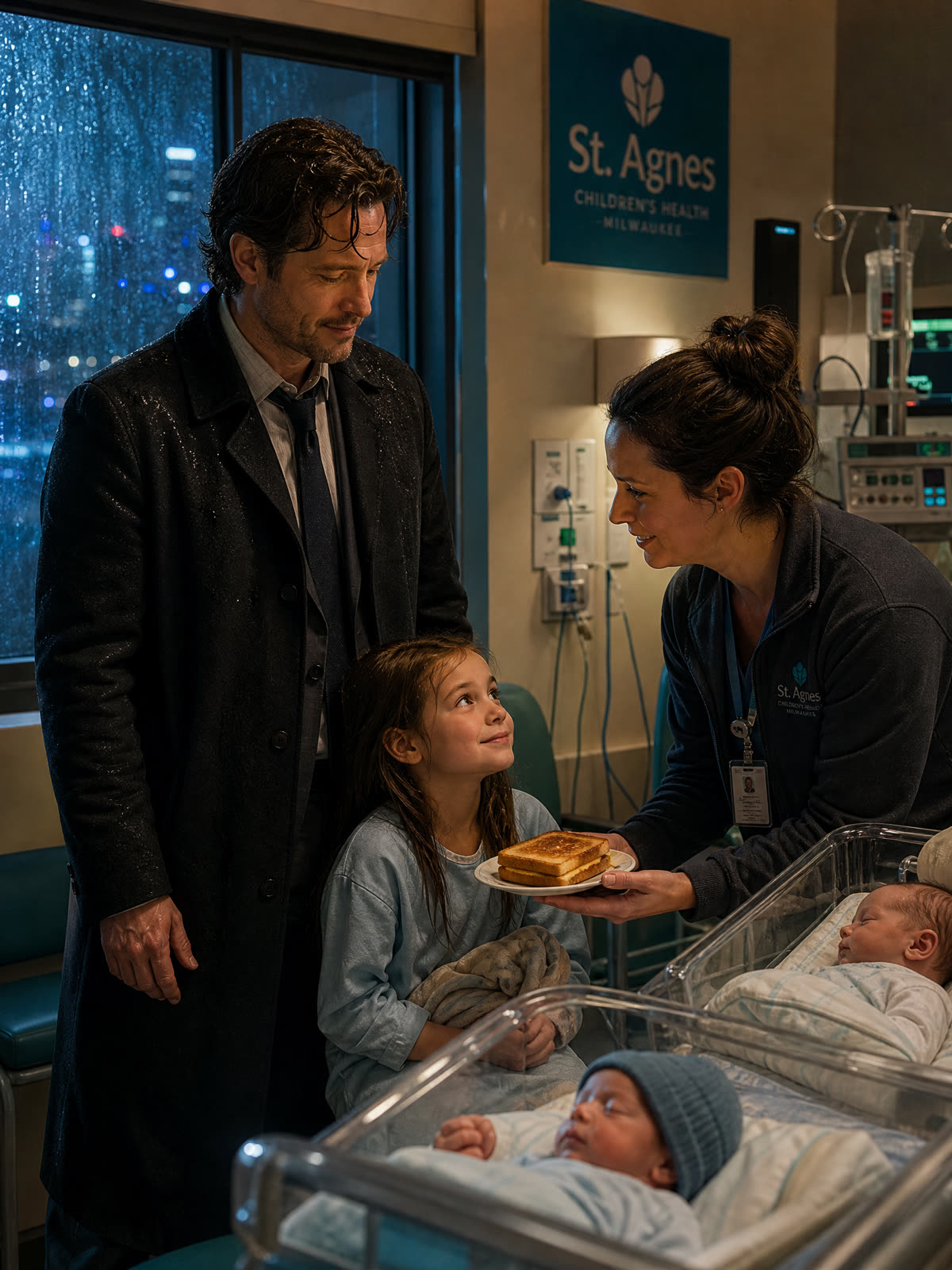
At the hospital, Theo and Finn were given fluids and warmth. Helen was admitted with pneumonia and an infection serious enough that the doctor said treatment could not wait. A pediatric social worker, Mrs. Brennan, brought Sadie dry clothing and a grilled cheese sandwich. More importantly, she offered the reassurance Sadie needed most. “You can stay with your brothers tonight,” she told her. “No one is separating you from them.” Sadie immediately looked at me, asking without words whether she could believe it. I nodded. For the first time since I had seen her kneeling at the checkout, the tension began to leave her shoulders. I stepped into the hall to call the one person who had never urged me to stop searching.
Mara Pike had handled Luke’s missing-person case before retiring from the Milwaukee Police Department. These days, she worked alongside a federal financial-crimes team. She answered after two rings. “Tell me this isn’t another false lead,” she said. “I have Luke’s watch, a photograph of his daughter, and a woman who says he’s alive.” The quiet on the line lasted long enough for me to hear her breathing alter. “Where are you?” Within an hour, she reached the hospital with two federal agents wearing plain coats. When I handed over the flash drive, she did not rush to insert it into a nearby computer. She put it in an evidence pouch and recorded the time.
“We’ll preserve this properly,” she said. “Who else knows you have it?” “Two men outside the house. Maybe whoever sent them.” “What did their car look like?” I shut my eyes and brought back the image beneath the streetlamp: the black sedan, dark windows, silver license-plate frame, and a small engraved crest. A lantern above a hill. When I opened my eyes, my mouth had gone dry. “It was the Bennett Family Foundation crest. My father’s foundation.” Pike studied me. “Who runs it now?” “Arthur Vale. He’s been the family adviser for fifteen years. He helped my mother pay for the search.” Even as I spoke, the implication began forming.
A man who helped finance the effort to find my brother would be well placed to learn if that effort ever came close to succeeding. My phone vibrated. Arthur had sent a message: Heard you had a difficult evening, Miles. Tell me where you are. I’ll come right over. I had told no one where I was—not my mother, not my assistant, not my doctor. I passed the phone to Pike. She read the message twice before setting it facedown on a table. “Did you use a card at the market?” she asked. “A platinum card from the family trust.” “Who receives alerts for that account?” I thought about a financial arrangement that had existed so long I had stopped noticing it.
My father had established the arrangement decades before. For convenience, statements went through the foundation’s accounting office. I had never thought to question why. “The foundation’s office. Arthur’s assistant.” Pike released a slow breath. “Then he knew about the market by seven, and he may have learned where you were when you called for help. Don’t answer him. Don’t delete the message.” I stared at the phone lying facedown between us. Ordinary things from my life—an account, a familiar adviser, a foundation carrying our family name—were taking on different meanings. Each connection seemed to lead back toward the people Helen had been trying so desperately to avoid.
By eleven that night, Pike came back from a borrowed conference room carrying a folder. We sat opposite each other in the family waiting area beneath a mural of cartoon whales. “We can’t confirm everything yet,” she said. “But the drive contains payment ledgers, internal messages, and scanned forms tied to a private maternity clinic that was said to have closed in 2016.” I knew the program she meant before she finished. “The foundation’s maternity program.” “Yes.” She opened the folder. Inside were pages covered with names and dates, the sort of information that could look ordinary until somebody explained what had been done behind it.
“Mothers were told their newborns had not survived,” Pike said. “The babies were then given new identities and transferred to paying clients through forged guardianship documents. We believe it happened to at least a dozen children.” I stared down at the papers. “The twins.” “Their mother was Dr. Elise Carver, a physician at the clinic. She found the records and tried to report what she had seen. She passed away in a car collision four months ago, a week after the twins were born.” I remembered Finn’s small hand clutching my collar. Pike did not say anyone had arranged the collision. She didn’t need to. Her expression told me that possibility was on her mind.
“Helen took the boys after Elise’s passing,” she continued. “Elise had left instructions with an attorney. Meanwhile, the people behind the scheme claimed the babies had no living relatives, so the children were about to be reassigned.” My thoughts went back to the couch, the thin blanket, and Sadie’s shaking hands on the formula can. “Why didn’t Luke come to the authorities?” “He did. Six years ago.” Pike held my gaze. “He brought a version of this to the district office. Within two weeks, a witness named in his report was gone, and someone had broken into Luke’s apartment. He vanished before the same thing could happen to Helen and Sadie.”
I lowered my eyes to the tile. Six years earlier, Luke had come to my downtown office and sat across my desk. He wanted to know whether I had ever taken a close look at the foundation’s accounts. I remembered getting angry. I accused him of attacking our father’s legacy, told him to stop digging, and said I needed to get back to work. That had been the final conversation before he disappeared. The memory had remained with me through the search, but now it changed shape. What I had treated as an accusation against our family might have been an attempt to show me the danger gathering around his.
“Why didn’t he trust me?” I asked. Pike’s expression softened. “Maybe he thought keeping you out of it was a way to protect you. That doesn’t make it fair, and it doesn’t make you responsible for what he chose.” “It feels like both.” “I know.” There was nothing useful I could say after that. My brother had tried to tell me something, and I had chosen a dead man’s reputation over listening to him. Now a flash drive had reached me through a feverish woman’s hands, and people connected to our foundation knew far too much about where I had been that evening.
A nurse appeared at the far end of the hallway. Helen was awake, she told me, and she was asking for me. I got up to follow her, carrying the memory of Luke in my office and the knowledge of what he had uncovered. The men had come to the old house expecting to find more than a sick woman and three children. Helen had already told me who was supposed to arrive there that night. Somewhere in the same city, my brother was on his way back to a house we had abandoned—and the people waiting for him knew we were gone.
PART 3 — The Brother Waiting in the Alley
Helen’s room was dim, the monitor beside her bed keeping a steady rhythm. Oxygen still rested beneath her nose, but the gray cast had faded from her face, and her eyes were clear. “Sadie’s asleep in the next room with the boys,” she said. “The social worker let her stay. Thank you for staying too.” “I’m not going anywhere.” A faint smile touched her mouth. “Luke is coming to the old house tonight. He doesn’t know we left.” “We have to warn him.” Her expression changed. “You don’t understand. They intercepted my last message. They want him to go there.” I looked toward Pike, who stood in the doorway with her arms folded.
“The agents want to set up around the house,” I said. “They believe it’s the best chance to find the men who are after Luke. But this is your family. What do you want?” Helen blinked, and I realized how long it might have been since anyone had asked what she wanted instead of telling her what she had to do. “I want him safe,” she said. “More than I want to warn him. If they’re waiting for him either way, I want people there who can protect him.” “Then that’s what we’ll do.” She reached for my hand. “He kept telling me you’d come if he asked. He just couldn’t risk asking.”
I looked down at the gold watch. I had fastened it around my wrist after finding it near her bed, and it hung more loosely than it should have. “Six years,” I said. “I’ve been waiting for him to ask.” At nine-thirty, Pike’s team took positions around the old house. I waited in the passenger seat of an unmarked vehicle three blocks away. She had let me come only after making one condition unmistakable: I was to remain in the car and obey the officer beside me. I had not argued. The memory of Sadie’s face when the front door shook was enough to keep me from mistaking this for a situation I understood.
The hard rain had softened to mist. Streetlamps spread blurred reflections across the windshield, and the radio carried low reports from the agents around the house. At 9:40, someone entered the alley behind the laundromat. He wore a dark canvas coat and favored his left leg with a slight limp. Beneath the broken porch light, he paused and looked toward the house. Even after six years, even at that distance, I knew the set of his shoulders. “Luke,” I whispered. My hand moved before I had made a decision. I opened the car door, and the officer reached for my sleeve.
Pike’s voice sounded over the radio. “Hold position. Everyone hold position.” I stopped with one foot on the curb. At the house, Luke raised a hand toward the gate. Before he could go through, a black sedan turned into the alley. The two men from Helen’s porch stepped out. A third man climbed from the rear seat carrying a folder beneath his arm. He wore a charcoal overcoat, and his silver hair was combed back as precisely as it had been at my father’s memorial. Arthur Vale looked older than he had at our last family dinner, but he wore the same familiar smile.
“Luke,” Arthur called, his voice warm enough for an airport greeting. “You’ve made this unnecessarily difficult.” My brother moved backward toward the porch. “Where are Helen and the children?” “Safe, if you cooperate.” Arthur raised the folder. “Give me the original records, and we can settle this quietly.” Luke’s answer traveled down the empty alley. His voice was rough, but it did not waver. “You’ve been selling children,” Luke said. “There’s no quiet way out of that.” Arthur stopped smiling. For years, I had known him as a composed presence beside our family’s affairs. From the curb, I watched that composure reveal something colder.
“Your father built a system,” Arthur said. “I only made it profitable.” The statement hit me with a force I was not prepared for. Our father had been dead for nine years. I could not tell whether Arthur was revealing the truth or using his name to make Luke doubt everything he believed. There was no time to decide. Arthur lifted a hand toward the men beside him. One of them reached inside his coat. I stood frozen beside the open car door, watching the space between my brother and the sedan, unable to know what would emerge from that movement.
Floodlights burst into the alley from both directions. The wet brick shone like glass. A voice identified federal agents and ordered everyone to show their hands. The man reaching into his coat stopped moving. What came out was a phone, not a weapon. He let it drop onto the pavement. Agents advanced from either end of the alley and secured all three men beside the black sedan. No one was injured. Not a single shot was fired. After everything I had imagined during six years of looking for Luke, the end of that particular danger came without the sound I had been bracing myself to hear.
Pike’s voice returned over the radio to announce that the scene was clear. Only then did the officer let go of my sleeve. I started down the alley, my legs feeling unsteady beneath me. Luke remained under the broken porch light with his hands partly raised, as though the idea that he could lower them had not yet reached him. Gray ran through his beard. His face was narrower than in the photograph, and a pale scar crossed his jaw. For an instant, I recognized the twenty-eight-year-old who borrowed my car without permission and offered a guilty half-smile afterward. Then that almost-smile vanished, leaving six lost years around his eyes.
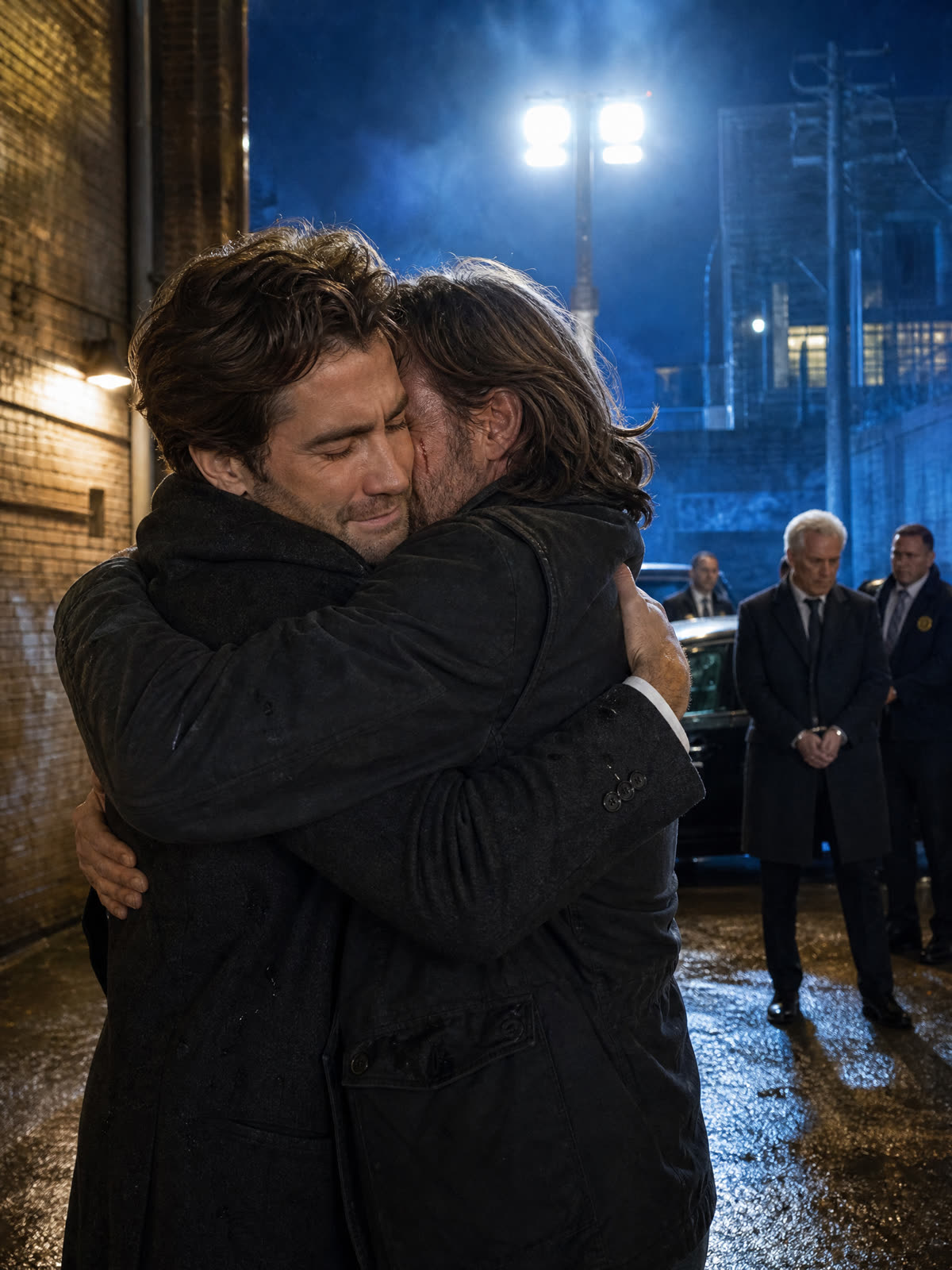
“Miles?” I tried to answer him, but no words came. I covered the remaining distance and wrapped my arms around him. He gripped me so hard that my ribs ached. His coat smelled of cold air and inexpensive soap. One of us was shaking; I couldn’t tell which. “I thought I’d never see you again,” I said against his shoulder. “I wanted to come home.” “Why didn’t you?” “Every time I got close, someone else paid for it.” We stood together beneath the floodlights while the agents worked behind us, and for the first time in six years, I no longer had to wonder where my brother was.
I drew back far enough to look at him. “Helen’s alive. She’s at St. Agnes with pneumonia, and the doctors are treating her. Sadie is safe. The boys are safe.” His face crumpled. He covered his mouth with the back of his hand and turned away, as if the old necessity of hiding his feelings had not yet loosened its hold. I stayed next to him and gave him time. Eventually, he asked, “Did Sadie get the formula?” That question undid me. “Yes,” I said. “She got it. She went in there and asked for what her brothers needed.” After all the records, threats, and missing years, he was thinking about whether a little girl had managed to feed the babies.
Agents led Arthur past us toward a federal vehicle. His chin remained lifted, and I could almost see him assembling the explanations he would offer his attorneys. He made no apology to either of us. I had not expected one. Watching him pass, I understood that I would not have accepted it anyway. The investigation continued for months. Arthur and four associates faced federal charges, while the foundation’s surviving programs were put under independent oversight. Investigators began the painstaking task of matching altered records with families whose lives had been changed by them. What Luke and Elise had collected was no longer something a few frightened people were trying to keep hidden.
Not every family received an answer quickly. Some mothers discovered that children they had grieved were still alive. For others, the paper trail ended without telling them where to turn next. Even so, the files gave investigators a way through years of concealment. Helen’s recovery came slowly, one stubborn week after another. Theo and Finn gained weight until their cheeks grew round. Sadie began sleeping all the way through the night instead of waking at three in the morning to check whether somebody needed her. There were changes that could be measured in documents and court proceedings, and others that could be seen only in a child finally allowing herself to sleep.
One Sunday in December, Haskell came to the apartment Luke had rented near Bay View. The market manager held a box of formula in both arms. For a moment he stared at the floor; then he looked directly at Sadie. “I owe you an apology,” he said to her. “I should have helped you instead of counting your coins. I’m sorry.” She folded her arms and studied him. Eight years old did not mean easily fooled, and she gave him the same careful scrutiny she had once given me. “Thank you for the formula,” she said. She did not assure him that what had happened was all right. He did not ask her to.
Haskell set down the box, nodded, and left. Luke, too, understood that returning did not erase the things his absence had cost. He started seeing a counselor in Walker’s Point, spent three days testifying in federal court, and learned the twins’ feeding schedule from the chart attached to the refrigerator. When Sadie needed to be angry, he let her. “You sent me birthday cards through strangers,” she told him one evening, her voice breaking. “I wanted you to come to my party.” “I know,” he said. “I wanted that too. I’m not asking you to forgive me yet.” “Good. Don’t ask.” He kept his word.
Our mother saw him again on a bright, cold January morning at her residence in Wauwatosa. When she opened the door, she looked at him, hid her face behind both hands, and then reached out to touch his cheek. “You’re too thin,” she said. We laughed until the laughter turned to tears. Afterward, we gathered around her little table for soup and made places for each grandchild. For years, she had set an extra place for a son who never arrived. Now he was sitting within reach, and there were children to fit around the table as well. Nothing about the years apart disappeared, but there was finally somebody there to hold.
In March, I was visiting Luke’s apartment and losing an argument with the mechanism of a folding stroller when Sadie climbed into his lap. The gold watch lay in her hands. She had asked me to bring it over. I had worn it for four months by then, long enough for a pale band to appear around my wrist. “Uncle Miles says you wore this everywhere,” she told her father. “Even when it stopped working.” “Why?” “Because it was a gift from someone I loved.” Over the top of her head, Luke looked at me. The watch had come from my first real paycheck, but what passed between us belonged to a time before either of us had earned one.
For a moment, I could almost see us as boys at the kitchen table, exchanging terrible jokes while our mother pretended she wasn’t listening. Sadie traced the scratch on the back of the watch with her thumb. Then she laid it gently in Luke’s palm. “You can have it back,” she said. “I don’t need it to remember you anymore.” He folded his fingers around the watch, his eyes bright, and drew her close. I turned toward the window to give them some privacy. The object I had found beside a sick woman’s bed was no longer the only proof that Luke had once been there. His daughter was sitting in his arms.
That summer, we brought the children to a park beside Lake Michigan. Beneath the clear sky, it was difficult to imagine the same city cold and soaked with November rain. Sadie ran ahead carrying a red kite, her braids bouncing behind her. Helen sat beside the twins’ stroller on a bench, healthy, sunburned, and laughing at something Theo had managed to do with his sock. Luke stood with me at the edge of the grass, hands in his pockets. The watch was ticking on his wrist again for the first time in years. I had taken it to a jeweler in Shorewood and paid to have it repaired.
“Why did you follow her?” Luke asked. I watched Sadie moving across the grass. “I thought a little girl shouldn’t have to walk home alone in the rain.” He nodded as the kite rose. “You saved my family.” My mind went back to the checkout line, the raised phones, and the child kneeling on the tiles. I remembered how close I had come to paying for her groceries and quietly heading back to my car. “No,” I said. “I carried some groceries. Sadie was keeping you all going long before I showed up.” The truth of it was there in front of us: the girl who had refused to give up was finally running without anything she had to carry for somebody else.
Across the lawn, Sadie turned and called for both of us to watch. Luke set off toward her at an easy jog, his limp almost gone, and I followed one step behind. Six years of searching had led us to that bright June afternoon because an eight-year-old would not leave a store without formula for her brothers. Now the people she loved were close enough to see her run. The lake wind caught her red kite and lifted it higher. She kept calling us forward, and we hurried across the grass toward her, our eyes following it into the sky.
Disclaimer: This story is a work of fiction inspired by real-life themes. Names, characters, places and events are fictionalized, and any resemblance to real persons is purely coincidental. Images are for illustration purposes only.
