

PART 1
The Weight of the Truth
“Can my dad and grandma leave first?”
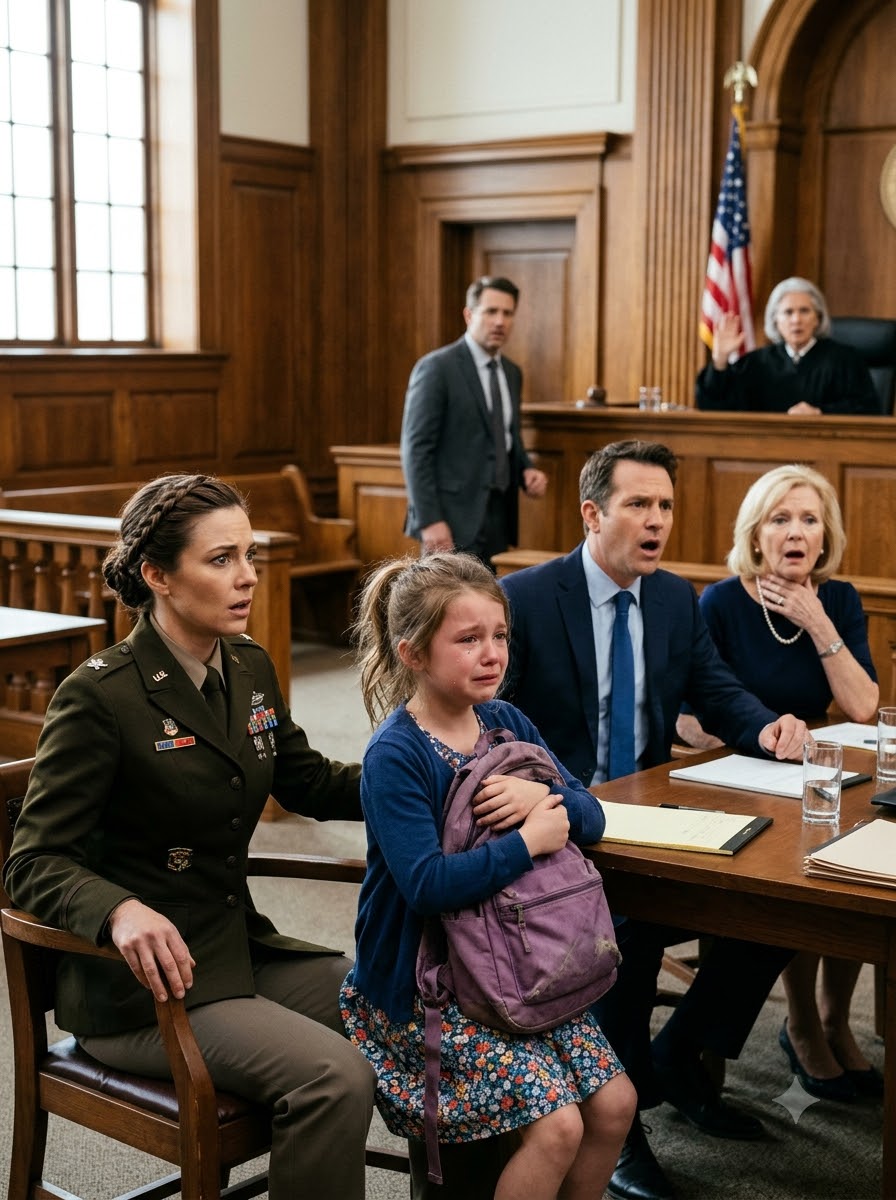
The words, spoken by a nine-year-old girl whose feet barely brushed the courtroom floor, fell into the heavy silence like a stone into a glassy pond.
Up until that precise second, my ex-husband, Wade Mercer, had worn the smug, relaxed expression of a man who believed the war was already won.
He lounged across the aisle in a tailored navy suit, one ankle casually resting on the opposite knee, looking less like a father fighting for his child and more like a corporate raider awaiting a favorable merger.
His attorney was actively shuffling papers, preparing to deliver a monologue detailing precisely why I was unfit to maintain primary custody of our daughter.
Then, Sophie asked her question.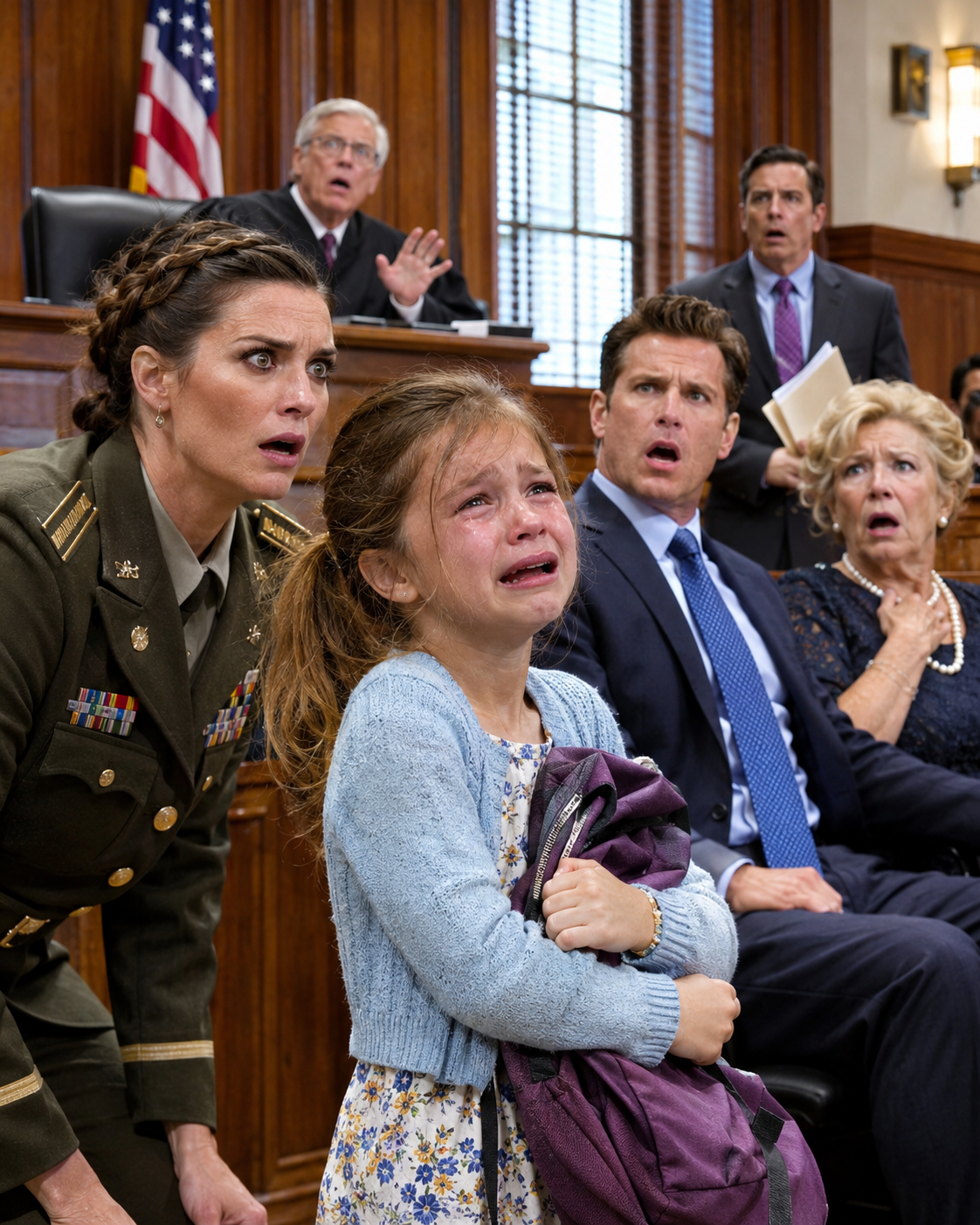
From my seat at the petitioner’s table, I watched the arrogant color violently drain from Wade’s face, leaving him a sallow, sickly gray.
It was a Tuesday in October, inside the hushed, mahogany-paneled walls of the Cumberland County Courthouse in Fayetteville, North Carolina.
For nearly two agonizing hours, I had sat rigidly beside my attorney, listening to strangers and former family members paint a portrait of a woman I fundamentally did not recognize.
According to Wade’s legal team, I was emotionally erratic, profoundly irresponsible, and far too obsessed with my military career to be a proper mother.
My name is Caroline Mercer.
I am forty-one years old, a former logistics Major in the United States Army, and, above all else, Sophie’s mother.
I was never a flawless parent.
My years wrapped in olive drab meant I had missed blowing out birthday candles, sitting in the audience for school plays, and reading more bedtime stories than my heart could comfortably bear.
But I had never, not for a single fraction of a second, abandoned my child.
Yet, Wade’s lawyer, a theatrical man named Harold Pritchard, seemed hell-bent on weaving a narrative of neglect.
“Mrs. Mercer,” Pritchard had crowed earlier, peering over his spectacles. “Is it not an undeniable fact that your daughter spent a considerable, almost foundational, amount of time with her grandmother while you were off playing soldier overseas?”
“Yes,” I had answered, keeping my voice level.
“And you would concede that consistency is the bedrock of a child’s psychological development?”
“Of course.”
“Yet, your relentless ambition repeatedly shattered that consistency, did it not?”
A hot spike of indignation had pierced my chest.
I desperately wanted to outline the reality of my absence: the birthday cards meticulously sourced and mailed from dusty outposts, the pixelated video calls conducted at three in the morning just to see her face, the way I utilized every single hour of leave to fly home.
But my attorney, Denise Whitam, had discreetly pressed her fingers against my wrist beneath the heavy oak table.
“Just answer what he asks,” she had breathed into my ear. “Don’t give him ammunition.”
So, I swallowed my pride.
I did.
Across the center aisle, Gloria Mercer observed the proceedings with her manicured hands neatly folded over a string of expensive pearls.
My former mother-in-law, a sixty-nine-year-old retired school administrator, possessed the unique, terrifying talent of delivering a lethal insult wrapped in the guise of grandmotherly advice.
She had spent the entirety of my marriage whispering into Wade’s ear that a real mother’s place was tethered to the kitchen sink.
Clearly, her doctrine hadn’t evolved.
When Pritchard boldly announced his intention to call Sophie to the stand, a cold knot of nausea tightened in my gut.
We had anticipated this maneuver.
Denise had vigorously objected to thrusting a child into the epicenter of a toxic adult warzone.
Judge Raymond Bell, a stern but fair adjudicator, had mandated strict protective protocols.
Sophie would not be thrown to the wolves in an open cross-examination.
Even with those safeguards, watching the heavy wooden doors swing open to reveal my daughter shattered something fundamental inside me.
She was swallowed by a blue cardigan worn over a faded floral dress.
Her light brown hair was scraped into a slightly crooked ponytail—the undeniable signature of her doing it herself.
Clutched tightly against her chest was the faded purple backpack I had bought her for the start of third grade.
Wade offered her a manufactured, encouraging beam.
Gloria nodded with regal approval.
Sophie’s eyes darted away, refusing to anchor on either of them.
A bailiff gently guided her toward the judge’s elevated bench, situating her in a heavy leather chair.
Judge Bell leaned forward, his imposing demeanor softening.
“Good morning, Sophie. I am Judge Bell. Do you understand why you’ve been asked to come here today?”
She offered a tiny, jerky nod.
“Can you use your words to tell me?”
“Because… because Mom and Dad can’t agree.” Her voice was a fragile whisper in the cavernous room.
“That is correct. And I want to make something abundantly clear to you right now. This disagreement between your parents? It is not your fault.”
Sophie’s thumb anxiously traced the frayed strap of her purple backpack.
That was the moment she looked up, her voice trembling but clear, and asked if her father and grandmother could be removed from the room.
The courtroom atmosphere instantly turned into a vacuum.
Wade jerked violently toward his attorney.
Pritchard leaped to his feet.
“Your Honor, my client has the right—”
“Mr. Pritchard, take your seat,” Judge Bell barked, his voice cracking like a whip.
He turned his attention back to my daughter, studying her for a long, heavy moment.
“Are you feeling unsafe or uncomfortable speaking while they are in the room, Sophie?”
She nodded again, tears welling in her eyes.
“Did someone instruct you on what you were supposed to say to me today?”
Sophie dropped her gaze to her scuffed sneakers.
“Yes, sir.”
Beside me, I heard Denise inhale a slow, sharp breath.
The judge immediately beckoned both attorneys to the bench for a hushed, furious sidebar.
Minutes later, Judge Bell slammed his gavel, announcing an immediate recess so the child’s concerns could be addressed in private chambers.
Wade and Gloria were summarily ordered to wait in the hallway, completely segregated from Sophie, while court personnel scrambled to adjust the parameters of the hearing.
As Wade stalked past our table, his mask of composure slipped.
He glared down at me, his eyes dark with accusation.
“What the hell did you tell her to do, Caroline?”
I didn’t dignify him with a response.
Denise did.
“Keep walking, Mr. Mercer,” she warned, her tone glacial.
For once in his life, he obeyed.
I was forced to remain seated at the petitioner’s table while a bailiff escorted Sophie into a secure, adjacent conference room.
Judge Bell, the legal counsel, and an appointed child advocate would determine how to proceed safely.
The agony of not being able to follow her, to wrap my arms around her trembling shoulders, was a physical torment.
I sat paralyzed, my hands interlaced so fiercely that the knuckle where my wedding band used to sit throbbed with a dull ache.
Twenty agonizing minutes bled into thirty.
Denise periodically checked her phone, aggressively turning it face down on the table.
“Whatever happens when I go back there,” she murmured, “do not, under any circumstances, confront Wade. I haven’t said a single word to him.”
“I know,” I whispered back, my throat tight.
“I need you to keep it that way.”
Eventually, a court clerk emerged, gesturing for Denise.
She disappeared into the back rooms.
When she returned a few minutes later, her usual stoic, professional mask was fractured.
I had never seen her look so profoundly unnerved.
“Caroline,” she said, leaning in close, her voice dropping to a conspiratorial whisper. “Sophie didn’t just come to testify. She brought something with her.”
“Brought what?”
“An envelope. She had it hidden in the lining of that purple backpack.” Denise scanned the room before continuing. “There is a handwritten note, and a digital memory card inside. The judge has ordered the evidence impounded until we can ascertain how to legally handle it.”
My heart hammered against my ribs.
“What does the note say?”
Denise hesitated, glancing down at her yellow legal pad.
She read the transcribed words softly.
“If you tell your mother the truth, Grandma and I will make absolutely sure you never see her again.”
All the moisture evaporated from my mouth.
“Who wrote that?”
“We don’t have a formal authentication yet,” Denise replied grimly. “But Sophie told the judge it was Wade.”
I stared blindly at the mahogany table.
For six grueling months, Wade had peddled the narrative that Sophie was terrified of me.
He had weaponized PTA meetings and family gatherings, whispering to anyone who would listen that our daughter dreaded her weekends at my house.
Now, the suffocating truth was crawling into the light.
“And the memory card?” I choked out.
“No one has reviewed the audio yet. But Sophie claims she recorded a conversation. A conversation she desperately wants the judge to hear.”
Before my racing mind could formulate another question, the heavy doors to the chambers swung open.
A bailiff whispered urgently to Judge Bell as he took the bench.
The judge surveyed the room, his expression thunderous.
“Given the highly concerning nature of the materials brought forth by the minor child,” Judge Bell announced, his voice echoing off the walls, “I am suspending all further testimony today. Counsel will receive immediate instructions regarding the preservation of evidence and the implementation of temporary, strictly enforced protective arrangements.”
He turned his piercing gaze toward the bailiff.
“Ensure the child is escorted safely to the secondary exit. No member of this family is to approach her without my explicit authorization. Are we clear?”
As the gavel fell, the puzzle pieces finally snapped together in my mind.
The faded backpack.
The crooked ponytail.
She hadn’t walked into this terrifying room prepared to lie for them.
She had come prepared to burn their house of cards to the ground.
Denise began swiftly packing her leather briefcase.
“Caroline, whatever is on that digital recording… we need to brace ourselves.”
I looked toward the empty doorway where my daughter had vanished, a fierce, protective fire igniting in my chest.
“Brace ourselves for what?”
Denise clicked the brass locks of her briefcase shut.
“This is no longer just a custody dispute. This is a hostage rescue.”
Three years before I found myself sitting in a courtroom wondering how my life had shattered, I was a woman who still fundamentally believed her marriage was salvageable.
It wasn’t because our life was a cinematic romance.
It wasn’t.
But when you spend fifteen years intertwined with another human being, you develop a dangerous capacity for making excuses.
You learn to justify behaviors you once would have found abhorrent.
Wade was exhausted.
Corporate sales were demanding.
Gloria, for all her passive-aggressive venom, meant well.
I had convinced myself that once I officially hung up my uniform and transitioned into civilian life, the simmering tensions would evaporate.
I first laid eyes on Wade Mercer at a humid, mosquito-plagued backyard barbecue just outside the perimeter of Fort Bragg.
I was twenty-four, a newly minted logistics officer.
A colleague had dragged me there with the solemn promise of smoked ribs and a strict moratorium on discussing deployment schedules.
Wade arrived late, wielding a plastic tub of mediocre grocery-store potato salad and a bag of charcoal briquettes no one had asked for.
He possessed a disarming charm—quick-witted, remarkably confident, and effortlessly conversational.
When someone inevitably revealed my rank and occupation, he hadn’t balked.
Instead, he flashed a brilliant, crooked grin.
“So,” he chuckled, handing me a plastic cup of lukewarm beer. “You’re the person who bosses everyone around?”
“Only when they desperately need bossing,” I shot back.
He had laughed, a deep, genuine sound.
I liked that my uniform didn’t intimidate him.
I liked that he didn’t try to flex his ego to compensate for my authority.
Or, at least, that is the illusion I bought into.
We were married two years later in a modest, sun-drenched ceremony near the heart of downtown Fayetteville.
My father, proud and tearful, walked me down the aisle.
When I recited my vows, Wade’s eyes brimmed with tears.
In that fleeting, golden moment, I truly believed I had anchored myself to a partner who understood that marriage was a foxhole—you cover each other’s blind spots.
For a brief, shining window of time, he did.
I was thirty-two when Sophie came into the world.
In the sterile, fluorescent glow of a recovery room at Cape Fear Valley Medical Center, Wade held our daughter.
He cradled her fragile weight, marveling at her impossibly tiny fingers as if he had just discovered a new element.
“She has your incredibly stubborn chin,” he whispered, pressing a kiss to her forehead. “Poor kid is doomed.”
We had laughed until my surgical incisions ached, prompting a frantic nurse to rush in and scold us.
Those memories were not fabricated; they were vividly, tangibly real.
And that was precisely what made the ensuing nightmare so difficult to reconcile.
How does the man who wept holding his newborn mutate into the man who threatened her in a kitchen?
We settled into a modest, single-story house off Ramsay Street.
It featured a narrow, overgrown backyard and a kitchen that perpetually smelled of dark roast coffee and toasted bagels.
Saturday mornings were a sacred ritual of Wade burning oversized pancakes, while Sophie meticulously insisted on dissecting hers into perfectly symmetrical geometric squares.
Sundays were for aimless neighborhood walks or mundane runs to the Harris Teeter.
It was an ordinary, unremarkable life—the precise kind of life you fail to appreciate until it is violently ripped away.
Naturally, my military obligations complicated our domestic rhythm.
Working in logistics meant functioning as the central nervous system for troop movements and supply chains.
It demanded obsessive planning, grueling seventy-hour work weeks, and sudden overseas deployments.
Before every departure, I operated like a machine: securing childcare, updating emergency protocols, and painstakingly labeling everything in the house so Wade wouldn’t have to think.
This was where Gloria inserted herself.
At first, her presence felt like a blessing.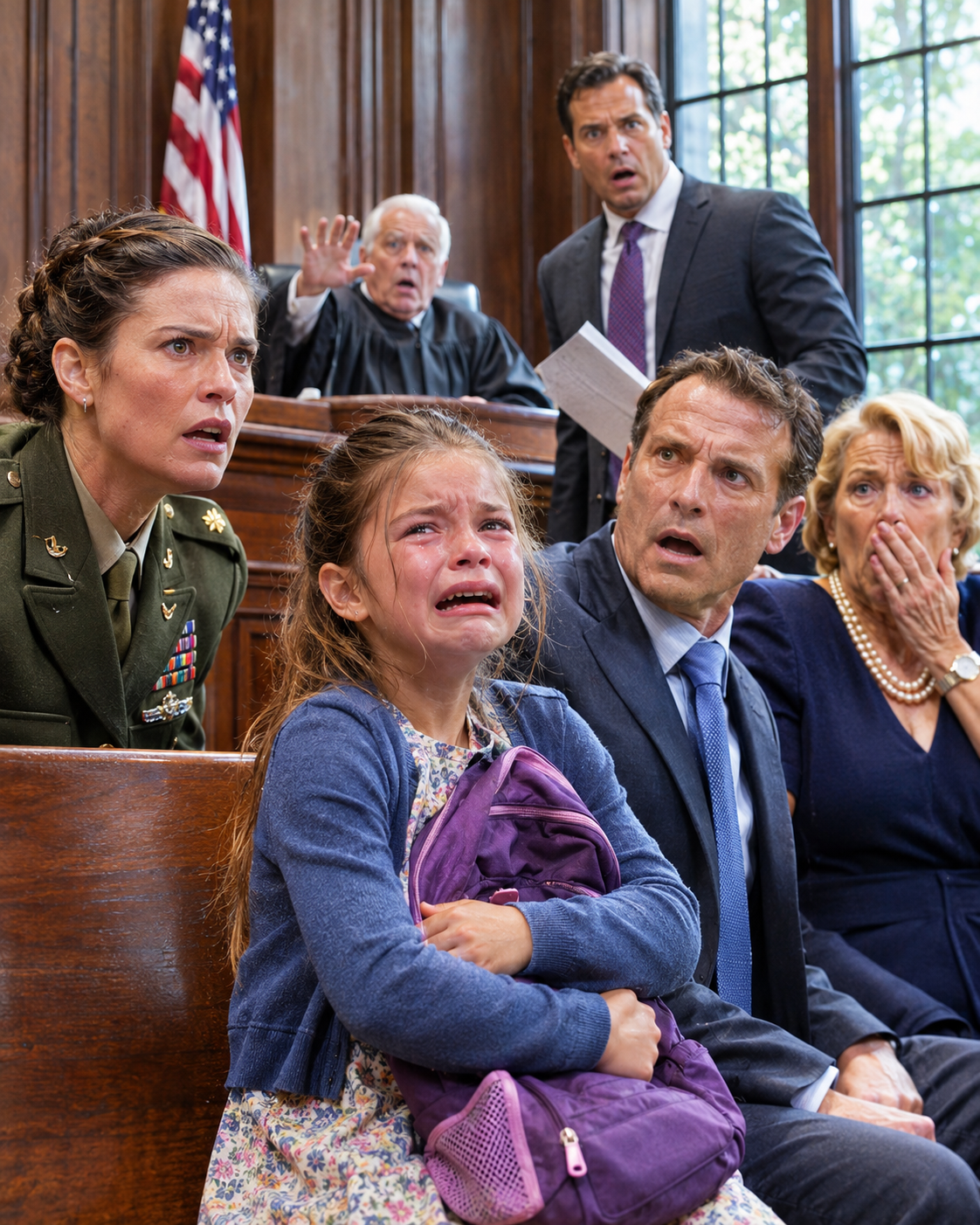
With decades of experience terrorizing elementary school hallways as an administrator, she knew how to enforce a schedule.
But somewhere in the shadows of my absences, her “assistance” morphed into covert warfare.
Her help became her ammunition.
The shift was subtle at first.
I remember a Thanksgiving dinner during a brief period of leave.
I was standing in my own kitchen, happily plating food for a four-year-old Sophie.
“She absolutely refuses to eat her carrots if they touch the mashed potatoes,” Gloria announced loudly from the dining room, swirling her wine glass.
“I know, Gloria,” I replied calmly.
PART 2
“Well, I just assumed you wouldn’t necessarily know,” she retorted, her voice dripping with artificial sweetness. “Given how away you always are. We have our little routines when you’re gone.”
I glanced at Wade.
He was cutting his turkey, his eyes glued to his plate.
He said nothing.
I swallowed the bitter taste in my mouth, telling myself a public spat over root vegetables wasn’t worth ruining the holiday.
There were dozens of those paper-cut moments.
When Sophie started kindergarten, a fellow mother mentioned that Gloria had introduced herself as the person “practically raising the child.”
When I finally pinned on the rank of Major, Wade threw a celebratory dinner, only to spend the drive home sulking because our friends had spent the evening asking about my promotion.
“Just once,” he muttered, staring out the passenger window, “I’d like to be the most important person in this family.”
I had chuckled, assuming it was a self-deprecating joke.
I was a fool.
By the time I submitted my resignation papers and left active duty, the foundation of our marriage was riddled with rot.
We existed as a collection of unfinished arguments and silent resentments.
I accepted a lucrative civilian position managing operations for a large-scale commercial distribution hub on the outskirts of Fayetteville.
The schedule was predictable.
I was home for dinner every night at six.
I foolishly envisioned Wade sighing in relief.
Instead, my constant presence seemed to irritate him profoundly.
He began finding excuses to stay at the office.
His smartphone was perpetually placed face-down on countertops.
He developed a sudden, paranoid attachment to his laptop, changing the password twice in a month.
When I finally cornered him and asked if we were okay, he deflected with cruelty.
“You’re not a Major anymore, Caroline,” he snapped. “Stop treating this house like a military installation. Not every single thing requires an interrogation.”
The final blow arrived on a mundane Tuesday.
He had claimed he was attending a mandatory weekend sales summit in Raleigh.
While sorting laundry the following Monday, I pulled a crumpled, thermal-printed receipt from the inner pocket of his blazer.
It was from a high-end, romantic seafood restaurant.
Two expensive entrees.
Two glasses of reserve Pinot Noir.
The restaurant wasn’t in Raleigh.
It was in Wilmington, a coastal town two hours in the opposite direction.
I waited until Sophie was asleep, the house quiet save for the rhythmic hum of the dishwasher.
When I placed the smoothed-out receipt on the kitchen island, Wade didn’t even try to lie.
He stared at the thermal paper for a long, heavy minute, before the truth spilled out.
He had been sleeping with a junior colleague from his marketing department.
Her name was Natalie.
I didn’t scream.
I didn’t shatter plates against the wall.
The military had trained me to process catastrophic failure with cold detachment.
I pulled out a barstool and sat down, feeling entirely hollowed out.
“How long?” I asked, my voice devoid of inflection.
“Six months.”
Six months.
For half a year, while I was sitting at this very counter teaching our daughter multiplication tables, while I was carefully packing his lunches and believing we were finally bridging the gap, he was building a secondary life.
I looked him dead in the eye and asked if he was prepared to end it.
He looked away, mumbling that he “wasn’t sure what he wanted anymore.”
The cowardice in that statement was the only answer I needed.
Our divorce was a finalized, bloodless paper transaction the following year.
We agreed, ostensibly for Sophie’s sake, to share joint physical custody.
I packed my life into cardboard boxes and purchased a smaller, older home fifteen minutes across town.
It was a stressful transition, but I was determined to make it a sanctuary.
The very first night Sophie slept under my new roof, I tucked her into a bed I had painstakingly assembled that afternoon.
She looked around the unfamiliar walls, her small brow furrowed.
“Mom? Why is my room so different?”
“Because this is our new home, sweetheart,” I told her softly, smoothing the duvet.
“Is Dad going to come here?”
“Not to live, baby. He has his house, and we have ours.”
She processed this with a solemn nod, then asked if she could keep the faded, star-shaped nightlight from her old bedroom.
I promised her she could have anything that made her feel safe.
For the first few months, we managed an uneasy détente.
We were co-parenting.
But peace, I soon learned, was deeply offensive to Wade’s ego.
He began testing the perimeter, launching a campaign of petty, logistical warfare.
He would unilaterally change pickup times without a text, leaving me scrambling.
He purposefully scheduled Sophie for expensive, time-consuming extracurriculars on my designated weekends, then played the martyr to the coaches when I couldn’t get off work early to accommodate his whims.
Gloria, seemingly energized by the divorce, began showing up unannounced at Sophie’s school for parent-teacher conferences, actively excluding me from educational decisions.
The psychological toll on my daughter became undeniable.
One rainy afternoon, as I was folding a basket of warm laundry, I turned to find Sophie hovering silently in the doorway of my bedroom.
She looked pale and small.
“Mom?” she asked, her voice trembling. “Did you like being a soldier more than you liked being my mom?”
I dropped the towel I was holding.
The air vanished from my lungs.
“Who on earth told you something like that, Sophie?”
She just shrugged, retreating into her shell.
I crossed the room and sat cross-legged on the floor in front of her, taking her small hands in mine.
“Sweetheart, listen to me. I was proud of my job. I helped people. But there has never been a single second of my life where I loved anything more than I love you. You are my whole heart.”
She slumped forward, burying her face against my shoulder.
I desperately wanted to interrogate her, to demand to know exactly what venom Wade and Gloria were dripping into her ears.
But I held my tongue, simply holding her tight.
Three weeks later, a certified courier knocked on my front door.
I signed for a thick, manila envelope.
Inside was a formal legal petition.
Wade Mercer was suing for full, primary physical and legal custody of our daughter.
I read the attached documents standing in my hallway, the words blurring together.
His petition alleged that I was mentally unstable, prone to fits of rage, and, most damningly, a negligent parent.
Attached as Exhibit A was a legally binding, sworn affidavit signed by Gloria Mercer.
The affidavit stated, under penalty of perjury, that she had personally witnessed me abandon a frightened, crying Sophie alone in my house overnight while I “pursued personal interests.”
I read the page three times, my hands shaking so violently the paper rattled.
It was a complete, malicious fabrication.
But Gloria had put her signature on it, and Wade was intending to use it as the cornerstone of his attack.
That night, after I put Sophie to bed and watched her chest rise and fall in the glow of her star-shaped nightlight, I sat at my kitchen table and dialed the number of the most ruthless family law attorney in Fayetteville.
When Denise Whitam answered and asked how she could assist me, I stared at a school picture of Sophie stuck to my refrigerator.
“They are trying to steal my daughter with a lie,” I said, my voice hardening into steel. “I need you to help me destroy them.”
Sitting in Denise’s office on Hay Street the next morning, I learned the hardest lesson of the civilian justice system.
The office smelled of old paper, leather bindings, and lemon polish.
Denise sat behind a massive desk, her reading glasses perched on the bridge of her nose, projecting an aura of terrifying calm.
“Caroline, I believe you,” she said, tapping her gold pen against Gloria’s affidavit. “But my belief is irrelevant. The judge does not know you, and he does not know your ex-husband. In this room, the truth is only what we can empirically prove.”
“She completely fabricated this event,” I argued, leaning forward. “It never happened.”
“Then we will dismantle it, piece by piece,” Denise replied smoothly. She slid a fresh, yellow legal pad across the desk toward me. “Welcome to your new second job. I need a meticulously documented timeline. Every single custody exchange. Every missed phone call. Every erratic text message. You need to become an archivist of your own life. And Caroline?”
“Yes?”
“Do not exaggerate a single detail. Even the facts that paint you in a poor light. If you lie to me, I cannot protect you.”
Those instructions became my religion.
My dining room rapidly transformed into a tactical command center.
After Sophie went to sleep, I would brew a pot of black coffee and spread out elementary school attendance records, pediatric dental files, and hundreds of printed text messages.
I requested visitor logs.
I combed through years of digital calendars.
Some evidence was easy to compile to prove my consistency as a mother.
But Wade’s strategy was insidious; he manufactured chaos, then documented my stressed reactions to prove I was “unstable.”
In February, he had secretly enrolled Sophie in a Saturday morning gymnastics league across town, knowing full well it was my weekend to take her to visit her grandfather.
When I texted him, furious at the overstep, his reply was chillingly curated for a judge’s eyes: “Once again, Caroline, your rigid personal priorities are taking precedence over Sophie’s developmental needs and happiness.”
He was building a paper trail, painting me as a hostile, inflexible monster.
“He is baiting you,” Denise explained, reviewing a binder of our communications. “He wants you to explode so he can print the screenshot.”
“So what do I do? Let him walk all over the schedule?”
“No. You reply with absolute, emotionless professionalism. You speak to him as if you are a customer service representative dealing with a hostile client.”
It was exhausting.
During the day, I managed complex logistics for a massive trucking firm, coordinating forty freight vehicles across three state lines without breaking a sweat.
But a single, passive-aggressive text ping from Wade could spike my heart rate and ruin my afternoon.
The financial hemorrhage was equally terrifying.
By the end of the second month, I had drained my emergency savings to cover Denise’s exorbitant retainer and the costs of private investigators verifying timelines.
I was forced to sell the reliable SUV I had owned since my army days.
A coworker bought it for his teenager.
Handing over the keys felt like a physical defeat; that car had carried Sophie home from the hospital.
Wade, ever the opportunist, noticed the missing car during a pickup.

He immediately texted: “I noticed you sold your vehicle. Are you experiencing financial insolvency? I am deeply concerned about the environment Sophie is in.”
I sat on my porch, typing and deleting a dozen vitriolic responses.
Finally, adhering to Denise’s doctrine, I sent: “My transportation and Sophie’s needs are fully secured. Please confirm you will be at the library for Friday’s 5:00 PM exchange.”
Denise called it a masterclass in restraint.
I called it the most psychologically taxing sentence I had ever composed.
But my financial ruin was secondary to the chilling metamorphosis occurring within my daughter.
Sophie had always been a vibrant, exhaustingly talkative child.
Now, she was withdrawing into a shell.
She answered questions with noncommittal shrugs.
She stopped asking to have friends over.
She began experiencing night terrors, demanding the hallway light remain blazing all night.
The terror reached a boiling point on a Tuesday evening.
I was emptying her backpack when my fingers brushed against a crumpled piece of notebook paper shoved deep beneath her math folder.
I smoothed it out on the counter.
It was a crude, chilling drawing.
Three stick figures stood huddled beneath a massive, scribbled black cloud.
The smallest figure was positioned in the middle, trapped between the two larger ones.
Above the drawing, written in Sophie’s shaky handwriting, were two words:
DON’T TELL.
I walked into her bedroom.
She was sitting on the floor, brushing the fur of a stuffed rabbit.
“Sophie, honey?” I kept my voice feather-light. “Can you tell me about this picture?”
Her head snapped up.
Genuine panic flashed across her face.
She scrambled up and snatched the paper from my hand, crumpling it against her chest.
“Where did you find that? That’s private!”
“It was loose in your backpack, baby. I’m not mad. I just want to know what it means.”
“It doesn’t mean anything!” she yelled, her eyes welling with tears. “It’s just a stupid story!”
I wanted to shake the truth out of the universe.
Was Wade screaming at her?
Was Gloria threatening her?
But Denise’s warnings echoed in my head: Do not ask leading questions. If you pressure her, opposing counsel will claim you are coaching the witness.
“Okay,” I said gently, backing away. “You don’t have to talk about it. But please remember, if someone is scaring you, you can always tell me. I will always protect you.”
She wouldn’t look at me.
“I know,” she whispered to the floor.
A week later, the nightmare escalated.
It was my designated time for a FaceTime call while Sophie was at Wade’s house.
She appeared on my phone screen wearing pink pajamas, sitting on her bed.
We chatted about a spelling test, but she kept nervously glancing over her shoulder toward her bedroom door.
“Mom?” she suddenly whispered, leaning intimately close to the camera.
“I’m here, sweetheart.”
“If… if a grown-up makes you promise to keep a secret, but it’s a really bad secret… do you still have to keep the promise?”
The blood froze in my veins.
PART 3
I sat up perfectly straight.
“No, Sophie. Absolutely not. Especially if a secret could end up hurting someone. You can always tell a safe grown-up.”
She bit her lip, her eyes wide with fear.
“Even if the grown-up gets really, really mad at me?”
“Even then,” I vowed fiercely. “I won’t let anyone—”
Before I could finish the sentence, the bedroom door in the background swung open.
Gloria’s towering figure stepped into the frame.
“That is quite enough screen time for tonight, Sophie,” Gloria snapped.
The screen instantly went black.
I frantically redialed.
It went straight to voicemail.
I stared at my reflection in the dark glass of the phone, realizing with horrifying clarity that my daughter wasn’t just being alienated.
She was being held emotionally hostage.
I did not sleep that night.
Every time I closed my eyes, the image of Sophie’s terrified face and the abrupt, violent termination of that video call played on an infinite loop.
By 7:00 AM, I was pacing the floor of Denise Whitam’s waiting room, holding a paper cup of coffee I couldn’t stomach.
When Denise finally ushered me in, I recounted the drawing and the FaceTime call, my voice vibrating with barely suppressed rage.
“They are doing something to her, Denise. She’s terrified. I need to go over there and pull her out of that house.”
Denise removed her glasses, her expression deadly serious.
“Caroline, listen to me very carefully. You cannot play vigilante. We are operating inside a legal crucible. If you storm over there, Wade will call the police, he will file a restraining order, and you will hand him full custody on a silver platter.”
“So I am supposed to sit on my hands while they terrorize my child?”
“You are supposed to maneuver strategically,” Denise corrected. “I am immediately filing an emergency motion for a court-appointed child psychologist to evaluate Sophie and to implement safeguards regarding her testimony. But you must not interrogate her. Wade is already building a case that you are coaching her. Do not give him the evidence.”
I despised the glacial pace of the civilian legal system.
In the military, if a supply line was compromised, I deployed resources and neutralized the threat by sunset.
Here, my daughter was the compromised supply line, and I was being told to fill out paperwork.
But I obeyed.
I focused entirely on making my home an impregnable fortress of stability.
I cooked her favorite meals.
We built elaborate blanket forts.
I stopped asking probing questions about what happened at her father’s house.
I just let her breathe.
One Saturday, we visited the downtown public library.
Sophie checked out a towering stack of books about equestrian care, despite never having ridden a horse in her life.
On the drive home, she stared out the passenger window, watching the pine trees blur past.
“Mom?” she asked quietly. “Can someone go to jail for telling the truth?”
I gripped the steering wheel, carefully monitoring my tone.
“Sometimes, people get very angry when they hear a truth they want to hide. But telling the truth is never a crime, Sophie. It’s the bravest thing a person can do.”
“Even if it gets your family in trouble?”
“Especially if it stops someone from being hurt,” I replied.
She fell silent, resting her head against the cool glass.
I had no idea that in her own terrifying, isolating world, my nine-year-old daughter was already fighting a covert war.
It was only much later, after the psychological evaluations and the court proceedings concluded, that I learned the horrifying extent of what was happening behind Wade’s closed doors.
For months, Wade and Gloria had been subjecting Sophie to brutal, systematic coaching sessions.
They framed it as “practicing for the judge.”
It began insidiously.
Gloria would casually ask which house had better snacks, or who helped with math homework.
But as the trial date loomed, the conditioning became aggressive.
“Your mother used to abandon you for months to go play army, didn’t she?” Gloria would press, pacing the kitchen.
Sophie would shake her head, crying. “No, she was working. She called me every day.”
“That is a lie she told you to make you feel better,” Gloria would hiss, leaning in close. “She didn’t want to be here.”
Wade deployed the ultimate weapon: fear of the state.
He sat Sophie down and explained, with chilling calmness, that if she didn’t say exactly what they practiced, the judge would decide both parents were bad, and Sophie would be sent away to live in a foster home with strangers.
It was psychological torture designed to break a child’s will.
One evening, Gloria slid a typewritten sheet of paper across the dining table.
It was a script.
1. My mother gets angry and yells at me.
2. My mother left me alone at night.
3. I am only safe with my dad.
Sophie, weeping, pushed the paper back.
“I won’t say number two. Mom never left me alone. It’s a lie.”
Wade had slammed his fist on the table, rattling the silverware.
“You are making this infinitely harder than it needs to be, Sophie. Stop being a brat and learn the lines.”
That was the night the threats escalated.
But Wade and Gloria had made a critical, arrogant miscalculation.
They forgot the Christmas present I had bought Sophie the previous year: a small, voice-activated digital audio recorder she used to practice reading her library books out loud.
Sophie had left the device running, buried deep inside her purple backpack, when she went into the kitchen for the coaching session.
When she retreated to her room and played back the audio, she heard her own crying.
But when she let the tape run, she captured the conversation that happened after she left the room.
She heard Gloria’s voice, sharp and conspiratorial.
“It’s a risk, Wade. Caroline never left that child unattended overnight.”
Then, Wade’s voice, dripping with arrogant dismissal.
“It doesn’t matter, Mom. She can’t prove where she was, and the judge will believe a grandmother over an absentee soldier. We just need the custody order signed before my company transfers me to the Richmond office. Caroline won’t have the money to fight an out-of-state relocation.”
Sophie didn’t comprehend the legal nuances of out-of-state jurisdiction, but she understood the core truth: her father and grandmother were plotting to steal her and move her away from her mother forever, based on a manufactured lie.
Terrified but resolute, Sophie began actively carrying the recorder.
A few days later, she intentionally captured a session where Wade explicitly threatened her.
“If you tell your mother what we talk about,” the audio captured him saying, “Grandma and I will make sure the judge takes you away, and you will never see Caroline again.”
Wade had even written a summarized threat on a Post-it note and stuck it to her script as a reminder.
Sophie carefully peeled it off, placed the memory card and the note inside a small envelope stolen from Gloria’s desk, and slit a small hole in the lining of her purple backpack to hide it.
She carried that radioactive secret back and forth between our houses for weeks.
She wanted desperately to give it to me, but every time she looked at me, Wade’s threat echoed in her ears.
While my daughter was playing spy behind enemy lines, Denise and I were searching for a miracle in the paperwork.
One rainy Tuesday afternoon, my desk phone at the distribution center rang.
It was Denise.
“Caroline, I need you to pull up the sworn affidavit Gloria submitted. The one where she claims you abandoned Sophie.”
I pulled the file from my desk drawer, holding the phone to my ear.
“I have it.”
“Look at the specific date she cites. October 17th of last year. Think back. Where were you on the evening of October 17th?”
I closed my eyes, accessing the mental filing cabinet of my calendar.
“October 17th… that was a Thursday. It was the fall parent-teacher conference at Sophie’s elementary school. I was sitting in Mrs. Keane’s classroom looking at dioramas.”
“Are you absolutely certain?” Denise’s voice vibrated with suppressed excitement.
“Yes. I signed the visitor log at the front office.”
“Get me a certified copy of that log. Immediately. But Caroline, it gets better. Go through the text message binder we compiled. Look at what Wade sent you on the night of October 17th.”
I scrambled for the binder, flipping wildly through the plastic sleeves.
I found the date.
At 8:14 PM, Wade had texted me: “Thanks for handling the conference tonight. Glad Mrs. Keane says Sophie’s reading is improving.”
I slumped back in my office chair, the breath rushing out of me.
“He texted me… knowing exactly where I was.”
“Exactly,” Denise purred, the sound of a predator smelling blood. “Gloria lied on a sworn affidavit to the court, providing a specific date that places you at home. But the school records prove you were at a conference. And Wade’s own text message proves he knew you were there. They didn’t coordinate their lies.”
“We caught them,” I whispered.
“We didn’t just catch them,” Denise corrected. “We are going to annihilate them on the stand. Does Wade know we have this?”
“No.”
“Keep it that way. Gloria is scheduled for cross-examination on Thursday. Let them walk right into the trap.”
The morning of the final hearing, the Fayetteville air was crisp and biting.
I parked my car in the concrete garage adjacent to the courthouse, killing the engine.
I sat in the silence for twenty minutes, watching ordinary people hurry toward the imposing granite building.
A woman wrestled with a stroller.
A lawyer aggressively checked his watch.
It was a Tuesday, a day of mundane legal transactions for most, but for me, it was the climax of a war for my family’s survival.
Denise was waiting for me near the metal detectors.
She looked like a Valkyrie in a tailored gray suit.
“How is your heart rate?” she asked, handing me a bottle of water.
“Like I swallowed a hive of bees,” I admitted.
“Channel it,” she instructed. “When Gloria takes the stand, you look her directly in the eyes, and you do not blink. We are not just defending you today; we are taking the offensive.”
Inside the courtroom, the atmosphere was suffocating.
Wade and Harold Pritchard were already seated.
Wade’s suit was immaculate, but the arrogant sheen had worn off; he looked tense, drumming his fingers against the table.
Gloria sat in the gallery behind them, draped in a cream-colored blazer, her pearls gleaming under the harsh fluorescent lights.
She pointedly refused to look in my direction.
Sophie, thankfully, was not present in the room.
Judge Bell had previously ruled that she would remain in the protective custody of a child advocate in chambers while the adults waged war.
Following the explosive revelation of Sophie’s hidden envelope days prior, the court had spent a week verifying the authenticity of the digital recordings and the handwritten note.
The judge had ruled that portions of the audio were legally admissible, given the extraordinary circumstances of coercion and the threat to a minor.
But before we played our trump card, Denise had to dismantle their foundation.
Gloria Mercer was called to the witness stand.
She walked to the wooden box with her chin tilted upward, projecting the unbothered air of a woman accustomed to unquestioned authority.
For the first twenty minutes, Pritchard gently lobbed soft questions at her.
She elegantly recounted her devotion to Sophie, baking cookies, and helping with history projects.
Then, Pritchard pivoted to the kill shot.
“Mrs. Mercer, could you please recount for the court what you witnessed on the night of October 17th?”
Gloria touched her chest, feigning distress.
“It was horrific. Wade called me, frantic. I went over to Caroline’s home. The house was dark. Sophie was inside, entirely alone, crying for her mother. Caroline had simply vanished into the night.”
“Thank you, Mrs. Mercer. No further questions.” Pritchard sat down, looking immensely satisfied.
Denise Whitam stood up slowly.
She didn’t rush to the podium.
She walked deliberately, letting the silence stretch until it became uncomfortable.
“Mrs. Mercer,” Denise began, her voice deceptively pleasant. “You signed a sworn affidavit, under the legal penalty of perjury, detailing this horrifying abandonment, correct?”
“I did,” Gloria said, narrowing her eyes. “Because it is the truth.”
“And you are entirely, unequivocally certain that this event took place on the evening of October 17th?”
“I wouldn’t have sworn to it otherwise. I keep meticulous calendars.”
Denise clicked a remote, and the courtroom projector hummed to life.
A scanned document appeared on the large screen.
“Mrs. Mercer, I am displaying a subpoenaed visitor log from Sophie’s elementary school, dated October 17th. Can you read the signature logged in at 6:45 PM and logged out at 8:30 PM?”
Gloria squinted at the screen.
The color began to drain from her neck.
“It… it appears to be Caroline’s signature.”
“It is. Because my client was attending a parent-teacher conference with Mrs. Keane. She was surrounded by educators. She was not, as you claimed, vanishing into the night.” Denise took a step closer to the witness box. “Now, you testified that Wade called you that night, frantic about Sophie being alone. Did you personally enter the house?”
“I… well, I drove over there,” Gloria stammered, her regal posture collapsing.
“That was not the question. Did you turn a doorknob, enter the structure, and physically see Sophie alone?”
Gloria glanced desperately toward Wade.
“Wade told me what was happening!”
Judge Bell leaned forward, his voice a low rumble.
“Mrs. Mercer, you will answer counsel’s question directly.”
“No!” Gloria snapped, her facade cracking. “I didn’t go inside.”
“So your sworn statement, claiming you personally witnessed this event, is a complete fabrication,” Denise stated flatly.
“I… I may have phrased it poorly.”
Denise clicked the remote again.
A massive screenshot of a text message filled the screen.
“Let’s examine this text message Wade sent Caroline at 8:14 PM that exact same night. ‘Thanks for handling the conference tonight.’ Mrs. Mercer, did your son inform you that he knew exactly where Caroline was before he asked you to sign a perjured affidavit?”
“I… I don’t recall.” Gloria was shrinking into the chair.
“Did he draft the statement for you?”
Her knuckles were white as she gripped the wooden railing.
“Yes.”
The courtroom was dead silent.
Pritchard was furiously writing on a legal pad, his face flushed.
“Your Honor,” Denise said, turning to the bench. “At this time, we request permission to publish a verified excerpt from the digital audio evidence submitted by the minor child, Sophie Mercer.”
Wade shot out of his chair.
“Objection! This is a circus—”
“Overruled,” Judge Bell snapped, glaring at Wade. “Sit down and remain silent, Mr. Mercer, or I will hold you in contempt.”
Denise connected a laptop to the audio system.
A click echoed through the speakers, followed by the undeniable sound of Gloria and Wade conversing in a kitchen.
“It’s a risk, Wade. Caroline never left that child unattended overnight.”
“It doesn’t matter, Mom. She can’t prove where she was… We just need the custody order signed before my company transfers me to the Richmond office. Caroline won’t have the money to fight an out-of-state relocation.”
The audio cut out.
The silence that followed was heavier than lead.
I stared at Wade.
He was staring at the table, his chest heaving.
His grand scheme, his manipulative masterclass, had just been detonated by a nine-year-old girl with a Christmas toy.
Denise turned back to the witness stand.
“Mrs. Mercer. Do you recognize the voices on that recording?”
Gloria closed her eyes, tears of humiliation leaking through her lashes.
“Yes.”
“Was the sworn affidavit you submitted to this court a deliberate, orchestrated lie designed to defraud a mother of her child?”
Gloria’s mouth opened, then closed.
She looked at the judge, then at the floor.
“Yes. It was.”
It was over.
Pritchard frantically requested a recess, but the damage was terminal.
When Wade was subsequently forced onto the stand, Denise eviscerated him.
She cornered him on the secret relocation plans, the perjured affidavit, and finally, the audio of him threatening to make sure Sophie never saw me again.
Wade tried to deflect, mumbling pathetic excuses about believing my military background made me too rigid.
But Judge Bell wasn’t having it.
PART 4
Before the ruling, I was granted permission to address the court.
I stood up.
I had spent months fantasizing about this moment, scripting vicious, vindictive monologues designed to humiliate Wade as deeply as he had hurt me.
But looking at him now—a desperate, broken man caught in his own web—the anger evaporated, replaced by a profound, exhaustion-laced pity.
“Wade,” I said, my voice steady, echoing in the quiet room. “You spent an entire year trying to convince this court, and our daughter, that I abandoned her. But when the time came, when she was backed into a corner, you were the one who made her terrified to tell the truth. You weaponized her love.”
He couldn’t look at me.
He kept his eyes fixed on his legal pad.
I turned my attention up to Judge Bell.
“Your Honor, I am not asking for revenge. I do not want my daughter to be punished for loving her father. But I cannot allow her to be raised in an environment where she is taught that love is conditional on lying. I just want her to feel safe.”
My voice finally cracked on the last word.
I sat down, my legs trembling.
Judge Bell’s ruling was swift and uncompromising.
Citing egregious manipulation, coercion of a minor, and perjury, he awarded me sole primary physical and legal custody of Sophie.
Wade was granted severely restricted, supervised visitation rights, contingent upon mandatory psychological evaluation and family counseling.
The judge also ominously noted that the perjury regarding the affidavit would be referred to the District Attorney’s office for potential criminal review.
There was no cinematic cheering.
No triumphant music.
Just the heavy thud of the gavel, signaling the end of a nightmare.
In the hallway, Denise pulled me into a fierce hug.
“We did it, Caroline.”
“What happens now?” I asked, feeling dizzy.
“Now,” she smiled, “I buy you a sandwich that didn’t come from a vending machine, and you take your daughter home.”
That evening, the house felt different.
The oppressive, invisible weight that had suffocated us for months had lifted.
Sophie sat beside me on our worn living room sofa, her legs tucked underneath her, fiercely clutching the stuffed rabbit she had owned since kindergarten.
The television was playing a cartoon on low volume, but neither of us was watching it.
“Mom?” she whispered, breaking the quiet.
“I’m right here, sweetheart.”
“Is Dad going to hate me forever because I showed the judge the recording?”
I muted the television and turned to face her, pulling her small, warm body against my side.
This was the moment that mattered more than any court order.
“Sophie, listen to me. Telling the truth didn’t make your father stop loving you. I can’t promise you how he is feeling right now, and I can’t explain why adults sometimes make terrible, selfish choices. But I need you to know, with absolute certainty, that you did not do a single thing wrong.”
She rested her head against my chest.
“But he was so mad.”
“I know he was,” I said, stroking her hair. “But his anger is his problem to fix, not yours. It is never a child’s job to protect a grown-up from their own bad choices.”
She thought about that for a long time, the gears turning in her mind.
“Even if it’s my dad?”
“Especially because it’s your dad. Parents are supposed to protect you. Not the other way around.”
We stayed tangled together on that couch until the grandfather clock in the hallway chimed nine times.
For the first time in nearly a year, I carried her to bed, tucked her in, and she fell asleep without asking me to leave the hallway light blazing.
That Tuesday evening was the true beginning of our new life.
The subsequent months were a journey of deliberate, careful healing.
I enrolled Sophie with a specialized pediatric counselor who had experience dealing with high-conflict divorces.
At first, Sophie was guarded, refusing to speak during the sessions.
But slowly, the walls came down.
She started coming home chattering about the therapist’s office, particularly obsessing over an incredibly ugly, territorial orange fish in the waiting room aquarium that she dubbed “Mr. Grumpy.”
“He just stares at everyone like they owe him money, Mom,” she laughed one afternoon, spilling apple juice on the kitchen counter in her excitement.
“He sounds exactly like my old drill sergeant,” I replied, grabbing a towel.
It was a small, mundane moment, but hearing her genuine, unburdened laughter felt like a miracle.
We aggressively reclaimed our routines.
Breakfast at 7:00 AM sharp.
Grocery shopping on Sunday afternoons at the Food Lion, arguing playfully over which brand of cereal to buy.
On Friday nights, I instituted a rule where Sophie got to dictate the dinner menu.
For three consecutive weeks, she exploited this power to demand boxed macaroni and cheese.
By the fourth week, I attempted to intervene.
“We have to eat a vegetable, Sophie. Something green.”
She looked at me with deadpan seriousness, a trait she definitely inherited from me.
“Mom, parsley is green. Sprinkle it on the mac and cheese.”
I couldn’t even argue the logic.
My professional life stabilized as well.
The corporate restructuring at the distribution center resulted in my department being dissolved, but Curtis, my manager, went to bat for me.
He facilitated a lateral transfer into a regional oversight role.
The pay was slightly less, and the commute was twenty minutes longer, but it offered ironclad job security and the health insurance we desperately needed.
As for Wade, the legal consequences of his hubris continued to unfold.
His communication with me was strictly legally mandated through a monitored parenting application.
He was forbidden from discussing the case with Sophie during his supervised visits.
From what I heard through the legal grapevine, his lucrative transfer to Richmond had been rescinded due to the ongoing complications of the perjury investigation surrounding Gloria.
I didn’t care.
I refused to let thoughts of their downfall occupy space in my brain.
It took time, but Sophie eventually started asking questions about her father and grandmother again.
She asked if Gloria was allowed to mail her a birthday card.
She asked if it was okay that she missed them sometimes.
“You are always allowed to love your dad, Sophie,” I told her carefully. “And it’s okay to miss Grandma. Loving someone doesn’t mean you have to pretend the bad things they did were okay.”
I never wanted her to feel guilty for having a heart, even if the people she loved had abused it.
One vibrant, breezy Saturday in early spring, we took a trip to a neighborhood park.
Sophie had dragged along her bicycle—a bright purple frame with a white wicker basket on the handlebars.
She had recently shed her training wheels and was fiercely determined to master taking sharp corners on the pavement.
I sat on a wooden bench, clutching her water bottle and a bag of pretzels, watching her pedal furiously down the path.
“Watch this, Mom!” she yelled, picking up speed.
She leaned aggressively into a curve, overcorrected, and the bike slid out from under her.
She hit the grass hard, tumbling in a tangle of limbs and purple metal.
My heart leaped into my throat.
“Sophie!” I shouted, sprinting across the grass.
Before I could reach her, she pushed the bike off her legs and scrambled to her feet.
She aggressively brushed the dirt off her denim jeans, inspected a small grass stain on her knee, and looked up at me.
“I’m okay!” she announced. “Just surprised the ground.”
I stopped running, letting out a breath I didn’t know I was holding.
I helped her straighten the twisted handlebars.
She didn’t cry.
She just climbed back onto the seat, set her jaw, and pedaled off to try the turn again.
This time, she navigated it perfectly, her ponytail flying behind her like a banner of victory.
For years, I had labored under the delusion that being a good mother meant acting as a shield, preventing anything bad, painful, or complicated from ever touching my child.
But watching her ride away, I realized the truth.
I couldn’t stop her from falling.
I couldn’t stop the world from occasionally breaking her heart.
But I could ensure that when she fell, she knew exactly who would be running across the grass to help her back up.
Later, as the sun began to dip below the tree line, casting long golden shadows across the park, we sat together on the bench sharing the pretzels.
Sophie swung her legs, watching a golden retriever chase a tennis ball in the distance.
“Mom?” she asked, her voice thoughtful. “Do you still hate Dad?”
The question caught me off guard.
I considered offering a sanitized, parental platitude.
But we had fought too hard for the truth to abandon it now.
“I am still very angry about the things he tried to do to us,” I admitted honestly. “But I don’t want to spend the rest of my life carrying that anger around. It’s too heavy.”
She nodded in solemn agreement, chewing a pretzel.
“Good.”
“Why is that good?”
“Because,” she said simply, looking up at me, “I don’t want to be angry forever either.”
I wrapped my arm around her small shoulders, pulling her close as the evening air cooled.
“Then we won’t be. We won’t let anger be the end of our story.”
That night, after the house fell silent, I sat at my desk and pulled open the bottom drawer.
Inside was a mahogany box containing my military commendations and old photographs.
I sifted through them—pictures of me standing proudly in front of a C-17 transport plane, photos of my unit sweltering in a desert deployment, the faded polaroid of my promotion ceremony.
I used to believe that courage was a loud, aggressive thing.
I thought it was defined by maintaining a stoic calm under enemy fire, by never showing fear, by out-strategizing your opponent on a map.
But looking at the quiet, sleeping house around me, I knew I had been wrong.
The bravest soldier I had ever encountered in my life wasn’t wearing Kevlar.
She was a nine-year-old girl in a floral dress, who walked into a terrifying courtroom carrying a secret that could destroy her world, simply because she refused to let the adults around her live a lie.
Wade had fought to conquer.
Gloria had fought to protect a toxic legacy.
I had fought to survive.
But Sophie had fought for the truth.
The ultimate victory wasn’t the piece of paper Judge Bell signed.
It was the sound of my daughter laughing at the breakfast table.
It was the sight of her riding a purple bicycle.
It was the profound, unshakable knowledge that she could bring me her darkest fears, and never, ever have to question if she would lose my love.
