

PART 1
The emergency room was only twenty-two minutes away, but every second felt unbearable.
Each pothole and uneven stretch of asphalt sent another sharp wave of pain from the top of my head down toward my jaw.
The overpowering, sugary scent of flowers from my sister’s extravagant wedding reception had been replaced by the sharp, sterile smell of hospital disinfectant.
My best friend, Bellamy, hadn’t left my side once.
She didn’t ask whether I’d somehow provoked my sister or done something to deserve what had happened.
She didn’t waste time questioning me.
She simply pulled into the ambulance zone, ignored the parking restrictions, took my arm, and guided me directly to the triage counter.
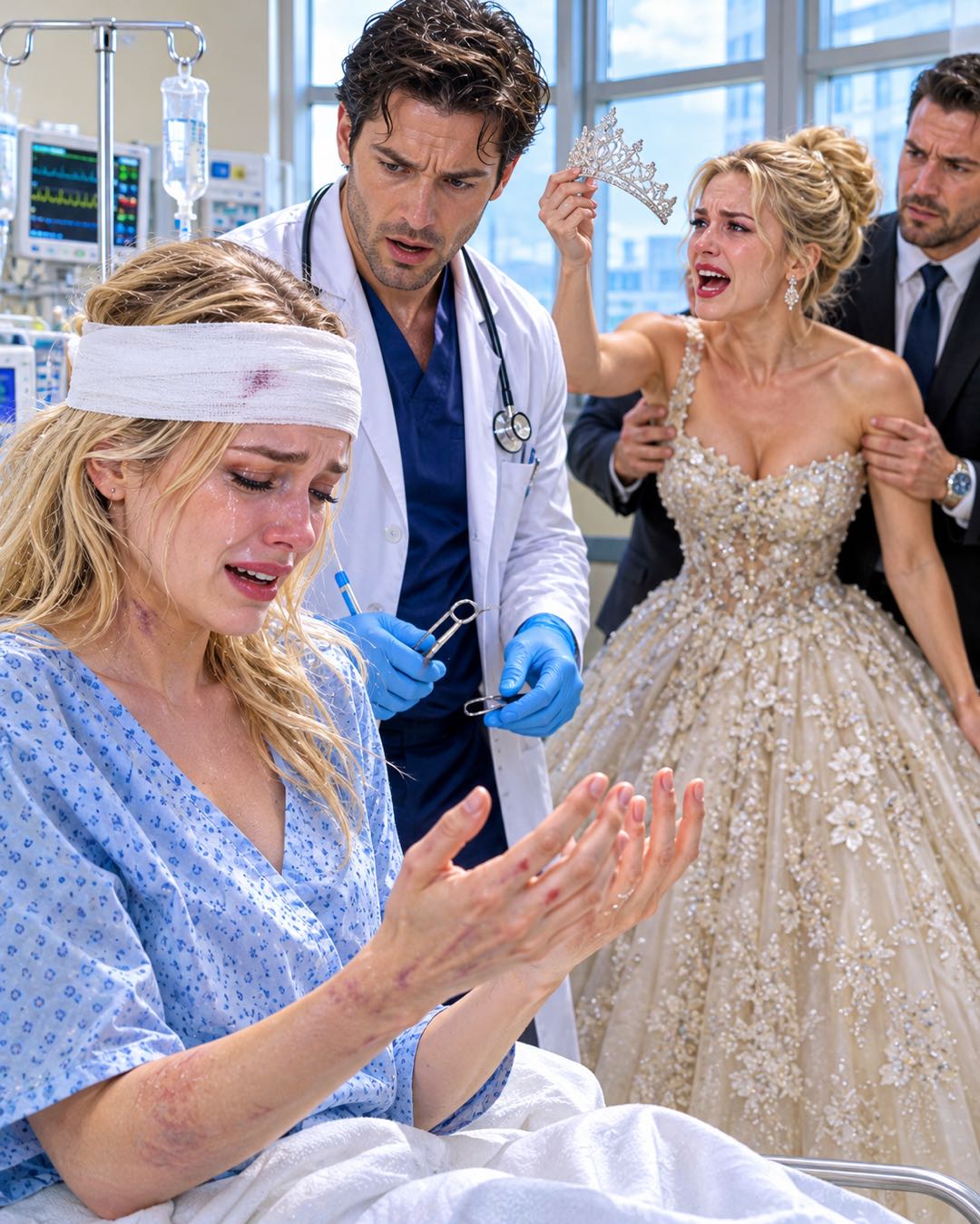
The nurse took one look at my blood-soaked hair, my ruined cream-colored designer silk dress, and my deathly pale complexion.
Her expression changed immediately.
Instead of making us wait among the crowded patients, she hurried us into a private examination room.
About ten minutes later, after the local anesthetic had begun working, my scalp felt as though dozens of furious wasps were stinging it simultaneously.
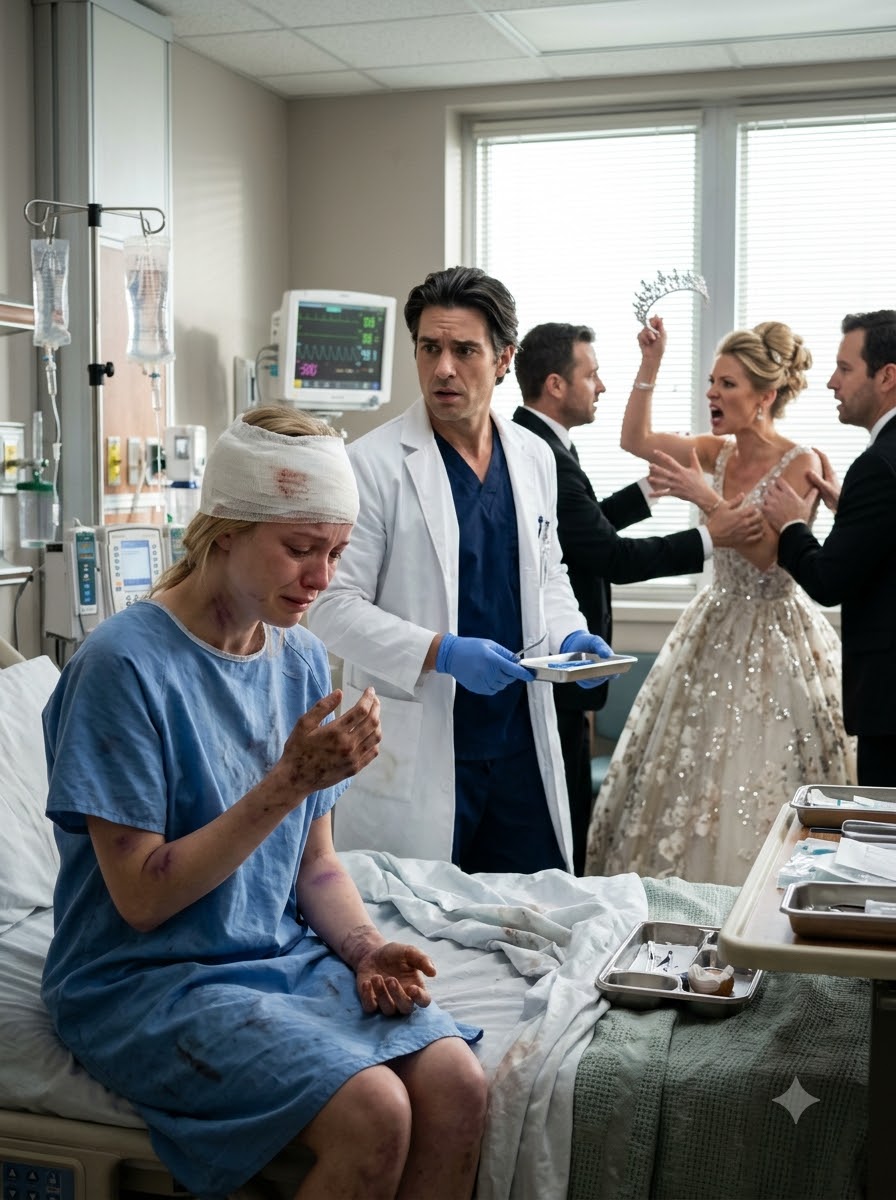
The attending physician leaned closer and adjusted the bright examination light.
“You have two very deep lacerations and one significant puncture wound,” the doctor explained, his voice becoming noticeably more serious.
“The skin is torn rather badly. I need to extract whatever is embedded in there before we even think about stitching this up. It feels… metallic.”
I squeezed my eyes shut.
My fingers clamped around the cold vinyl edge of the examination bed until my knuckles turned white.
The doctor carefully introduced a pair of long metal forceps into the wound.
Then I heard something that made my stomach tighten.
A faint, unpleasant scraping sound came from beneath my skin.
It sounded like two pieces of metal grinding against each other.
“All right, pulling the first one out now,” he announced.
Clink.
Something struck the stainless-steel medical tray.
The doctor examined the wound again.
There was another careful movement, another firm pull, and a second metallic sound.
Then came the third.
When he finally stepped away and removed his gloves, I slowly opened my eyes.
Three thick pieces of rusted metal lay on the immaculate silver tray.
They were stained with blood and covered in tiny fragments of silver-colored paint.
The physician stared at them before looking directly at me.
His professional expression had become grim.
“These were embedded deeply. You reported this was the direct result of another person’s actions? Given the highly unusual, weaponized nature of these foreign objects, strict hospital protocol requires me to document this thoroughly.”
He paused, examining the strange pieces again.
“These are absolutely not standard hair combs. This is…”
Bellamy stepped forward.
Her voice was firm, controlled, and unmistakably authoritative.
“Seal them. Separately. Right now. We need an unbroken chain of custody for the police.”
As the curved surgical needle passed through my numb skin for the first stitch, I realized something terrifying.
The physical pain was nothing compared with the crushing realization settling over me.
Those metal pieces hadn’t been accidentally attached to a decorative accessory.
They had been measured, cut, shaped, and painted to disappear beneath the rhinestones of the tiara.
Someone had deliberately transformed a beautiful wedding ornament into something dangerous.
This wasn’t a careless prank.
It wasn’t an impulsive decision made by an overwhelmed bride.
It was calculated.
It was intentional.
And someone had wanted it to happen.
But the most frightening part wasn’t the rusted metal sitting on the doctor’s tray.
It was the question that wouldn’t leave my mind.
What terrible secret was my family hiding that could make my own sister commit such a ruthless act against me in front of dozens of guests and multiple recording cameras?
By the time the doctor finished stitching my scalp, I had received seven stitches and a warning that I needed to avoid strenuous activity until the wound healed.
I also had a mild concussion.
The physician wanted to keep me under observation because of the dizziness and the possibility of complications.
Bellamy refused to leave.
She sat beside my hospital bed, holding my phone and answering the messages that kept appearing on the screen.
Most of them came from relatives who had attended the wedding.
Not one asked whether I was okay.
Instead, they wanted to know why I had left.
My mother called six times.
My father sent two messages.
My sister, Madison, sent one.
It read:
I can’t believe you ruined my wedding over a stupid joke. You owe me an apology.
I stared at those words until the letters seemed to blur.
I had blood running down my face at her wedding.
I had nearly collapsed in front of her guests.
And somehow, I was the person who owed an apology.
Bellamy read the message over my shoulder.
“Don’t answer her.”
“I wasn’t planning to.”
“Good. Let the police handle this.”
I looked toward the sealed medical evidence bag resting on a nearby counter.
“Bellamy, why would she do something like that?”
My friend hesitated.
She had known my family for nearly fifteen years.
She had watched Madison turn every family gathering into a competition and had witnessed my parents excuse nearly every cruel thing she did.
But even Bellamy seemed unable to understand the extent of what had happened.
“I don’t know yet,” she admitted. “But I don’t believe for one second that this was an ordinary prank.”
Neither did I.
And I was about to discover that the wedding incident was only the beginning.
The next morning, a detective came to the hospital.
His name was Detective Harris.
He introduced himself, asked permission to record my statement, and explained that the hospital had already submitted a report because of the suspicious nature of my injuries.
I described everything from the beginning.
Madison had invited me to her wedding three months earlier.
We had never been particularly close, but I had always tried to maintain a relationship with her.
She was my younger sister, after all.
When she asked me to attend, I agreed.
When she requested that I arrive early to help with some last-minute arrangements, I agreed to that, too.
I even purchased an expensive wedding gift despite Bellamy warning me that Madison had never appreciated anything I did for her.
During the reception, Madison approached me carrying a sparkling silver tiara.
She was laughing.
Her new husband, Derek, stood a few feet behind her with his phone raised.
Several guests had gathered nearby.
“Come on, Claire! You have to wear this for the pictures!”
I had laughed nervously and told her I didn’t want to mess up my hair.
She insisted.
Then, without warning, she brought the tiara down onto my head with considerable force.
The pain was immediate.
I felt something pierce my scalp.
Before I could even understand what had happened, Madison started laughing.
“Calm down! It’s just a prank!”
A few people laughed with her.
Others looked uncomfortable.
Then I touched my head.
My fingertips came away covered in blood.
I remembered Madison’s expression changing for only a second.
It wasn’t horror.
It wasn’t concern.
It looked almost like satisfaction.
Then she turned toward the guests and laughed again.
Detective Harris listened without interrupting.
When I finished, he asked a question that caught me off guard.
“Did your sister know about any financial or legal matter involving you?”
I frowned.
“What kind of matter?”
He glanced at his notebook.
“Property, inheritance, business interests, insurance, anything that might create a motive.”
I shook my head.
“Not that I know of.”
He didn’t look convinced.
“Think carefully. Sometimes these situations involve something the victim doesn’t even realize they’re entitled to.”
That sentence stayed with me long after he left.
On the second day, Bellamy arrived carrying my handbag, a change of clothes, and a folder.
She looked unusually serious.
“I need you to look at something.”
She placed her tablet on the hospital bed.
It contained several photographs from the wedding.
One showed Madison holding the tiara.
Another captured Derek standing behind her.
But the photograph that made my stomach drop was taken just seconds before the attack.
Madison wasn’t looking at me.
She was looking directly at Derek.
And he was giving her a small nod.
I zoomed in.
His expression was almost impossible to read, but his raised phone was clearly pointed toward me.
“Where did you get these?”
“One of the wedding guests sent them to me. She was uncomfortable with what happened and wanted someone to know.”
Bellamy swiped to another image.
It showed the tiara lying on a table before the ceremony.
At first glance, it looked ordinary.
Silver rhinestones.
A delicate curved design.
A row of decorative points along the bottom.
Then Bellamy enlarged the photograph.
I stopped breathing.
Beneath the rhinestones, there were tiny metallic protrusions.
They weren’t part of the original decorative design.
They looked exactly like the objects the doctor had removed from my head.
“Someone modified it,” I whispered.
Bellamy nodded.
“That’s what I thought.”
“Who had access to it?”
“Madison, Derek, and whoever handled the wedding decorations.”
I stared at the photograph.
“Why would they do this?”
Bellamy hesitated.
“There’s something else.”
She opened another file.
It was a screenshot of a message conversation.
The sender was Derek.
The recipient was Madison.
The date was two days before the wedding.
The message was short.
Make sure she wears it. We need the reaction on camera. Don’t let her leave before we get the footage.
I read it once.
Then again.
My throat tightened.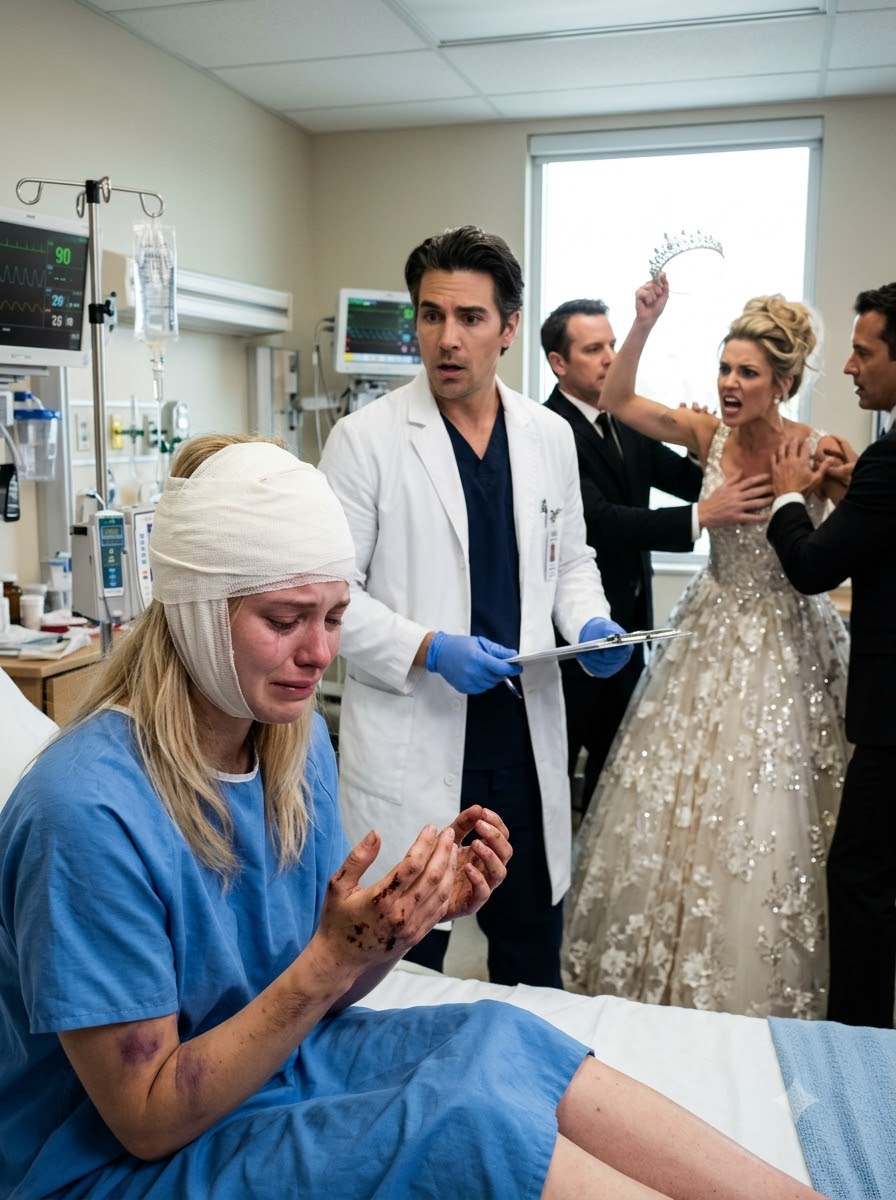
“What reaction?”
Bellamy shook her head.
“I don’t know. But I think we need to find out.”
On the third morning, two police officers arrived at Madison’s house.
I wasn’t there, but Detective Harris called me afterward to explain what had happened.
The officers had asked Madison and Derek to answer questions about the modified tiara.
They had also requested access to the original accessory, the wedding photographs, and the full video recordings.
Madison immediately insisted that she had no idea how the metal pieces had gotten beneath the rhinestones.
She claimed she had purchased the tiara from a wedding supplier.
Derek supported her explanation.
He described the incident as an unfortunate misunderstanding.
According to him, Madison had simply placed the accessory on my head too forcefully.
But when the officers asked to inspect the original packaging, something unexpected happened.
The box was missing.
Madison said she had thrown it away.
Derek said he had never seen it.
Their explanations contradicted each other.
The officers left with copies of the wedding footage and a formal request for additional evidence.
When Detective Harris called, he sounded more concerned than before.
“Claire, we have reason to believe this wasn’t an isolated incident. I need you to tell me whether you’ve recently experienced anything unusual involving your family.”
I thought about it.
Then I remembered something.
Three weeks before the wedding, Madison had called me about a document.
She said our grandmother’s estate attorney needed my signature on some updated paperwork.
I had asked her to send the documents to me.
She told me there was no need to worry.
“It’s just administrative stuff,” she had said. “Everyone has to sign.”
I never received anything.
When I asked again, she changed the subject.
PART 2
I hadn’t thought much about it at the time.
Now, it felt important.
“Detective, I think there’s something you should know.”
My grandmother, Eleanor, had passed away eighteen months earlier.
She had been the one person in our family who never treated me as though I was competing with Madison.
She was thoughtful, independent, and extremely careful with money.
She had built a successful property management business over several decades and owned several commercial properties before retiring.
My sister had always been interested in her money.
I wasn’t.
I worked as an accountant and had my own modest income.
I had never expected an inheritance.
But shortly before her death, Grandma had asked both of us to visit her.
She had explained that she was updating her estate documents.
She wanted Madison and me to understand that whatever she left behind came with responsibilities.
I remembered her holding my hand.
“Claire, money can reveal the person someone has always been. Don’t let it change who you are.”
At the time, I thought she was simply offering life advice.
After she died, the estate attorney contacted us.
He explained that Grandma had established a family trust.
The trust contained several commercial properties, investment accounts, and a substantial amount of money.
Madison and I were both beneficiaries.
However, the arrangement wasn’t equal in the way Madison had expected.
Grandma had named me the primary trustee.
Madison would receive a portion of the distributions, but major financial decisions required my authorization.
I hadn’t thought much about the structure.
I simply followed the attorney’s instructions and signed the necessary documents.
But Madison had been furious.
She accused Grandma of favoring me.
She told relatives that I had manipulated an elderly woman.
I had tried to explain that I hadn’t asked for anything.
It didn’t matter.
Eventually, I stopped discussing the inheritance altogether.
Now, sitting in the hospital, I began to understand why Madison had been so desperate to get my signature.
The estate attorney was named Mr. Whitaker.
I called him that afternoon.
He answered immediately.
“Claire, I’ve been trying to reach you.”
My stomach tightened.
“Why?”
There was a pause.
“Because someone submitted documents claiming that you had voluntarily resigned as trustee.”
I sat upright despite the pain in my head.
“What?”
“The paperwork was delivered to my office two weeks ago. It included what appeared to be your signature.”
I felt cold.
“I never signed anything.”
“I suspected that might be the case. The signature didn’t look entirely consistent with the documents we already had.”
“Who submitted it?”
“Your sister.”
For a moment, I couldn’t speak.
Mr. Whitaker continued.
“She told me you had discussed the matter privately and wanted to transfer your responsibilities to her. I refused to process anything without speaking to you directly.”
“Did she explain why?”
“She said you were overwhelmed and wanted to step away from the family responsibilities.”
I almost laughed.
Overwhelmed?
I had been managing my own life, working full-time, and helping Grandma’s estate attorney whenever necessary.
Madison had never once offered to take responsibility for anything.
“Mr. Whitaker, did she have access to the trust?”
“Not without authorization. But she did have access to some financial statements and beneficiary information.”
I closed my eyes.
“How much money is involved?”
He hesitated.
“Approximately $8.6 million in total assets, including the properties and investment accounts.”
My hands began to tremble.
Eight-point-six million dollars.
That was enough to explain why Madison had become so obsessed with controlling the trust.
But it still didn’t explain the tiara.
“Mr. Whitaker, someone attacked me at Madison’s wedding. The police are investigating. I think it may be connected to the documents.”
His voice immediately changed.
“Claire, don’t sign anything. Don’t discuss the trust with your sister. I’ll send copies of every document submitted in your name directly to the detective.”
I thanked him and ended the call.
Bellamy was watching me.
“Eight-point-six million?”
I nodded.
She leaned back.
“Now we know what they wanted.”
But I wasn’t convinced we knew everything.
Because if Madison simply wanted control of the money, she could have continued trying to manipulate me.
Why risk a criminal investigation?
Why put metal spikes inside a tiara?
Why arrange for the entire incident to be recorded?
There had to be another reason.
And the wedding footage was about to provide the answer.
That evening, Detective Harris sent Bellamy a message asking whether we could identify the person who had recorded the incident from the opposite side of the reception hall.
The guest was a woman named Natalie.
She had been sitting near the head table.
Bellamy contacted her immediately.
Within an hour, Natalie agreed to share the original video.
Unlike the short clip circulating among the wedding guests, this recording included the moments before and after the attack.
Bellamy played it on her tablet.
I watched Madison approach me with the tiara.
I watched Derek raise his phone.
I watched the moment she pushed the accessory onto my head.
Then I heard myself cry out.
The next few seconds were painful to watch.
I stumbled backward, reached for my scalp, and looked down at my bloody fingers.
Madison laughed.
But the video continued.
And that’s when I noticed something.
Derek wasn’t filming my reaction anymore.
He was filming the table behind me.
A large envelope sat beside the wedding guest book.
It was cream-colored and had my name written across the front.
I had never seen it before.
Madison glanced toward it.
Then she looked at Derek.
He nodded.
A bridesmaid picked up the envelope and approached me.
“Claire, Madison asked me to give you this.”
I remembered that moment.
I had been too disoriented to pay attention.
The bridesmaid placed it in my hand.
I dropped it almost immediately because my head was bleeding.
The envelope landed on the floor.
A man standing nearby picked it up.
He was Derek’s older brother, Ryan.
He slipped it into his jacket.
The video ended.
I stared at the screen.
“What was inside that envelope?”
Bellamy looked equally disturbed.
“We need to find Ryan.”
Detective Harris arranged an interview with Ryan two days later.
At first, Ryan denied knowing anything about the tiara.
He said he had only helped with the wedding decorations.
But when the detective showed him the footage, his expression changed.
He admitted that the envelope contained a document.
It was a prepared statement claiming that I had voluntarily agreed to relinquish my position as trustee.
It also included a second document authorizing Madison to manage certain financial matters on my behalf.
Neither document had been signed by me.
Ryan claimed he had been instructed to deliver the papers to me and record my response.
He insisted he didn’t know about the metal pieces inside the tiara.
But he did know why Madison wanted the footage.
According to Ryan, the plan was to create a situation in which I appeared emotionally unstable in front of witnesses.
If I reacted angrily, they would record it.
If I became distressed, they would describe me as incapable of handling the family trust.
If I left the wedding, they would claim I had behaved irrationally.
The documents were supposed to be presented afterward as evidence that I had voluntarily stepped away from my responsibilities.
It was an elaborate attempt to pressure me into surrendering control.
But Ryan’s explanation still didn’t account for the severity of my injuries.
Detective Harris asked him directly.
“Did you know the tiara had been altered?”
Ryan lowered his eyes.
“I knew Madison had asked someone to modify it.”
“Who?”
“Derek.”
The detective leaned forward.
“What did he ask them to do?”
Ryan swallowed.
“He wanted it to look like an ordinary decorative crown. He said the little points underneath would make the prank more convincing.”
“Did he tell you they would penetrate someone’s skin?”
Ryan shook his head.
“No. I thought they were just part of the decoration.”
But when Detective Harris showed him the medical photographs, Ryan began to cry.
He admitted that Derek had later told him the tiara was designed to cause enough discomfort to make me panic.
The plan had been to make me look foolish and emotional.
Nobody had expected the injuries to become so serious.
That explanation didn’t excuse anything.
Not even remotely.
The investigation expanded quickly.
The police obtained the wedding supplier’s records and discovered that the tiara had never come from the company Madison claimed to have used.
Instead, it had been purchased through a separate online account associated with Derek.
The payment records showed that the accessory had been specially modified before delivery.
Investigators also recovered messages between Madison and Derek.
Some were ordinary conversations about wedding arrangements.
Others were not.
One message from Madison read:
Once she gives up the position, everything will finally be ours.
Derek replied:
She won’t have a choice after Saturday.
Another message was even more disturbing.
Make sure the cameras catch everything. Nobody will believe her if she starts making accusations afterward.
I felt sick when Detective Harris showed me the screenshots.
They hadn’t simply wanted to embarrass me.
They wanted to control the story before I could tell anyone what had happened.
The wedding was supposed to become the perfect setting.
There would be cameras everywhere.
There would be dozens of witnesses.
There would be alcohol, music, laughter, and a bride who could claim her sister had ruined her special day.
If I protested, they could portray me as jealous.
If I became upset, they could call me unstable.
If I signed the papers, they would gain control of the trust.
And if I refused, they had already prepared a narrative designed to discredit me.
The only thing they hadn’t anticipated was the medical evidence.
They hadn’t expected three pieces of metal to be removed from my scalp.
They hadn’t expected the doctor to recognize that the injuries were inconsistent with an ordinary hair accessory.
And they certainly hadn’t expected Bellamy to preserve the evidence.
My mother called the following afternoon.
I almost didn’t answer.
But something told me I needed to hear what she had to say.
“Claire, what is going on?”
Her voice was sharp.
“Madison is devastated. The police came to her house, and now everyone is talking about the wedding.”
I closed my eyes.
“Mom, I was injured.”
“She told me it was an accident.”
“She put a modified tiara on my head. Three pieces of metal were embedded in my scalp.”
“You’re exaggerating.”
I felt something inside me go very still.
I had spent years trying to earn my mother’s approval.
I had made excuses for Madison.
I had accepted apologies that were never sincere.
I had allowed family members to convince me that keeping the peace was more important than acknowledging the truth.
But not anymore.
“I have medical photographs, Mom. I have the removed objects. I have the wedding footage. And I have messages proving this was planned.”
Silence.
Then she spoke again.
“You need to think about what this will do to your sister’s marriage.”
I stared at the hospital wall.
“She should have thought about that before she put metal spikes in a tiara.”
“Claire, she’s your sister.”
“And I’m your daughter.”
There was another silence.
PART 3
For the first time, I realized how little those words meant to her.
“Your grandmother would never have wanted you to destroy the family over money,” she finally said.
I almost couldn’t believe what I was hearing.
“Grandma would never have wanted you to help someone steal from me, either.”
My mother hung up.
I didn’t call her back.
Three days after the police first visited Madison, I was discharged from the hospital.
The doctor gave me detailed instructions about wound care, rest, and follow-up appointments.
My dizziness had improved, although the headaches remained.
Bellamy drove me home.
Before leaving, she helped me organize every document related to the incident.
Medical records.
Photographs.
Messages.
The original wedding invitation.
The estate paperwork.
Everything went into a folder.
I named it EVIDENCE.
It was a simple word, but it represented something I had never given myself permission to do before.
I was finally going to defend myself.
Not quietly.
Not privately.
And certainly not by pretending everything was fine.
Over the following week, more information emerged.
The estate attorney discovered that several financial transactions had been attempted using documents submitted by Madison.
They had not been completed because my authorization was missing.
However, the investigation revealed that someone had already contacted two property managers and instructed them to redirect certain rental payments.
The instructions appeared to have come from me.
They hadn’t.
My signature had been copied.
The attorney immediately froze the requested changes and notified the financial institutions.
Then he uncovered something even more troubling.
Madison and Derek had accumulated significant personal debts.
Their wedding had been far more expensive than they could comfortably afford.
They had purchased a new house, financed expensive vehicles, and made several large purchases in the months leading up to the ceremony.
They had apparently expected to gain access to the trust soon afterward.
Their plan wasn’t simply about receiving their inheritance.
They wanted immediate control over the assets.
And they had been willing to use forged documents to get it.
The tiara was only one part of a much larger scheme.
A week later, I received a call from Detective Harris.
“Claire, we’ve made progress.”
I sat down at my kitchen table.
“What happened?”
“We’ve obtained additional electronic records. Your sister and her husband discussed the modified tiara, the documents, and the wedding footage in considerable detail.”
My stomach tightened.
“Are they being charged?”
“The investigation is ongoing. There are several separate issues we’re examining, including the physical injuries, the forged paperwork, and the attempted financial interference.”
I thanked him.
Then I asked the question I had been afraid to ask since the beginning.
“Did they know how badly I could have been hurt?”
There was a pause.
“Some of the messages suggest they understood that the metal pieces could penetrate skin. We are having the digital evidence examined to establish exactly what each person knew and when.”
I put my hand over my mouth.
I had spent years believing that Madison was simply selfish.
Now I was learning that she had been willing to put my safety at risk to get what she wanted.
It was difficult to accept.
But I needed to accept it.
Because pretending she was incapable of doing something terrible would only make it easier for her to do it again.
Two weeks after the wedding, Madison finally contacted me directly.
Her message was longer than anything she had ever written.
Claire, I think things have gotten completely out of control. Derek made the arrangements, and I trusted him. I never wanted you to get hurt. You know how I am. I was just trying to make the wedding fun. Please tell the police this was a misunderstanding. We can work everything out privately.
I read it several times.
Then another message arrived.
Mom says you’re refusing to talk to anyone. You’re destroying our family. Grandma would be ashamed of you.
That was the moment I stopped feeling guilty.
Not because I wanted revenge.
Not because I wanted to see Madison suffer.
But because I finally understood that she still believed I would sacrifice my own safety to protect her reputation.
She hadn’t apologized for the injuries.
She hadn’t asked whether my stitches were healing.
She hadn’t expressed concern about the concussion.
She was worried about the police.
She was worried about the money.
She was worried about herself.
I didn’t respond.
Instead, I forwarded both messages to Detective Harris.
Then I blocked her number.
The estate hearing took place several weeks later.
I attended with Mr. Whitaker and Bellamy.
My scalp was healing, although the stitches had left a small area of tenderness.
Madison arrived with Derek.
She wore an elegant cream-colored suit and carried herself as though nothing had happened.
When she saw me, her expression hardened.
Derek leaned toward her and whispered something.
I didn’t look away.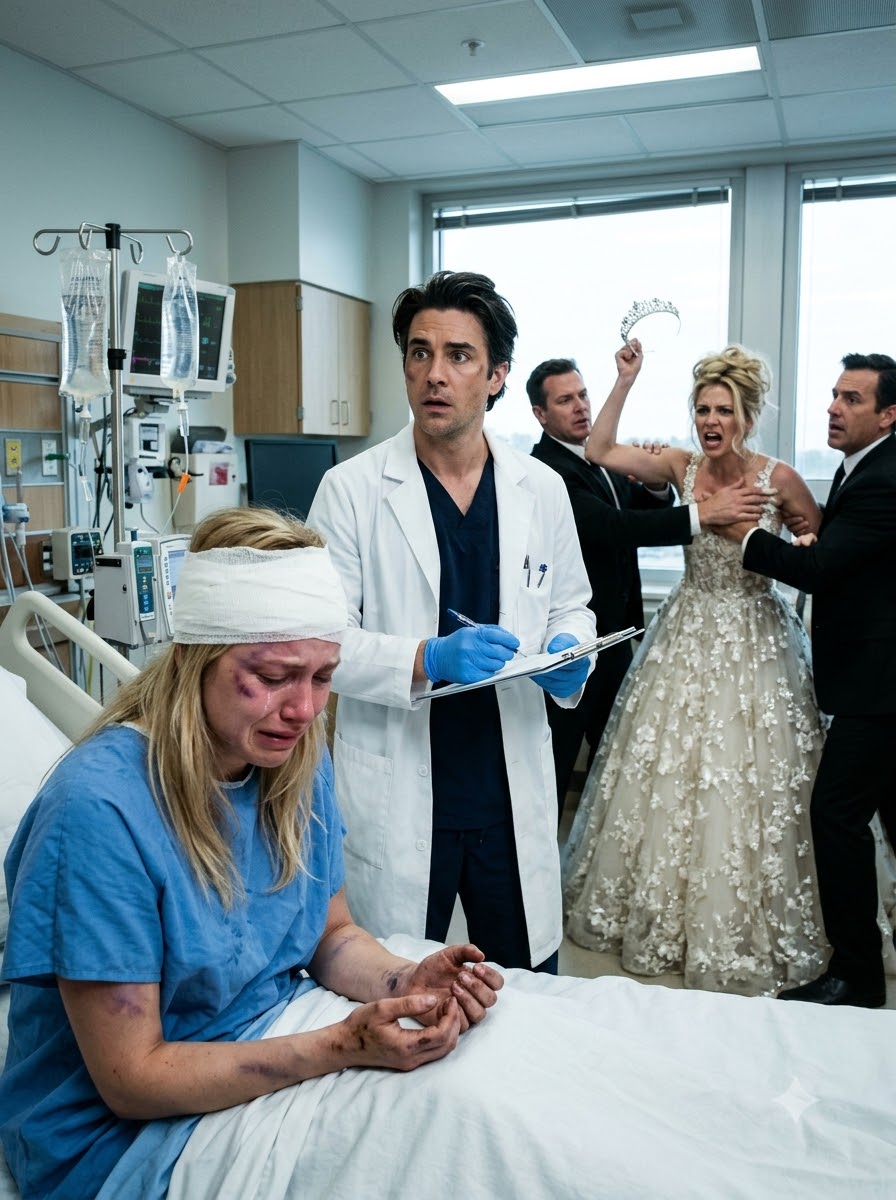
For once, I wasn’t going to lower my eyes just to make someone else comfortable.
The attorney presented the trust documents.
He explained that I remained the lawful primary trustee and that no valid resignation had ever been submitted.
He also provided the suspicious paperwork and the records showing that unauthorized changes had been attempted.
Madison’s attorney argued that the documents had been prepared as part of an informal family discussion.
Mr. Whitaker calmly explained that no such agreement had ever taken place.
Then he presented the original records containing my genuine signature.
The differences were obvious.
The hearing did not resolve every issue involving the trust, but it established that the attempted transfer was invalid.
The financial restrictions remained in place.
Madison would not be receiving control of the properties.
When the hearing ended, she approached me in the corridor.
“You got what you wanted,” she whispered.
I looked at her.
“What exactly do you think I wanted?”
She folded her arms.
“Grandma’s money. The trust. Everything.”
I shook my head.
“I wanted a sister.”
For a moment, her expression changed.
Then she looked away.
“You always thought you were better than me.”
“No, Madison. I spent years trying to make you happy. That’s the difference.”
She opened her mouth, but I continued.
“You hurt me, and then you blamed me for bleeding. You forged my signature, and then you called me selfish for refusing to surrender what Grandma entrusted to me. I don’t know what you expected me to do.”
Her eyes filled with tears.
But I couldn’t tell whether they came from regret or frustration.
Perhaps she couldn’t tell, either.
I walked away.
The criminal investigation continued.
The police eventually obtained sufficient evidence to move forward with charges related to the modified tiara and the fraudulent documents.
Derek’s electronic messages established that he had participated in arranging the accessory.
Madison’s messages showed that she had known about the plan and had actively encouraged it.
The wedding footage, medical records, photographs, and statements from several guests supported the investigation.
Ryan cooperated with the authorities and provided additional information about the envelope and the documents.
He admitted that he had initially agreed to help because he believed the incident would be harmless.
But after seeing my injuries, he realized how serious the situation had become.
I didn’t immediately forgive him.
He had still participated in a plan designed to humiliate and manipulate me.
However, I appreciated that he eventually told the truth.
Madison and Derek were required to answer for their actions through the legal process.
The estate attorney also began the necessary proceedings to protect the trust and recover any money that had been improperly redirected.
I didn’t need to invent a punishment for them.
I didn’t need to threaten them.
I didn’t need to destroy their marriage or expose them through some dramatic public confrontation.
The evidence was enough.
And for the first time, I allowed the consequences to belong to the people who had created them.
Months passed.
My scalp healed.
The headaches eventually disappeared, although a small scar remained beneath my hair.
I returned to work.
I resumed my normal routines.
I started spending more time with Bellamy, who had become even more protective of me than before.
She never complained about the hospital visits, the police interviews, or the endless paperwork.
One afternoon, we sat together at a small café.
She looked at me over her coffee.
“Do you ever wish you had just ignored everything and moved on?”
I considered the question.
There had been nights when I wished I could erase the entire wedding.
I wished I could forget the pain, the blood, the laughter, and the expressions on my family’s faces.
I wished I could go back to the version of myself who still believed that Madison would never intentionally hurt me.
But I didn’t wish I had remained silent.
“No,” I finally answered. “I wish it had never happened. But I don’t wish I had ignored it.”
Bellamy smiled faintly.
“Good.”
I looked out the window.
For years, I had confused forgiveness with allowing people to continue hurting me.
I had believed that family loyalty meant protecting relatives from the consequences of their decisions.
I had accepted cruelty because I thought refusing to accept it would make me a bad daughter or a bad sister.
I knew better now.
About six months after the wedding, I received a letter from the estate attorney.
Grandma’s trust had been reviewed, and all the assets were accounted for.
The attempted fraudulent changes had been reversed.
The properties remained protected.
The financial records were secure.
Mr. Whitaker also included a copy of a letter Grandma had written shortly before her death.
It was addressed to me.
I sat at my kitchen table and opened it carefully.
Her handwriting was familiar.
The letters were slightly uneven, but every word was clear.
She wrote about how proud she was of the person I had become.
She mentioned that she had always admired my patience, my independence, and my willingness to help others without expecting anything in return.
Then came the sentence that made my eyes fill with tears.
Claire, I hope you never confuse being kind with allowing someone to take everything from you. You deserve to be loved without having to prove your worth.
I read it again.
And again.
Then I pressed the letter against my chest.
For the first time since the wedding, I cried without feeling frightened or ashamed.
I cried because I missed my grandmother.
I cried because I wished she had been there to see what happened.
And I cried because I finally understood what she had been trying to teach me.
Madison eventually sent another letter.
This one was handwritten.
She didn’t mention the wedding at first.
She wrote about her marriage, the investigation, and the pressure she had been under.
She said Derek had convinced her that the trust should belong to both of us equally.
She said she had felt overlooked for years.
She claimed that she had become so desperate to prove herself that she stopped thinking about the consequences.
Near the end, she wrote:
I know you probably won’t forgive me, but I want you to know that I never thought things would go this far.
I read the letter twice.
Then I put it away.
Perhaps one day Madison would genuinely understand what she had done.
Perhaps she would eventually accept that jealousy did not justify cruelty.
Perhaps she would learn that being unhappy with someone else’s success did not give her the right to steal, manipulate, or hurt them.
But that was her responsibility.
Not mine.
I didn’t write back.
I didn’t need to.
Forgiveness, if it ever came, would happen on my terms.
And reconciliation would require more than a letter.
It would require honesty, accountability, and time.
A year after the wedding, Bellamy and I visited Grandma’s grave.
I brought white roses.
The same kind she used to keep in a glass vase on her dining-room table.
I placed them beside her headstone and stood quietly for a moment.
The wind moved gently through the trees.
I thought about the woman who had raised me to believe that family was supposed to be a place of safety.
I thought about the tiara.
The three pieces of metal.
The hospital.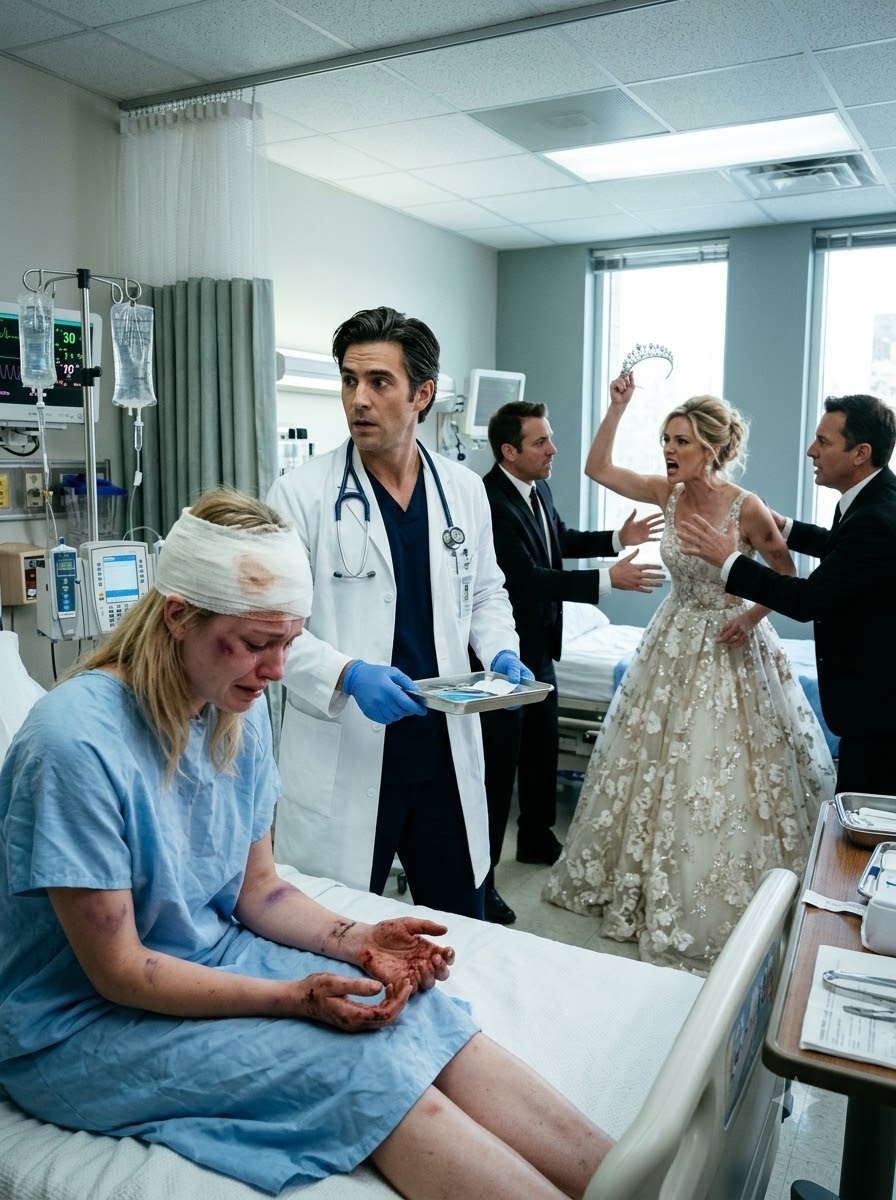
The police officers standing at Madison’s door.
And the moment I finally stopped protecting people who had never protected me.
Bellamy stood beside me.
“Do you think things will ever be normal again?”
I looked at the flowers.
“Maybe not the way they were before.”
She nodded.
I continued.
“But perhaps that’s not such a bad thing.”
I had lost the illusion that my family was perfect.
I had lost the belief that being related to someone automatically made them trustworthy.
I had lost a sister I once hoped would become my closest friend.
But I had also gained something.
I had learned to recognize the difference between love and manipulation.
I had learned that silence doesn’t always preserve peace.
Sometimes it only protects the person causing the damage.
And I had learned that standing up for myself didn’t make me cruel.
It made me responsible for my own life.
There was one final detail I never forgot.
At Madison’s wedding, when she pushed that tiara onto my head, everyone had laughed.
Some guests laughed because they thought it was funny.
Others laughed because they didn’t know what else to do.
A few simply stood there, uncomfortable, waiting for someone else to react.
But when the blood appeared, the laughter stopped.
And when the police arrived three days later, everyone suddenly wanted to know what had really happened.
That was when I understood something important.
The truth doesn’t always announce itself immediately.
Sometimes it begins with a photograph.
Sometimes with a medical report.
Sometimes with a message someone thought would never be discovered.
And sometimes it begins with three small pieces of rusted metal lying on a hospital tray.
Madison had wanted me to become the family joke.
She had wanted me embarrassed, frightened, and powerless.
Instead, she gave me the evidence I needed to uncover everything she and Derek had been hiding.
I never asked for revenge.
I asked for the truth.
And once the truth came out, I refused to hide it for anyone.
Because no matter how beautiful a family looks in wedding photographs, no amount of expensive flowers, sparkling jewelry, or carefully staged smiles can disguise what happens when the people closest to you decide that your pain is worth the price of their ambition.
And I would never again mistake that kind of cruelty for love.
THE END.
