

PART 1 — THE BIRTHDAY JOKE
“Relax, babe. It’s just a joke! We’ll be back in ten minutes!” my husband yelled as he guided our boat away, leaving me stranded alone on a sandbar in the Gulf of Mexico.
I watched his best friend raise the anchor while another woman recorded me from the back of the boat. All three of them were laughing. My life jacket was still hanging from the swim platform, and the water surrounding my ankles was already starting to rise.
Bryant knew I couldn’t swim. We’d been married for eight years, and he understood exactly why deep water terrified me. Yet as the boat disappeared farther into the distance, I realized something else. He’d taken my purse, my phone, and every practical means I had of getting home.
But there was one thing he hadn’t taken.
The silver smartwatch on my wrist.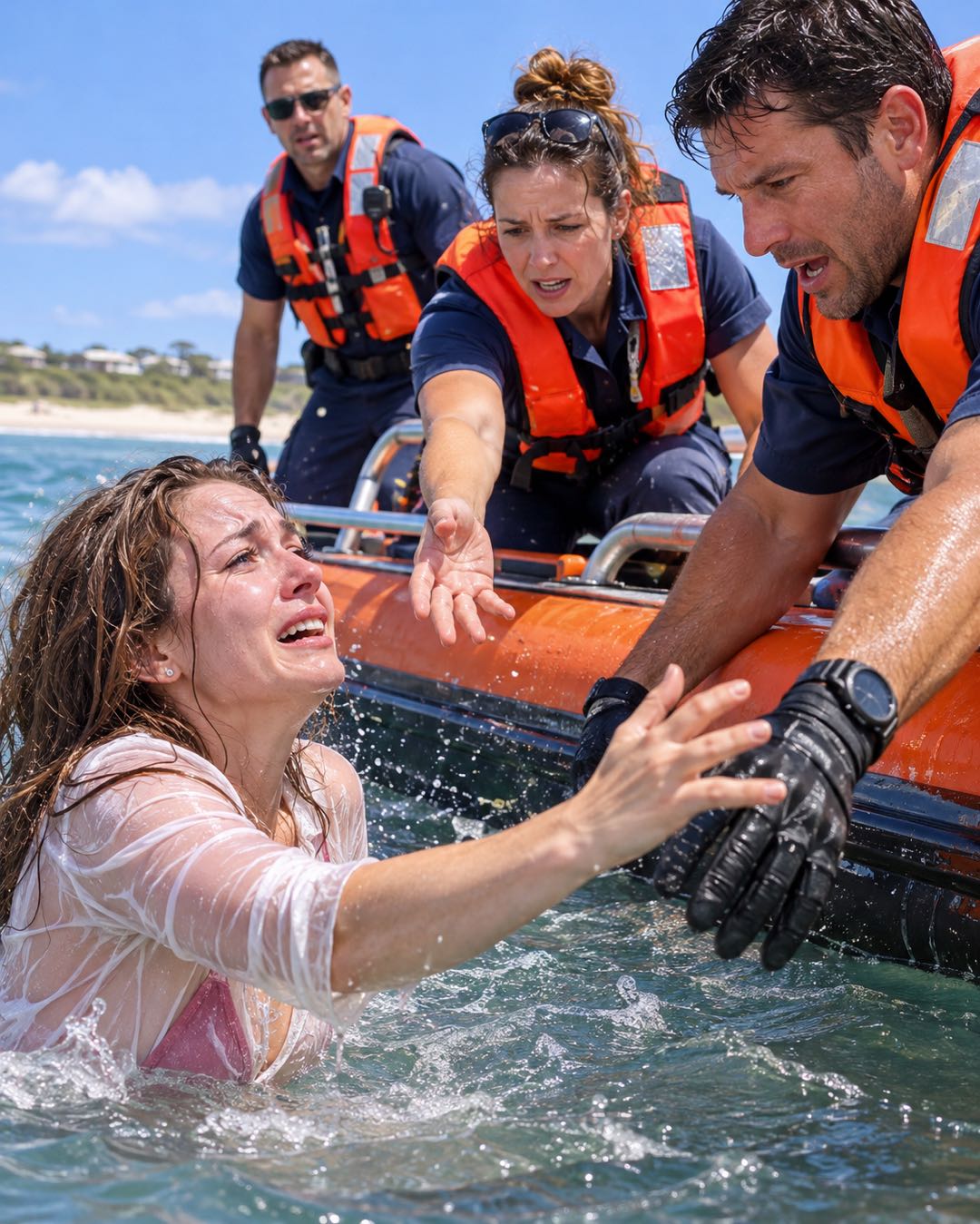
My name is Joelle Prentiss. I’m thirty-nine years old, and I own four physical therapy clinics throughout the Tampa Bay area. I began with a single rented treatment room, a used examination table, and enough determination to work six mornings every week. Today, I employ twenty-seven people, and I’m proud of everything we’ve accomplished together.
Bryant used to tell me how much he admired my ambition. At least, that’s what he said when we met at a charity golf tournament eight years ago. He was attractive, sociable, and always had an entertaining story to tell. He was also between business ventures, although it took me some time to realize that most of those ventures existed primarily in his conversations.
My father recognized something about him long before I did.
“I’m not saying he doesn’t care about you, honey,” Dad warned me a month before our wedding. “I’m saying you worked too hard to leave your future unprotected. If he loves you, a fair agreement shouldn’t frighten him.”
Bryant signed the prenuptial agreement without putting up much of a fight. My clinics would remain my property, along with everything I’d accumulated before the marriage. He retained his own property, and neither of us would have a claim to the other’s separate business assets if we divorced.
“Your dad can keep his paperwork,” Bryant assured me afterward, kissing my forehead. “I’m marrying you, not your bank account.”
For years, I trusted those words.
Our marriage wasn’t flawless, but I never considered it especially different from anyone else’s. Bryant enjoyed costly hobbies and frequently introduced new business ideas over dinner. I preferred paying our bills promptly and maintaining a healthy savings account. Occasionally, he’d accuse me of treating him like an employee whenever I questioned one of his purchases.
“It’s my house, too, Jo,” he’d remind me. “I shouldn’t have to ask permission every time I want something.”
Technically, he was correct about the house. We’d bought it together after getting married. I contributed most of the down payment, but both our names appeared on the deed. Several years earlier, I’d also revised my estate documents, leaving him our home and an interest in part of my business if I passed away while we were still married.
Back then, I considered it a normal way to protect my husband financially.
I never imagined those documents would eventually matter for an entirely different reason.
Three days before Bryant’s forty-second birthday, he announced that he wanted to spend Saturday out on the water. He’d invited his best friend Cody and Cody’s girlfriend, Tiff, and planned to take our twenty-four-foot center-console boat into the Gulf.
“No restaurants, no fancy presents,” he said. “Just a cooler, some music, and a whole day without you checking work emails.”
I smiled and accepted. We’d been having more disagreements about money lately, and I hoped a peaceful day together might help us reconnect. I even arranged for my clinic manager, Marissa, to handle any weekend emergencies so I wouldn’t need to keep looking at my phone.
Marissa had persuaded me to purchase a cellular smartwatch the previous Christmas. She wanted our clinic managers to have a dependable way to contact one another whenever they weren’t at their desks. I chose a more expensive model with cellular service and an emergency feature capable of contacting responders through a supported connection.
Bryant had made fun of the purchase.
“You really need another little computer strapped to your arm?” he’d asked. “What happened to just enjoying your day?”
I wore it regardless.
Saturday began pleasantly enough. Cody brought sandwiches, Tiff packed fruit and snacks, and Bryant appeared more cheerful than he’d been in weeks. We departed the marina after lunch and spent the afternoon cruising through the shallow waters near Anclote Key.
I kept my life jacket on the entire time.
When I was seven, I’d fallen into the deep end of a swimming pool during a neighborhood party. A man pulled me out before anything worse could happen, but I never forgot the terrifying sensation of being submerged. As an adult, I’d attempted swimming lessons twice, abandoning both sessions after panic overwhelmed me.
Bryant knew the story. He’d heard me explain it and witnessed how carefully I stayed away from deep water.
“You look like you’re preparing to cross the Atlantic,” he teased, tapping my life jacket.
“And you look like a man who wants to spend his birthday arguing,” I replied.
He laughed, slipped an arm around my shoulders, and kissed my temple. For a brief moment, everything seemed perfectly normal.
At approximately four-thirty, Bryant slowed the boat beside an extended, pale sandbar. The water appeared shallow enough to walk through, and the exposed stretch of sand continued toward the horizon. He suggested taking a birthday photograph with me standing at its far end, the Gulf forming the background.
“Come on, Jo. It’ll take two minutes. Just one good picture of my beautiful wife.”
I hesitated, studying the distance between the boat and the end of the sandbar.
“That’s pretty far out, Bryant. Why don’t we take one here?”
“Because the background’s better out there. You’re standing in ankle-deep water, sweetheart. What are you worried about?”
Tiff leaned over the boat’s side, holding her phone.
“I’ll take it for you. The light’s gorgeous right now.”
Bryant helped me descend the ladder before pointing toward my life jacket.
“Leave that thing here. It ruins the picture.”
I glanced at the orange vest. Even though the water barely covered my feet, something about taking it off made me uncomfortable. But Bryant was watching me, and Cody was already grinning as if my caution were another ridiculous habit.
I removed it and handed it over.
“One picture, and then I’m getting back on the boat,” I reminded him.
“Deal.”
I carefully made my way along the sandbar, checking every step before shifting my weight. When I reached the far end, I turned around and raised one hand toward the camera. Tiff lifted her phone, Cody moved toward the anchor, and Bryant positioned himself behind the steering console.
Then the engine roared to life.
Initially, I thought he was simply adjusting the boat’s position. But Cody began pulling up the anchor, and Bryant turned the wheel toward open water. The distance between us increased before I fully understood that they were leaving.
“Bryant! Hey, wait! What are you doing?”
He grinned and shouted through cupped hands.
“Relax, babe! It’s a joke! We’ll be back in ten!”
Tiff laughed while continuing to record me. Cody waved from beside the console, although his expression seemed less confident now.
“Bryant, stop! I can’t swim!”
“Better enjoy the view!” he shouted back.
The boat sped away, leaving a white trail behind it. I kept staring until I could no longer make out the people aboard. Then I looked down and noticed that the water was beginning to cover the tops of my feet.
I checked my watch. It was 4:47.
For the first several minutes, I convinced myself he’d return. Bryant had always enjoyed practical jokes, particularly when he had an audience. Once, he’d hidden my car keys before a family dinner and allowed me to search for twenty minutes before finally admitting he had them.
I hadn’t found that amusing either.
By five o’clock, the boat still hadn’t returned. I moved toward the highest part of the sandbar and scanned the horizon. The water had climbed to my shins, and a steady breeze was beginning to send small waves across the exposed sand.
At 5:19, I used my watch to call Bryant.
He picked up on the fourth ring. Music, wind, and someone’s voice could be heard in the background.
“Hey, Jo. Having fun?”
“Bryant, come back. This isn’t funny. The water’s rising.”
“You’re fine. It’s barely knee-deep.”
“It’s past my knees now. Please, I’m serious.”
He exhaled impatiently, as though I’d interrupted something important.
“You always do this. You have to be in control of everything. Can’t you just laugh at yourself for once?”
I turned toward the horizon again, desperately searching for the boat.
“I’m asking you to come get me. That’s all.”
His tone suddenly became different.
“You know what your problem is, Jo? You think because you own those clinics, you’re smarter than everybody else. Your money, your rules, your daddy’s prenup. Maybe being out there will teach you something.”
I froze, struggling to comprehend his words.
“Bryant, what are you talking about?”
“Tide’s coming in, babe. Better learn to swim.”
The call disconnected.
I tried calling him again, but he ignored me. I sent a brief message begging him to return, then captured a screenshot of the call history. I wasn’t sure whether I’d need the evidence, but something about his final words frightened me more than the rising tide.
I’d spent years helping patients recover from injuries, teaching them to control their breathing and concentrate on one manageable movement at a time. Standing alone on that sandbar, I tried to remember those same lessons.
I couldn’t stop the tide. I couldn’t swim back to shore. But I could still call for help.
I activated the emergency feature on my watch, held down the side button, and followed the instructions. The screen indicated that an emergency connection was being established. Moments later, I heard a dispatcher’s voice.
“Emergency services. What’s your location?”
“I’m on a sandbar in the Gulf of Mexico, near Anclote Key. My husband left me here, and the tide’s coming in. I can’t swim.”
The dispatcher confirmed that my coordinates had been transmitted and started asking questions. I explained where the boat had been, how long I’d been stranded, and what Bryant had told me during our conversation.
“Help is being sent, Mrs. Prentiss. Stay on the highest ground you can find. Keep your watch available, and tell me if the water gets higher.”
By then, the water had climbed to my thighs. I held one arm above the surface and watched the screen as the dispatcher provided updates. My legs were shaking, and every passing wave made it increasingly difficult to maintain my balance.
When the water reached my waist, I began talking about ordinary things to keep my mind occupied. I told the dispatcher about my clinics, Marissa, and the little dog I’d adopted from a shelter the previous summer.
She listened without rushing me.
“You’re doing well, Joelle. The rescue crew has your location.”
The sky grew darker, and I could no longer see the sand beneath my feet. I searched for firmer ground with my toes, terrified that one wrong step might send me into a deeper channel. The water was approaching my chest when I finally spotted a flashing light moving along the horizon.
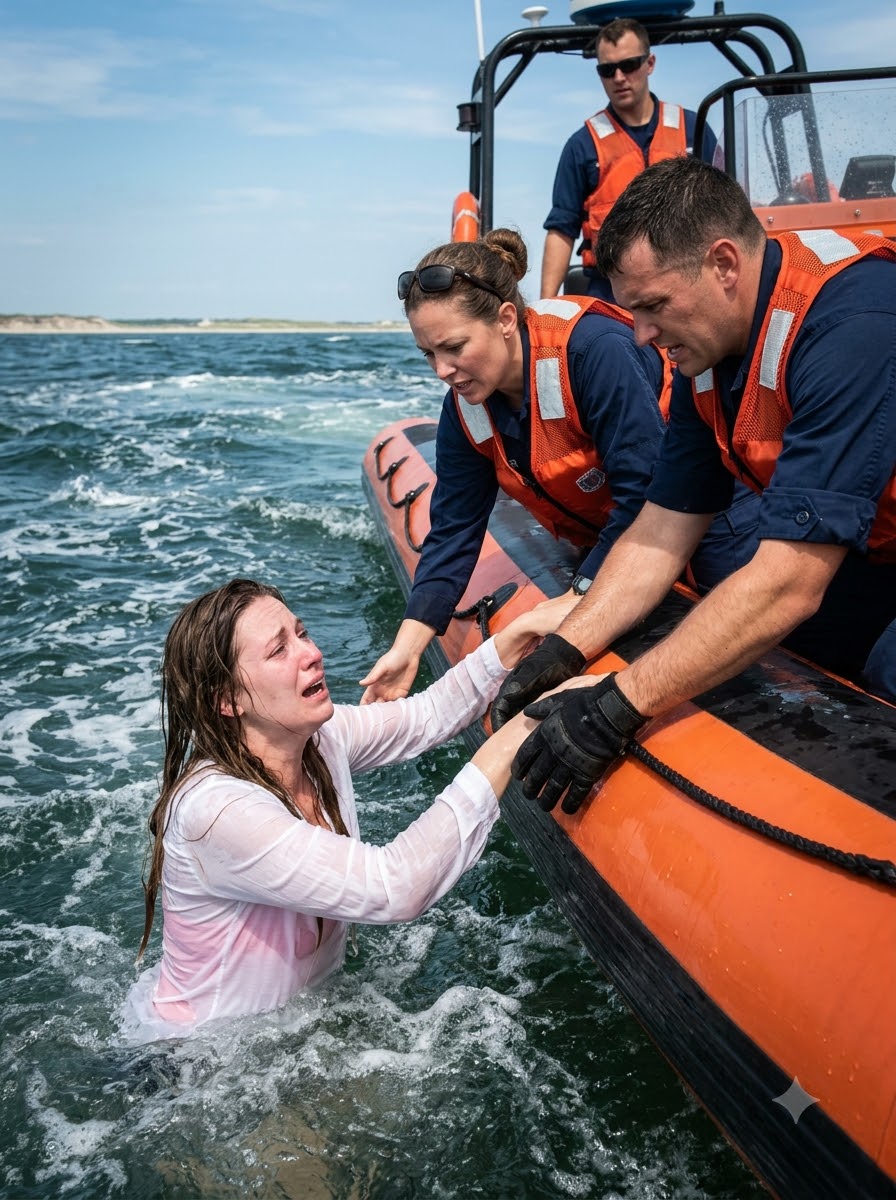
A Coast Guard rescue boat approached carefully, sweeping its searchlight across the water. Two crew members reached out, pulled me aboard, and wrapped a thick blanket around my shoulders. I was trembling so badly that I couldn’t hold the cup of water they offered me.
A young petty officer crouched in front of me.
“Mrs. Prentiss? I’m Petty Officer Diaz. Are you hurt anywhere?”
I shook my head.
“No. I’m just cold. Did you find my husband?”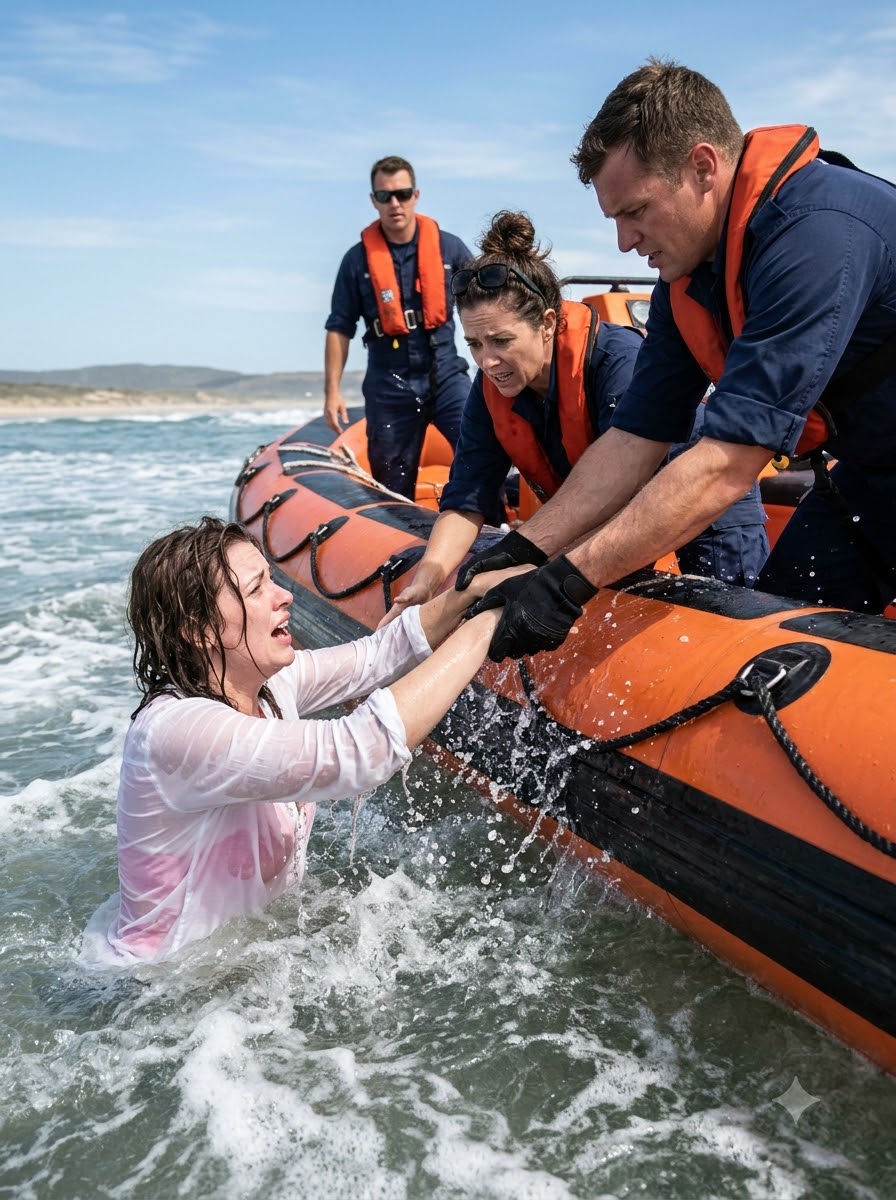
She glanced at another crew member before responding.
“Ma’am, we’ve been searching for you for over an hour. We were originally given a location about ten miles south of here.”
I stared at her in confusion.
“Why would you be looking there?”
Diaz opened a waterproof notebook and reviewed the information she’d recorded.
“At 5:12 this afternoon, your husband contacted the Coast Guard on the marine radio. He reported that you’d fallen overboard and that he’d tried to rescue you.”
My fingers tightened around the blanket.
“But I didn’t fall overboard.”
Diaz met my eyes.
“He also reported that he watched you disappear beneath the water.”
PART 2 — THE CALL HE COULDN’T EXPLAIN
For several moments, I couldn’t find the words to respond. The engine rumbled beneath us, and someone behind Diaz was communicating over a radio, but my thoughts were fixed on the time she’d just mentioned.
5:12 p.m.
I lowered my eyes toward my wrist.
“He told you I went under at 5:12?” I asked.
“That’s what the report says, ma’am.”
I brought up my call history and held the screen out for her to see.
“Then how did I call him at 5:19?”
Diaz leaned forward. She instructed me not to delete anything and photographed the display using an evidence camera. When she looked up again, her expression had become noticeably more serious.
“Joelle, I need you to tell me exactly what happened, starting from when you got off the boat.”
I explained the photograph, the life jacket, and Bryant’s promise that he’d return in ten minutes. I described Tiff recording me and Cody raising the anchor. When I repeated Bryant’s words from our phone conversation, Diaz carefully documented them.
“Did your husband know you couldn’t swim?”
“Yes. He’s known since we met.”
“And did you ever tell him you wanted to be left there?”
“Of course not. I begged him to come back.”
She nodded before speaking quietly into her radio. I couldn’t make out everything she said, but I heard the phrases conflicting account and preserve the recording.
The journey back seemed endless. I kept expecting Bryant to call my watch and demand to know where I’d gone. Instead, the screen remained dark apart from the emergency connection and occasional notifications.
Two sheriff’s deputies were waiting near the dock when we arrived at the Coast Guard station. An ambulance crew examined me for signs of cold exposure, and one deputy asked whether I felt capable of giving a statement that evening.
Before I could respond, my husband’s voice reached me.
“I tried! I went right into the water after her. I couldn’t find her anywhere!”
Bryant was standing near the station entrance, wrapped in a towel. His hair was wet, his shirt was sticking to his shoulders, and he was speaking to several people gathered beside a local news camera.
“She was right there one minute, and then she was gone,” he continued. “I did everything I could.”
I stopped in my tracks.
For eight years, I’d watched that man talk his way out of parking tickets, unpaid bills, and broken promises. He knew precisely how to sound convincing whenever he needed someone to believe him.
But I’d never witnessed him pretend to be grieving.
Diaz noticed where my attention had shifted.
“You don’t have to speak to him,” she said.
I nodded, but before we could move, Bryant turned around.
His eyes landed on me.
He stared at me standing between two rescue crew members, wrapped in a Coast Guard blanket. His mouth fell open, and the towel slipped from one shoulder.
He didn’t rush over to me. He didn’t ask whether I was injured.
“How?” he whispered.
The word was barely audible, but the people standing closest to him heard it. So did the camera operator, who had turned toward us.
A deputy moved between us.
“Mr. Prentiss, we need you to come inside.”
Bryant glanced from the deputy to me, struggling to arrange his expression into something familiar.
“Jo? Honey, thank God. I thought—”
“You thought I was gone,” I said.
He swallowed.
“That’s not what I meant.”
I said nothing. I wanted nothing from him at that moment, not even an explanation. All I wanted was dry clothing, a glass of water, and a telephone so I could tell my father I was alive.
The deputies separated us and began collecting statements.
I spent most of the night at a nearby hospital. My father arrived shortly after midnight, still dressed in the same button-down shirt he’d been wearing when I called him. He was seventy-one, and I’d never seen him appear so exhausted.
He sat beside my bed silently for a while before reaching for my hand.
“I should’ve trusted my instincts about him,” he said.
“Dad, you warned me. I just didn’t listen.”
He shook his head.
“That’s not what I’m saying. You loved your husband. You shouldn’t have had to investigate whether he was safe to be around.”
I glanced at the watch resting on the bedside table. A nurse had helped me take it off after the examination, and dried salt still covered its silver band.
“He knew I couldn’t swim,” I whispered.
Dad covered his eyes briefly. When he lowered his hand, he looked older than he had that morning.
“I know, sweetheart.”
The following day, investigators contacted me again. They’d examined Bryant’s radio transmission and discovered several significant differences between his account and mine. He claimed I’d slipped into deeper water while walking back toward the boat. He also insisted he’d immediately jumped in after me.
I asked whether they believed his version.
The detective assigned to the case, a woman named Morgan, didn’t give me a direct answer.
“We’re checking the timeline, Mrs. Prentiss. Right now, we need you to preserve anything connected to that afternoon.”
I provided the call records, the screenshot I’d captured, and the emergency communication history from my watch. I also explained that Tiff had been recording when the boat pulled away.
Morgan made a note.
“Did you see her recording after that?”
“No. But she had her phone pointed straight at me.”
“We’ll follow up.”
Cody was the first person to revise his account.
According to investigators, he’d initially supported Bryant’s version of events. But after deputies explained that I’d survived and the Coast Guard had documented my actual location, he requested another interview.
Cody admitted that Bryant had planned to abandon me on the sandbar as a supposed prank. He said Bryant had assured him that someone would return for me, either their boat or a passing fisherman.
“I thought he was being an idiot,” Cody reportedly told investigators. “I didn’t think he was serious about leaving her there.”
That explanation might have justified the first ten minutes. It couldn’t explain the false emergency report or why nobody had come back.
Then investigators recovered Tiff’s video.
I watched it several weeks later with my attorney sitting beside me. The recording opened with me standing on the sandbar, smiling awkwardly while Tiff instructed me to turn toward the sunset. Then the camera shifted toward Bryant as he started the engine.
My voice came through the speakers.
“Bryant, stop! I can’t swim!”
Tiff laughed, and Cody made a comment about returning soon. The boat picked up speed, and I gradually became a tiny figure in the distance.
Then Bryant spoke.
He was no longer shouting across the water. His voice was quiet and close to the phone.
“Nobody’s coming back. Get the radio ready.”
Cody said something I couldn’t understand. A few seconds later, the recording stopped.
I asked my attorney to pause the video.
For a long time, I sat staring at the dark screen. I’d spent weeks wondering whether Bryant had simply wanted to scare me or whether a cruel joke had somehow spiraled out of control.
Those six words settled the question.
“I want to go home,” I told my attorney.
She shut the laptop.
“All right, Joelle. We can finish another day.”
The investigation carried on for several months. Through the legal process, detectives obtained Bryant’s phone records and internet search history. They discovered that he’d researched tide predictions for the area before his birthday and searched for information about how long someone could stay afloat without a life jacket.
They also uncovered messages he’d exchanged with a woman in Orlando.
One message read, After the 14th, everything changes for us.
I immediately recognized the date. It was the day of his birthday outing.
The woman wasn’t charged with anything. Investigators found no indication that she’d known about his plan. However, her messages helped clarify why Bryant had repeatedly mentioned wanting a fresh start.
His financial situation was worse than I’d realized. Two business ventures had collapsed, he’d accumulated personal debts, and he’d been telling others that he expected to receive access to a substantial amount of money soon.
Then investigators discovered the documents.
Bryant had been examining copies of our prenuptial agreement and my estate plan. The prenup protected my business assets in the event of a divorce, but my will and related business arrangements provided for him if I died while we were still married.
My attorney clarified that those provisions were subject to various legal and business limitations, and that causing someone’s death could disqualify a person from receiving estate benefits. Apparently, Bryant either hadn’t understood those complications or simply hadn’t cared.
What mattered was that he’d believed my death would make him financially secure.
I remembered the afternoon he’d signed our prenup, smiling as he assured me he wasn’t marrying my bank account.
I couldn’t help wondering when he’d stopped regarding me as his wife and started treating me as an obstacle.
Bryant was charged with attempted murder and filing a false distress report with the Coast Guard. His attorney initially characterized the incident as an irresponsible prank that had gone too far.
However, the timeline, the recording, and the evidence of his preparations made that defense increasingly difficult to support.
Cody and Tiff agreed to cooperate with prosecutors. They acknowledged their involvement in leaving me on the sandbar, and their testimony helped establish what had happened before Bryant contacted the Coast Guard.
I had no desire to watch either of them apologize on television. They were adults standing aboard that boat while I pleaded for help, and they had willingly chosen to leave me behind.
When Tiff sent an apology through her attorney, I instructed my own attorney to acknowledge receiving it. I never responded personally.
My marriage ended while the criminal proceedings were still underway. With my attorney’s assistance, I protected my clinics, updated my estate documents, and removed Bryant from decisions he no longer had any right to influence.
After signing my new will, I remained in the parking lot for almost twenty minutes. I hadn’t expected a routine legal appointment to leave me feeling so drained.
Marissa called while I was sitting there.
“Are you coming by the clinic today?” she asked.
“Maybe later. I just finished with the attorney.”
She paused briefly.
“Do you want company?”
I glanced at the watch on my wrist.
“Actually, I think I want to do something by myself.”
That afternoon, I contacted a swimming instructor.
Her name was Fran. She was a retired lifeguard who’d spent decades teaching adults how to swim. She was seventy, wore her silver hair in a short braid, and had absolutely no patience for people who claimed they were too old to learn.
During our first lesson, I stood in the shallow end, gripping the railing tightly.
“I can’t do this,” I told her.
Fran rested her elbows on the pool’s edge.
“You don’t have to swim today. Today, you just have to get comfortable standing in the water.”
“What if I panic?”
“Then we’ll stop. And next time, we’ll try again.”
I stared at her.
“That’s it?”
She smiled.
“That’s it. Nobody’s leaving you here, honey.”
I cried so intensely during that first afternoon that we barely progressed beyond the steps.
Still, I returned the following week. And the week after that.
Fran showed me how to float while supporting my back. She taught me to place my face beneath the water, exhale slowly, and raise my head without gasping. Some lessons went smoothly. Others ended with me sitting on the pool’s edge, wrapped in a towel and waiting for my trembling hands to settle.
She never pressured me to move faster.
“You spent thirty-two years being afraid of this,” she reminded me once. “Give yourself more than thirty-two minutes to learn.”
In the spring, Bryant accepted a plea agreement and was sentenced to fifteen years in prison.
I attended the sentencing hearing with my father and Marissa. Bryant wore a plain shirt and looked much thinner than I remembered. When the judge gave him an opportunity to speak, he apologized for his actions and claimed he’d never intended for the situation to become so serious.
I listened quietly.
When my turn came, I told the court about the rising water, the unanswered calls, and the moment I learned he’d reported watching me disappear beneath the surface.
“For eight years, I believed my husband would come for me if I was in trouble,” I said. “That afternoon, he was the reason I needed rescuing.”
My voice trembled, but I managed to finish.
After the hearing, I left the courthouse beside my father. Reporters were waiting near the steps, but I declined to answer their questions.
Dad placed an arm around my shoulders.
“What do you want to do now?”
I thought about my clinics, the home I’d moved into, and the peaceful evenings I’d gradually learned to enjoy again. I thought about Fran waiting for me at the pool the following morning.
“I want to keep living my life,” I replied.
Last month, I completed an entire length of the pool for the first time.
Fran stood at the opposite end, watching as I pushed away from the wall. My father and Marissa were there, along with Petty Officer Diaz and several members of the crew who’d rescued me.
Halfway across, that familiar wave of fear returned. For an instant, I wanted to stop and grab the side. Then I remembered Fran’s reminder to breathe, and I kept going.
When my fingers finally touched the opposite wall, everyone erupted into cheers. Someone clapped so enthusiastically that the lifeguard blew his whistle and asked the group to calm down.
I laughed, holding onto the pool’s edge as I caught my breath.
Fran crouched beside me.
“Well, look at you,” she said. “What do you think?”
I wiped the water from my eyes.
“I think I’d like to do it again.”
She smiled and extended her hand, but I shook my head.
“Give me a minute. I want to try the next one on my own.”
My silver smartwatch was resting on the bench beside my towel. I’d removed it before entering the pool, just as I always did before lessons.
For months, looking at that watch had brought back memories of the worst afternoon of my life.
That morning, however, it reminded me of the people who had answered when I called.
Then I turned toward the water again, took one steady breath, and pushed away from the wall.
