


PART 1: One Hour to Leave
“Eighty million dollars! You just cost me eighty million dollars because you’re useless!”
My husband, Dennis Whitmore, bellowed so loudly that I was sure every neighbor in the building could hear him. In the next instant he snatched the antique crystal fruit bowl off the table and hurled it against the floor.
The crash tore straight through my chest. For a moment I could not move, and the glittering fragments seemed to hang in the air before they scattered across the marble.
That bowl had belonged to my grandmother. It was the one thing I still had from the house where I grew up, the last piece of my life before I married.
Dennis knew that perfectly well. That was exactly why he broke it.
“I asked you for one thing, Colleen,” he went on, stepping toward me, his face flushed dark red. “Review three lousy pages while I got ready for my trip. You can’t even do that right?”
I stood beside the marble island in our luxury condo in Charlotte, one hand resting on the cold stone as if it could keep me upright. Outside the tall windows, the evening light was turning the distant hills gold, and the contrast with the storm inside the room felt almost cruel.
I was forty-two years old. I had been married to this man for sixteen years.
In all that time I had learned one lesson above the rest: when Dennis was furious, any word I chose could make things worse. I had trained myself to measure every syllable before it left my mouth.
“Gary prepared the documents,” I answered. “I warned you some of the numbers didn’t match. I even asked you to have an attorney look them over.”

“Leave Gary out of this! He’s my trusted accountant!”
“Then ask him why he changed the costs after the last review.”
Dennis slammed his hand down on the counter, and the sound echoed against the glass.
“Because you don’t understand anything about business!”
He studied me with the contempt he had perfected over the years, a look so familiar that I could have drawn it from memory. It no longer stung the way it once had, but it still carried the weight of every time it had been aimed at me.
“I built this company from nothing. I pay for this condo, your clothes, even the air you breathe. All you do is sit here and do nothing.”
Those words no longer surprised me. I had heard some version of them so often that they had worn a groove into the quiet of our home.
When we met, I had just finished a master’s degree in economics, and a financial consulting firm had offered me a position. I remembered the thrill of that offer, the sense that my life was opening in front of me like a road.
Dennis asked me to turn it down.
“You don’t need to work, sweetheart. I’ll take care of everything. You take care of our family.”
At first it looked like love. It felt like being cherished, like someone wanted to carry my burdens for me.
Later it became a cage.
Little by little I gave up my profession, my friendships, even my own bank accounts. Dennis managed everything and handed me money whenever he decided I needed it, as though I were a child asking for an allowance. And now, standing among the shards of my grandmother’s bowl, I was hearing that I had never done anything at all.
“I’m not your employee, Dennis,” I said. “I’m your wife.”
He let out a bitter laugh.
“A wife should contribute something. You’re a burden I’ve been carrying for sixteen years.”
Then he spoke the words that would split my life in two.
“You have one hour to get out of my house.”
I looked at him and did not answer. Something inside me had gone very still, the way a lake goes still before a storm breaks or after one has passed.
“Didn’t you hear me? Out! And don’t even think about taking my jewelry, my cards, or my truck. You leave exactly the way you came: without a dime.”
He expected tears. Perhaps he also expected me to drop to my knees and beg his forgiveness, as I might have done in some earlier year of our marriage.
But I simply said:
“Fine.”
His expression shifted. For a flicker of a second, the certainty drained from his face, and he looked like a man who had pushed against a door expecting resistance and found it open.
I climbed the stairs to our bedroom, pulled an old suitcase from the closet, and packed a few pants, two sweaters, and some personal items. My hands were steady, which surprised even me. I folded each piece slowly, as if I were preparing for a short trip rather than the end of sixteen years.
Dennis appeared in the doorway, arms crossed, wearing a sneer.
“You’ll come crawling back before Friday,” he said. “Who’s going to hire a woman your age who hasn’t worked in all these years?”
I set my watch, my earrings, the cards tied to his accounts, and my wedding ring on the dresser, one by one, and the small clinks of metal on wood sounded louder than they should have. Then I zipped the suitcase closed.
“Is that everything?” he asked.
“It’s everything I need.”
He trailed me down to the entryway, still unable to believe I was actually going.
“When you’re starving, don’t call me.”
Before I stepped out, I turned for one last look at the shattered remains of my grandmother’s bowl, glinting on the floor like scattered ice.
“Be careful with the glass,” I told him. “You might cut yourself.”
Dennis slammed the door behind me.
I rode the elevator down without shedding a single tear. The mirrored walls showed me a woman with a battered suitcase and a straight back, and I hardly recognized her.
He believed he had just rid himself of a useless wife.
What he did not know was that beneath my sweaters I was carrying a folder I had secretly been building for six years.
And if anyone ever learned what it contained, the eighty million he had just lost would be the least of his problems.
PART 2: The Folder in the Motel Room
The motel where I spent that first night stood near the Greyhound station in Charlotte.
The room cost sixty-five dollars. It had a narrow bed, a window that looked out over a parking lot, and a fan that rattled every time it turned. After the marble and glass of the condo, the place felt strangely honest, as though nothing in it was pretending to be something else.
I set the suitcase on the bed and sat beside it for a long moment, listening to the fan and the muffled sound of trucks passing on the road.
Then I unzipped it, dug beneath the sweaters, and took out the folder.
It held copies of invoices, bank statements, contracts with shell companies, and records of transfers that Dennis believed were perfectly hidden. I spread them across the thin blanket, and the pages covered nearly the entire bed.
I had spent six years collecting that information, a page at a time, always careful, always afraid, always telling myself that I was only being curious.
It all began when I discovered that several contractors hired by his company were billing for work they never did. At first I assumed they were clerical errors, the kind of mistakes any busy company makes.
But the longer I looked, the clearer the pattern became, and the harder it was to call it chance.
My husband used middleman companies to inflate costs, divert money, and pay off officials who steered public construction contracts his way. Gary, his accountant, organized much of it with a neatness that made it look almost respectable.
The truly strange part was that money was also missing that even Dennis did not seem to know about, and that discovery had unsettled me more than anything else.
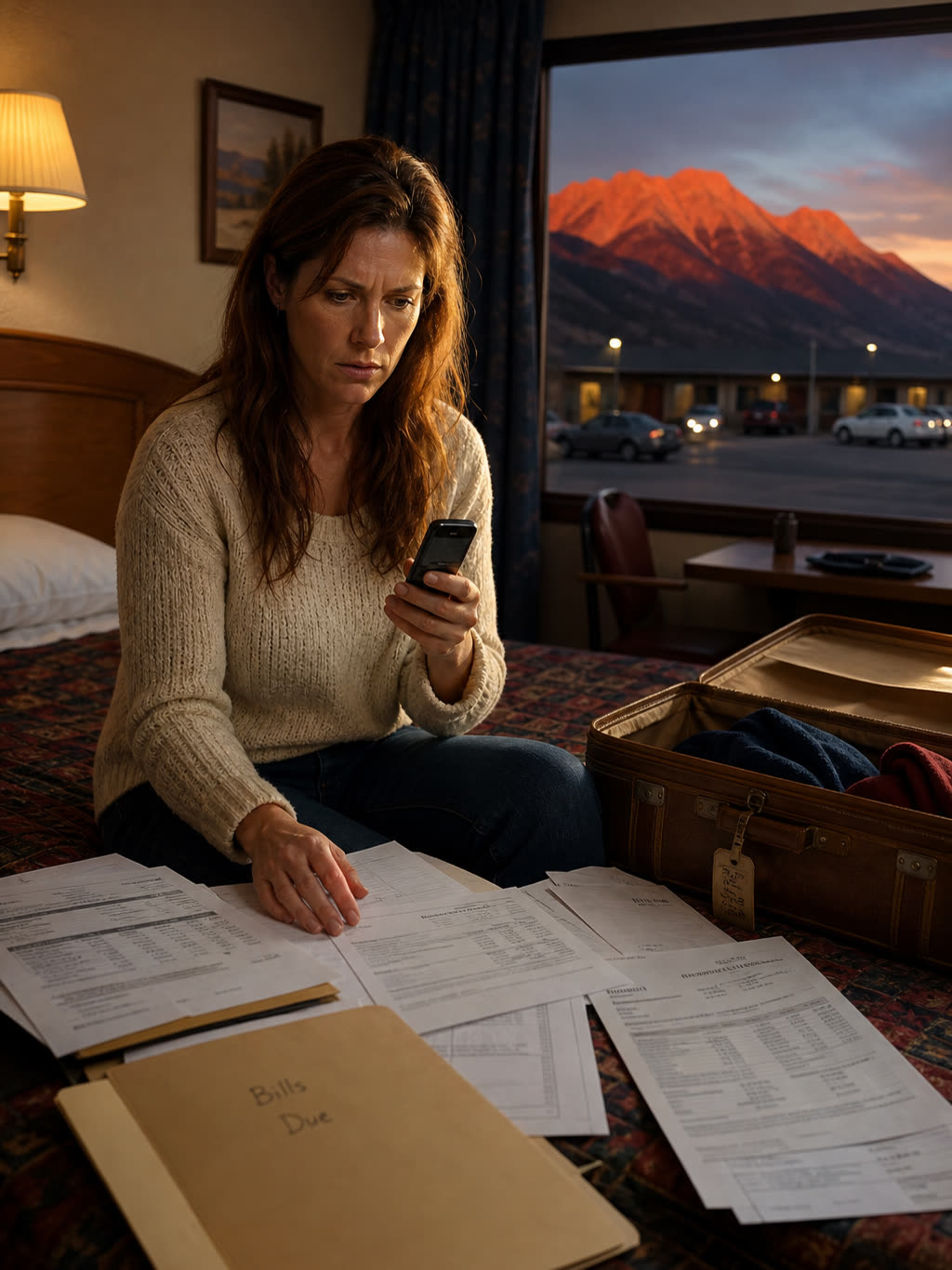
I turned on a cheap prepaid phone I had bought weeks earlier, the kind of thing I had hidden at the bottom of a drawer in case I ever needed it. My thumb hovered for a moment, and then I dialed Gary.
“Hello?”
“Gary, it’s Colleen.”
I could hear music and several people talking in the background, the clink of glasses, a burst of laughter.
“Mrs. Whitmore! We’re actually having dinner with Dennis right now. What a surprise.”
I made my voice shake.
“I need help. Dennis canceled my cards. I don’t have enough money to stay here.”
Gary chuckled.
“Your husband is very upset. He says you need to learn to appreciate what you have.”
“Could you ask him to transfer five hundred dollars?”
“Sorry. The instructions were clear. When you’re ready to apologize, maybe we can talk.”
The call ended, and I stared at the dark screen.
They were celebrating. While I sat in a rattling motel room, they were toasting over dinner, convinced that I did not know how to survive without him.
Dennis truly believed it, and that gave me an advantage.
I barely slept. When the gray morning light crept through the thin curtains, I gathered the documents back into the folder, washed my face, and took a cab to a law office in Myers Park.
I had made an appointment with Janice Holloway, an attorney who specialized in property disputes and business litigation. She was close to fifty, with dark hair and a stern expression that did not soften when I walked in.
“Mrs. Whitmore,” she began, “if you signed a prenuptial agreement with separate property, you can’t simply demand half of everything your husband owns.”
“I know.”
“We can look at compensation for the years you devoted to the household, plus whatever property you’re legally entitled to. But I need to understand your situation.”
I laid five documents on her desk and said nothing more. I let the papers speak.
Janice read the first without much interest, her pen tapping idly. At the second, she frowned. By the third, she leaned forward and the pen went still.
“Where did you get this?”
“From the administrative files Dennis kept at home. I’ve known about his operations for years.”
“Do you understand these transactions?”
“I’m an economist. Before I married, I worked in financial analysis.”
The attorney turned another page, then another, her eyes moving faster now.
“There are transfers here totaling fourteen million dollars to a company connected to Gary’s sister.”
“Dennis doesn’t know they exist.”
Janice slowly raised her eyes to mine.
“Then his accountant is stealing from him, too.”
I nodded.
“And I have the documents to prove it.”
The attorney was silent for a long while. I could hear the faint hum of the building around us, and my own pulse in my ears.
Then she asked:
“What do you actually want, Colleen?”
“A divorce, to recover what’s mine, and to stop Dennis from destroying my life.”
Janice studied the records again, tracing a finger down a column of figures.
“This goes beyond a divorce. There are signs of possible tax crimes, corruption, and money laundering. We need to protect this evidence and bring it to the proper authorities.”
Just then an email arrived from her assistant. It was a copy of a document we had only just requested through a former administrative employee of the construction company.
Janice opened it, and her face changed. The stern composure cracked into something close to alarm.
“Colleen, you need to see this.”
She turned the screen toward me.
It was an internal authorization for payments totaling twenty-seven million dollars to three suspicious vendors.
In the field for administrative officer, my full name appeared.
Beneath it was a signature nearly identical to mine.
A chill ran through me, from the base of my neck down to my fingertips.
“I never signed that.”
Janice checked the date. The document had been prepared three days before Dennis threw me out.
Then, slowly, we understood something terrible.
My husband was not only trying to take everything from me.
He had already started building the false evidence he would need, so that when the fraud finally came to light, the person blamed would be me.
PART 3: The Woman He Never Imagined
The signature was fake. I knew that. But knowing was not enough. I had to prove it before Dennis used that paper to make me responsible for his businesses.
“Don’t call him,” Janice warned when she saw me reach for my phone. “If he finds out what we know, he could destroy the original files. First we secure them, then we act through legal channels.”
I looked at the date again. The supposed document had been signed on a Thursday at eleven in the morning. That day I had been in Asheville, sitting with my mother during her surgery. I had the bus tickets, the hospital receipts, and a photograph my sister had taken of the two of us in the waiting room.
“Can we prove it?” I asked.
“We can gather evidence, request a forensic signature analysis, and demand the original records. I won’t promise it will be easy, but you’re not defenseless.”
Those last words nearly made me cry. Not because the attorney was offering me a victory, but because no one had spoken to me in years as if my version of events deserved to be heard.
For the next week I barely slept. Janice brought in a forensic document examiner and a criminal defense attorney. We made verifiable copies of the files, identified dates, organized the invoices, and carefully separated what could be proven from what we only suspected.
I was afraid of making a mistake. Every paper reminded me of the times Dennis had ordered me to stay out of his business. And yet the further we went, the clearer it became that my skills had never disappeared. I had simply kept them hidden too long.
The examiner found differences in the pressure and stroke of the signature. It looked like an image copied from an old receipt. Worse, the document’s formatting had been created after the date printed on it. Someone had prepared it to pass as older than it was.
Janice looked at me across her desk.
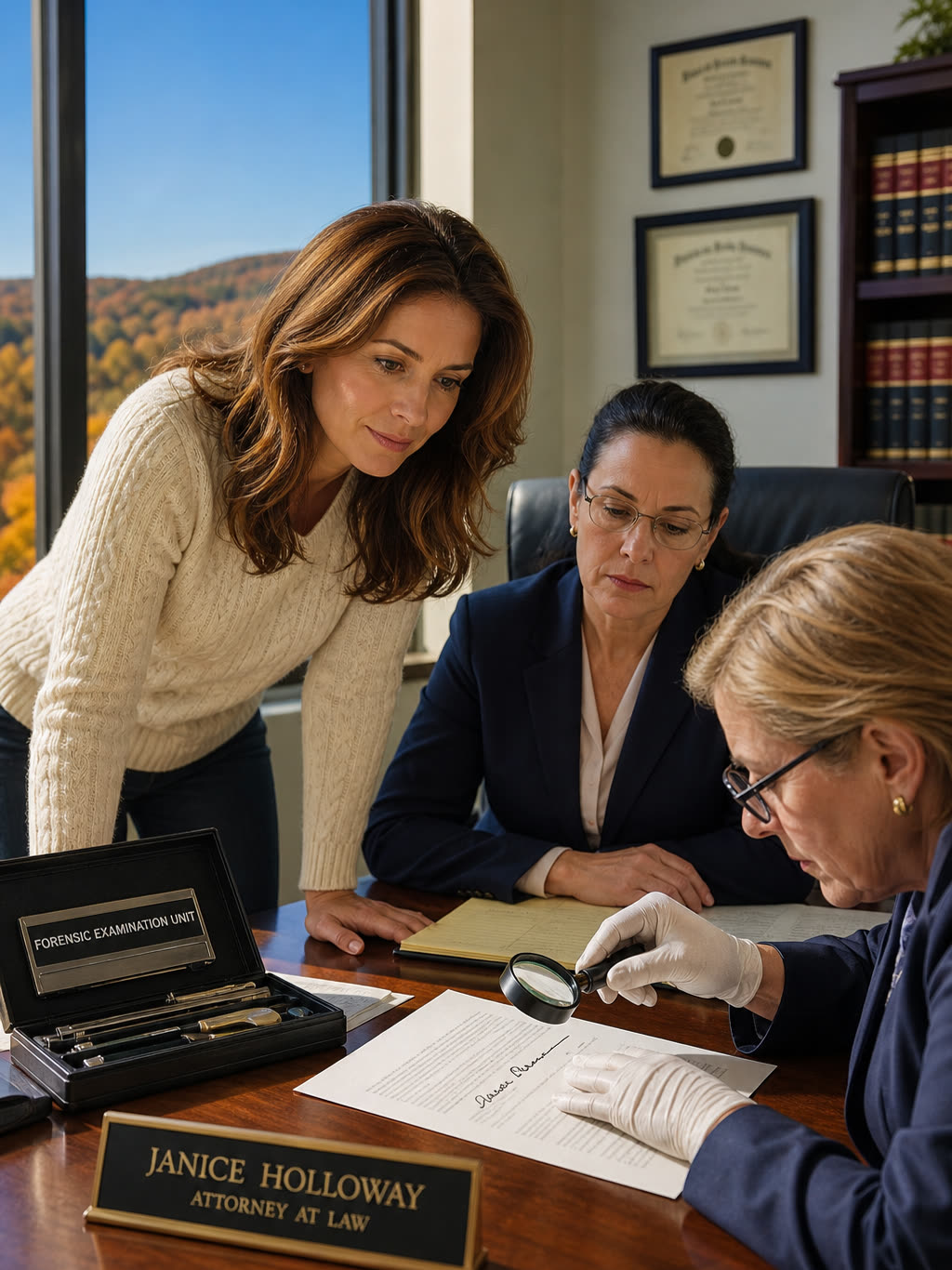
“This no longer looks improvised. Your husband was getting ahead of an investigation.”
That night I called my mother. I had told her I was traveling, but I could not keep up the lie any longer.
“Dennis kicked me out of the house, Mom.”
There was silence on the line.
“Did he hurt you?”
“Not this time. But I think he wanted to ruin my life.”
My mother took a moment to answer.
“When you were a girl, you used to stay up late helping me go over the books for the shop. You found errors even the accountant missed. I never understood why you let that man call you stupid.”
I cried then, sitting in that motel room. Not for losing the condo or the jewelry, but for the sixteen years I had spent mistaking the endurance of humiliation for saving my marriage.
We submitted information to the IRS and filed a formal complaint about conduct that could constitute crimes. My attorney insisted that the originals be examined by the proper institutions. My calculations and my outrage were not enough: every transaction needed backing.
The records showed six years of billing for work that did not exist. Several companies issued invoices for equipment, concrete, and services that never reached the projects. Part of the money flowed back to people connected to the construction company. Another part ended up with middlemen tied to Rodney Tate, a county councilman who steered contracts to Dennis.
And the fourteen million sent to the company linked to Gary’s sister never appeared in the reports the accountant gave his boss.
“They were cheating each other,” I said when I finished reconstructing the flow of money.
“And they intended for you to pay the consequences,” Janice replied.
Two days later a message arrived on my old phone, which I turned on only now and then.
“Return what you took. We can fix this. Don’t do anything stupid.”
It was Dennis.
I did not answer. I saved the message and forwarded it to my attorney.
The next morning I noticed the same gray sedan parked in front of the motel, for the second time. A man followed me into a coffee shop and pretended to study the menu when I stopped. I did not know who had sent him, but I stopped considering that motel safe.
With Janice’s help I moved into the home of her aunt Rosemary, a retired woman who lived in a small apartment in Matthews. She welcomed me with a mug of coffee and one simple condition:
“Nobody here is going to ask where you’ve been. But you have to eat well and sleep. You can’t fight the world if you’re wearing yourself out.”
It had been a long time since I had felt such unselfish concern.
Meanwhile, Dennis began calling relatives and acquaintances. To some he said I had suffered a nervous breakdown; to others, that I had stolen company documents to blackmail him. My mother-in-law even phoned my mother to say her son had supported an ungrateful woman for sixteen years.
My mother answered with a single sentence:
“Your son can explain his books. My daughter can explain hers.”
The investigation moved forward over several weeks. Federal agents corroborated transactions with bank and tax records, obtained court orders, and finally went to the offices of Whitmore Construction to secure documents and equipment.
I was in Matthews that day when Janice called.
“They’re inside,” she said. “The investigation is official. They no longer depend only on your copies.”
I did not smile. My knees were shaking.
At the company, Dennis tried to blame Gary for the invoices. Gary responded by handing over messages in which my husband had approved the payments. Then the transfers Gary had hidden came to light. They accused each other until it was clear that neither of them controlled the story.
The final blow was the eighty-million-dollar contract.
It had never been lost because I forgot to review three pages. The investor who would have financed that development had already spotted inconsistencies in the costs and asked for clarification. Dennis received the warning before he ever argued with me. He knew the deal was at risk because his own numbers could not survive an audit.
The night he smashed the bowl, he was not reacting to a mistake of mine. He was searching for someone to blame, and he had already decided it would be his wife.
When Janice showed me the correspondence documenting those warnings, I remembered Dennis’s face above the broken glass. For the first time I understood that the fear I had seen in him was not fear of losing money. It was fear that someone would discover how he had gotten it.
Months later we met in the Mecklenburg County courthouse.
Dennis had lost weight. He still wore expensive suits, but he no longer held my gaze with the same confidence. His attorney offered a small condo and fifty thousand dollars in exchange for my giving up every other claim.
“My client has been extraordinarily generous,” he declared. “Mrs. Whitmore never earned an income of her own during the marriage.”
Janice stood.
“My client devoted sixteen years to sustaining the household and gave up professional opportunities at her husband’s request. We ask that this contribution be valued and her rights determined under the marital property laws. We also ask that any effort to conceal lawfully acquired marital assets be investigated.”
Dennis’s attorney tried to discredit me for gathering financial documents.
“She is a resentful woman trying to exploit an investigation to enrich herself.”
I was permitted to speak.
“I didn’t come for his illegal money,” I said. “That is for the authorities to investigate. I came because for sixteen years I was told my work was worth nothing. I cared for our home, organized our life, and gave up a career. Now they want me to accept that all of it was worth zero dollars.”
Dennis let out a short laugh.
“You always knew I paid for everything.”
“And you always knew I could understand your books,” I answered. “That’s why it bothered you when I asked questions.”
The judge did not settle the property that day. She ordered the evidence to continue and made clear that assets under criminal investigation could not be treated as a prize in the divorce. It was a different proceeding with different rules. For the first time, that struck me as fair.
The criminal investigation ran its course. Gary admitted his part in several transactions, though he tried to minimize his responsibility. Rodney Tate was also prosecuted for the favors he had received. The bank records, the approval messages, and the sham contracts caught up with Dennis.
My name appeared on some documents. But the forensic analysis, my travel receipts, and the electronic records helped prove that the supposed authorization had been fabricated. I had to testify several times. It was exhausting. It was also the first time I faced his lies without asking his permission to speak.
The divorce ended with a settlement approved by the court after many hearings. I received a financial award and a condo drawn from the lawful marital property that could be documented. I did not get back sixteen years. No ruling could return the time. But I walked away with enough to begin without depending on Dennis.
Almost two years after that night, the criminal verdict came. Dennis was sentenced to eight years in federal prison for the crimes ultimately proven. Part of the assets tied to the illegal operations was subject to forfeiture. The charges against the others followed their own proceedings.
I went to see him one last time, after I knew the sentence. A thick pane of glass separated us.
“I lost the company,” he said. “I lost my friends. Gary testified against me. Even my mother stopped coming. Are you happy?”
I looked at him. For years I had imagined that seeing him defeated would give me back something of what he had taken. But I felt no joy.
“I didn’t come to celebrate, Dennis. I came to say goodbye.”
He lowered his head.
“I never thought you were capable of all this.”
“That was your mistake. You believed that because I stopped working outside the house, I had also stopped thinking.”
He stayed quiet. Then he said something I had never heard him say sincerely:
“I’m sorry. For how I treated you. For your grandmother’s bowl. For all of it.”
My throat tightened. I had not forgotten the afternoons when Dennis was kind, or the man I had fallen in love with. But I could not forget what our marriage had become, either.
“I accept that you’re apologizing,” I answered. “That doesn’t mean you have the right to come back into my life.”
He leaned toward the glass.
“Can we start over when I get out?”
I shook my head slowly.
“I already started over. Without you.”
Months later, I received a job offer from a national firm that reviews investments and companies in financial trouble. They had learned of my work through an independent consultancy where I had collaborated after the divorce.
The director reviewed my résumé.
“It says here you spent sixteen years out of the workforce.”
“That’s right.”
“And then you identified a network of irregular operations that other professionals missed.”
“It wasn’t one person’s work,” I clarified. “There were attorneys, examiners, and authorities. I knew the numbers and where to look.”
He smiled.
“Exactly. We need someone who can admit what she knows and what she still needs to verify.”
They offered me the lead of a financial controls team, at a salary of one hundred forty thousand dollars a year. I accepted after reading the whole contract, down to the last page.
With my savings and my new job, I bought a bright condo, much smaller than the one in Charlotte where I had lived with Dennis. I chose my own furniture, opened a bank account in my own name, and placed a simple blue glass bowl on the table.
It was not my grandmother’s bowl. That one could not be repaired. But every time I looked at it, I remembered something she used to tell me:
“What breaks by accident can be mended. What someone breaks to humiliate you, you have no obligation to pick up.”
For sixteen years I believed that love meant enduring, staying quiet, and making myself small so someone else could feel big.
Now I know a woman can lose a home, a marriage, and the certainties she held for half her life without losing her ability to rebuild herself.
Dennis threw me out of his condo convinced he was leaving me with nothing.
He never imagined that when he closed that door, he was handing back the only thing I truly needed: the freedom to decide who I wanted to be.
Disclaimer: This story is a work of fiction inspired by real-life themes. Names, characters, places and events are fictionalized, and any resemblance to real persons is purely coincidental. Images are for illustration purposes only.
