


PART 1: THE NIGHT MY HUSBAND ERASED ME
My husband dismissed me in front of four hundred witnesses. What he failed to realize was that the company was not his alone to rule. Camden Royce picked a crowded ballroom for my humiliation. Not behind closed doors. Not with kindness. Not even in the privacy of an office.
Beneath the crystal chandeliers of the Grand Meridian, in front of clients, directors, cameras, champagne towers, and employees he had spent two years teaching to overlook me, he made his announcement. The gala was supposed to crown Camden. By midnight, the board was expected to name him Global CEO of Vale & Royce International, and Camden had made certain everyone knew it.
His navy velvet tuxedo had been tailored in Milan, his hair was flawless, and his cuff links had belonged to his father. Whenever an important guest walked in, he appeared with a hand already extended and a photographer conveniently placed nearby.
Sloane Mercer had the table closest to the stage. Vice President of Brand Strategy. Thirty-three years old. Clever when she chose to be. Always beautiful. And sleeping with my husband.
She wore red silk. Camden once told me red looked desperate. Apparently that verdict applied to me alone.
My place card was at Table Nineteen, beside the service doors. “Elena Royce — Community Relations.” Nothing marked me as his wife. Nothing recognized six years of acquisitions, reorganizations, sleepless launches, investor dinners, funerals, and endless sacrifices that Camden now presented as his own achievements. I looked at the card for a moment. Then I sat down.
Camden counted on exactly that, because my willingness to put up with discomfort without a word had always made his life easier. Silent compliance. He had loved it once. “You’re the only quiet thing in my life,” he used to whisper when we were newly married. Back then, quiet meant security. Later it meant usefulness. In the end it meant weakness.
At 9:20 the lights dimmed. Camden climbed onto the stage, smiling as if his future had already been signed. He thanked the directors. He thanked the international partners. He praised the retired founder, August Vale, who had not yet arrived. Then came discipline. Legacy. Integrity. That last word almost made me laugh. I kept my hands folded in my lap.
“Leadership is not only about celebration,” Camden said, resting both hands on the podium. “It is also about making painful decisions with integrity.” The mood in the room shifted. Perhaps instinct warned me, or perhaps it was Sloane’s sudden stare, but I knew before he said my name. The cameras seemed ready as well. “Many of you know my wife, Elena, has worked in our community partnerships division.” Worked. Already past tense. “Unfortunately, after repeated performance concerns, breaches of internal trust, and conduct misaligned with our values, her employment with Vale & Royce International is terminated effective immediately.”
A pause. Complete, stunned silence. For one instant, ice clinked in somebody’s glass. Then Sloane began to applaud. Deliberately. Almost sweetly. Her diamonds flashed beneath the lights like tiny blades. Others joined in, then more. That was the ugliest thing about power. Cruelty rarely needed direct orders. Power only had to signal which cruelty was allowed.

From the podium, Camden watched me, waiting for the reaction that would make his accusations look justified. He expected tears. I could read the expectation under his grave expression. He wanted a manageable outburst: a supposedly hysterical wife, an unstable employee, a jealous woman mixing marital grievances with work.
He had spent months building that image. Only then did I see it: the long run of seemingly unconnected slights had been preparing everyone for this exact moment. Meetings I wasn’t invited to. Reports that had been altered. Emails that somehow left me off. The complaints about my “emotional investment” in community projects. Sloane telling executives I was struggling to adjust to Camden’s growing responsibilities. Camden asking whether I had thought about “taking some time away.”
At home, he called me oversensitive. At work, he called me unfocused. Behind closed doors, he told me I embarrassed him by behaving as though my opinions carried weight. And then he slept with Sloane and assumed I didn’t know.
I stood, aware that hundreds of people were watching to see whether I would fall apart. The ballroom grew stiller. I wore the black satin dress that Camden had once called too plain for a CEO’s wife. For once I was grateful for it. He had nothing visible to mock. My hands weren’t shaking. I wore no showy jewelry. My makeup was intact. Only me.
His smile stiffened. “Elena,” he said gently into the microphone, “we can discuss the details privately.” I looked straight at him. “You chose to announce it publicly.” His jaw tightened. Whispers ran across the ballroom. I had disrupted his performance.
“Elena.” There it was again. My name, carrying its familiar warning. I had heard it at dinners after I disagreed with him. At home whenever I asked where he had been. In the car after I smelled Sloane’s perfume on his jacket. Elena. Stay silent. Elena. Don’t cause embarrassment. Elena. Remember whose importance comes first.
I picked up my clutch. “Then there’s nothing to discuss privately.” Sloane’s smile finally faltered. Camden recovered quickly. “Security will assist you with collecting any company property.” The words stung unexpectedly. Not because of the job itself. Six years earlier, barefoot in our kitchen, he had held my face and promised that success would never make me invisible. Now he was ordering my removal from a company I had helped keep alive. A company he didn’t realize I partly owned.
I stepped away from the table. Then the ballroom doors swung open. I heard the reaction before I saw him. Chairs scraped. Someone near the stage whispered, “Mr. Vale.” August Vale had arrived.
At seventy-eight, he moved slowly but still commanded every eye. He came in carrying a silver-handled cane, accompanied by his longtime attorney, Margaret Ellis. Camden’s whole expression changed. “August.” He hurried off the stage, his warmth convincing to anyone who didn’t know how manufactured it was. “We were beginning to worry you wouldn’t make it.”
August ignored his outstretched hand. He was looking at me. “Elena?” I froze. His gaze moved between me and the approaching guard. Then he turned to Camden. “What,” August asked, “is happening?” Camden smiled modestly. “A difficult personnel matter. Unfortunately, Elena’s position has been terminated.” August stared at him. “Terminated?” “Yes.” “By whom?” Several guests exchanged looks. Camden nearly laughed. “By me.”
August’s gaze hardened into stillness. I had seen that expression once before, at my mother’s funeral, when he stood in the rain without an umbrella, studying her coffin as though demanding answers from grief. He looked at Camden in exactly the same way. Then August asked the question that froze the ballroom. “Why,” he said, “are you firing one of the principal owners of this company?”
The applause died. Even breathing seemed to hush. Camden stopped smiling. Sloane froze with her champagne halfway to her lips. After six years of being told my voice took up too much space, the truth finally spoke without Camden’s permission.
Camden stared as if I had overturned gravity itself. “What did he say?” The question wasn’t aimed at August. He meant me. His reflex was almost remarkable. In front of four hundred witnesses, he still assumed I owed him answers.
August answered for me. “I said Elena is an owner.” “That isn’t possible.” Margaret opened her leather portfolio. August glanced at her, and she understood at once. “Mrs. Royce is the beneficiary and controlling trustee of the Hart Legacy Trust,” Margaret said. “The trust currently holds a substantial private position in Vale & Royce International.”
Camden fixed his eyes on her. Then on me. Then on Margaret again. “How substantial?” I watched him calculate. There was no heartbreak in it. No sense of betrayal. Only arithmetic. August’s expression grew stern. “Substantial enough that you should have learned who owns the company before deciding who deserves to be humiliated inside it.”
The guests stayed hushed. I had wanted triumph, some clean satisfaction at finally seeing the truth exposed before the people who had dismissed me. Instead I missed my mother, whose restraint had shaped how I thought about money and influence. It caught me off guard. I had spent the evening bracing for Camden: his deception, his spectacle, his viciousness. But the name Hart Legacy Trust carried me back to a hospital room three years earlier.
My mother, Vivian Hart, was dying then. She had never behaved like a wealthy woman. She kept one silver Volvo for fourteen years, clipped grocery coupons she didn’t need, preferred diners to fine restaurants, and switched off lights even when other people were still in the room. At first, Camden liked her. As his social circle grew richer, he started calling her “old-fashioned.” Mother noticed. Nothing escaped her.
A week before she died, she asked me to close the hospital door. “Elena,” she said, “there are documents Margaret will give you after I’m gone.” I was exhausted. Furious. Frightened. “I don’t care about documents.” “I know.” “Mom—” “That’s why I’m telling you now.” She took my hand. Her fingers felt weightless. “My father believed money made people loud. I spent my life believing the opposite. If something has value, you don’t need to wave it over people’s heads.”
I couldn’t understand it. Not entirely. Margaret explained after the funeral. My grandfather had invested privately in August Vale’s original logistics business early on. When an expansion crisis later threatened Vale & Royce, my mother enlarged our stake through private financing. She wasn’t its only savior, and August never claimed she was. Her investment arrived just as banks tightened lending and other investors fled. It bought August time. Time allowed survival. Survival led to expansion, and eventually to Vale & Royce International.
Mother kept her investment out of public view. She wanted no board seat and no name on a building. She wanted the trust protected and its votes used only when they were needed. After her death, I inherited it. I had told Camden I was inheriting a family trust. That was accurate. He barely glanced up from his phone. “Good,” he said. “Have Margaret handle it. You’re terrible with financial paperwork.” I remembered my astonishment. He kissed my forehead. The conversation ended there. He never asked what it held. For three whole years. Not once.
That memory stung differently now. Back in the ballroom, Camden finally turned to me. “You never told me.” “I told you about the trust.” “Not this.” “You never asked.” His cheeks reddened. Sloane rose from her seat. “Camden, maybe we should take this somewhere private.” I met her eyes, and she stopped moving.
I had plenty I could reveal. The hotel receipt from Camden’s coat. The midnight messages. The anonymous photograph, sent six weeks earlier, of Sloane getting into his car outside her apartment. One sentence could have ruined them both. But then the whole evening would turn on infidelity, and it wasn’t about that. Not yet. Camden had publicly accused me of misconduct before clients, staff, and directors. I needed that false accusation dealt with first.
August seemed to understand that the professional allegation had to be examined separately from my marriage. “What performance concerns?” he asked. Camden drew himself upright. Pressure usually suited him, which was why the board liked him. “Elena repeatedly exceeded authorized budgets in Community Relations. There were concerns regarding confidential materials, donor commitments, and internal communications.” “Specifics.” “August, this is hardly—” “You announced it to the ballroom. The ballroom may hear it.”
Several guests looked away. Camden shot Sloane a glance. It lasted only an instant, but I noticed. August noticed too. So did Margaret. Sloane stepped forward. “My department received documentation showing that Elena committed the company to three community grants before final executive approval.”
I felt a chill. Those exact grants. I recognized them immediately. I had filed them correctly. Each one had been approved. I had personally seen the authorization codes. “Who gave you the documentation?” I asked. Sloane looked at me. “This isn’t personal.” I nearly laughed. “Then answer the question professionally.”
Camden stepped between us. “You’re done here.” “No,” August said. Camden turned to him. August gripped his cane with both hands. “She isn’t.” Then I realized something. August wasn’t simply rescuing me. He had come because he suspected wrongdoing, something beyond my marriage. He looked at Margaret. “Tomorrow morning. Nine o’clock. Full board.”
Camden went pale. “This gala was intended to precede the succession vote.” “It still will.” August looked at him. “But there will be no succession vote tonight.” Whispers filled the room. For Camden, the blow was devastating. He had built the whole evening around his promotion. The press announcements were drafted. Interviews were booked. Sloane’s team had prepared a campaign around “the next generation of global leadership.” With a single remark, August had stripped Camden of his expected crown.
Camden faced me. I had never seen a former lover’s face turn hateful so fast. “This was your plan.” “No.” “You set this up.” “I didn’t know you were going to fire me.” “Don’t lie to me.” I lowered my voice. “You really believe I arranged for my husband to publicly accuse me of misconduct just so I could reveal an investment you couldn’t be bothered to ask about?” He said nothing. Even Camden heard the absurdity once I put it plainly.
August turned to security. “Elena isn’t leaving.” Then to me. “You have access to your office?” I remembered a message from that afternoon. Your credentials will be updated after tonight’s event. I had assumed it was routine department security changes. Now I saw its purpose. “I don’t know.” “Find out.” Camden spun toward August. “Why?”
August lowered his voice. “Because if Elena’s grants were approved and someone altered the record afterward, we’re no longer discussing poor performance.” Sloane’s expression shifted. Briefly. I noticed. Fear. My own humiliation suddenly felt secondary. The company’s systems held an answer Camden never expected me to go looking for. Who had changed my work before it became grounds for dismissal?
PART 2: WHAT THEY NEEDED ME TO LOOK LIKE
My badge failed at 10:17 that evening. I checked the clock. I scanned it twice at the executive elevator. Red. The light flashed red again. Margaret was beside me. August had stayed upstairs with the directors to manage Camden’s crisis.
“Don’t try again,” Margaret said. “Why?” “Because now we document everything.”
Margaret and I approached the truth differently. I believed truth alone was enough. She knew it needed recorded times. I got home just before midnight, carrying the unfamiliar feeling that my personal life and my professional life had both shifted.
Camden stayed away. I had expected nothing else. The apartment felt strange without him, though every object sat exactly where we had left it. Not empty. Simply honest.
Walking through the living room, I saw years of self-erasure. His trophies filled the shelves. His photographs lined the hallway. His favorite whiskey sat on the cart. Our art came from his preferred galleries. Even the thermostat followed his taste.
I searched our home for something that was distinctly mine. I found a ceramic bowl my mother had made. Nothing else.
The phone rang. Camden. I answered after four rings. “Where are you?” he demanded. I looked around the apartment. “Home.” “You left without speaking to me.” “You fired me in front of four hundred people.” “This isn’t the time for dramatics.” I smiled in spite of myself. “Of course not.”
A pause. Then he softened his voice, which troubled me more. “Elena, listen to me. Tonight got out of control.” “You planned tonight.” “I planned a necessary personnel decision. I didn’t know August was going to turn it into theater.”
I closed my eyes. Camden could stand beneath chandeliers with a microphone and destroy his wife in public, then call someone else’s response theater.
“How long have you been sleeping with Sloane?” A pause. Not astonishment. Just a pause. It told me more clearly than any explanation Camden could have invented on the spot.

“Elena—” “How long?” “This has nothing to do with the company.” “How long?” He exhaled. “Things between us have been difficult.”
I went numb. Some betrayals erupt. Others merely confirm what you already suspected. His late evenings. The changed passwords. His phone lying facedown at dinner. Sloane knowing details about our vacations that I had never told her. Her scent lingering in his car. For months I had been gathering evidence while desperately avoiding its conclusion, unwilling to give up the image of the husband I had married. Now Camden had confirmed it.
“You could have left me,” I said. “It wasn’t that simple.” “It was simpler than destroying my career.” “That wasn’t about Sloane.” “Then prove it tomorrow.”
He paused briefly. I went on. “Bring every complaint. Every performance report. Every approval record. Every email. If I did what you said I did, prove it.” “You don’t understand what you’re walking into.” “No, Camden. I think that’s been the problem. I understood exactly what I was walking into for six years. I just kept pretending you were still the man who walked beside me.” He hung up.
Margaret emailed at 12:43 a.m. She attached three archived grant authorizations kept by the Hart Trust’s governance counsel. I opened the first. My submission. My proposed budget. The authorization trail. Approved. The second. Approved. The third. Approved. I compared them with the screenshots Sloane had shown at an internal review weeks earlier. The authorization codes were missing. Not denied. Simply erased.
My stomach clenched. I recalled that meeting. Sloane had sat across from me and asked, “Are you sure you submitted these properly?” “Yes.” “Because I’m looking at the system.” “So am I.” Yet when I logged in, the statuses read “Pending Executive Authorization.” I had assumed I’d made a mistake.
Camden had been furious. “You keep putting me in impossible positions,” he had said afterward. I had apologized. The memory hurt, because I had taken the blame without knowing the underlying record had been altered. I had apologized for somebody else’s alteration.
At nine the next morning, I carried my mother’s folder into the boardroom. Camden had arrived. Sloane sat three chairs away. Not at his side. Notable. August occupied the head chair. Margaret waited by the windows. The directors looked exhausted. Nobody offered refreshments.
August began without delay. “Elena, tell us about the grants.” I explained. I described the projects. A youth apprenticeship program in Detroit. A neighborhood recovery initiative in Baltimore. A logistics scholarship partnership in Newark. Each one fit within the board-approved community-impact budget. Each had been submitted correctly. Each had been approved. Weeks afterward, their statuses were changed.
A director leaned forward. “Changed by whom?” “I don’t know.” Sloane cut in. “System errors happen.” I turned to her. “Three times?” “I’m not in IT.” “No. You’re in Brand Strategy. Which is why I’m still wondering why my grant authorization records were in your possession.” She started to answer. Camden interrupted. “Because Community Relations falls within reputational oversight.” “It didn’t until January.” He fell silent.
I remembered the reorganization. A seemingly minor administrative change. Sloane’s team had gained review authority over “external-facing impact communications.” I had assumed Camden was merging divisions ahead of his promotion. Now I saw Sloane’s additional advantage: visibility. August asked, “Who proposed that restructuring?” Nobody replied. Director Thomas Keene studied the documents. “Camden did.”
The atmosphere changed as the directors began to see this was no ordinary dispute over a department’s performance. Camden leaned in. “This is becoming absurd. I proposed dozens of structural changes. You’re constructing a conspiracy from routine governance.” “Then routine governance will clear you,” Margaret said. She produced another document. System access logs. Not the content itself, only the administrative trail. Executive-level credentials had accessed all three grants after authorization. Those credentials came from Camden’s office.
I fixed my eyes on him. His surprise looked genuine. That detail mattered. For the first time since the gala, I trusted his reaction. Not on every issue. Only this one. Camden hadn’t known. Slowly, he turned toward Sloane. She went white. Suddenly the pattern emerged, linking Sloane’s access to the manipulated records with Camden’s eagerness to remove me. Sloane had changed the statuses. Camden had accepted them. Why? Because it suited him. Because by then he needed me to become professionally incompetent. My supposed incompetence justified firing me. My supposed instability justified divorce. My supposed jealousy absolved Sloane. My supposed weakness spared Camden any self-examination. He hadn’t invented every claim. He had simply accepted every convenient lie.
“Sloane,” he said. Her voice shook. “I can explain.” I met her gaze. For months I had pictured confronting his mistress. I had expected plain hatred. I did hate her. Yet the feeling was more complicated. Camden had armed her, however frightened she looked now. She had learned to wield it. August cut in sharply. “Then explain.”
Sloane swallowed. “The records weren’t falsified.” Margaret said nothing. Sloane hurried on. “They were temporarily moved back into review because Elena’s projects were creating budget exposure.” “By whose authority?” I asked. “Executive oversight.” “Whose?” She turned toward Camden. He met her eyes. Something between them broke then. Not affection. Camden had mistaken secrecy for closeness. What ended was trust. Sloane whispered, “Camden’s.”
He jumped up, sending his chair against the wall. “I never authorized you to alter records.” “You told me to fix the Elena problem.” A chill ran through me. Camden glanced at me. “Sloane.” “You said she was becoming a liability.” “I did not tell you to falsify approvals.” “You said you needed documented cause before the succession vote.”
There it was. Not some intricate plot, but something more disturbing and painfully ordinary. Camden wanted me gone. Sloane wanted to please him. She manufactured professional incompetence. Camden avoided questions because the evidence benefited him. I looked at my husband. “Did you ask her to build a case against me?” “Elena—” “Did you?” He stayed silent. His silence was the answer. The directors had heard enough. I hadn’t finished.
“Why before the succession vote?” Camden rubbed a hand over his face. For once he looked weary rather than commanding. “You were becoming unpredictable.” “How?” “You questioned decisions publicly.” “I disagreed with you twice.” “You challenged Sloane’s campaign projections.” “They were inflated.” Sloane recoiled. “You contacted August without telling me.” “He called me after my mother died.” “You maintained relationships with directors independently.” “They were my relationships too.” His voice rose. “That is exactly what I’m talking about!”
The room went silent. Too late, Camden recognized his admission. I felt no triumph. Only sadness. He had needed me labeled incompetent, not because I had failed, but because he couldn’t control me. If he became CEO while I remained inside the company, with relationships, credibility, and a voice, then one day I might contradict him when it mattered. He wanted a wife confined to the home. A subordinate employee. A powerless witness. Instead, he had tried to dismiss a shareholder.
August leaned back. “The succession vote is suspended indefinitely.” Camden stared at him. “August.” “Sit down.” “This company needs continuity.” August’s eyes sharpened. “This company survived wars, recessions, strikes, acquisitions, and one near-bankruptcy. I assure you it can survive not promoting you.” Camden obeyed.
My attention shifted. I studied Sloane. One question remained. She had altered the records. Camden had built the case against me. Neither explained why my badge was deactivated before the announcement. Someone had anticipated that I would challenge the allegations and made sure I lacked access. I turned to Margaret. “Can IT tell us when the order to revoke my credentials was submitted?” “They already did.” She passed me one final page. The request had been made forty-eight hours before the gala. Camden Royce had authorized it. I raised my eyes. His face showed he remembered signing.
The directors stayed in session three more hours. My marriage ended in under three minutes. Camden approached me later in the executive lounge. I was standing at a window facing the city when he came in and locked the door. A year earlier, that lock would have made me turn. This time, I kept looking at the city.
“Elena.” I stayed quiet. “Sloane is being suspended.” Again, silence. “I didn’t know she changed the records.” “I believe you.” He paused. I turned to him. Relief crossed his face. Then I went on. “I believe you didn’t know because you didn’t care whether they were true.” His relief evaporated. “That isn’t fair.” “Fair?” I could barely say the word. “You stood on a stage and accused me of misconduct in front of four hundred people.” “I was protecting the company.” “No. You were protecting your promotion.” “I had been told—” “You wanted to believe it.”
His jaw clenched. “You think owning shares suddenly makes you understand leadership?” There he was again, the man beneath his unspoken apology. I studied him for a long moment. “My mother invested in this company before you knew what it was.” “Your mother.” “Yes.” “Not you.” His remark struck exactly where he aimed it. For an instant I was back in that hospital memory, my mother’s fragile hand holding mine, her reminder that stewardship outweighed showmanship.
Seeing me hesitate, Camden stepped closer. “You inherited money, Elena. I built something.” “No.” His eyes narrowed. “You climbed something.” He stopped cold. “There is a difference.” His face tightened. “I spent fifteen years here.” “And I respected you for it.” “Respected?” “Yes. Past tense.” He looked away. For the first time, I saw fear under his anger. Not over losing me. He feared losing the flattering reflection of himself he found in my eyes.
I had known him longer than anyone in that building. Before the custom suits. Before the magazine interviews. Before the chauffeurs and executive offices. I had known Camden eating vending-machine crackers during his earliest restructuring. I had known the man who worked all night beside me on a community proposal because he believed business should improve communities. Eventually ambition stopped being his tool. It began controlling him.
“I was going to tell you about Sloane,” he said. I nearly laughed. “When?” “After the vote.” Naturally. Once he had the promotion. Once he’d fired me. After securing everything except the wife he had promised to love. “Were you going to divorce me?” He said nothing. I acknowledged it. “Thank you.” “For what?” “For finally being bad at lying.”
I walked toward the door. He grabbed my wrist. Not aggressively. In desperation. “Elena, don’t do this.” I stared at his fingers. He let go. “You’ve already destroyed my career.” “No. You did that on a microphone.” “August won’t reinstate the vote while you’re against me.” “Then perhaps you shouldn’t have publicly fired someone whose support you needed.” “You knew.” He repeated the accusation. “You knew what your shares meant.” “Yes.” “And you let me walk into that ballroom.”
I fixed my gaze on him. That moment ended my hope for our marriage, because he still saw himself as the injured party in a harm he himself had arranged. Even now, he blamed me for not stopping his cruelty toward me. “You planned to humiliate me,” I said quietly. “And you’re angry because I didn’t warn you there would be consequences.” He looked away.
I opened the door. “Elena.” I froze. “I loved you.” His last word cracked. The sound hurt, because I believed its sincerity. Once. Perhaps even recently, within his distorted understanding of love. But love without respect turns possessive, and possession breeds anger when its object refuses. “I loved you too.” I left.
Sloane was waiting beside the elevators. She had traded last night’s red dress for gray tailoring. Away from the chandeliers, she looked younger. Less imposing. Merely human. “Elena.”
PART 3: THE VOTE HE THOUGHT BELONGED TO HIM
I pressed the button for the elevator. “I didn’t know he was going to do it publicly.” I met her gaze. “You altered my records.” “I moved them back into review.” “You knew what it would look like.” Her eyes watered. I didn’t want to console her. “I thought he’d divorce you.” “And then?” She swallowed. “He said after the CEO announcement, things would change.”
There it was again. Her own version of Camden’s promise. After the vote. Once he had the promotion. After the next achievement. Everyone in Camden’s life had been waiting for the day after his ambition was finally satisfied. There was always another day. Another title. Another excuse. “You thought you’d replace me.” Sloane looked down. “Yes.” Her candor startled me. I asked, “Did you love him?” Her face tightened. “I thought I did.” I acknowledged it.
The elevator opened. As I stepped in, she said, “He told me you didn’t care about him anymore. He told me you stayed because you liked being Mrs. Royce. He said your marriage had been over for years. He told me you were just an employee.” Sloane’s face crumpled. I had imagined confronting her in fury. Instead, exhaustion came. That was the difference between us. He had lied to her about me. He had lied to me about myself.
“Sloane.” She raised her eyes. “You made your own choices. Don’t use his lies to erase yours.” The elevator doors closed.
I filed for divorce that evening. Not solely for adultery. The affair was not the only reason. The gala had exposed what years of marriage had slowly taught me. Camden wasn’t satisfied with personal success. He needed everyone near him diminished so that he would look larger. I refused to diminish myself again.
The next morning, August invited me to the original Vale & Royce headquarters. Not Camden’s prized glass tower. The first building. Its brick walls. Its narrow windows. Its scuffed wood floors. August’s original office was almost unchanged from thirty years earlier. He handed me a photograph. My mother stood next to him. She looked about forty. I had never seen the picture. “Your mother hated photographs,” August said. “She thought people behaved strangely when cameras appeared.” August grinned. “She was right.”
I traced its edge with my thumb. “Why didn’t she tell me more?” “Because Vivian wanted you to know people before they knew what you possessed.” I looked at him. “That sounds like her.” “She also knew wealth attracts obedience very easily.” Our eyes met. “Respect is harder.” I thought of Table Nineteen. Of coworkers avoiding my gaze. Of Sloane applauding. Of Camden expecting my tears. “Did you know what Camden was doing?” “No.” He answered instantly. “If I had, he would never have reached that stage.” “Then why did you come prepared with Margaret?”
August was silent for a moment. “Because your mother made me promise something.” My throat tightened. “What?” “That if the trust ever needed to exercise its authority, I would make certain you understood the company before anyone tried to use you for your shares.” I studied the photograph. “And now?” “Now you understand it.” “I understand how ugly it can be.” “That’s part of understanding any institution.” He leaned back. “The board needs to decide Camden’s future.”
I shook my head. “I don’t want revenge.” “Good.” He said it so quickly I looked up. “Revenge is an expensive way to let someone continue controlling your decisions.” “Then what do I do?” August pointed to the photograph. “What Vivian did.” I waited. “Decide what protects the company.” That demanded more than revenge. Far more. Revenge offered a simple route. Remove Camden by a vote. Ruin him. Let the headlines mirror his public humiliation of me. But corporate governance wasn’t marriage. Justice wasn’t anger. I went home and reviewed every report. Every succession paper. Every audit overview. Every staff evaluation. Even Camden’s. By sunrise, I had settled my vote.
Three days later, I went back to the gala ballroom. The chandeliers were still there. So was the stage. The champagne displays were gone. No cameras were invited. Only directors, senior counsel, relevant executives, and major shareholder representatives attended. Camden sat opposite me. He looked sleepless. Sloane wasn’t there. Her resignation had been accepted that morning, after investigators confirmed she had improperly changed grant statuses and misrepresented them in my performance review. The review had reached another crucial conclusion, one that stopped Camden from shifting all the blame onto Sloane. She hadn’t built the case alone. Camden had sought documented reasons to dismiss me. He had approved disabling my access. His personal interests had influenced staffing decisions. He had announced the dismissal publicly before any reviews concluded. Those were his choices. His mistress couldn’t carry them for him.
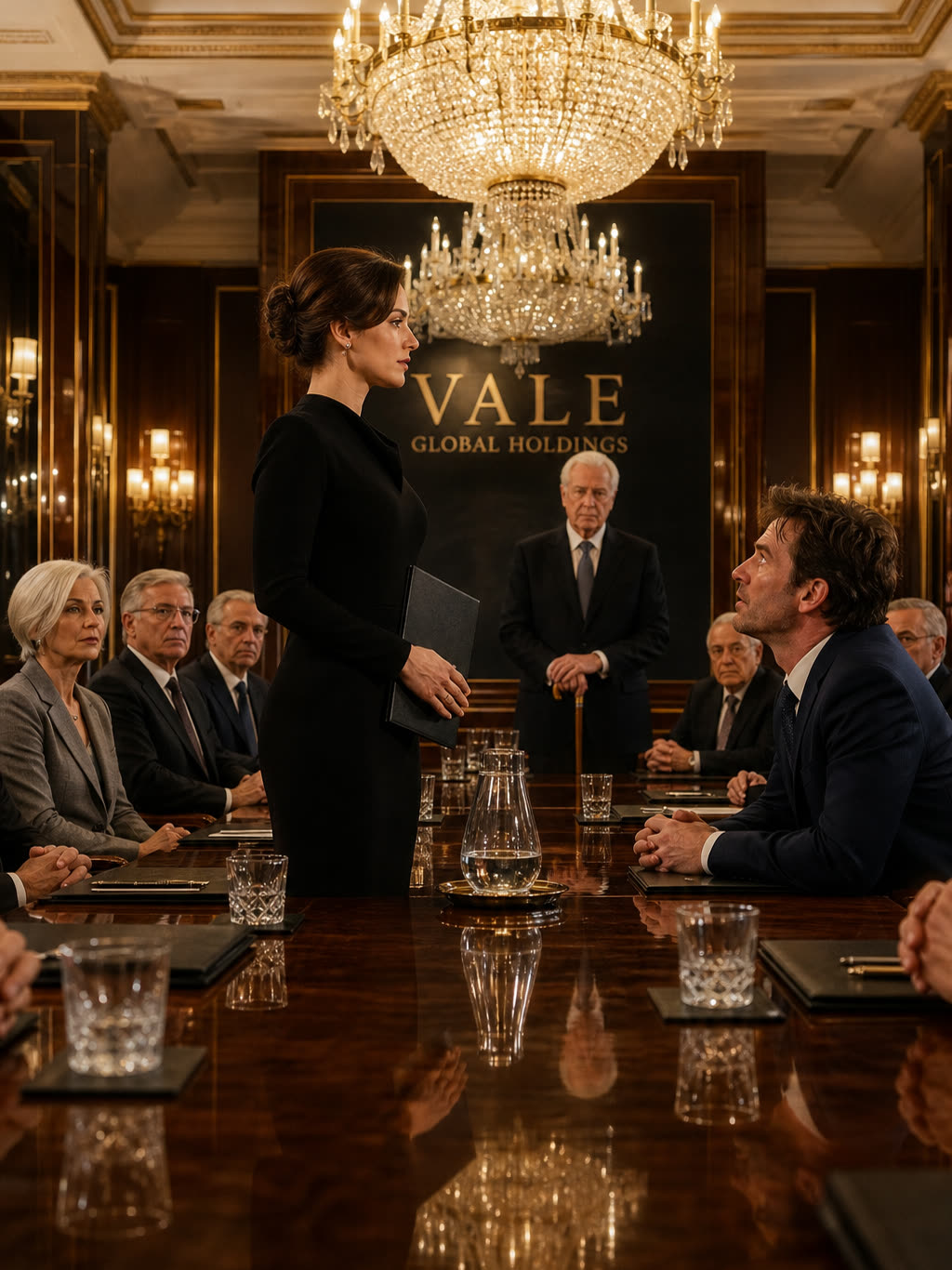
August opened the proceedings. “The question before us is not whether Mr. Royce has contributed meaningfully to this company. He has.” Camden looked up. I valued that acknowledgment. I wouldn’t erase his achievements just because he had hurt me; the record deserved accuracy even when my feelings made accuracy hard. Camden was capable. He had managed difficult expansions. He had won major contracts. He had modernized operations. That made his downfall worse. Success hadn’t required his cruelty. He chose cruelty after success convinced him that consequences applied only to others. August continued. “The question is whether the board retains confidence in his judgment to serve as Global CEO.” Camden asked for the floor. Nobody objected.
He rose. There was no microphone. No cameras. No Sloane to applaud. Only a man facing the people whose approval he had chased for years. “I made serious errors in judgment,” he began. Not simple mistakes, the corporate euphemism. Still boardroom language. Still guarded. He admitted his infidelity. He admitted ordering my dismissal. He denied knowing that Sloane had manipulated records. I believed him on that. Then he surprised me. “I allowed my personal resentment toward Elena to affect my interpretation of information about her.” He turned to me. I met his eyes. “For that, there is no professional defense.” The room stayed hushed.
“I believed Elena had become an obstacle to the future I was building. I told myself that removing her from the company would protect both the organization and our marriage from further conflict.” A bitter realization surfaced. Our supposed marriage. He had meant to preserve it by silencing my objections. “But the truth,” Camden went on, “is that I wanted control.” His voice shifted. His polished executive persona briefly slipped. “I wanted the promotion. I wanted my decisions supported. I wanted my home to stop feeling like another place where I could be questioned.” He gulped. “And when evidence appeared confirming what I already wanted to believe about Elena, I didn’t investigate it carefully.” Finally he acknowledged what mattered. Not that Sloane deceived him. Not that I concealed the trust. Not that August humiliated him. He had welcomed the falsehood.
Camden sat down. August surveyed the directors. “Mrs. Royce?” My married name sounded strange now. Soon it would vanish legally. I opened my folder. Camden watched. Perhaps he expected me to rescue him. Part of him probably did. That expectation was his last unearned privilege. “I have reviewed Camden’s record with this company,” I said. “Not just the last several weeks.” His face shifted. “He has created real value here. That should remain part of the record.” A board member nodded. His shoulders relaxed a little.
I continued. “But leadership isn’t only measured by what someone can build when everyone obeys him.” Our eyes met. “It is measured by what he does when someone beneath him disagrees. When someone inconvenient tells the truth. When he has the power to punish a person and knows he can probably get away with it.” Nobody stirred. “Camden didn’t fire me because he knew I was incompetent. He fired me because he had stopped caring whether I was.” I let the point settle. “He allowed a compromised process because it produced the answer he wanted. He used corporate authority to solve a personal problem. Then he turned a termination into a public spectacle on the night of his expected promotion.”
I faced August. “If I vote based on what Camden did to me as a husband, then I’m repeating his mistake. I’m allowing a personal relationship to determine a corporate decision.” Camden fixed his eyes on me. “So I won’t do that.” Hope flickered in his face. It hurt that I still recognized his hope. “My vote is based on what he did as an executive.” I closed my folder. “I vote no confidence.” Camden shut his eyes. Votes followed around the table. No. No. Abstain. No. No. By the final ballot, Camden’s presumed future had vanished. He was excluded from succession. Soon after, the board accepted his resignation as an executive. Nobody applauded. I appreciated the restraint, because a public celebration of his downfall would have repeated the cruelty of the gala. Consequences need no audience.
Camden stayed seated as the others left. I gathered my documents. “Elena.” I froze. He looked around the room. “Did you know, when August asked that question, that this was how it would end?” “No.” “What did you think would happen?” I thought briefly. “I thought you would finally have to listen.” He gave one laugh. It held no humor. “I suppose I did.” I began to leave. “Was any of it real?” I glanced back. No explanation was necessary. The apartment. Our early years. Our wedding. Nights spent dreaming of futures beyond job titles. The man who drove three hours through a blizzard after my mother’s fall left me afraid to drive. The woman who comforted him when his father died. Our inexpensive apartment. Our vending-machine suppers. Us. “Yes,” I said.
His expression tightened. “Then how did we get here?” I could blame Sloane. Ambition, too. Or money. Or the company. Those were circumstances, not causes. The answer was straightforward. “You started believing love meant I should never stand in your way.” He lowered his gaze. “And I spent too long believing love meant I should move.” I left him beneath the chandeliers.
Six months later, our divorce was final. I reclaimed Hart. Elena Hart. Seeing my name on paper felt like rediscovering the woman I had neglected but who had stayed waiting. I didn’t take the CEO role, though many observers imagined that would be the outcome after the scandal. The press certainly did. Heiress Revealed in Corporate Gala Scandal. Secret Investor Topples Husband. The headlines glamorized it. It wasn’t glamorous. There was no glamour in discovering your husband’s affair. None in realizing colleagues had been led to doubt my competence. None in knowing my closest companion had used intimate knowledge to target my most painful vulnerabilities.
Instead, I accepted the Hart Legacy Trust’s board seat. I resumed the community programs Camden had dismissed as distractions. The Detroit apprenticeship program launched that fall. Baltimore received its recovery funding. The Newark scholarship partnership doubled its first-year placements. On a rainy Thursday, I attended the opening of the Detroit center. There were no glittering chandeliers. No champagne. Only one local reporter filming, her umbrella repeatedly turning inside out. A seventeen-year-old girl named Maya showed me the logistics simulation she had built. At first she seemed nervous. Then her enthusiasm for explaining her work overcame the nerves. I paid attention. Genuine attention. Her explanation reminded me of my mother. Not her fortune. Her decisions. She might have demanded recognition long ago. She chose not to. She understood what Camden forgot. Power isn’t measured by how many people recognize it. Sometimes restraint in using it proves more.
August fully retired the next spring. At his farewell dinner, he gave me the photo of himself and my mother. Her faded handwriting appeared on the back: Build things people can stand inside. I studied her words for a while. August grinned. “She always talked like that.” “She did.” “Annoying woman.” I laughed while crying. “She liked you too.” He pretended to be offended. Before leaving, he rested a hand on my shoulder. “You know, the newspapers got one thing wrong.” “Only one?” He smiled. “They said I saved you that night.” I looked at him. “You did.” “No.” August shook his head. “I asked a question.” His eyes moved to the photograph in my hand. “You were already standing.”
Months later, Camden sent a final letter. I nearly left it unopened. He didn’t ask for reconciliation. He didn’t excuse his affair with Sloane or blame my inheritance. He described years of expecting his next accomplishment to bring security. Another title. Another raise. Another room full of people recognizing him. Each success only deepened his fear of losing it. He began equating disagreement with disloyalty. Then love with loyalty. Finally loyalty with obedience. At the bottom of the page, he had written: The worst thing I did wasn’t firing you. It was becoming the kind of man who needed you to be small before I could feel important. I reread the lines. Afterward, I folded the letter. I sent no reply. I had learned that forgiveness needn’t reopen a door. Sometimes it meant walking away from that doorway instead of waiting for a knock.
A year later, Vale & Royce returned to the Grand Meridian for its annual leadership dinner. I almost declined the invitation. Then I reconsidered. I chose black. Not because Camden once mocked its simplicity. Not as a reply to Sloane’s red. Not to remind anyone of the past. I simply liked wearing it. My place card waited at the front table. “Elena Hart — Director, Hart Legacy Trust.” I traced the printed name. Then I moved the card. Only slightly. One seat along. A junior Community Partnerships manager sat at the table’s edge, nearly hidden by a column. Swapping our cards visibly frightened her. “Ms. Hart, I can’t take your seat.” “Why not?” “Because it’s yours.” I smiled reassuringly. “So was the other one.” She looked puzzled. That was fine. Understanding wasn’t necessary.
The chandeliers dimmed. Conversation quieted. A speaker stepped onto the stage to talk about leadership. For a moment, memories threatened to overwhelm me. Camden addressing the crowd. Sloane’s clapping. Hundreds of eyes turning toward me. The guard drawing near. The shame scorching my skin. Then I remembered what came next. I had stood up. Before August arrived. Before anyone knew about the trust. Before directors uncovered the falsified statuses. Before I dared to expect justice. That detail was routinely forgotten. Headlines credited the founder with saving me. The company credited my ownership. Camden credited my wealth for his defeat. None told the whole story, because my first act of defiance came before any powerful ally intervened.
My assets gave me formal authority. August gave truth a public voice. The board imposed consequences for Camden’s conduct. But before any of that, when I believed I had lost my career, my marriage, my reputation, and six years of my life, I rose. I had no assurance of victory. Still, I rose. A year later, beneath those chandeliers, I understood my mother’s lesson. Power wasn’t the inherited wealth. The wealth only exposed it. True power was knowing that no title, marriage, executive role, or supposedly loving person could dictate how small I must become.
The audience applauded the speaker. I applauded too. I turned toward the young woman in a seat like my former one. “Come on,” I whispered. “Move closer. You should be able to see.” She smiled and shifted her chair forward. I did the same.
Disclaimer: This story is a work of fiction inspired by real-life themes. Names, characters, places and events are fictionalized, and any resemblance to real persons is purely coincidental. Images are for illustration purposes only.
