

Part One: The Word at the Table
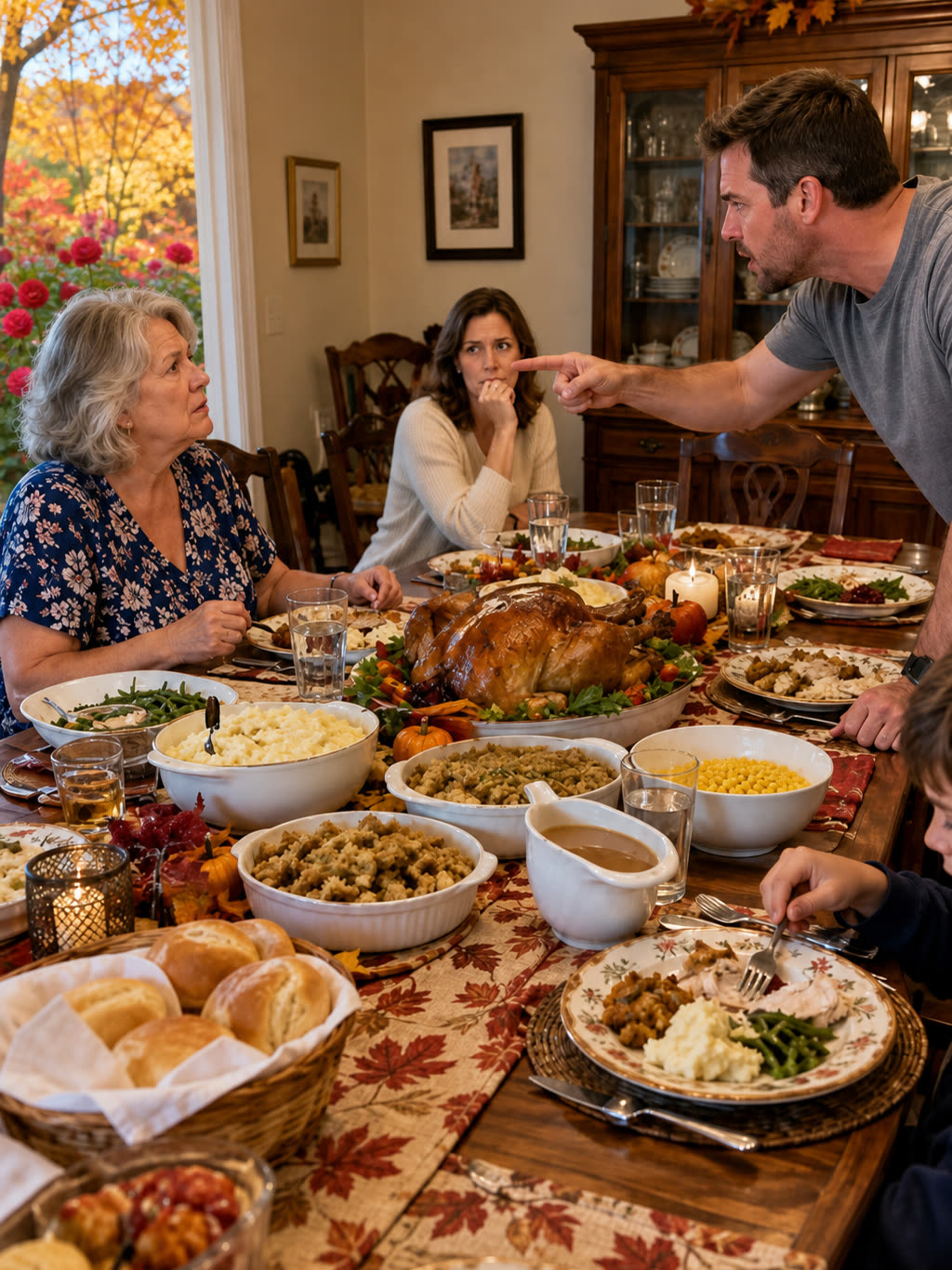
At Sunday dinner, my thirty-six-year-old son called me a freeloader.
He said it with a mouthful of the pot roast I had cooked, in the dining room of a house I paid for, sitting in the chair my late husband once occupied. He barely glanced up from his plate. He simply tossed the word out, the way someone might remark that rain was on the way.
“Honestly, Mom, you’re basically a freeloader around here.”
For a few seconds I was sure I had misheard. I actually waited for him to laugh or explain the joke. He didn’t.
Marissa, his wife, made a small noise into her water glass. It wasn’t quite a laugh. It was the sound of someone who agrees with something but doesn’t want to be caught agreeing.
My grandson, Oliver, was nine years old. He was pushing a carrot around his plate with his fork, the way he did whenever the adults got loud. He wasn’t eating it. He was only nudging it in a slow circle.
I looked at Daniel the way you look at a stranger who has sat down at your table uninvited. For two years he had lived in my home, and so had Marissa and Oliver. In all that time, not one of them had paid a single dollar in rent.
I paid the mortgage, $1,380 every month. I paid the electric, the water, the gas, and the internet. I paid the homeowner’s insurance and the insurance on my SUV, which Daniel drove to work each day while I stayed home. I bought most of the groceries. I watched Oliver after school, on weekends, and on the nights Marissa had her friends over. And when Daniel told me he was trying to rebuild his credit and needed “a little breathing room,” I let him use one of my credit cards for gas and “small things.”
So when my son called me a freeloader, something inside me went very quiet. I laid my fork beside my plate, neat and straight, the way my mother taught me to do when a meal was over.
“You have twenty-four hours to leave my house,” I said.
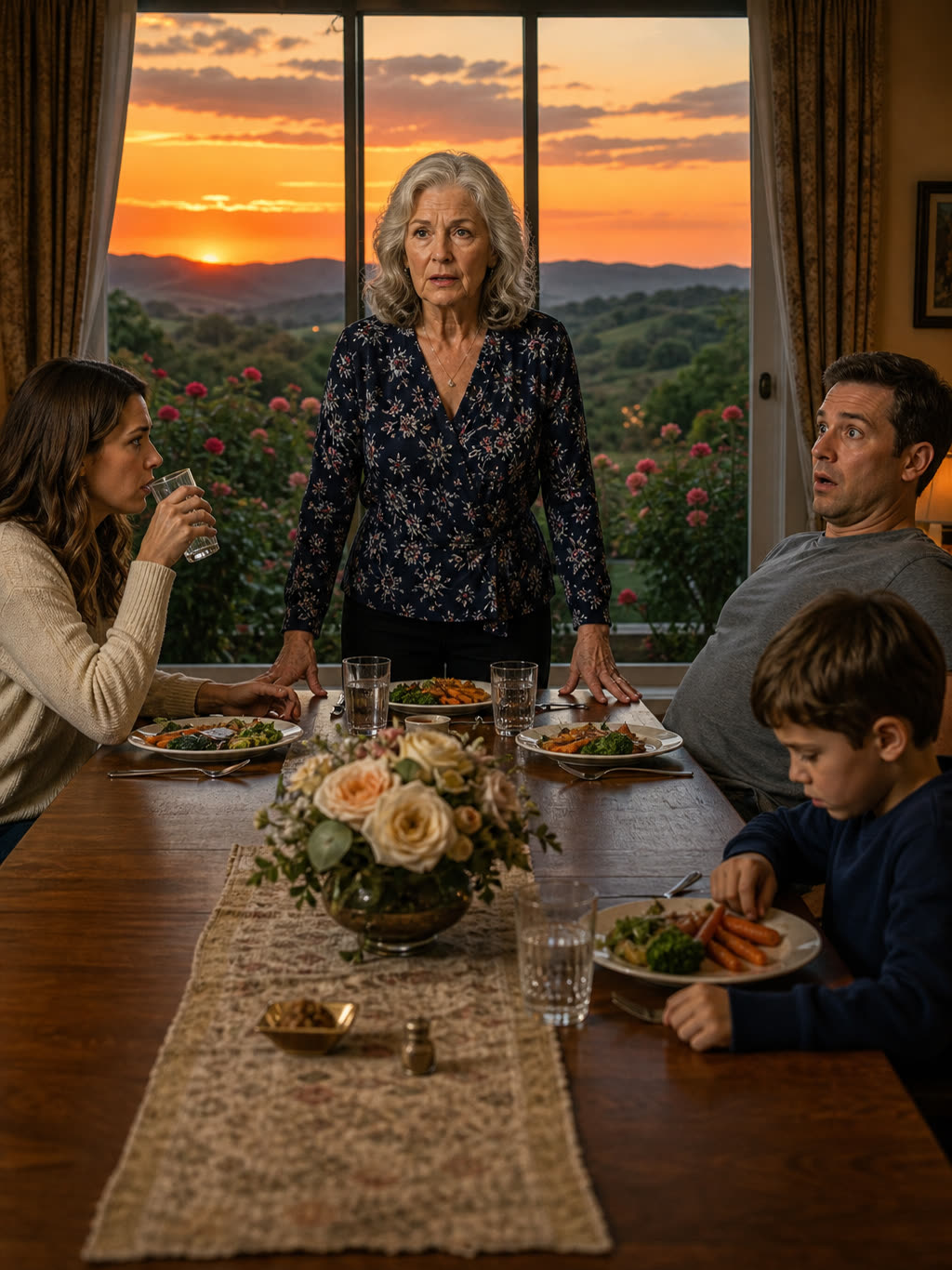
My voice surprised me. It was calm, almost gentle, like the one I used to use on the phone when I was a bookkeeper and had to tell a customer their account was past due.
The table went still. Marissa’s glass stopped halfway to her mouth, and the little smirk she usually wore around me slid right off her face. Oliver stopped moving the carrot.
That was the part that hurt. Not Daniel’s word, not Marissa’s sound, but my grandson staring at his plate with his shoulders up near his ears, trying to make himself small. Yet that was also the moment I understood something. If I backed down again, Oliver would keep watching this. He would grow up believing this was how you treated the person who loved you.
Daniel leaned back in his chair and let out a short, uneasy laugh.
“Mom. Come on. Don’t be dramatic.” He waved his hand. “I just meant you could help more with Oliver instead of spending all day out in the garden. Marissa and I are the ones who actually work.”
I stood and picked up my plate.
“Twenty-four hours,” I said again.
Marissa found her voice. “Wait. Are you serious right now?”
“Yes.”
Daniel shook his head slowly, smiling a little, like he was watching a child throw a tantrum he had seen a hundred times. “You’ll calm down by morning.”
I carried my plate into the kitchen, rinsed it, and set it in the rack. Then I turned and looked at them through the doorway.
“By tomorrow evening,” I said, “I expect your things to be out of my house.”
And then they laughed, both of them. Not loudly, but together, the way two people laugh when they share a secret about the person in the room.
I knew exactly what they were thinking. They thought I would lie awake all night drowning in guilt. They thought I would come down to breakfast with red eyes and say I was sorry, that I hadn’t meant it, and could we please forget the whole thing. They had good reason to believe it. I had done exactly that before, many times.
What they didn’t know was that I had already done my crying. I had done it slowly, over two years, in the shower and in the garden and in my car in the grocery store parking lot. There were no tears left. There was only the work of fixing things.
Two years earlier, my phone had rung at eleven-fifteen on a Tuesday night. I was already in bed. When you are a widow and the phone rings that late, your heart does something terrible. You think of hospitals. You think of highways.
“Mom?” Daniel’s voice was thick. “Mom, I’m sorry to call so late.”
“What happened? Is Oliver all right?”
“Everybody’s fine. Everybody’s okay.” He let out a long breath. “We lost the apartment.”
I sat up and switched on the lamp. Robert’s side of the bed was still made, as it had been for three years by then. I kept meaning to stop making it. I never did.
His story that night had plenty of holes. A car he couldn’t afford. A “business opportunity” with a friend that went nowhere. Late rent, then later rent, then a notice taped to the door.
“We have until Friday,” he said. “We’ve got nowhere to go, Mom. I wouldn’t ask if I had any other choice.”
I didn’t ask him a single question. Not why he hadn’t told me sooner, not how much he owed, not what the opportunity had been. I just said, “Come home.”
The funny thing is, it had never been his home. Robert and I bought the house twelve years earlier, when Daniel was already twenty-four and living in an apartment across town. It was our retirement house, a small brick colonial with a big backyard and a kitchen window that looked out on Robert’s roses. Robert used to stand there every morning with his coffee. “Look at that, Clara,” he’d say, even when there was nothing to see but grass. He died of a heart attack in the driveway, carrying groceries. I still don’t park in that spot.
They arrived that Friday with a rented trailer and a car stuffed with black garbage bags. Oliver came racing up the walk and threw his arms around my waist.
“Grandma! Dad says we get to live with you!”
“Just for a little while, buddy,” Daniel said quickly. He looked at me over Oliver’s head. “Few months. Tops. Just till we’re back on our feet.”
Marissa hugged me in the doorway, holding on longer than she ever had. “Thank you, Clara. Really. You’re saving us.” I believed her. I think that in that moment she believed herself too.
The first weeks were almost sweet. Marissa washed dishes without being asked. Daniel mowed the lawn and fixed the dripping faucet upstairs. They bought their own groceries and labeled them with little sticky notes, which made me laugh. Oliver, seven then, followed me around the garden wanting the name of every plant.
“What’s this one?”
“Those are Grandpa’s roses. That one’s called Peace.”
“Roses can have names?”
“Everything that’s loved has a name, sweetheart.”
He thought about that for a long time. Then he named a worm Kevin.
I can’t tell you the day things changed. Nobody walks into your home one morning and announces they’ve stopped respecting you. It happens a dish at a time. Daniel stopped carrying his plate to the sink, then his mug. I began finding cereal bowls crusted with milk on the arm of the couch, three and four at once. The sticky notes vanished, and so did their groceries. Soon everything in the refrigerator was mine, and they ate it like guests at a hotel buffet.
Then Marissa began making requests.
“Clara, would you mind picking up the organic chicken next time? The regular kind has hormones.”
“Clara, we really only drink oat milk now.”
“Clara, could you not buy the store brand pasta? It turns to mush.”
The grocery bill climbed from about $90 a week to about $240. I said nothing. I told myself it was for Oliver. Growing boys need good food.
One Thursday night that first winter, I came downstairs to make tea and found the living room full of women I didn’t know, drinking the wine I had bought for Christmas, a candle burning on Robert’s side table.
“Oh!” Marissa said, looking at me in my bathrobe as if I had wandered into the wrong house. “Sorry, Clara, it’s book club. We’ll keep it down.”
Nobody was reading a book. I made my tea and took it upstairs and drank it on the edge of my own bed, like a teenager hiding from her parents’ guests. That was the night I first felt it: that I was a visitor, renting a room in a house that belonged to them.
The kitchen was the worst of it. I have always loved cooking, Sundays most of all. Robert used to call my pot roast “the reason I married you,” which wasn’t true, but I liked hearing it. After a year, whenever I came in to start dinner, Marissa would sigh. Not loudly. Just enough.
“Are you going to be long in here? I was going to do my meal prep.”
Daniel would stand at the counter scrolling on his phone, and when I needed the drawer behind him he would shift one inch, only one, so I had to reach around him. I started cooking earlier, before they got home. I started eating at the counter instead of the table. I started keeping my good knife in my bedroom closet because Marissa kept using it to open boxes.
Yet when Oliver needed someone, I was always the first name called.
“Mom, can you get Oliver from school? I’ve got a thing.”
“Clara, can you keep him tonight? We have dinner reservations.”
I said yes every time. Oliver was the one thing in that house that still felt like mine. And that, I learned later, was exactly what they were counting on.
That Sunday night, after the laughing, I didn’t go to bed. I went into the small room off the hallway that Robert called his study. His oak desk was still there, his reading glasses in the top drawer, and a coffee mug with a faded bass on it. I sat in his chair, switched on the green banker’s lamp, and opened my laptop.
For thirty-one years I was a bookkeeper at a plumbing supply company. I kept other people’s money in order. I once caught a dishonest delivery driver because a stack of invoices was off by eleven dollars. But I had never once sat down and done my own books for those two years. I think I was afraid to.
I pulled up my bank statements, then my credit card statements, and opened a blank spreadsheet. The mortgage I didn’t count, since I would have paid it anyway. But the extra groceries. The higher electric bill once there were four of us and a gaming console running until two in the morning. The extra streaming services. The car insurance increase when I added Daniel as a driver. Oliver’s field trips, his soccer cleats, his winter coat.
And the credit card. When I gave it to Daniel, I told him it was for gas and emergencies. I had paid the balance each month without looking very hard, because looking hard felt like an accusation. That night I looked hard.
A steakhouse downtown, $186. A sports bar, $94. Another steakhouse, $212. A golf course. A store that sold watches. Four hundred and nineteen dollars, for a watch.
I took off my reading glasses and rubbed my burning eyes for a long time. Then I put them back on and kept going. At ten minutes to one, I typed the last number and hit the sum button. The total read $38,940. Over twenty-four months, not counting the mortgage.
Robert’s life insurance had paid out $150,000, and I had used a good portion of it on the house. What remained, plus my Social Security and my small pension, was supposed to carry me for the rest of my life. I wasn’t broke. But I had been spending my future to pay for their present, and my son had just called me a freeloader for it.
At one-fifteen, I called the number on the back of the card. A tired young man answered. His name was Marcus.
“I’d like to cancel a card,” I said. “Card ending in 4471. The authorized user is Daniel Bennett.”
“Is the card lost or stolen, ma’am?”
I thought about that. “No. It’s just not his anymore.”
“Understood. Any pending charges will still post. Would you like a replacement issued to you?”
“No, thank you.”
“Done. That card is now closed. Is there anything else?”
I almost laughed. “That’s plenty for tonight, Marcus. Thank you.”
Then I removed Daniel as a driver on my car insurance. A little box asked if I was sure. I clicked yes. The new premium was $94 lower. I canceled the streaming services I never watched and the music subscription I hadn’t known I was paying for. I changed the password on the main account and logged out every device but mine. I didn’t slam anything or yell up the stairs. I just closed doors one at a time, the way you go through a house before a long trip.
Close to two, I heard the stairs creak. Oliver stood in the doorway in his dinosaur pajamas, which were getting too short, his hair sticking up on one side.
“Grandma? Are we leaving?”
I closed the laptop slowly. There are moments when you want to lie to a child so badly it aches.
“Your mom and dad and I are going to figure out some grown-up things,” I said instead. “Some of it might be hard for a little while. But none of it is your fault. Do you understand me? Not one piece of it.”
He nodded. Then, very quietly: “Dad shouldn’t have called you that.”
My throat closed. I put my hand on his small, warm back. “Thank you, Oliver.”
“Is it a bad word?”
“It’s not a bad word. It just wasn’t a true one.”
I walked him back to bed and tucked him in. On my way down, I passed the brass hook by the front door where the keys to my SUV always hung. I looked at them for a moment. Then I took them off the hook and put them in my robe pocket.
The next morning I was at the kitchen table at seven with coffee and my tablet when they came downstairs laughing, as if the dinner had been a bad dream they’d both agreed not to mention. Marissa went straight to the refrigerator.
“Are you going to the store today? We’re out of oat milk. And I want salmon for dinner tonight. The wild kind, not the farmed kind.”
“No,” I said, and took a sip of coffee.
She turned. “No?”
“You heard me.”
“Well, I don’t have time to go shopping. I’ve got a full day.”
“Then you can order something,” I said.
Daniel finally looked up from his phone. “Mom. Seriously. What is going on with you?”
I set the tablet face down and carried my mug to the sink. “You have twenty hours left. I think packing would be a much better use of your morning than worrying about salmon.”
Marissa gave a short, disbelieving laugh and glanced at Daniel. He didn’t laugh this time. He just watched me.
He grabbed his briefcase, checked the watch I now knew had cost me $419, and headed for the front door. I followed a few steps behind. I wanted to see it.
He reached up without looking, as he had every weekday morning for two years. His fingers closed on nothing. He stared at the empty hook, then the little table beneath it, then the floor, then the hook again, as if the keys might reappear if he looked hard enough. Then he turned.
“Where are the car keys?”
“In my pocket.”
“Mom, I’m already late.”
“Then you’d better hurry. The 14 bus stops at the corner at 7:40.”
His face went red from his neck to his forehead, the color I had seen when he was six and didn’t get the toy he wanted.
“That’s my car.”
“No, Daniel. That car belongs to me. My name is on the title. My name is on the payment book. And as of last night, my name is the only one on the insurance.”
He stepped toward me. He is a big man, six foot one like his father, and for a second something cold went through my stomach. But he only said, “I’m your son.” He said it the way you’d say, I have a ticket. As if it were a pass through any door.
“Yes, you are,” I said. “And you’re also a grown man who has been living off my money, my house, and my patience for two years.”
Marissa came into the hall and crossed her arms. “This is ridiculous, Clara. Just give him the keys. You’re embarrassing yourself.”
I looked at her for a long moment. Then I walked past them both toward the study.
“Eighteen hours,” I said.
Something changed in Daniel’s face. The anger didn’t leave, but something beneath it shifted like a floorboard moving under a rug. He was beginning to understand that I wasn’t asking.
I closed the study door. A few seconds later the front door slammed so hard that Robert’s bass mug jumped on the desk. From the window I watched my son walk down the driveway, briefcase in one hand, phone in the other, his mouth moving. Talking to himself, or to Marissa, or to God. At the corner he stood among the others waiting for the bus: a man in a work vest, a teenager with headphones, an older woman with a cart. Daniel looked like a man waiting at the wrong airport.
Behind me, Marissa was banging cabinet doors in the kitchen. Opened and slammed. Opened and slammed. I sat in Robert’s chair and listened. For two years I had let their moods run my house like weather. When Daniel came home sour, I made myself scarce. When Marissa was irritated, I changed my plans. I told myself I was keeping the peace.
Sitting there that morning, I finally saw the difference. I hadn’t been keeping the peace. I had been giving up my right to have any.
Around noon, Marissa came back from spin class, and she was not alone. Two women’s voices filled my hallway, laughing about something an instructor had said. Nobody asked if I minded company. Nobody ever did anymore. For two years, her friends had spread across my couch, put their feet on my coffee table, and eaten my food while I retreated upstairs and closed my door. That day I stayed where I was, in the study, with the door wide open.
It took about four minutes. “Clara!” It was her impatient voice, the one she used when the dishwasher wasn’t emptied or Oliver had tracked mud in on my watch. I walked down the hall. Marissa stood before the pantry with both doors flung open, her friends by the couch in their leggings, holding water bottles.
The shelves were bare. Not a box of crackers, not a can of soup, not the fancy olives or the little jars of fig jam. That morning, after Daniel left for the bus, I had carried every bag and box I’d paid for down to Robert’s old storage room in the basement and locked it. It took five trips, and my knees complained the whole way.
“Where is everything?” Marissa demanded.
“The groceries I paid for are somewhere else,” I said.
“What does that even mean?”
“It means they’re mine. Because I bought them.”
One friend, a woman with a high blond ponytail, glanced at the other, who became very interested in the label on her water bottle.
“I was going to make a snack board,” Marissa said, her voice climbing. “There’s no cheese. There’s no fruit. There’s nothing.”
“You and Daniel both have jobs,” I said. “If you want to feed your guests, you can buy food for your guests.”
Her face went flat and hard, like a door closing. “Are you seriously telling me you hid the food from us?”
“I’m telling you I put away the food I paid for, so it wouldn’t be eaten by people who think it’s all right to insult me while they chew it.”
The silence was so thick I could hear the kitchen clock. Tick. Tick. Tick. The blond friend reached for her purse. “Oh my gosh, I totally forgot,” she said, too brightly. “I have a dentist appointment at one. I should go.” The other woman didn’t even pretend to have a reason. They were out the door in under a minute.
Marissa turned on me, cheeks pink. “You embarrassed me in front of my friends.”
“No, Marissa. You embarrassed yourself.”
“You are the most selfish woman I’ve ever met.”
“No. I’m just finished being used.”
“You’re going to regret this when Daniel gets home.”
“You have fifteen hours,” I said. “If I were you, I’d spend some of them finding boxes.”
She stomped upstairs, every step a statement. At two o’clock my phone rang. It was Daniel. I let it ring twice before I answered.
“What the hell did you do to my card?” he shouted. Behind him I could hear clinking silverware and a woman laughing at another table.
“I canceled it.”
“You can’t just cancel it! I’m at lunch with clients! The bill’s almost two hundred dollars and the card got declined in front of everybody!”
“It’s my card, Daniel.”
“You made me look like an idiot!”
“I’m not responsible for protecting you from your own arrangements. Those are yours.”
His voice dropped to a hiss. “I don’t have enough to cover it, Mom.”
I closed my eyes. How many times had I heard that sentence? When he was nineteen and wrecked his first car. When he was twenty-six and his rent check bounced. When he was thirty and needed a “bridge loan” that never came back. Each time I had quietly filled the hole, believing that someday he would learn to fill it himself. But how could he learn to swim if I kept pulling him out of the pool before he went under?
“Then you’ll have to figure that out,” I said.
“Mom…”
I hung up. My hand was shaking. I gripped the edge of the sink and looked out at Robert’s roses. Most had finished for the year, but Peace still had one bloom left, pale yellow edged with pink, hanging on. “I know,” I said out loud to nobody. “I know.”
That afternoon I went to the garage, where I had been saving flattened cardboard boxes for months because Robert always said you never know when you’ll need a good box. I counted out twenty, taped the bottoms, and lined them up in the hallway outside Daniel and Marissa’s bedroom. I didn’t touch one thing that belonged to them. I just gave them what they’d need.
At six the front door opened. I heard them on the stairs, and then their footsteps stopped. I knew what they were looking at: twenty empty boxes standing in a row like soldiers. Nobody laughed this time.
I was at the dining table with a mystery novel, reading the same page for the fourth time, when Daniel came around and pressed both hands flat on the wood across from me.
“Enough,” he said. “Okay? Enough. You canceled my card. You took the car. You hid the food. You humiliated Marissa in front of her friends. Fine. Message received. You’ve made your point. Now get those stupid boxes out of the hallway.”
I closed my book. “This is my house too,” he said, his voice cracking on the word house. “I’m your son, for God’s sake. I grew up here. You can’t act like I don’t belong.”
I didn’t argue. Beside my book lay a blue folder I had taken from Robert’s filing cabinet. I slid out one sheet and pushed it across until it stopped in front of his hands. “Read that.”
It was the deed to the house, a recorded copy with the county stamp in the corner. After Robert died, I had gone with Harold Pierce to the county recorder’s office to put the house fully in my name. I remembered the clerk’s pen squeaking, and thinking it felt like signing my name on a gravestone. I laid my finger beside the line that mattered. Grantee: Clara Ann Bennett, a widow, as sole owner.
Daniel swallowed. I watched his throat move.
“You didn’t grow up in this house, Daniel,” I said quietly. “Your father and I bought it twelve years ago. You were twenty-four. You had your own apartment on Willow Street with that roommate who kept the iguana. You grew up in the yellow house on Carver Avenue. We sold it to pay for this one. You helped carry the couch in, remember? You complained about your back for a week.”
“But I’m your family,” he said, quieter now.
“Being family doesn’t give you the right to my house. Or my bank account. Or my car. Or my patience. I gave you all of those things, Daniel. I gave them freely. You don’t get to call them yours just because I never asked for them back.”
His shoulders sagged. “You can’t really put us out on the street.” He looked at me with his father’s eyes. That was the cruelest part. He had Robert’s eyes, and he used them on me like a key.
“I gave you twenty-four hours,” I said.
That was when Marissa smiled. It began slowly, one corner of her mouth and then the other, her eyes bright and still. It wasn’t a happy smile. It was the smile of someone reaching into her purse and closing her fingers around the thing she had carried all along, just in case. She straightened and put a hand on Daniel’s shoulder.
“You’re forgetting someone, Clara,” she said softly.
She didn’t have to say his name. The knowing went through my chest like cold water. Oliver. The boy who named a worm Kevin. The boy who came downstairs at two in the morning to tell me his father shouldn’t have said what he said. They were going to use him.
Part Two: What Marissa Said
“If we go,” Marissa said, “Oliver goes with us. Obviously.”
“Obviously,” I said. My voice sounded far away.
“And I don’t think it would be healthy for him to keep seeing a grandmother who threw his family out of the house.” She tilted her head. “Do you? Kids need stability, Clara. They need to be protected from toxic people.”
Daniel looked up at her. For a second, just a second, I thought I saw on his face that he wanted her to stop. But he said nothing.
“So here’s what’s going to happen,” Marissa went on, her voice smooth now, almost kind. “You’re going to take the boxes away. You’re going to give Daniel his keys back. And we’re going to forget all this. Because if we walk out that door, you will not see Oliver again. Not on his birthday. Not at Christmas. Not ever.”
She let that sit.
“And I’ll make sure everyone knows why,” she added. “Your friends at church. That neighbor of yours. Everyone. Grandma Clara put a nine-year-old on the street.”
I once saw a deer struck by a car on the highway. It didn’t fall right away. It stood in the road with its legs locked, as if it hadn’t yet decided whether to be hurt. That is how I felt, sitting very still and waiting to learn how badly. And here is what I want you to understand: for one long moment, I almost gave in. I could see it all, me putting the keys back on the hook, me hauling groceries up from the basement while Marissa watched from the doorway with that smile, me spending the rest of my life on my knees in my own house so a little boy could keep hugging me on Christmas morning. I want to be honest about that.
Then I heard the stair creak, and all three of us turned. Oliver sat on the fourth step from the bottom in his socks, knees pulled up to his chest, arms wrapped around them. I don’t know how long he had been there. His face was white.
“Ollie,” Daniel said. “Bud. Go upstairs.”
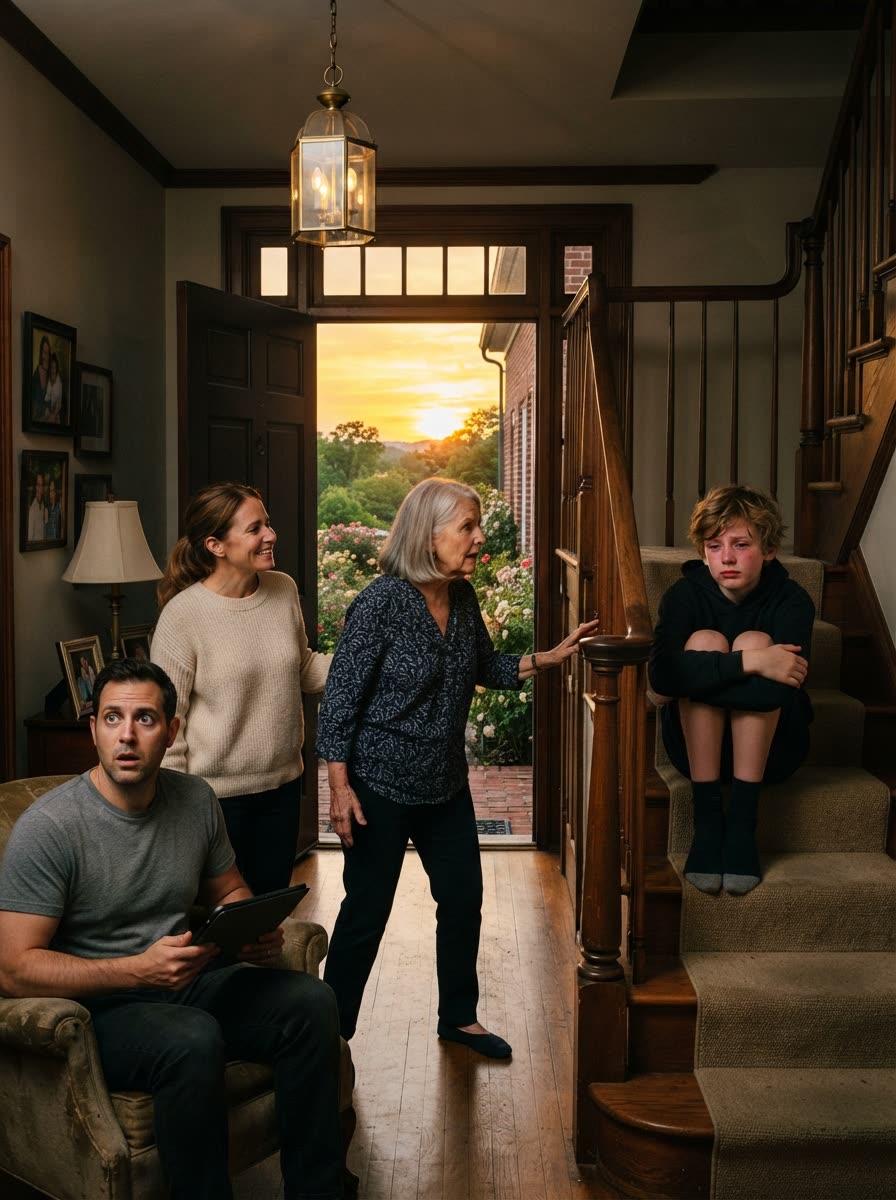
Oliver didn’t move. He was looking at his mother. “Are you going to make me stop seeing Grandma?”
Marissa’s smile flickered. “Honey, this is a grown-up conversation.”
“You said it to her,” Oliver said. “I heard you.”
Nobody answered him. I rose from the table, my knees shaking, and crouched in front of him, which my knees did not appreciate at all.
“Oliver. Look at me.” His eyes were full. “Your mom and dad love you very much. Whatever happens with the house, that’s grown-up business. It has nothing to do with how much you’re loved. Not by them, and not by me.”
“But she said…”
“I know what she said. Grown-ups say things when they’re scared and angry. Sometimes they say things they don’t mean.” I took his hand. It was cold. “I will never stop loving you. No matter where you live. No matter how long it’s been. You hear me? Never.”
He nodded, and a tear dropped off his chin onto his knee. “Now go up and brush your teeth. Your dad will come tuck you in.” He went slowly, one step at a time, looking back twice.
When his door closed, I stood and turned. Daniel had sat down and was holding his head in his hands. Marissa still stood behind his chair, but her smile was gone.
“I am not going to fight you over that boy,” I said. Marissa’s chin came up, ready for a win. “I’m not going to fight you, because he is not a rope. He’s a child. I won’t pull on him, and I won’t let you pull on him in front of me either.”
“Then you’ll give Daniel his keys back,” she said.
“No.”
She stared at me.
“If you want to keep my grandson from me to punish me, I can’t stop you. That will be your choice and you will have to explain it to him one day. He’s going to grow up, Marissa. He’s going to be a man. And he’s going to remember tonight. He’s going to remember who said what on these stairs.”
I slid the deed back into the blue folder. “But I will not buy him from you. I won’t pay for him with my house, or my car, or my dignity. A child is not something you rent to his grandmother.”
Daniel lifted his head, his eyes wet. “Mom. Please.”
I didn’t know what he was asking for. I’m not sure he did either.
“The offer to keep Oliver here during the move still stands,” I said. “If you need someone to watch him while you pack or look at apartments, I’ll do it. Gladly. That’s the only thing that hasn’t changed.”
Then I went upstairs and closed my bedroom door. I sat on my side of the bed, next to Robert’s side that I still made every morning, put my face in my hands, and for the first time in two days I cried. Not much. But enough. Then I took the sticky note from my robe pocket and dialed Harold Pierce’s home number. He answered on the fifth ring.
“Clara Bennett,” he said in his deep, slow voice. “It’s nine-thirty at night. Somebody better be dead or getting married.”
“Neither. Harold, I need help getting my son out of my house.”
A long silence on the line. “Well,” he said finally. “It’s about damn time.”
The next morning was Tuesday, and the twenty-four hours would run out at six that evening. Nobody packed. The boxes sat empty in the hallway. Daniel came down at seven-thirty, already dressed, and poured himself coffee from my coffee maker, leaning against the counter.
“I talked to a guy at work last night. His brother’s a lawyer. You can’t just kick us out in twenty-four hours, Mom. It’s illegal. We’ve lived here two years. We get mail here. We’re tenants. You’d have to file an eviction and go to court. That takes months.” He said it carefully, like a man laying down a winning card.
I nodded. “Your friend’s brother is right.”
He looked surprised. He had expected a fight.
“I spoke to Harold Pierce last night. He’s coming by this afternoon with a written thirty-day notice. That’s what the law here requires for someone who doesn’t pay rent and doesn’t have a lease. If you’re still here after thirty days, he’ll file in county court, and a judge will decide.”
His cup stopped halfway to his mouth. “So the twenty-four hours were never real.”
“The twenty-four hours were real. They were me asking. The thirty days are the law telling. I gave you the chance to leave like a man, on your own two feet, because your mother asked you to. You can still take it.”
He set the cup down without drinking. “Thirty days,” he said, and relief slid across his face. He thought he had bought time. He thought that in thirty days I would soften. He had been right about me for thirty-six years. I couldn’t blame him for thinking he still was.
Harold arrived at two in a brown suit probably older than Daniel. He drank a cup of my tea and went over the notice line by line. “This isn’t about being cruel, Clara,” he said, tapping the paper with one thick finger. “This is a document. Documents don’t have feelings. That’s what makes them useful.” He had me sign a letter to the bank removing Daniel from any of my accounts, and explained the timing and what a judge would ask.
“And Clara,” he said, putting on his coat, “write everything down. Dates. What was said. Who was there. If that daughter-in-law tries to make you into a villain in front of a judge, I want a record.”
“I’ve been keeping records my whole life, Harold.”
He smiled. “I know. Robert used to brag about it.”
After he left, I went into the study to print copies of the notice. The printer there was the only one in the house, and Daniel and Marissa used it constantly, mostly for Oliver’s homework and, I assumed, their jobs. When I lifted the stack of old pages from the tray, the top sheet was a letter on heavy letterhead from a mortgage lender, Lakeside Home Lending.
The first line said: Congratulations, Daniel and Marissa Bennett! You are pre-approved.
I don’t remember sitting down. I only remember being in Robert’s chair with the paper in both hands. It was dated six weeks earlier, pre-approved for a home loan of up to $310,000. Under a heading that said Verified Assets was a line I read five times: Joint savings account, Harborview Credit Union: $44,200. Beneath it were their incomes. Daniel: $78,000 a year. Marissa: $54,000.
Forty-four thousand two hundred dollars. Beside the printer, my spreadsheet was still open on my laptop, and at the bottom of the column in bold: $38,940. I looked from one number to the other.
They weren’t broke. They hadn’t been broke for a long time. Every month that I paid for their oat milk and their streaming and Daniel’s steakhouse lunches, they had been putting their own money away. Quietly, into an account I didn’t know existed. They were going to buy a house with money they saved by living in mine. And on Sunday, my son had looked me in the face and called me a freeloader.
I didn’t storm upstairs. I didn’t call anyone. I sat in the study for about an hour and thought about Daniel at six, at ten, at sixteen. The bike I bought him that he left in the rain until it rusted. The college he dropped out of, the tuition Robert and I paid anyway, and Robert saying, “He’ll find his feet, Clara. Boys take longer.” I thought maybe I had taken his feet away. Maybe every time I caught him, I had made his legs a little weaker.
Then I made three copies of the letter. One went into the blue folder with the deed, one into an envelope for Harold, and the original back on the tray exactly where I had found it.
That night I made pot roast. I don’t know why. Maybe because it was what I had made on Sunday, or because I wanted to finish what got interrupted. I set the table for four. Oliver came down first and helped with the napkins, watching my face and trying to read it.
“Are you still mad?”
“No, sweetheart. I’m not mad.”
“Are you sad?”
I thought about it. “A little. Mostly I’m tired.”
He nodded as if that made sense and put the forks on the wrong side. I didn’t fix them.
Daniel and Marissa came down at six-thirty, each holding a copy of the thirty-day notice, which I had handed them when they came home without a word from either. They sat and looked at the pot roast as if it might be a trick. We ate in silence while Oliver talked about a kid at school who could burp the alphabet. Nobody laughed.
When Daniel put down his fork, I slid the blue folder across the table to him for the second time in two days.
“What’s this? More legal stuff?”
“Open it.”
The lender’s letter lay on top. I watched the color leave his face the way water leaves a sink, all at once and then completely. Marissa took the paper from his hands, read it, and laid it face down, quickly, as if it were hot.
“You went through our things.”
“It was in the printer tray. In my study. On my printer. With my paper and my ink. I was printing your eviction notice.”
“That’s private!”
“So was my bank account,” I said. “Until you started spending it.”
Oliver looked from one of us to another. “What’s pre-approved?”
“Nothing, honey,” Marissa said.
“It means,” I said carefully, looking at Daniel and not Oliver, “that your mom and dad have saved up a lot of money. Enough to buy a house of their own. Which is a good thing. It’s a very good thing.”
“We’re getting a house?” Oliver’s face lit up. “Can I have a room with a slanted ceiling?”
Daniel closed his eyes.
“How long?” I asked him. He didn’t answer. “How long have you been saving, Daniel?”
Part Three: The Price of Staying
“Since about… since about the first spring,” he said. His voice was barely there.
“Twenty months.”
“We were going to tell you. When we found a place. We wanted it to be a surprise.”
“A surprise.” I nodded slowly. “Like Sunday was a surprise.”
Marissa leaned forward, her face pink again, though not from triumph. “You don’t get it, Clara. Do you know what houses cost now? Do you know what rent costs? We were drowning. We needed a head start. You had this whole big house and all that money from Robert and nobody to spend it on. Why shouldn’t we get a little help? That’s what family does!”
“I did help,” I said. “I helped you with thirty-eight thousand, nine hundred and forty dollars.”
Marissa stopped.
“I added it up Sunday night. Not the mortgage. Just the extras. Groceries. Utilities. Insurance. Oliver’s things, which I’d buy again in a heartbeat. And the credit card. A steakhouse, two hundred and twelve dollars. A golf course. A wristwatch for four hundred and nineteen.” Daniel’s hand moved to his wrist, as if he could hide it.
“If you’d sat me down and said, Mom, we want to save for a house, can we stay a while and build up some money, I would have said yes. Do you hear me? I would have said yes. I’d have been proud of you. I’d have cried at the closing.”
My voice cracked. I let it.
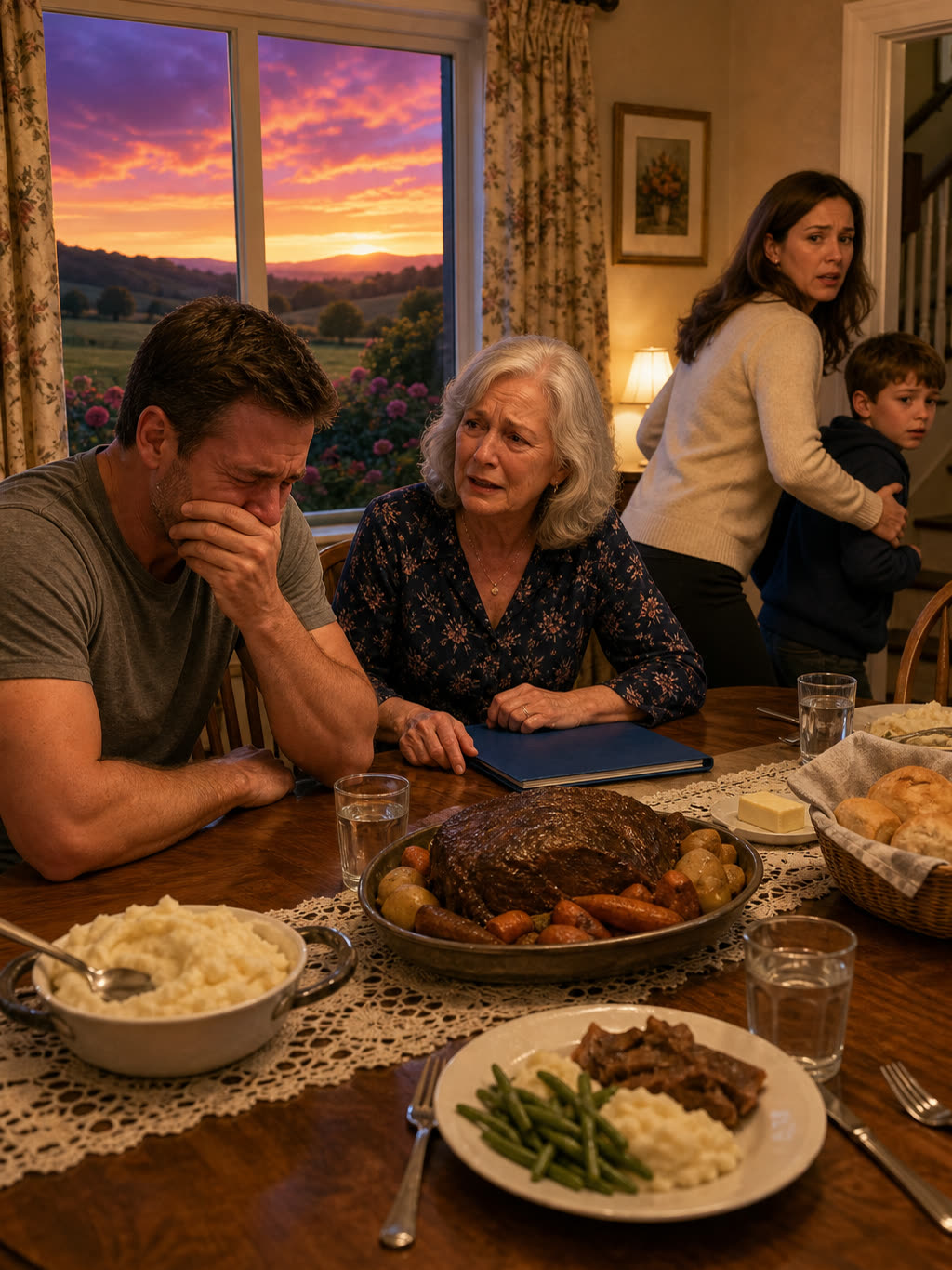
“But you didn’t ask. You just took. And then you sat in your father’s chair and told me I was the one taking.”
Daniel’s shoulders began to shake and he put his hand over his mouth. Oliver looked frightened. “Dad?” Daniel couldn’t answer. Marissa stood so fast her chair scraped. “Come on, Oliver. We’re going upstairs.”
“But I’m not done.”
“Now.”
He went, looking back at me from the doorway. I smiled at him. It was the hardest smile I ever made.
Alone at the table with the cold pot roast and the ticking clock, Daniel finally spoke. “I didn’t mean it. Sunday. I don’t know why I said it. Marissa and I had been arguing all afternoon about money, about the house, and you came in from the garden and you were humming, and you looked so…”
“So what?”
“Happy. You looked happy. And I was so stressed I couldn’t breathe. And it made me mad. That you got to be happy in your garden and I had to… I don’t know. Be the grown-up.”
I looked at my son for a long time. “Daniel. I’m sixty-eight years old. I buried your father. I worked thirty-one years. I raised you. I am allowed to hum in my garden.”
He nodded, crying openly. “Thirty days,” I said. “Or less. You’ve got a pre-approval and forty-four thousand dollars. You’ll be fine. You’ll be better than fine.”
“Are you going to make us pay it back?”
“I’m not going to sue you, if that’s what you’re asking. But I think you know what’s right. I think you’ve always known. You’ve just never had to do it.”
I rose and began clearing plates. He sat a while. Then he stood, picked up his own plate and Oliver’s, carried them to the sink, rinsed them, and set them in the rack. It was the first time in nineteen months.
They were gone in eleven days. With forty-four thousand dollars, it turned out, you can find a place quickly. They didn’t buy a house right away, since the lender wanted a lease history and the houses Marissa liked were over budget. They rented a two-bedroom townhouse on the east side, twenty minutes away, for $1,950 a month. Daniel told me the number himself, the way you’d name a disease.
“Plus utilities. Plus renter’s insurance. Plus first, last, and a security deposit. Do you know what that is, Mom? That’s like six grand.”
“I know what it is. I paid it for you once, on Willow Street. You were twenty-two.”
He looked at his shoes. “Yeah. I remember.”
Those eleven days were strange. Marissa didn’t speak to me at all. She packed in a fury, stacking boxes in the hall with loud thumps and ordering takeout every night, so that delivery drivers rang my bell at eight and nine and ten. She never let Oliver stay with me while they packed, taking him to her sister’s or to the new place. On the third night I heard her on the phone in the guest room, her voice carrying through the wall.
“No, she’s completely lost it. She hid the food, Jess. Hid it. In the basement. Like a crazy person.”
In her version I was a bitter old woman who had snapped out of nowhere. Nothing about the credit card or the savings account or the word at the table. I didn’t knock on the wall. I wrote it down in Harold’s little notebook with the date and time, turned on the radio, and went to sleep.
Daniel was different. He packed slowly and kept stopping in doorways. Once I found him in the backyard, staring at Robert’s roses.
“Dad planted these the first spring. I never helped him. He asked me once. I said I was busy. I’m sorry, Mom. For a lot of things. Not just Sunday.”
“I know you are.”
“Are you going to forgive me?”
I looked at the Peace rose. Its last bloom had finally dropped, the petals lying in the dirt. “Ask me again in a while. I don’t want to give you an answer I can’t keep.”
On the last morning, a Saturday, Daniel rented a truck and two friends from work came to carry furniture, polite young men who called me ma’am and didn’t look me in the eye. Oliver found me in the garden on my knees, pulling up the tomato plants for the season. He crouched beside me with a small paper bag.
“I wanted to give you something. But you can’t open it till we’re gone.”
“Okay. I promise.”
He chewed his lip. “Mom says I might not see you for a while. Is that true?”
I wiped my hands and took his face gently in both of mine, leaving a little dirt on his cheek. “Oliver, I don’t know how long a while is. Sometimes it’s short. Sometimes it’s long. But I want you to know two things. The first is, I’m not going anywhere. I’m going to be right here, in this house, with this garden, every single day. And the second is, none of this is your job to fix. You don’t have to choose sides. You don’t have to carry messages. You just get to be nine. Okay?”
“Okay.”
“Can I have a hug?”
He threw his arms around my neck so hard I nearly fell into the tomato bed. He smelled of the strawberry shampoo I’d bought him. “Oliver!” Marissa called from the driveway. “Car. Now.” He ran, turned at the gate to wave, and was gone.
I sat in the garden until I heard the truck pull out, and a while longer. When I finally opened the bag, I found a smooth gray rock marked in black capital letters, careful as only a nine-year-old can manage: KEVIN II. I laughed so hard I cried, or cried so hard I laughed. I’m still not sure which. I set it on the kitchen windowsill, where Robert used to stand with his coffee.
The house was so quiet. A white ring from someone’s wine glass marked my coffee table, the guest room was bare, and the hallway walls were scuffed where the boxes had scraped. At the front door I took out the keys I had carried for eleven days and looked at the brass hook for a long moment. Then I hung them up.
For a while, Marissa kept her word. Oliver’s tenth birthday was in November. I bought him a good telescope, the kind Robert had always wanted to give him, wrapped it in blue paper, and drove it to the townhouse. Marissa opened the door about four inches.
“I just wanted to drop this off for Oliver.”
She looked at the box, then me. “We’re having a family party.”
I waited. She didn’t invite me in. Behind her I heard kids laughing and someone shout, “Ollie, it’s your turn!” “Will you give it to him?” I asked. She took the box and closed the door. I sat in my SUV for twenty minutes without turning on the engine, watching a balloon tied to their mailbox bounce in the wind. Then I drove home and ate a grilled cheese standing at the counter.
Thanksgiving was at my neighbor Beverly’s. Bev was seventy-three, twice widowed, and said she was “considering a third husband, just for the paperwork.” She asked nothing about any of it until the pie.
“So,” she said, cutting me a far-too-large slice of pumpkin. “You finally did it.”
“I finally did it.”
“How do you feel?”
I thought about it. “Like I put down a suitcase I’d been carrying so long I forgot it wasn’t my arm.”
“And the boy?” My face must have answered, because she squeezed my wrist. “They come back, Clara. The kids. They always come back. They just have to get hungry first.”
“I don’t want him hungry.”
“I don’t mean that kind. I mean the kind where you find out what something costs.”
December was hard, and I won’t pretend otherwise. I put up the tree alone and hung Oliver’s handmade ornaments in front, where he’d see them if he came. He didn’t come. On Christmas Eve, at church, a woman named Diane stopped me on the way out and spoke in the low voice people use at funerals. “I heard about your son. I heard there was… some kind of falling out?”
I knew where she’d heard it. Marissa had a cousin in the choir. “I asked my son to move out after two years of living rent-free. He did. He’s renting a nice place on the east side. He’s doing well.”
“Oh. I heard it was… different.”
“I’m sure you did,” I said, and wished her a Merry Christmas, and meant it.
At home a text waited from a number I didn’t know. Merry Christmas Grandma. I like the telescope. I saw Saturn. It has rings for real. Dad let me use his phone. Love Oliver. I read it five times, sitting on the same stair where he had sat that night, holding the phone against my chest. Dad let me use his phone. I wrote back: Merry Christmas, my darling boy. I’m so glad you saw Saturn. Tell your dad thank you for me. I love you more than all the rings in the sky. I slept better than I had in months.
The envelope came on January fifteenth, addressed in Daniel’s handwriting, unchanged since he was fourteen, big loopy letters leaning too far right. Inside was a check for two hundred dollars, with 1 of 195 on the memo line, and a folded note.
Mom, I did the math. $38,940 divided by $200 is 194.7. So 195 checks. That’s about sixteen years. I’ll be fifty-two. I know that’s a long time. I’ll try to pay more when I can. I’m not doing this because you asked. You didn’t ask. That’s kind of the point. Living here has been an education. Rent is $1,950. Electric was $211 last month because Marissa likes it warm. Groceries are crazy. I had no idea. I really had no idea what you were carrying. I sold the watch. Got $160 for it. That’s in this check too. I’m sorry I called you that. I’m sorry for all of it. Daniel
I read it twice and looked out at the garden, brown and frozen. I picked up my phone to call him, then put it down. Instead I went to the study and added a row under the bold total. January 15. Received: $200. Remaining: $38,740. The checks kept coming. In April there were two in one envelope with a note: Got a small bonus. Marissa doesn’t know I sent the whole thing. Don’t tell her. I wrote back: Daniel, I’m not going to keep secrets with you about your own marriage. If you want to send money, send it honestly or don’t send it. That’s the only way any of this is worth anything. Love, Mom. Three weeks later: You’re right. I told her. She was mad. Then she wasn’t. She said she’s been thinking about some things too.
In May he asked me to lunch at a diner halfway between us. He sat up very straight in the booth, like a man at a job interview, thinner and tired in a different way, the good kind that comes from doing things.
“I got a promotion. Regional manager. It’s a raise. Eleven grand.”
“Daniel, that’s wonderful.”
“I don’t think I’d have gotten it last year. I wasn’t really trying last year. I didn’t have to.” He turned his cup in his hands. “Marissa’s sister lost her job in February. She asked if she could move in with us for a while. Her and her boyfriend. We said yes. For three months.” A crooked smile. “We made them sign a paper. They pay three hundred a month and they buy their own groceries. Marissa wrote it up herself.”
I laughed. I couldn’t help it.
“Two weeks in, her sister’s boyfriend left a stack of dirty bowls on the arm of our couch. Like, five of them. And Marissa just stood there looking at them. Then she went in the bathroom and shut the door. When she came out she said, Your mom put up with this for two years. And she cried, Mom. She really cried.”
My eyes were stinging. “She’s not a bad person,” Daniel said. “Neither am I. I don’t think. We just got comfortable. We got so comfortable we forgot you were a person.”
“I know.”
“Can you forgive me?”
He had asked me in the garden eight months before, and I had told him to ask again later. It was later. I reached across the table and covered his hand with mine. It was bigger than his father’s, with the same knuckles.
“Yes. I can.”
He bowed his head over our hands, and we sat that way until the waitress came with our pancakes and pretended not to notice.
Marissa came to the house in June, alone, on a Tuesday afternoon, without calling. I was on my knees in the garden when I heard the gate. She stood at the edge of the patio in jeans and a plain T-shirt, hands shoved deep in her pockets.
“Hi, Clara.”
“Marissa.” I kept planting tomatoes. She walked over to the roses, where Peace was blooming again, pale yellow with pink edges.
“What I said,” she began at last. “About Oliver. About not letting you see him. That was the worst thing I’ve ever said to anybody. I said it because I knew it would work. I knew you’d do anything for him. And you didn’t fold. I stood there with my big threat and you looked at me like I was a stranger. I’ve never been so ashamed of myself in my life. I was just too proud to say so.”
I set down the trowel and looked up. “Why are you telling me now?”
“Because Oliver asks about you every day. He keeps that dumb rock picture on his wall. He drew a picture of your garden for school, for ‘favorite place.’” She wiped her eyes. “I’m not asking you to like me. I’m asking if he can come here on Saturdays. I’ll drop him off and pick him up and I won’t come in unless you ask.”
I pressed dirt around a seedling. “There are rules. You don’t send him with messages. You don’t ask him what I say. He’s not a spy and he’s not a rope. And if you’re ever angry at me again, you tell me. To my face. Not to your sister, not to the choir, not to my grandson.”
“Okay.”
I stood, knees cracking. “He can come Saturday. Tell him to wear old shoes. We have work to do.”
She turned to go, then back. “Clara? You were never a freeloader. Not one day.”
“I know. But thank you.”
Oliver came that Saturday at nine, in sneakers with a hole in the toe, and ran up the driveway so hard I stumbled. He was two or three inches taller. “Grandma! Did you keep Kevin?” “He’s on the windowsill.” I heard him yell, “He’s still here!” We spent the whole day planting tomatoes and peppers and a row of sunflowers he insisted would grow taller than the house, and I told him the name of every plant again. He remembered most of them.
“Grandma, are you still sad?”
“No. Not anymore.”
“Good,” he said, and went back to digging.
That fall, Daniel and Marissa bought a small house with three bedrooms, one with a slanted ceiling. Daniel sent me a photo of the closing papers with his thumb in the corner. I cried at the closing after all, alone at my kitchen table, looking at my phone. The checks still come, two hundred dollars on the fifteenth. My spreadsheet says $34,140 remains. I don’t need it. I would give every dollar back in a heartbeat, but I won’t, and I’ve told him so, and he’s never asked. The checks are about a man learning to carry his own weight, and a mother learning to let him.
Last week Daniel came to help me put the garden to bed. We worked three hours, and I showed him how his father pruned the roses, at an angle above an outside bud, so the new growth comes in open and doesn’t choke the middle.
“Dad asked me to help him with these once. That first spring. I’m sorry I didn’t.”
“You’re helping now.”
Later he drank coffee at the kitchen window, looking at the cut-back roses and the gray rock that said KEVIN II. “It looks like nothing out there. Just dirt.”
“That’s what it looks like. It’s not what it is.”
At the front door he pulled from his jacket a single brass key on a plain ring, the house key I gave him the night he moved in. I had changed the locks on Harold’s advice, so it opened nothing. “I don’t know why I kept it. I think I wanted to remember.” I took it. It was warm from his pocket. He hugged me with both arms, smelling of garden dirt and coffee, and drove to his own house in his own car, both paid for by himself.
I stood in the doorway until his taillights turned the corner. Then I closed the door and turned the lock. My keys hung on the brass hook, right where they belonged, and I hung the old key beside them. It didn’t open anything. That was fine. Some things you keep because they still work. And some things you keep so you’ll never forget what it cost to stop needing them.
Disclaimer: This story is a work of fiction inspired by real-life themes. Names, characters, places and events are fictionalized, and any resemblance to real persons is purely coincidental. Images are for illustration purposes only.
