

PART 1 — THE ROOM THAT WAS NEVER HERS
“Grandma, why does everybody have a bedroom here except me?”
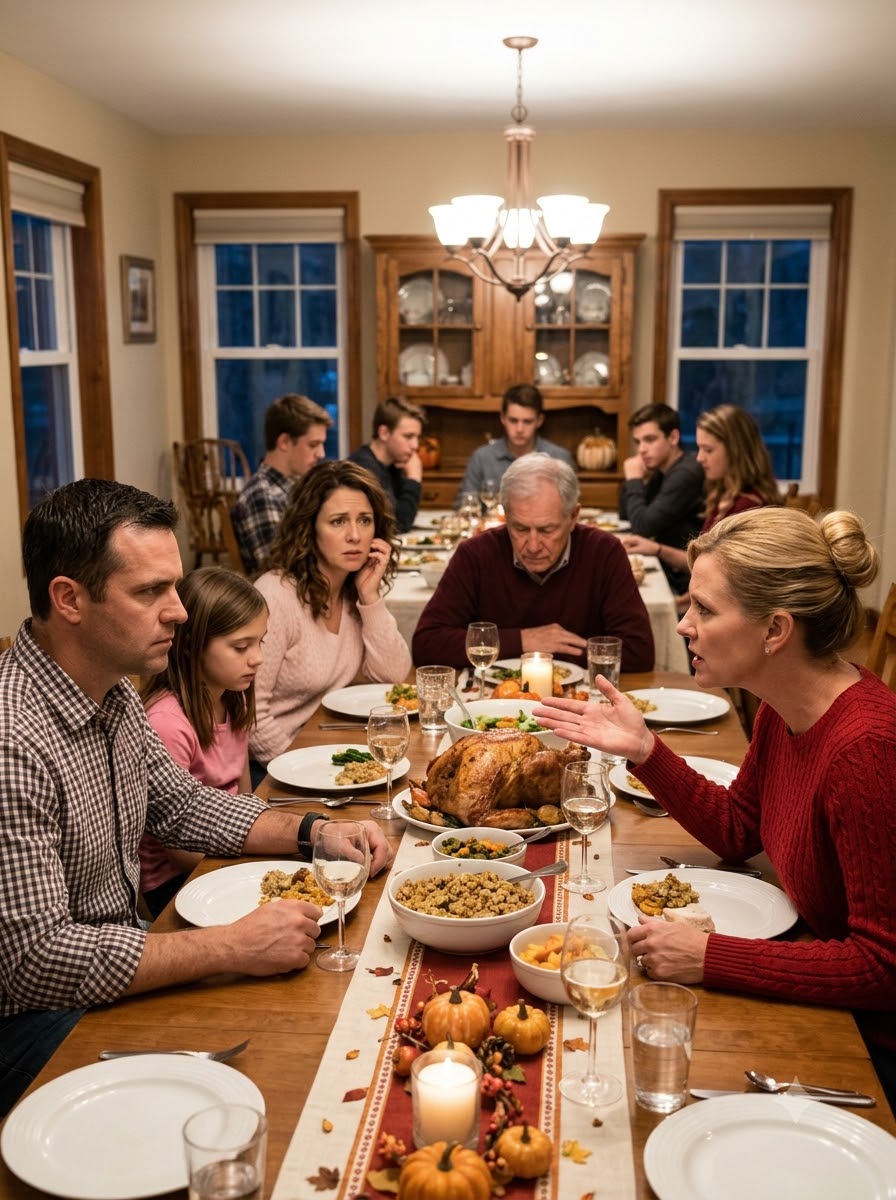
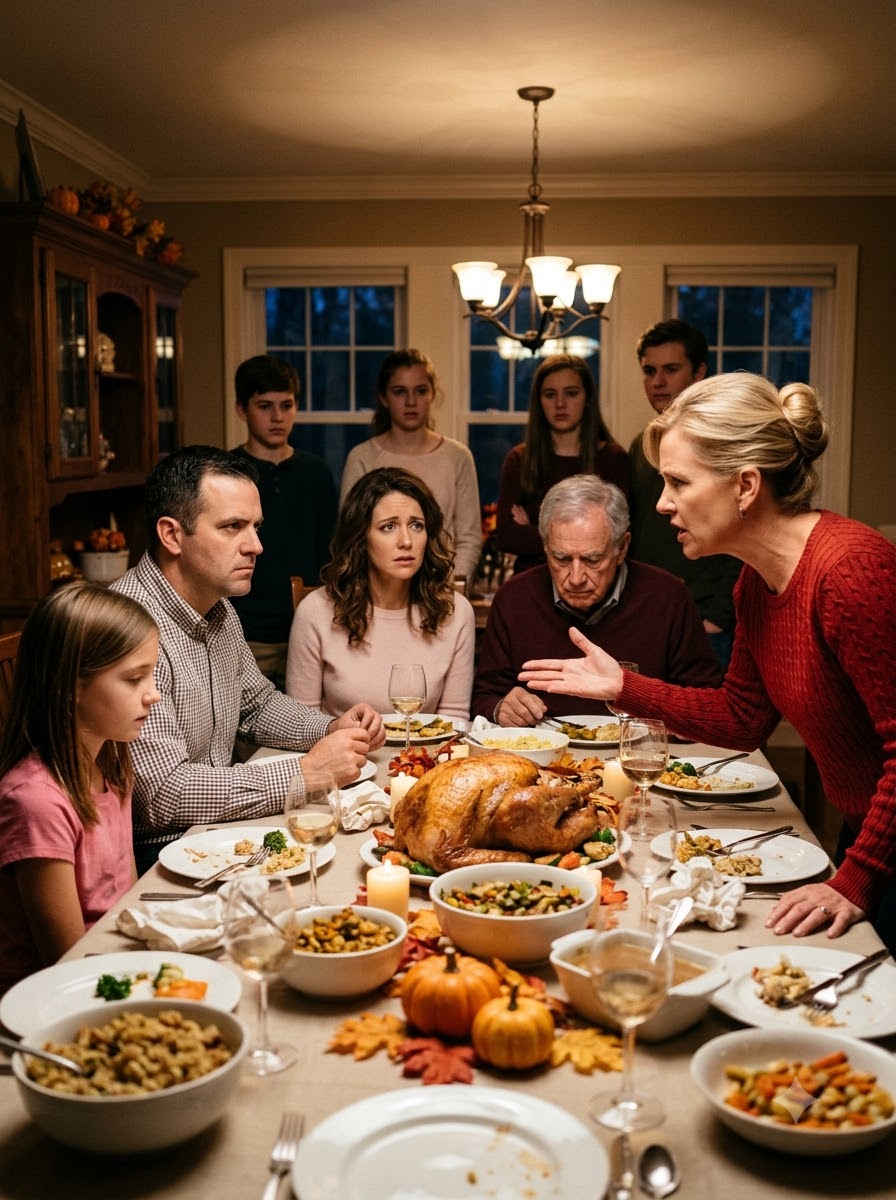
My eight-year-old daughter, Norah, asked that question at Thanksgiving dinner, with twenty-two relatives sitting around the table.
My mother-in-law, Gail, stopped carving the turkey.
My wife, Lauren, lowered her eyes, and I watched my father-in-law suddenly become fascinated by his mashed potatoes.
“Sweetheart, we’ve explained this,” Gail said, recovering her smile.
“Grandpa’s things are in the extra room. There’s simply nowhere else to put them.”
Norah looked toward the staircase.
“But Grandma, you said every grandchild should feel like they belong here.”
Nobody answered.
And when I glanced at Lauren, I noticed something that troubled me more than her mother’s excuse.
My wife wasn’t surprised.
She looked ashamed.
That night, I took my daughter to a hotel instead of letting her sleep on the living room couch again.
By the following afternoon, Lauren had discovered what was really behind the locked-away bedroom upstairs.
What she found would change everything we thought we knew about her family.
My name is Todd Whitford.
I’m thirty-eight, and I manage logistics for a freight company near Harrisburg, Pennsylvania.
My wife and I have been married twelve years.
We aren’t wealthy, but we have a comfortable home, steady jobs, and a daughter who still believes most adults mean what they say.
Lauren’s parents live in a renovated farmhouse outside Lancaster.
It’s a beautiful six-bedroom place with a wraparound porch, a large kitchen, and enough space for the entire family to gather during the holidays.
Gail takes tremendous pride in that house, especially the upstairs rooms she decorated for her grandchildren.
Janine, Lauren’s older sister, has three children.
Her brother Derek has two.
Between them, those five children occupy four bedrooms, with Derek’s youngest sharing with his brother.
Each room has personalized decorations, favorite books, and names painted on the doors.
The fifth upstairs bedroom, Gail always insisted, was storage.
Norah had been sleeping on the downstairs sectional since she was three.
The first time I questioned it, Gail gave me a sympathetic smile.
“Oh, Todd, she’s little. Children love camping out. Besides, Rich has all his woodworking equipment in that spare room. We’d have to spend weeks clearing it.”
Lauren squeezed my hand beneath the table, signaling that I shouldn’t argue.
I let the matter go because I didn’t want to make family gatherings uncomfortable.
That became a habit I would regret.
Gail wasn’t openly cruel.
She remembered birthdays, cooked wonderful meals, and bought Norah Christmas presents.
But the differences were always there if you paid attention.
Janine’s children received personalized ornaments and framed photographs displayed along the hallway.
Derek’s boys had shelves of toys waiting for them.
Norah received a gift bag.
When the cousins gathered upstairs, she followed them from room to room, knowing she would eventually have to return downstairs with her stuffed rabbit and blanket.
I told myself she didn’t mind.
Then, when she became old enough to notice, I told myself it was only a few nights each year.
That Thanksgiving, I ran out of excuses.
After Norah asked her question, Gail quickly changed the subject to Derek’s basketball team.
Everyone seemed grateful for the distraction, but my daughter continued staring at her plate.
I leaned toward Lauren.
“Can we talk in the kitchen?”
She followed me reluctantly, already looking worried.
“I’m getting us a hotel,” I said.
“Todd, please. Not during Thanksgiving.”
“Our daughter just asked why she doesn’t belong upstairs with her cousins. Your mother gave her the same excuse she’s been giving us for years.”
Lauren folded her arms.
“Mom isn’t trying to hurt her. She just has her ways.”
“Then her ways need to change. I’m not making Norah sleep on that couch again.”
Lauren looked toward the dining room, where her mother was laughing with Janine.
“She’s going to make this a whole thing.”
“She already made it a whole thing. We’ve just been pretending otherwise.”
I booked a room at a Holiday Inn outside Lancaster.
When we returned to the table, I told Norah we were going somewhere with an indoor pool.
Her face brightened immediately.
Gail’s expression didn’t.
“You’re leaving?” she asked.
“We’re staying nearby tonight,” I replied.
“We’ll see everyone tomorrow if the schedule works.”
“Over a sleeping arrangement?”
I picked up Norah’s jacket.
“It’s not about the furniture, Gail.”
She looked at Lauren, expecting her daughter to intervene.
For several uncomfortable seconds, Lauren said nothing.
Then she reached for her purse.
The drive was quiet.
Norah fell asleep holding the rabbit she always brought to her grandparents’ house.
Lauren stared through the passenger window while her phone buzzed repeatedly.
Janine had sent a message.
“Mom’s crying. Are you seriously doing this over a couch?”
Lauren read it twice before turning the screen facedown.
At the hotel, Norah discovered the waffle station and announced that she wanted to stay there every Thanksgiving.
I laughed, but Lauren looked away.
Later, when our daughter was asleep, she sat beside me on the other bed.
“I know Mom treats her differently,” she whispered.
I waited.
“I kept hoping she’d stop. Every year I thought maybe this would be the year she’d make Norah feel included.”
“Why didn’t you tell me you saw it too?”
Lauren rubbed her forehead.
“Because then I’d have to admit my mother was doing it on purpose.”
The following morning, Lauren remembered she’d left her laptop bag and Norah’s winter coat at the farmhouse.
She insisted on retrieving them herself while I took our daughter swimming.
She was gone nearly two hours.
When she returned, her face had lost its color.
“Todd, that room isn’t storage.”
I turned off the television.
“What?”
“The door was open. I looked inside. There’s a queen bed, a dresser, clean sheets, curtains. It’s a perfectly furnished guest room.”
I stared at her.
“Where’s Rich’s woodworking equipment?”
“There isn’t any.”
She sat down slowly.
“And there’s something else. I opened the nightstand drawer because I recognized an old photograph sticking out beneath a stack of cards.”
“What photograph?”
“Me and Craig. At junior prom.”
Craig was Janine’s husband.
Years before I met Lauren, she’d dated him briefly in high school.
Their relationship ended before graduation, and Craig eventually married her older sister.
I’d always considered it an awkward but harmless piece of family history.
Apparently, Gail had never felt the same way.
“Why would your mother keep that picture in a guest bedroom?” I asked.
Lauren stared at her hands.
“She always thought I should’ve married Craig.”
She told me things she’d never fully explained before.
Gail had loved Craig’s family, admired his plans to become an orthodontist, and openly encouraged Lauren to stay with him.
When their relationship ended, Gail had taken it harder than either teenager.
“After Janine started dating him, Mom used to joke that at least she’d kept the right son-in-law in the family,” Lauren said.
“What did she say when you married me?”
Lauren hesitated.
“She said I was choosing a harder life than I needed to.”
I remembered my first Christmas with the Whitfords.
Gail had asked about my parents’ jobs, my student loans, and whether freight management offered much advancement.
She’d smiled throughout the conversation, but I’d left feeling as though I’d failed an interview.
For twelve years, I’d assumed that feeling was my own insecurity.
Now I wasn’t so sure.
We drove home that afternoon.
Norah slept in the back seat, exhausted from swimming.
Lauren watched the highway and occasionally wiped at her eyes.
That evening, after putting our daughter to bed, we sat at the kitchen table until nearly midnight.
Lauren remembered her mother criticizing our first house because it was too small.
She remembered Gail comparing my salary with Craig’s.
She remembered the expensive individual gifts Craig received every Christmas while I was included in a generic present addressed to both of us.
None of those incidents had seemed important enough to confront individually.
Together, they told a different story.
“I think she’s been punishing me for marrying you,” Lauren said.
I reached across the table.
“Then she’s been punishing Norah for something our daughter had absolutely nothing to do with.”
Lauren began crying.
I didn’t try to explain it away.
Ten days later, Gail emailed me.
She apologized that Norah had felt excluded and assured me that she loved all her grandchildren equally.
She hoped we could put the misunderstanding behind us before Christmas.
Lauren read the message and shook her head.
“She wrote to you because she thinks you’re the one causing trouble.”
“What do you want to do?”
“I want to know how long she’s been lying.”
That was the first time Lauren had asked the question instead of avoiding it.
Over the following week, we began comparing memories.
I called Derek and asked about the bedrooms.
He told me Gail had started planning rooms for his boys before they were born.
“Amy asked about Norah once,” he admitted.
“Mom said Dad needed the storage space. I never questioned it.”
When I told him the room was furnished, he went quiet.
“Todd, that’s not right. I knew she favored Janine’s kids, but I didn’t think she’d lie to everybody.”
I wasn’t interested in turning Derek against his mother.
I wanted to understand what had happened, and I wanted Lauren to have the answers she needed before making any decisions about Christmas.
A few nights later, she found something.
She’d been searching through an old Yahoo account, looking for emails from the year Norah was born.
At first, she found ordinary messages about baby clothes, holiday plans, and family photographs.
Then she found a conversation from seven years earlier.
Lauren had asked whether Gail might finally prepare the spare room for Norah, who had recently started sleeping in a toddler bed.
Gail had replied that she would look into it.
Three days later, another email appeared in the same conversation history.
Gail had written to Janine, accidentally copying Lauren.
Lauren remembered receiving it years ago, but she’d convinced herself it was merely another example of her mother being difficult.
This time, she read it aloud.
“Janine, please don’t mention the fifth bedroom to Lauren. I’m keeping it available for your visits. We’ll tell them it’s storage. Norah doesn’t need to be upstairs with the older children, and you know how Todd gets when he thinks something isn’t fair.”
I stared at the screen.
Seven years.
For seven years, Gail had knowingly kept an available bedroom from our daughter and lied about the reason.
Lauren scrolled down and showed me her own reply from that time.
“Mom, I was copied on this. Can we please talk about Norah’s room?”
Gail had never answered that question.
Instead, she’d called Lauren the following afternoon, and Lauren remembered being told she was making a fuss over nothing.
“I let her convince me,” Lauren whispered.
“I knew what she’d written, and I let her convince me it wasn’t that bad.”
I could see how much that admission cost her.
“You don’t have to keep doing that,” I said.
She forwarded the email to both our current accounts, then closed the laptop.
For a long moment, neither of us spoke.
Finally, Lauren looked toward the hallway where Norah’s bedroom door stood slightly open.
“I’m not asking Mom for another room,” she said.
“I’m asking her why she thought my daughter deserved less.”
And this time, I knew she intended to wait for an answer.
PART 2 — A PLACE AT THE TABLE
Two weeks before Christmas, my mother-in-law offered our daughter a two-hundred-dollar sleeping bag.
It was embroidered with Norah’s name, came with a matching pillow, and apparently represented Gail’s solution to seven years of deliberate exclusion.
“It’s a beautiful setup,” she wrote in another email.
“Norah will have her own special space in the living room. I hope everyone can finally enjoy Christmas without any more unpleasantness.”
Lauren read the message while we were making dinner.
“She still doesn’t understand,” she said.
“Or she doesn’t want to.”
Lauren set down the wooden spoon.
“I want to go to Christmas dinner.”
That surprised me.
We’d already discussed spending the holiday at home, where Norah could wake up in her own bed and enjoy a peaceful morning.
“Are you sure?”
“Yes. But we’re staying at the hotel. And if Mom brings up that sleeping bag like she’s done us some enormous favor, I’m going to tell her what I found.”
I studied her face.
“You don’t owe anyone a confrontation.”
“I know. But I’ve spent twelve years letting her decide which conversations we’re allowed to have.”
She turned back toward the stove.
“I’m finished doing that.”
Lauren emailed her mother the following morning.
We would attend Christmas dinner but wouldn’t be staying overnight.
Gail called almost immediately.
Lauren let the call go to voicemail.
The message began with confusion and ended with accusation.
“Lauren, sweetheart, I really don’t understand why you’re letting Todd turn this into a family dispute. I’ve gone out of my way to make Norah comfortable. Your sister thinks this has gotten completely out of hand, and frankly, I’m beginning to agree.”
Lauren listened without interrupting.
When the recording ended, she deleted it.
“She still thinks you’re making me do this,” she said.
“That’s easier than admitting you disagree with her.”
For the first time in weeks, Lauren smiled.
Christmas morning, Norah opened her presents at home.
We had cinnamon rolls for breakfast, watched her assemble a new building set, and left for Lancaster shortly before noon.
We’d checked into the hotel the previous evening, so there were no overnight bags in the car.
That small detail made me feel strangely relieved.
We could leave whenever we wanted.
The farmhouse looked beautiful when we arrived.
Garland framed the porch, candles glowed in the windows, and the smell of roast beef drifted through the front door.
Gail greeted us warmly.
“There’s my beautiful granddaughter!” she exclaimed, hugging Norah.
“Come inside, sweetheart. Grandma has something special to show you.”
She led us into the living room.
Beside the sectional was a carefully arranged air mattress, topped with a pink sleeping bag embroidered with Norah’s name.
A stuffed bear sat on the pillow, still wearing its store tag.
“Look at this!” Gail announced.
“Your very own cozy corner. Isn’t it wonderful?”
Norah looked at the mattress.
Then she looked toward the staircase, where her cousins were laughing in their bedrooms.
“Thank you, Grandma,” she said politely.
Gail beamed.
“See? I knew she’d love it.”
I felt Lauren’s hand close around mine.
Our daughter had thanked her grandmother because we’d taught her to be polite.
Gail seemed unable to distinguish politeness from happiness.
Norah went upstairs to play, leaving the pink sleeping bag untouched.
The afternoon passed with the usual holiday routines.
Derek helped me carry extra chairs from the garage.
Janine arrived with Craig and their children.
Rich kept the fireplace going while Gail moved between the kitchen and dining room, making sure everything looked perfect.
At one point, Rich approached me near the garage.
“Todd, I know things have been strained,” he began.
“Gail really did try with that gift.”
“Rich, you know the fifth bedroom isn’t storage.”
He stopped.
For several seconds, he looked at the folding chair in his hands.
“Yes,” he admitted.
I hadn’t expected that.
“You’ve known?”
“It’s been a guest room for years. Gail wanted somewhere Janine could stay when she visited alone.”
“And you let Norah sleep downstairs?”
He lowered his eyes.
“I figured Gail would eventually sort it out.”
“She’s had seven years.”
Rich sighed.
“I know. I should’ve said something.”
He sounded sincere, but sincerity didn’t erase the years he’d spent looking away.
I thanked him for being truthful and returned to the house.
Dinner began at five.
There were twenty-two of us again, seated around two tables pushed together.
Gail had prepared roast beef, glazed carrots, mashed potatoes, and enough side dishes to feed twice our number.
For nearly an hour, everything seemed normal.
Derek talked about basketball.
Craig mentioned an upcoming dental conference.
The children discussed their presents while Gail reminded everyone to save room for dessert.
Then she stood with her wineglass.
“Before we finish, I want to say how grateful I am for this family. Nothing matters more to me than having everyone together. I hope every one of my grandchildren knows that this house will always be their home.”
Glasses lifted around the table.
Lauren didn’t raise hers.
Instead, she placed it carefully beside her plate.
“Mom, can I ask you something?”
Gail smiled.
“Of course, sweetheart.”
“If this house is home to every grandchild, why has Norah spent years sleeping on the couch?”
The room went quiet.
Gail’s smile tightened.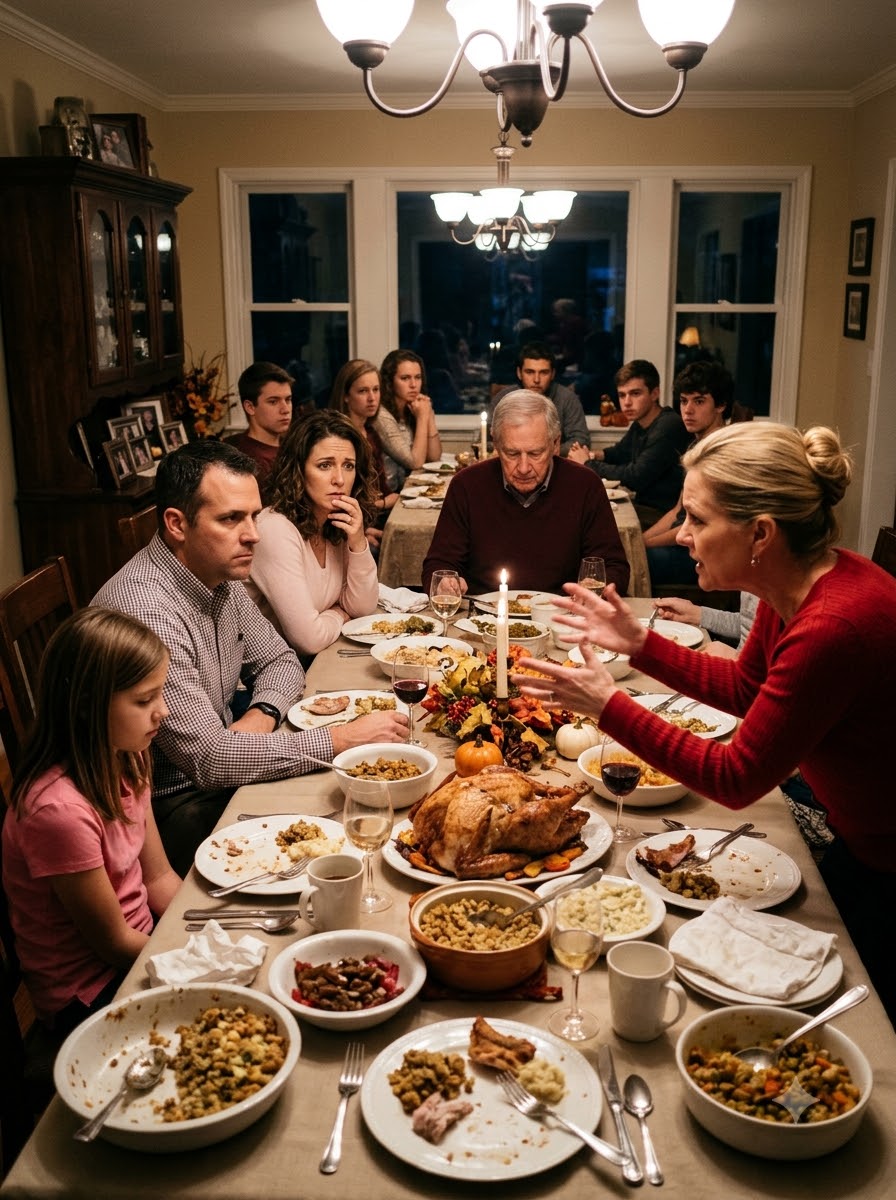
“Lauren, we’ve already discussed this. I bought her that lovely sleeping bag.”
“I’m not talking about the sleeping bag.”
“Then what exactly do you want from me?”
Lauren’s fingers trembled slightly against the tablecloth, but her voice remained steady.
“I want you to stop saying the upstairs bedroom is storage.”
Gail froze.
Janine looked between them.
“What bedroom?” she asked.
“The one Mom keeps for you,” Lauren replied.
“The one she told us was full of Dad’s woodworking equipment.”
Gail set down her glass.
“That room is for guests. I don’t see why this needs to become a public discussion.”
“Because you told my daughter there wasn’t space for her when you knew there was.”
“I never promised Norah her own bedroom.”
“You told every grandchild this house was their home. You painted their names on the doors. You made sure they had somewhere they belonged.”
Lauren paused, struggling to keep her voice steady.
“Then you gave my daughter a couch and expected her to be grateful.”
Gail looked toward me.
“Todd, surely you can see how unfair this is. I’ve welcomed your family into my home for years.”
I opened my mouth, but Lauren touched my arm.
“Mom, don’t look at Todd. I’m talking to you.”
Gail’s face reddened.
“I don’t appreciate being spoken to like this at my own dinner table.”
“And I don’t appreciate finding out you’ve been lying to me for seven years.”
Janine shifted in her chair.
“Lauren, maybe we should talk about this later.”
Lauren turned toward her sister.
“You knew about the room, Janine. Mom emailed you about it.”
Janine looked uncomfortable.
“I knew she wanted to keep it available for my visits. I didn’t think it was such a big deal.”
“Did you know she told us it was storage?”
Janine hesitated.
“Yes.”
That answer hurt Lauren more than I expected.
She pressed her lips together, looking at the sister she’d spent her childhood sharing secrets with.
“And you never thought to tell me?”
“I figured Mom had her reasons.”
“That’s what we all kept telling ourselves.”
Gail pushed back her chair.
“I’ve spent years making holidays special for this family. I refuse to sit here and be treated like some terrible grandmother because one child doesn’t have a decorated bedroom.”
Lauren looked at her for a long moment.
“Mom, I found the email.”
Gail stopped moving.
“What email?”
“The one you sent Janine seven years ago. The one where you said we’d tell Todd the room was storage because you didn’t want Norah upstairs.”
Janine looked down.
Gail’s voice became noticeably quieter.
“That was a private conversation.”
“You copied me on it. I asked you about it, and you made me feel ashamed for even bringing it up.”
Lauren wiped her cheek.
“I spent half my life trying not to disappoint you, Mom. Somewhere along the way, I taught my own daughter to accept being treated like she mattered less.”
Nobody spoke.
Even Gail seemed unable to find an immediate response.
Then Lauren continued.
“And when I went upstairs at Thanksgiving, I found that old picture of me and Craig in the nightstand.”
Craig looked up sharply.
“What picture?”
“Our junior prom photograph.”
Janine turned toward her mother.
“Why would you keep that?”
Gail looked genuinely uncomfortable now.
“It’s an old family photograph. I kept lots of things from when you girls were young.”
“In the room you reserved for Janine?” Lauren asked.
Gail pressed her lips together.
“I don’t have to explain every keepsake in my house.”
“No, you don’t. But I remember what you used to say about Craig. I remember you telling me I’d regret marrying Todd. And I remember how you treated Norah after she was born.”
Her voice broke.
“I can’t keep pretending those things have nothing to do with each other.”
Gail looked around the table, perhaps hoping someone would defend her.
Nobody did.
Rich finally spoke.
“Gail, I think we need to listen.”
She turned toward him in disbelief.
“You too?”
“I knew about the guest room,” he admitted.
“I should’ve said something years ago. Lauren’s right about that.”
For the first time, Gail seemed genuinely shaken.
She looked at her daughters, then at me, before quietly leaving the dining room.
We heard her bedroom door close upstairs.
Lauren sat motionless.
I wanted to tell her she’d done well, that she’d finally said everything she needed to say.
Instead, I poured her a glass of water and waited.
Janine was the first to break the silence.
“Lauren, I’m sorry,” she said.
“I should’ve told you about the room. I knew it bothered you, and I acted like it wasn’t my problem.”
Lauren nodded, but didn’t immediately forgive her.
Rich looked toward the staircase.
“I’ll talk to your mother. But first, I owe you both an apology. I let this go on because keeping the peace was easier than doing the right thing.”
“I appreciate you saying that,” I replied.
We stayed another hour, mostly for the children’s sake.
They’d gone downstairs to play video games before the conversation became heated, and Norah was happily sitting beside Olivia when I checked on them.
She looked up.
“Daddy, are we going back to our hotel tonight?”
“We are, sweetheart.”
She smiled.
“Good. I like having my own bed.”
I kissed the top of her head.
On the drive back, Lauren was quiet.
Eventually, she turned toward me.
“I should’ve spoken up years ago.”
“We both should have.”
“Do you think Mom will ever understand?”
I thought about Gail sitting alone upstairs while her family finished Christmas dinner without her.
“I don’t know,” I said.
“But she knows we won’t pretend anymore.”
The weeks that followed weren’t easy.
Gail called twice before New Year’s.
The first conversation ended badly when she insisted Lauren had humiliated her.
The second was shorter, with Gail admitting she’d handled the bedroom situation poorly but still defending her intentions.
Lauren listened, then told her mother she needed more than explanations.
In January, Gail called again.
This time, she said she’d spoken with a counselor.
“She asked me why I was so upset when you married Todd,” Gail told Lauren over speakerphone.
Lauren glanced at me.
“And what did you say?”
There was a long silence.
“I think I wanted you to have the life I’d imagined for you. When you chose something different, I took it personally. I kept thinking you’d made a mistake, and I suppose I wanted you to admit it.”
Lauren closed her eyes.
“Mom, I didn’t make a mistake.”
“I know that now.”
“Norah shouldn’t have had to pay for your disappointment.”
Gail began crying quietly.
“You’re right.”
It wasn’t a complete apology.
But it was the first time I’d heard Gail acknowledge something without immediately defending herself.
We didn’t visit in February.
Gail sent Norah a handwritten Valentine’s Day card.
She asked about school, mentioned a book Norah had recommended, and told her she hoped they’d spend time together soon.
Norah taped it to the refrigerator.
In March, Janine invited Lauren to dinner.
They spent two hours talking about their childhood and the ways their mother had encouraged competition between them.
Janine admitted she’d enjoyed being the favored daughter without considering what it cost her sister.
They didn’t solve everything over pasta, but Lauren came home relieved that they’d finally spoken openly.
Then, in April, Gail invited us for Easter.
The message was brief.
“We’d love to have you for brunch if you’re comfortable coming. I understand if you’re not ready. I’m sorry for how I’ve treated Norah, and for the ways I’ve hurt you and Todd.”
A handwritten letter arrived three days later.
Gail acknowledged the email, the years of unequal treatment, and the hurt she’d caused.
She didn’t ask us to forget what happened.
She wrote that she hoped we would give her the opportunity to behave differently.
Lauren read the letter twice.
“I think we should go,” she said.
“Are you sure?”
“Yes. But we’re not staying overnight unless Norah wants to.”
I agreed.
Easter morning, we drove to Lancaster under a clear spring sky.
Gail met us at the door, looking nervous in a way I’d never seen before.
She hugged Norah gently.
“Sweetheart, there’s something upstairs I’d like to show you. Would that be okay?”
Norah looked at us.
Lauren nodded.
We followed Gail to the second floor, where the door to the former guest bedroom stood open.
The queen bed was gone, replaced by a smaller bed with a purple quilt.
A bookshelf stood beside the window.
Glow-in-the-dark stars decorated the ceiling, and a little rug covered part of the wooden floor.
On the door, painted in slightly uneven purple letters, was one word.
Norah.
Our daughter stopped in the hallway.
For several seconds, she didn’t move.
Then she walked toward the door and carefully traced the letters with her fingertips.
“Grandma, is this really my room?”
Gail knelt beside her.
“Yes, sweetheart. It’s your room. And it should’ve been yours a long time ago.”
Norah turned toward her grandmother.
“Can I put my books here?”
“As many as you like.”
“And my rabbit?”
Gail smiled through tears.
“Especially your rabbit.”
Norah hugged her.
Lauren stood beside me, wiping her eyes.
I slipped my arm around her shoulders, and for once, neither of us felt the need to say anything.
We stayed for Easter brunch, but drove home that evening.
Norah wanted to sleep in her own bed, and Gail accepted that without protest.
Over the following months, things changed slowly.
Gail still occasionally favored Janine’s children without noticing, but Lauren no longer stayed silent.
Rich began calling Norah every Sunday to ask about school, and Janine made an effort to include her niece in family plans.
Nobody pretended the past had disappeared.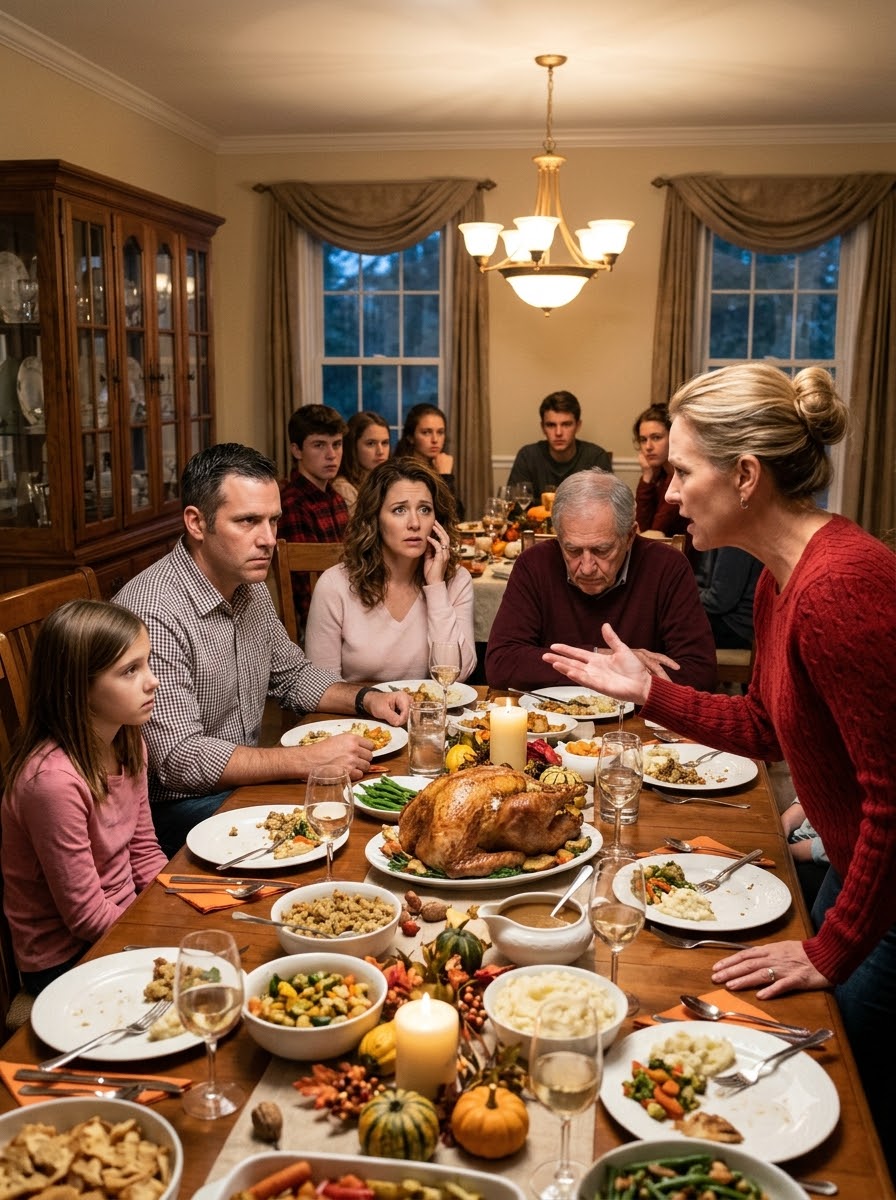
That summer, Norah finally spent a weekend at the farmhouse.
When we arrived to pick her up, I found her upstairs, arranging three paperback books on her new shelf.
Her stuffed rabbit sat against the purple pillow, and a drawing of a bird was taped beside the window.
“Ready to go, bug?” I asked.
“Almost, Daddy.”
She stepped into the hallway, looked at the purple letters on her door, and smiled.
Then she closed it gently behind her.
For years, she’d carried her little suitcase past five other children’s bedrooms, wondering why there wasn’t a place for her.
This time, she left knowing there was one waiting when she came back.
