

PART 1
My name is Nadia Ferris. I am thirty-seven. I work as a bank teller in Harrisburg, Pennsylvania.
My former husband, Reggie, completed two tours in Afghanistan. He came home altered. Sudden noises terrified him. Nightmares plagued his sleep. Eventually the drinking began.
We divorced when our daughter, Zoe, was seven. Two years ago his sister told me he had entered a treatment program in Florida. After that the calls stopped.
I told Zoe her father was in Florida, working on getting better. I truly believed it.
This autumn Zoe’s habits shifted.
She stopped asking for sandwiches and began requesting soup in her thermos. She started setting aside her allowance. Twice I found cash missing from my wallet—first twenty dollars, then forty.
She said she went to the library after school to finish her homework.
Then I checked the location history on her smartwatch.
Every afternoon between 3:40 and 4:00 she was beneath the Route 9 bridge by the river.
On Thursday I left work early and parked across the road.
At 3:38 Zoe appeared, backpack on, and descended the slope. She ducked under the bridge where tents, shopping carts, and tarps clustered.
I followed.
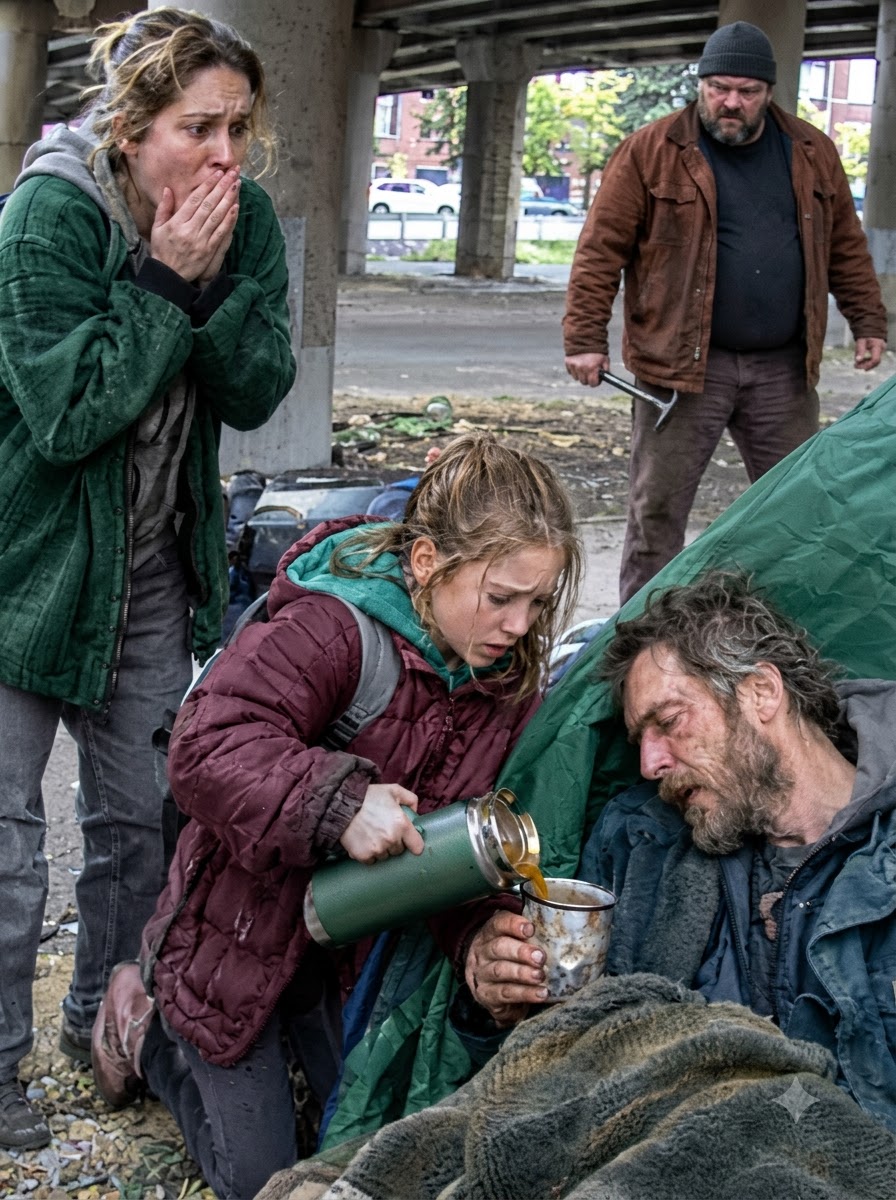
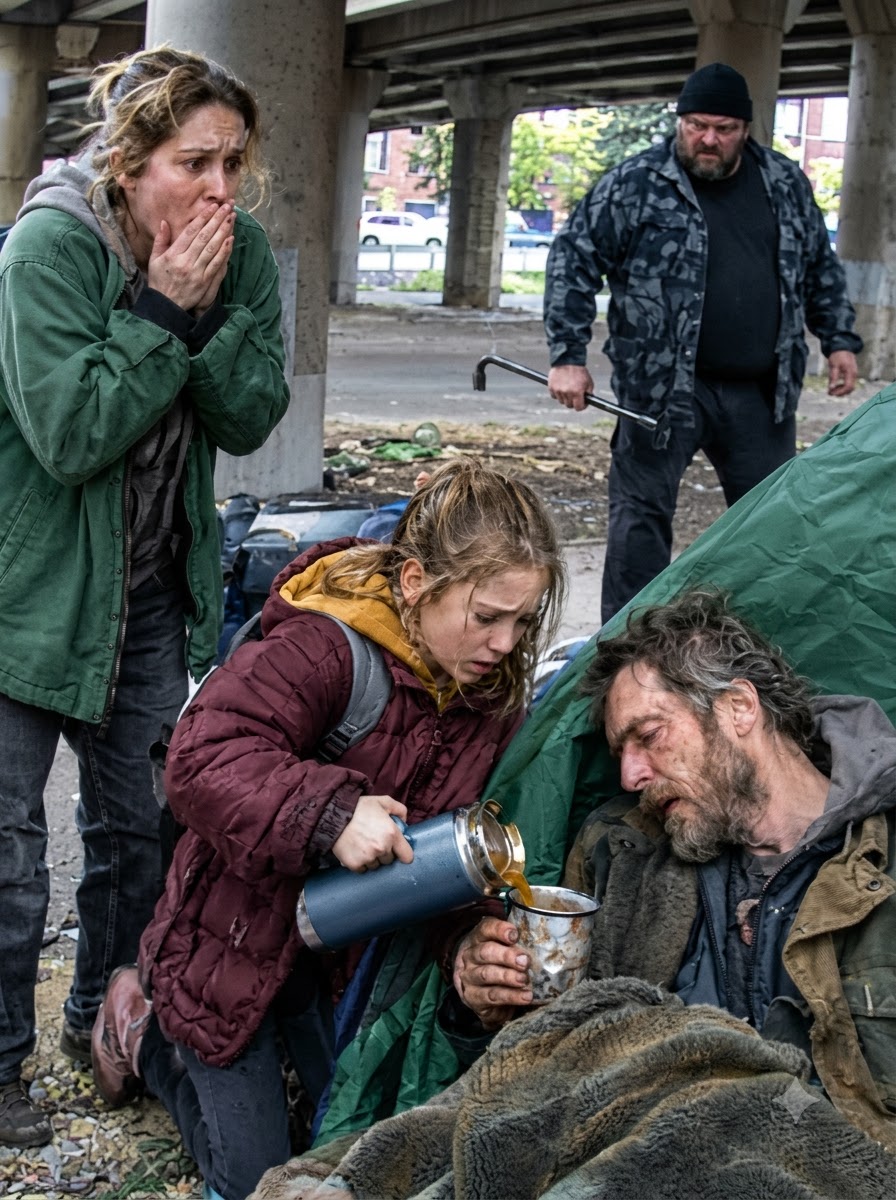
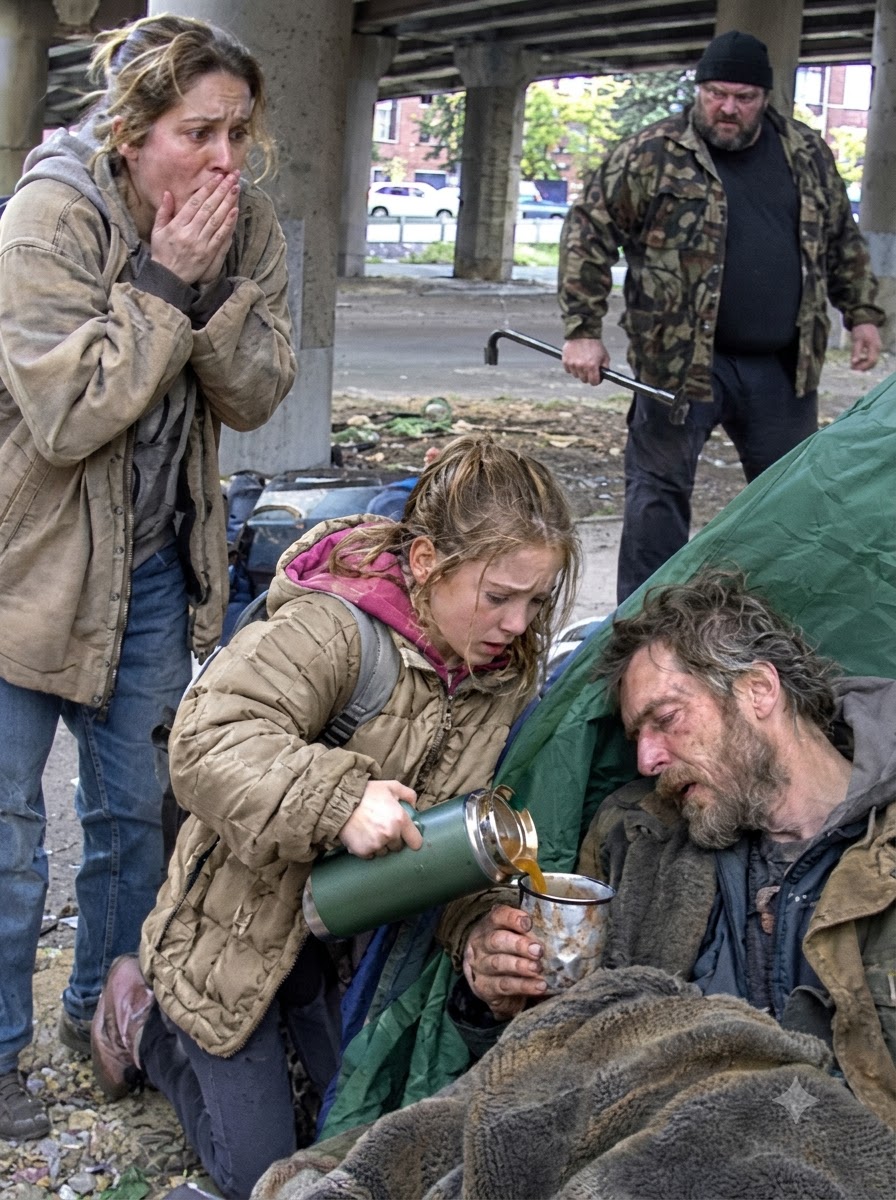
She knelt beside a green tent, pouring soup from her thermos into a battered tin cup.
“Here, Daddy. It’s tomato. Your favorite.”
A hand reached from the tent for the cup. It shook.
Then Reggie leaned into the light.
He was painfully thin. His face looked gray. His beard had grown long. A deep, wet cough racked his body.
He saw me.
“Nadia,” he whispered.
Zoe turned. Her face crumpled.
“Mom, please don’t be mad. I found him in September. He was walking by my school. I didn’t tell you because he said you’d make him go away.”
“Reggie,” I said. “You were in Florida.”
“I never went,” he said. “I couldn’t. I was too ashamed to tell anybody.”
He coughed again. Blood dotted the tissue in his hand.
I dropped beside him and pressed my palm to his forehead. He was burning.
Before the bank I had spent six years as an Army medic. I met Reggie at Fort Bragg. I knew the sound of pneumonia. I knew the signs of sepsis.
He was in serious trouble.
“Reggie, you need a hospital. Right now.”
“Can’t,” he said. “Crowder has my card.”
“Who’s Crowder?”
Gravel shifted behind us.
A large man in a camouflage jacket stepped from behind a concrete pillar, cigarette between his lips, tire iron in his hand.
“I’m Crowder,” he said. “Who are you?”
Zoe grabbed my sleeve. She was shaking.
“Mom,” she whispered. “He’s the one who takes Daddy’s money. Every month. Daddy gets a check from the VA, and Mr. Crowder takes the card.”
Crowder smiled.
“Reggie owes me rent. This is my bridge. I keep people safe down here. That costs money.”
“He’s sick,” I said. “He needs a hospital.”
“He’s fine. He’s always coughing.” He flicked the cigarette into the river. “Your kid’s been real helpful, though. Bringing lunch money. Keeping her daddy’s tab paid.”
I looked at Zoe.
She stared at the ground.
“He said if I didn’t bring twenty dollars every day, he’d throw Daddy’s tent in the river,” she said. “And his medicine.”
I did not panic.
I took one slow breath the way I had learned on a convoy road outside Kandahar.
Then, inside my pocket, I pressed the side button on my phone five times. Emergency SOS. It dials 911 and transmits my location.
Crowder stepped closer and rested the tire iron on his shoulder.
“Here’s how this works, lady. Leave the kid’s money. Walk away. Reggie stays with me.”
Behind me came a choking sound.
I turned.
Reggie had collapsed sideways out of the tent onto the gravel.
His eyes rolled back.
He was not breathing.
I dropped to my knees beside him. The medic training overrode everything else—the fear, the tire iron, the cold river wind cutting under the bridge. I checked his airway, tilted his head, and sealed my mouth over his. Two quick breaths. Then I placed the heel of my hand on his sternum and began compressions, counting under my breath the way they had drilled us in the field.
“Zoe, call out if anyone else comes,” I said, voice steady. “Stay behind me.”
Crowder’s boots crunched closer. “Stop that. You’re making it worse. He’ll come around. He always does.”
“He’s in arrest,” I answered without looking up. “Thirty compressions, two breaths. You touch me and you’ll answer for it when the police get here.”
“Police?” He laughed once, short and ugly. “Nobody’s coming. Phones don’t work good under here.”
I kept counting. Fifteen. Sixteen. Reggie’s chest was too thin; I could feel every rib under my palms. His lips had gone the color of the gravel. On the twenty-eighth compression a faint gurgle escaped him. I paused, checked the pulse at his neck—nothing strong enough to count—and gave two more breaths. His chest rose a little. I went back to compressions.
Zoe’s small hand gripped the back of my jacket. “Mom, the sirens.”
I heard them then: distant at first, then rising as the emergency vehicles left the main road and turned onto the access path that ran along the river. Crowder’s head snapped toward the sound. The tire iron lowered an inch.
“You called them,” he said.
“Emergency SOS,” I answered. “Location’s already out. Walk away now and you might still have a chance to explain the card.”
He took one step toward me. I kept the compressions going and angled my body so Zoe stayed behind me. The river smell mixed with the metallic taste of adrenaline. For a second I was back outside Kandahar, the radio crackling while we worked on a wounded driver under the open bed of a truck. Same counting. Same refusal to stop.
The first patrol car skidded to a stop on the gravel shoulder above us. Doors opened. Two officers came down the slope, hands on their holsters. One of them called out, “Police! Drop the iron!”
Crowder turned, the tire iron still in his hand. “This is my place. These people are trespassing.”
“Drop it,” the officer repeated. His partner had already circled wide, eyes on the tents and the people beginning to emerge from them. Another unit arrived, then the ambulance, its lights throwing red and blue across the underside of the bridge.
Crowder hesitated. The iron clanged against the concrete when he finally let it fall. One officer moved in to cuff him while the other radioed for additional units. A third officer came straight to me.
“Ma’am, we’ve got medics. Let them take over.”
PART 2
I finished the last two compressions of the cycle and rocked back on my heels. My arms burned. The paramedics were already sliding a board under Reggie, one of them taking over ventilations with a bag while the other checked for a pulse and started an IV. They worked fast and quiet, the way good crews do. I stayed close enough to answer questions.
“Forty-two-year-old male, veteran, history of PTSD and alcohol use. Suspected pneumonia and sepsis. No known allergies. Last known meal was soup about ten minutes ago. He stopped breathing roughly four minutes before you arrived. I started CPR immediately.”
The lead paramedic nodded without looking up. “Good work. We’re going to Harrisburg Hospital. You riding with him?”
I glanced at Zoe. She was still pressed against my side, face wet, backpack straps twisted in her fists. One of the officers was already talking to her in a low voice, asking if she was hurt, if she needed anything.
“We’ll follow,” I said. “Her father. She needs to see him arrive.”
They loaded Reggie. The monitor on the stretcher showed a weak, irregular rhythm. One of the paramedics called it in as they rolled him up the slope. Crowder was already in the back of a patrol car, staring straight ahead while an officer photographed the tire iron and the green tent. Another officer was speaking with two other men who had come out of nearby shelters; they were pointing toward Crowder and shaking their heads.
I walked Zoe to my car. Her hands were ice-cold. I started the engine and turned the heat on full, then reached across and fastened her seatbelt because she was staring at nothing.
“You did the right thing telling me,” I said. “Even if it was late. You kept him alive long enough for me to get there.”
She wiped her nose on her sleeve. “He said you would make him leave. He said the hospital would take his medicine and then Crowder would be worse.”
“Crowder is in the back of a police car,” I answered. “And your father is in an ambulance. Those are better odds than either of you had this morning.”
We reached the hospital eight minutes behind the ambulance. I parked in the emergency lot and walked Zoe inside. The triage nurse recognized my name from the radio traffic and pointed us toward a small family room. We waited while they stabilized him. I bought Zoe a bottle of water from the machine and made her drink half of it. She kept turning the bottle in her hands, watching the condensation run.
A detective arrived about forty minutes later. She was in her late forties, plainclothes, badge clipped to her belt. She introduced herself as Detective Alvarez and asked if Zoe was willing to talk. I stayed in the room. Zoe’s voice stayed small but clear while she told the story from the beginning: seeing her father on the sidewalk outside school in September, the way he had tried to hide his face, the thermos of soup she started bringing, the twenty dollars Crowder demanded every afternoon, the threat about the tent and the medicine. She described the VA debit card Crowder kept in his jacket pocket and the way he made Reggie sign the monthly statement so the bank would not freeze the account.
Alvarez took notes without interrupting. When Zoe finished, the detective looked at me. “We’ve already pulled Crowder’s record. Multiple priors for theft and assault, mostly against other people living on the street. We’ll get a warrant for the card and for any other property he was holding. The VA will want to know about the benefits fraud. Your daughter’s statement helps.”
Zoe looked up. “Is my dad going to be okay?”
“They’re still working on him,” Alvarez said. “The doctors will come talk to you as soon as they can. You did a hard thing today. Most adults wouldn’t have managed it.”
After she left, a nurse brought us blankets and told us Reggie had been moved to the ICU. He was intubated. The pneumonia had progressed to sepsis; his blood pressure had crashed in the ambulance and they were running fluids and antibiotics. The fever was still high. They expected him to stay sedated overnight at least.
Zoe fell asleep against my shoulder sometime after midnight, still wearing her school clothes. I watched the hallway through the narrow window in the family-room door and thought about the last time I had seen Reggie before the divorce. He had been standing in our kitchen in a clean T-shirt, trying to explain why he could not sleep in the bed anymore, why the sound of the dishwasher made his hands shake. I had not known how to answer then. I still did not know how to answer now.
In the morning a doctor named Patel came to speak with us. Zoe sat up straight, eyes swollen. Patel was careful with his words. Reggie had bilateral pneumonia, likely bacterial, complicated by malnutrition and probable alcohol withdrawal. The sepsis was responding to the antibiotics so far. They had placed him on a ventilator to rest his lungs. If the next twenty-four hours went well, they would try to wean him off the breathing tube. There was no guarantee.
“He has a long recovery ahead even if the infection clears,” Patel said. “He will need inpatient treatment for the substance use and for the PTSD. The social worker will talk to you about options once he is more stable. Does he have any other family we should contact?”
“His sister in Florida,” I said. “I’ll call her.”
Zoe waited until the doctor left. “Can I see him?”
“Not yet,” I told her. “When they say it’s safe.”
We went home long enough for both of us to shower and change. I called Reggie’s sister, Marlene. She cried when I told her he had never reached Florida. She said she would fly up as soon as she could rearrange work. I also called the school and explained that Zoe would be out for the day. The principal already knew something had happened; one of the officers had contacted them the night before to confirm Zoe’s identity.
Back at the hospital that afternoon, Alvarez stopped by again. Crowder had been charged with theft by deception, unlawful restraint, and simple assault. The VA card had been recovered from his jacket along with several hundred dollars in cash and a notebook listing names, tent locations, and monthly “rent” amounts. Three other people living under the bridge had given statements. One of them said Crowder had been running the same arrangement for nearly two years.
“Your daughter’s money is evidence now,” Alvarez said. “We’ll get it back to you once the case moves forward. In the meantime, if you need anything for her—counseling referrals, victim services—we have people who can help.”
Zoe listened without speaking. When Alvarez left, she asked, “Will they put him in jail for a long time?”
“I don’t know,” I said. “But he won’t be under that bridge tonight. Neither will your father.”
On the second morning they extubated Reggie. He was weak and confused, voice hoarse from the tube, but he recognized Zoe when the nurse let her stand at the foot of the bed for two minutes. He tried to lift one hand. She stepped closer and touched his fingers.
“I’m sorry I didn’t tell Mom sooner,” she said.
He shook his head once, slowly. “You kept me fed. That’s more than I managed.”
They moved him to a step-down unit the next day. The social worker met with me while Zoe was in the cafeteria with a volunteer. Options were limited. The nearest VA domiciliary had a waiting list. A civilian detox and dual-diagnosis program in the next county had a bed opening in ten days if Reggie agreed to go. He would need someone to transport him and to confirm he had a place to stay after discharge. I told the social worker I would talk to him.
When I went back into the room, Zoe was already there, sitting in the chair with her homework spread across the rolling table. Reggie was awake, propped on pillows, an oxygen cannula under his nose. He looked at me for a long moment.
“I should have called,” he said. “After I left the bus station. I stood there with the ticket in my hand and I couldn’t get on. I thought if I stayed out of sight you two would be better off.”
“We weren’t,” I answered. “Zoe found you anyway. She has been carrying twenty dollars a day and a thermos of soup for two months. That is not better off.”
He closed his eyes. “Crowder said he would report me if I tried to leave. Said the VA would cut the check if they knew I was living under a bridge. I believed him.”
“They would rather you be in treatment than under a bridge,” I said. “The detective already notified them. The card is evidence. You’ll get a new one once the fraud is documented. There is a bed in a program that starts in ten days. You can take it or you can sign yourself out against medical advice and go back to the river. Those are the choices.”
Zoe looked up from her math worksheet. “I want you to take the bed.”
Reggie’s mouth tightened. He studied the blanket for a while. “If I go, I won’t be able to see you every day.”
“You can call,” she said. “And Mom says we can visit on weekends if the program allows it.”
He nodded once. “All right. I’ll go.”
The next week moved in small, practical pieces. Marlene arrived and stayed in a hotel near the hospital. She and I took turns sitting with Reggie while the antibiotics finished their course and the social worker completed the intake paperwork for the treatment program. Zoe returned to school. On the first afternoon she came home and went straight to her room; when I checked on her she was sitting on the floor with the empty thermos in her lap.
“I don’t know what to do with it now,” she said.
“Wash it,” I told her. “Put it in the cabinet. If your father wants soup when he gets out, you can make it for him then. Not under a bridge.”
She nodded and carried the thermos to the kitchen.
On the morning we drove Reggie to the program, the sky was clear and cold. He sat in the passenger seat with a small bag of clothes Marlene had bought him. Zoe rode in the back, quiet. At the intake desk he signed the forms without argument. A counselor walked him through the rules: no leaving the grounds for the first two weeks, phone calls in the evening, family visits on Saturdays after the first month if he stayed compliant. He turned to Zoe before they led him inside.
“Thank you for the tomato soup,” he said. “It was the only thing that tasted like anything.”
She stepped forward and hugged him carefully around the waist, mindful of the still-healing IV bruises on his arms. “Get better,” she said. “Then you can have more.”
We watched the door close behind him. Marlene wiped her eyes and said she would stay in Pennsylvania until the first family session. I drove Zoe home. In the driveway she unbuckled her seatbelt but did not get out.
“Do you think he’ll stay this time?” she asked.
“I think he has a better chance than he did under the bridge,” I answered. “And so do we. That’s the part we can control.”
She nodded, opened the door, and went inside to start her homework. I sat in the car a minute longer, listening to the engine tick as it cooled, and then I followed her.
