


Part 1: The Nightgown
The first thing I noticed in my own bedroom was my wedding nightgown, draped over another woman.
It was not a nightmare. It was not one of those lurid television dramas my mother-in-law swore she never watched. Under the amber glow of the master suite lights in our secluded villa in Westport, Connecticut, my husband’s executive assistant was perched on my bed, wearing the pale champagne silk my mother had given me the night before my wedding.
And my husband, Blake Whitmore, the billionaire CEO who had told every magazine in New York that “family was the foundation of legacy,” had a possessive hand resting on her bare thigh.
For a moment, I could not breathe.
The suitcase handle was cold in my palm, and rainwater ran from my coat onto the white oak floor. I had flown back to JFK from Zurich a full week early to surprise Blake. I had imagined his delighted face, the two of us laughing, a three-a.m. breakfast, a marriage far warmer than the polished portrait that hung above our fireplace.
Instead I was standing outside a bedroom door that had been left partly open, listening to my husband say, “She’ll sign whatever I put in front of her. Emma doesn’t know how the real world works.”
Chloe Mercer gave a soft laugh. She was the assistant who sent me birthday flowers supposedly chosen by Blake, and who sweetly called me Mrs. Whitmore. Now her finger was tracing a slow line down my husband’s chest as if she owned him. “What about the shares?” she whispered.
Blake chuckled. “Once I get her signature, those voting shares are mine. After that, she’s useless. I’ll give her a clean settlement, tell everyone she couldn’t handle the pressure, and move you into the townhouse.”
Something inside me went still. It did not shatter or collapse. It simply went quiet. For three years I had been the agreeable wife, smiling at galas and choosing ivory because Blake called red “too attention-seeking.” At holiday dinners, Vivian Whitmore had inspected my looks, my accent, my manners, and my childlessness like defective goods her son had bought by mistake. Blake told people I came from a modest family in Ohio. He let them assume I had no connections, no money, no teeth. I never corrected anyone.
My father had warned me, after all. “Emma,” Dad had said before the wedding, “a man who loves your quietness may only love how easily he can speak over it.” At the time, I had written him off as cynical. Now, standing in the corridor of my own villa and listening to my husband plan my financial execution between kisses, I understood that Dad had never been cynical. He had been trying to spare me. I took out my phone and began to record. Then I opened the door.
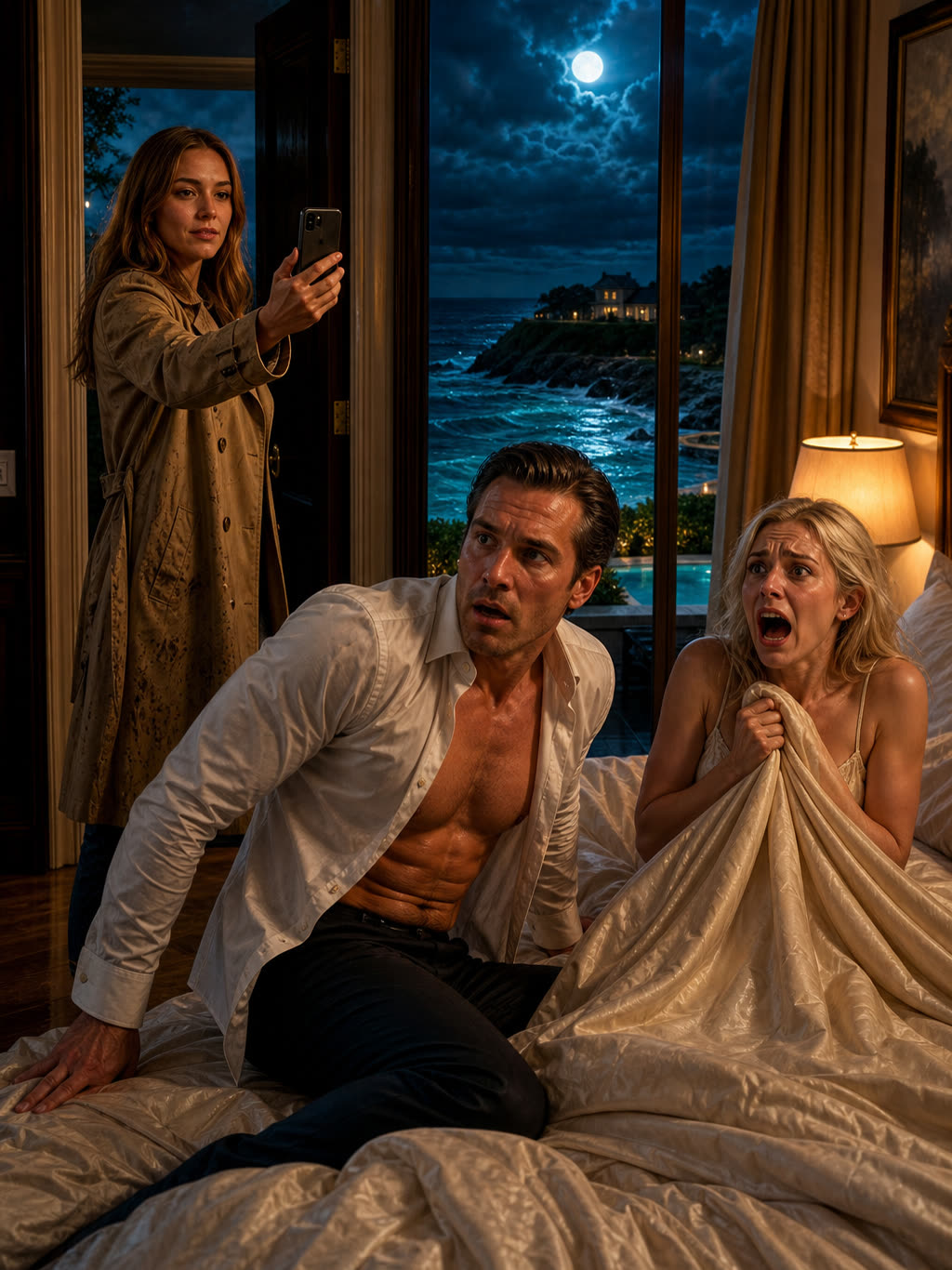
The hinge betrayed me with a thin squeal. Blake turned first. The color drained from his face so fast he looked almost skeletal. Chloe screamed and dragged the comforter up to her chin, but not before I had seen the nightgown clearly.
“Emma,” Blake said, scrambling off the bed. “You’re home.”
“What an incredible observation.”
I sounded composed, almost unnaturally so. It was the kind of calm that frightens the guilty far more than screaming ever could.
Blake snatched his pants off the floor with shaking hands. “Listen to me. This is not what it looks like.”
I stepped into the bedroom, raised my phone, and smiled. “Good. Because it looks like you were sleeping with your assistant in my house while explaining how you planned to steal my shares.”
Chloe burst into tears at once. “Mrs. Whitmore, please, I’m so sorry—”
“Don’t call me that while you’re wearing my nightgown.”
She went silent.
Blake’s face hardened. The fear slid away and was replaced by the icy superiority I had watched him use on junior executives just before he dismissed them.
“Emma,” he said quietly, “don’t make this ugly.”
I laughed once. “Ugly? Blake, we passed ugly ten minutes ago.”
He moved toward me and lowered his voice, as though he could still manage me. “Give me the phone.”
“No.”
“Emma.”
“No.”
His jaw tightened. “You don’t want to go to war with me.”
For the first time that evening, something sharp cut through my chest. It was not grief, and it was not even rage. It was recognition. This was my real husband, not the photographed man who kissed me in public. He saw me as an asset he had not yet finished acquiring.
“I want a divorce,” I said.
Chloe drew a sharp breath. Blake stared at me as though the words were in a language he did not speak.
Then he smiled. I had never seen a crueler smile.
“A divorce?” he said. “Emma, sweetheart, without me you are nobody. You don’t have a career. You don’t have powerful friends. You don’t even have a place of your own in this city.”
My eyes traveled slowly around the room. “This villa is in my name.”
“Because I put it there,” he snapped. “Everything you have came from me.”
I nearly laughed. The house. The car. The parties. The ten-thousand-dollar monthly allowance he treated as proof of his generosity. He understood none of it.
Chloe managed a whisper. “Maybe you should think carefully. Mr. Whitmore has been very generous to you.”
I turned to face her. “Chloe, when you wash that nightgown, use cold water. Silk stains easily.”
Her cheeks flushed scarlet.
Blake stepped closer. “You will regret humiliating me.”
“I’m not humiliating you,” I said. “You did that yourself.”
I turned and walked out, pulling my suitcase behind me. On the stairs, glass shattered against a wall at my back. Chloe began to sob. Blake cursed my name.
Outside, the storm had already passed. Above the villa the sky was dark and clear, the moon as sharp-edged as a knife.
At the gates I stopped, opened my contact list, and stared at a single name. Dad. My thumb hovered over the call button.
Not yet, I thought. For now, Blake could believe the victory was his.
At nine the next morning, I walked into Whitmore & Hale, Blake’s favorite Manhattan law firm, wearing the red he had once told me was “too bold for a wife.”
The marble-and-glass lobby breathed quiet intimidation. Blake was already standing beside the reception counter in a charcoal suit, every strand of hair in place, though exhaustion showed plainly in his eyes. The thought that he had spent a sleepless night gave me a small and rather bitter satisfaction.
When he saw me, his expression flickered. It was surprise, not affection, that caused it. For three years I had dressed like a woman trying to disappear into her husband’s empire. That morning I looked like a woman who had finally remembered her own reflection.
“Emma,” he said, coming toward me. “Let’s talk privately.”
“We’re here to sign.”
His voice dropped. “You’re making a mistake.”
“No, Blake. I made the mistake three years ago. Today is the correction.”
His eyes went cold. “Fine. You want to be dramatic? Here are my terms. You walk away with nothing. No villa. No car. No cash. No shares. No settlement.”
The lawyer beside him shifted uneasily. Even he could see how excessive the demand was.
I smiled. “Perfect.”
Blake blinked. “What?”
“I said perfect. Print the papers.”
For the first time since I had caught him, Blake looked unsure. He searched my face for some hidden strategy. He did not understand that the trick was never in the divorce papers. The trick was that for three years he had misjudged the woman standing in front of him.
In the conference room, the senior partner walked through the terms twice. By law, I was entitled to marital property. By law, I could challenge the terms. By law, Blake’s conduct mattered. “I understand,” I said. “I’m waiving all claims.” Blake leaned back in his chair, his self-satisfaction returning with every signature I placed on the page. I gave up the villa. The Porsche. The accounts. The lifestyle. To him, I was surrendering. He did not realize I was cutting a tether.
When the last document had been notarized, Blake stood and straightened his cuffs. “You’re calmer than I expected.”
“That bothers you, doesn’t it?”
He came close enough that the attorney could not hear. “You’ll come back. Women like you always do when the bills start arriving.”
I looked up at him. “Very soon, you’re going to understand exactly what you lost.”
He chuckled under his breath. “Still pretending you’re someone important?”
I did not answer. I walked out into the sunshine and raised a hand for a taxi.
“Where to?” the driver asked.
“JFK.”
Behind me, Blake called out, “Emma, when this little performance is over, don’t expect me to be generous.”
I kept walking and never looked back.
The calls started at the airport, and the first was from Vivian Whitmore, a master of weaponized courtesy. At Thanksgiving she had asked whether “women from Ohio” understood legacy, then stared pointedly at my belly. I answered.
“Emma,” she hissed, “what have you done?”
“Good morning, Vivian.”
“Do not take that tone with me. You divorced my son and walked away with nothing? Are you trying to embarrass this family?”
“I’m trying to leave it.”
“You will not speak to the press. You will not make accusations. You will not drag the Whitmore name through mud because you failed as a wife.”
I watched aircraft taxi along the runway. “Your son dragged it himself. I just refused to clean his shoes afterward.”
She sucked in a breath. “You ungrateful little nobody.”
There it was. The word they all loved. Nobody. I hung up.
More calls came in. Society women. Charity board members. Wives who had smiled at me over champagne and now smelled a chance to gossip. Is it true? Did he cheat? Did you really take nothing? Where will you live? I gave all of them the same answer: “Yes, we divorced. No, I took nothing. I’m fine.”
The last call was from my closest friend in New York, Natalie Cross. She was out of breath. “Emma, tell me this isn’t real.”
“It’s real.”
“You walked away with nothing? Why would you do that?”
“Because I don’t need anything from Blake.”
There was a pause. Then Natalie asked carefully, “Do you have money somewhere? Family money?”
I smiled sadly. There it was again, interest dressed up as compassion. “My parents are ordinary people,” I lied, for the very last time. “I’ll manage.”
At the first-class desk, I bought a ticket to London. The agent studied my passport and smiled. “One way?”
“One way.”
In the lounge, I finally scrolled to my father’s name. Arthur Caldwell. Founder of Caldwell Dominion Group, a global investment powerhouse with headquarters in London, Zurich, and Singapore. His name rarely appeared in celebrity magazines, because men like my father owned the kind of silence other people begged for.
He picked up after two rings. “Emma?”
The sound of his voice undid something in my composure. “Dad,” I whispered. “I divorced Blake.”
There was silence. Then, very softly, he asked, “Did he hurt you?”
I closed my eyes. “He betrayed me. With his assistant. And he was planning to take my shares.”
Dad never raised his voice, and that told me how deep his fury ran. “Where are you?”
“JFK. Flying to London.”
“Come home.” A pause. “And Emma?”
“Yes?”
“Tell me what you want.”
I stared through the glass at the plane waiting beyond the gate. For three years I had swallowed insults in silence. For three years I had let Blake believe my silence was weakness. For three years I had played his well-dressed shadow. Now I had reached my limit.
“Destroy everything,” I said.
Dad let out one slow breath.
“Gladly.”
Somewhere over the Atlantic, I did not yet know that Blake’s empire had already begun to crack, or that the first thing to fall would be the one name he had never thought to fear.
Part 2: The Name He Never Feared
By the time my plane touched down at Heathrow, Blake Whitmore’s world was already splitting at the seams.
Dad was waiting beyond customs in a black Bentley, dressed in tailored navy, after seven hours spent turning his fury into paperwork. At seventy-one, silver-haired Arthur Caldwell was elegant and quietly intimidating, a man so powerful he needed neither shouting nor threats. He only had to move capital. And when my father moved money, the foundations of other men’s businesses trembled.
Before I could speak, he pulled me against his chest. For one suspended moment I stopped being a newly divorced woman facing a humiliating scandal and became a little girl again. I cried into his expensive coat, grieving everything the world had done to me and realizing how much my pride had kept me from home.
“You’re safe,” he said.
“I should have listened to you.”
“You had to learn the shape of the knife yourself.”
In the car, he handed me a leather portfolio. “What is this?” I asked.
“A full exposure map of Whitmore Industries.”
I opened it. Page after page of charts, holdings, financing instruments, board structures, debt covenants, and investor positions spread before me. Dad tapped one sheet. “Caldwell Dominion owns forty-three percent of Whitmore Industries through layered funds.”
I caught my breath. “Forty-three?”

“Blake owns twenty-two. His mother owns nine. Together, they hold thirty-one.”
I stared at him in disbelief. His smile held no warmth. “Your husband strutted through New York believing he built an empire. In truth, I was quietly financing the floor beneath his shoes.”
I let out a stunned laugh. “Dad.”
“I told you I didn’t trust him.”
“You also let me marry him.”
“You were in love. I was outvoted by your stubbornness.”
My eyes went back to the papers, and my grip tightened on the portfolio. “What happens now?”
“First, we withdraw all callable financing. Second, we announce a review of governance concerns. Third, we buy the remaining voting shares from frightened investors at a premium. Fourth, we remove Blake Whitmore from every position he thinks makes him a man.”
The Bentley glided through London traffic, smooth as a hearse. “And if he fights?”
My father gazed out the window. “Then he learns why old money hires better lawyers than new arrogance.”
The first story hit the American press that afternoon. A financial journalist I had met in the first-class lounge posted it under a headline that spread explosively: CEO Blake Whitmore Caught With Assistant in Wife’s Villa—Divorced Wife Walks Away With Nothing. By dinner, New York was buzzing. By midnight, Chloe Mercer was trending beside Blake. By morning, Vivian had released an angry statement about “private marital matters” and “a vindictive former daughter-in-law.”
That was when Caldwell Dominion issued its formal notice, and Whitmore Industries’ shares began to fall before lunchtime.
At first, Blake blamed scandal-driven turbulence in the market. Then his pale CFO told him Caldwell Dominion was withdrawing capital and reviewing its shareholding.
“Caldwell?” Blake snapped. “Who the hell is Caldwell?”
The CFO swallowed. “Arthur Caldwell. London-based. Extremely private. Estimated assets under management exceed two hundred billion.”
Blake stared at him. “Why would a man like that care about us?”
The CFO hesitated.
“What?” Blake barked.
“His daughter’s name is Emma Caldwell.”
The office went silent. Blake’s world, I later learned, froze around that sentence. Emma Caldwell. My birth surname. The surname Blake had called ordinary, the one Vivian had looked down on across our wedding invitations, because they both assumed it belonged to a modest Ohio family with a struggling mother and a retired mechanic for a father. Not the daughter of Arthur Caldwell. Not the only heir to Caldwell Dominion Group.
Blake called me thirty-seven times that day. I watched my phone buzz on a marble counter in my father’s London townhouse while Mom arranged a bouquet in a crystal vase.
“Are you going to answer?” she asked.
“No.”
“Good.”
Mom had recovered from the illness Blake had once used against me. He still believed she was hospitalized in Ohio. In truth, she had spent a year in a private Swiss clinic that charged more each week than my monthly allowance.
“You look lighter,” she said.
“I feel like I took off a costume.”
“That man never saw you.”
“No,” I said. “He saw what he wanted.”
Blake’s texts arrived in waves. Who are you really? Emma, answer the phone. Was this your doing? We need to talk. Please. The last one came after midnight London time. I made a mistake.
I studied those four words in silence. Then I wrote back: No, Blake. You made a choice. I switched off my phone.
The following week, my father bought enough voting shares to lift Caldwell Dominion’s stake to sixty-eight percent, and he called an emergency shareholders’ meeting. Blake was removed as CEO by every vote but his own. Vivian was removed from the board. A forensic audit began digging into five years of executive spending, related-party transfers, and suspicious real estate purchases.
The morning after his removal, Blake flew to London. Security stopped him outside Caldwell Dominion headquarters. He screamed my name through the rain, drawing stares, then ran into the road and dropped to his knees before Dad’s car as it rolled out of the underground garage.
My father lowered the window.
“Mr. Caldwell,” Blake begged. “Please. I love Emma. This is all a misunderstanding.”
My father looked at him as if he were a stain on an expensive rug. “My daughter is no longer your wife.”
“Please. Whitmore Industries is my family’s legacy.”
“And Emma was mine,” my father said. “You should have remembered that.”
The window rose, and the car drove away.
Blake stayed in London four days. He slept in a rental car, washed in public restrooms, and waited outside Dad’s office as if he could negotiate with the weather. One photograph showed him kneeling at the curb, suit wrinkled, thousand-dollar shoes soaked, hair plastered to his forehead. The caption was brutal: Former CEO Begs Ex-Wife’s Billionaire Father After Losing Company. New York devoured every detail. Chloe phoned Blake, screaming. He called her a mistake. She cried that he had promised to marry her. He told her he would rather marry a tax audit.
I knew I should not enjoy any of it. But I did.
A week later, I saw Blake in person for the first time since the divorce. I was walking through Hyde Park with my mother on a bright, chilly morning. She had insisted I spend time outdoors instead of studying market reports at breakfast like a vengeful banker.
“You need a life, darling,” she said.
“I have a life.”
“No, you have lawsuits and excellent cheekbones. That is not the same thing.”
I was still laughing when Blake stepped out from behind a row of plane trees. He was in dreadful shape. He looked gaunt, with an uneven beard and an open collar under a slept-in suit. For a moment, I saw neither CEO nor husband nor villain, only a man who had built his throne on glass and was bleeding from the fall.
Then he dropped to his knees in front of me. “Emma,” he rasped. “Please.”
My mother stiffened. “Absolutely not.”
“It’s all right,” I told her.
Blake pressed his hands together. In another life, the gesture would have embarrassed me. In this one it felt inevitable. “I was wrong,” he said. “I was stupid. Chloe meant nothing. I was angry, greedy, confused—whatever you want to call it. But I love you. I know that now.”
“No,” I said. “You know I’m valuable now.”
His face twisted. “That’s not fair.”
“Isn’t it?”
“I came here for you.”
“You came here after losing your company.”
He opened his mouth but found nothing to say. I bent down until he had to meet my eyes. “Blake, if my father were still the man you imagined, some quiet nobody from Ohio, would you be kneeling here?”
He swallowed. The silence answered for him.
Behind me, a familiar male voice called, “Emma?”
I turned. Julian Vance was walking toward us with two coffees and a bag from my favorite bakery. His father was Dad’s oldest business partner, and Julian and I had known each other since childhood. While teaching me to ride in Surrey, he had once broken his wrist, and he still blamed me for laughing before I went for help.
He took in the scene at once: Blake on his knees, my mother furious, me calm. His expression sharpened. “Is this him?”
“My ex-husband,” I said.
Julian came to stand beside me and, with the effortless confidence of a man born into rooms that opened for him, rested a protective hand at the small of my back. Blake’s eyes locked on that hand.
“Who are you?” he demanded.
Julian smiled. “Someone who knows what she’s worth.”
Blake hauled himself to his feet. “Stay out of this.”
“I would,” Julian said, “but you’re kneeling in a public park begging a married woman.”
I shot him a look.
“Married?” Blake whispered.
Julian handed me my coffee and went on smoothly, “Practically.”
Mom hid a smile behind a cough. Blake looked as if he had been struck. “Emma. You moved on already?”
“I moved on the moment I walked out of that bedroom.”
He stepped toward me. Julian shifted half an inch. It was enough. Blake stopped.
“Go home,” I said. “Deal with what’s left of your life. Stop looking for me.”
“Emma, please—”
“No.”
I linked arms with Mom. Julian walked on my other side. We left Blake standing in the path among onlookers pretending not to stare.
That night, Blake flew back to New York and the ruins of his life. The audit uncovered stolen funds, inflated invoices, illegal shell-vendor transfers, and company money funneled into properties Vivian called “family assets.” Her Manhattan townhouse was seized during litigation, and the Hamptons estate went into emergency liquidation. Vivian, who had once mocked my “small-town polish,” moved into a two-bedroom apartment in Queens. She phoned Blake sobbing. He had no money left to save her.
Under Caldwell control, Whitmore Industries became WDI Global and its management was overhauled. Blake vanished from the directory and from the lobby portraits. Employees who once dreaded his arrival watched him leave carrying a cardboard box.
His downfall might have ended there. But Chloe Mercer had more planned.
She came back into his life wearing a loose beige dress, one hand resting over her abdomen.
“I’m pregnant,” she told him. “It’s yours.”
For a man who had already lost everything, those words landed like a rope thrown into deep water. Blake believed her because he desperately needed to believe that someone still tied him to a future.
Chloe knew that.
And she pulled the rope tight, with a secret I would only unravel days later, sitting over a breakfast table beside the Thames.
Part 3: The Lock I Chose Not to Carry
Chloe went public before Blake could decide what to do with her. She posted softly lit baby shoes, sonogram frames, and captions about “finding hope after betrayal.” She never named Blake, but the online crowd, the reporters, Vivian, and Blake himself all knew. She was no longer his secret. She had become the consequence of his choices.
At first, Blake went along. He attended one prenatal visit, bought a tiny silver rattle he could scarcely afford, and posed beside Chloe outside a private clinic with a painfully strained smile. Chloe looked victorious.
From London, I watched it all from a distance, curious but detached. I had no interest in competing with a mistress over a ruined man, but Chloe’s timing felt too perfect. Her certainty seemed rehearsed. So I asked Dad to look into it.
Three days later, he delivered a report. Over breakfast in my Thames-facing apartment, I read through it: clinic visits on page one, cash withdrawals on page two, and on page three, Chloe’s connection to her former college roommate, Dr. Marissa Vale, an obstetrician on the Upper East Side. By page four, the deception was unmistakable.
Chloe was not pregnant. She had bribed Dr. Vale to alter another patient’s ultrasound, change its name, and forge prenatal records. The real patient, a terrified twenty-six-year-old scheduled for a termination, had had her image, her dates, and her fear turned into Chloe’s weapon. I leaned back, sickened.
I sent Chloe a single message. Are you absolutely sure the baby is Blake’s?
Her reply came almost instantly. Don’t threaten me, Emma. You already stole enough.
I sent one screenshot. Then another. Then the bank record. Then the clinic file.
My phone began to ring at once, and Chloe’s voice was shaking. “How did you get this?”
“You’ve always confused ambition with intelligence.”

“Please,” she whispered. “Don’t tell him.”
“Why not?”
“He’ll destroy me.”
“You helped him plan to destroy me.”
“I was scared. I loved him.”
“No,” I said. “You loved winning.”
I ended the call and sent the entire dossier to Blake.
He received it in his one-bedroom rental, sitting at a plastic table buried in overdue bills. Investigators later made this public: he opened my email, read the clinic records, and saw the altered file. His last remaining illusion collapsed on that table. He called Chloe, and she confessed everything before he could finish a sentence. Their argument destroyed the partnership for good. She ran to the press before he could bury her.
Chloe exposed far more than her false pregnancy. She handed reporters the evidence she had gathered as Blake’s assistant: recordings, emails, financial orders, calendars, transfer notes, the names of officials, and messages about funneling money through shell contractors. She had been sleeping with Blake, but she had also been collecting leverage for herself.
When the exposé landed, the FBI and the SEC opened formal investigations. Blake was arrested outside a downtown restaurant at 8:14 p.m. Cameras caught every second: two federal agents, one pair of handcuffs, one former billionaire blinking in the flash of a dozen phones. The man who had once threatened to destroy me in New York was led into a black SUV while bystanders shouted questions he could not answer.
His accounts froze, his assets were seized, and investors sued. Former partners claimed they had been deceived. Vivian publicly disowned him in a statement more pathetic than funny. “You are no son of mine,” she told him over the phone. After posting bail, Blake stood in the rain outside the courthouse holding a dead phone. No company. No mother to rely on. No mistress. No child. No wife. Not even a reputation worth saving.
Meanwhile, my life did not become simple, but it finally belonged to me. I began working for Caldwell Dominion, not as a symbolic heiress but as a director of strategic investments. My father made me earn my place at every table. He marked up my financial models in red. He challenged my assumptions in meetings. He reminded me that revenge could open a door, but discipline kept it open.
Julian was often there, never pressuring me and never demanding instant healing. He brought coffee, argued over risk analysis, and made me laugh when I had forgotten that laughter could feel safe.
One evening, after a merger dinner at the Shard, we lingered on the rooftop terrace overlooking the London skyline. “You know,” Julian said, “when I told Blake you were practically married, I may have gotten ahead of myself.”
“You lied to a desperate man in a public park.”
“I improvised.”
“You enjoyed it.”
“Immensely.”
I looked at him, at the boy who had grown into a man without losing his kindness. “And now?”
He slipped a hand into his coat pocket and took out a small velvet case. “Now,” he said, “I ask properly.”
He proposed beneath London’s glittering night sky. There was no audience and no camera crew, and no assistant had picked the ring and delivered it with a typed card. He knelt on one knee on the terrace, the breeze stirring his hair, looking nervous in a way I had never seen.
“Emma Caldwell,” he said, “I have loved you through bad haircuts, worse horseback decisions, one terrible poetry phase, and a marriage I hated from the moment I saw his hand on your waist.”
I laughed before the tears came. He opened the box. The diamond was beautiful, but his eyes mattered more.
“I won’t promise you a life without pain,” he said. “That would be dishonest. I won’t promise never to fail you. I’m human. But I promise I will never make you smaller so I can feel powerful. I will never turn your trust into a weapon. And I will never invite another woman into your home and call it a mistake.”
“That last part seems very specific.”
“I believe in clarity.”
I held out my hand. “Yes.”
Two months later, we married at a stone estate in Virginia horse country rather than in France. Mom wanted American magnolias, and Dad joked that what he paid European florists could have financed a small nation. Our ceremony was elegant and welcoming, nothing like my first wedding. There were no cold society women judging my value. No mother-in-law murmuring about heirs. No husband consulting financial reports during the reception.
My father walked me down the aisle and squeezed my hand before giving me away. “This time,” he murmured, “he knows.”
Julian waited beneath an arch of white flowers, his eyes shining. “Yes,” I whispered. “This time, he knows.”
Lifestyle magazines covered the wedding: billionaire heiress Emma Caldwell marrying Julian Vance in Virginia. The photographs captured my dress, Mom’s smile, Dad’s terrible dancing, and Julian kissing my forehead with tenderness instead of possession.
Blake saw the coverage from a construction site in New Jersey. The federal investigations had made him unemployable in executive circles. Legal fees swallowed his remaining funds, his passport was restricted, and his reputation was in ruins. Through a man who asked no questions, he found cash work hauling supplies at commercial building sites. The former CEO who had once looked down on waiters now ate lunch from foil trays beside men who worked harder in one day than he had in a year. Someone later told me he watched footage of my wedding on a cracked phone behind a stack of drywall. He cried.
I felt no triumph when I heard that. By then, triumph had faded into something quieter. Relief.
Afterward, I worked, traveled, and built a life independent of the wrong man’s love. Julian and I bought a house outside London, crowded with bookshelves and a garden Mom immediately called “underdeveloped.” Dad pretended to dislike Julian but discussed markets with him for two hours every Sunday.
One autumn morning, a package arrived from New York. I did not recognize the return address. Inside was my champagne silk nightgown, washed, neatly folded, and wrapped in tissue. A note lay on top.
Emma, I am returning what was yours. I am sorry for what I did. Not because I lost. Because I finally understand that I became the kind of woman I used to fear. Chloe.
I ran my fingers over the silk. For a moment, I was back in that doorway with my suitcase in my hand, watching my old life lay itself bare under the bedroom lights. Then the memory faded. I refolded the nightgown and set it in a cedar box with other keepsakes from my mother. Not because it hurt. Because the pain had passed.
Months later, I flew to New York for a Caldwell board meeting. Julian came along, claiming business reasons, though I knew the Plaza cheesecake was the real draw. That evening rain began to fall, silver and soft, blurring Manhattan’s headlights and glass. Julian had dinner with a client while I reviewed a quarterly report alone in the hotel lounge, until someone spoke my name.
“Emma.”
I looked up. Blake was standing outside the glass doors. At first, I barely recognized him. He had grown gaunt and visibly older, in a worn jacket and muddy boots, rain streaming down his face. Security moved toward him, but he ignored them. Then he dropped to his knees on the sidewalk. People turned. Phones rose, and whispers spread.
I set down my cup and walked out under the hotel canopy. “Blake.”
Tears filled his eyes. “I’m not here for money.”
“I know.”
“I’m not here to ask you to fix anything.”
“Good.”
“I just need you to know I’m sorry.” His voice cracked. “I wake up every day and remember what I said to you. Nobody. I called you nobody. You were everything, and I called you nobody.”
Rain struck the pavement between us. “I forgive you,” I said.
Hope flashed across his face, bright and terrible.
“But forgiveness is not a door,” I went on. “It is a lock I am choosing not to carry anymore.”
His face crumpled. “We are finished, Blake. Completely. Forever.”
Just then, Julian’s car pulled up. He stepped out carrying an umbrella and a bakery carton, saw Blake kneeling, and understood at once. He came to my side and held the umbrella over me, letting the rain soak his own shoulder.
“Ready?” he asked softly.
I gave Blake one last look. The man who had once owned rooms was kneeling outside one he could never enter.
“Yes,” I said. “I’m ready.”
The next morning, Julian and I drove to JFK through rain-washed streets. As the SUV left the Plaza, I glanced back. Blake was gone. Rainwater mirrored the hotel doors and the traffic lights under a gray sky, in a city neither of us had ever truly possessed.
“Are you all right?” Julian asked.
I rested my head against the seat. “Yes.”
“Really?”
I turned to him. “For the first time in years, yes.”
On the flight home to London, I thought about my younger self, the one who had married Blake. Young. Stubborn. Desperate to prove my father wrong. I had mistaken dominance for strength, coldness for dignity, wealth for security. I had believed love meant being chosen by a powerful man. Now I knew love meant being seen when you were not performing.
Dad joined us for dinner the night we returned. He listened without interrupting as I told him about Blake kneeling in the rain. When I finished, he poured tea into my cup. “Do you regret not ruining him further?”
“No.”
“Good.”
“You sound surprised.”
“I am relieved.”
“Why?”
“Because revenge is a fire. Useful when you are freezing. Dangerous when you start decorating your house with it.”
I smiled. “That sounds like something you had printed on a billionaire fortune cookie.”
Julian laughed. Mom told Dad to stop being theatrical. My father insisted that drama was genetic and I had inherited plenty.
The years moved on. Caldwell Dominion eventually completed the restructuring of Blake’s former company. Thousands of employees kept their jobs under the new leadership, instead of losing their livelihoods because of his actions. Vivian kept selling interviews for a while, blaming me, Chloe, feminism, foreign investment, and even gluten, depending on which publication was listening. Eventually, high society tired of her. Chloe left New York. Years later, I heard she had moved to Arizona, changed industries, and was working under her middle name. I hoped, for her own sake, that she had improved.
As for Blake, occasional rumors drifted in like postcards from a country I never meant to visit. Someone saw him in Texas, working logistics at a warehouse. Someone claimed he was selling boats in Florida. Someone else swore he had gone to Canada. I never verified any of it. Others expected me to chase details, assuming resentment would always demand more. But hatred, like love, needs feeding, and I refused to feed mine any longer.
Two years after the divorce, I gave a speech at a women’s leadership conference in Boston. I never named Blake. It was unnecessary. I spoke about power, about inheritance, about silence, about how some women are raised to make themselves digestible for men who fear anything with bones. Afterward, a young woman approached me with tear-filled eyes.
“How did you know when to leave?” she asked.
I pictured the villa. The nightgown. The recording. The moon above the gate. My thumb hovering over my father’s number.
“I knew,” I said, “when staying required me to become smaller than the truth.”
My answer seemed to help her. It helped me as well.
That winter, we hosted Christmas outside London. Mom ran the kitchen like a kindly dictator. Dad complained about the crooked tree, then spent twenty minutes straightening it. Julian burned the first batch of dinner rolls and blamed the oven with a lawyer’s precision. Snow settled over the garden.
At midnight, when the others were asleep, I went downstairs alone and found the cedar box in the library. I opened it and touched the folded silk nightgown one last time. It no longer looked like evidence. It was simply cloth. Beautiful, delicate, powerless unless I gave it meaning. I closed the box and put it back on its shelf.
In the window, I saw a woman older than the one in that corridor, stronger than the insult-swallowing wife, gentler than the daughter who had asked her father to destroy everything. I had lived through betrayal. I had endured revenge. Above all, I had survived the temptation to let either one become my identity.
Julian appeared in the doorway, sleepy, smiling. “There you are,” he said.
“Here I am.”
He held out a hand, and I took it. Outside, the snow kept falling, blanketing the shadowy garden in white. Somewhere far away, Blake Whitmore was no longer my husband, my enemy, my wound, or my story. He was merely a lesson I had already absorbed.
Or so I believed, until the phone on the library desk lit up at midnight with a message from an unknown number, and I read the first line.
Disclaimer: This story is a work of fiction inspired by real-life themes. Names, characters, places and events are fictionalized, and any resemblance to real persons is purely coincidental. Images are for illustration purposes only.
