

Part 1: The Woman My Daughter Recognized in the Rain
My wife had been dead for three years. I had even attended her funeral. I tried to convince my daughter she was mistaken, but she pulled away and ran straight into the woman’s arms. The stranger hugged her tightly, then looked up at me with tears in her eyes and whispered, "You buried someone three years ago, but it wasn’t me." Then she revealed the secret my own mother had kept hidden from me all along.
The morning my five-year-old daughter found her mother began with a cold November rain and a business meeting I had already forgotten. I remember the grey light pressing against the windows of my penthouse, the clatter of rain against the glass, and the strange heaviness in my chest that had never entirely left me. I did not know it yet, but it was the last ordinary morning of my life.
My name is Everett Langford, and I was the chief executive officer of Langford Holdings, a multibillion-dollar investment corporation headquartered in Boston, Massachusetts. People in my industry said my name with a mixture of respect and caution. They saw the glass tower, the acquisitions, the quarterly reports that never disappointed. None of them saw what waited for me when the elevator doors opened at night.
For three years, I had believed my wife, Adriana, was dead. I had attended her funeral, watched her coffin disappear beneath the ground, and spent countless nights staring at photographs of a woman I would never see again. I had touched the cold earth with my own hand. I had accepted the condolences of hundreds of people who all said the same hollow thing, that time would heal me, and I had nodded as though I believed them.
Grief had changed me into someone I barely recognized. I worked relentlessly, acquired struggling businesses, and filled my calendar with appointments because silence always reminded me of Adriana. A quiet room was dangerous. A quiet room was where I heard her laugh, where I smelled the faint trace of her perfume on a scarf I could not bring myself to give away. So I made certain that no room in my life was ever quiet for long.
My only genuine connection to life outside the corporation was our daughter, Poppy. She had recently turned five and possessed her mother’s dark hair, expressive brown eyes, and stubborn determination. When she frowned in concentration, I saw Adriana. When she tilted her head before asking a difficult question, I saw Adriana. Loving my daughter meant being reminded of my wife every single day, and I would not have traded a moment of it.
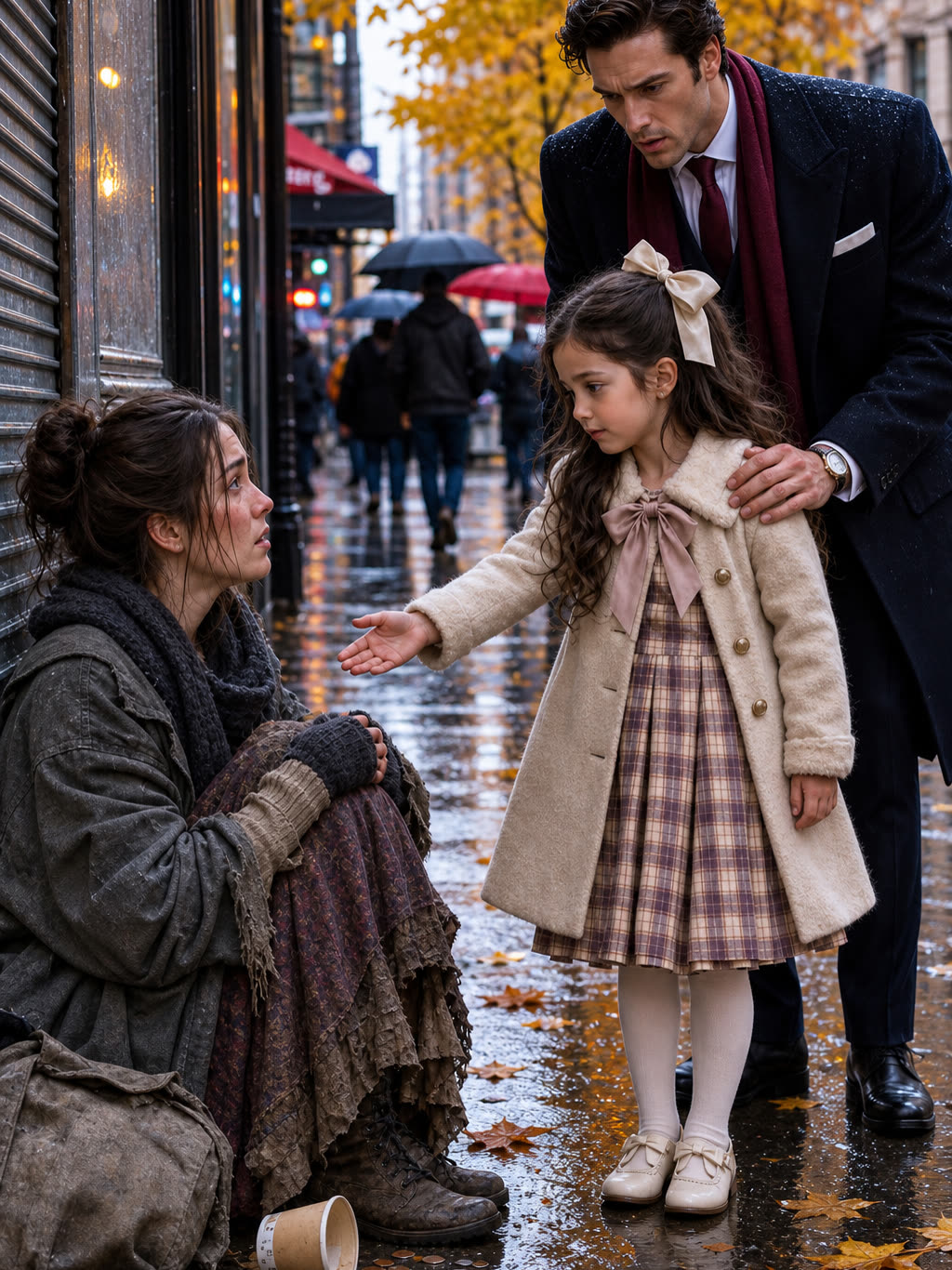
That Tuesday afternoon, we were walking toward our waiting vehicle after a pediatric appointment. Poppy wore her cream wool coat and the pink plaid dress she had insisted on, her hair tied back with a bow that was far too large for her head and that she adored. Rain blurred the storefront windows, and hurried pedestrians moved beneath umbrellas along Boylston Street. The autumn leaves had turned the pavement into a patchwork of gold and rust.
I was answering a message on my phone, half listening to her chatter about the doctor’s cold stethoscope, when Poppy suddenly tightened her grip around my fingers. It was not the playful squeeze I knew. It was urgent, almost desperate. She had stopped walking altogether, and when I looked down, her eyes were fixed on something across the street, wide and shining.
"Daddy, that woman across the street looks exactly like Mommy, and I think she’s waiting for us!"
I followed her gaze toward a closed electronics store. A thin woman sat beneath its metal awning, wrapped in an oversized gray coat. Her hair was tangled, and a battered paper cup rested beside her knees. Her shoulders were curled inward as if she were trying to take up as little space as the world would allow. I looked away at once, uncomfortable with the familiar ache of grief that rose in my throat, the ache I had learned to bury under spreadsheets and meetings.
"I know you miss your mother, sweetheart, but she died three years ago, and seeing somebody similar doesn’t mean she’s returned."
I said it as gently as I could. I had rehearsed this conversation in my head many times, because Poppy had asked about her mother again and again over the years, and each time I searched for words that would not break her heart or mine. But she shook her head, and the certainty on her small face frightened me more than any boardroom ever had.
Before I could explain further, she pulled toward the pedestrian crossing. I followed immediately, keeping her beside me until the crossing signal changed, my hand wrapped tightly around hers. Cars hissed through the puddles. Somebody’s umbrella knocked against my shoulder. All I could think was that I needed to get her to the car, away from this street, away from the strange hope in her eyes that I was about to crush.
The woman noticed us approaching and lowered her face. It was a small movement, but I saw it, the quick way she turned from us like someone accustomed to being turned away from. Poppy stopped directly before her, rain dripping from the ends of her dark hair, her small chest rising and falling.
"Mommy, I’ve been looking for you, and Daddy said you couldn’t come home anymore!"
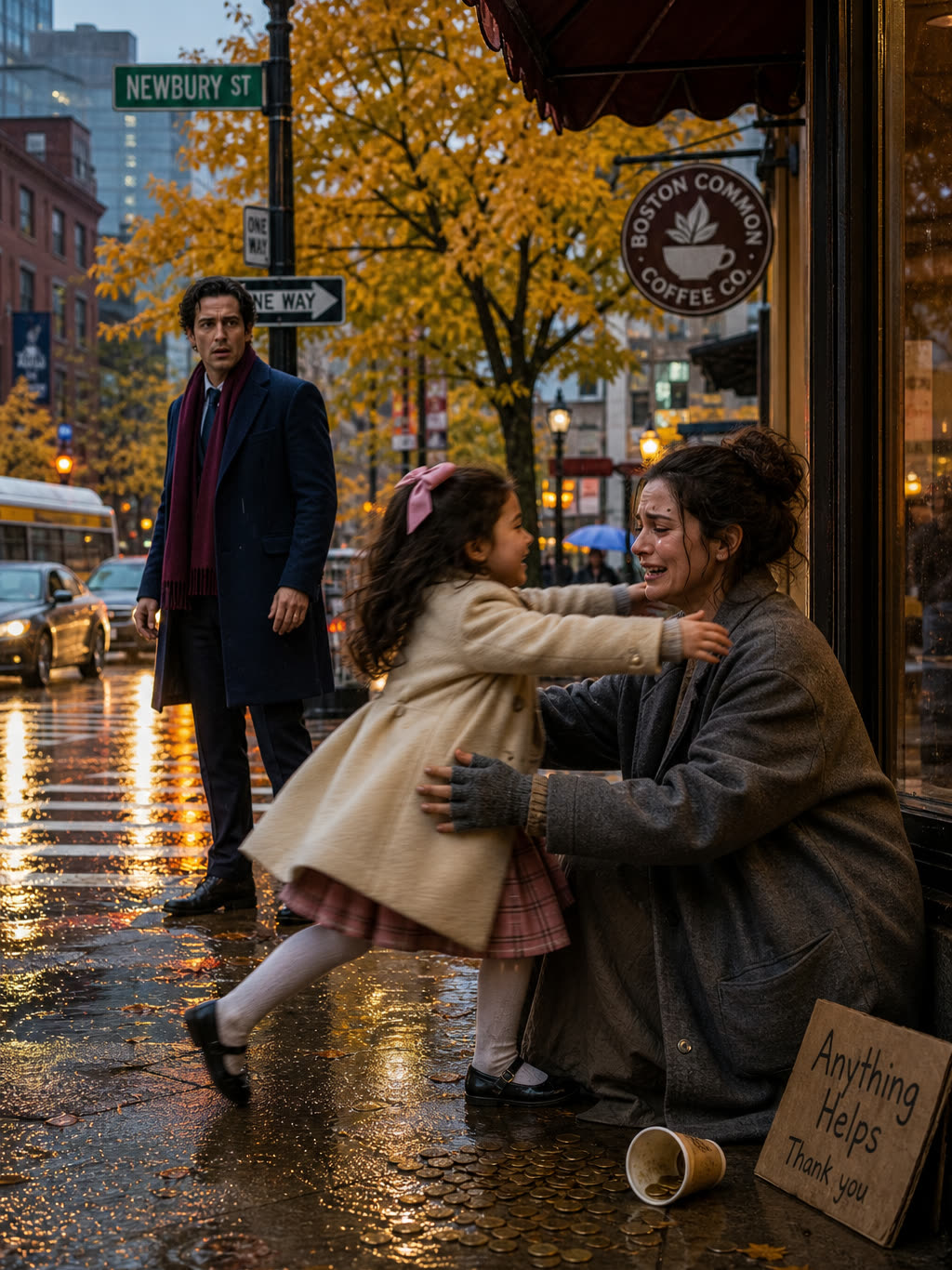
The woman slowly raised her head. Her eyes widened. The paper cup slipped from her trembling fingers, spilling coins across the wet pavement, and the sound of them rolling and settling was the loudest thing I had ever heard. Then she reached toward Poppy, her hand shaking, as though afraid the child might vanish if she touched her.
My daughter stepped into her embrace, and she held her against her chest, one hand cradling the back of Poppy’s head, her eyes squeezed shut. Poppy’s cream coat darkened against the gray wool, and neither of them seemed to notice the rain.
"My beautiful little girl, I never stopped wanting to come home to you," she whispered.
I couldn’t move. Every instinct told me this was cruelty, some terrible coincidence or a cunning trick, but my body would not obey. Beneath her exhausted expression and hollow cheeks, I recognized the woman I had married. The slight asymmetry of her jaw. The small beauty mark near her left eyebrow. The familiar way she kissed our daughter’s forehead, lingering a moment longer than anyone else would.
I had seen that kiss ten thousand times. I had seen it in the nursery, in the back seat of cars, in the doorway of our bedroom when she thought I was not watching. A stranger could not have invented it. A stranger could not have known to press her lips to that exact spot above Poppy’s left eyebrow and breathe in as if she were drinking the child’s scent.
"Adriana, how can you possibly be here when I watched them bury you three years ago?"
The words scraped out of me, and they did not sound like my voice. The street seemed to tilt. A man hurried past with a newspaper over his head and did not glance at us. A bus groaned to a stop. The world went on, indifferent, while mine cracked open on a wet sidewalk in the middle of the afternoon.
"Everett," she said, and my name in her voice nearly buckled my knees. "Please. Not here. Not in the street."
I crouched beside her on the wet pavement, heedless of my suit. Up close, she was thinner than I had ever seen her, and her wrists were chapped red from the cold. Her fingers, where they curled around Poppy’s coat, were cracked and raw. But the eyes were Adriana’s. There was no mistaking them. They were the same warm brown I had fallen in love with on a spring afternoon a decade earlier, only now they were rimmed with something that looked like years of fear.
"I identified your body," I said. My voice sounded strange. "The police called me. They said the car went into the harbor and there was nothing left to…" I couldn’t finish. The memory of that morgue rose up in me, the fluorescent lights, the sheet, the officer’s careful voice. I had signed what they put in front of me because I could not bear to look at it a second longer.
"You buried someone three years ago," she whispered. "But it wasn’t me."
Poppy had not let go of her. She had both arms wrapped around her mother’s neck, her small face pressed into the gray coat, as though she had been waiting for this moment her whole life. I thought of all the nights I had found her at the window, staring at nothing, and told myself it was only a child’s imagination. Perhaps some part of her had never believed what I told her.
"Who did you tell?" Adriana asked. Her eyes darted up and down the street, scanning every passing face, every parked car, every shadow beneath every awning. It was not the glance of a woman looking for help. It was the glance of someone who had learned to expect a hand on her shoulder at any moment. "Does anyone know you’re here with her?"
"My driver. Nobody else."
"Then get us out of the rain," she said. "And Everett, please don’t call your mother."
The way she said your mother made the back of my neck go cold. I had spoken to my mother that very morning. She had asked whether Poppy’s appointment had gone well, and she had told me to take care of myself. I felt the question rise in me, huge and terrible, and I swallowed it, because the woman I had mourned for three years was trembling on a wet sidewalk, and the rain was still falling, and somewhere behind the quiet fear in her eyes there was a story that I was no longer sure I wanted to hear.
Part 2: The Secret Behind an Empty Grave
I took them to my penthouse, because it was the only place I could think of. The ride was silent except for the rain and the soft hum of the engine. Poppy sat across Adriana’s lap with her face turned toward her mother’s neck, and Adriana kept one hand over her hair, as if she needed to feel it to be sure. My driver glanced at me once in the mirror, and I shook my head, and he asked no questions.
Adriana stood in the doorway for a long time before stepping onto the rug. She looked at the high windows, the grey city beyond them, the framed photographs on the wall. Her gaze lingered on one of the three of us at the beach, taken the summer before everything ended. Her lips trembled.
"It looks exactly the same," she said.
"I couldn’t change anything."
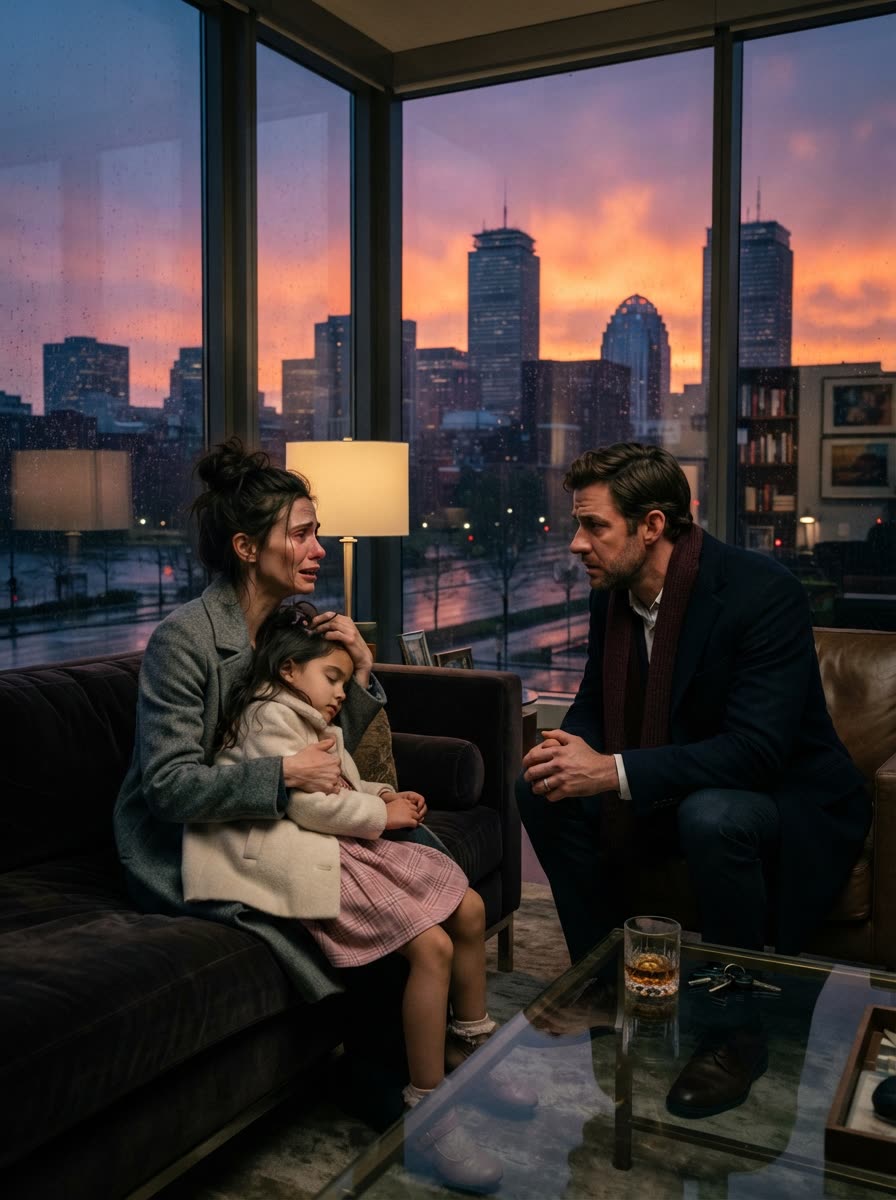
She ate soup at the kitchen island with Poppy in her lap, and I watched her hands shake around the spoon. She ate slowly, carefully, like someone who had learned not to trust that food would be offered twice. Poppy would not leave her side even to sit in her own chair. Every few minutes, she touched her mother’s cheek with one finger as if checking that it was real.
When Poppy finally fell asleep on the couch with her fingers tangled in her mother’s hair, Adriana told me everything. She spoke in a low voice, her eyes on the sleeping child, and the rain on the windows gave her words a strange rhythm, as if the city itself were listening.
Three years ago, she had found something in the Langford Family Foundation records. She had been helping with the annual audit, a favor for my mother, and she noticed that the charity’s money was moving through accounts that didn’t exist on paper. Millions of dollars, funneled into shell companies. The signature authorizing the transfers belonged to Constance Langford.
"I went to her first," Adriana said. "I thought there had to be an explanation. I thought she’d be embarrassed and fix it. Instead, she was very calm. She asked me to give her a week."
"My mother wouldn’t…"
"Everett." She said it gently. "Let me finish."
I closed my mouth. My hands were clenched between my knees so hard that my knuckles had gone white. Part of me wanted to leap up and shout that she was lying, that nobody could do such a thing, least of all the woman who had rocked me through fevers and nightmares. But another part, a colder part I did not like, was already remembering small things. My mother’s too-quick answers about the foundation. The way she had insisted on arranging the funeral herself.
Four days later, Adriana was driving back from Poppy’s two-year checkup when a car pulled out in front of her on the harbor road. She remembered the airbag, then a man in a paramedic’s jacket, then a needle. She woke up in a private room with no windows and a nurse named Ruth, who called her Miss Carter and told her she was being treated for a breakdown.
"I told them my name. I told them my husband would be looking for me." Her voice broke. "Ruth said you had signed the papers. That you’d agreed it was best for everyone."
"I never signed anything," I said. "I was told you were dead."
"I know that now."
She had spent two and a half years in a facility called Harbor Pines, in the Vermont hills, sedated most days, convinced that her family had given up on her. A doctor named Lionel Pryce visited every month and told her that fighting the diagnosis would only prolong her stay. She said the days had blurred into a single grey stretch, marked only by the changing light on the ceiling and the taste of pills.
"Last spring, Ruth started skipping my evening dose," Adriana said. "I don’t know why. Maybe her conscience finally got the better of her. I woke up clear for the first time in years, and I understood how long I’d been gone. I walked out the back door on a Sunday when the guard was on break."
She had made her way south on freight trucks and church buses. She knew she couldn’t go to the police. Her ID was gone, her records said she was a patient named Carter, and the only people who knew her real story were the people who had put her there. Every kindness she had received along the way had been small and anonymous, a sandwich, a seat near a heater, and she had been afraid of every one.
"I came to Boston because I wanted to see Poppy," she said. "Just once. I stood outside the preschool for weeks. I never got close. I was afraid if your mother found out I was alive, she’d finish it."
I stared at the sleeping girl on my couch and understood that my daughter had spotted her mother from across a rainy street, in a gray coat and tangled hair, after three years. A child’s heart doesn’t make mistakes like that. I had spent three years certain that I was protecting her from false hope, and all along she had been the only one of us who had not lost faith.
I did not call my mother. I sat awake beside them most of the night, watching the rise and fall of two breathing shapes on the couch, listening to the city hush itself after the rain. Twice my phone lit up with my mother’s name, and twice I turned it face down. The second time, my hand was shaking.
At six the next morning, I called Maureen Kowalski, a retired homicide detective who had once investigated a fraud case for my company. She arrived within the hour, listened for ninety minutes without interrupting, and then asked Adriana to describe the room at Harbor Pines. Adriana described it in perfect detail: the lock, the pale green paint, the narrow window slit near the ceiling, the sound of the nurse’s shoes.
By noon, Maureen had a name for the paramedic from the harbor road, a man named Garrick Doyle who had lost his license in two states. By evening, she had found the casket’s origin. A funeral home in Revere had received an unclaimed body three years ago, a woman in her thirties who died in a county hospital with no family. The paperwork had been altered to match Adriana’s dental records.
"Somebody paid a lot of people to look away," Maureen said.
"My mother," I said. It was the first time I had let the words out loud. They tasted like metal.
"Maybe," she said. "But I want her confession, not your suspicion. Can you get it?"
I thought about the woman who had raised me, who had taught me to tie a tie and hold a spoon, who had cried harder than anyone at the funeral. I thought of her hand on my shoulder at the graveside, warm and steady, the hand that had guided me away from a hole in the ground that held a stranger.
"I can try."
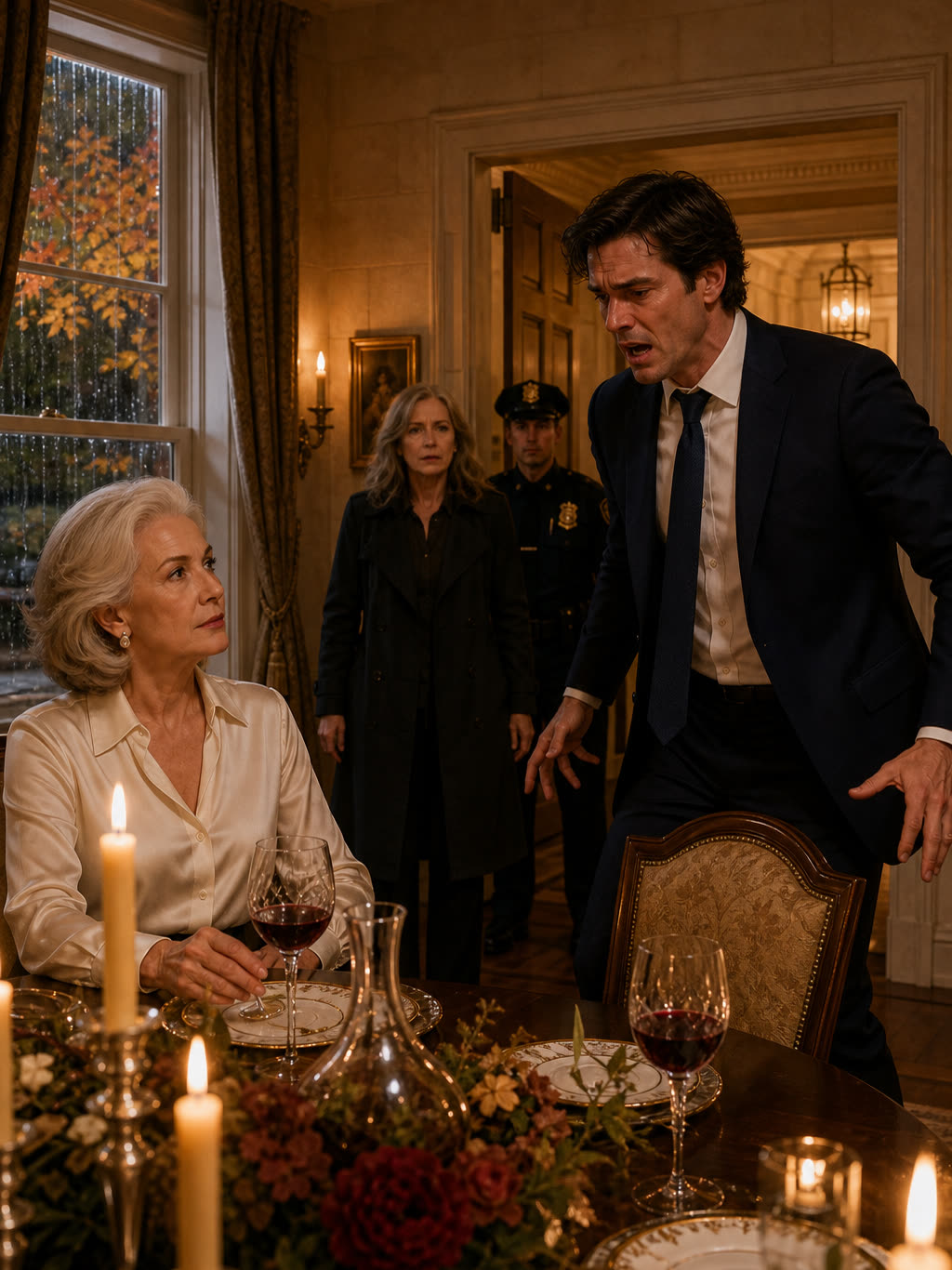
I invited my mother to dinner that Friday at her own house, a limestone townhouse on Beacon Hill. Adriana waited in a car three blocks away with Poppy and a female officer. I wore a small recorder under my shirt, and Maureen and two detectives sat in a van outside. Before I left, Poppy had pressed her stuffed rabbit into my hand and told me, very seriously, to bring it back.
Constance Langford greeted me at the door in a cream silk blouse, her silver hair perfectly set.
"You look tired, darling," she said, kissing my cheek. "You work too hard."
Her perfume wrapped around me, the same one she had worn my whole life, and for a moment I was a boy again, standing in this very hallway with a scraped knee. I made myself walk past the memory. The dining room was set for two, candles lit, a bottle of red already breathing on the sideboard.
"I’ve been thinking about Adriana," I said.
Her smile did not move. "Of course you have. It’s the anniversary soon."
"I found something in the foundation accounts."
She went still. It lasted a second, no more, but I saw it. Then she poured two glasses of wine with perfectly steady hands, and the dark liquid rose without a ripple, and I understood that I had just stepped into a room from which neither of us would leave the same.
Part 3: The Confession and the Road Home
"You were always too sentimental, Everett," my mother said, sitting down across from me. "Your father was the same. He wanted to give the money away, as if wealth were something to apologize for."
She set one glass in front of me and kept the other, turning the stem slowly between her fingers. The candlelight caught the pearls at her ears. She looked, as she always did, like a woman at ease in her own world.
"The foundation money wasn’t yours."
"It was the family’s. I made it grow." She took a sip. "I was moving it into safer places. Adriana didn’t understand. She threatened to go to the state attorney general. Over a few accounting entries."
"A few hundred million dollars."
"Over a misunderstanding." Her voice cooled. "I gave her every chance to be reasonable."
My heart pounded against the recorder, so hard I was certain she could hear it. I thought of Adriana’s chapped wrists and the way she had gripped her spoon. I thought of a pale green room without windows. I kept my face still, as I had learned to do in a thousand negotiations, and asked the only question that mattered.
"What did you do to her?"
She looked at me for a long moment, and for the first time I saw the woman clearly, without the warmth I had always painted over her.
"I protected my family," she said. "That girl would have ruined us. Poppy would have grown up with a mother who destroyed everything her grandfather built. I arranged a quiet place for her. She was never harmed. She was cared for."
"She was drugged for three years."
"She was treated." My mother’s chin lifted. "Dr. Pryce assured me she was comfortable."
"And the funeral?"
"A sad necessity." She waved a hand. "You needed to move on, darling. You couldn’t have done that while she was still in the picture."
I stood. My legs felt like water. The chair scraped against the floor, and the sound seemed to echo through the whole old house.
"You let me bury an empty casket."
"I gave you a clean grief," she said. "It was kinder than the truth."
The front door opened. Maureen walked in with two uniformed officers and a warrant. My mother turned her head slowly and looked at me. Not with anger. With the stunned, wounded expression of a woman who truly believed she had done nothing wrong.
"Everett," she said. "Tell them to leave."
"I can’t," I said. "I’m sorry."
"You’re choosing a stranger over your own mother?"
"No," I said. "I’m choosing my family."
They led her out in her cream silk blouse. She did not look back at the house. The door closed behind her, and the candles went on burning over two untouched glasses of wine, and I stood alone in the room where I had once been a child, unable to tell whether I was grieving or breathing for the first time in years.
The trial lasted five months. Constance Langford was convicted of kidnapping, conspiracy, fraud, and falsifying a death record. The court sentenced her to twenty-eight years. Dr. Pryce and Garrick Doyle took plea agreements and testified against her. Ruth, the nurse who had skipped Adriana’s evening dose, came forward on her own and received a reduced sentence for her cooperation. Adriana asked the judge to remember that, and the judge did.
The foundation’s missing money was recovered, nearly all of it. We put it back where it belonged and renamed the charity after my father. Adriana joined its board, and she personally reviewed every grant. She read each line twice, her finger moving down the page, and no one ever questioned her care.
Recovery was slower than any courtroom. For months, Adriana flinched at locked doors. She slept with the bedroom light on and woke with her heart racing, convinced the walls were closing in. She saw a trauma specialist every Tuesday and learned, little by little, to say I’m safe and believe it. I learned alongside her, how to sit quietly without filling the silence, how to wait.
Poppy never doubted for a second that her mother had come home. She followed her around the penthouse like a small shadow, bringing her drawings, her shoes, her stuffed rabbit, anything she could think of to place in her mother’s hands. At bedtime, she insisted on checking that the front door was locked, then climbed into our bed between us, one hand on each of us, as if she were holding the world together.
"You can’t leave again," she told Adriana one night in the dark.
"I won’t," Adriana whispered. "I promise."
"Even if someone tries to make you?"
"Even then. I’ll walk all the way home. I did it once."
I lay awake long after they were both asleep, listening to the rain on the glass.
On the second anniversary of that November day, we went back to Boylston Street. The electronics store was open now, its awning rolled up, its windows full of glowing screens. Poppy stood on the sidewalk in a yellow raincoat, looking across the street at the empty spot where her mother had once sat.
"That’s where I found you," she said.
"That’s where you found me," Adriana said, kneeling beside her. "How did you know it was me?"
Poppy thought about it very seriously.
"You kissed my head the same way," she said. "Nobody else does it like that."
Adriana laughed through tears and pulled her close. I stood behind them with my hand on both of their shoulders while the rain tapped on our umbrella and the traffic hissed past.
I had spent three years visiting a grave that held a stranger. I had told myself that grief was the cost of love, and that silence was the price of surviving it.
But the silence had been a lie, and it ended when a five-year-old girl broke away from my hand and ran into the arms of the one person I had believed was gone forever.
THE END
Disclaimer: This story is a work of fiction inspired by real-life themes. Names, characters, places and events are fictionalized, and any resemblance to real persons is purely coincidental. Images are for illustration purposes only.
