

PART 1: The Last Goodbye
Marcos Almeida was seconds away from saying his final farewell to his pregnant wife when something made the blood freeze in his veins. The crematorium staff were already preparing to seal her coffin, and he pleaded with them to lift the lid one last time. Then he saw it: a faint stirring beneath the fabric that covered her stomach.
Everyone around him insisted that it could not be real. His wife had been declared dead after a terrible accident on the highway. But Marcos would not allow the process to continue. Only a short while later, a medical team confirmed something extraordinary: his unborn son was still alive. And what the doctors found afterward would reveal a horrifying secret about the crash that had supposedly claimed his wife’s life.
Marcos could never say exactly when his life had come apart. The moment had no clear edge for him, only fragments that returned in the dark. He remembered the heavy rain hammering against the windows of his home in São Paulo, a steady drumming that had seemed almost soothing at first, the kind of sound that made a house feel safe.
He remembered his phone vibrating against the kitchen table, buzzing across the wood until he reached for it. And he remembered an unfamiliar voice on the line, a voice that spoke carefully and slowly, mentioning Rodovia dos Imigrantes, the highway where his wife had been traveling.
His wife, Ana Clara, had left earlier that afternoon to take care of a few family errands and to pick up some things for their unborn son. She had been in good spirits when she went out, humming as she gathered her keys. She was seven months pregnant, and every small outing had become part of the long, joyful countdown to the day their baby would arrive.
Back at home, in the nursery, a brand-new crib still leaned in pieces against the wall, its slats and screws waiting for Marcos to finish what he had promised to do. The room smelled of fresh paint, baby soap, and newly purchased furniture. Everything in it seemed to be holding its breath, waiting for a child who had not yet been born.
Ana Clara had folded their baby’s clothes with great care. She had arranged his tiny socks in neat little pairs and laid his blankets inside a drawer, smoothing each one with her palm as though the child were already wrapped inside it. Nothing in that room had been left to chance. She had made it ready with love.
They had already chosen his name.
Miguel.
Marcos had imagined holding his son countless times. In his mind, he had rehearsed the moment over and over: the weight of a newborn in his arms, the first small sound, Ana Clara smiling at him from the hospital bed. He had never once imagined that the child might enter the world without his mother. Now he stood in the middle of that unfinished nursery with the phone pressed to his ear, the rain rattling the window, and the half-built crib looming in the corner like a question he could not answer.
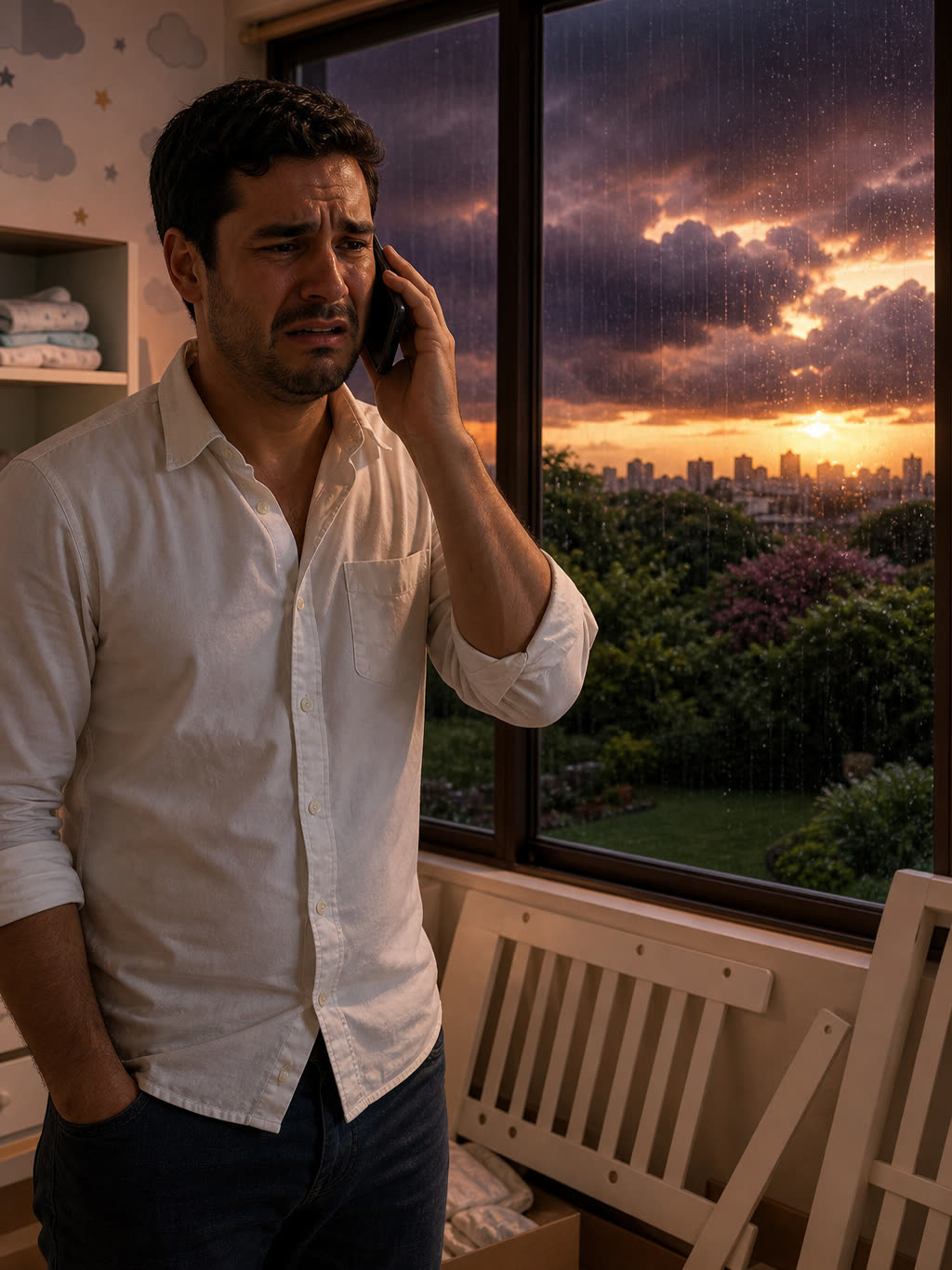
The person on the phone explained that Ana Clara’s car had apparently lost control on the rain-soaked highway. There had been a collision. The impact was severe. She had been pronounced dead. Marcos heard every single word, and yet none of it seemed real. The sentences passed through him like water through his fingers, leaving nothing he could hold.
The caller kept explaining the circumstances, but his voice grew distant, as if he were speaking from the far end of a long tunnel. How could Ana Clara be gone? Only that morning she had kissed him goodbye and reminded him to finish assembling the crib. Now someone he had never met was telling him that she would never come home.
Marcos and Ana Clara had met eight years earlier while waiting in line at a bank. He had first noticed her when she stood up for an elderly woman who was being treated rudely. She did it without hesitation, without caring who was watching. Ana Clara had a warm laugh, but she was never afraid to speak her mind. Marcos had fallen in love with her kindness long before he understood how much happiness she would bring into his life.
Their wedding had been simple. There was no extravagant reception, only a family gathering filled with laughter, plenty of food, and relatives offering advice nobody had asked for. Looking back, Marcos thought it had been perfect precisely because it was so ordinary and so warm, a day that belonged entirely to the people who loved them.
Ana Clara treasured small things. She saved birthday cards, photographs, handwritten notes, and every ultrasound image from her pregnancy. She believed that memories deserved to be protected, and she guarded them the way other people guard jewelry. That was why she kept a blue folder holding everything related to Miguel.
Inside it were the ultrasound scans, the medical records, the appointment details from Hospital das Clínicas, and a handwritten list of the items they still needed before the baby arrived. Marcos would later discover that this ordinary folder contained clues far more important than either of them could have imagined.
Ana Clara’s younger brother, Gustavo, had always been part of their lives. He visited the house often, borrowed money, and insisted that family members should help one another. He said it with an easy smile, as though the matter were settled before anyone could object.
Marcos had never entirely trusted him. There was something about Gustavo’s constant financial problems and his convenient excuses that left Marcos uneasy, a feeling he could never quite put into words. But Ana Clara loved her brother. And because Marcos loved his wife, he had tried hard to be understanding.
On the afternoon of the accident, Gustavo called Marcos twice before the police ever contacted him. During the first call, he simply asked whether Ana Clara had returned home. During the second, he sounded anxious. At the time, Marcos thought nothing of it. He was far too overwhelmed by the news of his wife’s death to consider anything else. But later, those two calls would become impossible to forget.
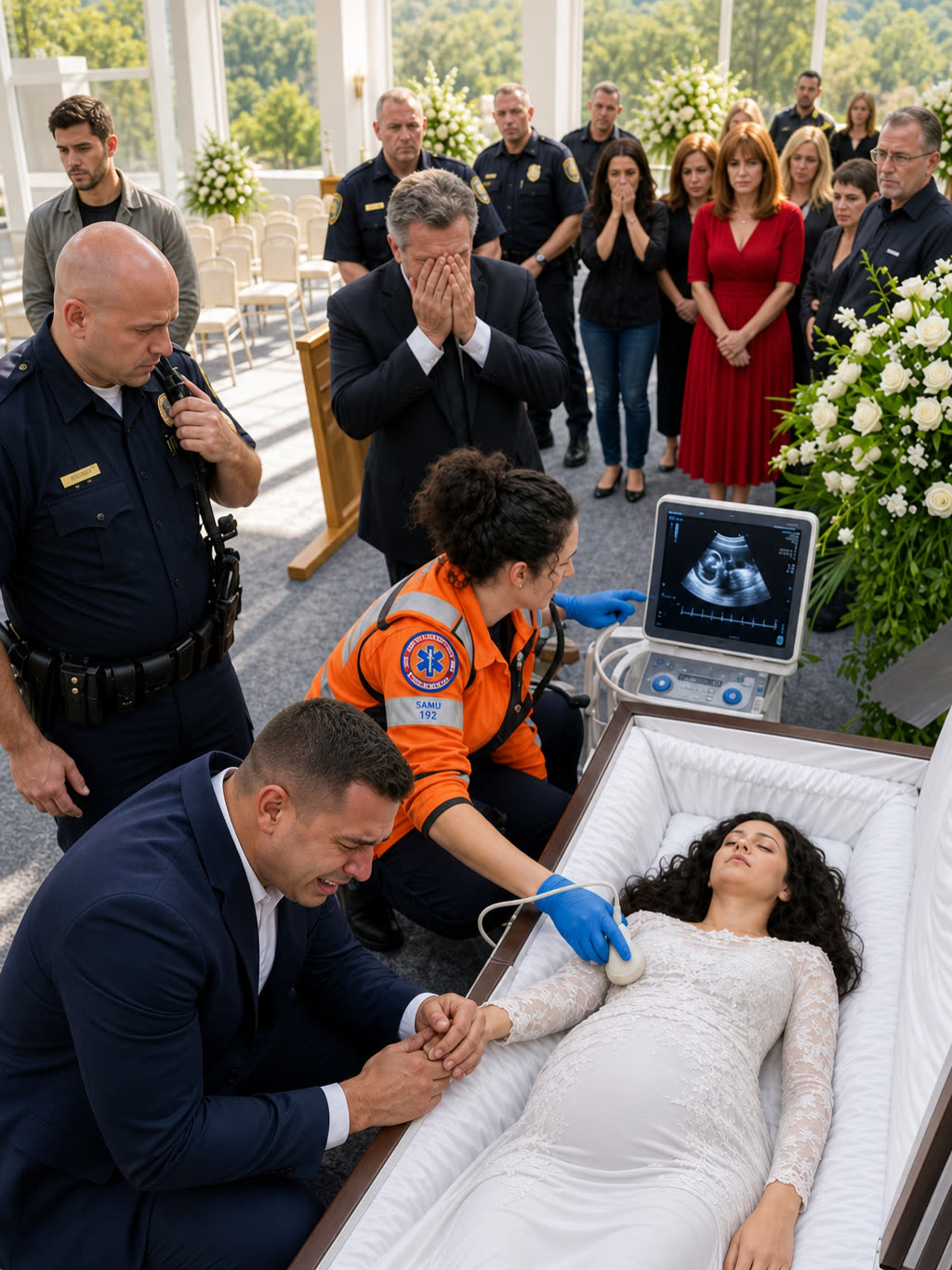
The following day, Marcos arrived at the Vila Alpina Crematorium in eastern São Paulo. He felt as though he were moving through a nightmare, his legs carrying him forward while his mind lagged far behind. The flowers smelled unbearably sweet. The bright overhead lights made the room feel cold and unfamiliar, stripped of any comfort.
At the center of the room stood a polished wooden coffin, and inside it lay the woman he had promised to love for the rest of his life. Ana Clara rested motionless, her face pale beneath the soft lighting. Her pregnant stomach was still visible beneath the fabric covering her body, a curve of life in a room where everything else spoke of ending. Marcos could barely look at her.
Beside him, Ana Clara’s mother clutched a rosary and whispered prayers through her tears, her lips moving without pause. Other relatives stood silently nearby, their heads bowed, their shoes shifting quietly on the floor. Nobody seemed to know where to put their hands or their eyes.
Gustavo stayed close to the wall, his arms folded tightly across his chest. His eyes were red, and he appeared devastated. Yet something about his expression seemed strangely distant, as if part of him were somewhere else entirely. Marcos was too consumed by grief to pay attention.
Eventually, a crematorium employee approached carrying the final authorization documents. The arrangements had already been made. All that remained was the last confirmation, a signature that would close the door on everything. Marcos stared at the pen. His hand refused to move.
Then he looked toward the coffin.
“Please,” he whispered. “I need to see her one more time.”
The employee hesitated. He explained that the process was about to begin. But Marcos repeated his request, his voice cracking at the edges.
“Just one last time. Please.”
After a brief discussion among themselves, the staff agreed. The coffin was opened, and the room fell silent. Marcos stepped closer and leaned over his wife. He wanted to tell her how sorry he was. Sorry that he had not gone with her. Sorry that he had allowed her to drive in such terrible weather. Sorry for every ordinary moment he had taken for granted.
He reached toward her hand. Then something caught his attention. The fabric covering her stomach moved. It was barely noticeable, a tiny flutter, so slight that he wondered whether grief had finally begun playing tricks on his eyes. Marcos froze and stared at her belly.
For several long seconds, nothing happened. The room seemed to hold its breath with him. Then he saw it again. Another faint movement. His breath caught in his throat.
“Wait!”
The employee turned toward him. Marcos leaned closer, his heart slamming against his ribs.
“Something moved!”
One of the staff members tried to explain that certain physical reactions could occur after death. But Marcos was not listening. He placed a trembling hand near Ana Clara’s stomach, not quite daring to touch. There it was again. A tiny movement beneath the fabric.
“Stop everything!” he shouted.
The room erupted into confusion. Ana Clara’s mother rushed forward, the rosary swinging from her wrist.
“What is it? Marcos, what’s happening?”
He looked at her with wide eyes.
“The baby!”
His voice broke.
“I think Miguel is still alive!”
Someone called emergency services. Another employee hurried toward the administrative office. The mourners began speaking all at once, their voices overlapping in a rising wave. But Marcos barely heard any of it. He stayed beside the coffin, his eyes fixed on Ana Clara’s stomach, afraid that if he looked away even for a moment, the miracle would vanish.
Then he noticed Gustavo. Unlike everyone else in the room, Gustavo was not looking at his sister. He was staring toward the exit. His expression had changed completely, the sorrow wiped away and replaced by something Marcos could not name. Marcos would remember that look for years.
A few minutes later, paramedics from SAMU arrived. They moved quickly through the crematorium carrying their medical equipment, and the funeral room suddenly became an emergency treatment area. One paramedic asked everyone to step back. Another began checking for signs of fetal cardiac activity.
Marcos stood motionless. The seconds felt endless, stretched thin by fear. At first there was only static and uncertainty, the hiss of a machine searching for something that might not be there. Then, from somewhere deep within the noise, a faint, rapid heartbeat was detected.
The paramedic looked toward his colleague, and the expression on his face made Marcos’s knees go weak. Whatever he was about to say would decide everything.
PART 2: A Faint Cry Beyond the Doors
“The baby has a heartbeat.”
Marcos nearly collapsed. His legs trembled beneath him, and he gripped the edge of the coffin to stay upright.
“Is he alive?”
“Yes. But we need to move immediately.”
Ana Clara’s mother began crying uncontrollably, the sound rising out of her like something she had held for a lifetime. Marcos covered his face with both hands. His wife was gone. But the son they had dreamed of meeting was somehow still fighting to survive, and that fragile fact was almost too enormous to carry.
The emergency team arranged an immediate transfer to Hospital das Clínicas. The planned cremation was suspended on the spot. Authorities were notified, because the discovery raised urgent questions about the original medical examination and the circumstances surrounding Ana Clara’s death.
As the medical team prepared to leave, a police officer examined the documents that had accompanied her body. Among them was the blue folder containing her pregnancy records. He turned the pages slowly, one by one, until one particular medical note caught his attention. The time recorded on it did not appear consistent with the preliminary timeline of the accident.
It was not proof of wrongdoing. But it was enough to warrant further investigation, and the officer made a careful note of it before closing the folder.
Marcos climbed into the ambulance without a second thought. He sat beside his wife and held her cold hand, wrapping his fingers around hers as if his warmth might somehow reach her.
“Please, Miguel,” he whispered. “Hold on. Daddy’s here.”
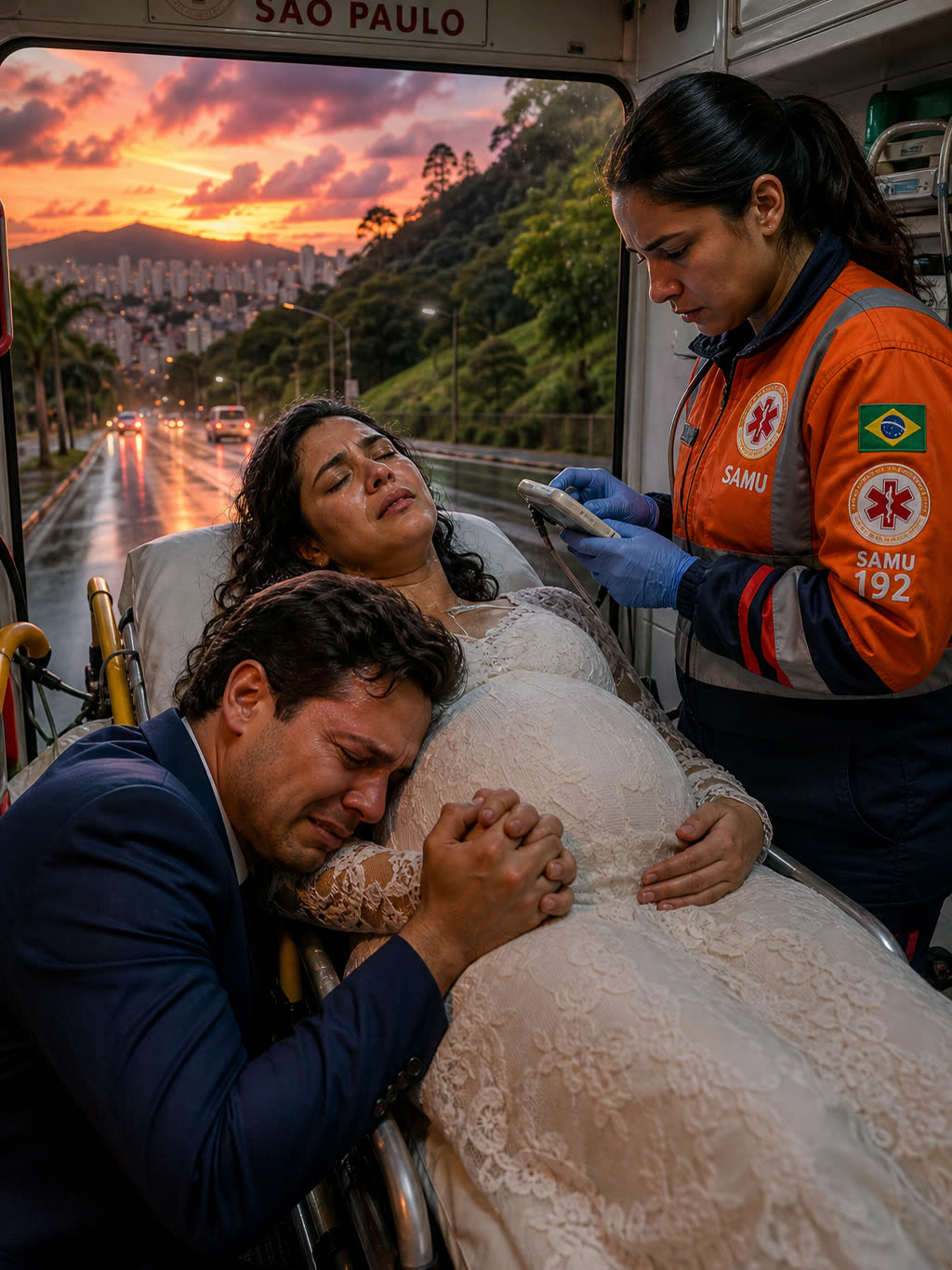
The siren echoed through the wet streets of São Paulo, a long wail rising above the traffic. Every red traffic light felt unbearable. Every turn seemed to take far too long. Through the ambulance window the gray city blurred past, and Marcos kept thinking about the tiny crib waiting at home, still in pieces against the nursery wall. He had already lost Ana Clara. He could not bear the thought of losing their child too.
When they arrived at the hospital, a team of doctors and obstetric specialists was already waiting at the entrance. They moved with swift, practiced precision. Ana Clara was rushed toward the operating room, and the wheels of the stretcher rattled down the corridor. Marcos tried to follow, but a nurse gently stopped him.
“Sir, you need to remain here.”
He shook his head, his eyes burning.
“Please. That’s my son.”
The nurse placed a reassuring hand on his arm.
“We’re going to do everything possible.”
The doors closed. Marcos sat in the hallway, still wearing the dark suit he had chosen for his wife’s funeral. His clothes smelled faintly of incense, a reminder of the room he had just left behind. He stared at the operating room doors, willing them to open.
Minutes passed. Then more minutes. The hallway clock seemed to crawl, and every footstep that echoed down the corridor made his heart jump. Nobody told him anything. He watched the doors as though they might speak.
At 6:32 p.m., a doctor briefly emerged to discuss an urgent medical authorization. At 6:41, a nurse hurried through the corridor. At 6:49, Marcos was still waiting for news, his hands clasped so tightly that his knuckles had turned white.
Then he heard something. A faint cry. At first, he thought he had imagined it, that his exhausted mind had conjured the sound out of pure longing. Then it came again, a tiny, fragile sound from beyond the operating room doors.
Marcos stood. His heart began to pound. A nurse appeared carrying a very small baby wrapped in a white blanket, holding him close against her chest.
“Mr. Almeida?”
He could barely speak.
“Is that…?”
“Your son.”
Miguel had survived. He was premature, fragile, and in need of immediate intensive medical care. But he was alive. Marcos dropped to his knees and began sobbing, the tears falling onto the hospital floor without any shame.
For a few precious seconds, the nurse allowed him to see the child before taking him to the neonatal intensive care unit. Miguel’s skin was reddish, his movements weak, and his breathing needed medical assistance. But he was there. A tiny piece of Ana Clara still living in the world.
Marcos believed he had just witnessed the most extraordinary moment of his life. He had no idea that the doctors were about to uncover something that would change the entire investigation.
During the emergency procedure, the medical team had noticed an unusual mark on Ana Clara’s body. Its location did not appear consistent with the injuries described in the traffic accident report. There was also an unexplained reaction on her skin. The findings were documented carefully, line by line, by people who understood that they might matter later.
Authorities requested additional forensic examinations, including toxicology testing and a more detailed inspection of the damaged vehicle. The cremation was formally suspended. What everyone had accepted as a tragic accident was now being questioned, and the quiet certainty that had surrounded Ana Clara’s death began to crack.
Investigators set about reconstructing Ana Clara’s final hours. They reviewed phone records, text messages, medical documents, and surveillance footage from businesses near Rodovia dos Imigrantes. Hours of grainy recordings were examined frame by frame. Most of it showed nothing of interest.
Marcos, meanwhile, could hardly think about anything beyond the hospital walls. He moved between the waiting area and the neonatal unit like a man in a trance, his mind caught somewhere between devastation and relief. He had been given back his son and had lost his wife in the same breath, and he did not know how to feel both at once.
Ana Clara’s mother stayed close to him. She sat in the hospital hallway with her rosary wrapped around her wrist, her eyes swollen from crying. At times she whispered Ana Clara’s name. At times she only stared at the floor. Neither of them could yet begin to understand what had happened.
Then, one recording proved especially important. A security camera at a gas station had captured Ana Clara’s car stopping shortly before the stretch of highway where the crash occurred. The investigator leaned toward the screen. In the rain-streaked image, someone stood beside the driver’s door.
It was Gustavo. Her own brother.
PART 3: The Truth Behind the Storm
The footage showed him arguing with Ana Clara in the rain. He appeared agitated. Ana Clara seemed upset. The confrontation had taken place only minutes before the accident, and every second of it was caught on camera, silent and unmistakable.
When investigators questioned Gustavo, he claimed he had merely stopped to discuss a family matter. He insisted that his sister had been nervous and distracted. He denied knowing anything that could explain the crash. His voice was calm, almost rehearsed.
But his story began to unravel when the toxicology results arrived. The examination detected a sedative in Ana Clara’s system. The substance was inconsistent with her known medical routine and posed serious concerns during pregnancy.
Marcos was stunned. Ana Clara had been exceptionally careful about medication. She rarely took even an ordinary painkiller without consulting her obstetrician first. Why would she have taken a powerful sedative on the day of the accident? The question sat inside him like a stone.
Investigators searched for more evidence. They examined her phone and recovered messages that had previously been deleted. Several were conversations with Gustavo. In them, Ana Clara demanded that her brother stop borrowing money. She accused him of lying to Marcos and of repeatedly exploiting the family’s generosity.
One message was particularly revealing. After Miguel was born, she intended to tell their mother everything. Gustavo had apparently accumulated debts that he had concealed from the family. Ana Clara had discovered the situation and refused to continue helping him.
Investigators began considering whether the argument at the gas station was connected to those financial problems. They examined the surveillance footage again. They compared Gustavo’s statements with his phone records. They reviewed the irregular medical timeline and the unexplained mark documented by the doctors.
Slowly, the evidence formed a disturbing picture. According to the investigation’s eventual findings, Gustavo had confronted Ana Clara during the storm and provided or administered a substance that impaired her ability to react while driving. The crash that followed was no longer considered an ordinary accident.
Marcos struggled to accept what he was hearing. Ana Clara had trusted her brother. She had defended him whenever Marcos questioned his behavior. She had given him money, welcomed him into their home, and believed he would never intentionally harm her. Now the investigation suggested that the person she had tried so hard to help had played a role in her death.
When Gustavo was arrested, Marcos felt no satisfaction. His mind returned to the crematorium. He remembered the way Gustavo had stepped backward when the baby’s heartbeat was discovered. The way he had looked toward the exit rather than toward his sister. At the time, Marcos had dismissed the behavior as shock. Now it appeared very different.
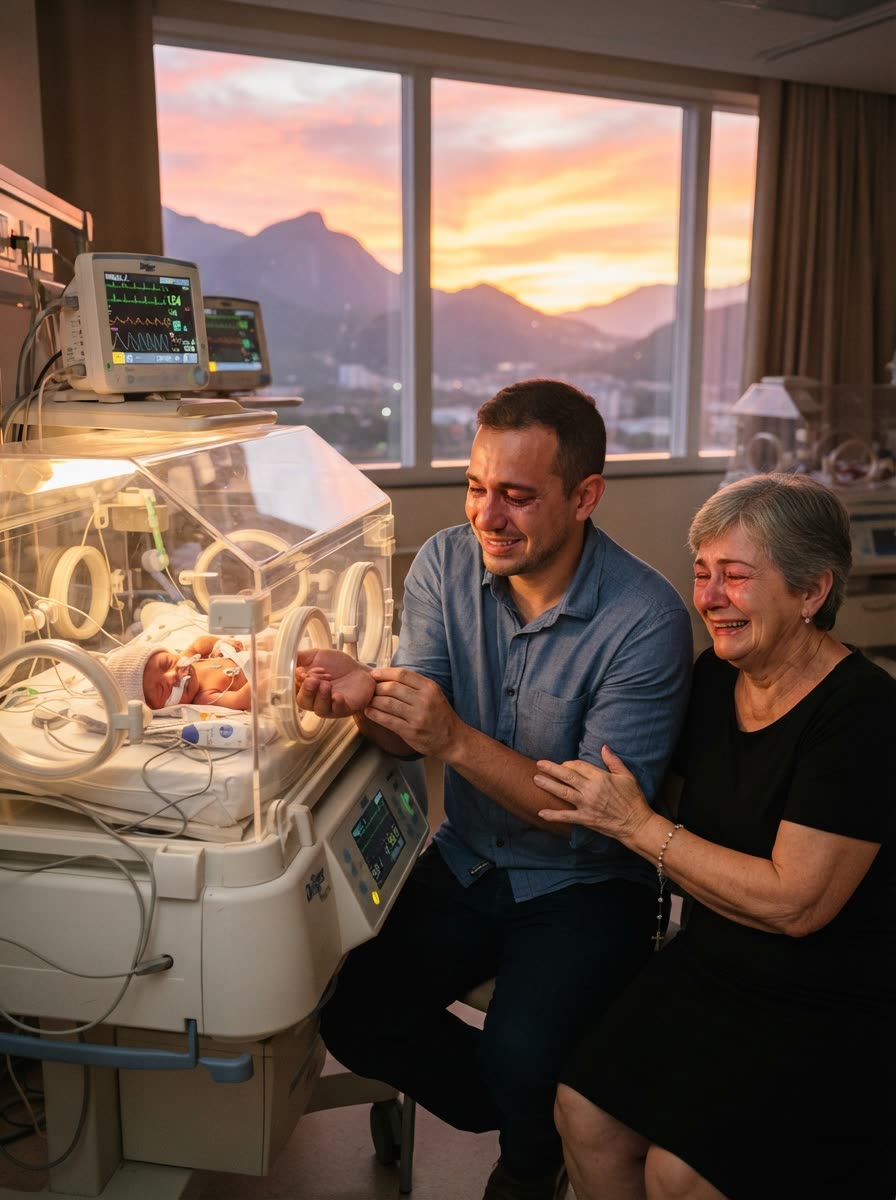
Meanwhile, Miguel remained in neonatal intensive care. His premature arrival had left him in a fragile condition, and every hour mattered. Marcos spent countless hours beside the incubator. He learned to understand the monitors, the feeding routines, and the complicated medical equipment that kept his son stable.
Progress came slowly. A little more weight. One fewer tube. A stronger cry. A successful feeding. Each small improvement felt enormous, as though the whole world had shifted a little in his favor. Marcos celebrated every one of them quietly, afraid to hope too loudly.
The first time Marcos was allowed to hold Miguel’s tiny hand without protective gloves, he began crying. The baby’s fingers curled weakly around his own, and for a moment the whole noisy ward seemed to fall away.
“You’re just like your mother,” he whispered.
“You’re stronger than anyone realizes.”
Ana Clara’s mother visited frequently. She often sat beside Marcos in silence, her rosary wrapped around her wrist. She had lost her daughter. She had nearly lost her grandson. And she was struggling to understand how her own son could have been involved in such a tragedy. Neither of them had words that could make the pain disappear.
So they simply sat together, watching the small chest rise and fall, listening to the soft rhythm of the monitors. Sometimes that was the only comfort they could offer one another.
Months later, the criminal proceedings began. The evidence included hospital reports, toxicology findings, surveillance footage, recovered messages, and inconsistencies in Gustavo’s account. The prosecution argued that Ana Clara’s death was not the result of a simple loss of control on a wet highway.
The court ultimately found Gustavo responsible for his role in the events that caused his sister’s death and endangered her unborn child. He was convicted. But the verdict brought Marcos no happiness.
It did not bring Ana Clara back. It did not allow her to hold Miguel for the first time. It did not give them the family life they had been preparing for. Still, the truth mattered. Without the discovery at the crematorium, the circumstances surrounding her death might never have been fully investigated.
Years passed. Miguel grew into a healthy little boy. He learned to walk, talk, laugh, and ask endless questions. The house that had once been so silent filled again with small footsteps and bursts of giggling.
Marcos made sure his son knew about the mother who had loved him before he was born. He told Miguel how Ana Clara stood up for people who needed help. How she laughed at his terrible jokes. How she had carefully folded his baby clothes and spent hours choosing the perfect colors for his nursery. And how excited she had been to meet him.
Marcos kept the blue folder in a safe place. Inside were Ana Clara’s ultrasound photographs, Miguel’s first hospital bracelet, and copies of the medical records connected to the day his life was saved. He rarely opened it. But he could never bring himself to put it away.
Sometimes, after Miguel fell asleep, Marcos remembered that afternoon at Vila Alpina. The scent of flowers. The cold lighting. The polished wooden coffin. And the moment he had begged to see his wife one last time.
He remembered leaning over Ana Clara and noticing the faintest movement beneath the fabric. Everyone else had believed the farewell was over. The cremation had already been authorized. The final paperwork was waiting. But Marcos had refused to say goodbye without looking at her one more time.
That decision saved his son’s life. And it uncovered a terrible truth that might otherwise have remained hidden forever.
Because sometimes, the moment that changes everything does not begin with a dramatic revelation. Sometimes, it begins with a grieving husband who notices one tiny movement—and refuses to ignore it.
THE END.
Disclaimer: This story is a work of fiction inspired by real-life themes. Names, characters, places and events are fictionalized, and any resemblance to real persons is purely coincidental. Images are for illustration purposes only.
