

PART 1: THE CALL THAT LEFT ME ON THE FLOOR
“MY MOTHER ONLY TURNS SIXTY-FIVE ONCE! IF YOU’RE FEELING THAT UNWELL, CALL A CAB!”
Those were the words my husband, Vance, barked into the phone while I lay curled on the floor of our home, thirty-nine weeks pregnant and caught in the grip of a serious medical emergency. The house around me was silent except for the rain tapping against the windows and the ragged sound of my own breathing. I remember staring at the grain of the wooden floorboards and thinking that nothing about this night was supposed to happen this way.
“Vance… my water broke! Something is terribly wrong! I can’t feel our baby moving!”
I begged for help between one contraction and the next, my voice cracking with fear. Through the speaker I could still hear everything: swelling music, bursts of laughter, and the bright clink of champagne glasses at an extravagant celebration in Queen Anne. It sounded like another world entirely, one where nobody was afraid.
Then my mother-in-law cut in, her voice strangely cold:
“Vance, sweetheart! Is she creating another scene just to spoil my birthday?”
My husband let out an impatient sigh. I knew that sigh well. I had heard it for years, every time my needs became inconvenient for him.
“Natalie, I don’t have time for your dramatics! Find transportation and get to Harborview’s emergency department. I’ll contact you after dessert!”
THEN HE ENDED THE CALL.
My name is Natalie Brooks Mercer, and in the stunned silence that followed, I understood something I could no longer pretend not to see. My husband had chosen to stay at his mother’s birthday party rather than help me through a medical emergency involving our unborn son. Another contraction rolled over me, so strong that the room seemed to tilt, and I began dragging myself across the wooden floor toward the front entrance, one painful inch at a time. When I reached out for the hallway table to steady myself, my trembling hand knocked into a stack of unopened mail, and a heavy ivory-colored envelope slid off and landed beside me.
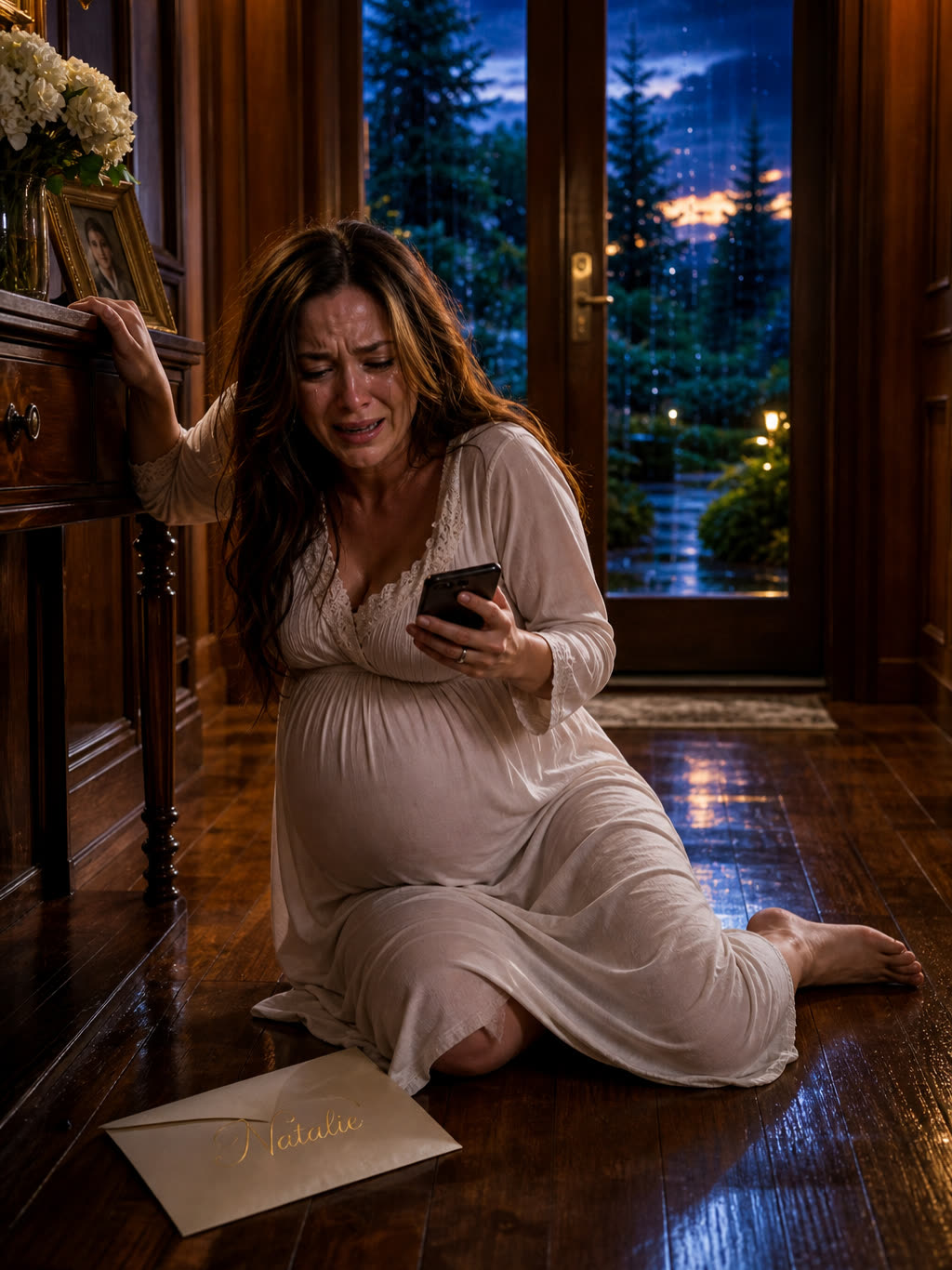
Even through the haze of pain, I noticed how thick and expensive the paper felt beneath my fingertips. Across its surface, in elegant golden lettering, was the name of a prominent Seattle legal firm. The gold caught the dim light of the hallway and seemed almost out of place beside my fear and the rain-streaked darkness outside.
Why would a firm like that send me a confidential letter? The question drifted through my mind, strange and faraway, but before I could follow it anywhere, another intense contraction demanded every ounce of my attention. I pressed my forehead against the cool edge of the table and breathed through it, whispering to my baby that I was still here, that I was not giving up.
Gathering whatever strength I had left, I managed to reach the front door and turn the lock, so that anyone who came for me could get inside. Then, with shaking fingers, I dialed 911 and clung to the phone as though it were a rope thrown across a river.
“Emergency responders are coming! Please remain awake and keep talking to me!” the dispatcher repeated.
I answered her questions as best I could, though my words kept dissolving into gasps. I counted the minutes the way I had once counted heartbeats on the monitor at my prenatal appointments, and each one stretched longer than the last. Then, at last, headlights swept across the rain-soaked driveway and washed the entrance in pale light.
Rapid footsteps sounded on the porch, quick and urgent, unlike the measured steps I expected from paramedics.
The heavy wooden door swung open.
“NATALIE! ARE YOU NATALIE BROOKS MERCER?”
An older gentleman in an expensive dark overcoat stood in the doorway, completely drenched by the rain. Water dripped from his sleeves and ran down his silver hair, but he did not seem to notice. His chest rose and fell as though he had sprinted the entire way.
I recognized his face instantly, and the recognition hit me almost as hard as the pain.
WARREN STERLING!
He was the influential billionaire who led the financial corporation that employed my husband. He was the executive whose reputation alone made Vance visibly nervous, the man whose name was spoken in our house the way people speak about weather that might turn dangerous.
Yet something about his appearance unsettled me even more than his sudden arrival. His silver-gray eyes and distinctive eyebrows looked remarkably similar to my own. It was like glimpsing my reflection in a window at night, older and lined with worry, but unmistakably familiar.
Warren dropped to his knees beside me without hesitation, heedless of the puddle spreading from his coat onto the floor. His expression suggested that he had finally found someone he had spent thirty-two years desperately trying to locate, and that he was terrified of losing her again.
Then his usually commanding voice trembled with emotion.
“PLEASE STAY STILL, MY GIRL… I’M HERE WITH YOU NOW. YOU WON’T HAVE TO FACE THIS ALONE AGAIN!”
I stared at him, astonished, my breath catching in my throat. Why would a billionaire I had never personally met speak with such genuine affection? And who exactly had he spent thirty-two years searching for?
The paramedics arrived moments later, filling the hallway with bright jackets and calm, practiced voices. They lifted me onto a stretcher, and as they carried me out into the rain, Warren stayed right at my side, one hand hovering near my shoulder as though he feared that if he let go, I might disappear.
“Why?” I finally whispered as the medical team administered medication and another contraction tightened across my abdomen. “Mr. Sterling… What brought you to my home?”
Warren hesitated before answering. Taking a clean white handkerchief from his tailored jacket, he gently brushed the perspiration from my forehead, the way a father might do for a feverish child. The tenderness of the gesture almost undid me.
He was the founder of the enormous financial organization where my husband, Vance Mercer, had spent seven years pursuing professional advancement. Yet here he was, sitting beside me inside an ambulance, looking more distressed than I could ever have imagined someone of his influence appearing. The sirens wailed around us, and the wet city blurred past the rear windows in streaks of red and gold.
“My investigator verified your identity less than two hours ago, Natalie,” he explained while the ambulance sirens echoed around us. “I never realized you had married Vance Mercer. We mailed two certified letters during the last six weeks, but neither received a response.”
My chest tightened with recognition. I suddenly remembered discovering a cream-colored envelope near our entrance, already opened. Vance had dismissed it as irrelevant corporate correspondence and discarded it before I could examine its contents. At the time, I had been too tired and too pregnant to question him. Now the memory rose up with an ugly clarity.
“He received it,” I murmured. “Vance accepted a certified letter about five weeks ago. I distinctly remember noticing his signature on the delivery confirmation.”
Warren looked at me in disbelief. The color seemed to drain from his face.
At that moment, we both began considering a troubling possibility. My husband had not simply remained at a celebration while I needed urgent medical attention; he might also have withheld important information concerning my biological family. The thought sat between us in the cramped ambulance, heavy and cold.
Before either of us could say more, the ambulance arrived at Harborview Medical Center. The rear doors flew open, and several healthcare professionals approached with a hospital stretcher, their faces focused and alert.
“Urgent obstetric case!” the paramedic reported. “Possible placental complications concerning fetal monitoring findings! Immediate assessment and intervention required!”
Bright hospital lights passed overhead in a dizzying rhythm as the staff rushed me toward the surgical department. I clutched the rail of the stretcher and tried to memorize faces, doorways, anything to keep myself anchored. An obstetric specialist walked beside me, speaking with a seriousness that frightened me more than any shout could have.
“Natalie, your baby is showing signs that he may not be receiving sufficient oxygen. We need to proceed with an emergency cesarean delivery.”
“Please help him!” I pleaded tearfully. “Please do everything possible to bring my little boy safely into the world!”
A nurse hurried alongside us with the necessary consent documents while the medical team prepared the operating room. Her eyes were kind, but her pen was already moving.
“Is your husband, Vance Mercer, available?” she asked.
I slowly shook my head, tears sliding into my hair.
“No. He isn’t here.”
Warren moved closer to my stretcher. The confident expression I had seen in photographs of corporate meetings had disappeared entirely, replaced by raw, unguarded worry.
“I’m her father,” he explained, maintaining a steady voice despite his trembling hands. “Please provide whatever medical care my daughter and grandson require. Financial arrangements will not be an obstacle.”
I desperately wanted to hold his hand and understand why finding me had taken so many years. I wanted to explain how frightened I felt, how much I worried about my son, and how impossible it seemed that my entire understanding of my family had changed within a single evening. But the medical team placed an oxygen mask over my face, and the words dissolved before they could leave me.
Their instructions became increasingly distant as the anesthesia began taking effect. The ceiling lights smeared into long white ribbons. I heard Warren’s voice somewhere beyond them, saying something I could not make out, and I tried with everything I had to hold on to it.
Then another warning sounded. A sustained alarm filled the room, sharp and relentless. The fetal monitoring equipment was no longer detecting a reliable heartbeat signal.
As my awareness gradually faded, I heard one physician urgently announce:
“We need to deliver this baby immediately!”
PART 2: THE SIGNATURE I NEVER SIGNED
When I finally opened my eyes, the rhythmic sound of medical equipment was the first thing I noticed, steady and almost soothing after the chaos of the night before. I attempted to shift position, but a deep discomfort spread across my abdomen. Without thinking, I reached toward my stomach, and what I felt there made my heart drop. My pregnancy was over.
“My baby!” I exclaimed, my voice hoarse and cracked. “Where is my little boy?” Warren hurried to my bedside. His eyes appeared swollen from exhaustion, and his expression suggested he had endured an extraordinarily difficult night, sitting in a chair that had never been meant for sleeping.
“Natalie, please listen carefully. Your son is alive.”
Tears filled my eyes before he finished speaking, spilling down my temples and into my hair. My whole body seemed to loosen at once. “The medical team stabilized him following delivery. He’s receiving specialized care in the neonatal intensive care unit because his breathing requires support and continuous observation.”
“Can I visit him?”
“When your doctors confirm that you’re ready to be transported.”
Warren pulled a chair closer and gently held my hand. His fingers were warm, and I realized they were still trembling slightly, as they had been in the ambulance. “I regret every year we spent apart,” he said softly. “But I promise you won’t have to face everything alone anymore.” I wanted to answer him, but the words felt too large, so I only squeezed his hand.
Several hours later, a nurse accompanied me to the neonatal intensive care unit, wheeling me slowly through quiet corridors where the lights had been dimmed. The unit hummed with soft alarms and the muffled shuffle of rubber-soled shoes. My newborn son rested inside an incubator, with specialized monitoring equipment and delicate medical tubing surrounding him. He looked impossibly fragile, like something precious that had been set down carefully in the middle of a storm.
I placed my palm gently against the transparent surface, my fingers spread as though I could somehow reach through it. “Mommy’s right here, sweetheart. I’m staying close to you.”
Footsteps approached from behind, brisk and confident. I turned in my wheelchair and saw Vance, wearing a perfectly pressed business suit, his expression carefully arranged to communicate concern. It looked like a mask he had practiced in a mirror.
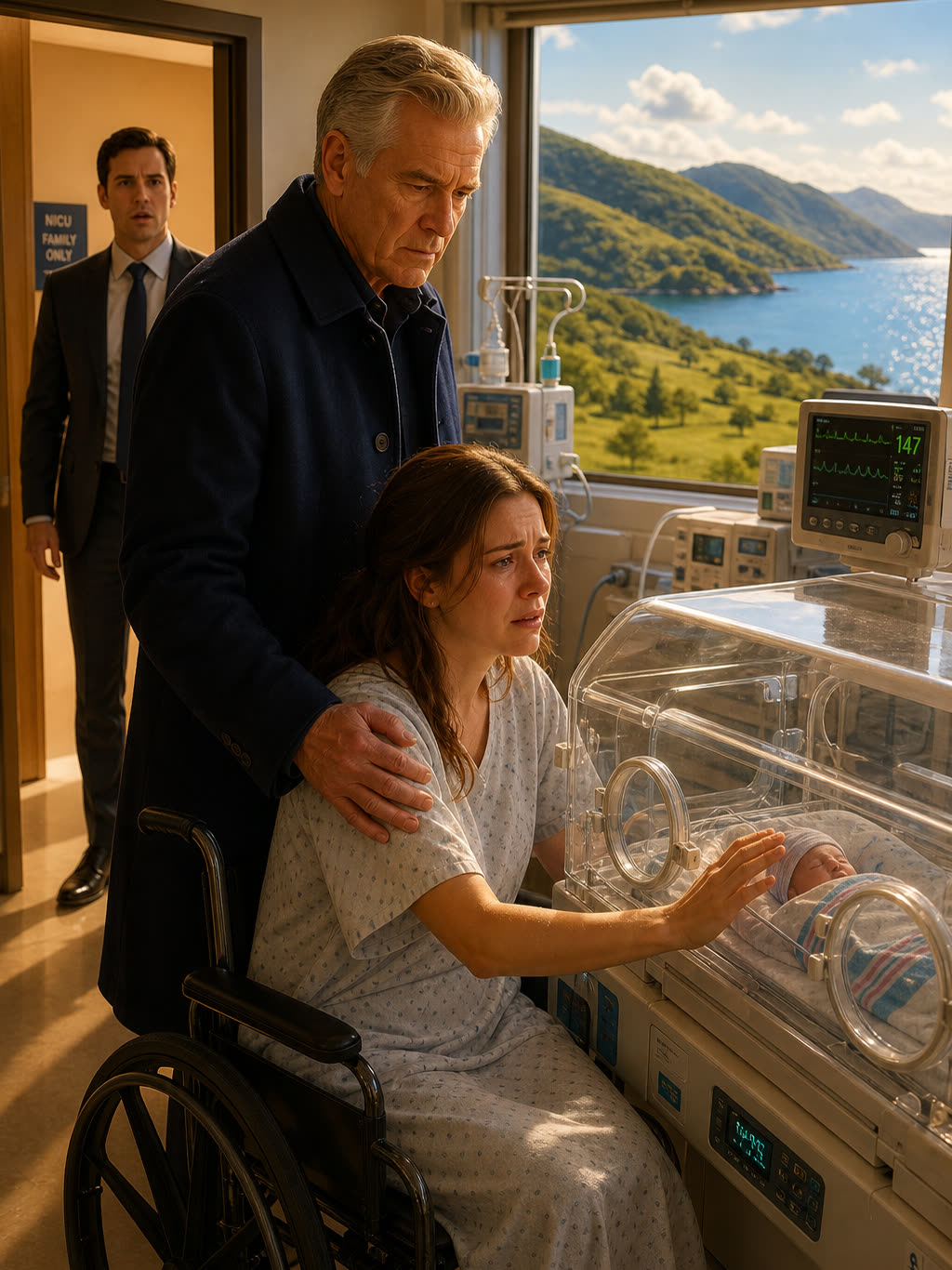
“Natalie, thank goodness you’re recovering,” he said. “I’ve been trying desperately to find you.” I remained silent, studying his face, searching it for the man I had married and finding only a stranger with familiar features. Warren stepped beside my wheelchair, calm and unmoving as a wall. “That’s interesting,” he responded evenly. “Because the information available to us indicates you remained at a celebration while my daughter required emergency medical care.”
Vance’s expression changed immediately, the careful concern slipping from his face like water from glass. “Mr. Sterling, you’ve misunderstood what happened.”
“We also have documentation indicating that you accepted certified correspondence intended for Natalie.”
My husband moved backward, one step and then another, until his shoulders nearly touched the wall. “I only wanted to spare her information that might have caused unnecessary stress during her pregnancy.”
I felt an unfamiliar wave of anger rise inside me, hot and steady, burning away the fog of medication and grief. It was not the explosive anger of a single moment, but something deeper, built from years of small dismissals I had excused one by one.
“You left me without your support, Vance. Now I’m discovering that you also kept important information about my father from me.”
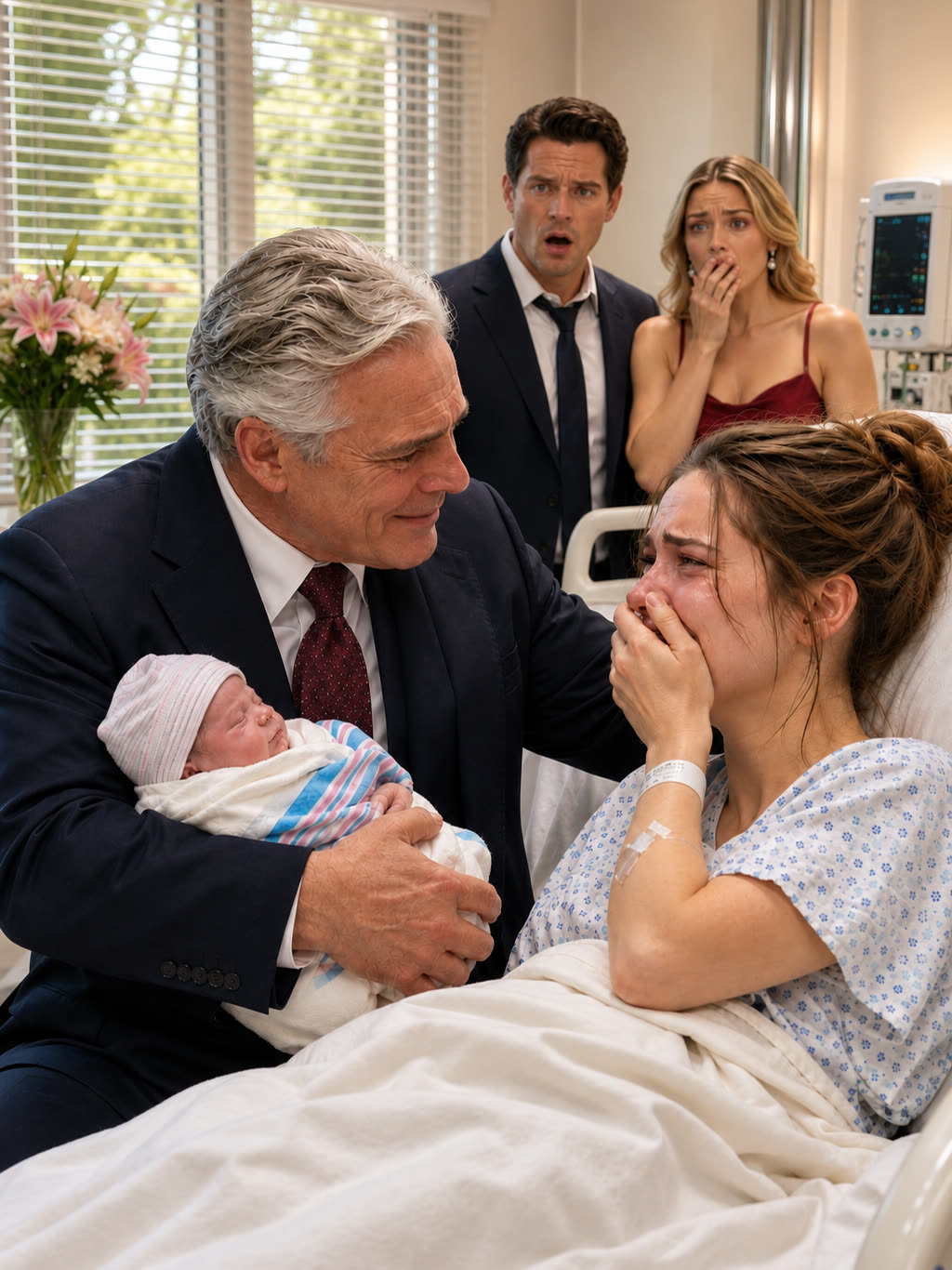
He opened his mouth to reply, but Warren had already asked for assistance from hospital security. Two uniformed guards appeared at the doorway, polite and immovable, and escorted Vance out of the restricted unit while the situation received further attention. He glanced back at me once. I did not look away, and it was he who lowered his eyes first.
Later that afternoon, my father returned accompanied by his attorney. I was propped up in my hospital bed by then, pale and sore, with Wesley’s tiny hospital bracelet photograph resting in my lap. The room was bright, and the window showed a sweeping view of green hills and silver water, a landscape so peaceful it seemed to belong to a different life.
“Natalie, there’s another matter we should discuss. Those letters contained more than information about our family connection. They also included paperwork concerning a trust established specifically for you.”
The attorney opened a substantial folder and laid out several pages across the rolling tray table, smoothing each one flat with careful hands. “Recently, someone submitted a legal petition requesting authority over certain financial assets that may rightfully belong to you.”
“Who submitted it?” I asked.
Warren carefully placed a document before me, as though it might cut him if he moved too quickly. The applicant’s name was Vance Mercer.
But the attached authorization was even more unsettling. My full name appeared beside a signature that closely resembled my handwriting. The document carried that morning’s date, and its recorded signing time coincided with the hours I had been under anesthesia for my emergency operation. According to its contents, I had willingly transferred control of my future inheritance interests to Vance.
“That cannot be correct,” I whispered. “I wasn’t capable of signing documents this morning.”
“We’re aware,” replied Ms. Okafor, the observant attorney sitting across from me. “That discrepancy makes this paperwork particularly important. According to its records, it was notarized at 9:42 a.m. inside a UPS Store on Fifth Avenue. Your hospital records confirm you were under anesthesia beginning at 9:05 a.m. and remained so until nearly noon.”
I examined the signature carefully, holding the page close to my face. The letters curved almost exactly as mine usually did. Even the distinctive ending of my capital N had been reproduced, with the same small flourish I had developed in high school and never lost. Whoever had written it had studied me.
But I knew I had never signed that document.
“Someone must have studied my handwriting,” I said. “Vance has watched me sign countless papers.”
“He may also have made a serious miscalculation,” Warren observed quietly. “Perhaps he believed your medical condition would prevent you from examining these documents anytime soon. Someone recovering from a major emergency may not immediately question financial paperwork.”
A strange calm settled over me. It was not peace, exactly, but the clarity of someone who has stopped being afraid of what comes next. The shaking in my hands eased, and my breathing slowed.
“Then explain everything,” I said. “Every detail. Beginning with how you came to be standing outside my house.”
Warren moved his chair closer to the bed. For the first time, I noticed how noticeably his hands trembled, even when he clasped them together in his lap. He drew a long breath, as though he were about to open a door he had kept locked for three decades, and was not at all certain what he would find on the other side.
PART 3: THE FATHER WHO NEVER STOPPED SEARCHING
“Thirty-three years ago, I was twenty-nine and building my business from a rented office,” he began. “I fell deeply in love with a woman named Catherine Brooks. She taught English at a high school. She teased me about my ambitious business ideas and introduced me to poetry. When she told me she was expecting a child, I wanted us to marry immediately.”
“What changed?” I asked, and he looked down at his hands. “My father intervened. He controlled the financial firm supporting my early business ventures, and he believed marrying a schoolteacher would jeopardize our investors’ confidence. He convinced Catherine that I had chosen my career instead of her, showing her a letter supposedly written by me announcing the end of our relationship. Meanwhile, he told me she had accepted money and moved away.” I tightened my grip on the hospital blanket until my knuckles whitened.
“Neither of us understood that we had been given false information,” he continued. “Catherine relocated to Spokane, where you were born. Eleven months later, she passed away unexpectedly from an aneurysm. Her sister, Ruth Brooks, adopted you and became the person who raised you.” The room seemed to go very still around me. “Aunt Ruth,” I whispered. She had passed away when I was twenty-two, and I still reached for the phone sometimes to tell her things.
Until that moment, I had believed my biological mother had been abandoned by the man she loved and had never recovered emotionally from their separation. It was the story I had grown up with, the quiet sorrow at the edge of my childhood. “She always told me my father disappeared before my birth.” Warren nodded slowly. “She believed that story throughout her life because my father’s legal representatives had convinced her it was true. I never knew you existed.”
“After my father passed away this spring, his attorney examined his personal archives and discovered Catherine’s letters. They had never reached me. Several were marked as returned correspondence, and the records suggested he had prevented our communication for years.” I struggled to find words, and the ones that came felt too small. All those years, two people who might have loved each other, and a child who might have had a father, had been kept apart by one man’s calculation.
“I began searching immediately,” Warren continued. “My investigator spent months tracing adoption documents. The name Natalie Brooks produced very little until he discovered your marriage certificate. Natalie Brooks had married Vance Mercer, someone employed by my own company.” His voice caught on the name. “And afterward, you mailed those letters,” I said. “Two separate letters. The first explained my identity and requested an opportunity to meet. The second contained legal information about a trust I established in your name. I wanted you to know the truth, even if you ultimately decided you never wished to meet me.” “And Vance accepted both deliveries.” “Yes.”
“Why would he conceal them?” My voice shook. “He worked for you. Why wouldn’t he simply tell me?” Ms. Okafor spoke carefully, choosing each word. “Because discovering your father’s identity might have prompted you to reconsider certain aspects of your marriage, Ms. Brooks. With authorization from the company, we reviewed relevant business email records. Six months before your wedding, Vance had researched your family background. He discovered an old adoption announcement in the Spokane newspaper archives suggesting a possible biological connection to the Sterling family.”
She paused before continuing. “He apparently did not know whether the information was accurate. But when Warren’s first letter confirmed the connection, he recognized that your circumstances could involve substantial financial interests.” “He married me because of that possibility,” I said. “We cannot conclusively determine every reason behind his decision to marry you,” she replied thoughtfully. “But the available information suggests he chose to withhold the truth once he understood its significance.”
I turned toward the clock on the wall and watched the second hand move. For several moments, nobody spoke. Then sadness settled over me, slow and heavy. I was not mourning the marriage itself, which already felt irreparably changed. I was grieving the seven years I had spent believing that my husband’s affection had always been sincere, and the version of myself who had trusted him without question.
That evening, a nurse escorted me back to the neonatal intensive care unit. Dr. Reyes, the neonatologist overseeing my son’s treatment, greeted me with a reassuring smile. “His oxygen levels are improving. He’s making encouraging progress.” “Would it be possible to hold him?” “We can arrange ten minutes of supervised skin-to-skin contact.” The nurse carefully placed my son against my chest. He felt incredibly small and warm, his delicate face slightly flushed, his tiny fingers opening and closing as he settled against me. I began crying without attempting to hide my emotions.
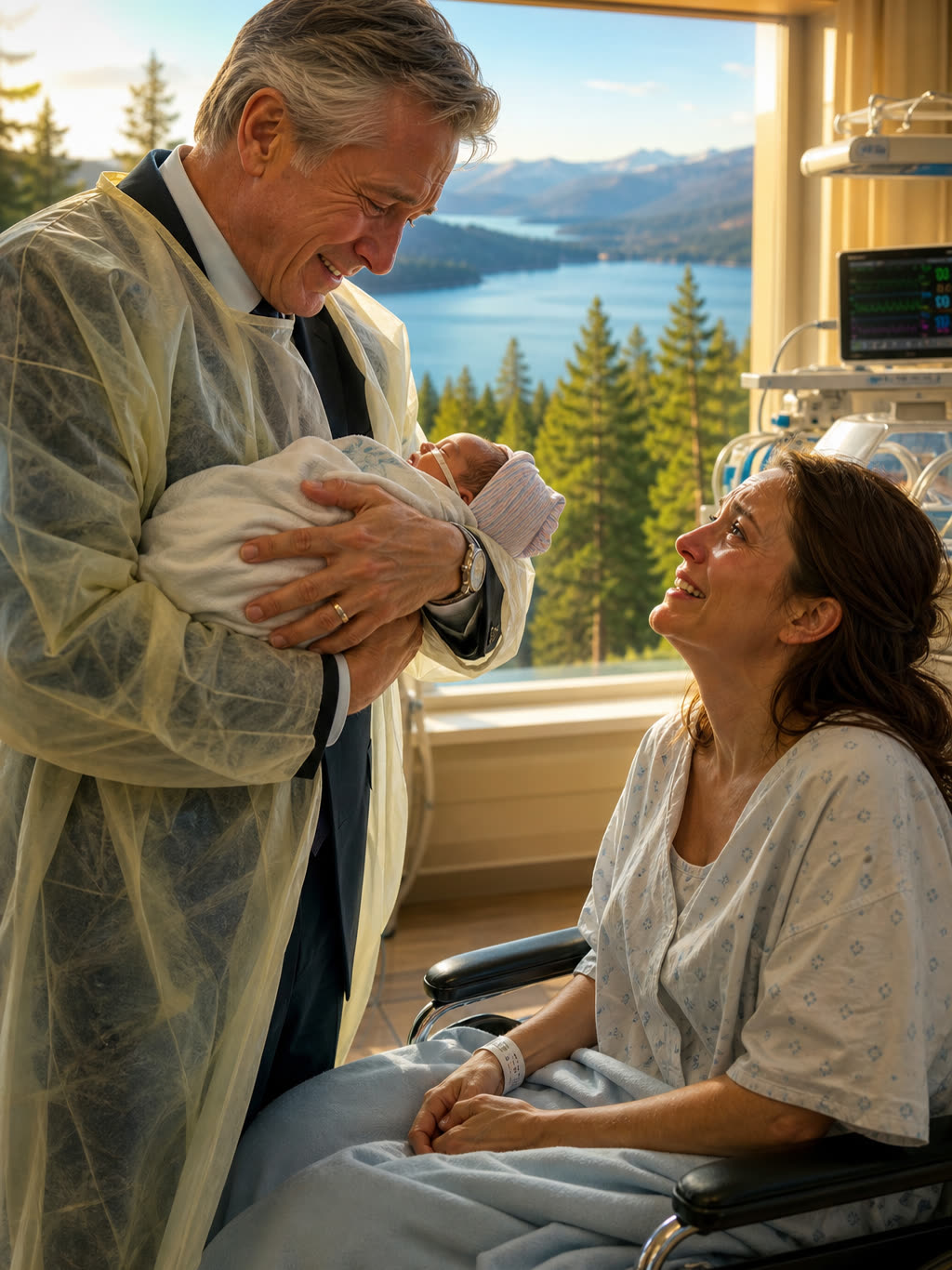
Warren remained near the doorway, uncertain whether he should enter. “Please come closer,” I told him. He approached cautiously, almost as though he feared disturbing the moment, and Dr. Reyes helped him put on the required protective clothing. When I carefully transferred my baby into his arms, my father released a quiet sound that was somewhere between laughter and tears. “He has your chin,” Warren whispered. “And yours,” I replied.
He gazed down at his grandson, tears moving slowly across his face and dropping onto the soft blanket. “Natalie,” he began, then paused before trying again. “My daughter. Would you mind if I called you that?”
“You already did,” I reminded him. “When you found me at home.”
He laughed softly. My son shifted against his grandfather’s chest, almost as though he understood the conversation, and the three of us stayed there in the dim blue glow of the monitors, a family that had been missing for thirty-two years.
Vance returned to the hospital the following morning. He was not alone, and his visit did not involve spending time with our newborn son. Two Seattle police detectives were waiting in the hospital lobby when he stepped out of the elevator. According to Ms. Okafor, who observed the encounter nearby, Vance initially approached them with a confident smile and a carefully prepared explanation. After several questions, the smile faded, and he requested legal representation.
Investigators had obtained the notary’s records, security footage from the UPS Store, and documentation establishing the timeline of my surgery. The woman identified in connection with the disputed signature was Brooke Callahan, whom I had recently learned was involved in a relationship with Vance. Another painful detail emerged during the investigation. According to the evidence reviewed, Brooke had practiced reproducing my signature during the same birthday celebration Vance had chosen to attend. While I lay on my floor in labor, they had been laughing over a pen and my name.
Both subsequently faced allegations involving document forgery, attempted financial fraud, and the submission of inaccurate legal records. Vance’s attorney argued that his client had intended to safeguard family financial interests. Prosecutors challenged that explanation, emphasizing the circumstances surrounding the disputed documents and my hospitalization. Warren allowed the legal process to proceed without attempting to influence its outcome.
Within forty-eight hours, the corporation’s board removed Vance from his position, citing the investigation and concerns regarding compliance with its professional ethics standards. He did not receive the separation compensation he had expected. His mother, Diane, contacted me twice. Her first voicemail demanded that I stop bringing embarrassment upon the family. Three weeks later, her second message sounded entirely different. After a long silence, she quietly admitted, “I didn’t know about those documents. I’m sorry for what I said to you on the phone.” I chose not to respond immediately.
Our divorce proceeded without a contested hearing. I retained the house temporarily before arranging its sale, since I could not bear the thought of staying on the floor where it all began. The court granted me primary parental responsibility and established supervised visitation arrangements for Vance while the criminal proceedings remained unresolved.
Nineteen days after his birth, my son was finally discharged from the hospital. We named him Wesley. I wanted him to have a first name chosen entirely for himself, rather than one connected to anyone else’s expectations. His middle name, Brooks, honored my biological mother, Catherine.
Warren prepared a beautiful nursery inside his Lake Washington home, choosing a spacious room filled with natural sunlight. He insisted on assembling the crib without assistance. The project took four hours and eventually required a telephone conversation with his assistant, who gently informed him that he had been reading the assembly instructions upside down.
On our first evening at home, I discovered Warren sitting quietly in the nursery’s rocking chair. Wesley slept peacefully against his shoulder. A framed photograph rested on the dresser nearby. It showed a young woman with dark hair and a wonderfully uneven smile, standing outside a bookstore. “That’s Catherine,” I said. Warren nodded. “She would have been incredibly proud of you.”
“I resemble her.”
“You inherited her determination,” he replied. “Even during a frightening medical emergency, you found the strength to reach the entrance and unlock the door. I’ve met powerful public officials who might not have shown that kind of courage.”
I settled onto the arm of the rocking chair, and he shifted slightly to give me more space. “I’m still upset,” I admitted. “About what your father did. About all the years we lost. About how Vance made me question my own worth.” “You have every right to feel that way.” “But I don’t blame you.” Warren closed his eyes briefly. “Thank you. I understand that you’re not obligated to feel that way.” “I know,” I answered, gently touching Wesley’s little hand. “That’s what makes my decision meaningful.”
Six months later, Vance’s criminal proceedings concluded with a negotiated guilty plea. He received a four-year prison sentence relating to forgery and fraud. Brooke received an eighteen-month sentence along with probationary conditions. I attended the hearing with Warren beside me. When the judge announced the outcome, I experienced neither excitement nor a desire to celebrate. Instead, I felt emotionally exhausted, but relieved that an important chapter had finally reached its conclusion.
Outside the courthouse, a reporter called out a question about the billionaire’s supposedly secret daughter. Warren stopped walking and faced the gathered reporters. “She isn’t a secret,” he said. “She is the most wonderful person I have ever found, and I intend to spend the rest of my life appreciating every moment we still have together.” I smiled through my tears. Then I continued down the courthouse steps beside him, with Wesley sleeping comfortably in my arms.
That evening, the three of us relaxed on the back porch while lights gradually appeared across Lake Washington. Wesley woke from his nap, blinked sleepily, and reached toward his grandfather’s glasses. “Those belong to me,” Warren informed him with exaggerated seriousness. “Probably not for much longer,” I teased. Warren grinned. For the first time since meeting him, I saw an expression that made him appear remarkably youthful.
My thoughts returned to the night everything changed. I remembered the rain outside, the frightening uncertainty, the unanswered need for support, and the ivory envelope resting beside me on the floor. At the time, I had no idea that its contents were connected to the missing pieces of my entire family history. I had believed I was completely alone. For thirty-two years, part of that belief had seemed true. Yet somewhere else in Seattle, a man had been searching for the daughter he never knew existed. And when he finally arrived at my door, he knelt beside me, offered comfort, and remained there until help arrived.
That experience taught me something I will always carry with me. Family is not necessarily defined by the people who raised us, nor exclusively by the person we choose to marry. Sometimes family is someone who arrives unexpectedly during our most difficult moments, drenched from the rain, and quietly promises that we will never have to face life’s challenges alone again.
And this time, I knew those words were sincere.
Disclaimer: This story is a work of fiction inspired by real-life themes. Names, characters, places and events are fictionalized, and any resemblance to real persons is purely coincidental. Images are for illustration purposes only.
