

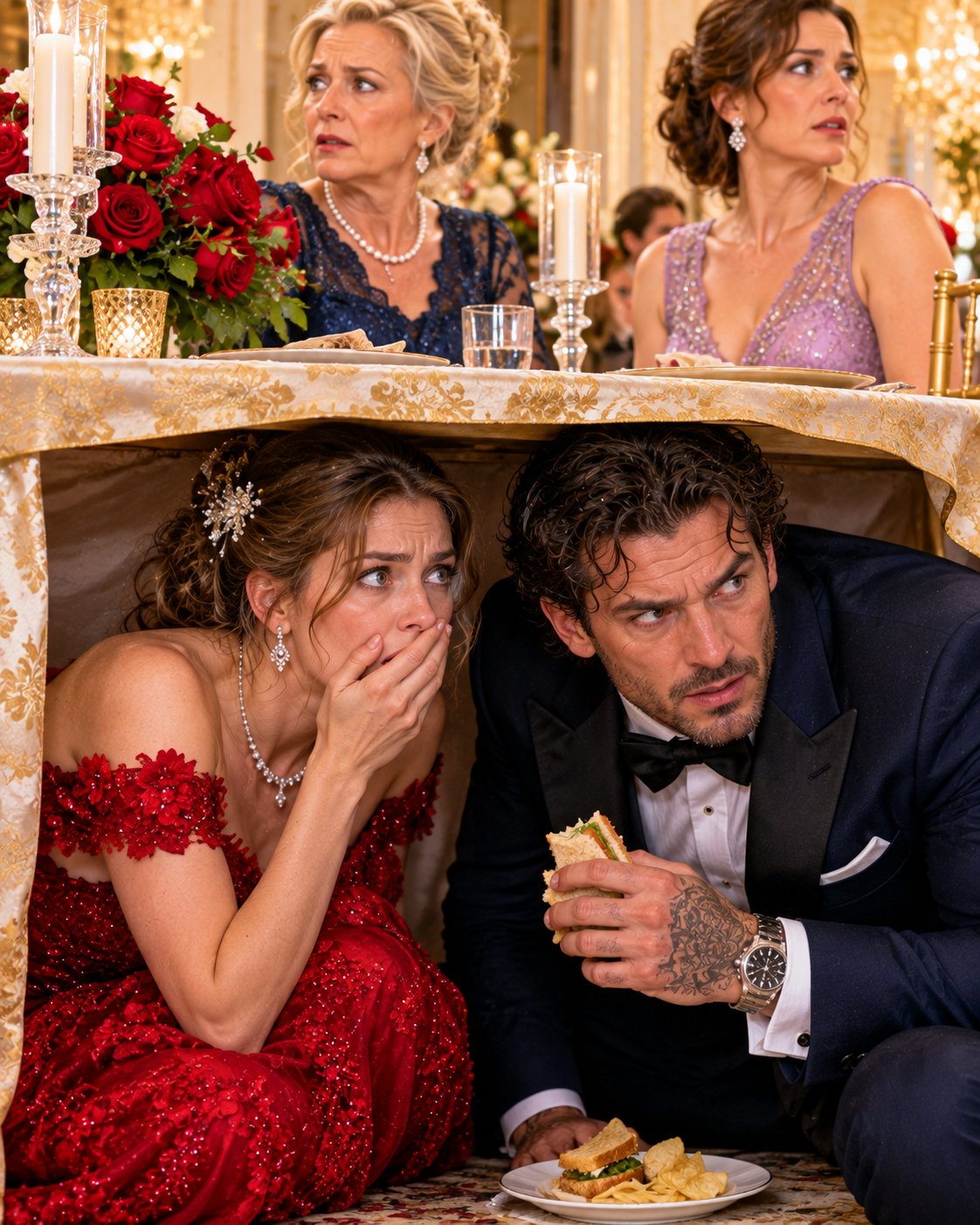
PART 1 — THE MAFIA BOSS BENEATH THE TABLE
At thirty years old, I never imagined that crawling beneath a banquet table would change the rest of my life.
I certainly never expected to find someone already hiding there.
Especially not a massive, tattooed stranger with a scar through one eyebrow, casually eating a chicken sandwich as though the carpet beneath an expensive hotel table were the most natural dining room in Chicago.
And I had absolutely no idea that the stranger was Vincent Marino.
The man newspapers described as Chicago’s most feared Mafia boss.
But that wasn’t the most shocking part.
The real surprise came when our mothers entered the room and began discussing something neither Vincent nor I was supposed to know.
My name is Evelyn Hartwell.
I was thirty, financially independent, and perfectly capable of deciding what I wanted from life.
Unfortunately, my mother, Margaret Hartwell, disagreed with the last part.
She believed my life would remain tragically incomplete until I married a wealthy, respectable man.
It didn’t matter that I had built a successful career or that I was happy living alone.
To Mother, an unmarried daughter was a problem requiring immediate intervention.
That evening, she had insisted I accompany her to an extravagant charity gala at one of Chicago’s most luxurious hotels.
I wore a fitted burgundy dress, and my dark hair fell in loose waves over my shoulders.
For nearly two hours, I smiled politely while Mother introduced me to businessmen, attorneys, property developers, and men who apparently believed describing their investment portfolios constituted flirting.

Then she announced that she had found someone particularly suitable.
A respectable widower.
With three children.
Two divorces.
And an impressive collection of vacation homes.
That was when I reached my limit.
While Mother became distracted by another guest, I slipped into the hallway and hurried toward a nearby banquet room.
It was empty.
The lights were dimmed, and several long tables covered with ivory tablecloths occupied the room.
I looked toward the entrance.
No footsteps.
No Mother.
Perfect.
I lifted the edge of the nearest tablecloth, lowered myself onto the carpet, and crawled underneath.
For approximately three seconds, I experienced genuine peace.
Then a deep male voice spoke.
“Careful with the sandwich. And would you mind moving your knee?”
I nearly screamed.
Sitting only inches away was an enormous man.
He had dark hair, broad shoulders, muscular arms covered in black tattoos, and a thin scar cutting across one eyebrow.
His white shirt stretched tightly over his chest.
In one hand, he held half a chicken sandwich.
He looked completely comfortable.
I stared at him.
“You’re eating under a table?” I whispered.
He appeared mildly offended.
“I was enjoying a perfectly peaceful meal until someone invaded my territory.”
I blinked.
“You do realize there are chairs outside?”
“And yet here you are, sitting on the carpet with me.”
Before I could respond, footsteps approached the banquet room.
I immediately pulled the tablecloth down.
The stranger raised an eyebrow.
“Running from someone?”
“My mother.”
His expression changed.
“Ah.”
I frowned.
“What does that mean?”
He glanced toward the doorway.
“Mine, too.”
For a moment, I could only stare at him.
Then I pressed my hand over my mouth to stop myself from laughing.
“Two grown adults hiding from their mothers. How embarrassing.”
He shrugged.
“I prefer to call it a tactical withdrawal.”
“With sandwiches?”
“I believe in being prepared.”
I shook my head.
Despite his intimidating appearance, there was something unexpectedly reassuring about him.
He didn’t seem interested in impressing me.
He wasn’t discussing money, property, or business connections.
He was simply a stranger hiding under a table and eating dinner.
Then my stomach growled.
Loudly.
His eyes dropped toward the sandwich.
He considered it for a second before silently offering me half.
I hesitated.
He smirked.
“Relax, sweetheart. It’s chicken, not a marriage proposal.”
I laughed.
Then I accepted the sandwich.
For several minutes, we sat together beneath the table, eating and discussing our mothers’ obsession with marriage.
I told him about the widower.
He grimaced.
“Three children and two divorces?”
“And a yacht,” I added.
“Obviously. The yacht changes everything.”
I burst out laughing.
The stranger turned toward me.
Something in his expression softened.
“What?” I whispered.
“Nothing,” he replied. “You have a beautiful laugh.”
My cheeks grew warm.
I was still trying to recover when two women entered the room.
One voice belonged to my mother.
“I cannot imagine where Evelyn has disappeared!”
The stranger immediately stopped chewing.
Then another woman answered.
“Believe me, Margaret, my son is just as impossible. I’ve spent the entire evening trying to introduce him to Bianca!”
I looked at the man beside me.
His jaw tightened.
The woman continued.
“Vincent Marino controls half of Chicago, commands hundreds of men, and terrifies everyone he meets. Yet apparently, finding him a wife is beyond my abilities!”
My sandwich slipped from my fingers.
Vincent Marino.
The Vincent Marino.
Chicago’s most feared Mafia boss.
A man whose name appeared in frightening headlines and whispered conversations.
A man powerful businessmen avoided offending.
And he was sitting beneath a table beside me.
Eating chicken.
I slowly turned toward him.
He gave me an almost apologetic smile.
“Surprise.”
Before I could recover, Mother spoke again.
“Perhaps we should introduce Vincent to Evelyn instead.”
Vincent suddenly took my hand.
His expression became serious.
He leaned close enough that his next words were meant for me alone.
“Whatever happens next, sweetheart, don’t tell them we met by accident. Because there’s a reason I’ve been looking for you.”
My heart began pounding.
For several seconds, I couldn’t speak.
Vincent still held my hand while our mothers continued discussing our romantic futures beyond the tablecloth.
“I’m simply saying,” Margaret Hartwell continued, “Evelyn needs someone steady. Someone who won’t be intimidated by her independence.”
Vincent’s mother laughed softly.
“And Vincent needs a woman who won’t be intimidated by him.”
Vincent closed his eyes.
I mouthed, Are you serious?
He mouthed back, Unfortunately.
I leaned closer.
“What do you mean you’ve been looking for me?” I whispered.
The playful amusement vanished from his face.
“I can explain.”
“That sentence has never made anyone feel better.”
A faint smile appeared.
“Fair.”
Outside, a chair scraped across the floor.
Mother sighed.
“She was here five minutes ago. I saw her walk down this corridor.”
Vincent’s mother replied, “Then perhaps she and my son have both escaped through a window.”
Vincent glanced toward the linen curtain.
“Mother has always underestimated my commitment to avoiding introductions.”
I nearly laughed.
But his earlier words refused to leave my mind.
There was a reason he had been searching for me.
I tightened my fingers around his.
“Tell me.”
“Not under a table.”
“You were comfortable discussing my laugh under a table.”
“That was considerably less complicated.”
“Vincent.”
He studied me.
Then his voice dropped.
“Did your father ever mention the name Daniel Marino?”
My heart gave a strange little jolt.
“My father?”
Vincent nodded.
My father, Thomas Hartwell, had died almost eight years earlier.
He had been a gentle man with kind eyes, an endless collection of terrible jokes, and an extraordinary gift for restoring historical buildings.
He founded Hartwell Architectural Restoration and transformed it from a tiny two-person business into one of Illinois’s most respected restoration firms.
He died unexpectedly from a heart condition at fifty-eight.
I remembered countless things about him.
The smell of cedar on his coats.
His ridiculous Christmas ties.
The notebook he carried everywhere.
The way he hummed while preparing coffee.
But I had never heard him mention Daniel Marino.
“No,” I whispered.
Vincent watched my face.
“Daniel was my father.”
I frowned.
“Your father and mine knew each other?”
“More than that.”
Before I could demand an explanation, my mother’s shoes appeared beside the tablecloth.
Vincent and I went completely still.
“Margaret,” the other woman said, “you cannot possibly think she’s under the table.”
A pause followed.
I recognized it immediately.
Mother had always possessed an irritating talent for discovering where I was hiding.
“Evelyn used to hide under tables when she was six.”
Vincent slowly turned toward me.
I glared.
“Do not laugh,” I mouthed.
His shoulders shook.
Then the tablecloth lifted.
Light flooded our hiding place.
Mother stared down at me.
Vincent’s mother stared at him.
Vincent calmly took another bite of his sandwich.
Nobody spoke.
Finally, Mother said, “Evelyn.”
“Hello, Mother.”
She looked at Vincent.
Then at our joined hands.
Then at the sandwich between us.
Her eyebrows rose.
Vincent’s mother pressed a hand over her mouth.
“Oh,” she said.
Vincent immediately pointed at her.
“No.”
She ignored him.
“Margaret.”
Mother’s expression transformed.
“Oh.”
“Absolutely not,” Vincent repeated.
I withdrew my hand.
“Can everyone please stop saying ‘oh’?”
Mother straightened.
“Come out from under there.”
I looked at Vincent.
He looked at me.
Neither of us moved.
Then he said, “We could remain here.”
“My knees are starting to hurt.”
“That does complicate the strategy.”
Eventually, we crawled out.
It was the least dignified entrance I had ever made at a formal event.
I smoothed my burgundy dress.
Vincent unfolded himself to his full height.
Under the table, he had seemed merely enormous.
Standing upright, he was genuinely imposing.
He was perhaps six-foot-four, with broad shoulders, a controlled expression, and tattoos winding over his exposed forearms.
Suddenly, I understood why people found him intimidating.
But the memory of him sharing a sandwich made it difficult to feel frightened.
His mother crossed her arms.
“Vincent.”
“Mother.”
“You have spent the entire evening avoiding Bianca.”
“Yes.”
“You hid beneath a table.”
“Yes.”
“With Margaret’s daughter.”
“Apparently.”
She turned toward me.
Her expression softened.
“Lucia Marino,” she said. “And you must be Evelyn.”
“Yes.”
“I knew your father.”
I stopped breathing for a second.
“You did?”
“Very well.”
Mother looked down and began adjusting her bracelet.
I noticed immediately.
“Mother?”
She avoided my eyes.
Something changed in the room.
Vincent’s earlier question returned.
Did your father ever mention the name Daniel Marino?
I looked between the three of them.
“What is going on?”
Margaret inhaled.
“This isn’t the place.”
“That is the second time someone has told me that in five minutes.”
Vincent gave her a small nod.
“I already asked about Daniel.”
Mother’s face changed.
“You did what?”
“I needed to know what Evelyn knew.”
“What I know?” I repeated. “I know absolutely nothing.”
Mother and Lucia exchanged a glance.
Vincent looked at me.
I had never felt so thoroughly excluded from a conversation about my own family.
My patience finally snapped.
“Enough.”
All three turned toward me.
I explained that I had already endured an evening of being treated like an eligible bride in an auction catalog.
Now I had discovered that the stranger sharing my emergency sandwich was one of Chicago’s most feared men.
And everyone appeared to know something about my deceased father.
Vincent’s mouth twitched.
“Emergency sandwich?”
I pointed at him.
“Not helping.”
He immediately became serious.
I faced Mother.
“Tell me.”
For the first time that evening, she looked frightened.
“Your father and Daniel Marino were friends,” she admitted.
“How close?”
“Very.”
“Why didn’t I know?”
“Because they decided you shouldn’t.”
My stomach tightened.
“Who decided?”
“All of us.”
I stared at her.
“You?”
She nodded.
Lucia stepped forward.
“Evelyn, there were reasons.”
“What reasons?”
“Complicated ones.”
I laughed bitterly.
“I’m beginning to hate that word.”
Vincent leaned against the table.
“Then let me simplify one part.”
Lucia gave him a warning look.
He ignored it.
“Two weeks ago, I received a letter written by my father.”
“I thought your father died years ago.”
“Eleven years.”
“Then how did you receive a letter from him two weeks ago?”
“It was held in trust.”
I frowned.
“Until when?”
Vincent’s eyes settled on me.
“Until you turned thirty.”
My birthday had been seventeen days earlier.
A strange chill passed over my arms.
“What does your father have to do with my birthday?”
“I don’t know everything yet.”
“But you know something.”
“Yes.”
He reached into his jacket.
Seeing my reaction, he stopped.
Then he slowly withdrew a folded envelope.
My name appeared on the front.
Evelyn Hartwell.
Written in dark blue ink.
“Who wrote that?” I asked.
“My father.”
I stared.
“Why would Daniel Marino write to me?”
Vincent’s voice softened.
“That’s what I’ve been trying to discover.”
I accepted the envelope.
It had already been opened.
“You read it.”
“It was addressed to both of us inside.”
I unfolded the cream-colored page.
Daniel’s handwriting was elegant and firm.
He wrote that, if Vincent had received the letter, I had finally turned thirty.
He explained that Thomas and Daniel had made mistakes and promises their children should not have been forced to inherit too young.
He instructed Vincent to find me.
To tell me only what I wanted to know.
And never to decide for me.
Then came an instruction concerning a key.
My father possessed it.
I would remember where to look when I thought about our childhood summer house.
Together, the key and an enclosed number would lead us to something our fathers had protected.
The letter ended with Daniel’s insistence that the Hartwell and Marino families were never supposed to become enemies.
They were supposed to finish something together.
I read it repeatedly.
Mother lowered herself into a chair.
Lucia’s eyes glistened.
Vincent waited.
“The summer house,” I whispered.
Mother’s gaze flickered.
I turned toward her.
“You know what he means.”
She hesitated.
“Your father owned a cottage near Lake Geneva before we married.”
“I know that.”
I remembered the cottage vividly.
The blue shutters.
A screened porch.
A maple tree.
A wooden dock tilted toward the water.
And an old rolltop desk in Dad’s study.
He had told me the cottage was sold when I was fourteen.
But Mother’s expression suggested otherwise.
“When was the last time you went there?” I asked.
“About sixteen years ago.”
“That’s exactly when Dad supposedly sold it.”
Mother said nothing.
“Supposedly?” Vincent asked.
I turned toward him.
“He told me we couldn’t go back because it belonged to someone else.”
Margaret closed her eyes.
“Thomas never sold it.”
I stared.
“What?”
“He transferred it.”
“To whom?”
Lucia answered quietly.
“To Daniel.”
I sat down.
“My father gave your husband our cottage?”
Lucia nodded.
Vincent added, “And after Daniel died, it passed to me.”
I looked at him in disbelief.
“You own my childhood summer house?”
“Technically.”
“Have you been there?”
“Once.”
“When?”
“Three weeks ago.”
That had been before my birthday.
Before Daniel’s letter was delivered.
“Why?”
Vincent explained that his father had left instructions concerning the property, but he had avoided dealing with them for years.
Lucia lifted her chin.
“I became tired of dead men controlling storage rooms.”
Under other circumstances, I might have laughed.
Instead, I searched my childhood memories.
The cottage.
The porch.
The lake.
The desk.
Then something returned.
I was eight years old.
Dad knelt beside the old writing desk.
He pressed something and placed a small object inside a hidden compartment.
When I asked what it was, he smiled.
Treasure.
I looked up.
“The desk.”
Mother inhaled.
“What desk?”
“At the cottage.”
I stood.
“There was an old rolltop desk in Dad’s study.”
Vincent straightened.
“It’s still there.”
My heart began racing.
“When can we go?”
“Evelyn,” Mother warned.
“Tomorrow.”
Vincent nodded.
“I’ll drive.”
“No.”
He raised an eyebrow.
“I have a car.”
“I have security concerns.”
“I have independence concerns.”
A faint smile touched his mouth.
“Compromise. You drive. I complain about your driving.”
“I’m an excellent driver.”
“That remains to be seen.”
Mother protested.
She insisted we could not simply disappear together to investigate something our fathers had kept secret.
I refused to argue.
Lucia gently touched Margaret’s arm.
Something passed between them.
Finally, Mother admitted that Thomas had not transferred the cottage to Daniel merely because they were friends.
Someone had tried to purchase the property.
Neither woman knew who.
Nor did they understand what our fathers had protected.
The room fell silent.
Then Vincent’s phone vibrated.
He glanced at the screen.
His expression changed instantly.
“What?” I asked.
He didn’t answer.
Instead, he showed me a photograph.
The Lake Geneva cottage.
Taken that evening.
Lights glowed through its windows.
And someone stood inside the study.
Beside my father’s old desk.
Underneath was a message from the caretaker.
“Mr. Marino, I thought you said nobody was expected at the house tonight.”
Vincent looked at me.
“Apparently,” he said quietly, “we aren’t the only ones who know about the key.”
And for the first time, I understood that whatever our fathers had hidden might still matter to someone powerful enough to come searching for it.
PART 2 — THE KEY, THE LOCKER, AND THE MAN WHO SHOULD HAVE BEEN DEAD
We didn’t rush to Lake Geneva that night.
I expected Vincent to react like the frightening man described in newspaper articles.
Instead, he carefully questioned the caretaker.
By the time the caretaker reached the house, the stranger was gone.
Nothing appeared missing.
There were no broken windows or damaged locks.
The only unusual detail was an open drawer in my father’s desk.
The hidden compartment had not been touched.
“How do you know?” I asked.
Vincent explained that the caretaker restored antique furniture and knew the desk well.
“That seems unusually convenient.”
“I employ unusually competent people.”
I glanced at him.
“There’s the famous humility.”
“I misplaced it sometime around dessert.”
Despite everything, I smiled.
We agreed to leave the following morning.
I suggested nine.
He wanted eight.
We settled on eight-thirty.
Naturally, our mothers exchanged delighted looks when they heard us negotiating.
I pretended not to notice.
The next morning, Vincent appeared outside my apartment at precisely eight twenty-nine.
I had been watching through the curtains for several minutes.
His arrival surprised me.
There was no convoy.
No black limousine.
No cluster of threatening security guards.
Only a charcoal-gray SUV.
Vincent stepped out wearing jeans, boots, and a dark sweater.
I met him near the lobby.
“You look disappointingly normal.”
His eyebrow rose.
“Good morning to you too.”
“I expected something more dramatic.”
“Would you like me to leave and return with trumpets?”
“Maybe later.”
He handed me a paper cup.
“Coffee.”
I accepted it.
“How do you know what I drink?”
“Your mother.”
I stared.
“She told you?”
“She told my mother. My mother told me.”
“This alliance between them is becoming dangerous.”
“Agreed.”
I tasted the coffee.
Vanilla latte.
Exactly right.
“Well?” Vincent asked.
“I resent that this is perfect.”
“I can live with that.”
We drove north under a pale November sky.
The trees lining the highway had nearly lost their leaves.
For a while, we discussed ordinary things.
My work.
His businesses.

Our mothers’ increasingly alarming matchmaking strategies.
Eventually, however, the questions I had been avoiding surfaced.
“Can I ask something?”
“You’ve asked approximately forty things since last night.”
“Forty-one, then.”
“Go ahead.”
I looked toward him.
“Are the things people say about you true?”
He didn’t pretend to misunderstand.
“Some.”
“Which ones?”
“That depends on which newspaper you read.”
I mentioned an article describing him as a criminal mastermind.
“I clipped that one for my mother.”
I laughed.
Then my expression became serious.
“Do I need to be afraid of you?”
His humor disappeared.
“No.”
He answered immediately.
Vincent explained that his family name carried a complicated history.
Some accusations were deserved.
Others were exaggerated.
He had inherited companies, obligations, rivals, friendships, and a reputation before he was old enough to decide what kind of man he wanted to become.
“That sounds exhausting,” I said.
“It can be.”
“Why not leave?”
His jaw tightened slightly.
“Because leaving would mean abandoning people who depend on decisions I make.”
I remembered Lucia’s description of him commanding hundreds of men.
“Hundreds of men?” I asked.
“Hundreds of employees,” he corrected. “Construction. Restaurants. Transportation. Property management. Security. My mother prefers more theatrical descriptions.”
“So you don’t control half of Chicago?”
“I struggle to control my mother’s Sunday dinner schedule.”
I smiled.
“There goes the legend.”
“Please don’t tell anyone.”
I studied the scar crossing his eyebrow.
“And the scar?”
He touched it.
“Basketball.”
I blinked.
“Basketball?”
“High school.”
“You’re telling me the terrifying scar came from basketball?”
“A very aggressive point guard.”
I laughed so hard I almost spilled my coffee.
He looked wounded.
“My suffering amuses you.”
“Immensely.”
Then we reached the cottage.
My laughter faded.
For sixteen years, I had remembered it as enormous.
In reality, it was a modest two-story house with cream-colored walls and faded blue shutters.
But the moment I saw it, memories returned so powerfully that my eyes filled.
Vincent slowed the car.
“You okay?”
“No.”
He simply nodded.
He didn’t tell me not to cry.
He didn’t insist everything would be fine.
He understood that I needed time.
I walked to the porch.
My fingers touched the railing.
“Dad painted this every summer.”
Vincent studied the thick layers of paint near the steps.
“Not very well.”
I laughed through my tears.
“No. He was terrible.”
“You want a minute?”
I hesitated.
“Yes.”
Vincent walked toward the dock.
He remained near enough that I could see him but far enough to let me grieve privately.
I sat on the porch steps and remembered.
My father teaching me to skip stones.
Mother reading beside the lake.
Pancakes.
Rainstorms.
Fireflies.
The old rope swing.
I wiped my eyes.
When I joined Vincent near the water, he was staring across the lake.
“Your turn,” I said.
“My turn for what?”
“To look emotionally devastated.”
“I don’t schedule that until Thursdays.”
“Vincent.”
His expression softened.
“My father brought me here once.”
“When?”
“I was fifteen.”
“Did we meet?”
“No.”
“Are you sure?”
“Yes.”
“How can you be sure?”
“Because I would have remembered you.”
Warmth rose to my cheeks.
Then he explained that Daniel and Thomas had spent nearly an entire afternoon arguing inside the study.
His father sent him fishing.
Instead, Vincent listened outside the window.
He remembered my father saying that something belonged to the city rather than either family.
Daniel replied that they must ensure nobody could buy it.
“What belonged to the city?” I asked.
“I never found out.”
The wind swept across the lake.
I shivered.
Vincent immediately began removing his jacket.
“I’m fine.”
“You’re shaking.”
“It’s cold.”
“That is traditionally when jackets are useful.”
I accepted it.
The coat smelled faintly of cedar and coffee.
We entered the cottage.
Inside, everything was covered with pale furniture sheets.
The kitchen still contained pencil markings showing my height at seven, nine, and eleven.
I touched each one.
The study was exactly as I remembered.
The rolltop desk stood beneath the window.
One drawer remained open.
I knelt beside it and searched the underside.
Nothing.
Then I remembered the little wooden flower carved into the side.
I pressed it.
Click.
A narrow compartment slid out.
Inside were a brass key and an old photograph.
The picture showed two young men standing beside the lake.
My father.
Daniel Marino.
They were laughing, one arm around the other.
On the back, Dad had written:
“Brothers by choice. Fools by experience. Still standing.”
Vincent studied the photograph.
“He looks happy.”
I turned toward him.
“You don’t remember him happy?”
“I do.”
He paused.
“But not often enough.”
We placed the photograph aside and examined the number Daniel had included in his letter.
311-47-9.
It didn’t look like an ordinary bank-box number.
My father loved puzzles.
He had once made me solve six riddles to find a birthday bicycle.
So we searched the bookshelves.
We tried interpreting the digits as shelf numbers, pages, and book positions.
Nothing worked.
Eventually, Vincent sat on the floor.
“I have negotiated multimillion-dollar property contracts that were simpler than your father.”
“He once made me solve six riddles to find a bicycle.”
“I’m starting to dislike him.”
“He would’ve liked you.”
The words slipped out before I could stop them.
Vincent looked at me.
Then he said quietly, “My father would’ve liked you too.”
My heart gave an inconvenient little stumble.
Near noon, I found an old map rolled behind the desk.
It showed downtown Chicago.
Several properties were circled.
One near the river.
One in Bronzeville.
Another near an industrial corridor.
The initials T.H. and D.M. appeared in the corner.
Vincent recognized the locations.
One had become an arts center.
Another contained affordable apartments.
A third was now a public garden.
The final property remained undeveloped.
Beneath its circle, Dad had written:
“The last one belongs to Evelyn and Vincent.”
I stared.
Our fathers had placed our names together decades earlier.
Then I noticed faint lettering impressed into the desk beneath the map.
We angled the lamp.
Slowly, the words became readable.
311 W. 47th. Locker 9.
The brass key suddenly made sense.
Before we could discuss it, someone knocked at the front door.
Vincent stood.
He motioned for me to remain in the study.
I followed him anyway.
He gave me a look.
“I believe I mentioned independence concerns.”
“This isn’t about independence.”
“Good. Then we agree.”
“No, we don’t.”
He sighed and opened the door.
An elderly man stood on the porch.
He was perhaps in his late seventies, wearing a brown coat and holding a wool cap.
His eyes moved from Vincent to me.
He froze.
“Evelyn?”
“Yes?”
Tears filled his eyes.
“You have Thomas’s eyes.”
“Who are you?”
He removed his cap.
“My name is Samuel Beckett.”
Vincent’s posture changed.
Alert.
“You knew our fathers?”
Samuel nodded.
“I knew what they were trying to do.”
“What were they trying to do?” I asked.
“Keep a promise.”
“What promise?”
He looked toward the lake.
“The kind that costs more than money.”
I showed him the brass key.
“Does this mean anything to you?”
His face drained of color.
“Where did you find that?”
“In Dad’s desk.”
He stepped back.
“You shouldn’t have.”
Vincent’s voice remained calm.
“Why?”
Samuel looked between us.
“Because locker nine was supposed to stay closed unless both your fathers were dead.”
“They are,” I said.
Samuel swallowed.
“No.”
My heart began hammering.
“What do you mean?”
He turned toward Vincent.
“Daniel Marino is dead.”
Then he looked at me.
“But Thomas Hartwell…”
His voice faltered.
“…may not be.”
I laughed.
Not because anything was funny.
Because my mind refused to accept the possibility.
“My father died eight years ago.”
Samuel lowered his eyes.
“I attended the funeral.”
“Then why would you say that?”
“I said he may not be dead.”
Vincent stepped closer.
“What do you know?”
Samuel asked whether we could sit.
Ten minutes later, we gathered around the kitchen table.
Samuel explained that he had once worked with both our fathers.
Initially, they worked on architectural projects.
Later, they founded an organization called the North Star Trust.
Thomas wanted historical buildings to remain useful to their communities.
Daniel believed neighborhoods should not become playgrounds reserved for wealthy people.
Together, they quietly purchased vulnerable properties through separate companies before transferring them into a protected trust.
The secrecy prevented speculators from buying surrounding property and raising prices before restoration could begin.
The map we had found showed North Star projects.
But the final property was different.
In 2001, an entire block near the Chicago River had become available.
Thomas and Daniel wanted to create affordable apartments, workshops, small-business spaces, and a public courtyard.
Someone else wanted the land.
The two friends disagreed about how to protect it.
Daniel believed the project needed strict secrecy.
Thomas wanted transparency.
Their disagreement lasted months.
Eventually, the Lake Geneva cottage became collateral within a legal arrangement that prevented the final North Star property from being sold without agreement between both families.
When Vincent and I turned thirty, joint authority was supposed to pass to us.
“Our signatures?” I asked.
Samuel nodded.
The map had been literal.
Our fathers wanted us to decide the final property’s future together.
Then Daniel died.
Thomas was supposed to finish the arrangements.
But Thomas also supposedly died.
Samuel’s expression darkened.
“That is where the story stops making sense.”
“Why?” I asked.
“Because Thomas contacted me six months after his funeral.”
My coffee cup nearly slipped from my hand.
Vincent caught it.
Samuel withdrew a folded note preserved inside a plastic sleeve.
I recognized my father’s handwriting immediately.
He apologized for making silence resemble abandonment.
He claimed he believed he was protecting me.
He instructed Samuel not to find him or tell Margaret.
And he wrote that when I turned thirty, the future of North Star should be my choice.
The letter was signed T.
Beneath the signature, a tiny verification mark appeared.
Samuel said my father had used it in private correspondence for years.
It could have been forged.
Samuel admitted that.
But he could not dismiss the possibility that Dad had survived.
I stared at the page.
For eight years, I had visited a grave.
I had mourned my father.
Now I was holding a letter supposedly written after his funeral.
Vincent gently pushed a napkin toward me.
I gave a weak laugh.
“You’re offering me a napkin while my dead father becomes potentially less dead.”
“It seemed more useful than making a speech.”
I accepted it.
Samuel explained that locker nine contained the original North Star charter, property documents, correspondence, and a statement written by both fathers.
Only a few people knew about the arrangement.
Thomas.
Daniel.
Samuel.
And their attorney.
Henry Vale.
I recognized the name immediately.
“He handled my father’s estate,” I said.
Samuel looked troubled.
“Henry wasn’t supposed to handle Thomas’s estate.”
“Why not?”
“Because they had stopped speaking years earlier.”
Another piece of my childhood shifted.
By midafternoon, Vincent and I were driving back toward Chicago.
Samuel refused to accompany us.
Before leaving, he embraced me.
“Your father loved you more than he knew how to explain,” he whispered.
For nearly an hour, Vincent and I barely spoke.
Then he reminded me that opening the locker was my choice.
I could wait.
Or refuse.
Or walk away entirely.
“Would you?” I asked.
He considered the question.
“No.”
“Neither would I.”
The address led us to an old postal annex in Bronzeville that had become a private storage archive.
Locker nine stood in the basement.
I inserted the brass key.
The door opened.
Inside sat a metal document case.
A second lock required a combination.
After several failed attempts, I noticed a compass engraved beside the dial.
North Star.
The year the trust was founded.
1998.
The lock opened.
Inside were architectural drawings, photographs, legal agreements, and two sealed envelopes.
One addressed to Vincent.
One addressed to me.
Vincent opened his first.
Daniel had written that North Star was never merely about buildings.
He wanted Vincent to inherit a choice rather than a reputation.
Neither family could control the other.
If Vincent and I agreed, we could develop the property.
If we disagreed, we could sell it and divide the proceeds among existing North Star projects.
The final lines encouraged Vincent to listen before arguing with me.
Vincent rubbed his jaw.
“I dislike being criticized from beyond the grave.”
Then I opened my envelope.
The first word nearly broke me.
Evie.
Nobody called me that anymore.
Dad reminded me of the hidden desk compartment and our childhood treasure hunts.
He told me that North Star belonged to me only if I wanted it.
I owed him nothing.
Not a project.
Not a legacy.
Not obedience.
My life was mine.
I cried quietly.
Then I reached the final paragraph.
There was one last instruction.
If Henry Vale told me Dad was dead, I should ask where he purchased the blue fountain pen.
I stared.
“A pen?”
Vincent leaned closer.
“A blue fountain pen.”
Before we could investigate, my phone rang.
Mother.
Her voice sounded strange.
Someone had delivered a box to her house.
No return address.
Inside was a fountain pen.
“What color?” I asked.
She hesitated.
“Blue.”
My blood went cold.
Then she said there was a note.
Only four words.
I closed my eyes.
“What four words?”
Mother’s voice broke.
“Tell Evie I’m sorry.”
PART 3 — THE FATHER WHO RETURNED FROM THE DEAD
My mother sat at her kitchen table when we arrived.
The blue fountain pen lay before her.
Beside it was the handwritten note.
I recognized the capital E in Evie immediately.
Dad had always written it that way.
I placed the letter from locker nine beside the pen.
Mother read it.
When she reached the sentence about Henry Vale, she sat down.
She explained that she had given Dad the pen when I was born.
He had complained about signing my birth certificate with an ordinary ballpoint.
He believed such an important document deserved a proper pen.
So she bought him one.
Afterward, he used it for contracts, letters, and nearly every meaningful document he signed.
The pen disappeared from his office before his funeral.
Mother noticed.
But grief had made everything else seem insignificant.
“I noticed everything,” she whispered.
“Why didn’t you say anything?” I asked.
“Because my husband had just died.”
Her voice broke.
“I was trying to remember how to breathe, Evelyn. A missing pen seemed absurd.”
I took her hand.
Vincent stepped into the hallway to make a call.
Mother watched him.
“You trust him?”
I hesitated.
“I met him yesterday.”
“That wasn’t what I asked.”
I looked toward Vincent.

I didn’t know everything about him.
But throughout the strangest day of my life, he had offered choices instead of instructions.
He gave me space when I grieved.
He listened when I spoke.
He brought coffee.
A jacket.
A napkin.
And jokes when I needed them.
“I trust the way he’s treated me,” I answered.
Mother nodded.
“That matters.”
Then she reminded me that she had wanted me to marry someone wealthy only the previous evening.
I told her Vincent and I were not engaged.
Vincent returned just in time.
“Devastating,” he said.
Mother smiled.
I pointed at her.
“No matchmaking.”
“I said nothing.”
“You were thinking loudly.”
Vincent had received news from his attorney.
Henry Vale died eighteen months earlier.
But Henry’s professional archive had been donated to Northwestern University.
Some records remained sealed.
Others were accessible.
We arranged an appointment for the next afternoon.
That evening, Vincent drove me home.
He walked me to my building.
“I can manage the final twenty feet,” I told him.
“I know.”
“Then why are you coming?”
“Because I want to.”
That answer stopped me.
Outside, Chicago traffic moved beneath the streetlights.
The ordinary sounds of the city seemed strangely comforting after everything we had uncovered.
I turned toward Vincent.
“Can I ask question forty-two?”
“I lost count at fifty.”
I asked why he had really been avoiding Bianca.
He admitted that she was perfectly pleasant.
But their mothers had attempted to arrange dinner six times.
He barely knew her.
I smiled.
“Imagine that.”
He gave me a pointed look.
“Yes. A radical concept.”
Then I asked what he wanted.
Not from marriage.
From life.
He thought for several seconds.
“Quiet.”
I blinked.
“That’s surprisingly modest.”
He explained that people assumed powerful men always wanted more attention, more rooms, more authority.
But he had spent too much of his life surrounded by people who needed something from him.
He wanted a room where nobody demanded anything.
“And someone under the table?” I asked.
His eyes met mine.
“That wasn’t terrible.”
“No.”
“It wasn’t.”
For a moment, the air between us changed.
Then a taxi honked loudly nearby.
We both jumped.
I burst out laughing.
Vincent glared toward the street.
“I may buy that taxi company solely to fire the horn.”
“Abuse of power.”
“Fine. Strongly worded complaint.”
“Better.”
He smiled.
“Good night, Evelyn.”
“Good night, Vincent.”
I went upstairs.
He waited until my apartment light came on before driving away.
I pretended not to notice.
The next day, we met at Northwestern’s archive reading room.
An assistant brought us three boxes from Henry Vale’s collection.
The first contained ordinary legal papers.
Contracts.
Tax correspondence.
Meeting notes.
The second contained letters between Henry, Daniel, and my father.
Some were amusing.
Dad once complained that Daniel believed punctuation was optional.
Daniel responded that Thomas apparently believed personality was optional.
Vincent and I laughed.
But later correspondence revealed growing tension.
Daniel wanted North Star’s final property preserved indefinitely.
Thomas worried that the trust had become too complicated.
Henry warned that the joint ownership arrangement could cause serious legal disputes.
Then we discovered an amendment.
A reserve beneficiary had been added.
Someone who would inherit my authority if I refused or could not accept it.
The name was Claire Hartwell.
Vincent frowned.
“Who is Claire?”
“I don’t know.”
“Relative?”
“Not one I’ve ever heard of.”
We searched everything.
Claire’s name appeared twice.
No birth date.
No address.
No explanation.
Near closing time, the archivist approached with another item.
Henry had left a restricted audio recording.
It could only be released to Evelyn Hartwell after her thirtieth birthday.
I showed my identification.
The assistant brought us a digital transfer.
I put on the headphones.
Then I heard him.
Dad.
For the first time in eight years.
His voice sounded older and tired, but unmistakably familiar.
“Evie, if Henry followed instructions, you’re thirty now.”
I began crying immediately.
Vincent took my hand.
Dad apologized for the secrets.
He admitted that temporary secrets had a terrible habit of becoming permanent.
Then he mentioned Claire Hartwell.
He explained that Claire was not my sister.
Nor was she his daughter.
She had once been his responsibility.
Years earlier, Thomas and Daniel had made a promise to a woman named Claire Bennett.
She helped inspire North Star.
Claire Bennett died before the trust was established.
But she had a daughter.
The girl grew up without knowing that her inheritance had helped fund the project.
Dad used the name Claire Hartwell as a legal placeholder until that daughter could decide whether she wanted any involvement.
Then he revealed her real name.
Lucia Marino.
Vincent nearly pulled off the headphones.
“My mother?”
We replayed the recording.
Same answer.
Lucia Marino.
Dad explained that Lucia and Daniel had grown up connected through their families, but they were not biologically related.
Claire Bennett had been Lucia’s birth mother.
Daniel’s parents raised Lucia after Claire died.
Years of complicated family arrangements had concealed her origins.
North Star’s final property had originally been purchased partly with funds Claire Bennett intended for community work.
That made Lucia the rightful reserve beneficiary.
Dad had wanted to tell her himself.
But before he could, someone discovered the old records.
The growing disputes frightened him.
He convinced himself that his disappearance would protect everyone.
Then his voice softened.
He said he had not disappeared because he stopped loving me.
He had disappeared because he feared his presence would drag our family into a life controlled by unfinished obligations.
I covered my mouth.
He admitted he had made another decision for me without asking.
Then he apologized.
The recording ended.
For a long time, Vincent and I sat without speaking.
Finally, I whispered, “He was alive.”
“At least when he recorded this,” Vincent answered.
The archivist returned.
One final envelope had been attached to the recording.
Inside was a photograph.
An older man stood outside a café.
Gray-haired.
Thinner.
But unmistakably Thomas Hartwell.
My father.
Alive.
On the back was a date.
October 12.
Three weeks earlier.
Below it was an address in Geneva, Wisconsin.
And one sentence.
“If Evelyn comes, tell her I’ll be at the table by the window.”
That night, I struggled with a question I never imagined asking.
Did I want to see my father?
For eight years, I would have given anything to hear his voice again.
I had wanted him to attend my promotions.
Meet my friends.
See my first apartment.
Laugh at my mistakes.
Celebrate birthdays.
Now the possibility existed.
And I was furious.
He had been alive while Mother learned to sleep alone.
Alive while I stood at his grave.
Alive while we packed his clothes into boxes because looking at them hurt too much.
He had allowed us to grieve him.
At six the next morning, someone knocked.
Vincent stood outside with two coffees and a paper bag.
“You look terrible,” I told him.
“So do you.”
“Thank you.”
“You value honesty.”
“What’s in the bag?”
“Chicken sandwiches.”
I stared.
“At six in the morning?”
“I felt symbolism mattered more than nutrition.”
I laughed.
Then started crying.
Vincent put everything down.
He opened his arms.
I stepped into them.
For several minutes, I stood in my apartment doorway with my face against the chest of Chicago’s supposedly terrifying Mafia boss.
“I don’t know if I want to see him,” I whispered.
“Then don’t.”
“I might regret it.”
“Then go.”
“That is completely unhelpful.”
“You don’t need advice.”
“What do I need?”
“Someone to remind you that either choice belongs to you.”
I closed my eyes.
Daniel’s letter had said the same thing.
Do not decide for her.
Dad’s letter had insisted my life belonged to me.
Yet both fathers had hidden enormous truths while trying to protect their children.
I stepped back.
“Will you come?”
“Yes.”
“Even if I change my mind halfway there?”
“Yes.”
“Even if I ask you to leave when we arrive?”
“Yes.”
“Even if—”
“Evelyn.”
“What?”
“You’re negotiating a friendship.”
I stared.
“Friendship?”
His mouth curved.
“For now.”
My heart fluttered.
“For now?”
“Get your coat.”
We drove to Wisconsin.
The journey was mostly silent.
When the café appeared, I almost asked him to continue driving.
It was an ordinary little building.
Brick exterior.
Green awning.
Flower boxes.
Nothing about it suggested that eight years of grief were about to collide with a man who should have been dead.
Vincent parked across the street.
“There’s no obligation.”
“I know.”
“I can go in first.”
“No.”
“I can stay here.”
“No.”
“I can stop presenting options.”
“Yes.”
He nodded.
We crossed the street.
My hand stopped on the café door.
Vincent waited.
He didn’t push.
He didn’t touch me.
He simply stayed.
Finally, I opened the door.
Warm air surrounded me.
Coffee.
Cinnamon.
Quiet conversation.
Then I saw him.
A gray-haired man sat beside the window.
Navy sweater.
Hands around a coffee cup.
He looked up.
His face changed.
“Dad?”
He stood.
“Evie.”
For a second, neither of us moved.
Then I crossed the room.
I embraced him before I could think.
His arms closed around me.
He smelled like cedar.
He felt older.
Smaller.
But he was my father.
We both cried.
“I’m sorry,” he whispered.
I stepped back.
“Don’t.”
He nodded.
“You don’t get to start with that.”
“You’re right.”
“You were alive.”
“Yes.”
“Eight years.”
“Yes.”
“Mom buried you.”
His face crumpled.
“I know.”
“No, you don’t.”
“You’re right.”
“Stop agreeing with me.”
Behind me, Vincent coughed to disguise a laugh.
Dad looked toward him.
For a second, his eyes widened.
“Daniel?”
Vincent froze.
Dad blinked.
“No.”
He shook his head.
“Vincent.”
The resemblance between father and son had startled him.
Vincent approached.
Thomas studied him.
“Last time I saw you, you were fifteen.”
“I’m considerably less annoying now.”
Dad smiled.
“I’ll reserve judgment.”
Somehow, despite everything, the familiar dry humor made my chest ache.
We sat.
Dad noticed the coffees we had brought.
“Did you bring your own coffee to a café?”
Vincent nodded.
“Trust issues.”
Dad laughed.
For one moment, I loved Vincent for making him laugh.
Then I remembered why we had come.
“Explain.”
Dad’s smile vanished.
And finally, he told the truth.
There had been no secret army.
No elaborate assassination conspiracy.
No terrifying enemy pursuing our family through the years.
The truth was smaller.
And in some ways, crueler.
North Star’s final property had become enormously valuable.
Developers approached Daniel, Thomas, and Henry Vale.
Some made legitimate offers.
Others tried exploiting legal loopholes.
Dad feared our family would become trapped in years of lawsuits and publicity.
Then Daniel died unexpectedly.
Dad panicked.
He was traveling alone in Canada when he suffered a serious heart attack.
His identification was stolen before he collapsed.
Around the same time, an accident involving his rental vehicle led authorities to believe he had died.
Another vehicle burned.
Identification confusion followed.
His funeral took place with a closed coffin.
Meanwhile, Dad remained unconscious in a Canadian hospital under a temporary patient identification.
By the time he woke and his identity was established, our family had already buried him.
“When I woke,” he said, “I had a choice.”
I stared.
“And you chose not to call.”
“Yes.”
“Why?”
“Fear.”
That single word stopped me.
Dad looked directly into my eyes.
He explained that Daniel was dead, North Star had consumed friendships, Henry and he had fallen out, and my mother had spent years worrying.
I had only just begun building my career.
He convinced himself that staying away would give us freedom.
“So you disappeared.”
“I told myself I was giving you freedom.”
“You were giving yourself freedom.”
His eyes filled.
“Yes.”
The answer hurt.
But it was honest.
“I was a coward.”
He admitted contacting Henry six months later.
Then Samuel.
He avoided Mother because speaking to her meant returning.
He watched our lives from a distance.
That made me angrier.
He had been close enough to know we suffered, yet still chose silence.
“That wasn’t your decision,” I whispered.
“I know that now.”
For a long time, we discussed what he had done.
There were no easy answers.
No sudden forgiveness.
No grand speech capable of returning eight lost years.
Eventually, Dad explained that he had learned about the gala through Lucia.
He had anonymously encouraged both mothers to attend.
Vincent and I stared at him.
“You manipulated us into attending the same gala.”
Dad raised his hands.
“I created an opportunity.”
“That is exactly what Mother says!”
Vincent leaned back.
“Impressive.”
“Do not encourage him.”
Dad insisted he had not known we would hide beneath the same table.
That had genuinely been an accident.
Against all reason, I laughed.
Vincent laughed.
Then Dad did too.
For a moment, the three of us sat together surrounded by questions and secrets, laughing at the ridiculous matchmaking habits of our families.
Eventually, Dad asked what would happen to North Star.
Vincent made it clear that the decision belonged to both of us.
I agreed to study the project.
I refused to promise anything until I understood it.
Dad accepted that.
Then I established new rules.
No hidden beneficiaries.
No more letters timed to birthdays.
No more secret decisions.
And absolutely no disappearing.
Dad nodded.
That conversation did not erase his betrayal.
But it began something.
Before we left, he handed me a photograph.
I was eight years old, standing on the Lake Geneva dock with a fishing pole.
A little boy sat nearby reading a comic book.
Vincent.
I stared.
“We met.”
“Apparently,” Dad said.
Vincent examined the photograph.
He had remembered visiting the cottage at fifteen.
But Daniel had brought him there several times before.
On the back, Dad had written that I declared fishing boring, Vincent agreed, and neither child spoke to the other.
Promising start.
I burst out laughing.
Vincent shook his head.
“Our fathers were impossible.”
Dad smiled.
“They hoped you’d become friends one day.”
“Friends,” I repeated.
Vincent looked at me.
“For now.”
Dad’s eyebrows rose.
I pointed at him.
“Not one word.”
He mimed locking his mouth.
Outside the café, light snow had begun falling.
Vincent and I stood beside the SUV.
My father remained inside, preparing for a difficult reunion with my mother.
Vincent looked at me.
“I meant what I said.”
“Which part?”
“The part about wanting quiet.”
I waited.
“I think you might be the first person I’ve met in years who makes quiet feel interesting.”
My cheeks warmed.
“That’s an unusually strange compliment.”
“I’m unusually bad at this.”
“I noticed.”
He stepped closer.
“This is the part where you help.”
I smiled.
“What happens if I kiss Chicago’s most feared Mafia boss?”
His eyes warmed.
“Probably disappointment when you discover the newspapers exaggerated that too.”
I laughed.
Then I kissed him.
For a few seconds, the mysteries, secrets, and painful revelations disappeared.
There was only the cold November air, falling snow, and the warmth of his hand at my waist.
When we separated, Vincent rested his forehead against mine.
“Well?”
I pretended to consider.
“Acceptable.”
“Brutal.”
“You’ll recover.”
He opened the passenger door.
I stopped.
“You’re driving?”
“Yes.”
“No.”
“Evelyn.”
“I drove here.”
“You nearly missed the exit twice.”
“Your directions were distracting.”
“They were GPS directions.”
“Exactly.”
I held out my hand.
“Keys.”
Vincent sighed.
Then handed them over.
Personal growth.
EPILOGUE — ONE LAST SECRET UNDER THE TABLE
My father returned to Chicago the following day.
His reunion with my mother happened privately.
Mother later described it as complicated.
Dad described it as deservedly loud.
They did not repair eight years of pain in one afternoon.
They began with coffee.
Then another conversation.
Then another.
Some days were difficult.
Other days were surprisingly ordinary.
Dad understood that forgiveness was not something he could demand simply because he had returned.
Mother understood she was allowed to remain angry while deciding whether she wanted him in her life again.
And I learned that loving someone did not erase the consequences of what they had done.
Two weeks later, Lucia discovered the truth about Claire Bennett.
She cried when she learned about her birth mother and the history surrounding North Star.
Vincent held her hand.
I sat beside her.
For Lucia, the discovery did not change who had raised her.
It did not change the people she loved.
It simply gave her a missing piece of her identity.
Over the following months, Vincent and I studied the North Star Trust.
We consulted attorneys.
Reviewed old plans.
Met neighborhood organizations.
Listened to residents.
And gradually began imagining what the final riverfront property could become.
Vincent surprised everyone when he suggested that the project should not carry either family name.
“No Marino,” he said.
“No Hartwell,” I agreed.
Eventually, we settled on North Star Commons.
It would contain affordable apartments, workshops, a public garden, and a restoration training center where young people could learn the craft my father had devoted his career to.
My mother claimed she had never doubted us.
That was a lie.
Lucia claimed she had abandoned matchmaking.
That was an even larger lie.
Vincent and I dated slowly.
Deliberately.
We were both complicated people.
We argued.
He hated being late.
I hated being rushed.
He organized his refrigerator by shelf.
I considered that evidence of psychological instability.
He learned that when I said I was fine, there was a reasonable possibility I was not.
I learned that when he grew unusually quiet, he was often carrying responsibilities he hadn’t yet figured out how to share.
So we practiced asking questions.
And listening to the answers.
One year after the gala, we attended the same charity event at the same hotel.
Mother promised she would not arrange another date.
Lucia made the same promise.
Naturally, neither woman could be trusted.
Within fifteen minutes, they vanished together.
Vincent found me near the ballroom.
“They’re plotting.”
“Obviously.”
“Leave?”
“Immediately.”
We walked down the familiar corridor.
The banquet room was empty.
The same long tables stood beneath ivory tablecloths.
Vincent stopped.
“No.”
I smiled.
“Yes.”
“We are thirty-one years old.”
“That didn’t stop us last time.”
“I’m wearing an expensive suit.”
“You were wearing an expensive shirt last time.”
He glanced toward my handbag.
Then narrowed his eyes.
“You brought food, didn’t you?”
I withdrew two wrapped chicken sandwiches.
Vincent stared.
“You planned this.”
“Tactical preparation.”
His mouth curved.
“That’s my line.”
“Not anymore.”
We crawled beneath the table.
Shoulder to shoulder.
Exactly as before.
Only this time, neither of us was running from anything.
Vincent unwrapped his sandwich.
I leaned against him.
“You know,” he said, “there are chairs outside.”
“And yet here you are.”
He laughed.
I loved that laugh.
Not because he was powerful.
Not because Chicago feared his name.
But because I knew the man behind the reputation.
The man who shared his sandwich.
The man who offered me choices.
The man who stood quietly beside me when grief made words impossible.
Then footsteps approached.
Our mothers.
Of course.
Margaret’s voice carried through the banquet room.
“Where are they?”
Lucia answered.
“I have an idea.”
The tablecloth lifted.
Our mothers stared down at us.
Vincent took another bite of his sandwich.
Lucia folded her arms.
“You cannot possibly be serious.”
Vincent swallowed.
“I believe this table has sentimental value.”
Mother noticed our joined hands.
“What are you two hiding?”
I smiled.
For once, there were no secret letters.
No brass keys.
No mysterious beneficiaries.
No supposedly dead fathers.
Nothing waiting in a locked box.
Except—
I noticed a small rectangular shape inside Vincent’s fitted jacket.
A velvet box.
My heart skipped.
He had been nervous throughout the evening.
Now I understood why.
Vincent saw my expression.
His eyes widened.
“You know.”
“I know.”
“You weren’t supposed to know.”
“You’re terrible at hiding rectangular objects in fitted jackets.”
He closed his eyes.
Above us, Lucia whispered, “Oh, for heaven’s sake.”
Vincent reached into his pocket.
“Since apparently every plan involving you ends here…”
He opened the box.
A ring glittered inside.
I began laughing before he could speak.
“Evelyn Hartwell.”
“Yes?”
“I had a speech.”
“I’m sure it was terrifying.”
“It was excellent.”
“Was there a yacht?”
“No yacht.”
“Three children?”
“None.”
“Two divorces?”
“Also none.”
“Vacation properties?”
“One emotionally complicated cottage.”
I laughed harder.
Vincent smiled.
Then he took my hand.
“I don’t want someone chosen for me,” he said. “And I don’t want to choose for you.”
My laughter faded.
“I want you to keep choosing for yourself.”
His thumb brushed gently over my fingers.
“And if, occasionally, one of those choices is me…”
His voice softened.
“I’d like a lifetime of that.”
Tears filled my eyes.
Above us, Mother sniffed.
Vincent looked irritated.
“Margaret.”
“Sorry.”
He turned toward me.
“Evelyn, will you marry me?”
I pretended to consider seriously.
“How’s the sandwich situation?”
“I can guarantee lifetime supply.”
“That’s compelling.”
“Evelyn.”
I kissed him.
When I pulled away, he was smiling.
“Yes.”
He blinked.
“Yes?”
“Yes.”
Our mothers screamed.
Actually screamed.
Vincent instinctively ducked.
I burst into laughter.
Lucia lifted the tablecloth completely.
Margaret was crying.
My father appeared in the doorway behind them.
I stared.
“You knew too?”
He looked innocent.
“I was invited.”
“You’re all impossible.”
Vincent slipped the ring onto my finger.
“Apparently you’re marrying into it.”
I smiled.
“So are you.”
And there, beneath the same ivory tablecloth where everything had begun, we made a decision entirely our own.
Not because our mothers arranged it.
Not because our fathers hoped for it.
Not because two family names had been connected through old legal documents.
But because we had discovered something far more important than inheritance or reputation.
Love was not a plan someone else could make for you.
It was not a promise hidden in a drawer.
It was not an obligation passed down from one generation to another.
It was a choice.
One that had to be made freely.
And then made again through the ordinary days that followed.
Vincent picked up the remaining half of my sandwich.
“Are you eating that?”
I stared.
“You proposed to me thirty seconds ago.”
“Yes.”
“And now you’re stealing my food?”
“I asked first.”
I took it from him.
“Marriage proposal revoked.”
He smiled.
“Too late, sweetheart.”
Outside, music began.
Our mothers were already debating wedding dates.
Dad was unsuccessfully attempting to quiet them.
Vincent offered me his hand.
“Ready?”
I looked toward the bright banquet room.
Then back at him.
A year earlier, I had crawled beneath a table because I was desperate to escape a future someone else had chosen.
Now I had nothing to escape.
And someone I wanted beside me.
I took his hand.
“Ready.”
Together, we crawled out.
