

PART 1: THE CHILD HE NEVER KNEW EXISTED
I was twenty-nine when my marriage to billionaire Lucas Albright ended after six years. My name is Nora Miller, and for most of those years, I had lived in a world that appeared extraordinary from the outside but felt unbearably empty within.
Lucas was chairman of Albright Global Industries. His name was attached to towering buildings, philanthropic organizations, and major business ventures. Newspapers celebrated his success, and strangers assumed that being married to him meant I possessed everything a woman could want.
They never saw the loneliness.
Before our wedding, I had been an ambitious architectural designer. I dreamed of developing sustainable buildings that would make communities healthier and more affordable. But after marrying Lucas, I gradually placed those dreams behind his career. We moved whenever his work demanded it. I attended endless receptions, smiled through conversations about wealth and influence, and tried to become someone his family would accept.
His mother never concealed her disappointment in his choice of wife.
She had always preferred Alyssa Bennett, Lucas’s childhood sweetheart. Alyssa belonged effortlessly to the wealthy social circles where I constantly felt like an outsider. Even after our marriage, her name appeared in family conversations often enough to make me wonder whether I would ever truly belong.
I told myself that Lucas’s emotional distance was temporary.
He missed anniversaries, postponed dinners, and spent our rare evenings together answering calls. Whenever I tried to explain how abandoned I felt, he insisted that everything he was building was meant to secure our future.
I waited for that future.
Then, during a routine medical appointment, I learned I was pregnant.
Hearing my baby’s heartbeat brought tears I could not control. The nurse handed me tissues while I stared at the tiny shape on the ultrasound screen.
For the first time in years, happiness felt uncomplicated.
I pictured Lucas smiling when he heard the news. I imagined him embracing me and talking about the child we had once hoped to have. I planned a special dinner and decided to place the ultrasound photograph inside a little gift box.
I never had the chance.
Before I could tell him, Lucas’s attorney contacted me.
My husband wanted a divorce.
When I entered Lucas’s office, he barely glanced at my face. He did not notice my exhaustion or ask why I seemed unwell.
He simply slid a thick legal agreement across his desk.
“The San Diego house stays yours,” he said. “You can keep the car, and I’ll transfer three million dollars. I don’t want any complications later.”
I stared at the papers.
Six years of marriage had apparently become a collection of assets to divide.
Lucas glanced at his watch. Whenever I hesitated, his impatience became more visible.
Then his phone rang.
Alyssa Bennett’s name appeared on the screen.
His entire manner changed when he answered.
“Don’t worry, sweetheart,” he said gently. “I’m almost finished. I’ll come straight to the airport.”
He listened, smiled, and added, “Of course I missed you.”
I looked down at my wedding ring.
He had once spoken to me with that tenderness.
Alyssa had recently returned from London. Lucas claimed she was dealing with personal difficulties and needed his assistance. His family had always welcomed her, and I had spent years overlooking the ease with which she remained part of his life.
Now his urgency seemed painfully obvious.
When the call ended, Lucas pushed the pen toward me.
“Please, Nora. I don’t have all afternoon.”
I turned another page.
A clause stated that no children had been born during our marriage.
My fingers drifted toward my handbag.
Inside was the ultrasound image.
One sentence could change everything. Lucas would discover he was about to become a father.
But another thought terrified me.
What if he remained only because of the baby? What if he spent the rest of our lives resenting the child who had prevented him from leaving?
“Are you really that desperate to leave me?” I asked.
Lucas leaned back.
“We’ve grown apart, Nora. There’s no reason to make this harder than it needs to be.”
He sounded as though the marriage had ended long ago and I was simply refusing to acknowledge it.
I searched his face one last time.
“Did you ever love me?”
His expression tightened.
“Don’t ask childish questions.”
Those four words destroyed the last fragile hope I had been protecting.
I could not earn his love by sacrificing more of myself. I could not persuade him to become the husband I remembered. And I refused to make my unborn child the reason he remained in a marriage he no longer wanted.
I signed.
Nora Miller.
Lucas collected the documents, thanked me for cooperating, and said he hoped I would eventually find happiness.
Then he reached for his phone again.
I walked out without shedding a tear.
Only after reaching the car did I press my handbag against my stomach and whisper a promise to the tiny life inside me.
Whatever happened next, my baby would be loved.
Three months later, I relocated to Phoenix.
Six months after that, Mason Miller was born.
He had Lucas’s dark eyes, the same chin, and even the serious little frown I remembered from my husband’s childhood photographs.
Lucas never contacted me.
He never discovered that he had a son.
I built a new life through architectural work, long nights, small opportunities, and the ordinary sacrifices of single motherhood.
Mason became the center of my world.
He loved science, especially inventions that could solve practical problems. Our home gradually filled with model bridges, solar panels, sketches, unfinished experiments, and questions that sometimes kept us awake long past bedtime.
Nine years passed.
I believed the marriage had become a closed chapter.
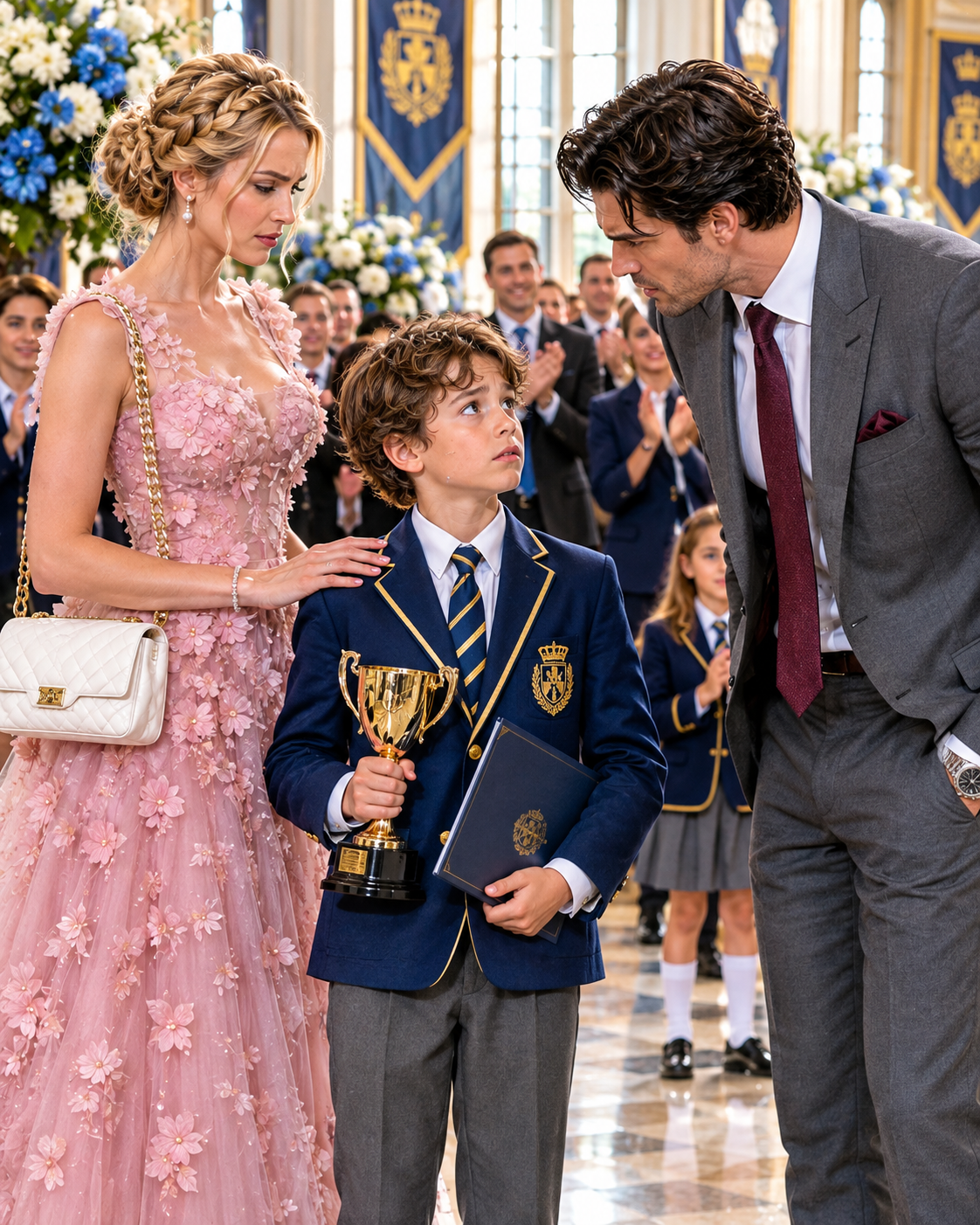
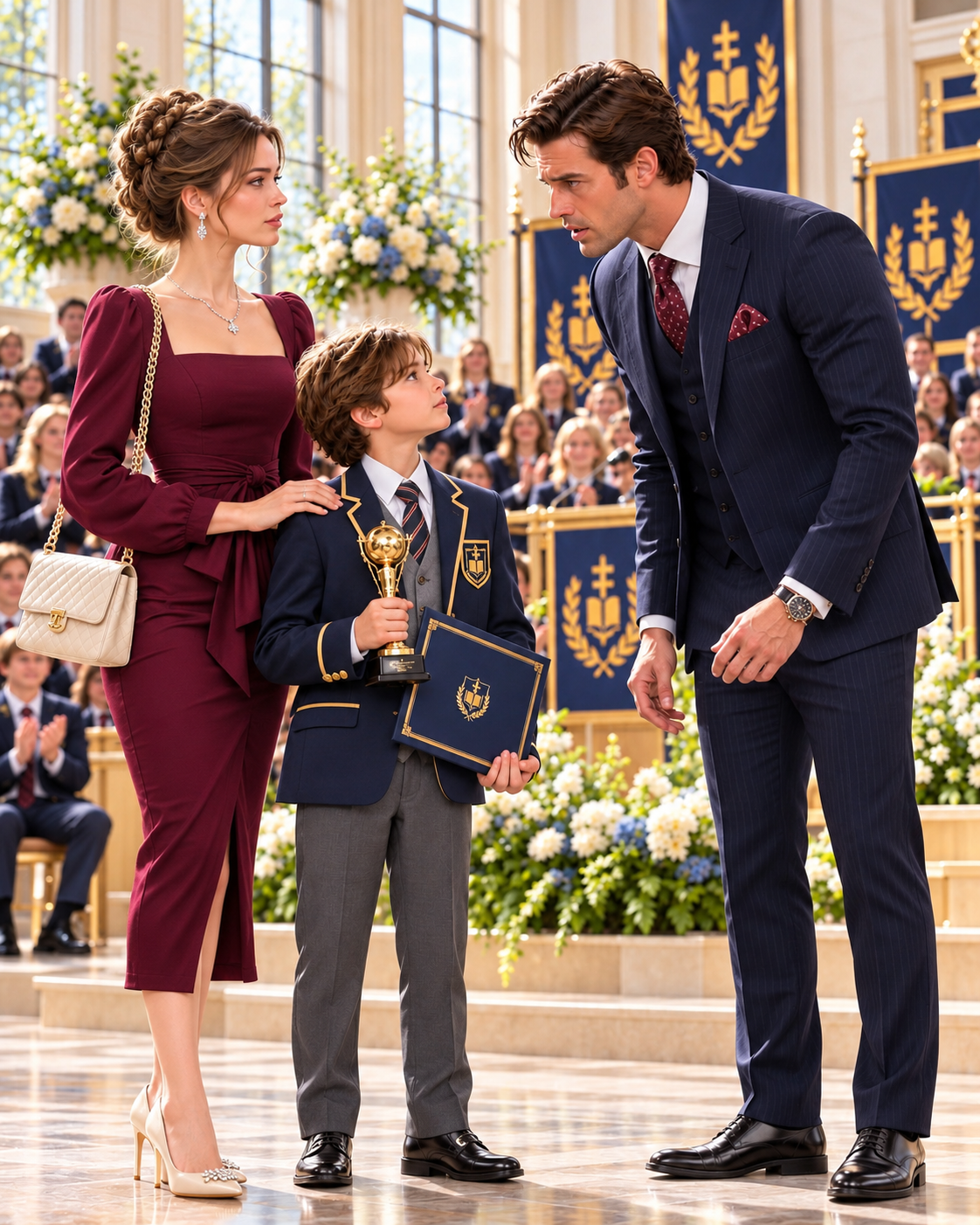
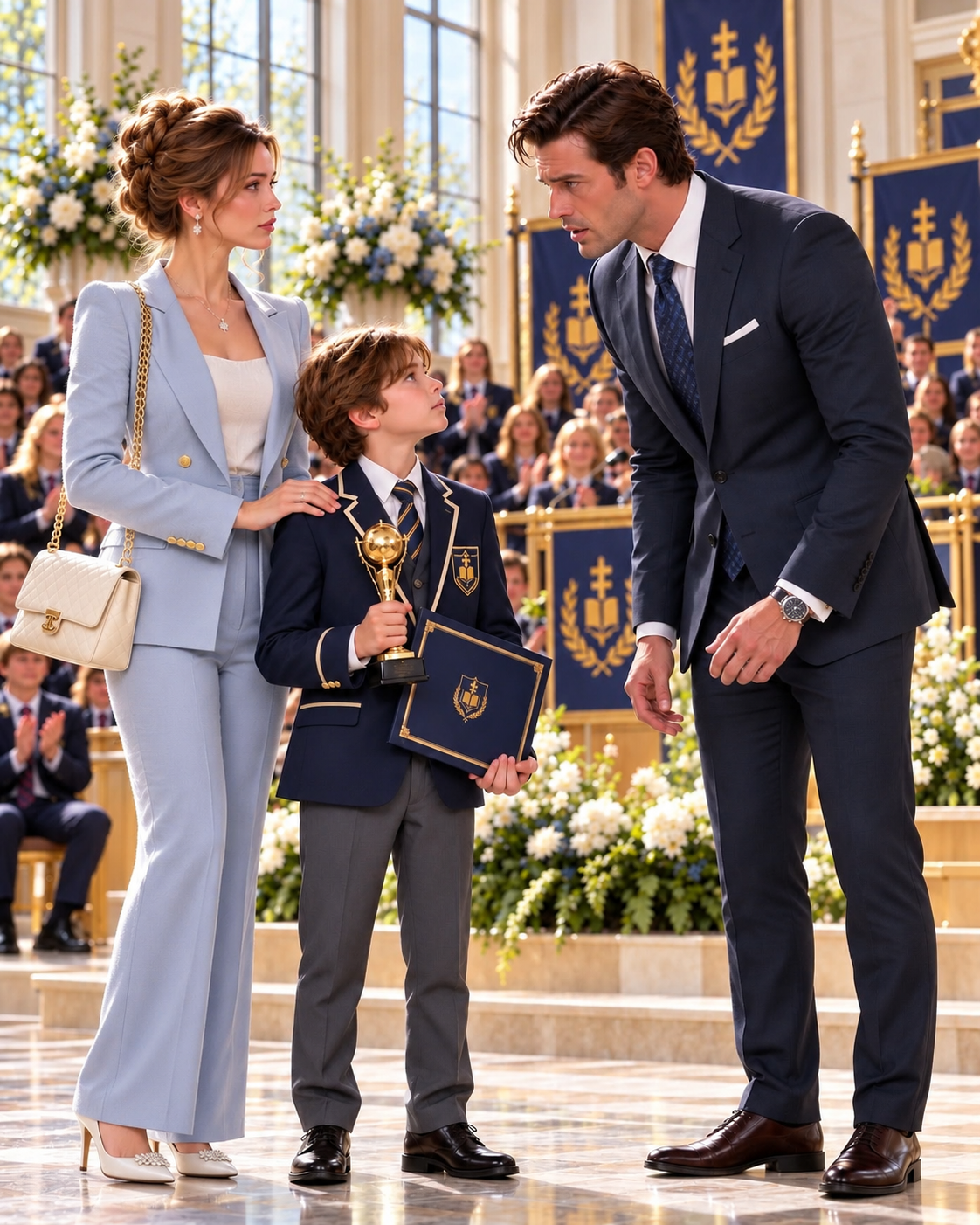
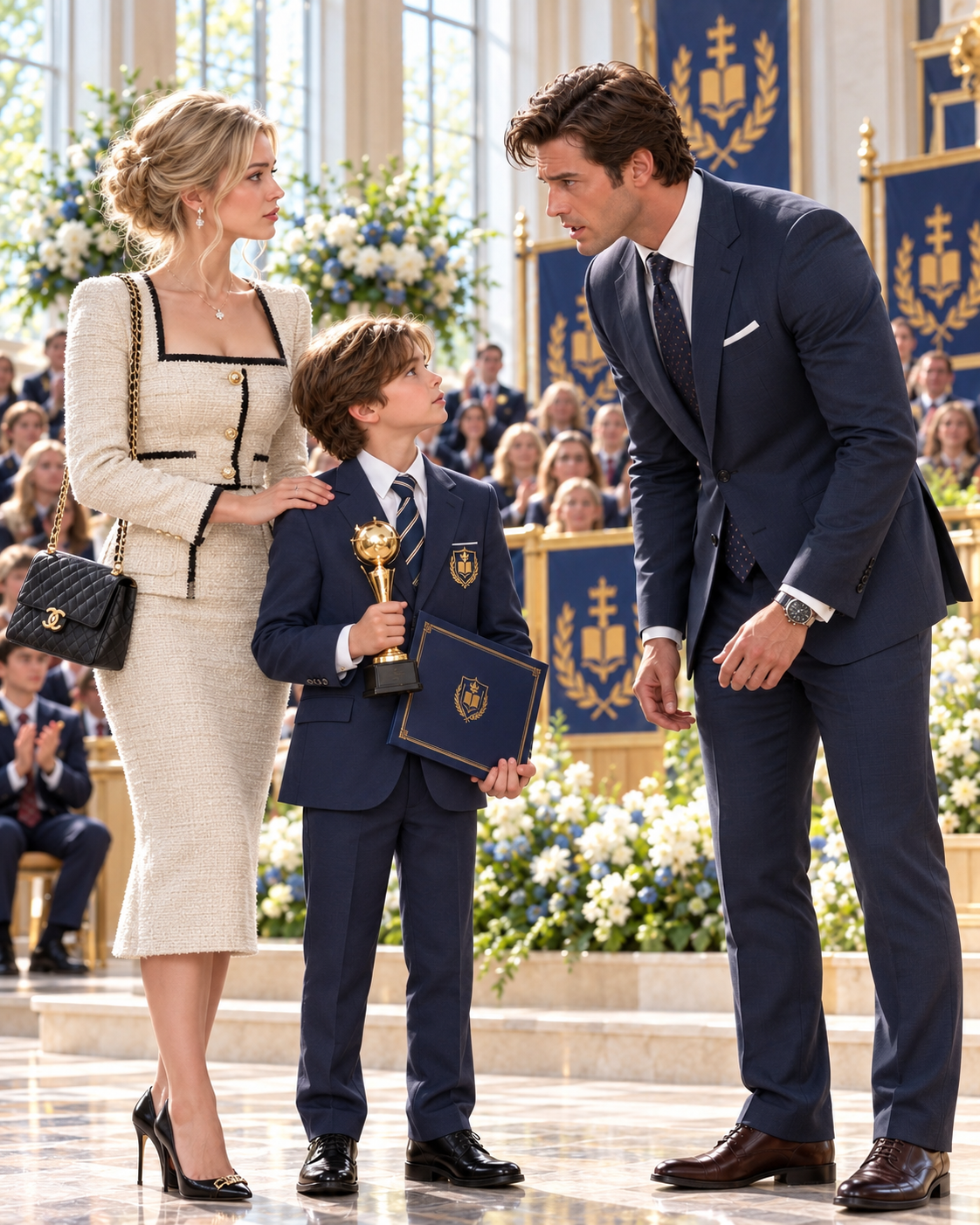
Then Mason won a scholarship and first place in a prestigious children’s science competition in San Francisco.
I stood near the back of the auditorium, struggling not to cry as the principal praised his solar-powered water filtration system.
The principal announced that the billionaire sponsor who had contributed ten million dollars would present the winning certificate.
A side door opened.
Lucas Albright walked onto the stage.
My breath stopped.
He stepped toward the microphone and read the winner’s name.
“Mason Miller.”
My son climbed the steps with a proud smile.
Lucas extended his hand.
Mason shook it.
Then Lucas looked closely at the boy.
His smile vanished.
He stared at Mason’s eyes, his chin, and the familiar crease between his eyebrows.
The resemblance was unmistakable.
“Nora,” Lucas whispered.
I heard him despite the applause.
Mason accepted the certificate.
“Thank you, Mr. Albright,” he said.
Lucas barely responded.
The principal continued praising Mason’s design, but Lucas seemed unable to listen.
I knew exactly what he was seeing.
He was seeing himself.
Mason hurried down the stage steps.
“Mom, did you see?”
“I saw everything,” I said.
He showed me the certificate.
“They said the design could help communities that don’t have clean water.”
“I’m so proud of you,” I told him.
I kissed his forehead and pulled him closer.
Lucas came down from the stage.
The principal thanked him for supporting the scholarship, but Lucas’s attention remained fixed on Mason.
“What is your full name?”
“Mason Miller.”
“Miller.”
Mason nodded.
“Like my mom.”
Lucas grew still.
“How old are you?” he asked.
“Nine.”
His eyes immediately found mine.
He asked Mason about his project.
Mason eagerly described how sunlight, charcoal, and sand might help purify contaminated water.
When Lucas asked whether he had built the model himself, Mason explained that I had helped with its frame after the first structure collapsed.
“That happens to most first designs,” Lucas said.
“You build things too?”
“Sometimes.”
“What kind?”
“Buildings.”
“Like skyscrapers?”
“Among other things.”
“Do you design them yourself?”
Lucas hesitated.
“I used to.”
“Why did you stop?”
“Because running a company takes more time than I expected.”
“That sounds boring.”
The principal laughed awkwardly.
Lucas almost smiled.
“It can be.”
Mason offered an innocent suggestion.
“You should design again.”
For an instant, I saw something soften in Lucas’s expression.
When Mason joined the other winners for photographs, Lucas and I were left facing one another near the curtains.
“Nora,” he said.
“Lucas.”
He glanced toward our son.
“Is he yours?”
“Yes.”
“I meant—”
“I know what you meant.”
He wanted to know where I had gone.
I reminded him that he had known about the San Diego house when the divorce was finalized.
He said he had only recently learned that I had moved to Phoenix.
When I demanded to know how, he admitted that he had asked the school for my contact details.
I immediately objected.
He insisted he meant no harm.
Then he looked toward Mason.
“He resembles me,” Lucas said.
I refused to confirm his suspicions.
“He has my eyes.”
“You’re not the only person in the world with dark eyes.”
“He has my chin.”
“Many people have chins.”
“And the way he frowns when he’s concentrating.”
“Perhaps he learned it from me.”
Lucas looked directly at me.
“You’re saying he isn’t mine.”
“I’m saying you should be careful with assumptions.”
Then he asked whether another man had been involved.
The question reopened an old wound.
“You left me,” I said.
“I know.”
“You signed papers saying our marriage had no children.”
“I don’t remember that clause.”
“I do.”
“What clause?”
I reminded him of the statement declaring that no children had been born during our marriage.
He insisted that he had not personally drafted the agreement.
I reminded him that he had signed it.
And that I had signed while he was rushing to meet Alyssa.
“Alyssa had nothing to do with the divorce.”
“She called you while you were handing me the papers.”
“She called because she needed help.”
“You sounded happy to hear from her.”
“I was trying to be kind.”
“You were trying to leave.”
He looked away.
Then he asked the question I had feared for nine years.
“Then why didn’t you tell me about Mason?”
“You didn’t ask,” I said.
Lucas stared at me.
“You were pregnant?”
“Yes.”
“Pregnant when?”
“When you gave me the divorce papers.”
The truth seemed to strike him physically.
Before he could respond, Mason approached.
Lucas looked at him with such open tenderness that fear rushed through me.
He asked where Mason had been born and whether he had always lived in Phoenix.
Mason answered politely, unaware of the conversation that had just changed his life.
When the principal mentioned a reception, I said we were leaving.
Lucas asked whether he could speak privately with Mason.
“No.”
My answer startled both of them.
I took Mason’s hand.
“We need to leave.”
Mason protested because the reception had cookies.
Then he asked why I seemed upset.
Finally, he looked at Lucas.
“Did you know him before today?”
“He was a friend of mine a long time ago.”
Mason wanted to know where we met and whether we had worked together.
Lucas answered carefully.
Then Mason asked the question that made both of us freeze.
“Were you married?”
“Yes,” I admitted.
“You were married to Mr. Albright?”
“Yes.”
“Why didn’t I know?”
“We’ll talk at home,” I said.
“About him?”
“About everything.”
Mason turned to Lucas again.
“Are you really a billionaire?”
“I’m afraid so.”
“Does that mean you can buy anything?”
“No.”
“Can you buy a better water filter?”
Lucas looked thoughtful.
“Probably.”
“Then you should.”
He laughed quietly.
For a heartbreaking instant, they looked exactly like father and son.
I led Mason toward the exit.
“Goodbye, Mr. Albright.”
“Goodbye, Mason.”
Lucas spoke his name as though he were afraid of forgetting it.
Before leaving, Mason asked whether Lucas would attend another competition.
“I don’t know,” Lucas answered.
“You should,” Mason said.
Outside, my son talked about the ceremony all the way to the parking lot.
I barely heard him.
At the car, he stopped and looked up at me.
“Mom, who was he really?”
“He was my husband.”
“Your ex-husband?”
“Yes.”
Then came the question I could no longer escape.
“Is he my father?”
I stood motionless.
People crossed the parking lot. Engines started. Families laughed as they walked toward their cars.
But every sound seemed far away.
“Why would you ask that?” I said.
“Because he looks like me.”
I tried to explain that unrelated people could resemble one another.
Mason did not believe it.
“Is he?”
He sounded frightened.
“Yes,” I whispered.
“Mr. Albright is my father?”
“His name is Lucas.”
“But he doesn’t know.”
“He knows now.”
Mason wanted to understand why I had concealed his existence.
I told him that Lucas had asked for a divorce before I could reveal the pregnancy and that I had feared he would remain only out of obligation.
Mason listened, then asked something I had never allowed myself to consider.
“That doesn’t mean he didn’t want me.”
He asked whether Lucas had ever searched for him.
I could only tell him I did not know.
Then he asked whether I had tried to find Lucas.
“No.”
“Why?”
“Because I thought you deserved a peaceful life.”
Mason looked down at his certificate.
“Maybe I deserved to know him.”
The words broke my heart.
I knelt and told him he deserved unconditional love, and that his father’s choices were not his responsibility.
He asked whether Lucas could love him.
“I don’t know.”
Then he asked whether I hated Lucas.
“No.”
“Do you still love him?”
I struggled to answer.
“I loved the person I thought he was.”
“Is that different?”
“Sometimes.”
Mason said he wanted to speak with Lucas again.
I protested.
But his answer was simple.
“He listened.”
I had no response.
That evening, we returned to our modest Phoenix home. Wide windows overlooked a small garden, and my workroom held the experiments we had built together.
For years, I had considered that house our safe place.
Then Mason discovered the box.
While I made tea, he entered my workroom and opened an old container filled with papers and keepsakes from my marriage.
He found letters, a wedding invitation, a dried flower, and the ultrasound photograph.
I reached the doorway just as he lifted it.
“What is this?”
“Put it down.”
“Is this me?”
“Yes.”
He also found the divorce decree.
He studied the dates.
“You said you moved to Phoenix three months later.”
“Yes.”
“And I was born six months after that.”
“Yes.”
Then he read the clause.
“No children born during the marriage.”
His expression changed.
“Why did this say there were no children?”
I explained that it had been part of the divorce agreement.
“But you signed it.”
“Yes.”
“Did Dad sign it too?”
“Yes.”
“Then he knew.”
I insisted Lucas had not known.
Mason challenged me.
“How can you know?”
I remembered Lucas’s shock in the auditorium.
But Mason reminded me of something painfully true.
“You don’t know him anymore.”
I admitted that I did not.
He asked why I had kept the ultrasound photograph and why I had never shown it to him.
I explained that I wanted him to be older.
“I am older.”
Then his eyes filled.
“Old enough to know why you hid my father?”
I reached toward him, but he pulled the photograph against his chest.
“You said he left us.”
“He left me.”
“Isn’t that the same thing?”
“No.”
“Then what am I supposed to call it?”
“You can call it complicated,” I said.
“That’s what adults say when they don’t want to tell the truth.”
I could not deny that my fear had shaped every answer I had given him.
I told him the truth: I had been wounded, and I had believed silence would protect him.
But he asked why I had never given Lucas the photograph or told him about the birth.
I admitted I had not.
Then Mason said something that followed me into the night.
“Maybe he didn’t know he was supposed to search.”
After Mason went upstairs, I examined the divorce decree.
The clause regarding children appeared near the end, beneath language about future claims and financial responsibilities.
The typeface looked slightly darker than the surrounding text.
I took out a magnifying glass.
Perhaps it was merely the result of repeated copying.
Or perhaps someone had inserted the sentence after the original document was prepared.
Later, the principal called.
Lucas had left the ceremony abruptly.
He had also asked the school about Mason’s family and medical needs.
The principal assured me he had not shared our address.
After the call, an unfamiliar number appeared on my phone.
Nora, this is Lucas.
I know you may not want to hear from me, but I need to ask one question.
A second message arrived.
Why did the divorce papers say we had no children?
Then a third.
And why did you never tell me you tried to send something to me nine years ago?
I stared at the screen.
Because there was something I had never told Mason.
After the divorce, I had mailed Lucas a letter.
Inside were my new Phoenix address, an ultrasound photograph, and a carefully written explanation that I was carrying his child.
Lucas never answered.
For nine years, I had believed his silence meant he had chosen not to acknowledge our baby.
But now my former husband was asking about a letter he was never supposed to know existed.
And I suddenly realized that someone might have been standing between us from the very beginning.
PART 2: THE DIVORCE THAT WAS BUILT ON LIES
I read Lucas’s messages repeatedly before finding the strength to respond.
I told him I had tried to contact him after our divorce.
He asked when.
I explained that I had sent a letter to his office, including the ultrasound photograph and my new address.
Several minutes passed before he replied.
I never received it.
The words made my chest ache.
For nine years, I had treated his silence as proof that our child meant nothing to him.
Now he insisted the letter had never reached his hands.
Lucas asked whether he could visit the following day.
I nearly refused.
Then he sent another message explaining that he would not take Mason anywhere or make promises. He only wanted to understand what had happened.
Eventually, I agreed.
Tomorrow at five.
For one hour.
That night, I returned to the divorce agreement.
The original document was tied with a faded blue ribbon.
I carefully untied it and studied the clause again.
No children had been born during the marriage, and neither party anticipated the birth of a child resulting from the marriage.
I remembered reading those words.
I remembered the pain of Lucas’s phone conversation with Alyssa.
But I did not remember anyone explaining the clause.
Nor did I remember Lucas reading it.
Later, I found the photocopied ultrasound image and the appointment card from the clinic.
On the back of the picture, I had written:
For Lucas.
Please read this before you decide.
I remembered slipping that image into the letter.
I had wanted him to know the truth without feeling pressured to return.
Now the possibility that someone had intercepted it would not leave me alone.
The next morning, Mason came downstairs holding his ultrasound picture inside a plastic sleeve.
“Can I keep this?”
“Yes.”
He asked whether Lucas possessed a similar photograph.
I admitted I did not know.
Then he urged me to ask him.
Mason wanted to know exactly what his father had known.
When I explained that Lucas denied receiving the letter, Mason asked whether someone might have stopped it.
I could not dismiss the thought.
Lucas’s mother had always despised me.
During the divorce, she had instructed me to accept the settlement and leave gracefully.
Could she have interfered?
Mason wondered the same thing.
I told him we would ask Lucas.
At 4:45 that afternoon, a gray car stopped outside my house.
Lucas arrived alone.
No chauffeur. No assistant. No corporate entourage.
He wore a simple navy jacket and carried nothing.
For a moment, he looked like the younger man I had once loved.
I let him inside.
His gaze traveled across the models, diagrams, and sketches Mason had created.
When Mason appeared at the stairs, Lucas greeted him gently.
“Hello,” Lucas said.
“Hi.”
“Thank you for letting me visit.”
Mason glanced at me.
“It was Mom’s idea.”
“It was not,” I said.
Lucas nearly smiled.
“I understand.”
We sat together in the living room.
Mason wasted no time.
“Did you know you had a son?”
“No.”
“Not even a little?”
“No.”
He asked whether I had told Lucas I was pregnant before the divorce.
Lucas admitted I had not.
Mason looked between us, trying to understand why two adults could have lived through the same marriage and emerged with such different versions of its ending.
Lucas explained that Alyssa had not been his lover.
She had been dealing with threats from an investor connected to a struggling company in London.
He said he had arranged legal assistance and temporary housing for her.
When I asked whether he had ever been romantically involved with her, he denied it.
“We were never together.”
He even produced an airline itinerary and hotel documents showing that the flight I believed he had rushed to catch had been canceled.
He had not flown away with Alyssa that evening.
My memories did not change.
I still remembered the tenderness in his voice.
But the meaning I had assigned to that call was beginning to fall apart.
Mason asked whether Lucas had loved me.
“Yes.”
“Then why did you divorce her?”
Lucas’s expression grew heavy.
He said his mother had convinced him that I intended to expose financial misconduct at Albright Global.
I stared at him.
I had never threatened his company.
Lucas explained that his mother had shown him emails apparently written by me.
Those messages suggested that I had obtained confidential documents and intended to release them unless he ended the marriage and transferred control of a subsidiary.
I denied writing them.
Lucas did not argue.
“I know that now.”
I demanded to know why he had believed such an accusation without confronting me.
He admitted that he had been afraid of a scandal affecting thousands of employees.
I told him he had sacrificed me because doing so was easier than questioning his mother.
He did not deny it.
“Yes.”
Mason, who had remained nearby, refused to leave when I asked.
“This is between adults,” I insisted.
“But it’s about me.”
He was right.
Lucas produced a scanned copy of one of the emails.
I recognized immediately that the language was not mine.
The account address was similar to one I had used in college, but the final number was different.
Lucas said the document metadata showed it had been created two days after its supposed date.
He had begun investigating after learning about my missing letter.
An attorney named Daniel Reese had worked for the family’s legal department during the divorce.
Lucas planned to contact him.
Mason asked whether Lucas had been kept from him or whether I had kept him from Lucas.
Neither of us could answer completely.
Lucas admitted he did not yet know.
I acknowledged that fear had caused me to hide the truth.
Mason was hurt, and he had every right to be.
After he went upstairs, Lucas told me he was not asking for custody.
He wanted an opportunity to know his son.
I warned him that money could not purchase nine missing years.
He agreed.
I allowed one more supervised visit.
As he prepared to leave, Lucas told me something unexpected.
His mother had died three years earlier.
I had not known.
He admitted that grief had made him too willing to forgive things he should have investigated.
That night, I found Daniel Reese’s contact information through a historical legal archive in San Francisco.
I sent a brief request for a meeting.
His reply arrived almost immediately.
Mrs. Miller, I remember your case.
Please do not discuss this matter by email.
I have something that should have been given to you long ago.
Beneath his name was a sentence that chilled me.
Your husband was not the only person who asked me to keep you silent.
When Lucas returned for his second supervised visit, I showed him the message.
Mason had been working on a model bridge, explaining how too much weight caused the central span to collapse.
Lucas stopped listening to the engineering lesson as soon as he saw my face.
He read Daniel’s email and went pale.
He insisted that he had never instructed the attorney to silence me.
Mason wanted to know who had.
We decided to meet Daniel.
Mason asked to accompany us.
I hesitated because the conversation concerned painful legal matters.
But Mason reminded us that the divorce had changed his life as well.
I agreed, provided he could leave whenever the discussion became overwhelming.
The following morning, we visited the legal archive near San Francisco’s waterfront.
Daniel Reese greeted us in a quiet reading room lined with old files.
His silver hair was neatly combed, and he leaned on a wooden cane.
He looked older than I remembered.
When he saw me, regret crossed his face.
He invited us to sit.
On the table lay a gray folder tied with a faded ribbon.
It carried the date of our divorce.
Lucas believed the original file had been destroyed.
Daniel explained that he had secretly retained a duplicate.
When I asked why, he gave an answer that changed everything.
“Because I knew the agreement had been altered.”
He opened the file.
The original draft included standard language stating that neither party was aware of a pending pregnancy.
A later version contained the clause we had signed, declaring that neither party anticipated the birth of a child.
Lucas demanded to know who had ordered the alteration.
Daniel looked directly at him.
“Your mother.”
Lucas went completely still.
Daniel explained that Lucas’s mother had contacted his office two days before the final documents were prepared.
She had insisted the agreement contain no language that might acknowledge a pregnancy or allow future claims involving a child.
More disturbingly, she claimed Lucas already knew about a pregnancy and had decided not to acknowledge it until after the divorce.
Lucas denied it.
Daniel admitted he had obeyed because he was the family attorney.
Then he revealed that he had learned about my pregnancy three weeks after the divorce was finalized.
I demanded to know why he had never contacted me.
Daniel said Lucas’s mother had instructed him to block communication concerning the matter.
She had ordered that any message I sent be treated as an attempt to manipulate Lucas.
My pulse quickened.
I asked about my letter.
Daniel admitted he had seen a copy.
Lucas’s mother had brought it to him, claiming it had been delivered to the family office by mistake.
She described it as a demand for financial compensation.
I nearly laughed at the cruelty of it.
I had not demanded anything.
I had only wanted my baby’s father to know that his child existed.
Daniel then produced the letters and the fabricated emails.
Some had been altered.
Others had been sent from an account created under my name.
Lucas recognized the copies he had been shown before the divorce.
At last he understood that his mother had manufactured the evidence used to destroy our marriage.
Mason asked why his grandmother had done such a thing.
Daniel explained that she wanted Lucas to marry someone more suitable to the family’s interests.
She favored Alyssa, whose family had influence in two company divisions.
But the deeper motive was control.
Lucas’s mother believed I encouraged him to think independently and challenge the board.
She wanted a daughter-in-law who strengthened the family’s position rather than questioning its power.
Daniel then placed another document before me.
It was my missing letter.
My handwriting covered the page.
Lucas,
I do not know whether you will read this, but I need you to know that I am pregnant.
I remembered writing those words in my small Phoenix apartment.
The letter explained that I had heard our baby’s heartbeat and included my new address.
Its final message was simple.
I am not asking you to return to me.
I only believe you deserve to know your child exists.
Lucas asked permission to read it.
His hands shook.
When he finished, he closed his eyes.
“I never saw this.”
“I know.”
“You said you were not asking me to return.”
“I did not want you to stay because of guilt.”
“You gave me a choice I never knew I had.”
For the first time, I understood that Lucas and I had each mistaken silence for rejection.
He had believed I chose to disappear.
I had believed he chose to ignore our child.
Neither of us had known that our words had been intercepted.
Mason looked at the document.
Then at his father.
“But you signed the paper that said I didn’t exist.”
Lucas lowered his head.
“I signed it without understanding what it concealed.”
“That still happened.”
“Yes.”
Mason turned to me.
“And you signed it too.”
“Yes.”
“Both of you signed something that hurt me.”
Neither of us defended ourselves.
Mason pulled away when I reached for his hand.
“I don’t know who to believe.”
“You do not have to decide today,” I said.
“I want the truth.”
“So do we.”
Daniel told us that the hidden documents did not end with the altered agreement.
He had also prepared a private memorandum at Lucas’s mother’s request.
It falsely stated that I had not disclosed a pregnancy during the divorce proceedings and that any later claim should be considered fraudulent.
Lucas demanded the memorandum.
Daniel retrieved a sealed envelope.
Inside were three pages.
The first claimed I had concealed information.
The second sought to undermine any future claim concerning a child.
The third contained a handwritten instruction in Lucas’s mother’s unmistakable script.
Ensure that Nora relocates before Lucas has an opportunity to reconsider.
I felt the room tilt.
On the back of the document was another note.
A private investigator has been engaged to monitor the Phoenix address and prevent direct contact between the parties until the relocation is complete.
I realized that even my move to Phoenix had not been entirely independent.
A relocation consultant had contacted me after the divorce, encouraging me to leave San Diego quickly.
She had described Phoenix as promising for young designers.
The moving costs had been covered through what I believed was part of the settlement.
Daniel revealed that the money had come through a charitable foundation connected to Lucas’s family.
The arrangement had been designed to make my departure permanent.
Lucas stared at the documents.
He asked who the investigator had been.
Daniel gave us the name Victor Hale.
Victor had retired from private investigations six years earlier.
He was still alive.
And he had moved to Arizona.
“Where in Arizona?” I asked.
“Phoenix.”
A chill traveled through me.
I wondered what Victor had witnessed.
Whether he had seen Mason.
Whether he had known the letter was intercepted.
Then Lucas produced an ultrasound photograph recovered from his mother’s private archive.
It resembled the image I had preserved for years.
But this copy contained an unfamiliar notation.
Transferred to private custody, October 14.
On the reverse was another instruction.
Retain until the child is located.
Mason studied it.
A nearly erased signature appeared along the bottom.
Alyssa Bennett.
And beneath her name were six words none of us expected.
I was told the child had died.
For a moment, Lucas could not speak.
I stared at the photograph.
Alyssa had apparently known about Mason.
Yet she had believed he was dead.
Daniel examined the document and discovered another faded line.
The family has resolved the matter.
The implications were horrifying.
Lucas’s mother had not merely concealed a pregnancy.
She had arranged for different people to believe different lies.
Lucas had believed I left voluntarily.
I had believed he ignored our child.
Alyssa had apparently been told the baby died.
Daniel revealed that Victor Hale’s complete investigative report might explain how the deception had been maintained.
We agreed to contact him.
But Lucas stopped us before the call.
He turned toward Mason.
He wanted to acknowledge him legally as his son.
I reacted immediately.
“No.”
I feared that once lawyers and family documents became involved, Mason would again be reduced to a name inside a system that had already harmed him.
Lucas insisted he was not asking for custody.
He wanted Mason’s relationship to him to be officially recognized.
Mason asked what that meant.
Lucas explained that he wanted his son to know he was acknowledged, without imposing a new name, home, or obligation.
Mason asked whether he would have to live with Lucas.
No.
Would he have to call him Dad?
No.
Would he have to forgive him?
No.
Could he keep my surname?
Yes.
Could he choose how often they met?
Yes.
For the first time, Lucas seemed to understand that fatherhood could not be claimed by authority.
It had to be offered through patience.
We eventually met with family mediator Rebecca Lane.
She spoke directly to Mason, explaining that he could ask questions and decide what made him comfortable.
A genetic test confirmed Lucas’s paternity with a probability of 99.99 percent.
Mason read the result carefully.
“So it’s official.”
“It was always true,” Lucas told him.
The acknowledgment was completed privately.
No cameras.
No company representatives.
No attempt to turn a child into a public-relations story.
Mason chose the name Miller-Albright.
He wanted to retain the name I had given him while adding the one he had never known he could claim.
Lucas proposed establishing a trust for Mason’s education and scientific interests.
I initially refused.
Eventually, we agreed that an independent fiduciary would oversee the account and that neither parent could withdraw the funds.
Mason’s future would be protected without allowing money to dictate his relationships.
Over the following months, Lucas began visiting regularly.
He listened to Mason’s ideas.
He asked permission before making plans.
He never demanded affection.
Slowly, my son began to relax around him.
Then Mason was selected for an international youth science program in Copenhagen.
Lucas asked whether he could accompany us.
Mason wanted him there.
I agreed, although the thought of traveling together unsettled me.
The trip represented a new kind of closeness.
Then Lucas received a call from his company.
The largest acquisition in a decade was approaching its final vote.
Albright Global was negotiating a merger with a European renewable-energy firm.
The deal promised to expand the company’s clean-energy division and protect thousands of jobs.
The board demanded Lucas’s presence.
If he missed the meeting, the transaction might collapse.
I told him Mason would understand if he stayed.
Lucas looked toward our son.
“That is exactly what I am afraid of.”
He knew Mason had spent his entire life expecting nothing from him.
For the first time, Lucas faced a choice between the business that had consumed his marriage and the family he had only just discovered.
I reminded him not to choose Copenhagen merely to earn forgiveness.
He needed to decide whether he genuinely wanted to be present.
That night, Lucas transferred temporary authority over the acquisition to an independent committee.
He told the board he would not attend the vote.
Several directors warned him the decision could cost billions.
Lucas accepted the consequences.
He chose to accompany Mason.
Then he decided to correct the public record.
He prepared a statement acknowledging that false information and an improperly altered divorce agreement had influenced the end of our marriage.
He did not expose Mason’s private medical history.
He did not publicly attack Alyssa or his deceased mother.
Instead, he accepted responsibility for failing to question what he had been told.
I agreed to the statement only after making him promise three things.
He would make clear that I had not abandoned him.
He would explain that he had not knowingly rejected Mason.
And he would acknowledge that ignorance did not excuse nine years of absence.
Lucas agreed.
At the press conference, reporters asked whether he expected me to forgive him.
“No.”
Then he added that he hoped to become worthy of my trust, while understanding that I owed him nothing.
When asked about custody, he explained that he intended to earn a relationship with Mason at the pace Mason chose.
My son watched the broadcast beside me.
Then he called his father.
He asked whether Lucas would still attend Copenhagen if the project failed.
Lucas promised he would.
For the first time, Mason believed him enough to smile.
But before we left, Daniel Reese reached Victor Hale.
Victor agreed to speak with us about the missing investigative records.
He said he had retained information that Lucas’s mother had never received.
It concerned Mason.
A photograph of the final page of Victor’s report arrived shortly afterward.
The notation claimed that I and my child had been found safe in Phoenix and that Lucas should be informed immediately.
But Daniel’s next message contradicted it.
Victor says he never made that report.
Then Lucas showed me the signature beneath the forged notation.
It was a name I recognized instantly.
Nora Miller.
Someone had forged my own signature.
And suddenly the question was no longer whether Lucas’s mother had kept our child secret.
It was how many people had helped her make a living boy disappear.
PART 3: THE TRUTH THAT BROUGHT THEM HOME
My name appeared at the bottom of the report in handwriting so similar to mine that I felt physically ill.
I insisted I had never signed it.
Lucas believed me.
The forged document suggested that someone had reported Mason’s existence while also creating the impression that I had chosen to remain hidden.
It was a carefully constructed deception.
My son was upstairs preparing for Copenhagen, unaware that another piece of his past had been uncovered.
Lucas immediately contacted Daniel.
Victor Hale was waiting at the legal archive.
We agreed to meet him without Mason until we understood the documents.
The following morning, we drove to San Francisco.
Victor was a thin elderly man with tired, gentle eyes.
He carried a leather case containing records he had preserved for years.
Lucas placed the forged report in front of him.
Victor examined it.
He denied writing it.
He also denied ever reporting that Mason had died.
Someone had added those statements after he withdrew from the investigation.
He suspected Elaine Porter, Lucas’s mother’s longtime assistant, had access to the records.
Elaine was still alive.
Victor explained that he had originally been hired to locate me in Phoenix, determine whether I had given birth, and report directly to Lucas’s mother.
He had been specifically instructed not to contact Lucas.
Six weeks after the divorce, Victor located my apartment.
He had watched from a distance.
He had seen me with an infant.
Mason.
Lucas struggled to contain his anger.
Victor admitted that Elaine had instructed him to report that I had relocated alone and no child had been born.
At first, she claimed the baby had died during childbirth and that I was emotionally unstable.
But Victor eventually saw Mason alive and healthy.
He realized the story was false.
Instead of confronting the family office, he began retaining copies of his observations.
He admitted that fear for his livelihood and reputation had kept him silent.
Lucas understood that fear.
He did not excuse it.
Victor showed us a page from his private records.
Child alive.
Mother unaware of surveillance.
Letter intercepted by family office.
Report altered after investigator’s withdrawal.
The words made me feel exposed.
I had believed the small Phoenix apartment was the first place where I had truly been free.
Someone had watched me there.
Someone had watched my newborn child.
And someone had made sure Lucas never learned the truth.
Victor explained that Elaine had possessed copies of my correspondence and used them to create a convincing forged signature.
The family office needed supposed proof that I had voluntarily refused contact.
Lucas’s mother had even employed another investigator to monitor the hospital around the time of Mason’s birth.
She knew her grandson existed.
She simply decided that his existence threatened her plans.
Victor believed she intended Lucas to marry Alyssa and strengthen financial alliances between their families.
Lucas stood silently as the truth settled around him.
His mother had treated marriage, motherhood, and a child’s existence as variables in a business strategy.
I finally understood that her greatest concern had never been whether I was suitable.
It was whether she could control her son.
Victor handed us the last original report.
It confirmed that I and Mason remained safely in Phoenix.
At the bottom, he had written instructions that the record should reach Lucas if anything happened to him.
He had preserved the truth for nine years.
When Lucas asked why he had finally come forward, Victor explained that he had seen the public statement.
Lucas had admitted his mistakes without using his mother as an excuse.
Victor believed the truth might finally be safer than the lie.
We left the archive with the documents.
During the drive home, Lucas apologized.
I asked what, exactly, he regretted.
Believing his mother.
Failing to verify the emails.
Signing an agreement he had barely read.
Accepting my silence as evidence that I wanted no relationship with him.
And never searching for me.
He admitted each failure without defending it.
I reminded him that discovering the truth would not restore Mason’s lost childhood.
Nor would it automatically restore my trust.
Lucas did not argue.
He simply said he could remain present now.
He could stay.
The word affected me more deeply than any extravagant promise.
When we reached home, Mason was waiting on the front steps beside his suitcases.
He immediately asked about the report.
Lucas sat beside him and explained that his grandmother’s assistant had helped spread a false story claiming Mason had died.
Mason looked frightened.
“But I didn’t.”
Lucas assured him that he had always been alive and safe with me.
Mason asked whether his grandmother had known.
Yes.
Had Lucas known?
No.
Had I known we were being watched?
No.
Mason wanted to read the records.
I told him some information was too painful and complicated for a child.
But I allowed him to keep the page confirming that he was alive.
He folded it carefully and placed it in his backpack.
“I want to remember that someone knew I existed.”
Lucas’s eyes filled.
Mason asked whether his father would have come if he had known the truth.
Lucas answered yes.
Then Mason asked whether he would have come even if his mother had forbidden it.
Lucas paused.
He hoped he would have.
But he could not honestly promise what his younger self might have done.
Mason seemed to appreciate the honesty.
That evening, the three of us reviewed his Copenhagen project.
Mason explained the filtration system while Lucas asked detailed questions.
He did not attempt to take over the design.
He listened.
When Mason went upstairs, Lucas told me he was considering stepping away from daily control of Albright Global.
He wanted to return to architecture and focus on sustainable housing and community projects.
I warned him not to build a new career around winning my approval.
He promised he would pursue it because it was something he genuinely wanted.
I also warned him against using financial support to gain access to my work.
He assured me that he would respect my independence.
The answer was not dramatic.
There were no declarations of eternal devotion.
But for the first time, I began to see the possibility of a relationship in which neither person needed to disappear for the other to succeed.
Copenhagen brought us closer in a way none of us anticipated.
Mason did not win.
During the final demonstration, the pressure inside his filtration device became unstable.
Water moved too quickly through the purification chamber.
The experiment failed.
My son stood before the judges with tears gathering in his eyes.
He was devastated.
Lucas did not offer to replace the device or use his connections to secure another opportunity.
He waited.
When Mason finally looked toward him, Lucas approached and crouched beside him.
“What happened?”
“The pressure was wrong.”
“What will you change?”
“The valve.”
“Then you learned exactly what the experiment was meant to teach.”
Mason wiped his cheeks.
“You’re not disappointed?”
Lucas admitted he was disappointed that the valve had failed.
Then he told Mason he was not disappointed in him.
My son leaned against Lucas’s shoulder.
The gesture was brief.
But I knew how much it meant.
They returned from Copenhagen without a trophy.
They brought home a stronger design, new ideas, and the beginning of a father-son bond that no longer depended on success.
Months later, Mason presented an improved system at another international youth science exhibition.
This time, he won.
Lucas remained at the back of the auditorium, applauding with everyone else.
He did not sit with the sponsors or seek recognition for funding the program.
When the ceremony ended, Mason ran toward him.
“You came.”
“I promised.”
“You didn’t promise to be here if I won.”
“I promised to be here whether you won or not.”
Mason embraced him.
Lucas closed his eyes and held his son gently.
I watched through tears.
For years, I had imagined Mason reaching toward a father who would not return.
Now his father was there.
Not because a court had ordered it.
Not because a financial arrangement required it.
Because he had chosen to show up.
Lucas and I began attending counseling together.
We did not enter the process with a promise to remarry.
We wanted to understand whether the damage between us could ever become something other than pain.
Some sessions were difficult.
I still became angry when Lucas explained decisions that had once made me feel disposable.
He occasionally struggled not to defend himself.
But he learned to listen.
I learned that recognizing his growth did not mean pretending the past had been harmless.
Mason continued living with me.
His visits with Lucas gradually became more frequent.
They toured museums, designed buildings, and argued cheerfully about science.
Lucas attended school events and parent meetings.
He did not assume that his wealth or biological relationship gave him greater authority.
He asked before offering advice.
He arrived when he said he would.
He learned to become dependable through ordinary actions.
Those actions mattered more than any expensive gift.
A year after Copenhagen, I opened my own sustainable architecture studio.
I named it Miller Green Architecture.
I had spent years dreaming of a business dedicated to healthier buildings and environmental responsibility.
Now I was finally creating it.
Lucas offered funding through an independent foundation.
I refused twice.
On the third occasion, after my attorney carefully reviewed the terms and confirmed that Lucas would have no control over the firm, I accepted a limited investment.
He did not attend the signing.
He sent flowers without a note.
I placed them in the reception area because I wanted them there.
Not because I owed him anything.
My studio expanded slowly.
Our first important commission was a sustainable community center in an area that had struggled with recurring water shortages.
Mason helped develop the filtration garden.
Lucas contributed to the structural planning.
I directed the project.
For the first time, our ambitions supported one another without one person being required to abandon their own.
Three years after Lucas first shook Mason’s hand on the stage, the community center opened.
Sunlight passed through the broad glass canopy.
Solar panels generated electricity.
Recycled materials formed much of the structure.
Rainwater collection and purification systems supplied the grounds.
Children gathered in the garden while teachers demonstrated the filtration technology.
At the entrance stood a polished stone bearing the name:
The Mason Miller Community Center.
Lucas stood beside me as the celebration began.
He said I had made it possible.
I reminded him that we had all contributed.
He looked surprised.
We had traveled a long distance from the day our marriage ended across a desk.
I was learning that partnership did not require surrendering my independence.
Lucas was learning that love did not grant ownership over another person.
Mason approached holding a small wooden box.
“Mom, Dad, it’s time.”
Lucas went still at the word Dad.
Mason had begun using it naturally.
But I knew Lucas never took it for granted.
At the ceremony, Mason opened the box.
Inside was the original ultrasound photograph, carefully preserved behind archival glass.
Lucas had recovered it from his mother’s private records and returned it to me, allowing Mason to decide where it belonged.
Now our son held it up.
“I want both of you to have this,” he said.
I reminded him that it belonged to him.
Mason nodded.
“It is the first picture of me.”
Then he looked toward Lucas.
“And it is the first picture Dad should have seen.”
Lucas accepted the frame with trembling hands.
He studied the tiny image of the child whose existence had been concealed from him.
Then he apologized again.
He told Mason he regretted the nine years that had passed before he knew he had a son.
Mason looked at him thoughtfully.
“You didn’t choose all of them.”
“No.”
“But you chose some of them.”
Lucas nodded.
“Yes.”
“That is why I believe you now.”
Lucas looked confused.
“Why?”
“Because you stopped pretending you were innocent.”
The words affected him deeply.
He thanked Mason for allowing him to become his father.
Mason squeezed his hand.
“Keep trying.”
“I will.”
Then Lucas turned toward me.
He apologized for ending our marriage before asking for the truth.
I admitted that I, too, had allowed fear to control my decisions.
I had wanted to protect Mason.
But I had also been protecting myself.
Lucas did not ask me to stop being afraid.
He reminded me that fear did not have to make every decision.
For a long moment, we stood facing one another beneath the glass canopy.
Then Lucas offered his hand.
He did not insist.
He simply waited.
I placed my hand in his.
Mason smiled.
The gesture was so small that the people around us barely noticed.
But to me, it represented something greater than any ceremony.
I had chosen to trust again.
Months later, Lucas asked me to marry him.
There was no extravagant public proposal.
No expensive restaurant.
No orchestral performance.
He asked at our kitchen table.
The same table where we had once examined documents claiming our child was dead.
He placed a simple ring made from reclaimed gold in front of me.
“I do not want to restore our old marriage,” he said.
“Neither do I.”
“I want to build something different.”
“Different how?”
“With honesty, separate dreams, difficult conversations, and the understanding that either of us may say no.”
I looked at him.
“And if I say no?”
“I will still be grateful for the life we have built.”
“And if I say yes?”
“I will spend the rest of my life proving that yes does not become a cage.”
Mason was standing in the doorway, pretending not to listen.
I asked whether he had known about the proposal.
He claimed he only knew Lucas had been nervous.
Lucas denied it.
Mason pointed out that his father had spent ten minutes rearranging sugar packets.
I laughed.
For years, laughter around Lucas had seemed impossible.
Now it came naturally.
I turned back toward him.
“I will marry you again.”
His eyes filled with tears.
“Are you certain?”
“No.”
He smiled.
“Good.”
“But I am choosing it.”
“That is all I want.”
We married for the second time beneath the solar canopy of the community center.
There were no corporate banners.
No business journalists.
No celebration of an empire.
Only family, friends, and people who had witnessed how patiently we had rebuilt our lives.
Mason stood beside us.
He was not there to symbolize the years we had lost.
He was there because he was the child who had helped us understand what honest love required.
Lucas promised to love me without controlling me.
I promised to speak the truth before silence became another wall.
Between us, Mason placed the ultrasound photograph.
It showed a tiny shape that had once seemed almost impossible to recognize.
Yet that tiny life had changed everything.
Years later, visitors to the Mason Miller Community Center could see the photograph displayed near the entrance.
Beneath it were five words.
Every family begins with a truth.
Our family was never perfect.
We still carried scars.
There were difficult memories and conversations that required patience.
But there was also laughter.
There were science projects scattered across the dining table, family meals, evenings filled with questions, and the comfort of knowing that promises could finally be trusted.
I continued designing sustainable buildings that brought clean water and brighter spaces to communities.
Lucas learned to lead without demanding control over every decision.
Mason grew into a thoughtful scientist who understood that invention mattered most when it improved people’s lives.
When someone asked how our family had come back together, I never claimed that love had magically erased the past.
Love had not restored the missing years.
It had not changed the cruelty of the lies or the mistakes we had made.
What changed us was the willingness to acknowledge those mistakes and choose differently.
I would remember the ultrasound photograph hidden inside my handbag on the day Lucas handed me divorce papers.
I would remember the sound of Alyssa’s name on his phone.
I would remember signing away a marriage while carrying the beginning of another life.
But I would also remember the auditorium where Lucas first met Mason.
The moment he recognized himself in our son.
The documents that uncovered the truth.
The day Mason called him Dad.
And the quiet proposal that gave me the freedom to say yes.
The past had taken nine years from us.
It had taken dreams, trust, and opportunities we could never recover.
But it had not taken everything.
After the lies were exposed, after accountability replaced excuses, and after trust was rebuilt through countless ordinary choices, we found that love could return.
Not as the marriage we had lost.
Not as a perfect version of the family we might have become.
But as something stronger because it was finally honest.
And this time, when I chose Lucas, I did not lose myself.
I found a family in which all three of us were free to belong.
