

Part 1: My Husband Took My Phone After His Mother Injured Me—Then Left Me on the Kitchen Floor
“Put that phone down. Nobody is calling an ambulance.”
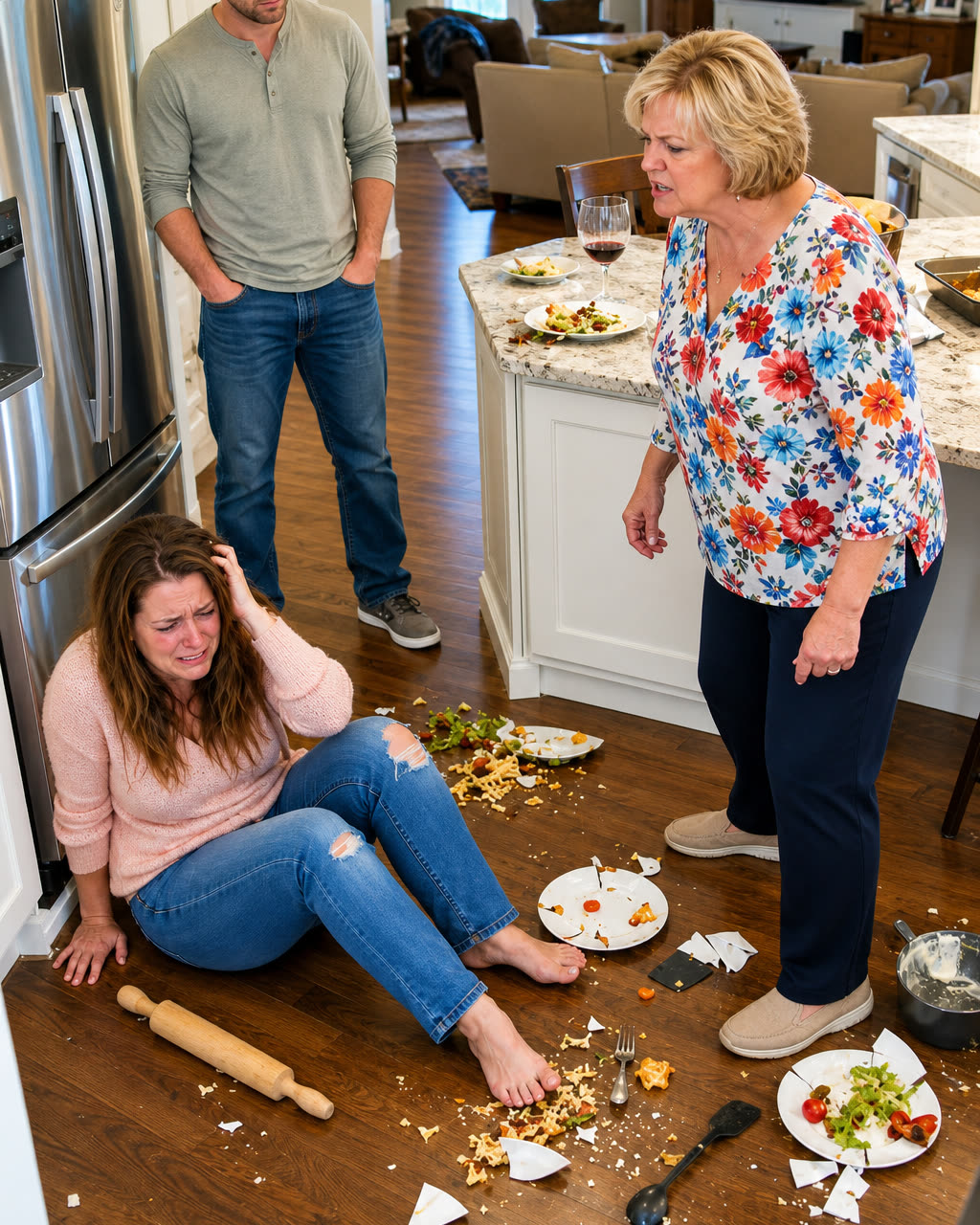
My husband snatched my phone out of my hand while I sat on our kitchen floor, unable to stand. The screen was still lit, my thumb hovering over the emergency call I had never imagined I would need. His mother stood beside him, still gripping the wooden rolling pin she had just used against my leg, her knuckles pale around the handle.
“She brought this on herself,” my mother-in-law said.
Instead of helping me, Paul pulled open a kitchen drawer, dropped my phone inside, and locked it. He told me to stop making trouble. Then he turned his back on me, walked into the dining room, and sat down to eat as if nothing had happened.
My name is Clara Bennett. I was twenty-nine years old, worked as a senior financial analyst, and had been married to Paul for four years. I was the kind of person who checked details twice and planned ahead, and I believed most problems could be solved if two people simply sat down and talked.
Until that evening, I had convinced myself that the tension between his mother and me was something we could eventually resolve. I told myself that Diane was just set in her ways, and that patience and politeness would wear down her sharp edges in time. I had no idea how wrong I was.
It started when Diane criticized the dinner I had prepared. She stood at the counter with her arms folded, studying the pans on the stove as though they had personally offended her. She complained that I had ignored her instructions about how the meal should be made.
I kept my voice calm. I told her politely that I could make my own decisions in my kitchen. I remember how quiet the room became afterward, the bubbling of the pot suddenly very loud, and how her expression hardened into something I had never seen so clearly before.
“You think earning more money than my son gives you the right to disrespect me?”
I tried to walk away rather than argue. I had only taken a few steps when Diane grabbed the rolling pin from the counter and struck my leg, sending me against the kitchen cabinets before I collapsed onto the tile.
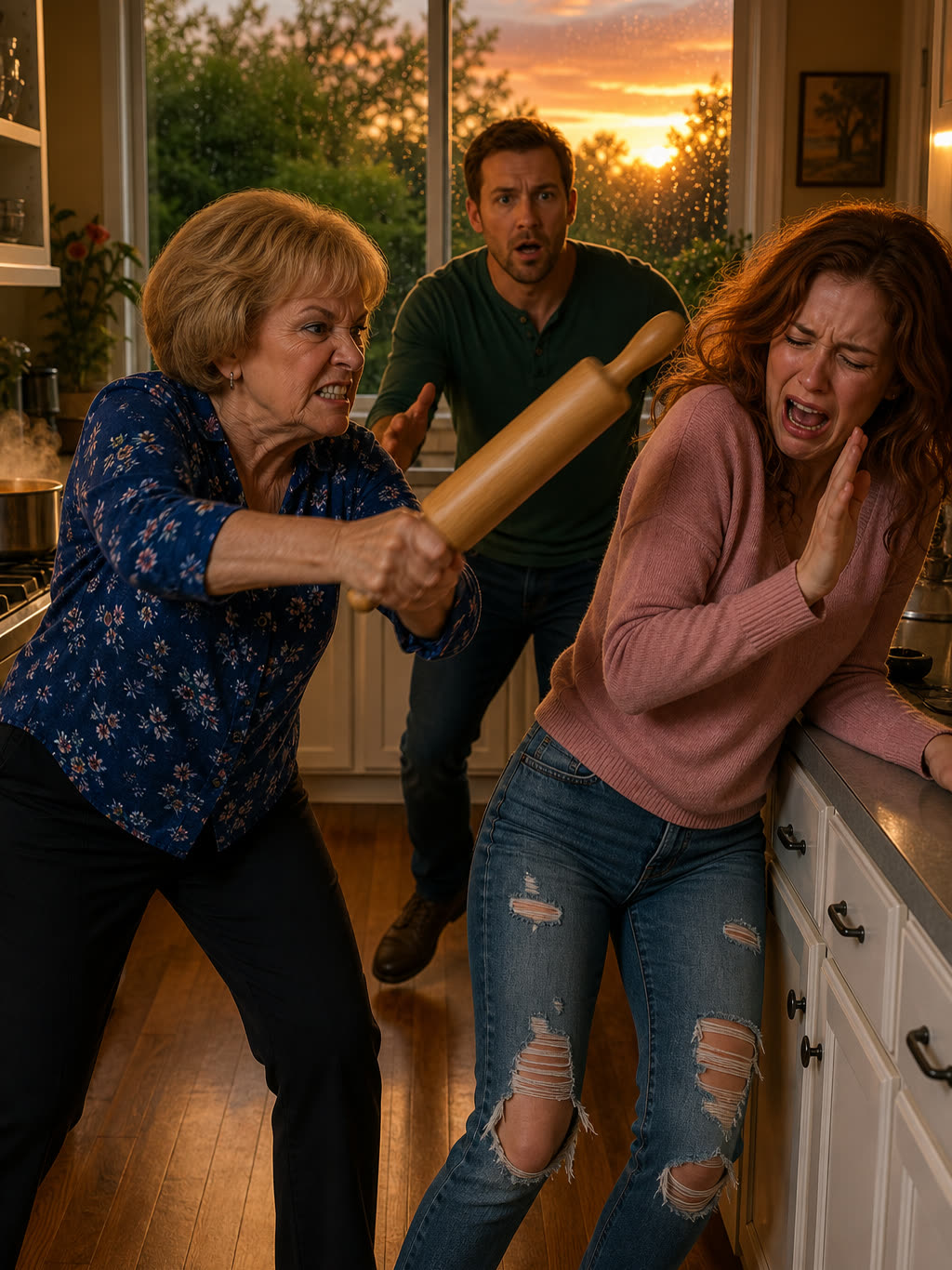
The pain was immediate. It shot from my shin up through my knee in a white-hot wave, and when I tried to put weight on my leg, it refused to hold me. Every attempt to shift my body made my stomach turn. I pressed my back against the cabinet doors and breathed in short, shaking gasps.
Paul had entered the kitchen moments later. I remember looking up at him with desperate relief, certain that the sight of me on the floor would cut through whatever anger filled the room. Instead of asking whether I was hurt, he demanded to know what I had said to upset his mother.
“Please, Paul. I need a hospital.”
“You deserved it for disrespecting my mother.”
I stared at him, waiting for the sentence to turn into something else. It didn’t. His father stood in the doorway behind him with his hands in his pockets, watching without intervening, his eyes fixed somewhere near the floor rather than on me.
When I reached for my phone, which had slipped from my pocket as I fell, Paul crossed the room before my fingers could close around it. He took it away and locked it in the drawer. I heard the small click of the key, and it sounded louder than anything else that night.
“You can think about your attitude tonight. We’ll deal with this tomorrow.”
They left me there.
From the dining room, I heard plates clinking and the television switching to a football game. The smell of the dinner I had cooked drifted across the kitchen. Diane laughed at something Paul’s father said, a light and easy laugh, while I struggled to sit upright with my leg stretched out in front of me.
I called Paul’s name several times, first firmly and then with a voice that cracked. Nobody came. The only answer was the roar of a crowd on the television and the scrape of a chair against the floor.
I tried to talk myself through it. I breathed slowly, counted the tiles in front of me, and told myself that at any moment Paul would come back, look at my leg, and realize what he had allowed to happen. I waited for that moment the way a person waits for a train that has already gone.
After what felt like hours, I heard him telling his father that I needed to learn who made the rules in their family.
That was when I stopped expecting my husband to help me.
Something inside me went very still. The fear did not disappear, but it changed. It became a cold, clear understanding that if I wanted to leave that kitchen, I would have to do it myself. Nobody in that house was going to carry me out of it.
The back door was only a few feet away, but reaching it took nearly everything I had. I turned onto my side and pulled myself across the floor with my elbows and hands. My injured leg dragged behind me, and I stopped whenever the pain became unbearable. Twice I thought I would be sick, and once I lay with my cheek against the cool tile, biting my lip to keep from crying out.
I kept listening for footsteps. Each time the dining room laughter swelled, I froze, certain someone would come to see what I was doing. But the television kept playing, and the voices kept talking, and no one looked for me.
When I finally reached the back door, I found another obstacle. The old security grate near the rear entrance had a damaged latch that Paul had been promising to fix for over a year. Now it held fast, a locked barrier between me and the dark yard.
I looked around the kitchen, my vision swimming. Within arm’s reach was a lower drawer, one I knew was full of odds and ends. I dragged myself toward it, slid it open as quietly as I could, and felt among the clutter until my fingers closed around a small tool.
My hands shook so badly that I dropped it twice. I worked at the mechanism a little at a time, wedging the tip under the damaged latch and prying with whatever strength remained in my wrists. Sweat ran down my temples. I whispered to myself to keep going, that it was only a latch, only a few more seconds.
Then it released with a quiet metallic snap.
Cold rain struck my face as I pulled myself outside. It was heavy and relentless, soaking through my clothes in seconds, and I had never been so glad to feel anything. The air smelled of wet earth and cut grass. For the first time that night, I could breathe without the weight of that house pressing down on me.
Across the narrow yard lived Mrs. Young, an elderly widow who had always greeted me kindly. She had waved to me from her garden on summer mornings, and she had once pressed a jar of homemade preserves into my hands just because I had stopped to admire her roses. Her porch light was off, but I knew she was usually home in the evenings.
I dragged myself through the wet grass toward her steps. The ground was slick, and my palms sank into mud with every pull. The yard seemed to stretch on for miles. Every few feet I had to stop and rest my forehead against my arm, listening for the sound of the back door opening behind me.
It never did. Nobody inside noticed I was gone.
By the time I reached her door, my hands were trembling so badly that I could barely knock. My hair was plastered to my face, and my teeth chattered so hard that I could hardly think. I gathered what strength I had left and struck the wood three times.
Nothing happened. The rain drummed on the porch roof, and I wondered, with a terror that made my chest ache, whether I had come all this way for nothing. I raised my fist to knock again.
A light came on inside.
I heard slow footsteps, the rattle of a chain, and the turn of a lock. Then the door opened, and Mrs. Young looked down at me, a soft cardigan wrapped over her nightclothes and her white hair slightly mussed from sleep.
Her expression changed immediately. The confusion drained from her face, replaced by something so full of alarm and tenderness that I nearly broke down right there on her welcome mat. She knelt beside me without hesitation, ignoring the rain that dampened her sleeves.
“Clara? Oh, honey, what happened to you?”
I tried to explain, but the words came out in broken pieces. I told her about the kitchen, the rolling pin, the locked drawer. She did not interrupt. She reached for the phone in her pocket and called emergency services, keeping one hand on my shoulder while she gave the address in a steady voice.
For the first time that night, someone believed I needed help.
She pulled her own cardigan from her shoulders and laid it over me, murmuring that help was coming and that I was safe now. I clung to those words. Through the open doorway, I could see the warm glow of her hallway lamp, and it felt like the most beautiful light I had ever seen.
I lay on her porch with my head near her knee, listening to the rain and watching it run off the roof in silver ropes. Somewhere in the distance, I thought I heard a siren, thin and far away, growing a little louder with each breath.
And while Mrs. Young stayed beside me in the rain, neither of us realized that a nearby security camera had recorded the final moments of my escape.
Part 2: My Husband Claimed I Had Fallen—But the Hospital Found Evidence He Couldn’t Explain Away
I woke beneath the bright lights of a hospital room three days after Mrs. Young found me outside her house.
My injured leg had been treated and immobilized, and a nurse was checking my vital signs when I opened my eyes. The room smelled faintly of antiseptic, and a machine beside me beeped in a slow, steady rhythm. Mrs. Young sat beside the window, holding a paper cup of coffee that had clearly gone cold hours before.
“Oh, sweetheart,” she whispered when she noticed me awake. “I was so worried.”
I tried to sit up, but she gently asked me to rest. Her hand, thin and papery, settled over mine, and I realized she had been sitting there for a very long time. There were shadows under her eyes, and her cardigan was creased as though she had slept in the chair.
The doctors had confirmed that my leg was fractured. They had also documented the surrounding injuries and recorded the account I gave when emergency responders first brought me in. I barely remembered giving it. The night had come back to me in fragments, the rain, the siren, the flash of lights across the wet porch.
A hospital social worker visited later that morning. She was a calm woman with a soft voice, and she pulled a chair close to my bed before she sat down.
She asked who had been present, how the injury occurred, and whether anyone had prevented me from getting medical attention. I answered each question as carefully as I could, keeping my eyes on the blanket and my voice as steady as I was able.
For years, I had minimized Diane’s controlling behavior. She criticized my clothing, questioned my spending, and demanded that Paul approve decisions I made. I had told myself it was only a difficult personality, that every family had its friction. I had said these things to my friends, and mostly I had said them to myself.
Whenever I objected, Paul accused me of being disrespectful. I had learned to swallow my words, to smooth things over, to apologize for things that were not my fault. But this was the first time I had been seriously injured, and the first time the excuses had nowhere left to go.
The social worker explained that the hospital would preserve the relevant medical documentation and coordinate with the authorities. She also helped me contact an attorney named Rachel Morgan, writing the number on a slip of paper because my hands were still shaking too much to dial.
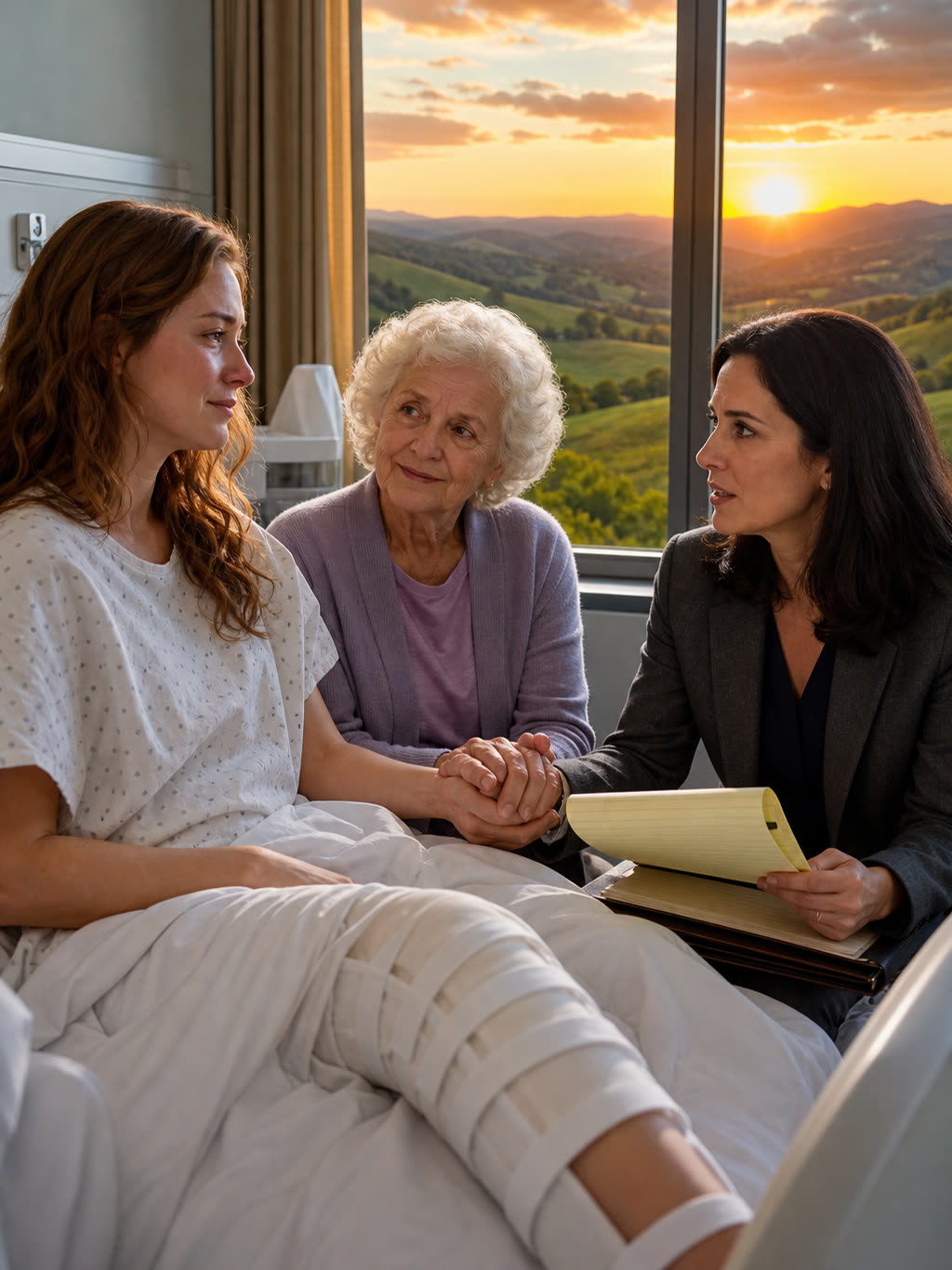
Rachel arrived that afternoon carrying a legal pad and a folder. She was composed and direct, with dark hair pulled back from her face and eyes that took in the room in a single glance.
“Your immediate safety comes first,” she told me. “After that, we need to preserve everything that supports your account.”
I nodded. It was a relief to hear someone speak plainly, to have a plan laid in front of me when I had spent so many hours with only fear in my head.
She explained that Mrs. Young had already given a statement to investigators. When emergency responders arrived, my neighbor had described finding me outside in the rain, unable to stand. She had told them exactly what she saw, and she had not wavered.
Investigators had also spoken with Paul and his parents. Rachel paused before she said the next part, as if she wanted me to hear it slowly.
According to Rachel, Paul claimed I had fallen during an argument.
“He says you lost your balance in the kitchen,” she explained.
I stared at her. For a moment, I felt as though the room had tilted. I could still see the rolling pin in Diane’s hand and feel the cabinet doors against my back.
“His mother hit me with a rolling pin. He took my phone so I couldn’t call for help.”
Rachel wrote down my words. She did not look surprised, and she did not tell me to calm down. She simply wrote, her pen moving steadily, and when she looked up again, her expression was serious and kind.
She told me the medical findings alone could not establish every detail of the confrontation, but they raised serious questions about Paul’s explanation. Investigators were comparing the accounts with the physical evidence collected from the house. Nothing was being decided yet, but a process had begun, and for the first time it did not depend on my silence.
Mrs. Young squeezed my hand. I turned my face toward the window, where late afternoon light was spilling over a row of distant green hills, and tried to let myself believe that I was really out of that house.
That afternoon, Paul called.
I almost did not answer. My phone, returned to me by a nurse, lay beside my pillow, and his name lit the screen like a warning. But Rachel had told me to save any contact he made, so I picked up and said nothing.
“Clara, we need to settle this before it gets out of control.”
I said nothing. I listened to his breathing, to the clipped, impatient way he spoke when he wanted a problem to disappear.
“My mother made a mistake. You know how she gets when she’s upset.”
The words washed over me like cold water. A mistake. As if she had burned a casserole or forgotten an appointment. I thought of the long hours on the kitchen floor and the click of the lock on that drawer.
“You left me on the floor.”
He exhaled sharply, the way he always did when I refused to follow the script he had written.
“Don’t destroy our marriage over one argument.”
I ended the call and saved the record of it. My hand was trembling, but beneath the trembling I felt something steadier. I had not shouted, and I had not begged. I had told the truth in five words and then hung up.
Later, Rachel returned with another update. She sat down beside my bed and opened her folder, but she held a single page in her hand before she spoke.
A security camera on a neighboring property had captured part of our backyard that evening. The recording showed me struggling across the grass toward Mrs. Young’s porch.
I closed my eyes. I did not want to imagine how I must have looked, dragging myself through the mud in the rain. But when Rachel described it, I felt a strange gratitude. It was proof. It was something Paul could not argue away or say I had misremembered.
It did not show what happened inside the kitchen, but it supported my account of leaving the house while severely injured. A woman with a badly hurt leg did not crawl through a storm because of a minor argument, and anyone watching that footage would understand that.
Mrs. Young had also preserved the original footage and provided investigators with the approximate time she called for help. When I looked at her, she gave a small, stubborn shrug, as though saving the recording had been the most natural thing in the world.
“I wasn’t going to let anyone say you weren’t telling the truth,” she said quietly.
Rachel placed a copy of the relevant report beside my bed. The paper was crisp and official, covered in times and notes and small numbers in columns. I did not read all of it, but I let my fingers rest on the edge, grateful for its weight.
For the first time, Paul’s version of events was being tested against evidence he couldn’t control.
Over the next day, I began to understand what that meant. Paul had always been the one who controlled the story. He decided what was said at family dinners, what counted as an overreaction, and what was forgotten by morning. Now people he could not charm or pressure were asking him questions.
Rachel visited again, bringing news in careful pieces. Investigators were still sorting through statements. Doctors had completed their notes. Mrs. Young’s account had been consistent from beginning to end.
Paul and Diane, meanwhile, had sent several messages through relatives asking when I would be released. Rachel told me, firmly, not to answer any of them.
I spent hours at the window while my leg healed in its brace. The hills outside shifted from gold to deep blue as the evening came, and the nurse who brought my dinner left the lamp on low. I thought about the four years of my marriage and wondered how many warnings I had mistaken for ordinary tension.
Two days after I regained consciousness, Rachel came into my room with her usual folder, but this time her expression was different. She closed the door behind her before she spoke.
Then Rachel told me something else.
Investigators had discovered that Paul’s account of when I left the house did not match the camera’s timestamp.
That discrepancy, she said, would become important when they questioned him again. He had given a specific time for the moment I supposedly stormed out after our argument, but the footage placed me in the yard hours later, and the gap was wide enough that no honest mistake could explain it.
I realized what that meant. Somewhere in those missing hours, my husband had been sitting in the dining room, eating dinner and watching football, while I lay on the floor of the kitchen.
Then Paul and Diane came to the hospital.
I heard their voices in the hallway before I saw them. Diane wore an elegant cream-colored coat and carried the same expensive handbag she brought to family gatherings. Anyone seeing her in the corridor might have mistaken her for a concerned relative, a kind mother-in-law stopping by with worry on her face.
She sat beside my bed without asking whether I was recovering.
“Clara, we need to consider what this is doing to the family.”
Paul stood behind her, watching my expression, his hands in his pockets and his jaw tight. He looked like a man waiting for a verdict he already intended to dispute.
I looked at my immobilized leg. The brace was heavy and white, and beneath it was the swollen proof of everything Diane had refused to name.
“You’re worried about the family?”
Diane straightened.
“I’m worried about everyone involved. There’s no reason strangers need to know our private business.”
Rachel, who had arranged to be present, stepped forward from the corner where she had been silent.
“Clara has already provided her statement. Any further questions should go through the appropriate legal channels.”
Diane’s smile disappeared. For a moment, her face was bare of any pretense, and I saw the same hard expression I had seen in the kitchen just before the rolling pin came down. Then she smoothed it away and clasped her handbag tightly in her lap.
Paul tried a different approach, telling me he was sorry things had become so serious. His voice was softer now, almost pleading, the voice he used when he wanted something from me. But when I asked why he had taken my phone and refused to call an ambulance, he avoided answering.
He looked at the floor. He looked at his mother. He looked at everything in the room except me.
Eventually, Rachel asked them to leave. Diane rose without a word and swept out of the room, and Paul followed, glancing back once from the doorway with something that might have been fear.
I let out a breath that I felt I had been holding for days. The room seemed brighter without them in it.
The next morning, another visitor arrived.
Her name was Margaret Bennett, Paul’s aunt and the younger sister of his father. She had attended our wedding and sent Christmas cards every year, but we had never been particularly close. I remembered her as a quiet woman who stood at the edge of family photographs and rarely spoke when Diane was in the room.
She stood near my hospital doorway holding a small leather handbag, and she looked as though she had not slept.
“I should have spoken sooner,” she said.
Rachel invited her inside. Margaret crossed the room slowly and sat in the chair Diane had occupied the day before, keeping her back straight and her handbag clasped against her knees.
She explained that Diane had spent years intimidating relatives who challenged her authority. Paul had gradually adopted the same behavior, defending his mother and pressuring others to remain silent. She spoke carefully, as though every word had been rehearsed in the car on the way to the hospital.
Then Margaret opened her handbag and removed a USB drive.
“I started recording certain conversations because I was afraid someone would eventually get seriously hurt.”
The small piece of plastic sat in her palm, and none of us moved. Rachel’s pen hovered over her legal pad. Outside the window, the hills had gone silver under a cloudy sky, and the room felt very quiet.
I realized I was gripping the blanket. Whatever was on that drive, I knew it would change everything.
Part 3: My Husband’s Aunt Brought a Recording—And Exposed What His Family Had Hidden
Rachel asked when and how the recordings had been made, explaining that their authenticity and legal admissibility would need to be assessed. She said it gently, but she did not soften it, and Margaret seemed to appreciate that. She sat up a little straighter, as though she had been waiting for someone to ask her exactly this.
Margaret nodded. She told Rachel the dates as best she could remember, and she said she would gladly provide any information needed to verify them. Her voice shook at first, but it grew steadier as she spoke.
One recording concerned an earlier family dispute involving Paul’s younger sister. Margaret said Diane had hurt her during an argument, and relatives had been pressured to describe the incident as an accident.
I thought of the family dinners I had attended, the polite conversation and the careful silences. I thought of how often someone had changed the subject when Diane’s temper rose. I had mistaken their quiet for peace, and all along it had been fear.
Another recording was more recent.
Margaret had received a call from Diane on the evening I was injured. She had answered without thinking, and it was only when she heard the tone of the conversation that she began recording. Her hands, she said, had been shaking so badly that she nearly dropped the phone.
During that conversation, Paul could be heard discussing what they would tell the police.
Rachel set a laptop on the tray table beside my bed and slid the drive into its port. She played a short section, her expression unreadable.
“Don’t worry,” Paul’s voice said. “I’ll tell them she slipped. Nobody’s going to believe her over us.”
My hands went cold. The voice was unmistakably his, calm and confident, the voice of the man who had promised to love me. He sounded like someone discussing a minor inconvenience, and I felt something inside me turn over and settle into stone.
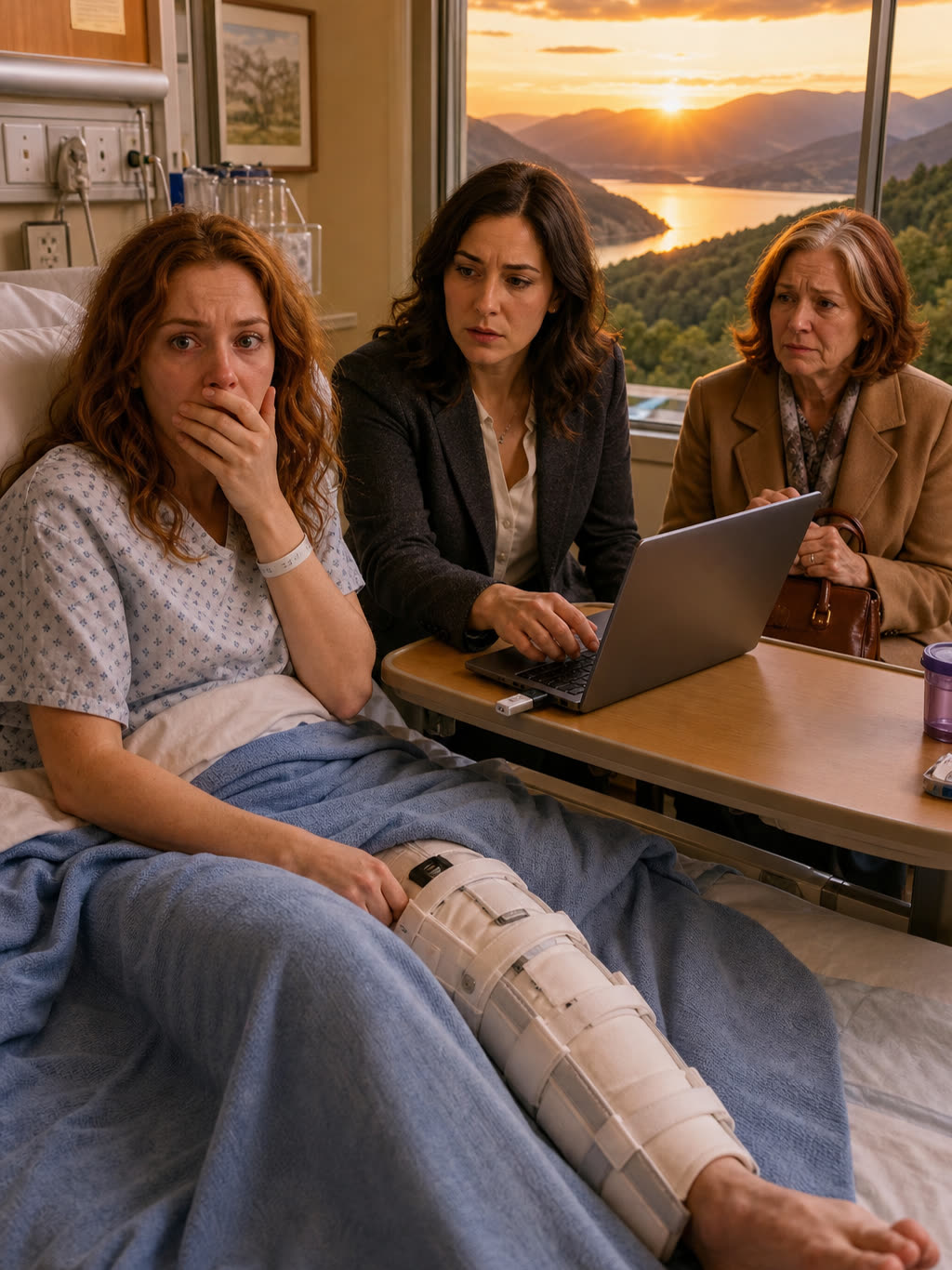
I had spent days wondering whether Paul understood how badly he had betrayed me. Hearing him discuss a false explanation made the answer painfully clear.
Then Diane’s voice came through the speaker.
“And make sure she doesn’t start asking questions about the money.”
Rachel stopped the recording. The silence afterward was heavy enough to hear.
I looked at Margaret.
“What money?”
Margaret lowered her eyes.
“I don’t know everything, Clara. But Diane has been receiving money connected to Paul’s accounts for a long time.”
I thought about the joint savings account Paul and I had built together. It was the one thing I had believed was solid. We had been saving for a larger home, and I contributed most of my annual bonuses, working overtime and skipping vacations because Paul had said the sacrifice would be worth it. He regularly assured me the money was untouched.
Rachel suggested reviewing our financial records with appropriate authorization before drawing conclusions. She reminded me that a recording did not explain itself, and that I should not leap to a verdict. But I saw in her face that she, too, wanted to look.
That afternoon, I accessed the account statements available to me. Mrs. Young had brought my reading glasses and a cup of tea, and she settled into the chair by the window while I propped the laptop on my knees.
At first, I noticed only familiar mortgage payments, utilities, and transfers between our accounts. Everything looked ordinary, and I felt a flicker of hope that Diane’s words had meant nothing at all.
Then I found a recurring payment to a company I didn’t recognize.
The same company appeared again the following month.
And the month after that.
I began adding the transactions together, my pulse climbing with each line. The numbers did not change in size or timing. They arrived steadily, like clockwork, and I realized that the money Diane had mentioned might have been coming from our savings all along.
I spent the next morning reviewing eighteen months of bank statements with Rachel. She worked beside me with a highlighter and a calculator, marking each entry with a quiet thoroughness that kept me from panicking.
The transfers were not random. They followed a pattern, moving money from our joint savings account into an account connected to a company controlled by Diane.
By the time we finished adding them together, the total was $86,400.
I stared at the figure. It sat at the bottom of the page in Rachel’s neat handwriting, and I read it over and over as though it might change.
For years, Paul had insisted that we needed to save aggressively for our future. I had postponed vacations, worked overtime, and deposited most of my bonuses into that account. I had pictured a yard and a porch, and a future in which we would finally feel secure.
Now I was looking at evidence that a substantial portion of those savings had been redirected without my knowledge.
Rachel cautioned me that the transactions still needed to be examined through the proper legal process. She said it twice, patiently, because she knew I was angry.
But I knew I had never approved those transfers.
As investigators reviewed the financial information, Margaret’s recording became increasingly significant. Diane’s comment about the money suggested she was concerned I might discover something beyond the assault. The thought made my skin prickle. I had been afraid of the rolling pin, but the real threat had been hiding in my own bank statements.
Paul continued sending messages.
At first, he claimed the transfers were temporary loans.
Then he insisted I had agreed to them.
When I asked him to show me where I had authorized the payments, he changed his explanation again.
“My mother handled most of it,” he wrote. “I didn’t know exactly what she was doing.”
I saved the message. I read it once and felt almost nothing, only a dull recognition that Paul would say anything to protect himself. He had told three different stories in the same week, and each one contradicted the last.
Rachel advised me not to argue with him directly. She said the more he wrote, the more he revealed, and that silence would serve me better than any reply.
The criminal investigation into my injuries continued separately from the examination of the financial transactions. Meanwhile, my attorney helped me pursue appropriate protective measures and begin addressing the marriage.
I left the hospital with a pair of crutches and a lighter heart than I expected. Mrs. Young drove me to a small place where I could stay safely, and I spent the following weeks resting my leg and sorting through papers at a borrowed table.
Several weeks later, I attended a legal hearing using crutches.
The courthouse hallway was cold and echoing, and my crutches clicked against the stone. I wore a plain navy dress and kept my chin up, though my stomach was tight with nerves. Rachel walked beside me, her folder under one arm.
Paul sat across the room in an expensive gray suit. Diane sat beside him, her handbag resting neatly in her lap.
Neither looked at me when I entered.
I took my seat and focused on my breathing. The room smelled of old wood and floor polish, and sunlight slanted through tall windows. It was strange to see them there, dressed so respectably, as though they had come to a church service.
The proceedings addressed the immediate safety concerns and the evidence relevant to the requested protective measures. My medical records, Mrs. Young’s testimony, and the security footage formed an important part of the documented timeline.
Mrs. Young sat in the second row in her best lavender cardigan, her hands folded in her lap. When she gave her account, her voice never faltered. I thought she had never looked so small or so strong.
Paul’s account remained inconsistent.
He had initially claimed I fell accidentally, but he had also acknowledged taking my phone and leaving me without immediate medical assistance.
I watched his lawyer shuffle papers and avoid looking at the footage on the screen. I watched Diane’s jaw tighten whenever my name was spoken. For the first time in four years, I felt no urge to apologize for taking up space in the room.
During a break, he approached me in the hallway. I had stepped out to rest my leg, and he appeared at the end of the corridor as if he had been waiting.
“Clara, please. We can still fix this.”
I kept my distance. My hands tightened on the grips of my crutches.
“You left me injured on the kitchen floor.”
He rubbed his forehead.
“I panicked. My mother was upset, and everything happened so fast.”
“You had time to take my phone. You had time to eat dinner.”
He looked down.
“I didn’t think it was that serious.”
I remembered begging him to call for help. I remembered the click of the key and the roar of the football crowd. For a long moment, I just looked at him, and I saw how small the man in front of me had become.
“You didn’t even try to find out.”
Rachel joined me, and we walked away before he could continue. I did not look back. My leg ached with every step, but I felt lighter than I had in years.
Later, she explained that the court had granted protective measures while the relevant proceedings continued.
It wasn’t the end of the case.
The financial questions were still unresolved, and investigators were examining the transfers alongside the recordings and statements they had collected.
But Paul’s attempts to describe everything as a misunderstanding were no longer controlling the narrative.
For the first time since our wedding, I was making decisions without waiting for his permission.
The months that followed were exhausting.
My leg gradually healed, but physical recovery was only one part of rebuilding my life. I had to find somewhere safe to live, return to work, and accept that my marriage was ending.
Rachel helped me navigate the divorce proceedings while the criminal and financial matters continued through their respective legal processes. She answered my late-night questions and never made me feel foolish for not knowing the answers.
Mrs. Young checked on me regularly.
She brought homemade soup, helped me collect a few belongings, and sat with me on afternoons when I felt overwhelmed. Often we said very little, and I came to treasure those quiet hours.
She never pressured me to forgive Paul.
Instead, she reminded me that I was allowed to make decisions about my own future.
The evidence continued to accumulate.
My medical records documented the fracture and associated injuries. Mrs. Young’s testimony established the condition in which she found me, while the security recording supported the timeline of my escape.
Margaret’s recordings provided additional information about Paul’s efforts to conceal what happened and the family’s history of pressuring people to remain silent.
The financial review also confirmed unauthorized transfers totaling $86,400.
Paul’s explanations changed repeatedly, but the account records showed where the money had gone.
Eventually, the criminal proceedings reached their conclusion.
Diane was found guilty of assault and received a custodial sentence. Paul faced separate legal consequences for his role in concealing the incident and for the financial misconduct established during the proceedings.
The court also imposed restrictions intended to protect me.
I sat in the courtroom and listened to the words, waiting for triumph to arrive. What came instead was a deep, tired calm, like setting down a heavy bag after a very long walk.
Through the financial and divorce proceedings, I recovered my share of the improperly transferred funds and received the assets awarded to me.
It didn’t restore the years I had spent trusting Paul.
But it allowed me to begin again without the same financial uncertainty.
By the time the divorce was finalized, I had moved into a small apartment with large windows overlooking a quiet residential street.
There was no one waiting to criticize my dinner or demand that I apologize for something I hadn’t done.
I could come home from work, put my keys on the counter, and enjoy the silence.
Six months after the attack, I returned to my job.
My colleagues welcomed me with flowers and a small gathering. My leg still ached occasionally, especially after a long day, but I could walk without crutches.
I was grateful to be doing ordinary things again.
One Saturday afternoon, Mrs. Young visited with an envelope.
Inside was a photograph of us standing outside her house a few weeks earlier. I was leaning on a cane, and she had one arm around my shoulders.
On the back, she’d written a short message.
“Sometimes the people who save us aren’t the ones who promised they would.”
I held the photograph for a long time.
Paul had once promised that I would never face anything alone. Yet when I needed him most, he had chosen to protect the person who hurt me.
Mrs. Young had made no promises at all.
She had simply opened her door.
That evening, I placed the photograph on a shelf beside my living room window.
Then I sat down with a cup of tea and looked around my apartment.
The furniture was modest, and I still had boxes waiting to be unpacked. But everything inside belonged to a life I was choosing for myself.
I thought about the kitchen floor, the locked drawer, and the rain-soaked yard I had struggled to cross.
For a long time, I had believed that keeping the peace meant staying quiet.
Now I understood that the peace I’d been protecting had never included my own safety.
When the final divorce papers arrived, I signed them without hesitation.
I filed my copy with the other documents, closed the folder, and returned to the living room.
Outside, the evening sun was settling over the neighborhood.
I opened the window and let the fresh air in.
Then the doorbell rang.
For the first time in years, I wasn’t afraid of what would happen when someone came home.
Disclaimer: This story is a work of fiction inspired by real-life themes. Names, characters, places and events are fictionalized, and any resemblance to real persons is purely coincidental. Images are for illustration purposes only.
