

Part 1: The Friday Flight
I was never meant to walk through my front door on a Friday. My return had been booked for Saturday, and I had made my peace with that schedule days earlier. Then a seat opened on the Friday flight because another passenger canceled, and I took it without a second thought. I changed my reservation while standing beside a coffee kiosk in the Nashville airport, a paper cup slowly cooling in my free hand, thinking only that I would surprise my family and sleep in my own bed one night sooner. Nothing about the decision felt important. It felt like a small gift from luck, the kind you accept without asking what it might cost.
At 6:41 p.m., I unlocked the front door of our house outside Raleigh and rolled my suitcase across the tile. I remember the time precisely because the confirmation for the changed flight was still open on my phone, the clock glowing at the top of the screen. Later, that timestamp would become one of the cleanest facts in a night crowded with people trying to soften ugly things with gentler words. At the moment I stepped inside, though, it was only a number. I had no idea I was crossing a line between the life I thought I had and the one that was waiting for me.
For five days I had been helping open a distribution center for the medical supply company I managed. It was the kind of trip that leaves the smell of burnt coffee in your jacket and a hum in your bones from warehouse equipment, rental cars, and far too many hours beneath fluorescent lights. I had counted pallets, signed forms, shaken hands with strangers, and eaten dinners alone in hotel restaurants while looking at photographs on my phone. By Thursday night I was tired in a way sleep would not fix. The only thing that kept me moving was the picture I held in my mind of coming home.
All week I had imagined home as a reward. In my mind it was warm and loud and a little messy. My daughter Ella would hear my key in the lock and come racing down the hallway, because at eight years old she had never learned how to enter a room quietly when she was happy, and I loved her for it. My wife Caroline would call from the kitchen that dinner was almost ready, even when “almost” meant the pasta water had not yet started to boil. It was a small, ordinary picture, and I had carried it like something fragile through five long days.
There would be a backpack dropped in the middle of the floor, a single shoe abandoned beneath the couch, and a school paper on the counter that needed my signature by morning. There would be noise from a cartoon or a song drifting through the house. That is what returning had always meant to me: a mild chaos that proved people lived there and that they were glad when I walked in. I had never understood how much I depended on that sound until the evening it was missing.
That Friday, there was nothing. The television was off. No footsteps came running, and no voice called from the kitchen. I stood in the entryway with my hand still on the suitcase handle and listened to a silence so complete it felt arranged. The house did not feel empty, exactly. It felt like a place where everyone was holding their breath, and I could not shake the sense that I had interrupted something.
The kitchen was clean in the wrong way, as though nobody had used it all day or somebody had scrubbed it too quickly. The counters shone. No dishes sat in the sink and no pot simmered on the stove. The air conditioner hummed through the vents, and somewhere near the sink I caught the smell of fruit punch hiding under a heavy layer of lemon cleaner. It was the scent of something that had been wiped away in a hurry. I stood there, trying to decide why it bothered me so much, and then I looked down the hall.
Ella was sitting on the floor outside her bedroom door. She wore a navy sweatshirt even though the September heat still pressed against the windows, and the sleeves had been pulled down over her hands. Her blond hair was tangled along one side, as if she had slept on it or dragged her fingers through it again and again. She did not look up when I came in. She did not run. My daughter, who had never once let me enter that house without announcing herself, simply sat very still and watched the floor.
In her arms was the stuffed rabbit she had slept with since preschool. It had once been white. Years of hugs had turned it gray, and one ear leaned permanently sideways from the time she used to chew it while drifting off to sleep. She had outgrown princess sheets and plastic tea sets, but she had never stopped reaching for that rabbit when she was frightened. That evening she was squeezing it so hard the tips of her fingers had gone pale, and the sight of those white fingertips went through me like cold water.
I set my suitcase down beside the wall and walked toward her slowly, the way you approach an animal you do not want to startle. “Hey, peanut,” I said. “What happened?” Ella looked toward the stairs before she looked at me. It was a small movement, but it changed the entire room. Children glance toward the place where they expect help to come from. Ella glanced toward the place where she expected danger to hear her. Then she met my eyes and whispered, “Dad, my back really hurts.”
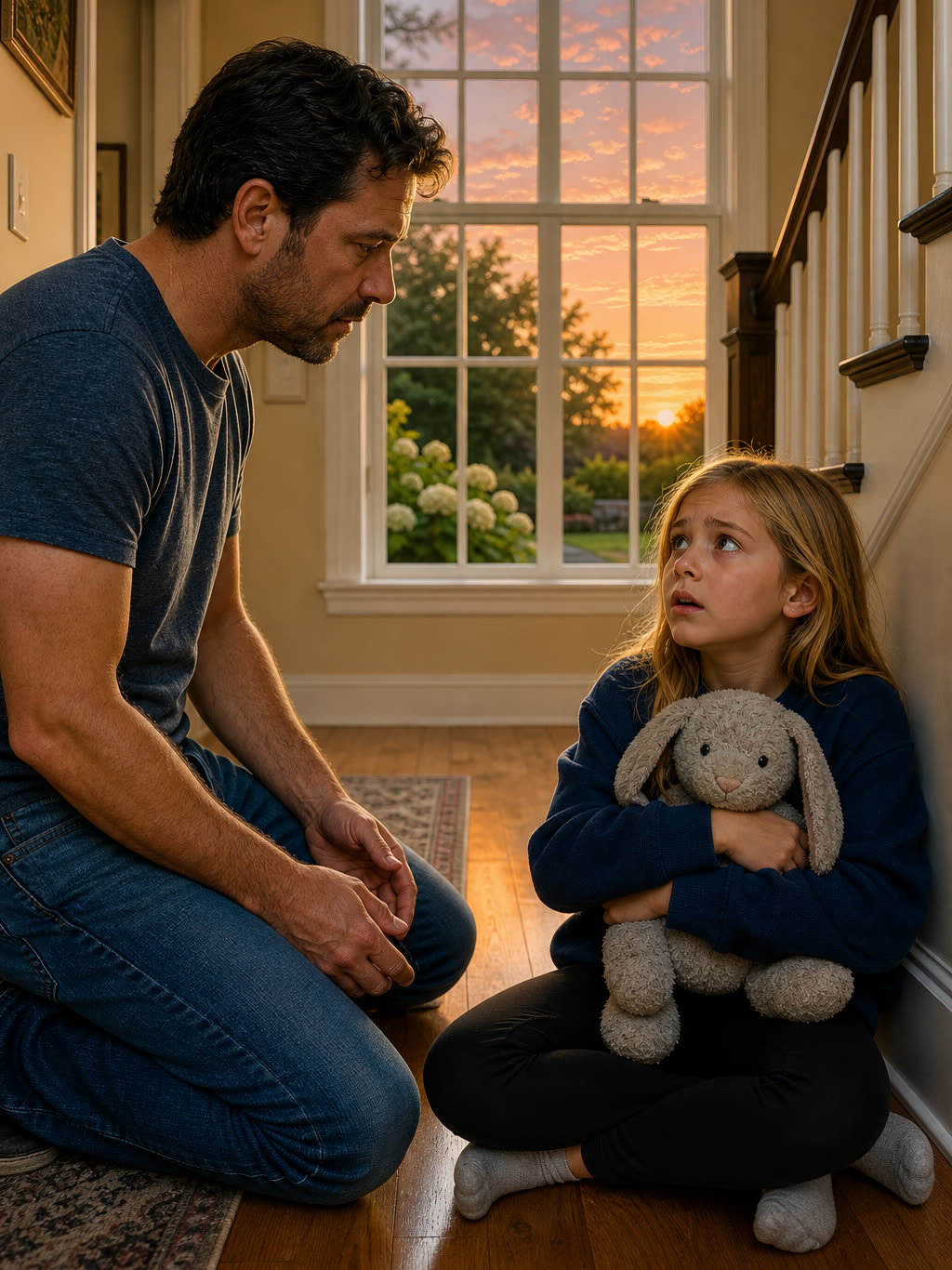
I knelt in front of her so that our eyes were level. I could feel my heartbeat in my throat, but I kept my voice gentle and my face as calm as I could make it. “Did you fall?” I asked. She stared down at the rabbit and ran her thumb along its bent ear. For a long moment she said nothing at all, and the hum of the air conditioner filled the space between us. Then she said, “Mom said I shouldn’t tell you.”
My mind did what minds do when the truth is too sharp to hold all at once. It reached for a playground fall. It reached for a slammed door, a bad dream, a misunderstanding, or one of those dramatic childhood sentences that turns out to mean something much smaller. I wanted so badly for it to be small. But fear has a sound, and my daughter’s voice carried it. I had heard Ella cry over scraped knees and lost toys, and this was something different, quieter and older than any of those.
“You never have to hide from me when something hurts,” I said. Her chin began to shake. She drew in a breath that trembled on the way in. “I spilled fruit punch on the rug yesterday,” she told me. “Mom got really mad.” She paused long enough that I could hear the vent above us click. I thought of the sweet smell by the kitchen sink and the lemon cleaner laid over it, and the pieces began sliding into place whether I wanted them to or not.
“She grabbed my arm, and I tried to pull away. Then I hit the dresser.” I kept my hands open and visible, resting on my knees where she could see them. I knew that if my face shifted too fast, she might stop talking and never start again. “What happened after that?” I asked. Ella swallowed. “She said it happened because I make her lose control.” The words came out flat, memorized, like a sentence she had been made to repeat until she believed it.
Some adults treat blame like a heavy box. They keep handing it down to the smallest person in the room because they do not want to carry it themselves. I looked at my eight-year-old daughter, sitting in a sweatshirt in the heat, holding on to a stuffed animal as though it were the only solid thing in the house, and I understood that someone had been handing her that box. The anger that rose in me was enormous, but I pressed it down. She did not need my anger. She needed me to stay steady.
I did not raise my voice. I did not call for Caroline. I did not ask Ella to perform her pain a second time just because I needed more details. Whatever I wanted to know, I could learn in the right place, from the right people, in a way that would not make her relive it for my sake. I held out my hand, palm up, and let it rest in the air between us. “Can you show me where it hurts?” I asked quietly.
She turned away from me and lifted the back of her sweatshirt only a few inches. There was dark bruising near her lower back, with a narrow, straight line running through the middle of it. The shape matched what she had described. I stared at it for a heartbeat, then lowered the fabric gently and felt my hands go cold. Every instinct I had told me to move, and to move now. “We’re going to the hospital,” I said.
Ella spun back toward me and grabbed my sleeve with both hands. “No, Dad. Please.” Her eyes were huge and wet. “Sweetheart, you need a doctor,” I said. She shook her head hard, and the rabbit slipped against her arm. “Mom said doctors can tell when kids are lying.” Her breath caught. “She said they might send me somewhere for bad children.” I felt something inside me go very, very quiet. Not peaceful. Not forgiving. Controlled.
I looked directly at her and spoke slowly, so each word could land. “Telling the truth does not make you bad,” I said. “Asking for help does not make you bad. Nobody is taking you away because you told me you were hurt.” Her grip loosened slightly, and I felt it in my chest like a knot easing by one thread. I reached for my wallet and checked that her insurance card was still folded behind my driver’s license from her last strep test. My phone still showed the changed-flight confirmation, and my suitcase still sat by the front door. Those ordinary details would later matter, because they proved I had not come home expecting a confrontation. I had come home early by chance. At that moment, all I cared about was getting Ella out of the house.
Then the garage door began to rise. The grinding rumble of the motor filled the hallway, and Ella moved closer to me before Caroline’s car door had even closed. I felt her small body press against my side, and I put one arm around her without taking my eyes off the mudroom. My pulse pounded in my ears. There was a short stretch of time, only seconds, when I could have grabbed her and walked out the front. But the door to the garage opened first, and Caroline came through it.
Part 2: What the Camera Remembered
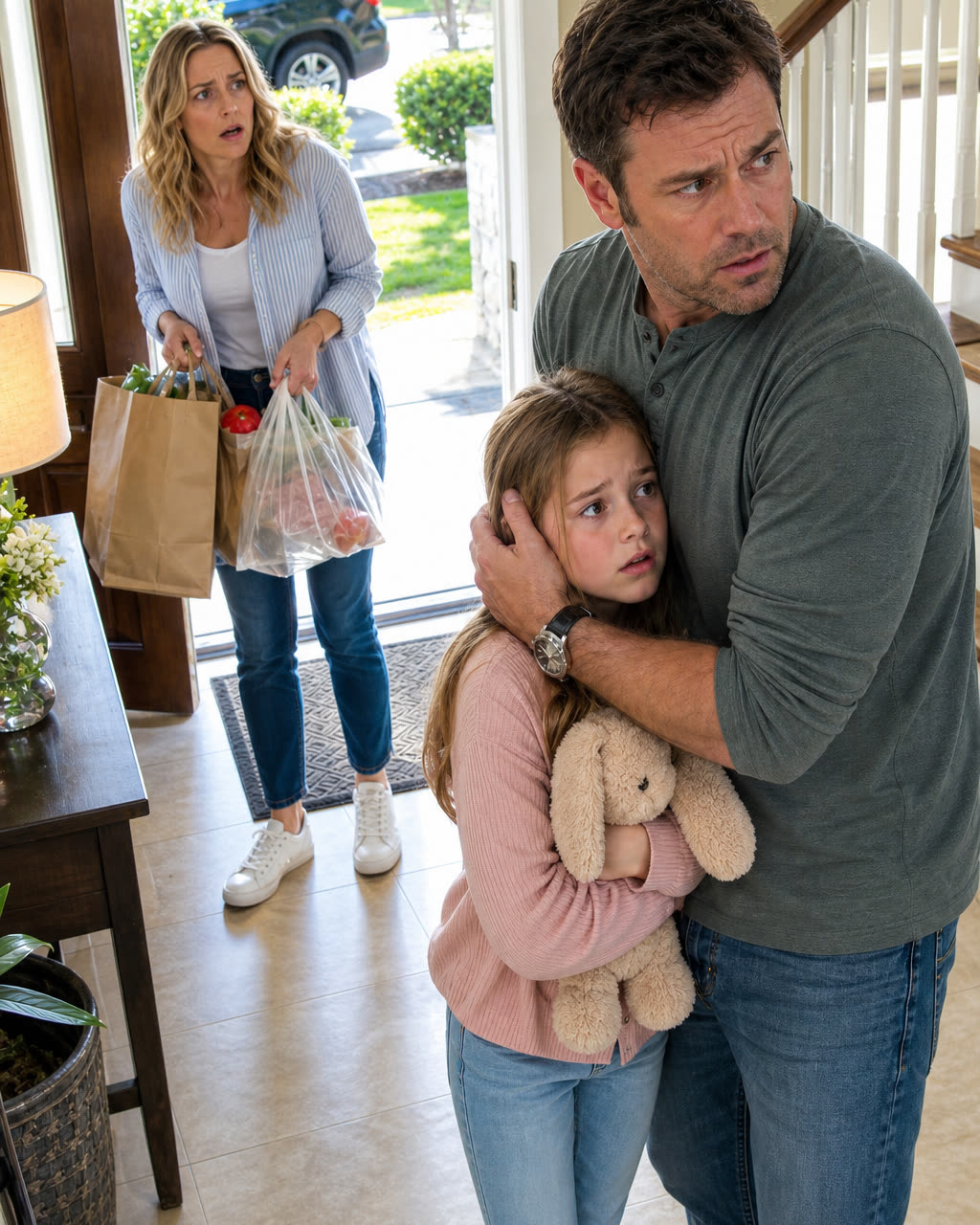
A moment later, my wife stepped through the mudroom with two paper grocery bags hooked over one arm and her phone pressed to her ear. She was halfway through a sentence when she saw me, and the words simply stopped. Her face moved through surprise, then irritation, then something harder that I had never seen aimed in my direction. For a moment, nobody spoke. The only sound was the faint crinkle of paper bags shifting against her sleeve. “You weren’t supposed to be home until tomorrow,” she said.
I lifted Ella carefully into my arms. She wrapped her legs around me and pushed her face into my shoulder, still clutching the rabbit. She weighed so little. I had carried her like this a thousand times, up stairs and across parking lots and out of dark movie theaters, but I had never felt the stakes of it so sharply. “I’m taking her to Wakefield Children’s,” I said. Caroline lowered her phone slowly. “For what?” she asked. “Her back,” I answered, and watched her face.
Alarm crossed Caroline’s expression, quick and real. Then it vanished behind annoyance, as if she had pulled a curtain across a window. “Oh, for heaven’s sake,” she said. “She bumped into a dresser. I gave her an ice pack.” I kept my voice level. “She told me what happened.” Caroline laughed, but nothing about the sound was amused. “Of course she did. You come home from your important little trips, and suddenly she knows exactly how to make you feel guilty.”
Ella pressed her face deeper into my shoulder, and I felt her breath hitch against my collar. Something in me tightened at hearing her described that way, as if she were a schemer rather than a frightened child. “Do not speak about her that way,” I said. Caroline’s eyes flashed. “You have no idea what it’s like when you’re gone.” She set one grocery bag down too hard. A carton inside shifted, and a plastic bottle of fruit punch rolled out across the floor until it stopped beside her shoe.
“I do breakfast, school, homework, laundry, everything,” she said. “Then you walk in and play hero.” The bottle rested between us like an object placed into evidence. Neither of us looked at it, and neither of us could stop seeing it. I thought about the rug and the lemon cleaner and the red stain someone must have scrubbed at in a panic. I understood, in a way I had not wanted to before, that this had not been a single bad moment. It had a history.
“Whatever problems we have are between you and me,” I said. “They are not for her to carry.” I moved toward the mudroom door, because the hospital was beyond it, but Caroline stepped directly in front of me and spread her feet. Her arms were crossed and her jaw was set. She had decided to make herself a wall. “You are not taking her to a hospital and making me look like a monster,” she said, each word clipped and cold.
Ella trembled against my chest, and I could feel the rabbit’s lumpy body pressed between us. I had never in my life wanted to be gentle and immovable at the same time, but that was exactly what the moment required. “Move,” I said. Caroline’s jaw tightened further. Then she said what she had been holding back, her voice low and sharp. “Walk out that door with her, Adam, and don’t bother coming back.” The words sat in the air of the hallway like smoke.
For one ugly heartbeat, I imagined shouting until every picture frame in the hallway shook. I imagined demanding answers while Ella listened. I imagined saying something cruel enough to hurt Caroline the way her words had hurt our daughter. The temptation was real, and it burned. Then I felt Ella’s fingers clutch the back of my shirt, small and desperate. A child learns what safety means from the adult who stays steady while the room tries to explode. “All right,” I said.
I stepped around my wife and carried Ella outside. The evening air hit us warm and heavy, and the sky over the rooftops had gone orange and pink. Across the street, Margaret Ellis stood behind her curtains with one hand lifted to her mouth. I saw her through the glass, a small figure framed in lamplight, and I knew at once that she had been watching for longer than a moment. She did not step outside, and she did not move away from the window.
Margaret had been our neighbor for six years. She was a retired elementary school librarian who remembered birthdays, returned trash cans after storms, and left garden tomatoes on our porch every July. Ella trusted her because Margaret never spoke to children as though their words were less important than an adult’s. That night, Margaret did not wave. She watched us cross the driveway with the expression of somebody who had already seen the beginning of the story and was waiting to learn how it ended.

I buckled Ella into the back seat of our SUV and placed the stuffed rabbit beside her, tucking its bent ear against the seat so it would not be crushed. Her face was pale, and she stared at the window without really seeing anything. I touched her hair once, lightly, and said nothing, because anything I said might have broken whatever thin calm she had gathered. Behind us, I heard the front door open and the sound of Caroline’s footsteps on the walkway.
“You are making this bigger than it is,” Caroline called. I closed Ella’s door before answering, because I did not want her to hear any more than she had to. Then I turned to face my wife across the driveway, with the orange light stretched long over the pavement between us. “I hope I am,” I said. And I meant it more than she could possibly know. I wanted to be wrong. I wanted the bruise to be nothing. Then I got into the driver’s seat and left.
The emergency entrance was bright enough to make every person look exhausted. I carried Ella through the automatic doors while she kept one arm around my neck and the other around the rabbit. Chairs lined the walls, a television murmured in the corner, and the smell of antiseptic hung in the air. At check-in, the nurse asked when the pain started, where it hurt, and whether Ella felt safe going home. That last question made Ella look at me, her eyes searching mine for permission.
“You can answer honestly,” I told her. She whispered, “Not if Mom is there.” The nurse did not react dramatically. She simply entered the answer into the intake record and placed an identification band around Ella’s wrist. Competence can look almost ordinary. A calm voice. A typed sentence. A chair moved closer so a frightened child does not have to speak across a room. I felt, for the first time since I had come home, that someone else was holding part of the weight.
Caroline arrived while we were still waiting to be taken back. During the drive she had traded anger for wounded dignity, and she carried it into the room like a coat she had put on at the door. “I’m her mother,” she told the nurse. “This is a family misunderstanding.” The nurse answered that Ella would be evaluated. Caroline pressed her lips together and sat three chairs away, then began sending messages on her phone with quick, hard strokes.
Ten minutes later, her mother walked into the waiting area. She said Caroline had called her in hysterics, and she settled into the chair beside her daughter with the posture of a general arriving at a battlefield. She called the hospital visit “an overreaction” before she had asked Ella a single question. Ella went rigid on my lap the moment she heard that voice, her whole body locking like a door. That was the first moment I understood that the fear in our hallway might not belong to one afternoon or one person.
I held Ella a little tighter and watched the two women whisper to each other across the waiting room. Something about the way they sat, shoulders angled together and eyes cutting toward us, made my skin prickle. They looked like people rehearsing. I told myself I was tired and imagining things, that five days of travel had frayed my judgment. But Ella’s stiff little body told me otherwise, and I could not stop wondering what she knew that I did not.
Then my phone buzzed against my leg. The message came from Margaret. “Adam, before anyone explains this away, you need to see what my porch camera recorded.” A video file appeared beneath the words, with a thumbnail showing our own driveway. Caroline stood near the garage. Beside her was her mother. And between them, small and unmistakable, was Ella. My thumb hovered over the screen while the waiting room noise faded into a dull roar.
Part 3: The Name That Broke the Silence
I opened the clip. For the first few seconds, the camera showed only Margaret’s porch rail, the edge of her lawn, and the corner of our driveway, all of it bright in the late light. Nothing moved. I almost thought the file was broken. Then Ella ran into view with her stuffed rabbit tucked under one arm, her sneakers slapping the pavement. She was heading toward Margaret’s house, and she was running as hard as a small child can run when she is afraid.
Caroline followed her into the frame. So did her mother. The camera angle did not show what had happened inside our home, but it clearly showed Caroline’s mother catching Ella by the wrist before she reached the street. It showed Ella twisting to break free. It showed Caroline standing close enough to step in and doing nothing at all, her arms folded, her face turned partly away. I watched my wife stand perfectly still while my daughter struggled.
Then the microphone caught Caroline’s mother’s voice, clear and low. “You don’t run to neighbors,” she said. “You keep family business inside the family.” Against my shoulder, Ella stopped breathing. I could feel it, the way her ribs went motionless, as if she were bracing for a blow that had already landed once. The nurse at the desk looked up. Caroline stood. “Give me the phone,” she said, but I did not answer her.
On the screen, Ella’s grandmother bent toward her until their faces were close. “Your dad will believe whatever we tell him.” The clip ended with Ella being led back toward our house, her small shoulders hunched and the rabbit dragging along her side. The waiting area became completely still. A man near the vending machines lowered his paper cup. A woman holding a sleeping toddler looked down at the floor. The nurse’s hands rested above her keyboard without moving.
Then Ella lifted her head from my shoulder. Her eyes were red and her voice was barely there. “Nana,” she whispered. It was the specific name that broke through every softened explanation. All the careful phrases, the family misunderstanding and the overreaction, collapsed in a single syllable from an eight-year-old. Caroline’s face lost color first. Her mother’s followed a second later, draining slowly, like water leaving a glass. Neither of them said a word.
Caroline reached toward my phone, her fingers outstretched and trembling. I stepped back and handed it to the nurse, who took it without hesitation and held it against her chest. The pediatric doctor returned just then with Ella’s chart and looked from the frozen image on the screen to the two women standing in front of her. Her expression did not change, but her voice carried an edge of steel. “Which one of you wants to explain why this child was told to hide an injury?” she asked.
Caroline began talking immediately. She said Ella was sensitive. She said the clip looked worse than it was. She said her mother had only been trying to stop an eight-year-old from running into the street. She said I traveled too much to understand what discipline required. The words poured out in a rush, each one reaching for a place to land that was not on her. Every sentence placed responsibility somewhere else. On Ella. On work. On stress. On the camera angle. On me.
Caroline’s mother said almost nothing. She stared at the phone in the nurse’s hands as if silence could remove her voice from the recording. Her mouth worked once, as though she might speak, and then it closed again. The doctor listened to all of it without interruption, then asked both women to return to the waiting area while Ella was taken into an examination room. Caroline objected. The nurse repeated the direction. For the first time that night, my wife encountered a boundary she could not move by becoming louder.
Inside the room, Ella changed into a hospital gown with my help. The paper crinkled under her as she climbed onto the exam table, and she looked very small against the white sheet. The doctor examined her carefully and asked questions in language an eight-year-old could understand. Ella answered some. She shook her head at others. When she became tired, the doctor stopped. Nobody accused her of lying. Nobody threatened to send her away. Nobody told her to protect an adult.
The medical record documented the location of the bruising, Ella’s description of the dresser, her statement about being grabbed, and the fear she had expressed about returning home. I watched the doctor type each detail with care. A hospital social worker joined us, a woman with a quiet voice and a steady gaze, and sat down in the chair beside me. I gave her Margaret’s video, the changed-flight confirmation, and the time I had arrived home. I showed her the message exactly as Margaret had sent it.
I did not edit the clip. I did not summarize what another person could watch with their own eyes. Facts do not become stronger when you decorate them. They become stronger when you preserve them. The social worker nodded slowly as she reviewed everything, and I felt a strange relief, the relief of handing the truth to someone whose job was to hold it carefully. When she asked where Ella and I could stay that night, I looked at my daughter. She was exhausted, but her breathing had slowed. “We are not going back there,” I said.
Caroline’s ultimatum returned to me. Walk out that door with her, and don’t bother coming back. She had meant it as a threat. By midnight, it sounded like permission. I booked a room at a hotel close to the hospital. It was not a dramatic escape. There was no suitcase packed for Ella, no favorite pajamas, and no toothbrush with her name on it. We stopped at a twenty-four-hour store for basic clothes, toothpaste, and a phone charger. Ella chose a plain blue T-shirt and held the rabbit under one arm while I paid.
At the hotel, she stood beneath the shower for a long time. I sat on the edge of the bed listening to the water, thinking about how many ordinary evenings I had taken for granted. Then she came out wearing the new shirt, climbed into bed, and placed the rabbit between us. “Are you mad at me?” she asked. The question hurt more than Caroline’s threat. “No.” She studied my face. “Are you mad at Mom?” “Yes,” I said, because children deserve truth that does not make them responsible for managing it. “But my feelings are not your job.”
Ella rubbed the rabbit’s bent ear between her fingers. “Is Nana going to hate me?” “You told the truth,” I said. “What adults do with the truth is their responsibility.” She thought about that for a while. Then she asked whether doctors really could tell when children lied. “They can tell when a child needs help,” I said. “That is what happened tonight.” Ella fell asleep with one hand wrapped around my sleeve, and I stayed awake beside her, listening to her breathe.
Caroline called seventeen times. Her messages moved from anger to apology to blame and back again. She said she had been overwhelmed. She said her mother had made things worse. She said the hospital staff did not understand our family. She said I was destroying our marriage over one accident. I did not answer that night. There are moments when silence is avoidance, and there are moments when silence is a locked door protecting the person behind it. Mine was the second kind.
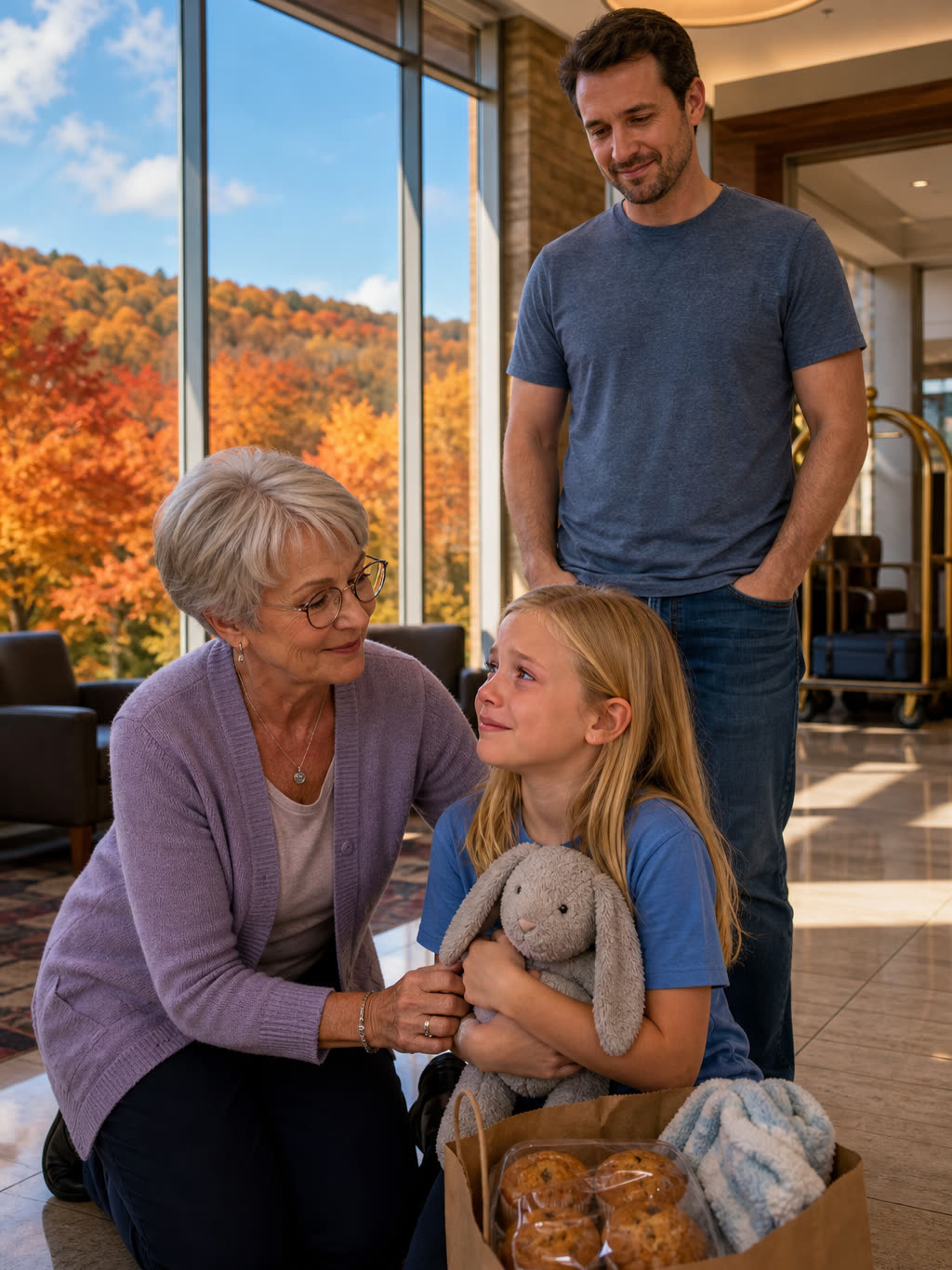
The next morning, Margaret met us in the hotel lobby, where tall windows looked out on trees blazing red and gold in the early light. She carried a grocery bag with muffins, juice boxes, and the small blanket Ella often used at her house. Margaret apologized for not crossing the street sooner. I told her the camera had done what none of us had known to do in the moment. It had remembered without fear. She gave me the original video file and a written note describing when she had reviewed it. Then she knelt near Ella.
“You did the right thing coming toward my house,” she said. Ella’s eyes filled. “I didn’t make it.” “You tried,” Margaret answered. “That counts.” Over the following days, I kept every record. The hospital discharge papers. The intake notes. The video file. Margaret’s message. My flight confirmation. Caroline’s texts. Not because I wanted to turn our family into a case file, but because people who depend on confusion often become very precise once consequences appear.
Caroline asked to meet without Ella. I agreed to speak by phone instead. She cried. She said she had never meant to frighten our daughter. I asked why Ella believed doctors would punish her for telling the truth. Caroline blamed her mother. I asked why she had blocked the door when I tried to leave. She blamed panic. I asked why the camera showed her watching while her mother pulled Ella away from a trusted neighbor. That question brought silence, a long one, and I let it stand.
I told Caroline I would not return to the house while Ella was unsafe there. I told her every future conversation would center on Ella’s safety, not on protecting the appearance of our marriage. She said I was choosing our daughter over her. “Yes,” I said. It was the easiest answer I gave all week. Healing did not arrive as one big scene. It came in ordinary pieces. Ella sleeping through the night. Ella asking for pancakes. Ella wearing a T-shirt instead of hiding inside a sweatshirt. Ella speaking to a counselor without checking the doorway every few seconds. Ella laughing once, then looking surprised that the sound had come from her.
I learned that safety is not only removing a child from the worst moment. It is building enough quiet, honest moments afterward that fear no longer owns every room. Months later, the stuffed rabbit still slept beside Ella. Its fur was still gray. Its ear still leaned sideways. But her fingers no longer turned white around it. Sometimes I think about the business trip, the canceled passenger, and the Friday flight I was never supposed to take.
Returning from a five-day business trip, I found my eight-year-old daughter shivering outside her bedroom door. When she muttered, “Dad, my back hurts… but Mom said I have to be quiet,” I rushed her straight to the ER. It wasn’t until our neighbor texted me a security clip, and my daughter whispered one specific name, that my wife and mother-in-law instantly went pale. The name was “Nana.”
The clip mattered. The medical record mattered. The timestamp mattered. But the first truth that changed everything came before any document. My daughter told me she was hurt. And I believed her.
Disclaimer: This story is a work of fiction inspired by real-life themes. Names, characters, places and events are fictionalized, and any resemblance to real persons is purely coincidental. Images are for illustration purposes only.
