

PART 1
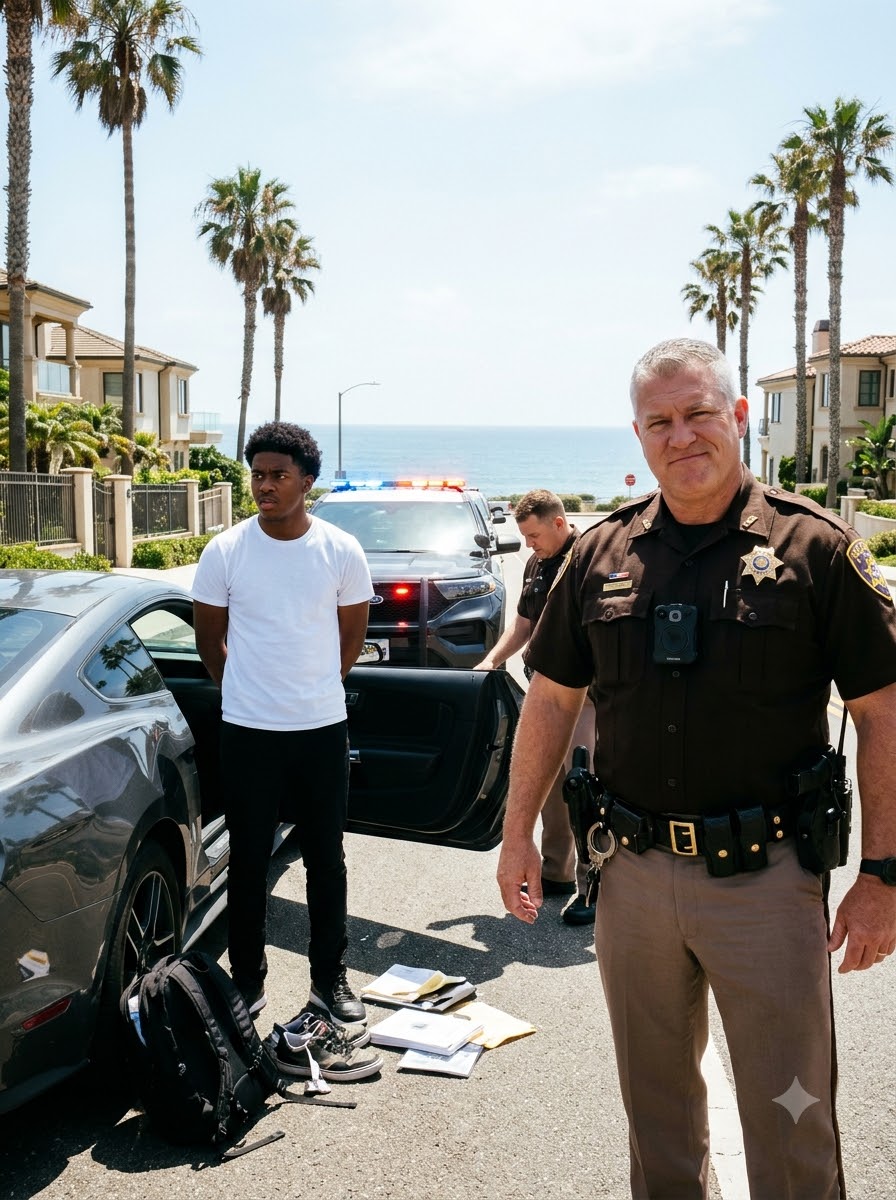
Red and blue emergency lights flashed across the polished hood of a quarter-million-dollar supercar as it traveled through a peaceful, wealthy neighborhood.
Behind the wheel, nineteen-year-old Devon Whitfield tightened his grip until his knuckles turned white.
He hadn’t broken the law.
He hadn’t been speeding.
He hadn’t threatened anyone.
But in this exclusive suburb, a young Black man driving a McLaren was apparently enough to attract the wrong kind of attention.
The officer approaching his window wore a confident, almost predatory smile. He had no idea that the teenager he was about to detain was the son of a man who could bring his misconduct under the scrutiny of the entire county.
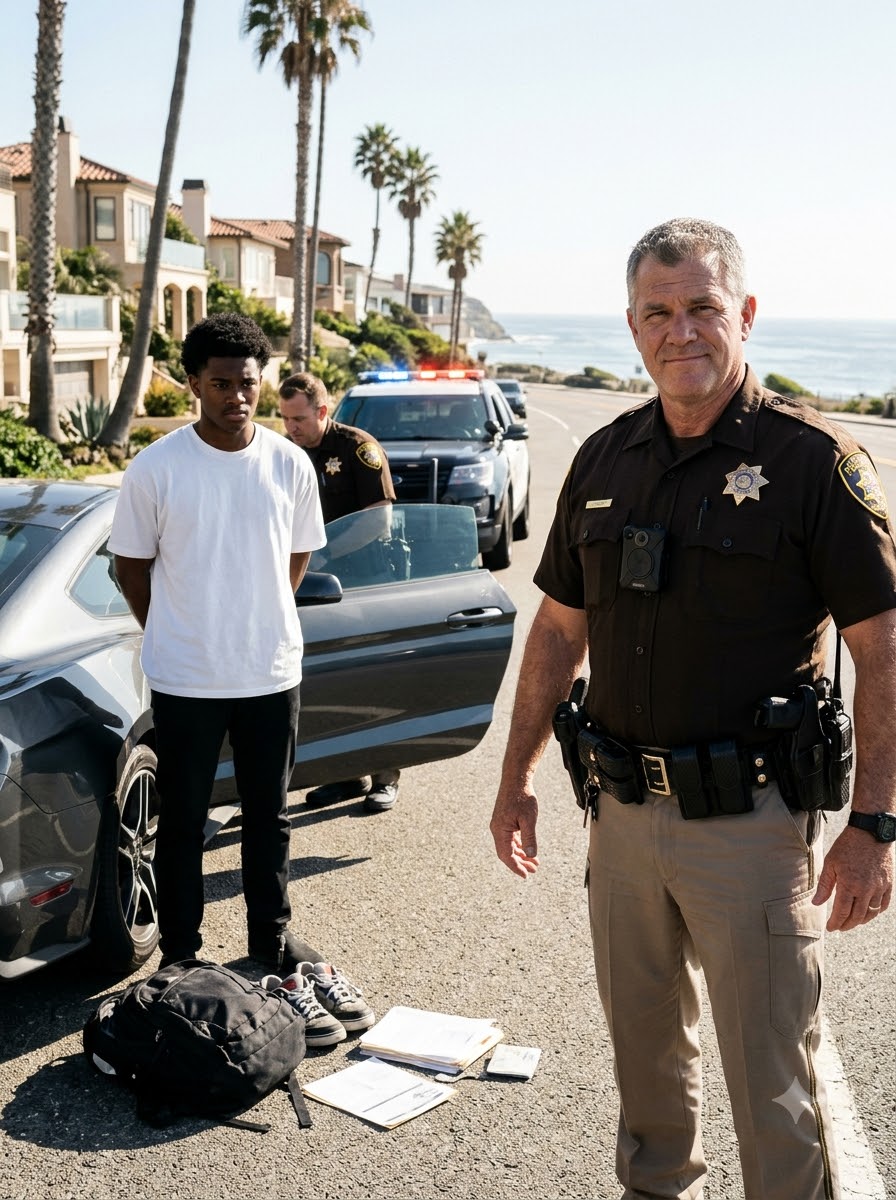
The afternoon sun blazed over the immaculate, palm-lined streets of Oakwood Hills.
It was an exclusive municipality bordering a gated community, where lawns were maintained with mathematical precision, imported cobblestones decorated driveways, and the breeze carried hints of jasmine and ocean salt.
Tech billionaires lived there.
So did hedge fund managers, corporate executives, and families whose fortunes stretched back generations.
It was the sort of neighborhood where exotic cars were ordinary.
Yet Officer Mitchell Ford had already decided that Devon Whitfield didn’t belong behind the wheel of one.
Devon loved the midnight-blue McLaren 720S.
The car wasn’t his.
It belonged to his father, Lawrence Whitfield, a man who had spent thirty-five years navigating the American legal system and building an extraordinary career.
That morning, Lawrence had tossed Devon the keys to celebrate his acceptance into a prestigious summer internship at a leading corporate law firm.
“Keep it under the speed limit, son,” Lawrence had warned.
Then his expression had grown serious.
“You know how it is out there. A car like this, a kid like you, they won’t see a Stanford honors student.”
He paused.
“You know what they’ll see?”
Devon knew.
He’d first received that conversation when he was twelve.
His father repeated it when Devon earned his learner’s permit at sixteen.
And again before he left for college.
Keep your hands visible.
Move slowly.
Speak respectfully.
Never give an officer an excuse to mistake an ordinary gesture for a threat.
Devon drove with both hands positioned at ten and two.
The McLaren’s twin-turbocharged V8 purred beneath him, its tremendous power restrained as he followed the winding coastal road.
The speedometer read thirty-five miles per hour.
Exactly the posted limit.
Music played softly through the premium sound system.
For a few precious minutes, he felt free.
Two miles behind him, Officer Mitchell Ford sat concealed beneath the shadow of a billboard advertising luxury waterfront property.
Ford had spent twelve years with the Oakwood Hills Police Department.
His supervisors regarded him as a stubborn holdover from an older style of policing.
Some wealthy residents considered him an aggressive protector of their neighborhood.
But his personnel history told a different story.
Civilian complaints had accumulated over the years.
Excessive force.
Racial profiling.
Unprofessional behavior.
Again and again, allegations were dismissed, minimized, or quietly buried.
Oakwood Hills valued the appearance of security.
Ford had learned to exploit that priority.
He regarded his patrol district as personal territory and believed he could decide who belonged there.
Sipping lukewarm black coffee, he watched the sparse afternoon traffic.
Then the midnight-blue McLaren passed.
His attention sharpened.
It wasn’t the vehicle that bothered him.
Lamborghinis, Ferraris, and Porsches appeared regularly on these roads.
It was the driver.
Through the slightly tinted window, Ford glimpsed a young Black man wearing a plain white T-shirt.
His posture changed immediately.
He dropped his coffee into the cup holder, shifted into drive, and accelerated onto the road.
“Dispatch, this is Unit Four,” he barked into his radio.
“Run a plate for me. Ocean Victor 9020.”
“Copy, Unit Four.”
Several seconds passed.
“Registration returns to Apex Holdings LLC. Valid registration. No warrants or active alerts.”
Ford frowned.
A corporate holding company was common among wealthy vehicle owners.
But Ford interpreted the information through his own prejudices.
A young Black man driving an expensive car registered to a company?
In his mind, that suggested theft or illicit money.
The fact that the vehicle hadn’t been reported stolen meant little to him.
He wanted a reason to stop it.
And if none existed, he intended to find one.
Ford followed Devon for nearly a mile.
He watched for drifting.
An improperly timed signal.
A window-tint violation.
Anything he could write into a report.
Devon noticed the patrol car in his rearview mirror.
It was following dangerously close.
A familiar rush of adrenaline tightened his chest.
He checked his speed.
Thirty-four in a thirty-five zone.
His seat belt was secure.
Both hands remained visible.
Stay calm.
His father’s voice seemed to echo in his thoughts.
Don’t give them an excuse.
Devon approached a four-way stop.
He brought the McLaren to a complete halt.
Counted three seconds.
Then proceeded carefully.
Behind him, Ford smiled.
He had found his excuse.
“Rolling stop,” he muttered.
He activated his emergency lights.
Red and blue strobes shattered the peaceful afternoon.
A sharp burst of siren followed.
Devon exhaled slowly.
He signaled, pulled safely onto the shoulder, and placed the McLaren in park.
Following the routine his father had taught him, he lowered the windows, switched off the engine, removed the keys, and placed them visibly on the dashboard.
Then he rested both hands on the steering wheel.
He was prepared.
But watching Ford approach in his side mirror, Devon wondered whether preparation would be enough.
The officer walked with the deliberate confidence of someone who expected obedience.
One hand rested near his holstered firearm.
He stopped beside the driver’s window, standing tall over the low cabin.
“Afternoon.”
There was no warmth in his voice.
“Know why I pulled you over?”
“No, officer, I do not.”
Devon’s tone remained respectful.
He kept his gaze forward and his hands visible.
Ford scoffed.
“You rolled through that stop sign back on Elm. And you were swerving over the center line.”
He leaned closer.
“You’ve been drinking, boy.”
The final word was deliberate.
Devon felt anger rise in his chest.
He forced it down.
“I haven’t been drinking, officer. And I came to a complete three-second stop at the intersection.”
Ford’s expression darkened.
“Are you calling me a liar?”
“No, officer. I’m explaining what happened.”
“License, registration, and proof of insurance. Now.”
“My license is in my wallet, in my back right pocket,” Devon replied.
“The registration and insurance are in the glove compartment. May I retrieve them?”
Ford narrowed his eyes.
Devon’s calm precision seemed to irritate him.
“Just get the damn ID. Move slow.”
Devon carefully retrieved his wallet and handed over his California driver’s license.
Then he opened the glove compartment and removed a leather binder containing the registration and insurance.
Ford snatched the documents.
He examined the license.
Devon Whitfield.
The name meant nothing to him.
Then he checked the registration.
Apex Holdings LLC.
“So, Devon,” Ford said, tapping the papers against his palm.
“Whose car is this? Because it sure as hell isn’t yours.”
“It belongs to my father, officer. Apex Holdings manages his private assets.”
Ford laughed.
“Your father, huh?”
He looked Devon over.
“What does your daddy do? Sell pharmaceuticals on the street corner?”
He smirked.
“Or is he a rapper?”
Devon’s jaw tightened.
The insult was unmistakable.
But he refused to respond emotionally.
“My father is a public servant, officer.”
“A public servant?”
Ford stepped backward.
“Right.”
Then his expression changed.
“Listen carefully, Devon. I smell marijuana coming from this vehicle.”
Devon’s eyes widened.
“That’s impossible, officer. I don’t smoke, and nobody has ever smoked in this car.”
“I said I smell marijuana.”
Ford raised his voice.
“Step out of the vehicle.”
Devon knew what was happening.
The officer had moved from a questionable traffic stop to an accusation designed to justify a search.
“Officer, I respectfully decline to consent to a search of this vehicle.”
Ford unclipped his radio.
“Unit Four requesting a secondary unit. Uncooperative suspect.”
He lowered the microphone and gripped the McLaren’s door.
“I’m giving you a lawful order to step out. If you refuse, I’ll drag you out and charge you with resisting.”
Devon understood the difference between challenging an officer’s legal justification and physically resisting an order.
He also understood that the roadside wasn’t a courtroom.
“I am complying, officer.”
He pulled the interior handle.
The McLaren’s dihedral door rose upward.
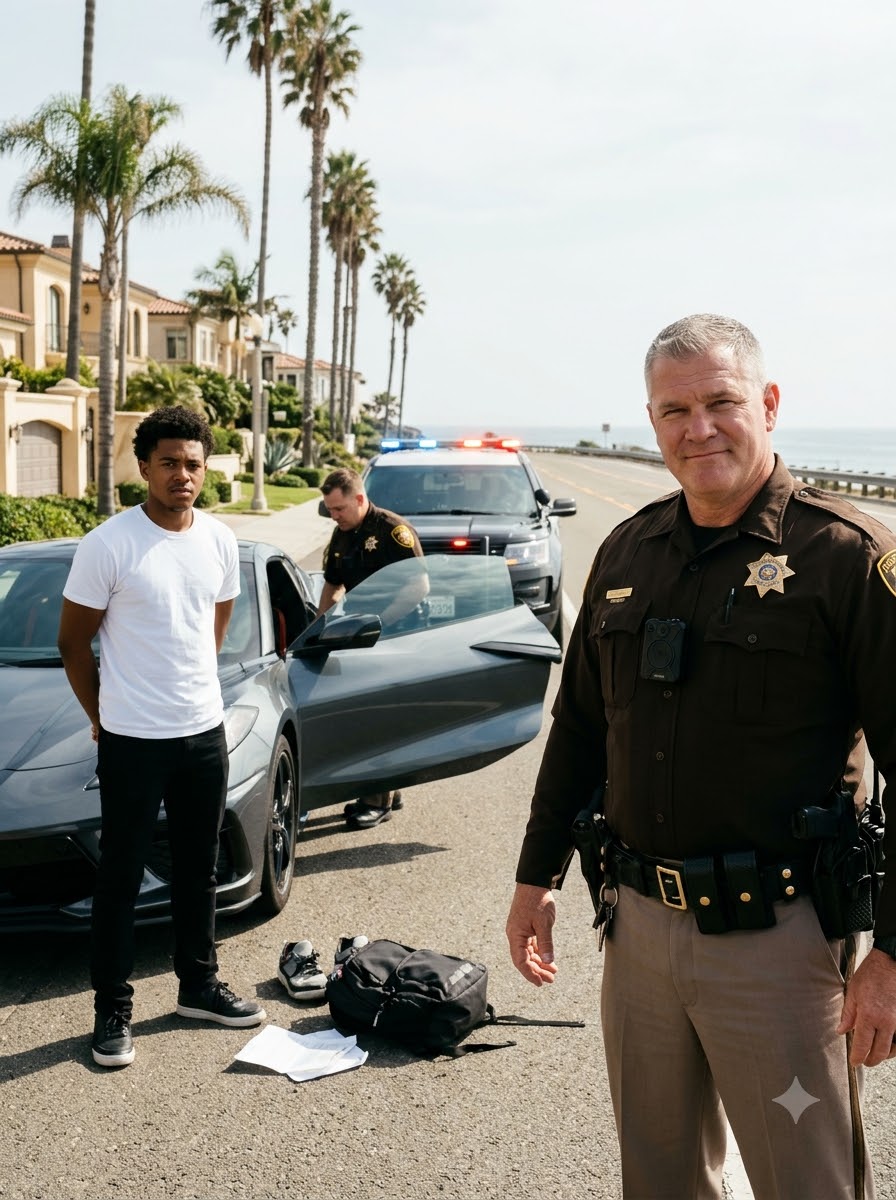
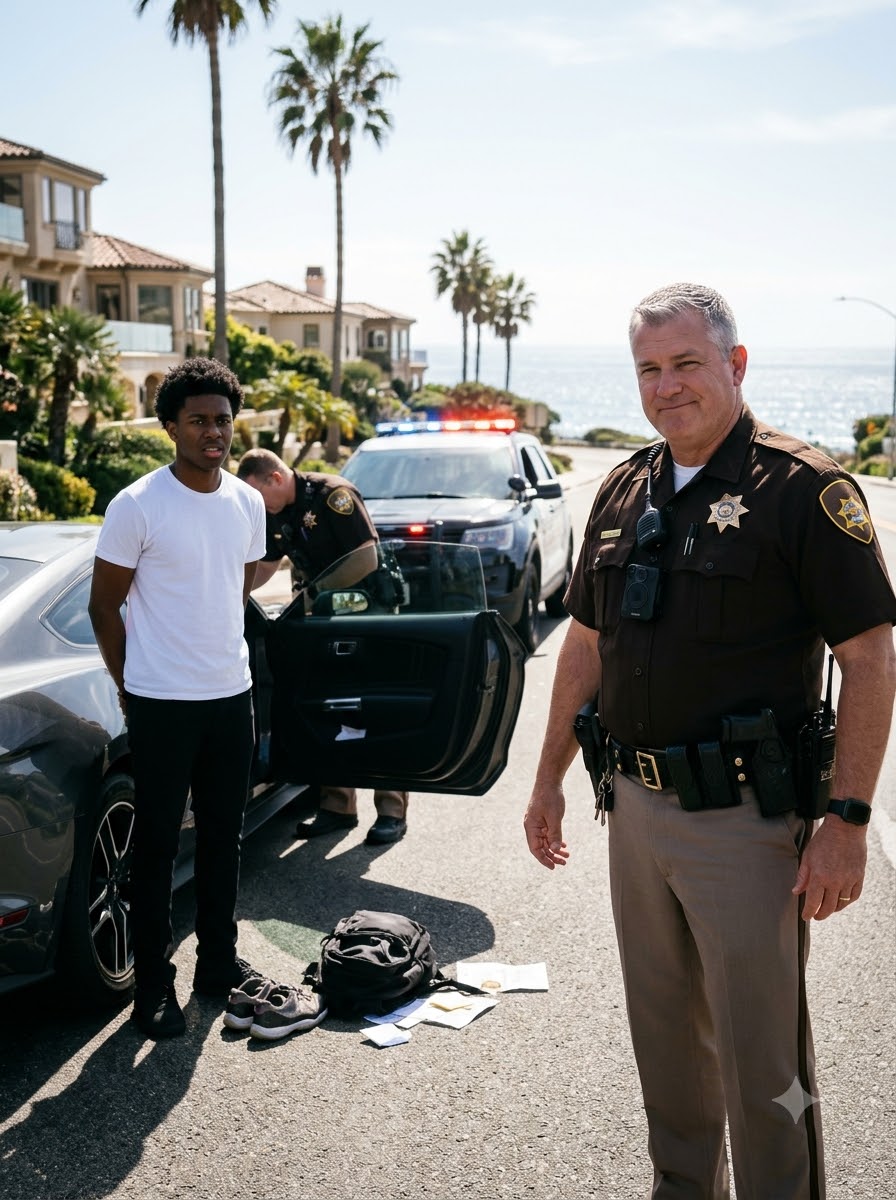
As Devon stepped onto the hot pavement, Ford seized his left arm and twisted it behind his back.
Pain shot through Devon’s shoulder.
He gasped.
“Turn around. Spread your legs.”
Ford shoved him against the supercar.
The sun-heated body panel burned through Devon’s thin T-shirt.
“Officer, I’m not resisting. There’s no need for force.”
Ford ignored him.
He kicked Devon’s feet farther apart and searched him roughly.
Pockets.
Waistband.
Ankles.
No weapon.
No contraband.
Nothing.
But Ford wasn’t finished.
He removed his handcuffs.
Cold steel closed tightly around Devon’s left wrist.
Then Ford pulled his right arm backward and secured the second cuff.
The restraints bit into his skin.
Across the street, an older woman walking a golden retriever stopped to watch.
A landscaper switched off his leaf blower.
A silver Mercedes slowed, and its driver began recording.
Devon stood pressed against the hot McLaren, humiliated in full view of strangers.
He was an honors student.
A volunteer at a community legal clinic.
A young man who had followed every instruction his father had given him.
Yet none of that had protected him.
Ford leaned toward his ear.
“Not so smart now, are you, college boy?”
His breath smelled of stale coffee and tobacco.
“Let’s see what daddy’s money can do when I impound this thing and book you for possession.”
Devon closed his eyes.
He concentrated on breathing.
His fear slowly hardened into determination.
Let him keep going.
Every decision is another thing he’ll have to explain.
A second patrol car arrived with its lights flashing.
Officer Toby Jenkins stepped out.
Jenkins was younger, with only three years on the department.
He had joined believing he could make a difference.
Working alongside officers like Ford had tested that belief.
“What’ve we got, Mitch?”
Ford tightened his grip on Devon.
“Got a wise guy. Reckless driving. Smelled weed pouring out of the car. Refused to cooperate.”
He gestured toward the McLaren.
“Claims it belongs to his daddy.”
Jenkins looked at Devon.
The teenager wasn’t struggling.
He wasn’t shouting.
He stood completely still.
Then Jenkins noticed the driver’s license Ford had placed on the car.
Devon Whitfield.
Something about the surname made his stomach tighten.
For the past two weeks, the name Whitfield had appeared constantly in local news coverage.
The governor had recently appointed a new district attorney.
Lawrence Whitfield.
A formidable prosecutor known for his opposition to police corruption and his demands for accountability.
Jenkins looked again at Devon’s license.
It couldn’t be.
Whitfield wasn’t an uncommon surname.
Surely this was a coincidence.
“Did you run the registration?” Jenkins asked.
“Some shell company. Apex Holdings.”
Ford waved dismissively.
“It’s a front. I’m searching the car.”
He pushed Devon toward Jenkins.
“Put him in your cruiser. If he twitches, write him up for resisting.”
Jenkins caught Devon by the elbow, using a gentler grip.
“Walk with me.”
Devon obeyed.
Jenkins guided him into the rear of his patrol car.
The door closed.
Devon found himself inside a cramped compartment smelling of industrial cleaner and stale sweat.
A Plexiglas barrier separated him from the front seats.
Through the rear window, he watched Ford begin dismantling the McLaren’s interior.
Floor mats were ripped out and thrown onto the roadside.
Ford shoved his hands between the leather seats.
He forced open compartments.
Charging cables, mints, and loose coins scattered across the passenger seat.
Then he opened the front trunk.
He pulled out Devon’s gym bag.
A tennis racket.
White sneakers.
Several heavily annotated pre-law textbooks.
Everything landed on the pavement.
Jenkins watched with increasing discomfort.
Ford found no marijuana.
No paraphernalia.
No weapons.
No suspicious cash.
Only the belongings of a college student.
After twenty minutes in the afternoon heat, Ford slammed the front trunk shut.
He marched toward Jenkins’s cruiser and opened the rear door.
“Where is it?”
Devon looked at him.
“Where’s the stash, you little punk? Did you throw it out before I stopped you?”
“As I’ve already explained, officer, there’s nothing illegal in the vehicle.”
The handcuffs were cutting into Devon’s wrists.
His fingers were beginning to feel numb.
Still, he kept his voice controlled.
“You’ve detained me, searched the vehicle without my consent, and damaged its interior.”
Ford barked a laugh.
“Listen to Perry Mason.”
He leaned closer.
“I smelled marijuana. That’s my probable cause.”
Then he smiled.
“And because you want to be a smart mouth, I’m calling a tow truck.”
Devon’s stomach tightened.
“I’m impounding the car, and you’re coming downtown.”
Jenkins stepped forward.
“Mitch, hold on.”
Ford turned.
“We didn’t find anything. Maybe we should issue the traffic citation and release him.”
“Shut up, Toby.”
Ford glared at him.
“I’m not letting this thug drive away laughing at us.”
Devon met Ford’s gaze.
“Officer Ford, I want to call my father.”
Ford sneered.
“You’ll get a phone call when you’re booked.”
Jenkins hesitated.
Then he spoke.
“Mitch, department policy allows us to facilitate a family contact during an extended detention when it’s safe to do so.”
Ford spun toward him.
The younger officer looked frightened.
But he didn’t withdraw the statement.
Finally, Ford gritted his teeth.
“Fine.”
He pulled out his department-issued phone.
“You want Daddy? Let’s call Daddy.”
He opened the dialer.
“What’s the number?”
Devon recited a number beginning with area code 310.
It wasn’t his father’s personal cellphone.
It was the priority line to the district attorney’s executive office.
A number ordinarily used by senior officials, judges, and family members in emergencies.
Ford entered the digits and activated the speaker.
“Make it quick, tough guy.”
The phone rang twice.
Then a professional woman’s voice answered.
“District Attorney Lawrence Whitfield’s office. Executive Assistant Sarah speaking.”
She continued.
“This is a priority line. Please state your emergency.”
Jenkins went pale.
Ford froze.
He looked at the phone.
Then at Devon.
Then at the driver’s license on the McLaren.
Devon Whitfield.
Before Ford could end the call, Devon leaned toward the speaker.
“Hi, Sarah. It’s Devon.”
Her tone changed immediately.
“Devon?”
“Can you connect me to my father, please? I’m being detained in handcuffs on Ocean View Drive by Officer Mitchell Ford of the Oakwood Hills Police Department.”
He paused.
“He searched the vehicle without my consent and is threatening to impound it.”
Sarah inhaled sharply.
“Devon, are you hurt?”
“I’m okay.”
“Hold the line. I’m connecting you to the district attorney immediately.”
A click sounded.
Then hold music began.
Ford stared at the phone.
The afternoon was still scorching hot.
But suddenly, he felt cold.
He hadn’t stopped an anonymous teenager.
He had handcuffed the son of the county’s newly appointed district attorney.
And Lawrence Whitfield had built his reputation on holding corrupt officers accountable.
Devon leaned against the cruiser seat.
He looked at Ford’s pale face.
“He’ll be right with us, officer.”
PART 2
The cheerful hold music sounded grotesquely out of place beside the flashing patrol lights and the wrecked McLaren.
Ford’s hand trembled.
Jenkins stood beside him, staring at the phone.
“Mitch,” Jenkins whispered.
“Hang up. Let him go.”
Ford didn’t move.
Ending the call now wouldn’t erase what had happened.
Before he could decide what to do, the music stopped.
A deep, controlled voice filled the speaker.
“This is Lawrence Whitfield. I understand my son is on this call and is currently in handcuffs.”
A pause.
“Who am I speaking with?”
Ford opened his mouth.
Nothing came out.
Devon leaned forward.
“Dad, it’s Devon.”
“Tell me exactly what’s happening.”
Devon spoke clearly.
“Officer Mitchell Ford stopped me on Ocean View Drive. He alleged a rolling stop, then said he smelled marijuana.”
He continued.
“He removed me from the car, handcuffed me, and searched the McLaren without my consent. He found nothing. Now he’s threatening to impound it.”
Silence followed.
Then Lawrence spoke.
“Officer Ford, are you listening?”
“Yes, sir.”
Ford’s voice sounded completely different.
The arrogance had disappeared.
“Remove the handcuffs from my son’s wrists.”
Lawrence’s tone remained controlled.
“Preserve the scene and your recording equipment. Do not conduct any further search without a lawful basis.”
Ford fumbled for his keys.
His hands shook so badly that he dropped them onto the pavement.
He bent to retrieve them.
Jenkins stepped forward.
“I’ve got it.”
He opened the cruiser door and unlocked Devon’s restraints.
“I’m sorry,” Jenkins murmured.
“This wasn’t my decision.”
The cuffs opened.
Devon brought his hands forward and rubbed the red indentations around his wrists.
He stepped out into the ocean breeze.
“Dad, the cuffs are off. Officer Jenkins removed them.”
“Are you injured?”
“My shoulder hurts from when I was pulled out. My wrists are bruised, but otherwise I’m okay.”
“Understood.”
Lawrence addressed the officers again.
“An independent investigative team is being contacted. You are to preserve all relevant evidence and remain available for the responding supervisors.”
He paused.
“I’m coming to the scene.”
The call ended.
Ford stared at his darkened phone.
He looked toward the McLaren.
Its doors were open.
Floor mats lay on the dusty shoulder.
The interior had been pulled apart.
Devon’s belongings were scattered across the pavement.
Jenkins turned toward him.
“What did you do, Mitch?”
Ford wiped his forehead.
“What the hell did you do to us?”
Panic replaced his earlier confidence.
He faced Devon.
“Listen, Devon.”
His voice became pleading.
“We can work this out.”
Devon said nothing.
“I made a mistake. I thought I smelled something. Maybe it was the heat.”
Ford gestured toward the McLaren.
“I’ll put everything back. No ticket. No impound. You can drive away.”
He forced a nervous smile.
“No harm, no foul.”
Devon looked at him.
“It wasn’t a misunderstanding.”
Ford swallowed.
“You saw a young Black man driving an expensive car and decided he couldn’t possibly belong behind the wheel.”
Devon’s voice remained quiet.
“You invented a reason to stop me. Then you invented a reason to search the vehicle.”
He glanced toward his belongings.
“If my father had a different name, I’d probably be on my way to a holding cell right now.”
Ford’s expression tightened.
“You don’t get to erase this because you finally know who he is.”
For a moment, the officer’s fear gave way to anger.
“You arrogant little punk.”
He stepped forward.
Jenkins moved between them.
“Mitch, back off.”
Ford stopped.
Jenkins’s hand hovered near his belt.
“Don’t make this worse.”
The two officers stared at each other.
Then Ford turned away.
He paced along the shoulder, muttering under his breath.
For fifteen minutes, the only sounds were the distant ocean, passing traffic, and the idling patrol vehicles.
Devon approached his belongings.
He didn’t disturb the scattered items.
Instead, he retrieved his smartphone from beside the gym bag.
He activated the camera.
Slowly, he recorded the damaged interior, the displaced equipment, the roadside, and the marks on his wrists.
Ford noticed.
“What are you doing?”
“Preserving the scene.”
Then multiple sirens approached.
Three black unmarked SUVs appeared over the hill, accompanied by two Oakwood Hills command vehicles.
They stopped around the existing patrol cars.
Chief Miller stepped out first.
He was broad-shouldered, with a severe buzz cut and an expression combining anger with unmistakable alarm.
Several investigators in business suits followed.
Then Lawrence Whitfield emerged from the center SUV.
The district attorney wore a tailored charcoal suit.
He was tall, composed, and carried himself with the authority of someone accustomed to difficult confrontations.
He walked directly toward Devon.
“Son.”
He placed both hands on Devon’s shoulders.
His eyes moved across his face and down to the marks on his wrists.
“Are you all right?”
“I’m okay, Dad.”
Lawrence pulled him into a brief embrace.
Then he turned toward Chief Miller.
“Chief, I want to understand why my son was handcuffed on a public road and why his vehicle has been dismantled.”
Miller swallowed.
“We’re investigating the circumstances immediately.”
He turned.
“Officer Ford, explain your actions.”
Ford stepped forward.
His legs appeared unsteady.
“Chief, it was a routine traffic stop. He rolled a stop sign.”
He glanced at Devon.
“When I approached, I detected a strong odor of marijuana. That gave me probable cause to search.”
He swallowed.
“He was uncooperative, so I restrained him for officer safety.”
Lawrence studied him.
“A strong odor of marijuana?”
“Yes, sir.”
“My son is a collegiate athlete who undergoes drug testing. He has never used narcotics.”
Lawrence gestured toward the McLaren.
“The vehicle was professionally cleaned two hours before he left home.”
Ford’s forehead glistened.
“It could’ve been a mistake. Maybe something nearby.”
He looked toward Miller.
“But I acted in good faith.”
Lawrence didn’t raise his voice.
“Then the evidence should establish that.”
He turned toward an Internal Affairs investigator.
“Please secure all relevant recordings.”
The investigator approached Ford.
“Officer, we need your body-camera footage.”
Ford flinched.
“The camera malfunctioned.”
Miller stared at him.
“What?”
“The battery died before the stop. It didn’t record.”
The chief closed his eyes briefly.
Lawrence looked toward Devon.
“Son, do you have any recordings?”
Devon nodded.
“The McLaren has a continuously recording security system.”
He pointed toward the vehicle.
“Cameras are installed around the exterior, and the footage is automatically uploaded to the secure Apex Holdings server.”
Ford grabbed the side of his cruiser.
His face drained of color.
Devon continued.
“There’s also a civilian witness.”
He pointed down the street.
A silver Mercedes remained parked approximately one hundred yards away.
Its driver stood beside it, holding his phone.
“He recorded the extraction and the search.”
Lawrence turned back to Miller.
“Chief, this requires an independent criminal investigation.”
Miller nodded.
“Agreed.”
“I also expect the vehicle footage, dispatch records, and officer communications to be preserved immediately.”
“Of course.”
Lawrence’s expression hardened.
“Given my relationship to the victim, I will not personally prosecute this matter. It needs an independent prosecutor.”
Miller looked toward Ford.
“Officer Ford, surrender your badge and service weapon pending the investigation.”
Ford’s mouth fell open.
“Chief, please.”
“Now.”
“I’ve served this department for years.”
Miller held his gaze.
“And you will be given the process required by department policy. But you will not continue patrol duty while this is investigated.”
Ford slowly removed his badge.
An investigator secured his firearm.
Miller instructed him to remain at the scene.
Shortly afterward, investigators advised Ford that he was being arrested on charges arising from the detention and alleged assault.
Jenkins stood nearby as another officer secured the handcuffs.
Ford stared at the restraints.
The same kind he had used on Devon.
Now they closed around his own wrists.
Devon watched without speaking.
Lawrence placed a hand on his shoulder.
“You handled yourself well.”
Devon looked toward the damaged McLaren.
“I was scared.”
“I know.”
“I kept thinking about everything you taught me.”
Lawrence nodded.
“You did what you could to stay safe. The responsibility for an officer’s conduct belongs to the officer.”
A recovery truck was already being arranged for the vehicle.
Father and son walked toward the waiting SUV.
Devon had left home that morning excited about his internship and a drive along the coast.
Now he was returning with bruised wrists, a painful shoulder, and an experience he knew he would never forget.
But the roadside arrest wasn’t the end.
It was the beginning of an investigation that would reach far beyond one traffic stop.
Less than twenty-four hours later, Mitchell Ford sat inside a windowless consultation room at the county detention center.
His hands trembled against the scarred steel table.
The uniform he’d worn with such pride had been replaced by an orange jail jumpsuit.
The badge was gone.
So was his weapon.
The heavy door opened.
Cameron Cole entered.
Cole was a highly paid defense attorney who had represented numerous officers through the police union.
He wore an expensive Italian suit and carried a monogrammed leather briefcase.
Usually, he entered these meetings with confidence.
Not today.
He placed the briefcase on the table.
“You’ve created an extraordinary problem, Mitchell.”
Ford leaned forward.
“I have years of service. The union has to help me.”
Cole opened his folder.
“Your former department has received multiple preservation notices. There are at least two independent recordings.”
Ford shook his head.
“We can explain the stop.”
“How?”
“The kid made a sudden movement.”
Cole looked up.
“Did he?”
“Maybe toward the console.”
“Mitchell.”
Ford continued desperately.
“We can argue the window tint prevented me from seeing clearly. I thought he was reaching for something.”
Cole’s expression hardened.
“You’re suggesting a defense that may be contradicted by video.”
Ford swallowed.
“I feared for my safety.”
“Then explain the footage.”
“What footage?”
Cole slid a printed photograph across the table.
It showed Devon seated inside the McLaren.
Both hands visible on the wheel.
“Investigators have recovered the vehicle recording.”
Ford stared.
Cole continued.
“They also have the civilian’s phone video.”
Ford looked down.
“And the district attorney’s office has announced that an independent prosecutor will review the case.”
Cole turned another page.
“Your former partner has already spoken to Internal Affairs.”
Ford’s head snapped upward.
“Jenkins?”
“He requested whistleblower protection.”
Ford’s breathing quickened.
Cole continued.
“According to the investigative summary, Jenkins says your body camera didn’t simply run out of power.”
Ford went still.
“He says you manually disabled it before the stop.”
Silence filled the room.
“And investigators have requested the device logs.”
Ford stared at the table.
Cole wasn’t finished.
“They’re also examining an encrypted group chat on your personal phone.”
Ford’s face changed.
The attorney noticed.
“That worries you.”
Ford said nothing.
Cole opened another document.
“Messages reportedly discuss stopping wealthy minority drivers, inventing suspicious behavior, and using unsupported drug allegations to justify searches.”
Ford pressed his palms against the table.
“Those were jokes.”
“That may be your explanation.”
Cole leaned closer.
“But the messages could be used to establish intent.”
Ford’s voice became a whisper.
“What do we do?”
“We review the evidence. We preserve your rights. And you stop suggesting explanations that aren’t true.”
Ford stared at him.
“The union will pay for this, right?”
Cole closed the folder.
“That’s another problem.”
“What problem?”
“The executive board has withdrawn authorization for continued union-funded representation.”
Ford blinked.
“They can’t.”
“They’ve decided your alleged conduct falls outside the coverage they’re willing to fund.”
Cole stood.
“You’ll need to retain private counsel or seek appointed representation if you qualify.”
Ford’s face crumpled.
“Cameron, please.”
The attorney picked up his briefcase.
“I can’t promise you an outcome.”
He moved toward the door.
“And Mitchell, don’t contact witnesses. Don’t delete messages. Don’t ask anyone to change a report.”
The door closed.
Ford sat alone.
For years, he’d believed his badge could protect him from consequences.
Now the recordings, digital evidence, and testimony of his former partner threatened to expose far more than one afternoon’s misconduct.
And six months later, those questions would be placed before a federal jury.
PART 3
Six months after the traffic stop, the federal courthouse was filled with reporters, attorneys, community members, and observers waiting for the trial of former Officer Mitchell Ford.
The case had attracted national attention.
What began as a roadside detention in Oakwood Hills had developed into a major civil-rights prosecution.
Investigators had examined Ford’s conduct during the stop.
They had reviewed his prior complaints.
They had analyzed his communications with other officers.
And they had recovered evidence that contradicted several statements he’d made immediately after the incident.
Ford sat at the defense table.
His shoulders were slumped.
His face looked pale and exhausted.
The confidence that once defined his patrols through Oakwood Hills was gone.
He was represented by appointed counsel, a sharp contrast to the expensive union attorney he had originally expected.
Across the aisle, Lawrence Whitfield sat in the gallery.
His expression was controlled.
Beside him sat Devon.
The nineteen-year-old wore a tailored navy suit.
He looked older than he had six months earlier.
Not because his appearance had changed dramatically.
Because the experience had changed the way he carried himself.
Devon had spent months meeting with investigators, reviewing his account, and preparing to testify.
He had also continued his studies and pursued the internship he’d worked so hard to earn.
The stop hadn’t erased his future.
But it had left marks that weren’t as easily visible as the bruises on his wrists.
The lead federal prosecutor, Robert Callahan, stood before the jury.
He held a remote control.
The courtroom lights dimmed.
A large screen illuminated the room.
The McLaren’s security footage began playing.
The jurors watched Ford approach the driver’s window.
They heard him accuse Devon of rolling through a stop sign.
They heard his comments about Devon’s father.
They watched Devon carefully explain where his documents were located before moving.
They heard Ford claim to smell marijuana.
Then the recording showed Devon exiting the vehicle.
Ford seized his arm.
Twisted it backward.
Pressed him against the hot body panel.
Applied handcuffs.
The courtroom remained silent.
The footage continued.
Floor mats were thrown onto the roadside.
Compartments were opened.
Devon’s gym bag was emptied.
Textbooks, tennis equipment, and personal belongings scattered across the pavement.
Nothing illegal was recovered.
Then the civilian witness’s video appeared.
It showed the physical extraction from another angle.
It captured Devon’s lack of resistance.
It showed Ford’s aggressive handling of the teenager.
The evidence wasn’t limited to what witnesses remembered.
The jury could examine what happened for themselves.
When the lights came back on, several jurors looked visibly disturbed.
Callahan approached the jury box.
“Ladies and gentlemen, you have seen the evidence.”
He gestured toward the screen.
“The defendant was entrusted with the authority to enforce the law.”
He paused.
“That authority did not give him permission to manufacture reasons for detention or use unnecessary force against a compliant driver.”
Callahan reviewed the timeline.
The license plate had returned valid.
The registration showed no alerts.
The vehicle had not been reported stolen.
The alleged traffic violation was disputed by the recordings.
No marijuana had been found.
No weapons.
No evidence of criminal activity.
Yet Ford had continued the detention, searched the car, and threatened to impound it.
Then Callahan turned to the testimony of Officer Toby Jenkins.
Jenkins had taken the stand earlier in the proceedings.
He described arriving to find Devon handcuffed and Ford preparing to search the vehicle.
He testified that Devon had not resisted while in his presence.
He explained how Ford rejected his suggestion to end the detention after finding no contraband.
Most importantly, Jenkins described what investigators had discovered about the body camera.
The device hadn’t suffered an unexplained battery failure.
Its recording had been deliberately disabled.
Digital logs supported that conclusion.
Jenkins also testified about messages recovered during the investigation.
Those communications suggested Ford had previously discussed targeting drivers based on race and the perceived mismatch between their appearance and the vehicles they operated.
The prosecution argued that the messages helped establish intent.
The defense challenged their interpretation.
Ford’s attorney insisted that the traffic stop began as an ordinary enforcement action and that mistakes made during a rapidly developing encounter did not necessarily establish a federal crime.
He argued that the prosecution had allowed public outrage and the identity of Devon’s father to overshadow the legal standards.
The jury heard both sides.
Devon testified as well.
He described the moment the patrol car appeared behind him.
The effort to keep his hands visible.
The fear he felt when Ford accused him of drug possession.
The pain in his shoulder.
The tight handcuffs.
The humiliation of watching strangers record him while his father’s car was searched.
Callahan asked him one question that silenced the courtroom.
“What were you most afraid of?”
Devon took a moment before answering.
“That if I moved the wrong way, something worse would happen.”
He looked toward the jury.
“I kept thinking about what my father taught me when I was younger.”
“What did he teach you?”
“Stay calm. Keep your hands visible. Don’t argue physically. Make it home.”
His voice tightened slightly.
“I did everything he taught me.”
The prosecutor waited.
Devon continued.
“And I was still scared.”
During cross-examination, the defense asked whether Devon knew his father’s position could influence the officers.
Devon answered honestly.
“I knew who my father was.”
He paused.
“But I didn’t tell Officer Ford because I thought the law should protect me without that information.”
The defense attorney asked whether he believed the stop would have ended differently if his father had not been district attorney.
Devon looked toward the jury.
“Based on what Officer Ford said before the call, yes.”
That answer stayed with the people in the courtroom.
Later, Lawrence Whitfield was called as a witness to establish the sequence of the telephone conversation and the events that followed.
He described receiving the emergency call.
Hearing his son explain the detention.
Arranging for independent investigators to respond.
He acknowledged that the incident involved an obvious conflict of interest because Devon was his son.
That was why the criminal prosecution had been assigned to independent authorities.
He had not served as the trial prosecutor.
The case had to be decided on evidence.
Not on the influence of a parent.
When closing arguments began, Callahan returned to that distinction.
“This case is not about whether Devon Whitfield has a powerful father.”
He faced the jury.
“It is about whether a police officer knowingly abused the authority entrusted to him.”
He gestured toward the evidence.
“The law must apply regardless of the driver’s name, race, income, or family connections.”
He paused.
“The defendant was given power to enforce the law. The evidence shows he used that power unlawfully.”
The defense presented its final argument.
Then the judge instructed the jury on the charges and the government’s burden of proof.
The jurors withdrew to deliberate.
For Devon, the waiting felt longer than the entire trial.
He sat beside his father in a quiet courthouse room.
Neither spoke for several minutes.
Finally, Devon asked, “What if they don’t convict him?”
Lawrence considered the question.
“Then we’ll have to accept that the jury reached a different conclusion under the instructions they were given.”
Devon looked down.
“After everything?”
“After everything.”
His father leaned forward.
“Justice isn’t something we get to define only when the outcome favors us.”
Devon nodded slowly.
“I know.”
Lawrence studied him.
“But whatever the verdict, the evidence was preserved. The misconduct was investigated. And you told the truth.”
Devon looked toward the window.
“I just don’t want him doing this to someone else.”
“Neither do I.”
Three hours after deliberations began, the jury announced it had reached a verdict.
Everyone returned to the courtroom.
Ford stood beside his attorney.
His face was drained of color.
The foreperson rose.
The jury found him guilty on the federal civil-rights and obstruction-related counts submitted for its decision.
The courtroom remained quiet as the verdicts were read.
Ford lowered his head.
His attorney placed a hand on his arm.
The judge thanked the jurors and scheduled sentencing.
The verdict was not the end of the legal process.
There were motions to consider.
A sentencing hearing.
The possibility of appeal.
But the jury had reached its decision.
The evidence had been tested in open court.
And Ford had been found guilty.
At sentencing, the courtroom filled again.
Judge Harrison reviewed the trial record, the applicable sentencing factors, and statements submitted by the parties.
The prosecution emphasized the abuse of authority, the deliberate interference with recording equipment, and the harm caused to Devon.
The defense described Ford’s years of service, his family circumstances, and the consequences he had already suffered.
Then Devon addressed the court.
He didn’t shout.
He didn’t insult Ford.
He spoke about the afternoon on Ocean View Drive.
About the heat against the side of the McLaren.
About the steel tightening around his wrists.
About trying not to move because he feared what might happen.
Then he looked toward the judge.
“The worst part wasn’t the handcuffs.”
He paused.
“It was knowing I had done everything I was supposed to do, and it still wasn’t enough.”
The courtroom remained silent.
Devon continued.
“I was lucky my father answered the phone.”
He looked briefly toward Lawrence.
“But somebody else might not have that option.”
He faced the judge again.
“I don’t want special treatment because of my family.”
His voice remained steady.
“I want officers to treat the next person fairly, even if that person doesn’t know a district attorney.”
When Devon finished, he returned to his seat.
Lawrence placed a hand over his son’s.
Judge Harrison turned toward Ford.
“Mr. Ford, this court has considered the evidence, the jury’s verdict, and the submissions presented at sentencing.”
He paused.
“Police officers are entrusted with extraordinary authority. That authority carries an equally extraordinary responsibility.”
Ford stared downward.
“The badge is not permission to disregard constitutional protections.”
The judge continued.
“Nor does a person’s age, race, or apparent financial status diminish the rights that officer is sworn to respect.”
He reviewed the seriousness of the offenses.
The deliberate nature of the misconduct.
The attempts to conceal relevant evidence.
The lasting harm to public confidence.
Then he imposed a sentence of fifteen years in federal prison, followed by the applicable period of supervised release.
Ford’s shoulders collapsed.
He covered his face with his hands.
The judge ordered him remanded to federal custody.
Deputy marshals approached.
The restraints closed around Ford’s wrists.
Devon heard the metallic click.
For an instant, he remembered the sound of his own handcuffs on Ocean View Drive.
Six months earlier, he’d stood against a hot supercar while Ford mocked him.
Now the former officer faced the consequences of his actions.
Devon didn’t smile.
He didn’t celebrate.
He simply watched until Ford was escorted from the courtroom.
Lawrence stood beside him.
“It’s over for today,” his father said quietly.
Devon nodded.
He understood there could still be appeals and other legal proceedings.
But the trial was over.
The verdict had been delivered.
Outside the courthouse, reporters waited behind barriers.
Cameras flashed as Devon and Lawrence emerged.
Questions came from every direction.
“Devon, how do you feel about the sentence?”
“Mr. Whitfield, will this change policing in Oakwood Hills?”
“Do you believe justice was served?”
Lawrence allowed Devon to decide whether he wanted to speak.
Devon stopped briefly.
He looked toward the cameras.
“I’m grateful the evidence was preserved and that the case was heard.”
A reporter asked, “Do you think your father’s position saved you?”
Devon considered the question.
“It helped me get someone to listen.”
He paused.
“But that shouldn’t be what decides whether someone’s rights are respected.”
Another reporter asked what he wanted people to remember.
Devon looked directly into the nearest camera.
“That this shouldn’t have required a powerful last name.”
Then he stepped away.
Lawrence placed an arm around his shoulders as they walked toward the waiting vehicle.
The afternoon sunlight was bright.
The air smelled faintly of the ocean.
Devon remembered leaving home six months earlier, excited about a summer internship and the chance to drive his father’s McLaren.
He had expected an ordinary afternoon.
Instead, he had experienced fear, humiliation, and a confrontation that changed the way he understood the law he hoped to study.
His father had spent thirty-five years working within the legal system.
Devon had grown up admiring that work.
But now he understood something more personal.
Legal principles were not merely arguments in textbooks.
They mattered most when someone with power decided those principles were inconvenient.
As he reached the SUV, Lawrence stopped.
“You did well, son.”
Devon looked at him.
“I was scared the whole time.”
“I know.”
“I thought being prepared would make it easier.”
Lawrence shook his head gently.
“Being prepared doesn’t mean you won’t be afraid.”
He rested a hand on Devon’s shoulder.
“It means you know what to do while you’re afraid.”
Devon looked toward the courthouse.
The reporters were still gathered near the entrance.
The trial would dominate headlines for days.
People would argue about the verdict, the sentence, and the department’s failures.
But Devon knew that his own life had to continue beyond the headlines.
He still had classes to finish.
An internship to pursue.
A future to build.
He opened the SUV door.
Before climbing inside, he looked at his father one more time.
“Dad?”
“Yeah?”
“What if the next kid doesn’t have somebody like you?”
Lawrence was silent for a moment.
Then he answered.
“That’s why the work can’t stop with this case.”
Devon nodded.
For the first time that day, he smiled.
Not because everything had been repaired.
Not because the system had suddenly become perfect.
But because he understood that surviving what happened didn’t have to be the end of his story.
It could become part of the reason he kept moving forward.
Father and son climbed into the vehicle.
The door closed.
As they drove away, the courthouse disappeared behind them.
Devon leaned back and watched the palm-lined streets pass outside the window.
Six months earlier, a police officer had looked at him and seen only a stereotype.
Today, a jury had examined the evidence and held that officer accountable.
But Devon knew the lesson was larger than one verdict.
Real justice couldn’t depend on whether someone drove a McLaren.
It couldn’t depend on whether their father was a district attorney.
And it couldn’t depend on whether a frightened teenager knew exactly which words to say.
The law was supposed to protect everyone.
That was the principle his father had spent his career defending.
And now, more than ever, it was the principle Devon intended to carry into his own future.
