

PART 1 — The Son I Thought I Had Lost
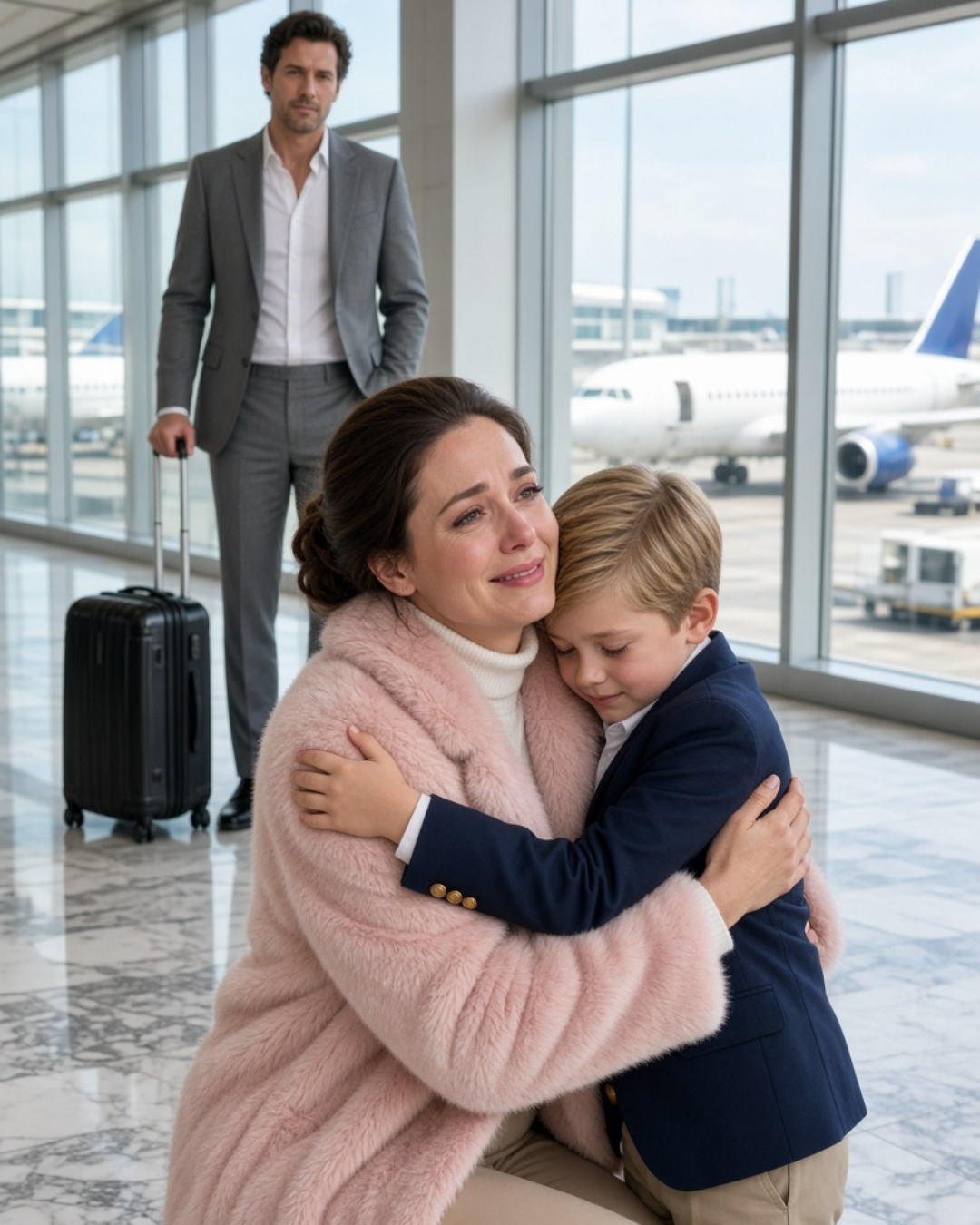
Seven days after losing custody of my eight-year-old son, I stood inside Dulles International Airport, struggling to keep myself from crying as he prepared to leave with his wealthy father.
I had spent the entire week wondering how the little boy I had raised with so much love could have chosen to walk away from me.
Then, just before disappearing through security, Owen wrapped his arms around my waist and slipped a mysterious black bank card into my coat pocket.
“Please trust me,” he whispered.
Minutes later, a message appeared on my phone, warning me that whatever happened, I must never give that card to his father.
I had no idea it was connected to $3.8 million.

And I certainly couldn’t have imagined that my former husband was hiding something far more dangerous than money.
My name is Rachel Mercer. I’m thirty-nine years old, and until that terrible week, I had spent eight years believing that unconditional love, stability, and a safe home could make up for all the things I couldn’t afford to give my son.
My former husband, Grant Whitaker, had never worried about money.
His family owned luxury hotels, commercial properties, and investment companies throughout Virginia and several neighboring states.
Grant had grown up surrounded by wealth and influence. He was accustomed to expensive cars, exclusive schools, private travel, and people who rarely questioned his decisions.
When our marriage ended five years earlier, he kept the mansion, the luxury vehicles, and almost everything connected to the financial empire he controlled.
I moved into a modest townhouse outside Fairfax and found work as an administrative coordinator.
Owen lived with me most of the time.
Our life wasn’t glamorous.
I packed his school lunches every morning, helped him finish homework at the kitchen table, attended parent-teacher meetings, and sat beside his bed whenever he was sick.
We couldn’t take expensive vacations or spend weekends at luxury resorts.
But we had traditions.
Friday movie nights.
Pancakes on Sunday mornings.
Evening walks through our neighborhood.
And long conversations before bedtime, when Owen asked questions about everything from dinosaurs to the stars.
I believed those ordinary moments gave him something no amount of money could replace.
Then Grant petitioned the court to change our custody arrangement.
He claimed Owen would have greater opportunities living with him.
His attorneys described private education, international travel, influential mentors, and access to the best resources money could provide.
They presented photographs of Grant’s enormous estate and detailed plans for Owen’s future.
I submitted school records, medical documents, and evidence of the stable home my son had known for years.
I believed our history together would speak for itself.
But Grant had something I hadn’t expected.
Owen appeared to support him.
During the private hearing, my son sat in a leather chair inside the judge’s chambers.
He wore a navy blazer I had never seen before.
Grant sat across the room, looking perfectly composed.
When the judge gently asked Owen where he wanted to live, my son lowered his eyes.
“I want to live with Dad,” he said quietly.
My chest tightened.
I waited for him to look at me.
He didn’t.
Then he spoke again.
“My mom can’t give me the future I need.”
Those words struck me harder than anything Grant’s attorneys had said.
They sounded rehearsed.
They sounded like something an adult had taught him.
But they came from my little boy’s mouth.
Across the room, Grant smiled with the satisfaction of a businessman who had just completed a profitable transaction.
I wanted to ask Owen why he was doing this.
I wanted to remind him of every bedtime story, every scraped knee, every school performance, and every night I had stayed awake caring for him.
Instead, I remained silent.
The judge considered Owen’s stated wishes alongside the other evidence.
The resulting order allowed Grant to take him abroad for an extended period, subject to certain restrictions.
I walked out of the courthouse feeling as though someone had taken away the center of my life.
For the next seven days, I barely slept.
I kept looking into Owen’s bedroom.
His dinosaur drawings were still taped to the wall.
His favorite books remained stacked beside his bed.
His sneakers sat near the door.
Everything looked normal.
Except I knew he was leaving.
I tried to convince myself that he had simply been dazzled by his father’s wealth.
Perhaps he wanted the mansion.
Perhaps he wanted expensive vacations and private schools.
Perhaps, at eight years old, he truly believed money could give him a better future than the one I had worked so hard to provide.
That possibility broke my heart.
One week after the hearing, I accompanied Grant and Owen to Dulles International Airport.
Grant wore an expensive charcoal suit.
He checked his phone repeatedly, appearing more concerned about his schedule than the fact that our son was leaving his mother.
Owen was unusually quiet.
He kept glancing toward Grant, then looking away whenever I tried to catch his eyes.
Near the security checkpoint, Grant finally announced that it was time.
“Say goodbye to your mother, Owen.”
My son approached me slowly.
I expected a brief hug.
Maybe an awkward wave.
Instead, he threw his arms around my waist and held me with all his strength.
“Don’t cry, Mom,” he whispered.
I swallowed the lump in my throat.
“I’m trying, sweetheart.”
He tightened his embrace.
“Just wait for me.”
I leaned back enough to see his face.
“What do you mean?”
Owen glanced over his shoulder toward Grant.
Then he quickly slipped something into my coat pocket.
“Please trust me,” he whispered.
Before I could ask another question, Grant called him.
Owen released me and followed his father toward security.
I watched them until they disappeared.
Only then did I reach into my pocket.
My fingers closed around a smooth, rectangular object.
It was a plain black bank card.
There was no printed name.
I turned it over, bewildered.
Why would Owen give me a bank card?
Where had he gotten it?
And why had he hidden it from his father?
My phone suddenly vibrated.
A voice recording had arrived from the children’s tablet Owen’s grandfather had given him years earlier.
I pressed play.
My son’s voice came through in a hurried whisper.
“Mom, there’s three point eight million dollars on that card. The PIN is your birthday. Don’t trust anyone Dad knows. I’ll explain when I can.”
I stared at the screen.
Three point eight million dollars.
I played the message again.
Then a third time.
My hands began trembling.
How could an eight-year-old boy have access to that kind of money?
And why was he warning me not to trust anyone connected to Grant?
Another message arrived.
“Dad thinks Grandpa Walter destroyed everything before he died. He doesn’t know I found it.”
Walter Whitaker.
Grant’s father.
He had died four years earlier.
Walter had been a reserved, serious man who rarely showed emotion in public, but he had always treated Owen with affection.
I had assumed his estate and business interests had passed into the family’s companies after his death.
Now I wasn’t so certain.
I immediately called Owen’s tablet.
There was no answer.
I tried again.
The call went directly to voicemail.
Then another message appeared.
“Mom, whatever happens, don’t give Dad the card.”
I stood near the airport terminal, staring at those words.
Only an hour earlier, I had believed my son had chosen his wealthy father because he no longer wanted the ordinary life we shared.
Now I was beginning to understand something completely different.
Owen hadn’t simply gone away with Grant.
He had taken something dangerous into his father’s world.
And he was trusting me to protect the one thing Grant apparently wanted to find.
I didn’t know whether to feel relieved that my son still trusted me or terrified by what he had become involved in.
Rather than drive home, I booked a hotel room near Dulles.
Once inside, I locked the door, placed the black card on the desk, and listened to Owen’s messages repeatedly.
At 11:40 that night, another recording arrived.
I could hear a door closing behind him.
“Mom, I’m okay. I’m in the bathroom. Dad thinks I’m brushing my teeth. Grandpa Walter made me a video. It’s on the tablet. The password is the name of the dinosaur you gave me. I can’t send it, but I can tell you where he said the paper is.”
I pressed the phone closer to my ear.
“Grandpa said to tell you the paper is in the lighthouse. You’ll know.”
The recording ended.
I sat motionless on the edge of the bed.
The lighthouse.
Suddenly, I remembered Walter’s study.
Four years earlier, a small brass lighthouse had stood on his desk.
Owen was the only child permitted to touch it.
The last time I saw the ornament, my son was four years old.
Walter had placed it carefully in his little hands.
“This is yours when you’re big enough to keep a secret.”
At the time, everyone had assumed it was an affectionate grandfather making a playful promise.
Now those words felt entirely different.
Had Walter known something dangerous was happening inside his own family?
Had he left instructions for Owen?
And how could a dying man possibly have expected a four-year-old child to remember a secret for years?
I remained awake until morning, searching for an explanation.
The following day, I contacted Priya Natarajan.
Priya was an attorney who had helped me with a minor rental disagreement years earlier.
She was the only lawyer I personally trusted.
I explained everything.
The custody hearing.
Owen’s strange behavior.
The airport goodbye.
The black bank card.
The messages about Walter.
Priya listened without interrupting.
Then she spoke.
“Rachel, do not use that card,” she said. “Not once. Don’t even check the balance. If that money is what I think it might be, every transaction will leave a trail, and the wrong person could follow it straight to you. Can you come to my office today?”
My stomach tightened.
“What do you think it is?”
“I think your father-in-law may have been protecting something,” she said carefully. “And I think your son may be the only person he trusted with it.”
I agreed to meet her.
But when I arrived at her office the next morning, I discovered that Priya had already contacted someone else.
Someone who had apparently been waiting four years for Walter Whitaker’s secret to resurface.
PART 2 — The Secret Walter Left Behind
Priya’s office occupied the ninth floor of an ordinary building in Tysons Corner.
When I arrived, she had cleared her schedule.
A man I didn’t recognize was sitting at the conference table.
He appeared to be in his fifties, thin and tired, with a gray folder resting in front of him.
Priya stood as I entered.
“This is Tomas Beck,” Priya said. “He’s a special agent with the FBI’s financial crimes unit. I called him last night, after we spoke.”
My heart began pounding.
I looked at her.
“You asked me not to use the card,” I said to Priya. “I didn’t. But how did he…”
“Because the agent has been waiting four years for someone to call him,” she said.
Beck opened his folder.
“Walter Whitaker contacted our office a few months before he died,” he said. “He told us he’d discovered that someone inside his own company was using the family’s hotels to launder money for a group of men who weren’t the type you say no to. He was a careful man. He said he needed more time to gather evidence, and he didn’t want to name anyone until he could prove it. Then he died of a heart attack, and the paper trail went cold.”
I felt the blood drain from my face.
Walter had been investigating his own family business.
And he had contacted federal authorities before his death.
“Who was he protecting?” I asked.
Part of me already knew the answer.
Beck studied me carefully.
“His son,” Beck said quietly. “Walter wasn’t sure how deeply Grant was involved. He hoped Grant was being pressured rather than complicit. That’s why he never gave us a name.”
I looked down at the conference table.
My thoughts raced back through the years.
Grant’s enormous wealth.
His complicated business relationships.
The associates who seemed to appear at family gatherings without anyone explaining who they were.
The sudden changes in his schedule.
The conversations that stopped whenever I entered a room.
At the time, I had assumed they were ordinary matters involving a wealthy family’s businesses.
Now I wondered what I had failed to notice.
Beck continued.
“The men Grant works with are real,” Beck continued. “One of them is Victor Lang. He moves money through shell companies, and he doesn’t forgive mistakes. About six months ago we began to suspect that Grant had lost control of something. Walter’s records are missing, and Grant has been searching for them ever since.”
I stared at him.
Then I remembered the custody hearing.
The expensive attorneys.
The carefully prepared plans for Owen’s future.
The strange determination with which Grant had pursued a new custody arrangement after years of allowing our son to live primarily with me.
“The custody case,” I whispered.
Priya nodded.
“Probably not about Owen at all,” Priya said gently. “Or not only about him. Grant needed a legitimate reason to move your son into the estate. If Walter hid something, and Owen found it…”
“Then Grant would want Owen close,” I finished. “To find out what he knows.”
My mind returned to the judge’s chambers.
Owen sitting in his unfamiliar navy blazer.
His lowered eyes.
His quiet statement that I couldn’t give him the future he needed.
I had believed those words meant he wanted to leave me.
But what if he had been pretending?
What if he understood that Grant needed him close and had decided to go along with it?
“He wasn’t lying,” I said slowly. “He was acting. He agreed to go so he could keep the secret safe.”
Priya looked thoughtful.
“Eight-year-olds are better at pretending than we give them credit for. Especially when someone they love has taught them how.”
I remembered Walter’s brass ornament.
“The lighthouse,” I said suddenly. “Owen said the paper is in the lighthouse.”
Beck leaned forward.
“Where is it now?”
“The study at the estate. On Walter’s desk, last I saw it.”
He frowned.
“We can’t walk into Grant Whitaker’s house without a warrant,” Beck said. “And we can’t get a warrant without evidence, and our evidence is in that house.”
The room fell silent.
We had a bank card that supposedly represented millions of dollars.
We had recordings from an eight-year-old child.
We had the memories of a grandfather who had died four years earlier.
But the documents the FBI needed were apparently hidden inside Grant’s property.
And Owen was somewhere with his father.
Then my phone vibrated.
Another recording from Owen’s tablet.
The timestamp read 9:12 that morning.
I pressed play.
Immediately, I knew something was wrong.
Owen wasn’t whispering as carefully as before.
His voice sounded frightened.
“Mom, Dad found the video,” he said, his voice tight and small. “He took the tablet. I told him it was just cartoons. He knows I’m lying. We’re going to see Mr. Lang this afternoon. Please, Mom, please hurry.”
The recording ended.
I stood so abruptly that my chair struck the wall.
“Where are they?”
Beck was already reaching for his phone.
“Sit down, Rachel,” Beck said, already dialing. “Please. Where did they fly?”
“They didn’t,” I said.
A sudden realization struck me.
“They never left the country. They took a flight to New York, or that’s what Grant said, but…”
I stopped.
Something Owen had mentioned during a car ride the previous week came back to me.
He had told me Grant owned another house.
A property with horses.
Somewhere in Middleburg.
He had also said his father didn’t tell Grandma about it.
“Owen told me Dad had a house in Middleburg. He said it had horses. He said Dad doesn’t tell Grandma about it.”
Beck stopped dialing for a moment.
“Middleburg,” he said. “A house in Middleburg is tied to one of Lang’s shell companies. We’ve had eyes on it for two weeks.”
He stood immediately.
“Priya, call the local sheriff and the Bureau’s field office. Rachel, you stay here.”
“No,” I answered.
Beck turned.
“Mrs. Mercer…”
“That is my son,” I said, and my voice came out calmer than I felt. “If he sees a stranger, he’ll be afraid. If he sees me, he’ll know it’s safe.”
Beck studied me for several seconds.
Then he agreed, but only under one condition.
“You stay in the car,” he said finally. “Whatever happens. You stay in the car.”
The drive to Middleburg took seventy minutes.
I counted every single one.
The roads seemed endless.
Every red light felt unbearable.
I kept replaying Owen’s recording in my head.
Dad found the video.
He knows I’m lying.
We’re going to see Mr. Lang.
I had spent the previous week grieving the loss of my son’s daily presence.
Now I was terrified that I might lose him permanently.
I thought about the custody hearing again.
Had Owen known what he was doing?
Had Walter prepared him for something like this?
Or had my little boy simply found himself caught between dangerous adults and decided to protect me the only way he knew how?
I couldn’t answer those questions.
All I knew was that he had trusted me enough to slip that card into my pocket.
And I was determined not to fail him.
When we reached Middleburg, the property appeared at the end of a long gravel driveway.
It was a low stone farmhouse surrounded by white fences.
An empty paddock stretched beside the building.
Three dark SUVs were parked outside.
By the time we arrived, two sheriff’s cruisers and four unmarked vehicles had positioned themselves along the road.
I remained in the back of Beck’s car.
Priya sat beside me.
My hands were clasped so tightly that my fingers hurt.
Through the window, I watched federal agents moving quietly along the trees.
I prayed.
I hadn’t prayed that desperately since childhood.
Then the farmhouse door opened.
Grant appeared first.
He was wearing shirtsleeves, and his tie hung loosely around his neck.
His face looked gray and exhausted.
A large man in an expensive tailored coat followed him.
I recognized him immediately.
Victor Lang.
Then I saw Owen.
Lang had one hand resting on my son’s shoulder.
Owen walked stiffly, keeping his chin raised.
And in his small hands, he carried a brass lighthouse.
Walter’s lighthouse.
Somehow, after leaving the airport, Owen had managed to retrieve it from his grandfather’s study.
I leaned forward in the car.
My breath caught.
Lang looked down at him.
“Give it to me, boy,” Lang said, almost kindly.
“No,” Owen replied.
Grant stepped closer.
“Owen,” Grant hissed. “Give it to him.”
My son tightened his grip on the ornament.
“Grandpa said not to.”
Lang stopped walking.
“Your grandfather’s dead,” he said softly.
I watched Owen’s shoulders tense.
For one terrible moment, I thought he might start crying.
Instead, he lifted his chin.
“He told me what to do if you said that,” my son answered. His voice shook, but he didn’t back down. “He said to tell you that he already sent a copy.”
Lang’s expression changed.
“What copy?” Lang asked.
“The one he mailed to the man with the badge,” Owen said, looking straight at him. “Four years ago.”
Everyone froze.
Then the agents moved.
I heard shouted commands.
I saw figures emerging from behind the trees.
And suddenly the quiet farmhouse was surrounded.
I barely remember opening the car door.
I don’t remember crossing the gravel.
I remember Beck shouting my name.
I remember someone yelling:
“FBI, get on the ground.”
Then Owen saw me.
He dropped the brass lighthouse into the grass.
And he ran.
PART 3 — The Future He Really Needed
Owen ran toward me with both arms stretched wide.
I hurried forward and caught him just as he reached me.
The force of his embrace nearly knocked me off balance.
He buried his face against my coat and began sobbing.
“I told you to wait,” he cried. “I told you to wait for me.”
I wrapped my arms around him.
“I’m here,” I said, holding on to him. “I’m here, baby. I’m not going anywhere.”
For several moments, I couldn’t do anything except hold my son.
I felt his small body trembling against mine.
I kissed his hair again and again.
He was safe.
He was alive.
And he was back in my arms.

Behind us, agents were securing the property.
Grant stood in handcuffs.
He looked toward Owen.
“Owen,” he said, and his voice cracked. “I never wanted…”
My son turned.
His tears had stopped.
He looked directly at his father.
“You said Mom couldn’t give me a future,” Owen said, turning to look at him. He wasn’t crying anymore. “You were wrong. She gave me one. She just didn’t give me yours.”
Grant lowered his gaze.
He didn’t answer.
I pulled Owen closer.
The boy who had broken my heart in the judge’s chambers had just explained something I had failed to understand.
He hadn’t stopped loving me.
He had never believed that my ordinary home was inadequate.
He had been trying to protect something his grandfather had entrusted to him.
And he had trusted that I would eventually understand.
When investigators examined the brass lighthouse, they discovered a hollow compartment concealed inside its base.
Within it were a tiny key and a folded sheet of paper bearing Walter Whitaker’s distinctive handwriting.
The key belonged to a safe-deposit box at a bank in Richmond.
One document was a personal letter addressed to Owen.
Another began with the heading:
To whoever finds this.
Beneath those words were account numbers, shell-company information, dates, and the names of three men.
Grant’s name wasn’t among them.
The documents gave federal investigators the missing connections they had been searching for since Walter’s death.
They also explained the mysterious black card.
The $3.8 million wasn’t money stolen from Grant’s companies.
It was Walter’s personal wealth.
Before his death, he had quietly separated those funds from the family business and placed them into a custodial account for Owen.
The account was governed by a trust Grant didn’t know existed.
Walter’s instructions were unusually specific.
The funds could be released only to Owen’s mother.
And only if Owen believed it was safe.
Walter had apparently understood that his grandson might one day need protection from the dangerous circumstances surrounding the family’s businesses.
He couldn’t know exactly what would happen after his death.
But he had left behind documents, money, and instructions intended to give Owen another way forward.
Later, Priya examined the records.
“Your grandfather thought of everything,” Priya said later, leafing through the pages. “Except the one thing he couldn’t control.”
“What’s that?” I asked.
“That a little boy would be brave enough to do it.”
I looked at Owen.
He was sitting nearby, exhausted, holding a cup of water with both hands.
He had been only four when Walter died.
Somehow, over the following years, he had remembered the lighthouse, the secret, and the promise.
I felt overwhelming gratitude that he was safe.
But I also felt sorrow.
No eight-year-old should have to carry a burden like that.
No child should feel responsible for protecting adults from dangerous criminals.
And no mother should have to discover that her son’s apparent rejection was part of a desperate attempt to keep her safe.
In the weeks that followed, the investigation expanded.
The records Walter had hidden helped federal authorities establish how money had moved through the Whitaker family’s hotels and shell companies.
Victor Lang and his associates had used legitimate businesses to conceal illegal transactions.
Grant had become entangled in the operation.
Investigators found evidence that he had initially been drawn into the scheme under pressure and threats.
But they also established that he had made decisions that helped the operation continue.
The danger had grown as Walter’s records remained missing.
Grant had become increasingly desperate to locate them.
And Owen had known more than anyone realized.
The following spring, Grant pleaded guilty.
His cooperation, combined with Walter’s records showing the threats and pressure surrounding his involvement, resulted in a reduced sentence.
He was sent to a federal correctional facility approximately two hours from our home.
I wasn’t sure how to feel about his punishment.
Part of me remembered the man I had once married.
Another part remembered the fear in Owen’s voice when he begged me to hurry.
I knew Grant had been threatened.
I also knew he had made choices that placed our son in danger.
Both things could be true.
Victor Lang and two other men were convicted of racketeering and money laundering.
The Whitaker hotels were placed under court-appointed management.
That arrangement allowed many innocent employees to keep their jobs while the financial investigation and restructuring continued.
The custody case was reopened.
The judge who had heard Owen’s original statement questioned him privately again.
This time, he explained why he had said he wanted to live with Grant.
He told her about Walter.
About the lighthouse.
About the black card.
And about the secret he believed he had to protect.
After reviewing the new circumstances, the court restored primary custody to me.
The judge’s written order included a statement I still keep in a drawer.
The court thanks this child for his courage. It regrets that he was forced to show it.
I cried when I read those words.
Not because they made me proud of the danger Owen had faced.
But because someone finally acknowledged that he had been placed in a situation no child should ever have to navigate.
The $3.8 million was placed into a trust for Owen.
I was appointed trustee.
For the first time in my adult life, I had access to resources that could dramatically change our circumstances.
I could have purchased a mansion.
I could have bought expensive cars.
I could have moved into the same wealthy circles Grant had always considered so important.
But I didn’t want to replace our life with an imitation of his.
Instead, I paid off the mortgage on our modest townhouse.
I reserved most of the remaining money for Owen’s education and future needs.
We continued living in the home where he had grown up.
He still had his dinosaur drawings.
His favorite books.
His familiar neighborhood.
And the little routines that had always made him feel safe.
I also established a smaller fund for something Owen cared deeply about.
One evening after his bath, he came downstairs wrapped in a towel.
He sat beside me and explained what he wanted.
“Grandpa Walter said money should do something good,” he told me one night, after bath time, wrapped in a towel. “I want to help kids who don’t have anyone.”
I looked at him.
After everything he had experienced, he was thinking about other children.
We discussed different ways to help.
Eventually, we created a small charitable foundation.
Owen chose the name himself.
The Lighthouse Fund.
It provided school supplies, winter coats, and after-school activities for children whose families were struggling financially.
Owen insisted on reading every thank-you letter.
Sometimes the words were difficult.
Sometimes he asked me how to pronounce a name or an unfamiliar phrase.
But he always wanted to finish each letter himself.
I watched him carefully open envelopes and read about the children who had received help.
And I understood that Walter had left him something more valuable than money.
He had given Owen a belief that wealth should be used responsibly.
From prison, Grant began sending our son a letter every month.
They were carefully written.
He asked about school.
He apologized.
He told Owen about his efforts to understand the mistakes he had made.
For a long time, Owen didn’t respond.
I never pressured him.
I placed the letters somewhere safe and allowed him to decide when, or whether, he wanted to read them.
Around his ninth birthday, he asked me for a pencil.
He sat at the kitchen table for a long time.
Then he wrote a short reply in large, uneven handwriting.
I’m not mad anymore. But I’m still waiting for you to be brave.
I read it after he showed me.
I didn’t know whether Grant would fully understand what our son meant.
But I thought I did.
Owen wasn’t asking his father to become wealthy again.
He wasn’t asking him to restore the mansion or reclaim his businesses.
He wanted Grant to become someone who could tell the truth, accept responsibility, and do what was right even when it was difficult.
That was the kind of courage Walter had tried to teach him.
And it was the kind of courage Owen had demonstrated long before any adult realized what he was doing.
One cool autumn evening, Owen and I sat together on the back steps of our townhouse.
We were eating apple slices.
The leaves were beginning to change color.
Somewhere nearby, a neighbor was raking the lawn.
The evening was peaceful.
For a while, neither of us spoke.
Then Owen looked up.
“Mom?”
“Yes, sweetheart?”
“When I told the judge you couldn’t give me the future I needed, I didn’t mean it.”
I pulled him closer.
“I know.”
He stared at his apple slice.
“I just needed Dad to think I believed him.”
I wrapped my arm around his shoulders.
“I know that too,” I said, and pulled him against my side. “You were the bravest person in that room.”
He continued chewing thoughtfully.
After a moment, he asked another question.
“Was it hard?” he asked finally. “Waiting?”
I looked toward the orange sky above the rooftops.
I remembered the courthouse.
The judge’s chambers.
The unfamiliar navy blazer.
The words that had broken my heart.
I remembered standing at Dulles International Airport while Grant prepared to take Owen away.
I remembered the black bank card appearing in my coat pocket.
The mysterious recordings.
The warnings.
The terrifying drive to Middleburg.
And the moment my son finally ran back into my arms.
“It was the hardest thing I’ve ever done,” I said. “But you told me to trust you, and I did.”
Owen looked at me.
“And you didn’t use the card.”
“Not once.”
He grinned.
For a moment, his smile reminded me so strongly of Walter that my chest tightened.
“Grandpa would’ve said you passed the test,” he said.
“What test?”
“The one where somebody gives you everything and you wait for the right reason to use it.”
I kissed the top of his head.
For eight years, I had believed that a mother’s love and dependable presence could compensate for the things money couldn’t provide.
The custody hearing had made me question that belief.
I had feared Owen wanted a life I couldn’t afford to give him.
I had believed the mansion, private education, and luxury travel had finally become more appealing than our ordinary home.
But I had misunderstood what my son was trying to do.
The future Owen needed had never been defined by enormous houses, expensive schools, international vacations, or millions of dollars.
It was a future in which he felt safe.
A future where he could trust the people who loved him.
A future where money was used to help rather than control.
And a future where he never had to carry dangerous secrets alone again.
I looked down at my son, sitting beside me with an apple slice in his hand.
He was still the same little boy who loved dinosaurs, asked endless questions, and believed his grandfather’s brass lighthouse held something magical.
He had never stopped needing me.
And I had never stopped loving him.
The black card had changed our financial circumstances.
Walter’s documents had exposed a criminal operation.
And Owen’s courage had helped bring dangerous men to justice.
But none of those things was the greatest gift we received.
The greatest gift was getting our ordinary life back.
Our townhouse.
Our evening conversations.
Our Sunday pancakes.
Our quiet moments together.
I held Owen a little closer as the autumn sky darkened.
For one terrible week, I had believed my son had chosen his father’s wealth over my love.
Now I knew the truth.
He had trusted my love enough to believe I would wait for him.
And when he finally came running back, I was there.
Just as I always would be.
THE END
