

PART 1
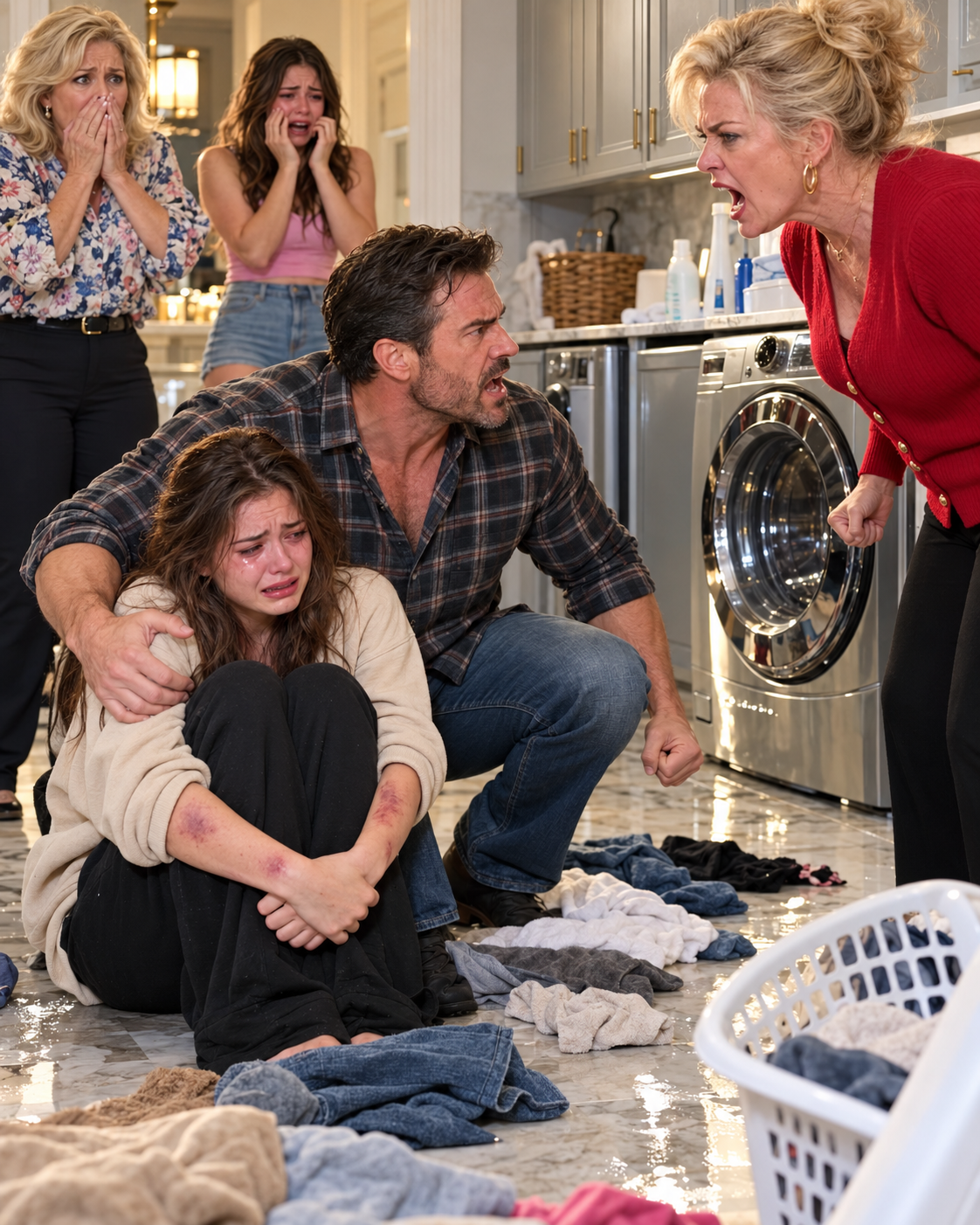
“Your daughter doesn’t deserve a seat at this table. Let her eat standing up. She should be grateful she’s allowed to live here at all.”
I never imagined those words could be spoken inside my own home.
But when I returned three days earlier than expected, I began discovering what had been happening to my daughter while I was away.
My name is Gabriel Torres. I worked as a freight truck driver, regularly traveling between León and Monterrey. I had spent thirty years behind the wheel, providing for my family and believing that the money I earned gave them a comfortable life.
That week, a shipment was unexpectedly canceled. Rather than remain away for another three days, I decided to drive home and surprise my wife and daughter.
It was nearly eleven at night when I pulled into our quiet neighborhood in León.
The house was completely dark.
There was no television playing, no music coming from the bedrooms, and not even a light shining from the kitchen.
I stepped inside and listened.
Somewhere toward the back of the house, water was splashing.
I followed the sound to the laundry room.
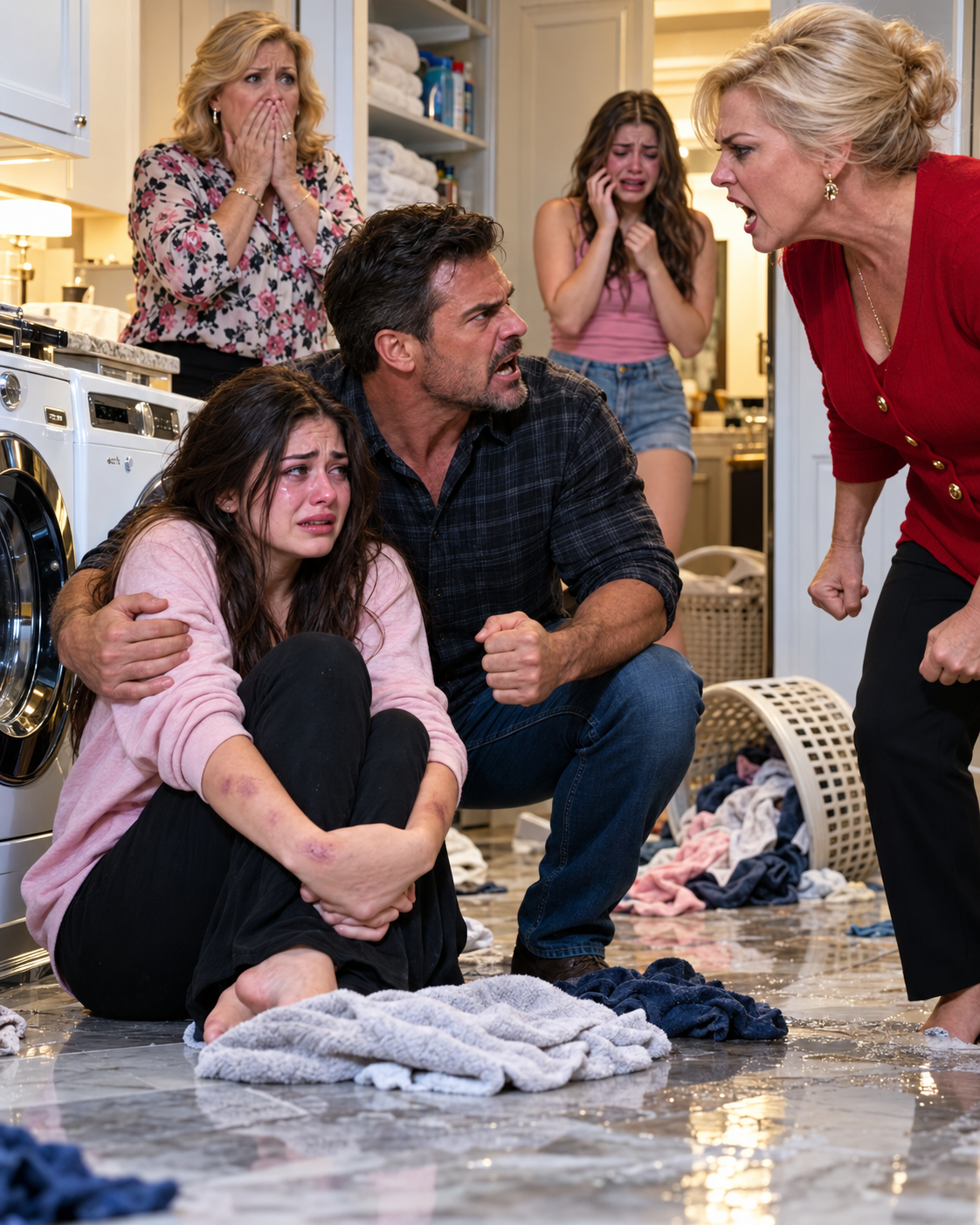
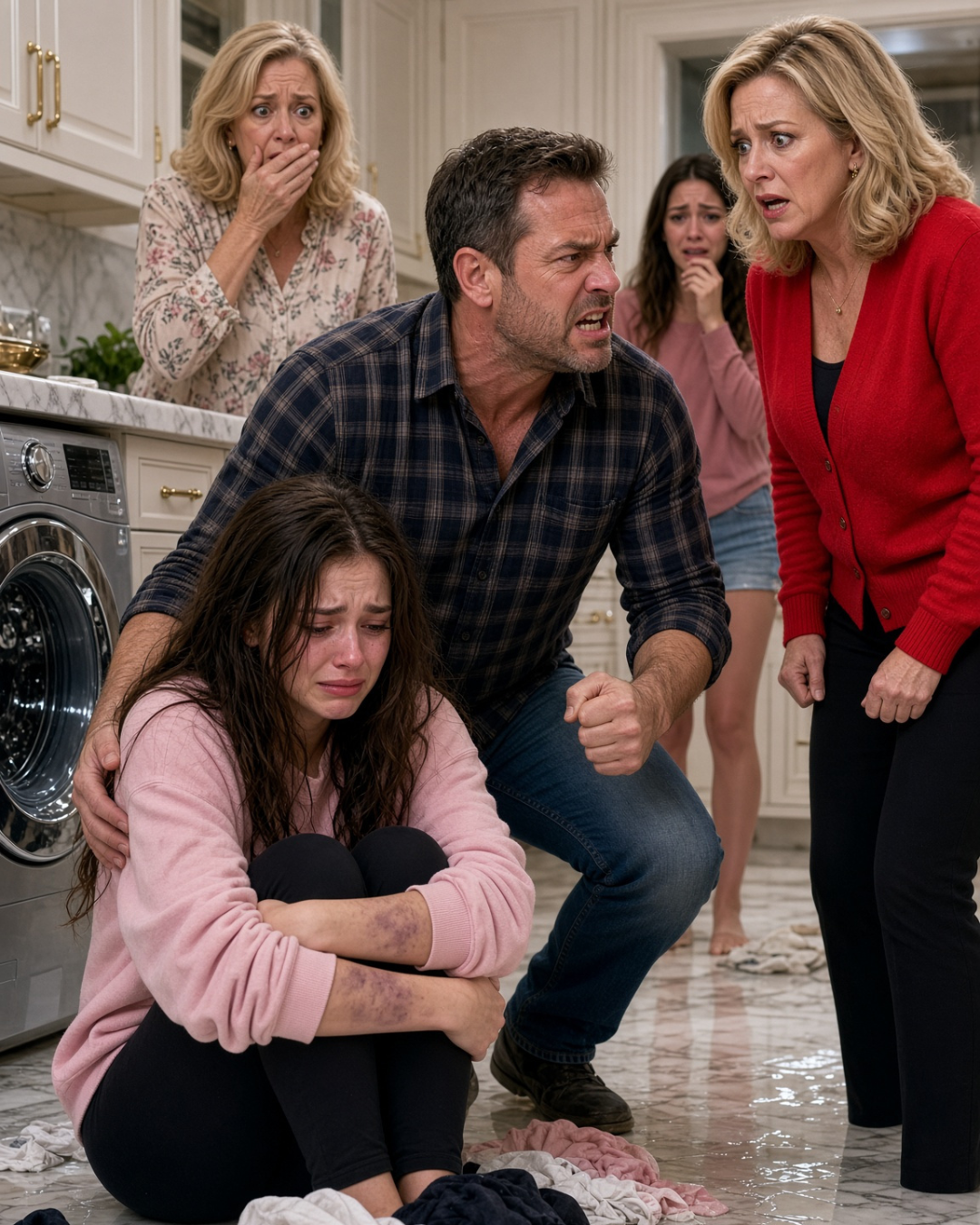
There, bent over a plastic bucket, was my sixteen-year-old daughter, Sofia.
She was scrubbing a sweatshirt by hand in freezing water. Her fingers were red, swollen, and raw.
The washing machine beside her was running.
Through its glass door, I could see everyone else’s clothes turning inside.
“Sofia?”
She jerked her head up so quickly that the sweatshirt almost slipped from her hands.
“Dad?”
Instead of looking happy, she looked frightened.
“Where’s Patricia?”
Patricia was my second wife. Sofia’s mother, Elena, had died of cancer years before, leaving me to raise our little girl.
Sofia swallowed.
“They went to Cancún.”
“Who?”
“Patricia, her mom, her sister and Bianca.”
Bianca was Patricia’s sixteen-year-old niece. She had been living with us for almost a year.
“They left you here alone?”
Sofia nodded.
“They’ll be back Sunday. They told me everything had to be clean before they got home.”
I looked from her freezing hands to the washing machine.
“Then why are you washing your clothes by hand?”
Her eyes dropped to the floor.
“I’m not allowed to use the machine for my stuff.”
For a moment, I thought I had misunderstood.
“What?”
“They say wasting electricity and water on my clothes costs too much.”
Then she hurriedly pulled the sleeves of her sweatshirt over her wrists.
That small movement made my stomach tighten.
“Sofia.”
She stopped moving.
“Pull your sleeves up.”
“Dad, I’m cold.”
“Please.”
Slowly, she pushed the fabric back.
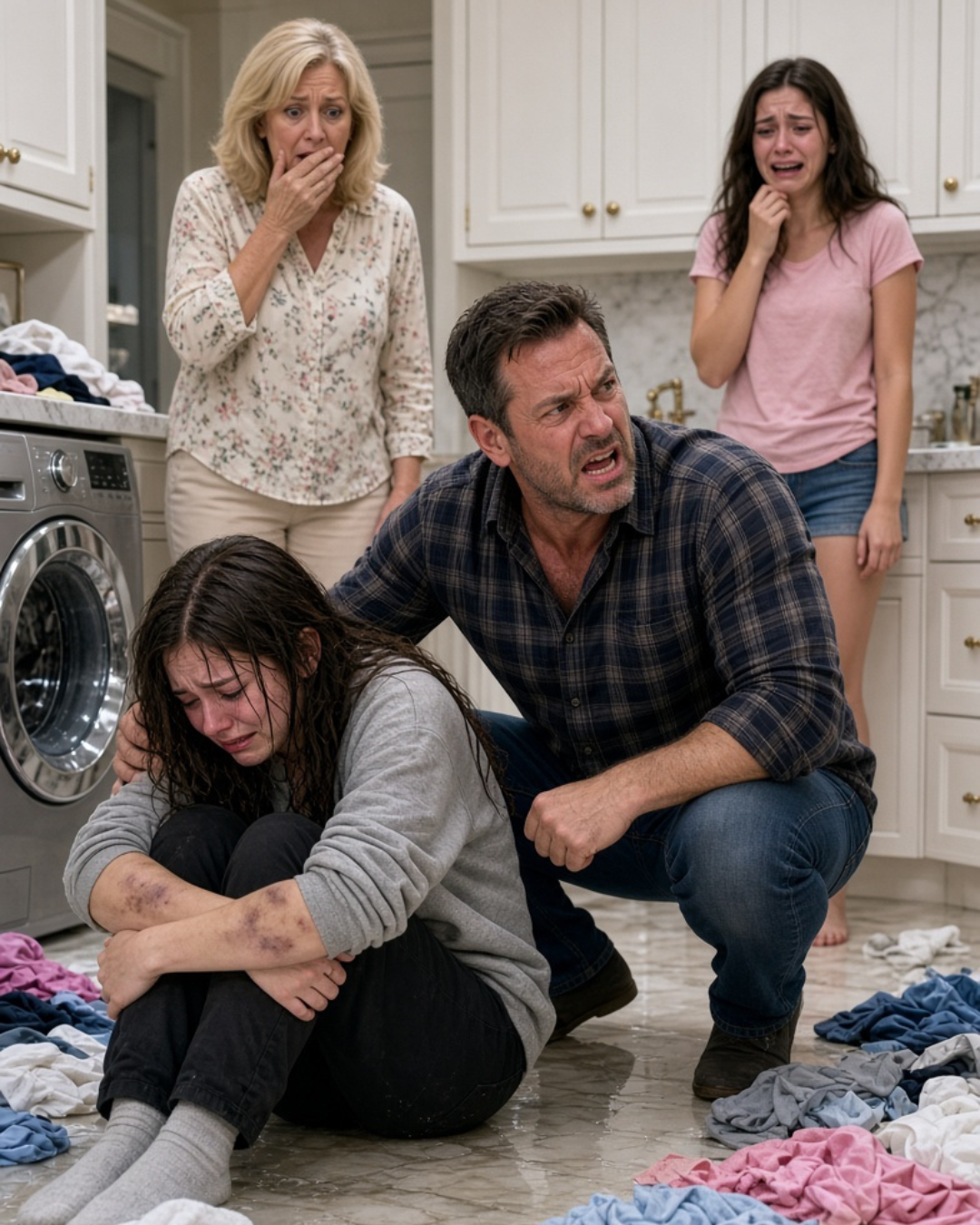
Fading bruises, scratches, and dark marks covered parts of her forearms.
I wanted to demand answers immediately.
I wanted to call Patricia and ask what kind of woman would treat a child this way.
But thirty years of driving heavy trucks had taught me that panic was dangerous. When something went wrong at highway speed, the first responsibility was to stay in control.
So I told Sofia to take a warm shower and go to bed.
I finished hanging the family’s laundry myself.
Then I sat alone in the kitchen until morning.
At five, I made oatmeal pancakes.
Elena used to prepare them for Sofia when she was little.
When my daughter entered the kitchen, I placed a plate in front of her usual chair.
“Sit down.”
She hesitated.
“You can sit here.”
Only then did she lower herself carefully into the chair.
“Now tell me everything.”
It took several minutes before she could speak.
And when she finally did, she told me everything without crying.
That frightened me more than tears would have.
She described the meals Patricia had withheld, the punishments that kept her awake until early morning, and the times Bianca had hit or humiliated her.
Her phone had been taken away. Patricia answered calls from school and pretended to speak on Sofia’s behalf.
Then Sofia told me what had happened on her birthday.
There had been decorations, a cake, guests, and candles I had paid for.
But they had celebrated Bianca instead.
“You called that day,” Sofia said quietly.
I remembered the call.
Patricia had told me Sofia was asleep.
“I wasn’t asleep,” my daughter said.
“I was outside.”
I stared at her.
“Outside where?”
“In the backyard.”
She looked down at her pancakes.
“I watched them through the window.”
Something inside me broke.
I reached across the table and covered her hand with mine.
“Sofia, I need to ask you something, and you can say no.”
She nodded.
“Can I record what you just told me? Not for social media. Not for anyone to laugh at. For a lawyer. For the people whose job is to protect you.”
She stared at my phone.
“Will she find out?”
“Eventually,” I said. “But by then, she won’t be able to touch you.”
After a moment, she wiped her palms on her jeans.
“Okay.”
I started recording.
This time she gave dates and names. She described being forced to stand beside the dining table while everyone else ate.
“She always said the same thing,” Sofia told the camera. “That I didn’t deserve a seat. That I should eat standing up. That I should be grateful she let me live here.”
The words I had been hearing in my head since coming home were not some imagined cruelty.
They were part of my daughter’s ordinary evenings.
When she finished, I photographed the marks on her arms in the natural light, placing a ruler beside each one. I also photographed a sheet showing the date and time.
Then I asked her about her phone.
“Where’s your phone?”
“Patricia keeps it. She says I only get it when I earn it.”
“Where does she keep it?”
Her eyes shifted toward the hallway.
Toward the bedroom Patricia and I shared.
I had spent twenty-two days out of every thirty on the road. Whenever I returned, Patricia made the house look immaculate. Fresh sheets, scented candles, perfectly arranged furniture.
I had never searched her belongings.
I believed trusting my wife meant respecting her privacy.
That morning, I opened her drawers.
The nightstand contained ordinary things: creams, a charger, and a novel.
Her closet was filled with expensive dresses, many still carrying their tags.
Then I noticed a locked drawer at the bottom of her dresser.
The lock was cheap. I used a flathead screwdriver and opened it in less than a minute.
Sofia’s powered-off phone lay on top.
Beneath it was a blue folder.
And under the folder sat a shoebox.
I opened the folder first.
It contained bank statements from an account I had nearly forgotten about.
When Elena died, her life insurance had paid one point four million pesos.
I had placed every peso into an education fund for Sofia, with myself as the only administrator.
It was supposed to ensure my daughter would never have to beg anyone for the opportunity to attend college.
The statements were addressed to our house.
Patricia always collected the mail.
I looked at the latest balance.
Thirty-one thousand pesos.
My legs weakened, and I sat on the bed.
There were withdrawals, repeated transfers to an unfamiliar account, and a travel agency charge from two weeks earlier.
Cancún.
My late wife’s insurance money had paid for a vacation while her daughter washed clothes in a bucket.
Clipped to the statements was a notarized power of attorney granting Patricia Alvarado de Torres full authority over Sofia Torres Ruiz’s education fund.
My signature appeared at the bottom.
I had never signed it.
Then I opened the shoebox.
Inside was a brochure for Renacer Youth Behavioral Residence, a facility in another state.
The brochure advertised structure, discipline, and reset.
Attached was an intake form.
Patient: Sofia Torres Ruiz.
Reason for admission: “Chronic lying, self-harm, aggression toward family members.”
It carried Patricia’s signature.
And mine.
The admission was scheduled for the following Monday.
At the bottom of the box, I found one more thing.
An envelope addressed in handwriting I would have recognized anywhere.
For my Sofi, on her sixteenth birthday. Love, Mamá.
Elena had written it while she was dying.
Someone had already torn open the seal.
I stood in that bedroom holding my dead wife’s letter, realizing Patricia hadn’t simply been stealing money or mistreating my daughter.
She had been preparing to send Sofia away.
And according to the documents, I had supposedly authorized every part of it.
PART 2
I didn’t read Elena’s letter.
It belonged to Sofia.
Patricia had already taken it from her once. I would not take away her right to read it first.
I placed the envelope inside my jacket, close to my heart.
Then I photographed every document exactly where I had found it, gathered the folder, the brochure, and Sofia’s phone into a backpack, and called the only lawyer I knew.
Héctor Salinas had been my neighbor fifteen years earlier. He had helped carry Elena’s coffin at her funeral.
He answered on the second ring.
“Gabriel? It’s seven in the morning.”
“Héctor, I need you to listen and not interrupt.”
He listened.
When I finished, he remained silent for several seconds.
“Don’t confront her,” he finally said. “Don’t post anything. Don’t touch that account. Take Sofia to a doctor today, a real clinic, and get everything written down. Then we file. Family violence, fraud, forgery of documents. And Gabriel?”
“Yeah.”
“You have until Monday. If that girl ends up in another state with your name on the admission form, getting her back will take months.”
By ten that morning, Sofia and I were at the office of Dr. Arturo Mendoza, her pediatrician since she was four.
He examined her injuries and asked me to wait outside.
When he invited me back, his expression was grave.
“Some of these marks are recent,” he said. “Some are weeks old. They are in different stages of healing. That tells me this didn’t happen once.”
He explained that Sofia had also lost almost six kilograms since her previous checkup in March.
“I’m documenting all of it,” he said. “And I’m required to report it. You understand that?”
“I’m asking you to,” I said.
Next, we visited Sofia’s high school.
The counselor, Ms. Lucía Ramos, brought us into her office.
“Mr. Torres,” she said carefully, “I’m glad you came. We’ve been very worried about Sofia’s… situation.”
“What situation?”
She opened Sofia’s file.
“Your wife came in twice this semester. She told us Sofia had been hurting herself. That she invents stories for attention. That we shouldn’t be alarmed if she showed up with marks, because the family had it under control and she was in private therapy.”
Ms. Ramos explained that Patricia had claimed I agreed with everything but could not attend meetings because I was always traveling.
“I never hurt myself,” Sofia said. Her voice was flat. “I told you that.”
Ms. Ramos’s eyes filled.
“You did,” she said quietly. “And I believed the adult instead.”
Patricia had constructed a story long before anyone might question Sofia’s injuries.
She had told the school my daughter lied.
She had filled out medical paperwork describing imaginary behavioral problems.
She had arranged a place where Sofia could be confined.
And she had put my forged signature on the documents.
Ms. Ramos copied her records and promised a written statement.
Outside, Sofia asked for her phone.
“Dad, can I have my phone back now?”
I handed it over.
When she switched it on, forty-seven missed calls appeared.
Every one was from Patricia.
Then my own phone rang.
Patricia again.
Sofia caught my sleeve.
“Dad,” she whispered. “There are cameras. In the living room and the kitchen. She watches them on her phone.”
I remembered the hours I had spent in the kitchen.
The pancakes.
The recording.
The moment I invited Sofia to sit in her own chair.
Patricia had been watching.
I answered on the fifth ring.
“Gabriel, mi amor!” Patricia’s voice was cheerful. “Why didn’t you tell me you were home? I saw you on the camera. I almost had a heart attack!”
“Shipment got canceled,” I said. “Wanted to surprise you.”
“Ay, that’s so sweet.”
Then she asked about Sofia.
“And Sofia? She’s behaving? You know how she gets when I’m not there.”
“She’s fine,” I said. “We had breakfast.”
“I saw.”
After another pause, she added, “You know she can be very dramatic, right? If she told you stories, I can explain everything when I get back.”
“I’m sure you can.”
She announced that they were changing their flights and returning Saturday night rather than Sunday because her mother wasn’t feeling well.
“Safe travels,” I said.
I ended the call.
I wasn’t taking Sofia back into that house.
Instead, I drove to Doña Carmen Ibarra’s home.
She was seventy-three and lived behind a gate covered with bougainvillea.
She opened the door before I could knock.
“I wondered when you’d finally come,” she said.
She gave Sofia a blanket and a comfortable chair, made coffee, and brought out her old phone.
“I’m an old woman,” she said. “I don’t sleep. I sit by my window.”
She showed me a recording.
On Sofia’s birthday, my daughter had stood alone in the cold backyard, watching a party through the window.
Inside, Bianca blew out candles while the guests sang.
Other videos showed Sofia carrying garbage bags at midnight and sitting on the back steps at six in the morning, still wearing her school uniform.
“Can I send these to my lawyer?” I asked.
“Send them to God himself if it helps,” Doña Carmen said.
I called Rubén, my longtime driving partner.
He arrived with his toolbox.
“Tell me what you need, compadre.”
“Cameras,” I said. “I want to know exactly where every one of them is. And then I want them unplugged.”
Héctor called while Rubén was working.
He had filed an initial complaint with the State Prosecutor’s office and contacted Child Protection.
Then he told me the name on the account receiving the education fund transfers.
Rosaura Alvarado.
Patricia’s mother.
That evening, Sofia found a message thread from Bianca.
Most of it contained insults, photographs of destroyed homework, and laughing emojis.
But the last three messages, sent from Cancún, were different.
I’m sorry.
I didn’t want to do any of it.
If your dad is really home, tell him I have proof. But I need him to promise me something first.
Sofia didn’t want to answer.
“She hit me, Dad,” she said, staring at the screen. “She laughed when I cried. She ate my birthday cake.”
“I know.”
“So why should I care what she wants?”
I sat beside her.
“You don’t have to care,” I said. “But I need to know what she has. And she’s sixteen, too. Someone taught her to do what she did.”
Eventually, Sofia replied.
What does he have to promise?
Bianca answered immediately.
That they won’t send me back to my mom.
Her mother was Marisol, Patricia’s younger sister.
I took the phone and typed:
This is Gabriel. I can’t promise what a judge will decide. But I promise I will tell them the truth about you, both the bad and whatever good there is. That’s all I can offer.
No response came that night.
On Saturday evening, Patricia returned.
I waited in the living room.
Rubén had discovered five cameras, including one pointed directly at the laundry bucket. He had disconnected and bagged them as evidence.
Sofia remained safely at Doña Carmen’s house.
Patricia entered first, wearing a white linen dress.
“Gabriel. Where’s Sofia?”
“Safe.”
Rosaura came behind her carrying duty-free bags, followed by Marisol and Bianca.
“What do you mean, safe?” Patricia demanded. “Safe from what?”
I placed the blue folder on the coffee table.
Everyone fell silent.
Patricia studied it for two seconds before sitting down.
“Okay. I was going to tell you. Your daughter is sick, Gabriel. She cuts herself. She lies. Ask the school. Ask anyone. I needed that money for her treatment, and you’re never here to sign things, so yes, I handled it. I did what a mother does.”
“You’re not her mother.”
Her expression tightened.
“And Cancún?” I asked. “Was that treatment too?”
“That was a gift for my mother. She’s sick—”
“She carried four bags up the driveway.”
Marisol stepped forward.
“You can’t come in here and accuse my sister after everything she’s sacrificed for your ungrateful—”
“Don’t,” I said quietly.
She stopped.
Patricia looked at the folder again.
Then she smiled.
“You think you’re so clever,” she said. “You think you’re going to take that power of attorney to a lawyer and say I forged it?”
“I never signed it.”
“Look at the notary stamp, Gabriel. Look at who signed as the witness. Look carefully.”
I examined the line I had overlooked.
Witness: Tomás Torres Medina.
My younger brother.
The boy I had taught to ride a bicycle.
The man I had lent forty thousand pesos the previous Christmas.
The uncle who hugged Sofia at family dinners and called her mija.
Patricia leaned back.
“Your family isn’t as clean as you think,” she said. “So before you call any lawyers, maybe call your brother.”
I didn’t call Tomás.
I drove straight to his apartment, with Rubén beside me.
“You’re not going to do anything stupid,” Rubén said.
“No,” I said. “I’m going to do something worse. I’m going to ask him to look me in the eye.”
Tomás opened the door wearing a stained T-shirt.
When he saw me, he stepped aside without pretending he was surprised.
His apartment smelled of cigarettes and microwave meals.
Betting slips and casino receipts covered the table.
“How much?” I asked.
He sat down.
“Gabriel—”
“How much do you owe?”
“Almost four hundred thousand.”
Patricia had approached him the previous year, knowing about his gambling debts.
“She said there was a way. That you’d never miss the money because you never check anything. That the fund was just sitting there.”
He admitted she had practiced my signature repeatedly.
“And I stood there at the notary’s office and said, Yes, that’s my brother, I watched him sign.”
“The notary didn’t ask for my ID?”
“The notary is a friend of Marisol’s.”
He laughed bitterly.
“Everyone is a friend of somebody.”
I asked whether he had known about Sofia’s injuries, the laundry bucket, and the birthday.
He didn’t answer.
“I told myself it wasn’t my business,” he whispered. “I told myself kids exaggerate.”
Then he revealed what Patricia had planned.
The behavioral residence wasn’t intended to treat Sofia.
Once she was admitted, Patricia expected no one to believe her complaints. Sofia would remain there until eighteen, while the rest of the education fund disappeared under supposed treatment expenses.
Afterward, Patricia planned to divorce me, accuse me of abandoning my family, and claim the house Elena and I had bought with twelve years of savings.
My brother looked terrified.
I told him he would accompany me to Héctor’s office the next morning and give the prosecutor a full statement.
“They’ll put me in jail.”
“Maybe,” I said. “Sofia spent a birthday in the cold watching through a window. You can spend some time thinking about that.”
At the door, he whispered, “Gabriel. I’m sorry.”
“Tell her,” I said. “Someday. Not me.”
When Rubén and I returned to Doña Carmen’s house around one in the morning, someone was sitting on the steps.
Bianca.
Her backpack rested beside her. Her face was swollen from crying, and a fresh red mark showed on her cheek.
She lifted her phone.
“I’ve been recording her for eight months,” she said. “Every time she told me what to do to Sofia. Every single time.”
PART 3
Doña Carmen brought Bianca inside and placed a bag of frozen peas against her cheek.
“Who did that?” I asked.
“My mom,” Bianca answered. “When she found out I’d messaged Sofia. She checked my phone at the airport.”
Then she explained that the recordings were hidden inside a calculator app.
Sofia appeared in the hallway wearing Doña Carmen’s borrowed nightgown.
The girls stared at one another.
“Hi,” Bianca finally said.
Sofia didn’t reply.
She sat at the far end of the couch.
Bianca unlocked the app and handed me her phone.
More than forty audio files appeared, each labeled by date.
I played the first.
Patricia’s voice filled the room.
“If she cries, take her phone. If she tells anyone at school, you tell them she’s lying. And Bianca, listen to me. When you push her, do it on the arms. Where the sleeves cover. Never the face.”
Sofia covered her mouth.
The next recording was about her birthday.
“Her birthday? We’ll do your party that day instead. Your mom never threw you one, right? Consider it a gift. Sofia can watch. It’ll teach her what being grateful looks like.”
Then came a recording from the dining table.
I heard forks touching plates.
And Patricia saying:
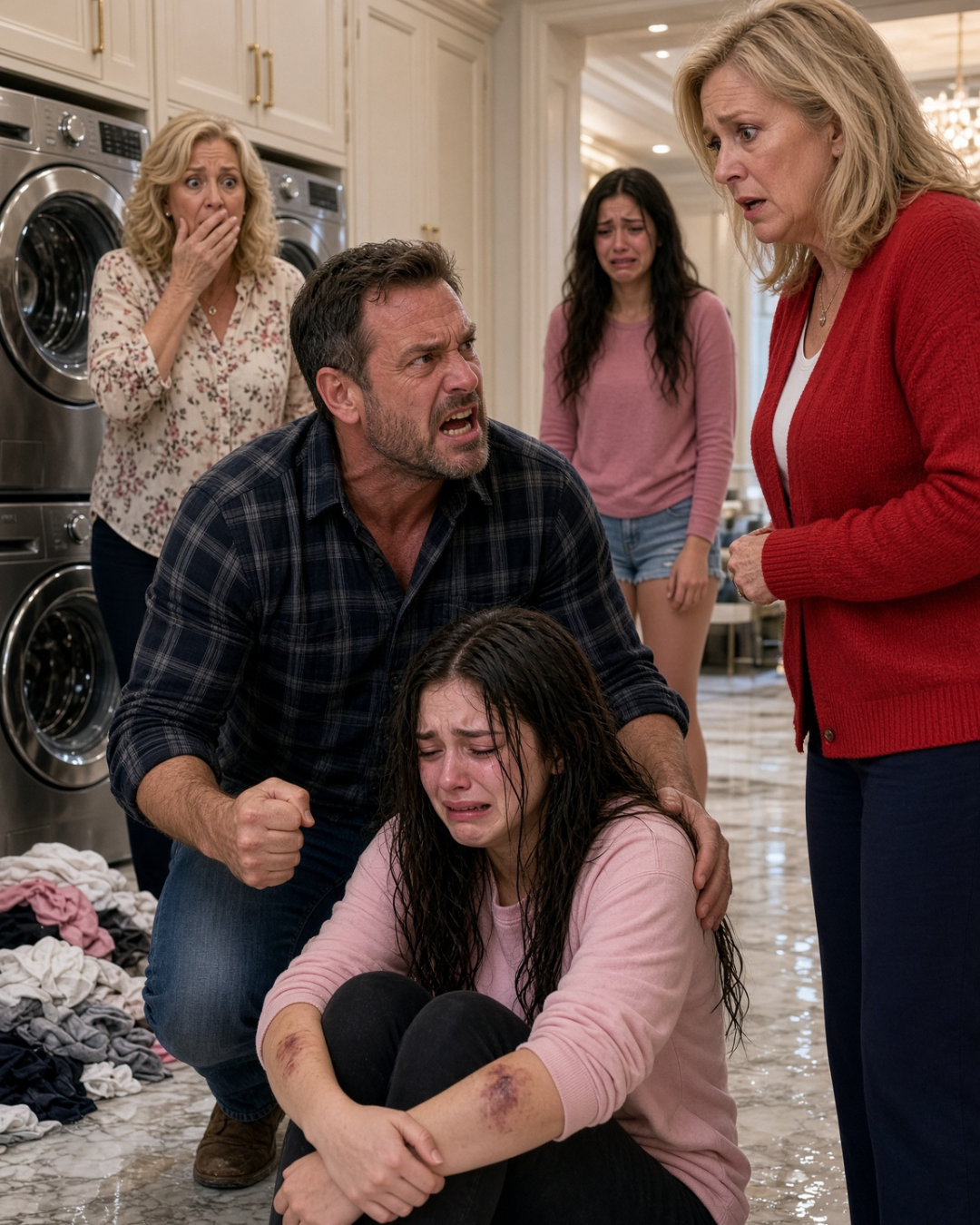
“Your daughter doesn’t deserve a seat at this table. Let her eat standing up. She should be grateful she’s allowed to live here at all.”
Bianca stared at the floor.
“She said that to her almost every night. Sometimes she made me say it.”
I stopped the recording.
“Why did you do it?” Sofia asked, trembling. “Why did you listen to her?”
Bianca began crying.
“Because my mom left me with Tía Patricia like a suitcase. Because Patricia said if I didn’t help, she’d send me back to my mom’s boyfriend, and I’d rather die than go back there.”
She looked at Sofia.
“Because she said it was you or me. And I picked me.”
Sofia got up and shut herself inside the guest room.
Nobody followed her.
She had every right to be angry.
The next morning, Héctor received Bianca’s recordings, Doña Carmen’s videos, Dr. Mendoza’s medical report, Ms. Ramos’s school records, and the documents from Patricia’s drawer.
Tomás arrived at nine and spent three hours speaking with the prosecutor.
Héctor called afterward.
“Gabriel, this is the strongest case I’ve had in years,” he said. “Fraud. Document forgery. Family violence against a minor. The prosecutor is very interested in the notary, too. This could take apart more than one family.”
For the first time, I felt we might be close to protecting Sofia permanently.
Then, at 4:12 that afternoon, someone knocked on Doña Carmen’s door.
Two police officers stood outside with a woman in a gray blazer.
“Mr. Gabriel Torres?” she asked. “I’m Licenciada Verónica Peña from the Child Protection Office. We received a complaint this morning stating that you removed your daughter from her home without authorization and that you have a history of violence toward her.”
I stared at her.
“What? I’m the one who filed—”
“The complaint was filed by Patricia Alvarado de Torres,” she said evenly. “It includes photographs of the minor’s injuries. And a statement claiming you caused them.”
Sofia’s bedroom door opened behind me.
“Sir,” said Licenciada Peña, “until we investigate, Sofia will need to come with us.”
I had driven through mountain hailstorms and watched trailers jackknife beside me.
Nothing had frightened me like seeing Sofia approach that police car.
“Dad!”
“Go with them, mija,” I said, forcing myself to remain calm. “This is how it works. They’re going to look at everything. And everything is on our side.”
“You promised she wouldn’t touch me again.”
“She won’t. These people aren’t hers. They’re yours.”
Licenciada Peña watched us.
Then she asked whether Sofia had another relative who could care for her temporarily.
“Elena’s sister,” I answered. “Inés Ruiz. In Guadalajara. She hasn’t seen Sofia in two years.”
“Why not?”
I started to answer and suddenly understood.
“Because my wife told me Inés didn’t want to visit anymore,” I said slowly. “And she told Inés we didn’t want her to come.”
Licenciada Peña wrote it down.
Inés drove three and a half hours that night.
When she reached the Child Protection Office and saw Sofia, she dropped her purse and embraced her.
Sofia finally cried.
“I wrote to you,” Inés kept saying. “Every month, mi niña, I sent cards. I sent money for your birthday.”
Sofia had received none of them.
That evening, I returned alone to my house.
Patricia and her relatives had moved to Rosaura’s place across town, supposedly for Patricia’s safety.
I sat in Sofia’s dining chair.
Héctor arrived around eleven with his laptop and two coffees.
“Let’s look at what she’s claiming,” he said.
Patricia had submitted photographs of Sofia’s injuries and claimed I caused them after returning from freight trips.
Each photograph was dated.
Héctor pointed to the first.
“October 3,” he read. “She says you grabbed Sofia’s arms during an argument that night.”
I checked my phone.
“October 3, I was in Saltillo. I’ll prove it.”
My truck was equipped with GPS tracking, electronic driving logs, engine records, and route data.
Transportes del Bajío, my employer, had kept those records for nine years.
At midnight, I called Lupita, the dispatcher who worked the night shift.
“Lupita, I need my logs for the last six months. Every stop. Every timestamp.”
“Gabriel, it’s midnight.”
“My daughter’s life depends on it.”
She paused.
“Give me two hours,” she said.
By three in the morning, Héctor had matched every accusation against my driving records.
Saltillo.
San Luis Potosí.
Monterrey.
A rest stop near Matehuala.
On every date Patricia claimed I had injured Sofia, I was at least four hundred kilometers away.
“She didn’t know about the logs,” Héctor said, exhausted. “She thought a truck driver’s word against hers. She never thought the truck would testify.”
On Tuesday, Licenciada Peña examined the evidence.
She listened to the recordings, reviewed the medical report, watched Doña Carmen’s birthday video, and compared the accusations with my location records.
Then she closed the file.
“Mr. Torres,” she said, “I’ve been doing this job for nineteen years. I know when a complaint is a weapon.”
Her phone buzzed.
As she read the message, her expression changed.
“The bank just flagged an attempted wire transfer from Rosaura Alvarado’s account,” she said. “Everything left in it. To an account in the United States.”
She looked up.
“And according to the prosecutor’s office, two one-way tickets to Houston were purchased this morning. Departing León tonight at 9:40.”
The prosecutor’s office acted quickly.
By six, Héctor confirmed that the accounts were being frozen and warrants had been issued for Patricia and Rosaura on fraud, forged-document, and family-violence charges.
Marisol was also under investigation following Bianca’s account of the assault at the airport.
Héctor warned me not to interfere.
“They’ll try to stop them at the airport,” Héctor said. “You don’t go there.”
“I’m not going there to stop them.”
“Then why are you going?”
I couldn’t explain it.
Perhaps I needed to see with my own eyes that the people who had controlled my daughter were finally being stopped.
Rubén drove.
Elena’s letter was still inside my jacket.
At 8:50 p.m., we reached the León airport.
Patricia stood near the check-in counters wearing sunglasses, although it was nighttime.
Rosaura clutched an expensive designer handbag.
Patricia spotted me.
For one brief moment, I remembered the woman I had married, the one who once brought soup to my mother in the hospital and laughed at my terrible jokes.
Then I remembered Sofia’s hands in the freezing water.
“You did this,” Patricia hissed. “You and that ungrateful girl. I gave that house order. I gave you a family. She had everything.”
“She had nothing,” I said. “Not even a chair.”
Two officers approached and read the charges.
Rosaura immediately began crying.
“It was her idea!” she shouted, pointing at Patricia. “All of it! I only let her use my name for the account! I didn’t know about the girl! I swear by God I didn’t know!”
Patricia turned toward her mother.
“You spent that money faster than I did, Mamá.”
The officers escorted them away.
I had expected to feel satisfaction.
Instead, I felt exhausted.
Like a man who had driven through a storm for twenty hours and finally reached the lights of home.
Marisol was arrested the following morning.
Licenciado Ortega, the notary, was suspended within a week. Investigators began examining eleven other documents he had certified.
Tomás was charged as an accomplice, although Héctor said his cooperation would be considered.
My brother called twice.
I wasn’t ready to answer.
Ten days later, Licenciada Peña phoned me.
“The investigation regarding you is closed, Mr. Torres. No basis. I’ve recommended that Sofia return home to her father.”
Then she added something that made my throat tighten.
“She’s been asking for you every day. And she asked me to tell you something. She said, ‘Tell him to make the pancakes.’”
I drove to Guadalajara that afternoon.
Sofia ran down Inés’s front steps and threw herself into my arms.
Her cheeks had more color. She had begun regaining weight.
She smelled of her aunt’s laundry soap.
Like a girl who had been allowed to use the washing machine.
We drove back to León that evening.
The house was dark when we arrived.
But this time, it was simply empty.
I switched on every light.
Then I sat beside Sofia on the couch and took Elena’s envelope from my jacket.
“Sofi,” I said, “there’s something that belongs to you. Patricia took it. I found it in her drawer. I didn’t read it.”
She recognized her mother’s handwriting immediately.
For my Sofi, on her sixteenth birthday. Love, Mamá.
Her hands trembled as she opened the letter.
She read the first line.
Then she looked at me with an expression I couldn’t understand.
“Dad,” she whispered. “Mom knew. She wrote about you. And about something you never told me.”
PART 4
“What did she write?”
Sofia handed me the letter.
“Read it with me.”
I recognized Elena’s handwriting, uneven in places from the illness that had weakened her near the end.
The paper was from the hospital.
Together, we read:
My Sofi,
If you’re reading this, you’re sixteen, and I’m sorry I’m not there to see you roll your eyes at me.
There’s something your father will never tell you because he thinks it makes him sound weak. When you were born, the doctors said you might not make it through the first night. Your father sat by your incubator for three days without sleeping. On the third night, a nurse told him he had to go home. He said, “My daughter has a seat in this world, and I’m going to keep it warm until she’s strong enough to sit in it.” And he didn’t leave.
He is going to work too hard when I’m gone. He’s going to drive too far. He’s going to think that sending money home is the same as being home. When he forgets, remind him. And if anyone ever makes you feel like you don’t belong somewhere, remember that a man once refused to move for three days so that you would always have your place.
You are not a guest in your own life, mi amor. You never were.
Love you to the moon and back. Mamá.
I hadn’t thought about those three days beside Sofia’s incubator in years.
I had almost forgotten saying those words.
Elena hadn’t forgotten.
Sofia leaned against my shoulder.
And in the brightly lit house, we cried together.
For Elena.
For everything Sofia had endured.
For the years I had mistaken sending money home for actually being there.
And for the chance we still had to rebuild our lives.
Justice didn’t arrive overnight.
It moved slowly, like a heavy freight truck gathering momentum.
Eight months later, the trial ended.
Patricia was convicted of family violence against a minor, fraud, and using forged documents.
Bianca’s recordings were played in court.
Patricia refused to look at either girl.
The judge sentenced her to nine years in prison and ordered full restitution of the education fund.
Rosaura received four years for fraud. Her sentence was reduced partly because she repaid what she could after authorities seized her apartment.
Marisol was sentenced for her involvement in the fraud and for assaulting Bianca at the airport.
Licenciado Ortega permanently lost his notary license and faced additional charges.
Tomás pleaded guilty.
Because he had cooperated with investigators, he received a suspended sentence, a restitution payment plan, and mandatory treatment for his gambling addiction.
He began attending meetings three times a week.
Last month, he wrote Sofia a letter.
She hasn’t answered.
But she hasn’t thrown it away, either.
It remains on her desk.
Sometimes forgiveness begins with the decision not to destroy the bridge completely.
Bianca was placed with her paternal grandmother in Celaya.
Her grandmother, a retired schoolteacher, cried when they met.
Bianca began therapy.
During the trial, she testified for two hours without looking away.
Afterward, she approached Sofia outside the courthouse.
“I’m not asking you to forgive me,” she said.
“Good,” Sofia answered.
Then, after a long silence, she added:
“But I’m glad you told the truth.”
That was all.
Neither girl owed the other anything more in that moment.
The education fund was eventually restored, mostly through seized assets and the sale of property Patricia had purchased with the stolen money.
Sofia now checks the account balance herself every month.
I added her name to the account alerts.
Nobody will ever be able to hide her financial statements from her again.
And I changed my own life.
I stopped driving long-haul freight routes.
Transportes del Bajío offered me a dispatch position at the León yard.
The pay was lower, but I could come home every evening.
Lupita and I now work the same shift.
She brings tamales on Fridays.
Rubén still drives the Monterrey route.
Whenever he passes the rest stop outside Matehuala, he calls me.
“This is where you saved your kid, compadre.”
I tell him the truck saved her by keeping records.
He tells me to stop being humble.
Doña Carmen visits every Sunday.
She brings flan and complains that we never eat enough.
Inés comes from Guadalajara once a month, and nobody stands between her and her niece anymore.
Our house slowly became a home again.
Sofia began laughing more.
She stopped apologizing whenever she opened the refrigerator.
She stopped asking whether she could sit at the dining table.
She learned that she could make noise, invite friends, and leave her schoolbooks wherever she wanted without being punished for it.
Those changes seemed small to someone who had never been afraid in their own home.
To me, they were everything.
Then came Sofia’s seventeenth birthday.
This time, we threw a real party.
Her name was written on the cake.
Her friends from school filled the house.
Ms. Ramos came, along with Dr. Mendoza and his wife.
Héctor arrived carrying a gift card and gave a speech nobody had asked him to make.
Doña Carmen danced with Rubén.
For the first time in years, the house was filled with laughter that nobody needed to hide.
Before we lit the candles, I stood at the head of the dining table.
“Before we sing,” I said, “I need to say something.”
The room became quiet.
“Last year, someone told my daughter that she didn’t deserve a seat at this table. That she should eat standing up. That she should be grateful just to live here.”
I looked toward Sofia.
She was sitting in the same chair she had hesitated to use at five in the morning when I returned from Monterrey.
But now she sat comfortably, surrounded by people who loved her.
“I want everyone here to know something. This is her table. This is her home. She was never a guest. She never needed to earn her place. Being loved isn’t a reward for good behavior. It’s what family is supposed to be.”
Tears filled Sofia’s eyes.
“And I’m sorry,” I said, my voice breaking in front of everyone, “that I was too far away to see it. I’m here now. And I’m not moving.”
Sofia stood.
She walked around the table and hugged me so tightly that I nearly dropped the lighter.
I held her for as long as she needed.
Then she returned to her chair.
Not standing beside the table.
Not alone in the backyard.
Not watching someone else’s birthday through a window.
She was sitting in her own home, laughing with her friends, surrounded by people who had chosen to show up for her.
We sang terribly out of tune.
She blew out every candle.
Later that night, after the last guest had gone and the house was quiet, I heard the washing machine running.
I walked toward the laundry room.
Sofia was standing in front of it, loading her clothes.
When she noticed me in the doorway, she grinned.
“Using all the electricity I want,” she said.
“Use all of it,” I answered.
She pressed the start button.
The machine began humming.
Warm light filled the room.
Clean water flowed through the clothes.
There was no plastic bucket.
No freezing water.
No frightened girl hiding her bruised arms.
Just my daughter doing her laundry in a home where she belonged.
I stood there watching her and thought about everything that had happened since the night I came home early.
The locked drawer.
The missing money.
The forged signatures.
The plan to send Sofia away.
The people who had betrayed us.
The people who had helped us.
And the letter Elena had left behind, reminding me of a promise I had made beside an incubator seventeen years earlier.
My daughter has a seat in this world, and I’m going to keep it warm until she’s strong enough to sit in it.
I had almost forgotten that promise.
But Elena had remembered.
And Sofia had brought me back to it.
If those months taught me anything, it was that the people who truly love you don’t give you a roof and then demand payment for every breath you take beneath it.
Love doesn’t keep a ledger.
Family doesn’t require someone to earn the right to belong.
And providing money isn’t the same as protecting the people who depend on you.
Sometimes love means asking questions you should have asked long ago.
Sometimes it means listening when someone is too frightened to cry.
And sometimes it means admitting that the home you believed was safe has become the place where someone you love is suffering.
If you ever find someone you love washing their life away in the dark, don’t scream.
Don’t panic.
Turn on the lights.
Then pull out a chair, and tell them to sit down.
THE END
