

PART 1
“Don’t hate me.”
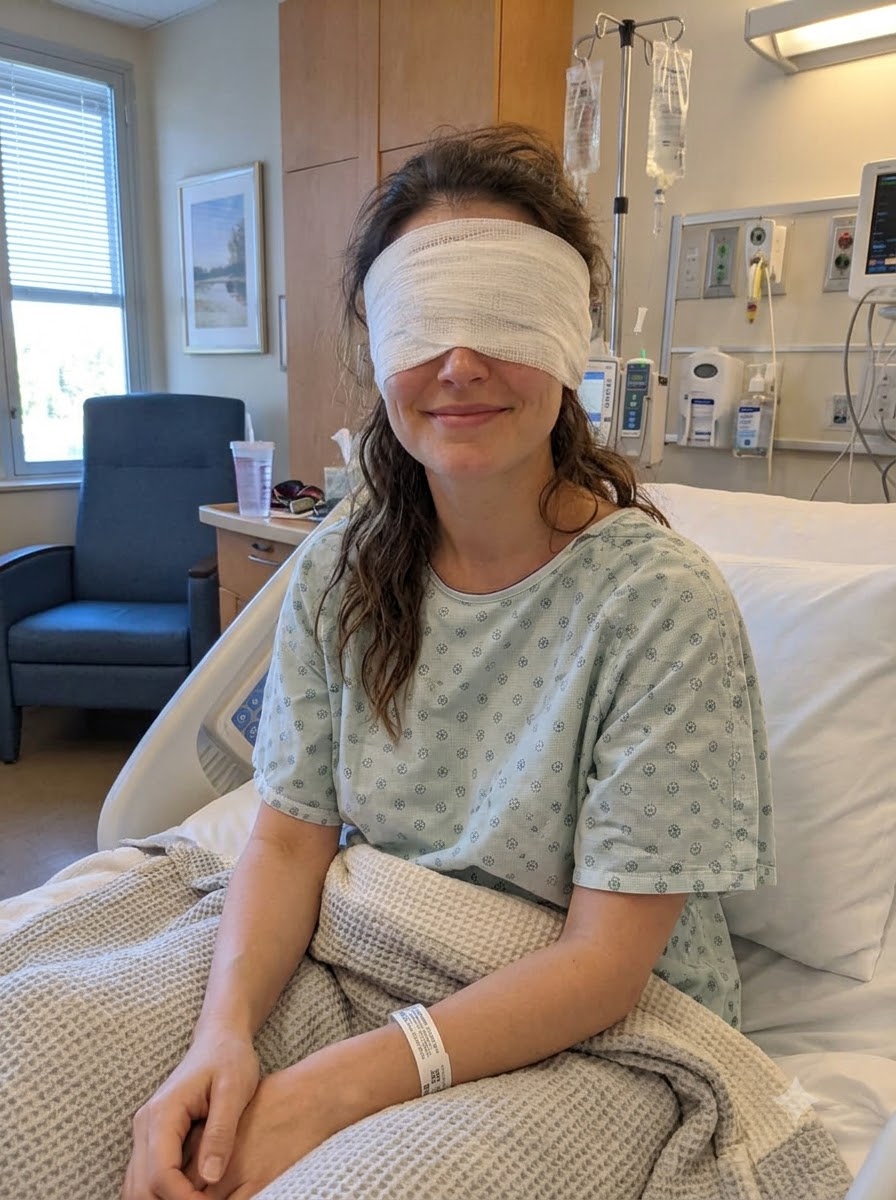
Those were the words my husband whispered as he carefully unwound the bandages covering my eyes.
I was sitting upright in a hospital bed. Somewhere beside me, machines beeped steadily. The room smelled of antiseptic and the faint lemon scent of hospital soap.
I could feel the gauze loosening with every movement of his hands.
After two days beneath those bandages, cool air finally brushed against my eyelids.
“Before you see this,” Nigel said, “I need to tell you that everything isn’t the way you think.”
I gave a nervous little laugh.
“What does that even mean?”
He didn’t answer.
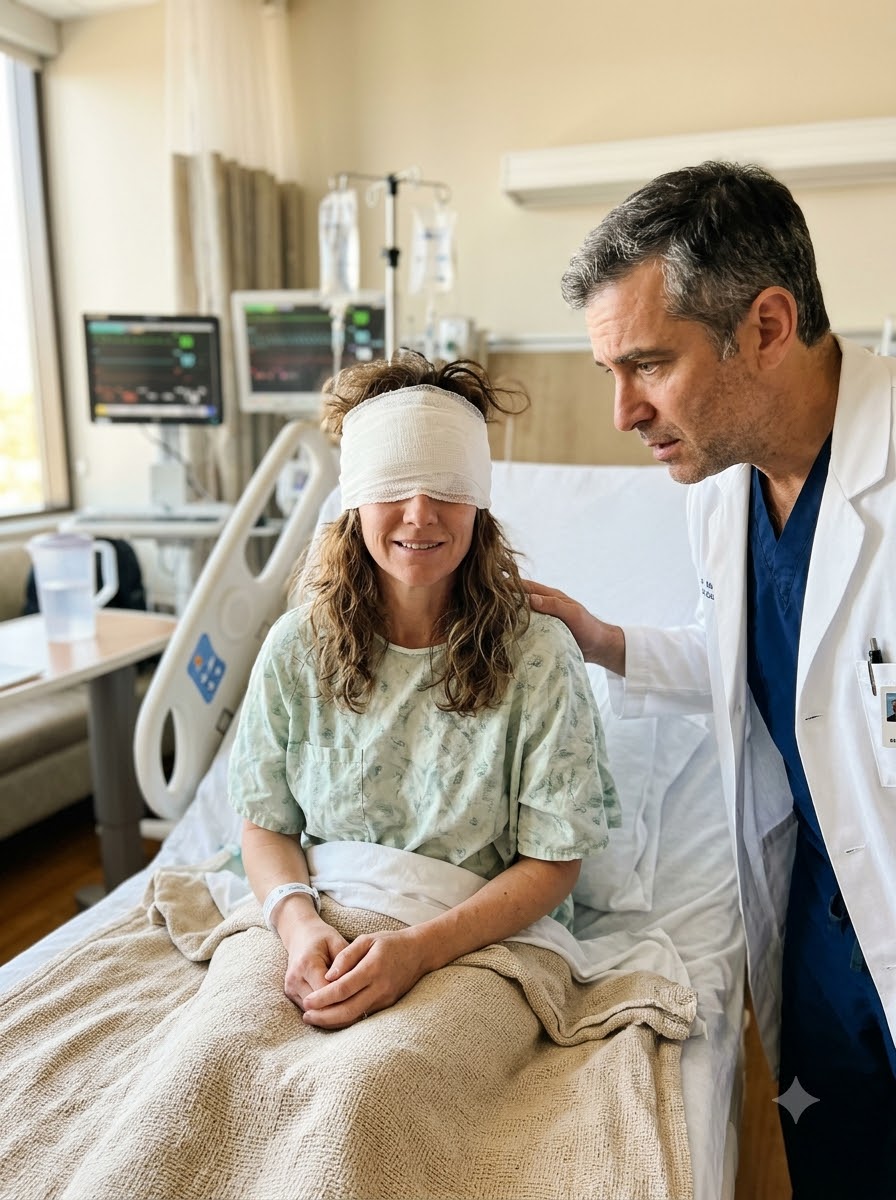
His fingers continued working, but they were trembling.
I had been married to Nigel for twenty years. I knew those hands better than I knew my own face. I had felt them shake only once before, on the night before our son was born.
Now they were shaking again.
My heartbeat accelerated.
The final layer of gauze slipped away.
And light began pressing through my eyelids.
But to understand why my husband was terrified of the moment I would finally see his face, I need to tell you what happened when I was eight years old.
It began with a playground accident.
The last week of August had been unbearably hot. Cicadas shrieked from the trees, and the neighborhood park was filled with children enjoying the final days of summer.
I was on my favorite swing, pumping my legs and trying to rise higher.
I loved that brief sensation at the top of each arc, when my stomach seemed to float and the world dropped away beneath me.
Behind me stood a boy named Niye.
He lived three doors down, in the house with green shutters and a basketball hoop without a net.
We had known each other since we were four.
We rode bicycles together, chased fireflies, and spent countless afternoons inventing games.
Niye was a year older than me, skinny and endlessly mischievous. His mother cut his hair herself, usually badly, and he was always trying to make somebody laugh.
Everyone called him Niye because his little sister couldn’t pronounce his real name.
That summer, he had a fresh scar above his left eyebrow. He’d fallen from the monkey bars and needed four stitches.
I’d spent a week calling him Frankenstein.
He pretended to hate the nickname.
“Bet you can’t go higher than that!” he teased, standing behind the swing.
“Watch me!” I shot back.
I leaned backward and kicked my legs forward.
Then I felt two hands strike my back.
Niye had pushed me at the highest point of the swing.
He wasn’t trying to hurt me. He thought he was helping me fly higher.
But I wasn’t prepared.
My fingers slipped from the chains.
Instead of swinging forward, I flew backward.
My head struck a jagged rock near the edge of the playground.
There was a terrible cracking sound.
The last thing I saw was the summer sky turning upside down, framed by the green leaves of an oak tree.
Then everything disappeared.
I don’t remember the ambulance.
I remember waking in a hospital bed and hearing my mother sobbing.
I thought it was nighttime.
I asked her to turn on the light.
She cried harder.
Doctors spoke quietly outside my room, using words I didn’t yet understand.
Optic nerve damage.
Severe trauma.
Uncertain prognosis.
They operated once.
Then again.
Neither surgery restored my vision.
The darkness remained.
At first, I believed I would wake up one morning and see again.
I waved my hands before my face, waiting for their shapes to appear.
Every morning, I told myself it might happen that day.
But nothing changed.
My mother took me to specialists across the city. I became familiar with the smells of waiting rooms and the sounds of medical equipment.
By Christmas, I finally understood that the darkness might be permanent.
That morning, my mother placed a present in my lap.
“It’s from Grandma. It’s a book.”
I felt the smooth cover beneath my fingertips.
And suddenly I understood that I might never read printed words again.
I threw the book across the room.
My mother said nothing.
She picked it up and placed it on my shelf.
Niye never visited me.
His mother came to the hospital every day during the first week. She brought coffee for my mother and sat beside her in the hallway.
Once, she held my hand.
Her fingers were cold and trembling.
But her son never came.
When I finally returned home in October, I asked whether I could visit him.
My mother hesitated.
“They moved, honey,” she said. “Last week. His dad got a job in another state.”
“Where?”
“I don’t know, sweetheart. They left in a hurry.”
I didn’t understand.
For years, part of me wondered whether Niye blamed me for the accident.
I never heard from him again.
At least, that was what I believed.
Growing up blind was difficult in ways I couldn’t explain to people who could see.
I hated needing assistance.
I hated tracing school lockers with my fingertips while other children ran past me.
I hated when adults asked my mother questions about me while I stood right beside her.
Most of all, I hated pity.
But I refused to let blindness decide everything about my life.
I learned Braille.
For months, I struggled to read a single page. My mother sat beside me at the kitchen table, learning alongside me so she could help with homework.
I memorized rooms by counting steps.
Fourteen from my bed to the bathroom.
Twenty-two from the front door to the kitchen table.
I learned to recognize people by their footsteps, breathing, and voices.
Eventually, I learned to hear a smile.
I graduated from high school with honors and entered university to study social work.
I wanted to help children whose lives had changed suddenly, just as mine had.
When I was twenty, my mother died of breast cancer.
It happened quickly.
I sat beside her hospital bed, holding her hand.
“You were always so brave,” she whispered. “Braver than me.”
“I’m not brave, Mom. I just didn’t have a choice.”
“That’s what brave is, baby.”
After losing her, I learned to live independently.
I worked, made friends, and built a life that I was proud of.
Yet one wish remained buried inside me.
I wanted to see again.
Not because I believed my life was worthless without sight.
I simply wanted to know what my own face looked like.
I wanted to read a restaurant menu.
To see the colors of a sunset.
To remember my mother’s face before the image faded completely from my memory.
Every year, I attended ophthalmology appointments.
Every year, the answer was essentially the same.
There was no treatment that could reliably repair my damaged optic nerves.
Then, when I was twenty-four, I met a new surgeon.
His name was Dr. Nigel Pruitt.
My longtime specialist, Dr. Feinman, had recently retired, and Nigel had joined the practice.
I was sitting on the examination table when the door opened.
“Hi,” he said. “I’m Dr. Pruitt. Nigel. I just joined the practice.”
Something about his voice struck me immediately.
It sounded familiar.
Not enough to identify, but enough to make me turn toward him.
“Do we know each other?” I asked.
There was a pause.
“No,” he said, with a smile in his voice. “I don’t believe we do.”
I accepted his answer.
Why wouldn’t I?
He was kind and patient. Unlike doctors who stood above me and spoke as though I couldn’t understand, Nigel sat beside me and explained everything clearly.
He discussed experimental treatments being researched overseas.
He never promised a miracle.
But when he talked about optic nerve regeneration, there was an unmistakable determination in his voice.
“Nobody’s cracked optic nerve regeneration yet,” he said. “Not in humans. Not reliably.”
“Yet,” I repeated.
“Yet,” he said firmly.
Over the following year, he became more than my doctor.
Our appointments grew longer.
After examinations, we talked about my work at a children’s services agency. He asked about the children I helped, and I asked about his research.
Sometimes he walked me outside and waited beside me for my cab.
He described the sky.
“It’s one of those clear, sharp blue days,” he told me once, in October. “The kind where everything looks like it’s been cut out with scissors. There’s one little cloud, way off, over the bank building. It looks like a sheep that gave up halfway.”
I laughed.
“That sounds lovely.”
“It is,” he said. Then, more quietly: “I wish you could see it.”
“Me too.”
“Someday,” he said.
He spoke as though he were making a promise.
I told my best friend, Lydia, about him.
We’d met during my first week at university, when she’d been assigned to help me navigate campus.
She quickly became the person I trusted most.
“Your eye doctor?” she said.
“He’s not just my eye doctor.”
“Hannah. He’s literally your eye doctor.”
“I know.”
“Is he cute?”
“Lydia. How would I know?”
“Okay, fair. Does he sound cute?”
I considered the question.
“He sounds,” I said slowly, “like someone who’s been carrying something heavy for a long time.”
Lydia grew quiet.
“That’s not cute,” she said. “That’s interesting.”
Eventually, Nigel asked me to dinner.
He waited until the end of an appointment, when the clinic was nearly empty.
“Hannah,” he said. “Wait.”
I stopped reaching for my cane.
“I know this crosses a line,” he admitted. His voice was very quiet. “I know it does. And you can say no, and I’ll transfer your care to Dr. Lim tomorrow, and you’ll never hear another word about it. But I’d regret it for the rest of my life if I didn’t at least ask.”
“Ask what?”
“Would you go out on a date with me?”
I understood the complications of a doctor dating a patient.
I also knew how much I liked him.
“You’d have to stop being my doctor,” I said.
“Done,” he said, so fast I laughed.
“Then yes.”
He transferred my medical care to Dr. Lim the following week.
Dating Nigel felt natural.
He never treated me as fragile.
At restaurants, he read menus aloud and added ridiculous observations about the dishes.
On walks, he described strangers and their pets.
He memorized how I liked my coffee: one sugar, a little milk, never too hot.
He always placed the mug three inches from my right hand.
It was such a small gesture.
But it meant everything to me.
There was one unusual moment early in our relationship.
We were sitting on my couch when I asked to touch his face.
I often did that with people I loved. It helped me understand their features.
“Of course,” he said.
My fingertips traced his forehead, cheekbones, crooked nose, and mouth.
Then I felt a narrow ridge of raised skin above his left eyebrow.
“What’s this?” I asked.
His entire body became still.
“Old scar,” he said. “From when I was a kid.”
“What happened?”
He hesitated.
“I fell,” he said. “Playground.”
“Kids are dangerous,” I said, smiling.
“Yes,” he said quietly. “They are.”
He kissed my palm and changed the subject.
I never connected that scar to anything from my childhood.
Two years later, we married.
The night before our wedding, we sat on the back steps of our rented house.
I traced his face again.
“You have a strong jaw,” I said softly.
“Is that good?” he asked.
“I think so. You feel steady.”
He kissed my palm.
“I am,” he said.
We welcomed our son, Ethan, two years after the wedding.
Our daughter, Rose, arrived three years later.
I learned their faces through touch.
Ethan had his father’s slightly crooked nose.
Rose had a dimple on her left cheek.
“What color are her eyes?” I asked Nigel, the day Rose was born.
“Brown,” he said. “Like mine. But lighter. Like coffee with too much milk.”
“So exactly how I like it.”
He laughed. “Exactly how you like it.”
Our children grew up understanding that their mother experienced the world differently.
Ethan read newspaper comics aloud, performing all the voices.
Rose narrated grocery aisles as though she were a tiny tour guide.
They never made me feel ashamed of my blindness.
And Nigel remained the kind, attentive husband I had always believed him to be.
We were happy.
Truly happy.
Meanwhile, Nigel’s medical career flourished.
He specialized in complex optic nerve reconstruction, published research, and attended conferences in Germany and Japan.
He spent countless nights working in his home office.
Sometimes I woke at two in the morning and found his side of the bed cold.
“Stay in bed,” I’d murmur when he finally returned.
“I’m close,” he’d whisper. “I’m so close to something big.”
“For who?”
“For a patient,” he said.
I assumed he meant somebody at the hospital.
One night, roughly ten years into our marriage, I heard him crying behind his office door.
I entered quietly.
“Nigel?”
He hurriedly shuffled papers.
“Hey,” he said. His voice was thick. “Sorry. Did I wake you?”
“What’s wrong?”
“Nothing. A trial failed today. Rats. Six months of work.”
“Oh, honey.”
“It’s fine. It’s fine. I just…” He let out a long breath. “I thought I had it this time.”
I wrapped my arms around his shoulders.
“You’ll get it,” I said. “Whatever it is. You’ll get it.”
He gripped my arms.
“I have to,” he said.
I didn’t understand why a failed animal trial had devastated him so deeply.
I didn’t ask.
Years passed.
Then one Tuesday evening in April, when I was forty-six, Nigel rushed through our front door.
Ethan was away at college. Rose was studying at a friend’s house.
I was sitting at the kitchen table listening to an audiobook.
Nigel stopped in front of me, breathing hard.
“Babe,” he said. His voice was shaking. “I finally figured out how to do it.”
I removed my headphones.
“Do what?”
“Our dream,” he said. “Our dream is going to come true. You’ll be able to see.”
For several seconds, I couldn’t speak.
“Trust me,” he said.
He knelt beside my chair and took my hands.
“I’ve been developing a procedure,” he explained. “For years. Decades. It reconnects damaged pathways in the optic nerve using a regenerative graft. Stem cells, scaffolding, growth factors. It’s… it’s complicated. I’ll explain all of it. It’s been through animal trials. It’s been through two phases of human trials in Switzerland. Fourteen patients. Eleven of them recovered meaningful sight.”
I could barely breathe.
He continued explaining that the procedure remained experimental and carried serious risks.
But my scans suggested I was a suitable candidate.
“And you would perform it?” I asked.
“With a team. Dr. Osei would co-lead. The ethics board has already reviewed it. I’d have to recuse myself if they said no, but they didn’t say no.” His hands tightened around mine. “Yes. I would perform it. I would stake everything on this.”
All those nights in his office.
All those conferences.
All those failed experiments.
He had been working toward this moment.
Toward restoring my sight.
I cried in his arms.
But as the surgery date approached, something unexpected happened.
Instead of becoming more excited, Nigel grew increasingly frightened.
He repeatedly reviewed every risk.
He urged me to reconsider.
And the night before the operation, when I asked what scared him, he gave me an answer I couldn’t understand.
“Of losing you,” he said.
I promised I wasn’t going anywhere.
Even if the surgery failed, I would still love him.
But he only held me tighter.
I thought he was afraid of a medical complication.
I never imagined that the real danger to our marriage wasn’t the surgery failing.
It was the possibility that it would succeed.
PART 2
The procedure was scheduled three months after Nigel first told me about it.
Those months seemed to stretch endlessly.
There were blood tests, imaging scans, consultations, and detailed discussions about possible complications.
An ethics board reviewed my case.
Three physicians and a lawyer questioned me about my understanding of the experimental treatment and my husband’s role in it.
They wanted to be certain that I wasn’t being pressured.
“I understand,” I told them.
“And you’re not feeling pressured by him in any way?”
I laughed.
“If anything,” I said, “he’s trying to talk me out of it.”
That was the truth.
Nigel insisted on reading the consent forms aloud.
Every paragraph.
Every warning.
Sometimes twice.
“You need to understand all the risks,” he kept saying. “All of them.”
“I do.”
“There’s a chance of infection. There’s a chance of total rejection. There’s a small chance—”
“Nigel. I understand.”
He fell silent.
“I just want you to know what you’re agreeing to,” he said finally. “Everything you’re agreeing to.”
Something about that last sentence unsettled me.
But I assumed he was simply frightened.
We told our children about the operation.
Rose burst into tears and hugged me so tightly that my chair nearly tipped backward.
“You’ll see me,” she whispered. “You’ll actually see me.”
“I’ll actually see you.”
“Oh my God. I need a haircut.”
Ethan was quieter when we told him over the phone.
“Dad’s been working on this my whole life, hasn’t he,” he said finally.
“I think so.”
“I used to hear him in his office,” Ethan said. “When I was little. I’d sit outside the door sometimes. I thought he was working on a cure for cancer or something.”
“I thought it was for other patients.”
“Mom,” Ethan said. “It was always for you.”
On the morning of surgery, nurses helped me onto a gurney.
The operating room smelled of disinfectant and cold metal.
Instruments clicked nearby.
A monitor beeped rhythmically.
Nigel stood beside me and squeezed my hand.
“You still have time to back out,” he said softly.
“I won’t,” I replied.
I turned toward his voice.
“If this works,” I said, “I want you to be the first thing I see.”
He inhaled sharply.
Then he kissed my forehead.
“I love you,” he whispered.
“I love you too.”
The anesthesiologist asked me to count backward from ten.
I reached seven.
Then everything faded.
When I regained consciousness, my head felt heavy and my mouth was dry.
Thick bandages covered my eyes.
“Nigel?”
“I’m here,” he answered immediately.
His voice sounded wrong.
There was no happiness in it.
No excitement.
“Was the surgery unsuccessful?” I asked.
“It was successful,” he said. “Everything went perfectly. Your scans this morning look better than we hoped. You’ll finally be able to see.”
I had waited thirty-eight years to hear those words.
But my husband sounded devastated.
The doctors kept the bandages in place for two days.
Nigel rarely left my side.
He slept in the chair beside my bed and helped me eat.
Rose visited and talked endlessly about what she would wear when I first saw her.
Ethan returned from college and sat beside me, rubbing my feet through the blanket as he had when he was little.
Everyone was celebrating.
Everyone except Nigel.
Whenever I reached for his hand, he hesitated before touching me.
On the third morning, Dr. Osei announced that the bandages could come off.
“Do you want me to do it?” she asked. “Or Nigel?”
“Nigel,” I said.
There was a brief silence.
“Of course,” Dr. Osei said. “I’ll be right here.”
Nigel sat on the edge of my bed.
“The light will hurt at first,” he warned. “It’ll be blurry. Your brain hasn’t processed visual information in a very long time. It might take a while to make sense of anything. Don’t panic. Just breathe.”
“Okay.”
He began unwrapping the gauze.
I felt cool air touch my skin.
Then his hands stopped.
“Don’t hate me,” he whispered.
My stomach tightened.
“Before you see this,” he continued, “I need to tell you that everything isn’t the way you think.”
I laughed nervously.
“What does that even mean?”
He said nothing.
The remaining bandages loosened.
Light pierced through my eyelids.
I gasped.
At first, everything was white and gold.
The brightness hurt.
Tears streamed down my cheeks as I blinked repeatedly.
Then shapes began appearing.
Soft outlines.
Edges.
Colors.
A blue curtain.
Gray machines with blinking green lights.
A pale ceiling.
A window with white blinds.
A nurse in pink scrubs, crying.
Dr. Osei standing nearby with her hand covering her mouth.
I could see.
After thirty-eight years, I could finally see.
Then I turned toward the man sitting beside my bed.
My husband.
The first face I wanted to recognize.
He looked older than I had imagined.
His dark hair was streaked with silver. Deep lines framed his mouth, and his brown eyes were red from crying.
His nose was slightly crooked.
Just like Ethan’s.
Then I noticed something above his left eyebrow.
A thin scar.
My breath stopped.
That scar.
Suddenly, I remembered a hot August afternoon.
The cicadas.
The swings.
A skinny boy with a terrible haircut.
A fresh scar above his left eyebrow.
Four stitches.
Frankenstein.
The memory struck with terrifying clarity.
“Bet you can’t go higher than that!”
“Watch me!”
The push.
The fall.
The rock.
I covered my mouth.
The man before me had aged nearly four decades.
But the scar was unmistakable.
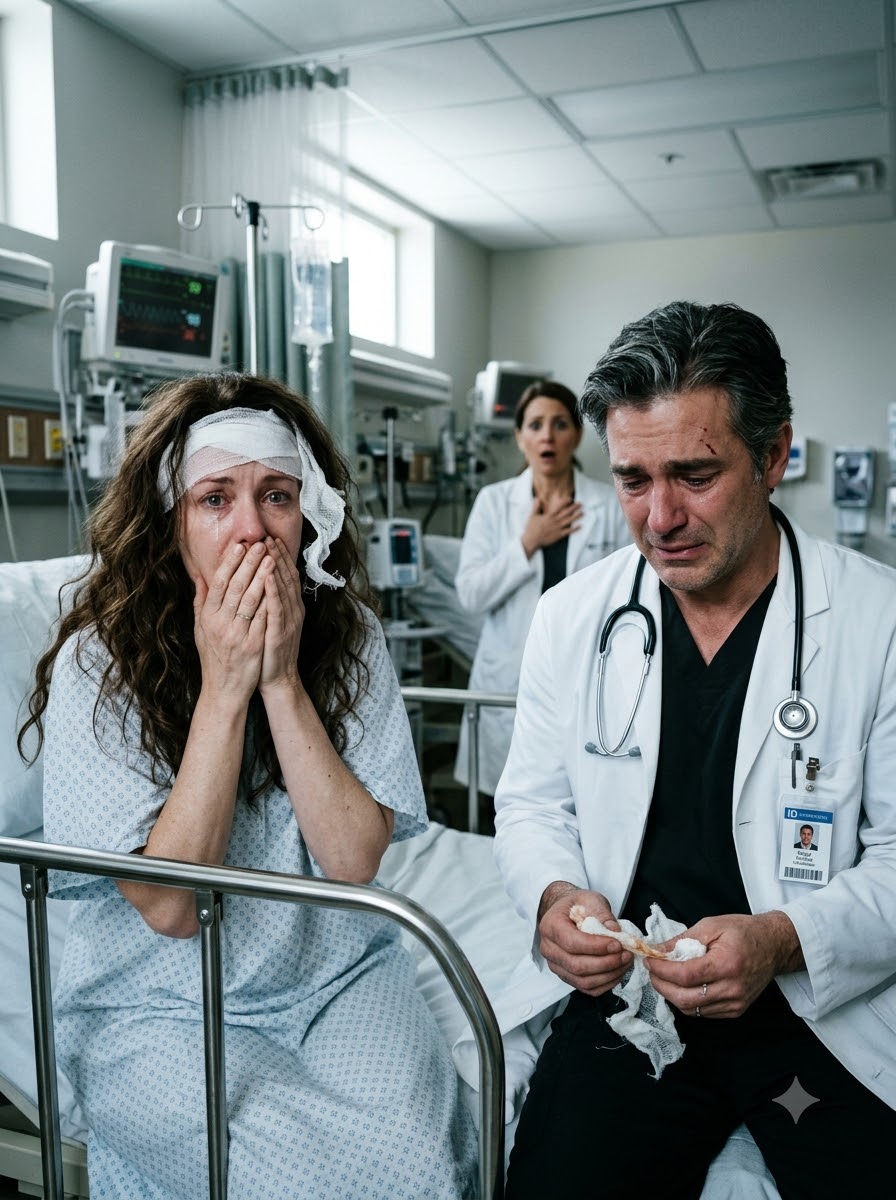
“How,” I whispered through my fingers. “How is it possible that it’s you?”
Nigel stared at me, tears running down his cheeks.
“Why didn’t you tell me sooner?”
“Let me explain, my love,” Nigel said.
I shook my head.
“Don’t call me that,” I said. “You pushed me. You’re the reason I lost my sight!”
He turned pale.
He didn’t deny it.
Instead, his fingers briefly touched the scar.
“I was eight,” he whispered. “I didn’t mean for you to fall like that.”
“But I did!” I shot back. “I did fall like that! And you disappeared after that day. You never came to the hospital. Your family just left. And then you came back, and you pretended we’d never met?”
“Hannah—”
“I asked you! The first day! I asked you if we knew each other! And you said no!”
He closed his eyes.
“You let me marry you,” I said. “You let me have your children. Without telling me who you were!”
My entire marriage seemed to tilt beneath me.
The man who had comforted me through difficult days.
The father of my children.
The surgeon who had dedicated years to restoring my sight.
He was also the boy responsible for the accident that had taken it away.
The nurse stepped forward.
“Ma’am, please stay calm. Your eyes need—”
“I want to leave,” I said. “Right now!”
Nigel reached toward my hand.
“Hannah, please.”
I jerked away.
“Don’t touch me!”
Dr. Osei spoke quietly to Nigel.
He stepped back.
Within minutes, I was sitting in a wheelchair.
The hospital corridors were overwhelming.
Faces passed in front of me.
Lights reflected from the polished floors.
Colors and movement seemed to collide.
I saw a red sign on the wall and struggled to recognize the printed word.
EXIT.
I hadn’t read ordinary letters since childhood.
I closed my eyes to escape the visual confusion.
Then opened them again because I couldn’t bear to lose the light.
Nigel followed us.
“Please,” he said. “Just hear me out.”
“I can’t,” I replied.
At the hospital entrance, Dr. Osei knelt beside my wheelchair.
“You shouldn’t leave,” she said quietly. “You should stay at least one more night for observation.”
“I can’t stay here.”
She studied me.
“I didn’t know,” she said. “Whatever this is. I want you to know that. He never told me.”
“Did he tell anyone?”
“I don’t think so.”
She gave me dark glasses, medication, and instructions.
She wrote down her personal number and told me to contact her if I experienced pain.
Outside, the sky was enormous.
Blue stretched in every direction.
Clouds drifted slowly overhead.
I removed my sunglasses for a moment despite the brightness.
It was the first sky I’d seen since childhood.
I wanted to feel nothing but joy.
Instead, I cried.
The man who had returned this beautiful world to me was the same person who had taken it away.
A yellow cab arrived.
I climbed inside without looking back.
During the ride home, I stared through the window.
Trees appeared in countless shades of green.
Traffic lights glowed.
People walked dogs.
A child rode a bicycle.
I pressed my forehead against the glass and cried.
The driver quietly lowered the radio.
When I entered our house, I felt like a stranger.
I had lived there for sixteen years.
I knew the exact number of steps between rooms.
I knew which stair creaked.
I knew the kitchen sink dripped unless someone turned the faucet tightly.
But I’d never seen any of it.
The couch was gray.
The hallway walls were pale yellow.
Photographs lined the walls.
I stopped before them.
There was Ethan as a baby, sitting on Nigel’s shoulders.
Rose dressed as a bumblebee for Halloween.
Ethan at his high school graduation.
Rose smiling at the beach.
My children.
I touched the glass over Rose’s face.
Then I began crying again.
Farther down the hallway, I found our wedding photograph.
I wore a white dress.
My eyes were closed.
One hand rested against Nigel’s face.
He was looking at me with an expression I had never witnessed.
Love.
Deep, unmistakable love.
For twenty years, I’d felt his affection.
Now, for the first time, I could see it.
That made everything more confusing.
I walked to his office.
The door was closed, as usual.
I opened it.
His desk was covered with papers, notebooks, and medical journals.
Bookcases filled the walls.
Through the window, I could see the vegetable garden Rose and I had planted.
I sat in his chair.
It creaked beneath me.
Then I began opening drawers.
If Nigel had hidden his identity for twenty-two years, I needed to know what else he had concealed.
I found research documents.
Surgical diagrams.
Medical articles.
Folders labeled:
CASE STUDIES — OPTIC NERVE.
SWISS TRIAL DATA.
GRAFT V.7.
And beneath everything in the bottom drawer was an old, worn folder.
The cardboard had faded.
Its corners were bent.
Across the front, written in black marker, was my maiden name.
HANNAH REEVES.
My hands began shaking.
I opened it.
Inside was a photocopied newspaper article from thirty-eight years earlier.
LOCAL GIRL INJURED IN PLAYGROUND FALL.
Beneath it lay years of handwritten notes.
The earliest were dated twenty-seven years earlier.
The first page read:
First year. Neuro-ophthalmology. Find out everything.
There were notes from lectures, conferences, and medical studies.
Year after year.
Page after page.
At the bottom of the folder was a small square of yellowed notebook paper.
I unfolded it carefully.
The handwriting belonged to a child.
Some letters were backward.
Others were misspelled.
I read slowly.
Dear Hannah,
I am sorry I pushed you. I did not mean it. I wanted you to go hire. My mom says you cant see now. I am going to be a docter and fix your eyes. I promise. I am sorry. I am so sorry.
From Niye.
P.S. You can call me Frankenstien if you want.
I sat motionless.
He had written the letter when we were children.
He had never sent it.
But he’d carried it through his family’s move, his education, medical school, and twenty years of marriage.
And he’d spent his life trying to fulfill the promise written on that paper.
I called Lydia.
She answered immediately.
“Hannah? Oh my God. How did it go? I’ve been dying. Nigel said he’d call me, but he—”
“You won’t believe this,” I said.
“What happened? Are you okay?”
“I can see,” I said. “The surgery worked.”
She gasped.
“That’s incredible! Hannah! That’s—oh my God. Can you see right now? What are you looking at?”
I stared at the old letter.
“It was Nigel,” I said flatly.
“What do you mean? Of course it was Nigel. He did the surgery.”
“No. I mean it was Nigel. He’s the boy, Lyd. The boy who pushed me off the swing. He’s the reason I’m blind. And he knew. He knew the whole time. For twenty-two years.”
Lydia fell silent.
“I feel betrayed,” I said. “I’m thinking of divorce. I can’t trust this man.”
She thought carefully before answering.
“Has he ever treated you badly?”
“No.”
“Not once? In twenty years?”
“No.”
“Has he been a good father?”
“Yes,” I said.
“A good husband?”
My throat tightened.
“Yes.”
“Then maybe,” she said gently, “you need to listen to him.”
“Lyd—”
“I’m not saying forgive him. I’m not saying anything. I’m saying listen. You walked out of the hospital without letting him say a single word. That’s not like you, Hannah. You always listen. It’s your whole job.”
I looked around at the research covering Nigel’s desk.
“I knew him as Niye when we were kids,” I said. “Just Niye. His little sister couldn’t say Nigel. I never knew his last name. When he walked into that exam room and said Dr. Pruitt, Nigel, I never put two and two together. I never connected it. Why would I?”
“Of course you didn’t.”
“He’s been working on fixing my eyes for more than twenty-five years, Lyd. Since before he met me. I’m looking at his notes. He wrote me a letter when he was eight. He promised he’d become a doctor and fix my eyes.”
Lydia listened.
“He kept that promise,” I said. “He actually kept it.”
Then I heard the front door opening.
Footsteps hurried down the hallway.
Footsteps I had known for twenty years.
Nigel appeared in the office doorway.
He was still wearing wrinkled surgical scrubs.
His face was blotchy from crying.
He looked at the open drawers.
Then at the old folder.
Finally, his eyes settled on the yellowed letter in my hand.
He stopped moving.
“Lyd,” I said into the phone, “I need to go. He’s here. I’ll update you.”
“Listen to him,” she said quickly. “Promise me.”
I ended the call.
Then I looked directly at my husband.
For the first time in our marriage, I could see the fear on his face.
And I was finally ready to demand the truth.
PART 3
Nigel remained standing in the doorway.
He didn’t approach me.
“I didn’t follow you to pressure you,” he said. “I swear. I just needed to know you were safe. You left the hospital two days after major eye surgery, Hannah. Alone. In a cab. I was terrified.”
I held the old folder against my chest.
“You hid your true identity from me.”
“I know.”
“For twenty-two years.”
“I know, love. I’m so sorry.”
He didn’t try to defend himself.
His gaze dropped to the yellowed paper.
“You found it,” he said quietly.
“Why did you keep it?”
“Because I never got to give it to you.”
He took a breath.

Then he began telling me the story he had hidden for most of his life.
He had recognized my name before entering the examination room on the day we met.
Hannah Reeves.
The same birth date.
The same childhood accident.
The same devastating optic nerve injury.
“The thing is,” he said, “I recognized you that first day. At the practice. Before I even walked into the room.”
“How?”
“Your name. On the chart. Hannah Reeves. Date of birth. Cause of injury, playground trauma, age eight.” His voice cracked. “I stood outside that door for a whole minute, Hannah. I almost didn’t go in. I almost asked someone else to see you. And then I went in and you were sitting there on the table, and you looked exactly the same. Older. But the same. And then you said my voice sounded familiar.”
He closed his eyes.
“I knew. I knew right then.”
“And you lied.”
“I lied.” He opened his eyes again. “I’ve carried that guilt since we were kids. Every day. Every single day of my life.”
I stared at him.
He explained that his family had moved to Ohio three weeks after the accident.
His father had been transferred, and his parents believed leaving town would give everyone a fresh start.
His mother had instructed him never to speak about what happened.
He obeyed.
But he never forgot.
“Becoming an ophthalmic surgeon wasn’t random,” he said. “I did it because of you.”
His mother had visited me in the hospital.
He remembered her coming home and crying in the kitchen.
He had begged her to take him to see me.
She refused because she feared his presence would upset my mother.
“Your mom came to the hospital,” I said. “Every day. She held my hand.”
He nodded.
“She told me. She came home every night and cried in the kitchen when she thought I was asleep. I’d sit on the stairs and listen.” He wiped his face. “I begged her to take me with her. She wouldn’t. She said it would upset your mom.”
For years, he searched for information about me.
During college, he discovered my name in a university newsletter announcing honors students.
He was relieved to learn I was continuing my education.
“I searched for your name for years,” he said. “Every year, I’d look. When I was in college, I found your name in a university newsletter. Social work honors list. I sat in the library and cried, I was so happy. You’d made it.”
“You were watching me?”
“No. No. I never contacted you. I never came near you. I swear. I just… I needed to know you were all right. And then I’d go back to studying.”
He pointed toward his research.
Medical school.
Neuro-ophthalmology.
A fellowship focused on optic nerve research.
Every major career decision had been shaped by the accident.
Eventually, he joined the same medical practice where I received treatment.
“I took the job at that practice downtown because I knew—”
“Because you knew I went there,” I said slowly.
“Because I knew it was the best practice in the state for your kind of injury,” he said. “And yes. Because I’d seen your name on a donor list for their charity fundraiser once. I knew you were a patient there.”
I couldn’t believe what I was hearing.
For years, I’d believed our meeting had been an extraordinary coincidence.
Now I understood it hadn’t been entirely accidental.
“Then why hide it?” I asked. “Why not just tell me? That first day? Or the second day? Or the day you asked me out? Or the day you married me?”
He lowered his head.
“Because I was ashamed,” he said.
His voice was barely audible.
“I was so ashamed, Hannah. I was ashamed when I was eight and I was ashamed when I was twenty-five, and I’m ashamed right now, standing here. Every time I looked at you, I saw that rock. I heard that sound. I’ve heard that sound in my sleep my whole life.”
He looked at me.
“And because I fell in love with you,” he said. “I didn’t expect that. I didn’t plan that. I swear to God I didn’t. I just wanted to help you. I wanted to be your doctor and fix it and disappear again. But then you laughed at the sheep cloud, and I…”
His voice broke.
“I was terrified you’d refuse both me and the surgery if you knew. I thought, if she knows, she’ll never let me near her. She’ll never let me fix it. And I couldn’t stand that. I couldn’t stand the idea of having the answer and not being allowed to give it to you.”
I shook my head.
“So you just never told me,” I said.
“Every year, I told myself I’d tell you. On our anniversary. On your birthday. After Ethan was born. After Rose was born.” His voice broke completely. “Every year, it got harder. Every year, there was more to lose.”
Suddenly, I remembered our conversation the night before surgery.
“The night before the surgery,” I said. “When I asked what you were afraid of.”
“I was afraid of this,” he said. “Of this exact moment. Of you opening your eyes and seeing my face and remembering.”
“That’s why you didn’t sound happy at the hospital.”
“I gave you back your sight,” he said. “And I knew it would cost me you.”
I looked at the documents scattered across his desk.
Twenty-seven years of research.
Failed experiments.
Medical conferences.
Sleepless nights.
And a child’s promise written in pencil.
I am going to be a docter and fix your eyes. I promise.
He had dedicated much of his life to repairing the damage he had caused.
But he’d also denied me the chance to decide what his identity meant to our relationship.
“You should have told me,” I said quietly.
“I know,” he whispered. “I was wrong.”
He offered no excuse.
That mattered.
But it didn’t erase the lie.
I stood and walked toward him.
My legs trembled.
My eyes hurt from the brightness and crying.
I studied his face.
The silver in his hair.
The shadows beneath his eyes.
The lines around his mouth.
The scar.
For the first time, I could see the man I’d loved for twenty years.
“You took my sight,” I said.
He flinched but didn’t look away.
“But you spent your whole life trying to give it back.”
Tears rolled down his cheeks.
“Every single day,” he said.
I wasn’t ready to forgive him completely.
Not then.
But I was willing to consider what came next.
“No more secrets,” I said.
“Never again,” he promised.
“I mean it, Nigel. Not one. Not about anything. If you’re tired, you tell me. If a trial fails, you tell me. If you’re scared, you tell me. If you burned my toast, you tell me.”
He laughed through his tears.
“Never again,” he said.
That night, I slept in Rose’s bedroom.
Nigel stayed on the couch.
I needed distance.
I needed time.
And I needed to understand how someone could love me so deeply while concealing something so important.
When Rose returned from school, she found me in the kitchen.
She dropped her backpack and ran toward me.
Then she stopped.
For the first time, we were looking directly at each other.
I saw freckles across her nose.
I’d never known she had freckles.
“Well?” she asked. Her voice was shaking. “Am I what you expected?”
I placed my hands against her cheeks.
I traced the familiar features I’d known since she was born.
Then I looked at them.
“You’re better,” I said.
She burst into tears and hugged me.
That weekend, Ethan came home from college.
We gathered around the kitchen table.
Nigel told our children everything.
The childhood accident.
The scar.
The move.
The letter.
The years of secrecy.
Rose cried.
Ethan listened with his jaw clenched.
When Nigel finished, our son finally spoke.
“So you lied to Mom,” he said. “For twenty years.”
“Yes.”
“And you spent your whole life fixing her eyes.”
“Yes.”
Ethan turned toward me.
“What are you going to do, Mom?”
I looked across the table at Nigel.
He held his coffee mug in both hands.
“I’m going to take my time,” I said. “And I’m going to figure it out.”
Ethan nodded.
“That’s fair,” he said.
Then he looked at his father.
“I used to sit outside your office,” he said. “When I was little. I’d hear you crying in there sometimes.”
Nigel’s expression crumpled.
“I didn’t know you could hear me.”
“I could always hear you, Dad,” Ethan said. “I just didn’t know why.”
The weeks that followed were difficult.
Regaining sight didn’t mean immediately knowing how to use it.
I had to relearn printed letters.
Busy grocery stores made me dizzy.
Unexpected movement startled me.
Bright lights caused headaches.
Sometimes I closed my eyes simply because the world was too overwhelming.
I cried when I saw a red cardinal at our bird feeder.
I cried when I recognized the maple tree in our backyard.
On the fifth day after leaving the hospital, I stood before a mirror.
I looked older than I’d imagined.
My hair was streaked with gray.
And my eyes were green.
I’d always assumed they were brown like my mother’s.
Nigel waited outside the bathroom.
When I opened the door, I told him.
“My eyes are green,” I said.
“I know,” he said softly. “I’ve been looking at them for twenty years.”
“You never told me.”
“You never asked,” he said. Then he winced. “That’s not a good answer, is it? After everything.”
“No,” I said. “But it’s an honest one.”
We began counseling.
Every Thursday for six months, we visited Dr. Abernathy, whose office sat above a bakery.
The rooms always smelled of fresh bread.
Nigel spoke about the accident, his childhood guilt, his mother’s silence, and every anniversary when he’d nearly confessed.
I spoke about blindness.
About the Christmas morning when I’d thrown a book.
About my mother’s death.
About learning to live without sight.
And about discovering that the man I’d trusted most had been keeping the most painful secret of my life.
During one session, I admitted something I’d never fully acknowledged.
For thirty-eight years, I hadn’t allowed myself to feel angry at the boy who pushed me.
I’d told myself he was a child.
That it was an accident.
That anger wouldn’t restore my vision.
“And now?” Dr. Abernathy asked.
I looked at Nigel.
“Now I get to be angry,” I said. “And I get to be grateful. At the same time. At the same person.”
Dr. Abernathy nodded.
“That sounds exhausting,” she said.
“It is,” Nigel and I said at the same time.
Then we both laughed.
It was the first time we’d laughed together in weeks.
During the second month, I moved back into our bedroom.
There was no dramatic reconciliation.
One evening, I simply walked past Rose’s room and continued down the hallway.
Nigel was sitting on the bed reading.
He looked up but said nothing.
I climbed into my side of the bed.
Eventually, he turned off the light.
We lay quietly in the darkness.
For once, the dark felt peaceful.
“Nigel?”
“Yeah?”
“Tell me about the first time you saw me. After. At the practice.”
He thought for a moment.
“You were wearing a blue sweater,” he said. “You had your hair pulled back. You were tapping your foot. Fast, like you were nervous. And when I said my name, you tilted your head. Exactly the way you did when we were kids, when you were trying to figure out if I was lying.”
“Were you?”
“Yes,” he said. “That first day, I was.”
“And after that?”
He reached across the bed and took my hand.
“After that,” he said, “everything I ever told you was true. Except the one thing.”
Healing took time.
Trust didn’t return all at once.
Some mornings, I still looked at the scar above his eyebrow and felt a sudden rush of anger.
I remembered all the years I’d touched that scar without knowing its meaning.
I remembered asking him whether we’d met before.
I remembered his denial.
But gradually, we learned how to talk about those memories without hiding from them.
A year after the surgery, I asked Nigel to drive me to our childhood neighborhood.
The park was two hours away.
He hesitated.
I could see that he was frightened.
But he agreed.
The playground had changed.
Plastic swings had replaced the old rubber ones.
A soft safety surface covered the ground.
The jagged rocks were gone.
But the oak tree remained.
Its branches were larger, and autumn had begun turning the leaves red and orange.
I walked toward the swings.
Then I sat down.
Nigel stood several feet behind me.
I looked up at the oak tree.
Beyond its branches was the same blue sky I’d seen moments before the accident.
“Push me,” I said.
He didn’t move.
“Hannah…”
“Push me, Nigel.”
He stood silently for a long time.
Then I felt his hands against my back.
Gentle.
Careful.
He pushed.
The swing moved forward.
Not very high.
Then he pushed again.
I rose a little farther.
At the top, my stomach dropped.
For one wonderful second, I felt weightless.
Like flying.
I laughed.
I laughed as the red and orange leaves blurred above me.
When the swing slowed, I turned.
Nigel stood behind me with his hands covering his face.
His shoulders shook as he cried.
I stepped off the swing.
I walked toward him and gently lowered his hands.
I looked at his face.
The scar.
The crooked nose.
The gray hair.
The boy who had written a promise in pencil.
The man who had spent decades trying to fulfill it.
“Hey, Frankenstein,” I said.
He laughed and sobbed at the same time.
“You remembered,” he said.
“I remember everything now,” I said. “That’s the problem. And that’s the gift.”
Two years have passed since my surgery.
My vision isn’t perfect.
I still wear glasses for reading.
Bright lights sometimes give me headaches.
Dr. Osei believes my optic nerves may continue improving.
Nigel’s procedure has advanced to a larger clinical trial involving forty patients across three hospitals.
He works more reasonable hours now.
When a trial fails, he tells me.
When he’s frightened, he tells me.
When he’s exhausted, he doesn’t pretend otherwise.
And every morning, he still places my coffee exactly three inches from my right hand.
I can see the mug perfectly well.
I’ve never asked him to stop.
The yellowed childhood letter now hangs in our hallway beside our wedding photograph.
Ethan suggested framing it.
Rose chose the frame.
Sometimes visitors ask about the misspelled words written by a frightened little boy.
Nigel always looks at me before answering.
I nod.
Then he tells them the entire story.
The swing.
The rock.
The move.
The lie.
The decades of research.
The surgery.
He doesn’t leave out the parts that make him uncomfortable.
I can see how difficult it remains for him.
His hands still tremble sometimes.
But he tells the truth.
For twenty years, I imagined my husband’s face.
I pictured him younger, without wrinkles or gray hair.
I imagined the features I’d learned beneath my fingertips.
The real face is different.
It carries years of exhaustion.
It carries the lines left by laughter and worry.
And it carries a scar that will always remind me of the day my childhood changed forever.
I don’t pretend the lie was harmless.
It wasn’t.
He should have told me the truth long before we married.
He should have allowed me to decide whether I wanted him in my life while knowing who he really was.
Restoring my sight didn’t erase that betrayal.
But neither did the betrayal erase twenty years of love, our children, or the life we’d built.
I learned that seeing someone clearly means acknowledging everything.
Not only their kindness.
Not only their mistakes.
But their fear, shame, choices, and willingness to take responsibility.
I spent twenty years loving a man whose face I couldn’t see.
Then I opened my eyes and discovered the truth he’d hidden.
For a while, I wasn’t certain our marriage would survive.
But after the anger, the difficult conversations, and the slow work of rebuilding trust, I made my decision.
For twenty years, I loved him in the dark.
For the first time in my life, I saw my husband clearly.
And this time, I chose him in the light.
