

PART 1
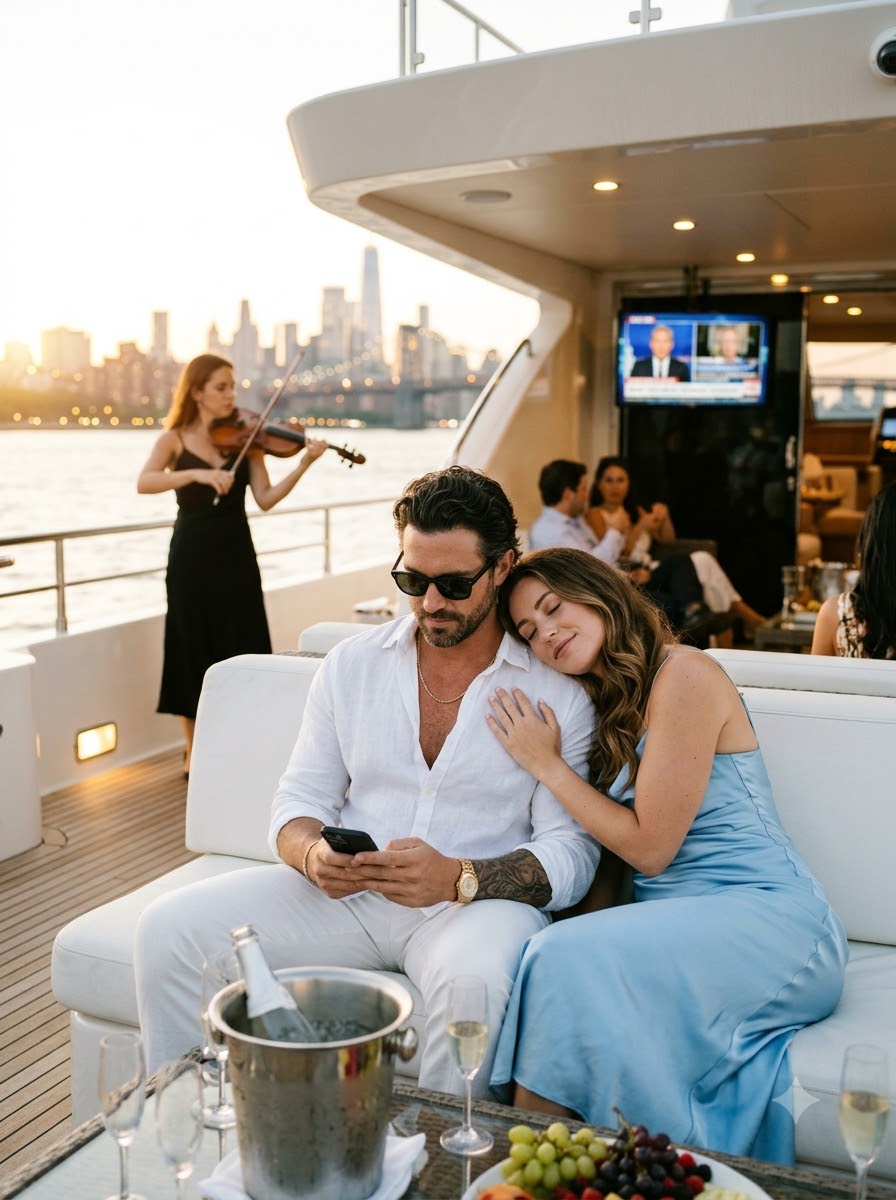
After one hundred and twenty hours on a luxury yacht in the Caribbean with my mistress, I finally powered on my phone. Eighty-eight missed calls. Thirty-one emergency messages. Four security alerts. Headlines screamed that my wife had vanished five days earlier and the entire country was hunting for her. When I reached our New York mansion, every possession she owned sat untouched—except for one fourteen-year-old letter in which I had promised to open the door if she ever wished to escape my world.
My name is Nicholas Walker, and I am among the most feared mafia bosses on the East Coast.
For fourteen years Anna had stood beside me through everything. The threats. The violence. The nights I walked in with blood on my clothes. She never wanted the fortune. She only asked for the husband I had once sworn to be. I kept telling her I was that man. Even while I betrayed her.
This time the other woman was Tessa, a beautiful violinist I had kept for three hundred and twelve days. I told myself Anna suspected nothing. She had known everything.
Before I left for the yacht she asked an odd question.
“Nicholas, if I disappeared for five days, would you notice?”
I laughed.
“Where would you go?”
She studied my face.
“Do you really think I couldn’t leave you?”
I kissed her forehead.
“I think you’d never want to.”
She gave no answer.
Five days later I understood why.
Our bedroom stood empty. Her dresses hung in perfect order. Jewelry, passport, money, and phone remained exactly where she had left them. No suitcase was gone. No sign of struggle. Only one item missing from the safe: the letter I had written before we married, when I was still a young man promising her a beautiful future.
“If you ever want to run from my world, I’ll open the door myself.”
I had forgotten those words. Anna had not.
I sent my men across the country. The police opened an investigation. News stations ran stories of possible kidnappings, rival-family attacks, even the chance that Anna had taken her own life. My enemies became suspects. I offered rewards, called in decades of favors, burned every connection I owned. Nothing.
For twelve days I did not sleep.
Then a video arrived.
Anna stood before a plain wall. No expensive jewelry. Nothing that carried my family’s name. She looked straight into the camera.
“You’re searching for me, aren’t you, Nicholas?”
My hands locked around the phone.
“I knew you would,” she continued. “Because you can’t stand losing something you believe belongs to you.”
She paused.
“But I never belonged to you.”
I could not breathe.
“I left everything behind. My clothes, passport, jewelry, and money. I knew you’d assume a woman who took nothing couldn’t get very far.”
Her eyes filled with sadness.
“You measured my freedom by what you gave me. You forgot I existed before I met you.”
Then she spoke of Tessa.
“Three hundred and twelve days. That’s how long you’ve been betraying me.”
My stomach dropped.
“And during those days, you told me you loved me 184 times.”
I stared at the screen.
“I counted, Nicholas. Not because I wanted to punish you, but because I needed to understand how someone could lie so often and still believe he was a loving husband.”
I lowered my head.
Then Anna said the thing that forced my eyes back up.
“Fourteen years ago, you promised to open the door if I ever wanted to leave your world.”
Her voice steadied.
“You forgot that promise.”
“I didn’t.”
“This time, I opened it myself.”
I thought the video was finished.
Then she added one last detail.
“I didn’t leave alone, Nicholas. I contacted someone you made me cut out of my life years ago.”
My heart began to pound.
Because I knew exactly whom she meant.
Her older sister.
The woman I had forbidden Anna from seeing.
And as Anna reached toward the camera, I understood the answer to her disappearance had been waiting all along in the life she had lived before she became my wife.
—
I watched the video three more times before I could move. The plain wall. The steady voice. The precise count of one hundred and eighty-four lies. She had not raised her voice once. That was worse than shouting. When the recording ended the second time I sat in the dark of the study and listened to the house. The security system hummed. Somewhere a faucet dripped. Fourteen years of her presence had been subtracted from every room and the silence left behind was absolute.
Elena.
Anna’s older sister. I had not spoken her name in almost a decade. The last time I saw her she had stood on the sidewalk outside a small bookstore in Brooklyn, rain soaking her coat, and told Anna that marrying me would kill her slowly. I had smiled at her then, the kind of smile that ends conversations. Two of my men had walked her to the subway. After that the bookstore closed. After that the phone numbers changed. After that Anna stopped mentioning her. I had called it protection. I had called it necessary. Elena had a habit of asking the wrong questions in rooms full of the wrong people, and I did not need a civilian with a sharp mouth drawing attention to the edges of my life.
Now Anna had gone to her.
I called the head of my security detail. Marco answered on the first ring.
“Find Elena Rossi,” I said. “Maiden name. Last known address was in Brooklyn twelve years ago. She may be using a different surname. Check every flight, every rental car, every cash withdrawal under either name for the last six days. Quietly.”
“Yes, sir.”
I hung up and opened the safe again. The empty slot where the letter had sat for fourteen years looked larger than it should have. I still remembered writing it. We had been twenty-three. I had taken her to a rooftop in Queens after a small job went clean and the night felt like it might stay clean. I had written the promise on hotel stationery because I wanted her to believe I was different from the men who never let their women leave. She had folded it carefully and put it in her purse. Three months later we were married. I had never asked to see the letter again.
Marco called back at four in the morning. Elena had boarded a flight from Newark to Lisbon under the name Elena Moretti the same night Anna disappeared. She had bought two tickets. The second passenger was listed as Anna Moretti. No luggage beyond a single carry-on each. They had landed, cleared customs, and vanished into the city.
Lisbon.
PART 2
I had men in Europe. Not many, and none of them were clean enough for a quiet search, but they existed. I told Marco to put three of them on the ground by noon and to keep the local police out of it. Then I booked my own flight. First class, under a name that still opened doors. Tessa called while I was packing. I let it go to voicemail. When she called again I answered.
“Nicholas, the news—are you all right? Should I come back?”
“Stay on the boat,” I said. “I’ll call when it’s finished.”
She was quiet for a moment. “Is it true? About Anna?”
“Stay on the boat, Tessa.”
I ended the call. In the mirror above the dresser I looked older than I had five days ago. The bloodstains she used to wash out of my collars had never bothered her as much as the lies. I had not understood that until the video.
The flight took seven hours. I did not sleep. Somewhere over the Atlantic I opened the notes app on my phone and typed the number 184. Then I deleted it. When the plane landed the Portuguese light was bright and thin. Marco’s men met me at a private terminal with a black car and a thin file. Elena Moretti had used a credit card at a small hotel near the river two nights earlier. She had paid for two rooms. Both were now empty. A desk clerk remembered the younger woman because she had asked, very politely, whether the hotel kept any paper stationery.
I went to the hotel myself. The clerk was nervous once he saw my face. I did not raise my voice. I simply placed a photograph of Anna on the counter and waited. He told me they had checked out that morning. The younger woman had left an envelope for anyone who came asking. He handed it over. Inside was a single sheet of hotel paper and six words in Anna’s handwriting.
You opened the door. I walked through.
No address. No time. No further instruction. I stood in the lobby with the note in my hand while tourists wheeled their suitcases past the marble fountain. One of Marco’s men cleared his throat. I folded the paper and put it in my pocket.
“They took a train south this morning,” the man said. “We have the tickets. Faro. They may already be on the water.”
I drove. The coastal road was empty of traffic and full of light. I thought about the first year of our marriage, when Anna still asked me questions at breakfast and I still answered most of them. I thought about the night I told her Elena could not come to Christmas. She had gone very still. Then she had said, “All right.” Just those two words. I had taken the silence for agreement. I had been taking her silences for agreement for a long time.
In Faro the men had already located a small charter company. A woman matching Elena’s description had rented a sailboat for a week, paid in cash, and requested charts for the open Atlantic rather than the usual coastal routes. The owner was reluctant to give me the boat’s name until I placed a second envelope on his desk. He wrote the name on a scrap of paper: *Liberdade*. Freedom. Anna had always liked quiet jokes.
We hired a faster boat and left the harbor at dusk. The water was calm. I stood at the rail and watched the coastline shrink. Marco stayed on the phone with the pilot who was tracking the sailboat’s last known position. They were moving slowly, almost as if they wanted to be found. Or as if they no longer cared.
We caught them just after midnight. The sailboat sat dark against the darker water, sails lowered, a single cabin light burning. I boarded first. Elena met me at the companionway. She looked older, thinner, and entirely unafraid.
“She’s below,” she said. “She knew you’d come. She asked me not to stop you.”
I went down the ladder. Anna sat at the small table with a cup of tea and an open notebook. She wore a plain sweater I had never seen. Her hair was shorter. When she looked up her face was calm in the way it used to be only when she was truly finished with a conversation.
“You found the note,” she said.
“I did.”
“Then you already have the only answer I intended to give you.”
I sat across from her because my legs had decided to stop working. The cabin smelled of salt and tea and the faint trace of the perfume she had stopped wearing years ago. Elena remained on deck. I could hear her moving, giving us the space.
“You counted,” I said. “One hundred and eighty-four times.”
“Yes.”
“Did you ever believe any of them?”
She considered the question. “The first fifty, maybe. After that I started writing the dates in the back of my planner so I would remember I was not imagining it. I stopped writing them down after a hundred. The number was no longer the point.”
I looked at her hands. No rings. The wedding band was gone. She followed my gaze and did not apologize.
“I am not coming back,” she said. “Not for the house, not for the money, not for whatever version of an apology you practiced on the plane. Elena has friends in a small town north of here. I have a job waiting at a language school. It is ordinary. I want ordinary.”
“You could have ordinary in New York,” I said, and heard how empty it sounded even as I spoke.
“No,” she answered. “I couldn’t. You would still be who you are, and I would still be the woman who washes blood out of your shirts and pretends the lies are kindness. I opened the door, Nicholas. You don’t get to close it again because the silence bothers you.”
We sat with that for a long time. The boat rocked. Somewhere above us Elena coughed once, deliberately. Anna closed the notebook.
“There is one thing I want you to do,” she said. “When you go home, tell Tessa the truth. Not the version that protects you. The real number of days. The real number of times you said the words. She deserves to know what she walked into. And then let her decide whether she wants to stay on the yacht or get off it. That is the only favor I will ever ask you for again.”
I nodded because there was nothing else left that would not sound like bargaining. She stood. I stood. For a moment I thought she might touch my arm the way she used to when she was trying to pull me back from a bad night. She did not.
“Goodbye, Nicholas.”
“Anna—”
“The letter was a promise,” she said. “You kept it by forgetting it. I kept it by remembering. We’re even.”
She climbed the ladder. I followed more slowly. On deck Elena handed me a small duffel that contained nothing of value except a single photograph of the two sisters as children, taken before either of them had learned my name. I took it. The sailboat’s engine started. They turned west, toward open water and whatever harbor waited beyond the charts I had paid to see.
I stayed on the faster boat until their light disappeared. Then I told the captain to take me back to Faro. In the morning I flew home. The mansion was exactly as I had left it. I walked through every room once, turned off the lights, and locked the door behind me. In the car I called Tessa. She answered on the second ring, voice careful.
“Nicholas?”
“I need to tell you something,” I said. “And I need you to listen all the way to the end before you decide anything.”
I started with the number three hundred and twelve. I did not stop until I reached one hundred and eighty-four. When I finished, the line was quiet for a long time. Outside the car the city moved the way it always had. Somewhere in the Atlantic a sailboat named *Liberdade* was carrying two women toward a life that no longer required my permission. I waited. For the first time in fourteen years, I did not try to fill the silence.
