

PART 1
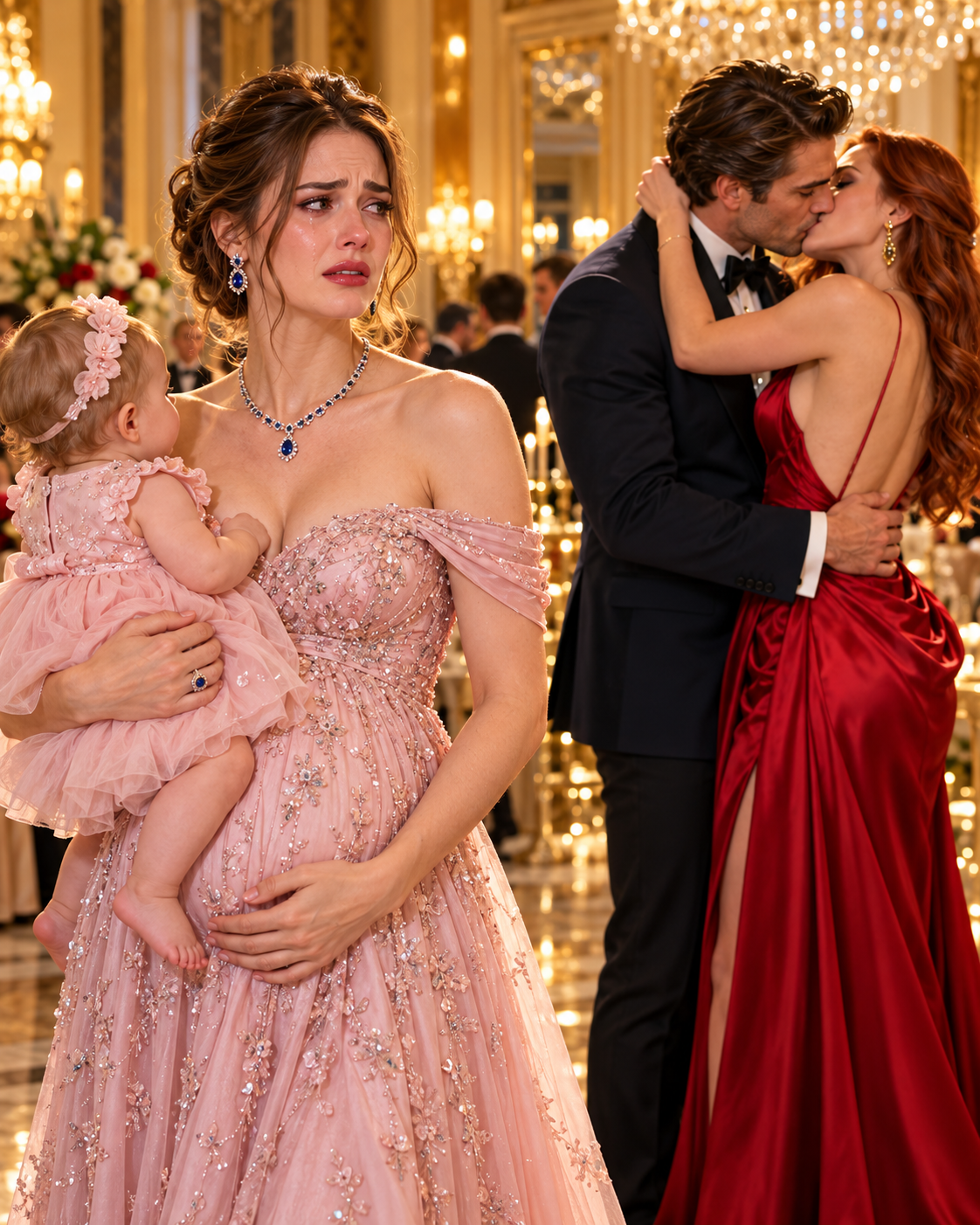
By the time Andrew Weston entered the ballroom with his mistress holding his arm, nearly every camera in Manhattan seemed to be pointed in his direction.
But the woman he should have been searching for stood twenty feet away, her palm resting gently against her pregnant stomach as she watched her marriage collapse beneath glittering chandeliers.
Emma Weston didn’t scream.
She didn’t strike him.
She didn’t break down in front of the donors, wealthy investors, senators’ wives, and gossip reporters gathered at the Manhattan Grand Hotel for the Bright Horizons Charity Ball.
She only stood there and watched.
Andrew’s laughter carried too loudly through the ballroom. His tuxedo was immaculate, his hair perfectly styled, and his confident smile had been refined by years of success and arrogance on Wall Street.

Beside him stood Lila Summers.
Twenty-three years old. Red hair. A face made for cameras. A crimson gown that seemed designed to announce her triumph rather than simply dress her for the evening.
Lila held Andrew’s arm as though she had just claimed something valuable.
Perhaps she believed she had.
Everyone in that room already knew.
Among Manhattan’s wealthy social circles, secrets rarely remained hidden. They simply waited for the right conversation over champagne before becoming public knowledge.
Guests looked toward Emma, then quickly turned away.
Some appeared sympathetic.
Others looked uncomfortable.
And a few seemed almost delighted to witness another woman’s humiliation.
Emma stood beside a marble pillar in an understated ivory gown. She was six months pregnant, her shoulders held straight despite the painful realization that something inside her had finally shattered.
She had once believed Andrew would be her forever.
Now she watched him kiss another woman’s temple beneath a chandelier while everyone around them pretended nothing unusual was happening.
Lila rose onto her toes and whispered something into Andrew’s ear.
He smiled.
Emma recognized that smile.
Once, it had belonged to her.
A photographer called out, “Mr. Weston, over here!”
Andrew turned toward the camera.
Lila turned with him.
And before the flashing cameras and some of the most influential people in the city, Andrew Weston kissed his mistress directly on the mouth.
The ballroom seemed to stop breathing.
Somewhere nearby, a fork struck the floor.
A woman gasped.
Beneath Emma’s hand, her baby moved—a delicate flutter that made the moment feel even more final.
Andrew pulled away from Lila.
Then he looked across the room.
For one brief moment, his eyes met Emma’s.
She searched his expression for regret.
There was none.
Only annoyance.
As though her presence had inconvenienced him.
That was the exact moment Emma stopped loving her husband.
It wasn’t gradual.
There was no final desperate hope.
No lingering uncertainty.
Something simply ended.
Completely.
Coldly.
Permanently.
She turned away before anyone could see her tears.
Her heels struck the marble in steady, measured steps. Behind her, the orchestra resumed playing with almost desperate enthusiasm, as though louder music might conceal the sound of a woman finally taking control of her own life.
Outside, April rain fell over New York in thin silver streams.
The doorman hurried toward her with an umbrella, but Emma barely noticed him.
Her phone vibrated inside her clutch.
She ignored it.
She had already completed the task that brought her there.
Three hours earlier, in the penthouse she had once desperately tried to turn into a home, Emma had placed a manila envelope on Andrew’s desk.
It contained divorce papers.
Signed.
Dated.
Final.
There was no accompanying letter.
No explanation.
No request for forgiveness.
Only her signature beneath the legal words that would end their marriage.
For two years, Emma had tried to make herself small enough to fit into Andrew’s version of love.
She smiled politely at parties where other women ridiculed her modest dresses.
She stood beside him during photographs while his fingers pressed too firmly into her waist and he described her to reporters as “the calm behind his ambition.”
She waited through his late nights.
She noticed unfamiliar perfume on his shirts.
She endured locked phones and business trips that never appeared on any official schedule.
When she discovered she was pregnant, she convinced herself that becoming a father might finally change him.
For one week, she believed it had.
Andrew rested his hand against her stomach and whispered, “My kid is going to have everything.”
Emma mistook his possessiveness for tenderness.
Soon, the mysterious phone calls returned.
His absences became longer.
Lila Summers began appearing everywhere.
At a rooftop gathering.
On a charity committee.
At a private investment dinner in Miami.
Emma heard the rumors.
She tried to endure them.
Until tonight.
Until Andrew made certain that the entire world witnessed his betrayal.
Inside the car, Emma placed both hands over her stomach and drew a shaky breath.
“Where to, ma’am?” the driver asked.
She stared through the window at the rain-slick streets, illuminated taxis, and blurred skyscrapers.
She had no clear plan.
That frightened her more than she wanted to acknowledge.
Her parents had insisted she maintain a separate bank account when she married Andrew.
Compared with his fortune, the amount was insignificant.
But it was enough to reach somewhere safe.
Her mother and father lived in Lancaster County, Pennsylvania, in a white farmhouse with blue shutters and a kitchen that always smelled of cinnamon and coffee.
She could return there.
Perhaps she should.
Then her phone vibrated again.
This time, she checked the screen.
An unfamiliar number had sent a message.
Mrs. Weston, your jet is ready. Private terminal, Gate 4. Everything you need is waiting.
Emma stared.
Her jet?
She read the message once more.
Mrs. Weston, your jet is ready. Private terminal, Gate 4. Everything you need is waiting.
There was no sender’s name.
No company information.
No indication of who had arranged the aircraft or where it was supposed to take her.
Then another message appeared.
Please don’t return to the penthouse. Mr. Weston may already know.
A cold sensation moved through her body.
“Ma’am?” the driver asked gently. “Should I keep going?”
Emma looked outside.
The Manhattan Grand Hotel had vanished behind traffic and rainfall.
Andrew was probably still inside, smiling for photographs while Lila remained at his side.
Perhaps he was already calling his associates to control the story.
Emma had spent years allowing him to decide what was true.
Tonight, she couldn’t bear to let him determine what she should fear.
“Take me to the private terminal,” she said.
The driver glanced at her through the rearview mirror.
“Are you sure?”
“No,” Emma admitted. “But go anyway.”
He nodded and changed lanes.
Emma held her phone tightly.
She considered calling her mother, but the thought of hearing Helen’s voice made tears rise in her throat.
Her parents had warned her before the wedding.
Not because they disliked Andrew personally, but because they noticed how frequently he answered questions intended for Emma.
During family dinners, he would interrupt her with a casual laugh.
“She means that she agrees.”
“She’s tired.”
“She doesn’t understand the business side.”
Emma always smiled to avoid an argument.
Helen never seemed convinced.
Three years earlier, shortly after the wedding, her mother had taken Emma’s hands across the kitchen table.
“Being loved should not feel like being managed.”
Emma had felt offended.
Now those words returned with painful accuracy.
The private terminal stood apart from the main airport, beyond a guarded entrance bearing a discreet brass sign.
A security officer approached the car, inspected the driver’s credentials, and allowed them through.
Inside, the terminal was quiet and brightly illuminated.
There were no crowds or crowded luggage carts.
No distant boarding announcements.
A woman in a navy coat waited beside a leather sofa.
She appeared to be in her late fifties, with silver hair neatly pinned at the back of her head.
Emma recognized her face after several seconds.
“Mrs. Weston?” the woman asked.
“Yes.”
“I’m Margaret Vale.”
The name sounded familiar.
“Vale Air?”
Margaret nodded.
“My family owns the company.”
Emma stopped walking.
“I don’t understand.”
“You aren’t expected to.”
Margaret glanced toward the passage leading to the aircraft.
“Not yet.”
Emma refused to move.
The older woman’s expression softened.
“I know this is unusual. But I promise you, you are safe here. You may leave at any time.”
“Who sent you?”
Margaret hesitated.
Emma immediately noticed.
“Was it Andrew?”
“No.”
“Did he know about this flight?”
“No.”
“Then who?”
Margaret’s gaze briefly settled on Emma’s stomach.
“Someone who believed you might need a way out before you were ready to ask for one.”
Emma felt her pulse quicken.
Everything sounded too mysterious.
Too carefully arranged.
She had just escaped a marriage filled with secrets.
Now she was standing before another stranger who apparently expected her to trust information she wasn’t allowed to know.
“Thank you,” she said quietly. “But I need answers before I board a plane.”
Margaret considered her response.
Then she reached inside her coat and produced a narrow cream-colored envelope.
A small wax seal bore the image of a silver compass.
Emma recognized the symbol immediately.
Years earlier, she had seen the same emblem on a letter hidden inside a box in her father’s study.
When she asked him about it, he closed the box and said, “Nothing you need to worry about.”
Margaret offered the envelope.
“This is for you.”
Emma didn’t reach for it.
“From whom?”
“You’ll know when you read it.”
“That’s not good enough.”
“No,” Margaret said. “It isn’t. But it is the truth.”
Beyond the terminal windows, rain glittered against the runway lights.
Emma remembered Andrew kissing Lila.
She remembered the divorce papers waiting on his desk.
She thought about the penthouse filled with beautiful possessions that no longer felt like hers.
Finally, she accepted the envelope.
Her first name appeared across the front.
Emma.
Nothing else.
No surname.
No title.
She broke the seal.
Inside was a single sheet of paper.
You have every right to leave him. But before you make any decision about the child, please hear the truth about the Weston family.
A signature appeared beneath the message.
Eleanor Weston.
Emma stopped breathing.
Andrew’s grandmother had died nearly a year earlier.
Eleanor Weston had been the only member of his family who treated Emma like a person rather than a decorative addition to Andrew’s success.
She invited Emma to tea.
She remembered details about her work and friendships.
And during the first winter of Emma’s marriage, she had placed an antique silver locket in her hand.
“For the baby,” Eleanor had said.
Emma laughed.
“There is no baby yet.”
“There may be one day.”
Emma touched the chain beneath her ivory gown.
She had worn the locket that evening, hidden against her skin.
The letter continued.
Andrew will tell you that I left him nothing because I disapproved of you. That is untrue. He will tell you that the trust connected to my estate is controlled by his father. That is also untrue. The trust belongs to you, if you choose to claim it.
Emma read those words twice.
Her hands began shaking.
I created it before your wedding, after I learned what was happening inside Weston Holdings. I hoped you would never need it. I feared you would.
There was more.
Do not trust anyone who tells you the family business is too complicated for you to understand. You are not foolish. You have simply been kept uninformed.
The final lines appeared fainter.
There is a room in the old house on Cape Cod. The key is inside the locket. Go there before you speak to Andrew. The truth is waiting in the desk beneath the window.
Emma slowly lowered the letter.
“Is she really dead?” she asked.
Margaret’s expression changed.
“Yes.”
“When did she write this?”
“Three weeks before she died.”
“Why didn’t I receive it then?”
“Because the instructions were specific. It was to be delivered only if you left Andrew.”
Emma looked through the glass.
“How did you know I would leave him tonight?”
“I didn’t.”
“Then why was the jet waiting?”
Margaret answered with quiet sadness.
“Because Eleanor made arrangements for several possibilities. She believed there would come a day when you needed transportation before you needed courage.”
Emma turned away.
The words hurt because Eleanor had recognized something Emma herself had refused to confront.
“Why didn’t she tell me?” Emma asked.
“Because she wanted you to choose freely,” Margaret replied. “If she had told you everything while she was alive, you might have stayed with Andrew out of fear. Or left because someone else told you to. She wanted the decision to belong to you.”
Emma closed her eyes.
For so long, she had blamed herself for staying.
Now she realized someone had quietly prepared an escape without demanding that she use it.
Margaret poured her a glass of water.
“Sit down,” she said. “You look pale.”
“I’m fine.”
“You are six months pregnant, have been under considerable stress, and have just learned that your deceased mother-in-law created a private trust in your name. You don’t have to be fine for another five minutes.”
Despite everything, Emma almost smiled.
She sat.
Margaret handed her the water.
“Your parents have been notified that you are safe.”
Emma looked up.
“By whom?”
“By me.”
“What did you tell them?”
“That you needed a quiet place for the night and would speak to them in the morning.”
Emma’s eyes filled.
“They must be terrified.”
“They were worried. Your father wanted to come to New York immediately.”
“Of course he did.”
“Your mother stopped him.”
That sounded exactly like Helen.
“She said you should be allowed to choose where you wanted to wake up,” Margaret continued. “They will meet you in Boston if you ask them to.”
Emma looked down at her phone.
“I should call them.”
“You should.”
She unlocked the screen.
Twenty-seven missed calls.
Ten from her mother.
Seven from her father.
Five from a number she suspected belonged to Andrew’s assistant.
The others came from reporters.
She ignored everyone except her parents.
Helen answered immediately.
“Emma?”
Her voice broke.
Emma covered her mouth.
“I’m here,” she said.
“Oh, sweetheart.”
Those two words nearly destroyed her composure.
Her father came onto the line.
“Where are you?”
“At a private terminal.”
“Are you safe?”
“Yes.”
“Is Andrew with you?”
“No.”
“Good.”
Helen took the phone again.
“Do you want us to come?”
Emma glanced toward Margaret.
“Yes,” Emma whispered. “Please.”
“We’re leaving now,” her father said.
“No. Don’t drive in the rain.”
“We’ll take the early train.”
“Dad—”
“We’re coming,” he said. “You don’t have to explain anything tonight.”
Emma closed her eyes.
“I’m sorry,” she whispered.
Helen answered gently.
“For what?”
“For not listening.”
There was a brief silence.
Then her mother said, “You listened when you were ready. That is not the same as failing.”
Emma began crying.
Not dramatically.
The tears simply slipped down her cheeks while her parents talked about ordinary things.
The weather.
The train.
Whether she had eaten dinner.
Neither demanded an explanation.
Nobody tried to tell her what to do.
After the call ended, Margaret returned.
“Your parents will meet you in Boston,” Emma said.
“I’ll inform the crew.”
Emma looked again at Eleanor’s letter.
“I want to see the house on Cape Cod.”
Margaret nodded.
“Then we’ll go there after you’ve spoken with Dr. Mercer.”
“Why would Eleanor leave something there?”
“Because that house was the only place in the family that Andrew never controlled.”
Emma folded the letter.
“What does the trust include?”
“I don’t know.”
“You expect me to believe that?”
“I know the trust exists. I know Eleanor appointed independent trustees. I know the legal documents are at the house. I was not permitted to read them.”
“By whom?”
“By Eleanor.”
Margaret’s composed expression briefly softened.
“She was very particular.”
Emma almost laughed.
“That sounds like her.”
“She liked you.”
The simple statement settled painfully in Emma’s heart.
The aircraft was waiting.
It could accommodate eight passengers, but Emma was the only one aboard.
A flight attendant offered tea, crackers, and a blanket.
Nobody asked about the charity ball.
Nobody mentioned Andrew.
As the private jet climbed through the clouds, Manhattan disappeared beneath a thick gray veil.
Emma watched the lights fade.
She had imagined leaving Andrew many times.
In those fantasies, she was fearless and completely prepared.
She carried one suitcase.
She knew exactly where she was going.
She felt no grief.
Reality was different.
She was frightened.
Pregnant.
Exhausted.
And leaving a marriage that had shaped nearly all her adult life.
Yet beneath the pain, another feeling was beginning to emerge.
Not happiness.
Not yet.
Possibility.
She rested her head against the seat and thought about her baby.
Andrew always spoke of their child as an heir.
Someone who would carry the Weston name.
He discussed private schools, nurseries, and trusts.
He rarely asked what kind of mother Emma wanted to become.
When she first told him she was pregnant, he kissed her forehead and said, “This changes everything.”
Emma believed he meant their marriage.
Perhaps he had only meant the family business.
The flight attendant returned.
“Mrs. Weston?”
“Yes?”
“There is a message from the captain.”
Emma accepted a folded card.
Mr. Vale has arranged for a car to meet you in Boston. Your parents will be brought directly to the hotel. Dr. Mercer will see you at nine.
Beneath the message, in different handwriting, was another sentence.
The room beneath the window has blue curtains.
Emma stared.
“Who wrote this?”
The attendant looked uncertain.
“It was given to us before departure.”
“By whom?”
“I don’t know, ma’am.”
Emma folded the card and placed it beside Eleanor’s letter.
The house on Cape Cod.
A hidden key.
A locked room.
A trust established before her wedding.
And a dead woman who had apparently known Emma might need to escape before Emma herself understood why.
She spent the remainder of the flight trying not to imagine what waited inside that desk.
She couldn’t stop.
Boston was still dark when they landed.
A black sedan waited beside the terminal.
Next to it stood Emma’s father, wearing a wool coat, his silver hair damp from the rain.
Helen stood beside him in a cream scarf.
The moment Emma stepped outside, her mother hurried toward her.
They embraced carefully around her pregnant stomach.
Helen held Emma’s face between her palms.
“You’re here,” she whispered.
“I’m here.”
Her father kissed the top of her head.
For several minutes, nobody mentioned Andrew.
They drove to a quiet hotel overlooking the harbor.
Emma showered, changed into clothes Margaret had arranged, and slept for two hours while her parents remained nearby.
At nine, Dr. Sloane Mercer arrived.
She was a composed woman with dark curls streaked with gray.
Her manner was warm and straightforward.
She examined Emma carefully.
The baby was healthy.
Emma’s blood pressure was somewhat elevated, though not dangerously so.
“Rest,” Dr. Mercer advised. “Eat regularly. Avoid unnecessary stress.”
Emma gave her a tired look.
“I’ll add it to the list.”
The doctor smiled.
“Your mother told me you had a sense of humor.”
“She exaggerates.”
“Your mother never exaggerates.”
After the appointment, Helen brought coffee into the sitting room.
Emma sat beside the window while her father stood nearby.
“There’s something we need to tell you,” he said.
Emma looked up.
He exchanged a glance with Helen.
“About Eleanor?” Emma asked.
Her father’s expression tightened.
“You knew.”
“Not everything.”
“How much?”
“Enough to understand that she didn’t trust Andrew’s father.”
Emma unfolded Eleanor’s letter.
“Did you know about this trust?”
Her parents read it together.
Helen slowly sat down.
“Eleanor contacted us before your wedding,” she said.
Emma stared.
“Why?”
“She asked whether you understood the financial arrangements. We told her you had said Andrew was handling everything.”
“That was normal,” Emma said bitterly. “He handled everything.”
Her father shook his head.
“No,” her father replied. “It was common. That doesn’t make it right.”
“What did she tell you?”
“That Weston Holdings was not as stable as Andrew claimed.”
Emma frowned.
“His company was successful.”
“It was profitable,” her father said. “Those are not always the same thing.”
Helen reached for Emma’s hand.
“Eleanor believed Andrew’s father had been moving money between divisions to conceal losses. She did not know whether Andrew was involved.”
“Was he?”
“We don’t know.”
Emma remembered Andrew’s locked phone and unexplained business calls.
“Why didn’t you tell me?”
“Because Eleanor asked us not to interfere,” Helen said. “She believed that if we confronted you with incomplete information, you would defend him. And she was right.”
Emma turned toward the rain-covered window.
Her mother was right.
She had defended Andrew against everyone.
“What did she leave in the house?”
“We don’t know,” her father answered. “But she sent us a key several months before she died.”
Emma touched the locket.
“Did she send this?”
Helen’s face changed.
“Yes.”
“Why didn’t you tell me?”
“Because she told us to give it to you only when you asked about the house.”
Emma examined the locket.
Behind the tiny photograph inside it, she discovered a narrow seam.
Her father used a small knife to open the hidden compartment.
A miniature brass key slipped into her palm.
For several seconds, nobody spoke.
Then her father said, “The house is two hours from here.”
Emma closed her fingers around the key.
“I want to go.”
“Not tonight,” Helen said.
“Tomorrow.”
Helen looked toward her stomach.
“You’re sure?”
Emma remembered the ballroom.
Andrew’s kiss.
The divorce papers.
The life she had accepted because she was afraid to ask whether she deserved more.
“No,” she admitted. “But I want to know the truth.”
The next afternoon, they drove toward Cape Cod beneath a clearing sky.
Eleanor’s house stood at the end of a narrow road bordered by beach grass and weathered cedar fencing.
Gray shingles.
Blue shutters.
A porch facing the ocean.
Emma remembered visiting only once.
Eleanor had called it the quiet house.
Margaret’s key opened the front door.
Inside, the rooms smelled faintly of cedar and sea salt.
Dust covered the furniture, but everything remained carefully arranged.
Books lined the walls.
A clock ticked above the fireplace.
Emma remembered Eleanor sitting in the sunroom wearing a blue cardigan.
She had asked whether Emma liked the ocean.
“I love it,” Emma answered.
“Even when it is rough?”
“Especially then.”
Eleanor smiled as though Emma had understood something important.
Now Emma entered the study.
A dark walnut desk stood beneath a window framed by blue curtains.
Its brass handles were worn smooth.
Emma inserted the miniature key into the center drawer.
It fit perfectly.
The lock opened with a quiet click.
Inside were three folders.
A small digital recorder.
And an old photograph.
Emma picked up the photograph first.
It showed Eleanor standing beside Thomas Weston, Andrew’s father.
A teenage Andrew stood between them, smiling awkwardly in his school uniform.
But there was another child.
A little girl with dark hair and solemn eyes.
Her hand was wrapped around Eleanor’s fingers.
Emma turned the photograph over.
Four words were written on the back.
Andrew’s sister, Claire.
Emma frowned.
She had never heard Andrew mention a sister.
“Who is Claire?” Helen asked.
Emma examined the date.
It was from the year before Andrew’s birth.
Her father opened the first folder.
It contained trust agreements, bank records, and letters between Eleanor and an attorney.
The second folder held documents from Weston Holdings.
The third was tied with a red ribbon.
Emma reached for the first page.
A trust had been established twenty-seven years earlier.
The beneficiary was listed as:
Claire Eleanor Weston.
Emma stared at the name.
“She was alive,” Emma said.
Her father leaned closer.
“Apparently.”
“Then why have I never heard of her?”
Nobody answered.
Emma untied the ribbon on the third folder.
The first page was another letter.
Emma, if you are reading this, then Andrew has failed you in the way I feared he might. But the greatest secret in this family is not the money, and it is not the company.
Emma continued reading.
It is what happened to Claire—and why Andrew was taught never to speak her name.
A faint mechanical sound interrupted the silence.
The digital recorder had activated.
Then Eleanor’s fragile, unmistakable voice filled the study.
“Emma, my dear. If you have found this, you must listen carefully. Claire is not dead.”
Emma stood frozen.
The recorder crackled.
“She is alive, and she has been looking for you.”
PART 2
Eleanor’s voice trembled through the small recorder.
“She is alive, and she has been looking for you.”
The words hung in the study.
Emma stared at the black device.
A red indicator light blinked steadily.
Beyond the window, gray waves moved across the ocean beneath the wind.
“Claire is alive?” Helen whispered.
Emma turned toward her mother.
“You knew there was a Claire?”
Helen’s face had lost its color.
“I knew there had been a child. I didn’t know she was alive.”

Emma’s father lifted the old photograph.
“Eleanor never mentioned a daughter.”
“She mentioned her to me,” Emma said. “Only once.”
“When?”
“After my wedding. She told me Andrew had grown up with a great deal of responsibility.”
Emma looked at the photograph again.
“I thought she meant the company.”
The recorder resumed.
“Claire was born before Andrew. Her mother was my son’s first wife, Marianne. The marriage ended quietly, but the circumstances surrounding Claire’s disappearance were never quiet inside this family.”
Emma tightened her grip on the desk.
“Disappearance?” her father asked.
Eleanor’s recorded voice continued.
“Marianne suffered after the divorce. She was young, isolated, and convinced that everyone intended to take her child from her. I will not pretend she was well. But neither will I pretend the family handled matters honorably.”
A faint hiss filled the pause.
“Claire was six when Marianne took her to Europe. She believed she was protecting her from us. For several years, we received letters. Then they stopped.”
Helen raised a hand to her mouth.
“My son told everyone that Marianne had abandoned Claire. He arranged for the records to be sealed and instructed Andrew never to speak of her. Andrew was only three when Claire left, but children understand absence long before they understand its cause.”
Emma examined the little girl’s face.
“Why would Andrew never tell me?” she asked.
Eleanor’s voice seemed almost to answer her.
“Because his father taught him that Claire was a shameful secret. And because Andrew learned early that silence could preserve a family’s reputation.”
A chill passed through Emma.
She remembered all the subjects Andrew refused to discuss.
Former friends.
Employees who disappeared from the company.
Relatives whose names were never spoken.
She had always interpreted his silence as arrogance.
Perhaps some of it was learned behavior.
That didn’t excuse his betrayal.
But it revealed a history she had never known.
“After Marianne died, I began searching for Claire,” Eleanor continued. “I found fragments. A school record in Belgium. A bank transfer from Geneva. A letter written by a woman who claimed to be her guardian. Every path ended just as I began to trust it.”
Her breathing sounded strained.
“Three years ago, I found her.”
Emma went completely still.
“She was living under another name in Lisbon. She did not want money. She did not want the family’s apologies. She wanted proof that I had not forgotten her.”
Helen slowly lowered herself into a chair.
“Why didn’t she come home?” she asked.
Eleanor continued.
“Because I was not ready to bring her into a house that still valued appearances above truth. And because Claire made me promise that I would not reveal her location until she chose to be found.”
Emma looked at the sealed folder.
“Then why say she’s looking for me?”
The recorder crackled softly.
“Because Claire believes you may be the only person inside the Weston family who was never told the complete story. She has been watching from a distance. She knows about your marriage. She knows you are expecting a child. She knows what Andrew has done.”
Emma instinctively touched her stomach.
The idea of being watched was unsettling.
Yet Eleanor’s voice held sadness rather than menace.
“She does not blame you,” Eleanor said. “Do not mistake her silence for indifference. She has been trying to decide whether contacting you would give you freedom or place another burden upon your shoulders.”
The recording paused.
Then Eleanor spoke again.
“If she reaches out, listen before you judge. Claire has lived with the consequences of decisions made by people who believed they were protecting the family. I made some of those decisions myself.”
The recorder fell silent.
For a long moment, nobody moved.
Emma felt her baby shift.
She rested her palm against the movement.
Claire was alive.
Eleanor had found her.
And somehow, Andrew’s missing sister knew about Emma’s marriage and pregnancy.
Her father opened the folder containing Weston Holdings’ financial records.
“The business records,” he said. “Perhaps we should understand what Eleanor meant about the company.”
Emma nodded.
The documents followed the company’s development over decades.
Weston Holdings had begun as a small construction business founded by Eleanor’s husband after the war.
Over time, it expanded into property development, private lending, and investment management.
The earliest statements appeared ordinary.
Later, the transactions became increasingly complicated.
Several subsidiaries had borrowed against properties listed at inflated values.
Funds moved between related accounts.
Loans were issued to businesses connected to Thomas Weston without clear supporting documentation.
Emma read page after page.
“Is this legal?” she asked.
Her father examined the papers.
“Some of it may be. Some of it is certainly questionable.”
“Questionable how?”
“Loans to related parties. Undisclosed liabilities. If these statements are accurate, the company may be carrying more debt than investors know.”
Emma remembered Andrew speaking into his phone at breakfast.
“The numbers will settle after the quarter closes.”
She had asked whether there was a problem.
He answered without looking at her.
“Nothing you need to concern yourself with.”
She had accepted it.
Now she wondered how many warnings she had overlooked.
The third folder remained on the desk.
A white label on its cover read:
For Emma only.
Her father reached toward it, then withdrew his hand.
“This one is yours.”
Emma looked at him.
“Stay.”
“I will.”
Helen stood beside her.
Emma untied the ribbon.
Inside were letters, newspaper clippings, and a narrow blue file.
The first letter had been sent by Eleanor to an attorney named Samuel Price.
I have confirmed that Claire is alive. I will not pursue legal custody, but I intend to preserve her inheritance in a manner no one in this family can access.
The next page was a trust agreement.
Emma read the opening paragraph.
Then she read it again.
Claire was not the only beneficiary.
A second name appeared beneath hers.
Emma Elise Weston.
Emma’s heartbeat accelerated.
“What does this mean?” she asked.
Her father studied the page.
“It means Eleanor divided the trust between you and Claire.”
“Why me?”
The next letter offered an explanation.
Emma has a quiet strength that my family will underestimate. Claire has a strength they have never understood. If the two of them ever meet, I want each to have the ability to choose her own future without financial dependence on the Westons.
Emma lowered the document.
Eleanor had understood her more clearly than she realized.
The older woman had noticed her hesitation, her silence, and her habit of allowing Andrew to speak for her.
Helen touched her arm.
“She believed in you.”
“I barely knew her.”
“Sometimes people recognize one another before they have the chance to become close.”
Emma touched her locket.
“What else is here?”
At the bottom of the folder lay another white envelope.
To be opened after Emma has heard the recording.
She broke the seal.
Inside was a handwritten letter.
My dear Emma,
By now you know about Claire. You may also know that my son and grandson are not the same men, though they have inherited many of the same habits. I do not ask you to excuse Andrew. Infidelity is a choice, as is arrogance, and as is the refusal to respect the person standing beside you. But I ask that you separate his wrongs from the secrets he was taught to carry.
Your marriage may end. It should end if you no longer feel safe in your own heart. Do not stay because you pity him, and do not leave because someone else demands it. Choose because you have remembered your worth.
Emma stopped reading.
Tears blurred the page.
She waited until she could see clearly again.
As for the business, do not sign anything Andrew or his father places before you. Your name may have been used in documents you were never shown. Ask an independent attorney to review every account, every property, and every obligation connected to Weston Holdings.
And if Claire contacts you, remember that she is not a mystery to be solved. She is a person who has been waiting many years to decide whether she belongs anywhere.
The final sentence stood alone.
You do not owe this family your silence.
Emma folded the letter.
The clock in the hallway continued ticking.
Her father finally spoke.
“We need to get you a lawyer.”
“I agree.”
“Not one connected to Weston Holdings.”
“I know.”
Helen looked toward the window.
“Do you think Andrew knows about Claire?”
Emma remembered his expression in the ballroom.
The irritation.
The absence of regret.
The way he treated her pain as an inconvenience.
“I don’t know what he knows,” she said. “But I know he never told me.”
Her phone began ringing.
Andrew’s name appeared.
She watched the call end.
Almost immediately, another call came from an unknown number.
Emma answered.
“Hello?”
There was a long silence.
Then a woman spoke.
“Is this Emma Weston?”
“Yes.”
“My name is Claire.”
Emma froze.
Helen placed a hand on her shoulder.
“Where are you?” Emma asked.
“Not far from the house.”
Emma turned toward the windows.
The narrow road outside appeared empty.
“Are you outside?”
“No. I’m at a small inn in Chatham.”
Emma held the phone more tightly.
“How did you get my number?”
“Eleanor gave it to me. She said I should use it only if I decided I was ready.”
“Why now?”
“Because I heard you left Andrew.”
Emma felt uncomfortable.
“I’m sorry,” Claire said. “That sounded as though I was waiting for your marriage to fail.”
“It’s all right.”
“It isn’t. I know enough about waiting to understand how cruel it can feel.”
Emma sat beside the desk.
Neither woman spoke for a moment.
Claire’s voice was careful, low, and unexpectedly warm.
“I met Eleanor three times after she found me,” Claire explained. “The first time, I nearly walked away. I believed she wanted to bring me back so she could feel forgiven.”
“Did she?”
“No. She wanted to know whether I was well. She brought me a box of photographs and an apology she never tried to defend.”
Emma looked at the old picture.
“Did she tell you about Andrew?”
“She told me he was a child when I left. She also told me he had become a man who believed he could avoid consequences by keeping everyone uninformed.”
Emma exhaled.
“That sounds accurate.”
Claire gave a quiet, humorless laugh.
“I’m sorry.”
“You don’t need to apologize for him.”
“I know. I’m learning that.”
The admission created an unexpected sense of understanding between them.
Emma glanced at the documents.
“Eleanor said you were looking for me.”
“I was trying to decide whether contacting you would help.”
“Help with what?”
“With the truth.”
Emma’s father nodded for her to continue.
“What truth?”
Claire fell silent.
Then she said, “Your name is on a document connected to Weston Holdings. Mine too. Eleanor believed the company was preparing to transfer its remaining debt into a private structure before the board learned how serious the losses were.”
Emma’s chest tightened.
“Why would my name be involved?”
“Because you are Andrew’s wife. And because, according to the papers Eleanor showed me, Andrew signed several guarantees using marital assets.”
Emma turned toward her father.
He took a document from the desk.
“Ask her whether the guarantees were notarized,” he whispered.
Emma repeated the question.
“I don’t know,” Claire answered. “But I know Eleanor was afraid the company would collapse and that Andrew would try to protect himself by placing the burden elsewhere.”
“Did he know about the trust?”
“Yes.”
Emma’s heart seemed to stop.
“How?”
“Eleanor told him after she became ill. She wanted him to understand that he could not control everything. He became furious.”
“When was this?”
“About a year ago.”
Emma remembered Andrew returning from Eleanor’s funeral.
He had been angry and exhausted.
When Emma asked what was wrong, he said, “My family is full of people who think money gives them the right to interfere.”
She assumed he was talking about Thomas.
“What did he say about me?” Emma asked.
Claire hesitated.
“Please.”
“He said you were too trusting.”
Emma closed her eyes.
Andrew had recognized her vulnerability.
And he had used it.
Claire continued.
“He also said you would sign anything if he told you it was for the baby.”
Emma looked at her stomach.
“I never signed anything,” she said.
“Perhaps not knowingly.”
Her father immediately reached for his phone.
“We need to preserve every document in this house.”
Emma nodded.
“Claire,” she asked, “what exactly do you have?”
“A copy of the original trust agreement. A letter from Eleanor. And one document I don’t understand.”
“What document?”
“A transfer authorization dated two weeks ago.”
Emma went still.
“Two weeks ago?”
“Yes. It appears to move a substantial portion of Weston Holdings’ property into a company registered in Delaware.”
Her father’s expression sharpened.
“Who signed it?” he asked.
Emma repeated the question.
“Andrew Weston,” Claire replied. “And Emma Weston.”
Emma grabbed the desk.
“I didn’t sign anything.”
“I thought you might say that.”
“Where did you get the document?”
“Eleanor sent it to me shortly before she died. She told me to keep it until you needed to see it.”
“Why would she have a copy?”
“Because she had been tracking the company’s records. She believed someone had altered your signature.”
Emma felt cold.
Helen steadied her when she stood too quickly.
“I’m fine,” Emma insisted.
Her mother’s expression made it clear she wasn’t convinced.
Claire spoke gently.
“I’m sorry. I should have told you more gently.”
“There is no gentle way to hear that.”
“No.”
Emma drew a careful breath.
“Are you safe?”
“Yes. I’m staying with a friend.”
“Then why did you say you were at an inn?”
“Because I didn’t know whether I could trust you yet.”
Emma understood.
“I don’t blame you.”
“I don’t know what to do with that,” Claire admitted.
“You don’t have to do anything.”
They remained quiet for a moment.
Then Claire said, “Eleanor wanted us to meet.”
“Do you?”
“I think so.”
Emma looked at the photograph.
The little girl who had vanished from the Weston family was alive.
She had a voice.
A history.
A life of her own.
“Yes,” Emma said. “I want to meet you.”
“Tomorrow?”
“Tonight, if you’re willing.”
“I’m willing.”
Claire gave her the address of a small inn.
Before ending the call, Emma asked one final question.
“Why did you really contact me?”
Claire paused.
“Because Eleanor was the first person in my family who asked what I wanted instead of telling me what was best. When she died, I realized I had been waiting for her to decide whether I belonged. She had already decided. I was the one still afraid.”
Emma’s throat tightened.
“What did she decide?”
“That I belonged to myself.”
The call ended.
Emma lowered the phone.
Her father began organizing the documents.
“We should photograph everything before we leave.”
“I agree.”
Helen touched the silver locket around Emma’s neck.
“Your grandmother gave you this because she knew you would need a key.”
Emma held the metal between her fingers.
“Maybe she knew I would need more than that.”
Her father glanced at the documents.
“The question is whether Andrew used your name without your knowledge.”
“And whether he’s trying to do it again.”
Emma’s phone lit up.
A message from Andrew.
We need to talk. You’re making a serious mistake by involving my family.
Another followed.
Come home before you hear lies from people who abandoned us years ago.
Emma read both messages.
For once, Andrew wasn’t demanding to know her location because he missed her.
He was afraid of what she might discover.
She showed her father.
“He knows,” she said.
He studied the screen.
“Or he suspects.”
Emma looked around Eleanor’s study.
The old photograph.
The locked drawer.
The documents preserved for years.
“I’m going to meet Claire.”
Helen took her hand.
“We’ll come with you.”
Emma shook her head.
“Not inside. I need to do this myself.”
Her mother considered her.
Then nodded.
“All right. But we’ll be nearby.”
Emma gave a faint smile.
“That’s what you always say.”
“And I always mean it.”
They left shortly before sunset.
Emma carried the blue folder in a leather case.
Her father photographed the documents and sent copies to an attorney he trusted in Boston.
Helen sat beside Emma in the car, holding her hand.
As they approached the inn, Emma realized she had arrived on Cape Cod believing she was searching for a dead woman’s secret.
Instead, Eleanor had left her a choice.
She could return to Andrew.
She could ignore the evidence.
She could continue allowing the Weston family to decide what she was permitted to know.
Or she could listen to the woman whose existence had been erased from the family story.
A woman stood beneath the inn’s porch light.
She appeared to be in her early thirties, with shoulder-length dark hair and a cream-colored coat.
She looked different from the solemn little girl in the photograph.
But Emma recognized her eyes.
Claire stood when Emma approached.
For several seconds, neither woman moved.
Then Claire looked at Emma’s pregnant stomach.
Her expression softened.
“You’re going to have a daughter?” Claire asked softly.
“A child,” Emma replied. “We don’t know yet.”
Claire nodded.
“I used to imagine what Andrew’s family might look like,” she said. “I never imagined meeting someone who carried the future of it.”
Emma felt the weight of the words.
“I’m not sure I want my child to carry the Weston name.”
“Then perhaps that is the first decision that belongs entirely to you.”
Claire reached into her coat.
She withdrew a narrow envelope.
“This came from Eleanor,” she said. “I was told to give it to you only after we met.”
Emma accepted it.
The familiar silver compass sealed the flap.
Beneath her name, Eleanor had written:
Read this before you speak to Andrew.
Emma looked at Claire.
“What’s inside?”
Claire glanced toward the dark road.
“Proof that your husband knew about the forged documents before you ever left the ballroom.”
Emma broke the seal.
Inside was a printed email dated two days earlier.
The sender was Andrew Weston.
The recipient was Thomas Weston.
The subject line read:
Emma’s signature—what happens if she refuses?
Emma read the email.
Then read it again.
The subject seemed almost administrative.
But the words beneath it made her stomach twist.
She has not signed the revised guarantees. We need her name attached before the board review. If she refuses, the transfer cannot proceed as planned.
Thomas had replied:
Give her the amended marital-property schedule. Tell her it is routine and connected to the baby’s inheritance. She will not involve outside counsel if you make her believe the delay could affect the child.
A final message from Andrew appeared below.
I’ll handle it. She trusts me.
Emma’s fingers went cold.
Claire watched without interrupting.
Finally, Emma looked up.
“He knew.”
“Yes,” Claire said.
“He planned to make me sign.”
“According to the email.”
Emma stared at the dark porch steps.
For months, she had wondered whether she was misunderstanding Andrew’s behavior.
Perhaps he was simply under pressure.
Perhaps he was protecting her from difficult business matters.
Perhaps his secrecy was less sinister than it seemed.
Now those explanations collapsed.
He had intended to exploit her trust.
Not because she was his wife.
Because he believed she would trust him more than her own judgment.
Claire spoke softly.
“There is more.”
Emma folded the email.
“What?”
“I have a copy of the transfer documents. The signature is not simply similar to yours. It was taken from an old form you signed when you opened a joint account with Andrew.”
Emma remembered the paperwork.
Shortly after their wedding, Andrew had asked her to sign several documents connected to household finances.
She hadn’t examined every page.
“Can a signature be copied from one document to another?” she asked.
“Not legally. But someone can trace it, scan it, or reproduce it electronically.”
“Who prepared the transfer?”
“An attorney named Peter Lang.”
Emma knew him.
He attended Weston family dinners and rarely spoke to her except to ask whether she wanted another glass of wine.
“Is he Andrew’s lawyer?”
“He represented Weston Holdings for years. But Eleanor had begun working with another firm before she died.”
“Why?”
“Because she believed Lang was helping Thomas move assets out of the company before the board discovered the debt.”
Emma looked toward the road.
She was beginning to understand the scheme.
Andrew and Thomas had been attempting to transfer property and financial obligations into a private structure.
Her name would make those transactions appear authorized.
If the business failed, her own assets might be exposed.
“Why did Andrew need my signature if the property belonged to the company?” she asked.
“Because some of the guarantees involved marital property,” Claire explained. “And because your name gave the documents credibility.”
Emma felt a deep ache beneath her ribs.
She wanted to believe some part of her marriage had been genuine.
She remembered Andrew holding her hand after she fainted at the hospital.
The afternoon he painted the nursery.
The night he drove across Manhattan to buy her a pastry she was craving.
Those memories had been real.
But so was his betrayal.
That was what made everything so painful.
A person could show tenderness and still behave selfishly.
Someone could offer affection while taking away another person’s freedom.
Andrew might have loved Emma in his own way.
But he had also been willing to use her.
Claire studied her face.
“You don’t have to decide what you feel about him tonight.”
“I know.”
“I spent years believing I had to choose between loving my family and admitting what they had done. It took a long time to understand that both things could be true.”
Emma folded the paper.
“Did you ever forgive Eleanor?”
Claire looked toward the sea.
“I forgave her in pieces.”
“What does that mean?”
“It means I forgave the woman who searched for me. Then I forgave the woman who stayed silent for too long. Then I stopped trying to make those two women into one simple version of her.”
Emma considered that.
“Do you forgive your father?”
Claire’s expression tightened.
“I don’t know him well enough to forgive him. But I have stopped allowing his choices to decide who I am.”
The answer stayed with Emma.
She thought of the divorce papers waiting in Andrew’s penthouse.
Signing them had been decisive.
But ending a marriage would not instantly erase the years she spent inside it.
There would still be accounts to separate.
Property to review.
Legal agreements.
Decisions about the baby.
And the inevitable stories Andrew’s family would tell about her.
Leaving was only the beginning.
Claire offered a second envelope.
“This is from Eleanor’s attorney. It contains the contact information for the trustees and a letter confirming that neither Andrew nor Thomas can access the trust.”
Emma accepted it.
“Why didn’t Eleanor simply leave the money to me and Claire directly?”
“She wanted safeguards. She knew money could become another form of control.”
Emma almost smiled.
“She was thorough.”
“She was afraid.”
Emma looked at her.
“Afraid of what?”
“That if she died before the truth was secured, Thomas would erase whatever remained. She also feared that if Claire came home too quickly, the family would turn her into a symbol instead of seeing her as a person.”
Emma considered her.
“And what do you want now?”
Claire glanced toward the house beyond the dunes.
“I want the option to know you without becoming responsible for repairing the family.”
“You won’t be.”
“And I don’t want the trust to turn us into business partners who only speak through lawyers.”
“Neither do I.”
Claire smiled cautiously.
“Then perhaps we begin with coffee.”
Emma returned the smile.
“That seems manageable.”
They walked toward the waiting car.
Helen opened the door before Emma reached it.
She glanced at the envelope and then at her daughter’s expression.
“Are you all right?” she asked.
Emma lowered herself into the seat.
“Not exactly.”
Her father turned around.
“Do we need to call the attorney?”
“Yes.”
He nodded.
“Then we’ll call him.”
Emma looked at Claire.
“Would you come with us?”
Claire hesitated.
“My parents know about you,” Emma explained. “They’re not going to ask you to explain your whole life tonight.”
“That is a very specific promise.”
“My mother makes those promises on behalf of everyone.”
Helen smiled gently.
“She’s right. You may come as a guest. Nothing more is expected.”
Claire looked back at the inn.
Then she climbed into the car.
They returned to Eleanor’s Cape Cod house.
It was quiet and private, and Claire could return to the inn whenever she wished.
Emma’s father called a Boston attorney named Rachel Kim, who had succeeded Samuel Price in handling Eleanor’s legal arrangements.
Helen prepared tea.
Rachel joined them by video.
She was a woman in her forties, direct in her questions but patient in her explanations.
She was also one of Eleanor’s independent trustees.
Emma described the emails and showed her the scanned transfer documents.
Rachel listened carefully.
Then she said, “Do not contact Andrew alone. Do not sign anything. Do not move money from any joint account until we have reviewed the legal implications.”
Emma nodded.
“Was the transfer completed?” she asked.
“We cannot know yet,” Rachel replied. “But based on the dates, it may have been submitted to the state registry.”
“What happens if it was?”
“We challenge it. A forged or unauthorized signature does not become valid because someone filed a document.”
“And the guarantees?”
“We will need forensic review. Your position is stronger if you never knowingly consented, and the email helps establish intent.”
Emma looked down.
“Will I be responsible for his debts?”
“Not automatically. But we will investigate every document bearing your name.”
Claire leaned closer.
“What about the trust?”
Rachel’s expression softened.
“The trust remains protected. Eleanor took extraordinary precautions.”
“She always did,” Claire said.
Rachel looked between them.
“I know this is a great deal to absorb. But you are not without options. Eleanor anticipated resistance. The trustees can provide funding for legal representation, housing, medical care, and any immediate needs. No one in the Weston family can withdraw those funds or alter the terms.”
Emma felt some of the pressure inside her chest ease.
For months, she had feared that leaving Andrew would mean stepping into a future without security.
Now she understood that protection could exist independently of him.
Rachel continued.
“There is one more matter. Eleanor amended the trust shortly before her death.”
“What amendment?” Emma asked.
“She created a shared charitable foundation in the names of Claire and Emma, but only if both beneficiaries agreed.”
Claire frowned.
“What kind of foundation?”
“Support for women rebuilding their lives after financial dependence or coercive control,” Rachel answered. “Eleanor never used those exact words in the first draft. She used the phrase ‘women who have been made invisible by the people they trust.’”
The room fell silent.
Emma remembered how she used to stand beside Andrew while he spoke for her.
She thought of women without savings, family support, or a private aircraft waiting to take them somewhere safe.
“What if we don’t want it?” Claire asked.
“Then it does not proceed.”
Emma turned toward her.
“Do you?”
Claire considered.
“I don’t know yet. But I like that she gave us a choice.”
“So do I.”
Rachel nodded.
“That is why Eleanor structured it that way.”
The conversation continued for another hour.
Rachel arranged a forensic accounting review, scheduled further meetings, and recommended a careful examination of the Weston financial records.
By the time the call ended, it was almost midnight.
Claire stood.
“I should go.”
Emma rose.
“Where will you stay?”
“The inn.”
“You can stay here.”
Claire looked around the room.
“I don’t want to impose.”
“You won’t.”
“I’m not used to being invited into family homes.”
Emma understood that no comforting sentence could erase those years.
“Then stay as a guest,” she said. “Not as a Weston. Not as a beneficiary. Just as Claire.”
Claire’s eyes glistened.
“All right,” she whispered. “For tonight.”
Helen brought clean sheets from an upstairs bedroom.
While Claire settled in, Emma returned to the study.
Eleanor’s photograph remained beside the window.
Emma touched its corner.
“I’ll try,” she whispered.
She wasn’t sure what she meant.
Perhaps the legal battle.
Perhaps the foundation.
Perhaps forgiveness.
Or perhaps learning how to become a mother who would never teach her child that love required surrendering a voice.
Maybe she meant all of it.
The following morning, Andrew Weston arrived at the house.
He wasn’t alone.
Peter Lang stood near the car while Andrew approached the porch.
He looked exhausted.
His tuxedo had been replaced by a dark overcoat.
But he still carried himself with the same practiced confidence.
Emma saw him through the window.
Her first emotion wasn’t fear.
It was disappointment.
She had imagined confronting him.
She expected anger.
Tears.
Perhaps an explanation that might change how she remembered their marriage.
Instead, she felt tired.
Andrew looked up.
Then Claire appeared in the hallway behind Emma.
His expression changed instantly.
For the first time since Emma had known him, he seemed completely unprepared.
“Claire,” he said.
She stopped.
Emma turned toward her.
“Do you want me to ask him to leave?”
Claire watched Andrew through the glass.
“No.”
“You don’t have to see him.”
“I know.”
Claire opened the door.
Cold air entered the hallway.
Andrew remained on the porch.
Claire stood inside.
For several seconds, they looked at each other.
“You’re alive,” he said.
Claire answered calmly.
“Yes.”
He looked at Emma.
“You knew?”
“I met her yesterday.”
Andrew’s jaw tightened.
“Eleanor lied to us,” he said.
Claire answered.
“She lied by omission. Your father lied directly.”
Andrew flinched.
“I didn’t know where you were.”
“You knew I was alive.”
“I knew there had been rumors.”
“You received letters.”
He looked away.
Emma watched him carefully.
Without his usual certainty, he appeared older.
Not innocent.
Not transformed.
Just confronted with something he could no longer control.
“I was a child,” he said.
Claire softened.
“I know.”
“I didn’t understand.”
“I know that too.”
“Then why are you treating me as though I did something?”
“Because you became an adult who continued the silence.”
Andrew had no answer.
Years of absence seemed to fill the doorway.
Emma stepped onto the porch.
“Why did you come?”
Andrew looked at her.
“To explain.”
“About the email?”
His face changed.
“You found it.”
“Yes.”
“Emma, it is not what you think.”
“Then tell me what it is.”
Andrew glanced toward Peter Lang.
Then lowered his voice.
“The company is in trouble. My father made decisions I disagreed with, but I thought I could fix them.”
“By moving assets into a private company?”
“By creating time. The board would have forced a liquidation.”
“And my signature?”
“I never intended to use it without your consent.”
“You asked your father what would happen if I refused.”
“I was trying to understand the process.”
“You wrote, ‘I’ll handle it. She trusts me.’”
Andrew looked down.
Emma felt the familiar urge to rescue him.
To soften the conversation.
To explain that she understood how much pressure he had been under.
She allowed the feeling to pass.
“You planned to deceive me,” she said.
“I planned to protect us.”
“You planned to protect yourself.”
Andrew looked up.
“That isn’t fair.”
“No,” Emma replied. “What you did wasn’t fair.”
He stepped toward her, then stopped.
“Emma, I know I hurt you at the ball.”
“That is not the only reason I left.”
“I love you.”
Once, those words would have changed everything.
Now they didn’t.
Emma believed he meant them.
That made the situation more painful, not less.
“I loved you too,” she said. “But love is not permission. It does not let you decide what I’m allowed to know.”
Andrew’s expression tightened.
“I can explain the transfer.”
“You can explain it to Rachel Kim.”
“She’s not your lawyer.”
“She is now.”
He glanced toward the house.
“You’re involving outsiders in my family’s business.”
“You involved me in it without telling me.”
He said nothing.
Behind him, Peter Lang began speaking into his phone.
Andrew looked back at Emma.
“What do you want?”
The question surprised her.
For years, Andrew had assumed he knew.
A larger apartment.
A child.
Beautiful clothes.
A place beside him at every event.
He had never asked what she wanted when those things were taken away.
“I want the truth,” she said. “I want my name removed from anything I didn’t authorize. I want a fair legal arrangement for the baby. And I want you to stop speaking about me as though I am an obstacle between you and your future.”
Andrew swallowed.
“I would never keep you from the child.”
“I didn’t say you would.”
“But you think I’m dangerous.”
“I think you are capable of making choices without considering how they affect me. That is enough reason for boundaries.”
He looked toward Claire.
“Are you going to take the trust?”
Claire answered immediately.
“It was never yours to give.”
Andrew’s face hardened.
Emma recognized that expression.
It appeared whenever he realized he was losing control.
But beneath the anger, she also saw grief.
Perhaps Claire’s return had forced him to confront things he had buried long before Emma entered his life.
Perhaps he was finally seeing the people around him as more than roles in a family story.
Wife.
Heir.
Abandoned sister.
Useful signature.
“I don’t know what to do,” he admitted.
Emma believed him.
“You can begin by telling the truth,” she replied.
Andrew looked at her for a long moment.
Then nodded.
“I’ll instruct Lang to provide every document.”
“Send them to Rachel.”
“I will.”
“And Andrew?”
“Yes?”
“Do not come here without calling first.”
He looked hurt.
Emma didn’t withdraw the boundary.
Finally, he nodded and returned to the car.
Claire remained in the doorway until the vehicle disappeared.
“Are you all right?” Emma asked.
Claire kept looking toward the road.
“I thought I would feel more.”
“You don’t have to feel anything on schedule.”
Claire gave a small smile.
“You’re becoming very wise.”
“No. I’m becoming very tired of being told what I feel.”
Claire laughed.
For the first time, Emma heard genuine lightness in it.
The confrontation was over.
But the consequences of the Weston family’s secrets were only beginning to unfold.
PART 3
During the weeks that followed, investigators and forensic accountants gradually reconstructed what had happened inside Weston Holdings.
The review confirmed that Emma’s signature had been copied from older banking documents.
The disputed transfer had been drafted but not fully completed.
Rachel filed formal objections, and the affected property remained under independent examination.
Thomas Weston resigned from the board before the investigation was finished.
Peter Lang withdrew from the matter after the trustees obtained the email correspondence.

Andrew cooperated with the accountants.
At first, he did so reluctantly.
He argued.
He defended his decisions.
He insisted that his intentions had been misunderstood.
But the documents were no longer hidden behind family loyalty or carefully managed explanations.
They had to be examined on their own merits.
Weston Holdings did not collapse overnight.
Instead, the company entered a restructuring process under independent oversight.
Several properties were sold.
Outstanding debts were renegotiated.
Employees received information directly rather than learning about the crisis through rumors and financial headlines.
Andrew remained involved in the business.
But he no longer possessed the authority to control every decision.
For the first time, the company began operating with more transparency than pride.
Emma followed the developments through Rachel.
She did not attend meetings simply because Andrew wanted her there.
She did not agree to conversations without knowing their purpose.
And she never again signed a document because someone told her it was too complicated to understand.
The changes felt unfamiliar.
For years, she had been accustomed to allowing Andrew to handle the details of their life.
He chose where they lived.
Which events they attended.
How they invested.
What information she needed.
Emma had mistaken that arrangement for stability.
Now she was learning the difference between receiving help and surrendering authority.
She moved into a peaceful Boston apartment arranged through the trust.
The rooms were smaller than the Manhattan penthouse, but they belonged to a life she had chosen.
There were no towering windows overlooking a city she rarely had time to enjoy.
No expensive furniture selected to impress visitors.
No staff moving silently through hallways while Andrew took calls behind closed doors.
Instead, there was a bright kitchen, a comfortable sitting room, and a nursery Emma could decorate without anyone correcting her choices.
Her parents stayed close.
Her father continued pretending he wasn’t checking the locks whenever he visited.
Helen filled the kitchen with homemade soup, fresh bread, and more advice than Emma had requested.
Sometimes Emma listened.
Sometimes she disagreed.
And her mother allowed her to do both.
That alone felt like a different kind of love.
Claire rented a small studio three floors below Emma.
Neither woman tried to force an instant family bond.
They had met under extraordinary circumstances, but they understood that trust could not be manufactured simply because they shared a connection to Eleanor.
Instead, they built a relationship gradually.
Coffee on Sunday mornings.
Long conversations over simple dinners.
Occasional walks along the harbor.
Quiet afternoons reviewing documents and discussing the charitable foundation Eleanor had proposed.
Some conversations ended with laughter.
Others ended in silence.
They learned that silence did not always mean anger.
Sometimes it meant two people were comfortable enough not to fill every moment with words.
Claire spoke about Lisbon.
About the life she had built under another name.
About the years she spent believing the Weston family had chosen to forget her.
Emma spoke about her marriage.
The beautiful moments.
The humiliating ones.
The way she had gradually stopped asking questions because Andrew always made her feel foolish for asking.
They didn’t compete over who had suffered more.
They simply listened.
Eventually, they began making plans for Eleanor’s foundation.
They named it Compass House.
Not after Weston Holdings.
Not after Andrew or Thomas.
And not even directly after Eleanor.
They chose the compass because it had been the symbol on the letters that guided them toward the truth.
A compass could show a direction.
It couldn’t force someone to follow it.
That distinction mattered to both women.
They began modestly.
Compass House provided funding for legal consultations, temporary housing, and financial education for women trying to rebuild independent lives.
Claire focused on operations and partnerships.
Emma worked alongside counselors and family advocates, listening to women whose circumstances differed greatly from her own.
Some had never had personal bank accounts.
Others had been pressured into signing debts they didn’t understand.
Some had left controlling relationships with children and almost no money.
Emma quickly realized how fortunate she had been to have parents willing to help and a trust that could provide security.
Not every woman had those advantages.
The foundation’s first grant helped a woman return to school after years of financial dependence on her husband.
The second helped a mother find safe housing while completing a nursing program.
Neither grant solved every problem.
But each provided a choice that hadn’t existed before.
Emma thought often about the woman she had been before the charity ball.
The woman who smiled while Andrew answered for her.
The woman who convinced herself that his possessiveness was love.
The woman who believed she had to become easier, quieter, and less demanding to deserve affection.
She no longer despised that version of herself.
She understood her.
And understanding became a form of forgiveness.
As summer approached, Emma’s pregnancy progressed.
Her medical appointments remained reassuring.
The baby continued growing.
Emma began spending more time in the nursery, arranging blankets and washing tiny clothes.
Sometimes she found herself wondering what Andrew would have been like if their marriage had survived.
Would he have attended appointments?
Would he have insisted on choosing everything?
Would he have treated their child as a person or as the future heir to the Weston name?
She couldn’t know.
And she no longer believed she had to answer those questions before moving forward.
Andrew remained involved through scheduled discussions with Rachel.
They began working toward a parenting arrangement that would protect their child’s interests.
The conversations were not always easy.
Andrew occasionally returned to his old habits.
He assumed he knew what Emma wanted.
He suggested decisions before asking for her opinion.
Sometimes he became impatient when she requested more time.
But the difference was that Emma no longer surrendered simply to end an argument.
She asked questions.
She took notes.
She requested changes.
And when she needed to, she ended a conversation until both could continue respectfully.
Andrew gradually learned that being involved did not mean being in control.
The divorce process moved forward.
There were difficult discussions about assets, obligations, and the future.
There were days Emma felt exhausted by the legal work.
There were evenings when she missed the man Andrew had once seemed to be.
She allowed herself to miss him.
She didn’t mistake that feeling for a reason to return.
By late August, the baby was ready to arrive.
Labor began during the night.
It was long and exhausting.
Emma’s mother remained nearby, offering encouragement and reminding her to breathe.
Her father waited outside, trying unsuccessfully to appear calm.
Claire arrived before dawn.
And after hours of pain, effort, and uncertainty, Emma heard her daughter cry.
The sound changed the entire room.
A nurse placed the newborn against Emma’s chest.
Emma looked down at the tiny face.
Her daughter’s eyes were closed.
Her hands were curled.
Her breathing was warm against Emma’s skin.
For a moment, nothing else mattered.
Not Andrew.
Not the divorce.
Not the business investigation.
Not the years of humiliation.
Only the small life resting against her heart.
Helen cried beside the bed.
Emma’s father studied the flowers as though they required his complete attention.
Everyone knew he was hiding tears.
Claire arrived the following morning carrying a small silver compass charm.
“For her bracelet,” she said.
Emma touched it carefully.
“What should we name her?”
Claire looked at the sleeping baby.
“You should decide.”
Emma smiled.
“Eleanor.”
Claire’s breath caught.
“Only if you’re sure.”
“I am.”
They named her Eleanor Grace Weston.
Emma had considered whether her daughter should carry the Weston surname.
But she ultimately chose it not because the family had been restored or because Andrew deserved that connection.
She wanted her daughter to inherit the part of the family’s history that had taught them courage.
The name would not define the child.
Her choices would.
Andrew visited two days later.
He entered the hospital room looking uncertain.
For once, he carried no extravagant gifts.
There were no photographers.
No assistants.
No announcement about the arrival of an heir.
He brought a small book of poems about the ocean.
“Your grandmother used to read these,” he said.
Emma accepted it.
Andrew stood beside the bed and looked at his daughter.
For a long moment, he said nothing.
“May I hold her?”
Emma considered him.
Then nodded.
Andrew carefully lifted the baby into his arms.
He held her as though she were more fragile and precious than anything he had ever owned.
His eyes filled with tears.
This time, he didn’t hide them.
“She’s beautiful,” he whispered.
“She is.”
He looked toward Emma.
“I want to do this properly.”
“Then start by listening.”
Andrew nodded.
Emma did not interpret the moment as a promise that everything would be repaired.
She had learned that beautiful words and emotional moments could not replace consistent behavior.
Andrew would have to demonstrate his intentions over time.
Their relationship did not return to what it had been.
Emma didn’t want it to.
At first, they communicated through Rachel.
Later, as the legal arrangements became clearer, they began holding scheduled conversations and relying on written agreements.
Andrew attended parenting sessions.
He practiced asking questions instead of assuming he already knew the answers.
Some days he succeeded.
Other days, his old habits returned.
Emma no longer measured her own healing according to his progress.
That was another kind of freedom.
Her life continued expanding in ways she hadn’t expected.
Compass House began receiving requests from more women.
Claire developed partnerships with counselors and legal professionals.
Emma learned how to review budgets and approve grants without allowing anyone to speak over her.
She discovered that she enjoyed the work.
Not because it made her feel important.
But because it allowed her to offer something Eleanor had once offered her.
An opportunity.
A safe place.
A choice.
Emma never pretended that money alone could solve every problem.
She knew from experience that financial security could not erase emotional pain.
But it could create enough breathing room for someone to begin making decisions without fear.
That was worth protecting.
She and Claire continued growing closer.
They were not sisters in the conventional sense.
Their childhoods had been different.
Their histories with the Weston family had left different wounds.
Yet both understood what it meant to have their lives shaped by secrets.
Claire had been erased from the family’s history.
Emma had been kept uninformed inside her own marriage.
Eleanor had recognized something in both women.
She had wanted them to discover their independence without forcing them to depend on one another.
Over time, their friendship became something neither had expected.
Claire became a trusted presence in Eleanor Grace’s life.
Emma became someone Claire could call without fearing she was asking too much.
Sometimes they talked about Eleanor.
Sometimes they avoided the subject.
They didn’t need to turn her into a perfect woman to appreciate what she had done.
Eleanor had made mistakes.
She had remained silent too long about Claire.
She had participated in decisions that caused pain.
But she had also acknowledged those failures and tried to repair what she could.
Emma understood that love did not require pretending someone had never been wrong.
Months later, on a clear spring afternoon, Emma returned to the Cape Cod house.
Eleanor Grace slept in a carrier against her chest.
Claire walked beside her.
The house looked brighter than Emma remembered.
The study had been carefully restored.
The walnut desk stood beneath the window.
Its brass handles had been polished.
The drawers had been cataloged, and the important documents were safely preserved.
Eleanor’s photograph rested in a simple frame.
Emma placed a vase of fresh flowers beside it.
Claire looked around.
“She would have liked the room this way,” Claire said.
“She would have told us the flowers were too dramatic.”
Claire smiled.
“She would have been right.”
The baby stirred.
Emma gently lifted her from the carrier and carried her toward the window.
Outside, the sea stretched toward the horizon, silver beneath the afternoon sunlight.
For a while, the two women watched the waves.
Then Emma spoke.
“I used to think leaving meant losing everything.”
Claire leaned against the desk.
“And now?”
“Now I think it means finding out what was yours before someone else convinced you it belonged to them.”
Claire looked toward Eleanor’s photograph.
“Do you miss him?”
Emma answered without pretending.
“Sometimes.”
“Do you regret leaving?”
“No.”
The answer came easily.
Not because the past had become simple.
But because Emma no longer needed it to be simple in order to move forward.
She had loved Andrew.
He had betrayed her.
She had survived the end of their marriage.
All three truths could exist together.
Her daughter opened her eyes.
Emma smiled and kissed her forehead.
“Your great-grandmother left us a key,” she whispered. “But she didn’t open the door for us.”
Claire looked at her.
“No?”
“No. She only showed us where it was.”
They stood together in the quiet study while waves moved beyond the house.
The future remained uncertain.
There would be more legal discussions.
Difficult conversations with Andrew.
Questions about forgiveness and family.
There would be days when old doubts returned, when Emma wondered whether she was making the right choices for her daughter.
She knew that raising a child connected to the Weston name would not always be easy.
But uncertainty no longer frightened her the way it once had.
She had learned that she didn’t need to control every outcome to build a meaningful life.
She only needed the freedom to make her own decisions.
Emma looked down at Eleanor Grace.
She remembered the night of the charity ball.
The chandeliers.
The cameras.
The cruel whispers.
Andrew kissing Lila while Emma stood twenty feet away, her hand resting on her pregnant stomach.
She remembered the moment his eyes met hers.
The irritation she saw there.
The absence of apology.
And the instant she understood that she could no longer keep sacrificing herself for a marriage that had stopped protecting her.
At the time, she believed she was losing everything.
She had walked away from the ballroom without a plan.
She didn’t know where she would sleep.
She didn’t know how she would raise her baby.
She didn’t know what would happen when Andrew discovered the divorce papers.
Then a mysterious message appeared.
A private jet waited.
An envelope carried a dead woman’s handwriting.
And a small silver key opened a room filled with truths that had been hidden for years.
But the aircraft hadn’t saved Emma.
The money hadn’t saved her.
Not even Eleanor’s carefully prepared arrangements had made the choice for her.
Emma had chosen to leave.
She had chosen to ask questions.
She had chosen to listen to Claire.
She had chosen to protect her daughter and reclaim authority over her own future.
The people who loved her had helped.
They had offered safety, information, and support.
But they hadn’t demanded that she surrender herself in exchange.
That was the difference Emma would never forget.
Claire came to stand beside her at the window.
Eleanor Grace reached one tiny hand toward the sunlight.
Emma gently wrapped her fingers around it.
For years, Andrew had spoken about everything their child would inherit.
Money.
Property.
The Weston name.
A place in the family business.
Emma now knew what she wanted her daughter to inherit most.
The knowledge that her voice mattered.
The freedom to question what she was told.
The courage to walk away from anyone who tried to make her smaller.
And the certainty that love should never require her to disappear.
Outside, the ocean continued moving beneath the spring sky.
The house was quiet.
The baby was safe.
Claire stood beside her.
And Emma finally understood that the life she had once called perfect had never truly belonged to her.
This one did.
She was no longer standing at the edge of someone else’s life, waiting to be chosen.
She had chosen herself.
THE END.
