

PART 1
My name is Margaret Whitmore.
For as long as I could remember, Christmas had meant one thing above everything else.
Being surrounded by family.
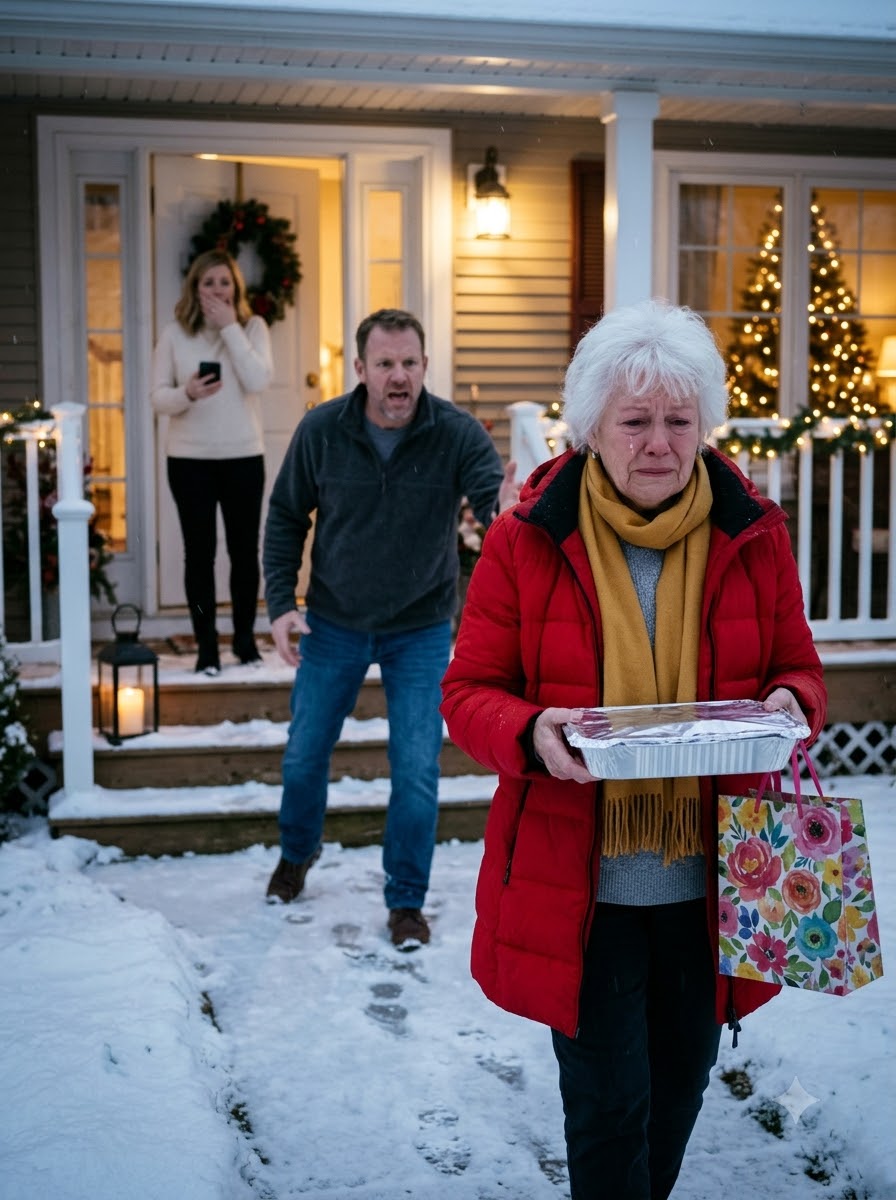
But that Christmas Eve, I found myself standing in the falling snow outside my son Daniel’s house in Maplewood, New Jersey.
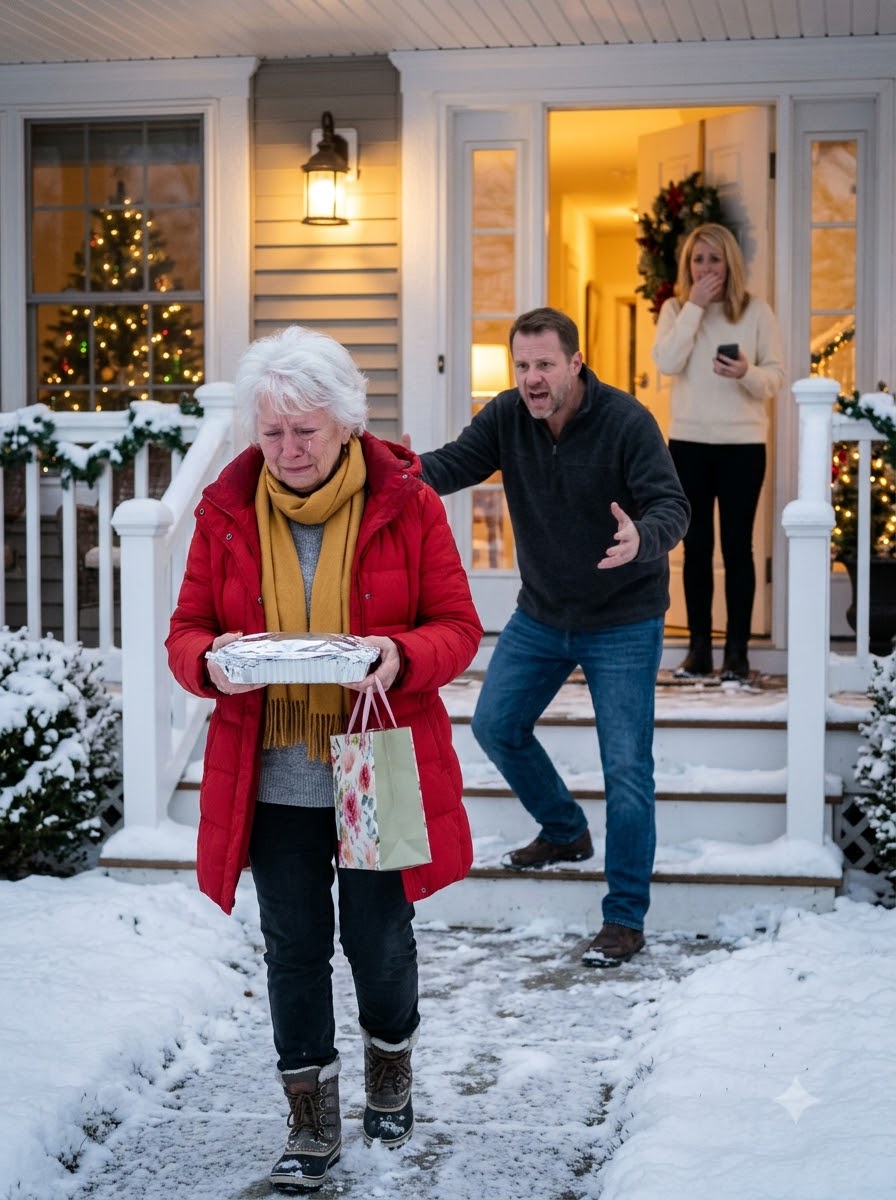
In one hand, I held a homemade turkey dish I’d spent hours preparing. In the other was a bag filled with carefully wrapped Christmas gifts for my grandchildren.
Through the large front window, I could see the Christmas tree glowing brightly and a living room crowded with people.

My grandchildren were there.
Claire’s parents were there, too, along with several other members of the family.
I pressed the doorbell.
A moment later, Daniel appeared, opening the front door barely wide enough to look outside.
“Mom? What are you doing here?”
“Merry Christmas, honey. I brought some food and presents for the kids.”
There was no smile on his face.
Behind him stood his wife, Claire, with a wineglass in her hand.
Daniel stepped outside and nearly closed the door behind him.
“You weren’t supposed to come.”
I stared at him, bewildered.
“Daniel, what are you talking about?”
“You weren’t invited, Mom.”
The words struck me harder than I could have imagined.
Everyone else had been invited into his home.
His wife’s parents.
Their extended family.
And my grandchildren were celebrating Christmas just a few steps away from where I stood.
Then I heard a small voice from inside the house.
“Daddy, who’s outside?”
Daniel responded immediately.
“Just someone at the wrong house.”
For a moment, I couldn’t process what he’d said.
“Daniel, I’m your mother.”
“Then please go home. Don’t turn this into a scene.”
Through the narrow opening, I caught one last glimpse of the beautifully arranged dinner table, piles of wrapped gifts, and children wearing matching Christmas pajamas.
There seemed to be enough space for everyone.
Everyone except me.
Then Daniel closed the door.
I remained on the porch, holding the food and presents as snow slowly settled across my coat and shoulders.
Nearly a full minute passed before I could bring myself to walk back to my car.
Once I reached home, I placed the turkey and gifts on my kitchen counter.
I sat in the darkened room, trying to make sense of what had happened.
A small part of me continued hoping Daniel would realize how deeply he’d hurt me and call to say he was sorry.
At exactly 10:47 that evening, my phone rang.
Daniel’s name appeared on the screen.
For one brief moment, hope returned.
But when I answered, laughter echoed behind his voice.
I could hear Claire making jokes about the turkey I’d carried to their door.
Daniel sounded as though he’d been drinking.
“Mom, don’t go around telling everyone we mistreated you. You made yourself look ridiculous by showing up uninvited.”
I said nothing.
Then I heard him turn toward Claire and remark:
“She thinks her money can buy her a place in this house.”
Claire laughed loudly.
And at that instant, something inside me finally shifted.
For fourteen years, I had provided financial assistance to Daniel and his household.
I’d contributed toward their mortgage.
Helped pay the children’s private-school tuition.
Covered their car insurance.
Invested money in Daniel’s business.
Whenever he called with another unexpected emergency, I sent additional funds.
Every month, automatic transfers left my account to help support the lifestyle his family enjoyed.
I had never resented giving him that money.
He was my son.
And I wanted my grandchildren to grow up with stability, comfort, and opportunities.
But on that Christmas Eve, I finally understood something I’d spent years refusing to acknowledge.
Daniel was happy to receive my money.
He simply didn’t want my presence.
When the call ended, I opened my laptop.
I signed into my online banking account and began reviewing every recurring payment I’d established for Daniel.
Mortgage assistance.
School tuition.
Business contributions.
Monthly emergency transfers.
One by one, I checked the details.
Cancel payment.
Confirm cancellation.
Cancel transfer.
Confirm cancellation.
Then I closed the separate emergency fund I’d maintained for his family’s benefit.
I sent no furious messages.
I issued no warnings.
I made no emotional phone calls.
I simply stopped paying for a life in which I was apparently no longer welcome.
And for the first time in fourteen years, I went to bed without wondering whether Daniel needed anything else from me.
What I didn’t know was that, by the following morning, my phone would be filled with twenty-five missed calls.
And those calls would reveal exactly what my son believed a mother’s love was worth.
I woke on Christmas morning to the sound of my phone vibrating against the wooden nightstand.
At first, I assumed it was an alarm.
Then I saw the screen.
Twenty-five missed calls.
Seventeen from Daniel.
Eight from Claire.
There were also fourteen text messages, each more demanding than the last.
The first had arrived shortly after seven.
Mom, call me.
The next appeared eleven minutes later.
Did you change something with the bank?
By eight o’clock, the messages had become increasingly frantic.
The transfer didn’t go through.
We need to talk immediately.
This isn’t funny.
The final message was from Claire.
You can’t just abandon your family because your feelings got hurt.
I sat on the edge of my bed and read that sentence three times.
Abandon my family.
The woman who had stood behind my son while he turned me away on Christmas Eve was accusing me of abandonment because I had stopped transferring money into their accounts.
For a moment, the familiar instinct to fix everything returned.
I could call the bank.
Restore the transfers.
Tell Daniel there had been a misunderstanding.
Pretend the previous night had never happened.
That was what I’d always done.
Whenever Daniel faced a problem, I rushed to solve it before he had to experience the consequences.
But then I remembered his voice.
“Just someone at the wrong house.”
I set the phone down.
I made myself a cup of coffee, warmed a slice of toast, and sat beside the kitchen window watching the snow cover my garden.
The silence felt unfamiliar.
For fourteen years, Christmas morning had meant checking whether Daniel needed money for gifts, groceries, travel expenses, or some last-minute emergency.
This was the first Christmas morning when I had nothing to arrange for him.
And although my heart ached, I discovered that the world had not ended.
At 9:16, Daniel called again.
This time, I answered.
“Mom, finally!”
There was no greeting.
No Merry Christmas.
No apology.
“What’s going on with the payments?”
I looked out at the snow-covered bird feeder.
“Which payments, Daniel?”
“All of them! The mortgage transfer didn’t arrive, and the business account isn’t showing the deposit you always send.”
“I canceled them.”
Silence.
Then he laughed.
It was a short, disbelieving sound.
“You’re joking.”
“No.”
“Mom, you can’t do that.”
“I already have.”
His breathing became louder.
“Do you understand what kind of problems this could cause?”
“Yes,” I replied. “I understand that you’ll have to start paying your own bills.”
He didn’t respond immediately.
Then his tone sharpened.
“So this is revenge because you weren’t invited to dinner?”
“No, Daniel. This is me accepting what you told me last night.”
“What are you talking about?”
“You said my money couldn’t buy me a place in your home. You were right. So I’m no longer going to spend it trying.”
He exhaled angrily.
“You’re being dramatic.”
“Perhaps. But I’m also being clear.”
“Mom, we have responsibilities. The kids have school. Claire has expenses. My business needs cash flow.”
“And you have a job, a business, and a wife who also works. You’re both adults.”
“You know it’s not that simple.”
I did know.
In fact, I knew considerably more about his financial situation than Daniel realized.
Every time he had asked for assistance, he had provided a different explanation.
A slow quarter at work.
An unexpected repair.
A delayed client payment.
Rising tuition.
A temporary cash shortage.
For fourteen years, there had always been something.
And I had always believed him.
“Daniel,” I said quietly, “when was the last time you called me just to ask how I was?”
“What?”
“When was the last time you invited me to dinner without needing something?”
“Mom, don’t start.”
“When was the last time you brought the children to visit me simply because you wanted us to spend time together?”
He remained silent.
I waited.
Finally, he said, “That’s not fair.”
“Neither was last night.”
He raised his voice.
“You’re really going to punish your grandchildren over a dinner invitation?”
That accusation hurt.
He knew exactly where to aim.
My grandchildren were the reason I’d continued helping long after my savings began shrinking.
They were the reason I’d postponed replacing my aging car.
The reason I’d stopped taking vacations.
The reason I’d told myself I didn’t need new furniture, expensive clothes, or the little cottage by the coast I’d once dreamed of renting for a summer.
But loving those children did not mean I had to finance every decision their parents made.
“I’m not punishing the children,” I told him. “I’m asking their parents to take responsibility.”
“You’re unbelievable.”
“And you told your child I was nobody.”
For the first time, his voice faltered.
“That wasn’t what I meant.”
“Then what did you mean?”
“I didn’t want a scene.”
“I was standing outside with Christmas dinner and presents. There was no scene until you decided your own mother wasn’t worth opening the door for.”
He muttered something under his breath.
Then he said, “Claire wants to talk to you.”
Before I could object, I heard the phone change hands.
“Maggie?”
Claire’s voice was unusually sweet.
She hadn’t called me Maggie in years.
Usually, she addressed me as Margaret, particularly when she wanted to remind me that she controlled her household.
“Merry Christmas, Claire.”
“Listen, I think everyone’s emotions got a little out of control yesterday.”
I almost smiled.
“Is that what happened?”
“We had a very carefully planned dinner. My parents were there, and we didn’t have extra seating.”
I remembered the enormous dining table visible through the doorway.
There had been empty chairs along the wall.
But I wasn’t interested in arguing about furniture.
“I understand.”
“Good. Then perhaps you can restore the payments, and we can discuss the misunderstanding after the holidays.”
There it was.
The actual reason for the call.
“I’m not restoring the payments.”
Her voice hardened immediately.
“Margaret, the children’s tuition is due next month.”
“Then you and Daniel have time to make arrangements.”
“You know we depend on that money.”
“Yes,” I replied. “That’s the problem.”
“Are you seriously going to ruin our financial situation because you weren’t included in one Christmas dinner?”
I closed my eyes.
“Claire, I didn’t ask to be the center of attention. I only wanted to see my family.”
“Well, you should have called first.”
I took a slow breath.
“I did.”
She stopped speaking.
“I called Daniel three days ago,” I continued. “I asked whether I should bring the turkey dish he always liked. He told me Christmas Eve would be busy, but he never said I wasn’t welcome.”
“Daniel handles those arrangements.”
“Then Daniel should have handled them honestly.”
She gave an irritated sigh.
“This is getting ridiculous.”
“Perhaps it is.”
“Think about what you’re doing to your grandchildren.”
“I am thinking about them. I have been thinking about them for fourteen years.”
Then I ended the call.
My hands trembled afterward.
Not because I regretted my decision.
Because standing up to my son felt like breaking a rule I’d spent my entire life obeying.
For most of my marriage, I had been the person who held everything together.
My husband, Thomas, had been a kind man, but he struggled with financial planning.
When bills piled up, I found a solution.
When Daniel needed braces, I worked extra hours.
When the family car broke down, I took the bus until we could afford repairs.
After Thomas died, I continued doing what I’d always done.
I solved problems.
I paid bills.
I made sacrifices.
And somewhere along the way, my son had stopped seeing those sacrifices as gifts.
He saw them as obligations.
By noon, I decided to find out just how much I’d given him.
I returned to my laptop and opened the folder where I kept my financial records.
I had always been meticulous with paperwork.
Every transfer.
Every check.
Every tuition payment.
Every contribution to his business.
I started with the mortgage.
When Daniel and Claire purchased their home, I had contributed to their down payment.
They told me it would be a temporary arrangement until Daniel’s business became profitable.
Fourteen years later, I was still sending money every month.
Then came the tuition.
Their two children attended a private school that Daniel insisted was essential for their future.
I loved my grandchildren and wanted them to receive an excellent education.
So when Daniel asked for help, I agreed.
Then there was the insurance.
The business loans.
The emergency deposits.
And the money I had given them during the years when Daniel claimed he couldn’t afford to pay himself a salary.
I opened a spreadsheet and began adding the amounts.
At first, I thought I had made a mistake.
I checked the figures again.
Then a third time.
The total exceeded $600,000.
More than six hundred thousand dollars.
I sat motionless, staring at the screen.
That money represented years of my retirement savings.
Years of postponed dreams.
Years of telling myself I could manage with less because my son needed more.
And the previous evening, that same son had refused to let me enter his home.
I closed the laptop.
For the first time, I allowed myself to cry.
Not because I wanted the money returned.
I had given most of it willingly.
I cried because I finally understood how much of myself I had surrendered in exchange for the hope that my family would keep loving me.
At three o’clock, someone knocked on my door.
I looked through the window.
It was my neighbor, Evelyn Parker.
She stood on the porch holding a covered plate.
Evelyn had lived next door for eleven years.
We exchanged flowers in the spring, checked on each other during storms, and occasionally shared coffee.
But I had never told her much about Daniel.
“Merry Christmas, Margaret,” she said when I opened the door. “I made far too much pie, and I thought you might like some.”
I invited her inside.
She noticed the untouched turkey dish on my counter.
“Were you expecting company?”
I hesitated.
Then, for the first time, I told someone what had happened.
I described the snow.
The narrow opening in the door.
Daniel’s words.
The laughter during his late-night phone call.
And the payments I’d canceled afterward.
Evelyn listened without interrupting.
When I finished, she placed her hand over mine.
“Margaret, can I ask you something?”
“Of course.”
“If Daniel didn’t need your money, do you think he’d still call you?”
I opened my mouth.
But no answer came.
Evelyn didn’t press me.
Instead, she looked at the turkey.
“It’s Christmas. Why don’t we heat that up and have dinner together?”
I laughed through my tears.
“It’s an enormous dish.”
“Then we’ll have leftovers.”
For the next hour, we warmed the food, set the table, and talked about ordinary things.
Her garden.
The weather.
A funny story about her nephew.
For the first time in days, I felt comfortable.
Nobody asked me to pay a bill.
Nobody expected me to solve a crisis.
Evelyn was simply happy to share a meal.
And I began to realize how much I’d missed that feeling.
That evening, after she went home, I found another message from Daniel.
We need to meet tomorrow. This has gone far enough.
I read it once.
Then I replied.
You may come at two o’clock. But we will be discussing more than the payments.
He responded almost immediately.
Fine.
I put my phone away.
I thought that perhaps, once we spoke face-to-face, Daniel might finally understand.
I was wrong about how easy that conversation would be.
Because the following afternoon, my son arrived at my house carrying a folder.
And the first thing he asked me to do was sign a document.
PART 2
Daniel arrived at precisely two o’clock on December twenty-sixth.
He wore the expensive charcoal coat I’d helped him purchase the previous winter.
Claire accompanied him.
Neither brought the children.
I opened the door and stepped aside.
Daniel entered without hugging me.
Claire gave me a tight smile before walking into the living room.
I had prepared coffee and placed a small plate of cookies on the table.
Neither touched them.
Daniel sat across from me and opened the folder he’d carried inside.
“Mom, we need to get this situation under control.”
I looked at the papers.
“What situation?”
“The financial arrangement.”
He spoke as though we were discussing a business contract rather than fourteen years of help from his mother.
Claire leaned forward.
“We’ve reviewed our budget, and stopping the payments without warning puts us in a very difficult position.”
I nodded.
“I imagine it does.”
Daniel slid a document toward me.
“We think the best solution is to formalize what you’ve already been doing.”
I read the heading.
It was a proposed family financial support agreement.
The document outlined regular monthly contributions toward their mortgage, tuition, and household expenses.
It also included a provision requiring me to maintain a designated emergency reserve.
I read the first page carefully.
Then the second.
Finally, I looked at Daniel.
“You want me to sign a contract promising to continue paying your bills?”
He shifted in his chair.
“It’s not like that.”
“Then explain it.”
“It gives everyone stability.”
“Everyone?”
“The children, Mom. Think about the children.”
I looked down at the document again.
There was nothing about repayment.
Nothing about Daniel’s responsibility to reduce his expenses.
Nothing about a date when my assistance would end.
It was simply an attempt to turn my generosity into a permanent financial obligation.
I pushed the folder back across the table.
“No.”
Claire straightened.
“Margaret, you haven’t even considered it.”
“I’ve considered it for fourteen years.”
Daniel rubbed his forehead.
“You’re being stubborn.”
“No, Daniel. I’m being responsible with my own money.”
He stared at me.
“You’ve always helped us.”
“Yes.”
“So why stop now?”
I met his eyes.
“Because I finally realized that helping you has not made you independent. It’s made you dependent on me.”
His face reddened.
“That isn’t fair.”
“Then tell me your plan.”
“What plan?”
“Your plan to support your family without my money.”
He glanced at Claire.
Neither answered.
I waited.
Finally, Claire said, “We would have to make some very difficult decisions.”
“Then perhaps it’s time to make them.”
Daniel leaned forward.
“Mom, you don’t understand how expensive everything is.”
“I understand very well. I’ve been paying a substantial portion of those expenses.”
“You’re acting like we forced you.”
I considered that.
“No,” I said. “You didn’t force me. I chose to help because I loved you. But you have treated that choice as though it gave you permanent access to my bank account.”
Claire folded her arms.
“Your grandchildren will suffer.”
I looked directly at her.
“Will they?”
She blinked.
“Excuse me?”
“Will they go hungry? Will they have nowhere to sleep? Or will you have to reconsider private school, expensive vacations, and the lifestyle you’ve chosen?”
Daniel stood abruptly.
“This is insulting.”
“So was telling your child I was nobody.”
His expression changed.
For a moment, he looked like the little boy who used to hide behind me whenever he was frightened.
Then the anger returned.
“You keep bringing that up.”
“Because you haven’t apologized.”
He opened his mouth.
Closed it.
Then said, “I’m sorry you were upset.”
I shook my head.
“That isn’t an apology for what you did.”
Claire reached for her handbag.
“We shouldn’t have come.”
I stood.
“Perhaps you’re right.”
Daniel looked stunned.
“You’re throwing us out?”
“No. I’m asking you to leave because this conversation isn’t going anywhere.”
He grabbed the folder.
At the doorway, he turned back.
“You’re going to regret this when the kids ask why Grandma stopped helping.”
My throat tightened.
But I didn’t change my answer.
“Tell them the truth, Daniel. Tell them Grandma loves them, but their parents are responsible for their household.”
He stared at me for several seconds.
Then he walked out.
Claire followed.
Their car disappeared down the street.
I closed the door and leaned against it.
I had never felt so heartbroken.
And I had never felt so certain that I had done the right thing.
The next morning, I called my attorney.
His name was Robert Ellis, and he’d handled my estate documents after Thomas passed away.
I explained what had happened.
Robert listened carefully and asked several questions about the payments.
“Margaret, were any of these transfers legally required under a signed agreement?”
“No. They were voluntary.”
“Did you personally guarantee any of Daniel’s business debts?”
“I don’t believe so.”
“Then we should review the records to make sure.”
He asked me to bring the documents relating to the business contributions and the bank accounts I’d used to support Daniel.
We scheduled an appointment for the following week.
Before ending the call, Robert said something that stayed with me.
“You’re allowed to help your family, Margaret. But you’re also allowed to stop.”
Such a simple sentence.
Yet I realized I had never truly believed it.
For years, I had treated motherhood as an endless obligation to give.
I had forgotten that love was supposed to flow in both directions.
Over the following days, Daniel sent several more messages.
Some were angry.
Others were strangely polite.
One morning, he wrote that the mortgage company needed clarification about an expected transfer.
Another day, he said the business would have to delay purchasing new equipment.
Claire informed me that they were considering withdrawing the children from private school.
I read every message.
But I did not restore the payments.
Instead, I began rebuilding my own financial plans.
I met with Robert and a financial adviser.
Together, we reviewed my retirement savings, monthly income, insurance policies, and estate arrangements.
Robert confirmed that the recurring assistance had been voluntary. He also reviewed my records to ensure that I wasn’t personally responsible for any outstanding obligations.
We discussed the importance of keeping my finances separate from Daniel’s.
I updated my estate documents and arranged for any future gifts intended for my grandchildren to be handled through a properly structured plan rather than unrestricted payments to their parents.
I wanted to help the children when it made sense.
But I no longer wanted my son to use them as a reason to control my decisions.
As the weeks passed, I noticed something unexpected.
I slept better.
I stopped checking my phone anxiously every time it rang.
I bought myself a new winter coat without wondering whether Daniel would need that money.
I scheduled repairs on my car.
And one afternoon, I walked into a travel agency and asked about a short spring trip to the coast.
For years, I had dreamed of sitting beside the ocean with a book and absolutely nowhere I needed to be.
Now, for the first time, I could imagine actually doing it.
But the hardest part of my decision had nothing to do with money.
It was missing my grandchildren.
Their names were Sophie and Oliver.
Sophie was ten, thoughtful and curious, with the same brown eyes Daniel had as a child.
Oliver was seven and loved dinosaurs, puzzles, and asking questions that no adult could answer.
I had purchased their Christmas gifts weeks before the holiday.
They were still sitting in the bag I’d carried to Daniel’s door.
Every time I passed the spare bedroom, I thought about them.
I didn’t want them to believe I had disappeared.
I didn’t want them caught between adults arguing over money.
So I wrote each child a letter.
I told Sophie how proud I was of her love of reading.
I told Oliver that I’d found a new dinosaur book I thought he would enjoy.
I reminded them both that Grandma loved them very much.
I didn’t mention their parents’ financial troubles.
I didn’t describe the Christmas Eve humiliation.
Those were adult matters.
The children deserved to be children.
I mailed the letters with their presents.
Two weeks later, an envelope arrived.
Inside was a drawing.
Sophie had sketched a Christmas tree, a snow-covered house, and three people holding hands.
Above them, she’d written:
Grandma, we missed you at Christmas.
Below that, Oliver had added:
Can we come see you soon?
I sat at the kitchen table with the drawing in my hands.
Then I cried harder than I had on Christmas Eve.
Because the children had missed me.
Not my money.
Not my payments.
Me.
I called Daniel that evening.
He answered cautiously.
“Mom?”
“I received the children’s drawing.”
“Oh.”
“I’d like to see them.”
He was quiet.
Then he said, “Claire isn’t comfortable with that right now.”
My chest tightened.
“Why?”
“Because of everything that’s happened.”
“Daniel, whatever disagreement you and I have, the children shouldn’t be used as leverage.”
He sighed.
“That’s not what we’re doing.”
“Then let them visit.”
“We’ll talk about it.”
He ended the call without making a promise.
For several days, I heard nothing.
Then, one Friday afternoon, my doorbell rang.
I opened it to find Daniel standing on the porch.
This time, he was alone.
He looked tired.
There were dark circles beneath his eyes, and his coat hung loosely from his shoulders.
“Can we talk?”
I stepped aside.
He entered the kitchen and sat at the same table where we’d argued weeks earlier.
For a long moment, neither of us spoke.
Then Daniel looked at his hands.
“Things have been difficult.”
I waited.
“We’ve had to make some changes.”
“What kind of changes?”
“We canceled the winter vacation. Claire sold her second car. And we’re looking at different schools for next year.”
I nodded.
“Those sound like practical decisions.”
He gave a bitter laugh.
“They don’t feel practical.”
“I know.”
He looked up.
“You really aren’t going to change your mind?”
“No, Daniel.”
He rubbed his face.
“I thought you would.”
“I know you did.”
Another silence followed.
Then he said something I hadn’t expected.
“I didn’t realize how much you were paying.”
I studied him.
“You asked for the money.”
“I know. But it was always separate things. The mortgage one month. Insurance another. School expenses. Business problems. I never added it all together.”
“I did.”
He looked at me.
“How much?”
I told him.
His expression changed.
“Over six hundred thousand dollars?”
“Yes.”
He leaned back in his chair.
For several seconds, he stared at the wall.
Then he whispered, “I had no idea.”
I wanted to believe him.
Perhaps he truly hadn’t understood the total.
But ignorance didn’t erase fourteen years of dependence.
“Daniel, I don’t regret helping you when you genuinely needed help. I regret that neither of us knew when to stop.”
He nodded slowly.
Then he looked toward the window.
“Claire says you embarrassed us.”
I felt the old pain return.
“By refusing to pay your bills?”
“By cutting everything off.”
“Daniel, your wife laughed while you mocked me on Christmas Eve.”
He lowered his head.
“I know.”
“You told your child I was a stranger.”
“I know.”
“And when you called the next morning, you didn’t ask whether I was all right. You asked about the money.”
His eyes filled.
For the first time since Christmas, he seemed unable to defend himself.
“I was awful to you.”
I said nothing.
He swallowed.
“I don’t know why I acted that way.”
I waited.
Then he continued.
“Claire’s parents have always made comments about how much you help us. They think it makes me look unsuccessful.”
I stared at him.
“So you excluded me because you were ashamed that I supported you?”
He nodded.
“Partly.”
The admission hurt more than I expected.
He had been embarrassed by the very help he’d repeatedly requested.
“Daniel, you could have told me you wanted to handle things independently.”
“I know.”
“You didn’t need to pretend I was nobody.”
His eyes filled with tears.
“I’m sorry, Mom.”
This time, he didn’t say he was sorry I felt hurt.
He didn’t blame Claire.
He didn’t talk about the bills.
He simply apologized.
And I believed that, at least in that moment, he meant it.
But forgiveness and trust were not the same thing.
I reached across the table and took his hand.
“I love you, Daniel. That hasn’t changed.”
He squeezed my fingers.
“But I’m not going back to paying your household expenses.”
He nodded.
“I understand.”
“And I need you to understand something else.”
He looked at me.
“I don’t want to be invited into your home because you need financial help. I want to be invited because I’m your mother.”
Tears slipped down his cheeks.
“I know.”
We sat together for a long time.
Then he asked whether I wanted to see Sophie and Oliver that weekend.
I smiled through my tears.
“More than anything.”
That Sunday, Daniel brought the children to my house.
Sophie ran through the front door and wrapped her arms around my waist.
“Grandma!”
Oliver followed, carrying a toy dinosaur.
I knelt and hugged them both.
For the next three hours, we baked cookies, played board games, and talked about everything they’d done over Christmas break.
Not once did either child ask about money.
Not once did they care whether I had paid their tuition or contributed to their mortgage.
They simply wanted their grandmother.
And that was when I understood something I’d forgotten.
Love doesn’t need to be purchased.
It only needs to be given honestly.
PART 3
By the time spring arrived, my relationship with Daniel had begun to change.
Not quickly.
Not perfectly.
And certainly not without uncomfortable conversations.
But for the first time in years, we were learning how to be mother and son without treating every interaction as a financial transaction.
Daniel started calling on Sunday evenings.
At first, our conversations were awkward.
He would ask about my week, and I would wait for the inevitable request.
Sometimes I could almost hear him searching for the words.
But the requests didn’t come.
Instead, he asked whether my car was running properly.
Whether I’d enjoyed the book Sophie recommended.
Whether the flowers in my garden had started blooming.
Ordinary questions.
Questions that once would have seemed insignificant.
Now they meant more to me than any expensive gift.
Claire remained distant.
I didn’t expect otherwise.
She had grown accustomed to a household where my contributions helped cover expenses without requiring difficult choices.
Now those choices belonged to her and Daniel.
They had to examine their spending.
They had to prioritize.
They had to accept that their income, not my retirement savings, determined what they could afford.
I learned through Daniel that they had decided to enroll Sophie and Oliver in the local public school the following autumn.
He sounded embarrassed when he told me.
I asked whether the school was good.
He admitted that it was.
The children had friends there, and the academic programs were strong.
“Then perhaps it will work out better than you think,” I said.
He was quiet.
“Maybe.”
I didn’t offer to pay the private-school tuition again.
And he didn’t ask.
That was progress.
One afternoon in April, Daniel invited me to lunch.
Just the two of us.
We met at a small café halfway between our homes.
When the check arrived, I instinctively reached for my purse.
Daniel gently stopped me.
“I’ve got this, Mom.”
I looked at him.
He smiled.
“It’s just lunch.”
But we both knew it wasn’t just lunch.
It was the first meal in years when my son had invited me somewhere and insisted on paying without expecting anything in return.
I let him.
And as we walked outside afterward, he asked whether I’d like to come to the children’s school concert the following month.
“I’d love to.”
He hesitated.
“Claire will be there.”
“I assumed she would.”
“She knows I invited you.”
I looked at him carefully.
“And?”
“And I told her you’re my mother. You don’t need to earn an invitation.”
I stopped walking.
For a moment, I couldn’t speak.
Then I hugged him.
It wasn’t a perfect reconciliation.
But it was a beginning.
The school concert took place on a warm Thursday evening in May.
Sophie stood in the second row of the children’s choir.
Oliver played a small percussion instrument with an expression of enormous concentration.
When they spotted me in the audience, both waved enthusiastically.
I waved back.
Daniel sat beside me.
Claire sat on his other side.
She greeted me politely but said little.
I didn’t force a conversation.
Some relationships require time.
Others never return to what they once were.
I was learning to accept both possibilities.
After the concert, the children rushed toward us.
Sophie handed me a folded program.
“I saved this for you, Grandma.”
Oliver insisted that I come to his birthday party.
I promised I would.
And this time, when Daniel mentioned the celebration, there was no hesitation.
“Of course Mom’s invited,” he said.
Claire didn’t object.
That summer, I finally took my trip to the coast.
I rented a small cottage overlooking the Atlantic Ocean.
Every morning, I drank coffee on the porch and listened to the waves.
I read three novels.
I walked along the beach.
I bought a ridiculous straw hat that made me look like a tourist, and I wore it anyway.
For the first time in decades, I wasn’t organizing my days around someone else’s needs.
I wasn’t waiting for Daniel to call about an emergency.
I wasn’t calculating how much money I could send him without compromising my own security.
I was simply living.
One evening, I sat outside watching the sunset and thought about Thomas.
He had always loved the ocean.
We used to talk about spending a summer near the water after retirement.
But life kept getting in the way.
Then his health declined.
And before we could make that dream happen, he was gone.
I had spent years telling myself that my own wishes could wait.
But sitting there, listening to the waves, I finally understood that waiting had become a habit.
I didn’t know how many healthy years I had left.
I didn’t know what tomorrow would bring.
And I no longer wanted to spend the rest of my life postponing happiness.
When I returned home, there was a message waiting from Daniel.
Hope you had a wonderful trip, Mom. The kids want to hear all about it.
I smiled.
No request.
No emergency.
Just a son asking about his mother’s happiness.
As autumn approached, Daniel’s business began to stabilize.
He told me he’d reduced expenses, renegotiated several contracts, and taken on additional work.
It hadn’t been easy.
But he sounded proud.
One Sunday, he admitted something that surprised me.
“For years, I thought I was running a successful business because we always managed to pay the bills.”
I listened.
“But I wasn’t looking at the whole picture. Your money was covering problems I should have fixed.”
“That must have been difficult to recognize.”
“It was.”
He paused.
“I’m glad you made me face it.”
I didn’t know whether he would have said those words six months earlier.
Perhaps not.
But I was grateful to hear them.
He also told me that he and Claire had started working with a financial counselor.
They were building a household budget and setting aside money for emergencies.
For the first time, their plan didn’t depend on my monthly transfers.
I congratulated him.
And I meant it.
The greatest gift I could give my son was no longer money.
It was the opportunity to become responsible for his own life.
As December approached, I found myself thinking about the previous Christmas.
The snow.
The turkey.
The presents.
The door closing in my face.
I wondered whether those memories would always hurt.
Perhaps they would.
Some wounds fade slowly.
But I had stopped allowing that night to define my worth.
Then, in early December, Daniel called.
“Mom, we’re planning Christmas Eve dinner.”
I felt my stomach tighten.
“I see.”
“I wanted to ask if you’d come.”
I remained silent for a moment.
Then I asked, “Are you sure?”
“Of course.”
“Daniel, I don’t want another misunderstanding.”
“There won’t be one.”
He paused.
Then added, “And Mom?”
“Yes?”
“You don’t need to bring anything.”
I smiled.
“I always bring something.”
“I know. But this year, I want you to come as our guest.”
I looked toward the kitchen counter where, almost a year earlier, I’d placed the turkey dish nobody wanted.
“That’s very kind, honey.”
He continued.
“Claire’s parents will be there, and so will some other relatives. But I’ve already told everyone you’re coming.”
I took a breath.
“All right.”
“Really?”
“Yes, Daniel. I’ll be there.”
After we ended the call, I sat quietly for several minutes.
I wanted to believe things would be different.
But I also knew that one invitation couldn’t erase fourteen years of unhealthy expectations.
I had learned to recognize the difference between hope and obligation.
I could accept an invitation without surrendering my boundaries.
I could forgive my son without pretending he had never hurt me.
And I could love my grandchildren without financing every part of their lives.
On Christmas Eve, I dressed carefully.
I wore a deep blue sweater, a silver necklace Thomas had given me, and the new winter coat I’d purchased for myself.
I carried a small bag of gifts for Sophie and Oliver.
This time, I didn’t bring a turkey.
Daniel had insisted he would take care of dinner.
As I drove through Maplewood, snow began to fall.
The streets looked almost exactly as they had the previous year.
Christmas lights glowed from porches.
Wreaths hung on front doors.
Families hurried inside carrying presents and covered dishes.
When I reached Daniel’s house, I parked in the driveway.
For a moment, I remained in the car.
I remembered standing on that porch twelve months earlier, feeling as though I had been erased from my own family.
Then I took a breath, picked up the gifts, and walked toward the door.
Before I could ring the bell, it opened.
Daniel stood there.
But this time, the door was wide open.
And he was smiling.
“Merry Christmas, Mom.”
I felt tears gathering.
“Merry Christmas, honey.”
He stepped forward and hugged me.
Not a hurried embrace.
Not an awkward gesture.
A real hug.
“I’m glad you’re here,” he whispered.
Behind him, Sophie and Oliver came running.
“Grandma!”
They wrapped their arms around me, nearly knocking the gift bag from my hands.
Daniel laughed and took the presents.
“Come inside. Everyone’s waiting.”
I stepped into the warm house.
The Christmas tree sparkled in the corner.
The dining table was beautifully arranged.
Claire’s parents were seated in the living room.
Claire approached and greeted me.
“Merry Christmas, Margaret.”
“Merry Christmas, Claire.”
She hesitated.
Then said, “I’m glad you came.”
I nodded.
“Thank you.”
It wasn’t an elaborate apology.
But it was a kindness I hadn’t received the year before.
And for that evening, it was enough.
Dinner was wonderful.
Daniel had prepared the turkey himself.
He admitted that he’d called a friend twice for advice and nearly burned the potatoes.
Everyone laughed.
The children told stories about school.
Claire’s father discussed his garden.
Someone played Christmas music softly in the background.
And I sat at the table, surrounded by family, without once feeling that I needed to justify my presence.
After dinner, Daniel stood and raised his glass.
“I’d like to say something.”
The room grew quiet.
He looked toward me.
“Last Christmas, I made a terrible mistake.”
My heart began to pound.
“I treated someone who has always loved and supported me as though she didn’t belong in my home.”
He swallowed.
“I was selfish, and I was ashamed of things I should have taken responsibility for myself.”
Claire looked down at her hands.
Daniel continued.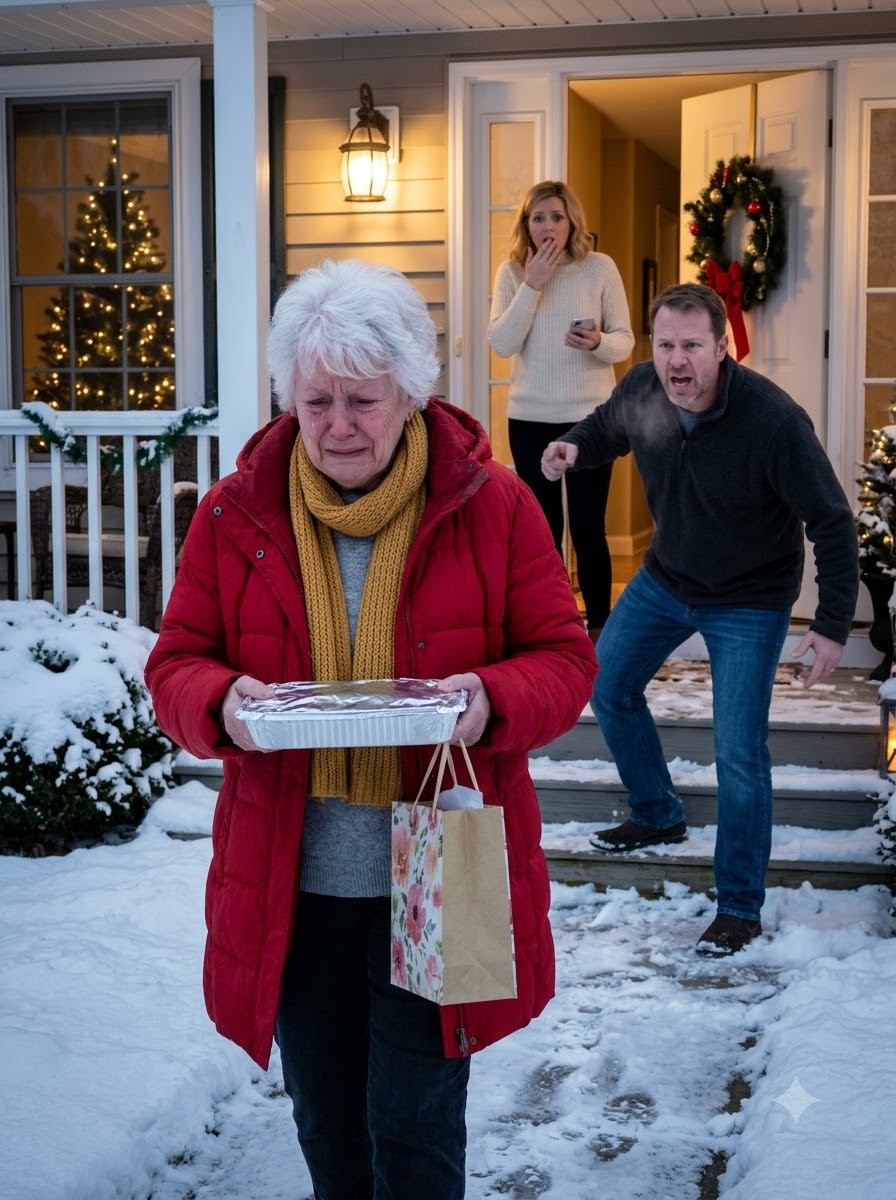
“My mother spent years helping our family. But somewhere along the way, I forgot that her love wasn’t something I was entitled to take for granted.”
His voice trembled.
“And I forgot that she deserved love and respect in return.”
I wiped my eyes.
He raised his glass a little higher.
“So tonight, I want to thank my mother. Not for the money she gave us, but for everything she taught me. Including the lesson I was too stubborn to learn until last Christmas.”
He looked directly at me.
“I’m sorry, Mom. And I’m grateful you’re here.”
For a moment, nobody spoke.
Then Sophie began clapping.
Oliver joined her.
Soon everyone was applauding.
I stood and hugged my son.
I didn’t need a grand speech.
I didn’t need the money returned.
I didn’t need anyone to pretend the past hadn’t happened.
I only needed to know that my son finally saw me as a person rather than a source of financial security.
Later that evening, after the children had opened their presents, Sophie climbed onto the sofa beside me.
“Grandma?”
“Yes, sweetheart?”
“Are you coming next Christmas, too?”
I smiled and brushed a strand of hair from her face.
“I certainly hope so.”
She leaned against my shoulder.
“Good. Christmas is better when you’re here.”
I held her close.
Those words meant more than every payment I’d ever made.
Because they weren’t about money.
They weren’t about what I could provide.
They were about belonging.
When I finally left Daniel’s house that night, he walked me to the car.
Snowflakes drifted through the porch light.
He opened the car door and helped me place my handbag inside.
“Drive carefully, Mom.”
“I will.”
Then he hesitated.
“Can I ask you something?”
“Of course.”
“Are you happy?”
The question surprised me.
For years, Daniel had asked whether I could help.
Whether I had enough money available.
Whether I could cover another expense.
But I couldn’t remember the last time he’d asked whether I was happy.
I looked at my son.
“Yes,” I said. “I think I finally am.”
He smiled.
“Good.”
I touched his cheek.
“I love you, Daniel.”
“I love you too, Mom.”
Then he closed the car door gently and stepped back.
As I drove home through the quiet, snow-covered streets, I thought about everything that had changed.
My son still had financial responsibilities.
His family still faced challenges.
My relationship with Claire was still a work in progress.
And there would undoubtedly be difficult moments ahead.
But I no longer felt responsible for rescuing everyone from every problem.
I had my own life.
My own plans.
My own happiness.
And I finally understood that being a good mother did not require sacrificing all three.
The previous Christmas, Daniel had told his child that I was nobody.
That night, he’d made me feel invisible.
But a year later, I knew something he hadn’t understood then.
My worth had never depended on whether my son invited me inside.
It had never depended on the amount of money I gave him.
And it certainly had never depended on how much of myself I was willing to surrender.
I was Margaret Whitmore.
A mother.
A grandmother.
A widow who had survived heartbreak and learned to begin again.
I was a woman who deserved kindness, dignity, and love.
And I didn’t have to purchase any of them.
That Christmas, I came home to a quiet house, hung my coat by the door, and placed the children’s handmade cards on my mantel.
Then I made myself a cup of tea and sat beside the glowing Christmas tree.
For the first time in many years, I felt completely at peace.
Because I had finally learned the lesson that changed everything:
You can love your family with your whole heart without giving them unlimited access to your life, your savings, or your self-respect.
And sometimes, the most loving thing a parent can do is stop paying the price for someone else’s choices.
Not to punish them.
Not to make them suffer.
But to give everyone a chance to understand what love is supposed to mean.
That Christmas Eve, I hadn’t bought myself a seat at my son’s table.
I had been welcomed because I belonged there.
And that made all the difference.
