


PART 1
Laughter was the first sound that greeted me when I unexpectedly returned to my mansion.
In any ordinary household, that sound would have meant nothing unusual. I was the father of twin boys who had just turned one. Our living room was overflowing with stuffed animals, colorful wooden blocks, and expensive toys—enough to supply an entire neighborhood daycare.
But for months, our enormous house had felt more like an elegant waiting room than a place where a family actually lived.
My sons, Nico and Noah, had almost stopped laughing.
The smallest unexpected noise could make their bodies go rigid. Every morning, when I prepared to leave for work, they cried with a desperation that made it seem as though they believed I would never come back.
My name is Ethan Caldwell.
I built my fortune by recognizing details other people overlooked. During negotiations, I could sense when someone was hiding their intentions. A single questionable number on a financial statement could catch my attention immediately. I could recognize when a struggling corporation was concealing serious problems behind polished presentations and impressive promises.

Yet somehow, I had failed to recognize what was happening beneath my own roof.
That morning, Margaret, the housekeeper who had overseen my household for years, approached me in the breakfast room.
She remained near the doorway, clasping her hands so tightly that her knuckles had turned pale.
“Mr. Caldwell, there’s something you should know about Lena.”
Her words immediately brought back something that had happened earlier that morning.
Before leaving for work, I had paused outside the nursery.
Noah was already awake, quietly studying a patch of sunlight spreading across the wall. When I greeted him, his serious blue eyes turned toward me, but there was no smile.
I reached into his crib.
He wrapped his tiny fingers around mine and held on with surprising strength.
For a moment, I nearly forgot about my first meeting.
Then Margaret appeared behind me and explained that the twins would calm down once I stopped interfering with their established routine.
I accepted her explanation because believing it was easier than questioning it.
An important international contract was waiting for my attention, and my driver had already brought the car around.
I kissed Noah on the forehead and walked away.
Now, remembering how tightly his little hand had held mine, I wondered how many times I had abandoned him at precisely the moment he needed me most.
My thoughts also returned to the afternoon Lena Morales first interviewed for the nanny position.
She had not tried to impress me with prestigious qualifications or elaborate theories about child development.
While Margaret listed her professional credentials, Lena noticed that Nico had lost one of his socks and was growing upset.
She crouched beside him, retrieved the sock from beneath a chair, and transformed the simple task into a gentle little game.
Nico watched her with complete fascination, as though nobody else existed in the room.
At the time, I considered it a charming but insignificant moment.
During the following months, I occasionally saw Lena carrying the boys through the garden, showing them birds or quietly singing as she walked.
I almost never remained nearby long enough to listen.
Later that day, while I was supposedly preparing to board my flight, I would remember those moments again.
Sitting in my parked car at the airport, I struggled with two opposing fears.
What if I returned home and unfairly accused an innocent young woman?
But what if I discovered something terrible and realized that my own negligence had allowed it to continue?
An automated announcement echoed through the terminal speakers.
I gripped the steering wheel.
Then I remembered how Nico had cried the previous evening when I handed him over to Margaret.
A child his age could not explain what frightened him.
He could only trust that someone older would notice.
I started the engine and headed home.
But that decision began with Margaret’s warning in the breakfast room.
Lena Morales was twenty-five years old, quiet, and consistently gentle whenever I happened to see her interacting with my sons.
She rarely requested anything for herself and always seemed uncomfortable when I expressed gratitude.
Margaret had selected her after several previous caregivers had resigned within a relatively short period.
“What about her?” I asked.
Margaret looked cautiously toward the hallway.
“When you’re away, she does strange things with those babies.”
The coffee in my mouth suddenly seemed unpleasantly bitter.
“What kind of things?”
“Things you wouldn’t approve of.”
My stomach tightened.
“Is she hurting them?”
Margaret hesitated just long enough for my imagination to fill the silence with terrible possibilities.
“I think you should see for yourself.”
She refused to elaborate.
Instead, she insisted that Lena was clever enough to behave properly whenever I was present.
I had heard too many accounts of children being mistreated behind closed doors to misunderstand what Margaret was implying.
Within the hour, I announced that I would be traveling to Geneva for business meetings.
My driver delivered me to the airport, and my assistant left the trip listed on my professional calendar.
But I never boarded the aircraft.
I rented an unremarkable sedan, waited until everyone at home would assume I was already flying across the Atlantic, and returned through the service entrance.
With my black leather travel bag in hand, I slipped into the rear hallway.
My heartbeat was so violent that I could feel it in my chest.
I had prepared myself to hear crying.
Perhaps shouting.
Perhaps something so horrifying that I would never forgive myself for leaving my sons alone.
Instead, I heard laughter.
I froze outside the living room.
Two tiny voices were squealing with unmistakable happiness.
When I cautiously looked around the doorway, I saw blankets stretched between pieces of furniture, pillows piled into miniature mountains, and brightly colored toys covering the carpet.
The elegant room looked as though a joyful tornado had swept through it.
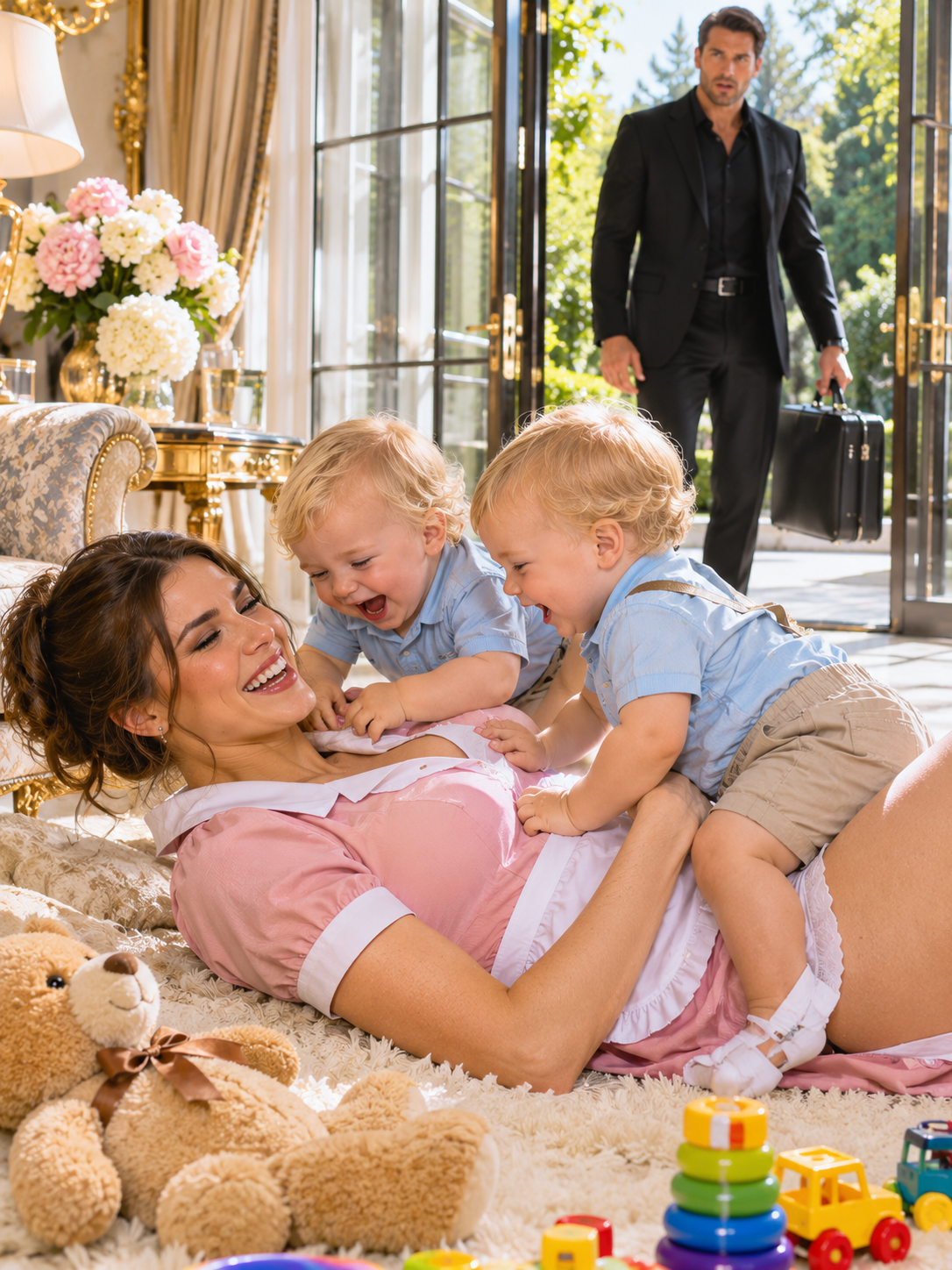
Lena was lying on her back in the center of the chaos.
She wore her usual pink dress, trimmed with white lace around the collar, but on her hands were enormous yellow rubber gloves.
Nico was perched on her stomach.
Noah was attempting to climb over her shoulder.
“Oh no!” she cried, lifting the gloved hands toward the ceiling. “The mighty princes have defeated the terrible monster!”
Nico burst into delighted shrieks.
Noah clapped so vigorously that he lost his balance and tumbled against Lena’s arm.
Without interrupting her performance, she caught and steadied him.
I couldn’t move.
For weeks, I had searched my children’s faces for even a glimpse of this happiness.
And now I was witnessing it while the entire household believed I was traveling to Europe.
Nico noticed me first.
He stopped laughing, blinked, and raised one round little finger in my direction.
“Daddy.”
My breath caught.
For months, I had tried to teach him that word.
I had repeated it during meals, baths, and bedtime, waiting desperately for him to say it clearly.
Now he spoke it as naturally as though he had known it forever.
“Nico?” My voice barely worked.
He began crawling toward me, his soft curls bouncing with each movement.
I dropped onto one knee.
But before he reached me, both boys turned back toward Lena.
They stretched their arms toward her.
“Mama,” Nico said.
“Mama,” Noah echoed.
Every sound in the room seemed to disappear.
I looked at Lena.
The happiness drained from her expression.
She slowly removed one yellow glove.
“What did they call you?”
“Mr. Caldwell, I can explain.”
“How long?”
Tears gathered in her eyes.
“A few weeks.”
“Why didn’t you tell me?”
She looked down.
“I was afraid.”
“Afraid of what?”
Instead of answering, she glanced toward the hallway where Margaret’s office was located.
It was a brief movement, almost impossible to notice.
But I recognized it immediately.
I had seen employees make that same frightened glance when they were afraid of a superior who had threatened them.
Before I could ask another question, Nico grabbed my trouser leg.
He pointed toward the hallway.
His entire expression transformed.
The smile disappeared, his little body became tense, and Noah began whimpering before crawling into Lena’s arms.
“Bad Nana,” Nico whispered.
I stared at him.
“What did you say, buddy?”
“Bad Nana.”
Margaret referred to herself as Nana Margaret.
She claimed that the children struggled to pronounce her formal name, although I had never previously heard either boy say it so distinctly.
Lena’s hands were trembling.
I looked at my frightened sons, then at the young woman who had been making them laugh, and finally toward Margaret’s closed office door.
Her earlier warning suddenly sounded very different.
I think you should see for yourself.
Had she expected me to discover the disorderly living room and conclude that Lena was irresponsible?
Or had she been trying to stop me from discovering something far more serious?
“Lena,” I said, keeping my voice low, “tell me exactly what happens here when I’m gone.”
She parted her lips.
But before she could answer, a door opened at the far end of the hallway.
Margaret emerged.
She adjusted the cuffs of her dark uniform and surveyed the scattered blankets, pillows, and toys.
Her gaze moved to my travel bag, then to the twins clinging to Lena.
For an instant, the calm expression she always wore slipped.
“Mr. Caldwell,” she said. “You’re supposed to be in Geneva.”
“I changed my plans.”
Her attention shifted back to Lena.
“I see you’ve discovered what I tried to warn you about.”
Lena carefully stood with Noah against her hip.
Nico pressed himself against her legs.
Margaret stepped toward them.
Both children recoiled.
That single reaction revealed more than anything Margaret had told me that morning.
“Stay where you are,” I said.
She stopped, visibly startled by my tone.
Margaret had worked for my family since before the twins were born.
She had helped oversee my father’s final illness and coordinated my wedding reception.
She remembered which china my late wife, Claire, preferred and knew where every spare key in the mansion was kept.
I had trusted her so completely with the everyday workings of my home that I had almost stopped noticing how much authority she possessed.
Perhaps that had been my greatest mistake.
“I think we should discuss this privately,” Margaret said.
“No.” I picked up Nico. “We’ll discuss it right here.”
A subtle hardness appeared in her face.
“The children are overtired. Lena has been encouraging disorder, confusing their routines, and allowing them to use inappropriate names.”
“They’re laughing,” I answered.
“Children laugh at things that aren’t good for them.”
Silence settled over the room again.
I looked toward Lena.
She was watching Margaret with the guarded expression of someone who expected punishment and already knew what it would feel like.
Whatever had been happening inside my home, I realized it could not be explained away as a disagreement over toys or affectionate nicknames.
Then Lena inhaled deeply and finally spoke.
“Mr. Caldwell, please ask Margaret why the nursery door locks from the outside.”
I stared at her.
I had never been told that the nursery had a lock.
And when I turned toward Margaret, she made no attempt to deny it.
For several long seconds, the only sound I could hear was the grandfather clock ticking near the staircase.
“The nursery door?” I repeated.
Margaret crossed her arms.
“A safety latch. Nothing more. The boys are curious, and the upstairs landing is dangerous.”
“They’re one,” Lena said. “They can’t turn the handle. And it’s on the outside.”
I faced Margaret.
“Show me.”
She waved the request away.
“Now is hardly the time. The children need their lunch.”
I did not move.
“Show me now.”
With Nico in my arms and Lena following with Noah, I headed upstairs.
Margaret walked ahead of us, her back rigid.
The nursery occupied the brightest corner of the second floor.
Claire and I had selected it together before our sons were born.
She had chosen soft blue walls, uncomplicated wooden cribs, and a ceiling decorated with tiny painted stars.
I had hired an artist to complete those stars while Claire was still hospitalized.
As we approached the room, Nico buried himself against my chest.
His fingers tightened around my collar.
He recognized where we were going.
Margaret stopped at the nursery entrance.
Above the handle, fastened to the outside of the doorframe, was a narrow metal latch.
The chipped paint surrounding its screws revealed that it had been installed recently.
“When was this installed?” I asked.
“Several weeks ago.”
“Who authorized it?”
“I made an executive household decision.”
I stared at the small piece of metal.
“No more executive household decisions,” I said.
Margaret opened the door.
The nursery was spotless.
Almost unnaturally so.
The two cribs stood in perfect alignment. The curtains remained closed despite the sunshine outside. Toys were arranged neatly on shelves, untouched and undisturbed.
There was nothing to suggest that two curious toddlers spent their days playing and exploring there.
I lowered Nico onto the floor.
He immediately turned toward the doorway and began crying.
Noah followed, his frightened cries joining his brother’s.
Lena crouched between them and whispered reassuringly until both reached for her.
“Why do they react like that?” I asked.
Margaret answered before Lena could speak.
“They’re spoiled. Lena picks them up whenever they complain, and now they expect constant attention.”
I had heard variations of that explanation for months.
The boys were sensitive.
They missed their father.
They needed discipline.
They were difficult because they were being spoiled.
Individually, each explanation had sounded plausible.
Together, they revealed something disturbing.
Every concern I had raised had been turned into a reason to stop asking questions.
“Lena,” I said, “tell me what you know.”
She glanced nervously toward Margaret.
“Look at me,” I said. “You won’t lose your job for telling the truth.”
“I’ve tried to keep them downstairs,” she began. “They’re happier with the light and the toys. But Margaret insists they spend long periods in their cribs when you’re away. She calls it discipline. Sometimes she closes this latch so they can’t be taken out without her permission.”
“That’s a lie,” Margaret snapped.
Lena visibly flinched.
I lifted my hand to silence Margaret.
Lena continued, struggling to steady her voice.
“When Noah cries, she says attention teaches weakness. When Nico reaches for someone, she says he has to learn independence. I thought she would stop if I could convince her they were too young. But then she threatened to report that I was neglecting them.”
“How long has this been happening?”
“Since shortly after I started. It got worse when you began traveling more.”
A sickening sensation twisted through my stomach.
I remembered countless mornings when I kissed my sons goodbye and promised to return before they even noticed I was gone.
Sometimes I had stayed away for three days.
Margaret shook her head.
“You cannot expect an inexperienced nanny to understand proper structure.”
“Structure doesn’t require a locked door.”
“It was never used in the way she claims.”
“Then you won’t mind if I remove it.”
I retrieved a screwdriver from a maintenance cabinet in the hallway.
Margaret watched without speaking as I loosened the screws one by one.
When the latch finally came free, I held it in my palm.
It weighed almost nothing.
Throughout my professional life, I had imagined danger as something enormous: lawsuits, ruined investments, dishonest competitors, or collapsing companies.
Yet this tiny strip of metal had apparently been enough to make my sons terrified of their own bedroom.
I called Daniel Reed, my head of security, and instructed him to come immediately.
I wanted every available camera recording from the previous three months preserved.
Margaret raised her eyebrows.
“The cameras are for the gates and hallways,” she said. “The nursery has no cameras. You agreed to protect the children’s privacy.”
“I remember.”
“And if you’re accusing me—”
“I’m asking for records.”
Next, I telephoned our pediatrician.
Dr. Miriam Patel listened carefully while I described the twins’ recent behavior.
She refused to offer a diagnosis without examining them.
Instead, she asked whether they were currently safe, whether anyone had observed injuries, and whether I could bring them to her office that afternoon.
Her composed questions helped me regain control of my thoughts.
“Yes,” I said. “I’ll bring them.”
Margaret approached the doorway.
“Perhaps I should prepare their things.”
“No. Lena can do that.”
“Mr. Caldwell, I have managed this home for seven years.”
“And today I’m managing it.”
For the first time, unmistakable anger flashed across her face.
She quickly smoothed her sleeves, attempting to recover her usual composure.
I carried the boys downstairs.
The moment Nico noticed the colorful blocks scattered across the carpet, his tense shoulders began to relax.
Noah reached toward his stuffed bear.
Lena sat beside them, although she no longer pretended to be the ridiculous monster in yellow gloves.
She looked as though she expected someone to take this happiness away at any moment.
Still wearing my expensive black suit, I lowered myself onto the floor beside her.
“Tell me why you were afraid,” I said.
She kept her eyes on the toys.
“Because Margaret knows everything about me.”
“What does that mean?”
“When I interviewed, she asked why I had left my previous job. I told her the family had moved. That was true. But she also found out I’d been helping my mother through a difficult illness and was behind on some bills. She said that if I challenged her instructions, I’d be fired and she’d make sure I never worked in childcare again.”
“Did she put that in writing?”
“Not the threat.” Lena hesitated. “But she sent messages reminding me that she controlled my references.”
My instincts as a businessman immediately awakened.
People who believed themselves untouchable often became careless.
“Keep those messages.”
“I did. I took screenshots.”
For a moment, I almost smiled at her foresight.
Then shame overtook me.
This young woman had been quietly gathering evidence and protecting my children while I congratulated myself on giving them everything money could buy.
“Why didn’t you tell me directly?” I asked.
“I tried once.”
“When?”
“The Thursday before your trip to Chicago. I asked if we could talk after dinner. Margaret told me you were upset about a deal and I should not bother you with household complaints. The next morning, you left early.”
I remembered that Thursday.
A negotiation had collapsed, and I had remained in my study until midnight, furious and distracted.
Lena might have waited outside my door.
I had never noticed.
Daniel arrived twenty minutes later.
A former investigator, he rarely spoke unless he had something meaningful to contribute.
I explained everything we had discovered and instructed him to secure the household systems, making certain nobody could erase records.
He nodded.
Then an unfamiliar expression of concern crossed his face.
“Ethan, there’s something I should tell you first.”
“What?”
“Your housekeeper contacted the security office yesterday. She asked us to suspend interior hallway recording during your trip.”
My stomach dropped.
“Why?”
“She called it a maintenance issue. I refused without your authorization.”
Before I could respond, Margaret appeared in the living-room doorway.
“That was a routine request,” she said.
Daniel turned toward her.
“Then you won’t mind telling Ethan why you also asked whether the nursery corridor had a blind spot.”
Lena’s face went pale.
Margaret said nothing.
And as I looked at the woman who had controlled my household for years, I realized that the locked nursery door might be only the smallest part of what she had been hiding.
PART 2
I had witnessed Margaret manage countless emergencies without losing her composure.
She had organized elaborate charity dinners when caterers failed to arrive, handled unexpected guests during family holidays, and brought order to the chaos of caring for newborn twins during the most devastating period of my life.
She possessed an extraordinary talent for transforming disasters into lists of manageable responsibilities.
But Daniel’s question about the nursery corridor left her completely silent.
After several uncomfortable moments, she finally spoke.
“If you’ll excuse me, I need to telephone my sister.”
“You can make the call from the kitchen,” I replied. “Daniel will stay nearby.”
She raised her chin.
“Am I a prisoner now?”
“No. But this is an investigation into my children’s safety, and you won’t be alone with them or have access to household records while it happens.”

She looked at me as though I were an employee who had forgotten his position.
Then she walked away.
Daniel quietly recommended that we treat the situation as one in which important evidence might disappear without warning.
Camera backups needed securing. Messages had to be preserved. Administrative passwords should be changed. Everyone involved should record their exact recollections before time distorted the details.
Hearing investigative language inside the home where my children slept made me deeply uncomfortable.
But I knew he was right.
Before leaving for the pediatrician, I returned to the nursery and noticed things I had ignored for months.
On a shelf stood the books Claire had purchased before our sons were born.
Their spines were perfectly straight, without the creases that came from being opened and enjoyed.
Claire had loved reading aloud.
A framed photograph on the dresser showed us at her baby shower, smiling while she held two tiny knitted shoes against her pregnant belly.
I had allowed this room to become a carefully preserved collection of good intentions instead of a warm place for growing children.
I carried the books downstairs.
Lena recognized one immediately, a story about a fox searching for his way home.
She explained that Nico loved the illustration of the moon, while Noah enjoyed hearing the pages turn.
When she opened it, both boys approached.
I watched her pause after each sentence, allowing them to touch the pictures.
She never forced them to pay attention.
She simply welcomed their curiosity.
Their comfort with her did not automatically prove every allegation against Margaret.
But it certainly challenged the suggestion that Lena was neglectful or unkind.
I was beginning to understand that careful observation was different from looking only for evidence that supported an existing suspicion.
When Daniel asked for access to the household systems, my first impulse was to hand over my phone and demand immediate answers.
He reminded me that digital evidence needed to be collected correctly.
I was accustomed to paying for speed, assembling teams, and removing obstacles with money.
This situation required something different.
If evidence disappeared, if witnesses felt pressured to change their accounts, or if we made accusations without proof, the consequences could make protecting my sons more difficult.
I told Daniel to proceed carefully, regardless of how long it took.
That was one of the first lessons I learned: protecting someone required more than simply reacting quickly.
At Dr. Patel’s office that afternoon, both boys began crying when a nurse closed the examination-room door.
The sound seemed to strike me directly in the chest.
Dr. Patel immediately opened it again.
She asked me to hold Nico while Lena comforted Noah, then allowed the boys to explore her stethoscope before beginning the examination.
She found no obvious physical injuries.
Relief swept through me, but it lasted only briefly.
She explained that emotional distress and fear could still affect very young children, even without visible injuries.
Determining what had happened would require observation and reliable evidence.
“Keep routines predictable,” she said. “Give them comfort when they need it. And don’t turn their words into an interrogation. At this age, language is limited. What matters is what you can independently verify.”
I nodded.
Part of me wanted Nico’s words—“Bad Nana”—to explain everything.
But they were not a complete account of what had occurred.
They were a warning that deserved attention.
I needed to listen as a father while checking facts as a responsible adult.
I drove home myself.
Lena sat in the back with the twins, keeping one hand close to each car seat.
At a traffic light, I saw her reflection in the rearview mirror.
“Thank you,” I said.
“For what?”
“For making them happy today.”
She turned toward the window.
“They make it easy. When they’re allowed to be children.”
Her words made me think of Claire.
Before our marriage, she had taught music at a high school.
No matter how wealthy I became, she never seemed particularly impressed by money.
During her pregnancy, she told me that children needed a secure home more than an impressive one.
I promised her they would have both.
She died from complications after giving birth, before she ever had the chance to hear our sons laugh.
For the year that followed, I had attempted to build a fortress around our grief.
I purchased beautiful furniture, hired experienced employees, and buried myself so completely in work that sorrow rarely found me standing still.
Claire would have recognized the unhappiness in our sons almost immediately.
I had convinced myself that Margaret understood their needs better than I did.
That evening, Daniel delivered an inventory of the mansion’s security systems.
Hallway recordings were stored locally for thirty days and backed up on an encrypted server for ninety.
The service gate camera had captured my unexpected return.
But several other entries troubled me.
On at least five occasions, Margaret had entered the nursery corridor while Lena was scheduled to take a break.
She remained there between twenty and forty minutes before leaving.
The cameras could not show what happened inside the nursery.
But they showed no other caregiver entering or exiting during those periods.
I remembered occasions when the boys seemed unusually exhausted after I returned home early.
Margaret had explained that they had missed their naps.
Daniel presented another record.
“Margaret requested access to the camera administration account three times this month. The last request was declined.”
“Did she say why?”
“Privacy concerns.”
Privacy.
The word had become an extraordinarily convenient excuse for secrecy.
I instructed Daniel to preserve the recordings and consult our attorney about the appropriate procedure for interviewing household employees.
Then I summoned Margaret to my study.
Daniel remained present while she sat opposite me across the large desk where I had signed contracts worth more than the mansion itself.
“I’m suspending your duties pending review,” I told her. “You’ll be paid while we establish the facts. You may collect personal belongings with Daniel present, but you will no longer supervise the children.”
She appeared genuinely shocked.
“Over an accusation from a girl who plays on the floor?”
“Over several concerns that need answers.”
“Ethan, after everything I’ve done for your family.”
I had never encouraged Margaret to address me by my first name.
Hearing it now felt calculated rather than affectionate.
“I know what you’ve done,” I said carefully. “I’m trying to learn what else has happened.”
Her eyes narrowed.
“Your wife trusted me.”
“Do not speak for Claire.”
My response came out more sharply than I intended.
Margaret abruptly rose, scraping her chair across the floor.
“You were never here,” she said. “You left those children with strangers. I held this household together while you escaped into your work.”
Her accusation hurt because part of it was true.
I had been absent.
I had repeatedly chosen work over returning to a house filled with reminders of my wife.
But my mistakes did not authorize anyone else to frighten my children.
“That’s my failure,” I said. “It doesn’t excuse yours.”
Margaret collected her handbag.
As Daniel prepared to accompany her upstairs, she paused at the doorway.
“You have no idea what Lena wants from you.”
Then she left.
Lena heard the raised voices from downstairs, where she was watching the twins.
She anxiously asked whether I intended to dismiss her after all.
I assured her that I did not.
But Margaret’s final remark continued troubling me.
I knew remarkably little about Lena beyond the documents Margaret had prepared.
That night, after the boys were asleep, I opened her employment file.
It contained excellent references, a satisfactory background check, and an agreement signed six months earlier.
But there was also an additional document I had never seen.
The typed addendum granted Margaret exclusive authority over disciplinary procedures, employee complaints, and nursery access.
My digital signature appeared at the bottom.
I searched my emails.
There was no approval request.
No record of the addendum being sent to me.
No copy delivered to our legal department.
I telephoned Daniel.
“Daniel,” I said into the phone, “can someone apply my signature without my knowing?”
“It happens,” he answered. “Don’t assume that’s what occurred until we check the system.”
I continued examining the file.
Then I noticed something even more disturbing.
The addendum had been approved through an old administrator account.
An account that should have been permanently disabled after Claire’s death.
Its username was CLAIRE.CALDWELL.
Someone had been using my dead wife’s credentials.
And the situation had suddenly become much larger than a locked nursery door.
For several moments, I simply stared at the screen.
The discovery reminded me of the day a doctor informed me that Claire would not survive.
Everything around me remained physically unchanged, yet my entire understanding of the world seemed to shift.
Claire had once used that account to approve household purchases and monitor the children’s medical expenses during her pregnancy.
She liked knowing where our money went, even when the amounts were insignificant compared with our income.
The account should have been inactive.
Its password was supposedly secured.
Yet here was her name authorizing decisions long after her funeral.
I remained at my desk until after midnight.
Finally, I called my attorney, Rebecca Shaw.
She had known our family since our first home purchase and had managed Claire’s estate.
After hearing about the addendum, she instructed me not to alter the file or confront anyone about it until a digital-forensics specialist could preserve the records.
“Do you think Margaret did it?” I asked.
“I think someone used credentials they shouldn’t have,” she answered. “That’s what we can say tonight.”
Her caution frustrated me.
But Rebecca had built her career by making distinctions that could survive scrutiny in court.
By morning, she had arranged for an independent digital-forensics consultant named Owen Brooks to examine the records.
Owen was patient and methodical.
He analyzed the administrator logs in a separate environment while Daniel continued reviewing the physical security systems.
Neither man promised an immediate answer.
The old account might have been used by several people with access to a particular office computer.
The records could potentially reveal when and where someone logged in, but not necessarily identify who was physically sitting at the keyboard.
Meanwhile, I began making calls that I would ordinarily have delegated.
I contacted the twins’ former caregivers and asked why their employment had ended, taking care not to suggest the answers I expected.
One had relocated across the country, exactly as the file indicated.
Another had accepted a position with better hours.
The third hesitated before admitting that she had disagreed with Margaret about how long the babies were expected to remain alone during naps.
She emphasized that she had never witnessed physical violence and did not want to exaggerate her concerns.
She had simply believed the nursery atmosphere was too rigid for infants and decided the position was unsuitable.
I thanked her for being precise.
Each conversation provided another fragment, but none supplied a complete explanation.
After years of making decisions from concise executive summaries, I found that uncertainty deeply frustrating.
Still, I was beginning to distrust anyone who claimed to possess every answer immediately.
That morning, Lena and I attempted to make breakfast feel normal.
Nico and Noah sat in their high chairs, spreading oatmeal across their trays.
Nico solemnly offered me a spoonful as though presenting an extraordinary gift.
Noah tried feeding his teddy bear.
For the first time in months, I postponed an important business call rather than hurry away from the table.
Lena noticed me watching the boys.
“Are you going to work?” she asked.
“From home for now.”
Her face softened.
“They’ll like that.”
“Will you?” I asked before thinking.
She laughed in surprise.
“I’ll be glad they have their father.”
Her response was warm without being flirtatious.
I appreciated that.
Margaret had planted the suggestion that Lena might be pursuing some hidden personal advantage.
But I refused to treat kindness as suspicious merely because I had discovered the danger of trusting someone blindly.
Later, Lena showed me how Noah had learned to fit a round block into a wooden shape sorter.
He tried repeatedly, became frustrated, and finally succeeded while I held the toy steady.
We applauded gently.
His face lit up with delight.
I wondered how many such victories I had missed because everyone in the house had been so focused on maintaining flawless routines.
That afternoon, I found an old recording on my phone from the twins’ first weeks at home.
Claire’s voice could be heard singing while a nurse adjusted one of their blankets.
She sounded exhausted and joyful at the same time.
I played the recording twice.
For a year, I had avoided hearing it because it reminded me of everything we had lost.
Now it reminded me that we still had two living children whose futures remained unwritten.
I saved the recording in a secure folder.
I wanted them to hear their mother’s songs when they were ready.
After breakfast, I also asked Lena whether there were additional incidents she had been too frightened to mention.
She removed a notebook from her bag.
Its pages contained dates, brief observations, and copies of messages.
One entry read:
“March 18—Nico cried when nursery door closed. Margaret instructed me not to return for twenty minutes.”
Another described Noah becoming inconsolable after a loud alarm sounded during his nap.
“An alarm?” I asked.
“A small electronic chime. Margaret said it was for the schedule. She used it before putting them in their cribs.”
Lena showed me a photograph of a white plastic timer sitting on a nursery shelf.
I recognized it.
I had assumed it was some accessory for the baby monitor.
“It wasn’t always loud,” she said. “But sometimes it startled them badly. I stopped using it. Margaret put it back.”
I asked Daniel to secure both the timer and Lena’s notebook.
Following Dr. Patel’s advice, we documented what we could establish without asking the twins leading questions.
She also referred us to Dr. Simone Ellis, an early-childhood specialist who could assess their distress and recommend a calmer environment.
Around noon, Owen telephoned with his initial findings.
Claire’s account had been accessed from Margaret’s office computer.
And it had been used for considerably more than approving Lena’s employment agreement.
Someone had authorized changes to household spending limits and forwarded confidential documents to an outside email address.
Rebecca joined the conversation on speakerphone.
“What documents?” Rebecca asked over the speakerphone.
“Staff contracts, vendor lists, and a schedule of disbursements from the children’s family trust.”
My mouth became dry.
Claire had established that trust before giving birth.
It was intended to protect the boys financially, regardless of what happened to either parent.
I had never imagined it could be connected to the troubling conditions inside their nursery.
Rebecca immediately ordered a review of every account and delegated authority.
She cautioned against assuming theft until actual transfers had been compared with the records.
But that afternoon, our accountant discovered unexplained invoices paid to a company named Whitmore Family Services.
“Whitmore?” I repeated. “That’s Margaret’s last name.”
Rebecca studied the invoice.
“We’ll investigate ownership before drawing conclusions.”
The listed services were frustratingly vague.
Household continuity planning.
Private family risk assessments.
Child development consulting.
I recognized none of the supposed professionals.
The payments had been authorized through delegated household authority, a privilege I had granted Margaret during Claire’s final hospitalization and never reconsidered.
I felt physically ill.
I had created a system to spare myself the burden of everyday decisions.
Then I had left that system unchecked because confronting my grief seemed harder than working another fourteen-hour day.
Lena entered the study with the twins while I was rubbing my forehead.
Nico crawled toward the rug beside my desk and began stacking blocks against one of its legs.
Noah followed, dragging his teddy bear by a paw.
“You don’t need to pretend you’re fine,” Lena said.
“I don’t know what I’m supposed to feel.”
“Start with what you know,” she answered. “They’re safe with you right now.”
Nico knocked over his block tower and burst into laughter.
The sound did not eliminate my fear.
But it gave me something else to hold on to.
Purpose.
At four o’clock, an unfamiliar number sent a message to my phone.
YOU ARE MAKING A MISTAKE ABOUT LENA. ASK HER WHAT HAPPENED IN BALTIMORE.
I immediately showed it to Rebecca.
She instructed me to preserve the message and avoid responding.
Then I asked Lena whether Baltimore meant anything to her.
She became completely still.
“My last employer lived outside Baltimore,” she said. “Their daughter had a serious asthma attack while I was with her. I called an ambulance. She recovered, but Margaret found out about it somehow.”
“Was there an allegation against you?”
“No. The parents thanked me. I have their letter.”
“Then why are you frightened?”
“Because Margaret told me she could make it sound as though I caused the emergency.”
Anger surged through me so suddenly that I stood.
But Lena met my gaze without looking away.
“If you’re going to investigate me too,” she said, “please speak to that family. I want the truth, even if you don’t trust me yet.”
That was the clearest difference between Lena and Margaret.
Lena welcomed verification.
Margaret demanded unquestioning loyalty.
Within an hour, the Baltimore family confirmed Lena’s account.
Their daughter was healthy, and they credited Lena’s quick response with helping them through a frightening emergency.
Rebecca obtained permission to preserve their statement.
I began to believe that the anonymous message might be Margaret’s final attempt to undermine Lena.
Then Daniel entered the study carrying an envelope delivered by courier.
Inside was a copy of Claire’s signature.
Beneath it lay a note printed in large black letters.
STOP ASKING QUESTIONS OR THE CHILDREN WILL LOSE EVERYTHING THEIR MOTHER LEFT THEM.
I stared at the message.
Someone was no longer simply trying to discredit my sons’ nanny.
Someone was threatening the future Claire had worked to protect for our children.
And whoever sent that warning knew exactly how to use my dead wife’s memory against me.
PART 3
I read the threatening note three times, hoping somehow that its meaning would change.
It didn’t.
Beneath the message lay a photograph of Claire on our wedding day. She was wearing a blue dress, laughing as the wind caught her veil and I struggled to hold it in place.
I hadn’t seen that particular photograph in years.
The original wedding album was stored inside a locked cabinet in the upstairs family room.
Only a few people knew where that cabinet was located.
Someone had entered that private part of my life, taken an image of my dead wife, and turned it into a warning about my children’s inheritance.
Rebecca insisted that we handle the envelope as possible evidence.
Daniel carefully secured it and contacted the authorities about filing a report.
Every instinct in me wanted to drive straight to Margaret’s apartment, confront her, and demand an explanation.
But I stayed home.
Nico and Noah were sleeping downstairs under Lena’s supervision, and for once, I chose to remain where my children needed me.
While they slept, I wandered into Claire’s old music room.
Her piano stood beside the window. Sheet music remained exactly where she had left it, and a small photograph from our first ultrasound was tucked into the corner of the mirror.
I hadn’t played a single note since her death.
Sitting on the piano bench, I remembered how she used to tease me for approaching every family problem as though it were a financial report.
“People aren’t projects, Ethan,” she would say. “You can’t manage your way out of loving them.”
For an entire year, I had tried to do precisely that.
That evening, I spoke with my mother, Evelyn Caldwell, for hours.
She told me stories about my childhood that I had never fully understood.
When I was six, a violent storm damaged our roof, leaving me terrified of the dark.
My father believed I needed to overcome the fear on my own.
But Evelyn sat beside my bed for several nights, reading until I fell asleep.
She never believed comforting me made me weak.
She believed it taught me that fear and safety could exist at the same time.
“Your boys are much younger than you were,” she reminded me. “You can’t give them a lecture about courage.”
“I know.”
“Then give them the experience of being comforted.”
I asked whether she would consider visiting twice a week until the twins became more settled.
She promised to come as often as we wanted, provided she could bring her notoriously terrible homemade cookies.
For the first time in months, I laughed without feeling that happiness somehow betrayed Claire’s memory.
I also asked Evelyn what courage looked like for a father who had already missed so much of his children’s lives.
She held my hand and explained that courage wasn’t a dramatic declaration or a grand promise made in front of other people.
It was waking up the following morning and doing the difficult, ordinary things that needed to be done.
I wrote down her words.
I knew I would need to remember them.
The next morning, Lena brought a small basket of freshly washed toys onto the terrace.
She explained that the twins particularly enjoyed simple objects they could hold, roll, stack, and knock over.
Nico offered her a blue cube.
She thanked him with the seriousness of someone receiving a precious jewel.
Noah attempted to say “ball,” then apparently decided chasing the actual ball was far more interesting.
I sat nearby with legal documents spread across my lap.
But every few minutes, I closed the folder and watched them.
Nothing extraordinary happened.
That was precisely what made the morning extraordinary.
My sons could play without fearing that their happiness might suddenly be interrupted.
Later, I passed Margaret’s former office.
Daniel had documented its contents, and the door remained locked while the investigation continued.
For years, I had walked past that room without questioning what decisions were being made inside.
I felt an almost overwhelming temptation to imagine every secret it might contain.
Instead, I returned to my children.
I could investigate what had happened without allowing the investigation to consume every moment of their present.
That evening, Evelyn arrived from Virginia.
Rebecca had told her enough that she insisted on seeing the twins herself.
My mother was a retired school principal, naturally affectionate with children and exceptionally difficult to impress.
She entered the living room, saw Nico and Noah playing with Lena, and immediately sat on the carpet despite wearing her best trousers.
“Well,” she said, accepting a wooden elephant from Noah, “it seems I’ve been promoted to the zoo.”
Noah grinned.
Nico climbed directly into her lap.
When Evelyn looked up at me, tears filled her eyes.
“When I visited last month, they barely made a sound.”
“I know.”
“Margaret told me they were sleeping.”
I stared at her.
“You came last month?”
“Twice. The first time she said they had a fever. The second time she told me you preferred no visitors while they adjusted to their routine.”
“I never said that.”
Evelyn’s expression tightened.
“I thought perhaps you wanted your privacy after Claire.”
For a moment, neither of us spoke.
Margaret hadn’t simply controlled my schedule or the employees in my home.
She had controlled who could see my sons and what the rest of our family believed about them.
After the twins went to bed, Evelyn brought out three birthday cards she had mailed but never received acknowledgment for.
Lena recognized one immediately.
She had seen Margaret place it, still unopened, inside a locked drawer.
The card contained a handwritten note asking whether Evelyn might visit more frequently.
“Why would she hide this?” I asked.
Evelyn considered the question.
After spending decades working with children and difficult adults, she understood certain patterns better than I did.
“Some people need to be indispensable. They make sure no one else can get close enough to help.”
Her words stayed with me.
The following morning, Rebecca and our accountant arrived with their preliminary financial findings.
Whitmore Family Services had been registered to an address associated with Margaret’s brother, although the ownership information still required verification.
Payments to the company had increased steadily during the months following Claire’s death.
Several invoices described consulting services involving child-welfare risk evaluations.
“And who requested those evaluations?” I asked.
“According to the invoices,” Rebecca said, “the household manager.”
“Margaret.”
“Yes. But the company’s role and the services actually delivered still need to be established.”
Rebecca explained the necessary steps.
We would suspend disputed payment authority, request that the bank preserve relevant records, pursue recovery if the evidence justified it, and ensure the boys’ protected assets remained separate from the household dispute.
She also recommended contacting the trust’s independent co-trustee immediately.
I had expected that confronting Margaret would eventually reveal the truth in one dramatic exchange.
Instead, we were dealing with financial histories, account permissions, dates, signatures, and countless questions.
The process was far less satisfying than anger.
But it was considerably more useful.
Then Rebecca showed me another disturbing document.
One report billed to our household described Lena as “emotionally boundaryless” and the twins as “overattached to substitute maternal figures.”
It recommended limiting their contact with her and placing them in a structured care program.
The name of a supposed expert appeared at the bottom.
Rebecca could find no indication that this individual had ever examined the boys.
Dr. Patel confirmed that no consultant with that name had contacted her office.
Evelyn stared at the report.
“They were trying to turn affection into a medical problem.”
I remembered Margaret standing in the living-room doorway, watching Lena make my children laugh.
Perhaps their happiness had never reassured her.
Perhaps it had threatened the story she wanted everyone to believe: that my sons were fragile, difficult children who needed her strict supervision.
That afternoon, Lena asked to speak with me privately.
We sat on the rear terrace while Evelyn entertained the twins inside.
“I have something I should have told you,” she said.
My heartbeat quickened.
“All right.”
“Margaret offered me money to leave. Three months ago. She said you had complained I was becoming too attached to the children.”
“I never complained.”
“I know that now. She offered a severance payment if I signed a statement saying I was unsuitable for the job. I refused.”
“Why?”
Lena looked through the glass doors.
Nico was chasing a ball across the living-room floor.
“Because they were already afraid. I worried what would happen if I left.”
“You could have told me.”
“I kept hoping you would come home and see for yourself.”
Her answer hurt.
That was exactly what had finally happened.
But only after Margaret had persuaded me to suspect the one person who seemed to make my sons feel safe.
“What else?” I asked.
Lena swallowed.
“The night before your Geneva trip, Margaret said there would be a new nanny here when you returned. She told me I should not expect to see the boys again.”
I leaned forward.
“Did she say who?”
“No. But I heard her on the phone, telling someone a transfer would happen as soon as you were out of the country.”
“A transfer of what?”
“I don’t know.”
Before I could ask anything further, the glass door opened.
Daniel stepped onto the terrace, holding his phone.
His expression was grim.
“We traced a reservation made under the household account,” he said. “A car service was scheduled to collect the twins tomorrow morning.”
I turned toward the living room.
My sons were still playing happily in the sunlight.
“Who booked it?”
“Margaret’s office. The destination is a private childcare residence outside the city.”
A cold sensation spread through my body.
For the first time, I began to wonder whether Margaret’s plan had ever been limited to getting Lena dismissed.
The following morning began with Noah calling from his crib.
I went to him before anyone else could.
He greeted me with a sleepy smile.
That simple moment reminded me exactly what every decision needed to protect.
The car reservation was scheduled for nine o’clock on Thursday morning.
It listed two infants, two overnight bags, and one accompanying caregiver.
According to the billing instructions, the children’s parent had approved their transfer to a temporary residential program for behavioral assessment.
But I had approved nothing.
Rebecca immediately began making calls while I stood beside the living-room window.
The car service confirmed that the reservation existed.
At first, the company refused to provide confidential client information without proper authorization.
Rebecca supplied the necessary account details, disputed the claimed parental consent, and demanded preservation of the booking records.
She also contacted the childcare residence and made it clear that no transfer of my children had been authorized.
A manager at the facility sounded confused.
She explained that a woman identifying herself as the household director had described a family urgently seeking help for distressed twins.
The facility had received documents that appeared to contain my approval.
However, the admission process had not yet been completed.
Another signature.
Another decision supposedly made in my name.
Another attempt to control my children’s lives without asking their father.
When the boys eventually fell asleep, I stood outside their open nursery door.
The quiet was different from the frightening silence I had grown accustomed to before my unexpected return.
Now I could hear the soft rhythm of their breathing.
A night-light glowed beside the doorway.
Most importantly, they could trust that someone would come if they cried.
I wanted that feeling to become more familiar than any frightening memory.
At the end of that exhausting day, I made a telephone call that had nothing to do with lawyers, banks, or investigators.
I called Marcus, my oldest friend.
He had known me long before Caldwell Holdings existed.
He listened without interrupting while I admitted that I had nearly allowed strangers to decide what my children needed.
When I finished, he said he was surprised I had gone so long without asking anyone for help.
“I thought paying professionals was asking for help,” I admitted.
“Sometimes,” he answered. “But somebody still has to know the kids. Somebody has to be there when the professionals go home.”
Marcus wasn’t a father.
But he had stood beside me at my wedding and attended Claire’s funeral.
He knew exactly how I used work to hide from things I couldn’t bear to face.
He offered to visit on Saturday and bring dinner.
I accepted.
It felt unexpectedly difficult to receive such a simple act of friendship.
Saturday arrived with rain.
The glass doors overlooking the garden were covered with condensation, and the twins became restless after breakfast.
Lena transformed the living room into a miniature obstacle course using cushions, rolled towels, and a cardboard tunnel.
I helped her arrange everything.
Marcus lay on the carpet and pretended to be a bridge.
Nico crawled beneath his arm.
Noah attempted to climb over him, laughing whenever Marcus groaned theatrically.
We were a ridiculous collection of adults playing in a room filled with expensive furniture.
And none of us cared.
After lunch, Marcus found me standing beside a photograph of Claire.
“You know she’d want them to have this,” he said, gesturing toward the laughter.
“I hope so.”
“She’d also want you to live, Ethan. Not just pay for a life around you.”
That evening, I started writing in a notebook.
I recorded the boys’ appointments, their small achievements, the things that frightened them, and the people I needed to contact.
It wasn’t a legal record.
It wasn’t a business report.
It was simply a father’s imperfect effort to pay attention.
Looking back over the pages, I realized how much had changed in a few days.
I also understood that the coming weeks would require patience.
Daniel cautioned me against interpreting the childcare reservation as definitive proof of an attempted abduction.
It might have been a fraudulent care arrangement, an attempt to pressure me, or one part of a broader financial scheme.
The evidence needed to establish intent.
I understood his caution.
But until the situation was resolved, my sons would not leave the property without me or someone I had personally authorized.
I canceled every business trip scheduled for the month.
My executive team was told only that I was dealing with a family emergency.
At first, they were frustrated.
Then they became concerned.
Eventually, they demonstrated that the company could function perfectly well without my constant presence.
I had built a corporation strong enough to survive my absence.
Yet I had allowed my family to suffer because of that same absence.
The irony was impossible to ignore.
Lena helped establish a gentler daily routine.
We ate breakfast together.
The twins played outside when the weather permitted.
They napped with the nursery door open.
Before dinner, Lena sang familiar songs.
Dr. Simone Ellis visited to observe them.
She made no sweeping judgments after a single appointment.
Instead, she studied how the boys responded to different sounds and adults, recommended predictable routines, and encouraged us to document their progress.
A week earlier, I would have demanded the quickest possible solution.
Now I was learning to wait.
Nico did not suddenly stop fearing closed doors because we had removed the latch.
Noah still startled whenever a timer sounded in the kitchen.
When they reached for me, I picked them up.
Business meetings could be rescheduled.
Emails could wait.
My sons could not.
Then Thursday morning arrived.
Despite Rebecca’s cancellation, the car service appeared at our gate.
Daniel went to speak with the driver while I watched through the security monitor.
The man seemed genuinely confused.
His dispatch information had never been updated.
He showed Daniel the pickup instructions.
One name immediately caught my attention.
Caroline Whitmore.
“Margaret’s niece,” I said.
I remembered Caroline attending a Christmas gathering several years earlier.
She had been a serious young woman studying social work.
I hadn’t seen her since Claire died.
Rebecca located her through appropriate channels and arranged a telephone conversation.
Caroline sounded distressed when we explained why we were calling.
“I never agreed to accompany the boys,” she said. “Aunt Margaret asked whether I could recommend a reputable care program. I sent her a website, nothing more.”
“Did she tell you why?” I asked.
“She said the father was struggling and the nanny wasn’t stable. She told me the boys needed professional help. I believed her.”
She paused.
I heard her take an unsteady breath.
“She’s done this before,” she said quietly.
“Done what?”
“Decided she knows what a family needs, then made everybody believe they asked for it.”
Caroline did not accuse her aunt of committing a crime.
But she agreed to provide the messages documenting their conversations.
Rebecca arranged to receive them properly.
Those messages showed Margaret discussing plans to remove the twins from Lena’s care while I was supposedly overseas.
They did not establish that the residential admission had been finalized.
But they made the deception unmistakable.
Around lunchtime, Daniel received a call from the police officer reviewing our report.
Investigators requested copies of the disputed authorizations, financial records, and threatening note.
They were examining whether the same individual might be responsible for the questionable payments and forged approvals.
I was specifically instructed not to contact Margaret directly.
That became even more difficult when another envelope arrived.
This one was addressed to Lena.
Inside was a termination notice printed on Caldwell stationery.
It was dated two days before I returned unexpectedly from the airport.
The document carried my digital signature and ordered Lena to leave the property immediately.
A second page threatened legal consequences if she discussed the twins’ care with anyone.
Lena read the papers with trembling hands.
“She already planned it.”
“You’re not leaving because of this,” I said.
“But what if she tries to make you believe—”
“I believe the evidence. And this document is more evidence.”
For the first time since the confrontation, Lena looked directly into my eyes without flinching.
Rebecca submitted the termination notice for forensic examination.
The following day, Owen identified the same inactive administrative account in the document’s history.
The authentication records showed access from Margaret’s office computer.
The payroll system also contained instructions for a severance payment that Lena had never received.
As investigators continued their work, I learned that Margaret appeared to have been spending far beyond what I understood her income to be.
Rebecca warned me that someone’s lifestyle was not proof of wrongdoing.
I agreed.
But the combination of unexplained invoices, disputed authorizations, and suspicious account activity required answers.
On Friday evening, Evelyn found me in Claire’s music room.
I was holding a small brass key to the piano bench.
Claire used to hide handwritten notes inside it when we were dating.
“You’re afraid,” Evelyn said.
“I’m afraid I’ll fail them again.”
She sat beside me.
“Then don’t promise never to make a mistake. Promise to listen when something is wrong.”
From downstairs came Nico’s laughter.
Lena had apparently said something amusing.
Despite everything, I smiled.
That night, Daniel called from the security office.
He had located a saved recording from the nursery corridor, captured several weeks before my supposed Geneva trip.
The footage showed Margaret entering the nursery while Lena was downstairs preparing bottles.
In Margaret’s hand was the white electronic timer.
Twenty-three minutes later, she emerged.
But it wasn’t the timer that made Daniel fall silent.
It was the object she carried out.
A folder.
Across its cover were my sons’ names.
And beneath them, printed in unmistakable capital letters, were two words:
TEMPORARY GUARDIANSHIP.
I stared at the frozen image.
I had never signed away guardianship of my children.
I had never authorized anyone to prepare such an arrangement.
Yet someone had apparently been creating paperwork that could make it seem as though I had.
And suddenly I understood that the most frightening part of Margaret’s plan might not have been what she had already done.
It was what she had been preparing to do next.
PART 4
I had never surrendered guardianship of my sons to anyone.
The thought alone sent a chill through me.
Before taking any action, I showed Rebecca the security footage. She explained that the words printed on a folder did not establish that a legal guardianship transfer had occurred. Such arrangements required formal legal procedures, and there was no reason to believe that a document Margaret carried had any legal authority.
Nevertheless, Rebecca agreed that the discovery was deeply concerning, particularly considering the forged signatures, questionable financial transactions, and attempted childcare placement we had already uncovered.
Within twenty-four hours, investigators obtained additional records through the appropriate legal channels.
They discovered draft documents describing the private childcare residence as a temporary placement facility. Margaret was identified as the household coordinator, while Caroline Whitmore was listed as the accompanying caregiver.

Caroline’s name had been included without her permission.
An attached form also contained what appeared to be my signature authorizing the arrangement.
I had never signed it.
The detectives remained cautious about revealing details while their investigation was ongoing.
Rebecca explained what the available evidence suggested.
Margaret appeared to have been constructing a false appearance of authority over the twins’ care while money from my household was being directed toward a company connected to her family.
Whether her primary intention was to maintain control of my sons, continue receiving money, or accomplish both remained a question for investigators to establish.
I desperately wanted a simple explanation.
A villain.
A motive.
A clear account of exactly what had happened.
Instead, I faced something much more disturbing.
Margaret had accumulated her power through ordinary permissions that I had willingly granted.
She arranged employee schedules.
She screened telephone calls.
She controlled professional references and managed household calendars.
She decided which problems deserved my attention and which could be dismissed.
Most importantly, she positioned herself as the only person capable of solving the very difficulties she described.
I had granted her each responsibility separately.
Then I stopped noticing how much control those responsibilities gave her when combined.
My sons had suffered the consequences.
The following weekend, I took Nico and Noah into the garden early in the morning.
Dew still covered the grass, and the first autumn leaves were collecting around the fountain.
Nico wanted to examine every fallen leaf.
Noah was far more interested in the gardener’s wheelbarrow.
I followed them at their own pace.
We traveled perhaps twenty yards in half an hour.
A year earlier, I would have considered that an incredibly inefficient use of my morning.
Now it felt like one of the most meaningful hours I had spent in months.
Lena joined us carrying a blanket and a thermos of coffee.
As the boys played, she told me that her mother had begun recovering from her illness.
Her mother had also encouraged her to stop postponing her own ambitions for everyone else’s needs.
I asked what she hoped to accomplish beyond her current position.
She spoke about studying early-childhood education.
She wanted to support families experiencing difficult circumstances and eventually establish a welcoming place where parents could ask questions without feeling ashamed or judged.
There was quiet confidence in her voice.
For the first time, I realized how narrowly I had viewed her.
She wasn’t simply the woman caring for my children.
She had dreams, responsibilities, and a future that existed independently of my household.
We sat together while the clouds drifted overhead.
I wanted to tell her that she had transformed our lives.
Instead, I offered something more practical.
“If you decide to study, let me know what schedule would help.”
She appeared surprised, then pleased.
Our friendship had become easier as I stopped expecting every meaningful conversation to end with an arrangement that served my own needs.
Later, Rebecca sat with me and explained the evidence in straightforward terms.
Some findings were well supported.
Others remained possibilities.
She carefully distinguished the financial investigation from the concerns involving the children’s emotional well-being.
I appreciated that distinction.
Suspected financial misconduct did not automatically prove every allegation Lena had made about Margaret.
And the boys’ distress was real regardless of what any court might eventually decide.
They deserved to feel safe now.
Their recovery could not wait for a legal verdict.
That evening, I watched Lena retrieve a toy that Noah had dropped.
She placed it near him and waited while he decided whether he wanted to take it.
There was no elaborate lesson.
No carefully staged performance.
Just a small child discovering that his choices mattered.
I wished I had given my sons more moments like that from the beginning.
Then I reminded myself that regret was only useful if it changed what I did next.
A few days later, Dr. Ellis returned to assess the twins.
This time, they greeted her with curiosity rather than immediate fear.
Noah still briefly hid behind my leg, but he eventually emerged to examine the toys she had brought.
She acknowledged their progress without suggesting that their earlier distress had vanished.
Then she asked how I was managing.
I gave a bitter laugh.
“I can negotiate with fifty executives. I can’t persuade a one-year-old that a closed door is safe.”
“You don’t have to persuade him today,” she said. “You can show him, again and again, that when he needs you, you respond.”
That evening, I began practicing exactly what she suggested.
Holding Nico in my arms, I gently opened and closed a hallway door.
When he became anxious, I stopped immediately.
We sang one of Claire’s old songs.
Then we left the exercise for another day.
There was no miraculous transformation.
No sudden moment when every fear disappeared.
There was only the patient work of teaching my children that they could trust me.
Lena continued caring for the twins during those first difficult weeks.
We changed her reporting arrangements so she could communicate directly with me.
Rebecca reviewed her employment agreement to ensure the terms were fair and transparent.
I apologized for allowing Margaret to isolate her.
But Lena refused to let me accept responsibility for every decision another adult had made.
“You didn’t know everything,” she said. “Now you’re making sure you do.”
“I should have noticed.”
“Yes,” she said gently. “You should have.”
Her honesty hurt more than reassurance would have.
And I respected her for it.
On Tuesday, Margaret’s attorney sent a formal letter.
Margaret denied mistreating the twins and claimed she had acted only to protect them from inadequate care.
The letter also accused Lena of developing an inappropriate emotional attachment to the boys for personal benefit.
Rebecca responded by requesting preservation of all relevant records.
She also advised me to stop reading legal correspondence late at night.
“I know you want to answer every accusation,” she said. “But your children need your attention more than Margaret needs your outrage.”
I put the letter aside.
Two days later, the bank completed another stage of its forensic review.
The findings provided a clearer picture of the disputed payments.
Significant sums had been transferred to Whitmore Family Services for work that nobody in my household could verify had actually been performed.
Additional invoices were waiting for payment when the accounts were frozen.
Rebecca began preparing a civil claim to recover the disputed funds.
Meanwhile, investigators continued evaluating whether criminal charges were warranted.
Most importantly, the twins’ protected trust assets remained untouched.
For the first time in days, I felt able to breathe.
But that relief was short-lived.
Investigators located the original guardianship folder during a lawful search connected to the suspected financial misconduct.
Rebecca was permitted to share one particularly disturbing discovery.
Among the draft forms was a typed assessment of my parenting.
It described me as “chronically unavailable, emotionally compromised, and unable to supervise dependents.”
I stared at those words.
Margaret had watched me grieve.
She had seen me retreat into my work after Claire’s death.
She knew how exhausted I was when I returned home and how frequently I traveled.
And someone had turned the worst period of my life into paperwork that could potentially be used against me.
The assessment combined ordinary facts with misleading conclusions.
Yes, I had traveled extensively.
Yes, I had struggled emotionally after losing my wife.
Yes, I relied on household employees.
But none of those facts meant I had agreed to place my sons elsewhere.
Nor did they prove I was incapable of caring for them.
Still, seeing my private grief transformed into an allegation filled me with anger.
I went upstairs to the nursery.
Nico was standing in his crib, reaching toward me.
I lifted him into my arms.
Noah immediately reached for me too.
I gathered both boys against my chest and settled into the rocking chair.
We stayed there until their breathing became calm.
“I’m here,” I whispered. “You don’t have to understand it. I’m here.”
That evening, Evelyn came downstairs carrying a shoebox from Claire’s closet.
Inside were letters Claire had written during her pregnancy.
Some were intended for the boys’ future birthdays.
Others were addressed to me.
Evelyn explained that she had promised Claire to deliver them when the time felt right.
One envelope immediately caught my attention.
Written across the front were the words:
FOR ETHAN, WHEN YOU FEEL LOST.
My hands trembled as I opened it.
Inside, in Claire’s familiar looping handwriting, was a message.
“You will make mistakes. Please don’t let the fear of making them keep you away from our children. They need your time much more than your perfection.”
I read it repeatedly.
Eventually, tears blurred the words.
The next morning, Rebecca called.
“Ethan, there’s been a development,” she said. “Margaret has agreed to speak with investigators. And she’s blaming someone else.”
I closed my eyes.
The truth seemed closer than ever.
But I no longer believed it would emerge without resistance.
According to Rebecca, Margaret claimed that an outside consultant had directed the preparation of the disputed documents.
She insisted that she had merely tried to arrange additional support for a household struggling after Claire’s death.
She continued denying that she had frightened the children.
She also maintained that Lena had exaggerated her concerns.
Investigators neither accepted her explanation automatically nor dismissed it simply because I believed she was responsible.
They examined records.
They contacted people named in the documents.
They compared dates with security logs, administrative access records, and payment instructions.
Each finding needed to be supported independently.
I found the process infuriating at times.
Then I realized how different it was from the system Margaret had created inside my home.
Under her authority, the person with the most power decided which version of events everyone else had to believe.
In a proper investigation, authority alone did not make someone’s statements true.
By then, I had begun appreciating a little disorder throughout the mansion.
Wooden blocks beneath the sofa and fingerprints on the glass doors no longer bothered me.
They were signs that my sons felt free to explore.
We maintained sensible safety rules, of course.
But I stopped confusing immaculate furniture with a peaceful home.
Sometimes I stood in the doorway holding my coffee, simply listening to Nico and Noah laugh.
I was grateful that the most precious thing in the mansion could no longer be kept perfectly tidy.
Lena was asked to give a formal account of her experiences.
She spent an afternoon speaking with an investigator, accompanied by an adviser who ensured she understood the process.
When she returned, she looked exhausted.
I offered her tea.
We sat on stools in the kitchen while the twins slept.
“I kept thinking I would forget something important,” she admitted.
“You wrote down what you could at the time.”
She stared into her cup.
“What if that isn’t enough?”
“Then we keep telling the truth we know and let them check it.”
She studied me for a moment.
“You sound different.”
“Less certain?”
“More present.”
Her words affected me more deeply than praise for any professional achievement.
I was finally beginning to understand that presence meant more than physically remaining inside the house.
It meant listening before deciding.
Noticing when someone was frightened.
Asking another question when the first answer didn’t feel right.
One Sunday afternoon, Evelyn suggested inviting a few people for lunch.
My first instinct was to refuse.
For so long, I had kept the mansion closed to anyone who might see how unhappy I was.
The idea of entertaining guests seemed exhausting.
But Evelyn invited Marcus, Rachel—Claire’s oldest friend—and a neighbor whose young daughter was close to the twins’ age.
We kept the gathering small.
The children scattered toys across the living-room carpet.
The adults ate sandwiches around the kitchen island.
Nobody pretended our family had experienced an ordinary year.
While the others were outside, Rachel approached me.
She said she was glad the music room was open again.
I told her I had finally listened to an old recording of Claire singing.
Rachel smiled through tears.
She said Claire had always hoped our home would be filled with music.
The conversation hurt.
But it also made me feel less alone.
I realized that by shutting everyone out during my grief, I had deprived the twins of people who genuinely wanted to love them.
I couldn’t recover those lost months.
But I could welcome those people now.
That night, I sent Rachel a message thanking her for visiting.
I also called a colleague who had quietly handled some of my responsibilities while I stayed home.
He assured me the company was doing well and told me to stop apologizing for being a father.
I laughed.
Then I spent a long time looking out at the garden.
I had always wanted to feel indispensable at work.
It gave me a sense of purpose when I couldn’t save Claire.
Now I was learning that being loved didn’t require being indispensable.
A few days later, Dr. Ellis asked to review the notes I had been keeping about the twins’ sleep and reactions.
She appreciated the observations but gently challenged one entry.
I had described a particularly difficult nap as a setback.
“Children don’t heal in straight lines,” she told me. “One hard afternoon does not cancel ten peaceful ones.”
I crossed out the word setback.
In its place, I wrote difficult day.
It was a tiny change.
But it transformed how I thought about my sons’ progress and my own mistakes.
Eventually, the forensic investigation established that numerous disputed approvals had originated from Margaret’s assigned computer through Claire’s inactive account.
More significantly, the system logs connected those approvals to sessions attributed to Margaret.
Records from vendors and financial institutions also contradicted the descriptions appearing on several invoices.
Rebecca reminded me that determining legal responsibility belonged to the courts.
But there was one decision I could make immediately.
Margaret would never again work inside my home.
Her attorney objected.
Rebecca handled the employment and legal arrangements.
I refused to turn her dismissal into a public confrontation.
My children had already experienced enough fear without another dramatic scene unfolding in their living room.
One afternoon, Caroline asked whether she could meet me.
We sat on the terrace while Evelyn played with the twins nearby.
Caroline apologized for failing to question her aunt’s account more carefully.
She explained that she had never met the boys.
She had simply assumed that an experienced household manager would be acting with their father’s knowledge.
“I should have asked you,” she said.
“So should a lot of people,” I answered.
She wiped her eyes.
“I wanted to help children. I didn’t think someone would use my name to make a plan look legitimate.”
I told her that the most useful thing she could do now was continue cooperating honestly with investigators.
She nodded.
Nearby, Nico was pushing a bright red toy truck across the patio.
Caroline watched him.
“I’m glad they’re here,” she whispered.
So was I.
The possibility that my children might have been sent to an unfamiliar facility based on paperwork I had never authorized still woke me at night.
But I was learning to distinguish between what had actually occurred and what I feared might have happened.
Fear could help protect us when it encouraged careful decisions.
It could also destroy every peaceful moment if I allowed it to control my thoughts.
Over the following weeks, Nico and Noah became noticeably louder.
They laughed at each other across the breakfast table.
They reached eagerly toward Evelyn whenever she visited.
Nico began calling every bird in the garden a “duck.”
Noah discovered the irresistible pleasure of throwing soft blocks into the laundry basket.
Their anxiety did not disappear overnight.
Some naps remained difficult.
Certain doors still made them uneasy.
We continued responding with patience.
There was one expression I had not heard again.
“Bad Nana.”
I was almost relieved.
We never encouraged the boys to repeat it.
We didn’t question them about it or ask them to demonstrate anything.
They deserved a childhood that wasn’t organized around proving a case for adults.
Then, one evening after bedtime, Lena asked to speak with me.
She looked nervous.
I immediately sensed that something important was coming.
She told me she was considering leaving.
My first reaction was panic.
I managed not to show it, but the feeling was unmistakable.
The boys trusted her.
I trusted her.
The possibility of losing that stability so soon frightened me.
“I found a training program,” she explained. “Early-childhood development. It’s something I’ve wanted to study for years. I kept putting it off because my family needed the money.”
“Would you have to move?”
“Not necessarily. But the classes would change my hours.”
I realized, with some embarrassment, that I had begun treating her continued presence as something my household was entitled to.
Margaret had treated people as instruments for maintaining control.
I refused to repeat that behavior, even with kinder intentions.
“You should apply,” I said. “We’ll adjust the schedule if you want to keep working here. If you don’t, we’ll help the boys through the change.”
Lena stared at me.
“You mean that?”
“Completely.”
A hesitant smile appeared.
“Then I’d like to stay, part-time. If that works for everyone.”
“We’ll make a plan together.”
I knew then that the warmth developing between us was genuine.
But neither of us attempted to define it.
Grief had taught me that important relationships should not be rushed.
Gratitude could be mistaken for love.
Dependence could be confused with devotion.
Lena deserved more than a future in which she rescued my children and became another person I expected never to leave.
A month later, Rebecca called with another update.
Prosecutors had filed charges involving unauthorized access and financial conduct.
The civil recovery proceedings were continuing separately.
The allegations would be contested, and the legal process could take considerable time.
But the threatened loss of the twins’ inheritance had not occurred.
Additional safeguards were now in place.
I stood by the window as she spoke.
Outside, Nico was trying to put a sunhat on Noah.
Noah strongly objected.
Lena laughed.
Evelyn applauded when the hat finally ended up on the teddy bear instead.
Then Rebecca said something that made me turn away from the garden.
“Ethan, Margaret has asked to send you a letter. You don’t have to read it.”
I remained silent for a long moment.
“Send it to you first,” I said. “I’ll decide later.”
I had finally learned that not every door needed to be opened immediately.
But I still had no idea what Margaret wanted to say to me.
And I wasn’t certain whether her explanation would bring closure—or reopen everything my family was struggling to leave behind.
PART 5
Margaret’s letter arrived three days later.
Rebecca had reviewed it first and confirmed that there was no immediate legal reason I couldn’t read it.
Still, I left the envelope untouched on my desk for nearly an entire afternoon.
For months, I had imagined that one day Margaret would finally explain herself. I had pictured her admitting what she had done, expressing remorse, and providing answers to the questions that had haunted me since I discovered the latch on the nursery door.
But when the opportunity finally came, I wasn’t certain I wanted to hear her explanation.
I had spent so much time trying to understand Margaret that I had almost forgotten something important.
My children did not need me to understand her.
They needed me to protect them.
That evening, after Nico and Noah were asleep, I opened the envelope.
Margaret described herself as a devoted employee who had sacrificed years of her life for my family.
She insisted that everything she had done was motivated by concern for the twins.
She reminded me how much responsibility she had assumed after Claire died and how frequently I had been absent.
There were explanations for the rigid routines, excuses for the disputed documents, and complaints about Lena’s influence.
But there was no meaningful acknowledgment of how frightened my children had become.
There was no apology for the locked nursery door.
And there was no recognition that using my dead wife’s administrative account without authorization had violated the trust my family placed in her.
I finished reading and set the pages aside.
For the first time, I felt no desire to argue.
Margaret had already occupied too much space in our lives.
I forwarded the letter to Rebecca and asked her to preserve it with the other records.
Then I went downstairs.
Lena was sitting on the living-room carpet, folding the twins’ freshly washed pajamas while they played beside her.
Noah had somehow managed to put a small sock over his hand.
Nico was trying to imitate him.
When they saw me, both boys abandoned their toys and hurried across the rug.
“Daddy!”
I knelt and opened my arms.
They crashed into me with such enthusiasm that I nearly lost my balance.
Their laughter filled the room.
I held them close.
For a moment, nothing else mattered.
Not the letter.
Not the investigation.
Not the enormous amount of money that had passed through questionable accounts.
Only the warmth of my sons against my chest.
Later that night, I told Lena that Margaret’s letter had arrived.
She looked concerned.
“Did she apologize?”
“Not really.”
Lena lowered her eyes.
“I’m sorry.”
“You have nothing to apologize for.”
She hesitated before asking another question.
“Are you angry?”
I considered my answer.
“Yes. But I’m tired of letting that anger decide what happens in this house.”
Lena nodded slowly.
For a while, we sat together in comfortable silence.
The mansion no longer felt like the cold, perfectly maintained building I had once returned to after exhausting business trips.
There were toys beneath the coffee table, children’s drawings attached to the refrigerator, and a small pile of picture books beside my favorite chair.
The furniture was no longer arranged exactly as the interior designer intended.
I couldn’t have cared less.
For the first time since Claire’s death, our home belonged to the people living inside it rather than to the person managing it.
Over the following months, the legal proceedings continued.
The evidence collected by Rebecca, Daniel, Owen, and the investigators established a detailed record of the unauthorized account access and financial irregularities.
Margaret eventually entered a plea concerning the unauthorized access and financial misconduct.
The outcome did not erase what had happened.
It did not return the months when my sons had been frightened in their own nursery.
It did not restore the time I had spent hiding behind work while other people made decisions about their lives.
But it brought accountability.
The civil recovery process also resulted in the return of disputed funds, while additional financial controls protected the household accounts from further misuse.
Most importantly, Claire’s trust for Nico and Noah remained intact.
The money she had set aside for their future was safe.
When Rebecca delivered that news, I expected to feel triumphant.
Instead, I felt quietly relieved.
There had been a time when I would have considered the recovery of a substantial sum the most important result of a legal dispute.
Now I understood that the real victory had nothing to do with a bank balance.
My sons were safe.
They were learning to trust the people around them.
And I was finally becoming the father they deserved.
Daniel remained in charge of security, but we changed the way household decisions were handled.
No single employee could control every aspect of the children’s care.
Important decisions required appropriate authorization and documentation.
Staff members had clear ways to raise concerns without fear of retaliation.
Evelyn visited regularly, and I made sure she never again had to ask someone else’s permission to see her grandsons.
I also stopped treating my calendar as though every hour belonged to Caldwell Holdings.
I appointed additional executives, delegated responsibilities I had stubbornly refused to release, and began arranging my work around the needs of my family.
Some colleagues were surprised.
A few questioned whether I could maintain the company’s performance while spending so much time at home.
But the business continued functioning.
Contracts were signed.
Projects moved forward.
People solved problems without waiting for me to intervene.
I gradually realized that my constant presence at the office had never been as essential as I wanted to believe.
It had simply given me somewhere to hide.
At home, meanwhile, my presence made a difference that no assistant or executive could replicate.
I learned which foods Nico preferred and which ones Noah immediately pushed away.
I discovered that Nico loved picture books featuring animals, while Noah was fascinated by anything with wheels.
I learned how to recognize the difference between their tired cries and their frustrated ones.
I became familiar with the small gestures that meant they wanted comfort, reassurance, or simply someone to share their excitement.
These were ordinary details.
But they were details a father should know.
Dr. Ellis continued visiting as the boys adjusted to their new routines.
Their progress wasn’t perfectly consistent.
Some days, Nico still became anxious when someone closed a door unexpectedly.
Sometimes Noah woke crying and needed to be held for a long time before he could settle again.
We did not punish them for being frightened.
We did not demand that they become independent before they were ready.
Instead, we responded with patience.
Gradually, their fear became less frequent.
The nursery door remained open whenever possible.
The harsh timer disappeared permanently.
Their room filled with sunlight, books, soft toys, and the ordinary sounds of a family moving through the house.
One afternoon, I found Nico sitting alone near the nursery doorway.
He was studying the place where the metal latch had once been attached.
For a moment, my chest tightened.
Then he looked up at me.
“Daddy.”
“I’m right here, buddy.”
He smiled.
And without hesitation, he crawled into the nursery to retrieve his favorite stuffed animal.
I stood in the hallway for several seconds after he disappeared inside.
It was such a small thing.
No dramatic announcement.
No extraordinary breakthrough.
Just a little boy entering his own bedroom without fear.
But I knew how much it meant.
That evening, I wrote about it in my notebook.
I had continued keeping the diary I started during the investigation.
At first, it contained appointments, observations, and reminders.
Over time, it became a record of the twins’ childhood.
I wrote down their new words.
Their favorite games.
The funny expressions they made when tasting unfamiliar foods.
I recorded the afternoons Evelyn spent reading to them and the mornings Marcus came over to help me build elaborate towers from wooden blocks.
Sometimes I wrote about Claire.
I wanted our sons to know that their mother had loved them before they were born.
I wanted them to understand that she had imagined their futures, chosen their names, and dreamed about the people they might become.
I did not want her memory to exist only in photographs or in the sadness surrounding her death.
She deserved to be part of their happiness, too.
Eventually, I began playing her recordings more often.
At first, hearing her voice still made me cry.
But gradually, the tears were accompanied by smiles.
Nico and Noah loved listening to her songs.
Sometimes they danced in the living room while her voice drifted from the speakers.
Other times, they sat quietly beside me, fascinated by the music.
I told them stories about her.
How she loved rainy afternoons.
How she sang while cooking.
How she laughed whenever I tried to dance.
And how excited she had been to meet them.
They were still too young to understand everything.
But I believed those stories mattered.
They were part of who my sons were.
Lena understood that better than anyone.
She never tried to replace Claire or erase her memory.
When the twins called her “Mama,” she did not encourage them to forget the woman who had given them life.
Instead, she helped me introduce Claire’s photographs and songs into their everyday routines.
Sometimes I watched her sitting with the boys, pointing toward a picture of Claire and speaking gently about their mother.
Those moments affected me more deeply than I could explain.
There was no competition in Lena’s affection.
She loved the children without asking them to choose whom they loved in return.
As the months passed, Lena began attending her early-childhood education courses.
We adjusted her working hours so she could study.
A new childcare assistant joined the household after careful screening, and responsibilities were shared transparently.
Lena remained an important part of the twins’ lives, but her future no longer depended entirely on my family.
She was building something for herself.
I admired her determination.
She often studied at the kitchen table after dinner, surrounded by textbooks and handwritten notes.
Sometimes I brought her tea while she worked.
Other evenings, she explained what she was learning about childhood development, attachment, and the importance of responsive caregiving.
I listened with genuine interest.
Not because I wanted to supervise her education.
But because I wanted to understand more about my children.
Our conversations gradually moved beyond the twins.
We talked about our childhoods, our families, and the experiences that had shaped us.
She told me about growing up with limited money but a close relationship with her mother.
I told her about the expectations that came with inheriting a family business and the pressure I had always felt to appear capable of handling everything.
Sometimes we laughed at how different our lives had been.
Other times, we discovered that our fears were surprisingly similar.
Neither of us wanted to disappoint the people who depended on us.
Neither of us found it easy to ask for help.
And both of us were learning that love did not require complete self-sacrifice.
I became aware that my feelings for Lena were changing.
At first, I tried to dismiss them as gratitude.
She had protected my sons when I failed to recognize their distress.
She had helped restore laughter to our home.
It would have been easy to confuse those things with romantic affection.
I did not want to make that mistake.
More importantly, I did not want Lena to feel pressured by the fact that I was her employer.
She deserved the freedom to make her own choices without worrying about her position or her relationship with the boys.
So I said nothing for a long time.
I focused on being a father.
She focused on her studies and her work.
Our friendship continued developing naturally.
Eventually, when it became clear that our feelings were mutual, we discussed them carefully.
We also changed her employment arrangement so that our personal relationship would not depend on her continuing to work as my children’s nanny.
It wasn’t a dramatic declaration beneath a chandelier.
There was no elaborate proposal or extravagant gift.
There was simply an honest conversation between two adults who had learned the importance of trust.
We agreed not to rush.
Claire would always be part of my life.
Nico and Noah would always come first.
And Lena deserved to be loved for who she was, not merely for what she had done for my family.
Our relationship grew slowly.
We took walks through the garden.
We shared meals after the boys were asleep.
Sometimes we went out for coffee while Evelyn stayed with the twins.
I discovered that Lena loved old bookstores, quiet music, and places where nobody expected her to dress or behave in a particular way.
She discovered that I was terrible at cooking anything more complicated than scrambled eggs.
The first time I attempted to prepare dinner for her, I nearly burned the vegetables.
She laughed so hard that I started laughing too.
For years, I had been surrounded by people who praised my decisions and carefully avoided embarrassing me.
Lena had no difficulty telling me when I was being ridiculous.
I found that unexpectedly comforting.
She didn’t need me to be a billionaire.
She didn’t need me to have an answer for everything.
She simply wanted me to be honest.
And slowly, I learned how to be.
The twins continued thriving.
By the time their second birthday approached, the transformation was unmistakable.
Nico had become adventurous and endlessly curious.
He loved exploring the garden and proudly bringing me whatever interesting object he discovered.
Noah remained slightly more cautious, but he had developed a wonderful sense of humor.
He delighted in making people laugh and often repeated a silly action simply because it amused his brother.
They still argued over toys.
They still became frustrated when they couldn’t explain what they wanted.
They were ordinary toddlers.
And that was exactly what I had hoped for.
Their birthday celebration was nothing like the formal gatherings I used to host.
There were no elaborate speeches.
No expensive entertainment designed to impress business associates.
We invited the people who genuinely loved the boys.
Evelyn arrived carrying homemade cookies.
Marcus brought an enormous stuffed dinosaur that barely fit through the doorway.
Rachel came with a collection of picture books.
Dr. Patel sent a thoughtful birthday card.
And the house filled with balloons, colorful decorations, and the excited voices of children.
I watched Nico and Noah run through the living room, laughing as they chased each other around the furniture.
For a moment, I remembered the first time I had returned unexpectedly from the airport.
The blankets scattered across the carpet.
The yellow rubber gloves.
Lena pretending to be a defeated monster.
The sound of laughter I had almost forgotten children were supposed to make.
I remembered how frightened I had been when I entered the house.
How completely my understanding of my own family had changed in a single afternoon.
And how close I had come to believing Margaret’s accusations without ever asking Lena for the truth.
Now, standing in the same room, I could hardly recognize the life we had once lived.
The mansion was noisier.
Messier.
Less predictable.
And infinitely happier.
When it was time for cake, everyone gathered around the dining table.
Nico was fascinated by the candles.
Noah wanted to touch the frosting before we had even finished singing.
Evelyn laughed while Marcus attempted to keep the birthday hats on both boys’ heads.
Lena stood beside me, smiling.
We sang together.
Then I helped the twins blow out their candles.
Applause filled the room.
Nico immediately reached for Lena.
“Mama.”
The word came naturally, without hesitation.
She lifted him into her arms.
Noah reached toward her as well.
“Mama.”
For a moment, I saw uncertainty cross Lena’s face.
She looked at me as though she still worried that hearing the boys call her that might cause me pain.
I understood why.
Claire had been their mother.
She would always be their mother.
Nothing could change that.
But I had learned something during the long months of rebuilding our family.
Love did not become smaller simply because it was shared.
The affection my sons felt for Lena did not erase their connection to Claire.
And allowing them to love another person did not mean I loved their mother any less.
I stepped closer and placed my hand gently against Lena’s back.
“Love isn’t something we have to ration.”
Her eyes filled with tears.
She looked down at Nico, then at Noah.
Both boys were smiling.
I knew then that the word “Mama” no longer needed to frighten any of us.
It was not a replacement for Claire.
It was another expression of the safety and affection our children had found.
Later that afternoon, after the birthday cake had been eaten and the children had grown tired of opening presents, the guests gradually moved into the music room.
Rachel noticed the photographs arranged above Claire’s piano.
Evelyn stood beside her, remembering the woman who had once filled that room with music.
For a moment, I felt the familiar ache of loss.
I missed Claire.
I would always miss her.
There would always be milestones she should have witnessed.
Birthdays she should have celebrated.
First words she should have heard.
I could not change that.
But I could make certain our sons grew up surrounded by people who remembered her with love rather than silence.
I sat at the piano.
Nico climbed onto the bench beside me.
Noah settled on Lena’s lap.
My fingers rested uncertainly above the keys.
I had never been a particularly talented musician.
Claire used to laugh whenever I attempted to play one of her favorite songs.
But I remembered enough of the melody to begin.
The first few notes were hesitant.
Then Rachel softly joined in.
Evelyn began singing.
Lena held Noah close while Nico tapped a few completely incorrect notes beside mine.
Everyone laughed.
And for the first time, that laughter did not feel like something happening in spite of Claire’s absence.
It felt like a continuation of the love she had left behind.
I looked around the room.
At my mother, who had never stopped trying to reach us.
At Marcus, who reminded me that friendship could survive even the longest periods of silence.
At Rachel, who kept Claire’s memory alive.
At Lena, whose kindness had given my sons a place to feel safe.
And at Nico and Noah, who were finally free to be the noisy, curious, joyful little boys they were meant to become.
I had once believed that being a good father meant providing everything my children could possibly need.
The finest home.
The best education.
Financial security.
Experienced caregivers.
I still wanted those things for them.
But I no longer confused them with the things that mattered most.
Children needed to be heard.
They needed comfort when they were frightened.
They needed adults who paid attention when something seemed wrong.
They needed the freedom to laugh, cry, make mistakes, and explore without fearing punishment for simply being children.
And above all, they needed to know that love would not disappear when they needed it most.
I had learned those lessons painfully.
There were moments when I still wondered how different our lives might have been if I had returned home earlier.
If I had listened more carefully.
If I had questioned Margaret’s authority before the twins became frightened.
But I could not build a better future by remaining trapped inside those questions.
I could only change what happened next.
So I continued doing the ordinary things.
I woke up when the boys called for me.
I read their favorite books, even when they requested the same story five times.
I attended their appointments.
I listened when Lena shared something she had learned.
I welcomed Evelyn and our friends into the house.
I worked when work required my attention, and I came home when my family needed me.
Some days were difficult.
Some nights were exhausting.
But I no longer wanted to escape.
The life waiting for me at home was no longer something I feared confronting.
It was the life I wanted to be part of.
As the birthday celebration drew to a close, Nico leaned against my shoulder, already half asleep.
Noah rested comfortably in Lena’s arms.
The last notes of Claire’s song faded through the music room.
Outside, the afternoon sunlight stretched across the garden.
Inside, our family sat together, surrounded by photographs, scattered toys, and the quiet happiness of an ordinary day.
I thought again about the afternoon Margaret told me that Lena was hurting my children.
I had returned expecting to uncover cruelty.
Instead, I discovered the woman who had been protecting them.
I had entered my mansion believing I understood what it meant to provide for a family.
But it took two frightened little boys, one courageous young woman, and a housekeeper’s betrayal to teach me what being present truly required.
My sons did not need a perfect father.
They needed a father willing to listen, learn, and stay.
And I intended to spend the rest of my life being that father.
And that was our happy ending: not a perfect home, but one where nobody had to be afraid to laugh.
THE END.
