

Part 1
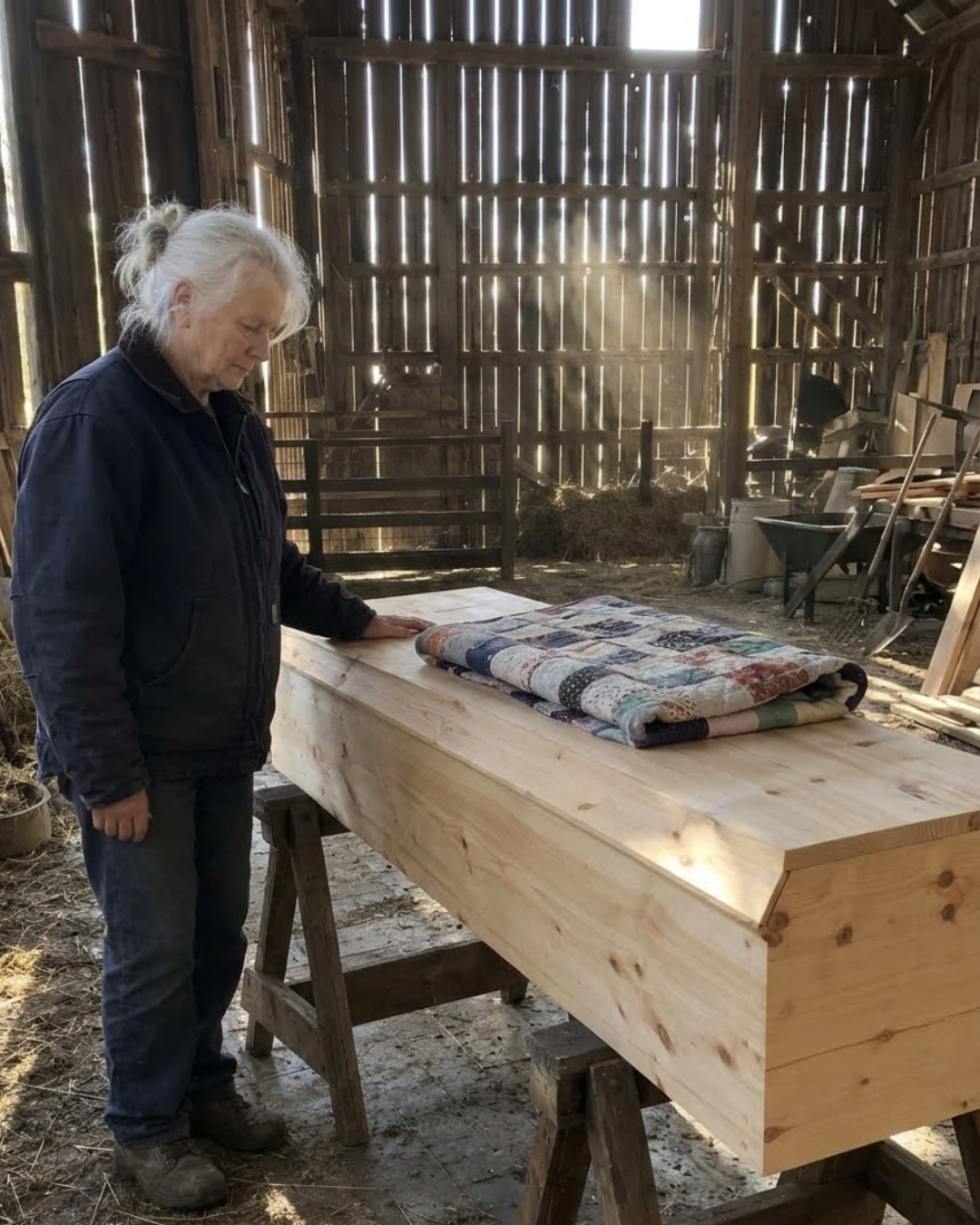
My mother’s hand stopped on the lid, and I leaned in close enough to read what the chisel had left.
It wasn’t a name. That was what undid me. I had expected Walter Pruitt, 1941 to whenever, the kind of thing a man carves when he’s planning his own end. Instead, running the length of the lid in my father’s blocky, careful capitals, deeper at the corners where his hand had pressed harder, were seven words.
DIANE. YOU WERE RIGHT TO MAKE ME WAIT.
Mom took her hand away and pressed it flat against her chest.
“Mom?”
“I’ll tell you inside the barn,” she said. “Not out here. Your brother’s car is coming up the road.”
I should tell you who we are.
My name is Beth Pruitt Callahan. I’m fifty-one, a pediatric nurse in Portland, Oregon, three time zones and a lifetime from the farm where I grew up. My father, Walter Pruitt, was a carpenter in Harlan County for fifty-four years. He built half the porches in the county and a good share of the staircases, and when he died on a Thursday in March, at eighty-three, in his own bed, with the radio on low, there were forty-one people at the hospital who had never met each other, all of whom owed him a deck, a cabinet, or a favor.
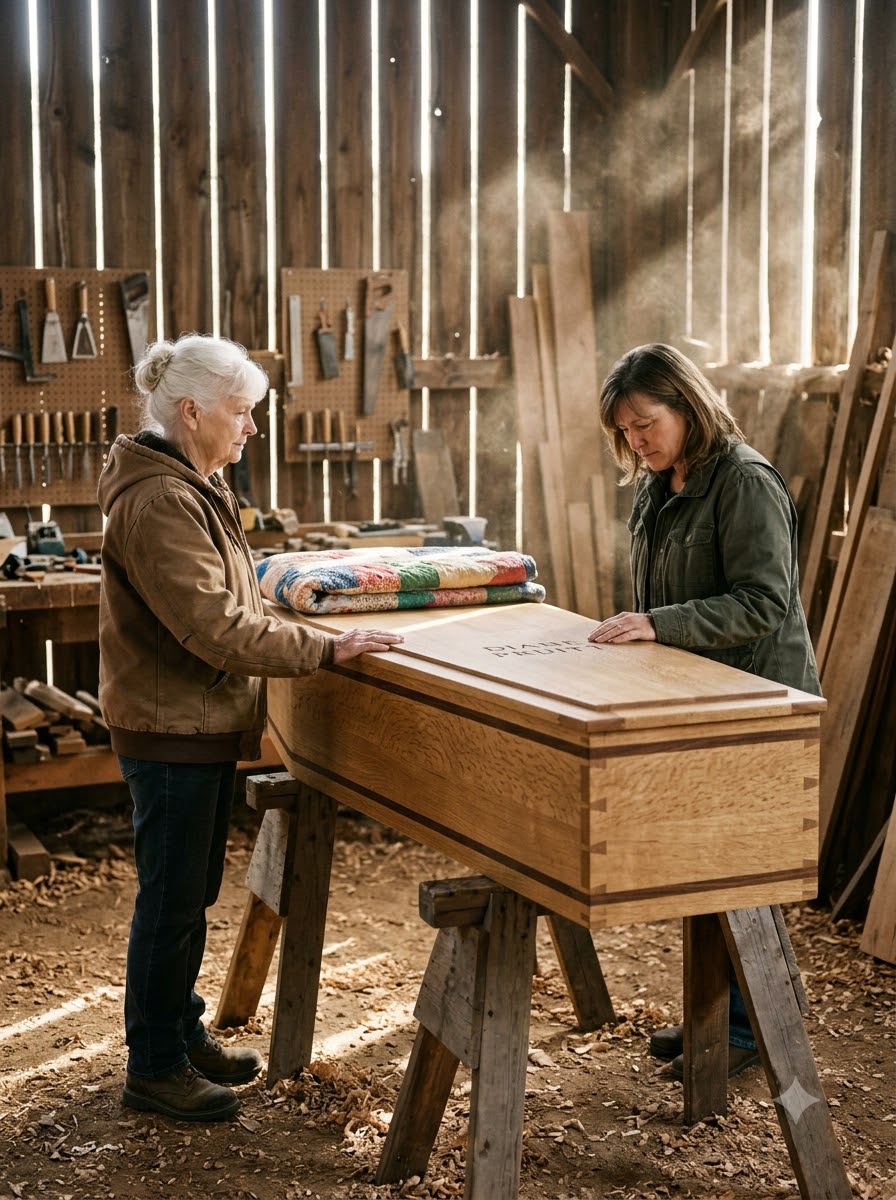
My mother is Diane. She’s seventy-nine, five foot one, with a spine like a plumb line. She taught third grade for thirty-one years and has never once raised her voice in a room, because she never needed to.
My brother is Kevin. Kevin is fifty-three, lives eleven minutes from the farm, sells commercial insurance, and has one gift, which is certainty. He is certain about everything, quickly, out loud. When we were children, he was certain the creek was safe to cross. It was not.
Kevin handled the arrangements because he lived closest. That was the family logic. I flew in Saturday morning, rented a car, and drove straight to Haskell & Sons Funeral Home, where my mother sat in a velvet chair with her purse on her knees and the look of a woman sitting through a lecture she had already graded.
Mr. Haskell, a soft, careful man in his sixties, handed me the paperwork.
Direct cremation. Basic container. $95.
“Kevin,” I said. “What is this?”
“It’s the cheapest option.” He didn’t look up from his phone. “Mom doesn’t have money for a casket. Dad’s dead. He won’t know the difference.”
“Did you ask Mom?”
“Mom’s not thinking straight.”
My mother was sitting four feet away.
She didn’t argue. I want you to understand how loud that was. She folded the paper once, neatly, along the crease, and slid it back across the desk to Mr. Haskell as if returning a library book.
“Take me home, please, Beth,” she said.
She said nothing in the car. Twenty-two minutes of country road, the fields still brown with March, and she looked straight ahead with her hands folded.
I wanted to say something. I’m a nurse. I know the shapes of grief, the ones that scream and the ones that go quiet like a held breath. I knew this was the second kind, and I knew not to fill it.
When we pulled into the gravel drive, she didn’t go into the house. Rosemary, the old beagle, came wobbling off the porch, and Mom patted her head without breaking stride. She walked straight to the barn.
I followed.
The barn was Dad’s cathedral. Forty years of sawdust had settled into its beams until the whole place smelled like cut cedar and machine oil. His workbench ran the length of the north wall, every chisel hung on its own nail, every plane in its own outline traced in black marker so he’d know if one went missing. In the back corner, under a stack of old storm windows and a blue tarp gone chalky with dust, was something long.
My mother lifted the windows off one at a time, carefully, and leaned them against the wall. Then she took the corner of the tarp and pulled.
I stopped breathing.
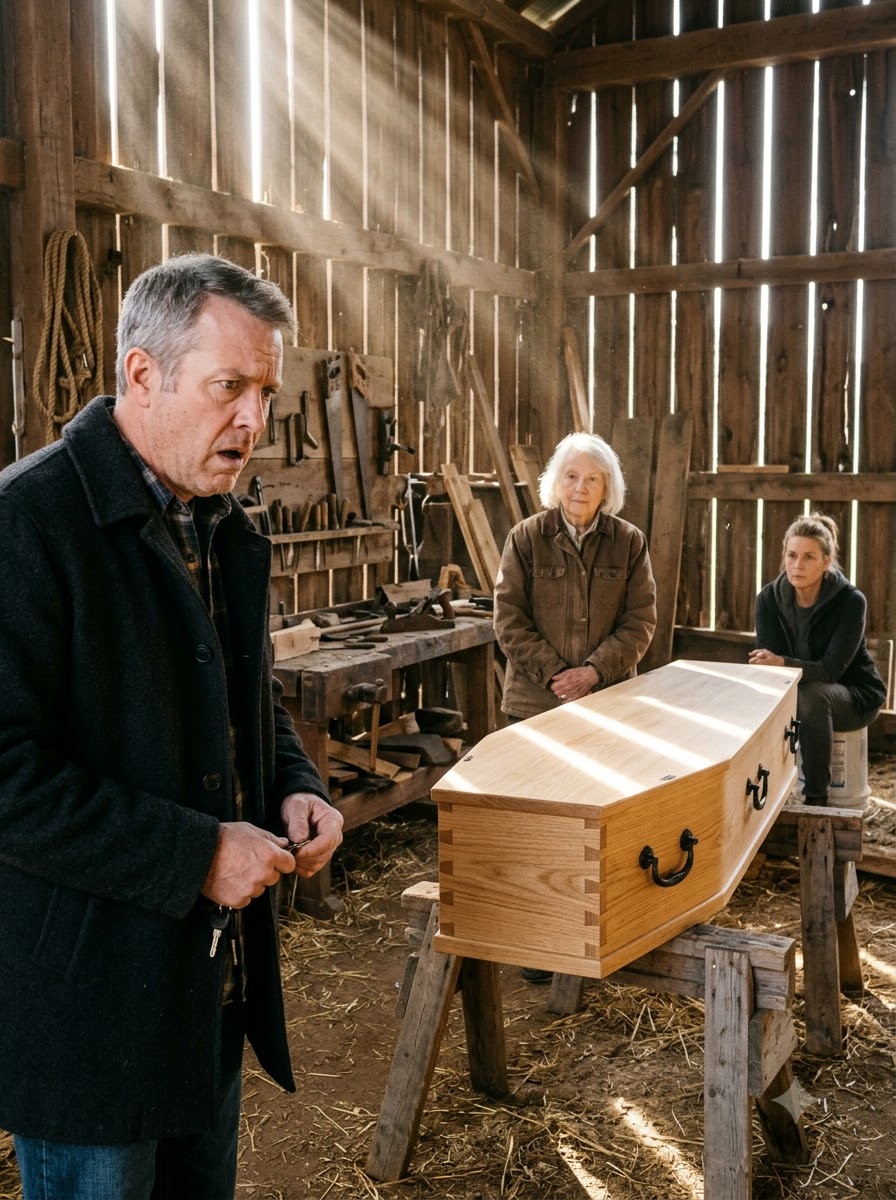
It was a coffin. Not a pine box, not a thing hammered together out of scrap. A real one, in quartersawn white oak, the grain running like water from end to end, the corners joined in dovetails so fine I had to look twice to find the seams. The lid was inlaid with a border of walnut. The handles were hand-forged iron. It had been oiled, many times, until it glowed the color of honey.
“Mom,” I whispered. “When did he…”
“Nineteen eighty-eight,” she said. “The winter he was laid off.”
“Nineteen eighty-eight?”
“The mill closed in November. He had no work till April. Five months.” She ran a finger along the dovetails. “He came out here every day and I thought he was feeling sorry for himself. I let him. One night I came out with soup and he was sanding this. He said, ‘Diane, if I’m going to be useless, I may as well be useful to somebody.’”
“Did Kevin know?”
“No.” She said it without bitterness. “Kevin never once came out to the barn.”
She took her phone from her coat pocket. It’s a flip phone, a gray relic Kevin keeps trying to replace. She pressed three buttons without looking.
“Mr. Haskell? It’s Diane Pruitt. Yes. I’m sorry about the paper. I’d like you to bring the truck out to the farm. And bring four men.” A pause. “Strong ones. It’s oak.”
She hung up. Then she turned back to the coffin and laid her palm on the lid.
That was when I saw the carving.
DIANE. YOU WERE RIGHT TO MAKE ME WAIT.
“Mom. What does that mean?”
Behind us, gravel crunched. A car door slammed.
“Inside the barn,” she said again, and drew me deeper into the shadows, between the workbench and the stacked lumber, where the light from the door didn’t reach.
“I’ll tell you something your father and I have never told anyone,” my mother said.
I sat on an upturned bucket. She stood, because Diane Pruitt does not sit for important things.
Part 2
“In 1968, I was twenty-one, and your father was twenty-five. He’d asked me to marry him three times. I said no each time.”
“You said no?”
“He was a good man, and I knew it. But I’d been accepted to a teaching program in Lexington, and I wanted to finish. And I wanted…” She stopped. “I wanted to be sure I was choosing him and not just choosing the first person who asked.”
“What did Dad do?”
“He said, ‘I’ll wait.’ Just that. Two words.” Her mouth twitched. “He waited four years. In that time he built me a hope chest, a writing desk, and a rocking chair, and he never once mentioned that I owed him an answer.”
I’d never heard this. In fifty-one years, I’d never heard this.
“I said yes in 1972, on a Tuesday, at the kitchen table. And he cried. This enormous man, with hands like shovels. He put his head on the table and cried.”
“Mom.”
“He told me, years later, that the waiting taught him something. That a thing you’re given too fast, you don’t know how to hold.” She laughed softly. “That’s what he meant by the carving. He made the coffin that winter. When he was ruined, when he thought he’d failed. And he carved that on the lid because he knew I’d find it one day, and he wanted me to know that he’d never resented the wait.”
Her voice cracked on the last word. She pressed her lips together.
“He made his own coffin so that I’d never have to choose between what I could afford and what he deserved. And Kevin called it a box that doesn’t matter.”
The barn door scraped.
“Mom?” Kevin’s voice, bright and brisk. “Mom, what are you doing out here? Beth, why’s she out here? It’s freezing.”
He appeared at the end of the aisle in his good wool coat, car keys in hand, still wearing the half-annoyed expression of a man whose plan has been interrupted.
“Mr. Haskell called me. He said you asked him to send a truck. I told him it was a mistake, that you’re upset.”
“I’m not upset,” my mother said.
“Mom.”
“I’m quite calm.”
He came down the aisle. He saw the coffin.
I watched my brother’s face. I’ve thought about it often since. It didn’t go through a clean sequence. It stuttered. Confusion, then recognition, then something small and cold, like a man seeing his own handwriting on a page he didn’t remember writing.
“What is that?”
“It’s your father’s coffin.”
“Dad made a coffin?”
“In 1988.”
“Why didn’t anybody tell me?”
“Because you never came out to the barn,” my mother said, evenly. “Kevin. Not once in thirty-five years. Not to see what he was building. Not to ask what he loved. You came for Christmas, and you stood in the kitchen, and you told him what he should be doing with his retirement.”
“That’s not fair.”
“It is. I’m sorry that it is.”
Kevin’s jaw worked. “Mom, I was trying to help. You don’t have any money. The farm is mortgaged. I did the math. A funeral is eight, ten thousand dollars, and we don’t…”
“Did you ask me whether I had money?”
“I assumed…”
“You assumed.” She nodded, slowly. “You have a talent for it.”
I’d like to tell you I stepped between them. I didn’t. I sat on my bucket with my hands between my knees, feeling about eleven years old, because I recognized something. I recognized the particular silence that falls when a long-withheld sentence is finally about to be said.
“I have eleven thousand dollars in a coffee can in the pantry,” my mother said.
Kevin stared. “What?”
“It’s been there since 1999. Your father put a little in every month. He said it was for the day. I never touched it.” She folded her hands. “It’s enough for a plain funeral. A proper one. The kind he’d have wanted.”
“Why didn’t you say so at Haskell’s?”
“Because I wanted to see what you’d do.” The words were quiet, almost gentle. “I wanted to know whether my son would choose the cheapest box for his father, or whether he’d stop and ask.”
Kevin’s face went gray.
“I’m sorry you had to find out that way,” Mom said. “But I needed to know.”
“Mom, that’s, that’s a test. That’s not fair.”
“No,” she agreed. “It isn’t. And I’m sorry. But you’d have done it to a stranger without a second thought. I wanted to see if you’d do it to your father.”
Kevin opened his mouth. Nothing came out.
“He won’t know the difference,” she said. “That’s what you said. And you’re right, Kevin. He won’t. But I will. And Beth will. And you will, for the rest of your life.”
He sat down on a sawhorse. My brother, who had never once in his life been out of words, sat on a sawhorse in a barn with his keys hanging from his fingers, and said nothing for a very long time.
Outside, a truck rumbled up the drive. Mr. Haskell’s hearse. Four men in dark suits climbed out, big, quiet young men, the sons of local farmers, and stood in the barn door with their hats in their hands.
“Mrs. Pruitt,” Mr. Haskell said softly. “We’re here.”
“Thank you, Mr. Haskell. It’s in the back.”
They came down the aisle with the careful, reverent shuffle of men trained to carry other people’s grief. One of them, a lanky boy of about twenty-five, stopped at the sight of the coffin.
“Ma’am,” he said. His voice cracked. “Did Mr. Pruitt build this?”
“He did.”
“That’s, those are hand-cut dovetails.” He swallowed. “My granddad was a joiner. He told me nobody does that anymore.”
“Walter did.”
The boy reached out and stopped, his fingers an inch above the oak.
“May I?”
“Please.”
He touched it. Gently, the way you’d touch a sleeping animal.
“It’s beautiful,” he whispered.
“Yes,” my mother said. “It is.”
Kevin finally spoke.
“Mom.” His voice was thin. “I don’t know what to say.”
“Then don’t say anything.”
“I should have asked. I should have, I should’ve come out here. I should’ve asked Dad what he wanted.” He put his face in his hands. “I thought I was being practical. I thought that’s what you do, you handle things, you make the hard calls. I was so busy handling it that I forgot he was my father.”
My mother crossed the barn. She stood in front of him, five foot one, and looked down at her fifty-three-year-old son on a sawhorse.
“Kevin.”
“Yeah.”
“Look at me.”
He lifted his head. His eyes were red.
“I’m not angry,” she said. “I want you to know that. I was, in that office. But I’ve been angry for a long time, at a lot of things, and I’m tired.” She put her hand on his cheek. “I just want you to come to the funeral and carry your father’s coffin. And I want you to look at the lid before you do.”
“Okay.”
“And I want you to read it out loud.”
His face crumpled. “Mom.”
“Out loud, Kevin.”
We buried Dad on a Tuesday.
It was a clear March morning, cold and bright, with the last of the snow lying in thin white seams along the fence rows. The church was Pleasant Grove Baptist, a white clapboard building Dad had re-roofed in 1991, and every pew was full. I counted two hundred and six people. Men in work jackets, women in their church coats, kids in their only good shoes. A line stood out the door.
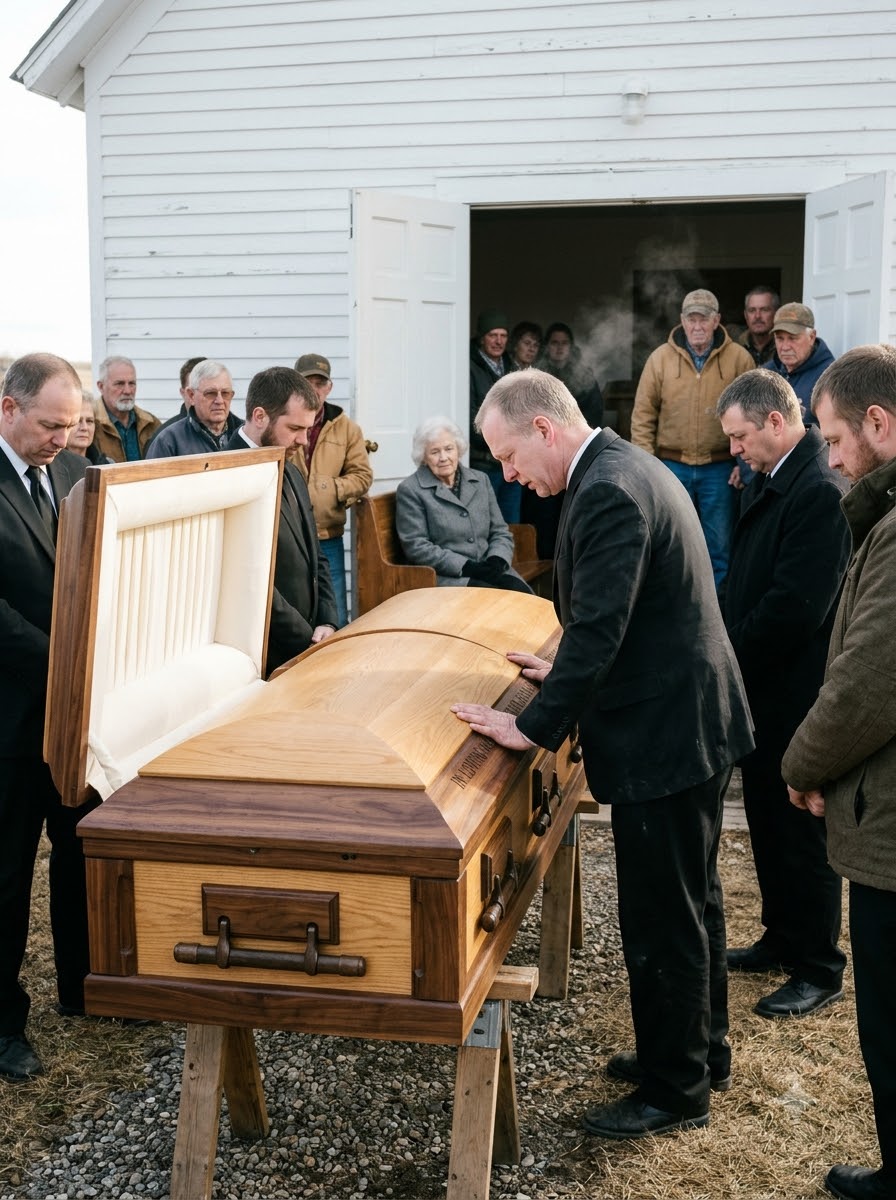
The coffin sat at the front, on a bier, lid open. The white oak glowed in the plain winter light. People filed past it slowly, one at a time, and I noticed that nobody touched the dovetails without first touching their own chest.
Mr. Haskell stood at the back. He’d refused payment for the transport. “It’s an honor, Mrs. Pruitt,” he’d said. “I’ve buried four hundred men in this county. I’ve never carried one in something like that.”
Pastor Dale delivered the eulogy, a decent one, with the usual warmth. But when he finished, my mother stood.
She wasn’t scheduled to speak. She’d told me that morning she wouldn’t. But she rose from the front pew in her good gray dress and walked to the lectern with her small steady steps, and two hundred people went quiet.
“I won’t be long,” she said. “Walter hated long speeches.”
A soft ripple of laughter.
“I want to tell you about the box.”
She told them. Not all of it, not the part about the four-year wait. She kept that. But she told them about 1988, and the closed mill, and a man who went out to the barn every winter morning and came back with sawdust in his eyebrows and a quiet, secret pride. She told them he’d built it without telling a soul.
“He built it,” she said, “because he didn’t want me to have to choose. He knew that a woman at a funeral home will always choose the plainer thing, to spare the family. So he decided to take the choice away.”
She paused. Her voice, for the first time, shook.
“That’s what love is, I’ve decided. It isn’t flowers. It’s a man in a cold barn, doing a hard thing in advance, so you won’t have to do it alone.”
Nobody moved.
“I want to ask something of you,” she said. “When you go home today, I want you to think of a hard thing you can do in advance for someone you love. A will. A conversation. A coffin, if you’ve the skill. Do it. Do it before the funeral. Because I promise you, it’s the greatest gift anyone ever gave me.”
She stepped down. Nobody applauded. It was a church, and she was a widow. But a sound went through that room, a long, low exhale, two hundred people letting go of something at once.
Kevin was the last to carry.
He stood at the foot of the coffin with the five other men, my cousins and Mr. Haskell’s sons, in a black suit he’d borrowed because his own didn’t fit. He looked pale and ten years older. When the pastor nodded, the men bent and took the handles.
Kevin hesitated.
He looked down at the lid. I saw his lips move. I couldn’t hear. But I saw them form the words, one at a time, the way a boy reads aloud for a teacher.
Diane. You were right to make me wait.
He stood there with his hands on the iron. Then he looked up, across the pews, and found our mother’s eyes.
She nodded.
He lifted. The six of them carried my father out of Pleasant Grove, down the center aisle, past two hundred faces, into the cold, bright morning. Kevin’s shoulders were shaking the whole way. He didn’t let go.
Part 3
I flew back to Portland that Friday. But I came again in June, and again in September, and by Christmas I’d put in for a transfer to the hospital in Harlan.
I’m back on the farm now. I live in the little house on the north field, the one Dad built in 1994 for his mother. It’s got a porch. He built it, of course. I sit on it in the evenings with a cup of tea and watch the light go amber over the pasture, and the barn stands against the sky like something that has kept a promise.
Mom still lives in the big house. She’s eighty now, and she’s started teaching again, a reading group for third graders at the library on Wednesdays. They call her Mrs. P. She brings oatmeal cookies. She keeps a jar of Dad’s pencils on the table, and when a kid has trouble spelling a word, she hands them one, stubby and chewed, and says, “Walter always said you can’t write what you haven’t touched.”
Kevin comes out every Sunday.
It started awkwardly. He’d stand in the kitchen, hands in his pockets, looking like a boy waiting to be called on. Then one Sunday in April, without saying a word, he walked out to the barn.
I followed, at a distance. He stood in the doorway for a long time. Then he walked to the north wall, to the workbench, to the tools hanging on their nails, each one in its own outline. He ran his fingers along the chisels.
“Beth,” he said, without turning. “What’s this one for?”
“A mortise chisel. For cutting the slot a tenon fits into.”
“Show me?”
So I did, badly, because I’m a nurse. But Mom came out, in her garden gloves, and took the chisel from my hand.
“Like this,” she said, and showed him. Fifty-four years of watching a man work had gone into her wrists.
That was how it began. Every Sunday, the three of us, in the barn. Kevin’s first joint was a catastrophe. His second was worse. By August, he’d made a small, lopsided stool, and he carried it into the kitchen like a dog bringing in a bird.
“It wobbles,” he said.
“They all wobble,” my mother said. “Your father’s first one fell apart in my lap.”
“Really?”
“Sat on it at a church supper. Went straight through.” She smiled. “He kept the pieces. They’re in a coffee can on the shelf.”
Kevin laughed. It was the first real laugh I’d heard from him in years, big and cracked and startled. Mom looked at him, and her whole face softened.
I want to tell you about the last thing I found in the barn.
It was in October, seven months after the funeral. I’d come out to look for a hammer. Behind the workbench, wedged between two joists, where you’d only see it if you were looking, was a small cedar box about the size of a loaf of bread. Dad’s careful dovetails. A brass hinge. On the lid, in the same blocky capitals:
FOR KEVIN. WHEN HE ASKS.
I stood with it in my hands for a long time.
Then I carried it to the house and set it on the kitchen table, where Kevin, who’d come early, was helping Mom shell peas.
“What’s this?” he asked.
“It’s yours. Dad left it.”
He wiped his hands on his jeans. He took the box very carefully. He read the lid, and his throat worked.
“When he asks,” he said, hoarsely. “I never asked.”
“You did,” my mother said, quietly. “You asked in the barn. With that chisel.”
He opened it.
Inside, on a folded square of flannel, lay a small carpenter’s pencil, flat and red, worn to a nub. Beneath it, a note on lined paper in Dad’s slanting hand.
Kevin,
I know you think I never noticed you. I noticed. You were the one who cared whether things worked. I never knew how to say it, because I was a quiet man and you were a loud boy, and it seemed like we were speaking different languages.
This pencil was my father’s. He gave it to me when I was your age. I’ve been waiting for you to ask about the barn so I could hand it over.
I’m sorry I didn’t ask you first. I think we were both waiting for the other one to knock.
Dad
My brother read it twice. Then he put the paper down, very carefully, on the table, and put his face in his hands.
Mom came around and wrapped her arms around his shoulders. He shook in her grip like a man being slowly unbuttoned. I sat across from them with tears running down my face, and I thought of a four-year wait, and a coffin in a corner under a tarp, and a carved sentence that said, you were right to make me wait.
Everyone in that family, I realized, had been waiting for someone else to knock.
Kevin made his first real piece last spring. A small oak chest, with a lid and a hinge and, on the front, in clumsy, uneven letters, a name.
He brought it to the house on Mother’s Day and set it on the kitchen table in front of Mom.
“What’s this?”
“Open it.”
She did. Inside, folded neatly, was a piece of lined paper. She unfolded it and read it, and her hand went to her mouth.
I don’t know exactly what it said. She’s never shown me. But I’ve seen her read it a dozen times since, on the porch, with her tea going cold, and each time she touches the lid of the little chest before she closes it.
Kevin stood in the doorway with his hands in his pockets, looking like a nine-year-old at a recital.
“It’s crooked,” he said.
“It’s perfect,” Mom said.
“The dovetails are, one of them’s, there’s a gap.”
“Kevin.” She set the paper down. She crossed the kitchen and took his face in both her hands. “It has your father’s gap. I’d know it anywhere.”
He laughed, helplessly, and put his arms around her, and the two of them stood there swaying in the afternoon light while I looked out the window at the barn and the long gold field and the oak at the edge of the yard that Dad had planted the year I was born.
Someone asked me recently, at a church supper, whether I’d argued with my brother that day in the funeral home.
“Not exactly,” I said.
“Would you have?”
I thought about it honestly. About the velvet chair and the folded paper, and Kevin’s thumb on his phone.
“I think I’d have wanted to,” I said. “But my mother taught me something that afternoon. There are two ways to stop a mistake. You can shout at it. Or you can walk quietly to a barn and pull back a tarp, and let the truth do the talking.”
“Which works better?”
“The shouting fixes the afternoon,” I said. “The tarp fixes the family.”
The woman nodded, slowly. She had a kind face, creased and tired. I could see her thinking about someone.
“Walter would have liked that,” she said.
“He’d have said it was too long.”
“He’d have said, ‘Pass the rolls.’”
We laughed. It was a good laugh, warm and brief, the kind you only get in a church basement. Across the room, my mother caught my eye and lifted her cup, the tiniest, driest salute, and I lifted mine back.
Out in the barn, on the north wall, the chisels hang in their outlines. The mortise chisel has a new place now, a little worn, next to a flat red carpenter’s pencil in a glass jar.
And in the corner, where the coffin used to sit, there’s an empty space on the floor, the shape of a long, narrow rectangle, where the dust has not yet settled.
Mom says she’s keeping it clear.
She says one day she’ll need it. And she says that when she does, she won’t have to ask anybody to knock.
