

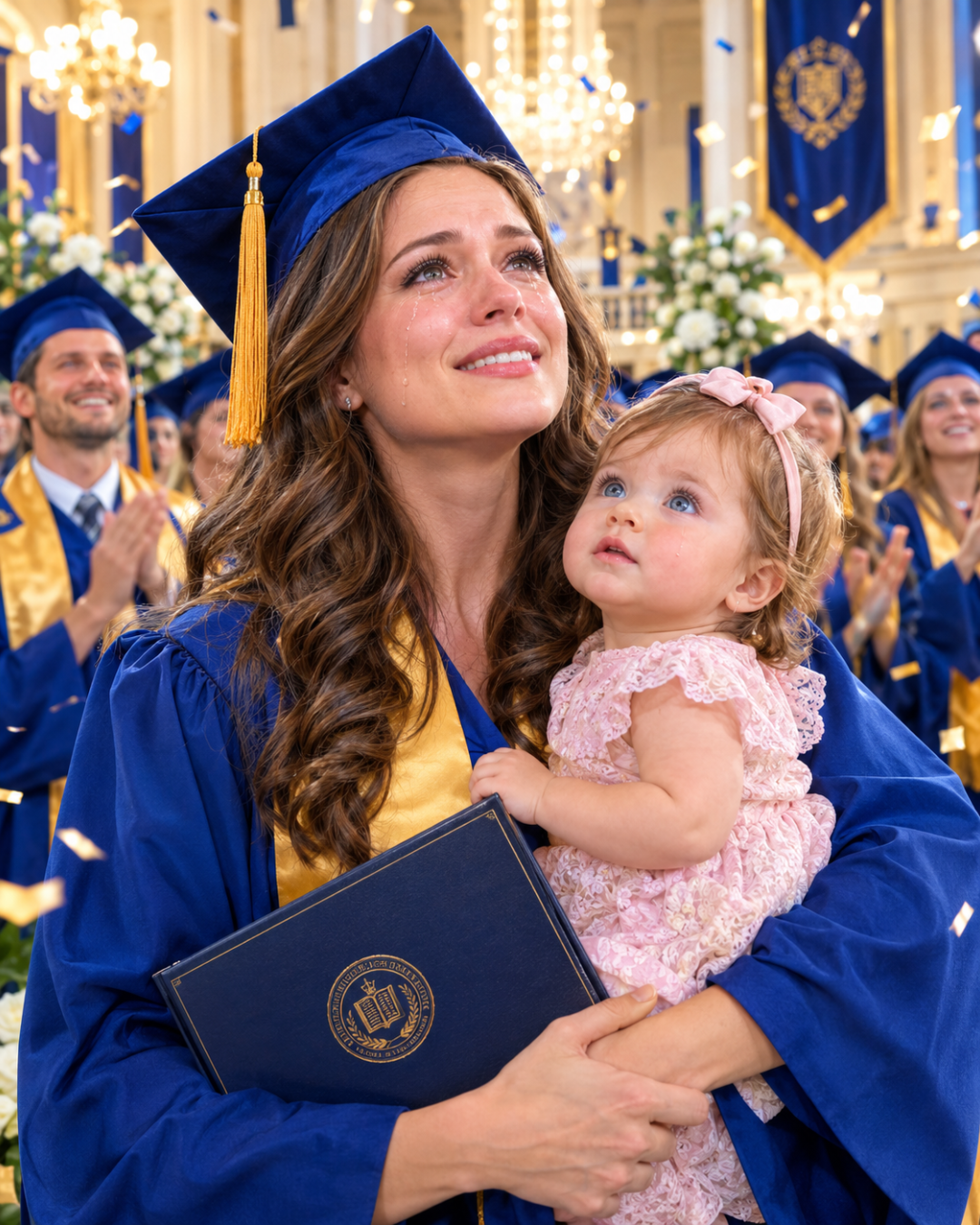
Part 1: The Girl He Thought He Had Destroyed
For three years, my life had been measured in sleepless nights, endless textbooks, and cups of coffee that had gone cold long before I remembered to drink them.
The university library had become my second home. Its stale air, humming fluorescent lights, and uncomfortable wooden chairs were as familiar to me as my own reflection.
I was twenty-one years old, a pre-med student with a perfect academic record, and I had sacrificed almost everything to remain at the top of my class.
Then, one freezing winter afternoon, everything changed.
I was sitting on the cold porcelain edge of a sink in the campus clinic’s restroom, staring at a pregnancy test.
Two pink lines.
I checked them again.
And again.
They didn’t disappear.
My hands trembled so badly that I nearly dropped the test.
Outside the frosted window, the wind swept through the bare elm trees, scattering the last dead leaves across the campus sidewalks.
I pressed my palm against my stomach.
I was pregnant.
Fear settled over me with such force that I could barely breathe.
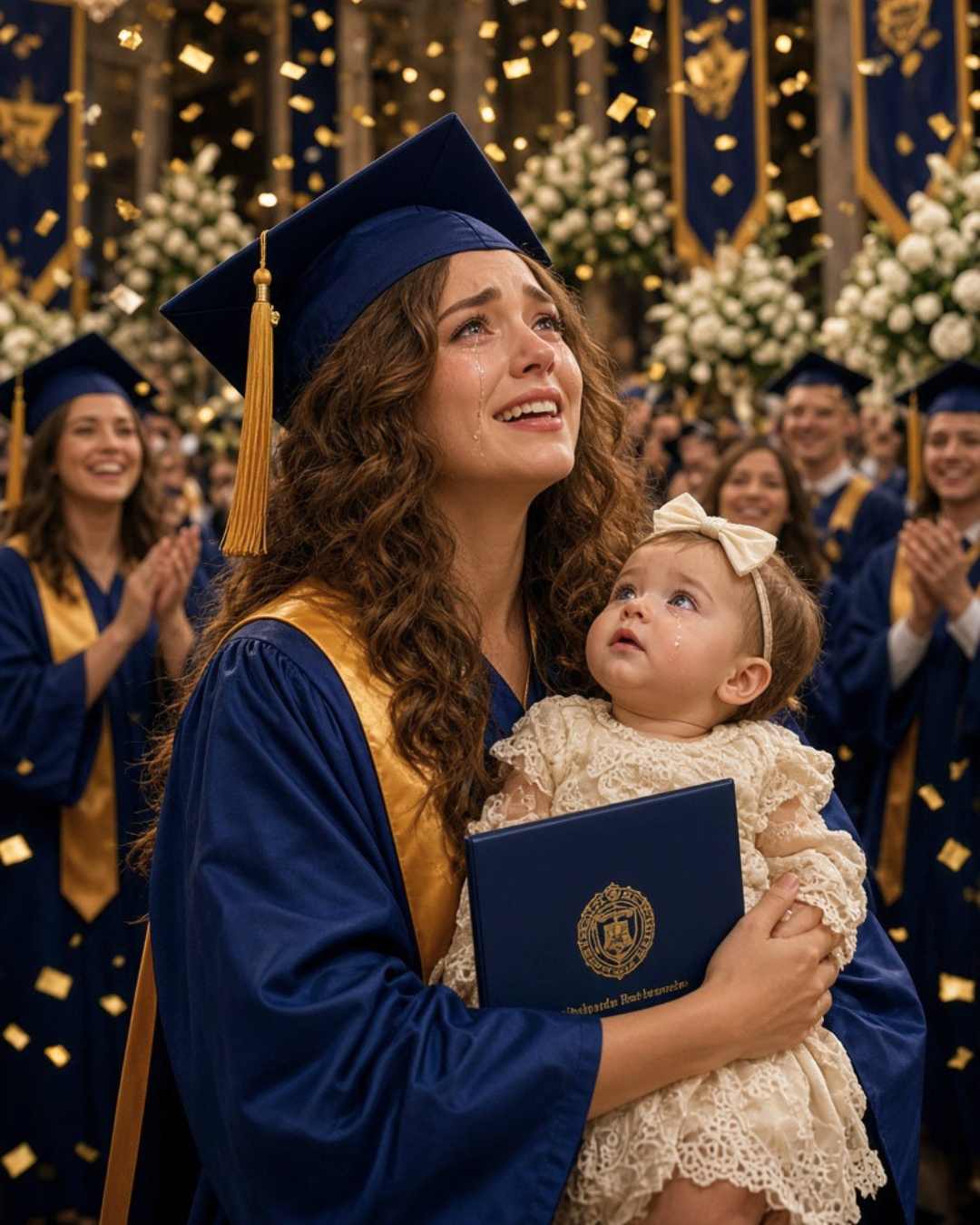
I had worked relentlessly to maintain my 4.0 GPA. My professors expected extraordinary things from me. I was preparing for medical school, research opportunities, and a career that had been my dream since childhood.
Now I was going to have a baby.
My first thought was of Julian.
Julian was everything the university admired.
Handsome, ambitious, confident, and always perfectly dressed, he was one of the most recognizable students on campus.
He was a rising pre-law star, a prominent member of an elite fraternity, and a young man who seemed to have his entire future arranged before graduation.
We had been together long enough for people to call us the university’s power couple.
I genuinely believed we loved each other.
I imagined him taking my hands, reassuring me, and promising that we would find a way forward together.
I was about to discover how little I understood the man I’d trusted.
That evening, I told him in the kitchen of our small off-campus apartment.
The heating system had broken again, and I was wearing my late grandfather’s thick wool sweater to stay warm.
Julian stood beside the counter, polishing his expensive leather shoes for a networking dinner.
I waited until I could find the courage to speak.
Then I told him about the baby.
His hand stopped moving.
He didn’t look surprised in the way I’d expected.
He didn’t come toward me.
Instead, he carefully placed the shoe brush on the newspaper covering the counter and slowly turned around.
The expression on his face frightened me more than anything he could have said.
There was no concern.
No tenderness.
Only contempt.
“You’re joking,” he whispered, his voice dangerously even. “Tell me you are playing some kind of sick, pathetic joke.”
My throat tightened.
“I’m not,” I stammered, my throat tight with unshed tears. “Julian, I’m terrified, but we can manage this. I can still take my finals. We can…”
“We?” he interrupted, a sharp, bitter laugh escaping his lips. “There is no ‘we’ in this equation, Clara. Are you completely out of your mind? I have a clerkship with a federal judge lined up for the fall. I am being courted by three different tier-one law firms. I have a bright future ahead of me, built on immaculate credentials and elite social circles. I cannot, and I will not, be dragged down by a pregnant dropout who just threw her entire life into the gutter.”
I stared at him.
It took several seconds for the full cruelty of his words to register.
He wasn’t worried about our child.
He wasn’t concerned about my health or my education.
He was thinking about his reputation.
To Julian, our relationship had always been part of a carefully constructed image. As long as I remained the brilliant, attractive student standing beside him, I was useful.
But the moment my life became complicated, he decided I was disposable.
Something inside me hardened.
“I’m not dropping out,” I said, my voice hardening, the first spark of defensive anger igniting in my chest. “I have a 4.0. I am at the top of my cohort.”
He stepped closer.
“Not anymore,” he sneered, stepping closer, towering over me. His pristine cologne—something sharp and expensive with notes of cedar and arrogance—suddenly made me nauseous. “You’re done, Clara. It’s over. Nobody respects a pregnant undergrad waddling into a gross anatomy lab. You’ll be exhausted. You’ll fail. Your academic and personal life is effectively over. Do us both a massive favor. Pack your things. Lose my number. I am not letting your catastrophic mistake ruin my trajectory.”
I could hardly recognize him.
The man I’d loved was speaking as though my pregnancy were a professional inconvenience that needed to be removed.
Then he turned away and resumed polishing his shoes.
That simple gesture told me everything.
My pain didn’t matter enough to interrupt his preparations for dinner.
I didn’t beg.
I didn’t shout.
I walked into the bedroom, pulled my old canvas duffel bag from the closet, and began packing.
Two hours later, I carried my textbooks down the icy apartment steps in a cardboard box.
The wind cut through my coat.
My fingers were numb.
Julian watched from the doorway.
He didn’t offer to carry a single thing.
Instead, he smiled.
“Have a nice life in mediocrity, Clara,” he called out into the freezing air.
I stopped at the bottom of the steps.
For a moment, I wanted to turn around and tell him exactly what I thought of him.
But I knew he wouldn’t listen.
I placed my hand protectively over my stomach.
Then I spoke quietly into the cold.
“Remember those words, Julian. Because I promise you, you will choke on them.”
I left without looking back.
The following months tested every part of me.
I rented a tiny studio apartment above a laundromat, where the floors trembled whenever the machines downstairs began their spin cycles.
The windows leaked cold air.
The furniture was secondhand.
The kitchen was barely large enough for one person.
But it was mine.
Nobody could threaten to throw me out of it because my existence had become inconvenient.
I continued attending classes.
I studied until my vision blurred.
I completed assignments between medical appointments and worked shifts at the campus library whenever I could.
There were mornings when nausea made it almost impossible to stand.
There were nights when exhaustion left me crying quietly over an open textbook.
But I refused to let Julian’s prediction become my future.
Every cruel word he’d spoken became another reason to continue.
I learned to study more efficiently.
I arranged independent coursework with professors who recognized my determination.
I finished research assignments ahead of schedule and attended every required seminar.
My classmates saw less and less of me.
Eventually, many assumed I’d disappeared from the program.
I didn’t correct them.
I was too busy building a life that didn’t depend on anyone else’s approval.
Two weeks before graduation, I went into labor.
My daughter was born in the university hospital’s maternity ward.
I named her Maya.
She was tiny, warm, and beautiful, with delicate fingers that curled instinctively around mine.
When the nurse placed her against my chest, I felt something I’d never experienced before.
For months, I’d been fighting to survive.
Now I understood exactly who I was fighting for.
I kissed Maya’s forehead.
“We’re going to the top, baby girl,” I whispered, tracing the soft curve of her cheek. “Just watch us.”
Motherhood didn’t make my life easier.
It made every hour more demanding.
My apartment became a constant cycle of feeding, changing diapers, washing clothes, and studying.
I learned to read medical journals while rocking Maya.
I reviewed lecture notes while preparing bottles.
I memorized research findings during the brief moments when she slept.
One Tuesday morning, just before graduation, I was still awake at three.
The street outside was almost silent.
Maya rested against my chest in a soft fabric carrier, her breathing gentle and steady.
My laptop illuminated the scratched wooden desk.
I was finishing the final paragraphs of my senior thesis, a detailed study of pediatric neuroplasticity.
My eyes burned.
My shoulders ached.
Every muscle begged for sleep.
But I kept typing.
When I finally submitted the completed thesis, I sat back and stared at the screen.
Then I opened the university’s academic portal.
The page took several seconds to load.
I held my breath.
When my records appeared, I read them once.
Then again.
Cumulative GPA: 4.00.
Status: Summa Cum Laude.
Departmental Rank: 1.
Valedictorian Status: Confirmed.
I covered my mouth.
I’d done it.
Despite the pregnancy, the abandonment, the financial struggles, and the sleepless nights, I’d finished at the very top of my college.
I hadn’t merely survived.
I’d achieved everything Julian insisted was impossible.
I looked down at Maya.
She slept peacefully, unaware that her mother had just accomplished something extraordinary.
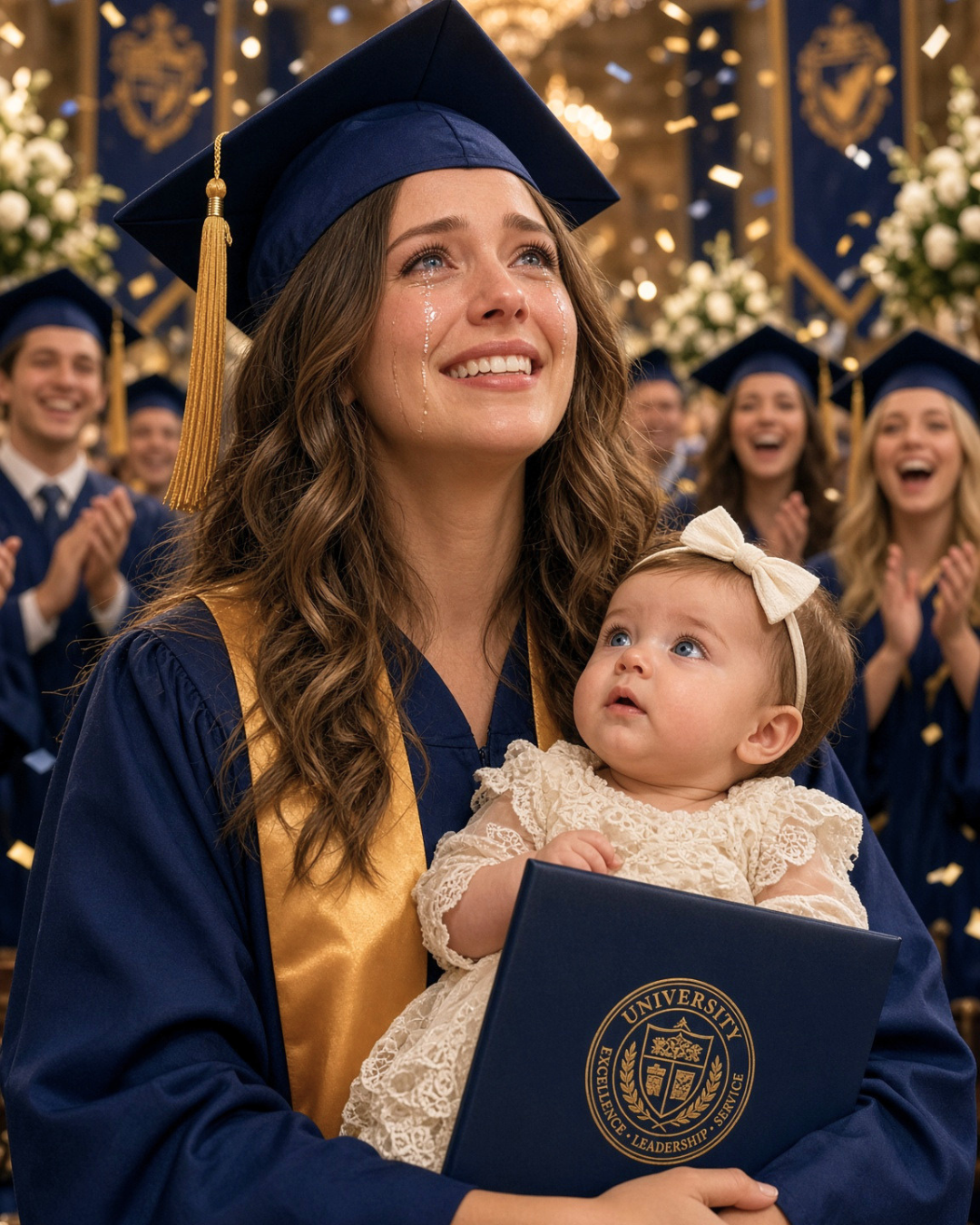
Across campus, Julian was celebrating his own expected success.
Social media showed him at fraternity events, raising champagne glasses beside wealthy alumni and influential professors.
He believed his 3.9 GPA would make him valedictorian.
He had apparently continued mocking me.
A mutual acquaintance told me he’d recently laughed about my supposed failure.
“That little dropout is probably changing dirty diapers in a damp basement somewhere while I prepare to take the stage,” he had supposedly laughed just days prior.
I didn’t respond.
There was no reason to.
Julian didn’t know about my academic results.
And he knew even less about the inheritance my grandfather had left me.
Arthur Sterling, my mother’s father, had been a successful industrialist who built an enormous business empire.
He believed wealth should create opportunities, not determine someone’s value.
When he died during my freshman year, he left behind a charitable foundation that supported university research and scholarships.
The Sterling Foundation Trust had financed major campus projects, including the magnificent auditorium where graduation ceremonies were held.
But almost nobody knew I was Arthur Sterling’s granddaughter.
My grandfather had deliberately kept our family connection private.
Under the terms of his estate, the trust would remain under independent management until I graduated.
Only then would I inherit executive authority over its assets.
The value of that inheritance was twenty million dollars.
Before he died, Grandfather had made me promise not to reveal my connection to the foundation.
“Never let them respect your money before they respect your mind, Clara,” he had told me on his deathbed, his frail hand gripping mine with surprising strength. “Make them see you first.”
I kept that promise.
I lived on my scholarship and modest library wages.
I bought secondhand clothes.
I ate inexpensive meals.
And I never used my grandfather’s wealth to impress anyone.
Julian had believed I was simply an intelligent girl from an ordinary family.
He’d never suspected that the woman he discarded would eventually control the very foundation responsible for some of the university’s most prestigious buildings and scholarships.
As I sat looking at my academic results, an email notification appeared.
The sender was the Office of the University President.
I opened it.
The message requested my presence onstage at commencement.
It confirmed that the university intended to formally acknowledge the transfer of executive authority over the Sterling Foundation Trust.
I was instructed to bring a specific wax-sealed envelope to the podium.
I read the email carefully.
Then I looked down at my sleeping daughter.
A small smile crossed my face.
Julian was preparing to stand before five hundred guests and celebrate the future he believed belonged to him.
He had no idea whose name the university president was actually going to announce.
Part 2: Five Hundred Witnesses to His Biggest Mistake
Graduation morning arrived beneath a cloudless blue sky.
Sunlight illuminated the university’s manicured lawns, and the scent of blooming jasmine drifted through the warm air.
The Sterling Grand Auditorium stood at the center of campus.
Its towering glass walls, polished mahogany, and sweeping steel architecture made it one of the university’s most impressive buildings.
My grandfather’s foundation had paid for its construction.
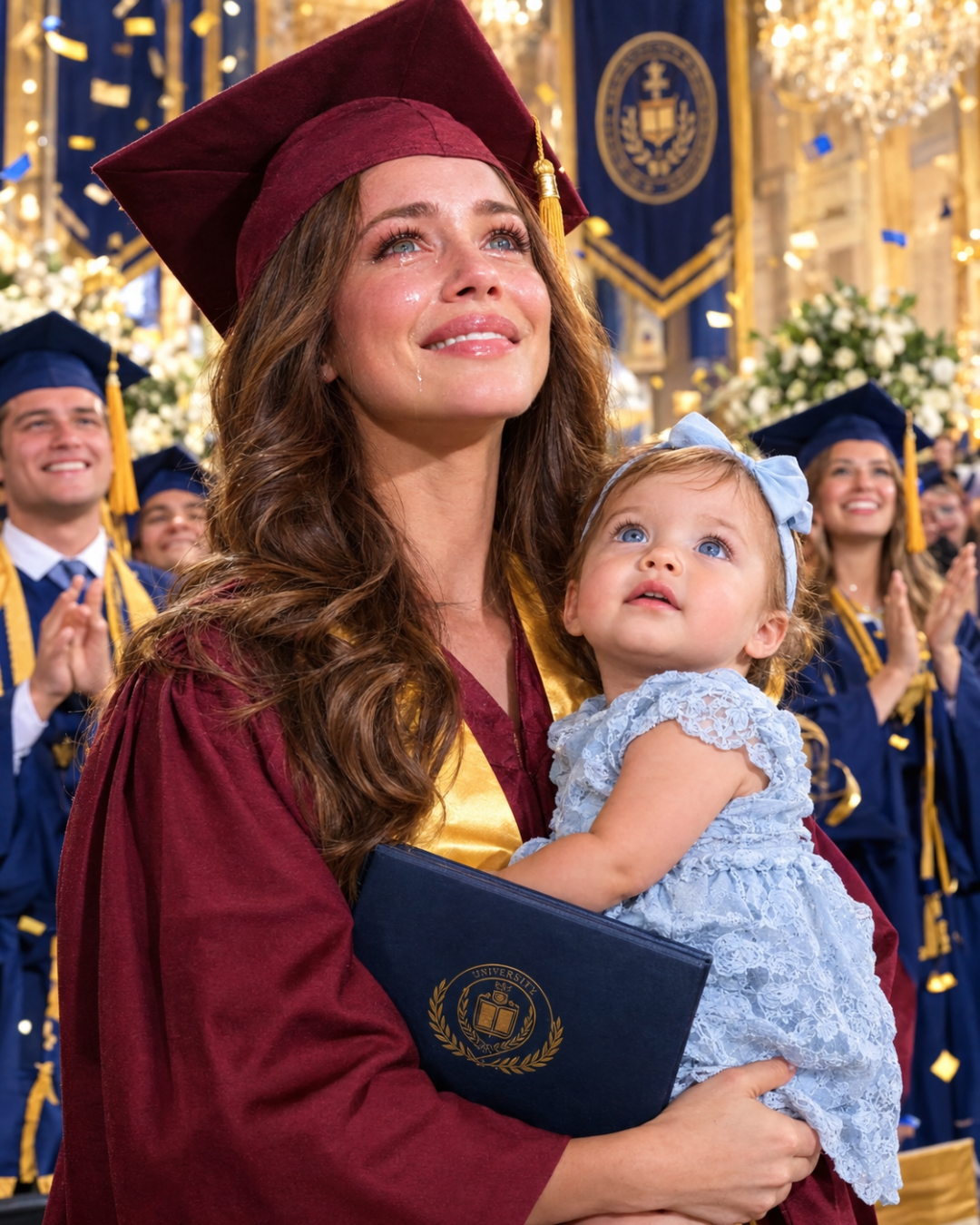
Today, I was going to walk through its doors carrying my newborn daughter.
Inside, approximately five hundred guests had gathered.
Parents held bouquets.
Graduates adjusted their caps and gowns.
Faculty members greeted alumni.
Wealthy donors occupied the VIP seating areas.
Everyone seemed excited about the ceremony.
I stood briefly in the vestibule, adjusting my graduation gown.
Maya rested securely against my chest in a navy-blue baby carrier.
Her dark eyes followed the lights overhead.
I gently smoothed her hair.
Then I straightened my shoulders and entered the auditorium.
Almost immediately, people began looking at me.
A young woman carrying a newborn through the center aisle of a prestigious graduation ceremony was apparently unusual enough to attract attention.
Whispers followed me.
Some people looked curious.
Others seemed openly disapproving.
I kept walking.
I had spent too many nights fighting for that moment to let strangers make me ashamed of being there.
Near the front of the auditorium, Julian sat among the honors students.
His black gown was immaculate.
A gold honors stole hung across his shoulders.
His hair was perfectly styled beneath his graduation cap.
He was speaking animatedly with the dean of the law school, laughing loudly and enjoying the attention.
Then he noticed the people turning toward the aisle.
He followed their gaze.
Our eyes met.
For a brief instant, his expression showed genuine surprise.
He clearly hadn’t expected to see me.
Certainly not wearing a graduation gown.
And definitely not carrying our daughter.
His surprise quickly transformed into anger.
He stood.
I could see the decision forming behind his eyes.
Julian had always hated losing control of a room.
He couldn’t tolerate being ignored.
And my presence threatened to distract everyone from the celebration he’d imagined for himself.
So he did what he’d always done when he felt threatened.
He tried to humiliate me.
“Well, well!” Julian called out, pointing a rigid, accusing finger directly at me. The surrounding chatter instantly died, sucking the air out of the room. “Look at the dropout failure dragging a baby into a place she clearly doesn’t belong! Tell me, Clara, did you get lost on the way to the welfare office? Did you come here to beg for charity from the successful students, or just to remind everyone what a catastrophic, walking mistake looks like?”
His voice carried across the auditorium.
Several fraternity brothers laughed.
A few parents gasped.
The law school dean looked uncomfortable but remained silent.
I stopped in the center aisle.
Every eye seemed fixed on me.
I could feel the weight of hundreds of strangers waiting for my reaction.
Julian wanted tears.
He wanted me to lower my head.
He wanted me to run out of the auditorium, humiliated, so he could return to his seat feeling powerful.
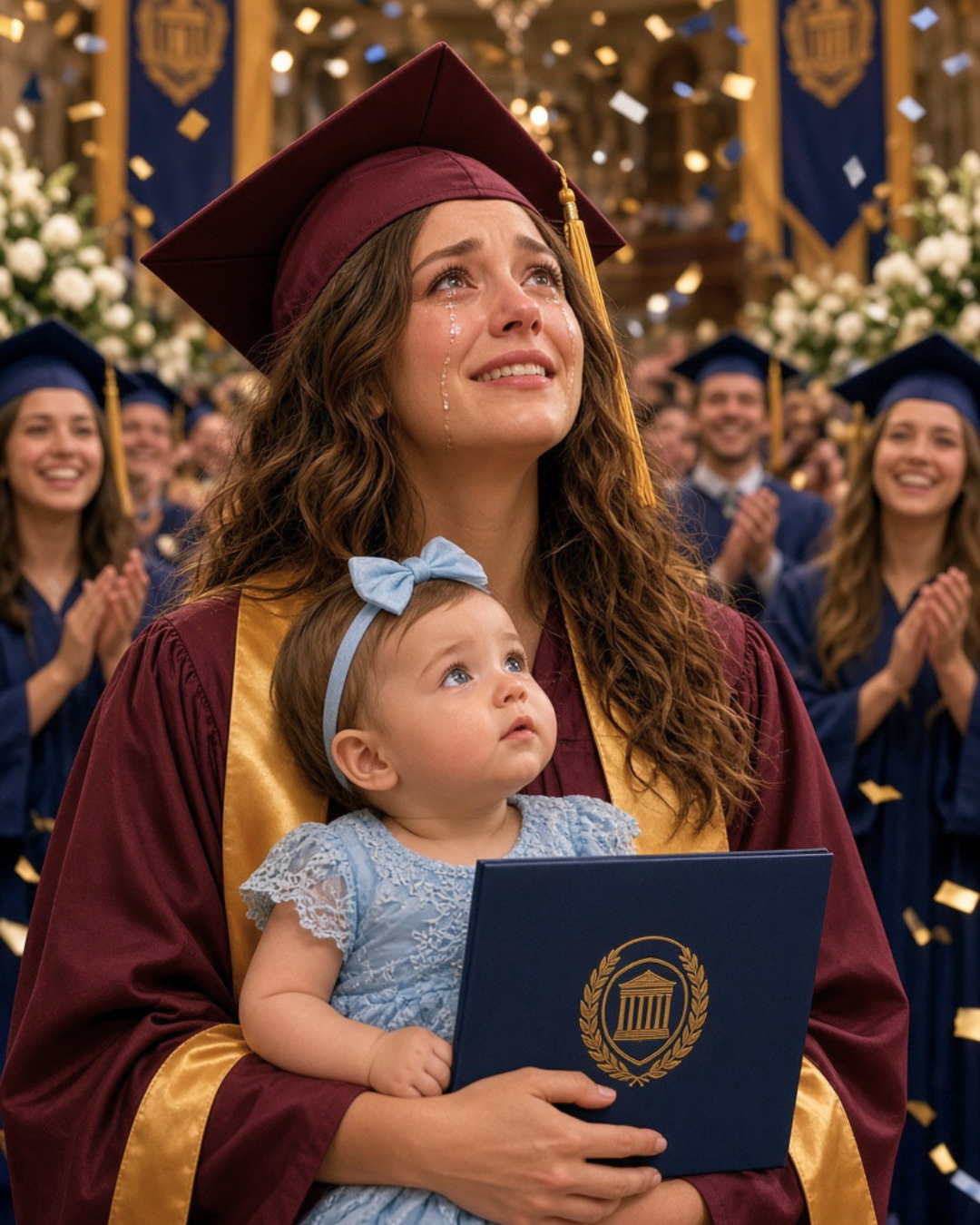
Instead, I looked directly at him.
I remembered the freezing apartment.
The cardboard box filled with textbooks.
The nights when I could barely keep my eyes open.
The hospital room where Maya had been born.
And the academic results waiting in my university record.
I smiled.
I didn’t say a word.
My silence seemed to disturb him more than any insult could have.
He shifted uncomfortably.
Then he turned toward his friends.
“Just watch. Watch the President call my name next. That’s how a real winner finishes.”
I remained where I was.
Because I knew something Julian didn’t.
The university president was already preparing to walk onto the stage.
And the announcement he was about to make would change everything.
The heavy curtains opened.
Dr. Aris Thorne stepped forward.
The university president was a distinguished silver-haired man known for his demanding academic standards.
He carried a leather-bound folder and approached the central podium.
The microphone briefly squealed as he adjusted it.
Then his voice filled the auditorium.
“Welcome, faculty, distinguished guests, alumni, and the graduating class,” Thorne began, his tone grave and ceremonial. “Before we proceed with the conferring of degrees, and before we honor the wider body of our exceptional graduates, we have a very specific, and highly unique, recognition to execute.”
Julian immediately straightened.
He adjusted his gold stole and leaned forward.
He looked ready to stand.
President Thorne continued.
“It is custom,” President Thorne continued, his eyes sweeping the room, “to invite our top academic achiever to this podium. To speak for the class. This year, the decision was not merely clear; it was mathematically indisputable. Step forward, please… Valedictorian Clara Sterling.”
For a moment, nobody reacted.
The announcement seemed to hang in the air.
Then people began turning toward me.
I saw Julian freeze.
His confident smile disappeared.
His mouth opened slightly.
He looked toward the president, then back at me, as though he’d misheard the name.
I continued down the aisle.
Maya remained comfortable against my chest.
My shoes clicked softly against the polished wooden steps as I approached the stage.
President Thorne stepped aside to welcome me.
Then he turned back toward the audience.
“I believe there was a misunderstanding voiced from the floor moments ago,” President Thorne continued, his voice ringing with fierce, protective pride. It was a direct, devastating rebuke. “Let me be entirely clear. Miss Sterling is not a failure. She is not a dropout. She is graduating at the absolute, undisputed top of her college with a flawless, perfectly maintained 4.0 Grade Point Average. A feat she accomplished while simultaneously navigating the profound demands of carrying and delivering a newborn child.”
A wave of astonishment swept through the auditorium.
People whispered.
Several graduates looked toward Julian.
His face had gone pale.
He was no longer sitting upright with the effortless confidence he’d displayed moments earlier.
He gripped the armrests of his chair.
But President Thorne wasn’t finished.
He opened the leather folder.
“Furthermore,” Thorne’s voice dropped an octave, commanding absolute authority. He reached into his leather folder. “As verified by our Board of Trustees and our legal counsel this morning, Miss Sterling is not just our top student. She is the sole, direct blood heir to the twenty-million-dollar Sterling Foundation Trust. The very trust that built this auditorium you sit in today. The trust that funds the scholarships of half the honors students in the front row. Effective today, upon her graduation, Clara Sterling is the sole executive director of the university’s largest endowment, making her our most esteemed benefactor and, effectively, the most powerful individual in this room.”
The auditorium erupted.
People gasped.
Guests in the VIP sections leaned forward.
Faculty members exchanged stunned looks.
The announcement seemed almost impossible to believe.
The woman Julian had just publicly called a failure was the university’s top graduate.
She was also the heir to a twenty-million-dollar foundation that funded major academic programs.
I looked down at him.
His expression had changed completely.
He seemed unable to process what he’d heard.
He’d spent years trying to impress powerful alumni, prestigious law firms, and university leaders.
And moments earlier, he’d insulted one of the institution’s most important benefactors in front of all of them.
He had done it publicly.
Loudly.
Without hesitation.
I didn’t need to say anything.
The consequences of his own behavior were unfolding in front of him.
Someone near the back of the auditorium began applauding.
Another person joined.
Then a professor stood.
Within seconds, the applause spread throughout the hall.
Hundreds of guests rose to their feet.
The sound became thunderous.
I stood beside the podium, holding the sealed envelope while Maya slept against my chest.
For months, I’d been invisible to the people who assumed my life was over.
Now five hundred people were standing in recognition of what I’d accomplished.
Julian sank into his chair.
The golden boy who’d been so eager to command the room appeared desperate to disappear from it.
I waited until the applause began to fade.
Then I stepped toward the microphone.
Maya stirred.
A tiny sleepy sound escaped her lips and carried through the auditorium speakers.
The audience responded with gentle laughter.
I smiled and rested my hand against her back.
“Thank you,” I began, my voice steady, clear, and surprisingly resonant in the massive space.
I looked across the audience.
Then my gaze settled briefly on Julian.
“We are often taught,” I said, my voice echoing off the high, glass ceilings, “that success is a ladder we climb by stepping on the rungs of prestige, status, and the validation of others. We are told that vulnerability is a weakness, that unexpected hardships are disqualifying failures.”
I paused.
“But true strength isn’t measured by how loud you mock others from a position of comfort. It isn’t found in a tailored suit or a cruel comment made to mask your own insecurities.”
Julian looked away.
“True power, the kind of power that builds legacies and changes the world, is measured by how you rise when the world expects you to break. It is found in the quiet, unglamorous hours of the night. It is found in the refusal to let someone else dictate your worth.”
I lifted my chin.
“To my fellow graduates, do not let anyone tell you that your struggles define you as a failure. Your struggles are the forge that tempers your steel. We are the authors of our own narratives. Build your own tables, fund your own dreams, and never, ever let arrogance convince you that you are anything less than a force of nature.”
I stepped away from the microphone.
The applause returned even louder than before.
Some parents wiped tears from their eyes.
Professors stood smiling.
Graduates cheered.
I held Maya close, feeling her steady breathing against my chest.
For the first time since Julian had thrown me out, I no longer felt that I had anything to prove to him.
I had already proved everything to myself.
The remainder of the ceremony passed in a blur.
Afterward, I went backstage, where faculty members, donors, and professional recruiters approached to congratulate me.
Senior partners from prestigious law firms introduced themselves.
Medical research deans offered business cards and discussed future opportunities.
People wanted to speak about fellowships, research programs, and the foundation’s plans.
I listened politely.
I understood that my grandfather’s fortune had attracted some of their attention.
But my academic record was something I’d earned through my own work.
Then I noticed movement near a service corridor.
Julian was leaving.
He’d removed his gold honors stole and was carrying it crumpled in one hand.
His head was lowered.
None of the fraternity brothers who’d laughed at me earlier were beside him.
He approached a rear exit.
Before he could leave, a uniformed campus security officer stepped into his path.
The officer handed him a white envelope bearing the university’s official crest.
I recognized it.
The dean had already told me that Julian’s public conduct would be reviewed.
The envelope contained a formal notice from the academic disciplinary committee concerning his targeted harassment of another student.
The university would determine whether his actions violated its standards and what consequences were appropriate.
His honors recognition and recommendations could be affected.
Julian stared at the envelope.
Then the heavy exit door swung shut behind him.
I turned back toward the people waiting to congratulate me.
I had no intention of chasing him.
Whatever happened next would be the result of his choices.
And I had a daughter, a medical career, and a foundation to think about.
But three years later, an unexpected encounter would remind me just how different our lives had become.
Part 3: The Legacy He Never Imagined
Three years passed.
The memories of my cramped studio apartment gradually became less painful.
I could still remember the laundromat vibrating beneath the floor, the bitter coffee, and the endless nights of studying while Maya slept against me.
But those memories no longer represented defeat.
They reminded me how much I had survived.
At twenty-four, my life looked entirely different.
I had completed my medical training path as the story’s youngest rising specialist and was working as Dr. Clara Sterling, Director of Pediatric Neurology, at the newly expanded Sterling Medical Research Institute.
The institute was a remarkable facility.
Its spacious lobby featured polished Italian marble, enormous windows, and modern laboratories equipped for advanced medical research.
Fresh flowers stood near the reception desk.
Researchers and physicians moved through the halls discussing new trials, treatment strategies, and funding proposals.
I wore a tailored blazer bearing my name and title.
My grandfather’s foundation had given me the resources to support important medical work.
But I never wanted that money to become a symbol of superiority.
I wanted it to help children.
I wanted it to fund research that might otherwise remain trapped behind financial barriers.
I wanted it to give families opportunities they might never receive on their own.
Every decision reminded me of something Grandfather had taught me.
Money was useful only when it served a purpose beyond itself.
That morning, I stood in the institute’s lobby reviewing preparations for a new research program.
Then a familiar little voice called out.
“Mommy! Look!”
Maya was running across the polished floor.
She was now an energetic toddler with dark curls, bright eyes, and a curiosity that seemed to grow stronger every day.
Her shoes squeaked against the marble.
She pointed toward a large brass plaque mounted on the wall.
I smiled and walked over.
Kneeling beside her, I followed her gaze.
The plaque read:
The Sterling Foundation: Founded by Arthur Sterling, Expanded by Dr. Clara Sterling. Dedicated to the relentless pursuit of knowledge and the unbreakable strength of the human spirit.
I looked at the engraved words.
My grandfather’s name.
My name.
Two generations connected by something far more meaningful than money.
Maya stared at the letters.
“That’s our name, sweetie,” I said softly, brushing a curl from her forehead.
Sunlight streamed through the windows and illuminated her face.
“Our name,” she repeated, her eyes wide with innocent pride.
I lifted her into my arms.
She laughed and wrapped her little hands around my neck.
For a moment, I simply held her.
I remembered the hospital room where I’d first promised that we would reach the top together.
Back then, I hadn’t known exactly what the future would bring.
I only knew I would never let someone else’s cruelty determine what my daughter believed was possible.
“Never let anyone tell you who you are, my love,” I whispered fiercely into her ear, a vow for her future. “You write your own story. You build your own stage.”
She rested her head against my shoulder.
And for that moment, nothing else mattered.
Later that afternoon, my driver took me through downtown traffic.
I sat in the back of the town car reviewing a grant proposal on my tablet.
The project involved pediatric research, and I was examining the budget before an upcoming meeting.
Rain began tapping against the windows.
At a red light near the financial district, I glanced outside.
A man stood on the corner waiting for the pedestrian signal.
He wore a cheap gray suit that hung awkwardly from his shoulders.
The fabric was worn and shiny around the elbows.
He held a battered briefcase against his chest, trying to protect it from the rain.
His posture was slumped.
His expression was tired.
At first, I barely noticed him.
Then he turned his head.
I recognized the sharp jawline.
Julian.
For several seconds, I watched in disbelief.
He looked nothing like the confident young man who’d stood in the graduation auditorium three years earlier.
His expensive suits were gone.
So was the polished, effortless arrogance.
He looked older than he should have.
I’d heard fragments of what had happened after graduation.
The university’s academic ethics review had damaged his reputation.
His law school opportunities disappeared.
The prestigious firms he’d spent years trying to impress no longer wanted to be associated with him.
He’d eventually found work as a low-level paralegal for a small defense attorney in a strip mall.
Instead of the elite legal career he’d once imagined, he spent his days handling paperwork and ordinary office tasks.
I didn’t know every detail of his life.
And I hadn’t tried to find out.
But the man standing in the rain was clearly far removed from the future he’d described so confidently when he threw me out.
A city bus rolled past.
Water splashed from its tires onto the cuffs of Julian’s trousers.
He stepped back.
Then his attention shifted toward the advertisement covering the side of the bus.
It promoted the upcoming Medical Innovation Gala.
A large photograph showed me wearing a white laboratory coat.
Beneath it were the words:
Dr. Clara Sterling: Changing the Future of Medicine.
Julian stared at the advertisement.
Even through the tinted car window, I could see his expression change.
His shoulders dropped.
He closed his eyes.
For a moment, he stood motionless in the rain.
I wondered whether he remembered the day he told me my future was over.
Whether he remembered standing in our apartment while I packed my belongings.
Whether he remembered the five hundred people who’d heard him ridicule me and our newborn daughter.
Perhaps he did.
Perhaps he was thinking about everything that had happened since.
I couldn’t know.
But I knew one thing.
The life he’d predicted for me had never existed.
And the life he’d been so certain he deserved had not unfolded as planned.
The traffic light turned green.
Our car began moving.
I watched Julian disappear behind us.
Then I turned back to my tablet.
I had no desire to roll down the window.
No need to remind him of his words.
No reason to demand an apology.
The person he’d abandoned had spent years building a future without him.
And that future was filled with work I cared about, people I loved, and opportunities I intended to use responsibly.
The rain began to ease.
A break appeared in the clouds, and sunlight fell across the leather seats.
I thought of Maya waiting for me at home.
Of the children who might benefit from our research.
Of my grandfather, who’d wanted me to understand the difference between being admired for wealth and being respected for character.
And I thought about the young woman who’d stood alone outside an apartment building in the freezing wind, carrying textbooks in a cardboard box.
She had been frightened.
She had been heartbroken.
But she hadn’t been defeated.
Julian had believed that abandoning me would end my future.
Instead, it forced me to discover how strong I could become.
I never needed his approval.
I never needed his connections.
And I certainly never needed him to decide whether I deserved success.
My daughter and I had built our own life.
One difficult night, one completed assignment, one hard-earned achievement at a time.
The greatest victory wasn’t the standing ovation, the twenty-million-dollar inheritance, or even the moment Julian learned the truth.
It was knowing that the little girl sleeping against my chest on graduation day would grow up seeing a mother who refused to surrender her dreams.
And if Maya ever faced someone who tried to make her feel small, I hoped she’d remember what I’d learned.
Someone else’s cruelty does not determine your worth.
Their rejection does not define your future.
And their inability to recognize your potential does not make that potential any less real.
I had once promised my daughter that we would reach the top.
Three years later, I understood that reaching the top wasn’t about standing above Julian.
It was about building a life where his opinion no longer mattered.
And that was a victory no one could take away from us.
