

PART 1: THE SUITCASE THAT CHANGED EVERYTHING
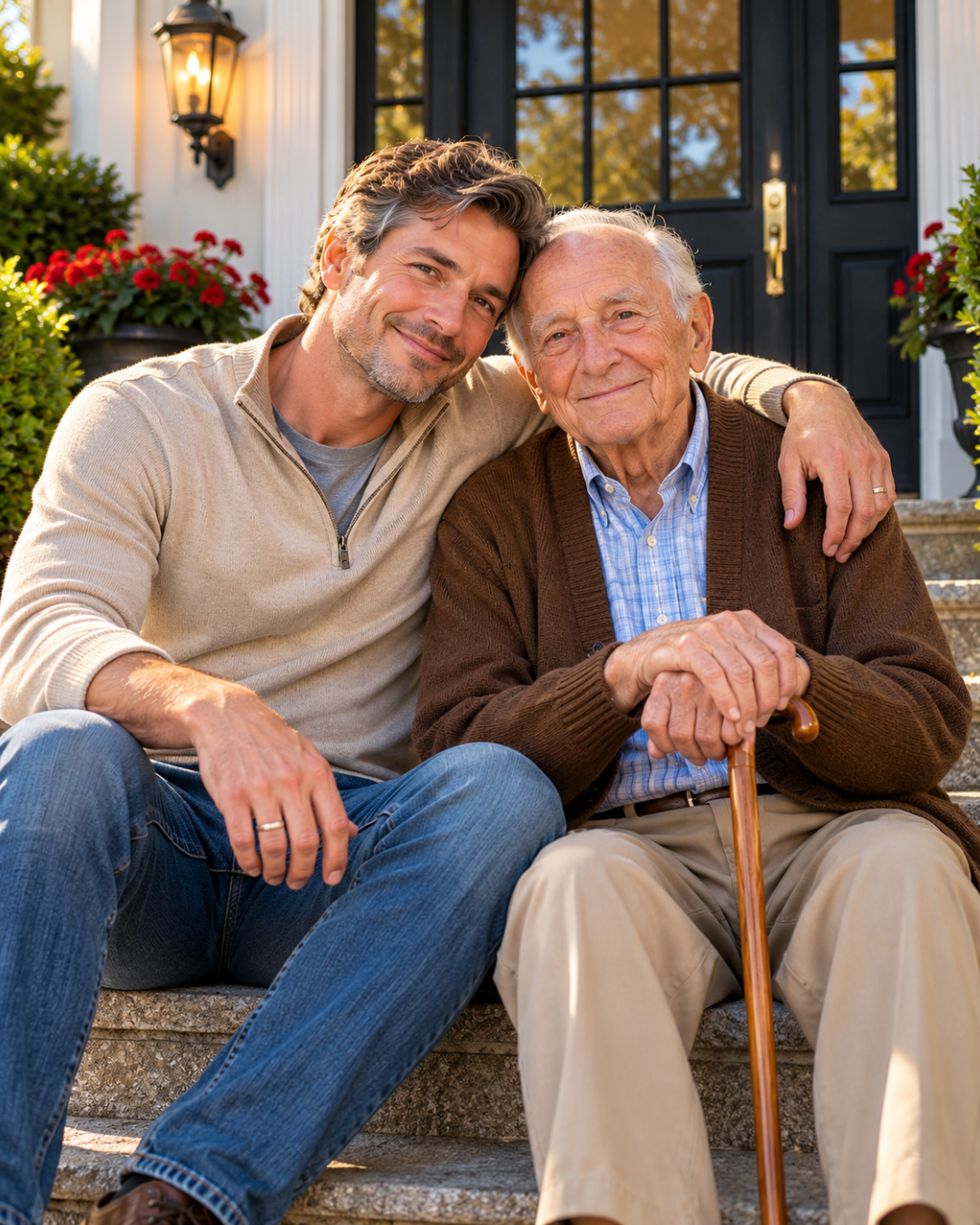
Arthur had lived next door to me for as long as I could remember.
For years, our relationship consisted of nothing more than friendly waves across the driveway, brief greetings, and the occasional conversation about the weather.
We weren’t close friends.
At least, not in the beginning.
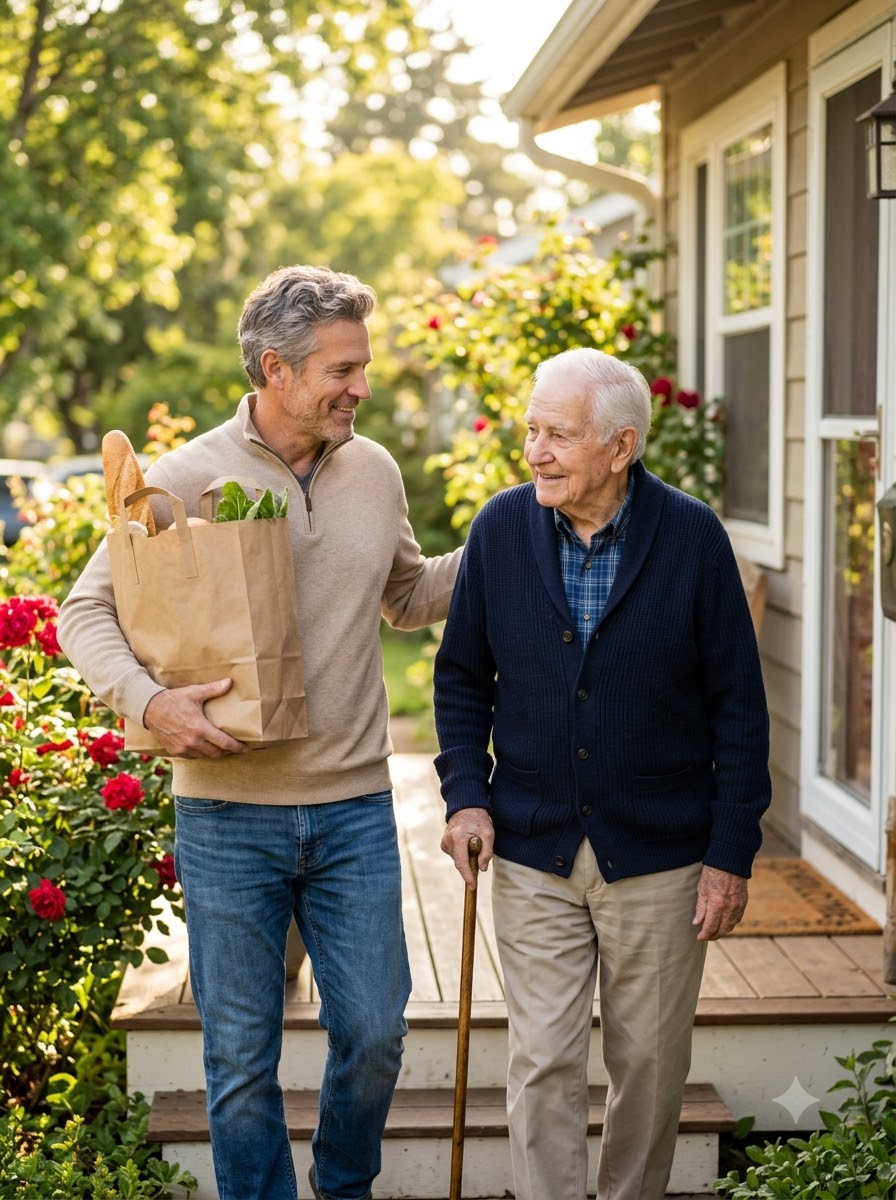
Everything changed one Sunday afternoon when I noticed him struggling to carry several grocery bags from his car.
He was having trouble keeping his balance, and one of the bags nearly slipped from his fingers.
Without thinking twice, I crossed the driveway and offered to help.
Arthur seemed surprised, but he accepted.
Together, we carried the groceries into his kitchen.
As a gesture of thanks, he invited me to stay for coffee.
I nearly turned down the invitation.
I had errands waiting at home, and I hadn’t planned on spending the afternoon chatting with my elderly neighbor.
But something about the warmth in his voice made me agree.
We sat at his kitchen table for almost an hour.
He told me stories about the neighborhood, his younger years, and the memories that seemed to live in every corner of his house.
I shared a little about my own life.
By the time I stood to leave, the conversation felt surprisingly natural.
I jokingly suggested that he call me the next time he needed groceries.
Neither of us could have imagined how important that casual offer would become.
As Arthur grew older, his health gradually deteriorated.
Driving became increasingly difficult for him, and eventually, even an ordinary trip to the supermarket required more energy than he could comfortably manage.
So I began shopping for him every Sunday.
In the beginning, he insisted on paying me for my trouble.
I always refused.
After enough unsuccessful attempts, he finally stopped offering money.
Instead, we established a routine.
I would arrive with his groceries, carry the bags inside, and put everything away.
Then Arthur would make coffee.
We would sit together at the kitchen table, sometimes for twenty minutes, sometimes much longer.
Our conversations wandered from his childhood to my family, from old neighborhood memories to whatever had happened during the week.
Sometimes we discussed serious things.
Sometimes we laughed over stories that weren’t particularly important.
And sometimes we simply enjoyed the comfort of having someone nearby.
Those Sunday visits became one of the most dependable parts of my life.
For twelve years, the routine continued.
Then one morning, I noticed that Arthur’s porch light was still burning.
It was unusual.
By noon, I learned that he had died peacefully in his sleep.
He was eighty-four years old.
The news left me with an emptiness I hadn’t expected.
Arthur had become much more than the elderly man living next door.
He was my friend.
The funeral was remarkably small.
I had imagined more people would come to honor a man who had lived such a long life.
Instead, only a handful attended.
When the service ended, I prepared to leave.
That was when a stranger in a dark suit approached me.
“Are you Julian, the neighbor who used to help Mr. Sterling?” he asked.
I nodded.
“I’m his lawyer.”
Before I could ask why he was looking for me, he handed me an old, battered suitcase.
“Mr. Sterling specifically instructed me to give this to you.”
I stared at the worn leather case.
I had no idea what Arthur could have left inside.
I carried it home, still grieving and completely bewildered.
Once inside, I placed it on the table and opened the latches.
The lid lifted with a faint creak.
And what I saw made my hands tremble.
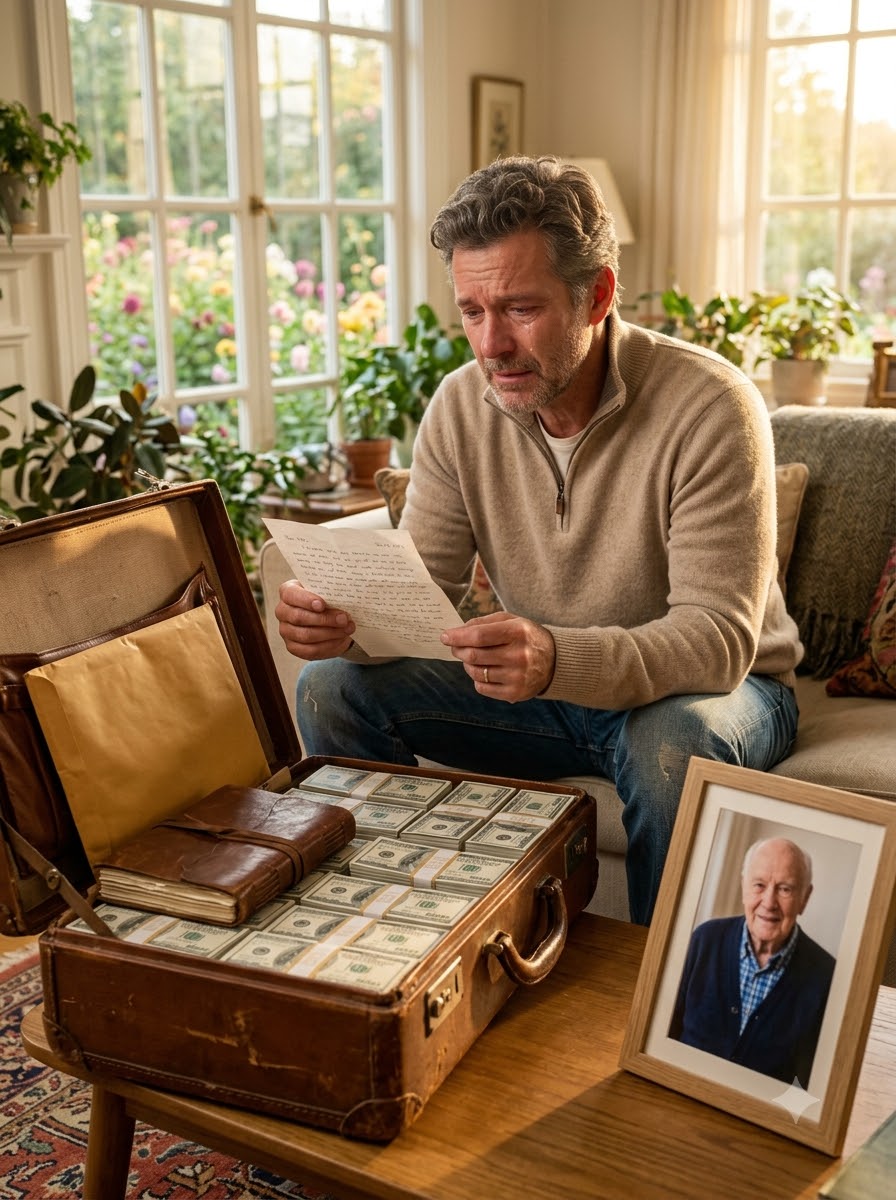
Inside the dusty brown suitcase were neatly arranged stacks of hundred-dollar bills.
Each bundle was secured with a paper band.
Beside the money rested a thick leather-bound journal and an official manila envelope marked with the crest of a law firm.
For several moments, I could only stare.
I lifted one of the bundles.
The bank strap was dated five years earlier.
As I counted the money, I realized there was nearly three hundred thousand dollars inside the suitcase.
But the cash wasn’t what overwhelmed me.
Lying across the journal was a handwritten letter.
I recognized Arthur’s careful, old-fashioned handwriting immediately.
With shaking fingers, I unfolded the paper.
Dear Julian,
If you are reading this, I’m finally at rest beside my dear Evelyn. For twelve years, you walked through my front door every single Sunday. You thought you were just delivering groceries and sharing a cup of bitter black coffee. What you didn’t know was that the very first Sunday you helped me carry those bags inside, I had planned to end my life.
My breath caught.
I lowered myself into my armchair as tears began blurring the words.
I remembered that first Sunday so clearly.
The grocery bags.
His grateful smile.
The coffee.
The photograph on his mantel.
I had never imagined what he was going through.
I continued reading.
Evelyn had passed away six months earlier, my estranged son had cut off all contact after selling off my small hardware business out from under me, and I felt like a ghost haunting an empty house. I was tired, Julian. But then you sat at my kitchen table, asked me about the framed photo on my mantle, and truly listened.
I covered my mouth.
Arthur had always spoken affectionately about Evelyn.
He’d told me about their marriage, their early struggles, and the home they’d shared.
But he’d never revealed how hopeless he had felt after losing her.
I hadn’t known that my decision to stay for coffee had reached him at the moment he needed companionship most.
The next paragraph made my tears fall harder.
You gave me twelve more years of friendship. You refused my money week after week, proving that genuine kindness still exists in a world that often feels cold and transactional.
I looked toward the open suitcase.
The money suddenly seemed almost unimportant compared with the meaning of his words.
Then I read the next section.
Inside this suitcase is $300,000—the remnants of a private land sale I kept hidden from my greedy estate executors. The manila envelope contains the deed to my house, transferred fully into your name through a revocable trust I established three years ago. Use the money to pay off your mortgage, send your kids to college, or just take a long-overdue vacation with your family.
I stopped breathing for a moment.
Arthur had left me his house.
The place where we’d spent twelve years drinking coffee, talking, and sharing ordinary Sunday mornings.
I looked back at the letter.
You were the son I wished I’d had, Julian. Thank you for buying my groceries, but most of all, thank you for saving my life.
Your friend,
Arthur Sterling
I pressed the letter against my chest.
Then I cried.
Not because I’d suddenly inherited money.
Not because I owned another house.
But because a simple act of kindness had meant so much more than I’d understood.
For twelve years, I’d believed I was helping an elderly neighbor with his weekly shopping.
Arthur had been quietly telling me that those visits gave him a reason to keep living.
And now, even after his death, he was trying to take care of my family.
I sat in the silence for a long time, remembering his smile, his stories, and the way he always had coffee ready when I arrived.
I thought the suitcase was Arthur’s final goodbye.
I was wrong.
Two weeks after his funeral, a man I’d never met appeared at my front door.
He wore an expensive suit and carried himself with obvious contempt.
A probate attorney stood beside him.
The stranger looked me up and down before speaking.
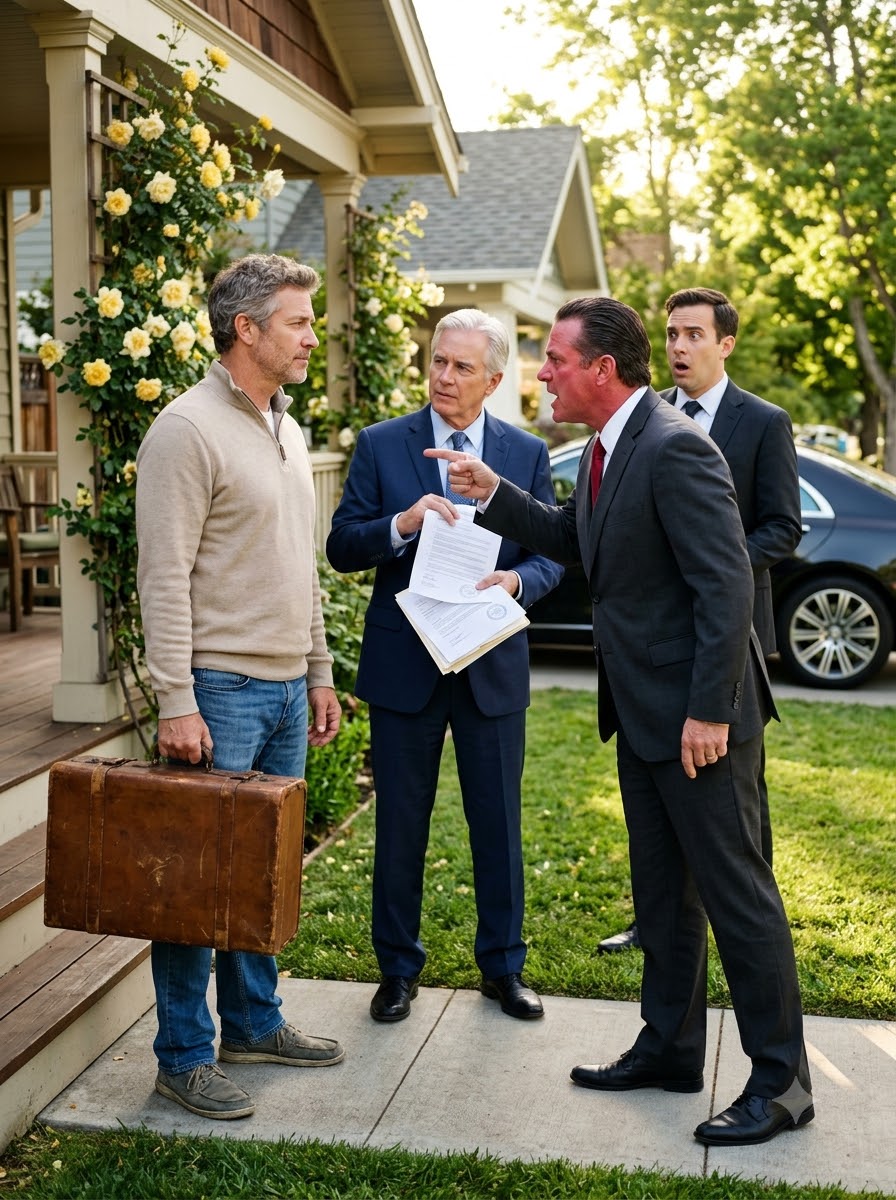
“You’re the neighbor,” Richard snapped without introducing himself, eyeing my modest home with thinly veiled contempt. “My father’s lawyer informed me that the deed to the property was transferred to you, along with personal effects. I know you manipulated a vulnerable old man into signing over his estate, and we’re filing a lawsuit for undue influence tomorrow morning.”
I stared at him.
Richard Sterling.
Arthur’s estranged son.
The man who hadn’t spoken to his father in more than fifteen years had finally returned.
And he wasn’t there to mourn.
He was there to take back everything Arthur had left me.
PART 2: THE SON WHO RETURNED FOR THE INHERITANCE
I stood on my porch, facing the man Arthur had spent years wishing would come home.
Richard looked nothing like the son I’d imagined from Arthur’s stories.
His tailored suit was expensive.
His expression was cold.
And the lawyer beside him appeared prepared for a confrontation.
I tried to remain composed.
“Your father was completely lucid until his final night, Richard,” I said, keeping my voice steady and measured. “He made his choices with a clear mind.”
Richard stepped onto the porch.
“He was an eighty-four-year-old lonely man!” Richard barked, stepping up onto the porch tread. “You brought him twenty dollars worth of bread and milk every week and stole his inheritance! I’m his blood! That land and that house belong to me!”
His accusation stunned me.
For twelve years, I’d never once asked Arthur for payment.
I hadn’t known about his land sale.
I hadn’t known he’d created a trust.
I certainly hadn’t known he’d intended to leave me his house.
All I’d wanted was to make sure an elderly neighbor had food in his kitchen and someone to talk to.
But Richard saw those Sundays as a scheme.
He believed my friendship had been an investment.
Before I could respond, a black sedan turned into my driveway.
Arthur’s attorney, Mr. Bennett, stepped out carrying a heavy leather briefcase.
He approached the porch calmly.
“Mr. Sterling,” Mr. Bennett called out calmly, adjusting his suit jacket as he walked up the porch steps. “I assumed I’d find you here trying to intimidate Mr. Vance.”
Richard spun around.
“Bennett,” Richard spat, turning around. “This contract is contestable. My legal team will tear this trust apart in court.”
Mr. Bennett remained composed.
He opened his briefcase and removed a set of certified documents.
Then he handed copies to Richard’s attorney.
“You can certainly try, Richard,” Mr. Bennett said with a cold, professional smile. “However, Arthur was well aware of your predatory nature. Every year for the last five years, Arthur underwent voluntary, independent psychiatric evaluations conducted by two board-certified neurologists. All five reports confirm 100% cognitive capability.”
Richard’s expression tightened.
Mr. Bennett pointed to another document.
“Furthermore, Arthur recorded a video deposition with the county clerk three months ago. In it, he explicitly details why he disinherited you, cites your abandonment, and states clearly that Julian Vance was receiving the property as an unprompted gift of gratitude.”
Richard’s lawyer began examining the papers.
The confidence he’d displayed moments earlier slowly disappeared.
He leaned toward Richard and whispered urgently, shaking his head.
Richard’s face reddened.
He looked from the documents to Mr. Bennett, then toward me.
His anger intensified as he realized Arthur had anticipated his challenge.
“You haven’t heard the last of this!” Richard snarled, turning on his heel and marching down the driveway, his attorney trailing right behind him.
I watched them leave.
Only after their car disappeared did I realize how tightly I’d been holding my breath.
Mr. Bennett placed a reassuring hand on my shoulder.
“Arthur anticipated every move he would make, Julian. Your home and your legacy are completely secure.”
I looked toward the house next door.
Arthur had spent his final years quietly preparing to ensure his wishes would be honored.
He’d known Richard might return.
He’d known the inheritance could cause conflict.
And he’d taken steps to protect the gift he’d chosen to leave.
I thanked Mr. Bennett, still struggling to comprehend everything.
When he departed, I stood outside for a while, looking at Arthur’s porch.
The house was silent.
The curtains were closed.
There was no coffee waiting in the kitchen.
For the first time, I fully understood that the suitcase wasn’t simply a financial gift.
Arthur had entrusted me with the place that held his memories.
I didn’t want to abandon it.
And I didn’t want his kindness to end with me.
When spring arrived, the property began changing.
My wife and I decided against leaving the house empty or selling it to commercial developers.
Instead, we used part of the money Arthur had left to restore the aging building.
We repainted the porch.
Repaired the roof that had creaked for years.
And planted yellow roses along the front walkway.
They had been Evelyn’s favorite flowers.
Arthur had mentioned them so often that I couldn’t imagine the house without them.
As the work progressed, I thought about the people in our neighborhood who lived alone.
Some had families living far away.
Others had lost their spouses.
Many had become isolated simply because age and poor health made ordinary social activities difficult.
Arthur had been one of them.
I began wondering what would happen if his home became a place where people like him could gather.
A place where companionship didn’t depend on whether someone remembered to call.
My wife supported the idea.
Together, we established the Arthur & Evelyn Sterling Community Center.
The ground floor became a welcoming space where local seniors could enjoy morning coffee, warm meals, board games, and conversation.
No one had to pay to participate.
No one needed a special invitation.
They could simply come in and spend time with others.
We placed the remaining funds into a permanent endowment, intending to support the center and help prevent elderly residents in our community from feeling forgotten.
The first time I saw people laughing around Arthur’s old kitchen table, I had to step outside for a moment.
I remembered sitting there with him.
I remembered how he always made bitter black coffee.
I remembered the stories he repeated because he enjoyed telling them, even when he knew I’d heard them before.
Now his home was filled with voices again.
Every Sunday at nine o’clock, I continued walking next door.
Only now, I wasn’t carrying groceries for Arthur.
I was bringing coffee and helping welcome the people who gathered there.
Sometimes, before anyone else arrived, I’d make a fresh pot of black coffee and sit at his old oak table.
I’d look toward the photograph of Arthur and Evelyn smiling together on a sunlit porch.
The twelve-year tradition hadn’t truly disappeared.
It had become something much larger.
I began to understand that changing another person’s life didn’t always require money, influence, or an extraordinary sacrifice.
Sometimes, it began with noticing that someone needed help carrying groceries.
Sometimes, it meant sitting down for coffee.
Sometimes, it meant listening when the world had stopped paying attention.
Arthur had left me a suitcase containing a fortune.
But the greatest thing he gave me was an understanding of how far a small kindness could reach.
I thought that was where the story would end.
Yet ten years later, on a crisp October Sunday, I walked toward the former Sterling house and saw something that made me realize Arthur’s legacy had grown beyond anything either of us could have imagined.
My daughter was waiting inside.
And the news she had for me concerned dozens of elderly people I’d never even met.
PART 3: THE LEGACY THAT OUTLIVED HIM
Ten years had passed since Mr. Bennett handed me that worn leather suitcase after Arthur’s funeral.
The oak tree standing between our properties had grown wide enough to shade both porches.
It was a cool Sunday in the middle of October.
Autumn leaves covered the neighborhood in brilliant shades of amber and deep crimson, drifting onto the clean stone path connecting my home to the former Sterling residence.
I stood on my porch with two travel mugs filled with dark roast coffee.
Morning sunlight reflected off the brass plaque beside the neighboring front door.
The Sterling House.
At seventy-four, I no longer walked as quickly as I once had.
But the familiar path still felt as natural as ever.
I made my way toward the house, listening to the sounds coming from inside.
People were already gathering.
The smell of cinnamon rolls drifted through the doorway, mingling with fresh hazelnut coffee.
Laughter carried from the living room.
When my wife and I first transformed Arthur’s house into a gathering place for older residents, we’d expected only a handful of neighbors to visit.
Perhaps three or four retirees would come for coffee.
Maybe a few more would stop by for occasional conversation.
We’d never imagined what the place would eventually become.
Ten years later, the Sterling House was one of the most important gathering places in our district.
More than thirty local seniors visited throughout the week.
On Mondays, the sunroom hosted gentle chair-yoga sessions.
On Wednesdays, a retired carpenter named George taught woodworking in the renovated garage.
And every Sunday, the kitchen belonged to the Sunday Breakfast Club.
Volunteers from the neighborhood gathered alongside high school students completing community-service hours and elderly residents who wanted a warm meal and friendly company.
They cooked together.
Shared stories.
Laughed.
And made certain nobody had to spend the morning eating alone.
I pushed open the wooden door.
“Morning, Julian!” called out Clara, a eighty-two-year-old retired schoolteacher who lived two streets down. She was sitting by the bay window, wearing a bright yellow cardigan and laying out a game of dominoes across a gleaming mahogany table.
I smiled and placed one of my coffee mugs near her.
“Good morning, Clara,” I smiled, setting one of the coffee mugs near her elbow. “How’s the hand looking today?”
She adjusted her reading glasses.
“Better than yesterday,” she chuckled, adjusting her reading glasses. “And don’t think you’re escaping a match today, young man. I’ve been practicing.”
I laughed and continued down the hallway.
The building had changed significantly over the decade.
We’d improved the heating system.
Reinforced the floors.
Added accessibility ramps that blended into the original porch.
But we’d made every effort to preserve the character of Arthur’s home.
The wallpaper in the hallway remained.
So did the solid oak trim he’d cared for throughout his life.
Even after years of improvements, the place still felt like Arthur’s house.
I reached the doorway of his former study.
The room now served as the administrative office for the Sterling Community Endowment.
Behind the heavy mahogany desk sat my twenty-four-year-old daughter, Maya.
Her laptop was open, and papers covered much of the desk.
Volunteer schedules.
Grant applications.
Financial reports.
She looked up as I approached.
“You’re in early, sweetheart,” I said, leaning against the doorframe.
Her face brightened.
“I wanted to finish the quarterly reports for the mobile grocery initiative, Dad. We officially expanded into the east side of county line this morning. Four vans, twelve routes, over eighty homebound seniors getting fresh produce every single weekend.”
I stood motionless for a moment.
Eighty elderly people.
Four vans.
Twelve routes.
Fresh groceries delivered every weekend.
The same simple act I’d performed for Arthur had become a coordinated effort reaching people across the county.
Emotion filled my chest.
“Arthur would be beaming,” I whispered.
Maya looked toward the corner of the room.
“He really would be, wouldn’t he?” Maya said softly, glancing toward the corner of the room.
On a floating shelf above the desk sat the old leather suitcase.
Its surface was worn.
The lining had faded.
But we’d preserved it exactly as it had been when Mr. Bennett placed it in my hands.
The suitcase remained open.
Inside were several reminders of Arthur’s life.
His original handwritten letter.
A brass pocket watch.
And a framed photograph of Arthur and Evelyn on their wedding day in 1952.
The cash was long gone, transformed into a restored house, a community center, and an endowment that continued supporting older residents.
But the suitcase remained.
Not as a symbol of wealth.
As a reminder of why the work had begun.
Maya closed her laptop and came to stand beside me.
Ten years earlier, she’d been a quiet fourteen-year-old girl who watched her father bring home an unexpected inheritance.
She’d seen the suitcase.
Heard Arthur’s story.
And watched our family transform his house into a place where others could find companionship.
When it came time to choose her future, she studied nonprofit management and social work.
She often said Arthur’s influence had helped her decide.
“He didn’t just leave us a house or a sum of money, Dad,” Maya said, closing her laptop and walking over to join me. “He left us a blueprint. He proved that the smallest act of attention can ripple out and change hundreds of lives.”
I wrapped an arm around her shoulders.
“It wasn’t a blueprint, Maya,” I replied gently, wrapping an arm around her shoulder. “It was just a cup of coffee and a little bit of time.”
We stood together for a moment, looking at the suitcase.
I thought of Arthur sitting at his kitchen table.
His hands wrapped around a coffee mug.
His quiet smile whenever I arrived with groceries.
The way he’d listen to my stories, even when they concerned nothing more important than work or family errands.
I’d never known how much those moments mattered to him.
Now my daughter was helping provide the same comfort to people neither of us had met.
We left the study and entered the living room.
Sunlight streamed through the polished windows, illuminating the furniture and the people gathered around it.
Four seniors were laughing near the fireplace.
Two high school volunteers sat nearby, listening closely as Mr. Henderson described his experiences working as a radio operator during the 1960s.
The teenagers seemed fascinated.
Mr. Henderson looked delighted to have such an attentive audience.
I recognized that expression.
It reminded me of Arthur.
The pleasure of being heard.
Of knowing that someone considered your memories worth their time.
I walked toward the fireplace mantel.
Beside Arthur’s portrait stood a small brass clock.
Its hands pointed to nine.
Sunday morning.
For twelve years, that hour had meant picking up two heavy canvas bags, crossing the driveway, and climbing three porch steps.
It had meant knocking on a quiet door.
Checking whether Arthur had everything he needed.
And sharing coffee with a man whose world had become smaller after losing his wife.
Back then, I hadn’t understood that those ordinary visits were helping him endure his loneliness.
I hadn’t known about the despair he’d felt on the day we first spoke.
I hadn’t known that he’d eventually describe our friendship as the reason he’d lived another twelve years.
Now, every Sunday at nine, those same porch steps welcomed dozens of visitors.
The door that had once remained closed was open.
The rooms that had once been silent were filled with voices.
And the kitchen where Arthur and I had spent so many mornings had become a place where nobody needed to sit alone.
I looked toward the framed photograph on the mantel.
Arthur and Evelyn were smiling beneath the sunshine, captured in a moment from long before I’d known them.
I imagined what Arthur might have said if he’d walked into his house that morning.
Perhaps he’d have complained about the noise.
Perhaps he’d have insisted on making the coffee himself.
Or perhaps he’d have taken his usual seat at the oak table and simply listened.
I smiled at the thought.
The years had changed many things.
I’d grown older.
My daughter had become an adult.
The house had been repaired, renovated, and filled with new people.
But the purpose behind it remained unchanged.
A person needed companionship.
Someone else chose to offer it.
And an ordinary act of kindness created something neither could have predicted.
I thought again about the day Mr. Bennett handed me the suitcase.
I’d believed Arthur was leaving me money and property.
At the time, those gifts seemed almost impossible to comprehend.
Three hundred thousand dollars.
A house.
A letter that revealed how much our friendship had meant to him.
But ten years later, the most valuable part of the inheritance wasn’t something that could be counted.
It was the responsibility to keep paying attention to people who might otherwise be overlooked.
Maya had taken that responsibility even further.
The mobile grocery initiative now served more than eighty homebound seniors every weekend.
Volunteers offered their time.
Students listened to stories.
Retirees found friendship.
And Arthur’s house continued welcoming people who needed somewhere to belong.
I took a deep breath.
The air smelled of fresh coffee, cinnamon rolls, and the faint scent of pine drifting through the open doorway.
Laughter rose from the living room.
Clara called out that she was still waiting for our dominoes match.
I smiled and stepped toward the others.
For a moment, I could almost hear Arthur’s voice among them.
Not because he was physically there.
But because the kindness he had received had become kindness offered to so many others.
Twelve years of grocery deliveries had grown into something that would outlast both of us.
The tradition had never truly ended.
It had simply found new people to carry it forward.
And as I joined the laughter in Arthur’s sunlit living room, I understood what my old friend had been teaching me all along.
We don’t always recognize the importance of the small things we do.
We may think we’re only carrying a grocery bag.
Only sharing coffee.
Only listening to someone talk about memories we’ve heard before.
But for the person sitting across from us, that time may mean more than we can imagine.
Arthur Sterling was gone.
Yet every meal served, every story shared, every grocery delivery completed, and every friendship formed within those walls carried something of him forward.
The battered suitcase had once contained money, a deed, and a letter.
Now it held the beginning of a legacy.
And the greatest gift Arthur left behind wasn’t the fortune he’d saved.
It was the reminder that even the simplest act of human kindness can change a life.
Sometimes, it can change hundreds.
And sometimes, twelve years of Sunday groceries can become a gift that lasts for generations.
